
While I normally put in a lot of internal links to previous, related posts here, I won’t be doing that for what I hope will be this year’s thirty NaNoWriMo posts. If you have jumped into or stumbled onto this story in mid-adventure, there are plenty of other ways to navigate around the site to find previous installments. Actually doing so is left as an exercise to the student.
One thing that’s making this story tougher to just “let flow” is that it’s more hard science fiction than last year’s story. Last year the story was almost as much fantasy as SF, with influences (in my mind) from people like Neil Gaiman and Stephen King. It started out with a pretty ridiculous premise, then tried to figure out how to build something more rigorous around it with a lot of hand waving and legerdemain. As long as the people did things that hung together (more or less) and made sense, the fantasy BS parts could get “fixed in post.”
This story is intended to be more like something from Kim Stanley Robinson or Ben Bova. All of the “science” that’s going in here is strictly “back of the envelope” based, and if the story ever goes to a second draft there will need to be a lot of actual calculating and figuring to do to make sure it’s on solid ground. But for right now, it’s okay if it’s “close enough for government work.”
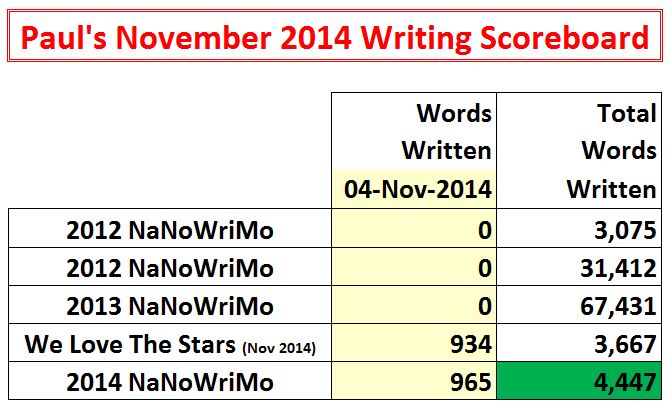
On the other hand, that means that I’m slowing down a lot to be looking up stuff. For example, from last night and tonight, based on our current observations (thanks, Cassini!), which of the Saturn moons are how big, how far out, made of what… I now know many more details about Saturn than I did seventy-two hours ago! But I’m also at about a quarter of the word count that I was at at this point of NaNoWriMo last year.
But I’m building momentum!
CHAPTER TWO (continued)
“We’re not equipped to build a station,” Miller said. “We never have been. You know it as well as I.”
“You’re right, that was never our primary mission, or even our secondary mission. But there were always contingency plans in case of an emergency. For example, if we got stranded here due to some equipment malfunction or didn’t have enough fuel to get back. If we had to be here for a few years while a rescue ship was sent, there were sims that went though some options.”
“The key word there is ‘emergency.’ We don’t have one. We’re still in great shape. We’ll be here for six years instead of three, but not for nine or twelve, or God forbid, even longer. We don’t have to try to stretch our resources to the absolute limit in order to try to build a colony as a last resort.”
“True, but hear me out,” said Alsby. “All of those original plans were made when we were supposed to be here for three years, do our surveys, plant our probes, get our data, and get back to civilization. We were under strict orders to limit our impact on the environment as much as possible.
“Now the rule book has been tossed and there may not be a civilization to return to if we can’t find some badly needed resources and get them to where they’re needed. If that’s not an emergency, I don’t know what is. In addition, the bootstrapping plan, if successful, will give us capabilities that weren’t in the earlier sims and evaluations.”
“Those original plans were the result of years of planning,” Miller said. “Let’s not forget what a hostile and dangerous place we are. We need to be very cautious about straying too far from the plan unless we have few other choices.”
“I’m well aware of how much hot water we can get in and how quickly it can all go bad out here. Help is a long way and a long time away. But let’s not be too anchored to a plan that might not be valid any more. Let’s give a look at the situation from a fresh viewpoint, play a new ‘what if’ game. Given what we have on hand, what we need to do, and what we think we’ll be able to do under the new mission guidelines, what’s our best strategy?”
“Understood, Susan, and I don’t necessarily disagree. But we were on thin ice to begin with. Acting with too much haste can increase the odds of a spectacular failure, which would not only leave us dead or worse, but would also leave those down system without those precious resources.”
“By definition, the stakes have gotten much higher, and our risk assessments will have to be adjusted as well. Just keep it in mind while you’re working through the changes we’re going to have to deal with, Todd. That’s all I’m asking for.”
“Okay, I’ll do that. Where were you thinking of looking to establish this station?”
“That’s another thing that I’ll need your input, and the expertise of your science teams. Looking at the list of things we’re looking for, number one on the list is always water. That’s where our power, propulsion, life support, food, and almost everything else come from.”
“There are a lot of icy moons to pick from. As long as you don’t pick Enceladus.”
“No, but remember, I think now that we have to get our landers down on Enceladus sooner rather than later. I want a chance to find some minerals and things other than water, so that rules out Tethys. I want to have minimal exposure to radiation, as well as being as high up in the gravity well as possible.”
“You want to go to Rhea, correct?”
“That’s what makes sense to me. We can do the Titan flyby, send a probe out to Iapetus, go deep in to flyby Enceladus, then rendezvous with Rhea, going into orbit there for a while.”
“SaSEM,” Miller said, “can that be done with our available delta-V, and what percent of our fuel would it use?”
“Yes, Todd, there are several trajectories that can accomplish that, depending on how deep into the gravity well we wish to go and how much fuel we are willing to use. A trajectory which minimizes our fuel usage would use less than five percent of our in-system maneuvering fuel supply.”
Alsby spoke up. “SaSEM, please pull together a summary on those options. Give them to Todd and to me, but don’t let anyone else in the crew have access just yet.”
“Yes, Captain. If necessary, may I ask for computing help from CeresOps? He has a great deal of experience with orbital mechanic calculations.”
“Can you do that without raising any red flags on Ceres? I would prefer to not have them looking over our shoulder until we’re ready with a solid plan. And won’t the lag be an issue?”
“All of the data requests and calculations will be routine, ma’am, there shouldn’t be any problem with the Ceres system. At this point Ceres is seven-point-six AU from us now, so the lag will be about an hour. We can deal with that.”
“Go ahead then, SaSEM, see what you can come up with and give us as many options as you can. Anything else for SaSEM, Todd?”
“No, I think we’ve bitten off more than enough for today, thanks.”
“Okay, let me know if you think of anything that we’ve overlooked. It’s going to be one hell of a balancing act between moving quickly and making sure we know what we’re doing at every step. I’m going to be counting on you a great deal, Todd.”
“That’s why they pay me the big bucks, Captain.”


 We Love The Stars Too Fondly