
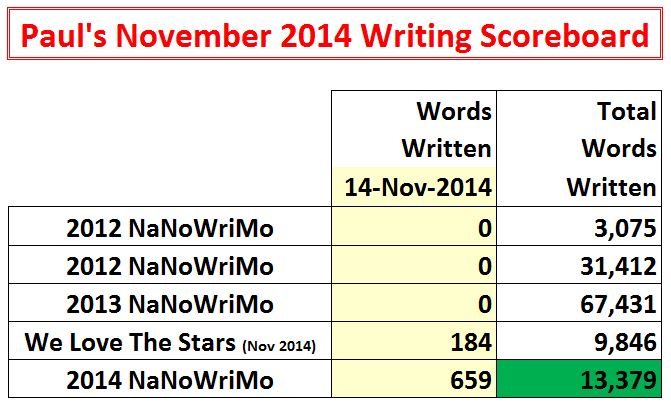
It’s not much, not much at all, but I just couldn’t face putting up another goose egg in the word count today.
While I normally put in a lot of internal links to previous, related posts here, I won’t be doing that for what I hope will be this year’s thirty NaNoWriMo posts. If you have jumped into or stumbled onto this story in mid-adventure, there are plenty of other ways to navigate around the site to find previous installments. Actually doing so is left as an exercise to the student.
CHAPTER SEVEN
Pawley knew that he had to get some sleep, but knowing was not doing. It was everyone’s first reaction to the crisis to put in twenty-two hour days and be moving like a banshee throughout all of them. Yet, while that might make people feel more accomplished and involved in the short run, in the long run it wouldn’t solve a thing if people started making serious mistakes due to sleep deprivation. Out here, with hard vacuum and radiation around nearly every corner, mistakes killed people; bad mistakes killed hundreds of people.
With resources as limited as they were, and a trained and experienced work force being a key resource of which they had massive shortages, those were events that had to be avoided at all costs.
It was amazing how much had been done from the ground, at least in LEO and GEO. The orbital infrastructure which met so many needs of those down on Earth was in many ways just an extension of the industrial machine below. Now that the wheels had fallen off that machine and the orbital assets were trying to survive on their own, that major fault in the system was obvious.
Pawley was meeting constantly with the leaders of the larger stations and representatives of the smaller ones. His message from the top down was very clear. As a group, everyone on orbit and off planet needed to pull off a herculean task. But if it was a war against the universe, a race against time, then the race was a marathon, not a sprint.
Several leaders of other stations had urged Draconian restrictions immediately on anything deemed unnecessary for survival. Pawley and the rest of the Council had made sure that didn’t happen. There would be restrictions, but they would be balanced against the need for people to have a reason to live instead of just a command to live.
The biggest immediate point of contention had been the video and information systems. All of the hard-liners had recommended that it be shut down completely. Their reasoning was two-fold.
First, workers getting home after an eighteen or twenty hour day didn’t need to watch some fluffy piece of entertainment. It was felt if anyone had time to spend on simply being entertained, something better could be found for them to utilize that time.
Secondly, with subsistence level conditions for the foreseeable future, it was thought that most people just needed to focus on what they had to be doing and not “wasting” their time getting news and updates from all over the system. There was a movement in the leadership to make all information available only on a need to know basis.
Pawley, Gonzalez, and Squires, who were being called the “Unholy Trio” behind their backs, got together with their respective station AIs and went through the predicted consequences of that policy. It didn’t sit well with any of them and they were relieved to find that the projections from the AIs gave weight to those gut feelings.
Realizing that they would only get one chance to get it right, policies were put into place to make information available to everyone about issues at both a local, in-station level and a global, system-wide level. Nothing would be hidden or swept under the rug. If the system was going to collapse and kill everyone, at least everyone would have the option of knowing as much about what was happening as they chose.
The reality was that someone working double shifts with no days off, whether they were processing regolith at a station on the moon, tending crops at an aerofarm on O’Neill, working basic maintenance at Goddard, or piloting a cargo shuttle between LEO and GEO, no one had much time to do much more than glance at the headlines. But it was enormously comforting to most to know the information was there if they needed more and that nothing was being withheld.


 We Love The Stars Too Fondly