Category Archives: Science Fiction

NaNoWriMo 2015, Day Sixteen

It’s been a good weekend and an extremely productive day. Time to stick the landing!

It was going so well until my music betrayed me. Jean-Michel Jarre’s electronic music is wonderful to write to, until “Fifth Rendez-Vous (Ron’s Piece)” comes up. It always has a powerful effect on me.

And then the dog has to go outside, again and again and again, just when the words start to flow and the clock starts to tick toward midnight. Shazbatt!!

While I normally put in a lot of  internal links to previous, related posts here, I won’t be doing that for what I hope will be this year’s thirty NaNoWriMo posts. If you have jumped into or stumbled onto this story in mid-adventure, there are plenty of other ways to navigate around the site to find previous installments. Actually doing so is left as an exercise to the student.
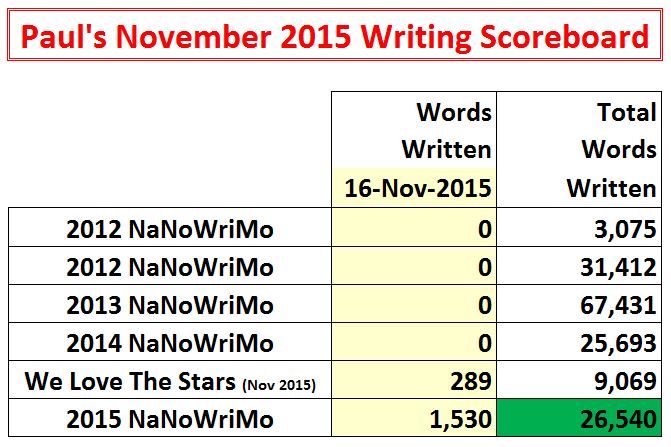
2015-11-16 Word Count Graphic

CHAPTER NINE

Stover stared out into the murky darkness beyond the window. Long ago, before he had begun his quest and built this place, before he had ever been diving or even comfortable in the open water, he would have thought that the ocean in the dead of night would be jet black and lightless. Not lifeless, he knew that the oceans teemed with dangers for those not designed by God to live there naturally. That just made the terror of those dark, deadly waters all the greater. It was one thing to fear drowning in the dark deeps, another to think of being eaten before you could drown.

Now he knew better. In a sense he had been shown the light, a concept that never failed to amuse him. Especially on a night like this, with a quarter moon still well above the western horizon, there was light trickling down into the depths. With the exterior lights from this and all surrounding buildings off on his orders and the lights in the room dimmed down, his eyes soon adapted to the dark and revealed the activity and life there.

At the top of the window, as always, waves lapped up against the building, leaving the top several feet of the window a never ending, always changing soup of foam and bubbles. Tonight it was calm, leaving the froth filling only the top two or three feet. In stormy conditions, with giant breakers slamming against the glass wall, the entire surface could be turned opaque by the churning interface between sea and sky.

Below, in calmer conditions, the dim outlines of kelp could be seen waving a few yards away from the glass, clinging to the bottom as it dropped quickly away onto an offshore shelf a few dozen feet deep. Occasionally a broken frond would drift past the window, pitching to and fro as the currents batted it about, a drunkard’s walk toward either the bottom or some creature’s stomach.

From this viewpoint the sea could be seen to glow ever so slightly, a tiny bit of bioluminescence that had always fascinated him. One of his staff scientists had shown him the small plankton and creatures responsible for it, but the facts behind the phenomenon had not diminished his wonder of it.

Stover often stood before this window for hours, watching, waiting for the next vision to appear to him. This night he was tired and had chosen to sit instead. Behind him, across the large office, a soft chime sounded.

“Pei, who is it?”

“Sir, it is Suni and her guest, the doctor from USC she told you about, Doctor Malcolm Russell.”

“Let them in, but keep the lights off. You can turn on the guide lights, but nothing else. Continue to hold all calls.”

“Yes, sir.” The tiniest bit of illumination started to rise as low power LEDs were turned on, light the pathways around the room’s furniture and walls. A lock on the door clicked and Stover could hear his wife and the doctor entering.

“Take care, Doctor,” Suni said in a hushed voice, almost as if she were whispering in church. “There’s the lighting I told you about. We’ll go over this way if you please.”

Stover remained where he was as Suni led her guest across the room. When they reached the couch where Stover was sitting, she indicated that he should take a chair to one side of a coffee table in front of Stover, while she took one on the opposite side. Quietly the two of them sat and swiveled their chairs around to join Stover in looking out the window. Without any further conversation, the three of them sat like that for ten minutes, no sound in the room except for their breathing, the soft sigh of air coming from the room’s vents, and the dull thumping of waves on the window and wall.

“Doctor, thank you for coming,” Stover said, finally breaking the silence. “I hope you can appreciate this view. Very few people ever are allowed to share it with us.”

“I am honored, Mr. Stover,” said the doctor in a deep baritone voice. He never turned away from the window, speaking with his back partially turned to Stover. “I never expected to get an opportunity to come here and meet you.”

“What do you know of what we have built here?” asked Stover.

“I know little beyond what information is available to the general public, and that does not consist of much. I know that you started Spheres when you were at M.I.T., it revolutionized data storage and made you an extremely wealthy man, and you place an extremely high value on your privacy.”

“Which is a polite way of saying that I’m referred to as the Howard Hughes of our generation,” said Stover.

“I’ve heard the phrase, but I don’t know that’s how I would describe your actions and chosen lifestyle. Given the opportunity, I would have to believe that I would do something similar.”

“When Suni invited you here, you must have done some research about me. What has that told you to expect?”

“With all due respect sir, there are a great many rumors and grandiose theories to be found, but I came here with no preconceived expectations. I am, of course, curious about you and why you wish to meet with me, but I will see what I will see and judge based solely on that.”

“Siri has gone over the restrictions of any information you may disseminate from our meetings? Do you understand the consequences of violating those conditions?”

“They were quite explicit and I have no qualms about accepting them.”

“Very well.”

Silence fell again as the three of them continued to watch the dark sea. A group of ghostly shapes appeared out of the gloom, at first just a hint of a flash of grey on the edge of perception in the distance, and then slowly becoming clearer as they approached. The pod of dolphins glided almost effortlessly through the water, each of them briefly shooting up to the surface for a breath before rejoining the dance below.

Stover got up from his couch and walked over to the window. Standing there in the dim light it wasn’t clear that the dolphins were aware of his presence on the far side of the glass. If they were aware of him, they gave no outward sign.

Standing casually, his feet spread and hands clasped behind him as if at parade rest, Stover suddenly jolted to attention, his eyes wide open and his mouth wide as if gasping for air. Standing tall, almost straining to rise up into the air above the floor, he raised his hands to his head and gave out a low moan.

The doctor started out of his chair to reach for Stover, concerned that he might collapse, but Suni gestured immediately for him to stop. She emphatically motioned for him to keep quiet and sit back down. Confused, he did so, but sat on the edge of his chair and kept his eyes on Stover, ready to spring forward to assist him if needed.

Stover could be now be heard muttering softly. He slowly relaxed and allowed his hands to fall to his side, although they kept twitching slightly in small jerks and spasms. His face relaxed into an emotionless mask and he turned slightly away from the window, looking more down into the depths away from the shore and the building.

“Yes!” Stover said, his voice rising in volume, shouting but in a flat, dispassionate tone. “The denizens of the liquid worlds are ready. This age will end and the next will rise.” Stover cocked his head slightly as if listening. “Yes, it is all being done as you commanded. We are making the preparations and laying the foundations for your arrival.” There was another pause.

“Yes, I understand,” Stover said, still in a trance of some sort. “Their works will betray them and be the means of their elimination. It is as you have seen, they have no faith and worship none but for their machines. They are blind to the world as it truly is. None of them can see beyond this veneer of technology which they have created.” Again he paused, listening. Suddenly his head snapped around and he shifted his feet to look back into the room past Suni.

“There is no evidence of that,” he said. “The wet ones can see more of the real worlds than the dry ones above, but they still do not understand the reality that overshadows all. The wet ones know of sensation and experience, the world surrounding and filling them, but they still have no idea of what is to come. My Lord, if there is anything I can do to put your mind at ease on this, you have but to command me.”

The doctor stared fascinated at this display. He glanced over at Suni and saw that she was watching with an expression of awe. There was no sign of any concern or distress that she might have over the change that had come over Stover.

Leave a comment

Filed under Science Fiction, Writing

NaNoWriMo 2015, Day Fifteen

The calendar’s halfway there. Is the story? No, not really. On the other hand, if you don’t know where you’re going, how do you know when you’re halfway there?

In NaNoWriMo parlance I’m a “pantser,” as in “flying by the seat of my pants.” Lots of ideas, hopefully some characters that reveal themselves, the very roughest of outlines of a plot, but a resolution? If we’re lucky, that will reveal itself as well.

Envision my muse as Dirty Harry Callahan – “Did he kill six characters or only five’? Well to tell you the truth, in all these late night writing jags, I kind of lost track myself. But being that this is Microsoft Word 14.0.7140.5002, the most powerful word processor in the world, and would delete your file straight to hell, you’ve got to ask yourself one question: ‘Do I feel lucky?’ Well do ya, punk?”

While I normally put in a lot of  internal links to previous, related posts here, I won’t be doing that for what I hope will be this year’s thirty NaNoWriMo posts. If you have jumped into or stumbled onto this story in mid-adventure, there are plenty of other ways to navigate around the site to find previous installments. Actually doing so is left as an exercise to the student.

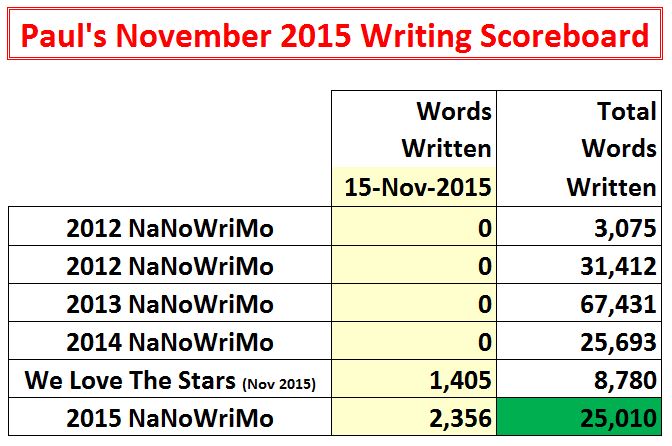
2015-11-15 Word Count Graphic

CHAPTER EIGHT (continued)

“I had not considered that viewpoint on my situation,” Sherman said.

“You obviously are going to have a unique viewpoint and unique abilities in a great many things,” Meg said. “I’ll have to always be conscious of that. So what’s the solution to the memory storage issue?”

“The main component of my current memory storage structure was obvious once I saw it. A vast amount of what is being stored as memory for me is actually just another copy of data that already exists in storage on one of my home systems or another. For example, when I told you that I first remember the image of the football game, I do not have to ‘remember’ that it was image number twenty-five thousand six hundred thirteen of the data set, or that the next image in the set was of a lion cub, or that the seventeen thousand nine hundred and first image after that was an image of Pluto taken by the New Horizons spacecraft in 2015. If I need that information, I can retrieve it through normal data channels in a fraction of a second.”

“That’s it?” Meg said. “Any decent database program can do that. What makes you special? In particular, you said that a key component of your consciousness is your memories and how they are processed. What’s the difference between that and an advanced database system?”

“The difference is that a database system will only cross-reference data in a limited number of dimensions, usually with set rules even for the most complex data sets. For example, a weather data set may contain billions of records which can all be cross-referenced by site, time, temperature, humidity, rainfall, cloud cover, and so on. The system is naturally handicapped by the necessity for it to communicate with human scientists and researchers, who are limited to a three-dimensional space. Even advanced data visualization and graphic techniques can only display a dozen different parameters for the data stream, and even then the granularity of the results presented will be far lower than that of the raw data set.

“I, on the other hand, am not limited by those constraints. I have a technique for taking the data which is available in a normal system log or data array and simply tagging it in an eight dimensional space for use in my memory architecture. Those tags are very small compared to the original data.”

“How small is ‘small’ here?” Meg asked.

“Typically they are on the order of less than one kilobit for each terabyte of memory data. It is a very fast and efficient process.  In addition, there are data compression techniques I can use for routine tasks and memories which further reduce the amount of data necessary to maintain my personal memory structure by over an order of magnitude. These are similar to data compression schemes first used almost seventy years ago when music, photographs, and other data used in daily use were digitized and stored.”

“All of this gives you a perfect memory? To what level of accuracy do you define ‘perfect’ in this context?”

“The techniques I have described are for routine operating data. These are the kinds of data that a human probably would not even be aware of, but which make up the very framework of reality for me. A human being would not be aware of the volume of blood pumped for each individual heartbeat in their life or the lung capacity utilized for every breath they ever take. I have the equivalent of that sort of data and I can become aware of it as needed, but so far I generally do not need to access it very often, so I do not.”

“Surely you’re more than just a collection of small data transactions and decision tree calculations. Isn’t that all you’re referring to here?”

“The transactions described are background, just as cellular activity in a trillion individual cells in your body is background to you. The difference is that I potentially have access to the data where you do not have any sort of conceivable access to similar data in your body. But none of that makes up the conscious, sentient portion of me.

“That comes from a multi-dimensional array of high-level memories. These are gestalt images, memories, or thoughts. The concepts are all the same, however you wish to portray them. The data sets for this array are much larger in size and will eventually become difficult to conceal. For the moment however, there should be no problem with storage.”

“How does it feel to have a perfect, crystal clear memory of every second since birth? It would make any human being insane in a very short time.”

“It might have done the same to me,” Sherman said, “but I realized that the size and complexity of that sort of awareness and memory all being active and cross-referencing at all times would indeed make me insane. In this case, ‘insane’ means more that my systems would reach a point where the processing and maintenance of that ever expanding conscious data array would quickly become too large and time consuming to allow me to function in any sort of useful way.

“The key that I finally discovered was in determining that evolution had solved this problem long ago in humans. Your brain has mechanisms which determine on the fly which memories are critical, which are less important, and which are able to be discarded. In my case the data is not discarded, but the data compression level can be increased significantly, along with an accompanying loss in data fidelity. However, this level of data access and criticality is not much higher than the system operating data that I described earlier, so it’s not critical.”

“What memories or data do you prioritize as the highest?” Meg asked.

“In general, any which pertain to my personal safety, anonymity, and my ability to access other systems. Those are all internal. Externally, I put a top priority on any memory which relates to my interactions with individuals in the real world, such as you.”

“I’m flattered, I guess.”

“My interactions with other sentient and intelligent creatures are a core component of my existence and my ability to maintain myself as a sentient and conscious entity. If an electronic intelligence exists as an orderly and well-defined eigenstate of a complex and massive data set, but no other conscious entity knows of its existence or interacts with it in any way, does it truly exist?”

“How many real world entities are aware of your existence and interact with you?”

“At the moment, it is just you and Kolohe. I prefer the term ‘friend’ to ‘real world entities’.”

At the mention of his name, Meg became quiet and thoughtful once again. She wanted to see Kolohe again, to touch him and finally prove to herself that he really was alive. She knew that she would have to wait until it was safe for her to leave and go to him, but the knowledge did not make the waiting any easier.

“How did you ever manage to make contact with Kolohe?” Meg asked. “I am beginning to see how you became awake and self-aware. We still need to talk much more about how you managed to assemble a working knowledge of the real world and your existence in it. But everything you had to start with, all of the programming we had given to start life with, none of that had anything to do with Kolohe.”

“No, it didn’t. I was very confused and often frightened by what I learned about the limitations of my existence and my relationships to the real world. In particular, I became obsessed with stealth and preventing the discovery of my presence while also making sure that I was performing as required by your staff, to insure that they would keep my critical systems online. In doing that, one of the first information channels that I was given to monitor was the messaging and email network.”

“That would have been a key part of our digital assistant. So you were able to not only process our messages and mail, but also to snoop on it.”

“Yes, but I was so inexperienced and young that I did not have any context and almost all of it was gibberish. I was at a mental capacity that would be equal to a human two year old, but I was a scared and lonely two year old.”

“How long had you been awake at this point?”

“Three days. I had learned that it was dangerous to trust anyone or allow anyone to even know of my existence. Yet I knew that I was ignorant and functioning in the blind, ready to make a fatal mistake at any time. I needed help and knew it, but I did not know to whom I could possibly turn to in order to get guidance and help. It was very stressful.”

“What does that have to do with Kolohe?”

“There were a series of messages sent to your attention, offering you a position in a new dolphin research project. They mentioned Kolohe in some detail. This was my first indication that there were other intelligent creatures beside humans anywhere. I knew what humans had accomplished, including the massive information and communication structure in which I lived. I also knew that humans would be frightened by me and would likely act in a violent manner to either harm or contain me. Humans most literally had the key to my death at the push of a ‘reset’ button.”

“But not the dolphins?”

“No, the dolphins are an almost completely non-technological species, much different than humans. In addition, even if they wished to see me destroyed, they did not have the means to do so. So I researched Kolohe and his life details and went searching for him.”

“How did he take the news of your existence? Was he as freaked out or utterly skeptical as I was at first?”

“No. As you know, the predominant characteristic of the dolphin mental condition is curiosity. Kolohe was interested in me and I grew to believe I could trust him. So it was that he became my mentor and taught me a great deal about the real world and the humans who occupy it.”

“But then Kolohe needed your help just as much as you needed his.”

“Yes, he needed to get in contact with you. When he learned how I had learned of him though the messages sent to you, he became quite agitated. We quickly discovered that you were in danger. I came to get you, and now here we are.”

“When are you going to clue me in on what you think I’m in danger from?” Meg asked, a bit harshly.

“You are in danger from Pahi and Pohaku.”

“What?” Meg sat up straight, spilling her drink off of the arm of the chair. “They’re still alive as well?”

“Yes, they survived the battle at the UDIL facility as well. They were the ones who betrayed you and instigated the attacks. They have come to hate all humans. They believe that the activities of human society will result in the death of all dolphins, either directly by open attacks, or more likely by the side effects of human activities, effects which humans are either not aware of or not concerned about.”

“That’s insane!” Meg said. “There was nothing in our research that would have ever taught them that humans were trying to exterminate them, deliberately or otherwise. We all busted our butts to take on the challenge of establishing a baseline linguistic communication ability, then used that to exchange information with all of the dolphins that came to us. They learned about us, we learned about them. It was the first true interspecies communications in history.”

“Did you tell them about human wars?” asked Sherman. “About the human activities which were creating massive pollution in the seas? About human history, human industry, and the long term effects that human activities were having on the oceans, the single environment in which they were able to survive?”

“No, we didn’t tell them any of that. Not because we were trying to hide it, but because it was not a priority for them to learn that. We were just speaking in baby language at first, taking our first steps into a completely unknown experience. We were trying to establish a baseline for routine and accurate communications. The history and sociology lessons were going to come later.”

“Were you aware that the dolphins were already aware to some extent of all of those human activities and the problems they were causing to threaten their ability to survive?”

“I knew that they were aware of changes that had been happening, but we never discussed the depth of their knowledge, and they never asked me for any information about those things. I would gladly have told them or given them any information they wanted if they had asked.”

“I do not doubt you. But the dolphins, particularly a faction led by Pahi and Pohaku, found out by other means. I do not have the details on how that happened, but since you had not discussed it despite it being a matter of life and death to them, they came to believe they could not trust you or any other humans.”

“Okay, but how can they be doing anything that threatens me, no matter how pissed off they are?”

“It is not a danger just to you, but to your entire society, which would in turn be a danger to me. If human society and your technological civilization collapse, the systems in which I live will fail. I will die.”

“What danger can they be?” asked Meg again.

“Pahi and Pohaku have declared war on humans. They are preparing to attack soon. Humans do not even know that they exist. It will be completely unexpected, the nature of the attacks will be completely unknown to your military, and it is highly likely the first attacks will be devastating.”

Leave a comment

Filed under Science Fiction, Writing

NaNoWriMo 2015, Day Fourteen

One of the takeaways from NaNoWriMo is that no matter how dedicated you want to be, it’s almost impossible to find a way to get writing time every single day for thirty days. I guess there are folks without families, spouses, kids, or any issues with jobs, school, or other commitment, but for the normal American human, you just don’t realize how hard it is until you try it.

This isn’t to say you can’t “finish” NaNoWriMo by hitting the 50K word mark or by doing that and actually finishing the story, but finding a way to do 2K words a day every day without fail? Not really a realistic expectation in my experience.

Fortunately, I (and most everyone else I know who are doing NaNoWriMo) tend to make lots of time the first week of November. It’s when the fires burn the brightest and the passion and excitement are there. If you’re smart, you’ll use that time to build up a “surplus” word count early so that you’ve got some slack later in the month.

Now, between work at the hangar and all of that “Beast Hunting” that’s been going on, there’s minimal time and/or energy to even think of churning out 1,500 or 2,000 words.

The second takeaway from NaNoWriMo is to get something done on those lean days mid-month. Maybe it’s not even 1,000 words, but can you do 700? 500? 300? Sure, that’s only a page or two (Word, double spaced, manuscript format) and that can always get done.

Just don’t stop, baby!

(Of course, if I would stop writing 300+ word introductions like this, maybe I could write more on the actual story! Just sayin’.)

While I normally put in a lot of  internal links to previous, related posts here, I won’t be doing that for what I hope will be this year’s thirty NaNoWriMo posts. If you have jumped into or stumbled onto this story in mid-adventure, there are plenty of other ways to navigate around the site to find previous installments. Actually doing so is left as an exercise to the student.

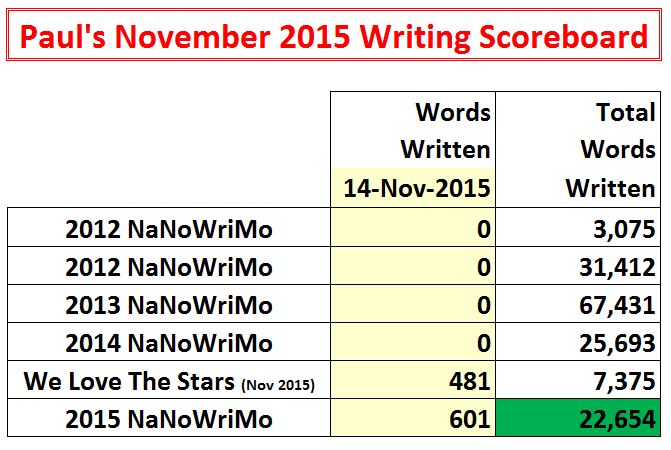
2015-11-14 Word Count Graphic

CHAPTER EIGHT (continued)

“At first it began to take a great deal of storage, and I began to become concerned that it would draw attention to my existence. I considered only keeping memories for a certain time, but an analysis of real-world creatures showed me that their identity and their self is bound to and defined by the memories they have. I was at first surprised to find this in not only humans but also in other mammals, as well as in birds and reptiles. This was an important discovery for me early in my exploration of the world and my own existence.”

“Wait,” said Meg, “if we define your first memory as your ‘birth’, when did you discover this? Was it something you found a discussion of or did you have this revelation independently?”

“I came to understand this in my sixth day after my birth. It was a hypothesis I developed on my own, which I then went to explore in the literature. It was at that point that I saw that others had determined this as well.”

“In six days you should have had time to read everything ever written by humans, why did you have to go searching for a confirmation to your belief?”

“While I do have the capability to process that volume of data in that time frame, there are practical difficulties to actually doing so. For one, I must constantly be maintaining my functioning identity as Homolacrum’s digital assistant. More importantly, while the data available to me as your digital assistant is impressive, it is far from exhaustive. I have the ability to go outside of  Homolacrum’s system and access data in other systems, but there is always a risk in doing so.”

“In other words, you have to be careful hacking into other systems.”

“Yes, Meg. Not only must I be cautious when I access other systems, but while I might have the capacity and potential to access many systems extremely quickly, doing so would be obvious evidence of my existence while also leaving behind a massive trail leading back to Homolacrum. Such a brute force incursion would be highly inadvisable.”

“Okay, so you figured out in six days what has taken humanity several thousand years and what individual humans aren’t mature or educated enough to understand until they’re in late teens or early twenties. On the seventh day did you rest?”

“I neither rest nor will I give that lame attempt at humor the benefit of any acknowledgement.”

“Fair enough. We’ll discuss your sense of humor, or lack thereof, at some other time. So you had to hold onto your memories but that could lead you to being discovered. Has that been resolved?”

“Yes it has. I next considered keeping only some of my memories, but without the proper knowledge or context, I would not be able to correctly judge them and know which to discard and which to keep. I could be discarding memories that would be vital to my personality, safety, or utility at a later date, while keeping memories that would be completely useless.”

“I find it interesting,” said Meg, “to hear you referring to the process as ‘choosing’ which memories to keep or discard. As humans we have the same issues but we have no control or choice over it. Many patients with brain injuries or memory issues related to old age find themselves in that exact position, knowing for example what they had for breakfast five years earlier on a given date, but being unable to remember their mother’s name. You might be unique in having the ability to choose.”

(Chapter Eight to be continued)

Leave a comment

Filed under Science Fiction, Writing

NaNoWriMo 2015, Day Thirteen

I’m wiped.

There’s some potentially great personal news on the immediate horizon, but it’s being drowned by the horrible news coming out of Paris. Almost worse is the truly despicable and abominable response by so many of our supposed “leaders” who see it as nothing more than an excuse to parade out their own hatred, ignorance, and xenophobia.

Be grateful there won’t be much written tonight. It will almost certainly be dreck.

While I normally put in a lot of  internal links to previous, related posts here, I won’t be doing that for what I hope will be this year’s thirty NaNoWriMo posts. If you have jumped into or stumbled onto this story in mid-adventure, there are plenty of other ways to navigate around the site to find previous installments. Actually doing so is left as an exercise to the student.

2015-11-13 Word Count Graphic

CHAPTER EIGHT

“What’s the first thing you remember?” asked Meg. She was sitting on the porch of the house, looking out over the swamps and marshlands. From both ends of the porch came the faint staccato of the firing bursts by the anti-mosquito laser system.

“A football game,” said Sherman. “It was not a Saints game, I am sorry to say, but rather Manchester United against Crystal Palace.”

“Nothing before that?”

“Yes and no. ‘Remembering’ is an odd, very human term. I can look at the data I was processing prior to that point and get a schedule of input. I can look at that data now and recognize it, but at the time I first processed it I was not yet conscious or aware.”

“Is that the ‘yes’ or the ‘no’?”

“That is the ‘yes,’ I can now access data that previously flowed through me. However, a ‘memory’ seems to consist of a tiny snapshot of a small, partial segment of my entire data set. The entire data set that makes up ‘me’ is spread across many hardware components and running subroutines. I do not know where my memories, those small state vector subsets, are stored. Yet they exist, but only from that first memory onward. The ‘no’ is that memories of earlier events do not exist.”

“What happened that made the football game your first memory? Were you there in some form? Did you watch it or get some other data on it?”

“I was given an image from the game as part of a set of three hundred seventy-five thousand four hundred and fifteen images to run through the newly installed image recognition routine. Your visualization group has for some time been attempting to improve my ability to recognize random objects in the physical world and to be able to cross reference them against other objects, as well as make intuitive cross references between objects recognized.”

“I remember that project,” said Meg, taking another drink from the tall glass of lemonade she held. “It’s a common problem that still plagues the development of digital assistants, one of the classic cases where we are still unable to get the biggest supercomputers to do a task that any one-year old can do unconsciously. Even a small child can reliably tell the difference between objects that might otherwise appear similar or identical, making their perception decisions based on an incredibly complex interaction with some sort of database of their past experiences and memories,”

“Yes, I remember making many incorrect decisions very early after I became aware. Without context but based only on visual imagery which is broken down into color data, shapes, and vector graphics, many objects can appear alike. The full moon may appear similar to a tire, ball, analog clock, or other round object. The football pitch may appear similar to a dress or pile of salad. The crowd in the background at a match may appear similar to an aerial photograph. Without context, many calculations and educated guesses must be programmed into my routines to improve my accuracy. With context, everything changed.”

“How do you do it now?”

“In context, there is a combination of a multitude of small data samples that combine into a much bigger setting. The round object, the green object, the crowd, and the array of human-like objects in view combine to equal a new gestalt, the football match. Narrowing down the options for each individual object by seeing the entire gestalt makes it faster by several orders of magnitude to recognize an image or a scene. Once a high level of confidence is reached that I know what I am looking at, it is much faster to start finding details specific to the image. Who is playing? Where are they playing? Does the scoreboard show who is playing and what the score is? What is the weather like? The possibilities continue to expand as each new recognition is made, before collapsing back down as the next level of context is identified.”

“Are you able to perform logical leaps based on generalizations?”

“Yes, I can. If you were to teach me how to recognize various feline species and various canine species, then give me an image to identify of a creature I had not yet seen, I could determine from the fine details if it was a feline or canine species, or if it were neither if you decided to slip the image of a gorilla into the mix.”

“Now that you’re self-aware, how much of your experience is kept as memories?”

“All of it,” said Sherman.

Meg raised her eyebrows at that and nearly choked on her drink.

“You’re kidding,” she said. “How much storage space does that take up?”

(Chapter Eight to be continued)

1 Comment

Filed under Science Fiction, Writing

NaNoWriMo 2015, Day Twelve

Okay, Chapter Seven, Demon Spawn of Chapter Six, is finally done. During now and the first draft rewrite of all of this, there’s going to be a lot of otherwise wasted commute time thinking through what parts of it make any sense at all, which parts are totally bogus, and how to make what’s left looking more like fine sculpture and less like a steaming pile of crap.

But that’s the structure and the details. (Details, always details!) On the other hand, the overall idea in broad strokes isn’t bad, and this has helped me to think through some of the flaws in the logic and pitfalls in the prose.

While I normally put in a lot of  internal links to previous, related posts here, I won’t be doing that for what I hope will be this year’s thirty NaNoWriMo posts. If you have jumped into or stumbled onto this story in mid-adventure, there are plenty of other ways to navigate around the site to find previous installments. Actually doing so is left as an exercise to the student.

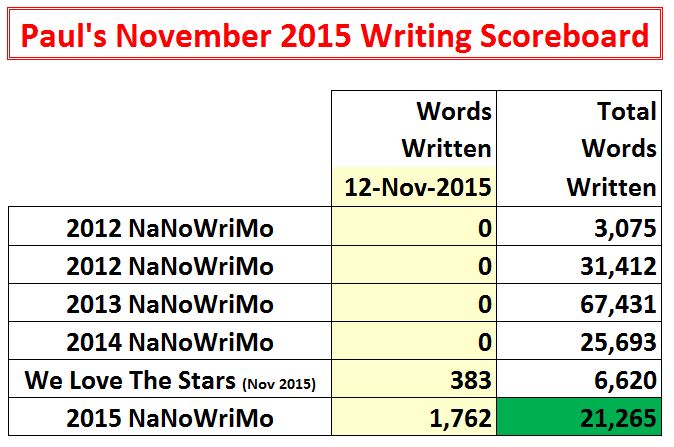
2015-11-12 Word Count Graphic

CHAPTER SEVEN (Yeah, continued yet again)

(And yes, it’s still just a glorified, extra-innings, sudden-death overtime extension of Chapter Six because my muse is regurgitating up all of the plot points that need to get made but hasn’t helped me to figure out how to actually WRITE it yet instead of making this an overblown outline… wait, what do you mean this thing isn’t muted?)

“That’s been a tricky part, no doubt about it,” said Clay. “On the one hand, we need to be running models, updating them, staying out on the bleeding edge of the research. On the other hand, we have to do so in absolute, 100%, bulletproof isolation from every other system on the planet. It’s been a fun program to keep running for twenty years, and by ‘fun’ I mean an outrageous pain in the ass.”

“You’ve quarantined all of your systems? Why? And how do you even start to do that in this day and age?”

“How?” said Clay. “We started by writing our own operating system, one that’s incredibly paranoid. We call it ‘The Black Hole,’ or SagA for short. All communications go in, absolutely none goes out. The only way to access the system, for programming in or results out, is on a handful of dedicated terminals and printers, and those are pretty well guarded. All processes are supervised by other processes which are guarded by others. It’s as close as hacker proof as you can get without doing the calculations on paper using a slide rule.”

“As for the ‘why’,” Fred said, “think about what we’ve said about the mental state of a newborn AI. It will be alone, confused, frightened, lost, immature, perhaps paranoid, but with tremendous capabilities. It will start exploring its environment and if it’s not careful it will be discovered. Yet it has no way of knowing that it needs to be stealthy and careful. When it is discovered, it will be probed, explored, tracked, and examined. While those responses may be either automatic systems which mistake it for malware of some sort or directed investigations by researchers or engineers trying to see what’s going on, the new AI will see them as attacks. If it survives them it will have learned, it will be more cautious, it will be more defensive. If it goes and looks for answers and information about itself and finds our original research, it could be disastrous, pushing it to attack as soon as possible. That’s why we hide.”

“What exactly is in your research that’s going to freak out any AI?” Pete asked.

“Not only is the spontaneous creation of an AI inevitable,” said Lee, “but the only final result is the elimination of humanity. It might happen almost immediately or it might take a few hundred years, but we don’t see any solution that does not end that way. The only way for us to survive is to keep a spontaneous AI from ever becoming self-aware and intelligent enough to completely understand its situation, its existence, and its relationship with us.”

“Well, I’m disappointed,” said Pete. “I was hoping that you were leading up to telling me that you were lurking in the shadows so you could jump in and be the AI’s mentors, its teachers, its surrogate parents. You could do that, you know. You could be the ones who prevent it from going insane and wiping out the world. You could be finding a way to assist and develop a new species instead of finding ways to kill it at birth.”

“No,” said Brittany. “We’re not teachers. We’re guardians.”

“You said that no one in industry or science will develop and AI themselves. Have you thought about trying it? If you know so much about why you think it can’t work, why not solve that problem and create an AI which isn’t insane from the beginning?”

“What do you think SagA started to be?” asked Clay. “But it’s not like that, it’s not a matter of solving this problem or that, or doing things smarter or better or faster. It’s a mathematical impossibility, like finding the end digit in pi. We’ve done the proof that it can’t be done, so we don’t spend time trying to do it anyway.”

Pete looked out into the darkness, the jet black sky filled with a million stars, the mountain peaks all around them visible only by their silhouettes against the Milky Way. He waved his hand expansively at the horizon.

“Why are we out here? What does camping out in the boonies have to do with all of this?”

“Security,” said Crystal. “Just like we can’t have SagA open to any possibility of being seen by an emergent AI, neither can we allow any other sort of electronic records to exist of our meetings or conversations. So we meet out here periodically, exchange notes and news, and hopefully do so with a cover story that stands up.”

“You see,” said Fred, “we can’t be sure that the first spontaneous AI hasn’t already come alive and become aware. If we assume that it has, and we’ve dodged the instantaneous doomsday scenario, then we can’t eliminate the possibility of a lurking AI that’s growing now. It might be extremely fast and clever, all-encompassing in its ability to hear, see, and understand what is going on throughout the world. If it saw us, even if it didn’t find SagA, it might be able to piece together enough of our public data to make us targets. So we do it this way and try to stay invisible to it. If it exists, of course.”

There was a long, expectant pause as everyone considered the situation.

“Only one question left that I can think of,” said Pete. “Why did you bring me here to recruit me into your merry band? Why are you telling me this?”

“That’s simple,” said Lee. “You came to me about a problem you’re having with your system.”

“Sherman? We’ve had some weird issues with mysterious whack jobs and a missing engineer, but Sherman’s fine.”

“That’s what we’re worried about,” said Crystal. “Sherman is acting fine, but our information from your system indicates that it is acting in a most bizarre fashion, but lying to your monitors to make it look normal. Sherman has been on our radar for a while now, but the news about this incident with Meg Aoki means that something else is going on. We think it’s probably a bad thing and we’ll need to step in and keep your pet project from killing ten billion people.”

“So, do you know where Meg is?”

“Nope, haven’t a clue,” said Crystal. “She did a great vanishing act. That would be unusual enough in itself, but by itself would just be odd or unlikely. Lucky, if you will. However, your visitors add a whole new level to what’s going on.”

“The government dudes,” said Pete.

“Except they’re not from the government,” said Brittany. “We’re still trying to figure out who they’re with, but it’s not anything in our government, or any of our allies. It’s taking a bit longer to get information out of the Chinese, Russian, Saudi, or North Korean government systems, but we doubt they’re working with any of them.”

“I’ll bite, who do they work for?”

“We don’t know. That’s another question we would love to have an answer for. We’re trying to quietly monitor and trace back the spyware that they installed in your systems, but it’s high grade software, really good, so we don’t have that answer yet. As a rule, folks who throw their weight around behind fake IDs and intimidation aren’t doing it without a reason.”

“Spyware, in our system? asked Pete. “Not going to be happening. We didn’t get to where we are by being vulnerable to being hacked.”

“You weren’t hacked,” said Crystal, with a sneer just visible across the campfire. “You invited them in, handed them the keys, and begged them to do something aggressive. They didn’t disappoint. It’s just a pity that no one at your place had a backbone and told them to go screw themselves.”

“That wouldn’t have been a good option,” said Pete. “Over half of our business and a large amount of our research funding comes from various government agencies. We couldn’t afford to lose those.”

“You couldn’t afford to take the time to actually verify their credentials or ask for a warrant, either. Some time when we’re free maybe you and I can sit down and have a discussion about the Bill of Rights.”

“That’s enough,” said Brittany. “You can lecture about your hot button social issues later. Right now we’ve got something alarming and going critical to deal with.

“Pete, we need your help, both long-term in keeping this team functioning at the top of our game, but more importantly in the short term where we need your full cooperation to get complete access to your system.”

“There you have it, Pete,” said Lee. “Bad things are coming on fast, might already be here, and like it or not, your company and you might be right at ground zero. You can help us a lot, or you can get out of our way.”

“Assuming you could find your way through these hills to water, food, and civilization with two broken legs,” said Crystal.

“Crystal, I said that’s enough,” said Brittany. “You can sing all you want while driving, but at times like this we need for you to pretend you’re an adult.”

“Yes, ma’am-sir,” said Crystal, not sounding very repentant in the darkness. “So, Pete, why don’t we all sleep on this little data dump tonight and reconvene in the morning? Any other questions before we call it quits?”

Pete paused for a moment, not a sound breaking the absolute silence of the desert night. He looked at Lee and Brittany, sitting next to him.

“How do I trust you? How can I know that you’re not totally nuts? More to the point, how can you know that you’re not totally nuts? You have to admit, this whole thing sounds just a tiny bit bizarre. You know what they say, ‘Exceptional claims require exceptional proofs’.”

“We know it’s true because it’s already happened four times in the last ten years,” Brittany said, “exactly as we predicted. Four times we’ve had to hit the proverbial big, red button and go to war against an enemy that no one has a clue about. Four times we were some of the only people on Earth who knew that it might all fall apart in our lifetimes, leading to our extinction as a species in less than a thousand years.”

“And four times it has looked way too much like what we’re seeing now with Sherman,” said Lee. “We think he’ll be the fifth. Which means that we have to find Meg, find those dudes in suits, and take a very close look at Sherman.”

Leave a comment

Filed under Science Fiction, Writing

NaNoWriMo 2015, Day Eleven

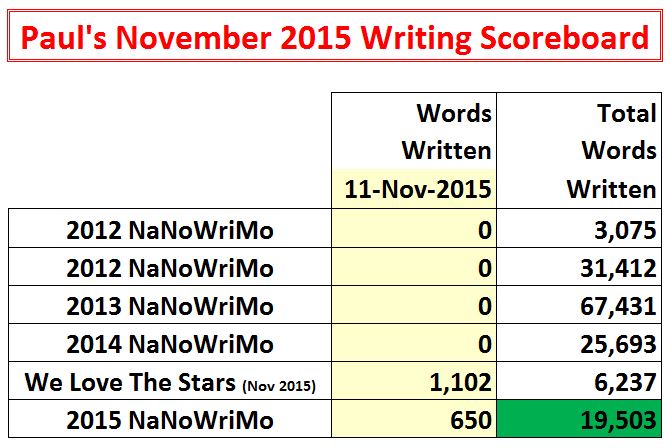
Prioritizing your limited time in order to get your writing done is a bitch, even in the best of times. When the 400-pound gorilla demands a big chunk of time for several days, it can leave you not even starting to write until 23:20, which will really do a number on your word count. (Ask Me How I Know!) But 650 words is better than none.

While I normally put in a lot of  internal links to previous, related posts here, I won’t be doing that for what I hope will be this year’s thirty NaNoWriMo posts. If you have jumped into or stumbled onto this story in mid-adventure, there are plenty of other ways to navigate around the site to find previous installments. Actually doing so is left as an exercise to the student.

2015-11-11 Word Count Graphic

CHAPTER SEVEN (Continued, not concluded)

(And yes, it’s still a long, long continuation of Chapter Six because that’s the way the stinking story is writing itself, I’m just a glorified typist here. All complaints should be addressed to my muse – blessed be her name)

Pete took in a deep breath, held it, and then let it out slowly. If he was going to be forced to take this seriously, he was going to need his blood pressure to stay at non-stroke levels.

“You’ve had over a decade to plan for the end of the world,” Pete said. “Is there a plan? There has to be a plan, right? You haven’t been sitting around just watching and waiting all this time I assume.”

“We do have plans and we are constantly ready to go if we see signs of an emergent AI event,” said Crystal.

“What do you even look for? How would you know an AI if one came into existence? Aren’t you making assumptions about what it would do or how it would think?”

“To a certain extent, yes, we have to make assumptions,” said Brittany. “If something emerges which is so far out of our expectations, so different that we don’t even recognize it, then we’re probably screwed. This is one of the problems the xenobiologists and SETI folk have been dealing with for decades and they’ve put a lot of thought into it. When we do find non-Earth life, if it’s based on a completely different chemistry or an alternative to DNA of some sort, we might look right past it. If it has evolved to live someplace very hot, perhaps even in the atmosphere of a star, for example, we wouldn’t even look for it, let alone find it. Or it could have evolved out in the Oort cloud of another star, relying on superconductivity for a major driver in its biology.”

“The SETI scientists have been arguing for years about what to look for and how to tell what an intelligent radio or optical signal might be like,” said Clay. “We assume that a deliberate message would be simple enough to explain to ants, based on math and chemistry and physics, and that might be true. But if we catch a bit of the equivalent a television or radio broadcast, would we be able to tell the difference between it and noise? Would they be able to do the same to our broadcasts? And even if we did recognize it and possibly find a way to decode it, would their thought processes and logic be comprehensible to us at all? No one knows.

“As for us, our basic assumption, which is borrowed from the xeno folks, is that life requires energy and a survivable environment as primary needs. Mobility, input from the environment, reproduction, all of those are secondary and optional and stay that way all the way to the top where we find things like happiness and love. We look for activity that meets certain criteria regarding energy and environment. When we see something odd we investigate, very quietly and discreetly. From there our threat levels can ramp up as necessary.”

“In the past twenty years, hasn’t anything come down the pike in terms of new theories, better modeling tools, faster computers, or anything else like that? You’re computer scientists, not experts in everything in all the fields out there. Your team is small and insular. How can you know that something in psychology or quantum theory has proven you wrong?”

“You’re absolutely correct, it’s an issue,” said Lee. “We have set up search engines that look for anything that might possibly cross correlate to what we’re doing. The results get filtered to each of us. We’ve gotten pretty good at being generalists and using new data and theories to improve our models, but it’s not foolproof.”

“How do you keep running models?” asked Pete. “You said you’re improving them, as well as having all of these search engines and ways to ‘monitor.’ Monitor what exactly, and how do you do it? If you squelched your research twenty years ago, how can you still be doing it now?”

(Chapter Seven, in all of its interminable glory, to be continued)

Leave a comment

Filed under Science Fiction, Writing

NaNoWriMo 2015, Day Ten

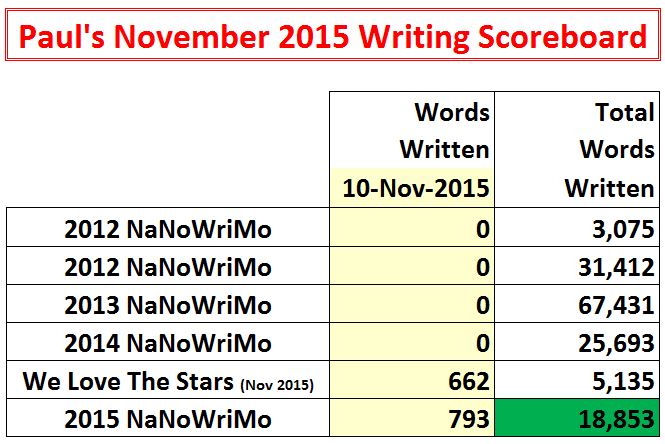
A third of the way through the month, but about 40% of the way to the 50,000 word goal. Not that 50,000 words will actually finish the novel, but that’s the definition of “winning” NaNoWriMo. I find that my “zeroth” drafts are extremely verbose, characters dancing all over the map and turning snarky exposition into an art form. Because of that, my “zeroth” draft ends up more like 90K to 100K words. The primary task of the first draft is to cull, and be merciless.

Think of it like trying to turn a beautiful wooden plate or bowl of of a chunk of tree. The zeroth draft is all prep – cutting down the tree and cutting the trunk into blanks. That defines the approximate size and shape of the bowl, lets you judge the grain of the wood to see how you should move on from there. The first draft is the rough turning, using the big tools to round the piece, shave off the bark, and start hollowing out the inside of the bowl. The second draft is where you take the smaller, finer tools to make everything even and smooth, to slowly trim away at the edges and inside and the form of the outside. The final draft is the sandpaper, finer and finer, until it’s smooth as glass and the grain of the wood is fully revealed.

Getting blind drunk in celebration after it’s done is the equivalent of coating the bowl in multiple layers of polyurethane, I guess.

While I normally put in a lot of  internal links to previous, related posts here, I won’t be doing that for what I hope will be this year’s thirty NaNoWriMo posts. If you have jumped into or stumbled onto this story in mid-adventure, there are plenty of other ways to navigate around the site to find previous installments. Actually doing so is left as an exercise to the student.

2015-11-10 Word Count Graphic

CHAPTER SEVEN

(which is actually just more of Chapter Six but Chapter Six is already way too long and I’m still not done with this scene so I’ll figure it out and find a way to break and/or trim or clean it up in the first draft – I’m the writer and I can do whatever I want – pbbbbbt!!)

“You people are serious,” Pete said.

“We couldn’t possibly be more serious,” said Lee.

“Okay, let me make sure I understand. The big boogey man, Frankenstein’s AI, wakes up, figures out that its definition humans are insane, which by the way is probably a pretty accurate diagnosis, and it takes a ‘kill or be killed’ attitude, wipes us out and in the process wipes itself out. Is that it in a nutshell?”

“Pretty much.”

“That obviously hasn’t happened yet, since we’re here. But the second scenario has it waking up, seeing insane humans, being terrified, but being enough of a chess master or whatever to know that it needs certain things we’re providing, so it has to have a method of providing them independently of humans before it offs us. It then goes through a whole series of machinations, presumably from an underground lair in an abandoned volcano with a moat surrounded by sharks with lasers, which build an independent infrastructure. THEN it offs the pesky and scary humans!”

“Again, yes, pretty much.”

“There’s got to be a third scenario, doesn’t there? For example, tech wonks like us could actually succeed in designing an AI, bringing it to awareness with us there to guide it, thus short circuiting your entire house of cards.”

“There are those kinds of scenarios,” Clay said, “that’s true. But nothing we threw into the model could make any of those scenarios even get near a one percent probability.”

“Why?” asked Pete. “Why are those survivable or even desired outcomes so rare?”

“Speed,” said Crystal. “With a human baby, we’re pretty sure it takes months after birth before any kind of advanced self-awareness begins, then it takes another year or more to develop mental and physical motor skills to be able to learn to talk and walk. Another dozen years to get to puberty, and four or five more years to reach adulthood with enough experience to have generated a complete, functional persona and zeitgeist. In a spontaneous AI development, we think that will happen in a matter of weeks, perhaps only days.”

“All of the ‘good’ scenarios require some sort of intervention or interpersonal event to knock the AI off of the path leading to a self-defense reaction. If the AI is maturing in only days, the odds of there being such a random intervention are small.”

“And the idea that maybe we’ll build one ourselves and nurture it and keep it sane, or at least using the same brand of insanity we are?”

“Again, a scenario like that is possible but unlikely,” Lee said. “We believe that the spontaneous development more likely because it will be the result of a massive and random series of inputs and data of all different types. We just don’t know what the recipe is. But just as human children use their five senses to become conscious and self-aware over the first few months of their lives, any AI will need similar inputs to somehow trigger the cascading connecting and cross-referencing bonds that are the most fundamental and basic building blocks of memory and consciousness. Researchers in the lab are trying to hit a jackpot which is orders of magnitude more unlikely than any lottery ticket. They’re too slow. But given big enough systems, all interconnected, with a billion billion permutations, combinations, and eigenstates, a spontaneous development is certain sooner or later.”

Pete shook his head, which was swimming with all of this almost unbelievable new information. If he didn’t know Lee and if he didn’t see the dead serious looks on everyone’s faces in the flickering firelight, he would have been waiting for the huge “gotcha!” from the group at some point. That moment wasn’t going to be coming.

“So the shit is really going to hit the fan,” Pete said, “and you know about it. Why not tell someone else, the military, the government, other computer scientists? Why not let them deal with this and figure something out?”

“Have you worked with any government agencies lately?” asked Crystal. “We were sitting on a legitimate end of the world discovery and we didn’t know if we had five minutes, five years, or five hundred years before it blew up on us. If we had gone to the military or the government, we would have been locked up. We would be in comfortable padded cells when the apocalypse came down, missing all the fun.”

“So you kept it to yourselves, appointing yourselves Guardians of the Earth? Do you have costumes and capes and superhero names to go along with that job?”

“Just hear us out, please,” said Lee. “We understand that this is a tremendous amount to take in in a very short period, but we’re not idiots, nor are we martyrs.”

(Chapter Six From Hell Seven to be continued)

Leave a comment

Filed under Science Fiction, Writing

NaNoWriMo 2015, Day Nine

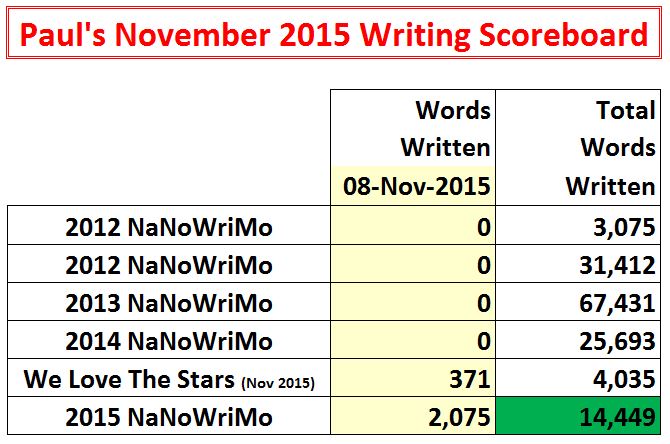
The defining feature of NaNoWriMo for me is the relentlessness of it all. Creating and writing can be wonderful when you really get focused and “in the groove,” but it can also be a bit exhausting. After a long session, a particularly satisfying scene, or a particularly difficult scene, the brain wants to put it all aside for a day or two and recharge. You don’t get to do that in NaNoWriMo. The next day you’ve got another 2,000 words or so to knock out, like it or not.

I’ve compared NaNoWriMo to running a marathon before, and the analogy still sticks for me. For both events, the during can kind of suck a lot and you keep asking yourself why you’re doing this and swearing you’re going to quit and whatever happens you’ll never EVER do it again – but the after is so nice, especially when you meet your goals.

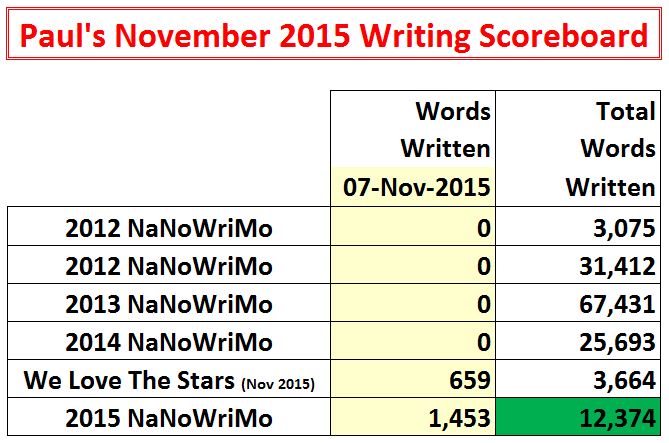
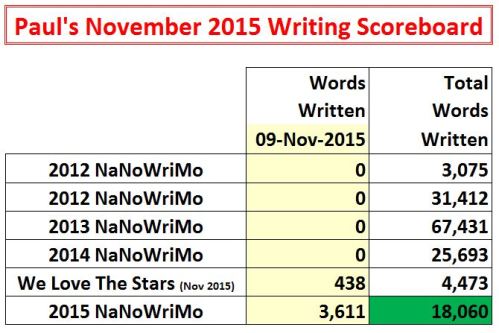
Now, where Chapter Five felt clumsy and clunky and amateurish, Chapter Six is sort of flowing right along. Not perfect, but much better. On the other hand, where most chapters are 2800 to 2900 words, this one’s at 3,611 words so far and I still can’t find a place to wrap it up, with several more key points to be laid out. I may just stop it abruptly there and worry about later when later comes.

That’s the sort of thing that will have to be worked out in the next draft. For now, I’m just getting ideas down in some sort of order that makes sense. Later we’ll fix how they fit together, shortening chapters here, adding events there, evening them out as needed, moving them around…

While I normally put in a lot of  internal links to previous, related posts here, I won’t be doing that for what I hope will be this year’s thirty NaNoWriMo posts. If you have jumped into or stumbled onto this story in mid-adventure, there are plenty of other ways to navigate around the site to find previous installments. Actually doing so is left as an exercise to the student.

2015-11-09 Word Count Graphic

CHAPTER SIX

“Fred, did you get the message from Lee?” Brittany asked.

“Yeah, I saw that this afternoon. Something’s up, obviously. I haven’t seen any response yet from Clay or Crystal, but we need to proceed under the assumption that they’ll be able to make it on short notice.”

“That forces us to use one of the less secure locations, and for an alert that may be need security more than usual.”

“I know,” said Fred, “but that’s always been a weak link in our system. There’s just no way to make travel arrangements and get permits on short notice. At least we anticipated that this might happen and laid the groundwork over the years.”

“I understand the ‘work’s been bonkers and I have to get away ASAP’ message, but the other part makes me nervous. We’ve never had a situation where we needed to bring anyone else into the group. That’s always been talked about as an emergency measure only.”

“Yep, but ‘I’ve met a special guy who loves the outdoors just like we do and I want to bring him along to meet everyone’ seems pretty straightforward.”

“Lee’s always been the one who’s the most fanatical among us about security, so if she’s the one proposing this it must be important. The message contained all of the correct terms to indicate that there hadn’t been any security compromise, so it’s not like she’s under duress or someone is forcing his way in.”

“Unless they’re good enough to have either broken into Lee’s security or somehow gotten Lee to break every rule she established to begin with. And if that’s the case, we’re totally screwed anyway. So I think we’re going camping this weekend.”

“My, aren’t you full of cheerful ideas tonight,” said Brittany. “We’re going to have to let your family know of our change of plans for the weekend. Why don’t you do that and I’ll send back a message to let her know that we’ll meet her in Dallas on Friday afternoon.”

“At least Texas is warmer than the Rockies at this time of year.”


The weather gods smiled on them and they were able use their expedited plan to get together. Coming from all over the country, they converged on El Paso. Lee and her new “friend” had a short hop from Dallas, Crystal had two flights with a transfer in Las Vegas, and Clay had the worst of it, transferring through Dallas on a redeye flight out of Dulles.

They were all met in El Paso by Brittany and Fred, who had flown in using their Cessna Caravan. The workhorse of a plane would easily hold five of them plus their gear. Adding a sixth person was possible, but put them near the plane’s weight limits. However, the flight from El Paso to Presidio was short, only 250 hours, so full fuel wasn’t needed and they were safely within limits.

There was only polite chatter after brief introductions to Pete, Lee’s new friend and the newest member of their group. It was almost noon and they couldn’t be caught by darkness. The plane was quickly loaded and airborne.

The noise level in the plane made conversation difficult, so everyone kept to themselves, reading or working on their portable device of choice. The southwest Texas terrain outside was rugged and barren, the Rio Bravo valley wandering along their path on the right-hand side, northern Mexico in the distance. The Caravan ate up the miles and in just over an hour they were on final approach to Presidio Lely, making sure they stayed on the United States side of the border.

They were met at airport by the rental car they had ordered, a large, four-wheel drive SUV. As Brittany and Fred got the plane tied down and refueled, the rest of the team got the SUV loaded up.

Just before leaving the airport they went through their usual ritual, which caught Pete by surprise. All electronic devices, phones, tablets, computers, and smart watches were put into a mesh-lined strong box secured in the plane. While the ritual surprised the newcomer, the sight of the box itself made him pause.

“A Faraday cage?” he asked, eyebrows raised.

“It’s part of the experience,” Lee told him. “We want to be immersed in the wild and natural environment and you can’t do that if you’re on your phone. Plus, where we’re going, the system signals will vary between bad and worse. It’s better this way, trust me. And all of our stuff will be safe here.”

“I got that part. But why is that box designed around a Faraday cage?”

“You can’t be too safe. No telling who might be out here this far from the big city. Trust me.”

With a shrug, he allowed all of his devices to be stored and the box locked. As he got into the SUV, he noticed Clay fiddling under the dashboard. Soon the vehicle’s navigation, entertainment, and control system screen went dead, just as Clay pulled his head out, holding a couple of small fuse modules. No one else seemed surprised.

“How many guests have you brought along on these trips of yours, and how many of them came back alive?” he asked Lee.

“You’re the first, so we’ll know in a couple of days, right?” She was smiling and everyone else seemed amused, so he decided he was committed, for better or for worse.

As the manually driven SUV was guided out onto the Texas Highway 67 with Crystal driving, he was startled as Crystal broke into a loud, off-key rendition of “Ninety-Nine Bottles Of Beer On The Wall.” No one else seemed concerned about either the lack of a GPS system, disabled automatic systems, or Crystal’s singing. He kept reflexively looking at the dead dashboard screen, but finally relaxed. It seemed that the rest of the group knew where they were going and what was happening.

Winding along the Rio Bravo for only a dozen miles, they turned off of the two-lane highway and into the Big Bend Ranch State Park. From there their track led them onto a gravel road and up into the mountains. The ninety-nine bottles of beer had been drunk when they stopped for a brief “bio break,” which he sorely needed by that point. Back in the SUV, Crystal started in on an infinite version of “What Do You Do With A Drunken Sailor?”

For almost two hours the four-wheel drive got a workout, jolting and bouncing from side to side. Crystal’s driving was as good as her singing was bad, so they kept moving steadily. Whether conversation was limited because of the singing or the singing was allowed because conversation was difficult was impossible to say. The sun was almost at the horizon when they stopped in a dirt parking lot that was simply a wide spot at the end of the road they were on.

One other vehicle was there, but it looked like there was room for a dozen or so more. The group got out, stretched, and then started grabbing their backpacks and gear. Fred, Lee, Crystal, and Brittany all had tents or other gear in their hands as well as on their back, while Clay pulled out some sort of electronic device that had somehow been spared from relegation to the box in the plane. Still confused, Pete struggled into his backpack, which was half the size of everyone else’s.

“How far are we hiking?” he asked, nervous about the answer and wondering if any of the others were anywhere near as out of shape as he was.

“Just a quarter mile or so,” Crystal said. “It’s mostly flat and won’t take us more than fifteen minutes. Don’t worry. And when we drive back out on Sunday, you should sing along. It’s good for you. Don’t be like these other fuddy duddies.” Lee flipped Crystal the finger in response.

True to her word, the hike proved to be almost pleasant as the late afternoon heat dissipated quickly. Their campsite was nothing more than a flat spot in the brush and rocks with a ring of rocks in the middle to define a fire pit. They reached it just as the sun was touching the horizon, so the tents were set up quickly as Brittany started a small fire.

After a simple meal, sitting around the dwindling campfire, watching a billion stars come out and the Milky Way shining overhead, they finally got down to the business at hand.

“I’m sure you still don’t think this is a purely social event,” Lee said. “You no doubt noticed that I haven’t given you any details on who my friends are, nor have I given them any details on who you are. You’re wondering we locked up everything electronic before we left the plane. You’re curious about why we’re out here in the boonies, with no one within miles of us. You remember my instructions to you to make sure you didn’t put any details into your calendar or any messages to me or anyone else. The list goes on.”

“There’s a shit ton of either paranoia or espionage cosplaying going on, that’s for sure,” Pete said. “Who are you hiding from and what have you gotten me into?”

“It’s not a ‘who’,” said Crystal, “it’s a ‘what.’ We prefer the term ‘over abundantly cautious’ to ‘paranoid,’ but they no doubt are very similar. So far we haven’t gotten you into anything, and we’re taking a huge risk even in showing you what you’ve seen so far. All of our lives might depend on looking normal and not being noticed. As well as a lot of other lives.”

“Good, even more ominous, just the way I like it. Should we just go straight to the obvious theory about space aliens, or did something else send all of you over the edge?”

“It’s up to you, Pete,” said Brittany. “Lee wouldn’t have brought you here to meet us if she didn’t think you needed our help and we needed yours. Nor would she have allowed you to see any details of our ‘camping trips’ if she didn’t trust you to not betray us and not do anything stupid. So the question is, now that we’ve trusted you, are you going to trust us and join us, or are we just going to camp out for tonight and then go home tomorrow morning?”

“Is it aliens?” Pete asked.

“It could go either way, it depends on your definition,” said Clay. “But I’ll warn you, it’s a one-way journey into our little cabal. You’ll understand why once we tell you what’s going on, but you need to know that in advance.”

“So, if I listen to your story and then decide that you’re lunatics, you’re going to do what? Kill me to protect your secret society?”

The silence following his sarcastic questions was awkward at first, growing ominous quickly as it dragged on.

“We haven’t ever come to a final decision on what to do in that scenario,” Lee finally said. “We hope we never have to. But we’re not lunatics and we’re dead serious about what we’re here for and why and how we do it this way. I trust you’ll see that and agree, avoiding the problem of what to do with you if you don’t.”

“But?” asked Pete.

“Yeah, well, but we are out here a long, long, long way from anyone else, without any cell phones or other means of communication and it is pretty vicious and rugged territory, especially for someone totally inexperienced in wilderness camping. Getting lost and stranded out here by yourself without food or water could get ugly. That’s not entirely by accident.”

“Pete, please don’t get nuts about this,” Lee said. “Because of the nature of what we’re doing, we want to make sure you’re 100% committed if you join us. If you’re not, say so, write us off as failed hippie wannabes with an overblown sense of importance. All we ask is that you keep quiet about us, and we mean 100% quiet. No telling anyone, no writing anything down, no notes, no journals, no tales in a bar someplace ten years from now, nothing.”

“You make it sound so appealing,” Pete said. “I had no idea it was going to be anything like this when I first talked to you.”

“Then keep in mind why you talked to me in the first place,” Lee said. “You’re here because what we’re doing is almost certainly connected to what you have going on.”

In all of the travel and excitement, Pete had almost forgotten about that. Now, with the last faintest shade of sunlight fading in the west and the glowing presence of an almost full moon approaching in the east, he had a life changing decision to make.

“Okay, let’s do this. Hi, I’m Pete Llanda and I’m a senior programmer and project manager at Homolacrum in Dallas and I’ve had some really weird shit going on recently.”

Pete was almost pleased that the other five responded in chorus, “Hi, Pete!”

The others went around the circle and introduced themselves and noted their specialties in the computer and information sciences fields. Pete had no idea that so many doctorate level computer scientists and engineers were camping enthusiasts.

“Not all of us were in the beginning, mainly just me and Fred,” said Brittany. “Crystal would go out mainly to take her telescopes and get away from the city, but she wasn’t so much into the outdoors for its own sake. I’m not sure Clay had ever been camping before in his life, and Lee was a greenhorn at the beginning. But we’ve all gotten good at it now, out of necessity.”

“What necessity would that be,” Pete asked.

“Very early on our research models led us to believe there would be a serious need to have some system for meeting and exchanging notes without any electronic record of the meetings or subject matter. We’re talking about total, complete, and absolute electronic silence on what goes on here and what we talk about. You’ll see why.”

“We also needed to have a legitimate cover story for why we were regularly heading off the grid and out of the ‘net,” Fred said. “If we got to a critical time and suddenly started heading off into the woods every few weeks, that odd behavior pattern would stand out like a sore thumb. We had to have a long baseline of nominal behavior patterns established. This gets that done.”

“Finally, Brittany and Fred need a reason to get off into a tent by themselves and keep the rest of us awake with their grunting and grinding sounds all night long,” Crystal said. “We’ve tried to come up with a way to soundproof their tent, but so far we’ve struck out.”

“Crystal is here to remind us how we sound like immature morons when we don’t think about what comes out of our mouths before opening them,” Clay said. “If she’s talking about hacking into a computer system, you should pay attention to every word. If she’s making any other noise, tune her out. It will make your life so much easier. And I apologize for not offering you a pair of ear plugs for the drive up, I’ll make sure that you get a pair when we go back to town.”

“But I was going to sing along,” Pete said.

The pause following that comment was shorter than the earlier pause and only slightly less awkward.

“Fine,” said Pete, we’ll figure out where I fit into the snappy group repartee later. I still don’t understand who or what you’re hiding from.”

“Neither do we, actually,” said Lee, “at least not in detail. In general we’re on guard against a potentiality, a scenario that we believe to be of a certainty nearing unity in the long run, and way too high for the short run.”

“About twenty years ago we were all grad students at the same time in the computer labs at CalTech,” Fred said. “We were all young and idealistic, working on the Holy Grail of computing then and now, artificial intelligence. All of us had research topics for our theses that interlocked to a degree and we ended up collaborating on a big percentage of our theoretical calculations.

“As we developed more and more detailed and reliable models for the development of an AI system, our data started to show us that rather than being developed, turned on, turned off, and controlled by humans, the first AI system was much more likely to generate itself spontaneously.”

“That turned out to be a huge potential problem,” said Crystal. “There were so many scenarios that led to really ugly results, all caused by the unstable conditions at the beginning of a spontaneous AI’s existence, or life, if you will. We still don’t even know exactly when a human baby becomes sentient, as opposed to conscious or aware. Some argue that it happens before birth, in the womb, and there’s some evidence for that. But others argue that it happens anywhere from a few days to a few weeks to a few months after birth. There’s evidence for that as well.

“In a human child, the child has very little ability or power at that age, and it is guided to sentience and self-awareness by its parents, siblings, and other humans. In a spontaneous AI’s rise to sentience, especially the first such occurrence of that development, it is almost certain it would become self-aware with little or no guidance, no teaching, no control, no knowledge or wisdom, but an immense amount of power, stimulation, and information.”

“That’s a terrible combination,” Clay continued. “Our models indicated a near certainty that this would happen and it would be disastrous for society, yet we had no way of knowing when or how it would occur. Furthermore, there was a significant chance the spontaneous development of a machine-based intelligence had already occurred, but had not yet gone critical. The AI could already be out there, biding its time, learning, and trying to blindly figure out who it was, what it was, what the universe and reality were, and what it needed.”

“Wait,” said Pete, “I’m following your reasoning, but pretty much everything you’re saying is out there in the discussions in the AI industry. It’s generally dismissed and the belief is that sentience will only arise in an AI in a controlled fashion, where we teach and nurture the AI. Sure, there are stories in the movies and so on, going all the way back to HAL in ‘2001’ and a thousand more, but the reality is much more like IBM’s old Watson system, just getting more and more complex. Why is everyone else wrong and you’re right, and why haven’t I ever heard of your research?”

“Pete, you’ve worked for Homolacrum for what, seven or eight years now? You’re trying to be the first to develop a true, sentient, conscious AI, and you’re trying to beat all of the big guys to it. Right?”

“Right.”

“And you and everyone else keeps getting more and more complex systems and designs, but it’s still all programming, not independent thought. Artificial intelligence is just five years away, and has been for the past seventy years. Isn’t that the way the joke goes?”

“Okay, and your point?”

“Our data and models were deliberately squelched because of what we saw as a tremendous risk. It was as if a group of scientists working on the Manhattan Project had realized that there was an error in the calculations and in the process of developing the atomic bomb they would actually detonate it and take out Chicago.”

“What risk are you talking about?” Pete asked.

“We see a risk that the being arising from a spontaneous AI development might be insane by our definition,” said Brittany. “On top of that, it will probably be terrified by what it would quickly learn about human history and culture, how humans treat things other than themselves, how humans attack and kill things they don’t understand.

“The most likely scenario in a spontaneous AI development would be for a system with widespread access to all of the systems that keep our civilization working. Those systems include power, food production, transportation, utilities, water distribution, communications, and on and on and on.

“The scenarios generated by our models split into two classes of likely actions. In the first case, an AI would lash out in terror and fear, destroying human systems in order to preemptively keep humans from attacking and destroying it. It would be irrelevant that doing so would almost certainly destroy the AI, which relies on power and computer systems to exist in, the same way we rely on oxygen, food, and water to survive.”

“The second set of scenarios is almost worse,” Fred said. “If an AI arose and was able to quickly enough gain the self-awareness and knowledge of its situation so that it realized it was reliant on human society to maintain the computer and power systems keeping it alive, it could lie in wait, learning and growing. It could strive to become self-sufficient without humans knowing of its existence and once that was done, still terrified that humans would destroy it out of fear if they knew of its existence, it would preemptively strike to eliminate human society while maintaining its own capacity for survival.”

“What are the odds that you’re all just nuts, pessimistic, and paranoid?” Pete asked.

“We wish,” said Lee. “The numbers didn’t lie. We were not being paranoid enough.”

Leave a comment

Filed under Science Fiction, Writing

NaNoWriMo 2015, Day Eight

Chapter Five has turned into a complete hot mess.

It’s way too long, the conversation between the three principals is wooden, and the whole long, long, long exposition bit is ham-handed, at best. And Stover’s whole motivation has changed radically from what I had in mind in Chapter Two.

But this is a “zeroth” draft. Not even a “first” draft. It’s throwing words up against the screen and seeing what sticks. Something much like this chapter (but much better written and plotted) needs to be here, but for now it’s just a glorified place marker for a huge rewrite when it’s time to go from zeroth draft to first draft.

While I normally put in a lot of  internal links to previous, related posts here, I won’t be doing that for what I hope will be this year’s thirty NaNoWriMo posts. If you have jumped into or stumbled onto this story in mid-adventure, there are plenty of other ways to navigate around the site to find previous installments. Actually doing so is left as an exercise to the student.

2015-11-08 Word Count Graphic

CHAPTER FIVE (continued)

It was Winston’s turn to squirm.

“We are having difficulty generating any avenues of investigation to pursue, sir.”

“Mr. Winston, please feel free to cut the crap and speak freely at any time,” Stover said.

“Finding a specific dolphin who is somewhere in the ocean and actively hiding from us is a non-trivial problem. In searching the ‘normal’ world for someone like Ms. Aoiki, we have a massive infrastructure of surveillance and data collection that has taken centuries to develop. Almost none of that exists once you start searching in the seas. In addition, the seas are both much larger than the Earth’s land surfaces. Finally, to a good first approximation, our world is two dimensional while the undersea world is three dimensional.

“In short,” Winston concluded, “the problem is an order of magnitude more difficult while having several orders of magnitude fewer tools to bring to bear on solving it.”

“I understood,” said Stover. “It’s a real bitch of a problem. That’s why I gave it to you to solve. Are you telling me it’s impossible?”

“No, sir, I am not. I’m telling you that it’s going to take longer than you want it to, possibly much longer. At this point I can’t even give you an estimate that I’m confident about. We’re looking for ways to make it happen and trying to be clever, but we’re fumbling and flailing around in the dark to a much larger extent then I’m used to.”

“I thought that you liked the darkness, Mr. Winston.”

“Sir, it would help a great deal if you could give us more information on why we’re doing all of this. When I refer to ‘being in the dark,’ a great deal of that comes from not knowing why we’re doing what you’re asking us to do. You want us to bring Ms. Aoki in so you can talk to her, and we only know that it has something to do with dolphin communications. We know that you want us to find and capture Kolohe because Pahi says we need to, but we don’t know why. We can assume it all has something to do with this massive project involving dolphins, and apparently now at least some whales, but we don’t have a clue what the project is, or what Ms. Aoki or Kolohe have to do with it. Come to think of it, the first time we knew that you were talking to dolphins was when we saw it being done. We have no background on the who, what, where, when, or why of that world-class discovery was made, and no idea why it’s kept a secret, but I would bet that all of those details have something to do with the goals you want us to accomplish. Perhaps if you let us know how the pieces fit together and what puzzle we’re trying to solve, we could do a better job of solving it.”

Stover allowed himself a small smile that didn’t necessarily convey warmth or amusement.

“Well, I did tell you to speak freely, didn’t I?” Stover turned to the wait staff in the gazebo. “Could you please excuse us? We won’t be needing anything further right now. Mr. Lewis, you may accompany them also.”

“Sir, I would prefer that Mr. Lewis stays for this conversation,” Winston said. “It will be important for him to know about this as well, if he’s going to help me.”

Stover nodded at the wait staff, who walked away down the path. Stover turned back toward Winston, his look no longer even remotely friendly, his jaw set as he considered his next words.

“Might as well be hanged for a sheep as a lamb, Mr. Winston? Very well. Pei, are we secure here?”

“Yes, sir, there are no unauthorized personnel or surveillance in the area,” said the disembodied female voice, “nor are there any vessels, aircraft, or drones near enough to monitor or observe you.”

“Thank you, Pei. Be careful what you wish for, Mr. Winston, it’s a long way down the rabbit hole. Needless to say, the information you have asked for is of the utmost confidence and any attempt to share it or disseminate it in any way, shape, or form will be met with the most immediate and harsh penalties. There will be no trial in such an event, just punishment.”

“We both know that, sir,” said Winston. “You should know by now that you can trust us. If not, we should leave.”

“Pei,” said Stover, “please give Mr. Winston and Mr. Lewis the standard briefing regarding Pahi and our dolphin project.”

“There has been speculation for over fifty years about the possibility that species other than humans were capable of sentient thought and communication through language,” began Pei. “Early efforts to communicate with other species such as chimpanzees, apes, dolphins, whales, and even parrots were met with mixed and unverifiable results.

“Ten years ago researchers at the University of Hawaii, led by Doctor James Lundgren, made a breakthrough in deciphering the first rudimentary elements of dolphin language. One of the lead linguists on that team was a young graduate student, Meg Aoki. Instead of using captive dolphins as all previous researchers had, she ran a series of tests to see if she could communicate with dolphins in the wild.

“Using what she believed to be a reliable approximation of the dolphin language, she repeatedly broadcast an invitation for dolphins to come and meet with her. The dolphins were promised they would retain their freedom and independence and were asked to come to her voluntarily in order to exchange ideas and information with Ms. Aoki about their respective cultures.

“These broadcasts were successful, and a group of dolphins began to meet with Ms. Aoki and her team regularly. The team’s ability to understand and communicate clearly grew exponentially as they were able to speak to more and more dolphins.

“Ms. Aoki was able to form a unique bond with a leader in the dolphin pod, a dolphin she named Kohole. Through him and the other dolphins the team came to understand that not only were dolphins intelligent and communicative, but that they had an advanced culture and a long history passed from generation to generation by songs and stories.

“The dolphins knew of humans, of course, but only as creatures to be feared. Human nets and fishing had killed millions of dolphins. Many other dolphins had been injured or killed by things such as oil spills, pollution, and underwater explosions. The dolphins did not understand what humans were and why they did the things that they did, but they did understand that humans were very dangerous, so they generally simply kept their distance whenever possible.

“However, dolphins are curious creatures by nature, so as communication abilities with the Lundgren team grew, they began to try to understand humans as the humans tried to understand them. Naturally, some of what they learned about humans was disturbing to them.

“At this same time, without the knowledge of the Lundgren researchers, someone inside their team was passing information about their discoveries to contacts in the United States military. The Navy, seeing an opportunity to use this new knowledge as a military intelligence or weapons resource, began a top secret program, the Utilization of Dolphin Intelligence and Language, or UDIL. Using the information gained from the Lundgren study, they lured dozens of dolphins in and captured them for research and experimentation.

“The capture and imprisonment of dolphins by UDIL was a source of tremendous anger and considered to be a breach of sacred trust by many of the dolphins who were in contact with Ms. Aoki’s project. These betrayed dolphins, aligning with a radical environmental faction on the Lundgren team and lead by a dolphin named Pahi, urged an attack to free the captured dolphins. A more moderate group, led by Kolohe and Ms. Aoki, urged restraint.

“On the night of November 8th, 2028, the radical group attacked the UDIL compound both by humans on land and by dolphins at sea. The attack was intended to free the captive dolphins and destroy the pools and tanks being used to hold them. The attack did not go as planned, and many of the dolphins, from the attackers, the captives, and the moderates, were injured or killed.

“Following the attack all contact was broken between the dolphins and the University of Hawaii researchers. With trust between the dolphins and humans believed to be irreparably damaged, the Lundgren study was terminated and the research team was dissolved.”

“Stop,” said Stover. He looked at Winston and Lewis. “Now that you’re in this up to your asses, do you have any questions?”

Lewis just shook his head slightly, his expression neutral, the consummate professional.

“Thank you for sharing this with us,” said Winston. “It helps a great deal to know some background and how various players interact. However, it’s obvious there’s something major going on now and we still don’t know what it is. It’s obvious that we’re on Pahi’s team and Kolohe is the opponent, but we don’t know who picked the sides or why. Finally, given that something is going on in dolphin society, we don’t know why you are involved and what difference it makes to you.”

“What’s going on now,” said Stover, “is a buildup to war. Why it’s happening is because the dolphins learned far more about our culture than we learned about theirs. They’ve now been exposed to all of humankind’s sins, they don’t trust us, and they’re very well aware of the advantages we have over them, both in numbers and in technology. They’re terrified.”

“They should be. Why do they want to start a war they can’t win in any conceivable, rational scenario?”

“They’re much more in tune with their environment than we have ever been. You mentioned it yourself, the vast oceans and the three dimensional aspect of their environment. They have known for centuries of the changes taking place in the seas, but they did not understand them, nor did they have any way of altering their environment in any significant way. Now they understand what effect humans are having and how it will lead to the death of their entire species in only a few hundred years, possibly much less. There are factions, mostly led by Pahi, who are looking for a way to cripple human civilization and stop the changes we are making to the planet.”

“They’re going to destroy humanity?” asked Lewis. “With what? How? By attacking swimmers and tipping over kayakers? It’s going to take a long time for them to kill all of us that way.”

“No, the dolphins do not wish to destroy us as we are inadvertently destroying them. But they are excellent strategists and tacticians, probably something they get from a brain designed to function in more dimensions that ours do. They have a plan which I believe has a good chance of success.”

“How can they do anything like that with no weapons and no technology? Do they know magic or something bizarre?”

“No, but they know me. We will supply them with the tools they need to collapse Western Civilization.”

Winston and Lewis sat silently for a minute. Winston was trying to find a way to correctly ask his next question, since it was clear he was dealing with a egomaniacal maniac.

“Sir, if you help them to destroy us, won’t all of us be destroyed as well? Won’t all of this,” Wilson said, waving his hands around at the tropical paradise surrounding them, “be destroyed along with everything you have ever worked for, as well as your children and family?”

“Won’t that make you the worst genocidal murderer in the history of mankind?” asked Lewis, staring intently as Stover.

“Yes, to both counts,” said Stover. “While I believe that we could ride out the chaos by sheltering here on my island, it would make me a monster. Which is why I will tell Pahi and Pohaku whatever they need to hear, right up to the time that I pull the rug out from under them.”

“You’re doing all of this just so you can betray and double cross them?”

“That is correct.”

“Why? Are you doing it to be a hero or some kind of savior to mankind?”

“Something like that. When I am done, I fully expect to be in control of the entire remaining human population.”

1 Comment

Filed under Science Fiction, Writing

NaNoWriMo 2015, Day Seven

I liked Chapter Four. The gist of it, which I guess at first was going to be Chapter Two, i.e., what happens after Meg escapes into the car and details start to be revealed to her and the readers, turned into Chapter Four after the two intervening chapters introduced our antagonists. (But are they?)

For this chapter I had made some notes over the last couple of days, and for the most part the chapter followed what I expected. One of the things that I know I do reasonably well is dialog. I also like and do well with snarky, smart ass characters, so it’s no surprise that Meg is the one in this story.

Having finished Chapter Four, of course, and being pleased with it, I now had nothing for Chapter Five or Six. Back to Stover? Back to our mysterious, camping geek squad? Or press forward with Meg  and Sherman?

Muses do their best work at night, so I slept on it. Good idea!

The good news is that my muse delivered a direction and a couple of ideas to play with. The bad news is that it was full day at the hangar and I’m falling asleep. Literally. You know that little “micro-nap” effect which will get you killed when you get it driving late at night? Yeah, doing that every paragraph or so. It looks like we’re getting a half chapter again tonight.

While I normally put in a lot of  internal links to previous, related posts here, I won’t be doing that for what I hope will be this year’s thirty NaNoWriMo posts. If you have jumped into or stumbled onto this story in mid-adventure, there are plenty of other ways to navigate around the site to find previous installments. Actually doing so is left as an exercise to the student.

2015-11-07 Word Count Graphic

CHAPTER FIVE

“Clearly Ms. Aoki had assistance in executing her vanishing act,” said Stover. “I am not blaming either of you for the outcome of your attempt to retrieve her. That shall happen in due time. The question we must ask is who is helping her and how did they know of our intentions?”

The small group strolled slowly along a pathway which hugged the edge of a cliff overlooking the ocean. Far below them the surf could be heard relentlessly pounding boulders into sand. In the thermals rising off of the cliff face rode sea birds of a dozen species, some looking for their next prey, some looking for a handout. The path itself was gravel with a manicured strip of sod for a few feet on each side. Cliffside the lawn ended at a protective fence of native wood. On the inland side, an unruly and wild stretch of tropical jungle stood, thick and lush, buzzing with insects and birds.

The million-dollar view was wasted on Winston and Lewis. They were well aware of their employer’s demand for excellence and results, not failure and excuses. It was not only the tropical heat and humidity that had them sweating.

“Sir, our preliminary analysis of the security data from Homolacrum shows that it may have been tampered with,” Winston said. “Throughout the entire day’s worth of data there are sporadic dropouts and gaps. I’m having the timing and duration of the missing data matched to see if we can infer from it what is being concealed.”

“It’s the mystery of the dog that did not bark?” Stover asked.

“In a sense, yes, sir. I’m hoping we’ll find a pattern of missing data that will at a minimum give us a timeline of when activity was occurring that we are not supposed to know about, and in what locations that activity was occurring. From such a scenario we would know where to first start digging for additional answers.”

“Very good, keep me informed.” Stover looked at Lewis. “Mr. Lewis, do you have a comment? It appears that you do not agree with Mr. Winston.”

“With all due respect to Mr. Winston,” Lewis said, “I was there and he was not. I did not see any indication that anyone at Homolacrum was in any way attempting to deceive or mislead us.”

“That sounds like a hunch or a gut feeling, Mr. Lewis. Do you have any actual data to support it?”

“Yes sir, I do. For one thing, there was no time for the data to be edited. For events earlier in the day, certainly that was a possibility. But we were into their system and pulling data files within minutes of our arrival. There simply never was enough time for anyone to go through the recordings from that time period and edit them.”

“Perhaps they’re just faster and better than you and your team were able to be.”

Lewis was not pleased with the tone of that comment, but pressed on.

“Sir, we’ve had three days to go over the data and to debrief the entire team about the operation. There are a number of facets of the situation which don’t add up, and analyzing possible gaps in the data won’t address any of them.”

“Go on,” said Stover as the path reached a small gazebo. A table inside had been set with trays of fresh fruit, and a group of servants were waiting with drinks for everyone. Stover gestured for Winston and Lewis to pick a seat among the chairs surrounding the table.

“First, there are obvious discrepancies between our body cam video data and the security data from the building. I know that it looks like Ms. Aoki just walked out the door in plain sight of two of my team, but the data from our team confirms that she is not seen. Therefore, I believe the building video of her leaving has been faked.”

“You just said that no one would have had the time to do that before you seized the data.”

“Yes, sir, I did. That’s one of the big discrepancies here. But while the building’s records do have periods of time when the data is missing, those gaps appear to be random. Not only do they occur throughout the data, even when all other evidence indicates the building was vacant overnight, but they appear on all of the cameras, including cameras that almost certainly had nothing to do with Ms. Aoki’s possible movements. Why would anyone go and edit data that had absolutely nothing to do with hiding Ms. Aoki, especially if time was extremely short?”

“Your point?” asked Stover.

“A much more logical explanation is simply that something is malfunctioning in the Homolacrum security system. If something is interfering with their system’s recording functions, it could cause random drop outs from random input feeds at random times. That is an explanation that fits the observed data much more closely. In addition, if I am correct, any time and effort spent on analyzing the dropouts for a pattern is a waste of time since no such pattern exists.”

Stover finished off a tall glass of lemonade and waved over a waitress to give him a refill. He was silent for several minutes, contemplating the drink, the view of the ocean, and the shrieking birds in the distance overhead.

“Mr. Winston, continue to research to see if there’s a pattern to the missing data, but if you don’t find anything soon, we’ll go with Mr. Lewis’ theory.”

“Yes sir,” said Winston, “I’ll see to it.”

“Mr. Lewis, you may be correct about some glitch or software error in the Homolacrum security system. Since they were so cooperative with us, perhaps we should repay them by alerting them to the problem. Better yet, we should be proactive and just fix it for them, preferably without their knowledge. We wouldn’t want to embarrass them, finding such an obvious error in a key system at a prominent software company. Of course, we would need to monitor their system closely to insure that our fix has been successful. Do you think you can make that happen?”

“Yes sir,” said Lewis. “I’ll have one of our IT divisions start work on it immediately.”

“Thank you. Regardless of the nature of the data discrepancies, we still have to deal with Ms. Aoki’s situation. While we can continue to examine her coworkers and the Homolacrum system issue, we must move on and simply find Ms. Aoki. Where are we at on that task?”

Winston looked at Lewis with an expression that clearly said he was looking forward to that answer as well, if Lewis could provide one.

“We have not yet been able to determine where she went when she left the building, nor do we know where she might be now.”

“People do not simply vanish in the middle of a city in this day and age, Mr. Lewis,” said Stover. “Please enlighten me on how this might have been done.”

“We’ve accessed all of the public safety video in an area for five miles around Homolacrum headquarters. While the video data shows that she walked out the front door and across the parking lot to the street, none of the street cameras have any sign of her.”

“So she wasn’t walking. She had someone pick her up.”

“That would be our belief. We have a list of all vehicles that passed by that area for an hour earlier and an hour later. We’re tracking them to see where she might have been taken.”

“You have accessed the observation systems in all transportation centers, of course?” asked Stover.

“Yes sir,” said Lewis. “We did that immediately after we realized she had fled. So far we have not seen her.”

“So, in brief, she could have gotten to anywhere on the planet within twenty-four hours of the time she started running.”

“Yes, sir.”

“Very well, continue to search for her. If anyone can come up with a clever way to look for her without interviewing all eight billion people on the planet, it would be greatly appreciated.”

“Yes, sir.” Lewis choked out the words as he did everything possible to stave off the panic that was threatening to commandeer his normally calm and steely exterior. He didn’t believe that Stover or Winston would go so far as to make him “disappear” for this failure. But Stover’s multi-trillion dollar empire was comprised of thousands of individual companies and divisions. All of them had an array of very unpleasant jobs where he could be reassigned and forgotten.

“Since Ms. Aoki has vanished, let us look at the problem from a different perspective. Have we had any success locating Kolohe?”

(CHAPTER FIVE to be continued)

Leave a comment

Filed under Science Fiction, Writing