
Last night (Sunday, August 25th) there was a spectacular pass of the International Space Station over the US West Coast. This might have been one of the best I’ve ever seen.

This graphic was grabbed from ISStracker.com, a great site for finding out where the ISS is at any point and where it’s going to be in the next four and a half hours (three orbits). The track for this pass was the yellow line on the right. (The yellow line on the left is the next orbit, ninety minutes later, where the Earth has rotated beneath it.) As you can see, the ISS was coming right down the US west coast. The Flyby app (from SpaceWeather.com, highly recommended!) was predicting that ISS would rise in the NNW over Northern California at 20:17 PDT and over Southern California at 20:18 PDT, going right through the zenith, a very bright NNW to ESE pass.
Needless to say, I grabbed a camera. I did not have time to grab a tripod however, so I had to improvise.
I knew that I was going to be making long, “bulb” exposures with my Canon Digital Rebel XTi camera, exposures long enough to be showing the stars as trails instead of points due to the Earth’s rotation. Any other movement during the exposure would show up as wiggles in both the star trails and the ISS’s track.
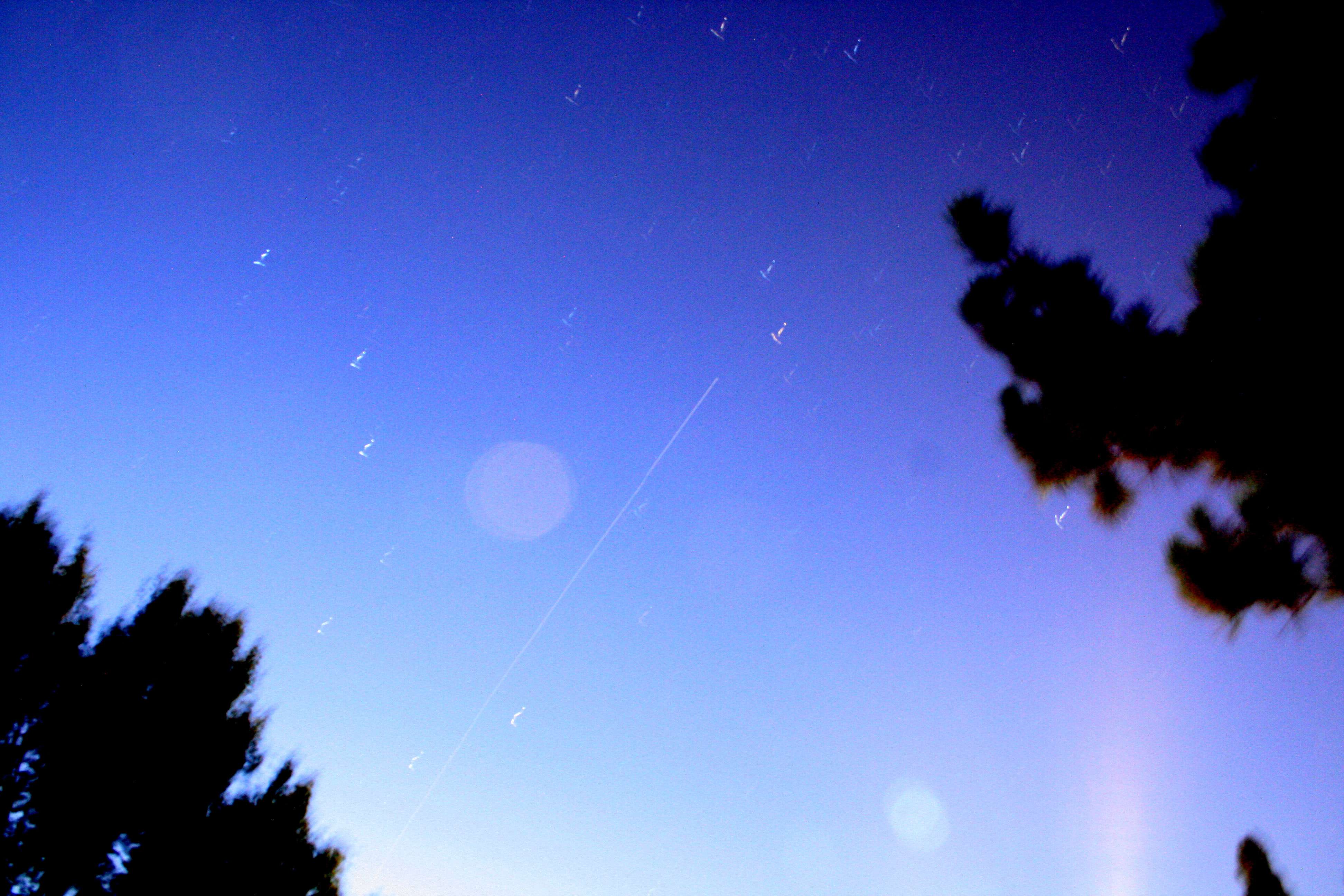
As predicted, the ISS rose up in the NNW. The long exposure into the twilight washed out the picture quite a bit, but a little processing in Photoshop corrected for that. There was less that I could do about the three street lights just below the camera’s field of view and the lens flares they produced. I had set the camera on the ground with my iPhone and car keys under the lens to prop it up toward the sky a bit. I was in an awkward position to hold the camera’s trigger button down for the long exposure, and that introduced some vibration into the camera and wiggles into the star trails.
Nevertheless, you can clearly see the Big Dipper on the left above the tree there, with the two “pointer” stars aimed at Polaris, the North Star, which is just under the branches of the tree on the right. The ISS came up through the bowl of the Big Dipper and toward the zenith. This was a 95-second exposure.
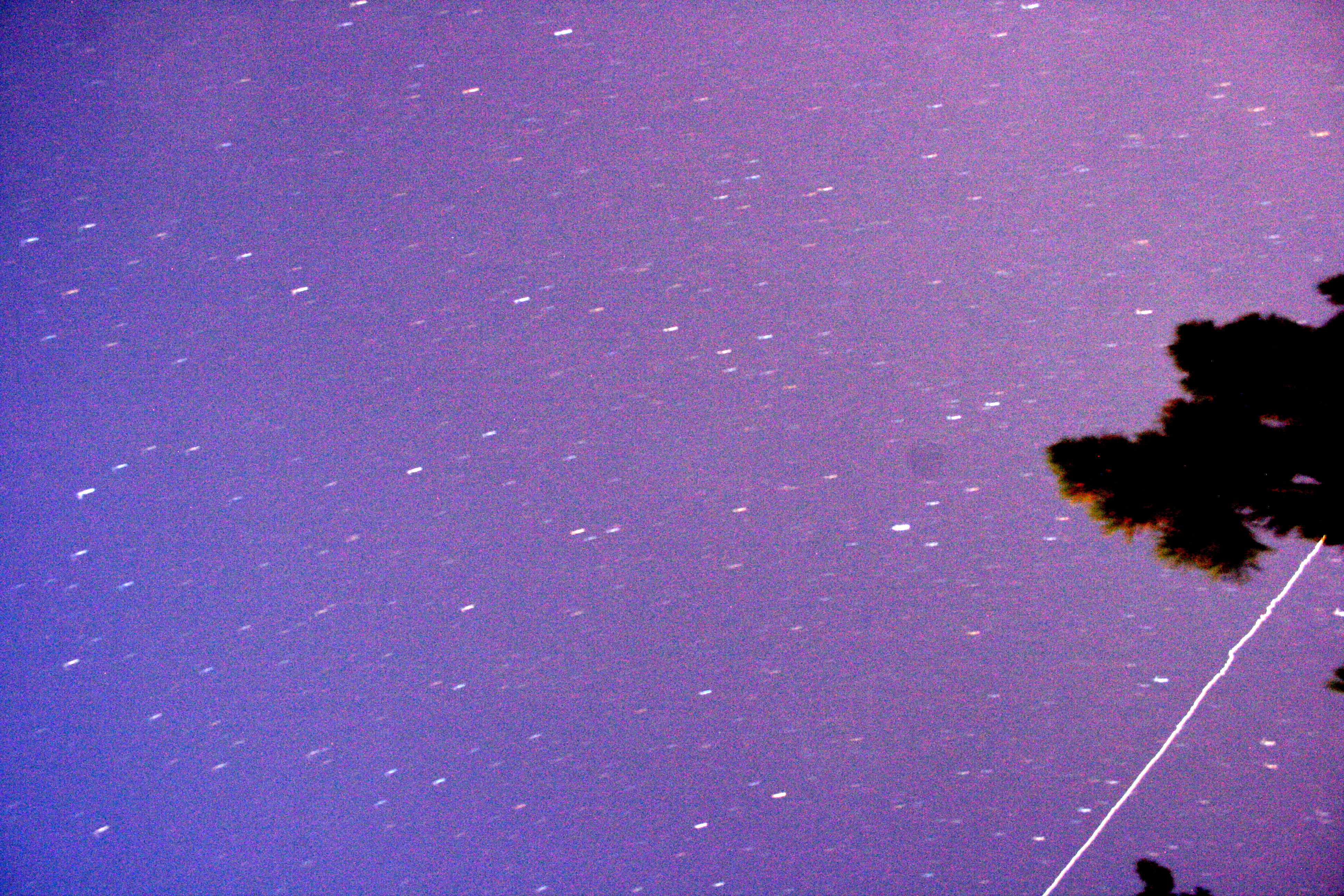
At this point I put the camera flat on its back and pointed it straight up at the zenith for the second shot, a 62-second exposure. The ISS was only in the frame a part of that time. If you look closely at the star trails you’ll see that they look much smoother and cleaner than the first picture, and the trail of the ISS (which in reality is straight as the proverbial arrow) has fewer jitters. But there’s still some jiggling going on.
Just to the left of the tree branch overhead you can see the bright star Vega and constellation Lyra. Just to the left of center you can see the “Keystone” asterism in the constellation Hercules. On the left edge in the center you can see the curve of stars that make up the constellation of Corona Borealis.
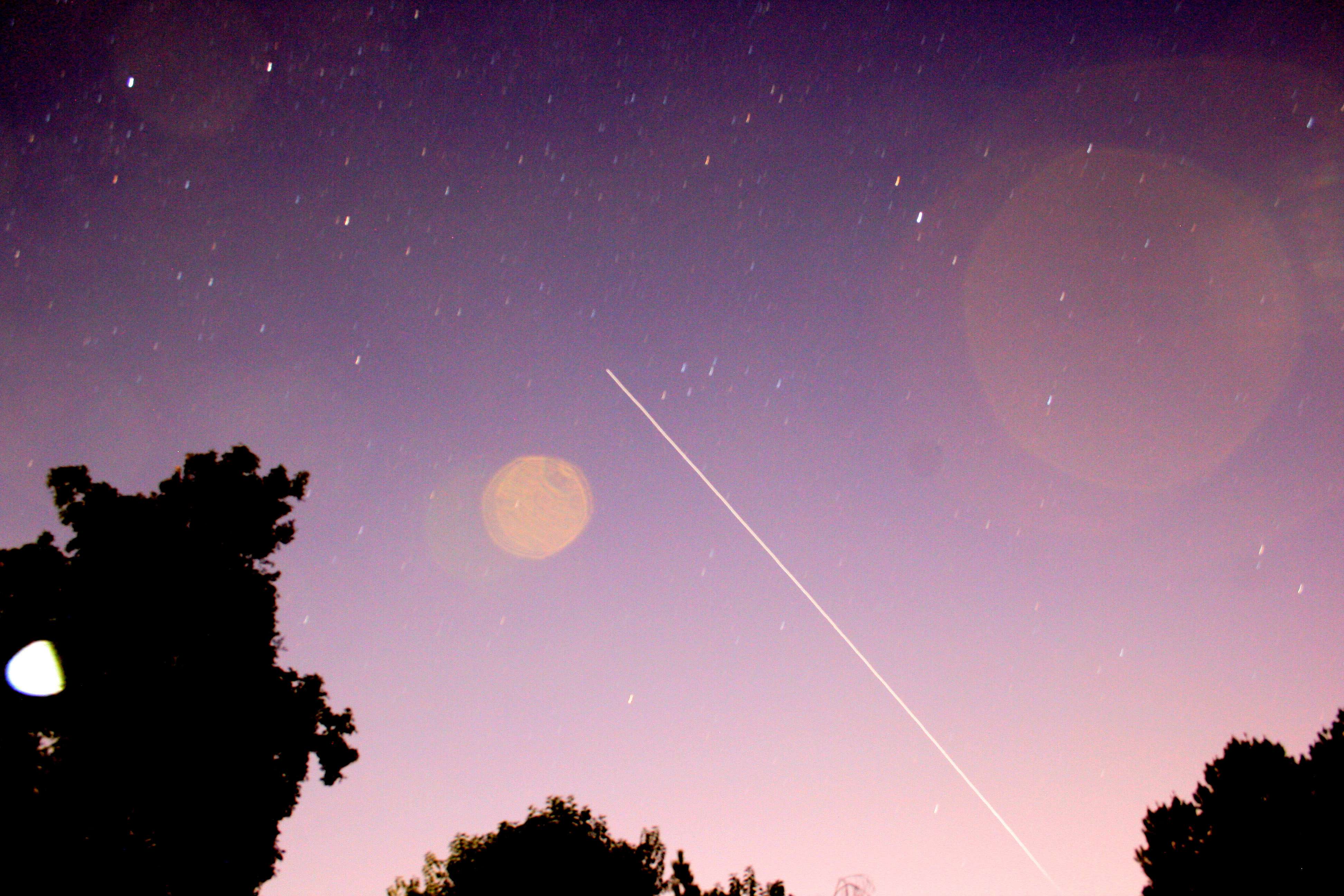
This picture made the quick experiment worth it! I had jumped up off of the ground and moved over to the mailbox, again with the camera lens tilted up and held by my iPhone and car keys. But this time I was standing and not trying some odd contortionist trick, so there is very little jitter or jiggle anywhere in the picture. This is a 102-second exposure which has been processed in Photoshop to clean up the dynamic range. I love the way the ISS trail is straight and true toward the ESE horizon, although I could have lived with a couple fewer lens flares from street lights.
Just to the right of where the ISS trail starts in this picture you can see a cluster of moderately bright stars that make up the constellation Delphinus. To the upper right of that you can see two bright stars (at about the 10:00 position on the big lens flare in the upper right corner), one of which is bright white (Altair) and the other of which shows a distinct orange tint (Tarazed), both in the constellation Aquila.
Do you like these? Try it yourself whenever there’s an ISS pass at sunset over your position. They won’t always be this bright or this long or this spectacular, but it’s easy to try. (Plan ahead, use a tripod!) And if you’re on the US west coast, there’s another pass almost identical to this one on Tuesday, August 27th. Estimated rise time in Northern California is 20:15:15 in the WNW with a maximum height of 28.6 degrees. For Southern California, it’s 20:16:22 in the WNW with a maximum height of 35.2 degrees. Check the Flyby app or online at the NASA ISS “Spot The Station” website.


 We Love The Stars Too Fondly
Wow. Those are spactular. And you even got my star–Vega
LikeLike
If there’s a bright star, it’s always your Vega, dear!
LikeLike