
While I normally put in a lot of internal links to previous, related posts here, I won’t be doing that for what I hope will be thirty NaNoWriMo posts. If you have jumped into or stumbled onto this story in mid-adventure, there are plenty of other ways to navigate around the site to find previous installments. Actually doing so is left as an exercise to the student.
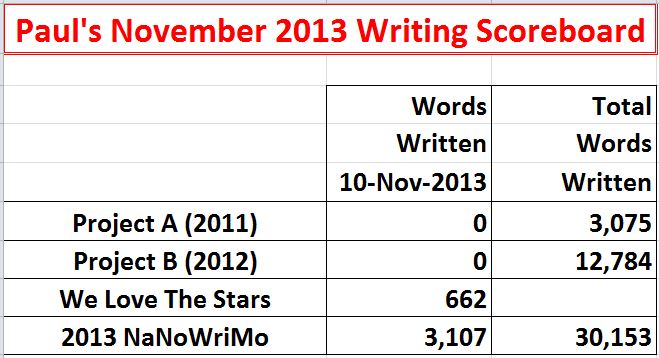
Today’s distractions have been brought to you by football, the successful return to Earth of the ISS Expedition 37 crew (congratulations on a great mission!), and the usual Sunday breakfast+groceries+shopping routine. Last week that routine and football had little-to-no effect on my word count because I was on a mission from God. With today’s IRL events coming on top of yesterday’s day-long event, the cumulative effect has been more significant.
To continue the running/marathon analogy, I had a great pace and was going strong — but now I’ve stumbled. My rhythm has been broken. I realize now just how hard I was pushing myself for this first week and I would really like a break – but one does not take breaks while running a marathon, if one can avoid it! While I’m still making progress, I feel a little bit like the football player who’s just caught a toe while running at full stride. (The analogy works for either version of “football”.) My figurative arms are windmilling and my figurative strides are uneven as I try to catch my balance and reset my stride, or, if that fails, at least go down semi-gracefully and not get hurt and knocked out of the game. So it will be important to see if I “fall” (i.e., end up with little or no output for NaNoWriMo for a day or two) or if I can “recover” (i.e., pick up the pace again and get back on track) in the next day or two.
Okay, so it might not be my best analogy, but it’s kind of the way I feel. Time to flail and stagger for a bit to see if any words come out. If they’re good words, so much the better. Maybe if I promise myself ice cream if I get ‘er done?
CHAPTER NINE (continued)
The camera came next. Tom was accustomed to using a good, high-end camera so it didn’t take long to set it up and get used to the subtle differences between the Canon he usually used and the new Nikon. He took a string of pictures using both lenses and also tried out the video capture capabilities.
The small telescope was trickier. The easy part was getting the camera to attach to it. Getting that setup to focus on something only a mile away or less meant that the focusing mechanism was pretty close to the end of its range. After all, t was designed to focus on nothing closer than the moon. But Tom found that it could be done, if only barely. He doubted that he could get it to focus on anything closer than a half mile or so, but for that he had the regular telephoto lenses.
The hard part of dealing with the telescope was the mounting. The modified half-horseshoe mount was computerized and designed to let beginning astronomy buffs find objects in the sky without learning where they were or how to point the telescope. Just set up the telescope properly, pick an object from the onboard database, and hit the “Go!” button. But that wasn’t what Tom needed it to do.
While it was possible to disengage the computer drive and manually point the telescope where you wanted, the mount was still designed to find things in the sky. Finding targets on the ground either at or below the horizon was not a normal operation. On the other hand, while the telescope itself could be removed from the mount, doing so and using as a huge telephoto lens was extremely awkward. The whole thing was unbalanced and unwieldy, with no way to attach it to the tripod or another system.
In the end, Tom decided to leave it attached to the mount. It wasn’t a perfect setup by any means, but it did allow the added benefit of having a good cover story built in. If someone should see him and become curious about his activities he could pass as an amateur astrophotographer setting up for a night of dark sky observations. That couldn’t be that unusual out here so far from the big cities.
He tested the rig with some pictures of Farmington, fifteen to twenty miles away on the plateau beneath the mountain he was on. Getting a really good focus was tricky, but when it got the hang of it the results were impressive.
Carefully Tom packed up all of the equipment, putting the telescope in the car’s trunk with the sleeping bag and new clothes, while he kept the camera and binoculars on the passenger’s seat where he could get at them quickly if needed. Crawling gingerly down the steep mountain roads toward the interstate, he headed back to his hotel.
CHAPTER TEN
The stack of brochures for local attractions split pretty evenly into two classes on closer review. There were a lot of activities in the region for the “indoors” or “mainstream” crowd who were looking for nothing more strenuous than maybe golf or water skiing. Other attractions for them in the region were shopping, jewelry, restaurants, even a winery.
For the “outdoors” or “active” crowd, the area within a three or four hours’ drive had at least a dozen national parks and monuments, plus state parks and historical sites. Many of the latter were associated with early Native American ruins and villages.
Tom wasn’t a dedicated hiker or outdoorsman, but he wasn’t in terrible physical shape either. A lot of his reporting assignments over the years had involved getting out into the field with various scientific teams, often in places well of the beaten path. He wasn’t going to be running any marathons any time soon, but a couple of hours of hiking on a trail designed for the average desk-bound and overweight American wasn’t going to kill him.
Sorting through the brochures, he built a list of all of the attractions and started summarizing some notes on each, along with building a map of their locations. It was soon obvious that many of the sites had been considered to be sacred or mystical sites and many still were.
It didn’t take much digging to find “New Age” connections to every single site, which explained all of the billboards for psychics and tarot card readers he had seen coming into town. It seemed like nothing sold harmonic crystals or mysterious psychic energy sources like the ruins of a two thousand year old Native American village location.
What Tom didn’t find was anything on any of those websites or in any of those brochures that said anything solid or factual about any of the grandiose claims. In particular, nothing was mentioned in any of the claims and treatises about the phenomenon that Tom and Jason had seen. The paranormal and supernatural claims were all the same vague, non-specific, open-to-endless-interpretation mumbo jumbo that Tom always saw when these sort of paranormal claims were made and supernatural services offered. He had investigated and debunked plenty of these types of claims when he was working as a reporter. It wasn’t science. It wasn’t even science fiction.
Most of the national parks and monuments had gotten those designations because they were unquestionably remarkable and stunning. The Bisti Badlands looked like a landscape from an alien planet with pinnacles and spires of rock carved into bizarre shapes and totems by millennia of wind and rain. Tom wasn’t surprised to find that some science fiction films and television shows had filmed outdoor scenes in the area.
Along those lines, Tom also immediately recognized Monument Valley from the movies, but not science fiction films. He suspected that it had been seen in probably 90% of the westerns made in the 1950’s and 60’s.
As for Native American sites, the Aztec Ruins National Monument was also a UNESCO World Heritage site. So was the Mesa Verde cliff dwelling city. Shiprock Pinnacle was a sacred site to the Navajo. Canyon de Chelly was an ancient fortress and city predating the arrival of the Europeans by centuries.
Many of the ancient sites had some sort of astronomical building or a suspected observatory location in addition to the other buildings and homes. Related in spirit to other ancient observatories at places such as Stonehenge in England, Chichen Itza in Mexico, Angkor Wat in Cambodia, the Egyptian pyramids, Tikal in Guatemala, Medicine Wheel in Canada, Machu Picchu in Peru, and countless others, these locations had been far more advanced than anything used by Western astronomers for hundreds of years before the Renaissance had given birth to the telescope.
Finally, as he was startled by the horn of a fast moving passenger train rolled through town, Tom was noting that there were also several historical railroads up in the mountains. Now they took tourists up to the Grand Canyon and some of the other big parks, as well as on wine-tasting tours and “murder mystery” rides. A hundred and fifty years ago they had been a vital to the mines and cattle ranchers and a huge part of the development of this part of the world.
While he felt more knowledgeable now, Tom still didn’t see how any of those pieces fit in with the puzzle he was trying to solve. What did any of those things have to do with why the commune members had come here? Why would any of those things have attracted Auntie Annie here? And why would she be making those funeral urns out here with the bizarre artwork?
Granted, Annie by herself was probably just a loon, prone to making bad or bizarre decisions. But if she had others involved, especially others who weren’t out of touch with the real world, someone must have had a reason to come to this part of the world instead of another. And if they were making funeral urns with weird artwork for $5,000 a pop, someone had to be very much in touch with the real world.
It could have simply been that the land was cheap and the locals minded their own business, so commune members could find a place where it felt safe and they would be left alone. That could be especially true after they got evicted from their long-time home outside of Manitou Springs. While it would seem that there were plenty of other places that might fit that bill and not be 100-plus degrees every day during the summer, maybe that’s all it was, a need to be away from everyone else. There was most certainly a lot of room to run away to out here.
Tom was shaken from his revelry by another new icon popping up on his phone. He tapped it and watched as a secure connection was made to his home system, followed by the opening of a mapping application. The map showed the Farmington area, with two colored, blinking dots standing out. Almost immediately a chat window opened up from Jason.
“I can confirm that this connection is secure. Anything exciting happen today, Tom?”
“I took your suggestion and got some tools and toys,” Tom typed, explaining to Jason about the gear he had gotten earlier in the day and how he had tested it out. “I think that will give me a good start, especially for a rank amateur.”
“No half measures, eh, Tom? You told me that you were a reporter of some kind? Some day you’re going to have to tell me how you can afford to just go out and buy all of that stuff on a reporter’s salary.”
“Don’t sweat it, Jason. Let’s just say that I’ve made some good investments. Other than that it’s a story for another day, like when you tell me where you’re getting all of these James Bond-like computer programs. Speaking of which, is this new app what I think it is?”
“If you think it’s a tracking map for your GPS tracking devices, then yes, it is. You’re the green dot, Ellen’s car is the red one. If you tap on any of the dots you’ll be able to see a track and history of that device’s movements. Try it.”
Tom tapped the green dot and the map zoomed in to show an area of a mile around his current location, with a bread crumb trail of smaller and dimmer green dots leading off along his earlier path. Zooming back out a bit and following the trail, Tom could see exactly where he had gone on this afternoon’s trek. Hovering the cursor over the trail caused the cursor to change to a time stamp indicator. Tom was impressed.
“How often does the location update?”
“Readings are taken once a minute and sent to the server in real time, assuming that the unit can get a connection. If not, it can store up to a week’s data and then upload it later when a connection becomes available.”
“How long will these things last? What’s the battery life?”
“It’s anywhere from sixty to ninety days, but there are other factors that can affect it, such as low temperatures. Up there if it’s getting below freezing every night, we’ll get less, but I expect we’ll still get at least forty-five to sixty days.”
“What’s the accuracy on these readings?” Tom asked.
“The specs say about ten feet, plus or minus a foot or so. I don’t know if you should use it for driving in the dark without lights in the fog, but it should let you see where Ellen’s car is in the parking lot next time.”
“Great. Where is she now?” Tom tapped the red icon.
“She’s somewhere a couple of miles off of the main roads over near the Arizona border. It doesn’t look like your friend has been anywhere else except for the post office since you tagged her last night. You can see that she stopped at what looks like a gas station as she got off of the highway on the way home, but other than that she went straight to that location and hasn’t moved.”
“Do we know what’s out there? Is it a farm or another commune?”
“That’s the next interesting thing. Double tap the dot to get a menu, then go to the Google Earth overlay.”
Tom did as he was instructed. The location showed itself to be nothing but dirt and weeds, no matter how far he zoomed in on the image.
“There’s nothing there. Are they camping out or something?”
“Look at the image data in the fine print down at the bottom. The picture you’re seeing is over ten years old. Do you know how to use the history function on this map app? Most people know that they can slide back through older pictures and maps, but they don’t know that sometimes you can also use it to go a little bit the other way? Pull that history slider to the left, then bring it back to the right all the way against the stop and watch what happens.”
Again Tom did as he was instructed. Nothing much changed as he moved the slider to the left, since today’s dirt pretty much looked a lot like yesterday’s dirt. The only significant difference was that the image quality kept going down as older and older aerial photographs were used and they were soon in black and white. Then Tom brought the slider back smoothly to the right, the images flipping forward in time. Suddenly there were a group of over a dozen buildings shown when there hadn’t been any before.
“I see it now, but what just happened?” Tom typed.
“The default aerial photo for this location is over ten years old and it shows an empty desert location. But it turns out that there are newer photos available, you just have to know to ask for them. This latest photo is only six months old and it shows a compound there.”
“Why wouldn’t the most recent data show up by default? Could it be simply some sort of database error? After all, that function to force the most recent data to show instead of the default has to be there for a reason.”
“True, that little trick exists for a reason. There are times that Google deliberately doesn’t want to show the most recent data. Any government might request that for security or military reasons. Google might be collecting new data and building a new data set for an area and they don’t want to integrate it until it’s completed. Neither of those explanations appears to apply here as far as we know. So what do you think, is it just a coincidence?”
Tom was starting to get sick of that word. “You keep using that word, but I do not think that it means what you think it means,” he typed back.
“Inconceivable!” replied Jason. At least Tom now knew that he had a respectable background in classic cinema.
“So, someone’s hiding something and they’ve either got enough pull to get Google to do it for them or they’ve got enough skill to get into the database and change it themselves. Can we use this to figure out when the compound was built?”
“I already did that. It went up very quickly, about year and a half ago, which would put it a month or so after the commune in Colorado was shut down.”
“Correlation does not imply causation,” Tom typed.
“True, but it does give us something to think about. In addition, that compound doesn’t look ramshackle, it looks conventional construction. You’re the guy with money, you tell me how many bucks you need to put up a dozen buildings like that. So where did a bunch of hippies get that kind of money?”
“Maybe they’re not hippies. Maybe it’s some kind of religious cult. They wouldn’t be the first ones to hand over all of their worldly possessions to some self-proclaimed prophet only to live like slaves for payback.”
“Either way, that’s your target. Just be careful. The more we find out the less it makes sense, but we do know we’re dealing with people who have some skills, some resources, and a strong desire to not be found. They may react badly toward someone actively tracking them down and spying on them.”
“I’ll keep that in mind,” Tom typed.
“You’ll also need to keep in mind that they may have other vehicles and other people. You know about Ellen and Annie and this lady who was driving last night, but there could be two other people there or twenty-two.”
“Times like this I wish we could just turn this over to the police or the FBI or someone and let them handle it. Then I remember what we’re investigating and how those padded cells don’t have internet access.”
“You have that right. Two more things,” Jason typed. “First, go into the setup menu on this app and you can have it send you a notice when a target starts to move. You’ll want to do that, but don’t bet your ass on it. The data for this app is actually being stored on your system at home for security reasons. You’ll only have access to it when you have a secure connection. You should be able to get that any time in town or on the highway where you’ve got a good, high speed connection, but you might not have it out in the boonies. As in, out in the boonies near this compound where you might really need it on short notice.”
“Thanks for the heads up. I’ll send messages whenever I’m able, to keep you up to date on what I’m doing and what I plan to do. I think tomorrow I’ll start trying to get a better idea of what and who are out there.”
“Great. What do you plan on doing tonight?”
“It’s clear, it’s getting dark early these days, and I’m supposed to be pretending to be an amateur astronomer out here for the dark skies. I think that I’ll make a show of checking with the hotel front desk for advice and directions, then taking all of that gear out to actually look at the stars.”
“Be careful.”
“What, do you think I’m going to coincidentally run into Ellen or her friends out there while watching Jupiter’s moons?”
“No, I’m worried that you’ll trip in the dark and break your leg, or go over the edge of a cliff.”
“I’ll be careful. About all of those things.”


 We Love The Stars Too Fondly