
Twenty-four hours from now, the moon will look radically different than it does now. We’re not talking about the day-to-day progression of the phases. We’re talking about it going from full to dark in just a couple of hours, then back to full. It might be so dark as to vanish if you’re surrounded by bright city lights and the accompanying light pollution. It might be dark red, or coppery red, or orange, or a little bit of all of it.
Tomorrow night we have the first of four total lunar eclipses, a phenomenon known as a tetrad. The totality phase of the eclipse on the night of April 14th & 15th (TONIGHT!) will be completely visible to everyone in the continental United States, most of Canada and the Carribean, and the western 2/3 or so of South America.
Sorry, Europe and Africa and Asia — but you get the next one, on October 8th.
If you’ve never seen a total lunar eclipse, don’t confuse it with a solar eclipse and all of the warnings you have (justifiably) hear about looking at one.
- Solar eclipse — NEVER look at the sun without proper protection (easily obtained) or you can cause permanent damage to your vision.
- Lunar eclipse — Look at them all night long, absolutely no chance of any damage to your vision.
- Solar eclipse — Totality visible only in a very tiny curved path across the earth, outside of that you get only a partial eclipse.
- Lunar eclipse — Visible to everyone in the hemisphere, the entire half of the plane where the moon happens to be above the horizon.
- Solar eclipse — Totality lasts anywhere from a few seconds to seven minutes, depending on the orbital mechanics and where you are on the path of totality
- Lunar eclipse — Totality lasts for hours
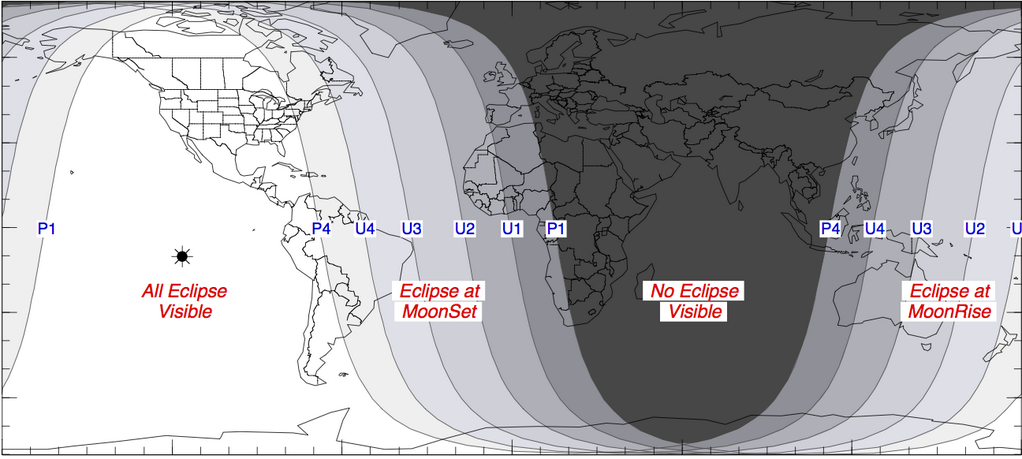
In that last respect, lunar eclipses can be borderline boring, especially for a member of the general public who is expecting something more like a solar eclipse. You can watch the lunar eclipse over several hours. Keep in mind that there are two parts to the Earth’s shadow, the dim outer shadow known as the “penumbra,” and the dark inner shadow known as the “umbra.” Here’s the general gist of it:
- P1 — The bright, round, full moon starts to dim ever so slightly as the leading edge of the moon starts to touch the penumbra. In the penumbral phases, you may not even know that the eclipse has started, it’s not much of a change.
- U1 — The moon’s leading edge starts to first enter the umbra. This is when you’ll start to see the curved shadow of the Earth slowly moving across the moon’s face, very noticable. “Slowly” as in “it’s going to take an hour and eight minutes for the moon to get totally into the shadow.” Tonight this phase starts at 05:58 UT, 1:58 AM EDT on the US east coast, 12:58 AM CDT, and 10:58 PM PDT on the US west coast.
- U2 — The moon’s trailing edge enters the umbra and totality begins. 07:06 UT, 3:06 AM EDT, 12:06 AM PDT for North America.
- U3 — The moon’s leading edge starts to exit the umbra and totality ends, 08:24 UT, 4:24 AM EDT, 1:24 AM PDT for North America.
- U4 — The moon’s trailing edge exits the umbra, at 09:33 UT, 5:33 AM EDT, 2:33 AM PDT
- P4 — The moon’s trailing edge exits the penumbra and the eclipse ends, 10:37 UT, 6:37 AM EDT, 3:37 AM PDT.
This map, from “Eclipses During 2014”, F. Espenak, Observer’s Handbook – 2014, Royal Astronomical Society of Canada, shows where those phases can be seen:
For those not familiar with the term, “UT” is Universal Time (defined as the time in Greenwich, England, at zero degrees longitude), used by astronomers and others so that no matter what time zone you’re in, we’re all comparing apples to apples and oranges to oranges when describing when something happens. The military and pilots refer to this as “Zulu” time.
If you look at the diagram, you can see that the moon will be entering the Earth’s shadow from the right as we see it, moving to the lower left.
In the partial phases, it will almost look like the moon is undergoing its normal phases — except that the terminator is curved, not straight, it’s orientation is all wrong, and it’s growing or shrinking “slowly” (see definition above).
As we get near totality and the bright white portion of the moon starts to shrink rapidly, you’ll start to see the moon turn colors, probably to some shade of red, orange, or brown. What color will we see on this eclipse? No one knows, it varies unpredictably from eclipse to eclipse. The color is affected by the amount of dust, clouds, and other conditions in the Earth’s atmosphere, which acts like a lens to bend a tiny fraction of the light passing through it back onto the moon. It’s the same effect that gives us all of those orange and red and salmon and pink colors at sunset, just on a much bigger scale.
Can you take pictures or video of the lunar eclipse? You sure can! (I thought you would never ask.) A DSLR with a telephoto lens works best, or a small telescope that you can attach your camera to. Mount the DSLR or a video camera on a tripod.
What exposures? Whatever you do, do NOT trust your camera’s automatic system to measure the light and set the exposure. I guarantee it will get it wrong. As I’ve talked about before, digital pictures are cheap, cheap, cheap, so take LOTS of pictures. Bracket a series of exposures from what might seem way too dark through what might seem way too light. Somewhere in there it will be perfect. (It’s the Goldilocks strategy!)
What I will typically do is to start taking sets of pictures every five minutes or so (or ten minutes, or whatever), with every set being probably twenty to thirty pictures, all one step apart on the shutter speed. So, get it focused, then start shooting.
In the very early or very late stages the moon will be bright, nearly full, so I’ll be shooting 1/4000 (dark & underexposed), 1/3200, 1/2500, 1/2000, through 1/125, 1/100, 1/80, and 1/60 (bright & overexposed).
In full totality the moon may be very dark, so I’ll probably be down at 1/10, 1/8, 1/6, 1/4, through to 5 sec, 6 sec, 8 sec, or even more. Note that if you’re using a telescope or telephoto lens and not guiding or tracking along with the movement of the moon, any exposures of several seconds will be blurry due to the moon’s motion (i.e., the Earth’s rotation).
There you go!
Check your weather and I hope you have clear skies. (Los Angeles is looking okay so far, but we may get some high clouds. As long as it’s not fog or the “June gloom”!)
Find a nice spot where you can see the moon clearly, especially if it will be rising at the beginning of the eclipse or setting at the ending.
Get a lawn chair, lose some sleep, and see a most beautiful and amazing sight, a demonstration of celestial mechanics at its best.
If you get bored, take a look at Jupiter, very bright and ahead of the Moon by about a third of the sky, or Mars, bright and very distinctly orange or red to the naked eye, leading the Moon by just bit as they cross the sky.
Enjoy!


 We Love The Stars Too Fondly