
Last night I went on at some length about tonight’s total lunar eclipse, visible starting at about 11:00 PM on the US west coast, 2:00 AM on US the east coast. I won’t repeat much of that, except:
- P1 — The bright, round, full moon starts to dim ever so slightly as the leading edge of the moon starts to touch the penumbra. In the penumbral phases, you may not even know that the eclipse has started, it’s not much of a change.
- U1 — The moon’s leading edge starts to first enter the umbra. This is when you’ll start to see the curved shadow of the Earth slowly moving across the moon’s face, very noticable. “Slowly” as in “it’s going to take an hour and eight minutes for the moon to get totally into the shadow.” Tonight this phase starts at 05:58 UT, 1:58 AM EDT on the US east coast, 12:58 AM CDT, and 10:58 PM PDT on the US west coast.
- U2 — The moon’s trailing edge enters the umbra and totality begins. 07:06 UT, 3:06 AM EDT, 12:06 AM PDT for North America.
- U3 — The moon’s leading edge starts to exit the umbra and totality ends, 08:24 UT, 4:24 AM EDT, 1:24 AM PDT for North America.
- U4 — The moon’s trailing edge exits the umbra, at 09:33 UT, 5:33 AM EDT, 2:33 AM PDT
- P4 — The moon’s trailing edge exits the penumbra and the eclipse ends, 10:37 UT, 6:37 AM EDT, 3:37 AM PDT.
This map, from “Eclipses During 2014”, F. Espenak, Observer’s Handbook – 2014, Royal Astronomical Society of Canada, shows where those phases can be seen: 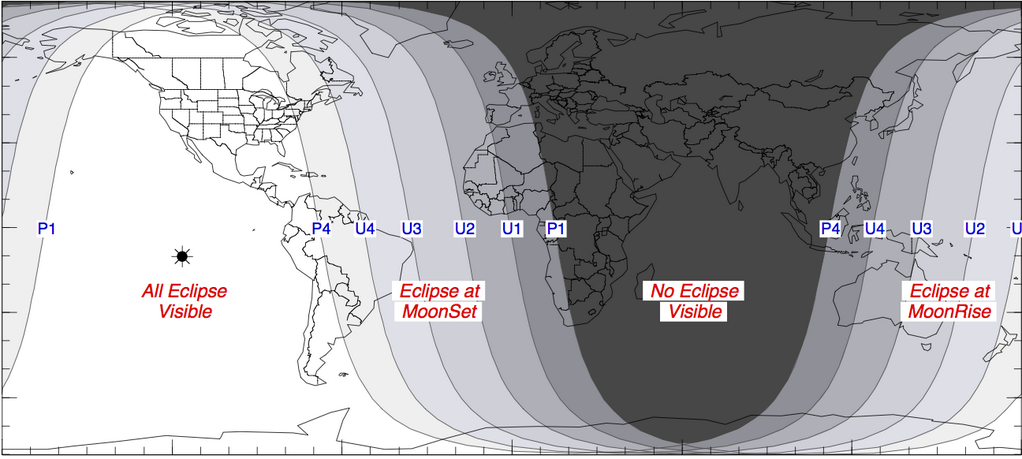 I mentioned that you will also be able to see Jupiter and Mars in the early part of the evening. Shortly after sunset/moonrise, Jupiter will be almost directly overhead, bright white. Any decent pair of binoculars will show the Galilean moons (Io, Europa, Ganymede, & Callisto), and if you watch them over a couple of hours you can see them move, just as Galileo saw. There are a number of places online that can show you in real time which moons are where. If you’re a Sky & Telescope subscriber, they have a particularly excellent one.
Mars is very bright, reddish orange, ahead of the moon by about an hour or so right now. (I could look it up, but I want to get back out to the ‘scope.) Look “ahead” of the moon as it goes from east to west, the bright red thing is Mars, only a few days past opposition.
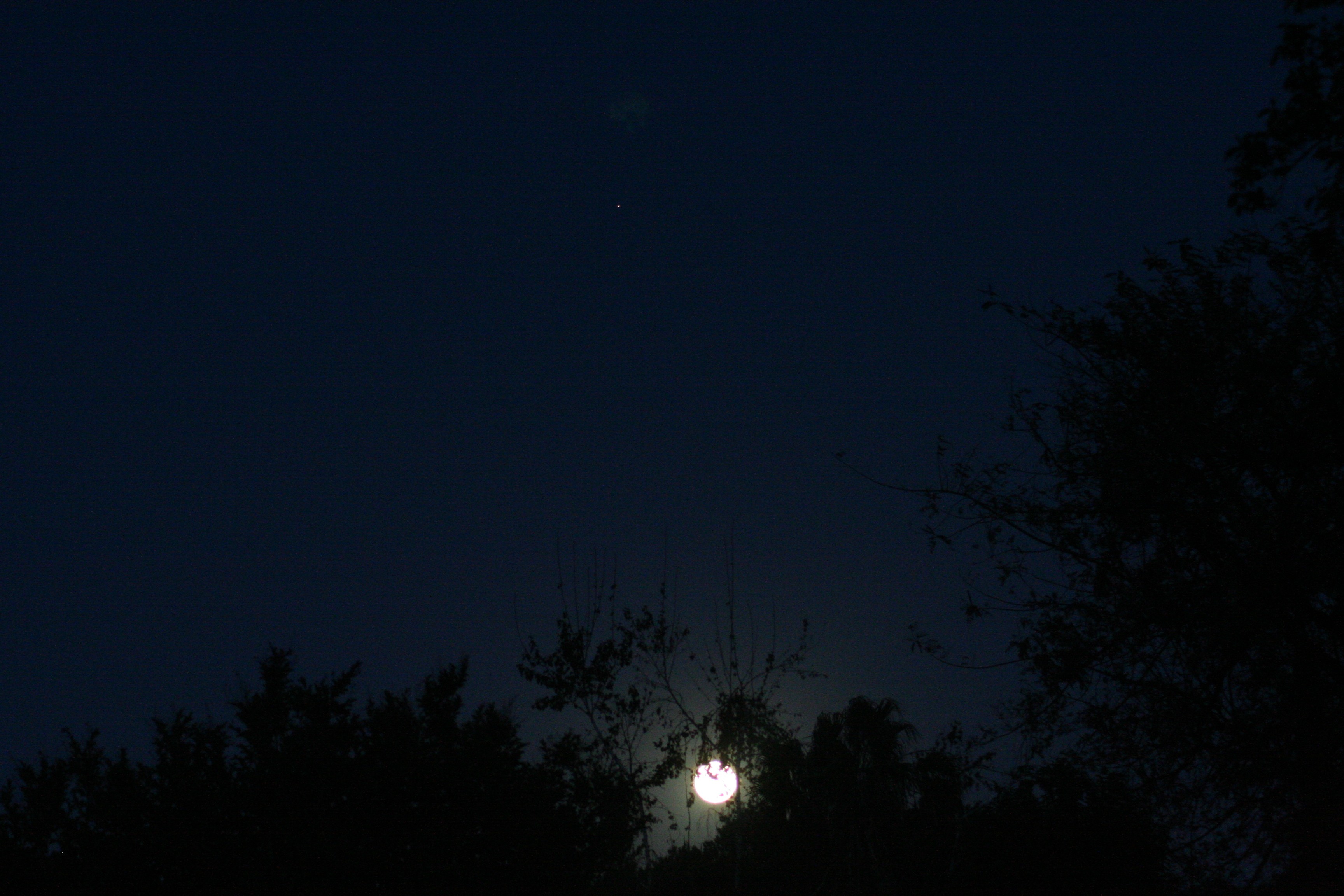 This is what it looked like shortly after moonrise at our house — Mars is clearly visible upper center.
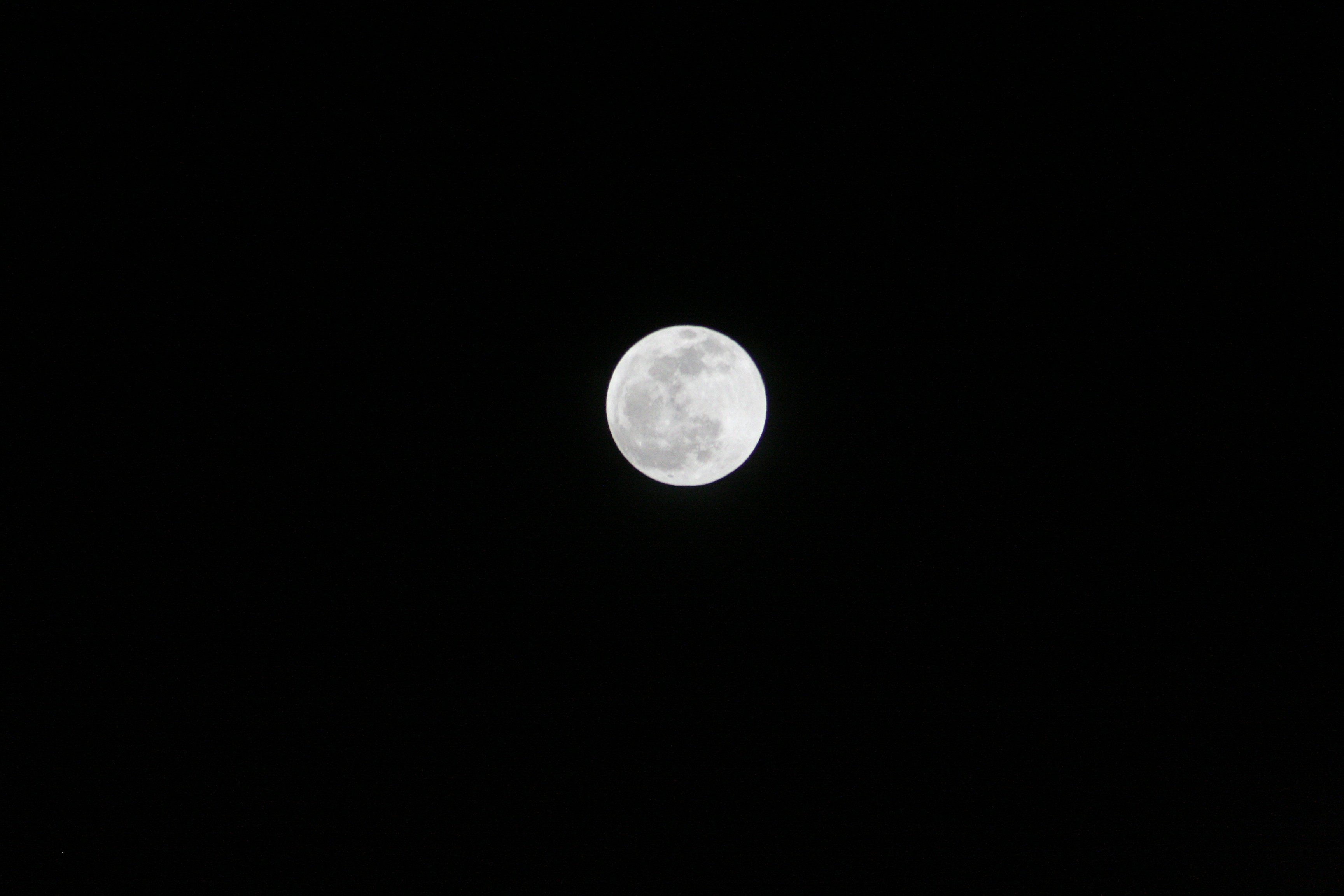 Once it cleared the trees, the full moon through a telephoto lens is really bright. This was taken at 1/4000 second, the fastest my Canon can go, and it’s still a bit overexposed.
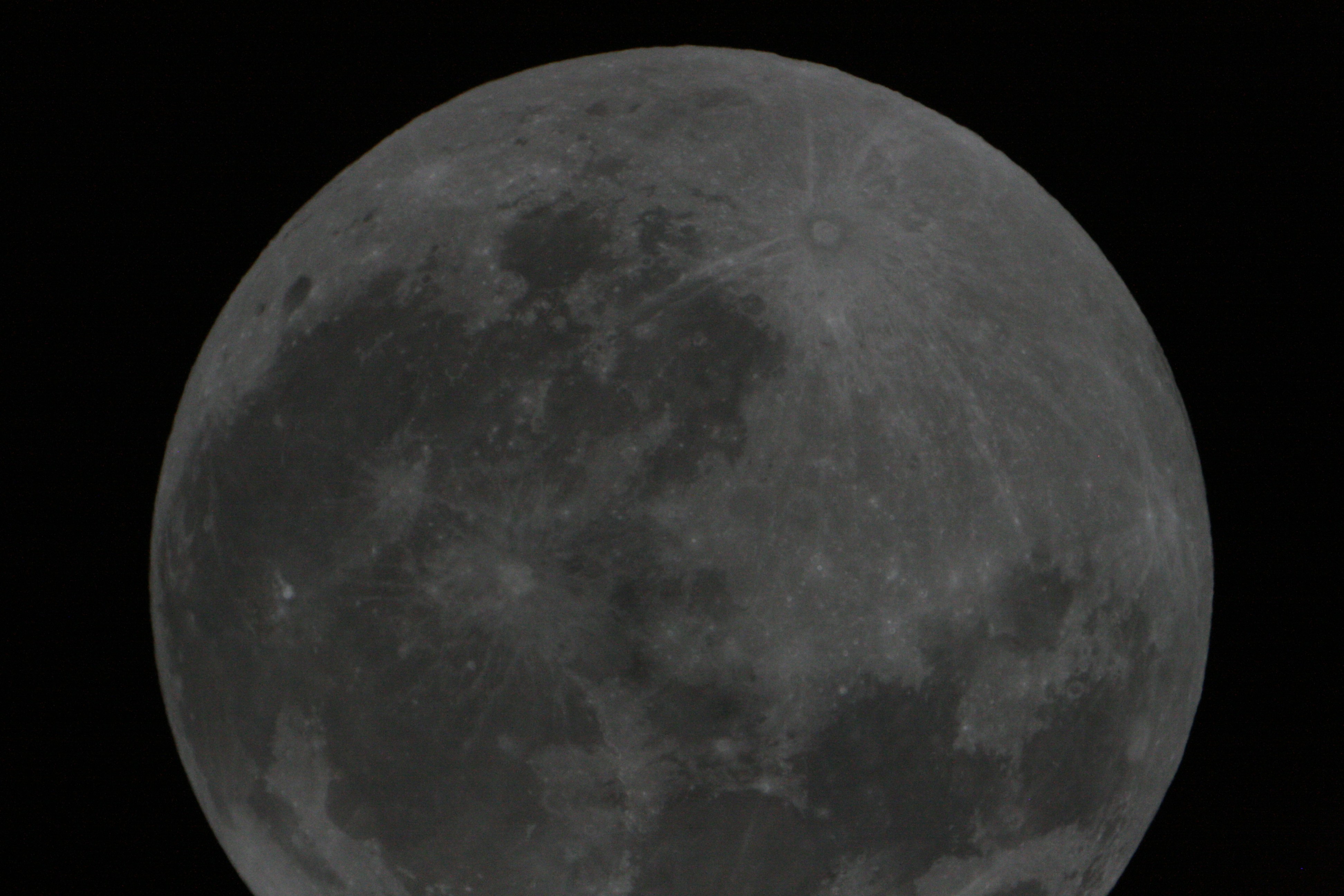 Through the little Meade, this is the full moon a few minutes ago. Again, very bright, shooting fast. (This is at 1/2500 second, but as a lens, the Meade isn’t as “fast” as the telephoto lens.)
We’re starting to get a few high clouds here in LA, but I’m hopeful that we can dodge them or peek through them.
About 70 minutes until the umbral eclipse starts, about 2:15 until totality starts. On your marks, get set…


 We Love The Stars Too Fondly