
Last weekend I gave everyone a “heads up” about a week of fantastic ISS passes in both the evening and morning for much of the United States. And for many parts of the world for that matter — it’s an orbital mechanics thing.
Following my own advice, I went out and saw all of the evening passes. (I don’t do pre-dawn if there’s any way to avoid it, sorry.) As usual, I had my camera, and this time had a bit more first-hand experience from last Sunday’s ISS pass and the pictures that I got then.
Tuesday’s pass at 21:58:43 was lower in the sky, shorter duration, and a bit dimmer. (“A bit dimmer” is still brighter than everything except the sun, moon, Venus, and Jupiter.) Since it was going right above all of the street lights that gave me so much trouble last Sunday, I left the camera inside and just watched it. And waved, of course. You always have to wave just in case the astronauts are looking down at that moment.
Wednesday’s pass was about the same as Sunday’s, fairly high, long, and bright, so out came the camera.
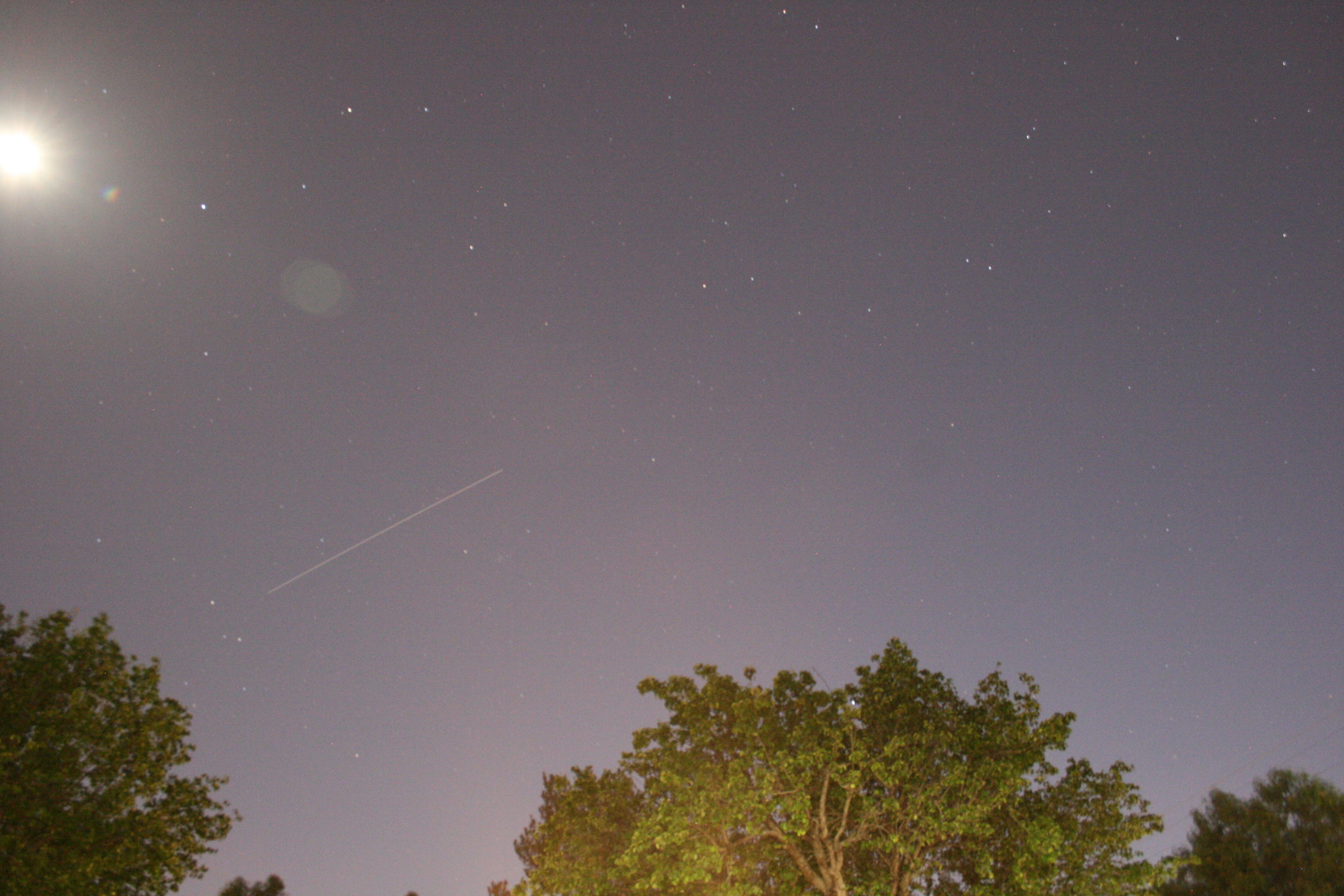 Even though there was a bit of interference from the moon, a 31-second exposure showed a nice ISS trail.
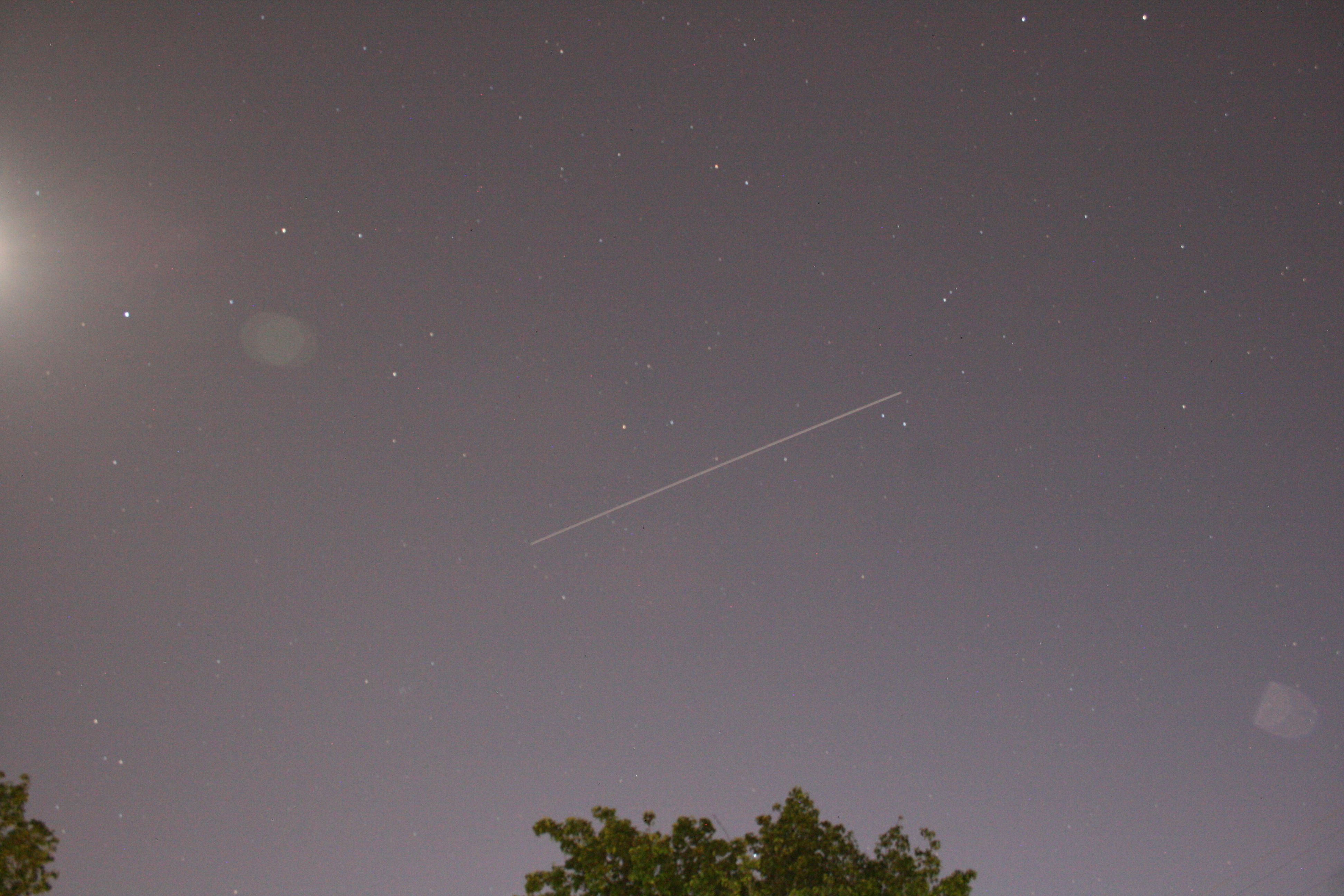 Another 31-second exposure, coming from the lower left (west southwest from this view) to the upper right (almost due north). The Long-Suffering Wife came out to watch this pass with me. She was treated to the sight of me gallivanting insanely across the street and back carrying camera gear and tripods.
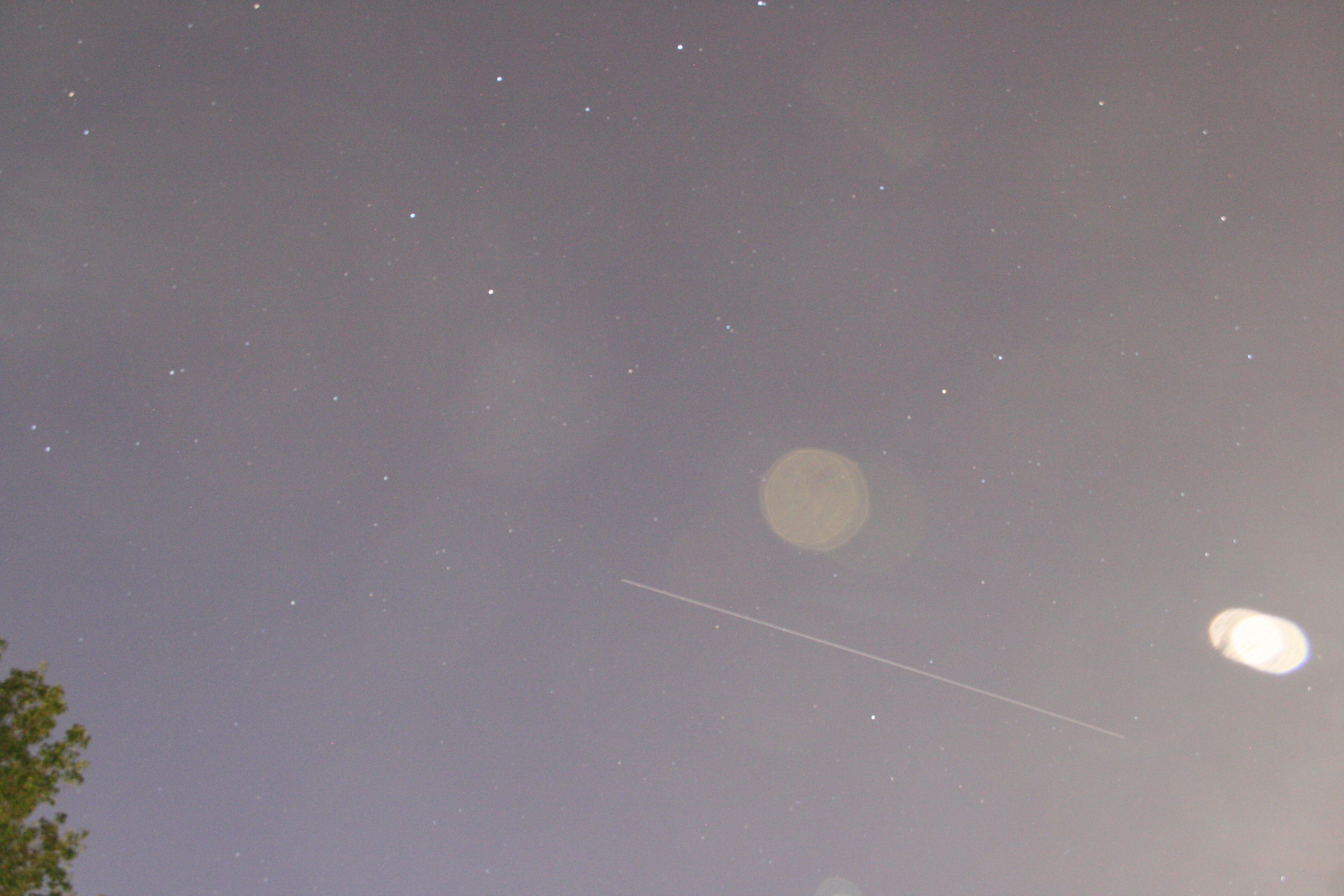 Moving off to the north, a 46-second exposure also starts to pick up some internal lens flares from the streetlights just beneath the frame.
Thursday night I posted a number of comments on both Twitter and Facebook about how fantastic and spectacular that pass was going to be. I based that conclusion on the fact that it was an extremely bright pass (magnitude -4.1) and that it would go straight overhead (highest elevation was 89.2 degrees). I just missed one teeny, tiny little piece of the puzzle.
 With the ISS rising at 20:20:20 local time, the sky was just barely starting to get dark. The sun had just set at 19:49.
This picture was the best of the few that showed anything at all, and it was a 1-second exposure. Other pictures where I put the camera back on “auto” mode were shot at 1/10-second and show nothing but blue sky with what might be a tiny little withe dot.
If you take a 30-second or 45-second exposure of the sky at that time, you get a picture that is 100% white. You will not see the ISS in the picture. Well, maybe the NSA could manipulate the file to get any data that might be in there, but Photoshop won’t. (I tried.)
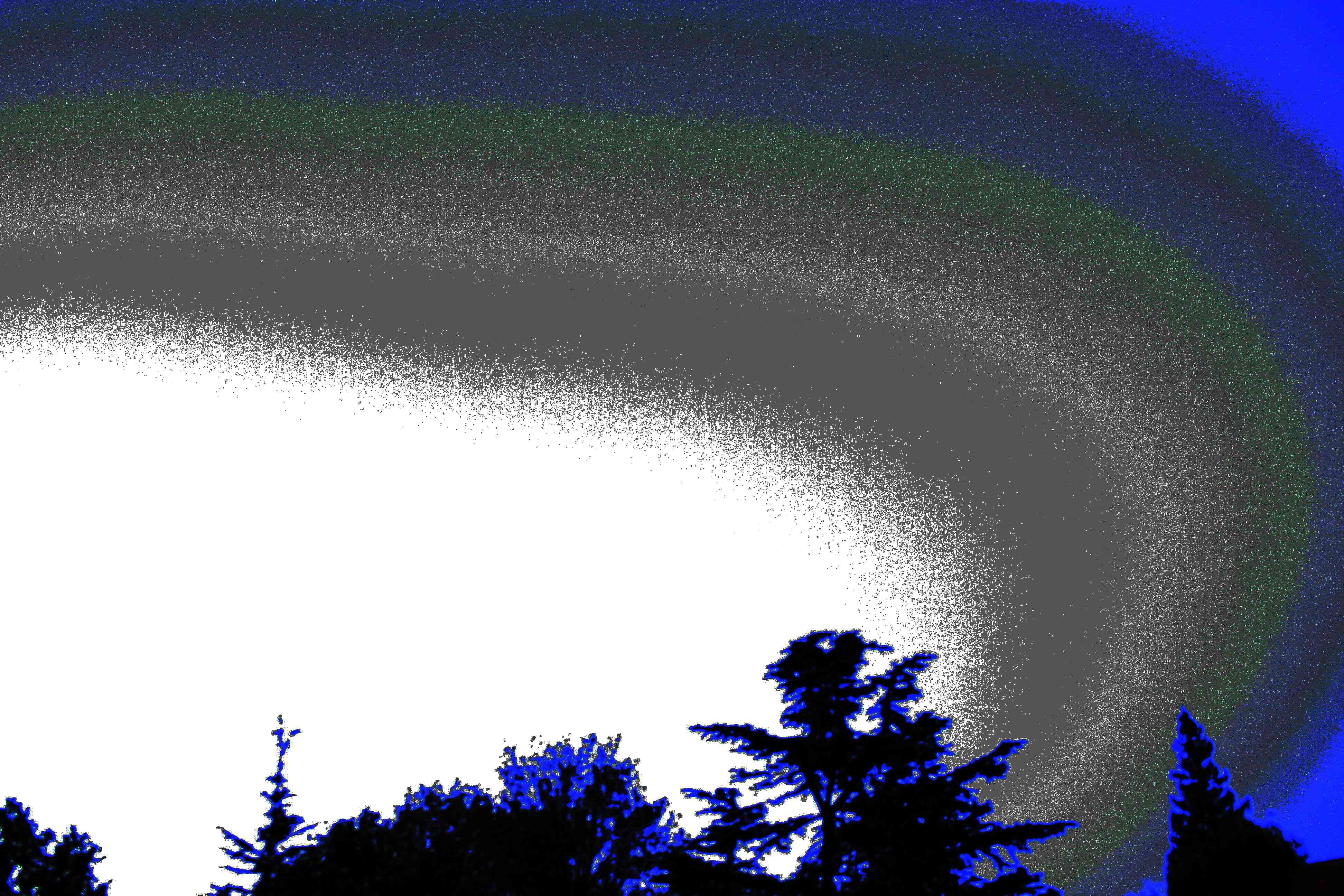 Very pretty and bizarre, but my Photoshop-fu is not strong enough to make that dog hunt. (Thank you! I’ll be scrambling mixed metaphors all week!)
The lesson here is obvious — a magnitude -3.3 object is much easier to see in a dark sky than a much brighter magnitude -4.1 object in a much, much brighter sky.
The other lesson (which I already knew) is that the human eye is capable of things that cameras can’t come close to doing. To the eye, the ISS was invisible at first, coming out of the sky due west of us (right where the sun had just set just thirty minutes earlier), but once it got about thirty degrees above the horizon it was clearly visible. Being very bright and moving up to where it was directly overhead before sinking off to the northeast, it was beautiful.
In addition, being in a blue sky rather than a black sky seemed to make it look like it was moving much, much faster. I think this is an optical illusion caused by the fact that we’re used to seeing high-flying planes which look similar but are either much bigger and moving quickly across our field of view, or much smaller and appearing to move slowly. When we see something the ISS in the daytime, our brains are predisposed to interpret as a high-flying plane, but since it’s travelling across the sky in just a fraction of the time that a high-flying plane would, its speed is very apparent.
In short, during the day we see it as an object very high and very fast. At night, we see it as a slow-moving star with fewer references.
So next time you get a notice from your software (or me) that there are ISS passes coming up, note the date, time, brightness, maximum elevation, direction — and double check to see when the sun sets or rises so that you know if you’re in twilight or darkness.
Or just forget about the camera, grab a lawn chair, and go watch!


 We Love The Stars Too Fondly
I saw one on Wednesday evening, while I was hanging out in the hot tub.
LikeLike