
To Recap: In May, 2012 I went to Asia on the “Three-Countries-Three-Weeks-Three-Kids” tour. The first stop on this once-in-a-lifetime trip was Shanghai, followed by several days in Seoul. Now I was footloose and fancy-free (i.e., lost a lot) in Kyoto, Japan. I found one of the most beautiful and interesting places I’ve ever seen and I’m going to continue to bombard you with share dozens of pictures from there with you for the next few weeks.
Now we’re getting to the really good stuff. Remember, you can click on any photos to get larger versions.

Leaving behind the Fushimi Inari temples at the base of the mountain, we start to climb the mountain. I didn’t ever find it to be a particularly strenuous or steep climb, nor is it miles and miles to the top. But there will be places where you’re huffing and puffing a bit, especially if you’re toting a backpack full of cameras. (Ahem…)

Here for the first time you can see the rows upon rows of vermilion torii gates that line the paths up the mountain.

While they’re all initially painted the bright vermilion color that’s associated with Inari Okami, they fade in the weather and are repainted at different times, leaving an endless variety of colors from near-white, to pink, to red, to bright orange.

The paths split and wind around the hill, only to re-split, re-connect, and split yet again. It’s not so much a maze as it is a chance to tour the mountain using dozens, if not hundreds, of different routes.

Yet another junction, a chance for you to choose your path forward. (Very zen! Probably the wrong religion.) I didn’t see any signs or markers indicating which path was which, at least not in English, so if you’re going to be obsessive about going on every route or something, you may have a problem.
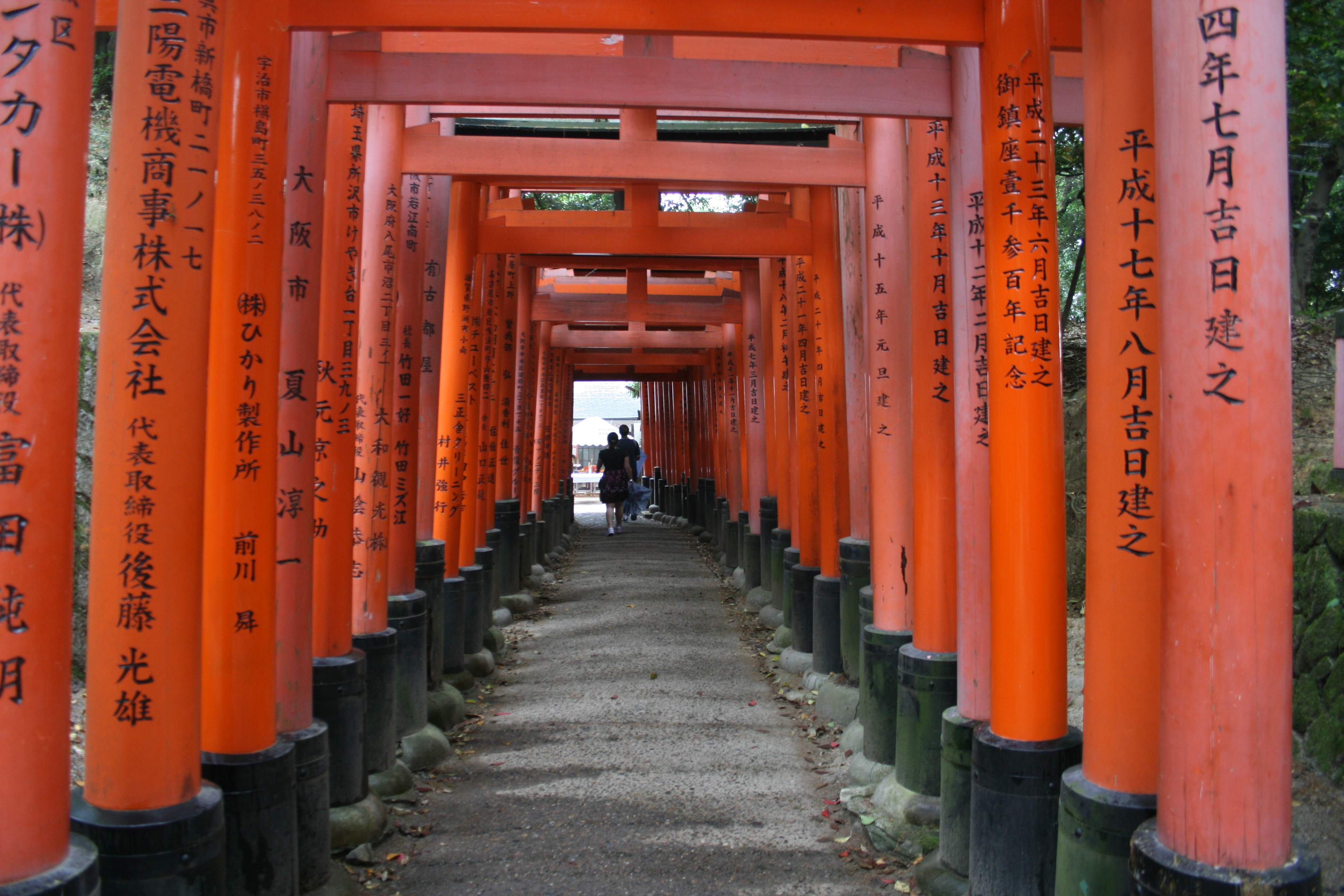
There are many, many interesting perspectives. As you can see, many of the posts on the torii gates have Japanese inscriptions on them. I believe they’re prayers or the names of ancestors or sponsors, but I could be wrong.

Looking back at the same torii gates, I noticed there aren’t any inscriptions on the other side. I’m sure there’s a reason or significance, but I don’t know what it is.

Then I found a side path that looked quite different, heading off into a glade. The torii gate here is not painted (but is still beautiful) and at least at first there’s just the one large on at the entrance.
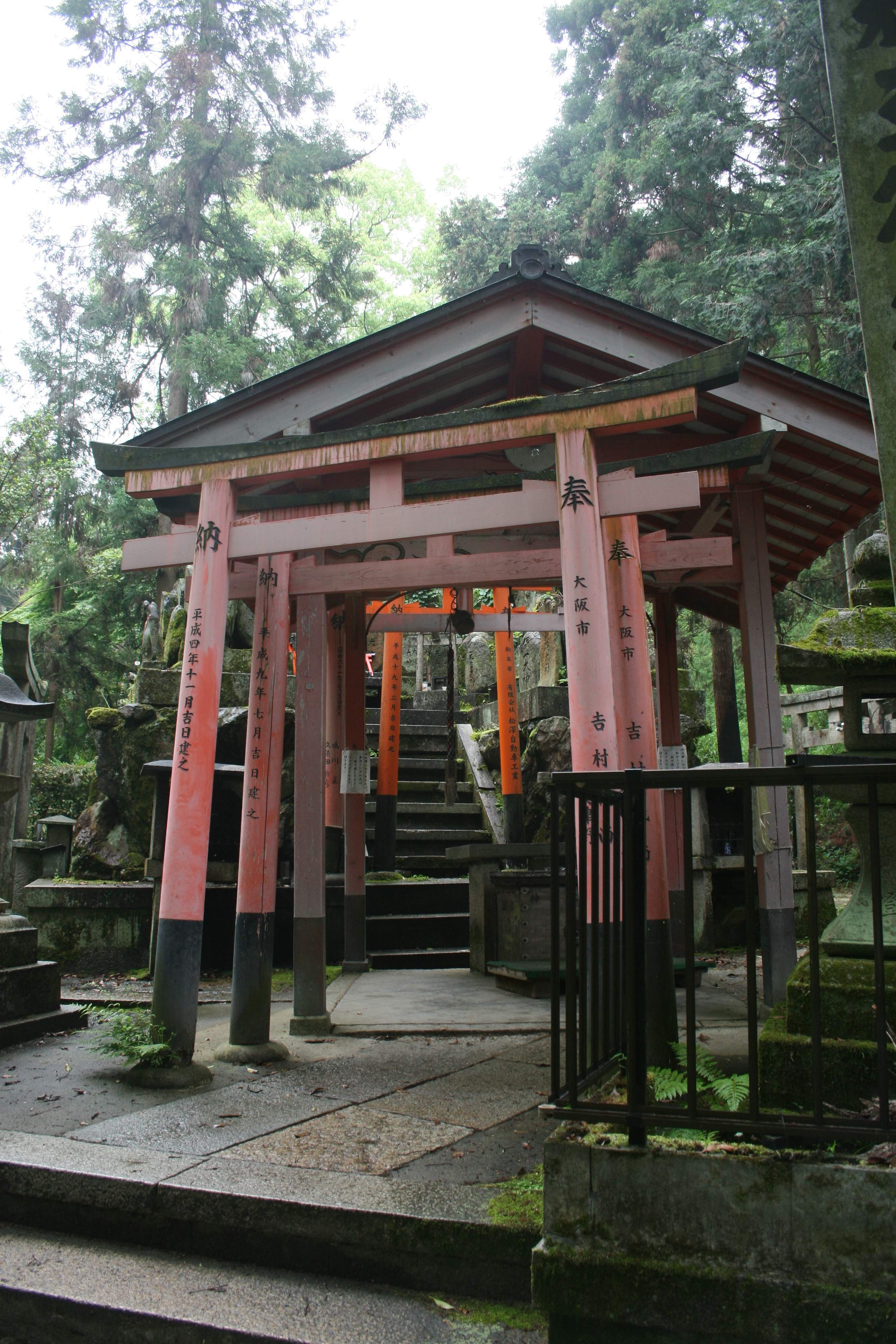
Inside the shrine in the glade, there are a few vermilion gates. For the first time I saw small family shrines. I was told that the shrines are built and maintained by families for their ancestors, but it’s not clear if they actually contain ashes as a Western graveyard would, or if the shrines are just ceremonial memorial sites.
Next time we’ll look more at the small family shrines here (they seem to be different in many ways from the shrines higher up the mountain) and get some fantastic views of the torii gates from outside.


 We Love The Stars Too Fondly