
You may have heard (like here where I ranted about it last week) that there’s a partial solar eclipse tomorrow afternoon. As always, BE SAFE WHEN LOOKING AT THE SUN, but beyond that, the short version is that the further north and west you are in North America, the more of the sun you’ll see covered. There’s an excellent map here that shows coverage for tomorrow. If you’re in the Los Angeles area, here’s a great graphic from Griffith Observatory showing what to expect and the times:
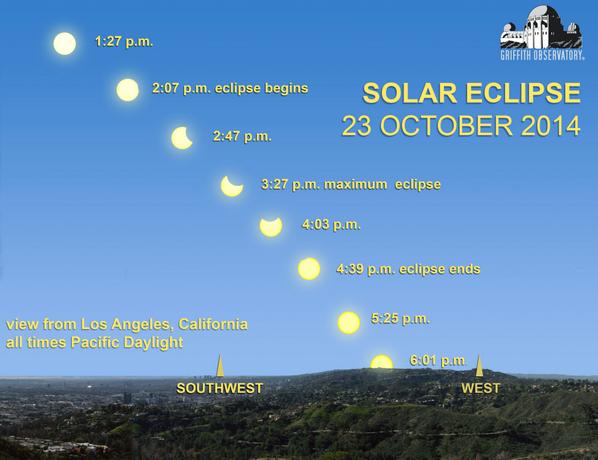
(Graphic credit: Griffith Observatory)
To make it even better, as we speak there’s a honkin’ HUGE spotspot facing us. It’s shooting off some major flares so there are some great aurora at night if you’re in Canada, Scandanavia, Russia, or even the northern tier of US states.
This thing is so big that it can clearly be seen with the naked eye IF YOU’RE BEING SAFE WHILE LOOKING. (You think there’s an underriding theme here, huh?) If you’ve got a solar filter (you can get cheap plastic/mylar ones for a dollar or two at many camera shops, or online, it’s easy to see. If you catch the sun just as it’s rising or setting and the atmosphere is cutting down its light to the point where it’s safe to look at, you should see it clearly.
And, of course, if you’ve got your solar filter already taped onto your camera because you’re going to be taking pictures of tomorrow’s partial solar eclipse, then you can pop out into the front yard for five minutes and see if it’s all working.
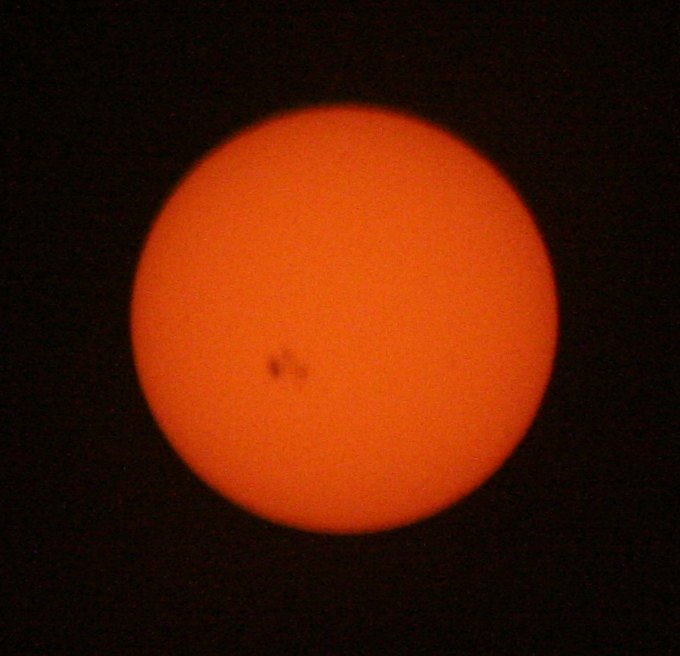
It’s working, given a broad definition for the term “working.” I might have to see if there’s anything I can do (besides spending a couple hundred dollars that I don’t have right now for an optically flat silvered glass solar filter for my Meade ETX-125 telescope) to cut down on the distortion of fine details that the solar filter causes. It’s basically just a piece of coated mylar film in a cardboard holder, duct taped onto the lens shield in front of the lens. This setup is great for showing things like a partial eclipse where all you’re looking for is a chunk of the sun’s disk missing. For anything that requires better optical qualities, well, that’s why the telescope filters are a couple hundred dollars and the mylar in a piece of cardboard is $2.
Just so you can see what this sunspot looks like in a professional telescope, with an image of the Earth superimposed for scale:
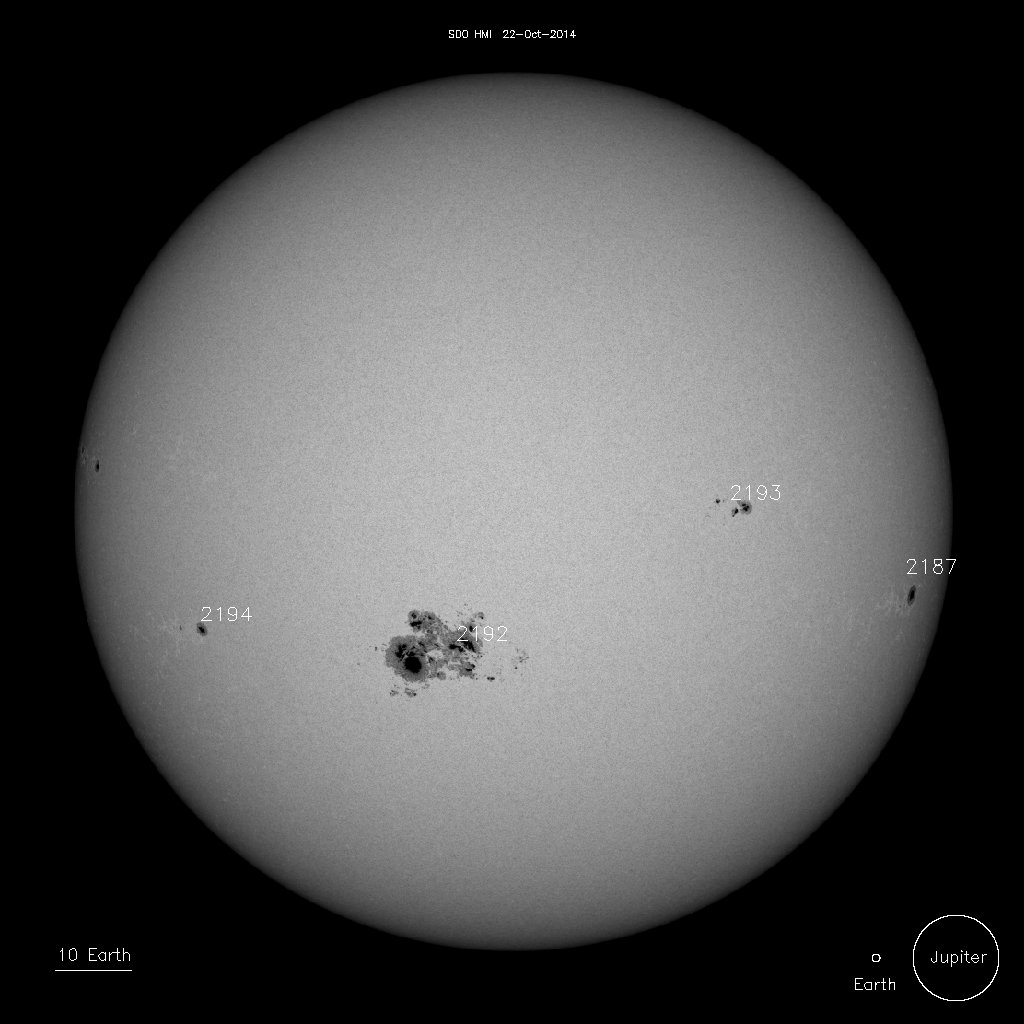
Courtesy of SOHO/MDI consortium. SOHO is a project of international cooperation between ESA and NASA.
Just curious – you’re going to BE SAFE while looking tomorrow, aren’t you?


 We Love The Stars Too Fondly