
In the winter of 1973, I spent many a sub-zero night standing knee-deep in snow, trying to see that decade’s infamous “Christmas comet”, Comet Kohoutek. I had no telescope, just a “Sears grade” pair of binoculars. I had no digital or video camera (of course, it was 1973!) but only an Argus C3 film camera.
In Vermont that winter, at night, it was really, really cold. I remember seeing the comet a few nights, just a fuzzy, white patch in my low-power binoculars.
Tonight, it’s not quite that cold in Los Angeles, but it’s down into the mid 30’s. This time with high-quality, astronomy-grade, Celestron binoculars and a pair of good DSLR cameras and telephoto lenses, I was after Comet Lovejoy.
The full moon wasn’t far away, and Los Angeles isn’t any less light polluted than it’s ever been. While I was not able to see Lovejoy with the naked eye (that should come when the moon’s not so bright in a few days), in the binoculars it was pretty easy to spot.
It’s not going to look like the pictures you might be seeing. (And you really, REALLY should click on that link!) In particular, at least here tonight, none of the distinctive green color of Lovejoy could be seen by eye. Through binoculars tonight, it was a white smudge, a powder puff. Where the stars were all pinpoints, Lovejoy looked like a small, round, pale white cloud.
So what happens when I try to get it with the camera?
First, the technique. This was fast and dirty, the cameras on a tripod, shooting a whole lot of frames from about 1/6 second all the way up to 25 seconds. Using the camera it was impossible to see the comet directly, so I went through series of pictures, moving the camera a bit for each set, changing the zoom and field of view for each set of sets.
It’s sort of like carpet bombing the sky with the camera, hoping to get lucky.
With the 28mm wide angle lens, the first thing that’s obvious is that the full moon is really messing with the pictures.

Here the moon is just out of the picture at the upper left corner.

Annotating that first picture, Orion is obvious, as it Taurus, and the Pleiades.
Tonight Comet Lovejoy is somewhere around where that yellow circle is. The way I found it (tonight — it’s moving so it won’t be quite in the same spot tomorrow) was by first finding Orion. In my binoculars, the field of view just covers the distance between Orion’s belt and Rigel, the really bright star that makes up the bottom of Orion’s right leg. Using that distance/FOV as a unit, I was seeing Lovejoy about two “FOV’s” to the right (east) of Rigel.
But with this picture and that bright moon, I couldn’t see Lovejoy. It might be the dot that’s inside that circle (click on any of the images to enlarge to the full sized image), but it might not be. Any longer exposures aren’t any better because the moon just washes them out even more.

I moved to the telephoto lens at 75mm. In these pictures you can clearly see Lovejoy, and you can clearly see it’s green color. In this picture, Rigel is the bright star at the mid upper left, where Lovejoy is on the right side, about halfway out from the center to the edge of the picture, between the 3:00 and 4:00 positions. This was a 4 second exposure.
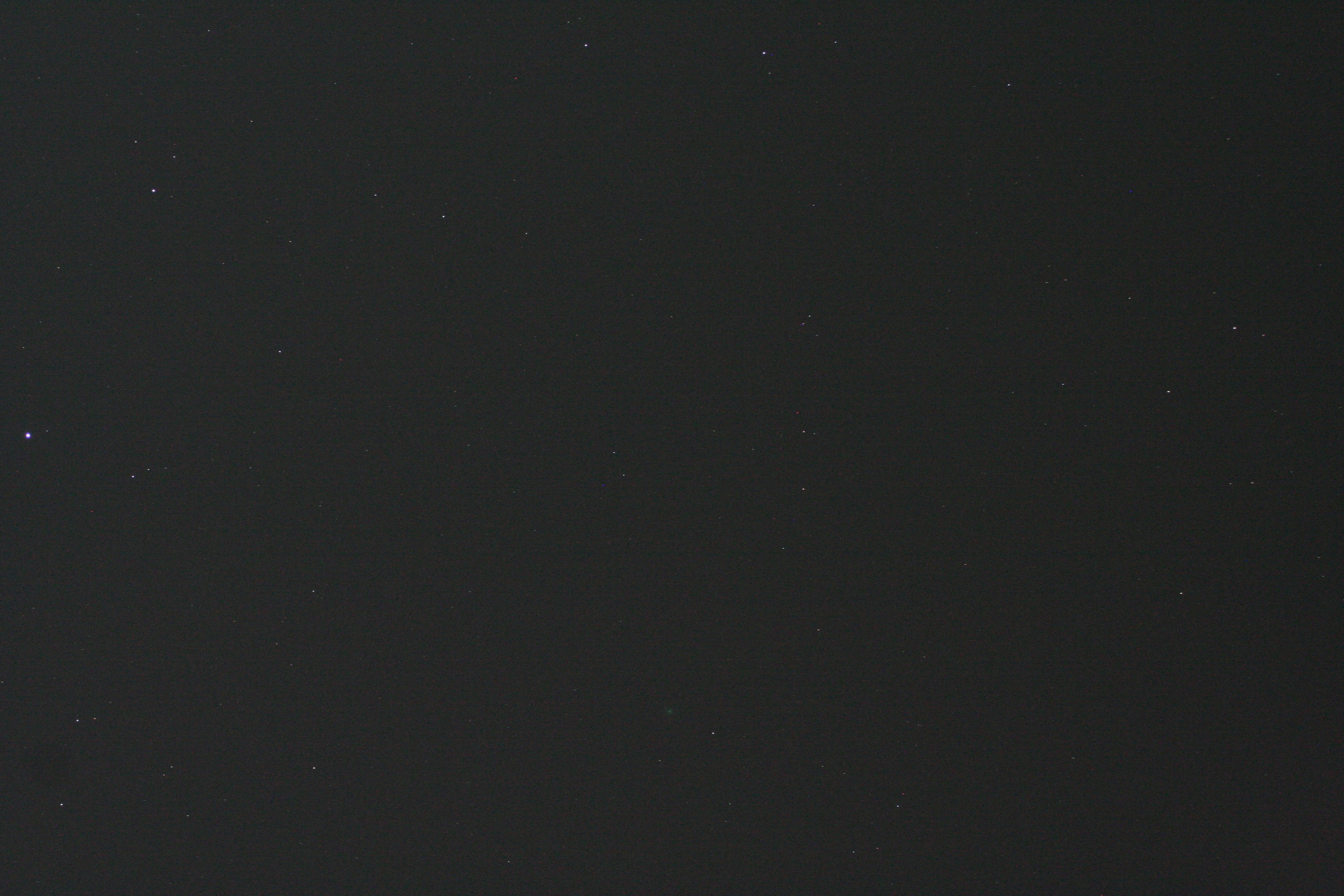
Again, I was shooting blind, trying to blanket the area with different overlapping series of pictures. In this 4 second exposure, Rigel’s right at the center of the left side, while Lovejoy is at the 6:00 position, again about halfway from the center of the picture to the bottom edge. The green color is clear, as is the fact that it’s a bigger, fuzzier object compared to the stars, which are more or less pinpoints.

The big problem of the night occurred when I tried to zoom in to 300mm. Again, blanketing the area with hundreds of pictures pointed in slightly different directions with a series of exposures, I got a couple of photos that are recognizable, if not good. Here Lovejoy’s at the far left side, near the top.

Here Lovejoy’s at the far right side, again near the top.
The problem with the 300mm pictures is obvious – they’re out of focus. Focusing through the eyepiece is tricky at best, since the difference between in focus and out is absolutely miniscule. One might think that you could simply set the lens at ∞ and forget about it, but like 99.9999% of all lenses, the Canon lenses actually stop at a focus point just beyond ∞, so you can’t rely on that.
So Lovejoy’s there, I can see it, I can sort of take pictures of it, but I have to figure out something to get the focus right on the high magnification settings for the zoom lens. Something to work on over the weekend and into next week.
Look back at that annotated picture (above) or any of the sky maps showing Lovejoy’s path. Over the next month it will head up past Orion, past Taurus, and past the Pleiades.
You keep looking for it — I’ll keep trying to figure out how to get better pictures.
Clear skies!!


 We Love The Stars Too Fondly
Well, I could see it very easily on your photos! Esp the one with Rigel at the far left. Must try again if we have another clear night tonight (looks hopeful at present)
LikeLiked by 1 person
Congrats – I’m gonna try for it soon… unfortunately I don’t get *any* view of the eastern sky (just the north, west and south) so it might mean staying up later…
LikeLike