
The Moon is a day or three past full, and tonight it’s fairly close to Jupiter, which is quite bright. As bright as Jupiter is, it’s thousands of times dimmer than the 89% illuminated Moon. Which makes it challenging to get a picture of them together. Getting a picture of the Moon along with Jupiter and the Galilean moons is even tougher.

The Moon is easy enough to capture. In fact, with my Canon xTi and a Tamron 75-300 mm zoom lens, the biggest problem is that it’s almost TOO bright. That camera’s fastest exposure speed is 1/4000 second. This photo is at 1/2500 second, just two steps down.

Jupiter and its four Galilean moons are also easy enough to capture. From lower left to upper right, you can see Europa, Io, Ganymed, and Callisto. (If you ever look at Jupiter and want to know which one is which at that moment, go look at the “Jupiter’s Moons” page on the Sky & Telescope website.)
Trying to capture them both together, I took a full set of “bracketed” exposures, from 1/4000 second (where the Moon is fine, Jupiter is barely visible, and none of the Galilean moons can be seen at all) to 1 second (where the Moon is COMPLETELY overexposed but you can see Jupiter and the Galilean moons clearly). The best compromise is at about 1/1250 seconds, with the Moon overexposed and blurry but recognizeable and Jupiter just visible without any of its moons.
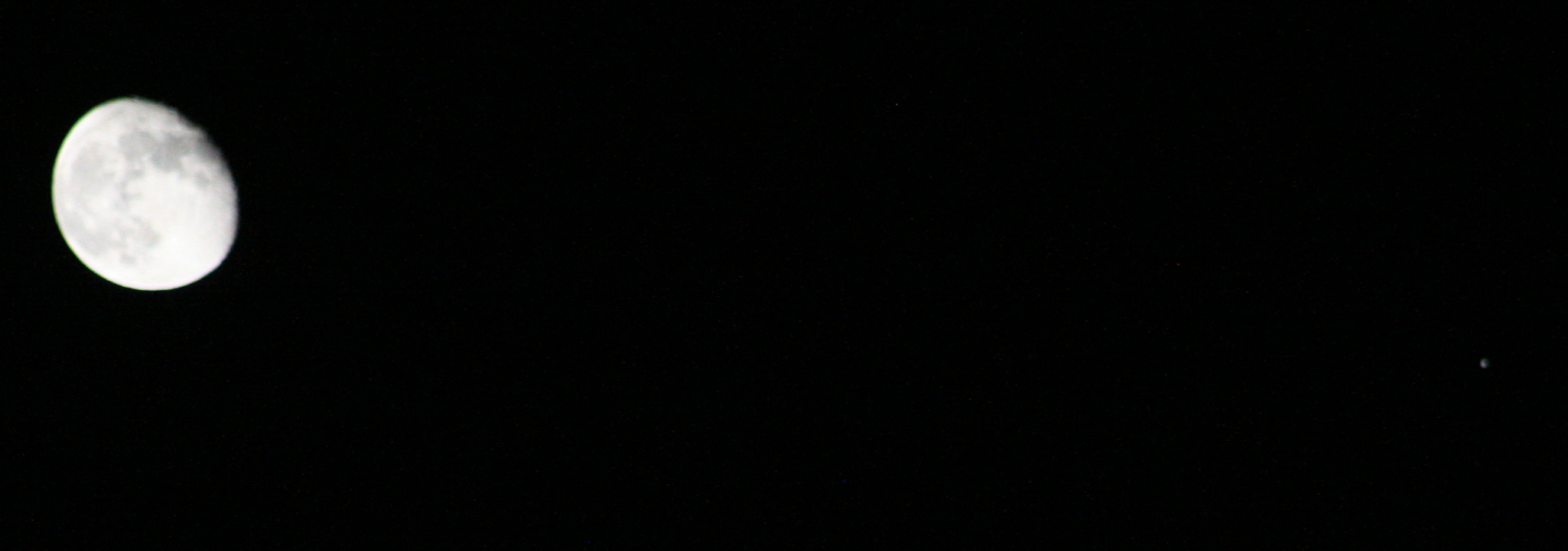
You might have to click on it to make it full-screen sized in order to see Jupiter on the far right.
What’s interesting is that as the Moon gets totally overexposed, the internal reflections of that super bright object start to show up like ghosts and they’re close enough to still being in focus to be recognized.

The real Moon is in the upper left, Jupiter and its moons on the right, and the internal reflection (the ghost Moon) is in the lower right. Not necessarily useful, but still cool and appropriate for October!


 We Love The Stars Too Fondly