
After your blood pressure and heart rate drop back down and you get a few good nights’ sleep following this, you finally realize that the Universe has not been jolted out of alignment. Rather, your perception of the Universe and your relationship to it has been clocked upside the head. The Universe just keeps rolling on, oblivious.
This was brought to me in graphic form tonight as I walked the dog. Venus, which had been amazingly bright in the west at sundown for weeks and weeks, had seemingly gone away in just a few days. (Don’t worry, it will pop out into the morning sky before sunrise in a few more days. We didn’t lose it.) But now Jupiter, only a bit dimmer than Venus, is riding high up into the sky in the early evening, sitting next to Orion. And tonight, the almost-full moon was just a couple of fingers-width away from it. (Full moon is at 20:53 UTC on the 15th. It’s currently 05:41 UTC on the 15th or 09:41 on the 14th Pacific, so full moon is about fifteen hours away.)
In Los Angeles, the haze and clouds have been swept away by very strong (and dry) Santa Ana winds, so the brush fire danger is just about off the charts — but the stars are crystal clear.
Time to grab the tripod and the camera with the telephoto lens!
There was a problem with the picture I wanted. As bright as Jupiter appears, it’s several orders of magnitude dimmer than the full moon. The full moon is really, really stinking bright!
So class, how do we approach this problem? Bracket, bracket, bracket! Digital is dirt cheap! Take a whole metric crapload of pictures across a broad range of exposures and see what happens. What have we got to lose?
No fancy equipment, just a tripod and a Canon Rebel XT with a Tamron 70-300 mm telephoto zoom lens.
Just to be on the safe side, I started with the fastest shutter speed my Canon Rebel XT will do, 1/4000 of a second. (I fully expected this picture to be seriously underexposed.) Then photos at steps of one speed slower every time, all the way up through 1/2 second. (I fully expected this picture to be completely washed out and overexposed.)
A very pretty sight. Gorgeous. Brilliant starlight. Moon so bright you could read a newspaper by it.
And then the Universe blew my mind tonight.
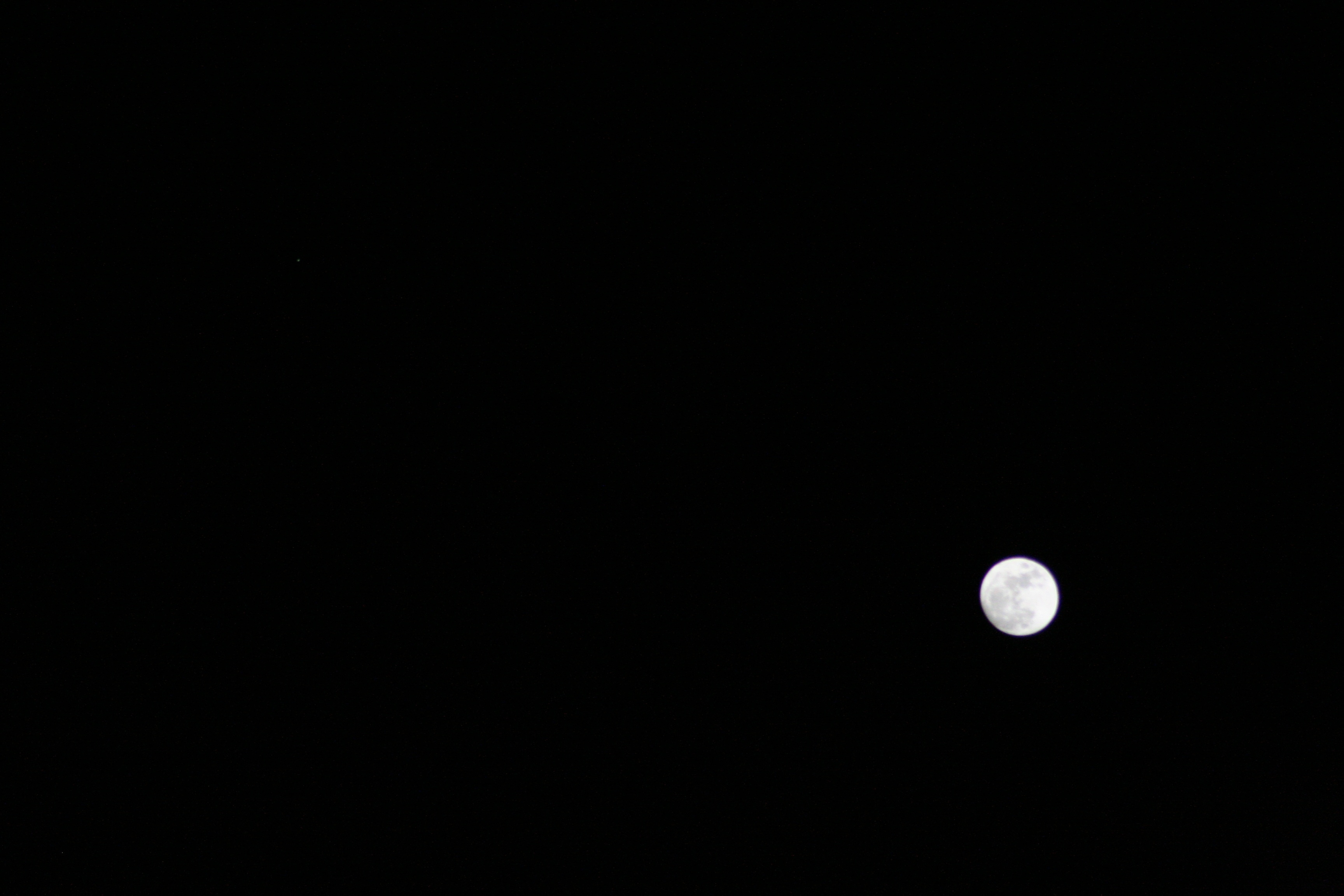 This is that very first picture, at 1/4000 second. In the lower right, of course, is the full moon and in the upper left is a little dot that’s Jupiter. (You should click on the images to get the full sized versions, it’s much easier to see what I’m talking about.) This is a great example of just how bright the full moon is and how big the dynamic range is between the two objects. You can actually see the big features of the moon pretty well, even with this simple setup. Even at this fast, FAST exposure, the full moon is starting to be overexposed. Yet Jupiter is just a dot, barely seen, which is not unexpected since this was a really short exposure.
I was very happily surprised to see how this image came out, especially given the seconds and seconds I had slaved over setting up and preparing to take it.
But, wait. There’s more!
Being a bit obsessive about these things (which is like saying water is a bit wet) I went flipping through the whole series of images. As expected, by 1/1250 second, the moon is completely washed out. But as we keep going and the moon more and more looks like a huge, white blob, Jupiter starts looking brighter and clearer.
 At 1/640 second we see the last image before we start to pick up serious lens flares from the bright moon. As we keep going, these flares develop into a greenish-bluish ghost image of the moon just below Jupiter.
 By 1/25 second this ghost image actually gets bright enough to show the same kind of detail as the primary image did in the first image. As we get beyond this, the ghost image gets brighter, the lens flares get brighter, the full moon more and more washes out almost everything. But “just because”, I flipped through the images all the way to the end.
And then…
 Other stars starting to show up in the field in this 1/2 second exposure. In between the moon and Jupiter is Mekbuda (Zeta Geminorum, mag 3.93 average). In the far lower left corner is Wasat (Delta Geminorum, mag 3.53). In the far upper left and at the very top center are two unnamed 5th magnitude stars, while outside the glare of the moonlight I can pick out at least eight dimmer 6th magnitude stars.
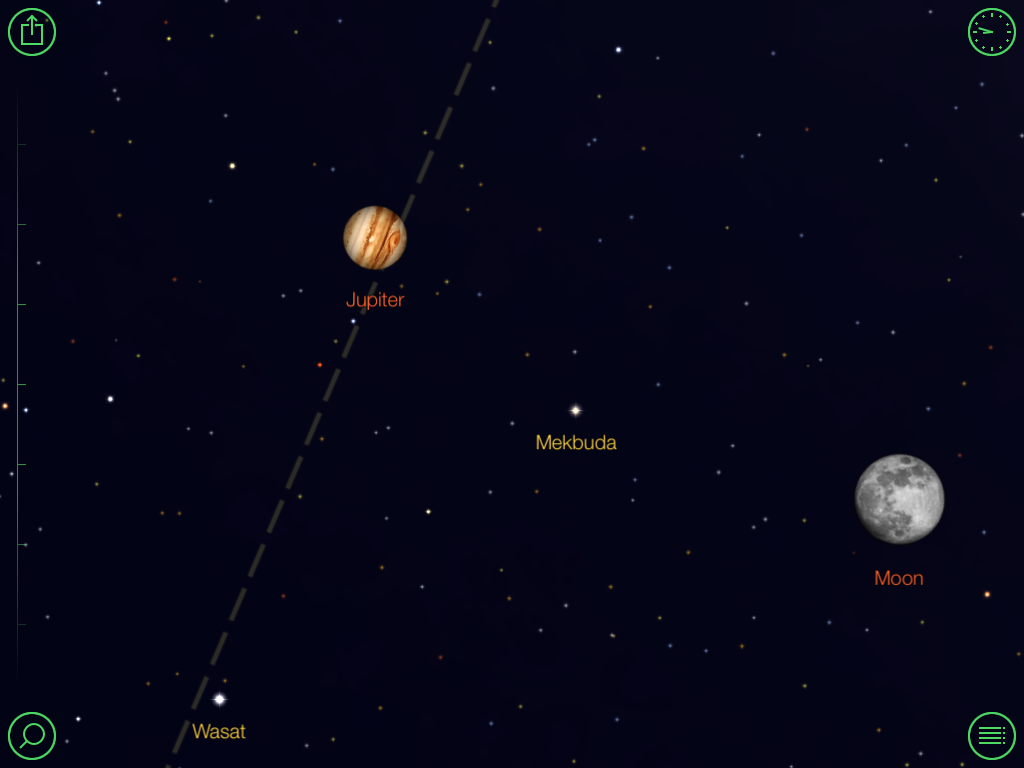 Image from the Star Walk iPad app. It looks a bit like this. Jupiter obviously isn’t shown to scale, although the moon’s size is probably close to being the correct size.
But best of all, to my utter amazement and joy — take a look at Jupiter! It’s now an overexposed blob also, actually showing elongation to an oval or a streak, the image smeared toward the upper center as the Earth beneath me rotated 314.9574 feet to the west in that 1/25 second. But even better, the best of all, look at the two small dots in a line at the seven o’clock position right next to Jupiter.
 See them? That’s got to be Io (the inner moon) and Europa (the outer one). And if you look really closely, can you kind of maybe see a spike or bump sticking out of Jupiter’s glare, right on that line between Jupiter, Io, and Europa? The map says that Ganymede should just be coming out of Jupiter’s shadow at about that time, right about at that spot. Could I possibly have captured it as well?
Two of the four Galilean moons captured, and maybe a third! All with two minutes of preparation and some common, off the shelf camera equipment.
Thanks, Universe. Thanks for the reminder that there are wonders all around us, even if there are sometimes also bad things.
Given the former we’ll find a way to deal with the latter.


 We Love The Stars Too Fondly