
I hope you enjoyed the pictures posted yesterday of Monday night’s total lunar eclipse. Before we put this event to bed, there were a few more “adventures” that I can report on.
First, early on Monday afternoon, I caught the following going by in my Twitter feed:
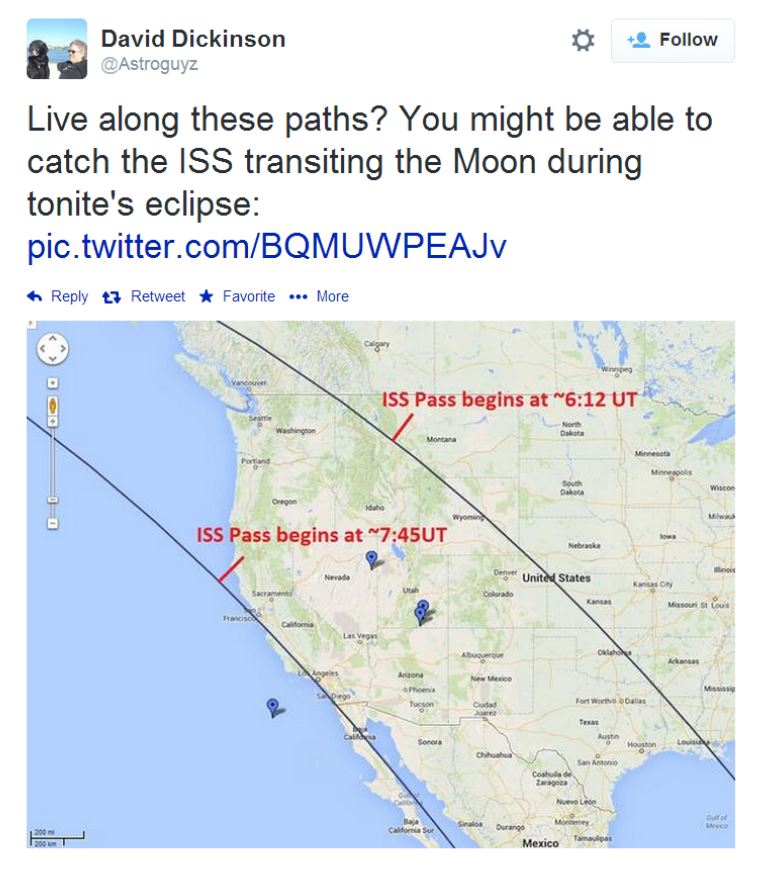 Why, yes, I do happen to live along one of those paths! I sent a Tweet to that effect back to Mr. Dickinson and he was kind enough to pass along a link to the CalSky site, which had generated the original image.
This would be so incredibly fantastic to catch — the ISS passing in front of the fully eclipsed moon! It would also be incredibly difficult, since the ISS would be in a “shadow pass,” i.e., not illuminated by the sun. Even if you happened to be lucky enough to set up in the right place (and there’s very little room for error), you would simply see ISS pass by in a second or so, with no advance warning. Tough.
The CalSky site will lay their calculated paths over the Google Earth maps, so I zoomed in to see how close we might be to the calculated path.
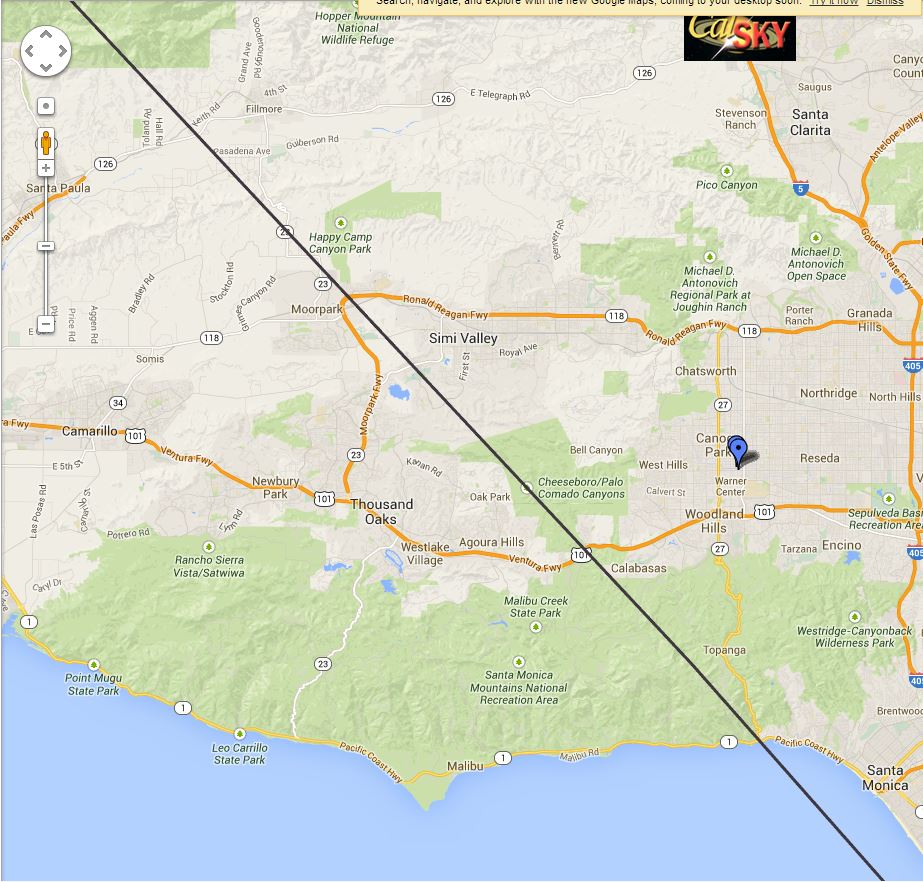 It’s close (FYI, I don’t know what the blue pushpin is, but it’s not not our house), but we were still going to be about four miles or so off of the path. I don’t know how wide the viewing area is to either side of that path, and I don’t know how accurately that path is calculated, but assuming the data and the path are good, my off-the-top-of-my-head wild-ass-guesstimate is that you need to be within a half-mile or less of that line to see anything. It might be only a hundred yards or so. (I’ll be researching this more later, even if it’s not during an eclipse, this sounds like a cool thing to try to do.)
So I got all excited about the possibility of doing this, then got more cautious. I went ahead and set an alarm on my iPhone (along with alarms for the U1, U2, U3, and U4 times) and hoped for the best. Ultimately, the clouds did us in, and at the time of the ISS pass we could barely see the moon…
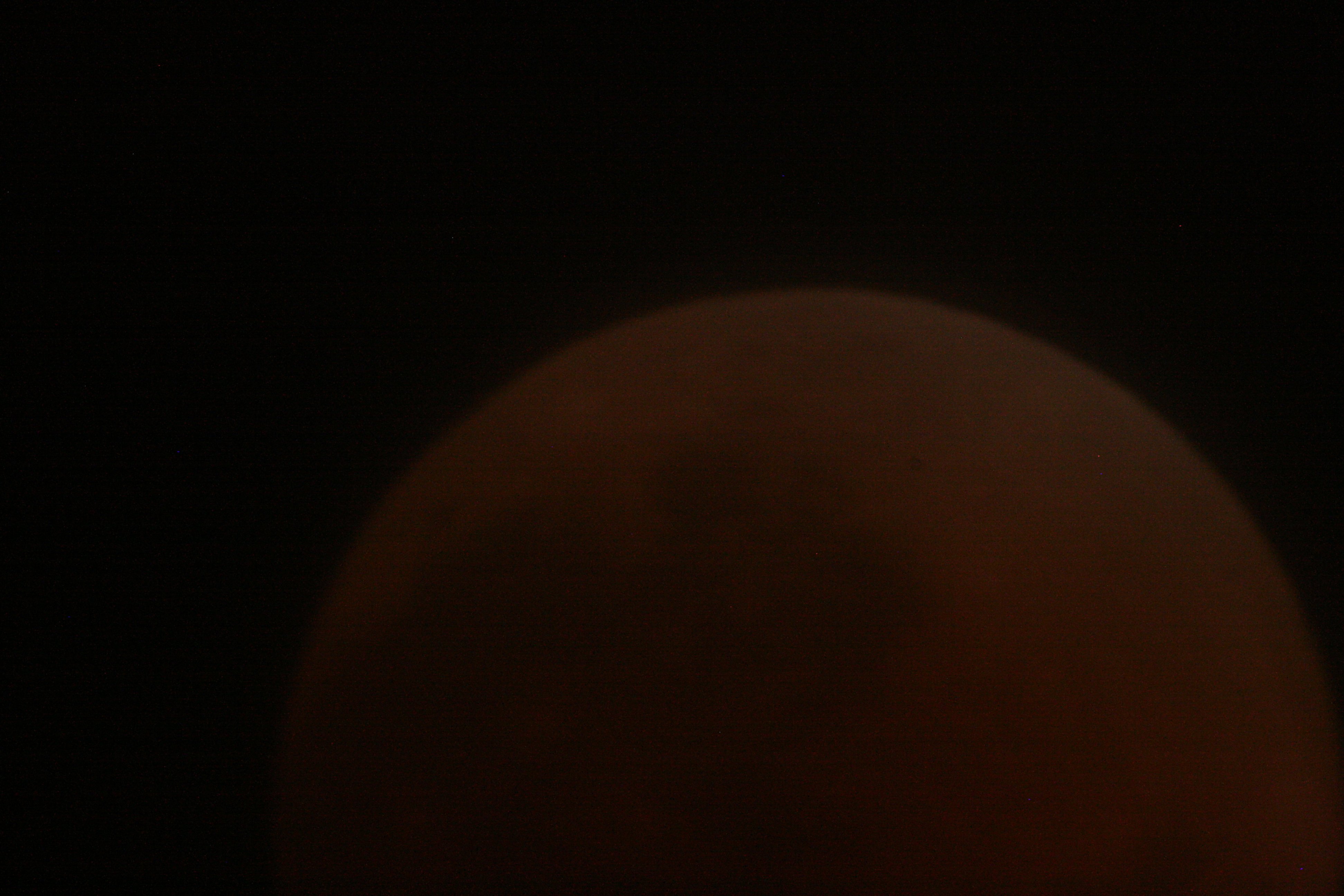 …let alone a (relatively) tiny speck passing fleetingly in front of it.
Oh, well. Fail early & fail often! Or, as the Mythbusters say, “Failure is always an option!”
What do our neighbors see when I’m out with all of the gear?
 From left to right we’re blocking the sidewalk with the camera with the big telephoto lens on a tripod, the 5″ Meade with the other camera, and the 8″ Cave reflector. The chair’s actually in the street next to my car — the curb makes a great footrest! And the mailbox makes a great workspace for keeping lens covers, eyepieces, video cameras, and so on.
But what’s that big white thing on top of the mailbox? It’s a complete shot-in-the-dark experiment, as kluged up of an arrangement as you’ll ever see. And it worked!
I had found an app for my iPad called “Timelapse Camera HD.” It’s simple, works like a charm, and does what it says it does. After I had gotten the scopes set up I remembered that I had it and figured I had absolutely nothing to lose in trying it.
The iPad had to be pointed toward that general part of the sky. It was moving from left to right in this view, and rising, so I needed to aim the iPad so that the initial image was in the lower left corner. The easiest way to do that was to grab a couple of hefty books and use them to get the aim and angle “close enough for government work.” I set the frame rate for one every three seconds, and let ‘er rip.
While the iPad may technically record HD video, the fact is that the camera lens is so-so. In addition, shooting at night at a bright object like this, there’s no way for the system to autofocus.
What you do get is a bright, overexposed blob of white, that’s moving as expected, then fading as we get toward totality, and finally actually showing up reasonably well in totality as an orange dot with a visible yellow shade in the lower right. (See yesterday’s photos.) And then the battery died, so that’s another lesson learned.
At twenty frames per minute, the 2518 frame video lasts 2:05:54. (There’s no sound.) It starts at 22:24 local time (time stamp is shown), with U1 at 22:58, U2 at 00:06, U3 at 01:24. The video replay is 1:44 long.
At about 22:35 you start to see bands of clouds passing by. The video caught them, illuminated by the full moon, very well. More clouds at 22:49 through 23:05.
After U1 at 22:58 you can see the moon (and the glare from it) declining steadily. At about 22:06 you can see a plane go by from the bottom to the top (probably something out of LAX headed for Asia) and another at about 23:15 over on the right-hand side. By about 23:46, twenty minutes before totality, the moon has dimmed enough so the glare of overexposure is gone and the moon appears as a disc. By 00:03 or so, just a minute or two before totality, the reddish-orange color is apparent. The moon’s eclipsed disc appears to flicker toward the end as it’s obscured by clouds and then peeks out again.
It just goes to show you, if you’ve got all of the electronic toys and tools that we’re carrying around in our pockets these days, experiment a bit, try something that’s not in the user’s manual, see if something that sounds totally wacky will actually work. It just might!


 We Love The Stars Too Fondly
Good one dear. And nice narrative about the video
LikeLike