
It’s one of those times of year when orbital mechanics bestows on us some truly spectacular views of the International Space Station as it passes over just after sunset in the evening and just before sunrise in the morning.
 An app like Flyby is great for letting you know when there are bright passes coming up, not just for ISS, but for the Hubble Space Telescope and dozens of other bright satellites. Tonight it said that ISS would rise at 21:10:29 PDT.
 ESA
ESA
At 21:02:06 PDT, seven minutes before ISS rose, here’s what the ESA tracking website showed. The ISS is tracking up from the southwest, heading right over Southern California. In addition, look at how the ground track of the ISS (yellow lines) closely matches the sunset and sunrise boundaries, the terminators. (No, not that Terminator, the one that’s the difference between night and day on a planetary body.) That path which sticks so close to the sunset/sunrise line is what makes us have repeated excellent passes.
So, put the camera on the tripod, manual focus set at infinity, zoom lens pulled all the way back to give us a wide field of view, shutter set on “Bulb” so it will stay open as long as I say for it to keep open. Ignore the weird looks from the neighbors, and watch the south-southwest skies. (Actually, after twenty-three years, the neighbors are used to this by now, but folks driving by can be caught off guard.)
There it is, right on schedule, coming up out of the haze over the Pacific Ocean. We’ve got a few thin, scattered clouds, but they won’t be a big problem. As the ISS gets up a few degrees over the hill, start taking pictures.
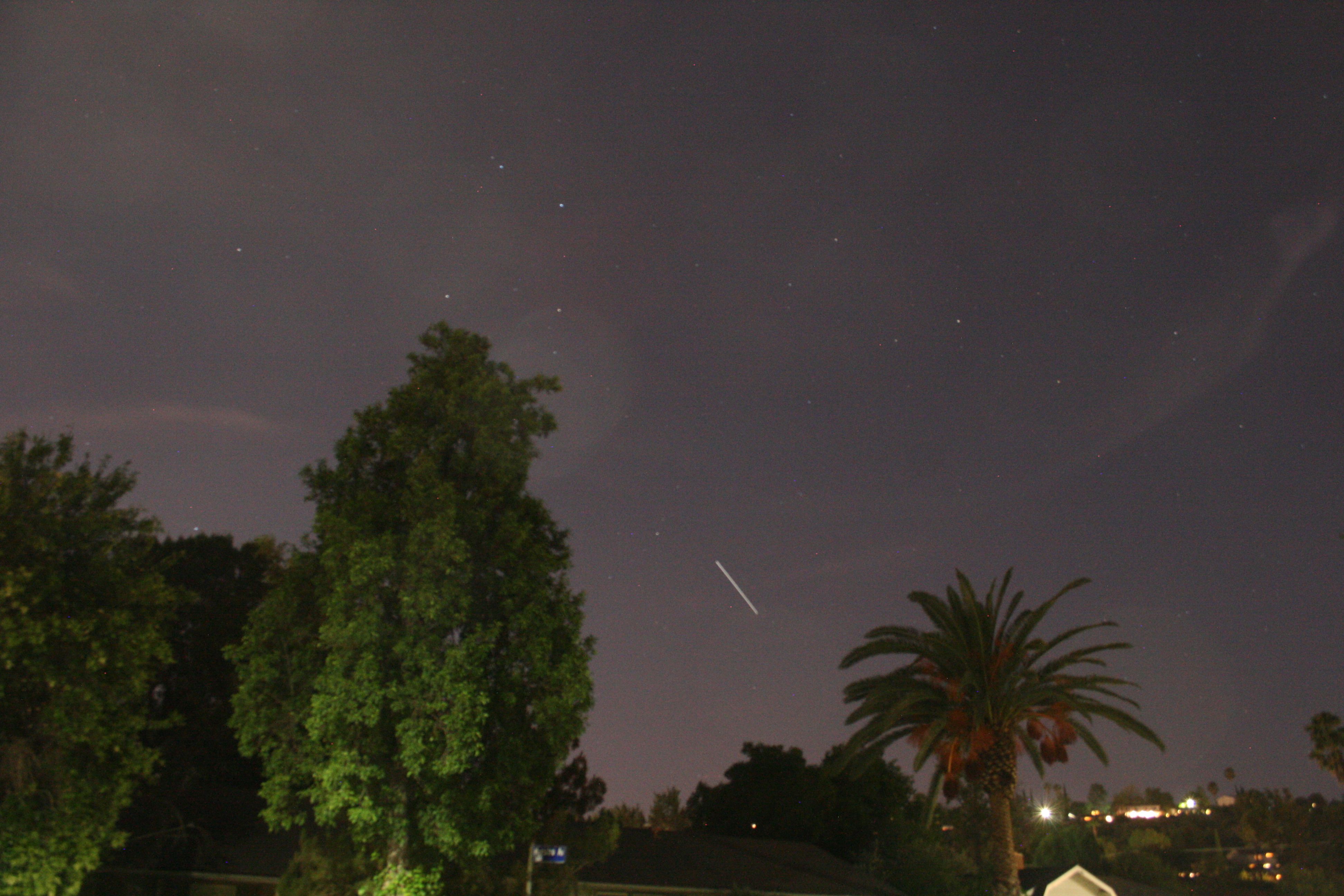 It’s a balancing act, between the need to grab as many photons as possible (so we can see the stars and station) and the interference from the street lights (which are trying to wash our long exposures into a yellow haze).
This is a 16-second exposure taken at 21:14:02 PDT. ISS is rising up from the horizon to our SSW. You can see a few of the brighter stars, some of the high clouds, and you can get a good idea of just how stinkin’ bright the ISS can be compared to even the brightest stars.
The four bright stars at the core of Virgo are right above the tall tree just left of center, with Saturn just to their left and Mars just to their right. The constellation Leo can be seen just above our big palm tree just to the right of center.
 This is a 31-second exposure taken at 21:14:42 PDT.
You can see that the sky looks lighter due to the light pollution from the street lights. ISS continues to climb, starting to rise up right through Virgo.
 Those first two photos were taken from the sidewalk across the street so that I could see to the south, but they were also taken right under the streetlight. As ISS continues to rise, the next picture would have the streetlight in the field of view, which isn’t going to work. So grab the camera, sprint across the street into a spot right next to our house where we’re in the shadow from all of the streetlights.
At 21:16:00 PDT, ISS is getting close to its highest point from our view. Being a bit more in the shadows, I went for a 46-second exposure. ISS is moving from the lower right toward the upper right. The brightest star in the upper right is Mars, not a star, and Saturn is the bright-ish star just off the left tip of ISS’s trail here.
You can see that in a 45-second exposure, even with a wide-angle lens, the stars are starting to blur and turn into lines. Proof that the Earth indeed does rotate! You can also see the track of a high altitude jet crossing ISS’s path. Not to worry, we’ve got some truly excellent vertical separation there.
 I really didn’t want to go with any very much longer exposures for fear of washing them out completely. At 21:17:06 PDT this 45-second exposure shows ISS leaving the zenith about 50 degrees above the horizon to our south and heading off toward our northeast.
Now it’s going down behind the trees, so we need to abandon our “shady spot” and find a place to take one more picture. Unfortunately, we’re looking right down the street into three streetlights. I found a spot behind a tree where at least the nearest one was partially blocked…
 …and at 21:19:04 PDT took a way-too-long 95-second exposure. You can see ISS heading to the horizon in the northeast. It was very bright and visible to the eye all the way down until it was behind that tree, but with the long exposure time, the rest of the sky is all washed out. Good to know for the future, 95-seconds is to be avoided at this location. Live and learn.
 And at 21:19:20 PDT, we see that ISS is over the Great Lakes, heading toward the Canadian maritime provinces, Gibraltar, Africa, the Pacific Ocean, and in about 80 minutes, probably a really nice, bright pass over Seattle, Vancouver, and the Pacific Northwest. (If you’re there, heads up!)
For Southern California, Flyby shows really bright ISS passes this week at:
- Tuesday, 06/03/2014, 05:18:38
- Tuesday, 06/03/2014, 21:58:43
- Wednesday, 06/04/2014, 04:29:44
- Wednesday, 06/04/2014, 21:09:22
- Thursday, 06/05/2014, 03:41:01
- Thursday, 06/05/2014, 20:20:20 (SUPER bright!)
- Friday, 06/06/2014, 04:28:48
- Saturday, 06/07/2014, 20:19:39
Get an app or go online for a free site such as the NASA “Spot The Station” site. Go out and just watch one of the greatest technical achievements of the human race sail over your head.
It’s good for the soul.


 We Love The Stars Too Fondly
Your photos are amazing dear
LikeLike