
“Low hanging fruit.” In common usage today, it means winning the easy game, picking up the simple rewards that are right in front of you, or taking advantage of opportunities that you practically are tripping over. Tonight’s photos are an instance of “low hanging fruit” in an astronomical photography sense.
When I took Jessie out for her evening constitutional, it was “clear and a million” here. It was about a half hour after sunset, just starting to get dark. The bats were out — it’s a good thing, keeps the bug population down. And hanging low in the west was a very thin crescent moon. I left Jessie to check her “pee-mail” and ran inside to get cameras and the little telescope.
A quick check of the ephemeris app (I like “Moon Phase”, it howls on full moon nights) shows that the moon was new on the 23rd at 23:15 UT. Since it was now about 02:00 UT on the 27th (19:00 on the 26th PDT), that meant that the moon was about 74:45 old, a bit over three days. That’s a thin crescent.
It isn’t that hard to see the moon as much as a day earlier than that, but it gets exponentially harder the earlier you get to new moon. Not only is the “younger” moon closer to the sun and lost in the glare, which means it’s closer to the horizon at sunset at a time when the sky’s brighter, but it’s also thinner and dimmer to boot. There are amateur astronomers who actively try to see how “young” a moon they can see. I think the earliest I’ve seen it is about 35:00 or so, but the records are 15:32 for the naked eye and 11:40 for optically-aided sightings.
So 74:45 is very pretty, quite noticeable, and not that hard to take photos of. With a mid-sized telephoto lens (75-300 mm) you can see this:
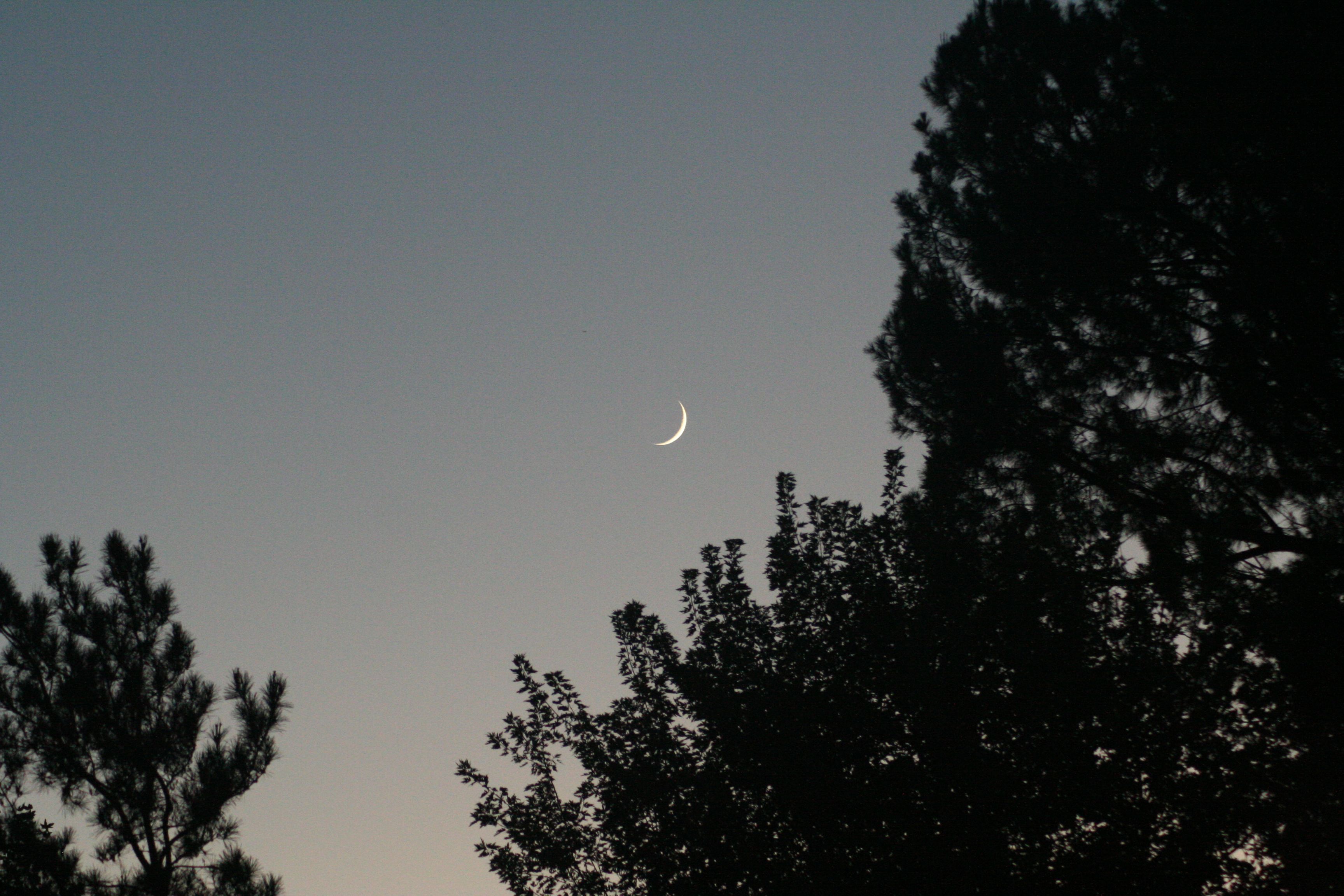
A wider-angle shot with the moon down near the horizon will often show trees, hills, and buildings along with the moon. This can help frame the picture.
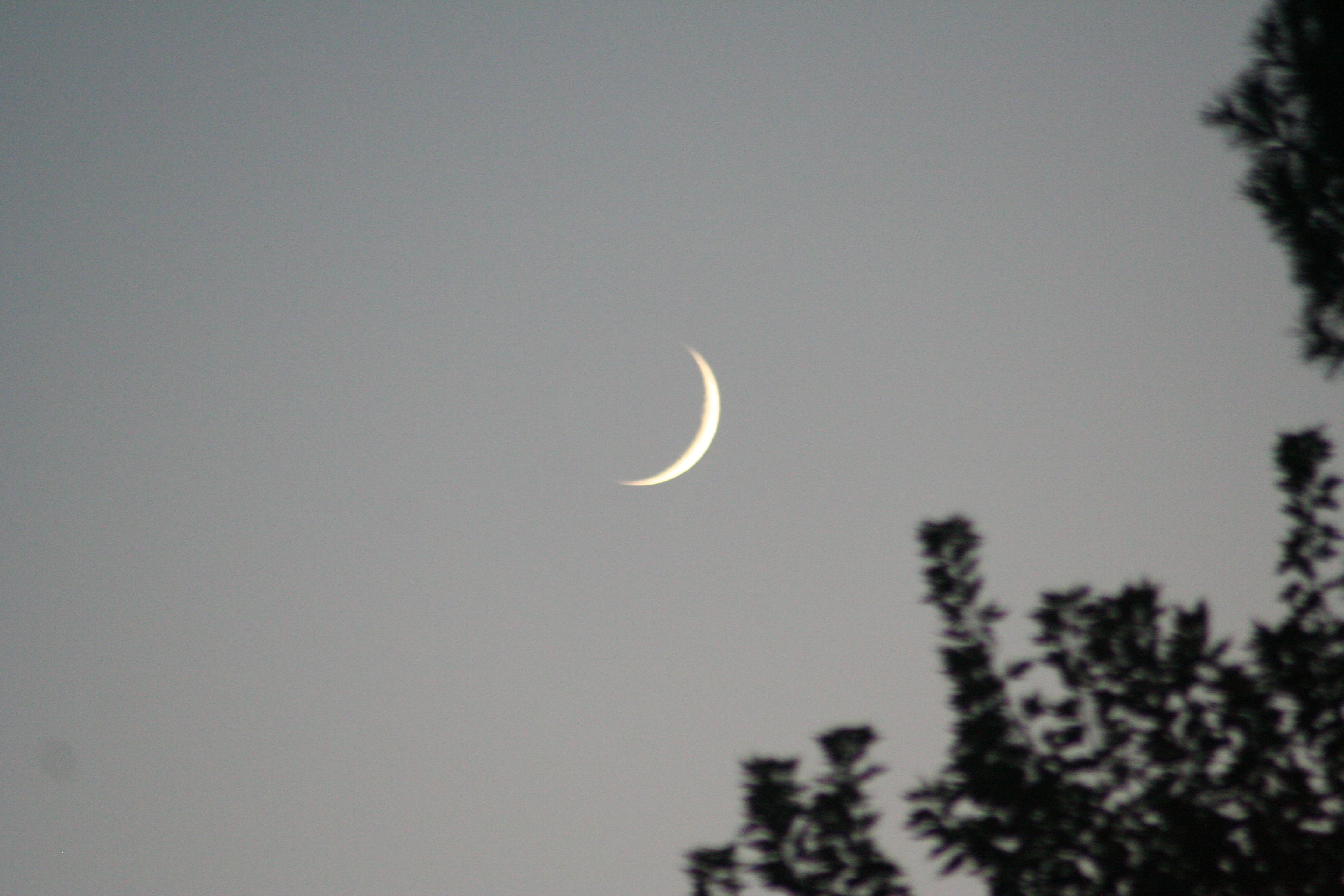
In addition, you can see that the moon is floating through a sky that is still not that dark at all. For shots using a long telephoto lens, you should use a tripod if available, or at least try to brace yourself against something (such as a car). This will minimize blurring when the exposures get up to a significant fraction of a second.
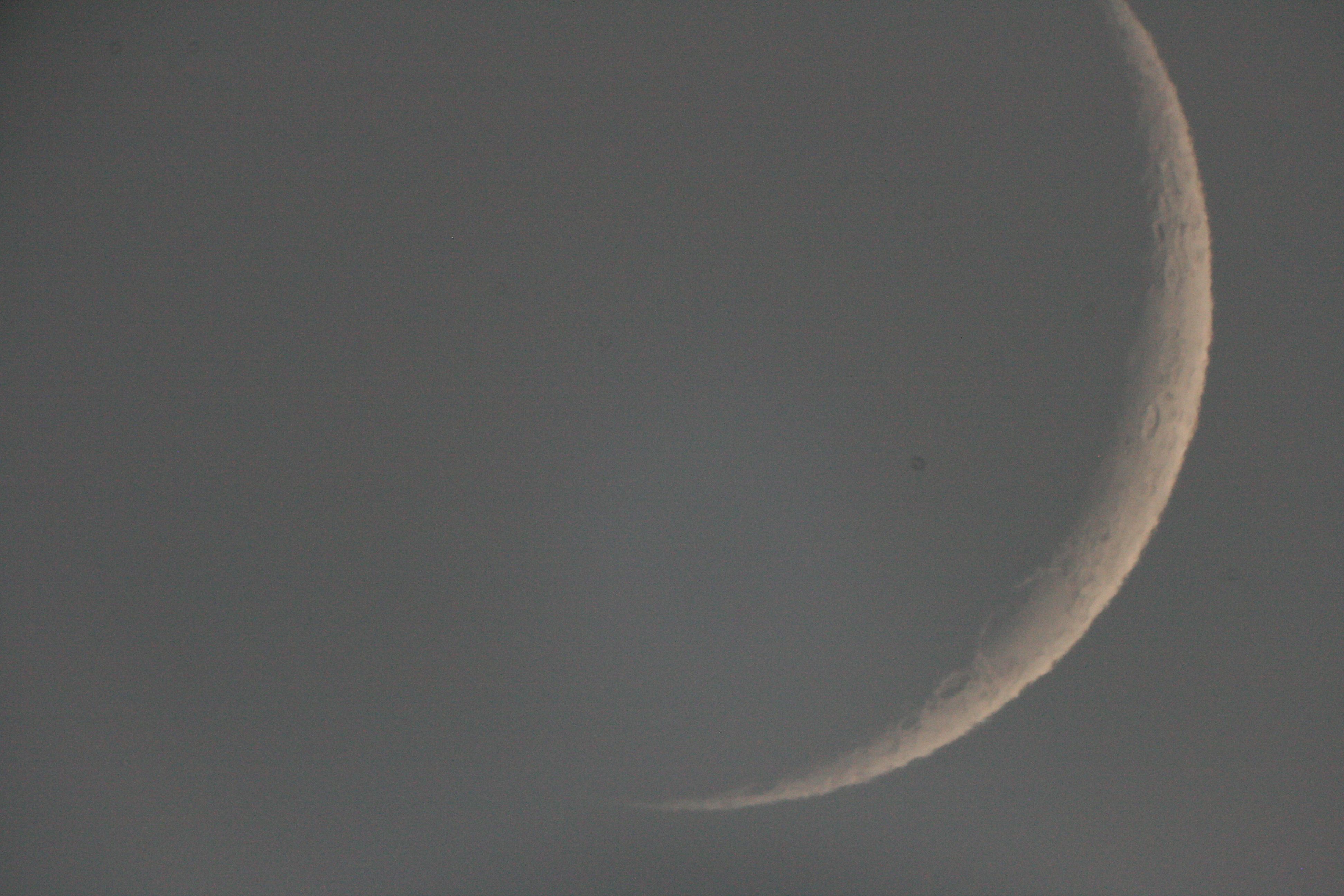
Quickly setting up the little ‘scope, while it was still fairly light, I got this view. It’s similar to the view I got when I did this last year, but the moon then was 13% illuminated and 91 hours old, as opposed to 8% illuminated at 74:45 hours.
The first problem with taking these images is that it’s hard to focus, with the moon being difficult to see. This same issue also makes the pictures wishy-washy. The problem is in the low contrast due to the bright-ish sky and relatively dim moon. In a few days, the illuminated portion of the moon will be MUCH brighter and the pictures can be taken well after sunset so the background sky will be quite dark, giving you a high contrast situation. Good pictures, easier focusing.
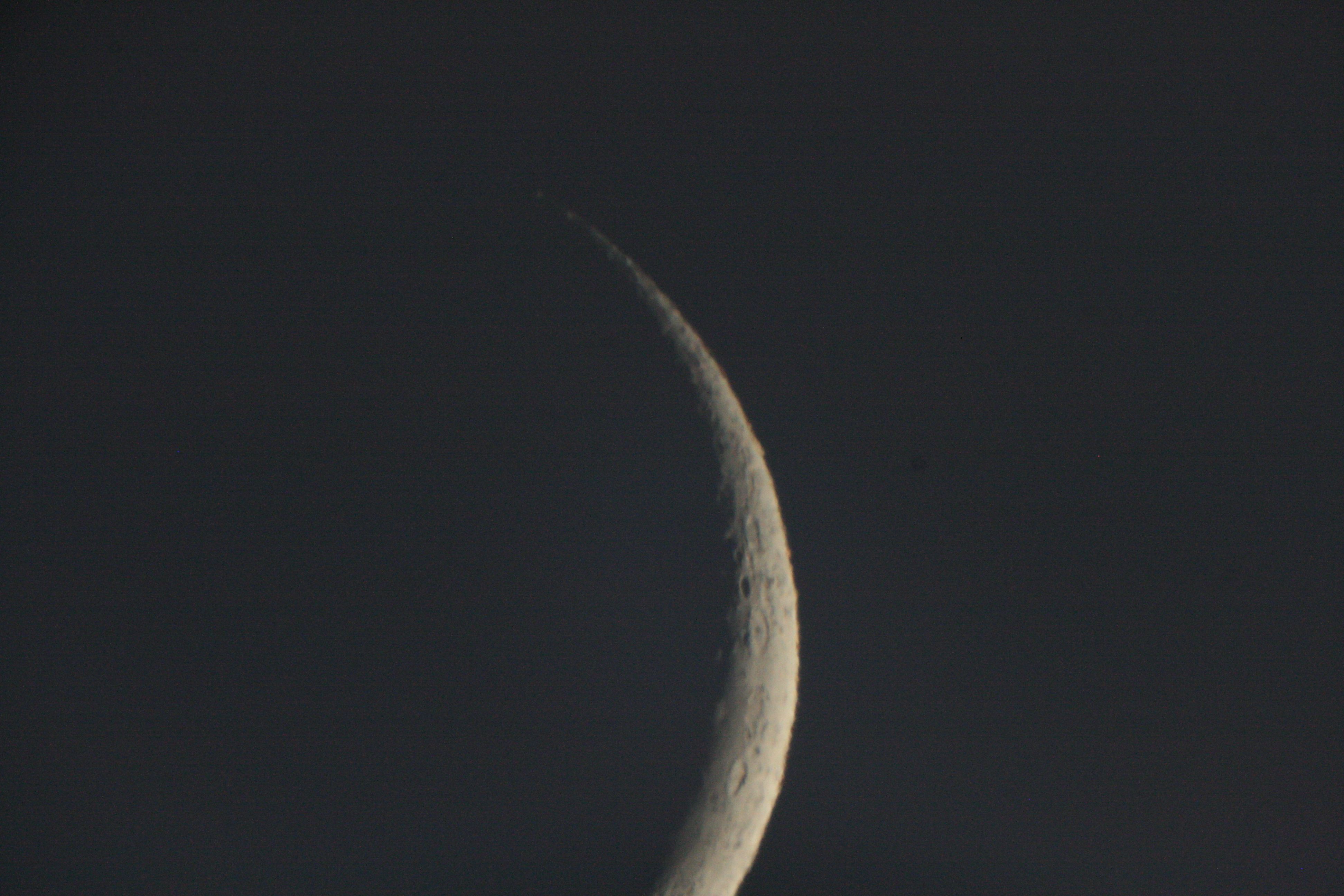
Once the sky gets a little darker, your focusing gets easier and the contrast goes up, but now you’re looking through a whole lot more atmosphere. Even clear air is usually turbulent and gives a slightly fuzzy image as a result. (There’s a reason the Hubble Space Telescope and every other telescope we can manage are all up above the atmosphere.) At sunrise or sunset, longer viewing paths through the air, much more turbulence, much fuzzier pictures.
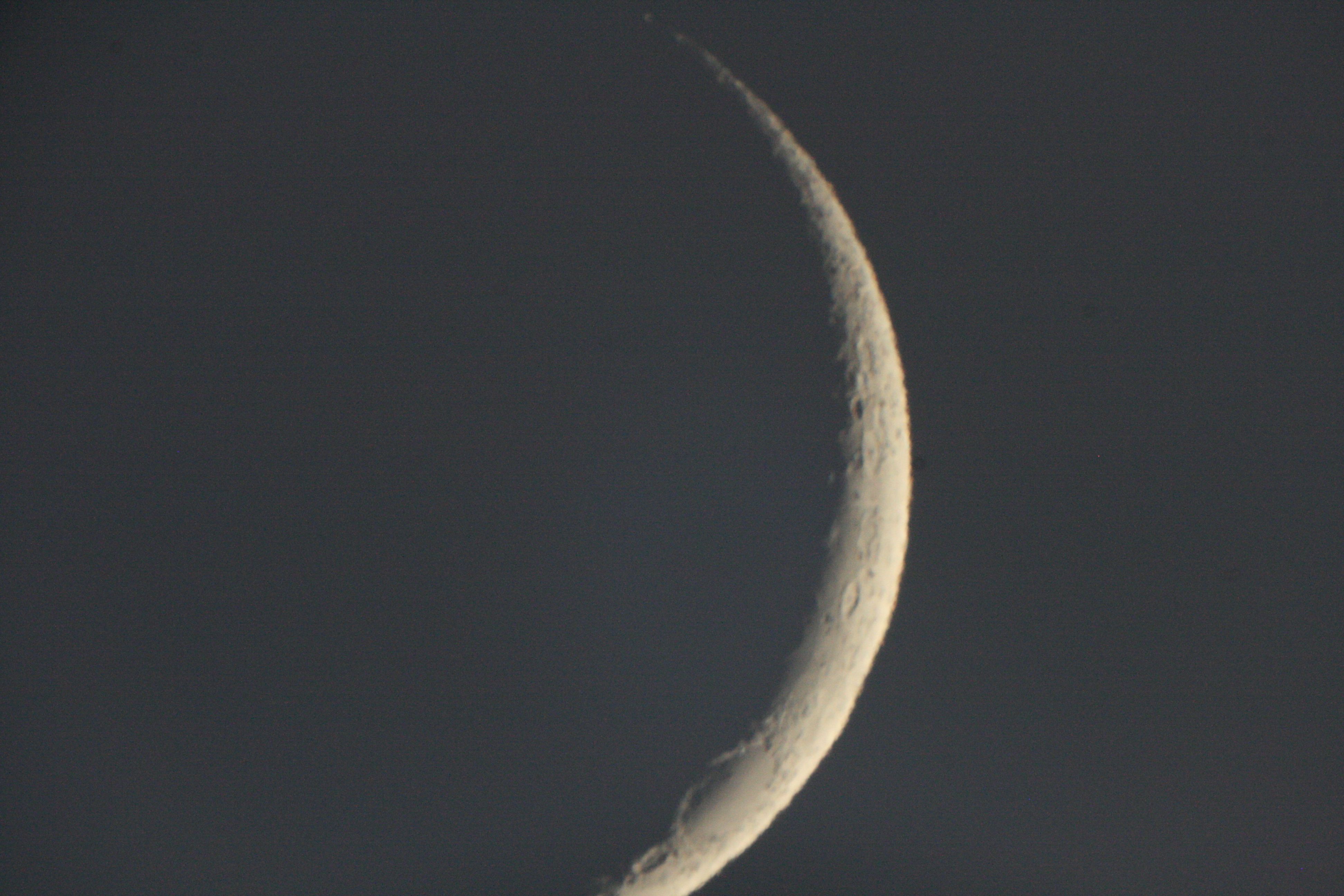
The other factor which didn’t help was vibration as I took the pictures. I have gotten a neat little toy which will trigger the camera remotely, which can reduce the vibration by a couple of orders of magnitude — but the battery is dead on the receiver. So much for being an old Boy Scout — I was not prepared.
Tomorrow I’ll try to remember to get new batteries. Of course, tomorrow it won’t be “clear and a million.” If I’m prepared in advance and looking forward to an observing and photography session, we’ll no doubt have the first significant rain for the first time in close to a year.
It’s okay. We need the water.


 We Love The Stars Too Fondly
These are gorgeous! Thanks!
LikeLike
Thanks, Jemima!
LikeLike
Great photos 🙂 Did you catch the Moon and Saturn last night?
LikeLike
We had scattered clouds, no photos, but I saw it just before it set. Looked great! Tonight the moon will be near (5deg) Mars in the west.
LikeLike
Right – me and my gf will be out later 🙂
LikeLike