
Of course, it can be a bit exhausting to spend a full day at the hanger with deadline stuff up the ying-yang and a couple hours of “fun” training on the tugs and forklift thrown in to boot. Especially when I was up until well past midnight last night, writing, so I’m short a couple hours of sleep. And the night before. And the night before that. And… So by the time it comes time to write, staying awake might be the top priority.
You know that I’m tired when it takes me three days to figure out “which day” of NaNoWriMo should be listed in the post title, as if the first day of NaNoWriMo hadn’t been on the first day of November… (I believe that today the correct value is “eleven,” but someone might want to double check my work.
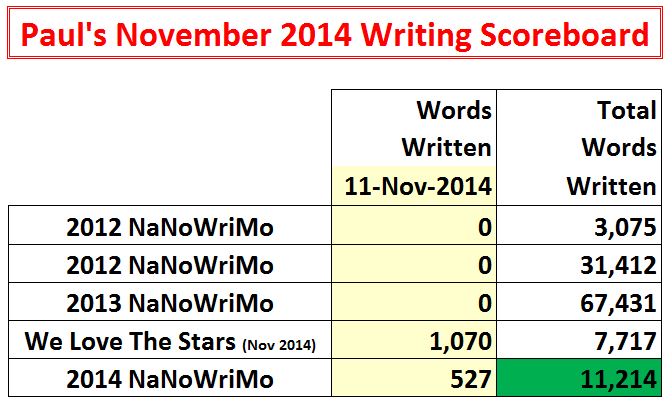
After the first dozen times I find myself nodding off at the keyboard and not knowing if I’ve been out for two seconds or twenty minutes, it’s time to wrap. 527 words today is better than zero words today.
While I normally put in a lot of internal links to previous, related posts here, I won’t be doing that for what I hope will be this year’s thirty NaNoWriMo posts. If you have jumped into or stumbled onto this story in mid-adventure, there are plenty of other ways to navigate around the site to find previous installments. Actually doing so is left as an exercise to the student.
CHAPTER SIX (continued)
As the data started to flow back from the orbiter, filling many of the ship’s video screens with close-ups and vistas of an entirely new world, the mood onboard the Cronus was good. It had been a busy two weeks getting the Titan probes modified, checked out, and launched. Everyone was riding an emotional high as all three Titan probes were operating successfully.
Most of the science crew was going into overdrive now that they were being flooded with raw data. It was one thing to be getting remote readings from varying distances across the Saturn system, it was another to be drowning in a tidal wave of chemical analyses, weather data, pictures, and videos.
The crewmembers who were the primary communications specialists were also losing sleep, making sure that as much of the data as possible was being sent down to the big AIs and researchers at Goddard and O’Neill. Bradbury also got a subset of the data since they were dealing with their own practical issues associated with very cold planetary surfaces with very toxic atmospheres.
Engineering crews were hard at work, both at finishing the Iapetus orbiter and lander and at figuring out how to bootstrap the job of making modified van Neumann machines to explore, mine, and build once they had reached the volatile-rich inner moons. Maintenance was stuck with the utterly boring and routine tasks of making sure that the air was breathable, the water potable, the hydroponics growing, and the toilets functional.
No one on Cronus was less than one of the tops in their field, and by the very nature of life within a small crew in a hostile environment, all were enough of a jack-of-all-trades to help out wherever they could. Back in LEO there could be average ironworkers or chemical engineers holding down a job for a paycheck. Out on the edge of human exploration, being “average” meant being dead, and probably taking a load of crewmates along with you.
Alsby was mindful of the stress that she and their new mission were putting on everyone. When the Titan probes were down, the data handling routine set, and the Iapetus probe preparations well ahead of schedule, she declared a general holiday for three days. A holiday schedule was set up which put everyone on duty for just an hour or two each day, in order to deal with any problems, The rest of the time was to be spent relaxing.
With Cronus still orbiting fairly far out from Saturn, Miller and Doctor Anderson looked at the radiation and cosmic ray background measurements before agreeing to allow brief excursions by everyone out to the exterior observation area.
Most of Cronus’ crew had come from the Earth-Moon area. They knew from their experiences there how truly stunning the Earth could be from a low orbit, a blue and white water planet with occasional stretches of forest and desert.
But no one had ever seen Saturn like this with their own eyes. Video images were fine, and anyone could pull the current view up at any time, but everything paled compared to the real thing right in front of your face.


 We Love The Stars Too Fondly