Category Archives: Astronomy

Be Grateful

I stepped out this evening late and caught a beautiful sight, the three-day old crescent moon just disappearing behind the trees and Castle Peak.

Because of all of the smoke in the air from the brush fires everywhere, the moon was a vibrant orange color.

I wish I could get the iPhone images to show that off.

Why should you “be grateful?” Well, aside from all of the usual reasons (i.e., even with all of the normal day-in, day-out BS we deal with, it could be so, so much worse), there’s the fact that if I hadn’t seen this and taken a couple of quick pictures to share, I was going to share a goofy selfie that I took while in the endodontist’s chair today for the second of three root canals in a three week period. (Not fun, not feeling so good tonight. Growing old and being the mature, responsible adult character sucks.) Trust me, a beautiful, orange, crescent Moon is so much better to look at than a drooling idiot wearing a bib!

Leave a comment

Filed under Astronomy, Photography

In Search Of A Coat Hangar

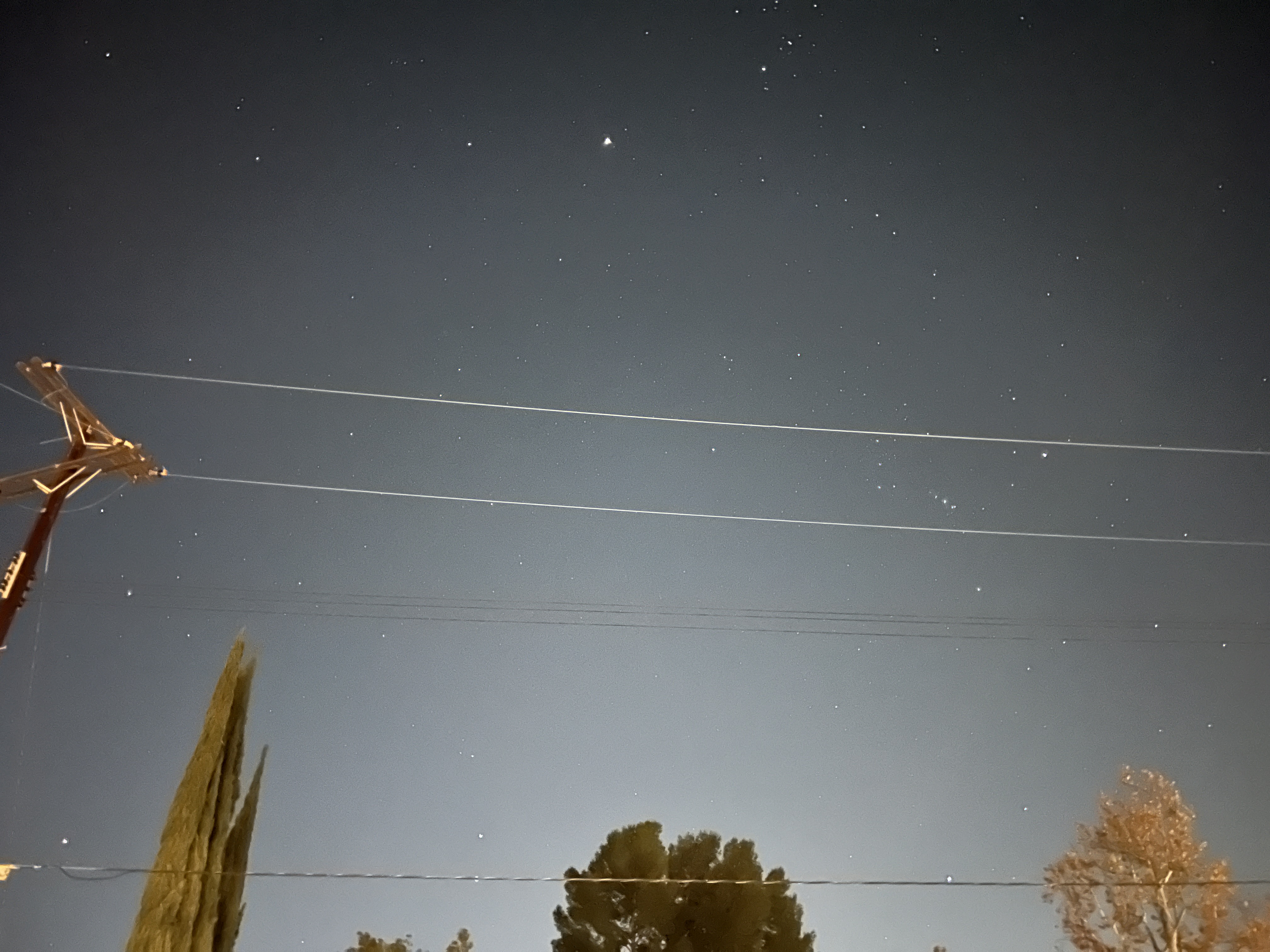
Technically, it’s an asterism, a collection of stars that are smaller than a constellation and look like something to our pattern-seeking monkey brains, in this case, a coat hanger. Officially it’s known as Brocchi’s Cluster and at this time of year it’s high overhead about 9:30 to 10:00. (Here‘s an excellent close-up of it.)

This is one of my full-resolution images from tonight, taken with the “light bucket” wide angle lens (16mm) that I love so much, using an 8 second exposure at F 2.80, looking from about the zenith down to the horizon in the west. Click on it for the full-sized image – can you spot the coat hangar (“upside down”) in the upper center?

I’m always surprised when I shoot these pictures. Given the coastal haze and light pollution from the city all around me (a 30-second exposure is completely white and washed out) that’s so bad that I could only see maybe a dozen of these stars with the naked eye, it’s amazing that the camera can pull out all of the detail it does. It’s all up there, it’s just so sad at times that we’ve shut ourselves away from it all.

Those brief few minutes under a dark, clear sky when we first got to Vermont two weeks ago will stick with me a long time. I need a lot more of that and a lot less of this.

Leave a comment

Filed under Astronomy, Photography, Space

Strawberry Moon

Last Friday was the solstice, the longest day of the year in the Northern Hemisphere and the start of  astronomical summer. It also happened to be a full moon, the “Strawberry Moon.”

Here it is, rising in the east over Encino in the distance and Griffith Park beyond that. Not the Sun, but orange for the same reason as sunset or sunrise is so orange – the passage of that white light through miles and miles of thick atmosphere.

There are a ton of truly spectacular professional photographs out there with the rising, full, Strawberry Moon and mountains, landmarks, and spectacular scenery captured as well. I’m just amazed that anyone with a recent model cell phone can do something like this with little to no planning or skill.


Leave a comment

Filed under Astronomy, Photography

Two Day Moon

There was another Falcon 9 Starlink launch out of Florida right around sunset here, which meant I was out looking at the sky about 80 minutes later. (Just shy of the end of the first 90-minute orbit.)

Nada!

Which is not to say that there wasn’t anything pleasant or wonderful to see, I just didn’t spot any second stages passing overhead venting fuel.

There was a very pleasant and beautiful, if somewhat subdued, sunset to watch. None of the flaming golds and oranges and reds that we can occasionally get, and not a cloud in the sky to give it “texture.”

But the Moon is just barely two days past new, so it’s just a silver sliver popping into view and hanging there once it started to get dark.

If your skies are clear, go take a look tomorrow night. It will be just as stunning then. And the night after. And on, and on, and on…

Leave a comment

Filed under Astronomy, Photography, Space, Sunsets

Six Lessons Learned On The Grass

Last Friday, while having my telescope set up at my daughter’s school, we saw what I believe to be a Falcon 9 upper stage venting excess fuel on its first orbit around after a Starlink launch from Florida. Tonight there was a very similar launch at a very similar time on a very similar mission, so about 80 minutes after the launch I sat out on my front yard with a camera for a while just in case it happened again. It didn’t. But there were still six lessons I learned.

  1. With the multiple flood lights set up by the new neighbor across the street, it’s tough to see anything more dim than a 737’s landing lights going into Burbank. DAMN! In the search for the Forever Home in the High Desert, I’ll have to keep that in mind.
  2. When it’s quiet, you can hear the train whistles from the Santa Susanna Pass, about two miles away as the crow flies. Funny, I would have guessed it was closer to ten miles, but Google Earth says otherwise.
  3. The rabbits out on the front lawn freak out when I go and sit down on the grass – that’s their grass and there was a lot of leporine side eye going on. I didn’t know I needed an invitation.
  4. In addition to the trains, there were repeated calls from what I’ve always referred to as a “night hawk” or “screech owl.” Turns out the latter guess was closer – what I’m hearing is the screech of a barn owl. Given the Great Horned Owls we hear almost every night, I guess I’m not surprised to hear another kind of owl around as well. But I’ve never, ever seen one, I just hear them once or twice a night, and several times tonight.
  5. The rabbits would be a lot healthier if they spent less time giving me the stinkeye and more time watching out for those barn owls.
  6. The sprinklers turn on at 8:00. With little or no warning. Good thing I’m wash & wear, even at my advanced age.

The Forever Home definitely needs to have dark skies, trains, owls and hawks, and probably rabbits. Although I suspect in that environment (and sort of here as well) the coyotes will be more of an issue for the rabbits than the owls and hawks.

Leave a comment

Filed under Astronomy, Birds, Forever Home, Space

A Night Under The Stars

The Younger Daughter is a teacher at a private school here in LA and tonight as part of their end-of-the-year activities they had a sleepover night at the school. She asked if I would be interested in bringing some telescope gear to the school so her students could look through them.

Of course I will do that! (See that hill in the distance on the right side? That’s where Kobey Bryant’s helicopter crashed a few years back.)

While we were waiting for it to get fully dark, we saw the strangest thing pass overhead. It rose due west at about 21:05 and passed almost straight overhead, maybe a little bit to the south of us. It had this butterfly pattern to it and when I first saw it I thought the coastal fog was starting to roll in and this was a 737 going into Burbank with its landing lights illuminating the fog. It was BRIGHT!

I soon realized that it couldn’t be a jet, it was moving much too fast. I grabbed the binoculars and could clearly see a bright pinpoint at the center, with twin “jets” of some sort coming out both sides. Give its speed and path from due west to due east, it was clear that it had to be in orbit, not in the atmosphere. Given the “jets,” I think that this was probably an upper stage from a rocket, venting excess fuel.

This was it almost to the eastern horizon, just before the “jets” stopped and it faded from view.

I checked when I got home. There was a SpaceX Falcon9 launch out of Florida at 19:37, launching Starlink satellites into the “6-64” shell. Given the launch about 98 minutes earlier, the timing is close enough for government work. I’ve heard of folks over Texas seeing SpaceX upper stages venting after launch, and this would have been over them just a few minutes after it went over us, so while I’ve never seen this phenomenon before, I’ll keep an eye out for it in the future!!

The stargazing, on the other hand, sort of sucked. ALL of the planets are in the morning sky, the Moon doesn’t rise until midnight, the bright winter constellations have all set, the bright fall constellations of the southern sky haven’t risen yet, there was haze, we were in the middle of the city, and there were way too many lights all around. We ended up looking at Vega a lot, which is easy to see but boring.

Leave a comment

Filed under Astronomy, Photography

No Aurora For Me

Another obvious bucket list item for me would be to see the Northern Lights or aurora. I figured I would need to book a trip to Iceland or Northern Canada or Alaska to see them, but tonight a huge CME (Coronal Mass Ejection) from the Sun has slamdanced the Earth and we’re getting the most vivid and widespread aurora in 50+ years. On social media there are amazing and detailed photos from places like Detroit, Chicago, upstate New York, and even as far south as Nashville and Ohio. Even further south, there are photos of the sky glowing red and purple from Miami, Texas, and Mississippi, and even Southern California. I saw one set of pictures from Thousand Oaks, which is only a dozen miles from here.

Here, I’ve been taking cell phone pictures and looking a couple times an hour all night, but with no luck. We have light pollution near the horizone and the Little Dipper, and some haze and clouds off to the north.

Straight overhead you can see the Big Dipper, which would look even better if I wasn’t too lazy to go get the iPhone tripod and use it instead of shooting these pictures handheld. But no aurora, no purple or red tint to the sky. And now the clouds have moved in here.

Maybe on the next once in a lifetime occurrance. Maybe that will either be stronger so that the skies light up even at 34º12’03″N, or I’ll be somewhere further north so that I can see them.

If you’re further north tonight, I hope you had clear skies and a great view of a colorful sky, excited by high energy particles and plasma thrown out from the Sun! Enjoy!!!

And please, everyone try to take a peek for aurora on Saturday and Sunday as well. This solar storm might be strong enough to last a couple of days. If at first you don’t succeed…

Leave a comment

Filed under Astronomy, Photography, Space

Belt Of Venus – West Texas Style

Last night I shared a picture looking west at sunset from a rest stop off of I-10 in west Texas, just east of where I-10 and I-20 split. But if you look the other way…

I’ve mentioned and shown pictures before of the “Belt of Venus,” an astronomical phenomenon seen in the eastern sky at sunset.

It’s simply the Earth’s shadow rising in the sky as the Sun sinks below the opposite horizon.

It can be clearly seen, even from a city like Los Angeles, but it was spectacular from a dark location in the middle of nowhere in a “clear & a gazillion” sky.

Leave a comment

Filed under Astronomy, Photography, Travel

The 2024 Total Solar Eclipse

Some days it’s better to be lucky than good. All week I was asking for a little luck, a break. When the time came and the celestial mechanics lined up while the crowd counted down, we were lucky.

As I said last Monday (see the other pictures from that day here), it was an emotional roller coaster ride all day long. It was completely overcast when I woke up, but clearing a bit by breakfast.

My son drove up from San Antonio (about 90 minutes southeast of Kerrville) and we stated the walk over to Louise Hays Park. It’s two miles, but most of it’s along a lovely nature trail along the Guadalupe River. We even spotted a herd of a dozen or so deer off in the bushes next to the trail. Lots of interesting birds and flowers. (Many pictures to use later…)

Louise Hays Park is an island in the Guadalupe River that’s been turned into a humongous community park. In the center of the park was a large stage and video screen and two NASA pavilions. All around the edge of the park were vendors and food trucks. It was a nice setup. I have nothing but nice things to say about the City of Kerrville’s program and preparations for this event. It’s a town of about 25,000 folks, but there were early estimates that they could easily get 250,000 people coming to town for the eclipse, if not even more. They were ready and it all went smoothly. The predicted clouds probably kept the crowds down by a significant factor. I would estimate that there were something like 50,000 to 60,000 folks at the park, but it certainly wasn’t 200,000+.

Soon after we got to the park and set up our cameras and tripods, we started cloud watching. Kerrville had 4:24 of totality, starting at 13:32. By noon things were looking sort of nice, maybe 50% cloud cover overhead, high clouds that were thin enough to see through, but with lots of low, thick clouds on the horizon all around.

At 12:14, the first partial stages of the eclipse started and everyone started using their eclipse glasses to watch as the moon started to cover the sun. There was a notable buzz in the crowd. People with big lenses and solar filters on their cameras started snapping pictures constantly. (I, unfortunately, did not have a solar filter for my camera. Next time…) We watched the partial phases through about halfway to totality. Most were watching the sky. I kept glancing at those thick, low clouds getting closer.

At about T-0:30, a band of low level, thick clouds moved in. We couldn’t see squat. Excitement had turned into despair.

Folks were not thrilled with this turn of events. We would occasionally get a second or two of enough clearing of the clouds to see how the partial phase was progressing, but they never lasted long. And the clock was ticking.

Less than thirty seconds before totality, a brilliant sliver of sunlight appeared almost directly overhead, a crescent 🌙 of light that announced the end of the partial phase.

The crescent shrank over the next 30 seconds,

Noted now – it was closer to five minutes, not thirty seconds, going from the timestamps on the photos. Time is an interesting thing in these circumstances. I would have swore it was much less time, but the data doesn’t lie.

then vanished

as the “diamond ring” effect was visible.

(Blow this up to full screen size and look at the detail I caught in the clouds and the sharp edge of the moon’s lower edge. Blind luck, no skill, but considering that a half hour earlier we were sure that we would miss totality completely, a little bit of leftover luck was welcome.)

Another one to blow up to view on a full size screen. These two pictures may be on the short list for the most favorite pictures I’ve ever taken.

The full “Diamond Ring” effect – a little blurry since A) I had the camera in “auto” mode instead of “manual” so as it got dark it went with longer and longer exposures, and B) I was holding the camera instead of having it on a tripod. In retrospect – OOPS!

Looking at the file timestamps, from the first “diamond ring” photo where you can start to distinguish the moon’s disk in the glare of 99.99% partial phase until it’s 100% totality is twelve seconds. Fourteen pictures.

Our surroundings became completely dark, the temperature had dropped 10°F or more,

Unless you’ve seen one of these eclipses in person, you truly won’t believe just how fast it gets dark and how much the temperature drops in that last minute or two.

The corona appeared in all of its glory. The crowd went berserk.

Still a handheld photo, still with the camera seeing a dark sky and waaaaay overexposing the corona. If we had gotten the entire 4:24 of totality I’m sure that I would have had the time to check the pictures I was getting, realize what was wrong, and fix it. As it was, we all knew that the clouds would move back in any time. I was just taking pictures as fast as I could because I was quite sure that I didn’t have much time. I was, unfortunately, correct.

As I said all week leading up to this second – “It was what it was.”

I had several video cameras running on their own, so with the big lens in my hands I was banging off images as fast as it would store them. I had enough time to shoot 24 pictures in 26 seconds before the clouds completely covered the fully eclipsed Sun. The one adjustment I had time to make for the last three pictures was to pull back on the zoom lens, from 300mm to 75mm. Still overexposed in auto mode, with the clouds getting thick fast.

It was freakin’ glorious. While the photos may not have turned out as well as I had hoped, looking at the fully eclipsed Sun through the telephoto lens was spectacular. There wasn’t a ton of detail visible like you’ll see in any of the truly amazing pictures where folks had a clear sky. The clouds blurred out a lot of that detail. But the corona to my sight through the telephoto lens was a bright circle, razor sharp on the inside where the Moon’s surface was and spreading out over a “Moon diameter” distance in all direction with a fuzzy outer edge. I could not see any prominences or flares, but I could clearly see that the inner edge had a pink and red tint to it.

Twenty-six seconds of totality. Then the clouds came back over for good. Our window of opportunity closed.

During the rest of totality everyone continue to party. There was screaming, hooting, hollering, singing, crying – and that was just me. Well, me and fifty thousand or so of my new best friends. In all 360º there was the “sunset/sunrise” effect, the sky an orange or golden color as it would be when the Sun was still below the horizon. Behind us the “sunrise” was coming as the Moon’s shadow raced across the Earth at about Mach 2. And “sunrise” was coming from the south. In 2017 in Nebraska we saw this effect much more prominently, mainly because there we had almost all high clouds and could clearly see the horizon all around. In Texas, the villain clouds were much lower, so the view all the way to the horizon was also blocked in several directions.

If it had been clear and we got the entire 4:24 of totality there were a number of other things I had wanted to look for. Jupiter and Venus would have been bright and easily visible, with Mars, Mercury, and Saturn also naked eye objects if you knew where to look. There’s also a comet that might have been visible to the naked eye, and definitely would have been visible in binoculars. (Which I had ready.) No joy on any of that due to the clouds.

As I said, I had multiple video cameras going, including the incredibly fashionable forehead-mounted GoPro. We’ll see what that caught. It should be fun.

We couldn’t see when totality finished, but the clocks told us it had to have happened and it started to get brighter. The total eclipse was over. We were still clouded out.

About six minutes after totality ended, the clouds thinned enough for a few seconds to catch the post-totality partial phases. We saw much less of the partial phases after totality than we had before totality, the clouds being much thicker and lower.

We hung around the festival for a couple of hours to let the crowd disperse. There was music, birds in the river (ducks, geese, a couple of different types of herons – more pictures later, of course!), vendors, and food. Finally it was time to pack up, hike the two miles back to the hotel (I really need to be in better shape, or ten years younger, before the next eclipse), and go out to dinner. I had expected total gridlock and the restaurants to be packed beyond capacity with over 200,000 extra folks in town, but they weren’t there, so traffic and dinner were fine.


What’s next? I’m thinking there might be some opportunities for travel.

August 12, 2026, Greenland, Iceland, Spain/Portugal

August 2, 2027, North Africa, Egypt, Middle East

July 22, 2028, Australia

November 25, 2030, Southern Africa, Australia

March 20, 2034, Central Africa, Middle East, China

September 1, 2035, China

July 13, 2037, Australia

December 25, 2038, Australia

April 30, 2041, Central Africa

April 19, 2042, Indonesia

August 22, 2044, Canada, Minnesota/North Dakota

August 12, 2045, The GREATEST American Eclipse, Northern California to Florida. From NorCal to Utah all has over 4:20 of totality along the center line. From Utah to Mississippi has 5:00+ of totality, and from Mississipi to Florida you’ll see 6:00+. Holy Guacamole, Batman! I’ll only be 88 years old then, that’s TOTALLY doable! Then the path of totality continues on over the Bahamas, Haiti & the Dominican Republic, Guyana, Suriname, and the east coast of Brazil.

Keep your passport current and keep hoping for clear skies!


2 Comments

Filed under Astronomy, Photography, Space, Travel

The Dark Side Of The Moon – Literally

What a roller coaster ride!

When I got up this morning it was mostly cloudy, with low clouds and fog, but the Sun occasionally popping out for a second or two.

We stuck with our plan and stayed in Kerrville, going down to the local park where there was a huge eclipse program planned, open for free to the public. The skies continued to improve.

Up until about thirty minutes before totality, well over halfway through the partial phases, it was plenty clear enough to see the Sun.

Excitement levels were high. We got a talk by NASA astronaut Reid Wiseman, who is the commander of the Artemis II mission to the Moon.

At about T-0:30, a band of low level, thick clouds moved in. We couldn’t see squat. Excitement had turned into despair.

Less than thirty seconds before totality, a brilliant sliver of sunlight appeared almost directly overhead, a crescent 🌙 of light that announced the end of the partial phase.

The crescent shrank over the next 30 seconds, then vanished as the “diamond ring” effect was visible. Our surroundings became completely dark, the temperature had dropped 10°F or more,

The corona appeared in all of its glory. The crowd went berserk.

It was spectacular!

We had 4:32 of totality, but the fortuitous hole in the clouds closed up tight. We saw nothing more of totality. Our surroundings stayed dark, the frogs started croaking, the ducks flew back home, and we could watch “sunrise” rush at us at Mach Two from the south.

After totality ended, it continued to be cloudy and cool. We stayed and enjoyed the festival for another couple of hours before walking the two miles back to my hotel.

We needed a break and got it.

Leave a comment

Filed under Astronomy, Photography, Travel