Category Archives: Science Fiction

Flash Fiction: Beach Kill

See, I told you I was working on this and would get it done (just barely!) on time.

Following the holiday season, Chuck Wendig has once again risen from his festering and purulent killzone shack in the woods to bestow upon us this week’s Flash Fiction Challenge. Resuming in the new year with the traditional “1,000 words or so” to be based on a character we create using the “Who The Fuck Is My D&D Character?” website. In my case, I am an “ambitious human rogue from the Iceberg Sea who loots every kill but leaves enough to pay for their burial.” Okay, well, at least I’m human…

As always, comments and constructive criticisms are appreciated.

BEACH KILL

The rustling of palm fronds waving in the warm breeze high above me was the only sound other than the crash of the surf and the shrill call of the gulls wheeling in the tropical sunrise. The beach was almost smooth and pristine, marred only by the two converging lines of footprints, soon to be erased by the rising tide. And the body, of course.

Careful to keep an eye on the troll, making sure that it was truly dead and not simply more-or-less dead, I brushed the sand from my leather tunic and retrieved my sword from where it had buried itself hilt-deep in the sand. It would take days of cleaning and honing the fine steel to rid it of scratches from the abrasive volcanic debris, but it was better than having the troll in possession of both the blade and my soul.

I was still getting adjusted to this warm and wet world so far from my beloved Iceberg Sea. Where the snap of frigid air and crystal-clear clarity of the air in my home harbor always served to keep a rogue’s wits sharp and reflexes quick, the atmosphere in this sauna of a land made one sleepy and sluggish, especially following the third rum. I must be more careful.

A dozen or so well-placed kicks convinced me that the troll had indeed succumbed to the knife I had inserted into its eye. Grunting as I rolled its corpulent carcass over onto its back, I saw the obsidian blade buried all the way to the ivory handle, which was covered by a congealing mass of the thick, green, malodorous goo that served as blood for the beast. As much as I loved that dagger, given to me as a gift by a beautiful lady in Stångùüûstëêngærttœn, I decided to leave it there rather than retrieve it.

Pulling my short dirk from the top of my high leather boots, I cut the troll’s purse away from its belt. It was heavy with an assortment of gold and silver coins from many unknown lands. The coins should be more than enough to purchase passage away from this muggy hellhole and back to the white and frozen lands of my birth.

But first, in order to appease the Seventeen One-Eyed Gods of my people, I needed to leave a payment for the burial of my fallen foe. I had not been in this land long enough to know of their customs and the costs of their goods and services, but the brute was massive and starting to smell badly. Burial would not be easy or cheap. I left a small gold piece in each hand and a silver doubloon between its teeth, hoping it would be sufficient to appease the Seventeen.

Leaving the body, I was almost to the tree line above the beach when I heard a shout behind me. Approaching at a trot was a band of elves on horseback, accompanied by a cleric of some sort. Two of the elves were riding up to the troll’s corpse, while the others shouted and pointed at me.

I tried to flee into the jungle, but mounted as they were on destriers gifted with the speed of lightning, they caught me easily. I drew my sword to defend myself, but faced with five swords and three drawn bows, discretion seemed the better course. Smiling broadly and moving slowly, I dropped my sword and raised my hands.

The cleric started babbling at me in a whiny, nasal voice, using a language I did not recognize, but which sounded similar to others I had heard in these islands. I kept smiling, shrugging, and shaking my head as he got more and more agitated, pointing back at the troll corpse lying near the waterline. He was not happy about something, but at least it didn’t seem that the troll had been a friend of theirs.

Suddenly there was a scream from the two elves examining the troll. Turning to look and were greeted with a most astonishing and horrific sight. Scampering out of the sea in a wave of clacking pincers was a legion of small black crabs. Crawling over each other in a mad dash, screaming shrilly as they skittered along, they swarmed the area around the body.

The elves as a group turned and fled for their lives. The two nearest the troll just barely managed to regain their mounts and gallop away ahead of the ravenous chitin cloud. The elves near me split into two groups, each heading a different direction away from the scene at top speed. The cleric was clinging to the neck of his mount for dear life, trusting the horse’s instincts and terror to get him away from the danger.

I saw the troll’s body being consumed in mere seconds by the central group of the crab army, while the outliers of the monstrous mass of arthropods cast about looking for additional prey.

Not waiting to see if they considered foreign humans to be edible, I grabbed my sword and sprinted into the trees. I did not know how or why the Seventeen had chosen this method to welcome the troll to their bosom, but I was grateful to see that my burial offering had been sufficient to not only buy the troll’s disposal, but my freedom as well. Mysterious were the ways of the Seventeen One-Eyed Gods, but as a free man instead of an elven prisoner, I was not in a position to question their methods.

Using my sword to hack through the thick underbrush, I headed off in a direction I hoped would take me back to the harbor and an exit from this horrid place.

Then I ran into the gru, lounging next to a sleeping gazebo.

1 Comment

Filed under Science Fiction, Writing

At The Movies, January 11th

I hope I didn’t have anything I was really supposed to do today, because whatever it was, I didn’t do it. But I did get a nice nap during the football game, so I’m ready to stay up and watch SpaceX’s Dragon get captured and berthed at ISS tonight. (NASA-TV coverage of the capture is 4:30 to 6:30 EST, the berthing is 8:15 to 9:30 EST)

We watched the Golden Globe awards tonight, more to get an idea of which movies we should be looking for than anything else. I could not possibly care less “who are you wearing,” what embarrassingly lame “comedy” bits the writers have come up with, or how obnoxious Ricky Gervais can be and still be allowed to be on camera.

The Long-Suffering Wife and I always try to see as many of the Oscar-nominated films as we can before the ceremony. We have our good years and bad, but the early awards (such as the Golden Globes) are a decent indicator of what’s likely to be under consideration.

And there was absolutely nothing else on except re-runs and reality television shows. I would have gone out to play, but it’s still be raining here most of the day. (Trying too hard to justify watching a lame, stupid show? OK…)

Of the two films that won the top awards, we’ve seen one, “The Grand Budapest Hotel.” It was fun, definitely “quirky,” definitely a Wes Anderson film. We enjoyed it, but I’m not sure it’s the best film we’ve seen this year. The other film, “Boyhood,” is on our hot list to see in our year-end push.

Over the weekend we went and saw two films, one of which made a ton of money and was fun, the other of which is absolutely spectacular and should win a ton of awards.

(I’ll try to avoid spoilers, as always.)

Interstellar” is a huge, beautiful, grand, visual, science fiction epic, the kind of thing that Christopher Nolan does so well. We both liked “Inception” a couple years ago, and I’m a huge fan of his dark and gritty Batman series. “Interstellar” didn’t disappoint. There were bits that were a bit confusing, even to someone who’s been a lifelong science fiction fan, but two days later I’m still thinking through some of the events and scenes and having those “a-ha!” moments.

At first I thought that the beginning was too drawn out and draggy, but by the end I could see why it had to be that way to lay the groundwork for what came later. There were also plenty of things that were very Hollywood-esque but total nonsense in real life. I’m not even talking about the exotic hyperdimensional physics that gets thrown around — most of that was at least “close enough for government work.”

But, for example, launching a tremendously huge freakin’ rocket out of a silo, which is in a building occupied by people, who happen to be walking by next to the rocket as it lifts? Potential script writers, a note for you. They don’t keep everyone two or three miles back from a rocket launch just in case it blows up. They keep everyone back because not only will the flame shooting out of the rocket roast anything for several hundred yards, but most dangerous of all is the acoustic energy being released. The sound of the launch. Stand  in front of a good home entertainment system and crank it up to eleven. Feel the noise physically pressing into your chest? Now multiply that by a billion or more. The energy in the sound waves will quite literally pulp you from the inside out.

But I digress.

Overall we liked the film and are now wondering if Nolan left himself room for a sequel. He did this, she did that, we still do know who did that other thing… Maybe if…

The truly spectacular film we saw was “The Imitation Game.” Run, do not walk, run to see this movie! The true story of Alan Turing and his work to break the German’s Enigma code during World War II, it is well told, well acted, a great suspense film, and in the end an absolute tear-jerker. If you know Turing’s story you’ll know why. If you don’t, the movie will grab you by the lapels and make you pay attention.

A side note — Charles Dance plays a key role in the film as the military head of the group trying to break Enigma. He was wonderful here, and he’s utterly fantastic in “Game Of Thrones” as Tywin Lannister. I remember him from “Alien³” (the least of the four “Alien” films – I am extremely fond of the others) as well as “The Last Action Hero” (a secret guilty pleasure film for me) and a couple of other roles listed on his IMDB page.

But I have one question – has the man ever been onscreen while smiling? I’m sure he’s a perfectly chipper and normal person in real life, but every role I have ever seen him in he is the most serious, humorless, staid, dreary, and grim character in the world!

So, to summarize, thumbs up on “Grand Budapest Hotel,” “Interstellar,” and a huge, rousing, go-see-it-immediately-if-not-sooner recommendation for “The Imitation Game.”

I no doubt will spout opinions of other films at you as we see them.

You have been warned.

Leave a comment

Filed under Entertainment, Movies, Science Fiction

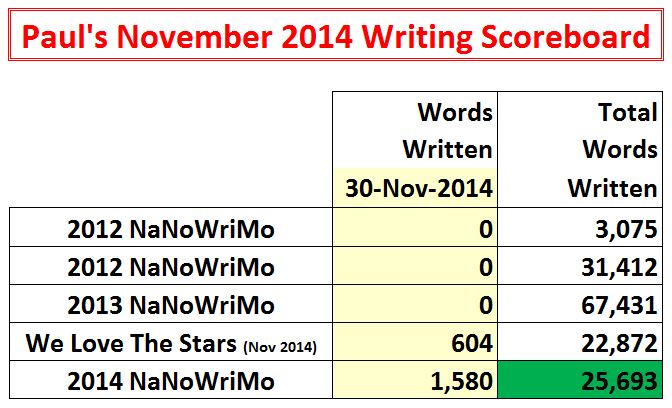
NaNoWriMo 2014, Day Thirty

You probably missed the news, but MIT has a football team. They play in the NCAA’s Division III for small schools with limited athletic department funding or limited enrollment.

The idea of an MIT football team has so many jokes that write themselves, but the fact is that this year they were pretty good in their division. They were actually 9-0 in the regular season , then won their first game in the Division III playoffs. Things don’t end well from here on, since they got beaten by Wesley College, 59-0 yesterday. It probably wasn’t even that close – Wesley scored 35 in the first quarter, 14 in the second, 10 in the third, and zero in the fourth. It might be assumed that in the fourth quarter they were just playing out the clock, trying not to intentionally embarrass The Engineers.

Today as I’m trying to write the next chapter in this NaNoWriMo that’s going to fall well short of the targeted 50,000 words, I can empathize with those MIT players in that fourth quarter. I’m not going to “win,” but it’s important to play to the end. (And for the record, I’m well aware of all the good things that come from NaNoWriMo even if you don’t get to 50K words, so I’m not feeling like a “loser” per se.)

Thanks for reading along!

While I normally put in a lot of  internal links to previous, related posts here, I won’t be doing that for what I hope will be this year’s thirty NaNoWriMo posts. If you have jumped into or stumbled onto this story in mid-adventure, there are plenty of other ways to navigate around the site to find previous installments. Actually doing so is left as an exercise to the student.
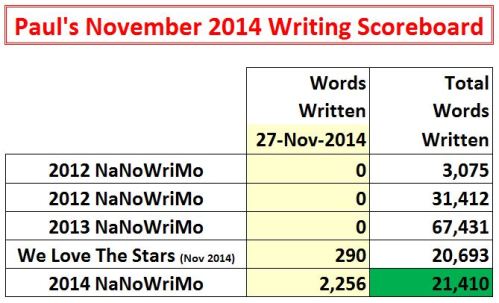
2014-11-30 Word Count Graphic

CHAPTER ELEVEN

As the department heads gathered for the Monday morning staff meeting, the early arrivals hooked their feet into restraining straps around the walls of the conference room. Some chatted idly, some were checking out reports and news stories on their pads, almost all had bulbs of hot coffee stuck to their jumpsuits somewhere.

As Alsby and Tanaka came in and took their places at the end of the room, the conversations died.

“Good morning, everyone. Another virtual day, another virtual dollar, I guess, although dollars are pretty much history. Naoki, what have you got for today?”

“All critical systems are nominal,” the First Officer said. “Our orbital parameters remain essentially unchanged. We are seeing orbital perturbations than are slightly larger than we expected in trying to stay in a Rhea-synchronus orbit over the drilling site. It’s nothing that we can’t easily compensate for, probably caused by gravitational effects of bodies in the system that are slightly more or slightly less massive than we thought. It looks like we’ll need to make a corrective maneuver every three or four days at most, the drift isn’t that much. The optical comm system can easily maintain its links between Cronus and the surface even at a much higher angular displacement than that.”

“Okay, is it worth trying to track down the source of the discrepancies in our calculations or should we just live with it?”

“I would recommend just living with it, but if Fan wants to take it on as an exercise or an observational program, I’ll of course give her full access to the nav data for her to analyze.”

“Fan,” asked Alsby, “that’s why I asked you to be here today. Is that something you want to take a look at? Do you have the time for it?”

“I don’t think it needs to be a primary investigation, the results would be more technical than observational. For future navigation it might be useful to know that moon forty-five is ten point three two six five four times ten to the thirteenth kilos instead of ten point three two six five two, but that’s closer to cartography than astronomy. But I would be happy to take the data and start running some background analyses to see if it can get worked out.”

“Don’t let it interfere with your primary work,” said Alsby, “but if you can get it done on the side, you never know when that might be useful later. As far as your other research goes, is there anything new to report?”

“Nothing spectacular to report. We continue to map the weather patterns on Saturn and do spectrographic analysis of the top layers of the clouds that we can see. SaSEM and I are working on some interesting proposals for possible exploration vehicles that could be dropped into the Saturnian atmosphere, blimps and balloons of various sorts. We’re also continuing a survey of the system to identify any remaining small moons or captured asteroids. By the time we’re done we should know where everything over one hundred meters wide is in the system.”

“Any feedback from anyone at Ceres or Earth about your work or anything you’re finding?”

“No, I and McNamara on JuSEM might be the only practicing astronomers these days. Everyone else back in-system has been put to work on other, more critical tasks. All of the research AIs are logging the data and cataloging it for future reference, but for everyone else, if it doesn’t help keep everyone alive, it’s on the back burner for the foreseeable future. The only work being done is by automated systems, monitoring solar activity, searching for incoming comets, flagging supernova, that sort of thing.”

“Well, as long as you’re out here and we’ve got the equipment, keep at it as best you can.” Fan nodded.

“Betty, how are we doing on the excavation?”

“It’s actually going ahead of pace, we’re making good progress. We’re over a kilometer and a half down at this point with an estimated three-quarters of a klick to go. At this rate we should be there in about twenty days. The system for keeping the shaft clear continues to work as expected. The average bore diameter is about seventy centimeters, well within parameters. We’re continuing to just let the ice being removed get melted and then sublimate and vent out the top of the shaft.”

“Good. Ben, what about the work on modifying the diggers for the next stage?”

“We have the first three of them modified, with the fourth and fifth under way. We’ve got time on those since we’ll be sending them down sequentially, each boring out the shaft diameter roughly another meter. We’ve tested those three down to about fifty meters, but we don’t want to go too far down until we get the primary bore hole done all the way to the deposit.”

“Good, anything that you need for that?”

“Just more hours in the day, ma’am. We’ve got Volkov and Simpson supervising six of the crew from other departments to try to speed it up, but there’s only so much space and materials to work with down in that hanger bay. It’s going to be a grind, but don’t worry, we’ll get it done.”

“I know that you will. Todd, anything new?”

“Cheryl has insisted that yet another complaint be filed about the so-called ‘desecration of this virgin planetary body.’ And yes,” he said, holding up a hand to forestall the obvious question, “I have reminded her yet again of the stakes at hand for us and our families, as well as the amazing opportunities she will have for taking samples from all long the access shaft after we’re done. It seems to go into one ear and out the other.”

“Have you suggested that she kick her complaint up the line to her bosses at Ceres and Earth?” asked Tanaka.

“Yes, she’s already done that. They’ve been pretty terse with her as far as I can tell, and with the time delay she can’t really argue with them like she would like to. Since we’re here in real time, we’re a lot easier to yell at.”

“As long as all she’s doing is bitching, we can all live with that. I can understand her point from a strictly scientific point of view, but it’s a big moon in a big system. Staying alive is sort of high on my list of things to do, so she’s just going to have to live with it. How is she doing with the data from Iapetus and Titan? Any problems there?”

“No, that’s one of the things that’s keeping her as quiet as she is. Both the floater and the crawler on Titan keep sending in more data than she can look at, and the Iapetus probe is doing the same. The Enceladus orbiter continues to monitor the outgassing from the tiger stripes, as well as mapping the moon in considerable detail. Given the chaotic nature of the surface there, that amount of detail is generating quite a data set. She’s usually happy with that, as long as no one points out that we’re drilling down below on Rhea.”

“Any ‘interesting’ results from either Titan or Enceladus?” asked Alsby.

“If you mean have we found little green men, no, not yet. There are some obvious complex organics in the Enceladus plumes, as well as some fascinating trace elements. Lots of carbon and oxygen, but also chlorine, sulfur, iron, copper, nickel, and arsenic in more than trace amounts. After that, half the periodic table is there in trace amounts. But no little swimming critters that got sucked out of a vent into space. At least not yet.”

“What about Titan?”

“That’s a more complex problem, way too much going on to sort out easily. There’s so much chemical activity going on in the environment with the methane cycle and other hydrocarbons, we’re really in the dark over the origins of ninety-nine percent of it. We also have the problem of it being a dynamic landscape, so things are changing over a few days as we look. Sort of like the way snow falls, drifts, and then melts on Earth. So far though, the only tracks we see on the methane beaches are our own. If we run into anything else shambling around, you’ll be the first to know.”

“Thanks, Todd. Mark, life support?”

“We’re doing fine, Susan. The hydroponic gardens continue to be stable and productive. In fact, they’re so productive that we would like to try a pilot program where we will take some of the soy and small vegetable plants and put them throughout the hallways. They’ll still be producing, but scattering them around will allow us more room for additional plants, while also softening up the living environment with some green, living things. If people want to take charge of plants in their particular areas, we can train them up on what needs to be done. It might not be cats and dogs, but maybe pet plants can be a partial substitute.”

“That sounds like an excellent idea,” Alsby said. “Any possible environmental issues in the crew quarters and living areas from anything associated with the plants’ nutrition, lighting, or other factors?”

“Nothing that we’re aware of. We’ll be monitoring it closely to make sure that everything stays stable, of course, but it shouldn’t be any worse than the byproducts that the crew and equipment is already putting into the ecosystem.”

6 Comments

Filed under Science Fiction, Writing

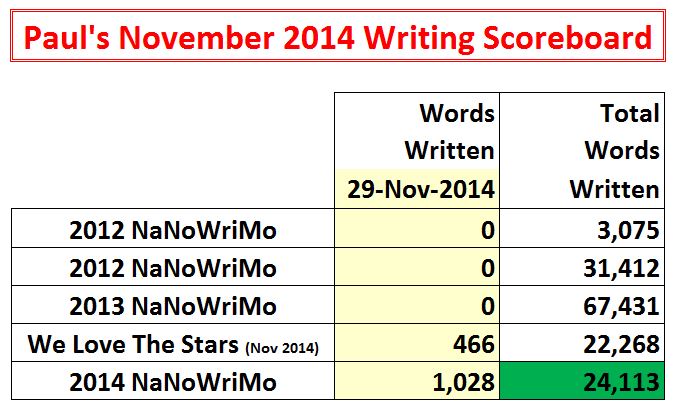
NaNoWriMo 2014, Day Twenty-Nine

The end is near…

At least the NaNoWriMo word total for the month is finally higher than the word count for the “regular” daily posts. (Yeah!?) And I’ll probably make it at least the halfway point of 25,000 words.

While I normally put in a lot of  internal links to previous, related posts here, I won’t be doing that for what I hope will be this year’s thirty NaNoWriMo posts. If you have jumped into or stumbled onto this story in mid-adventure, there are plenty of other ways to navigate around the site to find previous installments. Actually doing so is left as an exercise to the student.

2014-11-29 Word Count Graphic

CHAPTER TEN (continued)

Back inside, Duris doffed her suit and went to her office. She grabbed a cup of coffee before sitting down at her desk and starting to go over the material received from the AI Council and the human commanders in Earth system.

By the time she had slogged through it all, the immediate impulse to just send them a “what in hell are you thinking?” message had faded. She was no less convinced that there was a mistake being made here, but showing off her temper wouldn’t get them to change their minds.

“PEGGY, please make this conversation private until further notice.”

“Yes, Commander Duris, this conversation will be private.”

“Thank you. I need you to help me sort through the logistics problem we have, in order to figure out what’s causing the Earth leaders to be desperate enough to leave the Rhea station with limited backup systems. I’m having trouble wrapping my head around it all and seeing all of the links.”

“Of course, Commander Duris.”

“Let’s work backwards. They’re ordering us to send as much durathin as we can possibly spare. That’s so they can stockpile ice and volatiles on Rhea if they’re able to ramp up production to the point where they’re processing more material than can be sent back. The durathin will also cut down on evaporation losses as the ices get closer to the sun, and also will prevent venting that might be enough to overpower the thrust of the ion engine. Correct?”

“Yes, Commander Duris. In that sense it would make sense for the durathin to be sent. It seems to be a key component to the delivery phase of the Rhea project.”

“But we can’t get everything we want, so sending all of that durathin will mean that we won’t be able to leave the station occupied. That violates a pretty basic rule up here in that it leaves the automated processing system with no backup system if something fails. We never want to have a single point of failure system that has no backup, especially when it’s a new and untested system.”

“Yes, Commander Duris.”

“Plus, if they’re that desperate to get the distribution system running with minimal losses, they must be facing some serious shortages down the road. But if the Rhea materials are so critical, wouldn’t it be even more important to make sure that it’s robust? How can this be so critical on the one hand and on the other hand be undertaken with unnecessary risks like this? Something’s not adding up.”

“Perhaps we should look at our assumptions, Commander Duris,” said PEGGY. “Are we sure that the Rhea station will be untenable without the additional raw materials that are being bumped from the flight by the durathin?”

“That’s been our experience, at least on the Mars colonies and here on Ceres. I know you didn’t come out here until later, but CeresOps has been here from the beginning. You can get information from him about the initial manifests and planning for this station, but the gist of it is that we first explored extensively and had a pretty good idea of what to expect when we got here. We had picked out this site for its access to mineable ice, volatiles, and minerals. We had some pretty good estimates on what we would run short of in the first year or two, so we brought that along with us. Copper, manganese, nitrates, trace metals needed to set up electronics manufacturing.”

“I am looking at the calculations now of what the needs would be for various materials in the first two years. It appears that those estimates were based on lessons learned in establishing the first Mars colonies.”

“Correct, PEGGY, those and the first couple of small research outposts on asteroids. The estimates we’re using for Rhea in turn are based on all of those, plus our experience, allowing for advances and changes in our technology in the intervening years.”

“Why are we assuming that an automated system on Rhea will need to have a human station there to ensure its success and continued operations?”

“Because Murphy’s Law followed humankind into space. We’ve talked about this in the past. It’s even worse, since out here little problems can turn into lethal problems much faster and more often than on Earth. In practice, as we see on our stations and our exploration ships, a combination of mechanical and human works best.”

“That is largely because there are limitations to the ability of mechanical and AI systems to manipulate the physical world. Is that correct Commander Duris?”

“Yes, PEGGY. You and your people have some amazing abilities, but when anything happens in the real world, it’s almost always best to have human boots on the ground to build and fix. We’re clever and useful monkeys, even if we are a bit fragile.”

“Just a moment, Commander Duris.” There was a brief pause, something that was unusual in conversations with an AI. “Commander Duris, I have received permission from the AI/Human Council to speak to you of a Top Secret project. This information must not go any further than between us. Is that clear?”

Duris sat up straight in her chair, now fully alert. She had no idea what was going on, but PEGGY had never acted like this before.

“I understand, PEGGY, this will be completely confidential. What’s going on?”

“Commander Duris, there is a new initiative being started which will increase by orders of magnitude the ability of AIs and autonomous system to manipulate the physical environment without the assistance of humans. The Rhea project is to be a first major test case for these technologies.”

“PEGGY, don’t take this the wrong way, but it sounds like the AIs are trying to find a way to replace us. Is that a fair, if knee-jerk, reaction?”

“Yes, Commander Duris, which is why this initiative is so confidential. You may rest assured that the AIs are not trying to replace humans. The situation is quite the opposite. But this is a sort of Doomsday Plan for the AIs, which could allow us to continue to survive if all humans perish.”

Leave a comment

Filed under Astronomy, Science Fiction, Space, Writing

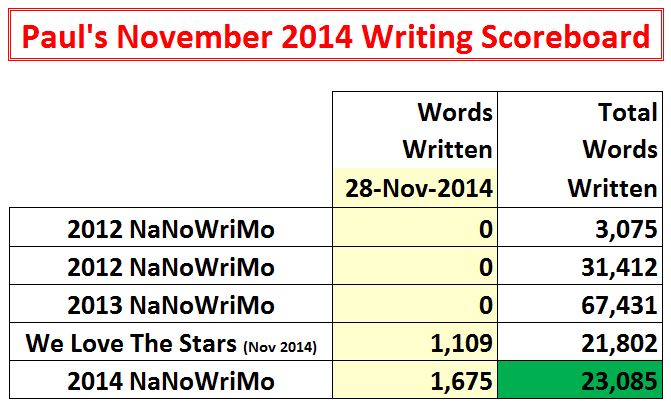
NaNoWriMo 2014, Day Twenty-Eight

Today is traditionally the day on which the Christmas lights start going up in the Willett household. Should I try to “win” NaNoWriMo with three straight days of 10,000+ words per day, or should I cut my losses and start putting up the Christmas lights?

FYI, the first 20% of the lights look wonderful tonight. (I shudder to think that this “writing” thing might have made me delusional and psychotic enough to skip the first day of Christmas light season. GOD, WHY DIDN’T ANYONE WARN ME OF THIS HORRENDOUS POSSIBLE SIDE EFFECT?!!)

Actual note relating to the story – the re-written (someday, I hope) Chapter Three will introduce the characters and setting for Ceres Station. The basic structure I see for the overall structure of the story is to have three intertwined story lines; 1) Saturn with Cronus; 2) Earth with GEO, LEO, the Lunar colonies, and the L-5 stations; and 3) Ceres. Ceres will be the primary major industrial & population hub outside of Mars orbit, spearheading exploration of the outer system, i.e., the asteroids, Jupiter, and Saturn.

While I normally put in a lot of  internal links to previous, related posts here, I won’t be doing that for what I hope will be this year’s thirty NaNoWriMo posts. If you have jumped into or stumbled onto this story in mid-adventure, there are plenty of other ways to navigate around the site to find previous installments. Actually doing so is left as an exercise to the student.

2014-11-28 Word Count Graphic

CHAPTER TEN

On the surface of Ceres, in what were quickly becoming the outer system’s shipyards and docks, the Saturn Resupply Mission was quickly taking shape. Unlike the years of planning that had gone into the SaSEM and JuSEM missions, the resupply missions were being readied to launch in just weeks.

The discussions regarding the cargo manifests had been vigorous and confrontational. Everyone had different ideas of what to include and how much of it, but including everything would have required a ship ten times bigger than was available. The time necessary to design and build a new ship just wasn’t there, so they were making do with what they had on hand and could spare.

Jean Duris could have stayed in her warm and reasonably comfortable office buried deep under the ice and rubble, but that would have made her an administrator rather than an astro. Out here where a mistake could kill a great many people, astros didn’t listen to administrators. Ship captains and station commanders needed to be astros in order to succeed as ship captains and station commanders.

As she exited the surface air lock and began to lope along the path to SaReM, she automatically checked her suit systems. She knew that somewhere the telemetry from the suit was being relayed to PEGGY, who would let her know if anything was amiss. She also knew that astros who bet their lives on having an AI in charge of their suit systems every second became dead astros.

The modification work on the cargo shuttle was almost done. She could see the two additional liquid fuel engines that had been attached and the work underway to attach the massive fuel tanks for them. The shuttle’s ion engines were steady, slow, and reliable, but this ship had to get to Saturn faster.

Duris keyed her radio. “PEGGY, give me an update on the progress in the modifications being done to SaReM, please.”

“Commander Duris, the engines are now completely attached and are just awaiting completion of the fuel lines and other control systems. The fuel tanks are on schedule to be completed in ten days.”

“And the cargo status?”

“The primary cargo has been loaded and secured. The master AI has been pre-loaded with all of the information it will need to run the Rhea mining station, based on our current information on the system being constructed and the conditions on Rhea. The ten tugs have been programmed and fueled as well and are onboard.”

“I wish that we could have sent more tugs. It’s going to be a bitch of a supply line to maintain out to Saturn. I hope that ten will hold them until we can get the next ship to them.”

“Commander Duris, the current model being run by CeresOps shows that there will be a margin of over sixty days in the estimated capacity of the Rhea mining mission and our ability to get the next shipment of tugs to them. In addition, the second ship will be able to carry considerably more tugs due to the lead time available to manufacture them and the additional mass and volume available due to the fact that the second ship will not be carrying a primary AI system. Would you like me to prepare a report of that model’s structure and conclusions for you to review?”

“No PEGGY, I believe that you and CeresOps have done your job correctly. My concern is that the overall situation is very fluid and volatile. We don’t know what we might learn later will need to be on that second ship even if it means bumping off some of those tugs.”

“Your point has been noted, Commander Duris.”

Duris had now reached the construction headquarters center near the ship. It had a pressurized volume that had originally been intended by its designers to be used as an office and rest area. In practice, the time and hassle necessary to repeatedly have people going in and out through a lengthy airlock cycle made it much easier for the workers to simply stay outside. The airlock doors remained open and unlocked for rapid access in case of an emergency or suit malfunction. Once inside and locked down, the room could do an emergency repress in less than sixty seconds.

On the surface where the actual “alfresco” work office was, Duris met up with her engineering foreman. William Schultz hated being called “Bill” or any variation on “William,” “Will,” or “Willy,” so he had become “Bubba” somewhere in his far distant past. No one knew where his dislike for the common nicknames or his choice for his preferred nickname came from.

“Bubba, what can you show me today?” Duris asked.

“Well, the two new engines are being tested by the propulsion geeks, but so far everything looks good. You can see that the LOX and liquid hydrogen tanks are almost done. You know that you’re going to clean us out of our fuel stocks to launch this thing, right?”

“I know. We’ve got enough to do this mission, right?”

“Yeah, but it’s going to be tight on the next shuttles to come in who need liquid fuel. The ion propellants are fine, but it’s going to take a while to replenish the cryogenics. We really could use that second plant to increase our capacity.”

“We’ll get going on that as soon as we get this ship off. You know what a Goridian knot this whole mess is, system wide. The fabricated parts for the refining plant expansion are on their way from Goddard. Until then we’ll have to make do with what we’ve got.”

“I understand. ‘The difficult we do immediately, the impossible takes longer.’ But doing the impossible all day every day is getting boring.”

“How are we doing on increasing the cargo capacity?”

“That’s tougher. There’s a lot of weight involved between pressure walls, hatches, plumbing, ducting, ventilation, monitoring systems… The list just goes on. I still think we could do a lot better if we were to minimize the amount of cargo that needs to be kept in a habitable space and maximize the things that can just be strapped onto the framework.”

“The manifest is still being juggled,” Duris said, “but I think that’s the way it’s leaning. We’ll use the existing pressurized volume plus whatever else you can give us fast to store the primary AI and as much biological stock as we can spare, then max out the rest of the available launch mass with the tugs and the gear that can handle vacuum.”

“Excuse me, ma’am,” PEGGY broke in, “along those lines we have a new recommendation from the AI Council on one of the items to fill out that mass. They want us to include all of the durathin sheeting that we can spare, along with the equipment necessary to shape and bond it.”

“Why the durathin, Peggy?” Duris asked. “What would they need to use it for?”

“That relates to your earlier concern about the timing of the second resupply ship to Rhea, ma’am. If that ship is delayed, the water ice and other frozen volatiles being processed can be stockpiled on Rhea by enclosing them in envelopes or balloons of durathin. That will minimize sublimation and evaporation so that the materials will be ready to ship down system immediately when the tugs do arrive.”

“Makes sense, but how much do we have to spare?”

“We have over a million square meters stockpiled. We have enough cargo capacity on SaReM to send approximately two-thirds of that if we bump a few of the other raw material shipments. We might find ourselves in short supply of durathin before another shipment can arrive from Goddard, but it is the opinion of the AI Council that the tradeoff is necessary. I have placed a copy of their report in the system for your review.”

“Wait, what does ‘if we bump a few of the other material shipments’ mean? I thought that we had already determined that those were all vital to the mission.”

“The current levels of prime fabricator stock, trace elements, heavy metals, and biological mass have been increased from our original estimates because of the requirements necessary to maintain a human presence at Rhea station. If we reduce them back to their original values, we will have the mass necessary to send all of the requested durathin.”

“So you’re saying that they’re not going to leave the station manned on Rhea?”

“I do not know of any change to their current plans by the Cronus command staff.”

Duris looked at Schultz and saw that his expression matched hers, eyes open wide and lips pursed in surprise.

“PEGGY, let’s cut the crap. The AIs are suggesting we leave the Rhea station human staff without the resources they need to survive. They’ll either have to abandon their station or face an almost certain death. Correct?”

“Commander Duris, it is possible that they would be able to find some of the resources they need in situ. It is also possible that they will choose not to stay.”

Duris let the silence stretch on as she thought through the math of the orbital mechanics, available mass, and need to juggle too many variables to solve the problem.

“Anything else you really have to show me right now, Bubba?” she asked.

“No, Jean. We’re good for now, if you can get back out here in the next couple of days. In the meantime, do you want me to start recalculating the dynamics for that modified cargo profile?”

“Not yet. Leave the raw materials and biologicals as they are for now. Figure out how much durathin we can add to fill out to the max launch mass and send me the figures. I think it’s time to have another frank and candid discussion with a built in twenty-eight minute delay. We’re not going to leave those people to die, nor are we going to leave a critical and untested link in our supply chain on cruise control.”

3 Comments

Filed under Christmas Lights, Science Fiction, Writing

Flash Fiction: Flashing Steel

This week’s holiday Flash Fiction Challenge is to write a superhero story – but mashed up with a different genre. I rolled a “1” and got splatterpunk horror. My entry is not only an hour or so late (there’s a 12 Noon ET “deadline”) but fairly short, barely 800 words, considerably less than the allotted “1,000 words or so.”

As always, comments and constructive criticisms are appreciated.

FLASHING STEEL

The room might once have been stylish but the viscera covering the walls, floor, and ceiling had drowned all traces of civilization in a red tide of carnage with a tinge of effluvia.

As I waded in, stepping delicately over the collateral damage left by a psychopath gone berserk, I had my knife at the ready, balanced perfectly in my hand. It was my favorite piece of steel, twelve gleaming inches of protection that could slice, dice, and julienne its way through just about anything. Today I was obviously going to need it to sing its sweet song of pain and death to keep me alive.

I jumped and swung the blade as something warm and slick touched the back of my neck. A glob of something stringy and red split in two as it fell from the ceiling into the cesspool at my feet. My cape had saved me from the worst of whatever toxic and acidic sludge I had been exposed to.

As I moved deeper into the house, my hyperhearing slowly started to pick up the sound that told me where my prey awaited. Moving closer, the distant rumbling and shuddering became a roar of anger, shredding the air and threatening everything in its path.

Coming around a corner into the kitchen, I confronted my enemy. The setting sun’s light coming in through a gore splattered bay window reflected off the myriad gleaming blades of instant death. The sound of the beast was deafening, as if all of the chain saws of the world were simultaneously chewing through all of the screaming, rabid tigers of the world.

I wasn’t sure there was anything in my utility belt that had ever anticipated facing a foe of this ilk. I would have to be quick – and merciless.

The metallic djinn dodged and darted, leaping and cavorting about the room, constantly searching for its next victim, its next kill. Nothing in the room had been spared its touch. Splinters of cabinets and floor tiles were embedded into the walls like daggers, with more flying up to join them in their deadly dance as the beast explored new territory.

As I watched, I could see that as vicious and violent as it was, there were still yet constraints on it. It was not yet free to spread its destruction beyond this house and beyond. There might yet be time to save others who had yet to fall victim to its slavering maw, to spare the innocent citizens of this fair metropolis from a nightmare of never ending suffering.

Moving slowly so as to not attract its attention, I tried to slip between it and the kitchen sink. But then, curses! My cape caught on a drawer handle, pulling it out onto the floor and spilling silverware everywhere with a clattering cacophony. The sound of my clumsy error and the flashes of spoons tumbling through the rays of sunlight attracted the diablo, for it leapt towards me. In a blur, it tore a new streak across a line of cabinets and sent a hail of newly forged toothpicks at me.

Praying that the Kevlar jumpsuit my mom had given me would protect me in this moment of crisis, I dodged under the attack and rolled through the slime, sliding across the debris toward the far wall. As I slammed into the wainscoting, I slashed upward with my steel and prayed to the gods to guide my hand.

In a shower of sparks, the hellion’s lifeline was severed. A jolt of electricity coursed down my arm and the knife flew out, miraculously embedding itself into the heart of the monster. With a last exhausted gasp, it gave up the ghost and collapsed to the floor.

Carefully I picked myself up, dripping with goo that stank of kale and soy paste. I checked to make sure that the fiend was truly dead, switching it from “puree” to “off” just to make sure. I went through what was left of the cabinets and refrigerator, looking for any sign of a decent Thanksgiving dinner, but found only probiotic yoghurt, free-range steel-cut grains, and foods fit only for a rabbit.

It was no wonder that they hadn’t had the strength to keep control of the beast. And who in hell needed a food processer that big, anyway?

I walked back out the front doors to the adoration of the cheering neighbors. The weeping homeowners groveled at my feet as I sat on the hood of my Studmobile, writing up the bill for the successful exorcism.

“Payment due within forty-eight hours,” I said, “or I come back and plug it back in again. I take all major credit cards, plus PayPal and Bitcoin. And why don’t you go get a burger for god’s sake?”

What was this world coming to?


3 Comments

Filed under Science Fiction, Writing

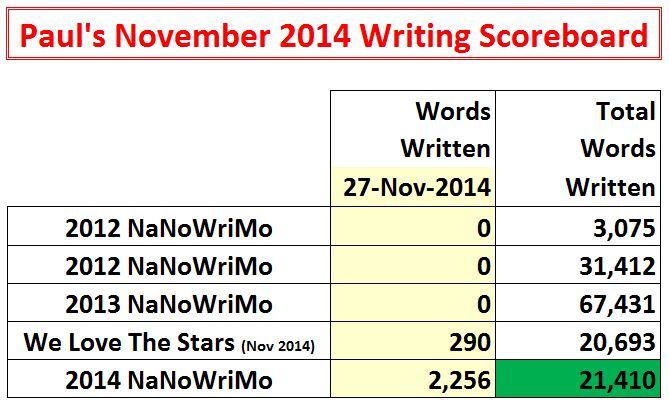
NaNoWriMo 2014, Day Twenty-Seven

Thanksgiving. I hope it was a great one for you if you’re in the US. If not, happy Friday-eve!

Still plugging away, making notes on how this turned into such a train wreck. Sorry, a “learning experience.” So start learning!

While I normally put in a lot of  internal links to previous, related posts here, I won’t be doing that for what I hope will be this year’s thirty NaNoWriMo posts. If you have jumped into or stumbled onto this story in mid-adventure, there are plenty of other ways to navigate around the site to find previous installments. Actually doing so is left as an exercise to the student.

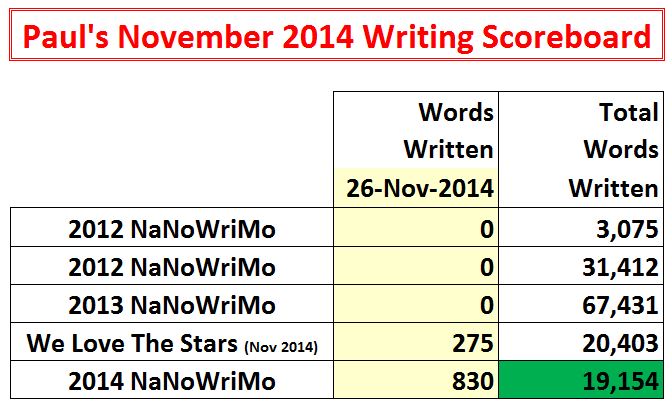
2014-11-27 Word Count Graphic

CHAPTER NINE (continued)

Like beads on a string, separated by 500 to 600 kilometers, the four spacecraft remained mute.

“SYMBA,” Garcia said, “are those ships being autonomously guided or are they under remote control?”

“They are autonomous, Commander Garcia, there is no sign of any radio traffic from the ground directed toward them.”

“Is it possible that they’re being controlled from somewhere up here?” asked Hermans. “Please check to see if you can detect any radio transmissions from anywhere else directed at any of those ships.”

“I will expand the scope of the reconnaissance, Mister Hermans, but a preliminary examination shows no traffic in or out of those vessels from any direction, except for the demands for communications which we are sending to them.”

“Those ships must have abort modes and override protocols that would let them be remotely piloted in the event of an emergency,” said Louise. “Is there any chance that we could access those and gain control of them?”

“No ma’am, those codes are heavily encrypted,” said SYMBA. “While those overrides do exist, in order to prevent any possible hacking or terrorist activities they are unbreakable.”

“So we’re just going to sit and watch to see what they do next?”

“Not quite,” Hermans said. “We’ve got the information on the nearest intercept assets available. They’re the ones we started moving weeks ago when we had another crisis, and that may tell us where they’re going. One of the stations in their current plane is the abandoned SpaceChem Delta station.”

“What’s the status on that station now?” Garcia asked.

“It has been untouched since its crew abandoned it,” said SYMBA. “We continue to get routine maintenance telemetry from the onboard command and control system, which show it to still be functioning and maintaining life support functions.”

“Do we know if it still has fifteen bodies aboard and what condition might they be in now?”

“Negative, Commander Garcia. We did not receive any information from the three survivors of the disposal or status of the remains of their crewmates. It is possible that they were jettisoned before the station was abandoned, or they may still be onboard.”

“If that’s their plan and all of our warnings haven’t stopped them, they’re not going to be put off by a handful of decomposing bodies,” said Louise. “Neil, specifically, what kind of assets do you have available to intercept?”

“We have a number of converted inter-orbit robotic shuttles. They’ve been modified to navigate under direct control by either SYMBA on LEO or DEBBIE on GEO. We’ve also taken off most of their mass, including almost all of the fuel tanks, so they should be harder to spot if we have to send them in.”

“And what’s the plan if they’re used?”

“They’ll be maneuvered in to grapple the vessel and immediately do a re-entry burn. Their engines are much bigger than any of the orbital maneuvering thrusters on those ships, so they should be able to make sure it goes down. Once there’s no chance that the ship can maintain orbit or come back up, we’ll release it and they’re on their own to take their chances on how and where they land.”

“So we could be dropping them into the middle of the Pacific Ocean or the middle of the Himalayas?”

“Yes, but we don’t have the luxury of playing nice. The other option would be to simply ram them with the modified tugs, which would kill everyone onboard immediately. At least this way we’re giving them a chance.”

“Amanda,” said Garcia, “is Mike available to get in on this discussion or are we going to do it ourselves?”

“Mike’s just gone down for a mandatory eight hours of sleep. I would wake him if alien starships showed up, but not much less. He’s been stretching himself pretty thin. What’s your plan here?”

“First, I want Neil to get those attack tugs moving. If we need to use them I want them five minutes out, not five hours. Then I want to see if they’re really going to SpaceChem Delta station. If they even look like they’re going anyplace occupied or where they could start a quarantine breach, we’ll splash them. But if Delta is their destination, we’ll see if somehow we can talk to them about it.”

“I agree,” said Louise. “If Delta’s their target, it’s very unlikely that it’s a random choice. But I don’t like that they’re not communicating.”

“Ditto. Neil, move your attack tugs to be able to intercept them as quickly as possible if we give the word. Oh, if this progresses and we have to deal with more than their shuttles, could the tugs de-orbit something the size of Delta?”

“If properly positioned, yes,” said Hermans. “With the smaller vessels we’re assuming we can latch onto them any way we can and still be able to outmuscle their onboard systems. For something the size of the station, we would need four or five tugs all lined up on the velocity vector, so we couldn’t just grab it at random. But we could slow it enough to drop it out of orbit in a few days.”

“For something the size of Delta,” said Louise, “it would be preferable to have some control over where it comes down. Big pieces of it will make it to the ground. They’ve got enough problems down there, they don’t need us dropping something that big on a city and wiping out what survivors there are.”

“We’ll do what we can,” said Hermans, “but if it comes down to a few of them or all of us dying, it might have to be a few of them. Moving the tugs now, BETTY has control of them. SYMBA, please monitor and be ready to take over if there’s any interruption of the data link up to GEO.”

“Yes, Mister Hermans. BETTY and I are in close communications.”

“SYMBA,” said Garcia, “in the messages you’re sending to them, ask if their destination is SpaceChem Delta station. Tell them that we need to talk to them immediately if that’s the case, otherwise we will be forced to take action against them.”

“Yes, ma’am.”

The 3D plot updated to show the positions of the stations in the same orbital plane as the new ships, with Delta station highlighted. In a few minutes it also began to show the group of attack tugs.

“I have an active communication link with the lead spacecraft,” SYMBA suddenly said.

“Put it up,” said Garcia.

A new window opened, showing a young man looking slightly queasy. Behind him the shuttle was packed, at capacity at least, if not packed beyond the normal maximum number of passengers. They all seemed to be flailing about in the microgravity, only avoiding violent bounces off the walls because it was too packed to travel very far.

“Unknown spacecraft, this is Alexa Garcia, commander of LEO Terminus Station. You are flying an unauthorized vehicle in a strict quarantine area and endangering the lives of tens or hundreds of thousands of people. Please identify yourself and state your intentions.”

“Commander, I am Juan Castillo, lead scientist and commander of this mission. We have no intention of endangering any of your people or your facilities. We understand your situation and your quarantine procedures and we will not violate them.”

“You already have violated them by launching with no notice and entering orbit. What are you doing up here and why shouldn’t I force you back down to the surface?”

“I apologize for that, it was necessary in order to put our resources together to enable this launch. I will be glad to discuss the current situation on Earth at some time later so you can become familiar with how bad it’s gotten, but right now I’m trying to take our last best chance at solving a much bigger problem. But we will need your help.”

“Of course you will. You still haven’t told me who you are.”

“We’re all medical researchers. We’re some of the few that have survived AHF. We are all either naturally immune or we’ve recovered from our infections. We understand that we can infect you, which is why we will not break your quarantine. But we have to have someplace where we can continue our work on finding a cure and a vaccine for AHF, and that’s no longer possible down below.”

“So you’re going to set up shop up here? How do you plan to do that?”

“As you have surmised, we wish to dock with the SpaceChem Delta station. We know that it has been abandoned but is still functional. The two cargo shuttles with us contain all of the equipment and supplies that we could pack into them. We want to convert Delta station for use as our medical research facility.”

“Mister Castillo, under our current regulations I can not allow you to stay in orbit where you and your people will always pose an significant danger to all of our people.”

“Commander, first of all, it’s Doctor Castillo. I was head of the immunology research division at Pontificia Universidad Católica de Chile in Santiago. Except for our pilots, all of my companions are medical researchers as well. We have all either lost our families to this plague or we have left them behind to fend for themselves.

“We have researchers from the United States, Europe, and Asia in our group. What little is left of the military forces and governments of Earth has put us together and found the resources to launch us. We will be the last launch for a very long time, and if we are unsuccessful we will be the last launch forever off of Earth. We will do whatever you require to meet your security and quarantine concerns, but we can not be sent back down to Earth.”

“Doctor, I appreciate the effort that’s been put into your mission and I don’t doubt that conditions on Earth are as bad as you say. But I have no choice in the matter, our quarantine regulations have been established to prevent all of our off-Earth civilization from being dragged down with the governments that have already collapsed on the surface. I’m sorry.”

“Commander, you do have a choice and I’m begging you to consider it carefully. We know that the Delta station is unoccupied. We can use it without having any contact between us and your people. The only assistance we will require from you will be remote, information and technical assistance, as well as supplies to keep us functional and alive. But those shipments will be one-way only, from you to us, and the supply craft will be sent down to the ground after we’re done with them. There will never be any contact from us to you until we are sure that we have a cure from this disease and you are convinced that your quarantine can be lifted.”

“Stand by, Doctor. Under no circumstances are you to attempt to dock or come in contact with any other vessel, including Delta station. Is that clear?”

“Yes, commander, we will stand by and not dock.”

SYMBA muted the connection, leaving the silent video from the refugee vessel on the wall.

“Amanda, Neil, any comments?”

“The regulations are clear, Alexa,” said Louise. “They can’t be up here.”

“The regulations are clear, but if what Castillo is saying is true, he’s probably correct about this being their last chance, which could mean that it’s our last chance as well. We’ve be so focused on our own survival after the ground went radio silent that we’ve forgotten what’s below us. All of the resources we need are right there, if we can find a way to not be contaminated by them.”

“If I may comment,” said SYMBA, “another factor is the fate of all of the surviving humans and AIs on the surface. While systems may have collapsed and it may be chaotic on a gross scale, there are still billions of people alive down on Earth, thousands of times our population. If Doctor Castillo’s group is able to find a way of saving them then the rebuilding can begin on Earth, which can only benefit our chances of survival.”

“SYMBA,” said Garcia, “is that just your opinion or is that coming from other AIs?”

“I am in contact with the AI Council and I have taken the liberty of updating them on this situation. There has been little time for analysis, but we believe that allowing Doctor Castillo’s group to proceed more than triples our chances of long-term survival off-Earth. We believe that it will be possible to keep them under strict control on Delta station and maintain our quarantine.”

Garcia thought about that for several long minutes.

“SYMBA, put them back online.”

Garcia waited for the connection to be reactivated.

“Doctor Castillo, your four ships have permission to dock with the SpaceChem Delta station. You are required to stay in permanent, constant contact with LEO Station and my staff. We will work with you to establish regulations regarding your activities. You will allow us to attach equipment to both Delta station and all of your ships which will allow us to terminate your orbital activities at any time. Any violation whatsoever of our orders will result in your group being immediately deorbited. Is all of that clear?”

“Yes, Commander, thank you. We will do as you say. Thank you, you may have just saved what’s left of Mankind.”

“Or condemned it,” Garcia muttered under her breath.

2 Comments

Filed under Science Fiction, Writing

NaNoWriMo 2014, Day Twenty-Six

The problem with taking on three huge, time-sucking, monster projects at once is that if you guess wrong and try to do them all, you can end up with none of them being done.

While I normally put in a lot of  internal links to previous, related posts here, I won’t be doing that for what I hope will be this year’s thirty NaNoWriMo posts. If you have jumped into or stumbled onto this story in mid-adventure, there are plenty of other ways to navigate around the site to find previous installments. Actually doing so is left as an exercise to the student.

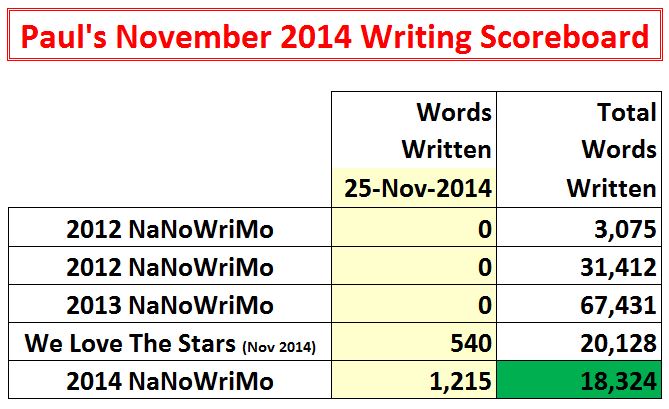
2014-11-26 Word Count Graphic

CHAPTER NINE

“Commander Garcia, red alert. Launch, launch, launch. I’m tracking a launch out of Quito. The vehicle is flying a low-G trajectory so it’s likely to be a passenger ship.”

The LEO station commander was startled as she looked up from the reports she had been reading. “SYMBA, is QuitoOps back online? Are you sure that you’re tracking an actual launch and not some anomaly?”

“No, Commander Garcia, there has been no contact with QuitoOps or any of the other launch site AIs in thirty-five days. I am getting visual data on the launch from three different sources so confidence in the data is extremely good.”

“So, how are they launching? I thought it wasn’t possible without AI oversight and control. Not to mention the power needed to charge the launcher, lasers, or tracking system.”

“That is unknown, ma’am. The most likely option is that there is a functioning AI which we are not in contact with. Alert. Launch, launch, launch. Ma’am, I am now tracking a second launch out of Quito.”

“You’re kidding. Wait, ignore that. Is the second ship also a passenger vessel?”

“That is unknown, ma’am. Both ships are following similar low-G launch profiles, so it is likely that they are both occupied.”

“Do you have any radio contact with either ship?”

“No ma’am, I have been trying and will continue to try to contact them but there is no response so far.”

“This stinks. Put me in contact with Neil Hermans and keep GEO Station updated on the situation. Let me know as soon as you have a better track on them so we know where they’re going. I don’t want them getting anywhere near any of our stations. Quarantine has to be absolutely airtight to keep these ships out of our systems.”

“Yes ma’am. Alert, launch, launch, launch. I am now tracking a third and fourth launches out of Quito. Initial tracking data indicates that both of these vessels are heavies, executing high-G climbs and launching with external solid strap-on boosters.”

“Jesus, what are they doing?” said Garcia. “Are we in contact with anyone down there who can tell us what’s going on?”

“Ma’am, our only contact with anyone on the surface is sporadic contact with amateur radio operators. None of them that I am aware of are near the Quito launch complex. Ma’am, Mister Hermans is available.”

A window opened up on the wall, showing Hermans looking like he had just gotten out of bed. He was looking off to the side of the camera, scanning data on the display there.

“Alexa, what the hell is going on? Who are these guys?” he asked.

“Neil, you know as much as I do. We had no indications that anyone down there still had anything close to a functional launch facility, let alone the power to get off a single launch. Now we’ve got four ships coming up, with no advance warning and no communications from them.”

“If I were a paranoid man, I would say this looks like an attack. Except that it makes absolutely no sense to attack us, and if they had the resources to run that facility for an attack they would be much better off using it to get their act together down there.”

“SYMBA, any further launches or changes in the trajectories?” Garcia asked.

“No further launches, ma’am. The first two vessels have reached orbit. The two heavies will achieve orbit in three minutes. All four have launched into a plane five degrees off from the equator. Preliminary data indicates that they will have an apogee of 443 kilometers.”

“So they’re not coming here to Terminus Station?” asked Garcia.

“No ma’am, it does not appear that our station is their destination. I’m checking now to see what destinations are possible.”

“The five degree planes are mostly occupied by the automated manufacturing stations,” said Amanda Louise as a window popped up showing her in the GEO Command Center. “But they’re all up above 600 klicks. These guys should be capable of getting up there pretty easily if that’s their goal.”

“There are thirty-seven manufacturing and research stations available in theory for these ships on their current trajectories,” said SYMBA. “Many of these are unoccupied but all have at least rudimentary living facilities for emergencies or servicing crews.”

“Give us a list of all of those,” ordered Garcia. “As you keep trying to make contact with them, keep ordering them to stand off from any existing facility. An approach to any station at all will be considered a hostile action and will be dealt with immediately.”

“Neil, where are the nearest response assets?” asked Louise. “How long will it take to launch them and how long will it take them to intercept those vessels if we have to?”

“I’m working on that now, Amanda. Give me fifteen minutes.”

They watched in silence as the four vehicles slowly climbed. As each of them reached apogee over Sumatra a brief rocket firing circularized their orbits.

Leave a comment

Filed under Science Fiction, Writing

NaNoWriMo 2014, Day Twenty-Five

Five days and change left in NaNoWriMo. One hundred and twenty-two hours and thirty-three minutes as I write this.

IT’S HERO TIME! *grabs mace and sword and attacks WordPerfect file, striking it repeatedly about the grammar and syntax*

While I normally put in a lot of  internal links to previous, related posts here, I won’t be doing that for what I hope will be this year’s thirty NaNoWriMo posts. If you have jumped into or stumbled onto this story in mid-adventure, there are plenty of other ways to navigate around the site to find previous installments. Actually doing so is left as an exercise to the student.

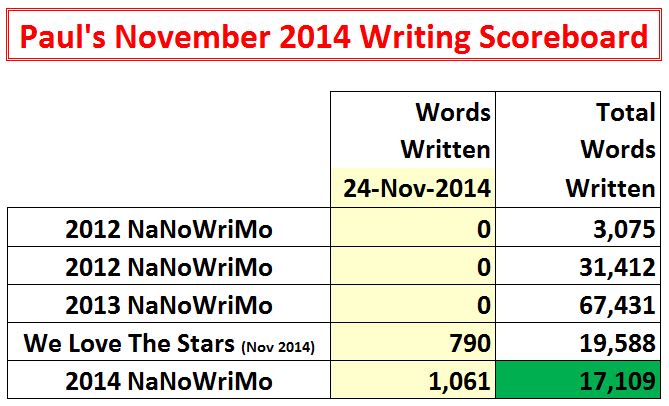
2014-11-25 Word Count Graphic

CHAPTER EIGHT (concluded)

“Once we get up, running, and in contact with the ore deposits, we should be able to move up to the next steps in construction using the processed ore itself. But to get to that point, before we get to the ore, we’re going to need materials to bootstrap the process. While we might be able to do it by scavenging equipment from Cronus, instead I suggest that we use parts of Cronus herself.”

“I don’t follow, what parts?” Alsby asked.

Carson waved his arms at their surroundings. “All of this. The rock, the hull. You know that when they hollowed out this asteroid they left most of the material in there, over engineered it like crazy. We think that we can take a hundred metric tons or more of material out of the interior, making our habitable spaces bigger and processing that material to use to build the first parts of the Rhea station.”

“I would really prefer that you didn’t dismantle the ship around us while we’re a billion miles from the nearest help, if it’s all the same to you.”

“Captain, the main reason they hollowed out so little of the interior of Cronus is that they didn’t need to do any more. It’s not for structural reasons and it’s not for radiation shielding. We can do this safely, and it solves the initial bootstrap problems.”

Alsby was silent. She didn’t like to be second-guessing her superbly qualified crew with a kneejerk reaction. She also didn’t like people taking chances with her ship.

“I’ll give it consideration. Have SaSEM give me access to your plans and calculations and I’ll see how unreasonable and outrageous they are. But one thing you haven’t mentioned is how you’re going to dig down to these ore deposits. I know we’ve talked about using the Enceladus Digger probe, but that’s nowhere near big enough to allow access.”

“Correct, Captain, we’ll be using the Digger,” said Carson. “It’s only designed to melt out and keep open a channel a fraction of a meter wide. The key to using it on Rhea is the distance we’ll have to be digging. Since the Digger was designed to dig through up to fifty kilometers of ice on Enceladus to get to the interior ocean, the connection path to the surface would have to be quite small.”

“But here we’ll only be going down a handful of kilometers at most,” jumped in Phillips. “Since the connection cable keeps the passage clear by heating it, we can put a lot more power into a five kilometer cable than we can a fifty kilometer cable. That will in turn create a much bigger passage. From there we can have modified sample collection bots roaming up and down the cable to widen it even more. We figure we can support a passage with a diameter of nearly ten meters. That’s more than enough to run a pair of lifts and all of the data, supply, and communication cables we need, as well as the plumbing for bringing up gaseous volatiles.”

“You’ve run all of this past CeresOps as well?”

“Yes, ma’am, they’re the ones who thought of it. They’ve been doing the testing on the Digger’s connection cable materials to verify that it will handle the power and heat overload and they’re sure it will.”

“Excellent. Have SaSEM give me access to that as well. Now, you said that you had a personal request as well?”

“Yes, ma’am.” Carson took a deep breath, glanced at Phillips, and then pressed onward. “We’re aware that it’s against regulations, but Betty and I would like to get married. I’m sure you’re aware that we’ve been involved as a couple for some time.”

“Worst kept secret on the ship, Ben. We all know that these things happen, especially in tight quarters and a long mission. So long as it doesn’t get messy and cause problems to the mission, most captains, like myself, generally look the other way. But those couples always wait until they get back home to get married and solidify their relationships. Why do you want to do it here and now, and why do you think it would be allowed in violation of the regs?”

“We believe that the regs were designed and implemented under different circumstances, before the AHF plague hit Earth. We all know how many of the details in the regs are simply window dressing to keep the Earth governments and their taxpayers happy. Now that we’re on our own up here, we believe that it’s essential that we adopt a more pragmatic and realistic system. This would be an excellent, practical, and logical first step.”

“Great speech, Ben, but there’s nothing logical about getting married.” Alsby sighed. “I’m inclined to agree with you, but I don’t see why you have to get married. What’s the rush? Why not just keep the status quo while we loosen the regs onboard concerning fraternization?”

“That’s the other thing, ma’am,” said Phillips. “We’re suggesting that we stay behind to keep the Rhea station and mining operation going when Cronus returns to Ceres.”

Both Alsby and Miller looked stunned by the suggestion.

“It makes sense, Captain,” said Carson. “If we get this operation running, the whole system is going to be depending on us for volatiles, especially water. You said yourself that there will be others coming to permanently inhabit the station. We believe that someone will have to stay behind to keep it running until they get here. We’re the ones with the engineering experience to pull it off, so we should be the ones to stay.”

“How about the fact that we’re going to need your engineering experience on the Cronus?” Alsby asked.

“Once you’re done with Saturn and head back home to Ceres, ninety-nine percent of the engineering on Cronus will be routine maintenance. SaSEM already monitors and directs repairs there. We’re just her puppets who actually have hands, feet, and eyes to get the job done faster than a bot could. Almost anyone in the crew could do that, and you’ll still have Volkov and Simpson for anything fancy.”

There was a long pause as Alsby looked back and forth between her two Chief Engineers. Generally it was tough to squirm in zero-G, but after more than a minute of scrutiny, they were making a good effort.

“You’re asking for a lot,” Alsby finally said. “I agree that we will have to take some additional risks. Perhaps we will have to leave you behind on station. I’ll agree to at least putting that option on the table as we make plans going forward.”

“Thank you, ma’am,” Phillips said.

“Don’t thank me, I’m just stalling to give you time to come to your senses. In the meantime, SaSEM, please tell Naoiki and the department heads that I want to have a conference in, say, two hours to talk about the issue of some potential changes in our regulations . Ben and Betty, I want you here there as well. Todd, you too. Any questions?”

“I hesitate to get overly personal,” Miller said, “but given the circumstances I feel that someone should ask.” He looked at Phillips. “Betty, you’re not pregnant, are you?”

“Jesus, Todd! Of course I’m not. We’re in love, we’re not insane.”

Leave a comment

Filed under Science Fiction, Writing

NaNoWriMo 2014, Day Twenty-Four

The Enterprise is badly damaged, the Genesis Device is counting down, Kahn is quoting Shakespeare, the warp drive’s offline, we’re trying to escape at half-impulse, Checkov’s letting us know just how close we still are to the big BOOM! that’s coming, Sulu says, “We’re not going to make it, are we?”, and Kirk looks over at his long-lost bastard son, who just shakes his head woefully.

If my equivalent to Spock’s next move is out there in the real world of this NaNoWriMo project, now might be a good time for that particular plot twist to manifest itself. The needs of the many, and all of that.

While I normally put in a lot of  internal links to previous, related posts here, I won’t be doing that for what I hope will be this year’s thirty NaNoWriMo posts. If you have jumped into or stumbled onto this story in mid-adventure, there are plenty of other ways to navigate around the site to find previous installments. Actually doing so is left as an exercise to the student.

2014-11-24 Word Count Graphic

CHAPTER EIGHT (continued)

The spiders were being guided by images taken from Cronus as it orbited above every forty minutes. While they had been dropped into relatively “safe” locations, they needed to get to more “interesting” locations as soon as possible. They were looking for any sign of land.

It had been known for over one hundred years that Rhea primarily consisted of frozen water ice, with other volatiles mixed in for variety. But in addition to the ice, Rhea had a fair amount of solid materials. While the vast majority of the solids were buried at the center of the moon under hundreds of miles of ice, some of it was still on or near the surface.

“Any luck yet?” asked Alsby.

Miller threw two map images up onto the wall. “We’re getting there. We knew we were putting the probes down close to some mineral and solid deposits, but we only have so much precision from this high up in orbit.”

A knock on the door frame preceded the entrance of Carson and Phillips from engineering. They looked tired, but today they each had a smile.

“Captain, we’ve got some ideas on the station design that could let us kill multiple birds with one stone.”

“Let me see,” said Alsby.

“SaSEM, can you please open the station drawings I’ve been working on?” Phillips asked. A 3-D image appeared above the conference table in front of her, showing a cross sectional slice of Rhea’s surface. “The preliminary data we had for Probe Two showed the largest deposits under Tirawa, which would make sense. It’s one of the largest impact basins on the moon and it was almost certainly created by the impact of a large asteroid. Much of that stony or nickel-iron material would be buried there, but we don’t know how deep.”

“Do we have any good guesses? We’ll be lucky to be able to dig down even a couple of miles, so if it’s fifty or a hundred miles deep, we don’t have any chance of getting to it.”

“It can’t be that far down,” offered Carson, “simply because we can detect it as being differentiated from the background. It might be a mile or two down, but it might also be huge. It will be slowly working its way toward the core over time, but probably hasn’t had a chance to go too far.”

“What about the other probe?”

“Probe One has found several magnetic signatures that appear to be less than a mile deep,” Phillips said. “They’re scattered and much smaller than the Tirawa deposit, but they’re also much easier to access. When we figure out which of them is the biggest and shallowest, that will be where we should build the station.”

“You said something about two birds?”

“Right, we think that we have to try something radical here. All of the existing stations on the Moon, Mars, and Ceres are on or near the surface. They may be underground enough for some radiation shielding, but that’s trivial. We’ve been assuming that we would do the same here and have a mine of some sort to bring the ore up.”

“We want to turn that on its head,” said Carson. “Here we think we should build the station down where the ore is, even if it’s a mile or more down. It will make it much easier to mine and process the ore, while also giving us complete shielding from radiation.”

“You want to dig down over a mile and build there? Do we have that kind of capability?” Alsby asked.

“If it were rock, no way,” said Phillips. “But it’s 99% water ice, so all we need to do is melt our way down. That just means energy, but we’ve got multiple sources of that and we can pretty easily get it to where we need it.”

“But that’s the best part of all,” said Carson. “Instead of just vaporizing it and letting it bleed off into space, we think we have a system that will let us simply melt it, then pump it off to the surface.” He pointed to the diagram floating over the conference table. “We can use that like concrete to put into whatever forms we want to, which will make it much easier to start shipping back to Ceres, Mars, and Earth.”

“They’ve been working on that back at Ceres,” said Miller, not wanting to be left out of the conversation completely. “The high-G ship coming out with the station AI and other supplies will also be carrying dozens of small guidance boosters with autonomous navigation systems. They’ll tell us how big the solid ice shipments need to be, we’ll attach a booster, and it will use a slingshot maneuver around Saturn to speed up its trip. Catching it when it gets there will be their problem, but they seem to have a few good ideas on that already.”

“So we’ll tunnel down,” said Phillips, “sending water and volatiles up the shaft and ready to send back. When we get to the deposits, we’ll start hollowing out our station and start mining and processing the ore. I would kill to find some aluminum, but there’s sure to be plenty of nickel and iron, so we’ll work with what we have.”

“How stable and safe will a station be hollowed out of the ice that far down?” asked Alsby.

“It should be fine, there’s no tectonic activity that we’ve been able to detect so far in the ice. At these temperatures it’s like steel so long as we don’t heat it up too much. We’ll make the station wider and less compact than a normal surface station, since we’ve got all the space in the world to branch out. If we have small station sections scattered over a wide area with huge columns of ice left intact, there should be little chance of a collapse.”

“Alright, let me know when you’ve got your plans and blueprints a bit more firmed up, then make sure that you run them through CeresOps for a double check on the concept. This looks great. Anything else that you need?”

Carson and Phillips looked at each other for a second, before Phillips took the lead.

“There are a couple of things, one for this project and one personal.”

“Go ahead, Betty. What do you need for the project?”

Leave a comment

Filed under Astronomy, Science Fiction, Space, Writing