Category Archives: Space

Sunset Launch

Just about perfect “just after sunset” timing for a SpaceX launch out of Vandenberg. I missed it, but my daughter caught it from near Downtown LA.

(Photo: Michi Willett)

I ran outside.

The rocket was long gone over the southern horizon, but the high altitude contrail, still lit up by the sun somewhere over the horizon to the west, was still glowing.

The other view I’ve seen is from the Virtual Railfan Hesperia/Cajon Pass webcam. If you can see a copy later, grab it. It’s great to see that when we move up to the High Desert we’ll still be able to see launches.

It lasted for a while, until the Sun moved on and the contrail dissipated.


Leave a comment

Filed under Airshows, Critters, Photography, Space, Sunsets

The Stars Align

That’s a classic line for a title, but a highly inaccurate one. While there are stars in view, the bright objects are not stars, but planets and our Moon.

When I first went out it reminded me of several symbolic scenes from “2001: A Space Odyssey.” (If there’s a giant 4x9x16 black alien obelisk floating out there to do something amazing and save the human race from our own incredible stupidity, NOW would be a good time! Just saying…)

The super bright object in the middle (and the upside down internal reflection from the iPhone camera above and to the left) is obviously the Moon. It’s a three-day old, 9% illuminated crescent that’s just stunningly gorgeous hanging there (see that upside down, reflected image) but still far brighter than anything else in the sky outside of the Sun.

The next brightest object, center top, is Venus, the third brightest object in the sky. It will be there for another couple of months in the evening sky. Tomorrow night the Moon and Venus will be even closer, if not lined up like a movie special effects shot. (Look for it yourself just after sunset!) We’ll see if we can see it here in LA, the weather’s supposed to be getting cloudy.

(Image: Star Walk app for iPhone)

I was curious if the bright object just above and to the left of the Moon was another internal reflection or not, but it’s apparently Saturn. I knew that it was out there, but in the twilight and slight haze (which also is making that halo around the Moon) I couldn’t see it with the naked eye. But no, that’s got to be Saturn that the camera’s picking up with a long exposure.

Not seen, but also there, is Neptune, just to the left of Venus. I might be able to pick it out as a pinpoint with my 8″ telescope (Venus and Saturn will show visible disks, Saturn’s rings would be clearly visible) and it might show some blue color, but the iPhone doesn’t have a chance.

Taking even longer exposures (this is 20 seconds, the longest my iPhone 13 will do) under the landing approach to Burbank Airport can lead to other visual visitors becoming prominent. That’s a private Cessna 550 Citation coming into Burbank at 3,725 feet and 127 knots.

And one other thing I notice in looking at these images on the big computer monitors instead of on the iPhone – take a look (full-sized images) at the Sky Walk image. Immediately to the left of the symbol for Neptune, there’s a quadralateral of four dimmer stars. You can see where Neptune is centered about midway between Venus and that quadralateral of stars. Now look at the full-sized image above, and there’s that quadralateral off to the left of Venus.

Can you see Neptune in there? Was I wrong above about the iPhone being able to pull it in? There are two very, very dim objects, one closer to the quadralateral and just above the wires, the other higher and closer to Venus. Could one of those be Neptune?

Zooming in as far as the Sky Walk app will take me, it might be the lower one, near the wire.

Intriguing…

Leave a comment

Filed under Airshows, Astronomy, Critters, Photography, Space

Happy New Year 2025

So many aspects of time are purely human constructs. While they might be things that rule our existence every day, seconds, minutes, hours, and weeks are about as arbitrary as they get. Seconds are sort of synched to the normal resting human heart rate, but that’s approximate at best. Everything else on that list is ours because some prehistoric king or priest made it up or heard the Voice of God (I want some of what they were smoking…).

But not all time measurements. That’s one of the odd things about how we measure time. So many of the units are 100% pulled out of thin air and whole cloth – but several key ones are based on astronomical constants that have changed by only a fraction of a fraction of a fraction of a percent over millenia.

Tonight’s western sky after sunset reminds me of that. It might be a new year to us (100% random and arbitrary) but the crescent moon visible for the first time this month after new moon reminds me that the month is based on the cycle of the moon. And the year, while the start and end point of it might be only loosly tied to real events (the new year starts at or very close to the winter solstice in many societies – they knew when the days started getting longer again and the light and warmth of spring and summer were on their way back, they had to know to not starve to death), the length of it was tied to the Earth’s orbit around the Sun.

Although not tied to our current calendar (I wouldn’t be surprised if some ancient calendars had tie ins to the movements of the brighter planets like Venus and Jupiter), Venus was well known as both the Evening Star and the Morning Star. It was a big deal when some ancients figured out that they were one and the same!

So as our 2025 starts (for better or for worse, and given today’s news…) take a moment in the evening over the next couple of days to stick your head outside around sunset and look for the Moon to be a little closer to Venus every night and then pass it and move on in three or four days. Watch the Moon get more illuminated every day. Watch for Jupiter, extremely bright almost overhead at sunset. If you have binoculars, look for the Galilean moons of Jupiter, spinning around the giant planet like a miniature solar system. Look for Saturn between Venus and Jupiter. Look for red Mars, nearing its brightest for the year in the east shortly after sunset, think about the two robots we have roaming around the sands and rocks there and sending back pictures and data every day, and the other dead robots that came before and litter the surface, just waiting for Mark Whatney to come and repair them and put them back to work. (IYKYN!)

I hope that will let everyone have a bit of perspective. As the meme goes, “You’re just a ghost, driving a meat-covered skeleton on the surface of an insignificant rock, hurtling through space.” There may be a lot of bad shit going down in 2025, but the Earth, Moon, planets, Sun, and Universe won’t care at all. In 365.25 days, we’ll be right back here again.

Leave a comment

Filed under Airshows, Astronomy, Photography, Space, Sunsets

Waiting For The Comet

Tonight’s sky to the west a half-hour or so after sunset. The crescent Moon is visible at the far left and in the lower left (just to the left of the tree silhouette and under the power line) you can see Venus.

What you can’t see is Comet C/2023 A3 (Tsuchinshan-ATLAS) which is lost in the Sun’s glare from our viewpoint at the moment. It’s been approaching the Sun and rising just before sunrise for the last couple of weeks. It’s apparently survived perihelion (closest approach to the Sun) without breaking up or evaporating, so there’s now a decent chance that as it approaches Earth (not that close really) that it might get bright enough to be easily seen with the naked eye after sunset. (A great summary of the key data is here. There are many other NASA and Astronomy and Sky & Telescope sites.)

This image from the “Bright Comets” app on my iPhone (highly recommended!) shows that at the time I took these pictures, the comet was below the horizon. It’s very close to the Sun from our viewpoint, the Sun had set, so had the comet. But over the next few days the comet will be moving “up” away from the Sun, so our chance to see it is coming.

(Image: Bright Comets app by Hanno Rein)

It will be a couple more days – figure next weekend or next week to start looking for it above the western horizon a half-hour or so after sunset. Closest approach is Saturday, October 12th. The comet’s position relative to the Sun and us is changing pretty quickly, but that’s a noticable change in position over days and a couple of weeks, not necessarily over minutes or hours. If you miss Saturday or it’s cloudy, look on Sunday. Or Monday. Or any evening for the next week or two after that.

Comets and their brightness are notoriously hard to predict, but this one’s been looking bright and very promising in the pre-dawn sky – Google it and you’ll find some very nice images. Let’s hope that we get lucky and next week and later in October a view like this has a bright comet rising up from the horizon with its tail stretching across most of the image.


Leave a comment

Filed under Astronomy, Photography, Space, Sunsets

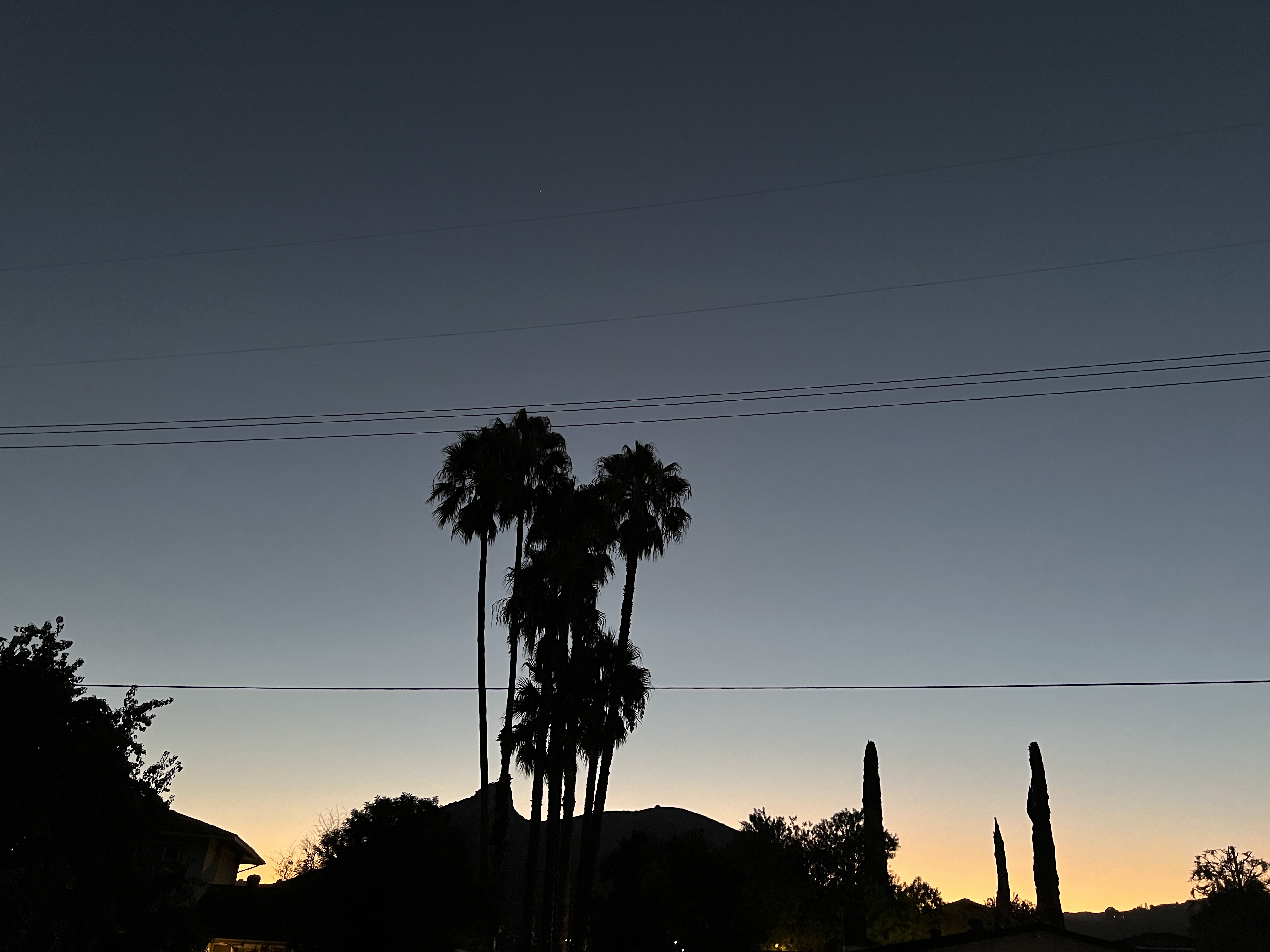
Sunset – August 30th

No amazing clouds or flourescent reds & oranges, but calm & pretty.

I also notice when I look at the picture on the screen, just above the top wire straight above the palms you can see Venus, returning to the evening sky. I didn’t see it at all with the naked eye, but I wasn’t looking either. I’ll have to double check again tomorrow.

Can you see it?

Leave a comment

Filed under Astronomy, Photography, Space, Sunsets

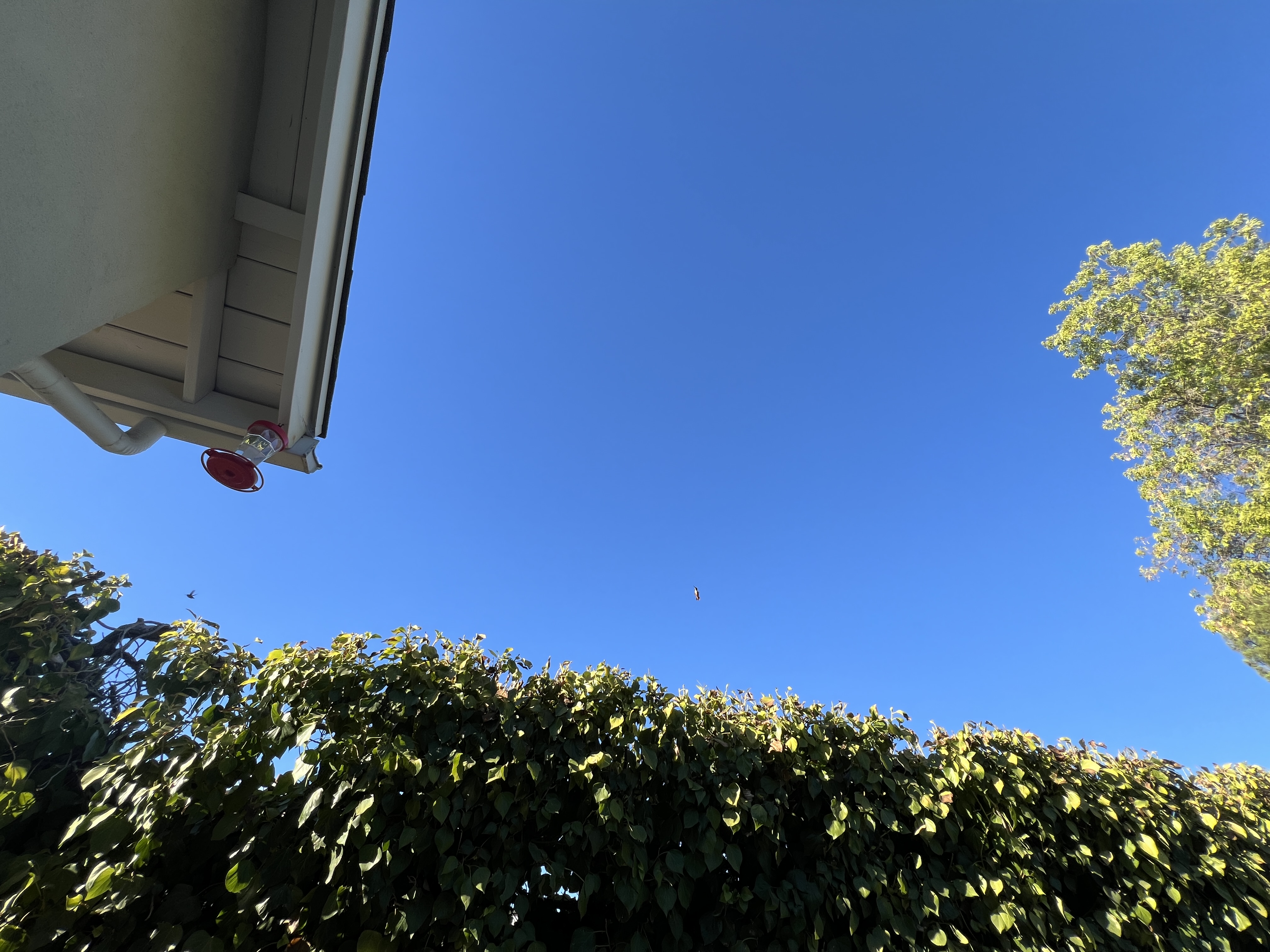
The Bluest Of Blue Skies…

…and a hovering hummer.

The second backyard feeder’s on the left, and in front of the most bluest of deep blue, cloudless skies, there’s a single hummingbird, hovering as it just chased off another hummingbird that was trying to eat at “its” feeder. This isn’t Little Bastard – it has laid claim to the first backyard feeder over on the other side. In the past, this second feeder has been a free-for-all with no dominant hummer trying to control it, but that might have changed.

The blue skies, warm afternoon, slight breeze, and sound of hummers zipping by got me to thinking about the skies and environment on other worlds that I’ve fantasized about since I was five years old. To be on the Moon, or on Mars, with no blue skies, no breeze, no critters, instant death on the other side of a thin spacesuit… Yeah, I would take it in an instant, but I would miss “the Green Hills of Earth.” That’s a price I would be willing to pay, but I acknowledge that the price exists.

Leave a comment

Filed under Birds, Deep Thoughts, Photography, Space

DSKY

I’ve had the honor and priviledge of attending five NASA Socials, and in doing so I’ve gotten to see and touch and hold some pretty neat things. But flipping through old photos tonight, I think this one has to be at the top of the list.

This is a space-flown DSKY, I believe from Apollo 16. (Might be Apollo 15, it’s been a few years, but I think it’s 16.) It’s the “display and keyboard” that was in the Apollo Command Module for the spacecraft guidance computer.

Not a backup or a test item. This hunk of metal and circuitry flew to the Moon and back fifty-ish years ago. And they let us touch it and push buttons and so on. For a “space cadet” from age 5 like me, that’s pretty freaking neat.

This was at my first NASA Social, at Edwards AFB in November, 2014. (For more pictures and about five long posts with much more detailed descriptions of everything else we saw then, search “NASA Social” on this site.) They had this there because it was later used in some of their early work with fly-by-wire control systems on fighter jets.

Space-flown hardware is THE BEST!

Leave a comment

Filed under Photography, Space

Firefly

I’ve gone off at length about the joy of seeing hundreds if not thousands of fireflies in the woods out behind the Hartness House every night when we were in Vermont. We don’t have fireflies in SoCal – except for one big one tonight.

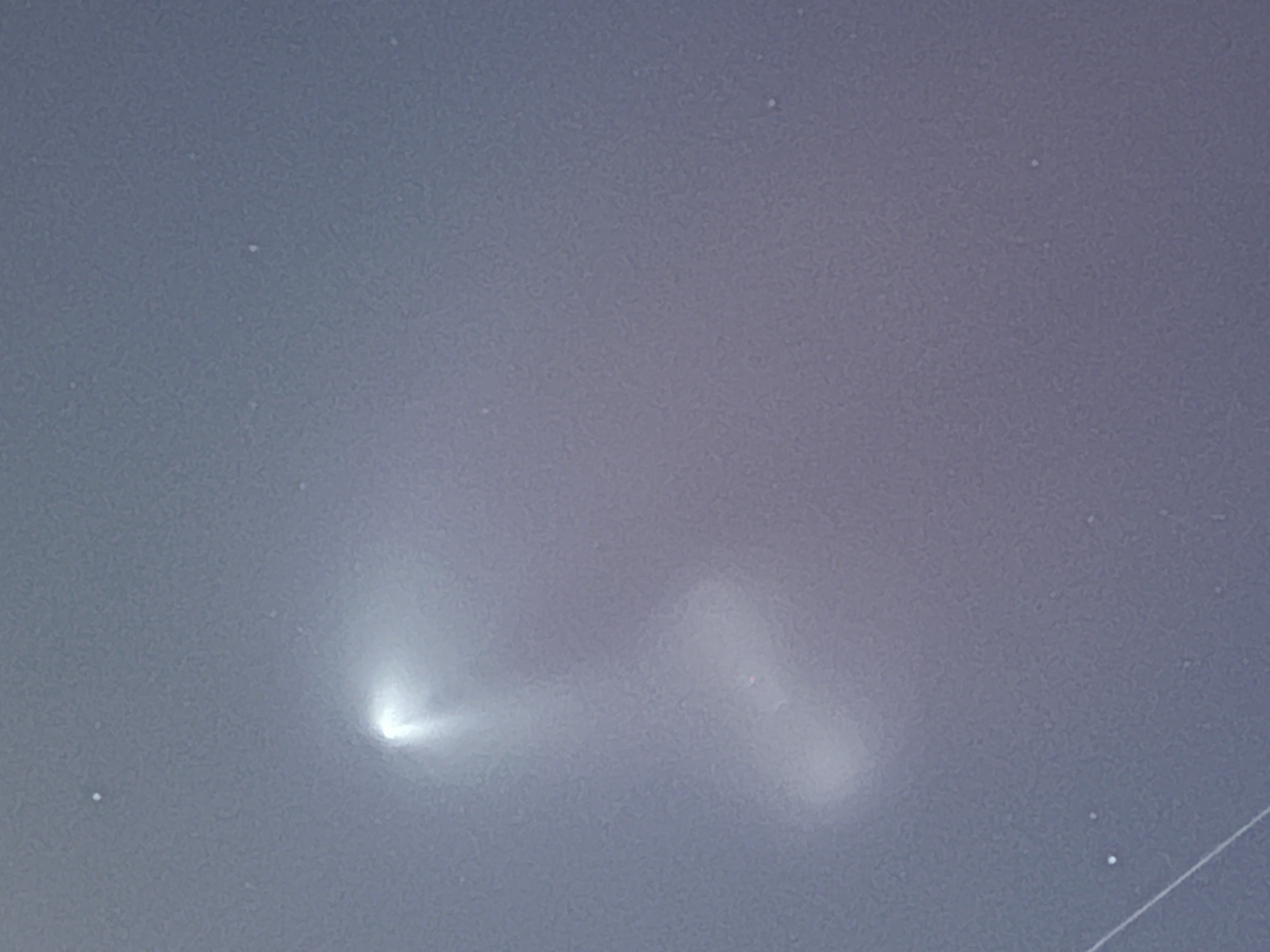
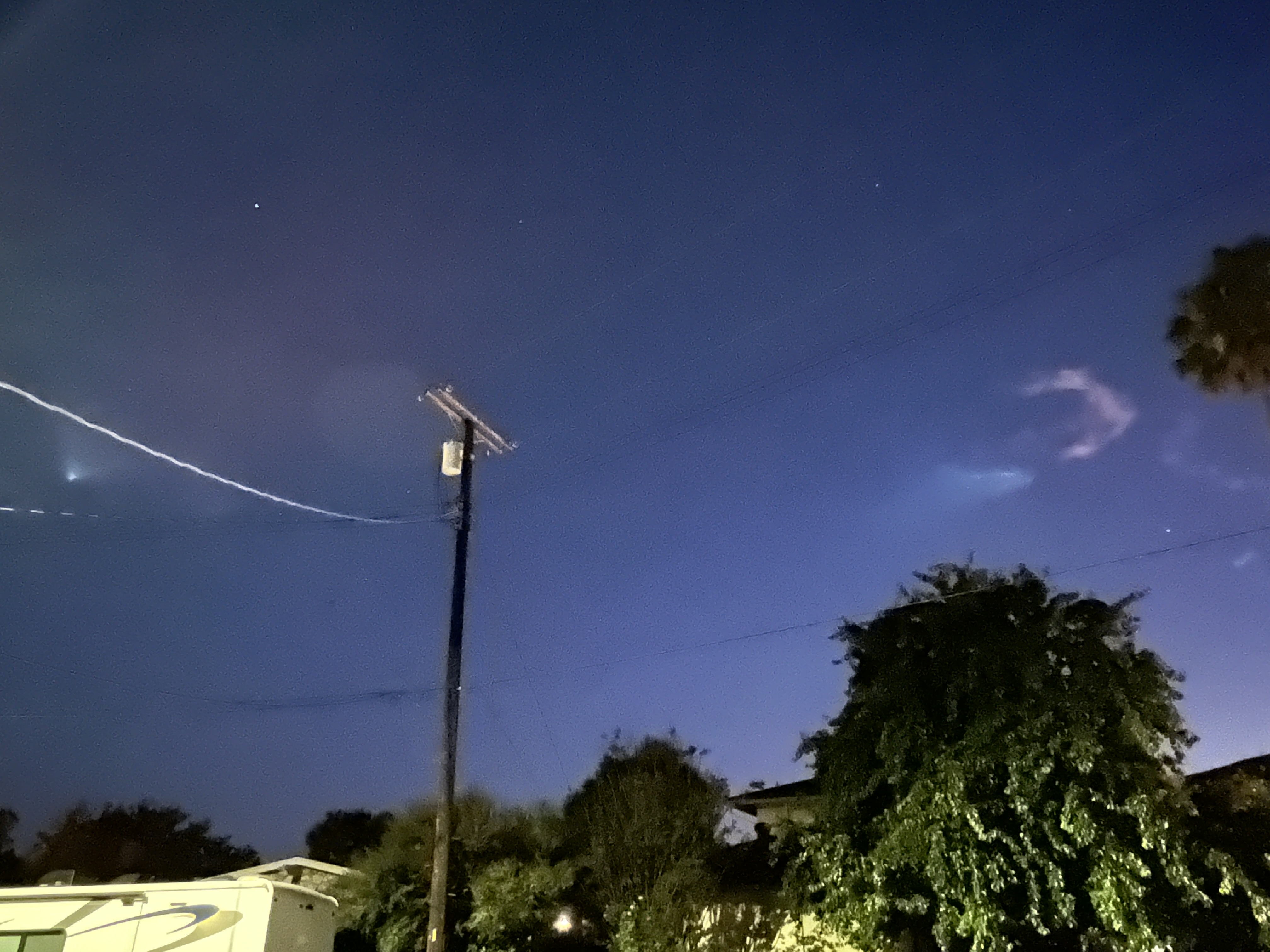
Named more for the SF series and movie, this was the 5th launch of the Alpha launch vehicle from Firefly Aerospace. You can see the orangish trail coming up behind the palm trees on the right, lit by the Sun somewhere far over the western horizon, while above the telephone pole on the left you can see the second stage heading south to orbit (it got there successfully!) with the just separated first stage falling back behind it, venting excess fuel.

Up close, the “V”-shaped exhaust from the second stage is clearly seen as it heads uphill, while the first stage is at the center of that “butterfly” of gas behind it. One or both of the two small dots might be fairing halves that were jettosined to save weight after the rocket got out of the atmosphere.

Not perfectly seen here, but we got a decent “jellyfish” effect from the exhaust plume expanding and glowing in the sunlight in the dark sky after sunset.

This launch looked different from the SpaceX launches we see once a week or so now. The SpaceX Falcon 9 is a much bigger rocket with more engines and exhaust, but this was a nice launch to see, very pretty! Congratulations

Leave a comment

Filed under Photography, Space

In Search Of A Coat Hangar

Technically, it’s an asterism, a collection of stars that are smaller than a constellation and look like something to our pattern-seeking monkey brains, in this case, a coat hanger. Officially it’s known as Brocchi’s Cluster and at this time of year it’s high overhead about 9:30 to 10:00. (Here‘s an excellent close-up of it.)

This is one of my full-resolution images from tonight, taken with the “light bucket” wide angle lens (16mm) that I love so much, using an 8 second exposure at F 2.80, looking from about the zenith down to the horizon in the west. Click on it for the full-sized image – can you spot the coat hangar (“upside down”) in the upper center?

I’m always surprised when I shoot these pictures. Given the coastal haze and light pollution from the city all around me (a 30-second exposure is completely white and washed out) that’s so bad that I could only see maybe a dozen of these stars with the naked eye, it’s amazing that the camera can pull out all of the detail it does. It’s all up there, it’s just so sad at times that we’ve shut ourselves away from it all.

Those brief few minutes under a dark, clear sky when we first got to Vermont two weeks ago will stick with me a long time. I need a lot more of that and a lot less of this.

Leave a comment

Filed under Astronomy, Photography, Space

Two Day Moon

There was another Falcon 9 Starlink launch out of Florida right around sunset here, which meant I was out looking at the sky about 80 minutes later. (Just shy of the end of the first 90-minute orbit.)

Nada!

Which is not to say that there wasn’t anything pleasant or wonderful to see, I just didn’t spot any second stages passing overhead venting fuel.

There was a very pleasant and beautiful, if somewhat subdued, sunset to watch. None of the flaming golds and oranges and reds that we can occasionally get, and not a cloud in the sky to give it “texture.”

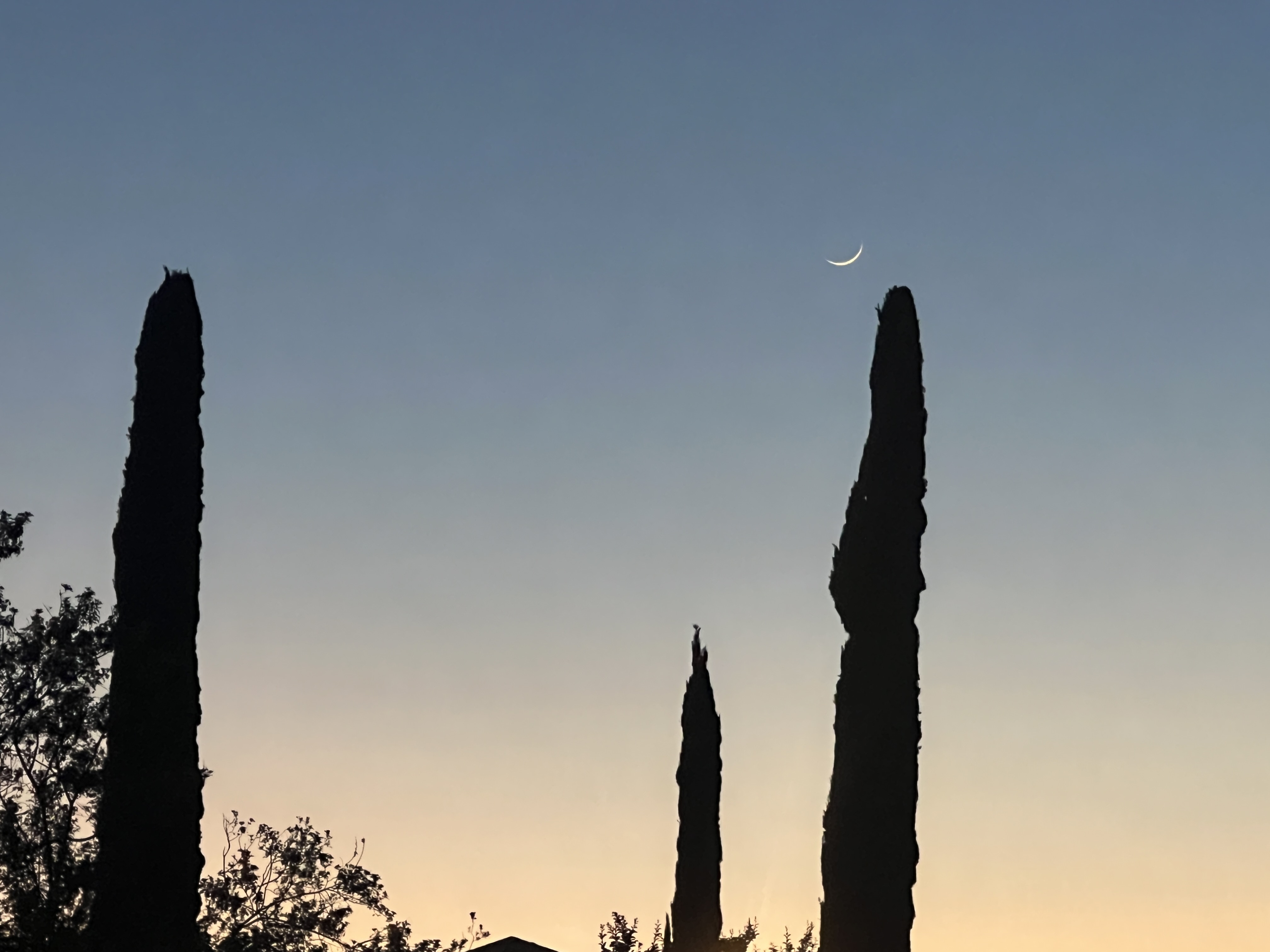
But the Moon is just barely two days past new, so it’s just a silver sliver popping into view and hanging there once it started to get dark.

If your skies are clear, go take a look tomorrow night. It will be just as stunning then. And the night after. And on, and on, and on…

Leave a comment

Filed under Astronomy, Photography, Space, Sunsets