Category Archives: Space

Venus & Jupiter & Satellites

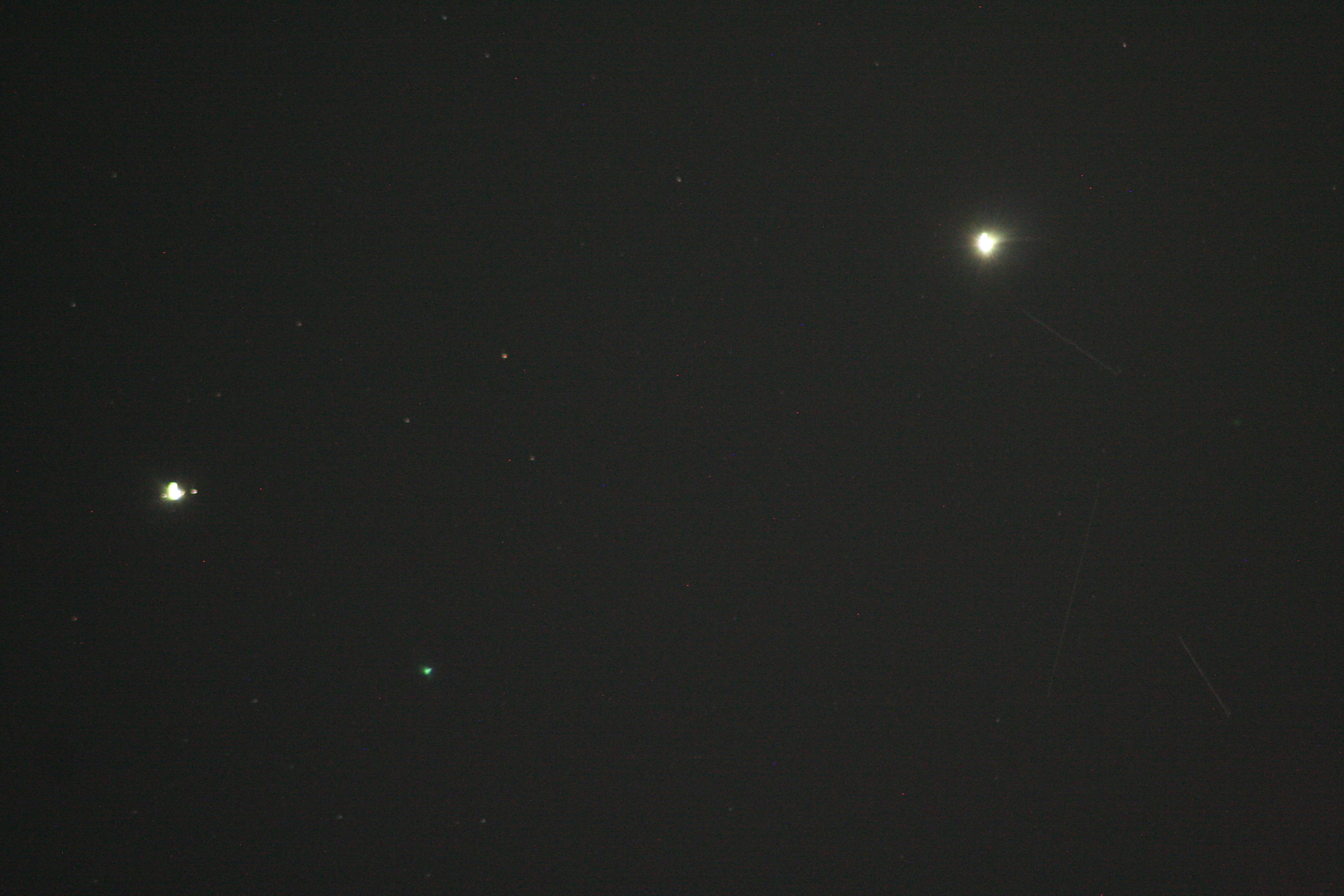
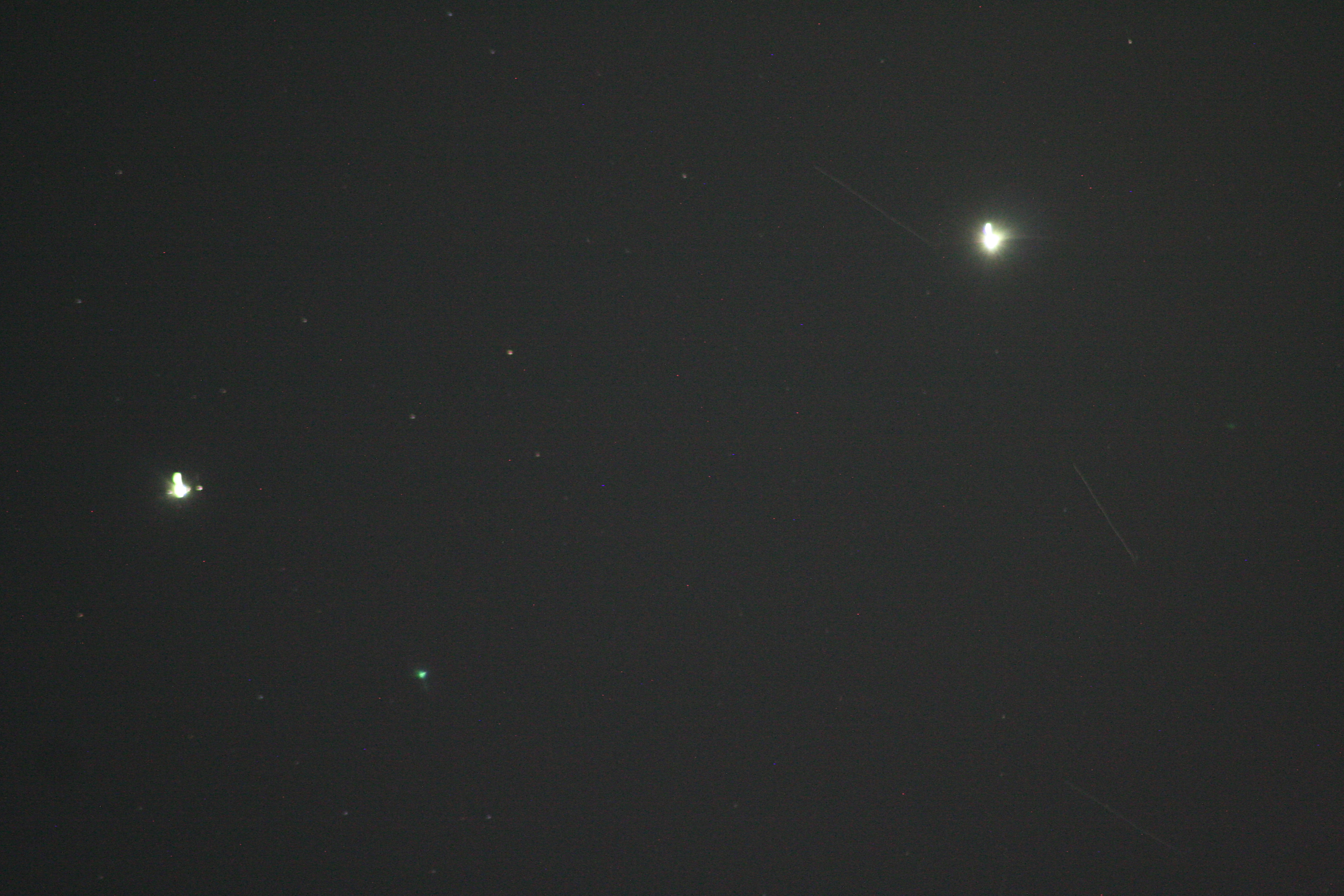
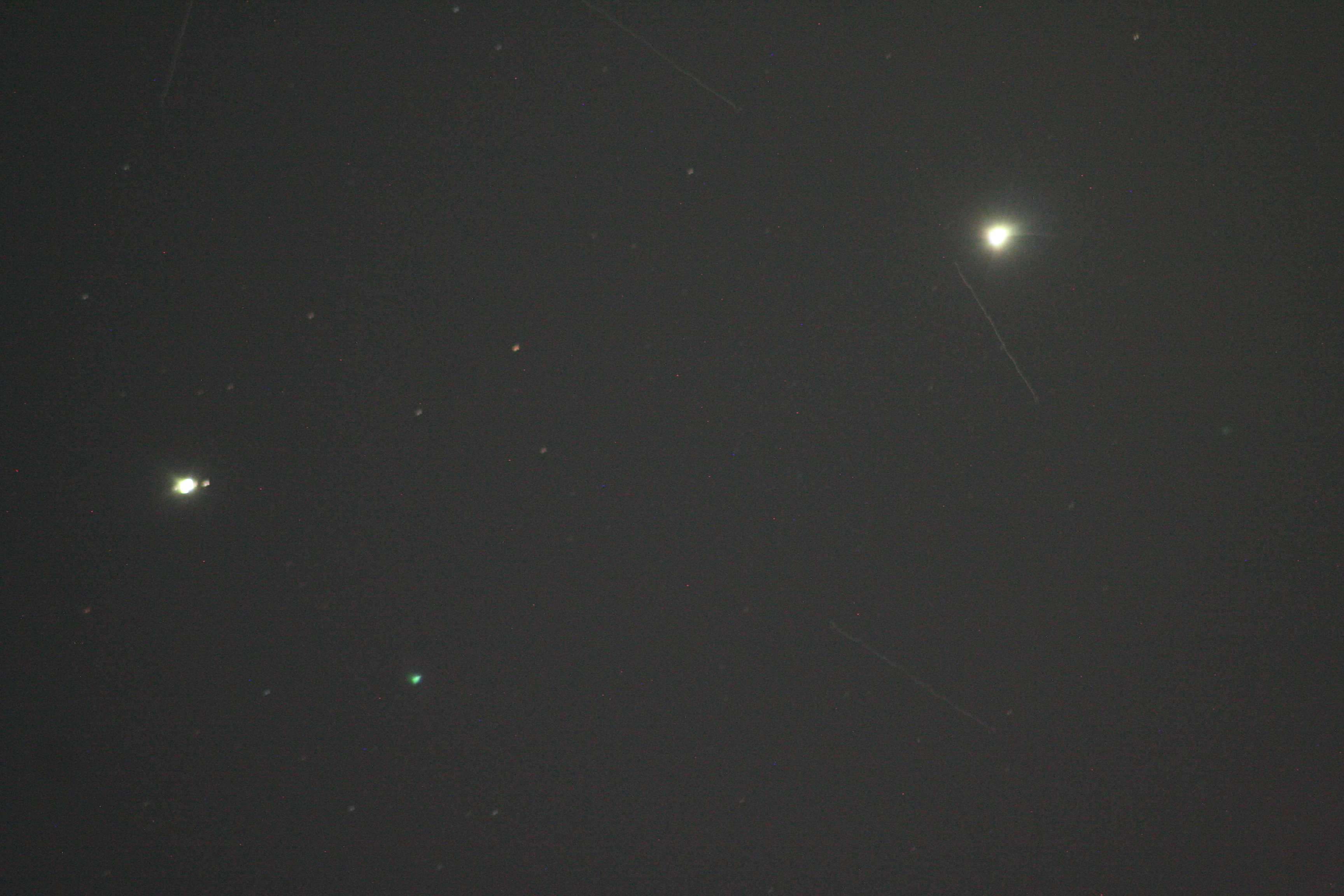
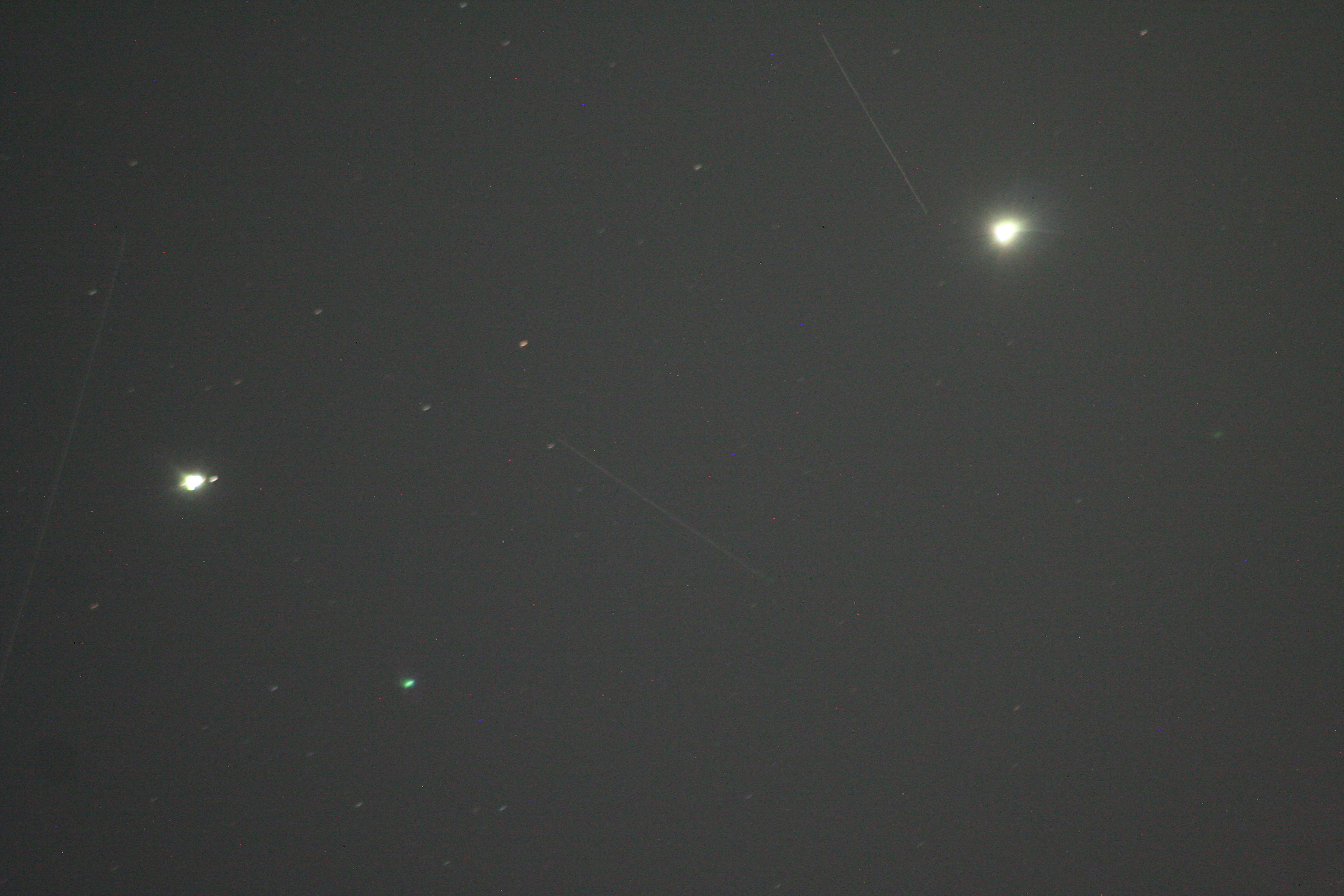
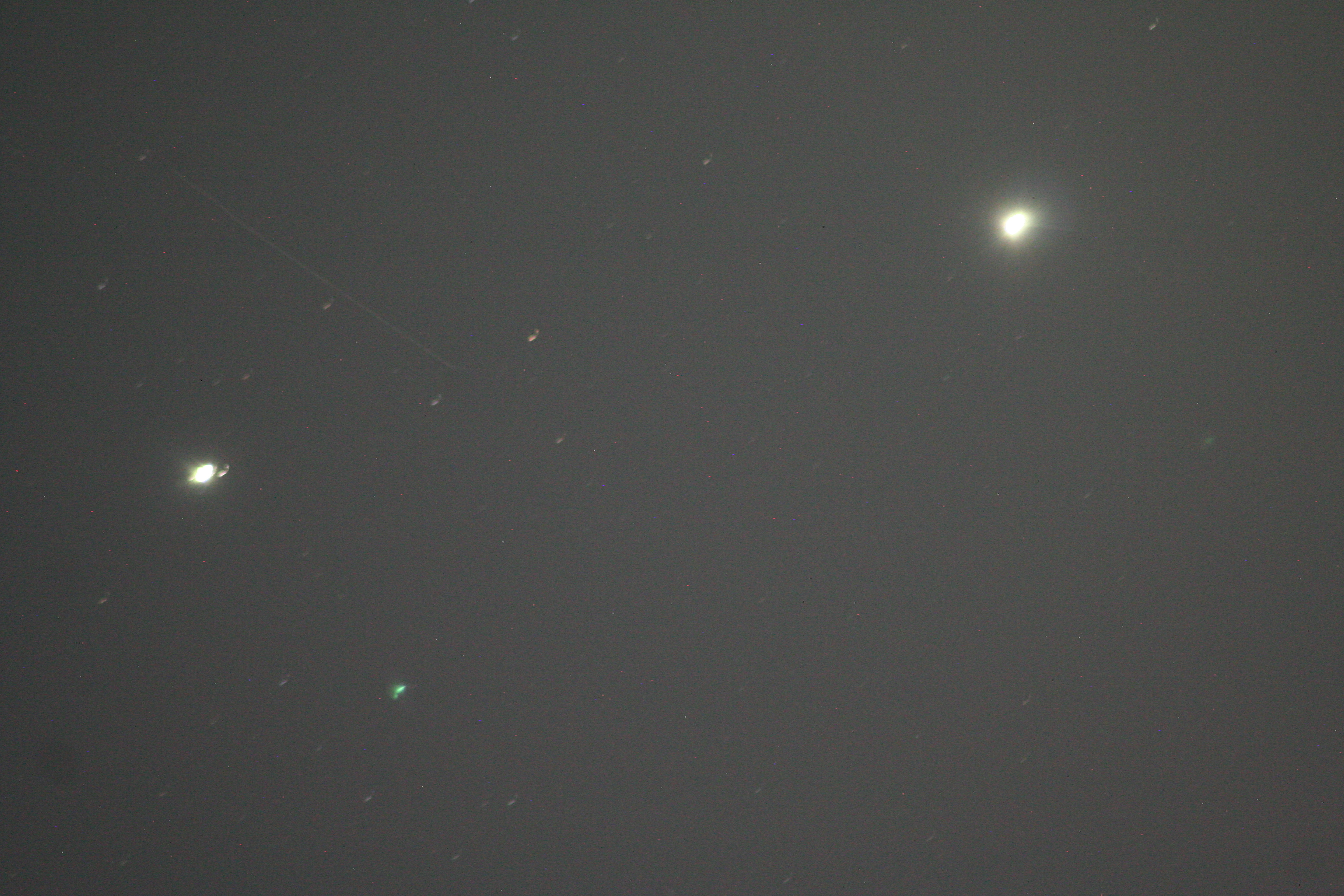
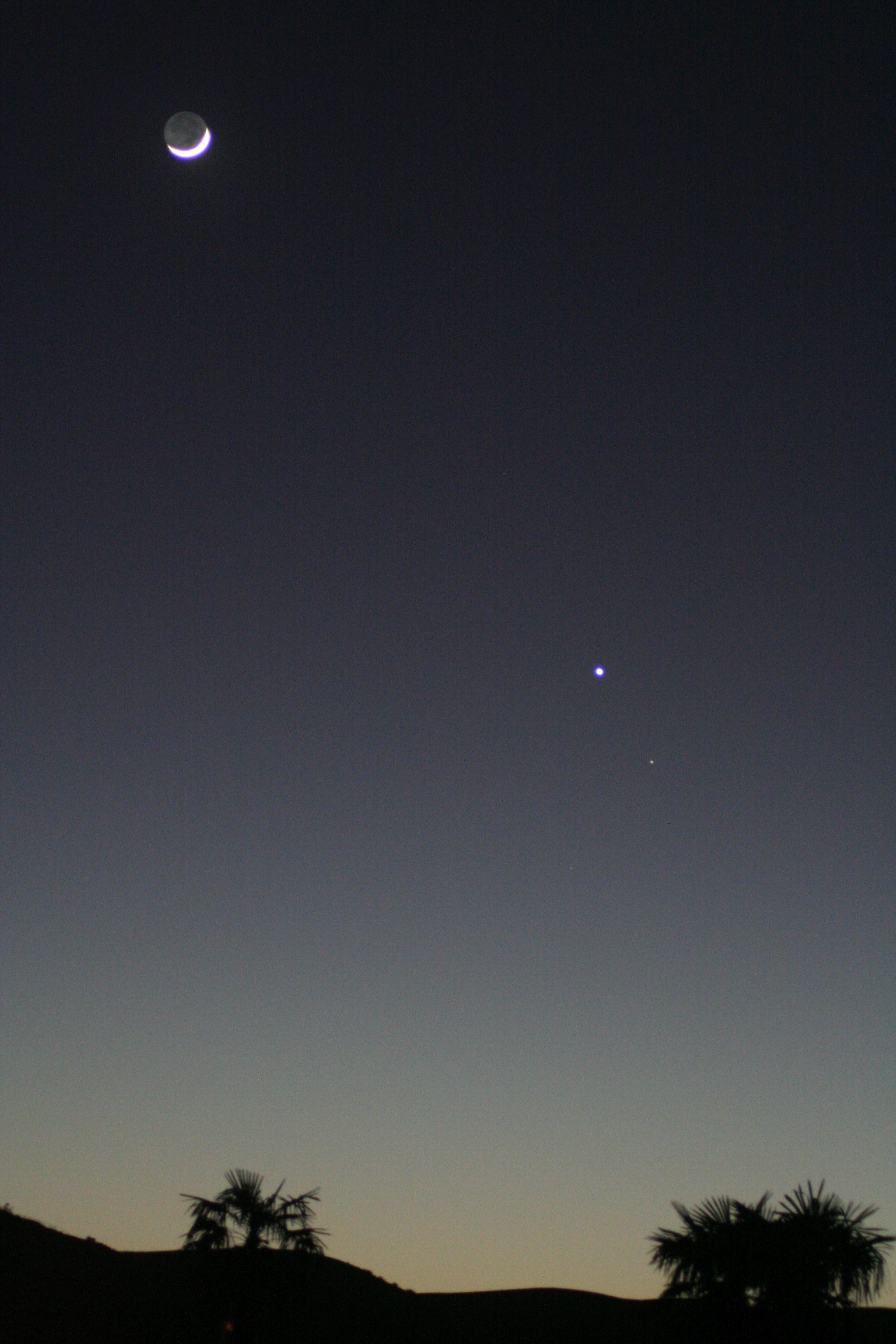
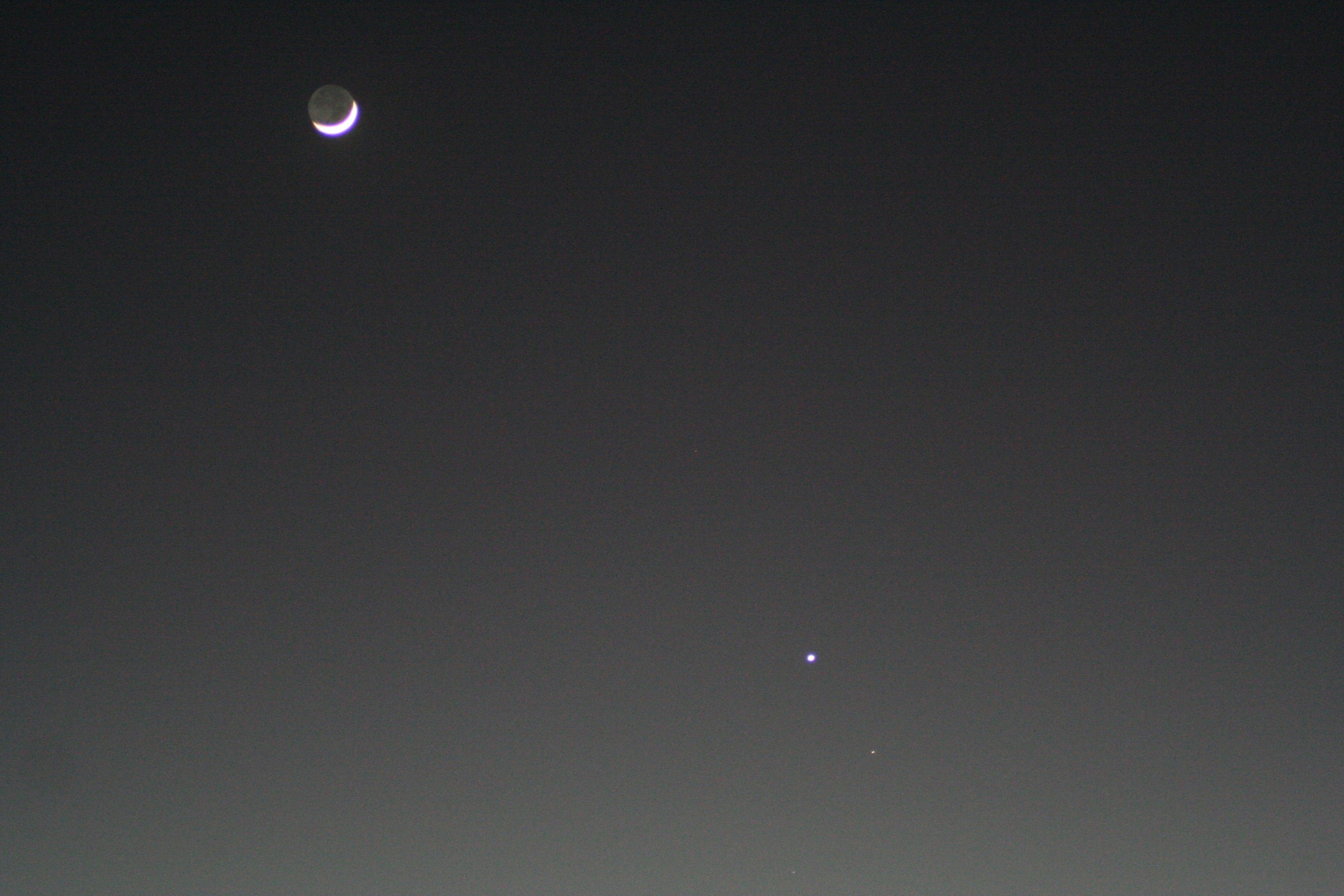
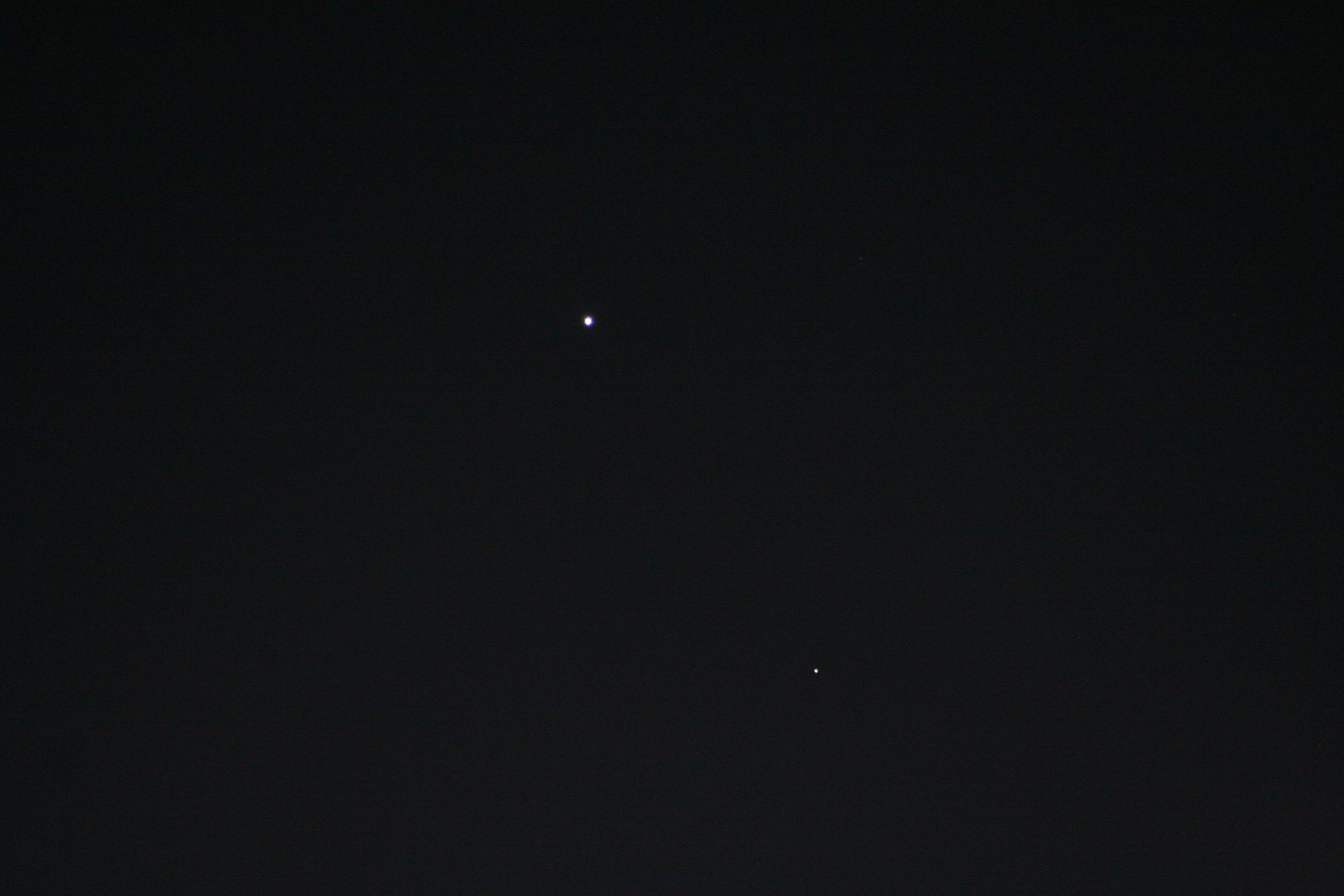
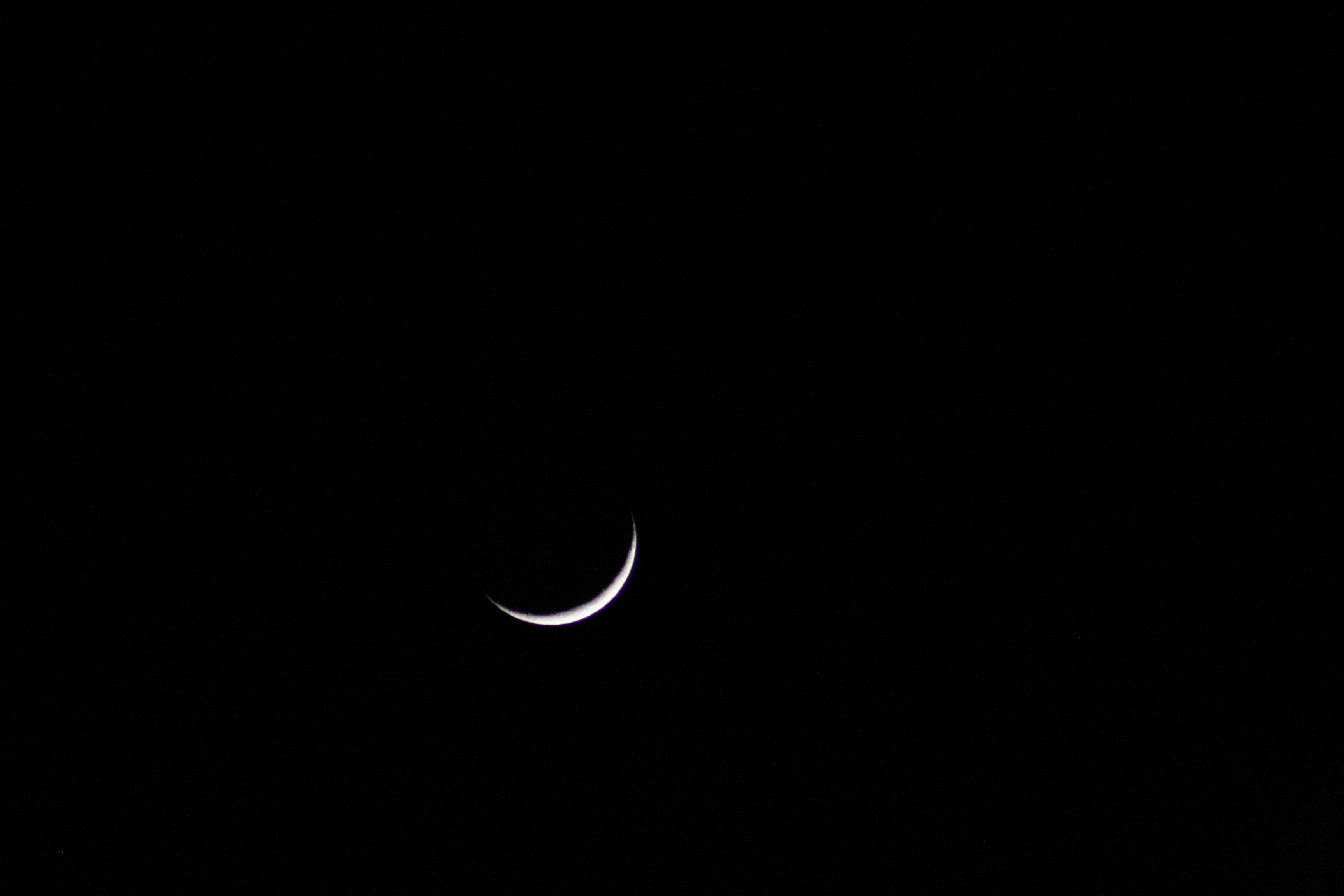
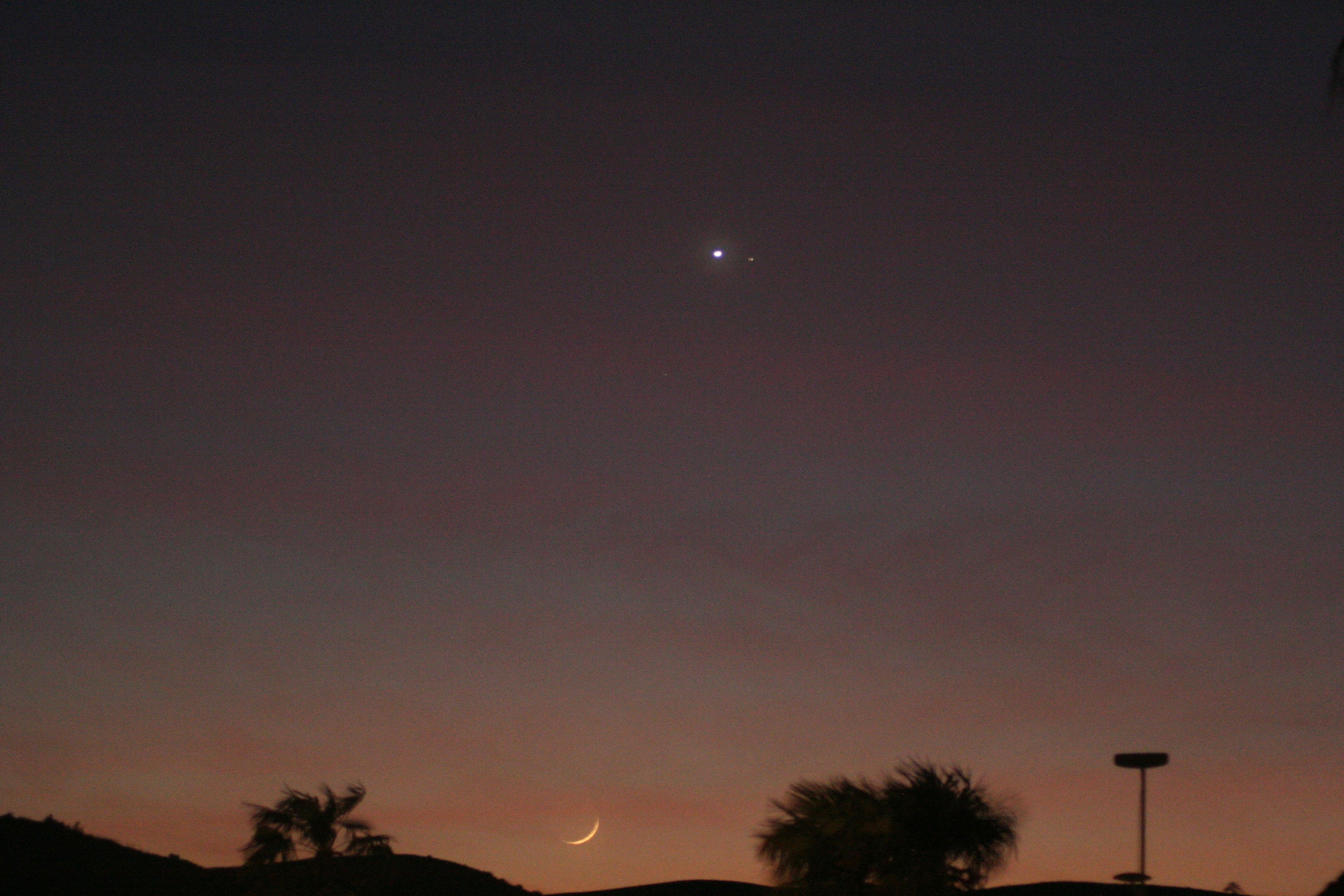
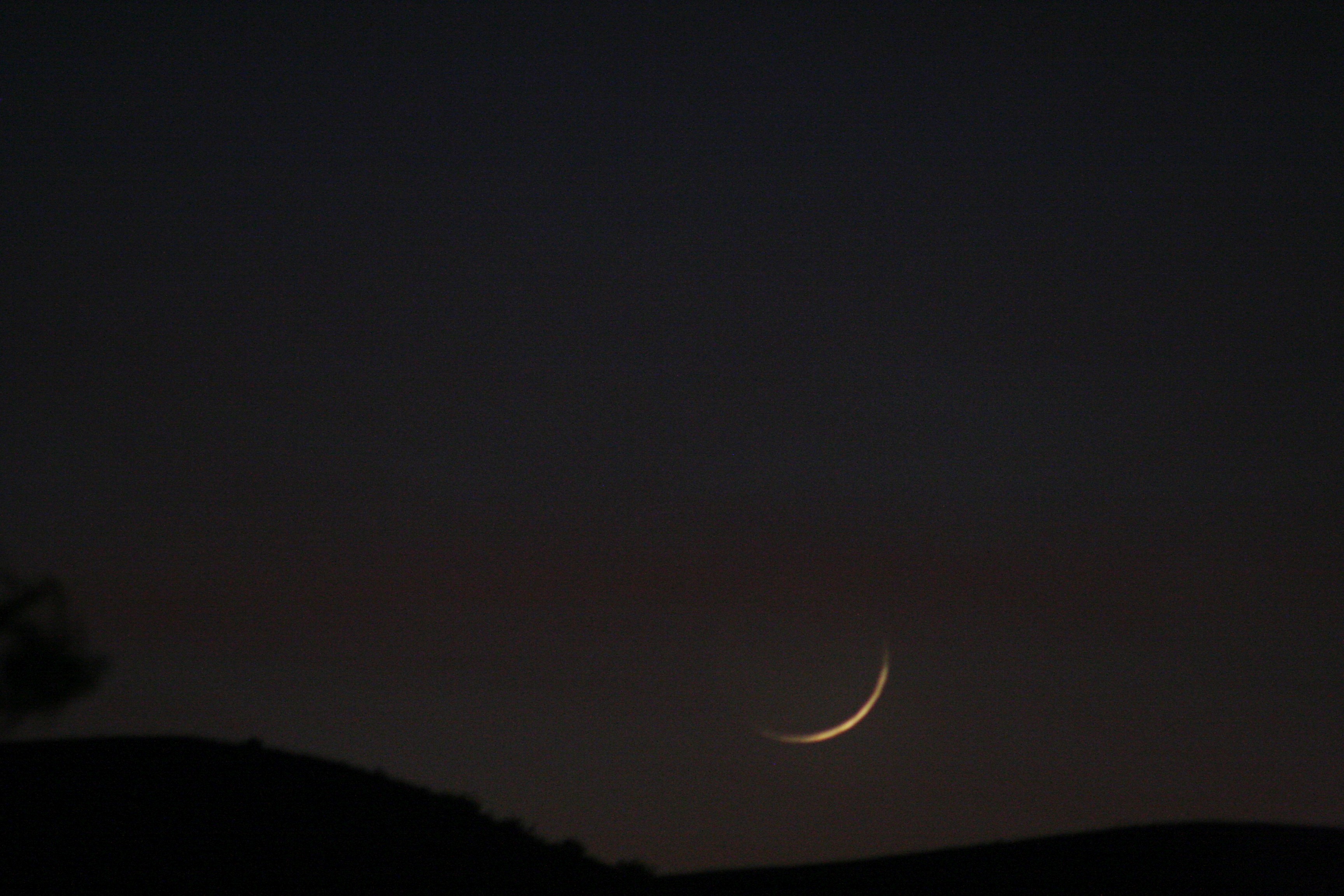
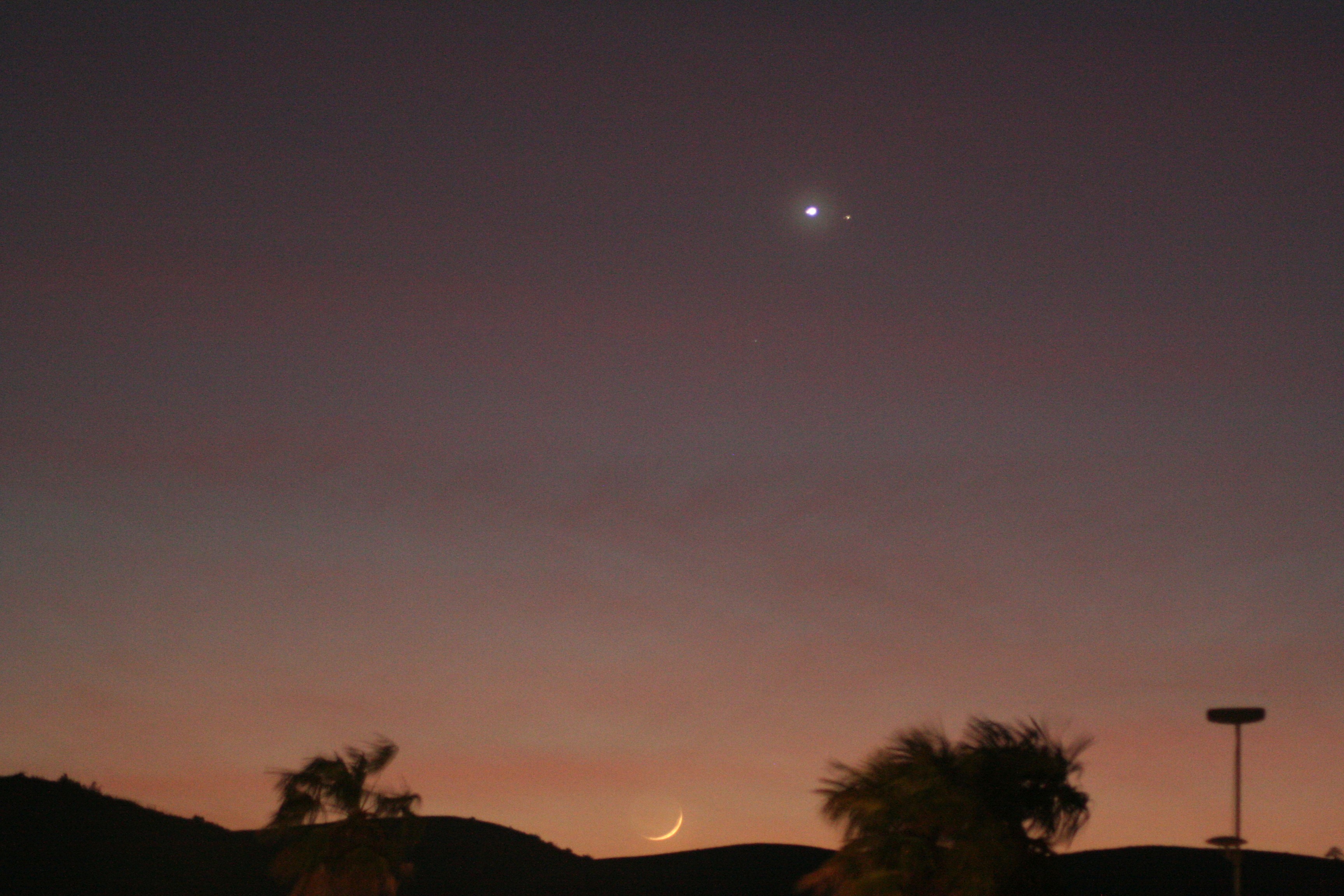
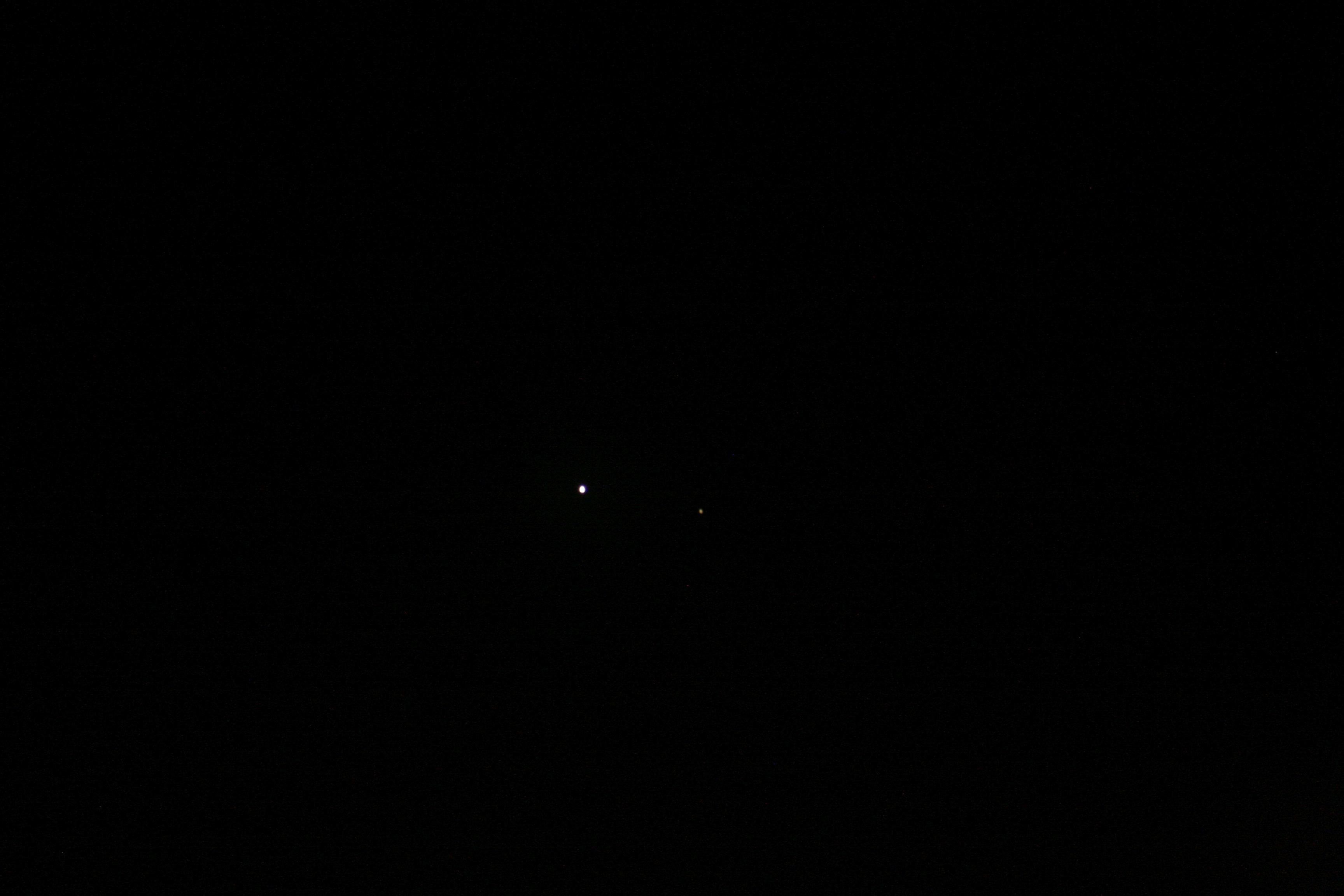
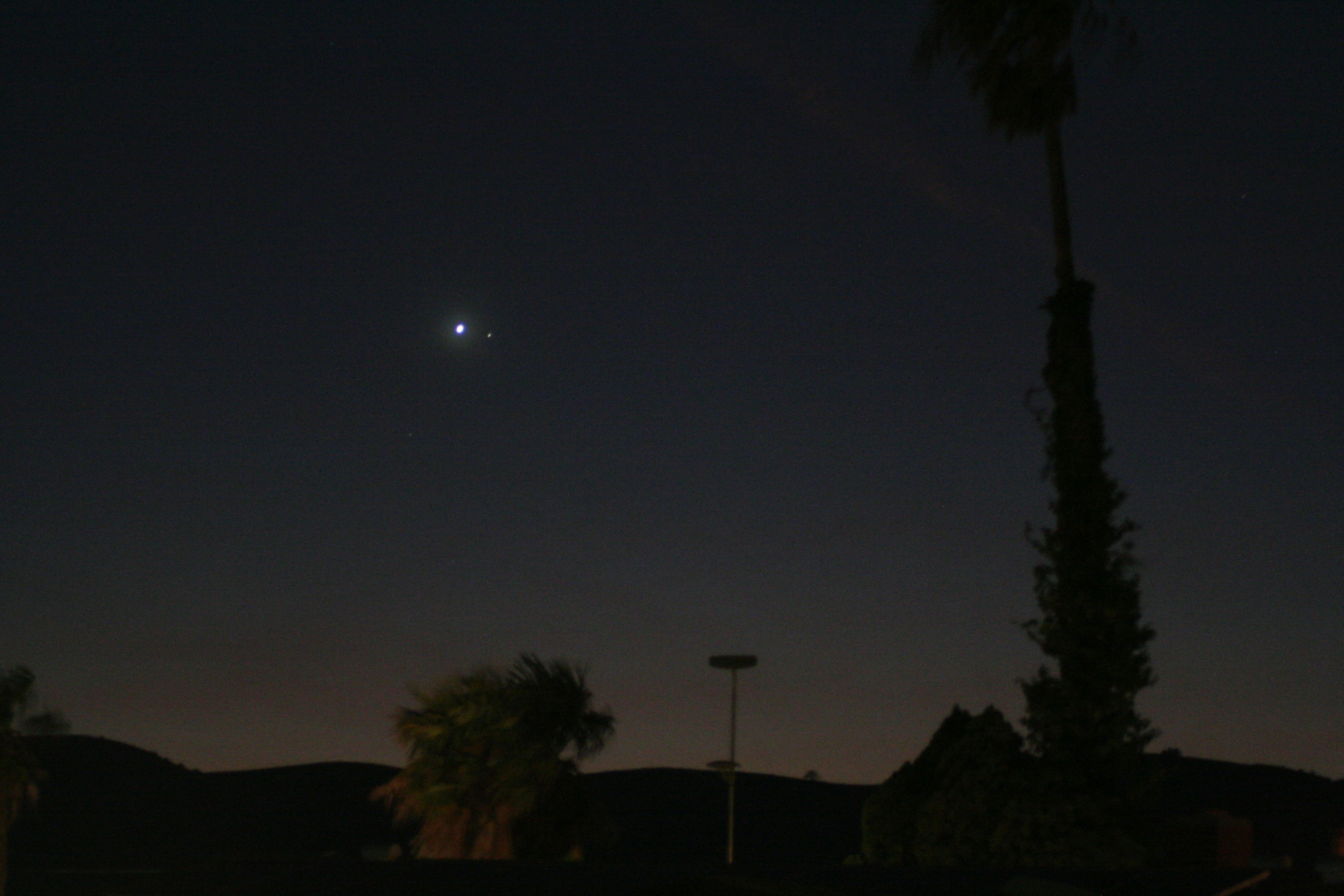
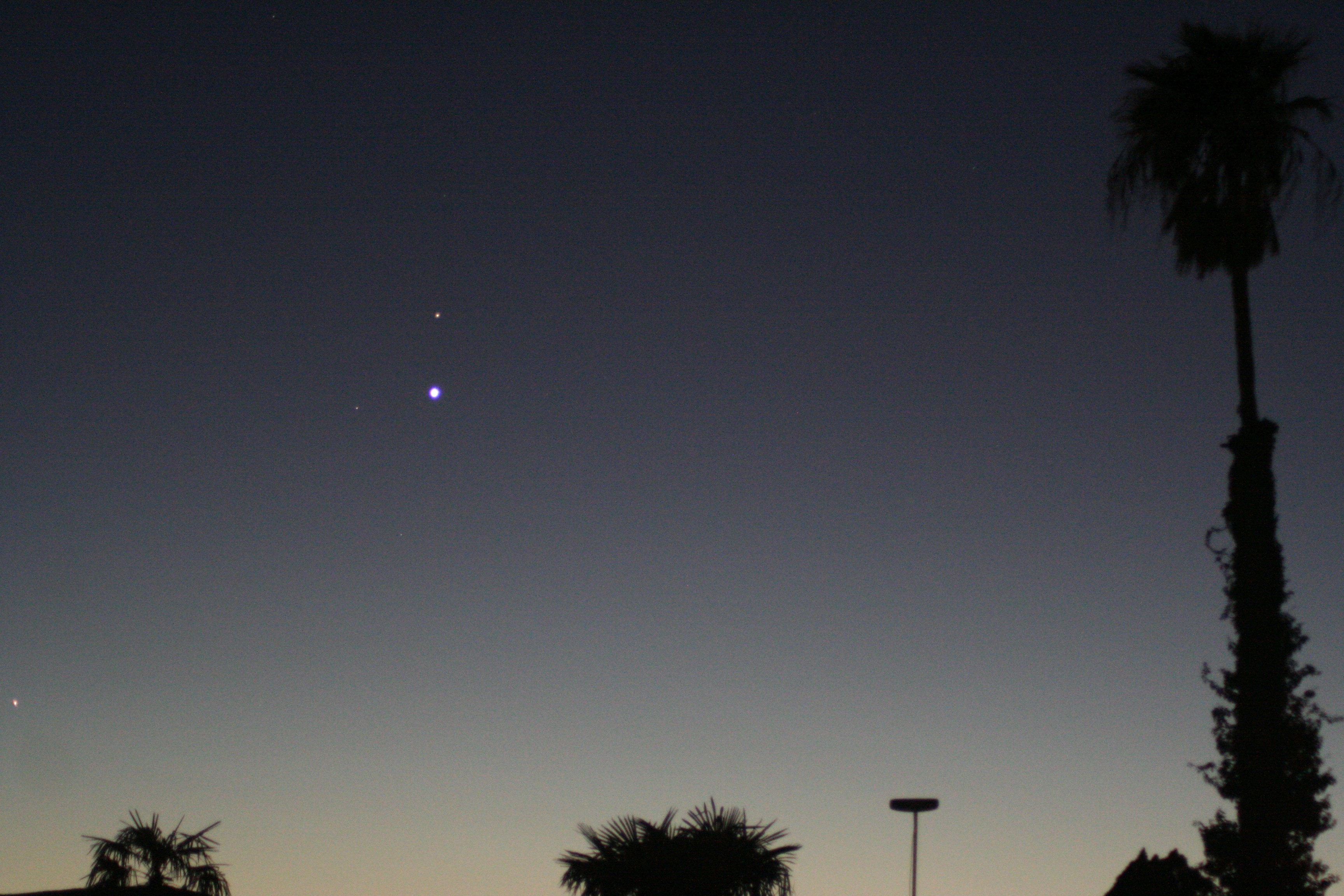
I thought these pictures were interesting, if far from perfect. They’re from the February 26th batch of pictures, three days before the Jupter & Venus conjunction.

They run from three seconds to eight seconds and they were shot with a 300mm zoom lens and the wind was blowing like a demon, so you can see that they’re a bit jittery and smeared as the camera bounced around.

That’s not why I want to share them with you.

Blow each of them up to full sized (click on the image) and you’ll see a number of very faint but visible criss-crossed lines. Better yet, save them or load all five photos in and the flip through them to animate them a bit.

You’ll see at least five items crossing the field, the faint lines getting longer as the exposures get longer.

These are satelittes, and given their close proximity to each I suspect they might be part of a Starlink swarm.

The only orbiting objects I normally capture is the ISS, which is brighter than Venus or Jupiter here. Yet at random, here I’ve spotted at least five background objects over the course of a thirty-seven second series of pictures.

When you see news articles about the Hubble Space Telescope or ground-based telescopes having trouble with all of the satellites up there ruining their observations, believe them!

Leave a comment

Filed under Astronomy, Photography, Space

Watch The Skies The Next Few Days!

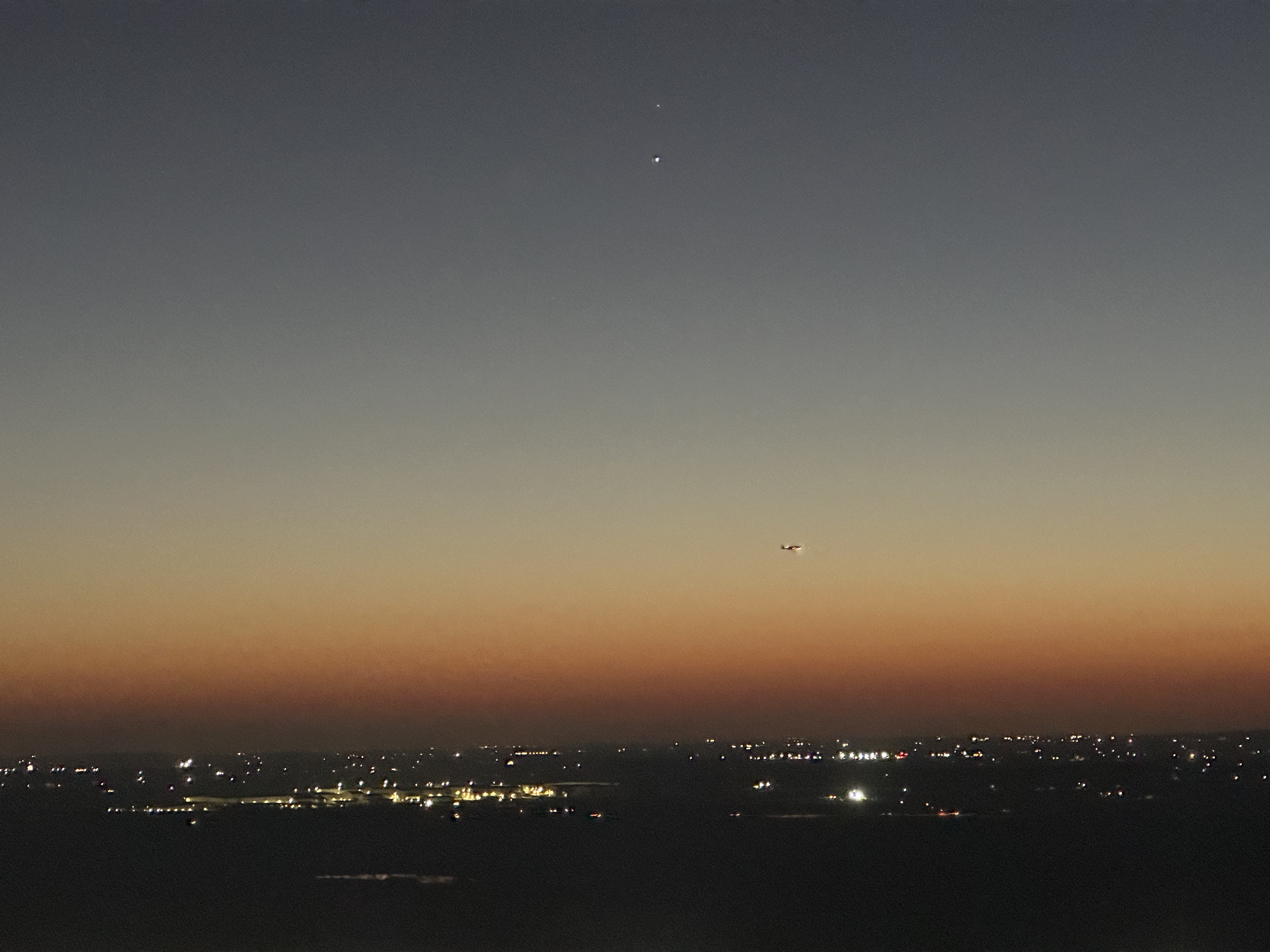
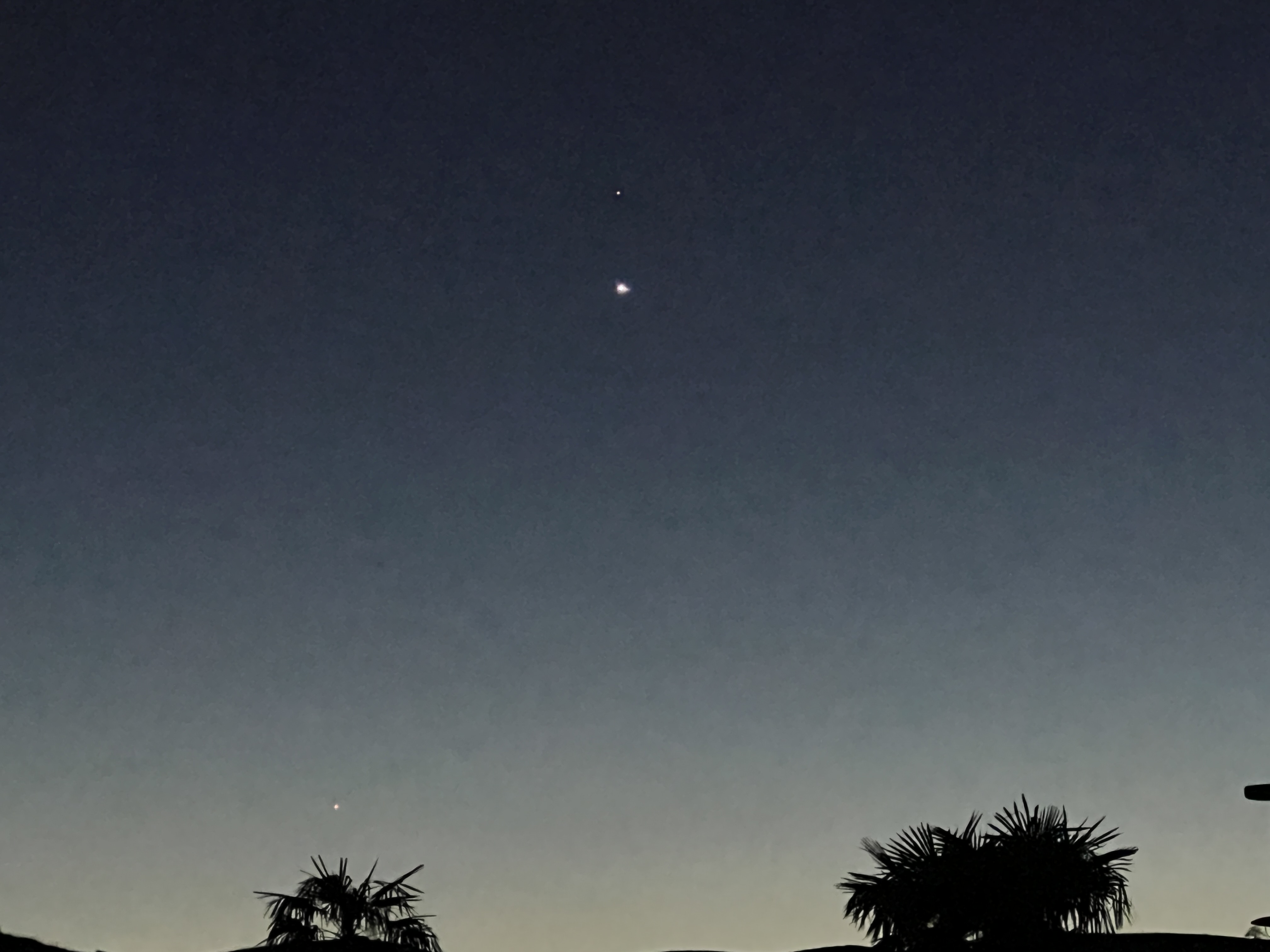
If you’re just about anywhere for the next couple of weeks and you have a clear sky at sunset, look to the west just after sunset.

Remember when Venus and Saturn (and sometimes the young Moon) were all near each other in the evening sky about a month ago? Well, something similar and very bright is happening again.

This time it’s Jupiter and Venus. And for the next couple of days, the young Moon as well. For the next nine or ten days you’ll see Venus nearest the horizon with Jupiter above it, both quite bright. On March 1st they’ll appear the closest to each other (from our viewpoint, of course – in reality they’re a billion-plus miles apart) and then Jupiter will continue to sink toward the sunset and Venus will continue to rise above until Jupiter disappears in the glare in mid-March.

Again, as always for this sort of thing, ignore the mass media clickbait that will try to tell you, “TONIGHT!!!” March 1st they’ll appear the closest, but if it’s clear you’ll be able to easily see them for another month.

Yes, there will be pictures here. Later. After we get past…well…

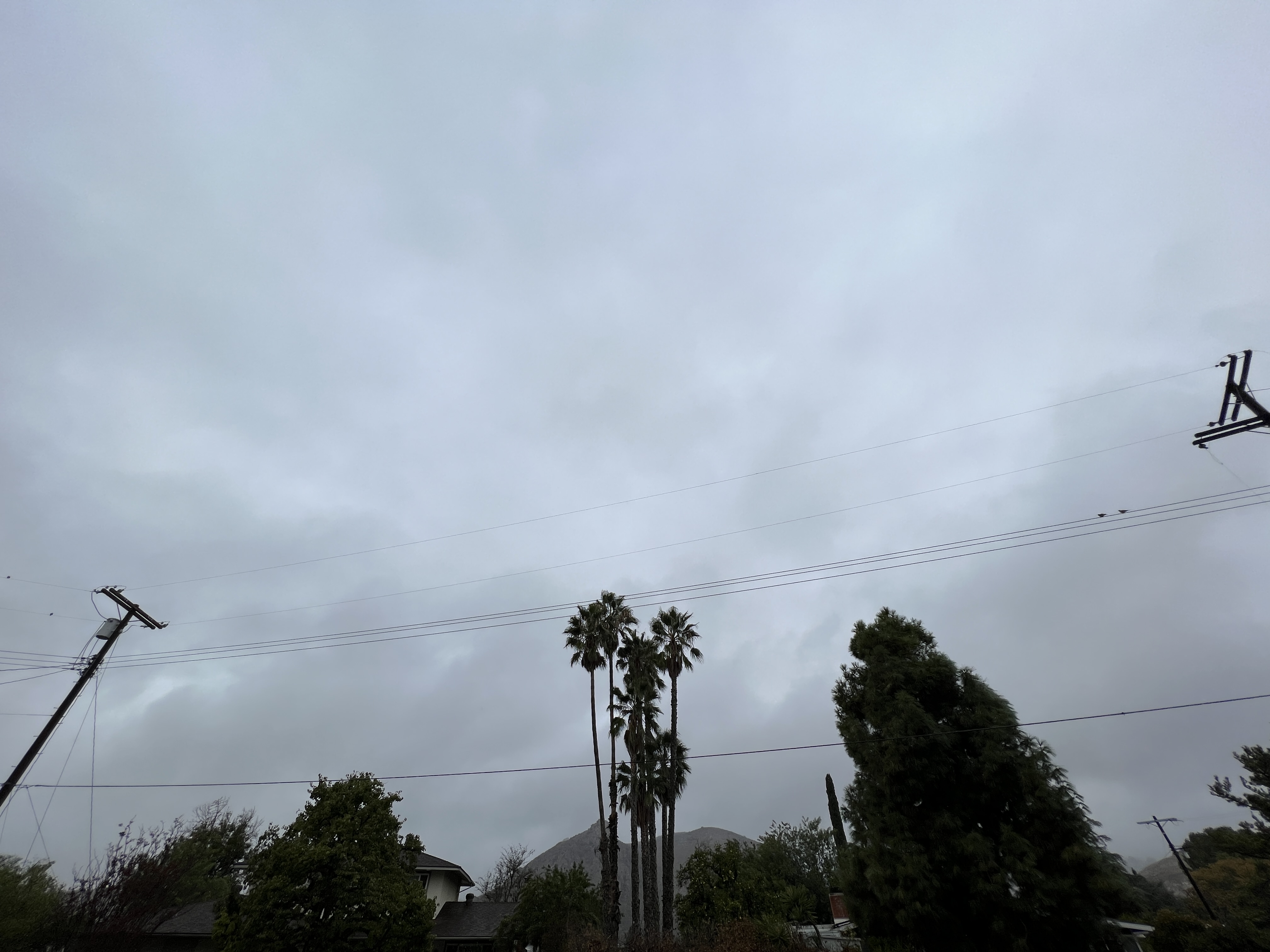
In Los Angeles (and most of California) there’s no seeing anything other than clouds for several days as a large, unusual, and COLD storm moves in. It might not be the same cold that they’re getting in Chicago and Vermont, but there’s a finite chance that it could mean the oddest of odd events in places like San Francisco and Los Angeles – SNOW.

“1-4 inches” possible down to 1,000 feet??!! And yes, folks are asking specific questions about places near us like the Santa Monica Mountains, Santa Clarita, the Antelope Valley, and so on.

Our house? We’re at about 1,060 feet according to the GPS fix on ForeFlight.

This could be interesting…

1 Comment

Filed under Astronomy, Space, Weather

Double Rings Around The Moon

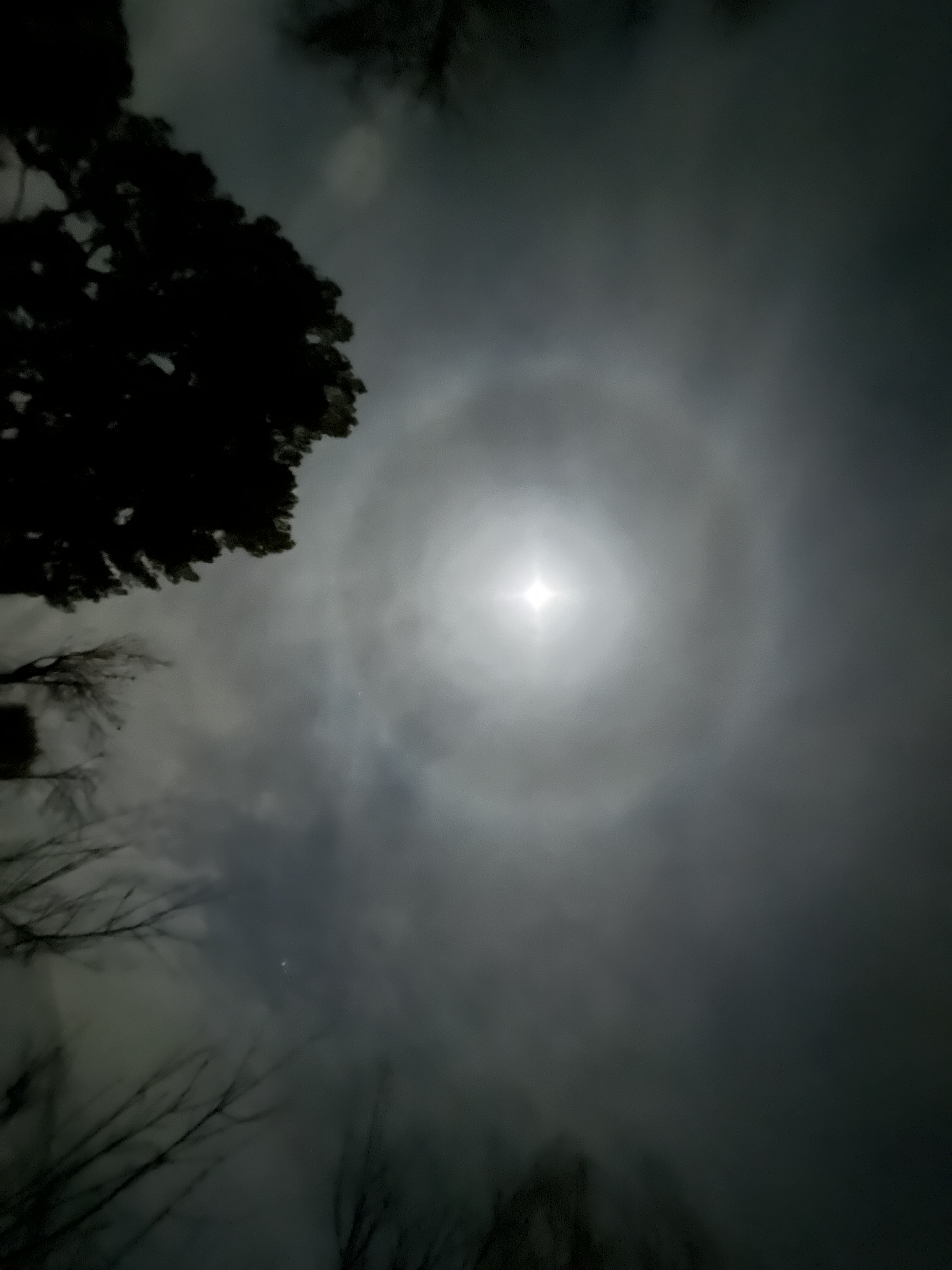
I’ve seen & shared photos of a 22º ring or halo around the moon, but I don’t think I’ve ever seen a double ring.

The outer ring is the 22º ring, and I can’t find any reference at all anywhere to a double ring around the moon, so this might just be an artifact of some kind.

The moon is almost full (95% illuminated) and was nearly overhead, if that has anything to do with it.

Now I’m curious. Does it look like an actual inner ring to anyone else? Or is it just a circular area of glare from the bright moon off of the clouds, where the ring is like a rainbow, with the moonlight being refracted off of ice crystals to give the 22º arc?

I guess I should have taken that upper division physics class on optics!


2 Comments

Filed under Astronomy, Photography, Space

Comet C/2022 E3 (ZTF) – FOUND!

It’s really late, I’m really short on time, but the short version is that being stubborn paid off tonight. The maps and information from TheSkyLive.com helped a ton.

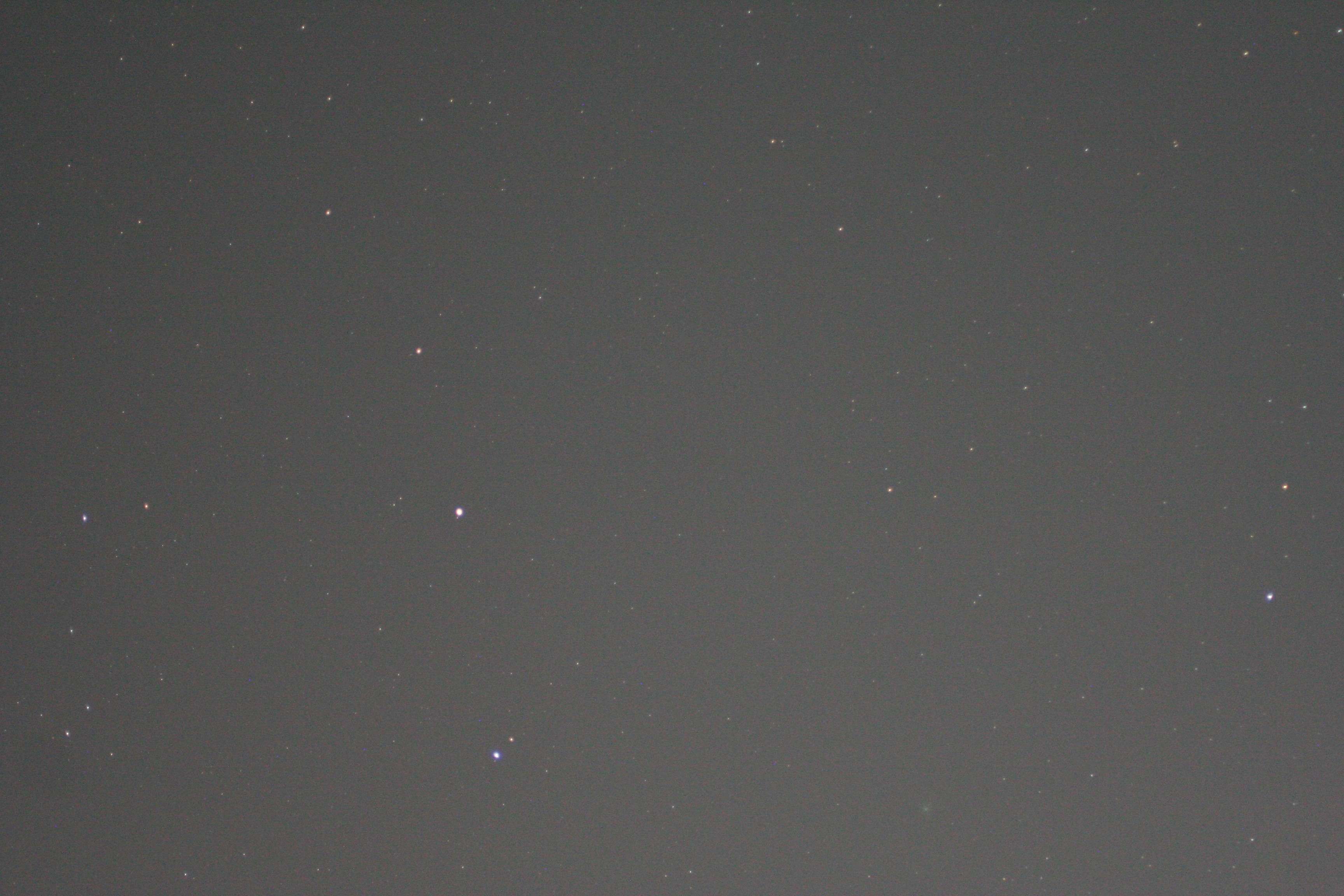
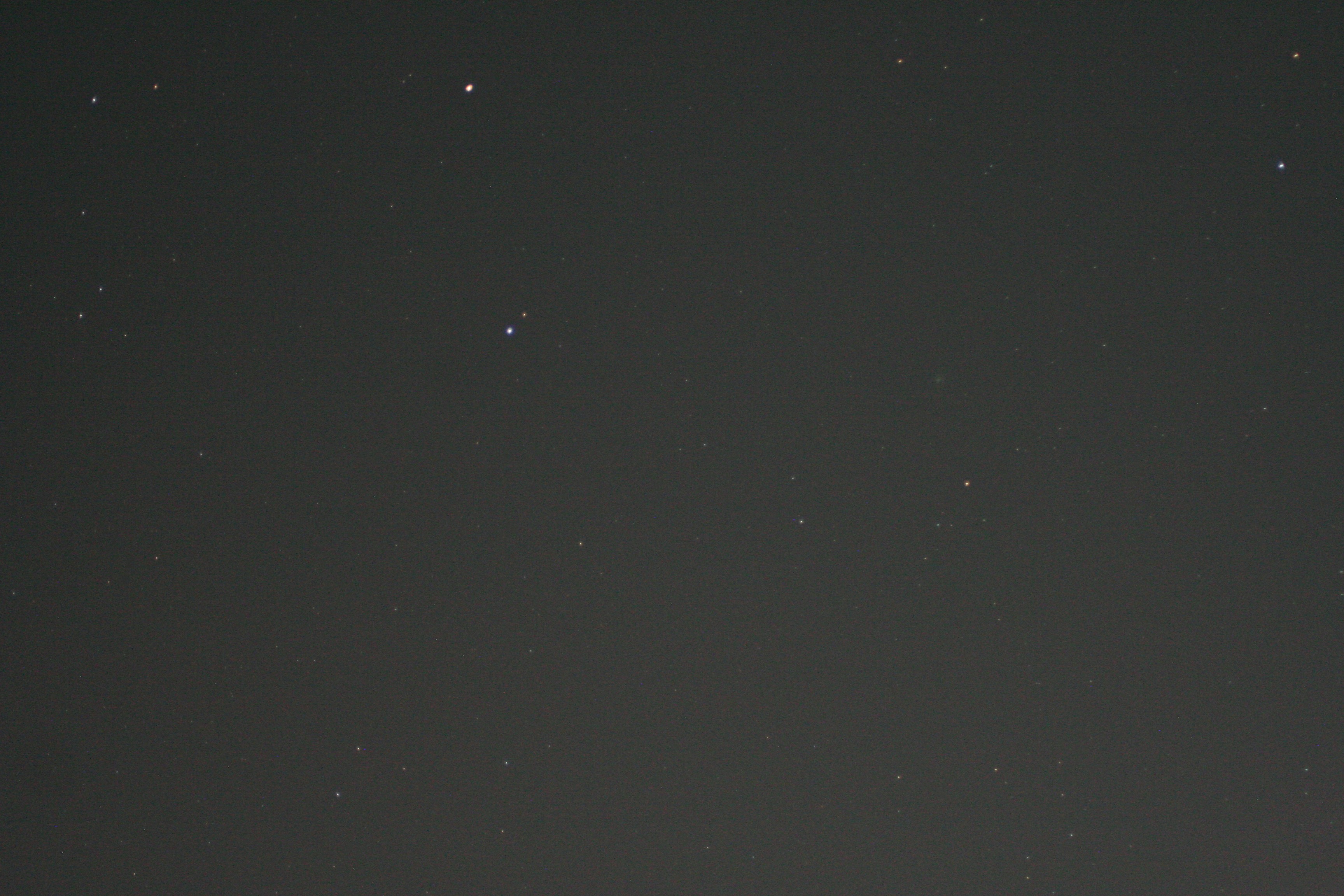
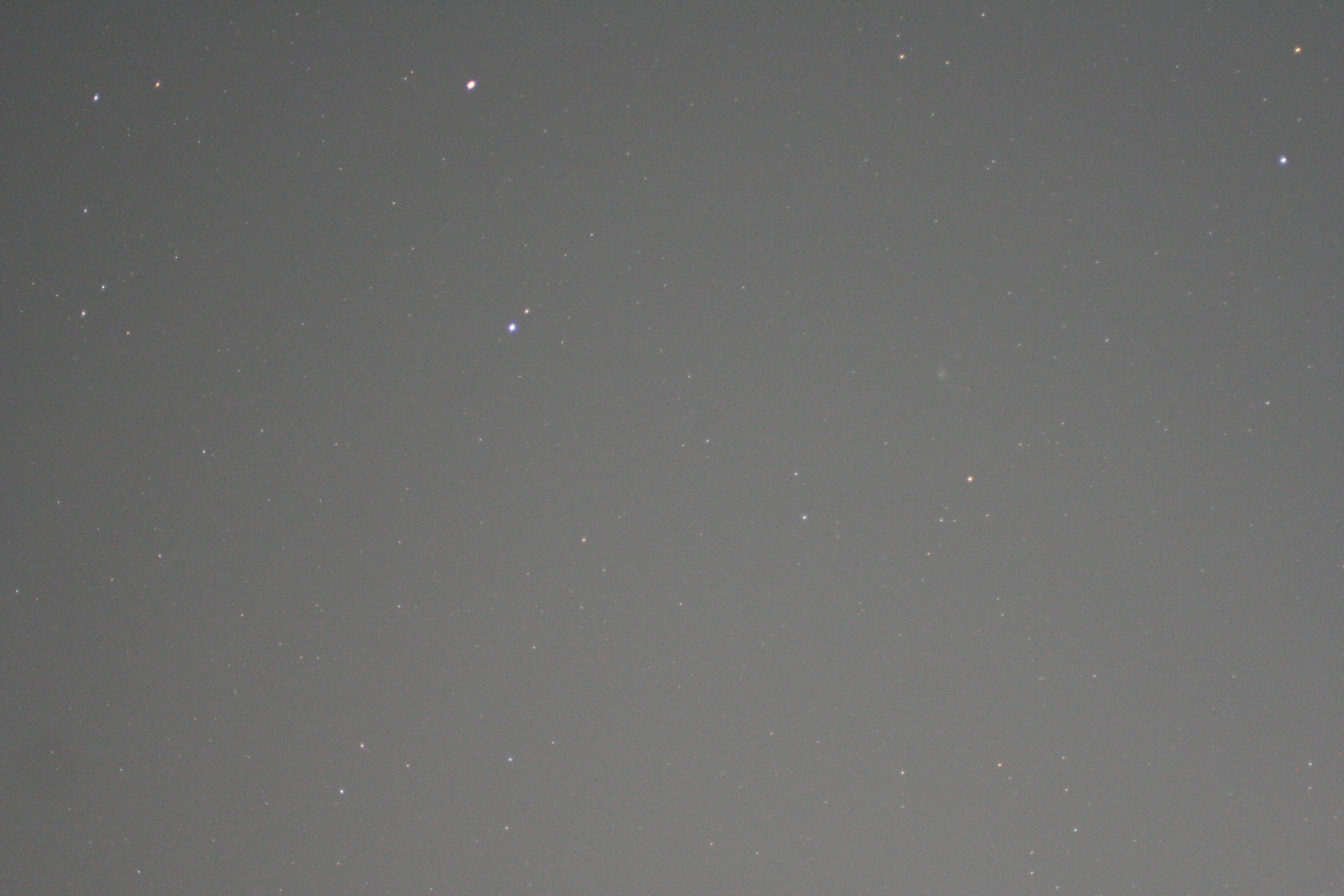
Shooting blind, bracketing the framing, I finally identified that I was aiming too high on the first two sets of photos, so I went back out for a third. Do you see the fuzzy, faint, green dot? That’s the comet.

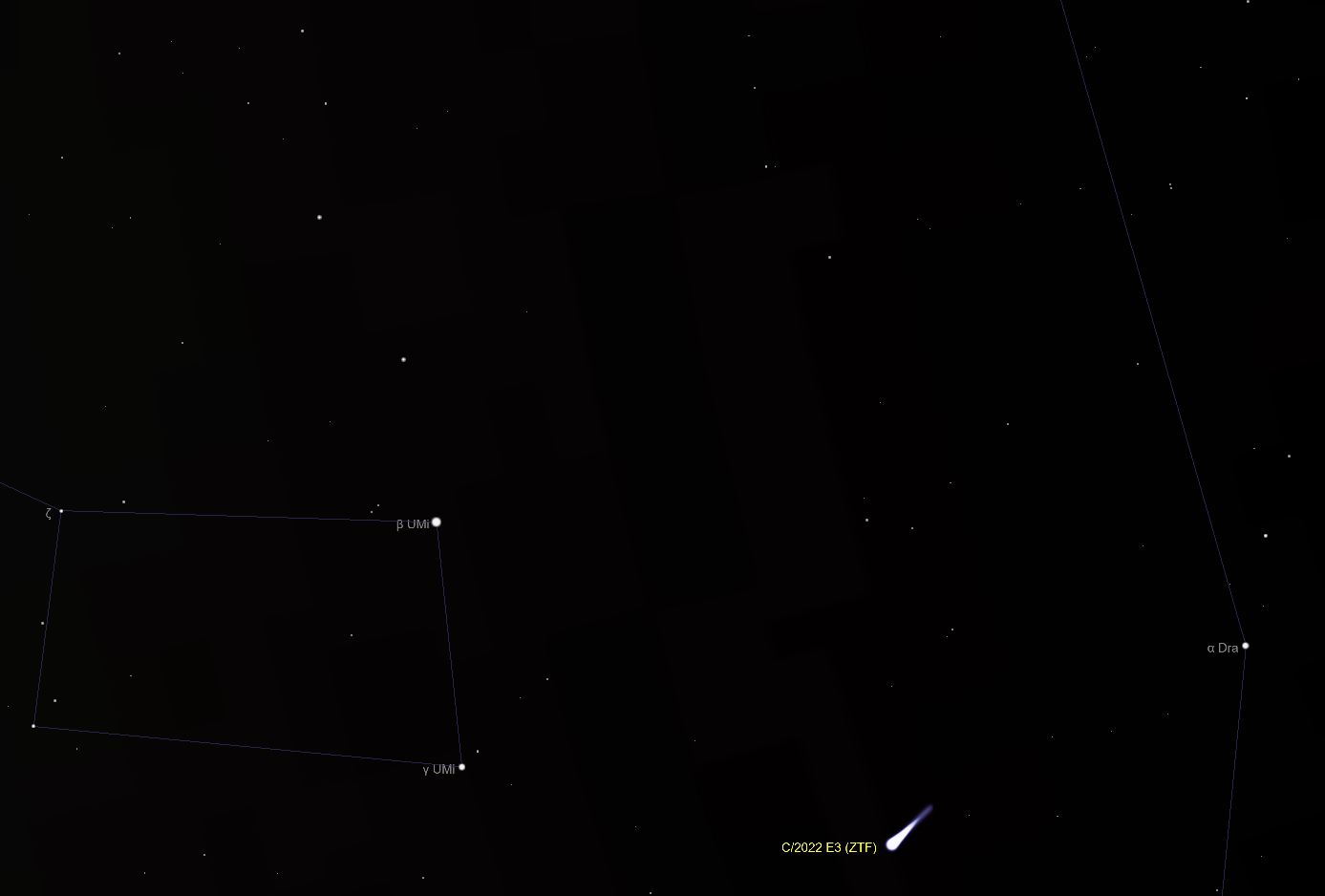
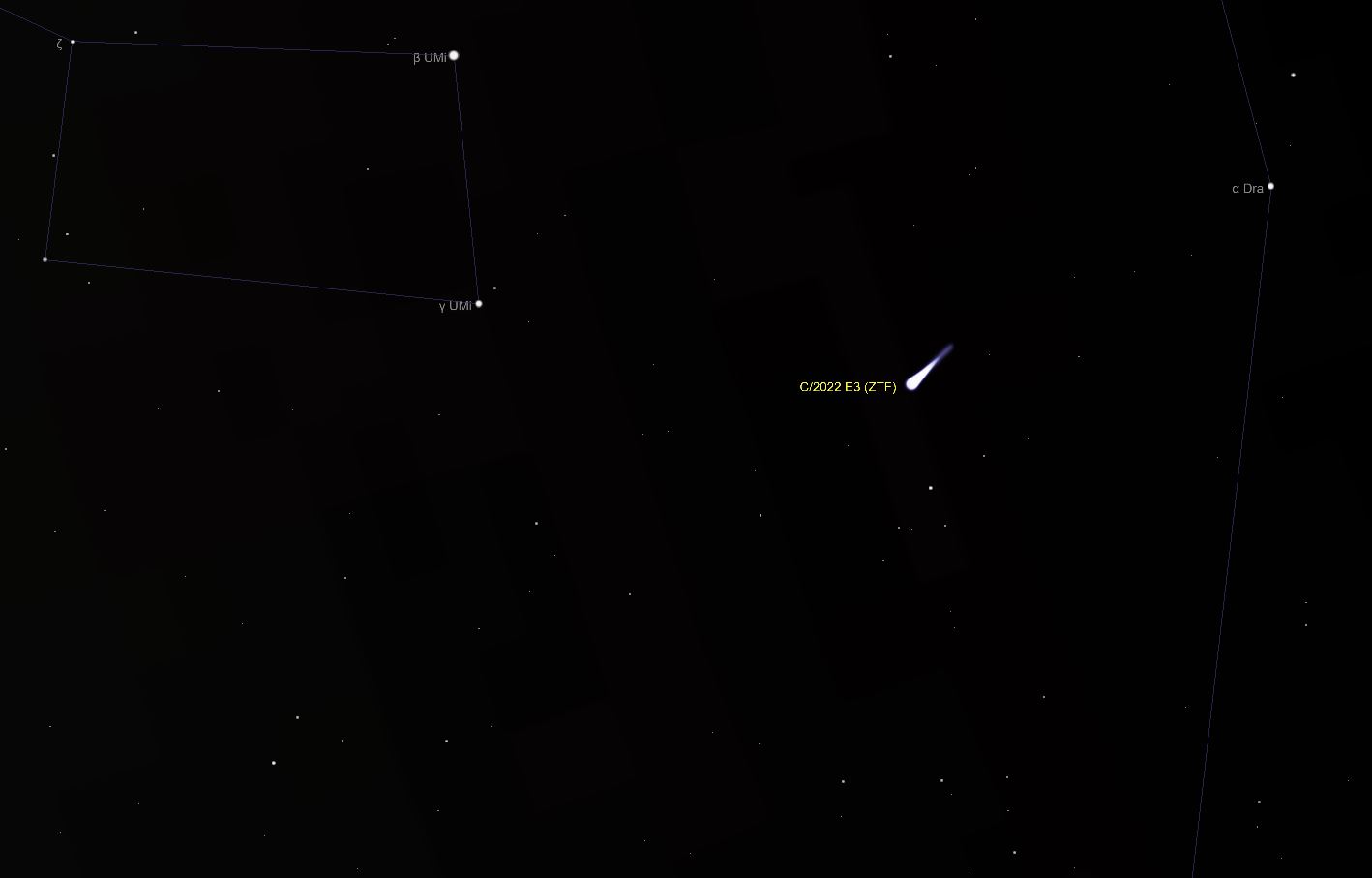
Here’s a portion of the map from TheSkyLive.com that matches what you’re seeing.

If I shoot short pictures (5 seconds) I don’t get as much washed out sky from the light pollution. But the comet is really faint and diffuse.

If I shoot longer pictures (13 seconds) I get a ton of light pollution washing everything out – but you can almost sort of start to see some of the tail. Maybe.

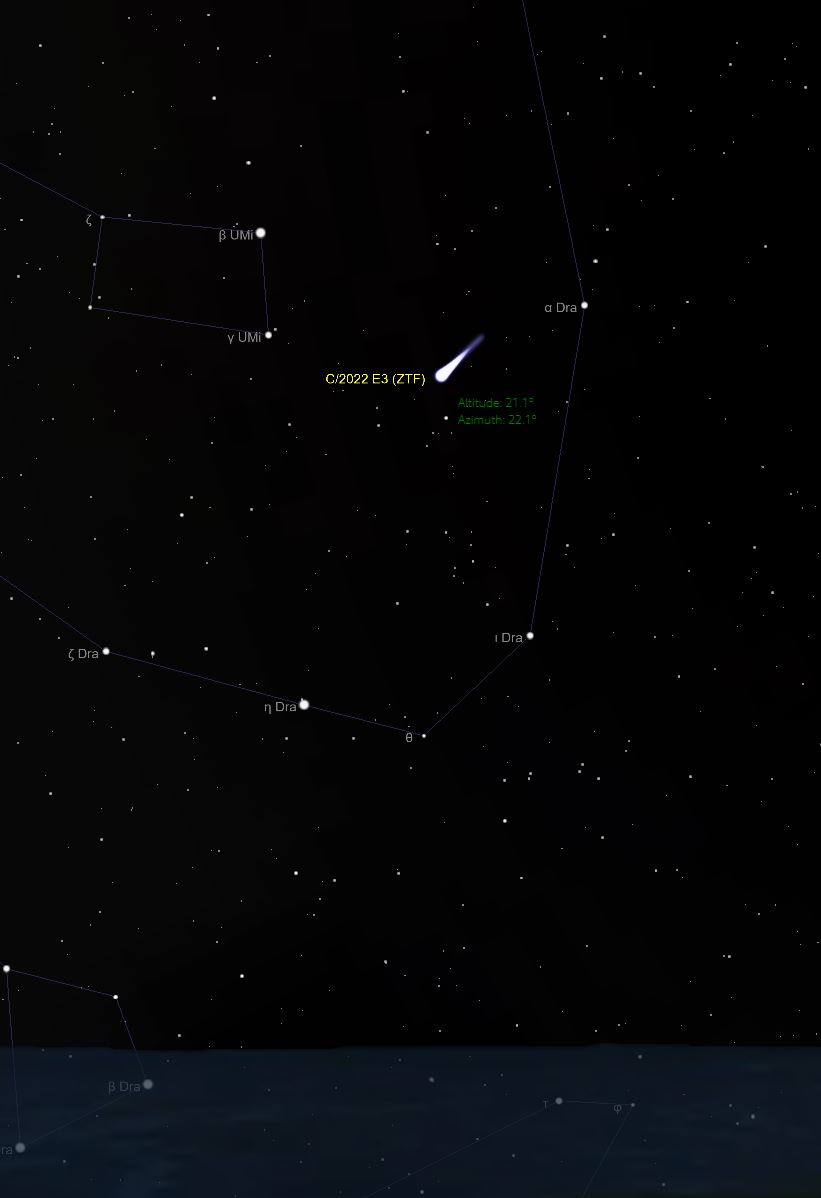
Here’s the frame from TheSkyLive.com that matches those two photos.

The other problem, as seen from this final frame from TheSkyLive.com, is that we’re close to the horizon, so even if the sky were clear of haze (it’s not) and/or light pollution (it’s really, REALLY not!) we would still be looking through a lot of air. So, three strikes.

But I FOUND IT ANYWAY!

Leave a comment

Filed under Astronomy, Photography, Space

Comet C/2002 E3 (ZTF)

You might have heard about the “green” comet. It’s been lurking around in the Corona Borealis constellation for a while and is now moving over between the Big Dipper and Little Dipper, headed toward Casseopeia. All of those are fairly bright constellations near the north celestial pole, so in theory the comet should be easy-ish to find.

It’s just now growing to be bright enough to be visible to the naked eye – if you’re in a dark location with no light pollution and a cloud-free, haze-free sky. “If” carries a lot of weight in that sentence. The Los Angeles suburbs and the infamous San Fernando Valley have none of those things.

Which is why I’m using binoculars, which in theory at this point should make the comet easily visible – if I’m looking in the right place.

So I’m using a map – this one from TheSkyLive.com is really good. Just make sure you have it set for the correct time and location.

For the past four nights I’ve looked, but haven’t seen it yet. On the other hand, to our north it’s been hazy as all get out, some times tough to even seen the bright stars of The Big Dipper, even with binoculars. With a faint, diffuse comet being that much harder to see, I’m not surprised.

But tonight is much more clear, so I’m going to go back out. We’ll see what we’ll see.

Comet ZTF will be getting more bright and rising higher in the sky for Northern Hemisphere viewers over the next several weeks. If you’re up late, like near midnight, or at least after 22:00, go take a look!

Leave a comment

Filed under Astronomy, Space

Saturn & Venus & Moon

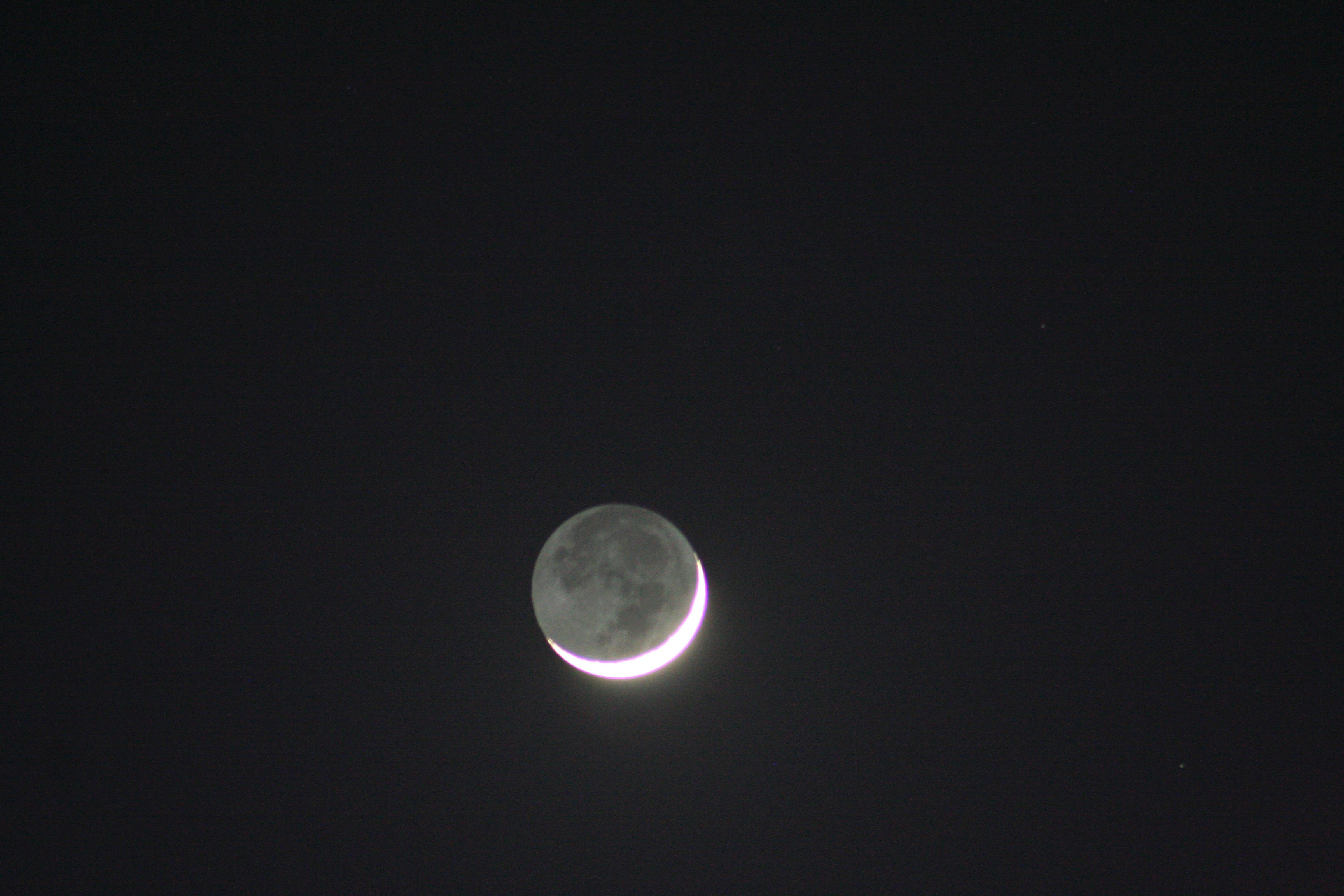
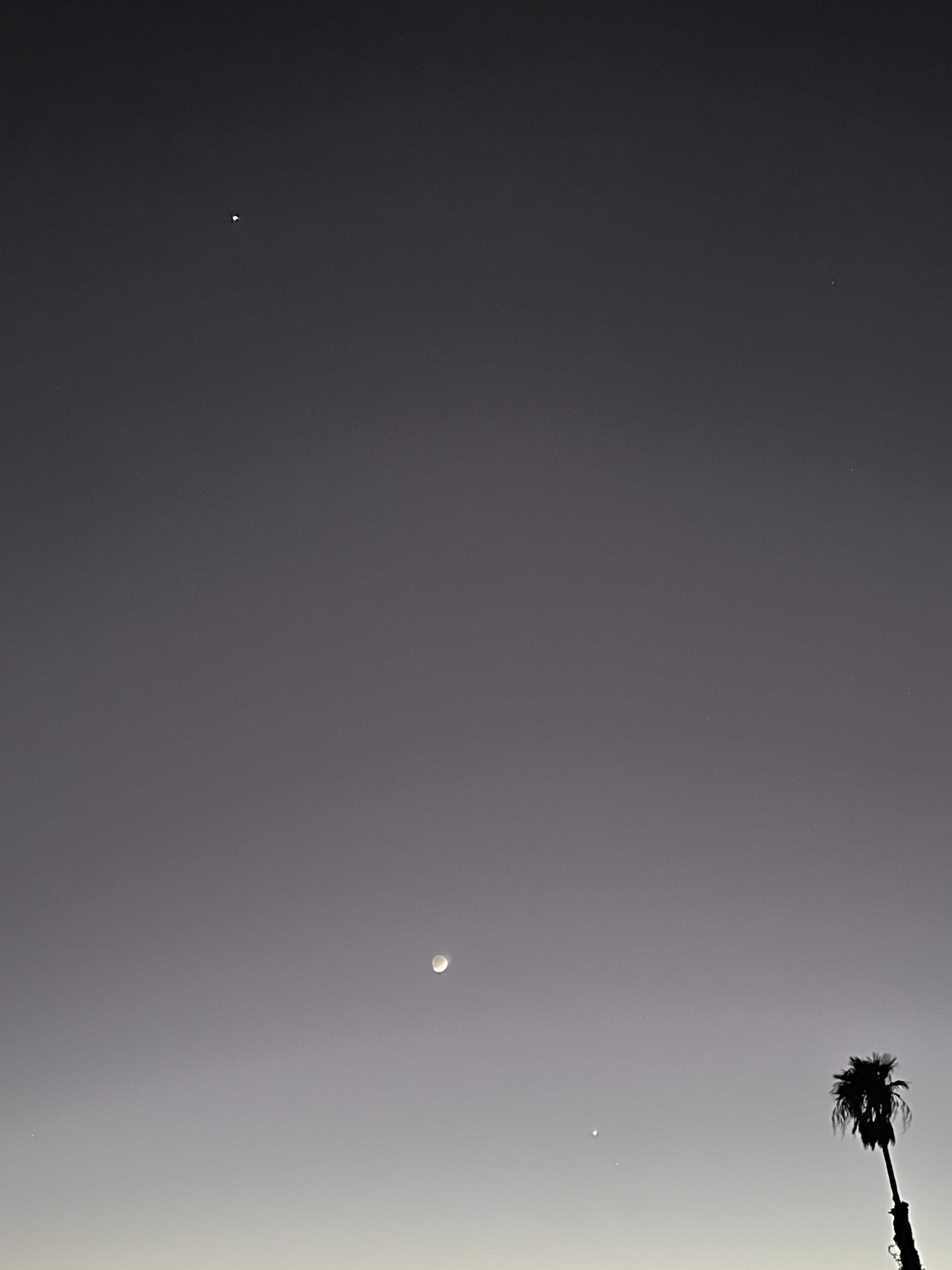
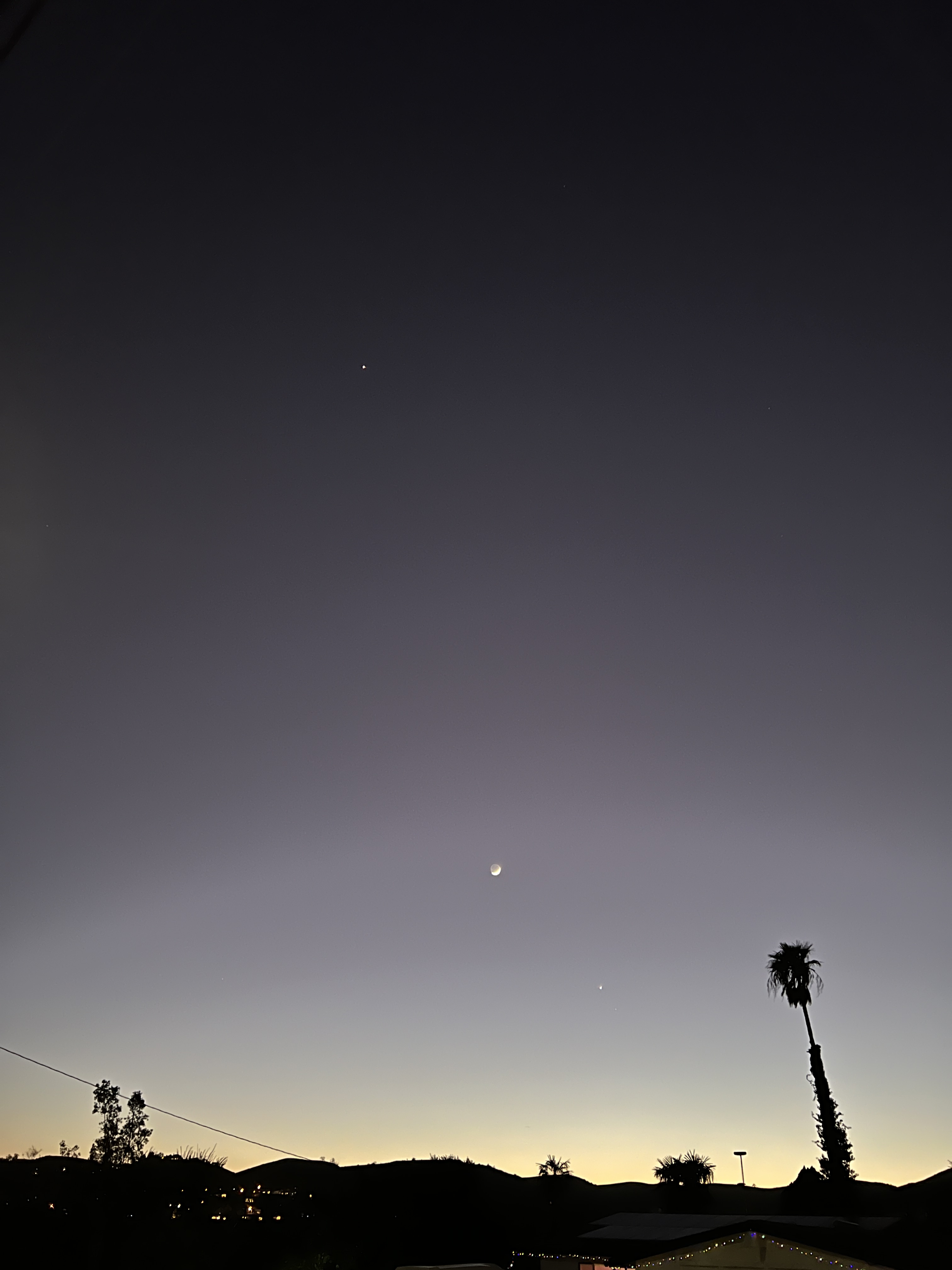
One more night. The moon’s passing Venus and Saturn by and the two planets are also splitting. They’re pretty, but they’re not spectacular, while Saturn’s fading fast. (“Fast” = over the next couple of weeks, but still a lot dimmer than it was even a week or two ago.)

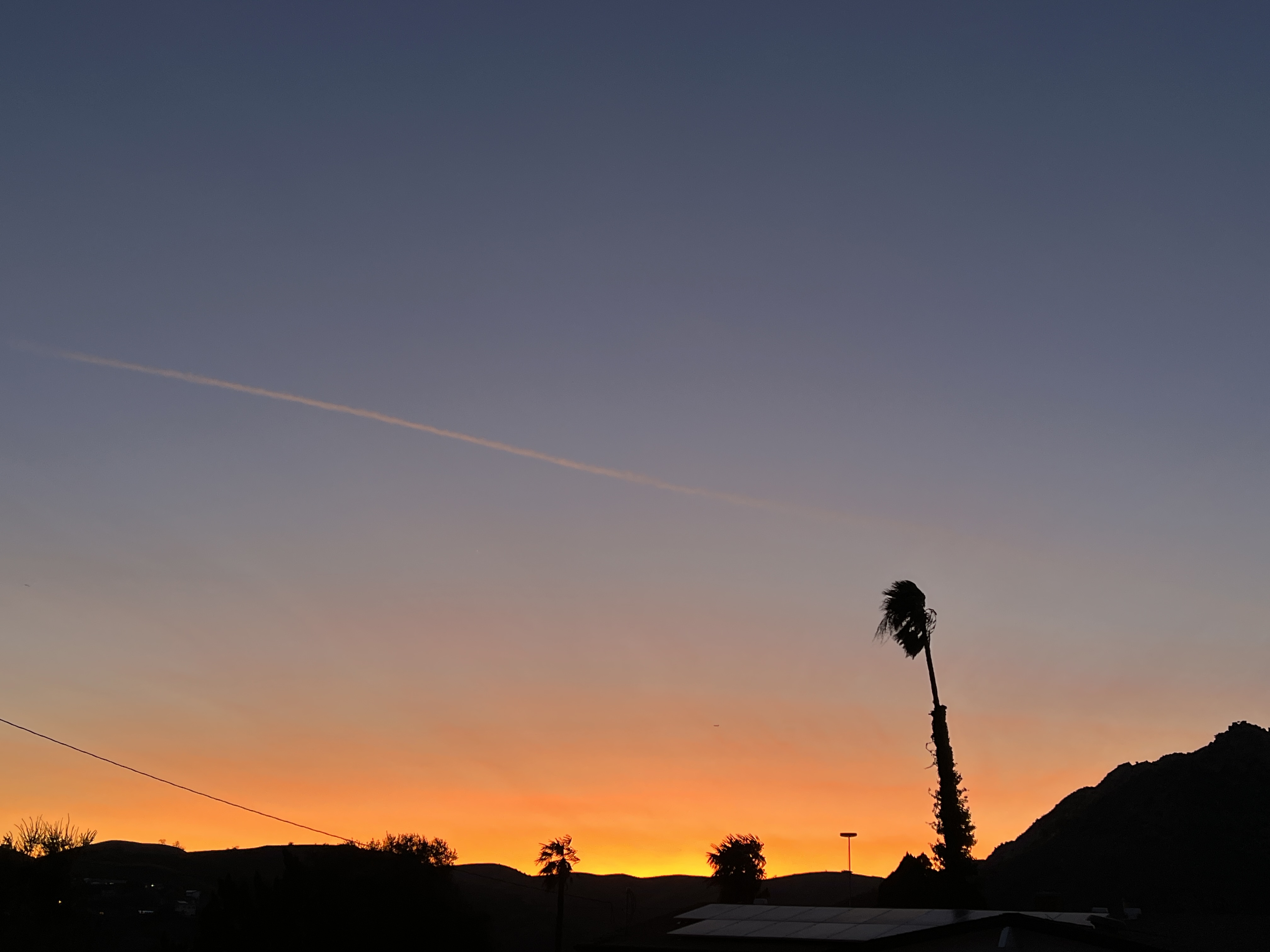
Not so much color in tonight’s sunset, but at least the wind’s gone. Mid-sunset you can barely see Saturn.

The moon is now three days old, something like 16% illuminated. Saturn is now well below Venus, much different than just two days ago. You can only wonder what the ancients thought of that, the “stars” moving around in what HAD to be a permanently fixed heaven.

Close up with a longer exposure you can still see the color difference. But Saturn’s apparent color will fade as it gets dimmer, mainly because it will only be visible against a much brighter sunset sky.

As always, the moon’s crescent is so much brighter than it seems when shooting photos. There’s a little bit of detail to be seen there.

But overexpose the illuminated crescent and the Earthshine-lit face of the moon is clearly visible.

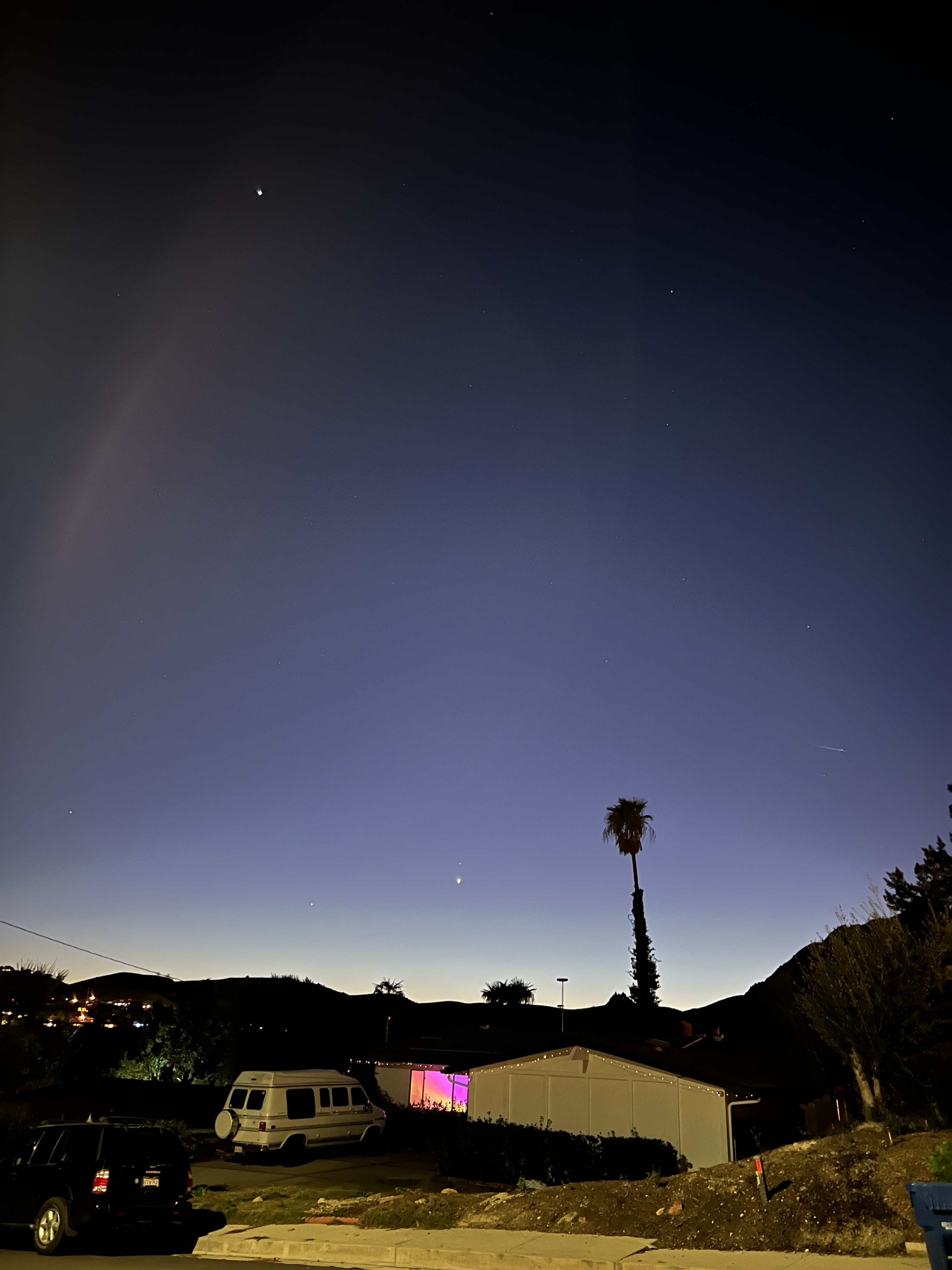
Pulling out the iPhone for the wide angle picture, Saturn fades away completely, but now we’ve got Jupiter visible at the top.

Tonight I also had one of the local barred owls in a tree right above me, hooting like a fool, right up until I switched the iPhone to video. Then, dead silence. My video is several minutes long and it didn’t make a peep. I do wonder if turning on the camera turned on some sort of infrared illuminated focusing mechanism and that flashing IR signal was visible to the owl.

I wonder how much of this scene, moon and planets, can be seen by the owl. And what it thinks of it, if anything.

Maybe that’s just us.

Maybe not!


Leave a comment

Filed under Astronomy, Photography, Space, Sunsets

Venus & Saturn & Sunset

Tonight was the closest approach of Venus & Saturn in this conjunction. It happened about three and a half hours before these photos, but I wasn’t able to see until after sunset. That’s life on a small, round ball of dirt and water in the midst of an extremely vast cosmos.

Speaking of sunset…

Boy, howdy! Normally the most spectacular ones I’ve seen have a lot of big clouds, but tonight was a lot of very high haze. Wowsers!

I wish this photo could event begin to show all of the layers upon layers of different shades of orange and pink and peach colors that could be seen.

While spectacular, it was also enough clouds to be obscuring what I wanted to observe, i.e., Venus and Saturn. By this time I should have easily been able to see Venus, as bright as it is. But, no joy. I wasn’t at all convinced that I would be able to see Saturn when it got a bit more dark. But I went out anyway a half hour later to see what could be seen.

Stupid moi! I had sort of forgotten about that whole “moon” thing that’s two days past new moon and just the tiniest of slivers hanging there just barely above the horizon.

The other factor which I hadn’t taken into consideration was the wind. It is freakin’ howling out there, as you can see from the palm trees. I’m glad that I shot a lot of pictures, since most of them are blurred as all get out, even with the use of my heavy, “good” tripod.

It was great to see the moon slipping below the Calabasas hills, at one point with the lit crescent part below the ridge but still with part of the Earthshine-illuminated upper arc still visible. I would share that with you but all of those pictures look like I was taking them from a trampoline mounted on a roller coaster, so you’ll have to trust me on this one and use your imagination.

As it finally got dark I could see Saturn, but it was definately dimmer than last night, caused by the thin, high cloud layer. But you can see how Saturn has moved relative to Venus, past it to the right and down toward the horizon. (Of course, remember that it’s your relative view that’s changing, we’re all seperated by almost a billion miles and they only look “near” each other since we happen to be at a particular spot in our relative orbits as we all circle the sun.)

Darkness finally, cold (into the upper 40’s, which is cold for SoCal), and the gales blowing, it was easier to see Saturn.

Remember, if you didn’t get a chance to see this tonight or last night, if you get a clear Western sky about an hour after sunset, go look anytime over the next week to ten days. The two will be separating with Venus going ↖ away from the sun and Saturn going ↘ toward the sun and getting dimmer and lost in the glare of the evening twilight. But you’ve got a few days if you’ve missed it so far. Binoculars will help, if you’ve got them.

And don’t forget Jupiter overhead, or Mars back behind you near Orion.

Get outside! Take a look!

Leave a comment

Filed under Astronomy, Photography, Space, Sunsets

Venus & Saturn

If you have a clear Western horizon and no clouds one of the next couple of nights, take a look about 45 minutes to an hour after sunset.
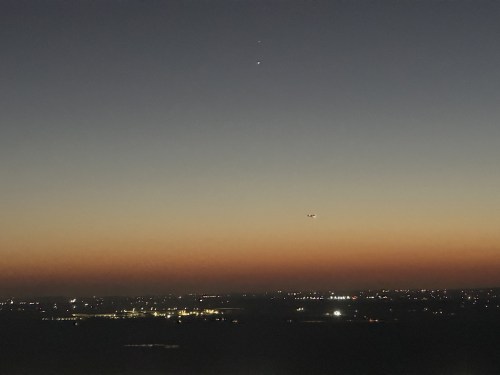
(Photo by Steven Willett)

In Texas tonight, they had a more colorful sunset than we did, but up at the top center you’ll see two objects. The bright one at the bottom is Venus. Just above it, dimmer, is Saturn.
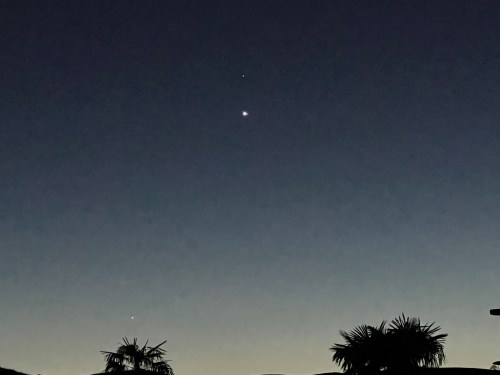
 

From Los Angeles’ west San Fernando Valley, there was a much more blase sunset, but the planets were no less bright, even on a cell phone.
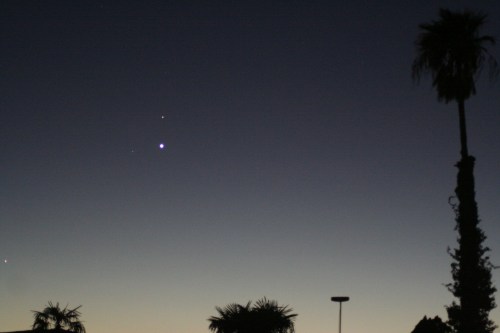
With the good camera (Canon DSLR) and a telephoto lens you can start to see the bright white color of Venus, as well as the softer, more yellow color of Saturn. If you have a small telescope or even a decent pair of binoculars, the rings of Saturn can start to be seen.


These two have been getting closer for weeks. Venus is rising into the sunset sky, it’s apparent motion taking it away from the sun, while Saturn’s apparent motion will be taking it behind the sun from our viewpoint, so it’s sinking quickly into the evening twilight. In about two weeks it will be almost impossible to see, being too close to the sun to be seen after sunset.

Tomorrow night, just after sunset on the North American East Coast on Sunday, January 22nd, will be the closest they’ll appear to each other, both easily visible in a telescope or binocular field of view. But you’ll still see them near each other on Monday, or Tuesday, or the next several days. Just a little bit further apart every day.

But, like I remind you with all of these events, no matter what the mainstream media would like to tell you about, “***TONIGHT***, there’s this ***AMAZING*** THING going on!” it’s not just tonight. Or tomorrow. So if it’s cloudy this weekend for you, but nice on Monday or Tuesday, go look anyway. Be a rebel!

And while you’re out there and you’ve seen bright, white Venus and dimmer, yellow-ish Saturn on the Western horizon after sunset, look up, near the zenith.
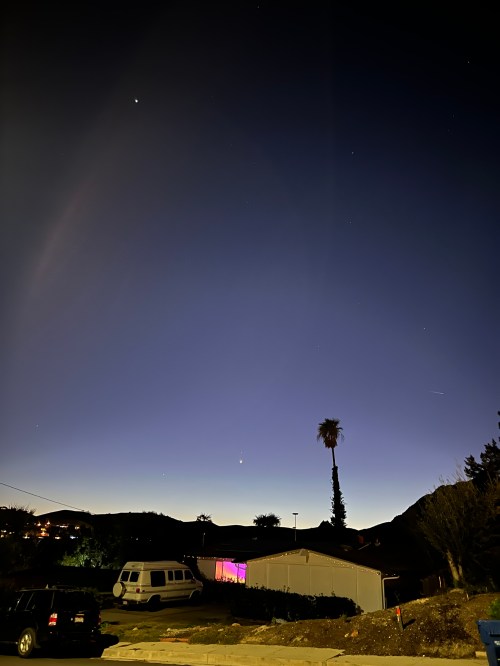
That really bright object almost directly overhead? That’s Jupiter. And if you have binoculars or a telescope, the Galilean moons are easily visible.

If you stay up a little past sunset, out in the east where you see Orion (one of the easier constellations to find), look just to the west of Orion and you’ll see the Pleiades cluster (lovely!) and between it and Orion you’ll see a bright-ish red object. That’s Mars.

If you have a telescope that’s just a little bit bigger than a beginner’s model, about halfway between Mars and Jupiter you might see Uranus, a blue-green object. But you will need that telescope.

If you have a decent telescope, probably 8″ or bigger, look just to the west of Jupiter to find Neptune, which will be a deep blue color.

But remember, even if you don’t have a telescope or binoculars, even if all you have is your Standard Issue Mark I Eyeball, you can see Venus, Saturn, Jupiter, Mars, and of course, that fourth planet that’s easily visible in this picture.

Earth. Third rock from the Sun. I’m sure you’ve heard of it.

Enjoy your sightseeing!


Leave a comment

Filed under Astronomy, Photography, Space, Sunsets

Artemis

That was freakin’ beautiful!

NASA’s Artemis I mission finally launched tonight, heading off planet to the moon on an uncrewed mission to prove the technology behind the Artemis rocket, the Orion spacecraft, and the ESS service module. There have been delays, hurricanes, cryogenic fuel leaks, and a gazillion other hurdles. Tonight the last of the hurdles were overcome and Artemis flew!

The mission has a long way to go – it has to get to the moon, orbit there for several weeks running tests on hardware and systems, then coming back to test the heat shield in a landing off of San Diego.

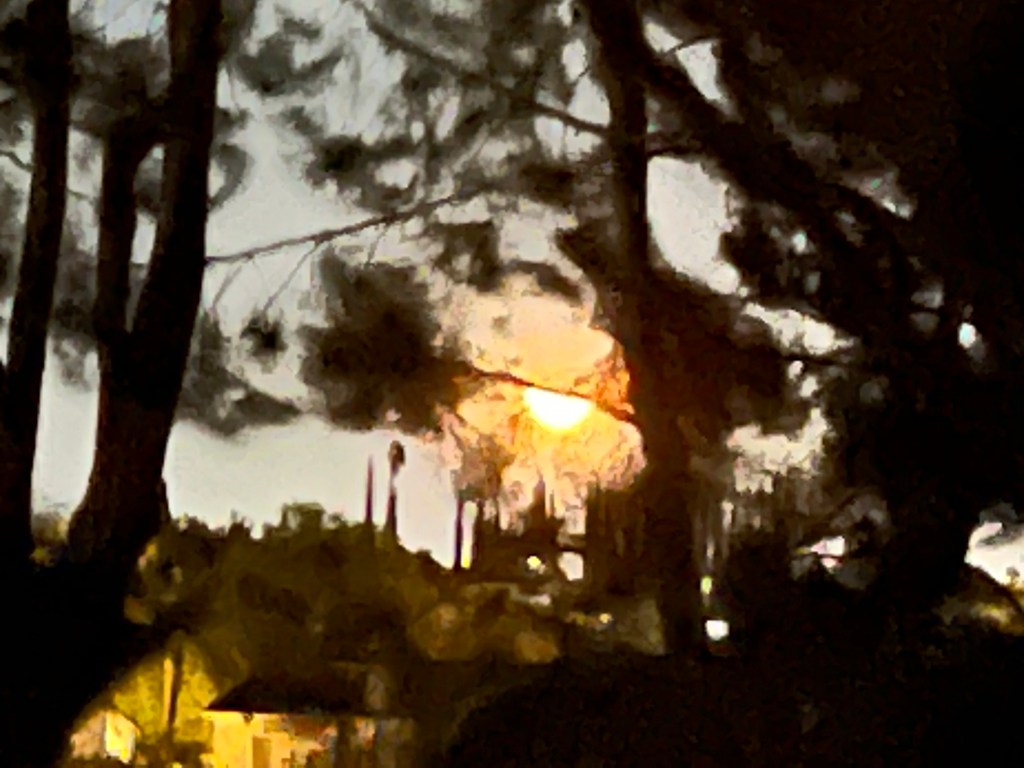
I went out to check out the Santa Ana winds in the back yard and see if I could see any sign of a brush fire that’s popped up above Lake View Terrace. No sign of flames, but through that smoke in the distance was the rising moon.

There’s the target! I regret that it’s taken 50+ years to get here, but from here let’s keep going!

Leave a comment

Filed under Photography, Space

Tonight’s Full Lunar Eclipse

Posting a bit earlier in the day to give everyone who might need it a heads up. There’s a full lunar eclipse tonight.

If you’re in the US midwest or on the east coast you can see the beginning of it just before dawn. If you’re on the North American west coast (about from the Rockies west, map here) you can see most or all of it in the middle of the night. If you’re on the Asian east coast you can see most or all of it just after sunset. If you’re in Hawaii, you’re golden, you can see it all overhead at a relatively comfortable hour!

Assuming your sky is clear. Here in SoCal…

Light rain started around midnight and is supposed to go through Wednesday morning. While we’re grateful for the rain (the first measurable rain since March and we’re entering the third? fourth? fifth? year of a critical drought) the timing is less than optimal.

This is the last total lunar eclipse in about three years, so if you get a chance, take a peek!

Start times for different events:

UTC EST PST
First contact with umbra
(the deep part of the Earth’s shadow)
09:09 04:09 01:09
50% partial 09:44 04:44 01:44
Start of totality 10:17 05:17 02:17
Mid eclipse 10:59 05:59 02:59
End of totality 11:42 06:42 03:42
50% partial 12:14 07:14 04:14
Final contact with umbra 12:49 07:49 04:49

Remember, all you need to see a lunar eclipse (other than a clear sky or a hole in the clouds) is ye olde Mark I human eyeball. Binoculars or a small telescope might let you see more color or detail, but the naked eye works just fine. (It’s a solar eclipse that you never, EVER want to look at without protection.)

How dark will this eclipse be? How colorful? Will the moon look red, orange, brown? Who knows, they’re all different. That’s the great part of it! If you snap a picture, feel free to share it!

And that whole “signs & portents” thing where the full moon starts to turn dark and then blood red in the sky on the eve of the US midterm elections. It’s strictly a coincidence. Totally by chance. It means nothing. At all. No danger being foretold. None.

Just make sure you go out tomorrow and vote anyway, just to make sure. Seriously!

Leave a comment

Filed under Astronomy, Photography, Space, Weather