
You may have heard that we’re going to get “THE COMET OF THE CENTURY!” (again) this year. I’m not saying that it’s not going to happen — believe me, there’s nothing I would like to see more than a spectacular comet that’s visible to the naked eye for a month, even in the city, with a tail stretching all the way across the sky. But as someone who’s been an amateur astronomer for over forty years, I have a healthy appreciation for just how unpredictable and variable comets can be. ISON may be huge and spectacular, but the odds are that it will be great for amateur astronomers, but only so-so for anyone without at least binoculars.
We get this hype about every ten years, it seems. Kohoutek was supposed to be a spectacular “Christmas Comet” in 1973, but was barely a naked eye object. Does anyone remember Comet Hale-Bopp except as the excuse used by a San Diego suicide cult? (We actually saw Hale-Bopp pretty well, taking a trip out of LA into the mountains to get to a dark sky site.) A lot of the hype seems to be more from the press than from the astronomy community, but that really doesn’t mean anything to the public that just interprets it as “the scientists are crying wolf again”.
ISON started getting hype over a year ago when it was discovered in late September, 2012. At that time it was still a long, long way out from the sun and two factors increased the probability that it might be a bright comet. First, it was likely to be a big chunk of ice instead of a little one since the bigger they are, the further out they are when they get discovered. (The little ones reflect less sunlight, are harder to see, and don’t get spotted until they’re closer.) Secondly, calculations of its orbit indicated that it would get close to the sun and its orbit would make it favorable for viewing from Earth while it was close to the sun.
But there are a ton of variables. It might be more rock than ice underneath an icy shell, and it wouldn’t get bright at all. It might be almost all ice, light and fluffy, and when it got close to the sun it would simply fall apart and evaporate completely. It might just not behave the way we would hope for any one of a hundred different variables that we can’t even determine. Our experience is actually touching and sampling comets is a little bit thin. (Wouldn’t it be great to fix that?)
But we can hope. And we can be prepared. If we get lucky, Comet ISON could be good, great, or stunning.
First, there are a ton of spots on the web that will give you sky charts and information on where to look. My favorite right now is the ISON Atlas website. It has multiple charts and diagrams for every month. (Desktop software for this sort of thing is getting pretty amazing.) But you can also find charts and tracking information at the web sites for Sky & Telescope magazine, Astronomy magazine, or Space.com. Right now, ISON is in the morning sky just before dawn, very near to the planet Mars, in the constellation Leo.
Now that you know where to look, do what you can to get a dark sky. If you can get out away from the lights of the city, fantastic, the further the better. Also, try to pick a night where there’s little or no illumination from the moon. A full moon’s light will wash out all but the brightest stars, so your view of the comet will suffer significantly. You can check a calendar of moon phases here. You can also find sites on the web that have lots of notes on notable observing events, such as when ISON will be very near the M95-M96-M105 trio of galaxies in Leo this Saturday, October 26th.
Looking at the timeline, ISON may be brightening to naked eye visibility in the first week or so of November. (Dark skies!) Getting closer and closer to the sun (and we hope getting brighter and brighter), ISON will be at perihelion (closest approach to the sun) on November 28th at approximately 6PM on the US east coast, 3PM here in Los Angeles. We, of course, won’t be able to see that (since the sun is stupid freakin’ bright) but we have several sun-observing spacecraft that will track it all the way in. And then look for it to come around the other side.
ISON wouldn’t be the first comet to just vanish and never come out on the other side. Nor would it be the first to come out as a dimly visible and rapidly fading cloud of much smaller comet fragments. However, recent observations by the Hubble Space Telescope and other observatories indicate that so far ISON is holding together well and is well within the expected range for size and brightness, even if it is so far a little bit toward the lower end of the expected range in brightness.
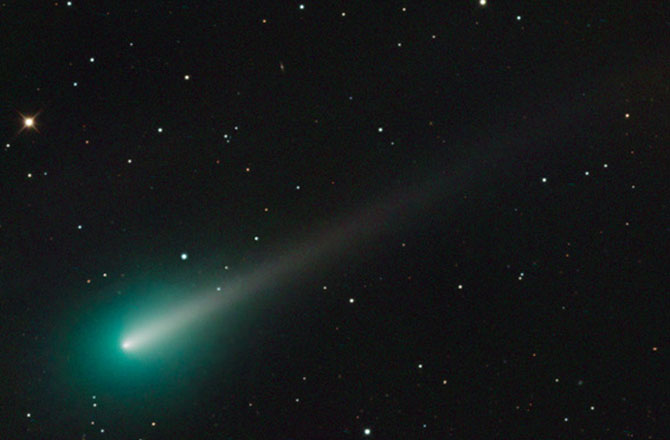 This October 8th picture by Adam Block of the University of Arizona was taken using a 32-inch telescope on Mount Lemmon. (This is not how it looks to the naked eye right now — it’s a long exposure with a big telescope and some really good CCD equipment to suck in a lot of photons. Your eyes are a bit less capable.)
If ISON comes around the sun intact and if it brightens as we hope it will, it should be an excellent object to observe in the evening skies of the Northern Hemisphere in December. (Catch all of those bold and italicized “ifs”?) The comet will be up near the north celestial pole so it should be visible almost all night, in both the evening and morning skies.
Will it be “brighter than the full moon”? Nope, no way. That’s uninformed media hype only.
Will it have colors, even the kind of colors seen above? Nope, not to the naked eye. You may see pictures of it that show some color, but again, they’ll be long exposures with fancy cameras that catch a lot more photons than your eyes. Many photons + long exposures = dim colors (maybe). Few photons + eyeballs only = black and white and faint and dim. Blame the way your eyes were designed. Great for having a wide dynamic range so that you can see the lions in full daylight and also motion in the dim moonlight, lousy for naked eye astronomy.
Will it have a tail visible to the naked eye that stretches halfway across the sky? A qualified “maybe” — if ISON develops well, if you’re at a dark sky site, and if you understand that to the naked eye it’s not going to be a bright and glowing tail, but more like a wispy smoke trail. The tail also won’t be moving or “waving” like a flag fluttering in the breeze, no matter how much it looks like that in the Michael Bay movies. (Hey, he did “Pearl Harbor“??!! Now it all makes sense!!) A time-lapse series of photos over days and weeks might show some of that kind of activity, but you’ll see something that will look like a faint, wide jet contrail illuminated by dim moonlight.
Can you take pictures of it? Sure, even with a simple setup (see here, here, here, here, here, here, and here) of just a DSLR on a decent tripod you should be able to get nice pictures. Just remember to use manual focus set at infinity, open the lens up as much as possible, and manually bracket a whole series of exposures from about 1/100 second up to 30 seconds (or as much as your camera will allow). Take multiple bracketed sets like that. TAKE LOTS OF PICTURES – digital is cheap! The brighter ISON gets, the less you’ll need any kind of telephoto lens and the more you’ll need a wide angle lens. If the tail is stretching halfway across the sky, you’ll want to catch all of it.
Keep an eye on the news, check the sources mentioned above, and maybe pencil in some free nights that first week in December (when the moon is almost new and the comet is at its brightest) just in case. If you take an advance look at how to get to some dark sky spot out away from the city, so much the better. And keep an eye here, I’m sure I’ll be trying to get some pictures and observations soon, if the late night coastal fog stays away.
Comet ISON is coming! (We hope.)


 We Love The Stars Too Fondly
My hopes are with you! 🙂
LikeLike