
To Recap: In May, 2012 I went to Asia on the “Three-Countries-Three-Weeks-Three-Kids” tour. The first stop on this once-in-a-lifetime trip was Shanghai, followed by several days in Seoul. Now I was footloose and fancy-free (i.e., lost a lot) in Kyoto, Japan. I found one of the most beautiful and interesting places I’ve ever seen and I’m going to continue to bombard you with share dozens of pictures from there with you for the next few weeks.
Climbing up from the Fushimi Inari temples, I was enraptured by the vermilion torii gates lining the maze-like paths. I explored a shrine on a side path, then started walking up the mountain again.
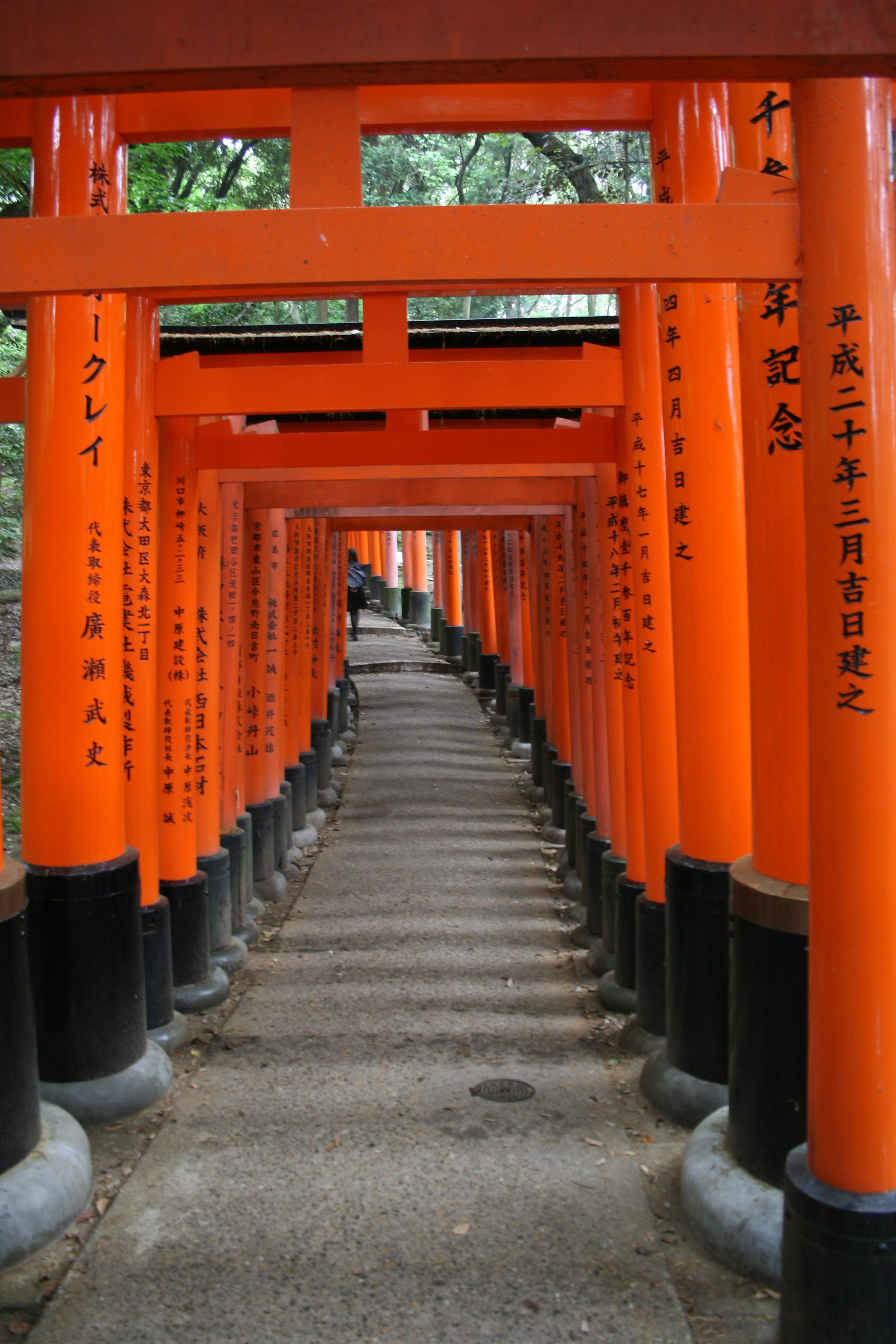 So, “hill” might be a better term than “mountain.” It will get your heart rate elevated a tad, but you needn’t be ready to run a sub-4:00 marathon in order to enjoy the experience.
 I do wish that I read Japanese so I knew what some of the messages on the torii gates are. I wonder if there’s an app for that yet?
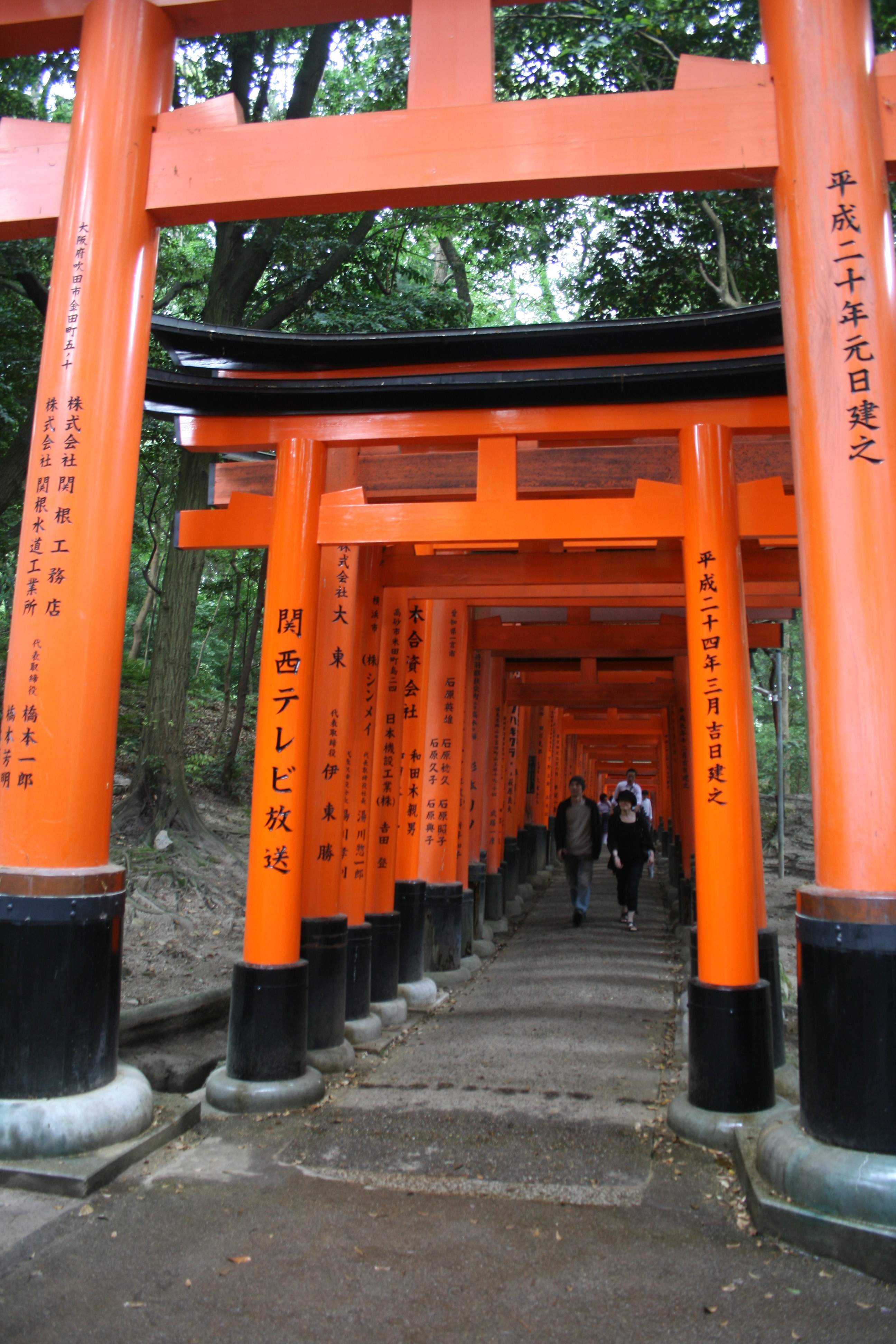 There were a few other people visiting on the day when I was there, but the gloomy conditions, light rain, and fact that it was a weekday might have kept the crowds down. I think it’s safe to assume it might be a bit more crowded on a sunny, weekend day.
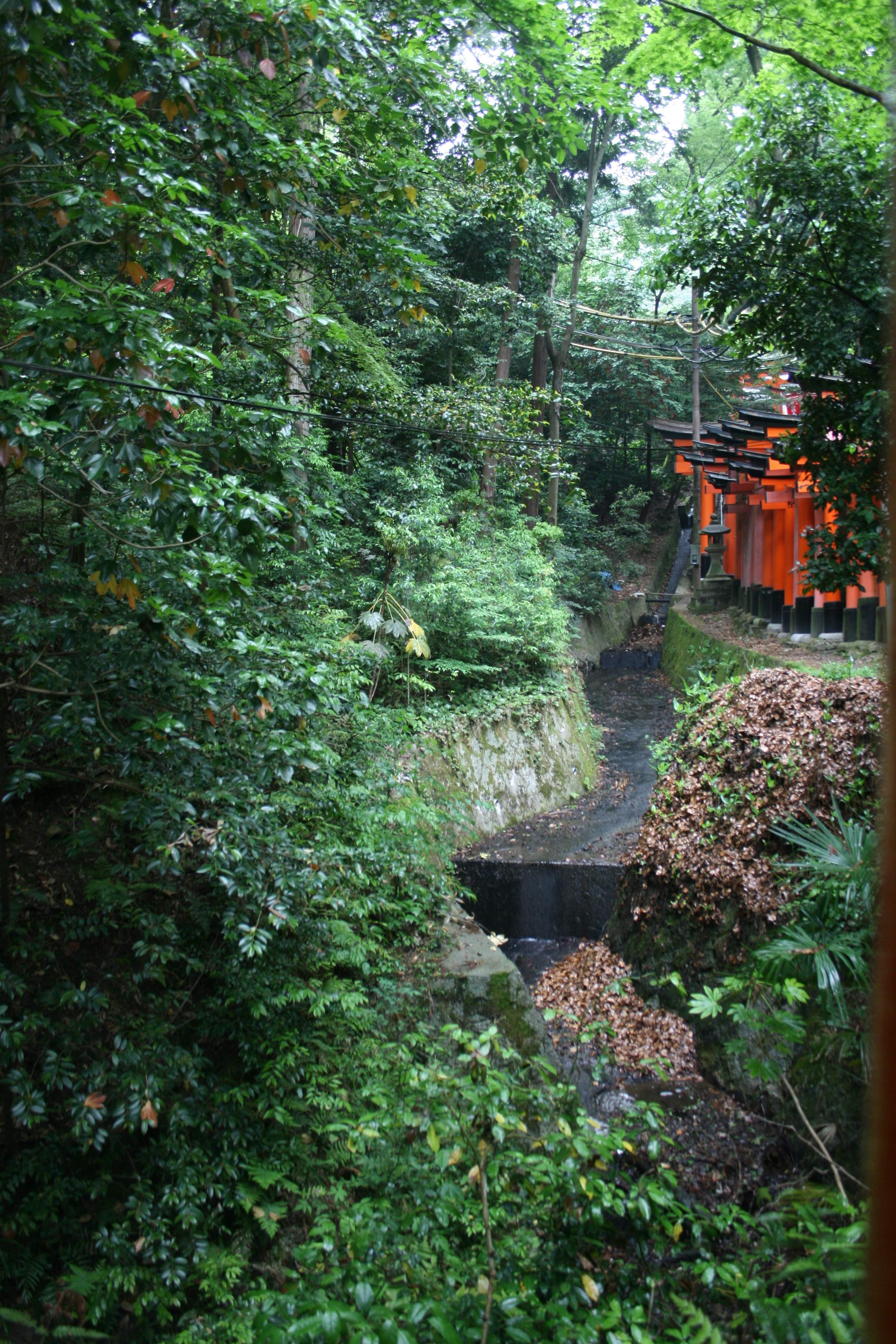 At a steeper part of the climb, a stream and a series of small waterfalls run next to the trail.
 At the top of this rise I saw the first of many, many shine areas next to the path. Unlike the first one I had seen, this one was not all grey stone, but had many parts decorated with the same vermilion colors, torii gates, and fox statues wearing red yodarekake scarves.
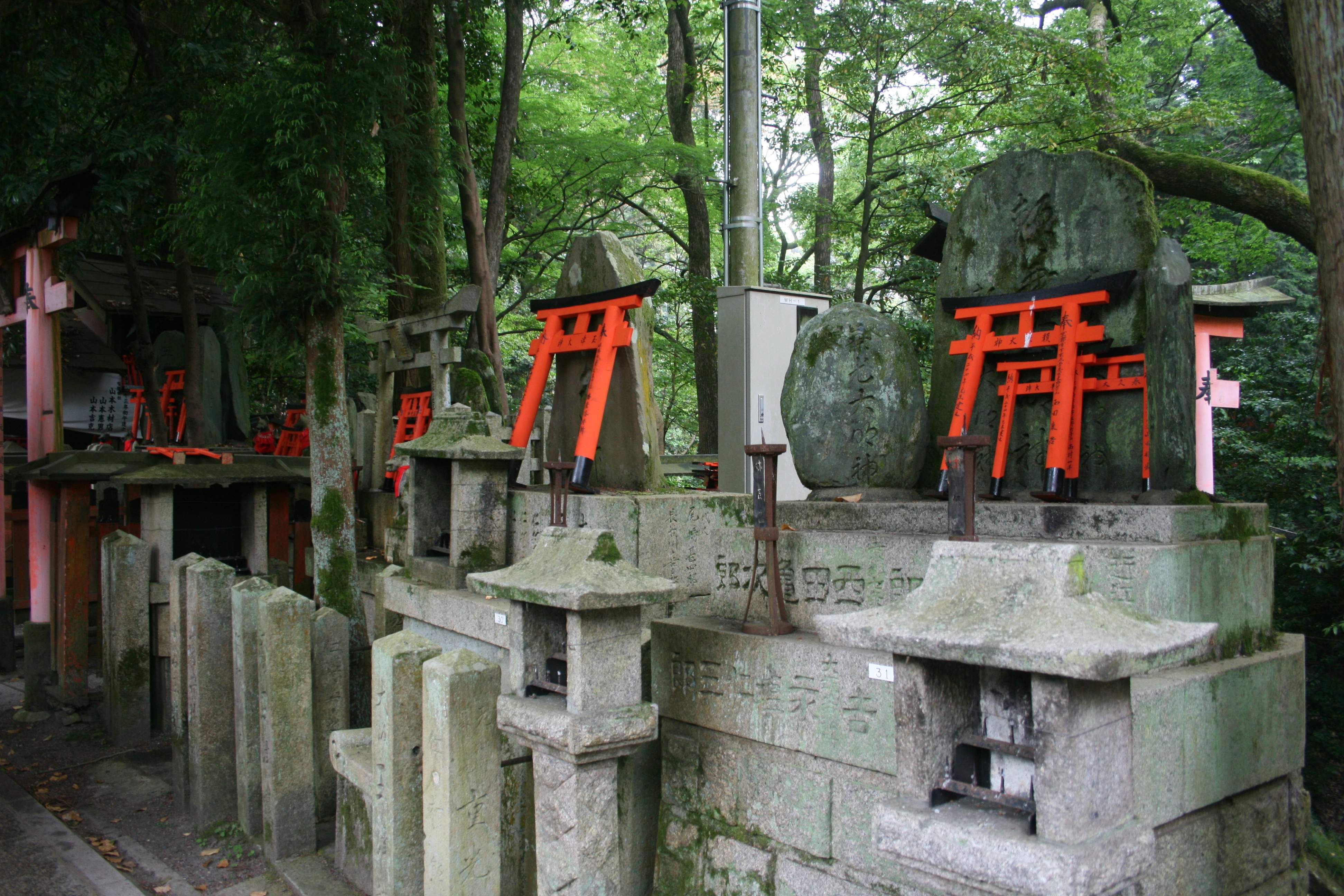 Many small shrines are decorated with small, wooden, vermilion torii gates. They seemed to come in a whole range of sizes and you could buy them at all sorts of little shops around the area. I had figured they were souvenir items (and I was tempted to get one) but their presence all over the place on the small family shrines would seem to indicate that they’re not souvenirs but play some role in how the families keep their shrines decorated and up to date.
 Ditto for the fox statues, and one might guess that having a separate torii gate right in front of your family shrine is one of the biggest status symbols around.
 Of course, having taken a picture looking up the hill at the stream, I had to take a picture looking back down the hill.
 Okay, a few things about this sign.
First, I didn’t see any monkeys, wild or not, but I did know that they lived in the area, sort of like how we have coyotes and racoons living in Los Angeles. My daughter, who had been living in Kyoto for several months on her college semester abroad, had seen them regularly. She had also warned me that they could be aggressive.
Secondly, it’s in English only, which pretty much guarantees to me that it’s intended solely for American (and some European) tourists.
Thirdly, making “Do Not Take Pictures” the first warning? Get real! The average American tourist (and I’m at the head of the line, here) when confronted with a wild monkey, will instantaneously whip out a camera and start taking pictures. Especially if you’ve warned them not to!
I get the rest of it, they’re aggressive, they can be mean and dangerous, so feeding them is a good way to get bitten. And by “bitten” I mean hauled off to the emergency room to see if they can save those fingers and let you off with just a few dozen stitches. It’s like the warning you get with bears or cougars in Los Angeles. They’re much more rare than the coyotes and raccoons, but who’s not going to take pictures first and ask later about whether or not an expert would think it was your smartest move?
And “pretend to throw” rocks at them if they approach? If I’m picking up rocks to begin with because I’ve been stupid enough to be flaunting an open Snickers bar and a Diet Coke and now it’s looking like a trailer for “Planet Of The Apes” around me, I’m not “pretending” to throw anything. I’m throwing the damn rocks!
What I remember being the biggest disappointment however was that this sign was at a food & drink concession stand up on the mountain that was closed, presumably because of the small crowds that day. Meanwhile, it was warm, muggy, and moist and I had been getting in a good workout. I really could have used a cold Diet Coke and a big Snickers bar!


 We Love The Stars Too Fondly
You have a spare “secondly” at the end!
From my Chinese knowledge, the writing on the right side of the gates is dates, saying 20 years and some. 平成 is the name of the current Japanese emperor, Akihito, who’s been in power since 1989. (Thanks google!) So my guess is some sort of “long live the emperor” thing.
On the left it keeps saying something about the west gate (I think – China uses simplified characters, Japan traditional) before breaking into specifically Japanese writing. You’ll have to ask Kat on that one. (On closer inspection, farther gates have east on them – I got nothing. Praying for safety from all sides?)
LikeLike
Thanks for the information. We’ll see if Kat can provide further insight. I would have figured it said something more along the lines of “Eternal blessings on the house of Xxxxxx” or “Let us never forget our wonderful ancestor, Fred,” not necessarily a “Long live the Emperor.” Who knew?
LikeLike