
With a full moon rising in back of the house.

With a full moon rising in back of the house.
Filed under Astronomy, Christmas Lights, Photography
This was a tough shot. The Moon was far away and tiny (relatively), the Christmas lights about 18″ away and big (relatively), and the iPhone naturally wanted to focus on the Christmas lights. But I remembered reading about how to lock the focus on the iPhone and played with it a bit to see if I could get it to work. And it did!

I don’t have any formal photography training, but I’ve taken so many pictures for so many years that I occasionally get something that I really like. This would be one of those.
Filed under Astronomy, Christmas Lights, Photography
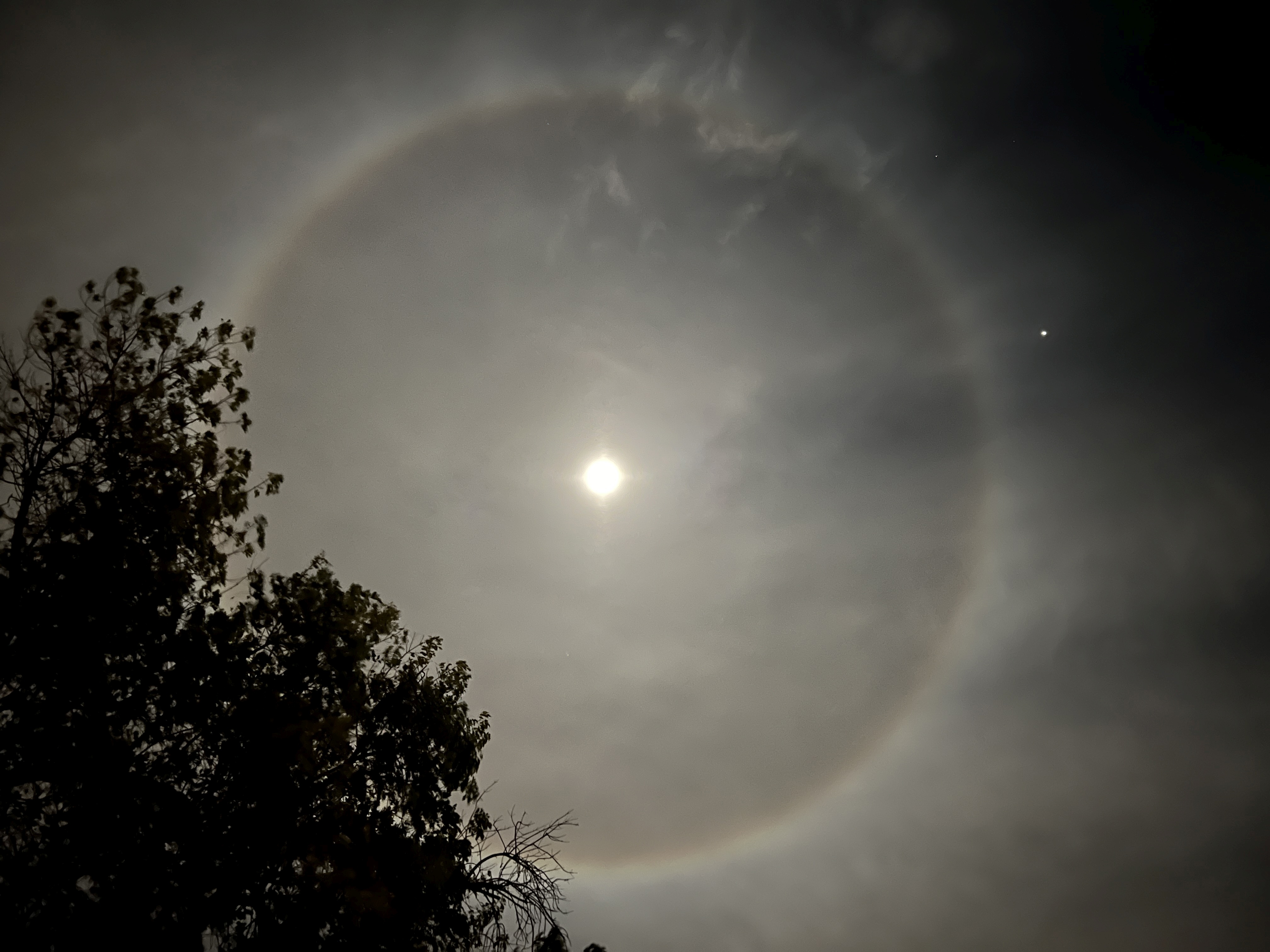
Just a touch past Full Moon tonight, moving past Jupiter, with a layer of high, thin clouds moving overhead. That means a 22º arc, with Jupiter just outside.
It’s been a nice holiday weekend. Now back to work.
Be kind to others. And to yourself.
Filed under Astronomy, Photography
Mucha more better! (Ghod, I’m going to be soooooo sore in the morning…)

The full Moon and Jupiter are still pulling their own weight up there (it’s a gravitational thing!) but the Christmas lights are looking good.
I concentrated today on getting everything on the gutters and roofline up. LOTS of ladder climbing, but *ZERO FALLS*, which is a big deal these days since I don’t bounce the way I used to.
Those bushes and shrubs are looking pretty barren, but that’s a lot easier to fix. Tomorrow, between the laundry, groceries, and Chiefs game, there should be time to get most of that done.
Filed under Astronomy, Castle Willett, Christmas Lights, Photography
On October 1st I had pictures from when the Moon was very close to Jupiter in the sky. It’s now 27 days later and Jupiter has moved a little bit toward the west. Meanwhile the Moon has gone all the way around, getting in front of the sun two weeks ago in an annualar eclipse (partial here in LA) and now being back near Jupiter.
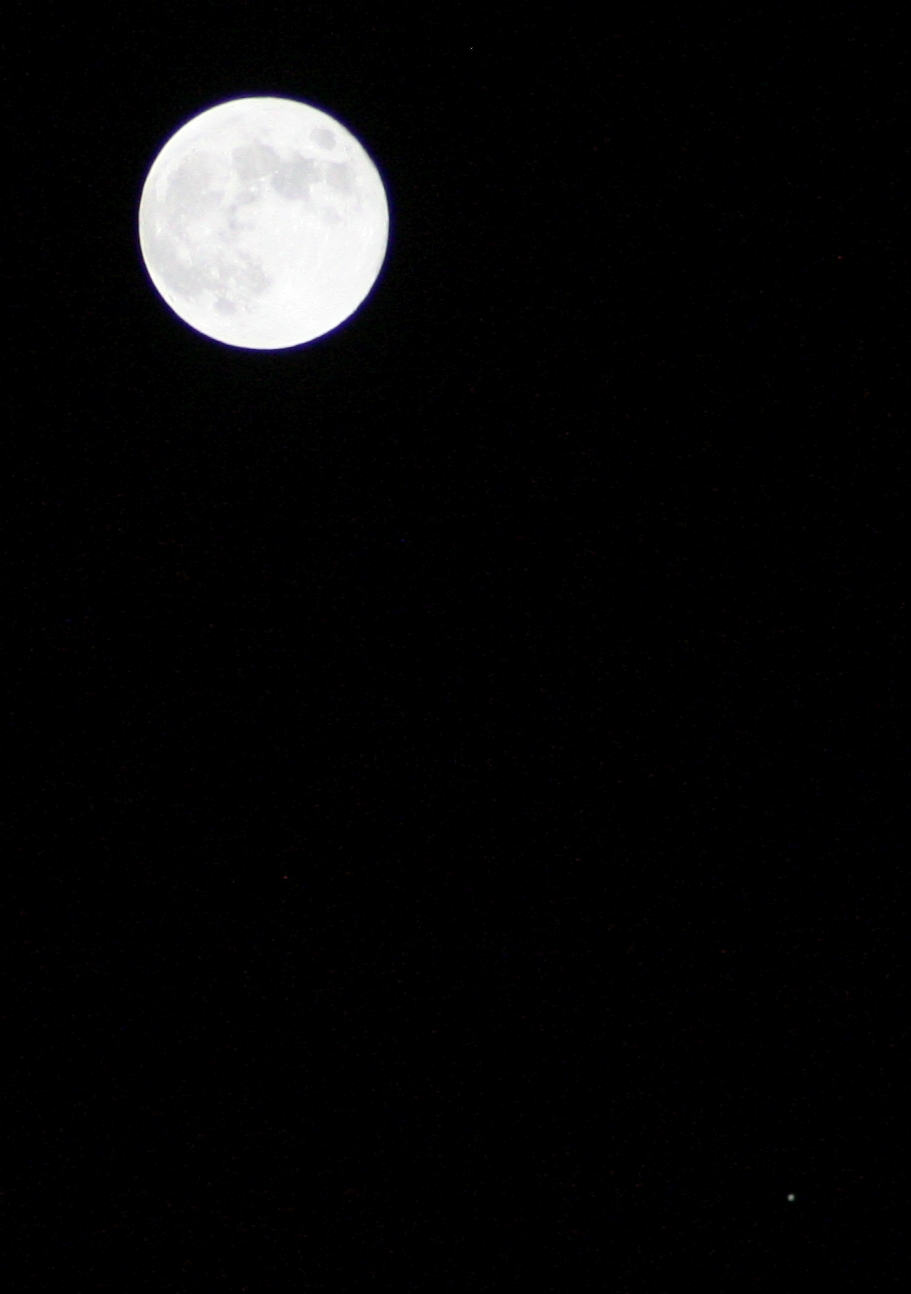
As before, the Moon is so bright that even at my DSLR’s fastest shutter speed (1/4000th second) it’s slightly washed out and overexposed. Meanwhile, Jupiter, in the lower right corner, can barely be seen at that exposure, despite being the fourth brightest object in the sky right now, behind the Sun, Moon, and Venus.
How amazing is the human eye with its ability to clearly see the major details of the Moon, lava plains and huge craters and mountain ridges, while simultaneously seeing Jupiter clearly as the bright object it is.
Go take a look. Or tomorrow. (Assuming your sky is clear, of course. If you’re getting 12 inches of snow or it’s pouring rain, make snowballs or get inside!)
Filed under Astronomy, Photography
Yesterday was National Observe The Moon Night, an annual event around this time of year when the Moon is at or near First Quarter phase. That means it will be up high in the early evening and easy for folks to see without having to stay up late or get up early. There will be a nice terminator line to bring some contrast to craters, plains, and mountains.
But you can still observe the Moon tonight. Or tomorrow. Or any day you want. I encourage it!
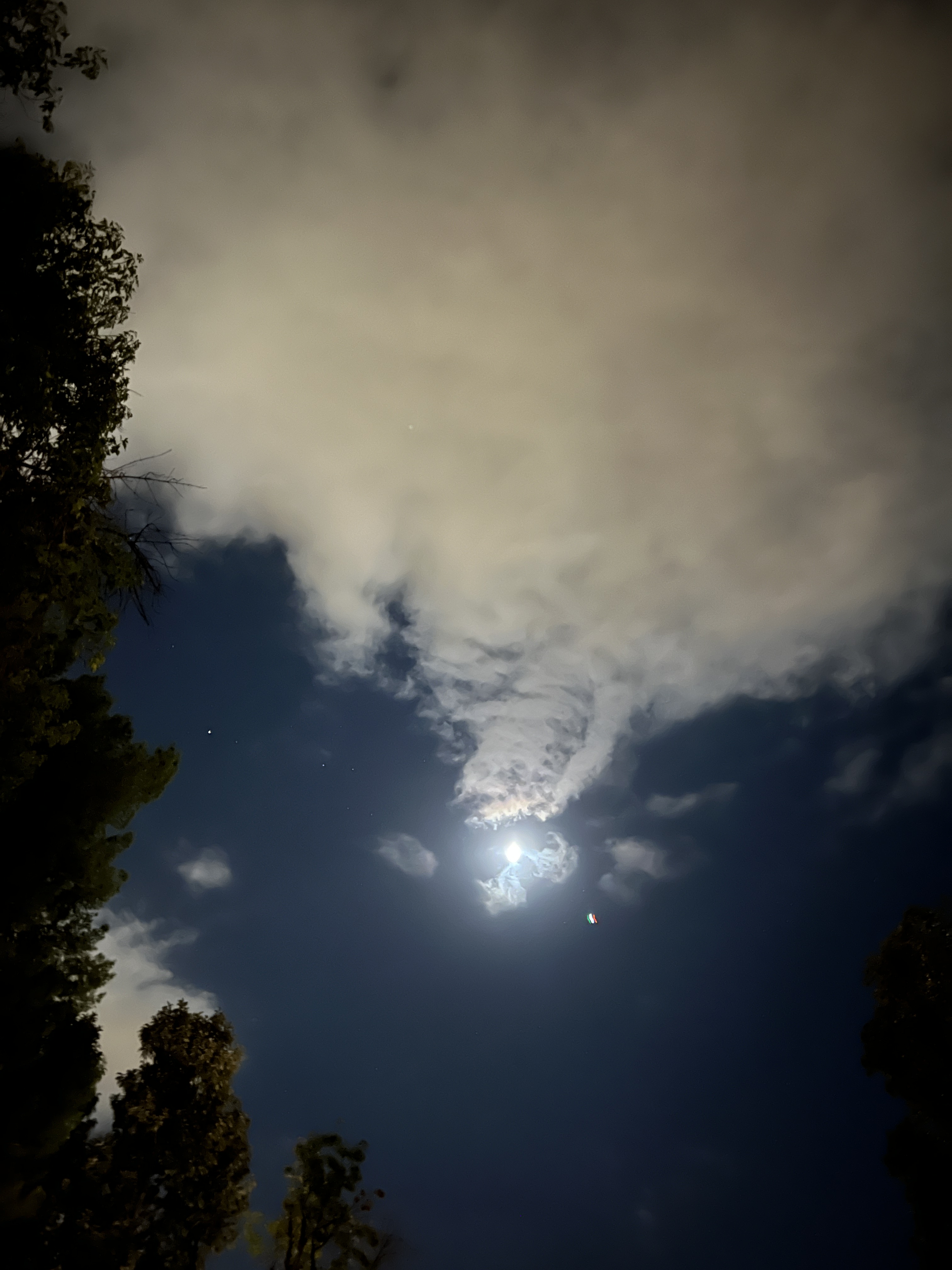
Maybe you have a small telescope. Or even binoculars. Either will do a far better job of bringing out details than anything used by Galileo or Newton. Watch how the shadows change the view and appearance across the big craters from day to day.
Or you can just watch with the naked eye. Find a grassy spot or a lawn chair. Just lay there and watch for a few minutes every now and then. (Remember bug spray!)
And one of these days you’ll be able to watch and know that there are men and women living up there, the same way you can watch the ISS go overhead and know there are people living and working there.
Observe the Moon. One day it will be observing you back.
Filed under Astronomy, Photography
Shortly after 08:00 this morning the Moon began to move in front of the Sun, causing a partial solar eclipse as seen from here in Los Angeles. In other places, along a path from Oregon, directly over Albuquerque, into Texas, directly over San Antonio, into the Gulf of Mexico, over Central America, and over South America, folks got to see a “Ring of Fire” annular eclipse. NASA-TV had an excellent program covering it.
Here I made a simple attempt to photograph the progress of the eclipse. No fancy solar telescope, no H-alpha filters, just my 300 mm telephoto lens, a Canon xt DSLR on a tripod, and a handheld solar eclipse filter held in front of the lens.

09:45, a minute or two after maximum coverage in LA. The Moon has come in from the upper left and is moving down toward the lower left.

09:53 – the color of the Sun varies a bit depending on the length of the exposure. Even with the eclipse filter and the Sun’s disk partially obscured, the Sun is BRIGHT.

10:06 – For each set of pictures I was shooting a series of images, “bracketing” the exposures from 1/4000 second down to about 1/100 second. Then from each set I picked the best picture based on focus, exposure, and other factors.

10:26 – The dark film used to make the eclipse glasses isn’t optically flat, so taking pictures through it introduces a fair amount of blur. To truly do a nice job on this subject I would need a precision, optically flat glass filter, which can be a bit pricey. I’ll be looking at it for next year’s total eclipse, but not today.

10:45 – Getting close to the end of the eclipse.

10:54 – These last three images are just a minute apart as the eclipse was ending.

10:55 – Just the tiniest little sliver of the Moon’s edge is still covering 1% of the Sun’s disc in the lower left.
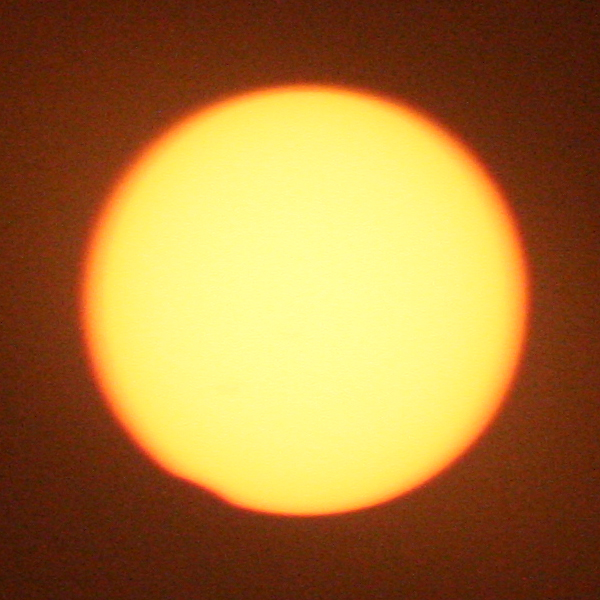
10:56 – Last contact
I hope that you got to see the eclipse today, or at least had (or will have) a chance to see it online. Now it’s time to start planning for next April 8th, the last full solar eclipse in North America this century.
I’ll see y’all in Texas! April 8th! Be there or be square!
Filed under Astronomy, Photography
Tomorrow morning there’s a partial and annular solar eclipse. I would like you to see it if you can, and I would like you to do so safely and not harm your eyes.
QUICK REVIEW & SUMMARY:
Got it? There might be a quiz. Here’s a cheat sheet:
2023 Safe Eclipse Viewing Flyer – Digital Download
If you’re pretty much anywhere in the Americas you’ll have a chance to see at least a partial eclipse tomorrow morning. In Los Angeles, for example, the first contact of the Moon’s limb covering the edge of the Sun is at 08:07:58, the final contact is at 10:50:09, and the greatest partial coverage is at 09:24:33, with about 74% of the Sun covered.
A good site to get timing and coverage information for your location is here, at timeanddate.com.
For the record, if you’re someplace like here where the eclipse is only partial, don’t expect anything spectacular if you’re not actually looking at the Sun. It won’t get noticeably darker or anything unless you’re in the path of the annular eclipse.
If you’re in the path of the annular eclipse, you’ll see the Moon pass in front of the Sun, but at a distance from Earth where it looks slightly smaller than the Sun, so a ring of the Sun will always be visible. Thus the need for eye protection.
News flash – the Sun is really freakin’ bright! Even having the Moon block 99% of the Sun still means you can do serious eye damage to yourself if you’re not protected.
You need real “eclipse glasses,” with film that’s designed to block enough light to make them safe. Hopefully you got them well in advance, they’ll be tough to find (or freakishly expensive) tomorrow. (Yes, of course, I always have a dozen or so pairs around… But that doesn’t help you.)
Do NOT use regular sunglasses. They’re not strong enough.
Do NOT use something like tin foil or some dark filters that you got out of a birthday fruit basket sometime five years ago.
If you’re stuck without eclipse glasses and you still want to see, you CAN make a pinhole projector. Get a large sheet of cardboard or poster board. Poke a teeny, tiny pinhole in the middle. Hold the cardboard a foot or so off of the ground, square to the sun, so that the shadow of the board is visible on the ground. The Sun’s image will show up in the middle of that shadow, projecting through the pinhole. You may have to fiddle with how far off the ground to hold it, but it’s easy, cheap, and really works!
Another safe way to watch it, including the annular phases even if you’re not in the path of the annular eclipse, even if your sky is covered with clouds, is on NASA-TV.
Be safe! Enjoy the partial eclipse, and if you’re lucky enough to be in the path of the annular eclipse, enjoy that even more!
Clear skies!
No fried eyeballs!
Filed under Astronomy
The Moon is a day or three past full, and tonight it’s fairly close to Jupiter, which is quite bright. As bright as Jupiter is, it’s thousands of times dimmer than the 89% illuminated Moon. Which makes it challenging to get a picture of them together. Getting a picture of the Moon along with Jupiter and the Galilean moons is even tougher.

The Moon is easy enough to capture. In fact, with my Canon xTi and a Tamron 75-300 mm zoom lens, the biggest problem is that it’s almost TOO bright. That camera’s fastest exposure speed is 1/4000 second. This photo is at 1/2500 second, just two steps down.

Jupiter and its four Galilean moons are also easy enough to capture. From lower left to upper right, you can see Europa, Io, Ganymed, and Callisto. (If you ever look at Jupiter and want to know which one is which at that moment, go look at the “Jupiter’s Moons” page on the Sky & Telescope website.)
Trying to capture them both together, I took a full set of “bracketed” exposures, from 1/4000 second (where the Moon is fine, Jupiter is barely visible, and none of the Galilean moons can be seen at all) to 1 second (where the Moon is COMPLETELY overexposed but you can see Jupiter and the Galilean moons clearly). The best compromise is at about 1/1250 seconds, with the Moon overexposed and blurry but recognizeable and Jupiter just visible without any of its moons.
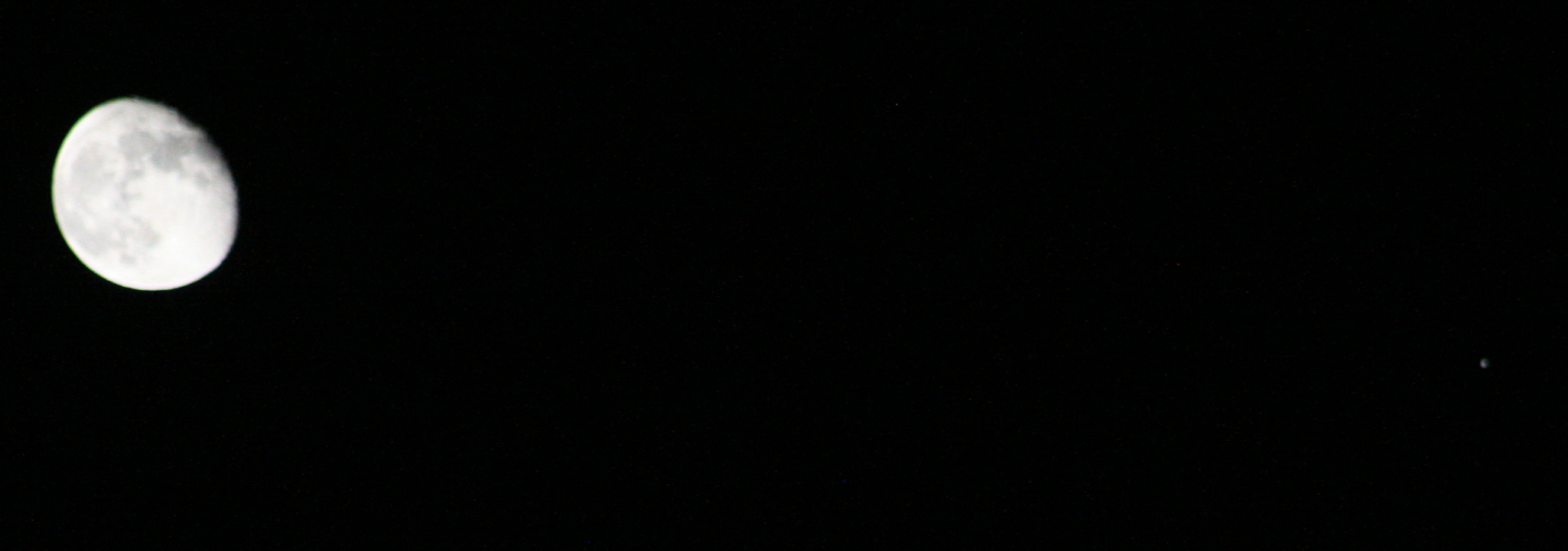
You might have to click on it to make it full-screen sized in order to see Jupiter on the far right.
What’s interesting is that as the Moon gets totally overexposed, the internal reflections of that super bright object start to show up like ghosts and they’re close enough to still being in focus to be recognized.

The real Moon is in the upper left, Jupiter and its moons on the right, and the internal reflection (the ghost Moon) is in the lower right. Not necessarily useful, but still cool and appropriate for October!
Filed under Astronomy, Photography
You might have seen some news or social media coverage of a comet that’s currently visible (barely) for just another couple of days. It’s Comet Nishimura (C/2023 P1) and if you’re in the Northern Hemisphere you might be able to see it in the morning sky just before sunrise for about the next two days. But heads up, that’s a BIG “might.”
Comet Nishimura is getting very close to the Sun, so the time it rises is just before the Sun rises, which means the sky is getting brighter and the dim comet is getting harder to see. On the other hand, the comet is also getting brighter, so it’s something of a race between the competing factors.
It will help a lot if you have a dark sky, so get away from the bright lights of your city. Of course you’ll need a sky that’s clear of clouds.
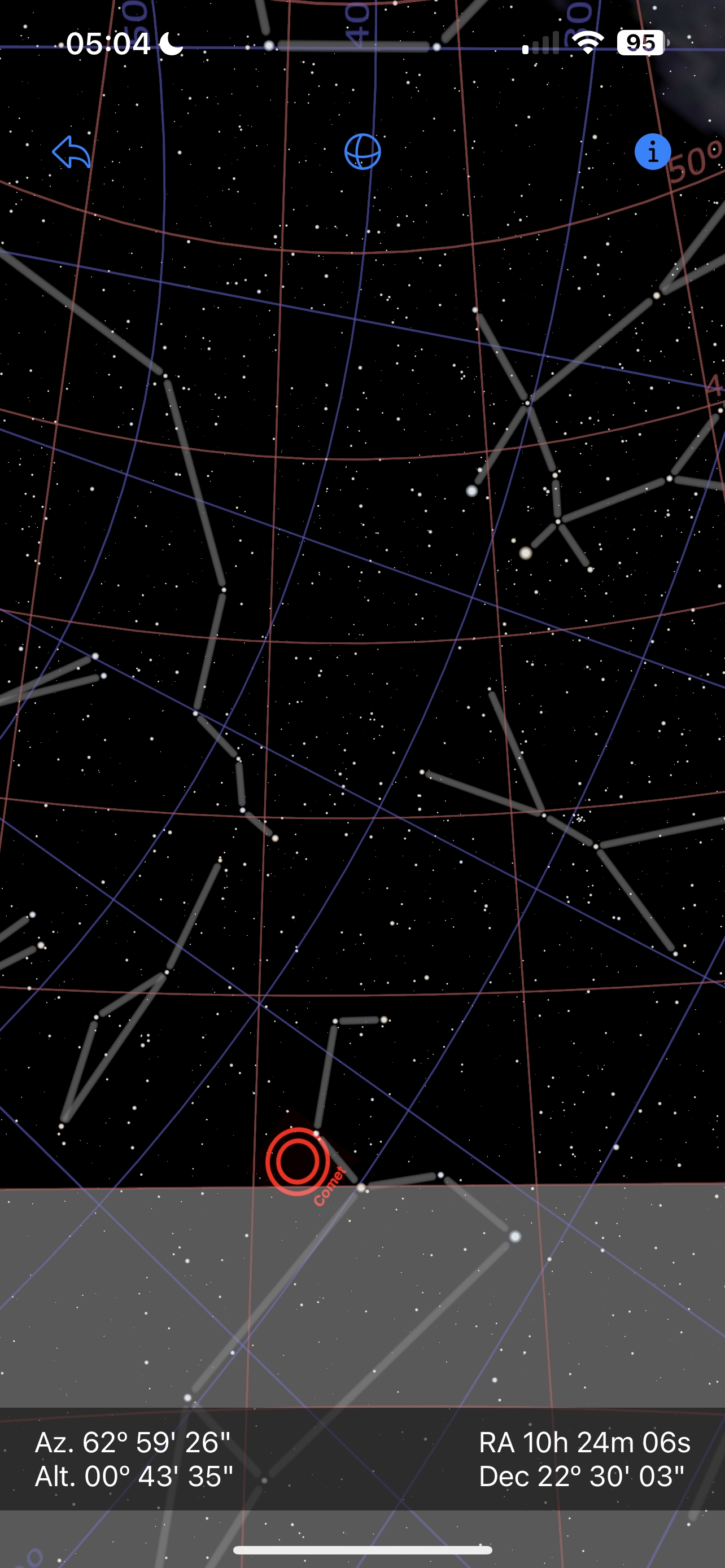
Comet Nishimura is rising about 5:AM local time now. The easiest way to track it is this iPhone app, which does nothing at all except show you where the comet is.
After September 12th the comet will be past the Sun from Earth’s viewpoint and will be in the evening sky, but only if you’re in the Southern Hemisphere. It’s very Northern Hemispheric-centric for the news and social media to say that it’s “gone” after that, but when was accuracy or the facts important to modern mainstream media, let alone social media clickbait sources?
I tried to go out to see the comet two days ago, on the morning of September 8th, but had no luck.
 (Image from Comet Nishimura app)
This is a wide angle view from the 8th – as you can see, at 04:55 the comet was just rising. That however also assumes a flat horizon, which I don’t have, in addition to being in Los Angeles with all of its light pollution.
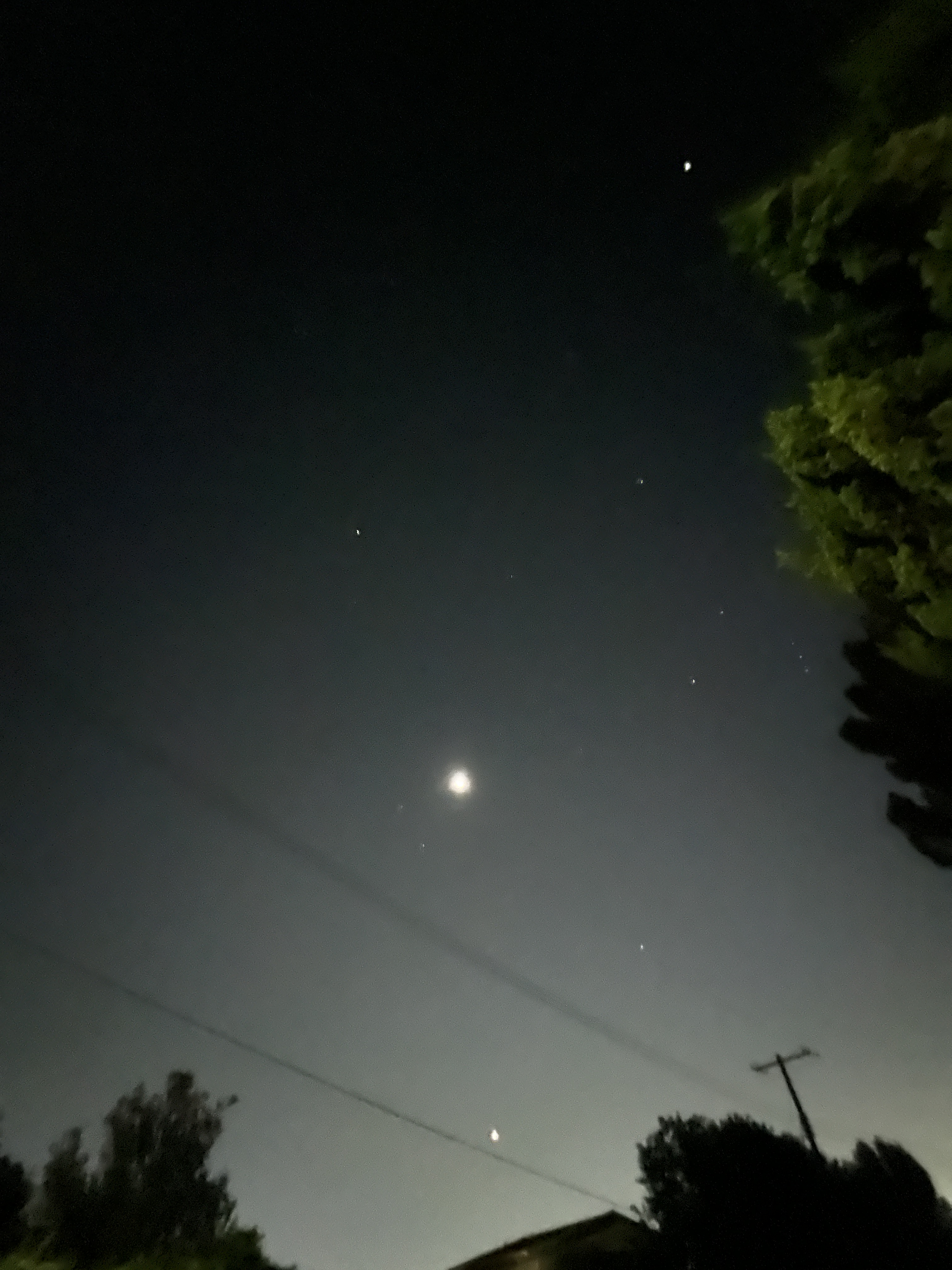
If you go out to look in the next couple of days the things you’ll notice that aren’t shown on the Comet Nishimura app are the Moon (dead center here, also moving closer to the Sun from our POV, at New Moon on the 14th), Venus (brilliant at the bottom, near the horizon), and Jupiter (very bright up at the top). This is just a marginal photo on my iPhone, but if you blow it up you can easily see Castor and Pollux just to the lower left of the moon and also in the Comet Nishimura app star map. That should let you orient yourself.
As you can tell, even if the comet had risen and could be seen through the marine layer haze and light pollution, there’s a big tree on the non-flat horizon where the comet’s supposed to be rising.
 (Image from Comet Nishimura app)
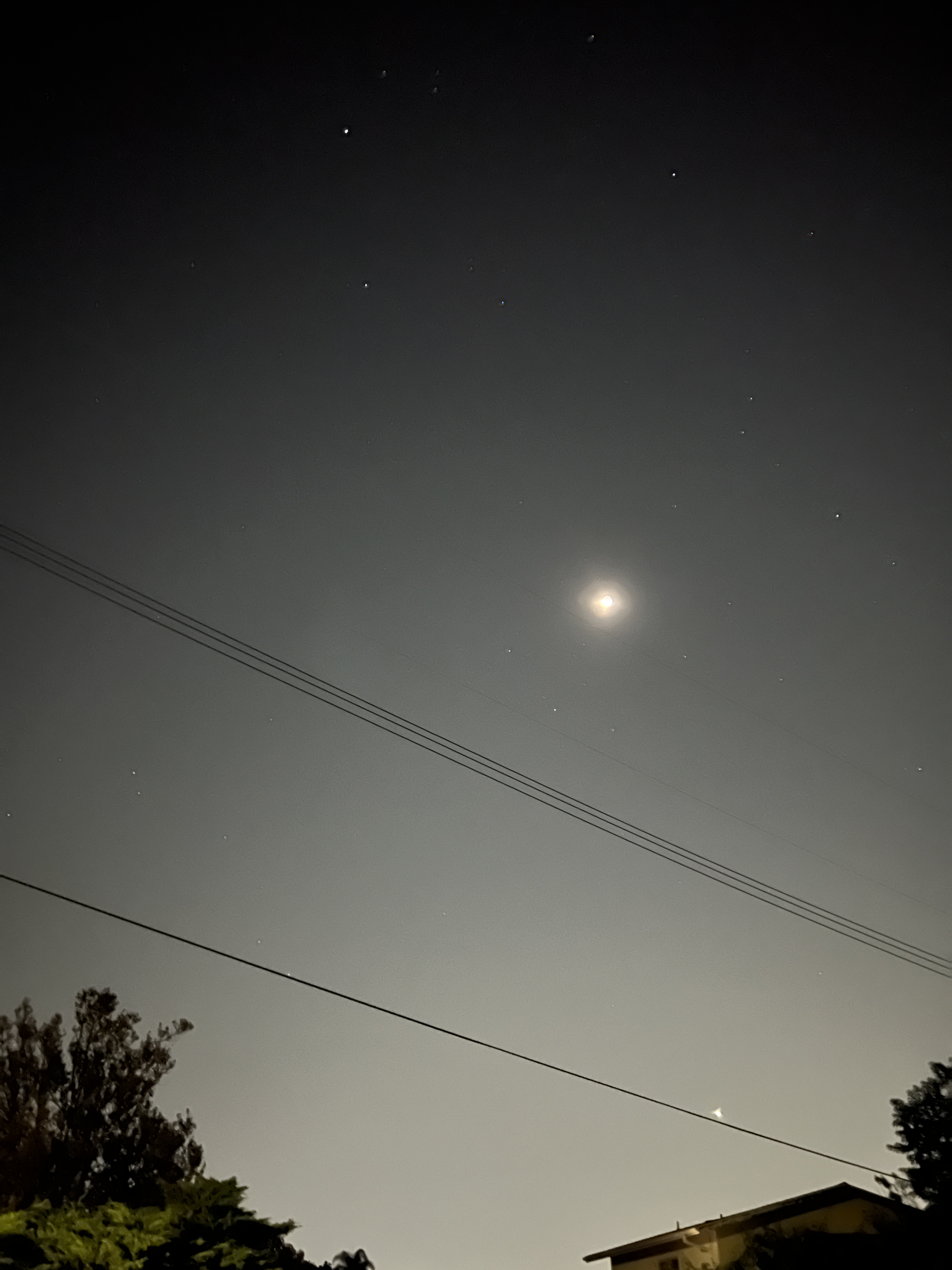
Still no joy, even though I’ve moved to where I can peek through the gap between the trees and the house. If there was a comet or any sign of its tail there poking up over the horizon I couldn’t see it either with the naked eye or with my binoculars.
I hope you have better luck if you go comet hunting tonight or tomorrow! (Or if you’re in the Southern Hemisphere!)
Filed under Astronomy, Photography
 | lmratliff on Bottleneck |
 | firesmith on Proof Of Life – August… |
 | momdude on Back Yard Blooming |
| lmratliff on Back Yard Blooming |
 | Jemima Pett on Forever Home – One … |
| momdude on Twenty-Five Years |
 | berich56 on Twenty-Five Years |

 We Love The Stars Too Fondly