Category Archives: Astronomy

Comet Nishimura

You might have seen some news or social media coverage of a comet that’s currently visible (barely) for just another couple of days. It’s Comet Nishimura (C/2023 P1) and if you’re in the Northern Hemisphere you might be able to see it in the morning sky just before sunrise for about the next two days. But heads up, that’s a BIG “might.

Comet Nishimura is getting very close to the Sun, so the time it rises is just before the Sun rises, which means the sky is getting brighter and the dim comet is getting harder to see. On the other hand, the comet is also getting brighter, so it’s something of a race between the competing factors.

It will help a lot if you have a dark sky, so get away from the bright lights of your city. Of course you’ll need a sky that’s clear of clouds.

Comet Nishimura is rising about 5:AM local time now. The easiest way to track it is this iPhone app, which does nothing at all except show you where the comet is.

After September 12th the comet will be past the Sun from Earth’s viewpoint and will be in the evening sky, but only if you’re in the Southern Hemisphere. It’s very Northern Hemispheric-centric for the news and social media to say that it’s “gone” after that, but when was accuracy or the facts important to modern mainstream media, let alone social media clickbait sources?

I tried to go out to see the comet two days ago, on the morning of September 8th, but had no luck.

(Image from Comet Nishimura app)

This is a wide angle view from the 8th – as you can see, at 04:55 the comet was just rising. That however also assumes a flat horizon, which I don’t have, in addition to being in Los Angeles with all of its light pollution.

If you go out to look in the next couple of days the things you’ll notice that aren’t shown on the Comet Nishimura app are the Moon (dead center here, also moving closer to the Sun from our POV, at New Moon on the 14th), Venus (brilliant at the bottom, near the horizon), and Jupiter (very bright up at the top). This is just a marginal photo on my iPhone, but if you blow it up you can easily see Castor and Pollux just to the lower left of the moon and also in the Comet Nishimura app star map. That should let you orient yourself.

As you can tell, even if the comet had risen and could be seen through the marine layer haze and light pollution, there’s a big tree on the non-flat horizon where the comet’s supposed to be rising.

(Image from Comet Nishimura app)

Still no joy, even though I’ve moved to where I can peek through the gap between the trees and the house. If there was a comet or any sign of its tail there poking up over the horizon I couldn’t see it either with the naked eye or with my binoculars.

I hope you have better luck if you go comet hunting tonight or tomorrow! (Or if you’re in the Southern Hemisphere!)


Leave a comment

Filed under Astronomy, Photography

Wandering Star

The word “planet” comes from the Greek word for “wanderer” and indicated that the “star” in question wasn’t fixed, but instead moved relative to the other stars.

In our western, sunset sky we often see bright planets. Search this site for “conjunction” or “Venus” and you’ll find plenty of pictures. So I wasn’t surprised to go out the front door the other day and see something bright just above the horizon.

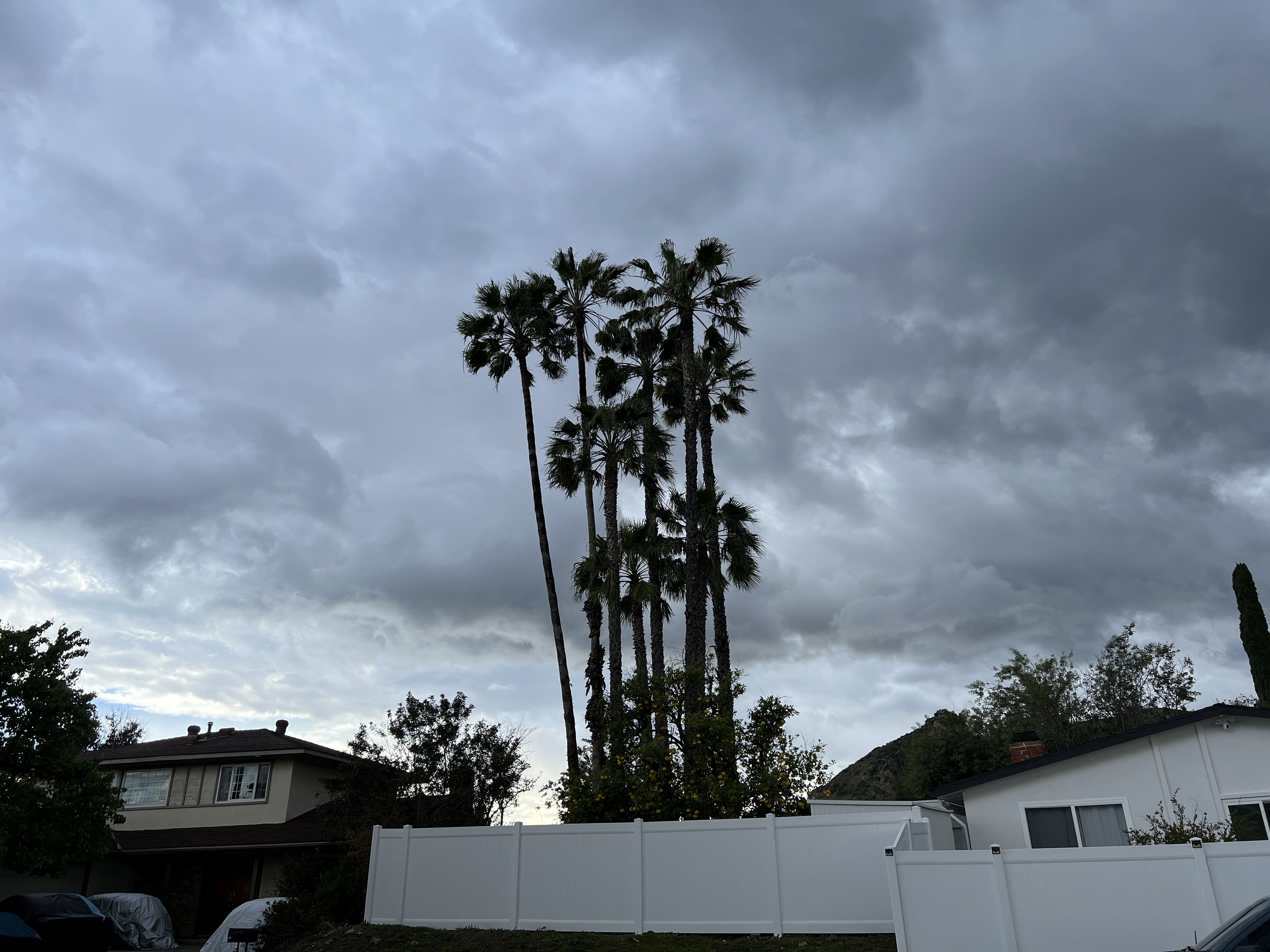
See it? Just to the right of the batch of palm trees, between the mountain (Castle Peak) and the lowest cable? Here’s a close up.

Not bright enough to be Venus. And wait… Venus is in the morning sky, not the evening sky. Jupiter might be that bright in the sunset sky, but it rises around midnight these days.

So what is it?

Well, around here, the way to check for the next most likely object is to wait a minute. Is it “wandering” toward the horizon as the planet rotates, or is it “wandering” in the wrong direction and a bit faster than anything ever seen by the Greeks?

Right. It’s moving too slow to be the ISS (although the direction fits) but shortly after this picture was taken it got close enough overhead to see the other green and red navigation lights.

The new LED navigation and landing lights are really bright. When I first saw him he was probably out to the west of the 23 Freeway, near the edge of this image or even somewhere off to the left, just climbing out of CMA.

Wandering, yes. A star, no.

2 Comments

Filed under Astronomy, Flying, Photography, Sunsets

Orange Super Blue Moon Rising

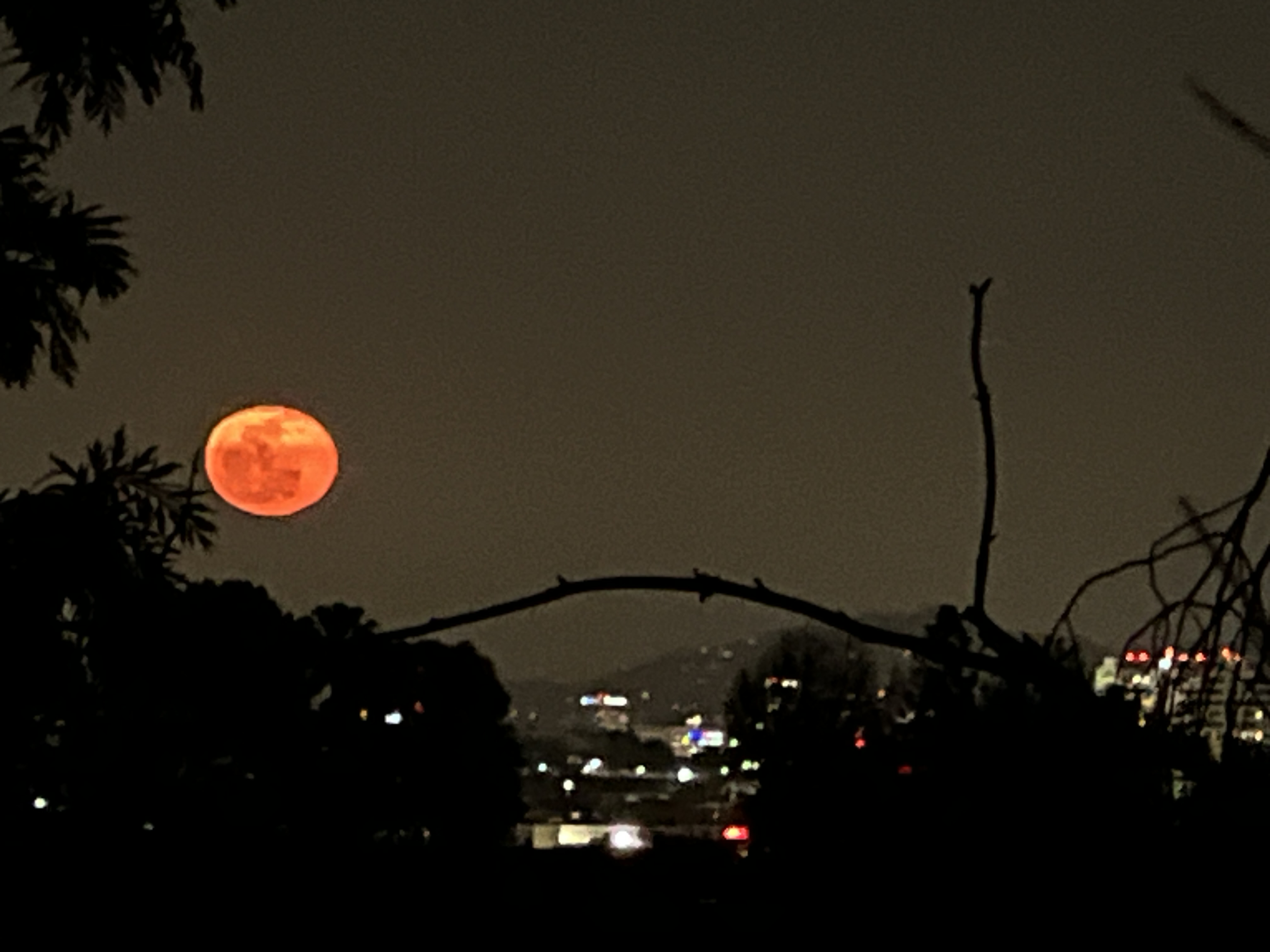
We interrupt our traipsing through past Worldcon trips to bring you today’s “Blue Supermoon” rising!

You couldn’t possibly have missed all of the hype. But the short (and factual) description is that tonight the Moon was full (happens every 29.5 days, more or less), it was a tiny percentage closer to Earth than average (its orbit is an ellipse, not a circle, so sometimes it’s a bit closer, sometimes it’s a bit farther away, perfectly normal and routine) which means it was a tiny percentage brighter than average, and it was the second full moon in a calendar month (which happens on average every couple of years because our calendar is weird and irregular and lumpy), and tonight all three of those things happened more or less simultaneously. The press had a field day.

First of all, the camera (and hidden image processing software) in the iPhone 13 doesn’t quite know what to do with an bright orange super blue Moon on a dark-ish, dusk-ish background. It does its best.

The good news is that it did better this time on focusing on the Moon instead of the telephone pole and trees. Not great, mind you, but better.

The good camera (Canon Rebel XT DSLR with a 300mm Tamron lens) is lousy in full auto mode being even older and more computationally primitive than the iPhone. But put it in manual mode and shoot a series of pictures with varying exposures and manually focusing, then something in that series is going to get close.

This is a LOT like what it looked like in terms of color and contrast. And yes, just coming up through the turbulent, hot, pea soup atmosphere over downtown Los Angeles and the San Fernando Valley it does look that distorted and misshapen.

As it gets up a bit and we’re not viewing it through quite so much icky atmosphere, the Moon rounds up and starts to get bright. Like really, really bright.

Which confuses the crap out of the camera, which sees all of that black and wants to do a 1/2 or 3/4 second exposure. Knowing (a little bit) better, I overrode it for a 1/250 second exposure. Still too bright! Should have gone for 1/1000 second. Or shorter.

The iPhone never gets over that and constantly overexposes the scene. But it does a decent job of catching the city spread out down below.

Now that it’s way up overhead, even a 1/1000 second exposure would be way, way too long. I don’t think my older (13 years? 15 years?) DSLR will do an exposure short enough to show detail on any full moon, not just a super duper blue Moon. Not without going to some sort of neutral density filter to cut down on the light.

Regolith is reflective as all get out, especially for just vacuum cured grey dust and pulverized rock!

Leave a comment

Filed under Astronomy, Photography, Space

No Perseids Captured

Over the last weekend you might have seen something on the news about the Perseid meteor shower peaking on Saturday night. If so, the first piece of advice to see them was to get away from the light pollution near any city.

I didn’t.

(These are the full-sized files with an incredible amount of detail – click on the images to blow them up to full sized!)

The good news is that the big, “light bucket” lens that I do dearly love does a great job of picking out a gazillion stars even under light polluted conditions.

(Ditto! Click on it! Please ignore all of the hot pixels I didn’t have the time to edit out!)

The bad news is that to avoid being totally oversexposed and washed out, these are 2.5 second exposures. I have nearly a thousand of them! Filled an entire 8GB memory card! I didn’t capture a single Persid meteor in any image. (Although if you check the top left on that first image, there’s a 737 going into Burbank…)

I did see two bright, long trails of Perseid meteors with my eyes, but they were where that second set of pictures of pointed, above the tree, while I was doing the first set of pictures, aimed more to the north to the left of the tree.

C’est le guerre…

I would love to get this lens out to a really dark sky where I can do 30, 60, even 300 second exposures and still have the background sky be dark. That would be fun.

Leave a comment

Filed under Astronomy, Photography

Moon & Scorpion Head

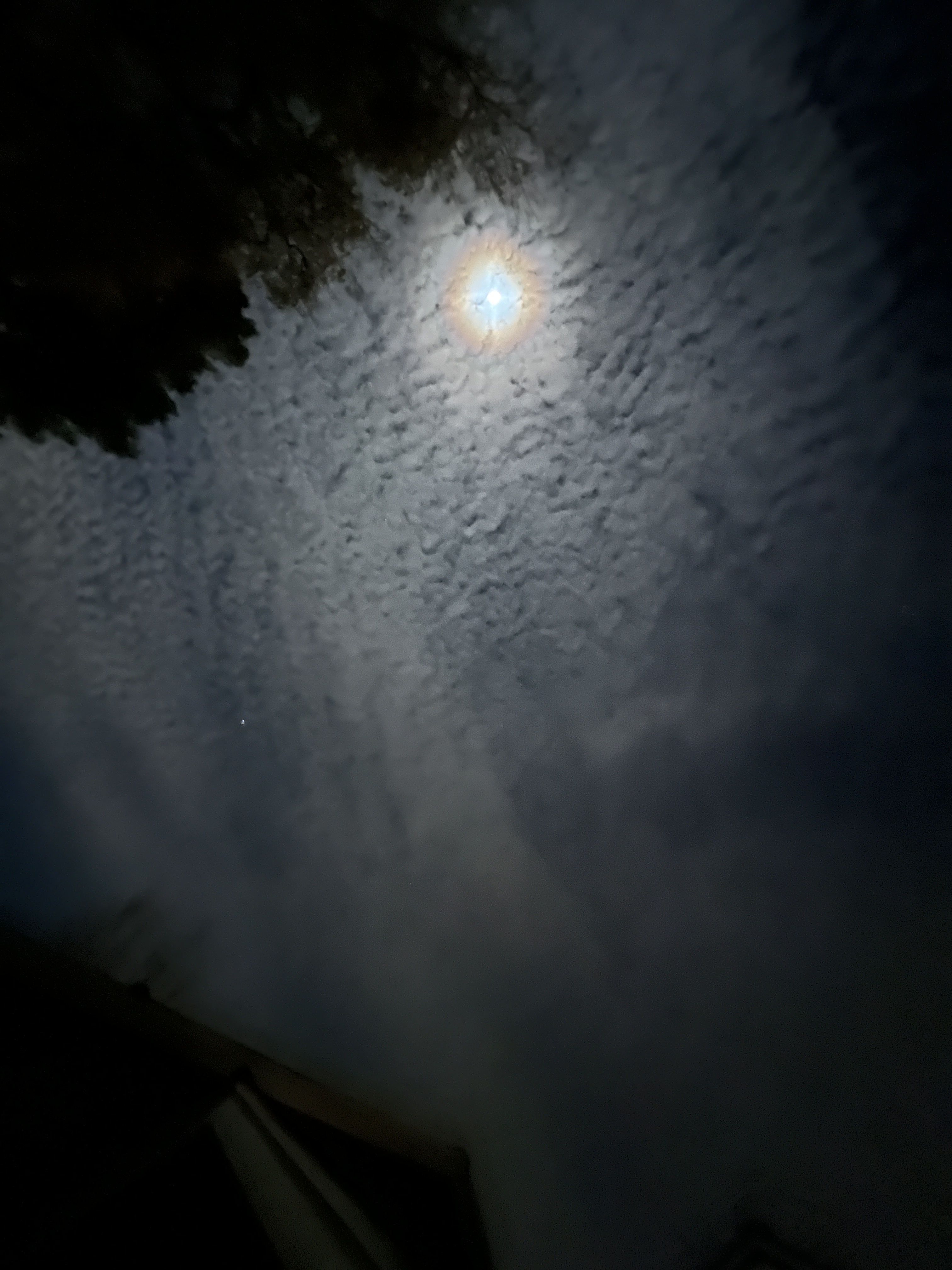
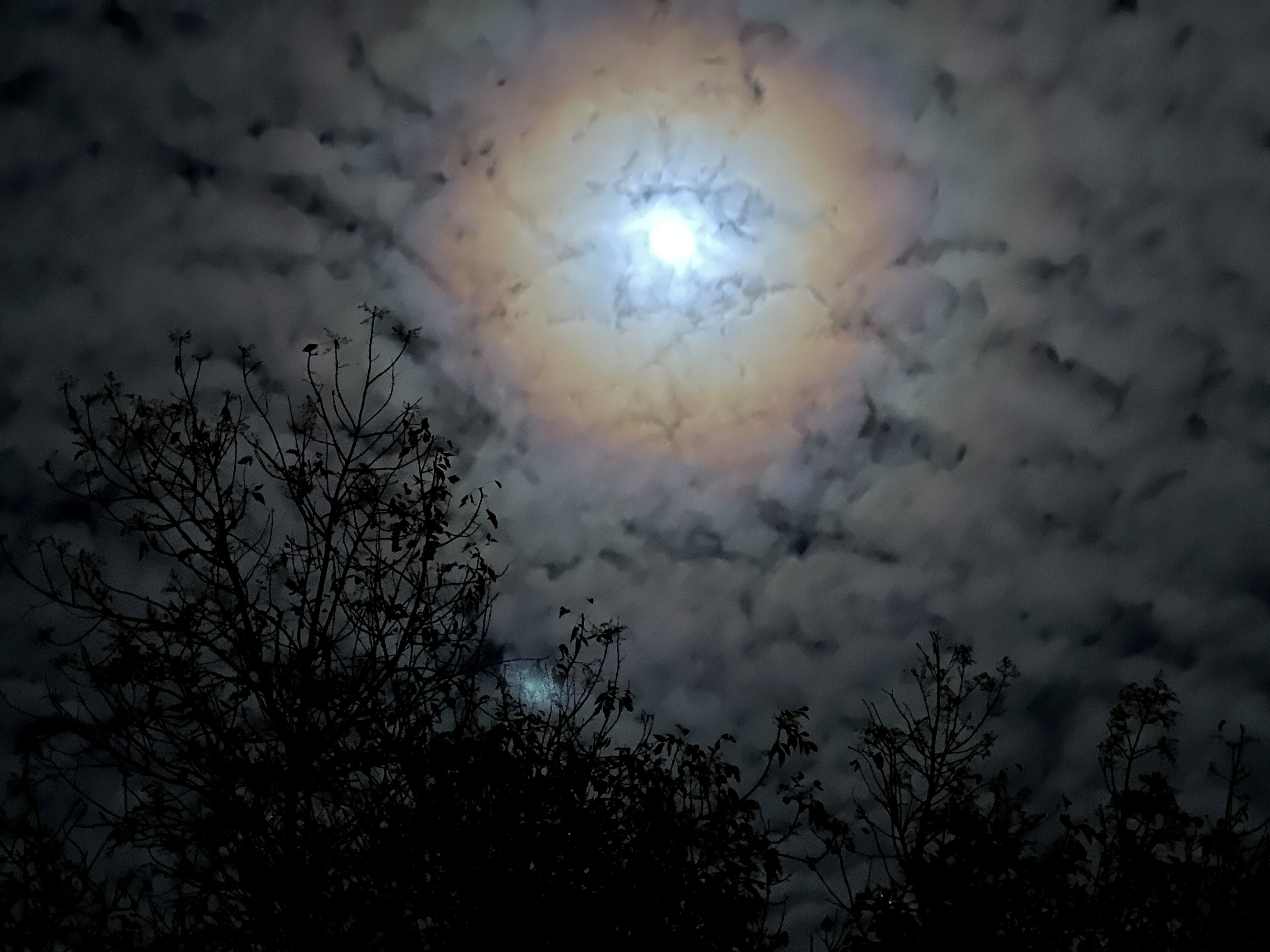
The sort-of-not-really-full-for-two-days-yet Moon was rising in the southeast. There are layers of spotty clouds overhead (no rain in sight, but the humidity’s up) and the moon was lighting them up nicely, so let’s see what ye olde iPhone 13 can do!

Sweet! But in that clear spot in the lower right, facing due south… Could we be picking up the bright stars in the “head” of Scorpius? (Star chart diagram here.)

Why, yes! Yes we are! We can even see some of the reddish tint to Arcturus! (Near dead center.)

Leave a comment

Filed under Astronomy, Photography

Day 529

Convention started. Smaller than I expected.

Dinner with friends. (Still eating WAAAAAY too much on this trip. 🤯 )

I love that our hotel has balconies. And we’re on a high floor.

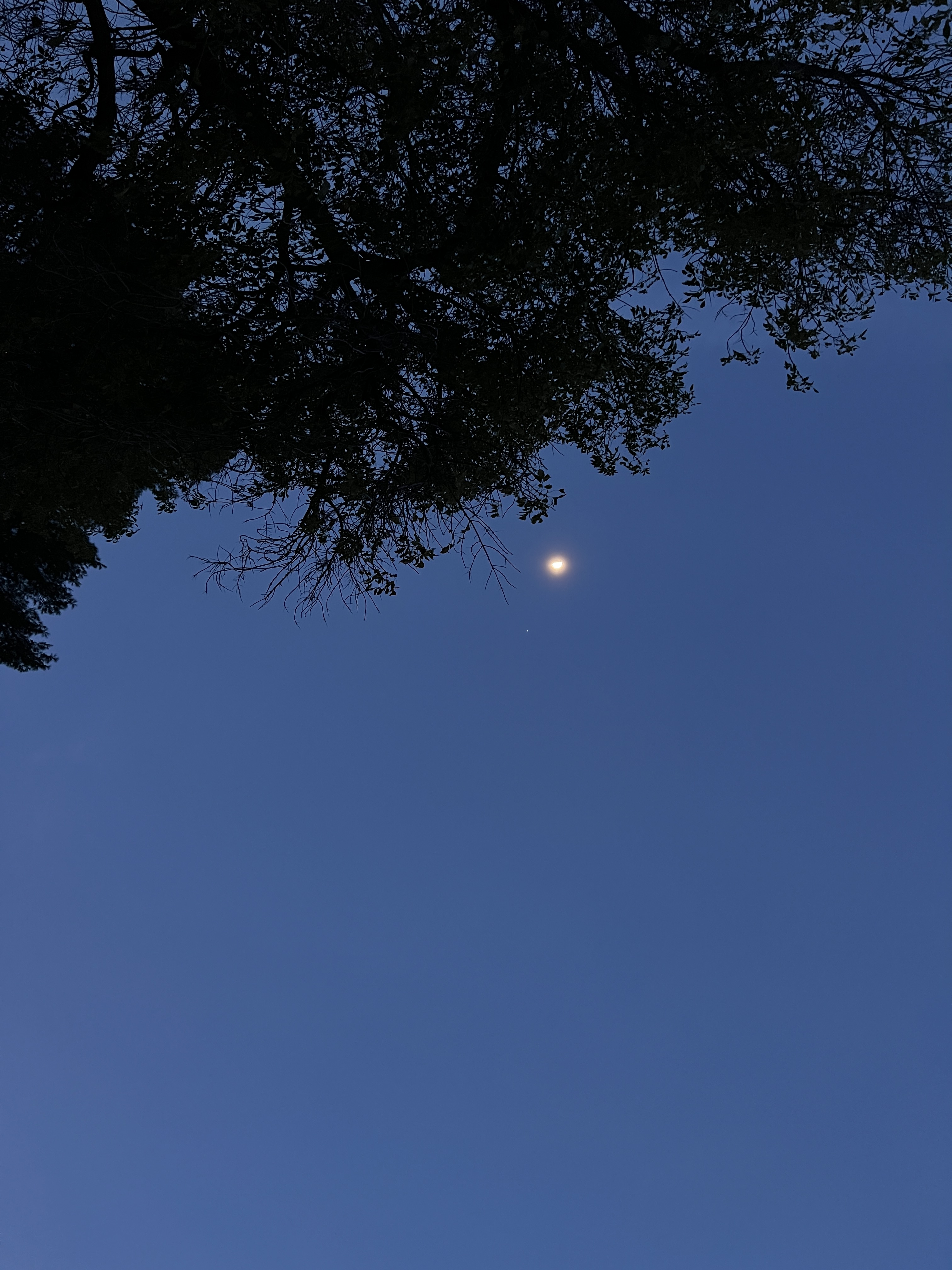
Beautiful sunset view with a sliver of a crescent moon.

Skies are clear tonight – any sunspot activity? Dare we hope for auroras? ❤️💫✨☄️🌠


As I’m finishing writing this on my phone (well, THERE’s your problem!) one of my kids kindly gives me the heads up that “today’s” post just reposted the same as yesterday’s post. Sorry ‘bout that all y’all, blame phat thumbs and an obvious user error issue, but THIS is today’s post.

Leave a comment

Filed under Astronomy, Photography, Sunsets

July 4th 2023

It’s 22:30 local and it still sounds like a war zone out there. Once again we didn’t go out and fight any crowds or traffic to see a fireworks display – we can see them when we go to a Friday night Angels game.

From the hill we live on we have a decent view of a local display that’s about four miles away. While we were sitting out in the back we were serenaded by at least three (probably more) red-tailed hawks who were NOT HAPPY about all of the boomy sounds all around. They kept perching for a few minutes in the pine trees in front of us, then circling and screaming over the neighborhood, then perching again. I haven’t seen that before.

Finally, just after 22:00, the 95% full moon came up through the clouds of cordite and smoke, looking like a pumpkin or a full lunar eclipse.

I hope your day was enjoyable and safe.

Leave a comment

Filed under Astronomy, Los Angeles, Photography

Pick Your Exposure

The 98% full moon (the 100% full moon is at 04:38 PDT on July 3rd, about 28 hours from now) was rising over the house tonight while I was out for a brief walkabout.

The iPhone sees that everything’s getting dark in the dusk and exposes the image appropriately, which leaves the Moon horribly over exposed.

But you can manually override the iPhone’s automatic settings and see detail on the Moon! But you won’t see much of the house and flag and trees.

There seems to be a LOT of things in life that are like that, which is a real pain in the ass when you really, REALLY want BOTH!

(And if you see a really nice professional photograph that shows both in this particular instance? I’ll about 99.99999999% guarantee that it’s two pictures photoshopped together.)

Leave a comment

Filed under Astronomy, Photography, Space

Summer Solstice 2023

No sunrise pictures from Stonehenge for me this year. First of all, there’s that whole “sunrise” and how damn early it is that I’m opposed to. On the other hand, if I were able to make it all the way to Stonhenge for the solstice, I suspect I’d find a way to scrape my sorry ass out of bed early enough to be there.

However, we did have a very pretty conjunction after sunset, starting with the three-day old crescent Moon and the very bright Venus.

A short exposure shows the crescent nicely and Venus is a pinpoint. If I had the telescope out, Venus would show the same crescent as the Moon. (It’s geometry.)

Crank up the exposure and Venus is overexposed but the Moon much more so. There are craters and plains and some details silhouetted at the terminator (the line between sunlight and darkness) but you see the dark portion of the moon dimly illuminated by “earthshine,” light reflected from the Sun off of the bright Earth.

Pull back a little and try to capture some details in the illuminated part of the moon, but I always forget just how stinking bright it is. Even though I had reset for a 1/250 second exposure, it’s still a bit overexposed. I should have gone down at least to 1/1000 second.

Pull back the zoom a little more and try again? Same mistake.

Pull all the way back on the zoom, overexpose for earthshine, and what else shows up? That thing just to the right of the palm trees that looks like a bright red planet? That’s a bright red planet, i.e., Mars.

As always, if you didn’t see this tonight, go look for it tomorrow night or Friday or Saturday. The Moon will be further up and to the left each night (for example, closer to Mars tomorrow) but you’ll still be able to see all of this if you have a clear western sky about an hour to two hours after sunset. Our forecast is for the June gloom to return with the coastal marine layer and fog moving back in, but we’ll see. Maybe the gods will cut us a break.

What does that Magic Eight Ball say? “Outlook not so good!”

Leave a comment

Filed under Astronomy, Photography, Space

ISS Pass – May 13th

If you’ve seen any of the previous pictures that I’ve posted of ISS passes over the years (go ahead, look now if you want, I’ll wait) you’ll have seen that they’re all different. The one constant is that they’re west to east paths (within certain ranges), but every time there are different paramters. Like where the ISS rises in the west (-ish) and where it sets in the east (-ish). How much of the pass is visible – for an evening pass the ISS often passes into shadow somewhere along the line, while for pre-dawn passes (which I am NOT getting up for about 99.999% of the time!) it will appear out shadow somewhere overhead. Another key is how high it gets. Sometimes it’s down near the northern or southern horizon and you just barely see it above the horizon.

The spectacular passes are when it goes from horizon to horizon while passing through or near the zenith, the spot directly overhead. Those are the brightest passes, and the longest.

Tonight’s pass, courtesy of Heavens-Above.com:

Look at that track! Starting at the lower right in the southwest, through the zenith (okay, 88º elevation, where the zenith is at 90º), and back down to the horizon in the northeast. Of course, this almost guaranteed that it would be cloudy, because Murphy’s an asshole.

Much to my surprise, it was clear as a bell.

The good news is that the pass was spectacular. The bad news is that I live in the middle of a big city with a ton of street lights, general light pollution, and every house lit up with porch and security lights. So there’s a lot of glare.

I first saw it with the naked ey about the time it crossed the path of that aircraft in the lower left. The coastal fog and haze will do that. But it got bright quickly and climbed out of that haze. Then, when it got into the wires overhead, it was time to quickly flip the tripod 180º and look toward the northeast.

The ISS was just behind the edge of that well-illuminated tree as it started to descend from the zenith to behind my neighbor’s house. At least the telephone pole, while somewhat unphotogenic, wasn’t in the way.

If you’re in SoCal, there are more passes in the next few days. Tomorrow night (May 14th) at 21:31:17. The 15th at 20:42:00, the 17th at 20:43:04, and the 22nd at 23:10. All of those are lower toward the horizon and dimmer. The passes on the 14th and 15th will be the best of the lot. (There are also some better AM passes but again, *A*freaking*M*, as in 04:50:35 on the 14th. Knock yourself out!)

No matter where you are, again, go to heavens-above.com to get predictions for passes of the ISS (and lots of other bright spacecraft) over your location.

Leave a comment

Filed under Astronomy, Photography, Space