Category Archives: Astronomy

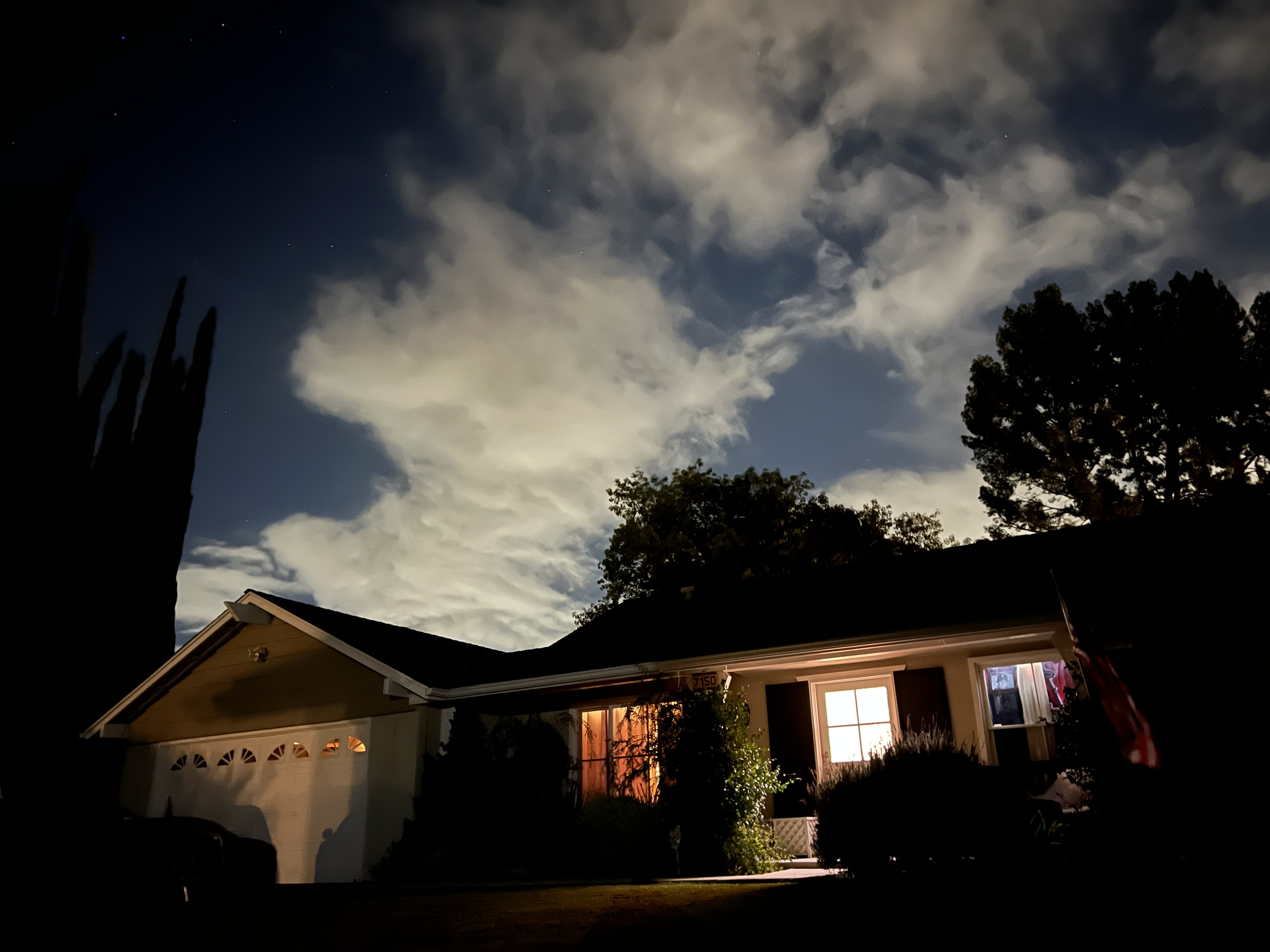
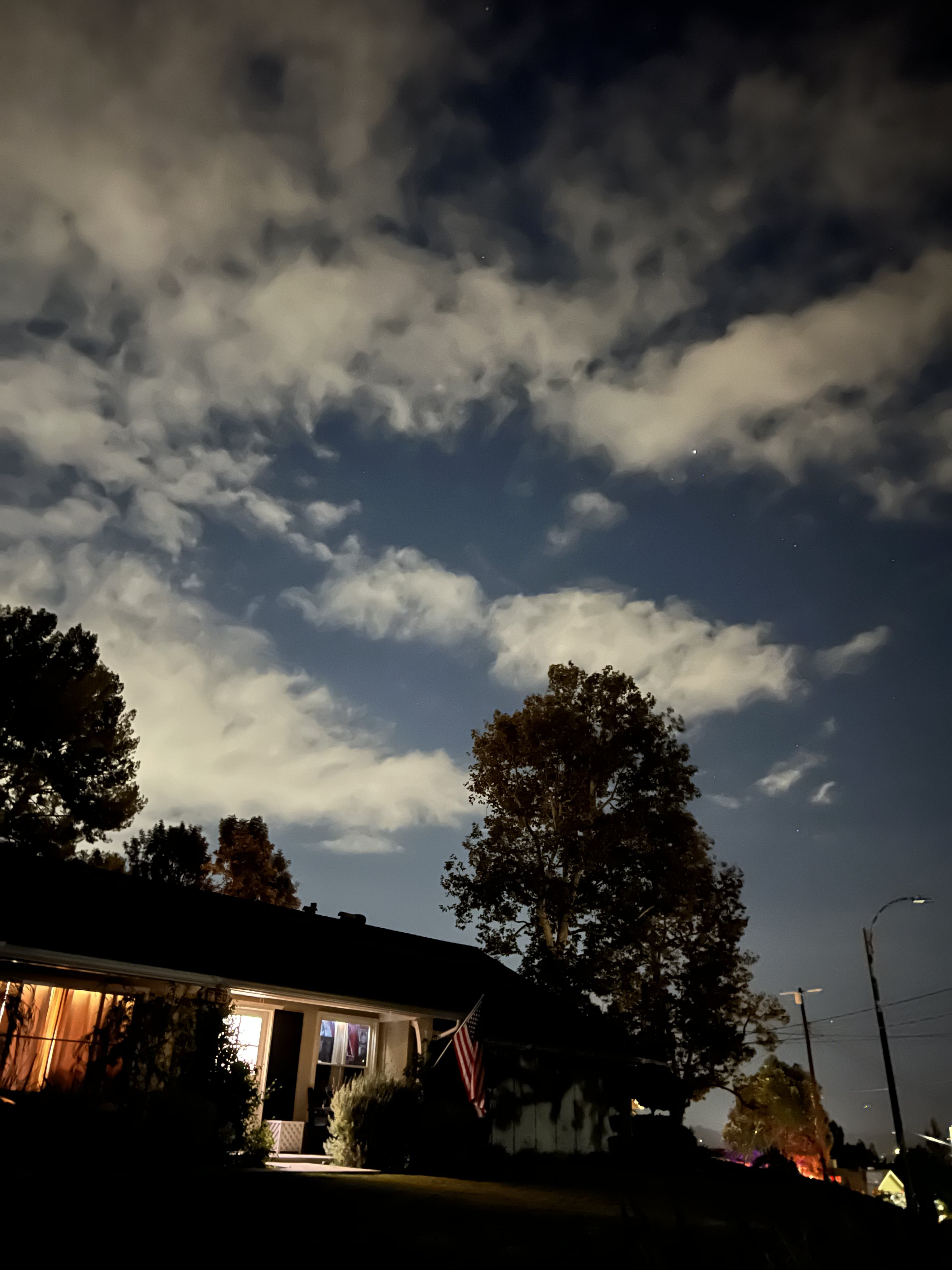
Stupid, Stupid, Pretty Sunset!

I’ve been watching all day.

It hasn’t looked that great.

It did give us a very pretty sunset, but that’s sorta counterproductive for tonight’s particular goal.

Now, at 23:05 local, with totality beginning at 04:11 local, a little over five hours from now, it’s… complicated.

On the one hand, it looks spectacular.

On the other hand, it’s about 80% cloud covered – and getting worse.

I’ve got the cameras all ready to go and the alarms set – we’ll see if I can drag my sorry butt out of bed in the middle of the night to at least check to see how cloudy it is.

Let the games begin.

Leave a comment

Filed under Astronomy, Photography, Sunsets, Weather

Twenty-Seven Hours & Counting

Tomorrow night there’s a total eclipse of the moon, visible from all over the Pacific hemisphere. If you’re in Europe or eastern North or South America, better luck next time. If you’re in Hawaii, you’re golden. In eastern Australia or New Zealand, you’ll see it in the east not too long after moonrise. If you’re in Los Angeles or on the US West Coast, you’ll see it just before sunrise.

Unlike solar eclipses (*NEVER* look at a solar eclipse with the naked eye or any kind of magnification), lunar eclipses are 100% safe to look at with the naked eye, or with binoculars, or a telescope. In this case, if you’re in LA or San Diego or San Francisco or Phoenix or Seattle (you get the idea) your biggest issues will be possible clouds and getting up at 03:00. (I plan on being ready, getting up, checking for clouds, and if they’re there, I’m back in bed!)

Here’s a great site for information on when the different phases of the eclipse start, including detailed information for major cities. This is a short eclipse by lunar eclipse standards. The full phase of the eclipse is only fourteen minutes long, 04:11 to 04:25 in Los Angeles.

After being “clear and a bazillion” for the whole day, I rolled the telescope out late this afternoon and within second it was starting to cloud up.

By the time the moon rose and cleared those trees, it was downright “yucky.” (That’s an official, technical, internationally recognized astronomy term by the way.) I was testing out my equipment for attaching my good DSLR cameras directly to the telescope, using it as a humongous telephoto lens.

The moon was there – the focus wasn’t.

I’m going to blame the clouds. Which is not unreasonable at all, they were an issue.

In addition, right around full moon (we’re 27 hours away, since lunar eclipse = full moon, by definition = do the geometry) most of the moon’s surface looks flat and featureless.

The “good” pictures are always along the terminator, the division between night and day on the lunar surface, where the shadows are sharp.

You can see a tiny bit of that along the top side, where some of the craters on the limb (edge of the visible disk) are highlighted. But not much.

For example, this picture showing the center of the moon with no portion of the limb? Lots of rays and some bright spots, but no shadows with the Sun almost straight overhead.

We’ll see what tomorrow night / Wednesday pre-dawn brings for the eclipse. Keep your fingers crossed!

Leave a comment

Filed under Astronomy, Photography, Space, Weather

Moon & Mercury – May 14th

And Venus.

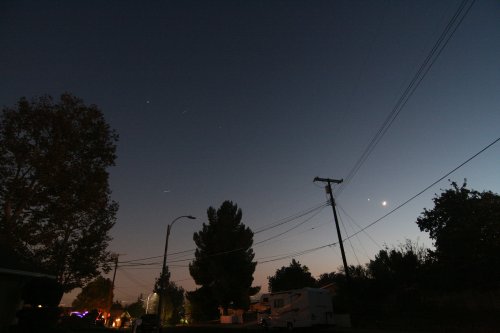
Last night the Moon and Mercury were close to one another, able to fit into the field of my 300mm zoom lens. Venus was way, waaaaaay down near the setting Sun and while folks with flat horizons were seeing it, I have trees, houses, and a small mountain to my west.

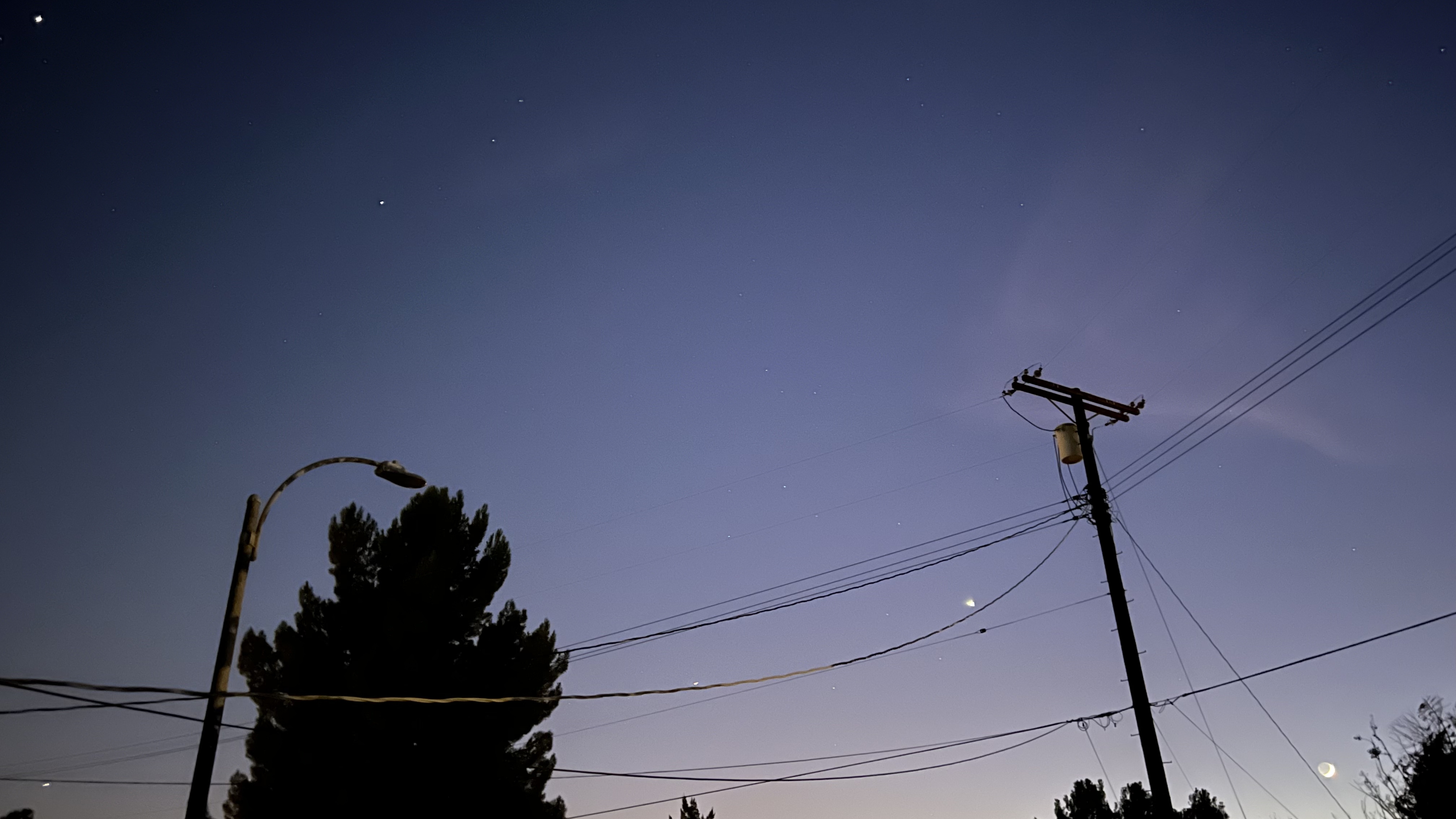
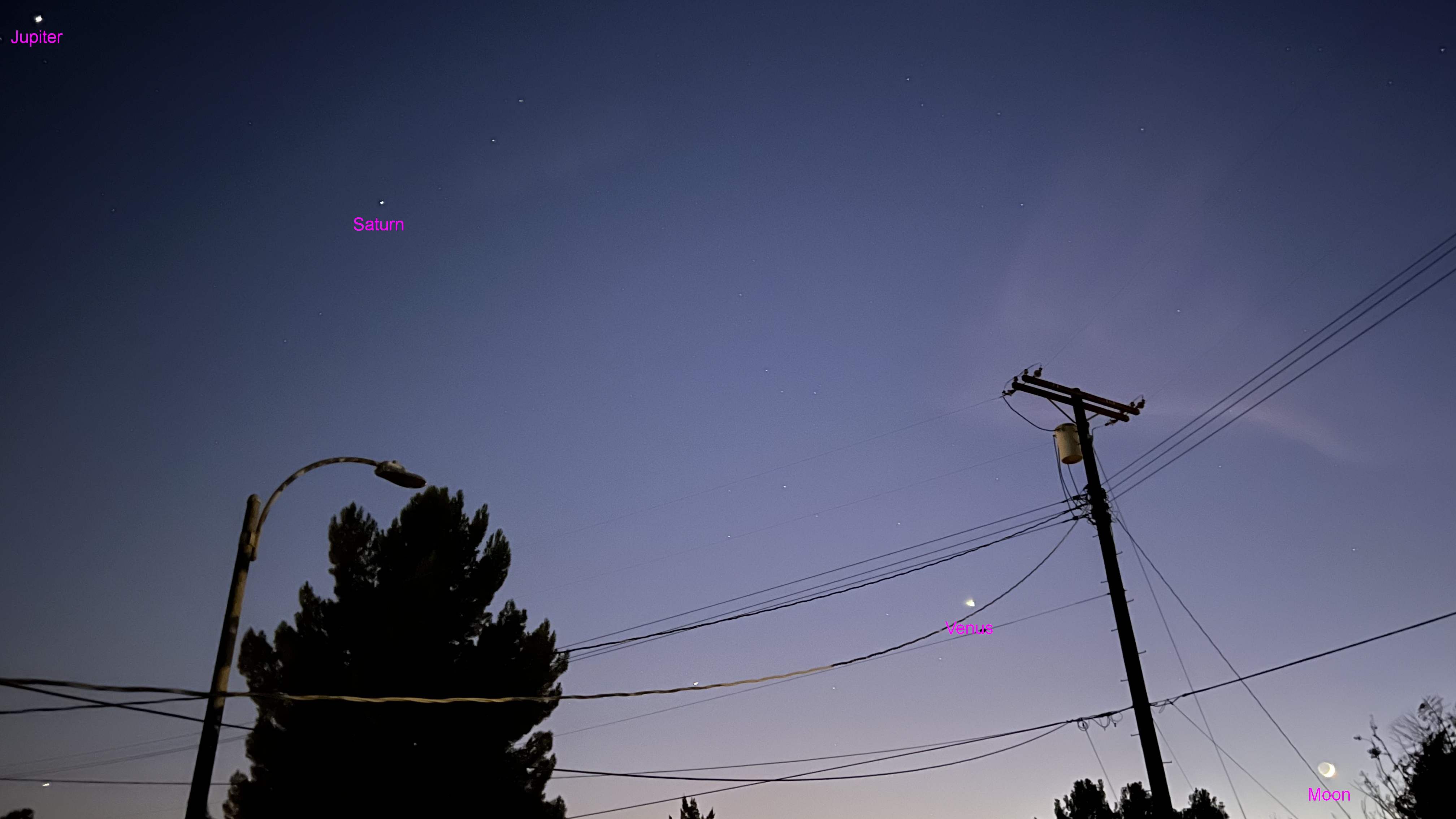
Tonight everything had moved, as celestial bodies tend to do. It’s that whole space-time, circling around in the gravity well thing. Which meant that Venus was a bit higher, and even though it was still too bright to see Mercury, Venus is a lot brighter than Mercury and I could juuuuuust see it above the trees as it was setting.

See it? To the right of the phallic tree, just barely above those trees. If you click on the image to get the full-sized photo, you’ll see it…

This cell phone image, blown up to the limit of resolution looks fuzzy – tomorrow night go out (assuming it’s clear) and if you can, take a pair of binoculars. Venus is very bright, looks like a diamond shining against the gathering dusk. Spectacular.

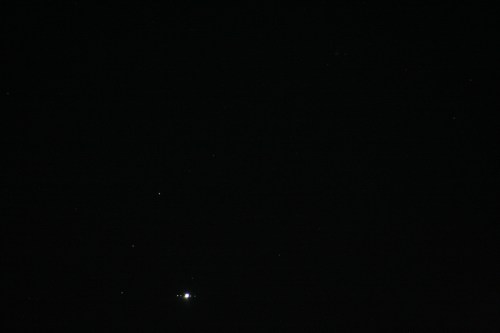
Sort of like this, with the good camera, just as it was disappearing.

Even without a lot of magnification, similar to what you would see with the naked eye, it stands out pretty well.

But there weren’t any pictures with the Moon, Mercury, and Venus. Too bright as Venus was setting. So I waited until it got darker.

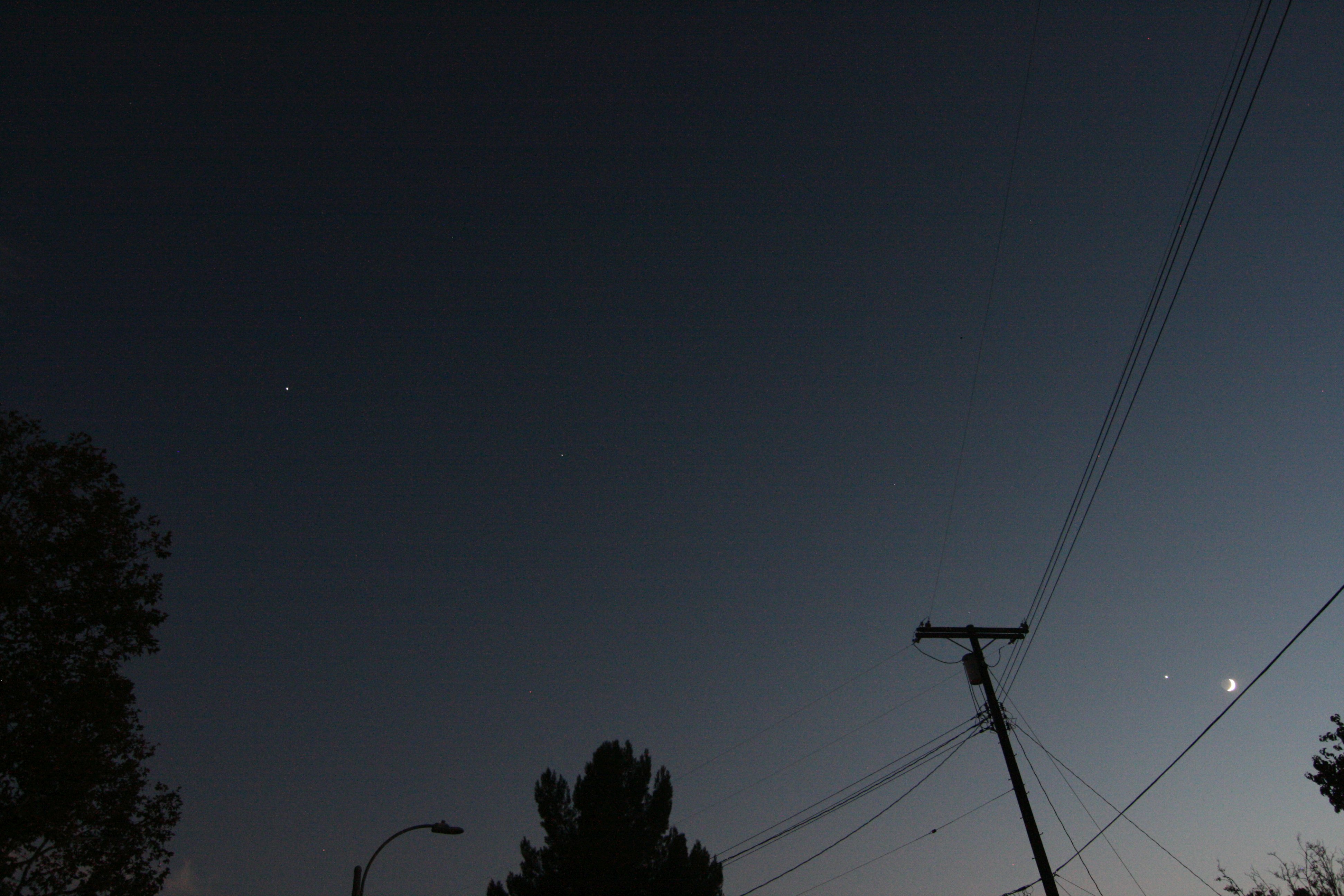
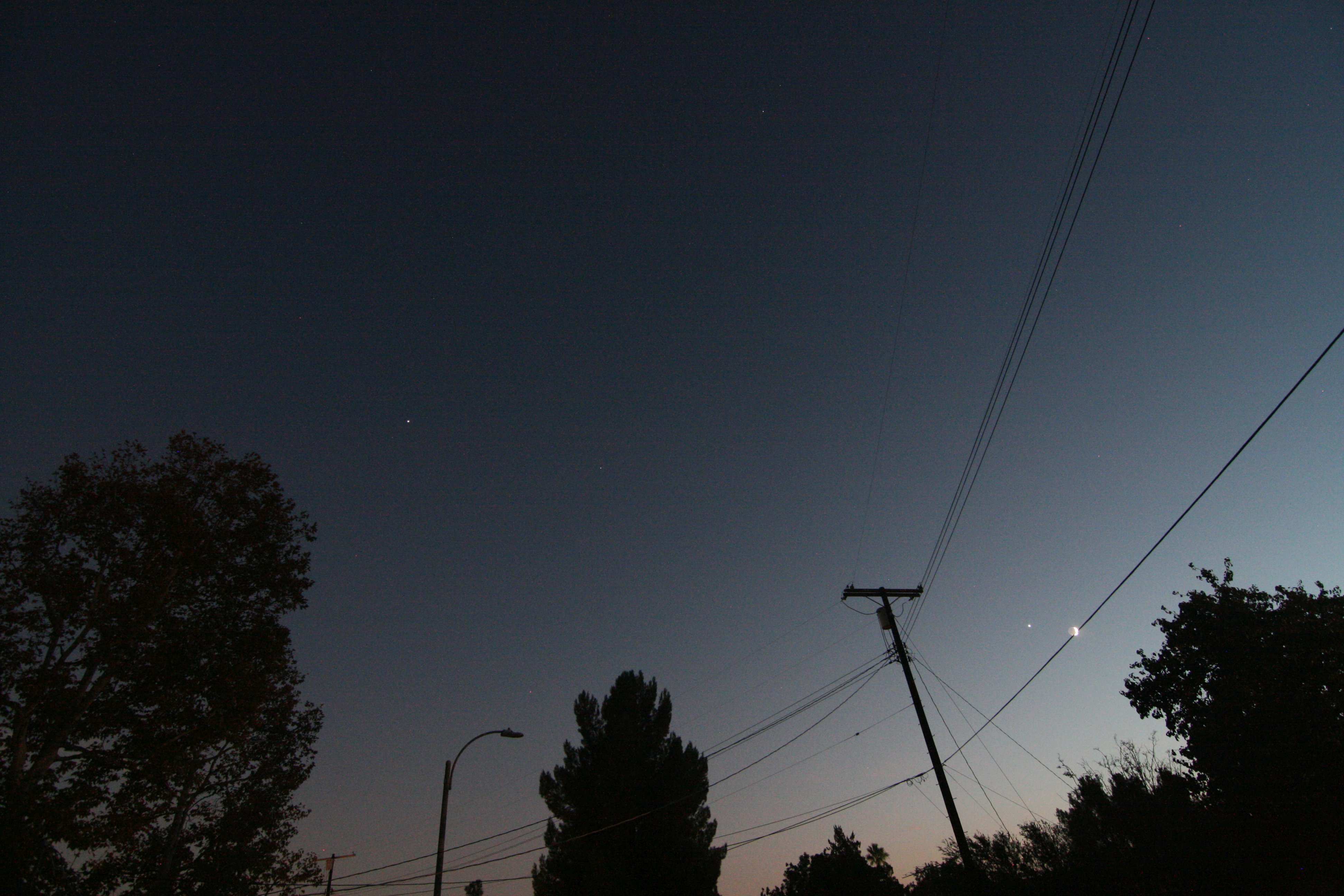
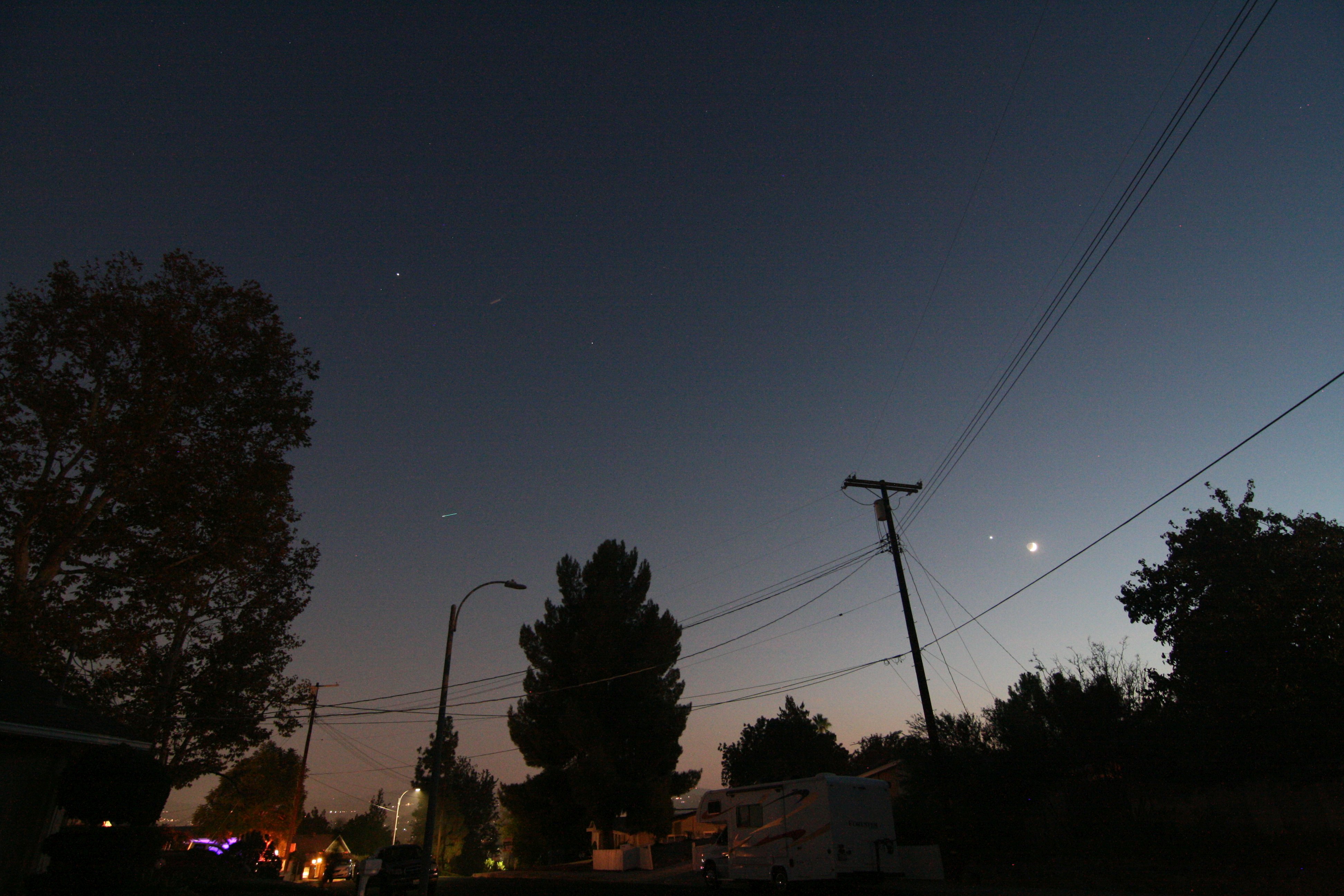
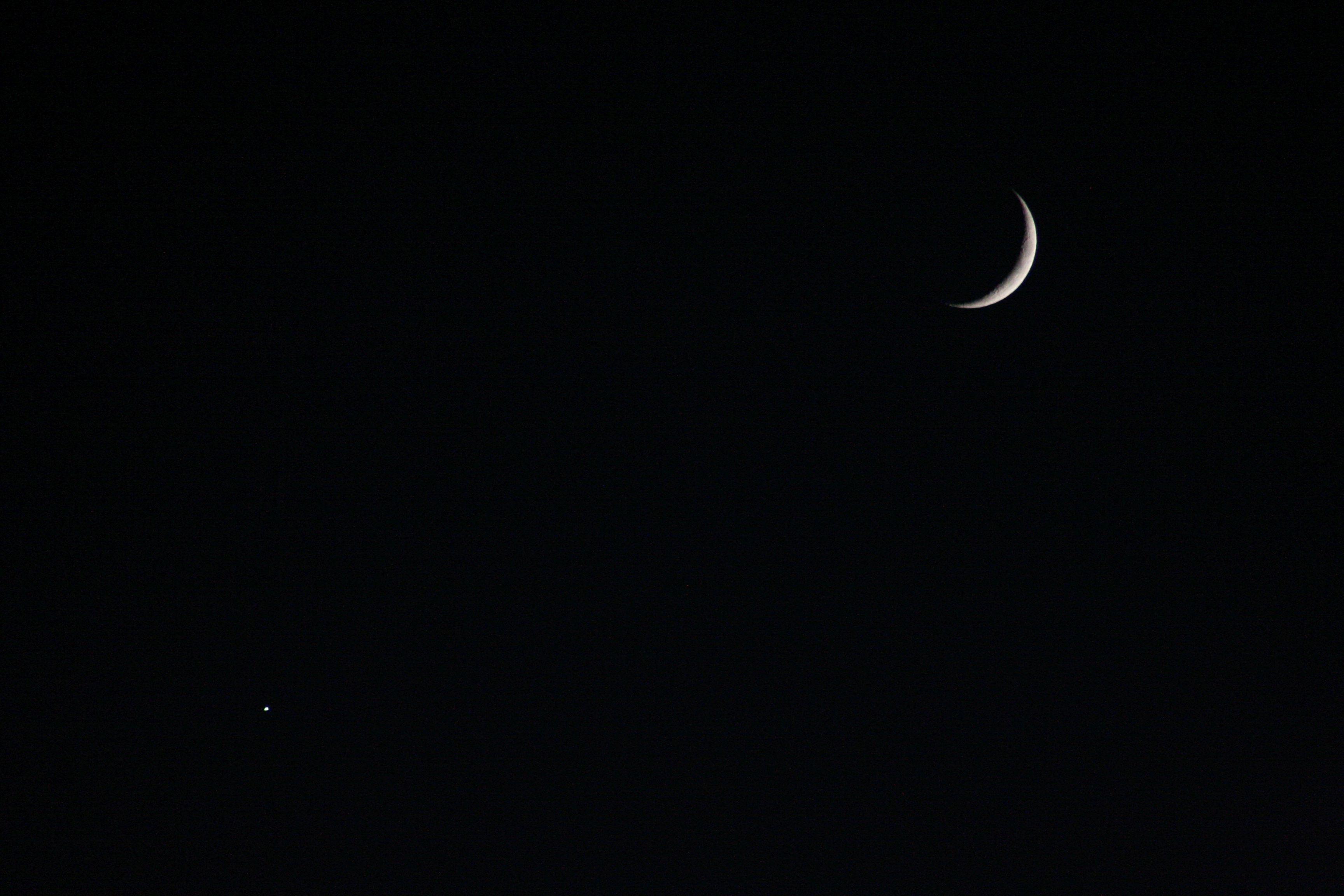
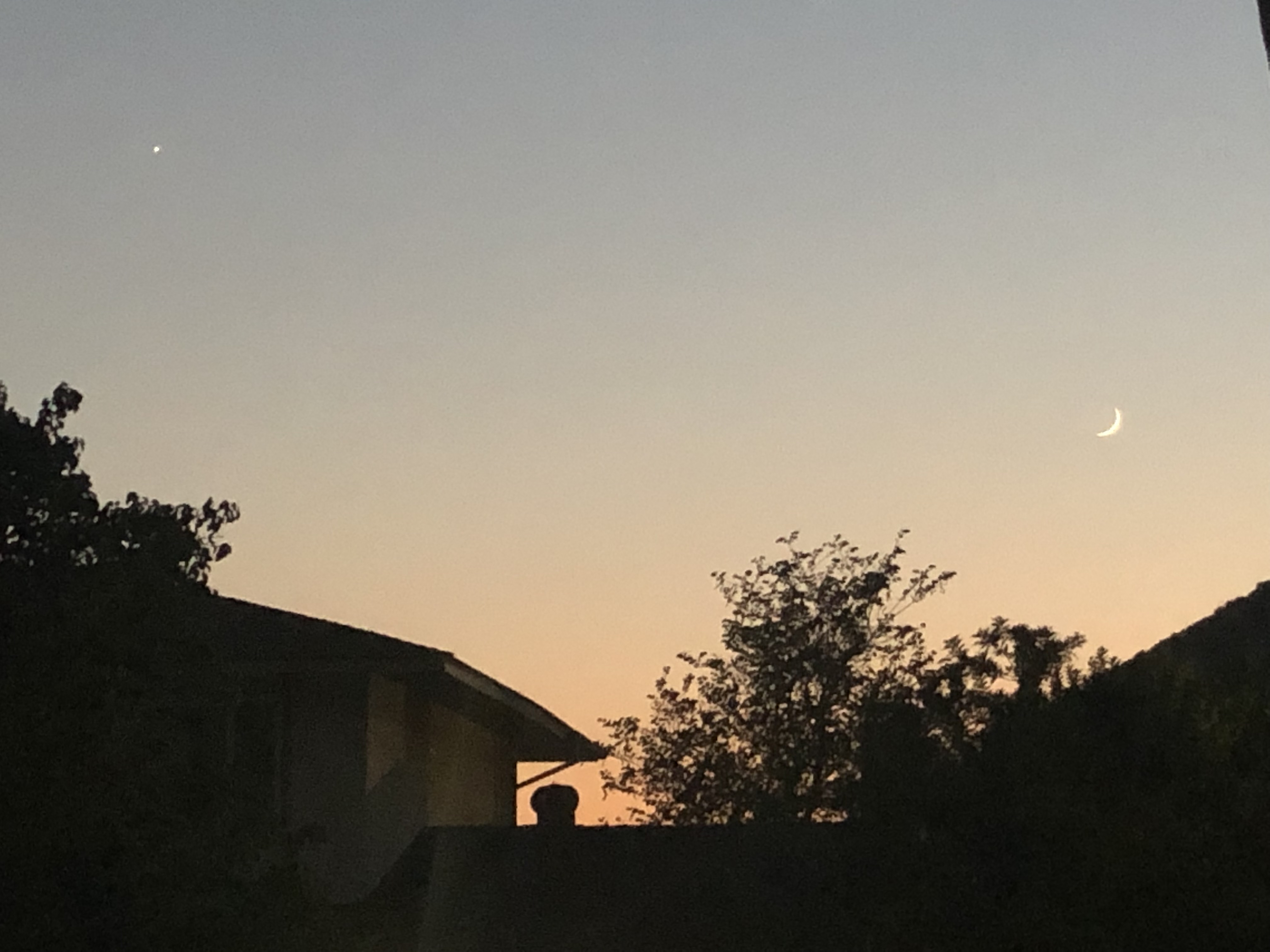
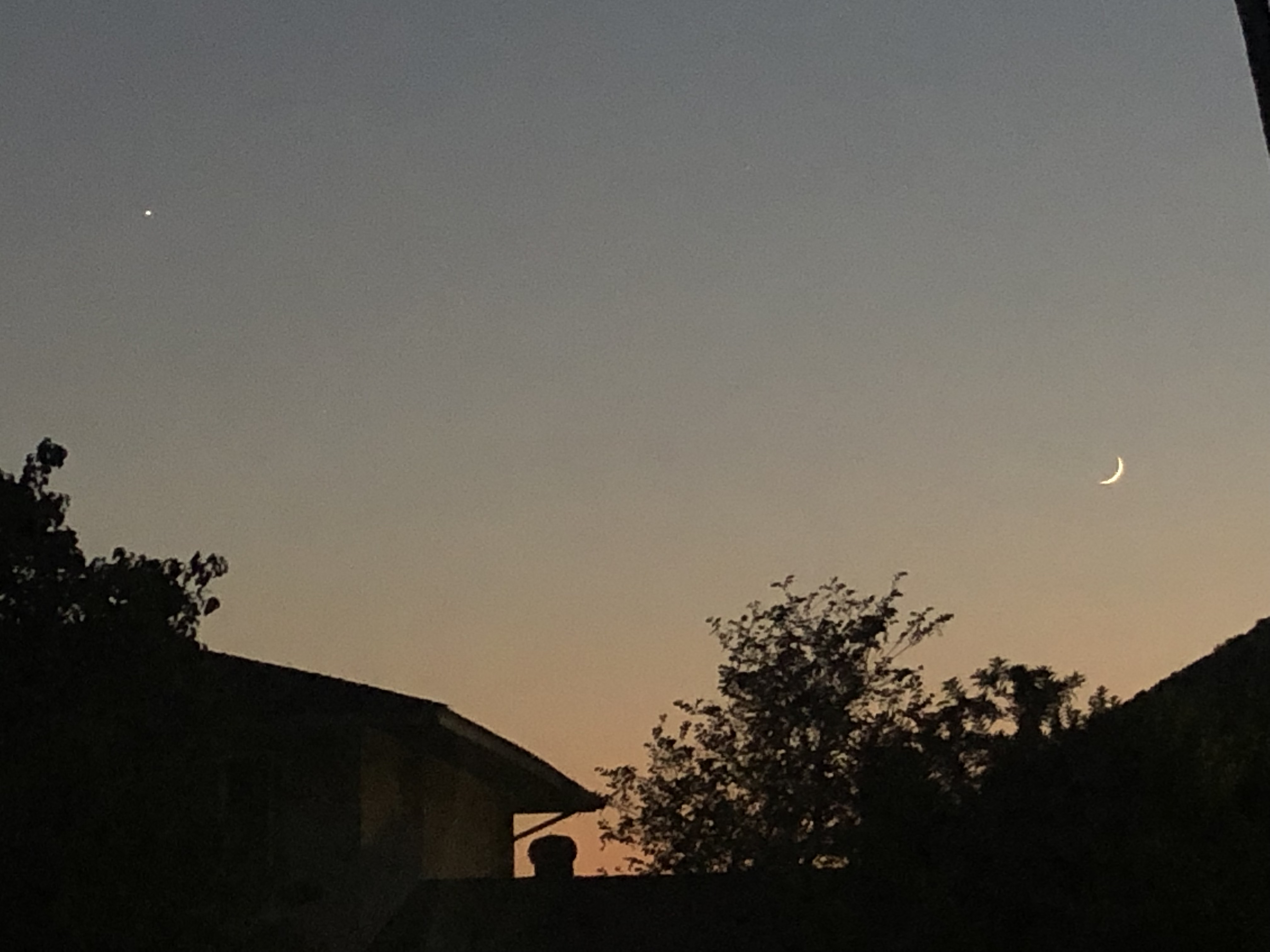
About a half hour later, the Moon in the upper left, Mercury about halfway between the trees to the right of the phallic tree, just below being level with the top of it.

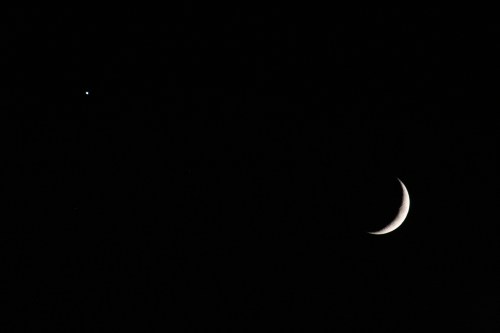
Compared to last night, it’s easy to see how much the Moon moves from one night to the next.

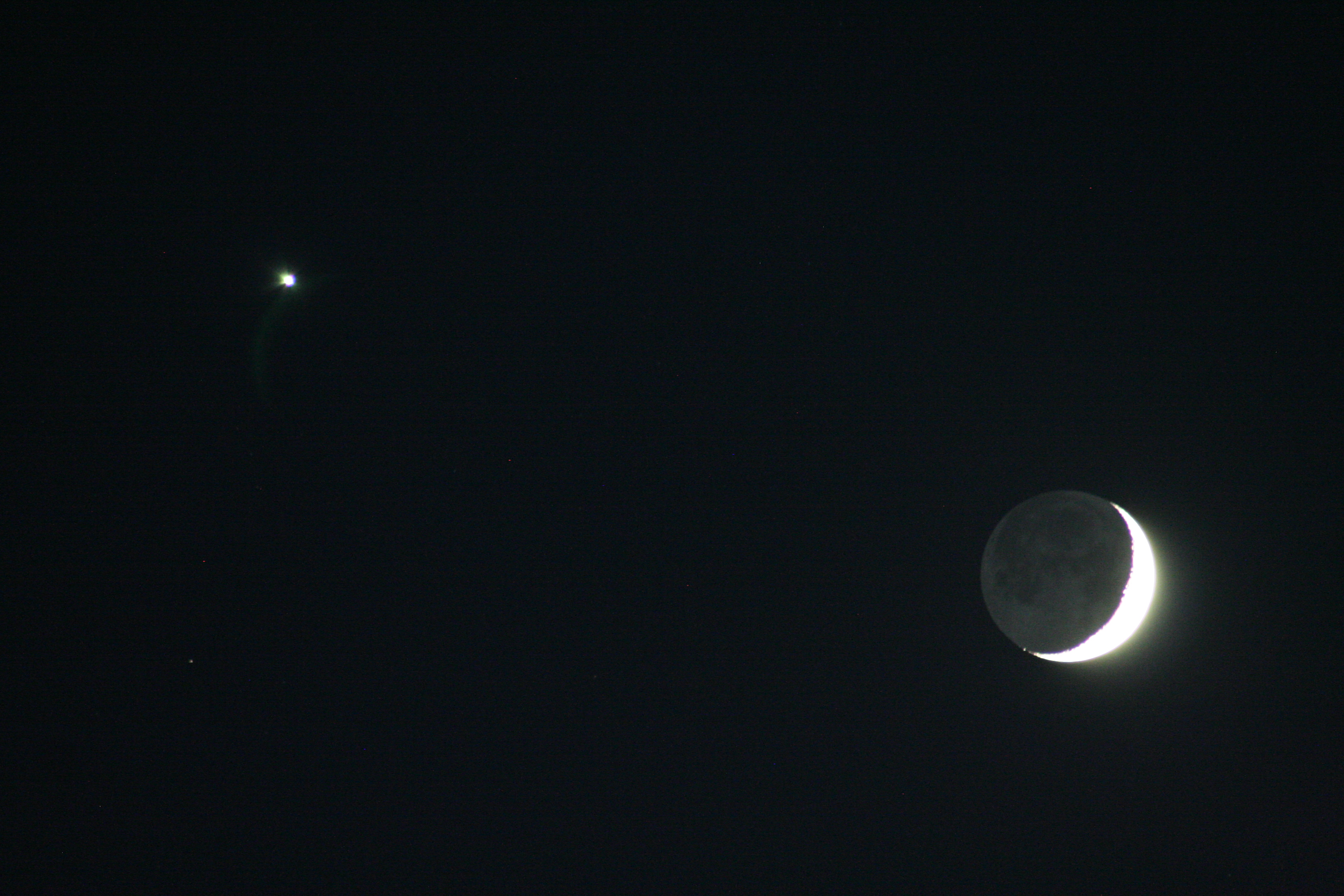
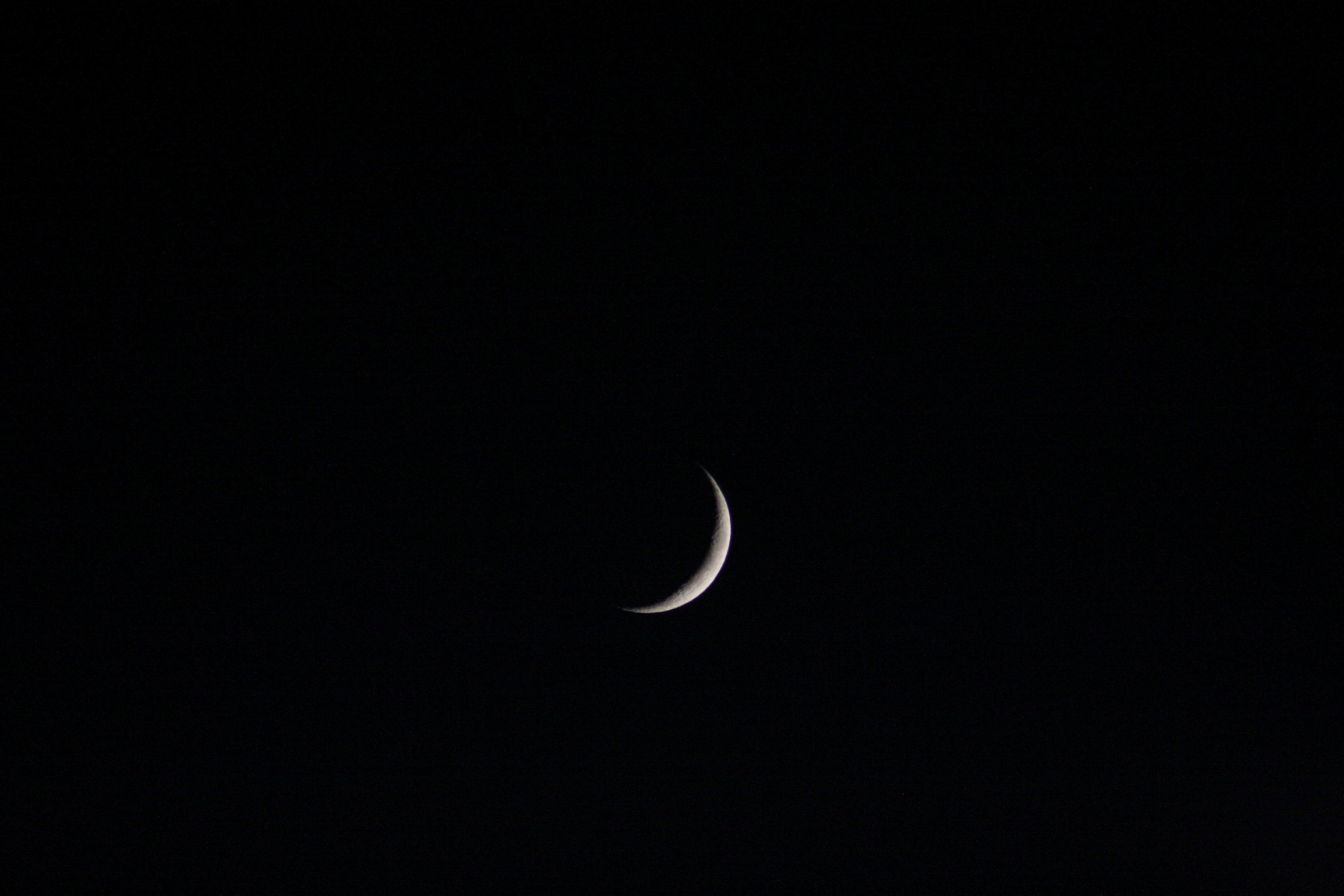
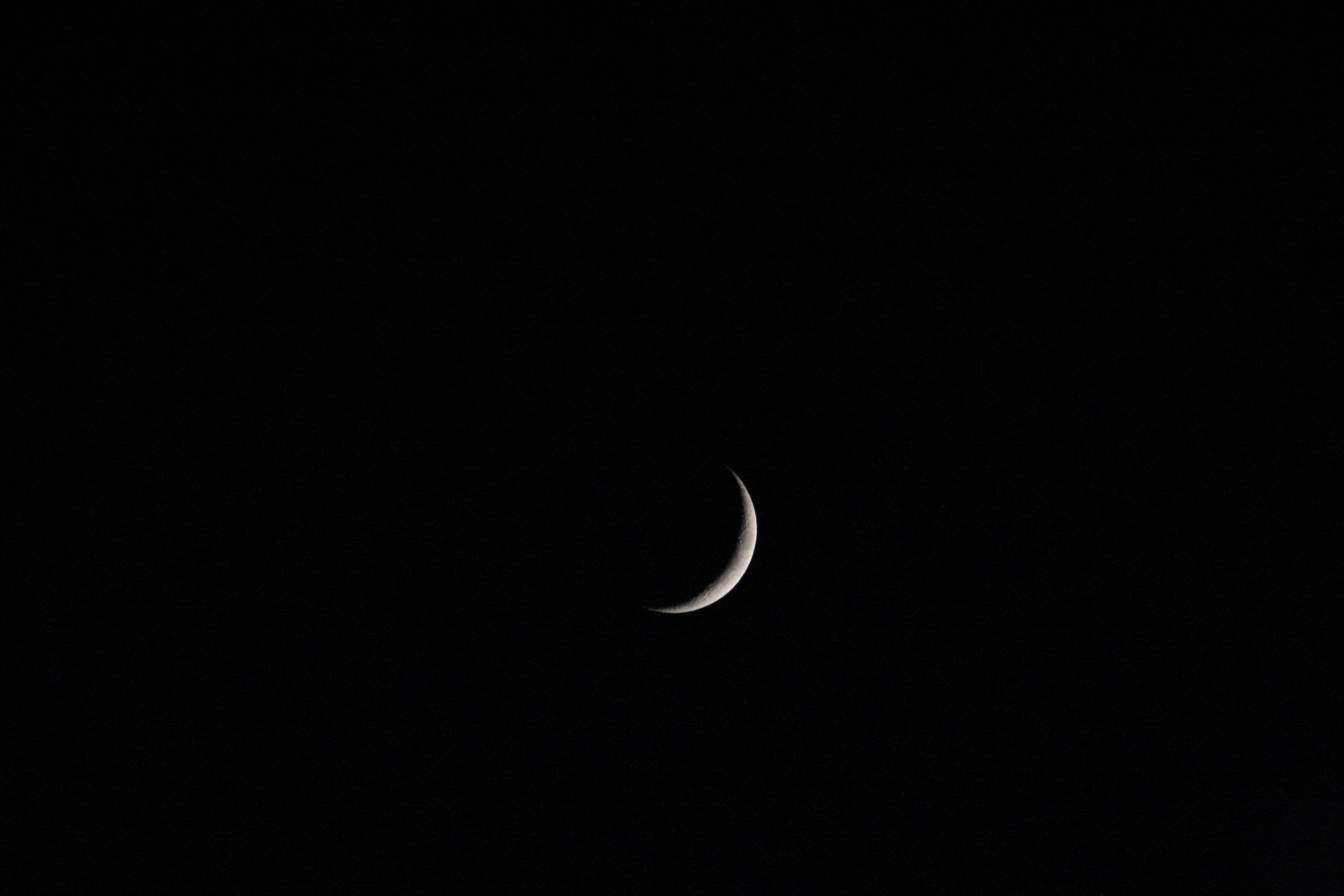
A cropped image of the crescent moon, three and a half days past new moon.

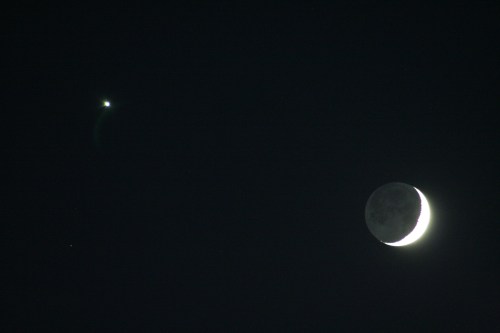
Similarly cropped image of overexposed moon, showing the dark portion of the moon in Earthshine.

Full-frame crescent moon in Earthsine.

It will probably be a couple of days before Venus climbs up high enough to be seen in the dark sky with Mercury, and by that time the Moon will be close to or past a quarter moon, way out of this picture. Just as well, the forecast is iffy for the next couple of evenings here.

However…

On the early morning before sunrise on Wednesday, May 26th, there will be a total eclipse of the moon. (See examples of what it will look like here and here.) You won’t see it if you’re on the US east coast or Europe, but you will probably see some or all of it in eastern Asia or on the west coast of North America. In Los Angeles, the partial eclipse begins at 02:45 AM, totality begins at 04:11 AM, maximum eclipse is at 04:18 AM, totality ends at 04:25 AM, and the partial phase ends at 05:52, right at sunrise.

As they say, mark your clocks and set your calendars!


Leave a comment

Filed under Astronomy, Photography, Space

Moon & Mercury – May 13th

Most folks never get a chance to see Mercury. It’s only visible, dimly, in the early evening sunset or just barely before sunrise.

If you’ve got a clear western sky for one of the next few nights, it’s a great chance. Mercury is rising about as high as it ever gets, for the next night or two the crescent moon will be nearby (although getting further away and more full every night), and in a few days Venus, VERY bright, will be climbing up from the horizon below it, to also serve as a beacon to tell you where to look.

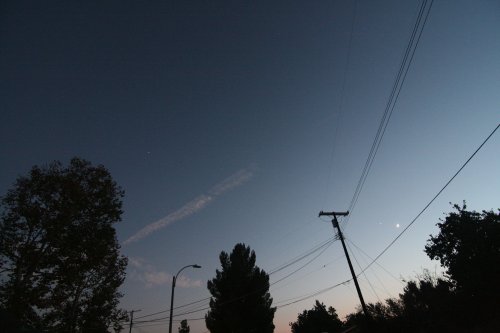
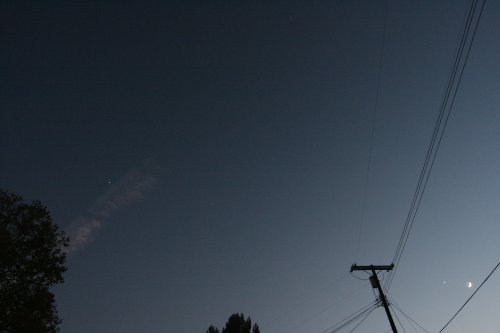
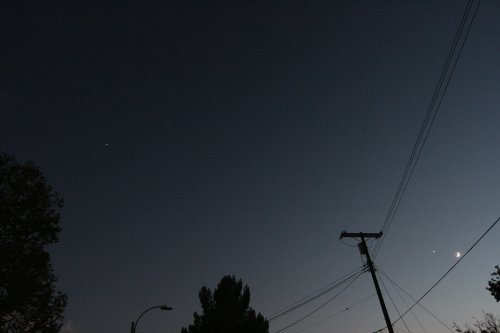
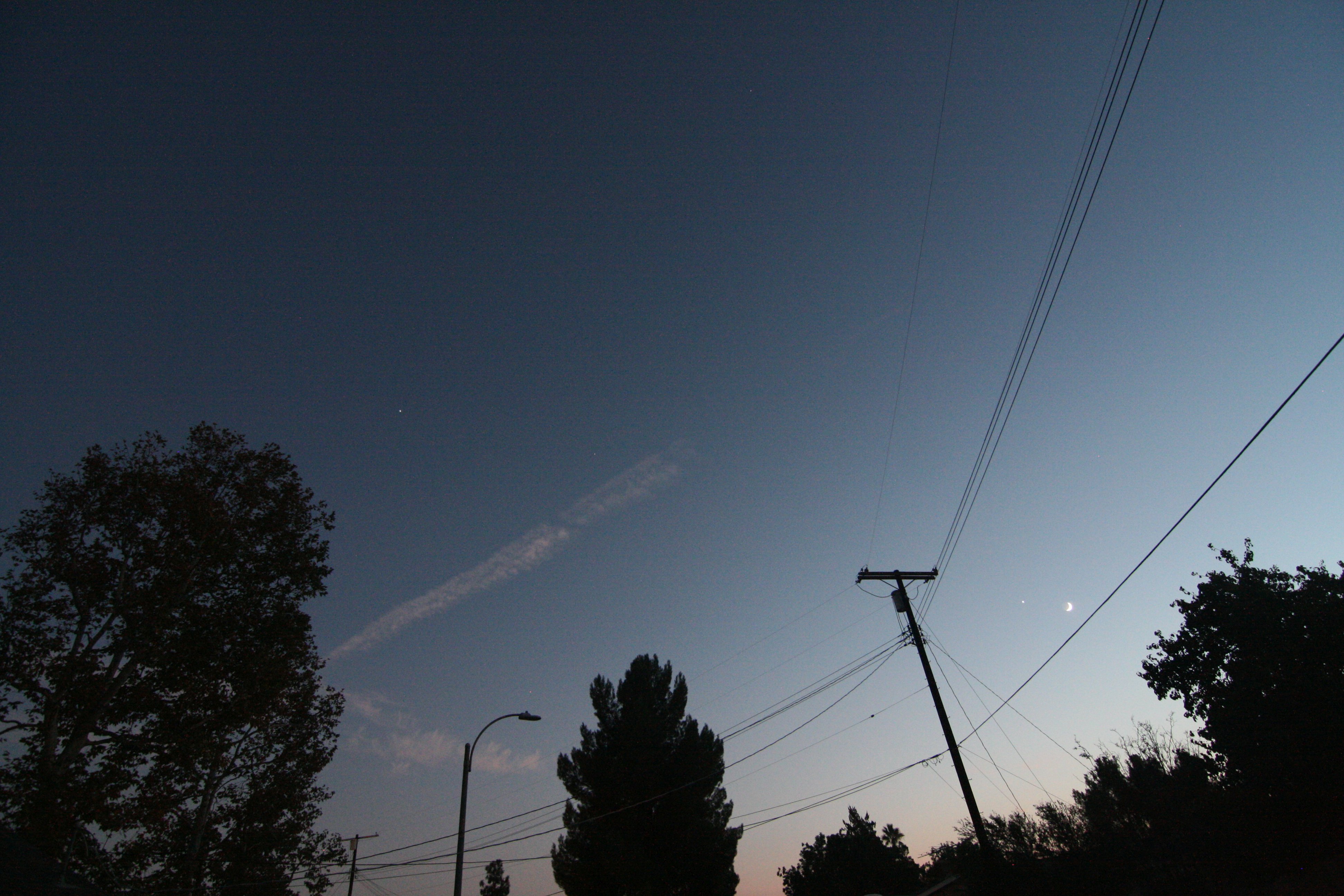
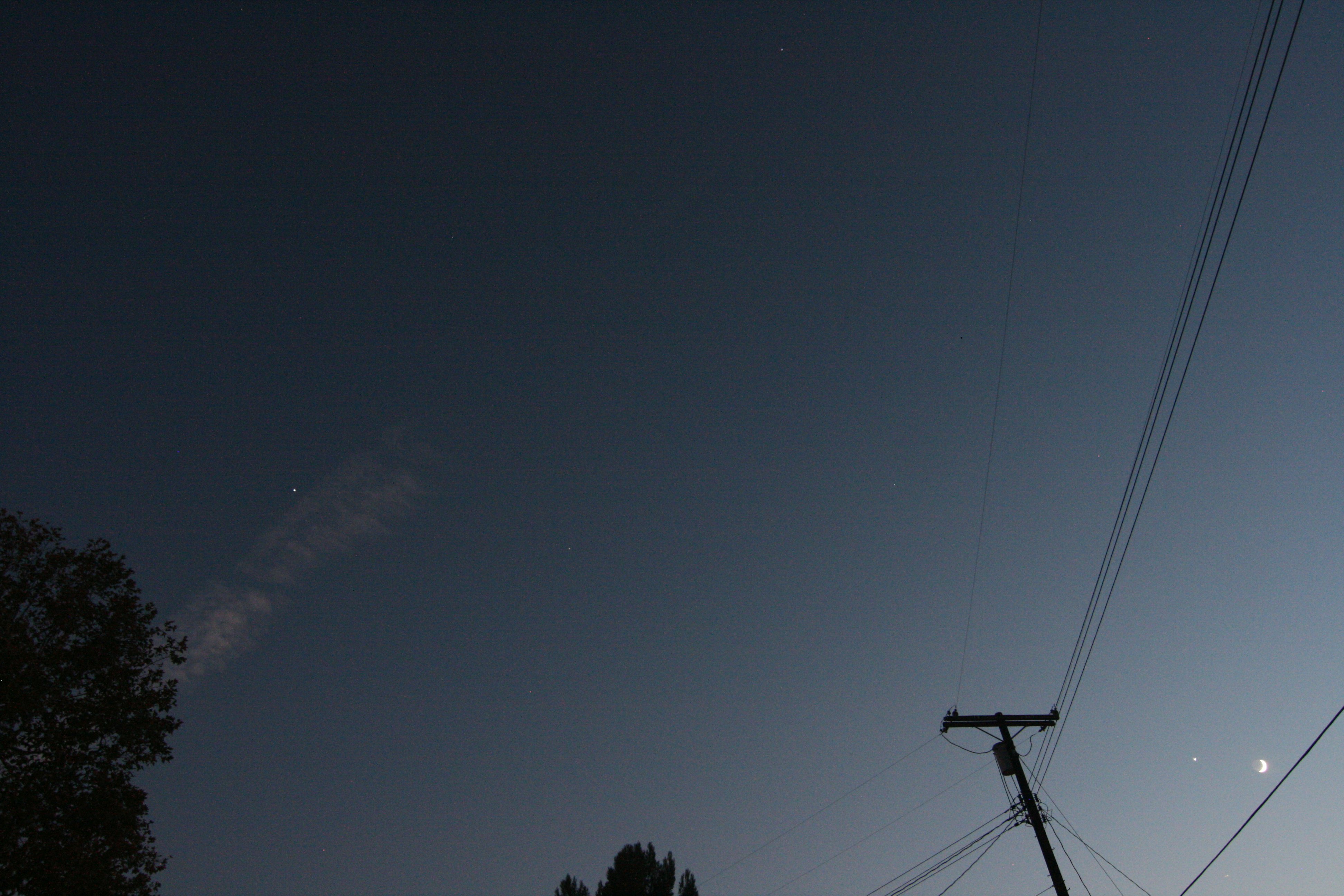
In these first three pictures, the moon is to the upper left of the phallic tree across the street, Mercury on the right side of the tree.

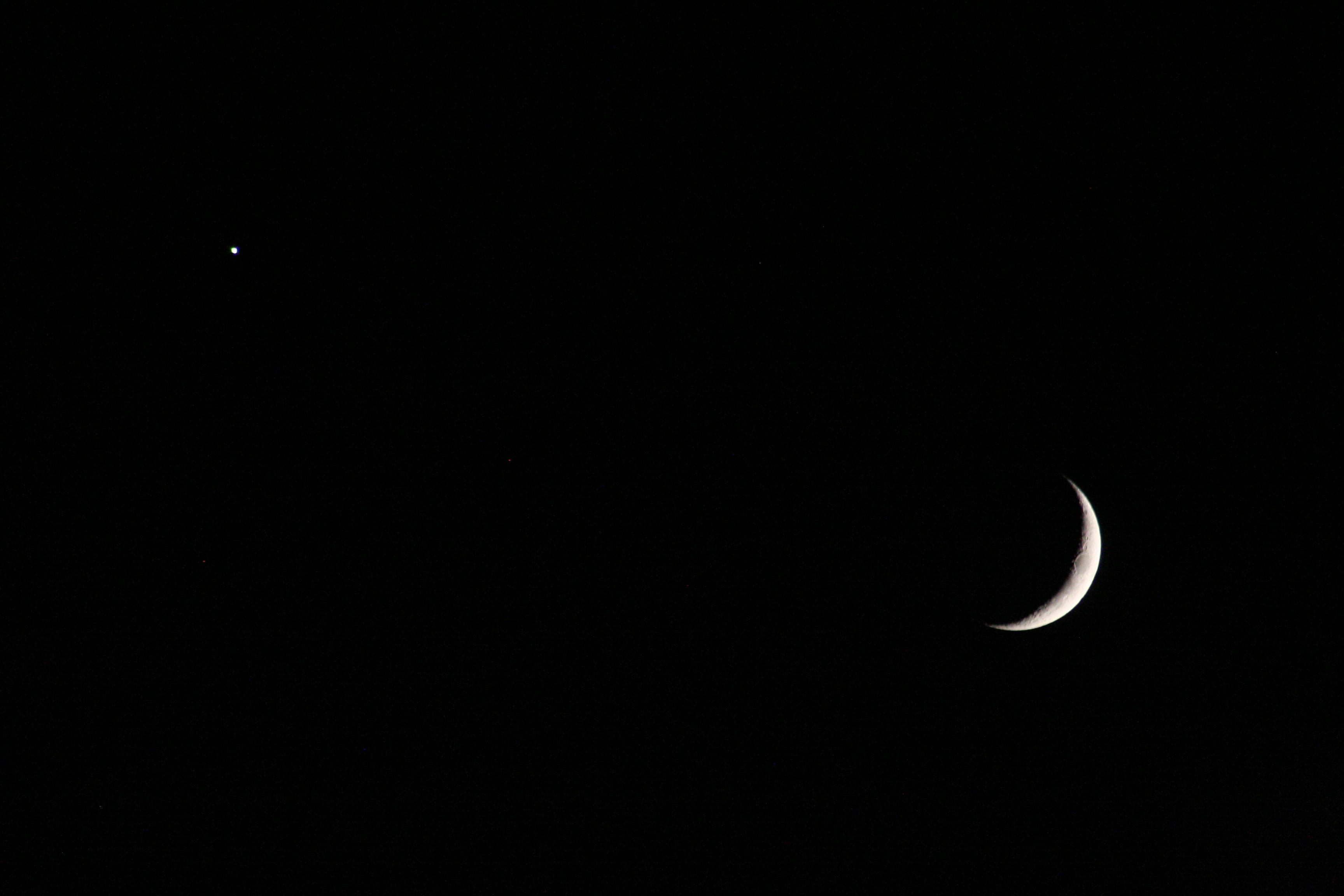
As always, expose for the brightly lit rim of the moon and the rest of the lunar disk is dark, but overexpose just a bit and you start to see the dark portion of the lunar surface illuminated by Earthshine. Finding the right spot in the middle – that’s art.

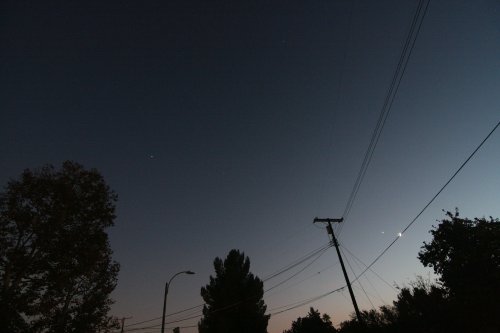
And then, just before Mercury goes down into the coastal clouds and fog rolling in or behind that tree, move a few feet to the left to find a spot between the trees where you can see them both.

Let’s hope that tomorrow’s clear and a million at sunset as well!

1 Comment

Filed under Astronomy, Photography, Space

The Clouds Win – No Supermoon Tonight

In the latest round in the unending battle between the clouds and the wonders of the Universe which they can and will obscure every chance they get, tonight we got this at sunset:

That’s due west right at sunset. Ignore the trees, they aren’t the problem.

Somewhere out there also was the “Pink Super Moon” rising. It’s not just a theory, I know it was there and rising because I have a great deal of faith in celestial mechanics.

But in every direction all you could see were clouds.

There were spots where a bit of fading blue showed through, but there were more places where the cloud deck was thick and threatening.

I saw reports from friends around the LA area that in places it was even starting to rain. (Which, as I said last night, we sorta desperately need, but…)

So no “super moon,” pink or otherwise for us. Just maybe some drizzle so I can shut off the sprinklers for one more night.

Leave a comment

Filed under Astronomy, Photography, Weather

The Dark & The Light

If you’ve seen my pictures of comets and conjunctions and ISS passes and so on you’ll remember that there’s a really bright, annoying, pain in the ass street light right at the south corner of our front yard.

Suddenly, about a week ago, it went out.

That’s it in the lower left, silhouetted in the dim moonlight and light pollution. No idea why, no clue when they’ll be by to fix it.

So, NOW!! Quick!! Before they fix it! Get out the telescope and cameras! (Although the view of Woodland Hills is nice…)

Except that, OF COURSE, every night since it went out has been cloudy and dark and it’s a big deal to kinda, sorta, maybe see the moon poking through the holes.

Who says that the gods don’t have a sense of humor?

Leave a comment

Filed under Astronomy, Photography, Space, Weather

Rising Full Moon – March

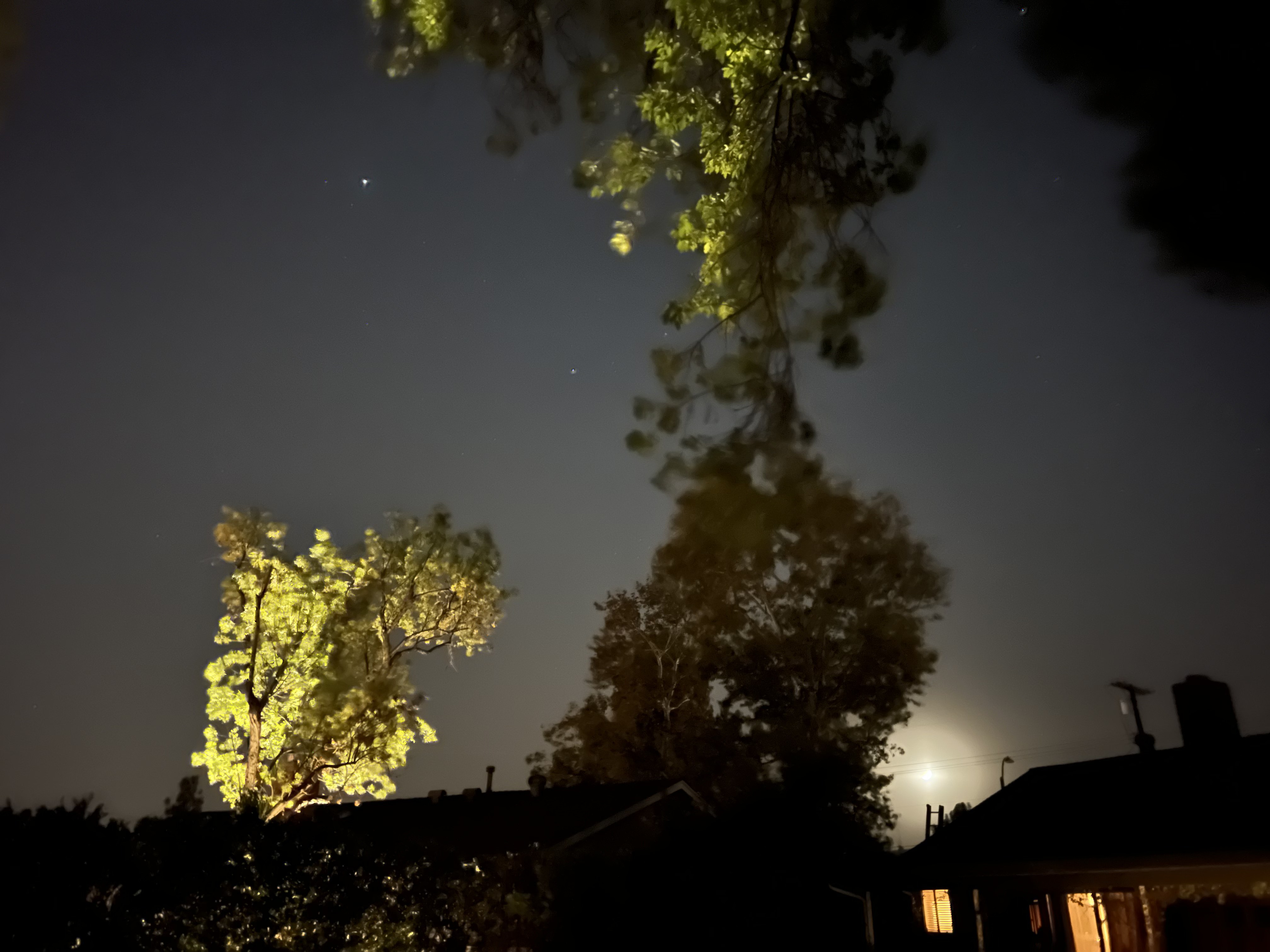
It was orange, and about 99% full, and bright, and orange, and right there outside the back window and over the hill and the San Fernando Valley.

The iPhone algorithm wants to make the whole scene bright, so it’s a long exposure and horribly overexposes the moon. The good news is that it saves some of the color.

The “good camera” (Canon Rebel XT DSLR with a 75-300 mm Tamron telephoto lens) set at 75mm does the same thing, but I can override that, manually focus, and so on. I just wish that I had had the time to grab and set up a tripod, but it was a complete spur of the moment opportunity.

But the really good part about digital cameras instead of film is that photons are dirt cheap, so if you shoot enough hundreds of photos in the five minutes you have, statistical fluctuations say that you’ll get one that’s decent. And that’s what I got – one.

I’m going to call that a win.

1 Comment

Filed under Astronomy, Photography, Space

ISS Pass – March 18th

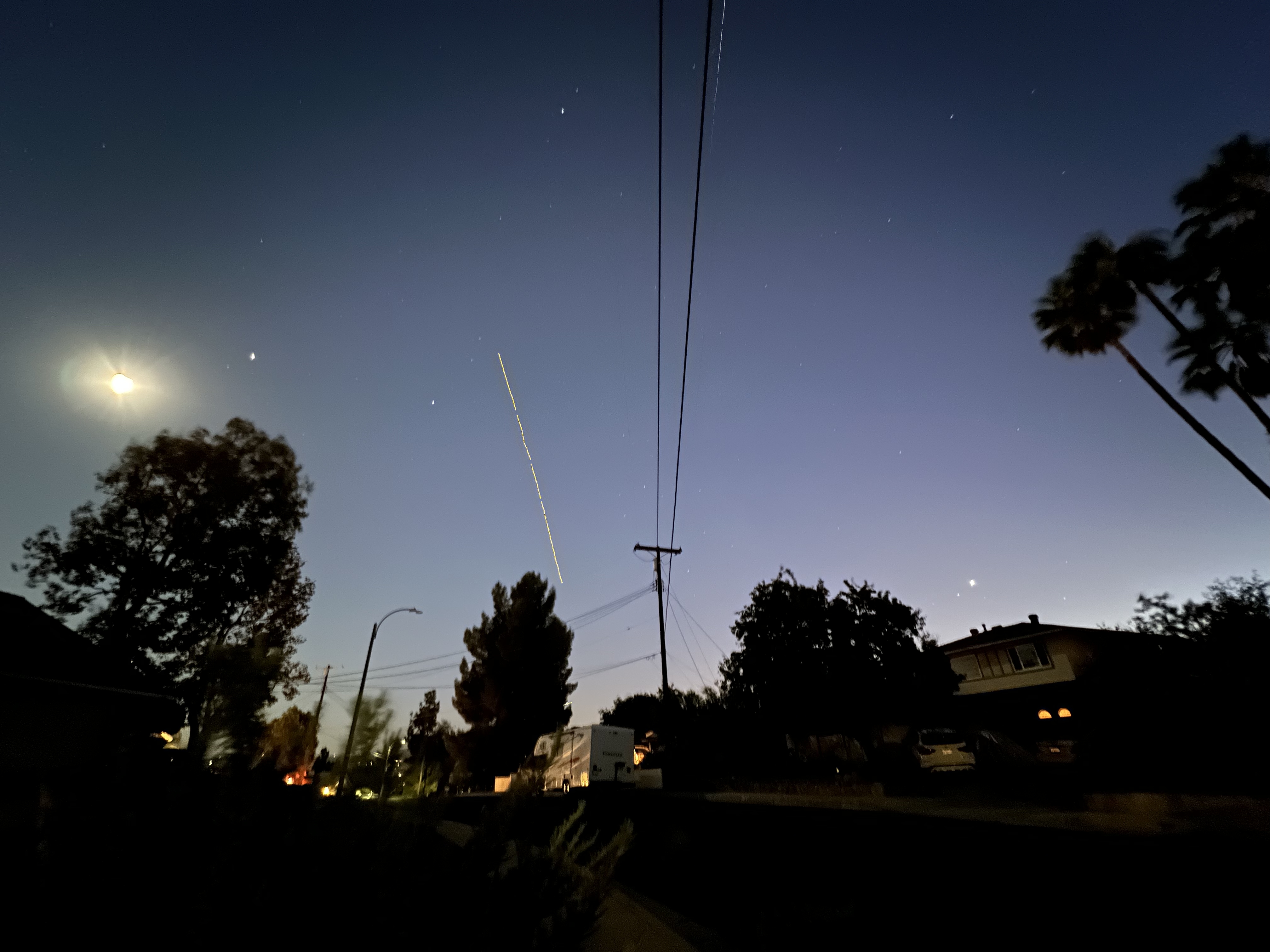
Tonight’s pass was fairly low to the horizon and not that bright (low = lots of atmosphere to look through = dimmer), but the winds had died down and while it was cool (52°F), the crescent moon was up there, so let’s give it a try! Practice, practice, practice!

Not bad! Low, almost due west, climbing at a shallow angle up and to the right, where it doesn’t even get high enough to get above that huge pine tree across the street.

Image from Heavens-Above.com

As the prophecy foretold!

Shift a little to the right as the ISS clears the big pine tree, only to watch it fade into orbital night just before it gets to the Italian cypress trees. The airplane track starting just above the cypress trees and heading north (bottom center)? That’s Fedex #1839 from San Diego to Oakland, at 36,000 feet.

But wait – there’s more!

The faint line coming from center upper right to center lower left? That caught my eye just as the ISS was fading. It’s going due north to due south, so it’s got to be some sort of polar satellite. Possibly a weather satellite, or a spy satellite. Possibly ours, possibly theirs. No clue.

But I shot a much longer string of photos, continuing after the polar satellite had faded into darkness. Merging all of them you can get a great view of how stars near Polaris, the North Star, the pole star (at the lower left) don’t appear to move at all in a time lapse photograph like this (they’re dots) while stars much further away from the pole (on the right) will trail into little arcs as the Earth turns beneath them.

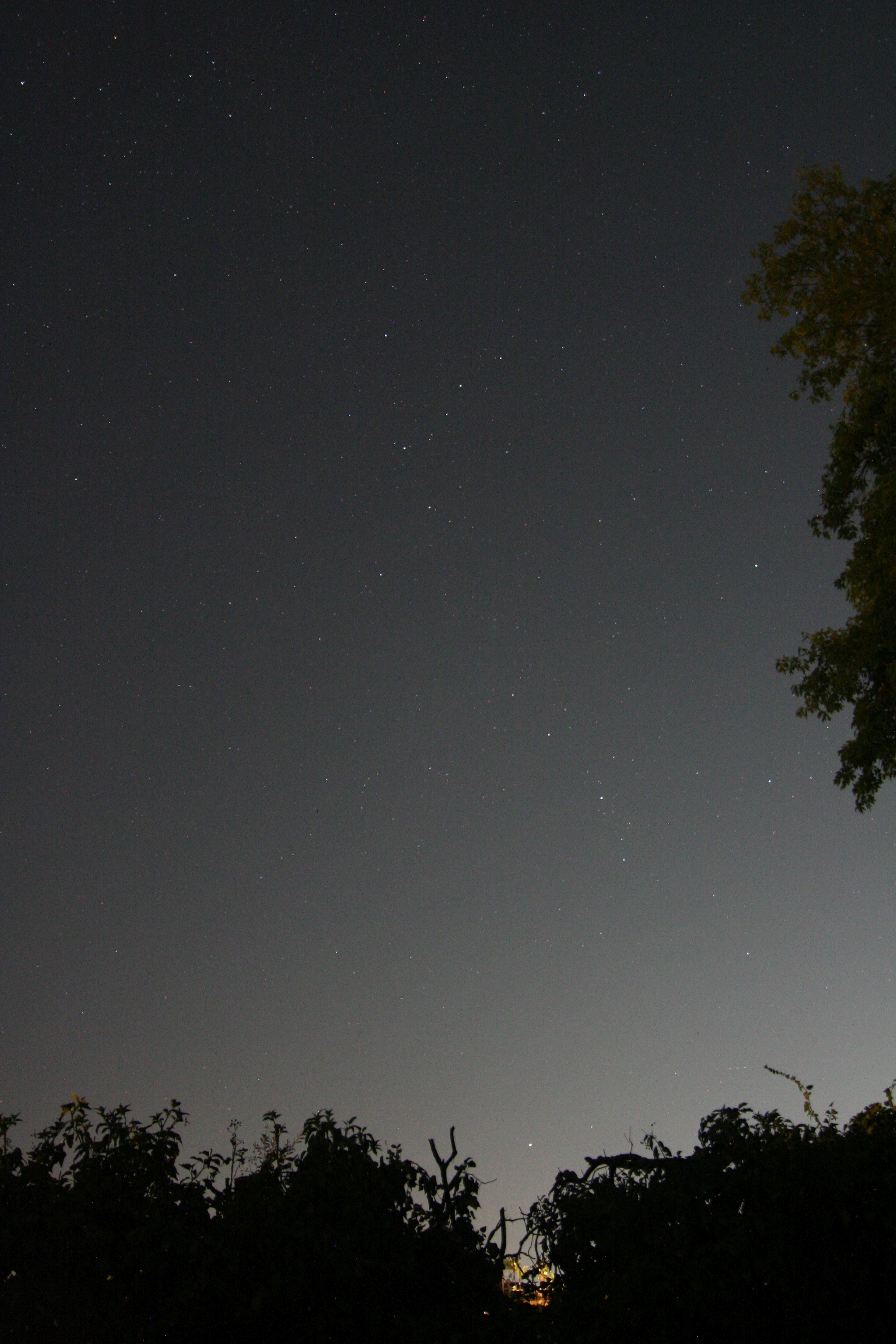
Still can’t find Polaris? Here’s your handy-dandy tutorial, learned lo these many decades ago on some Boy Scout camping trip. Find the Big Dipper (outlined in magenta), it’s easy, a big, bright constellation. On the far end of the dipper portion are the two “pointer” stars. Follow the direction they point (green line) about five times the distance between the two pointers, and you’ll se the one semi-decently bright star in the area – that’s Polaris!

Now go back and blow up that first picture up above. Polaris here is to the upper right of the top of the telephone pole. Again, a dot, not an arc. Now look at the stars on the far left side. See how much they appear to have moved in the two minutes of time covered by this series of pictures?

Flat Earth my ass!

(Should be another great pass tomorrow night, much higher, much brighter!)

2 Comments

Filed under Astronomy, Photography, Space

ISS Pass – March 17th

As of 18:00 there were a few scattered high clouds and I thought it would be a great night to watch a fantastic ISS pass.

Image from Heavens-Above.com app

At 19:45 I went out – and it was about 90% clouded over. Thin clouds, so I could see the moon and the brighter stars in Orion, Sirius, but that was about it. I figured I wouldn’t see much at all, but what the heck, give it a try, right?

DAMN! I love this new lens. It is a razor sharp light bucket. With the naked eye through those thin clouds I could see about four, maybe five of those stars…

The green blobby thing in the lower left is that damn street light – I would pay good money to be able to switch it off for about twenty minutes.

And that white & red & green streak coming from the bottom, straight to the top? Alaska Airlines #1495, out of LAX to Spokane.

Then the ISS was overhead…

The clouds were much thicker overhead, not nearly as many stars poking through as it headed off to the north (lower left).

Stupid trees. A quick shift of the tripod, and off the ISS went, fading into the orbital night just before it went behind the roof.

If you’re in Los Angeles, there are passes every evening through the 21st, with the best one on Friday night, the 19th at 19:56. (Can’t make this shit up… Some of you will understand. The rest of you – take my word for it.)

Leave a comment

Filed under Astronomy, Photography, Space

A Simple Experiment

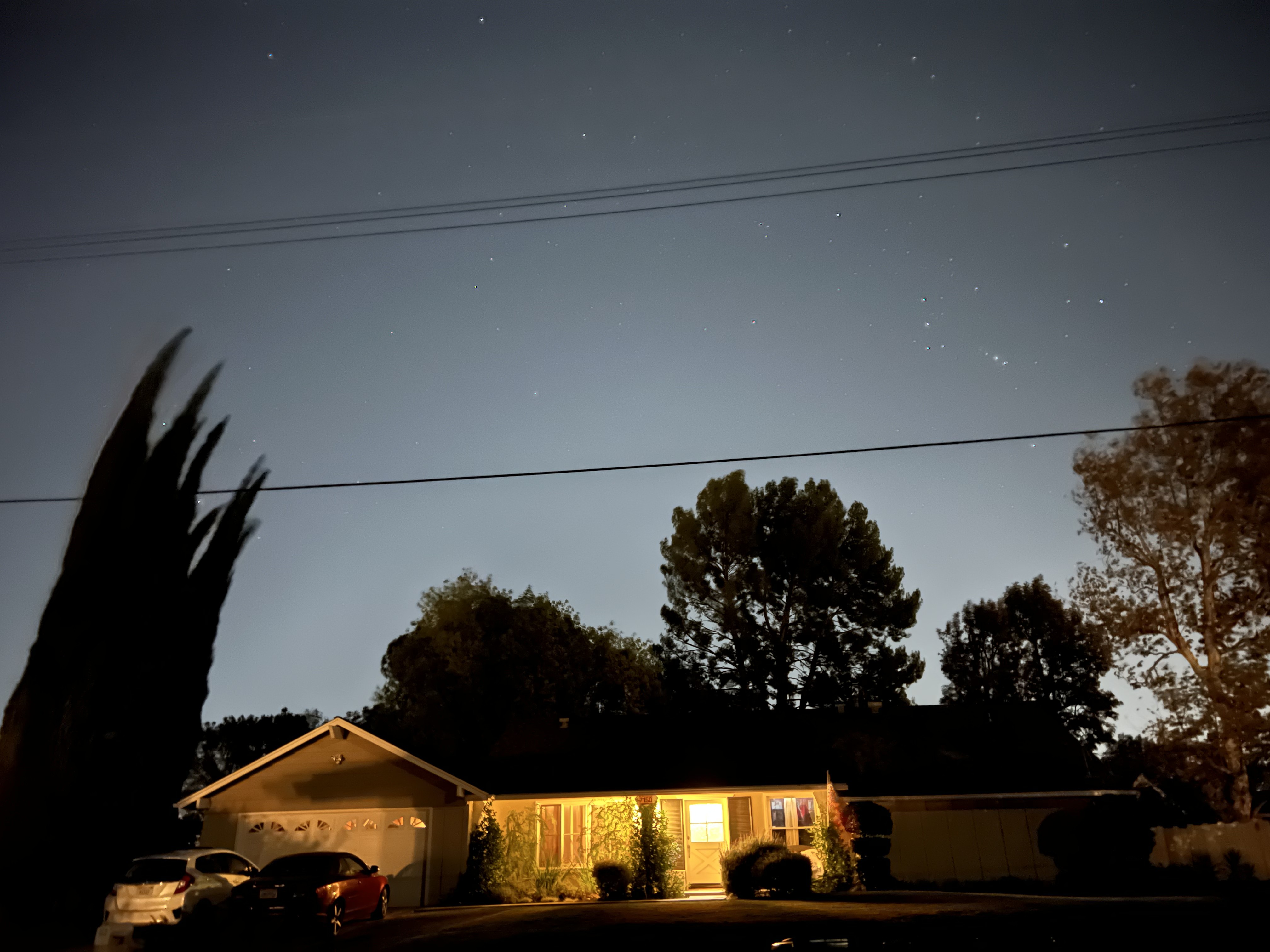
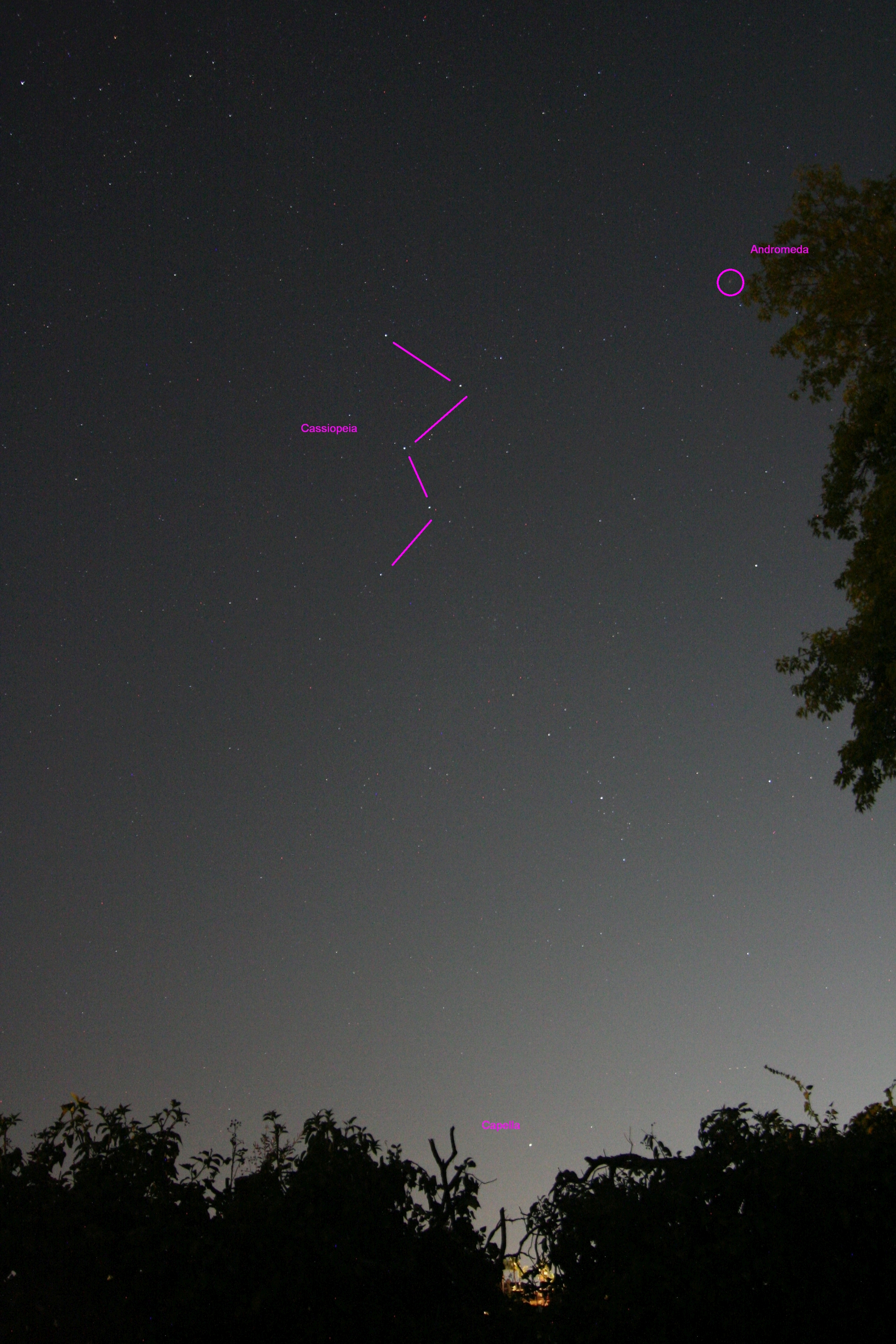
I was doing a lap around the backyard in the dark (my watch had bitched at me about sitting too long, and it was correct) and I was looking up at Orion and Sirius and Aldebaran. It was clear, the moon isn’t up yet, they were gorgeous – as always. I thought about going in and getting my tripod and good camera and setting things up, but I’ve got deadlines to meet and I needed to get back inside…

Could I use my iPhone, handheld, no tripod, no other apps? Of course not! It’s just an iPhone 8, and while I hear that the iPhone 12 can do really well with low-light astrophotography (and the Pixel 5 is supposed to be amazing?) and the iPhone 13 is going to be even better, a phone that’s coming up on four years old couldn’t ever… Could it?

That’s an assumption.

How hard would it be to test?

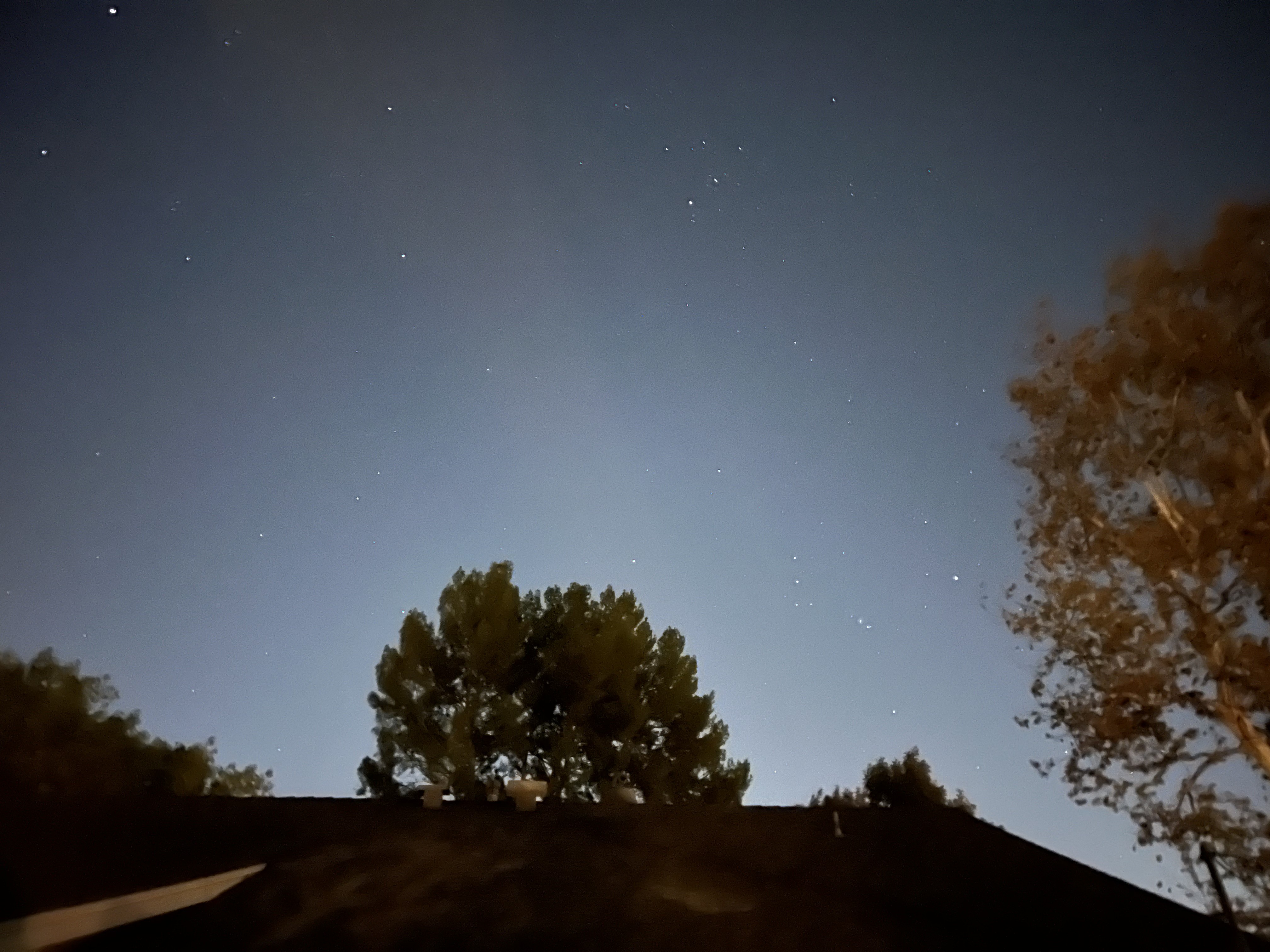
It turns out that answer is, “Yes – and no, but mostly no.” The biggest problem is getting it the camera to focus, it doesn’t have anything solid to grab ahold of. But if you can lock the focus, you can get something that at least shows Sirius (middle right), the four “feet and shoulder” stars of Orion as well as the “belt” stars, Aldebaran on the right, and Procyon near the top. That’s something like six of the dozen brightest stars in the Northern Hemisphere (one of the reasons the winter sky is so easy to find your way around, and so spectacular looking) so it’s cool that they DO register, but like the dancing bear, it’s not that they do it well, but that they do it at all that’s impressive.

Once the focus is locked you can try to manually fiddle with the exposure and brightness, but that seems to mainly cause a lot of noise as the image sensor gets overloaded.

At least that picture brings out the orange color of Betelgeuse (top left star in Orion, still hasn’t gone supernova…) where the first picture didn’t show any of the colors.

So, that answers that. Perhaps before they fade into the spring sky I can get a night where I’m not getting my ass kicked by deadlines and I’ll bring out the good gear to play with.

Leave a comment

Filed under Astronomy, Photography