Category Archives: Space

A Second Clear Night

Last night’s post was rushed – I was running out of time before my self-imposed “posting deadline” of midnight. So it got cut off abruptly, with the bottom line being that I could see the bright star Capella rising very, very near the horizon in the northeast. That’s rare in SoCal, especially these days, since there’s usually so much haze and coastal clouds scattering the ever present light pollution.

Tonight it was clear again, so I went to take pictures. Again it’s clear, but Capella doesn’t rise until after 22:00, and it doesn’t clear the fence until after 23:00, so this will be rushed as well. (For example, I didn’t have the time to clean up all of the “hot” pixels in Photoshop – please ignore all of those bright red and bright purple specks.)

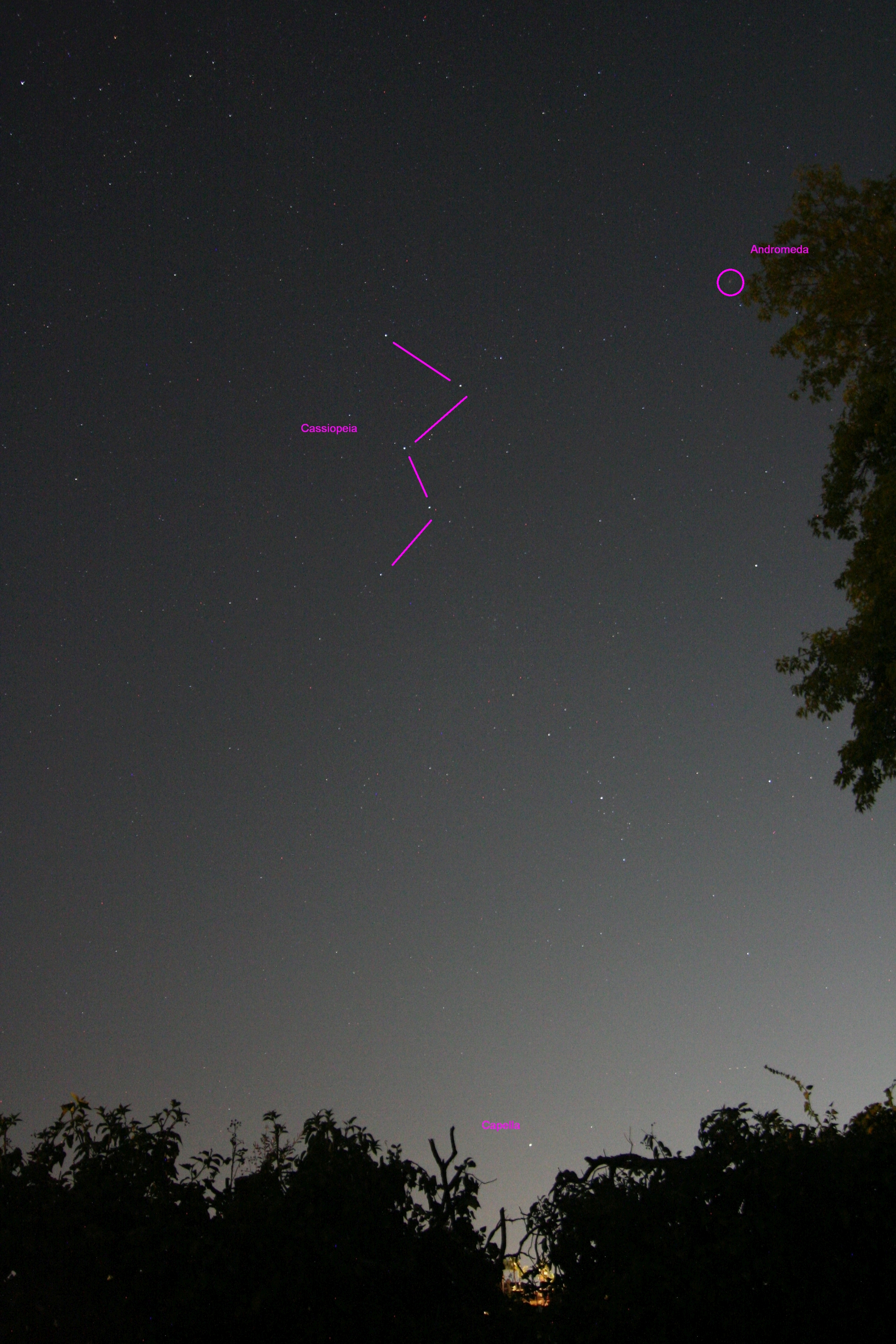
First of all, here’s a very quickly annotated copy – the (currently) sideways “W” or “M” shape of Cassiopeia  up high, near the north pole, which is unmarked but just to the left of it, right around the left edge of the image. And down below, grateful for that hole or notch in the top of the hedge, is Capella.

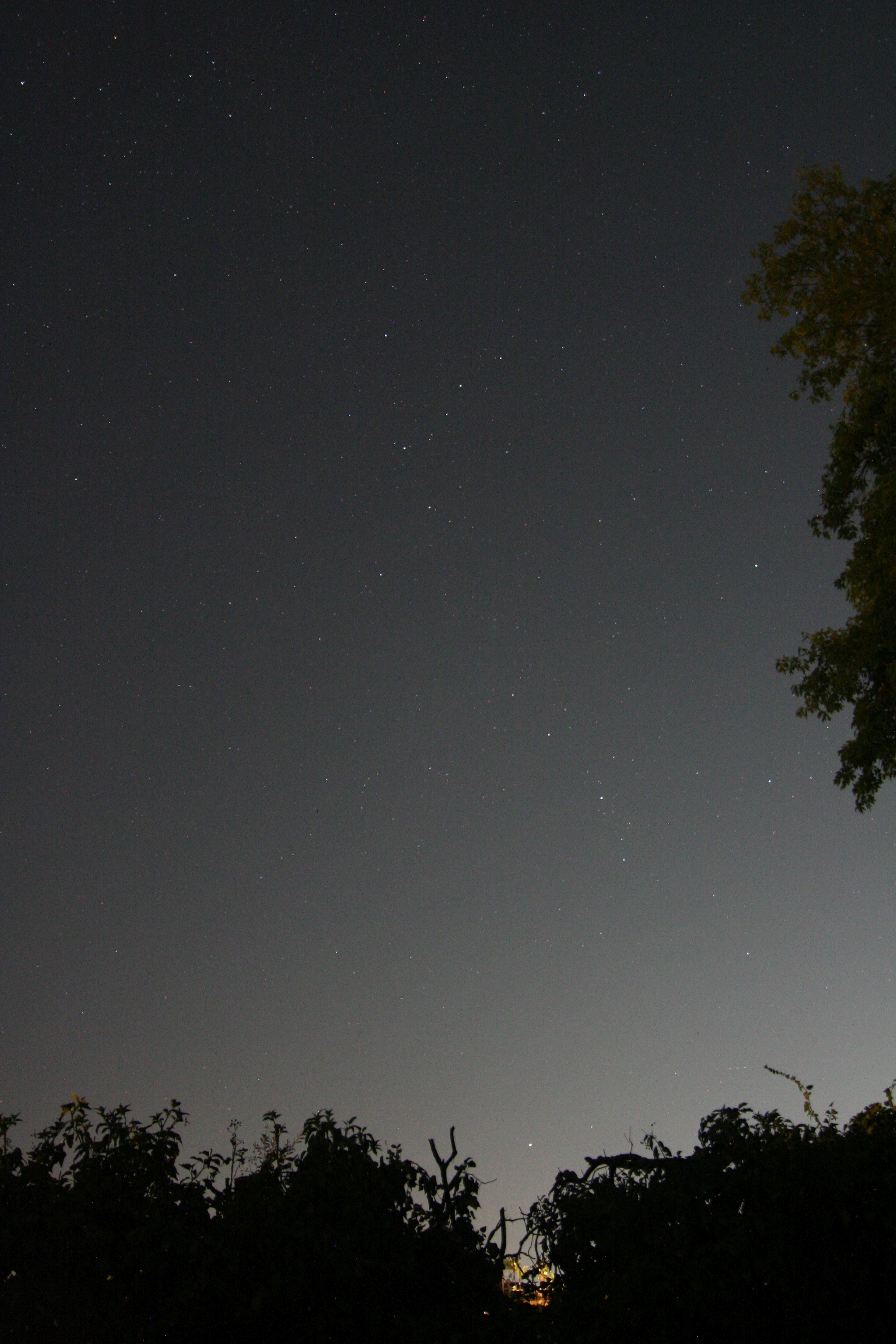
Here’s the unedited image. Click on it to blow it up and explore.

And there’s one more item annotated in the image, just to the left of the tree, a bit above Cassiopeia – that’s the Andromeda Galaxy.

No kidding!

1 Comment

Filed under Astronomy, Photography, Space

ISS Pass – August 04th

It’s getting near the end of the “season” for great ISS passes here. The high beta angle period has passed and after the next few days we’ll be moving back to mostly morning passes. Like, 04:00-ish morning. Uh, no thanks!

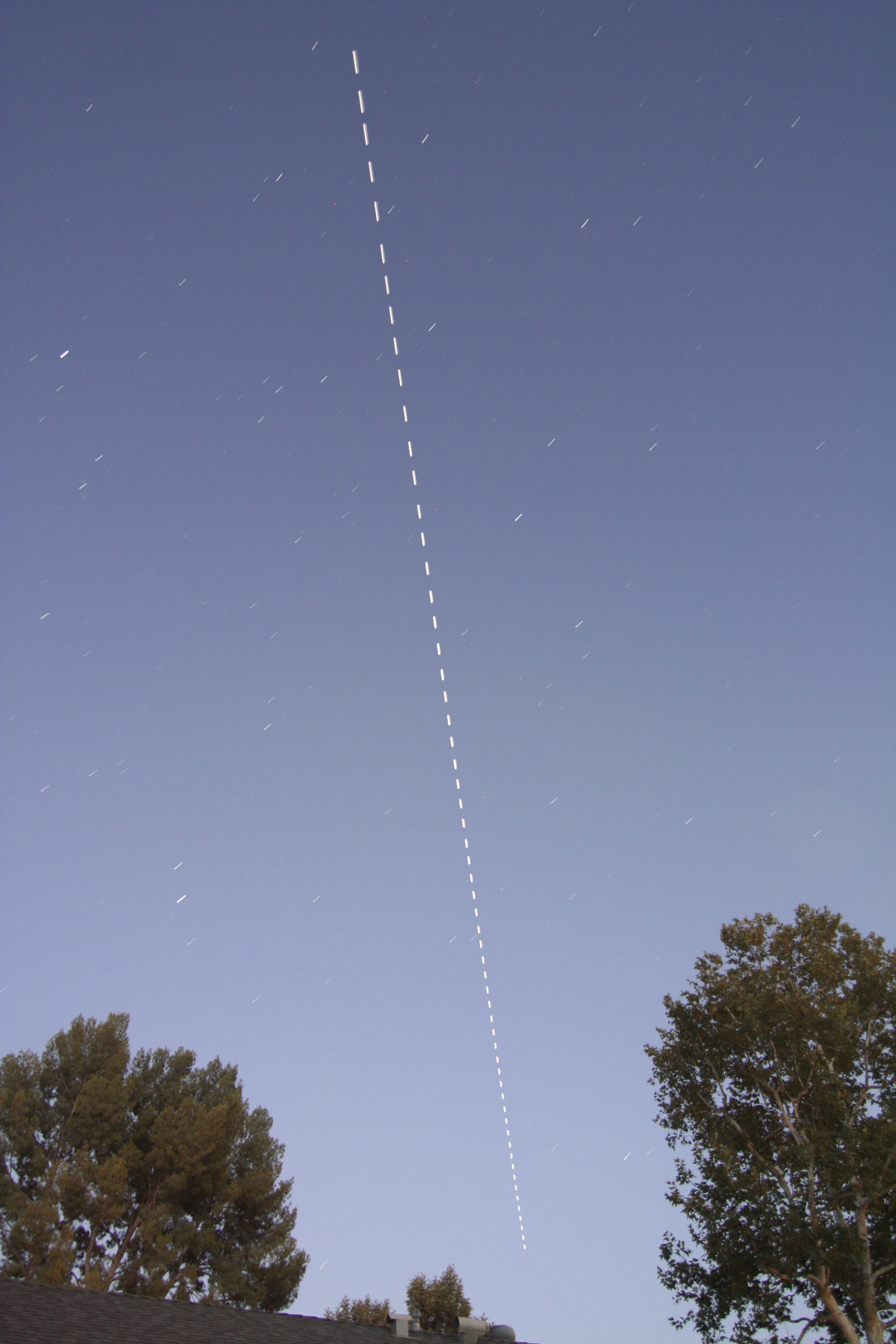
But for tonight, there was a spectacular, almost horizon-to-horizon pass, going almost through the zenith (87º maximum) and at mag -3.8.

The problem was that it was just a bit too early and too bright to be taking longer (3 or 4 second) exposures, and even one-second exposures would be bright and potentially overexposed. But taking shorter exposures, as we’ve learned, can overwhelm the older camera and memory cards, taking pictures faster than they can be saved.

I took a shot at it, with one-second exposures and about one-second pauses between photos. The end result came out great, heading from just before the zenith to the eastern horizon, although it looks a bit more like a dashed line than normal, with the gaps being the longer pauses between shots to give the camera time to keep up.

I like it!

This is that wide angle, “light bucket” lens that I like so much, with an easy and almost perfect focus at infinity, so it looks clean and sharp. Later I went out when it was fully dark and played with what it would do in LA’s light polluted and slightly hazy skies, with interesting results. I’ll share those in the next couple of days after I get some time to go through them.

Leave a comment

Filed under Astronomy, Photography, Space

ISS Pass – July 14th

It’s “high beta-angle” season on the ISS – short version without getting into too many discussions of orbital mechanics (maybe some other time…) is that for a few days the ISS is in the sun 24/7, so if it’s in your night sky it’s highly visible. There are some great passes coming up this week for most places, sometimes both in the sunset hours an hour or two after sunset in the evening and in the pre-dawn hours in the very early morning.

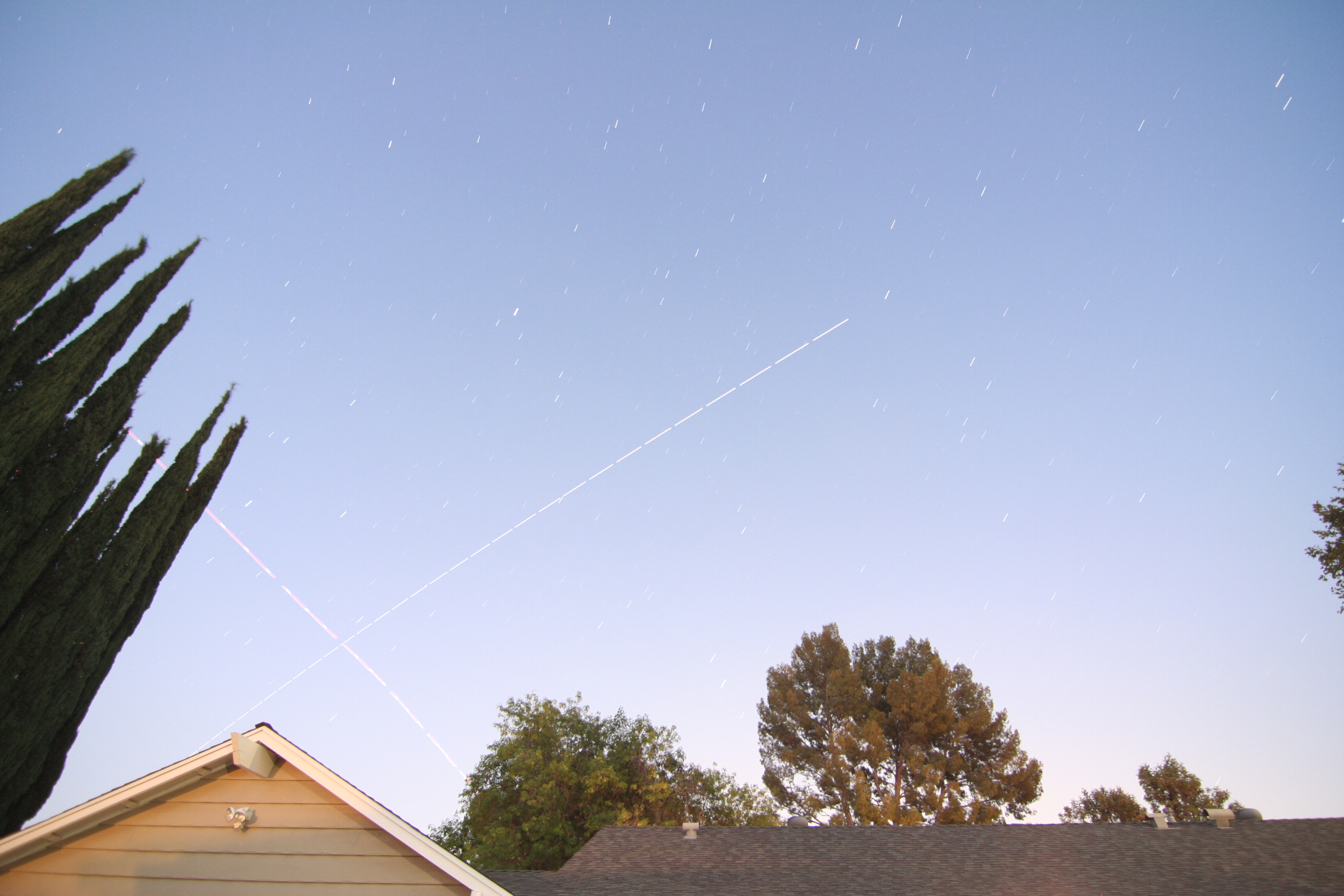
(Click to see it BIG – it’s worth it!)

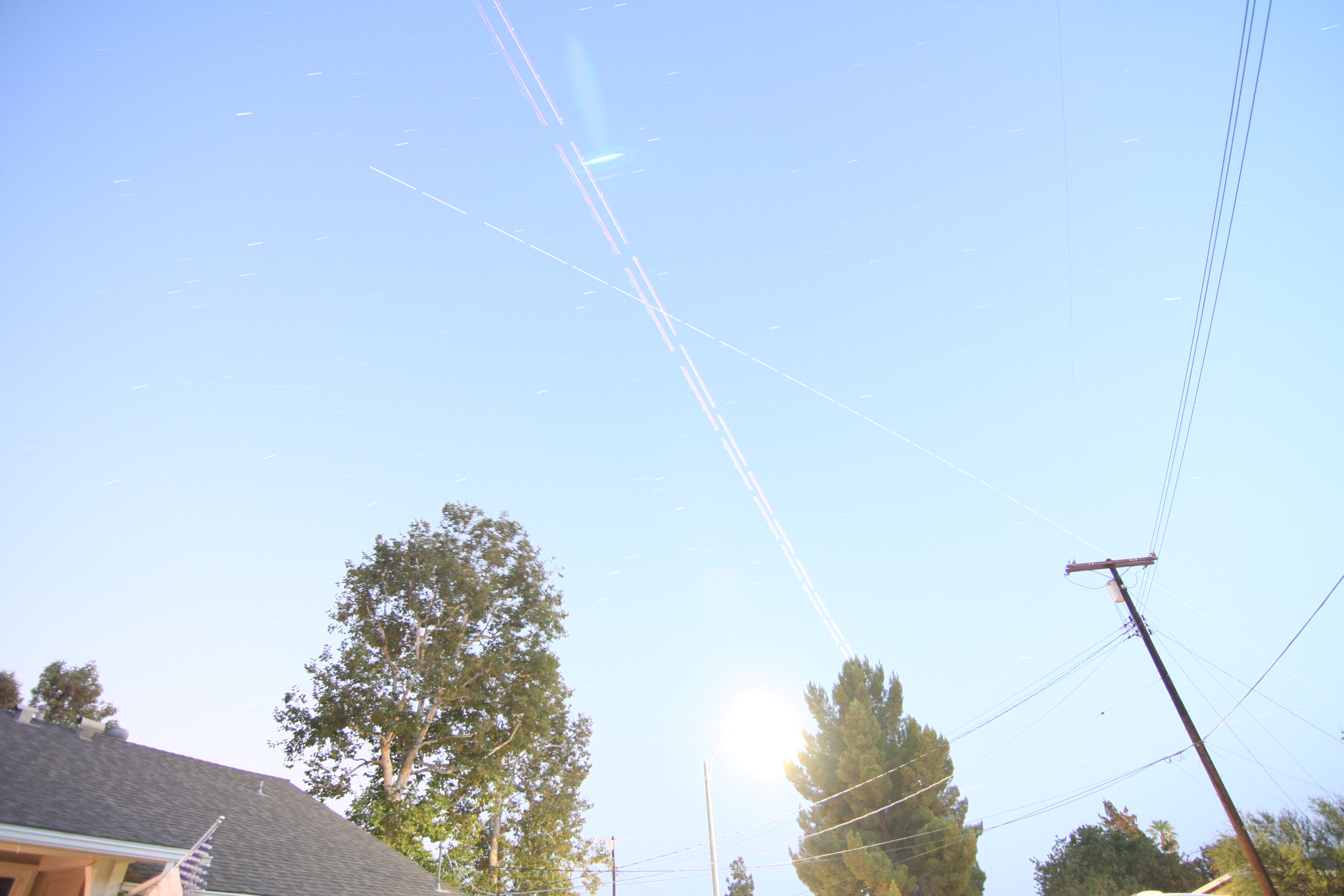
It came up from the south-southwest (lower right, behind the telephone pole) and headed close to the zenith (i.e., directly overhead). One problem is that honkin’ big streetlight right there, which in turn caused caused those UFO-looking lens flares at the top. They’re reflections, not UFOs, which I guess makes them IFOs.

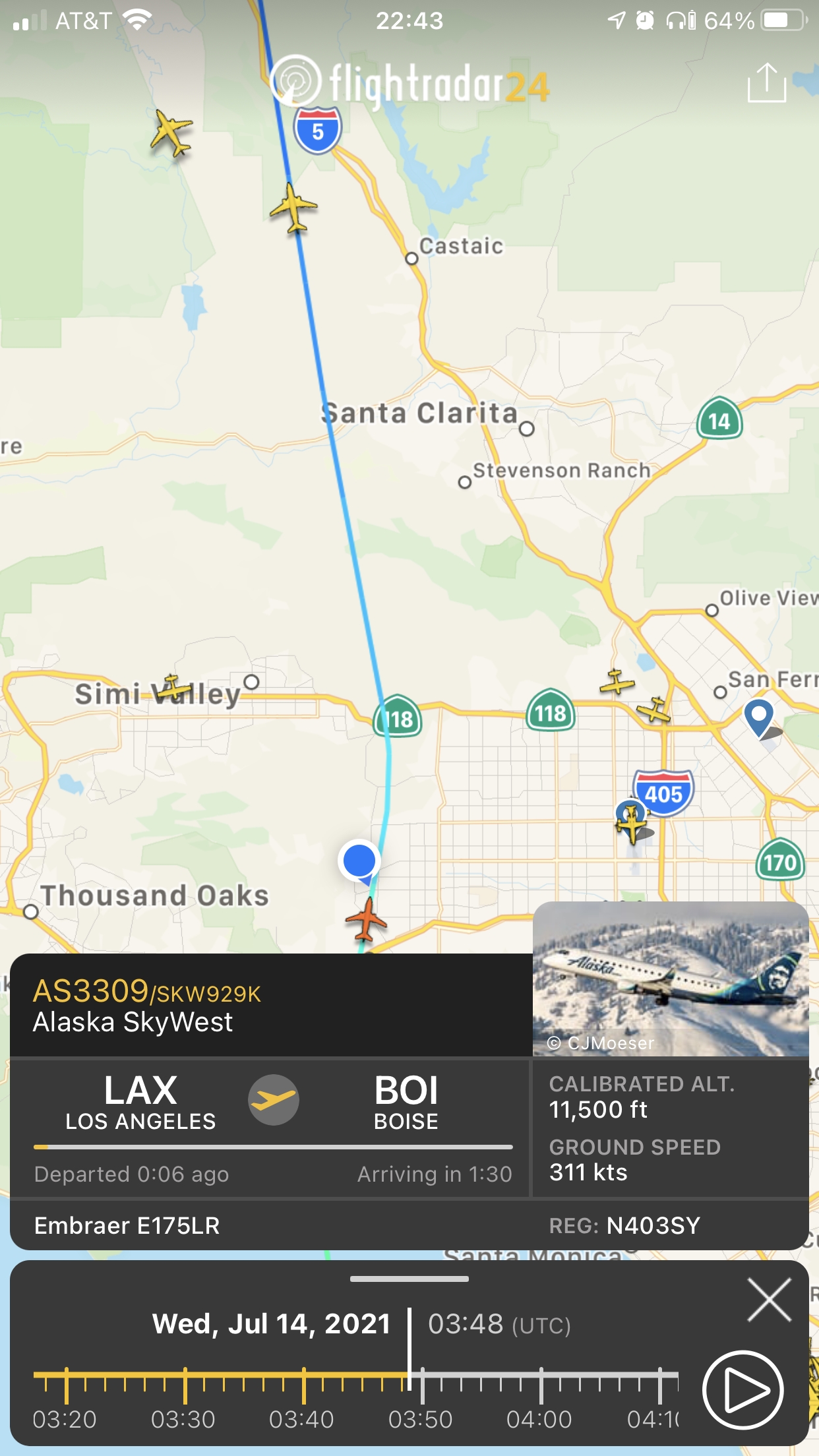
The second problem is those two jets coming out of LAX. The one on the right is Alaska SkyWest flight #3300 headed toward Boise…

(Image from FlightRadar24 app)

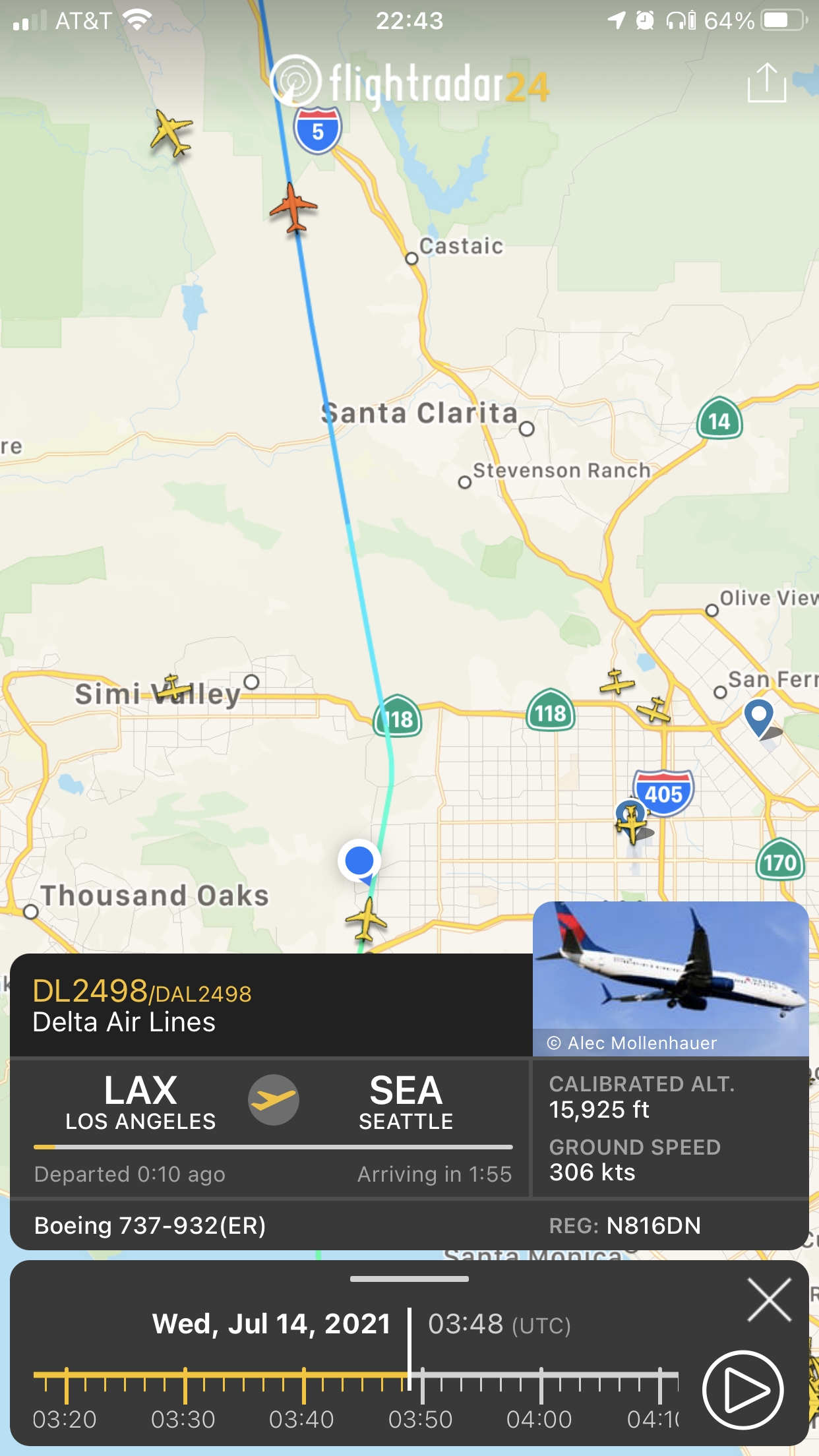
…while the one on the left is Delta flight #2408 to Seattle. Bye, guys!!

(Image from FlightRadar24 app)

The bigger problem is that it was barely an hour after sunset, not very dark, a little hazy so we got some reflected light pollution dancing around. I tried at first doing 1-second photos to keep the sky from over exposing, but I was also saving photos in RAW format in addition to JPG format and with a shot every second the camera couldn’t keep up with storing the images. So I switched to 4-second exposures and hoped for the best. “The best” in this case is a bit over exposed.

But then it swung through the zenith (center right) and headed down toward the north-northeast horizon (lower left). That sky didn’t have a street light or lens flares in it, and the sky was darker to the east, so the background light didn’t overexpose the frames quite as much. And that plane is unidentified, but it sounded like a Cessna or Cirrus, probably out of Van Nuys.

Lessons learned tonight? Again, I love this lens. Not much I can do about how bright or dark the sky is. But there are a number of opportunities for great evening passes for the next few days still. If you can, check out some of the NASA or other websites for ISS tracking to see if there’s a pass for you this week, or better yet, check out the Heavens-above.com site for pass predictions and maps.

Finally, there are also a number of opportunities for great morning passes for the next few days. You won’t see any pictures of those here. I don’t get to bed until nearly 1AM and I’m up a very few short hours later. I’m not getting up at Oh-freakin’-dark-thirty just to see a morning ISS pass. Sorry!

2 Comments

Filed under Astronomy, Photography, Space

Planetary Conjunction – July 12th

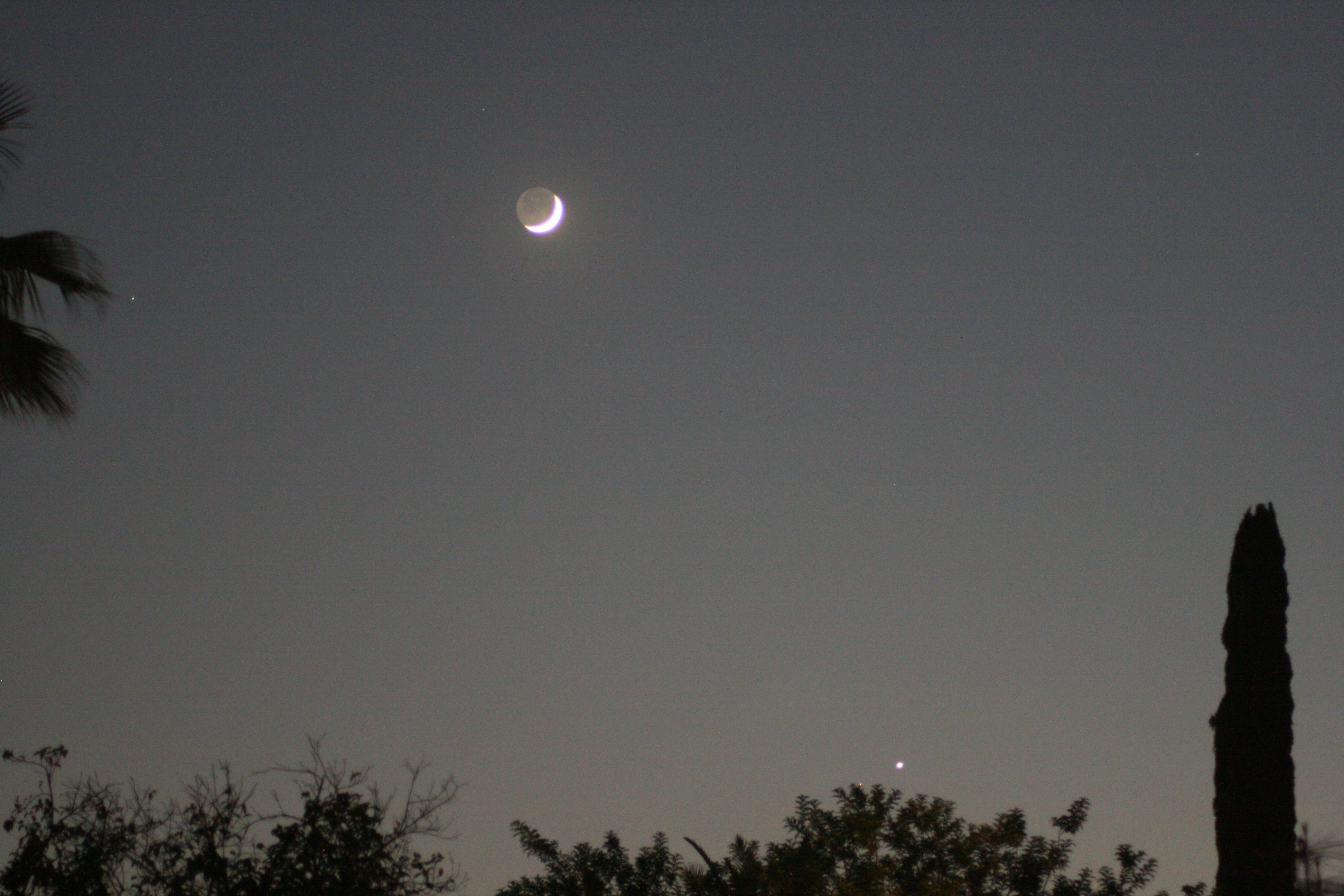
Celestial mechanics, right there in plain sight. Yesterday’s photos + 24 hours (give or take a few minutes).

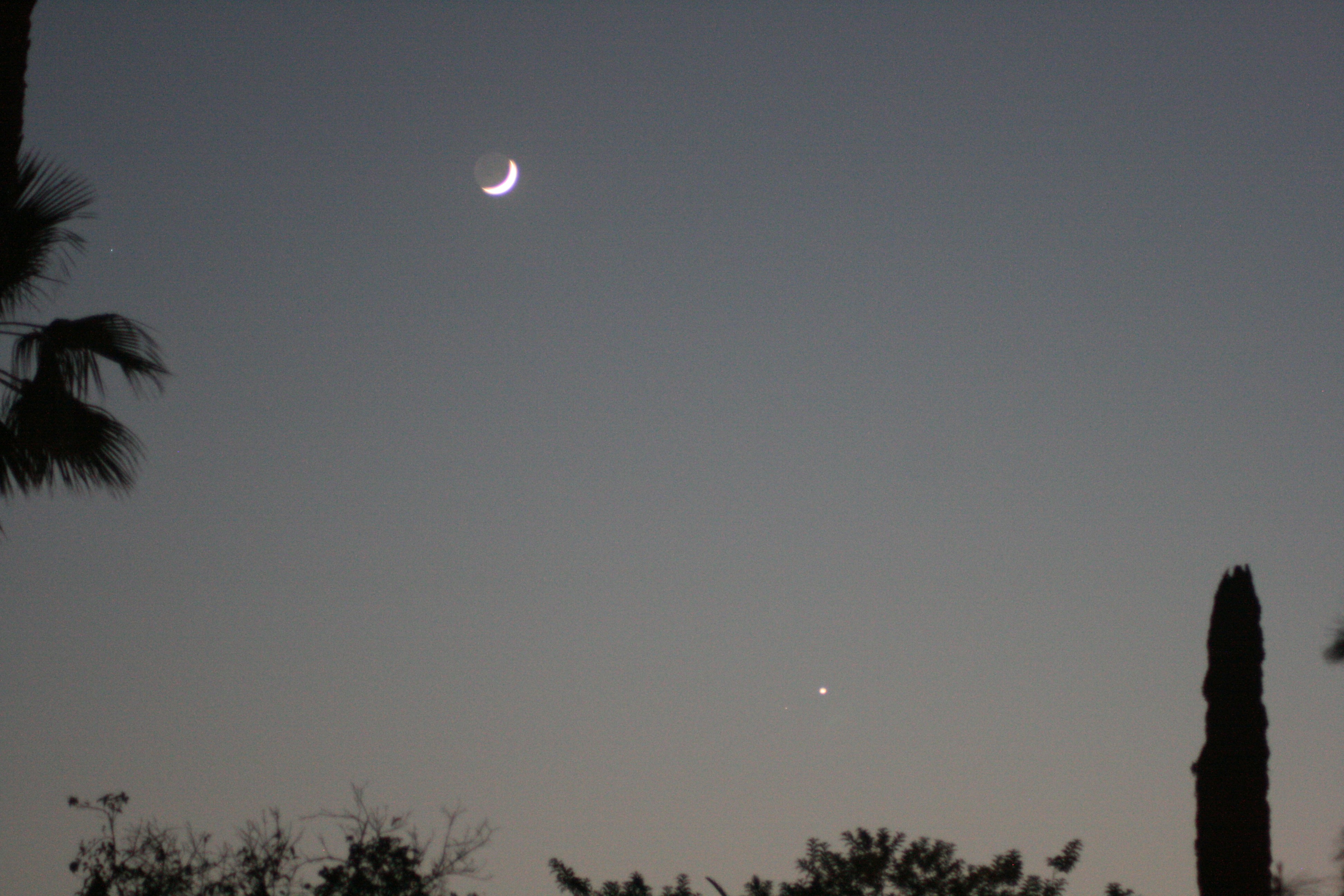
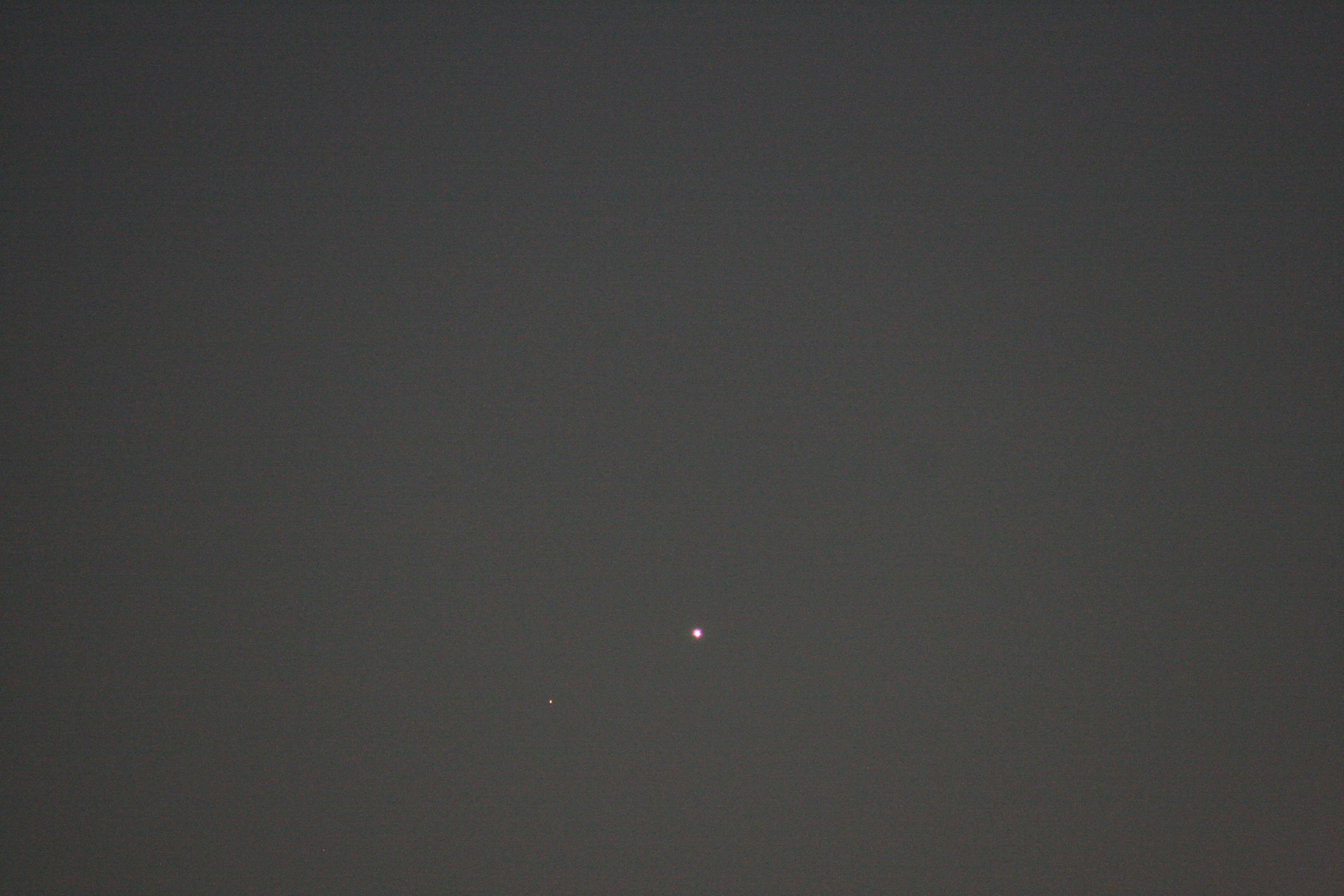
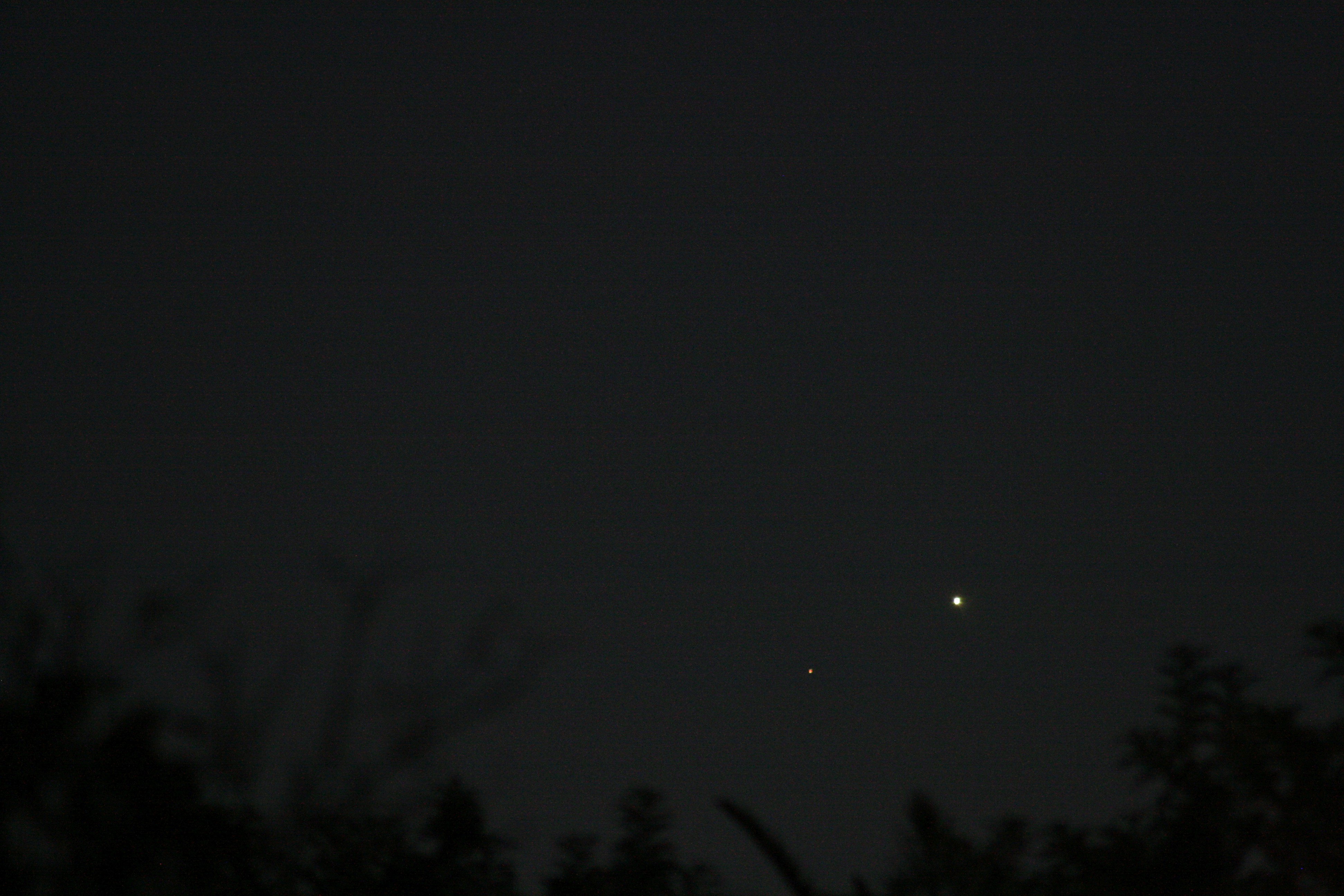
Mars is fading, as expected. Needed binoculars to see it, and you’ll probably have to click to see the full-sized image to see it here.

There it is! Just about eight hours from their (apparent!) closest approach to each other. The word “apparent” is key here. Remember, we’re all gravitationally bound (for the moment) to giant balls of rock, water, and gas, which are in turn spinning on their axes, which in turn are in orbit at thousands of miles an hour around a small, yellow, G-class star, so while they look close together from this particular point of view, they’re actually 74,400,000 miles apart from each other.

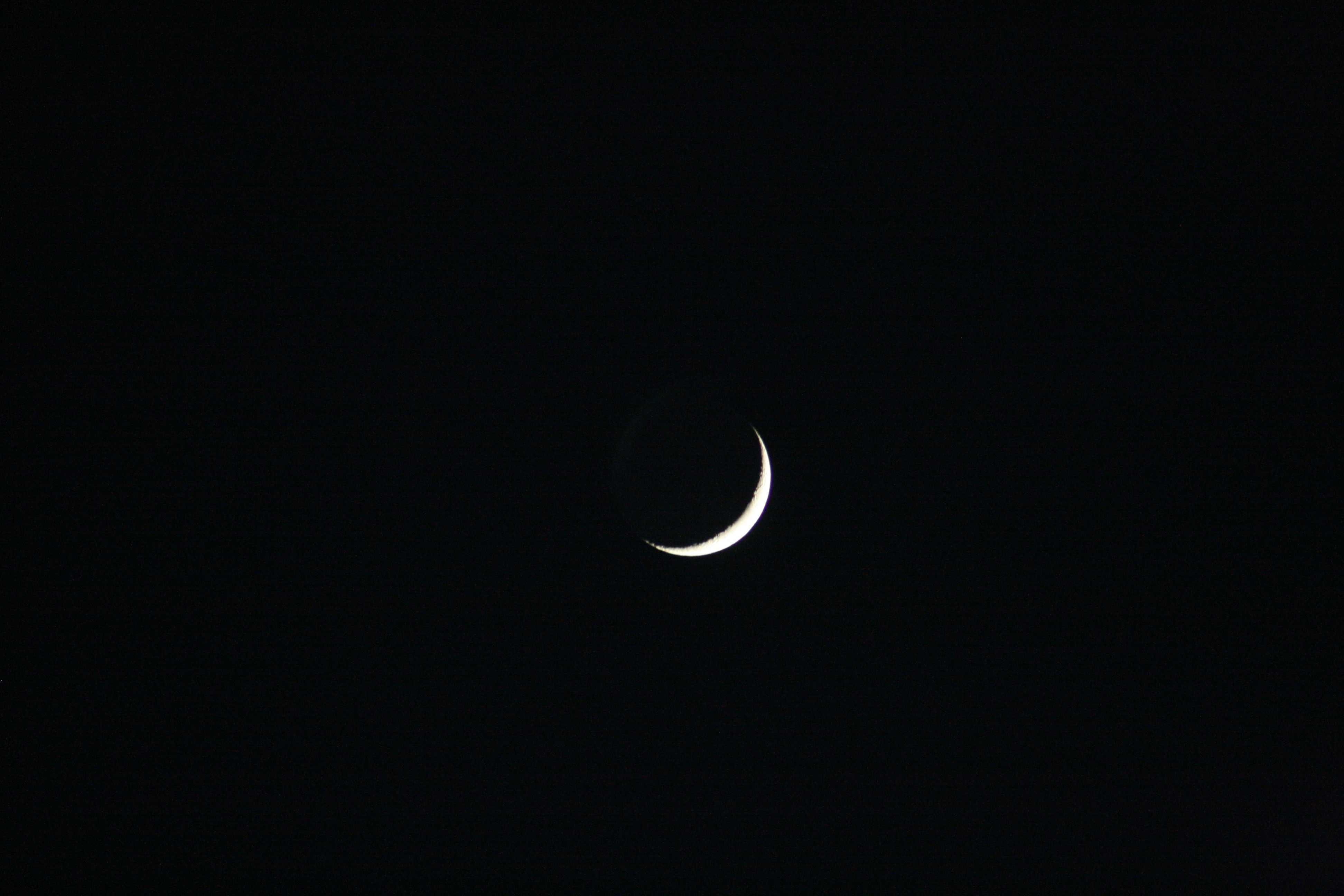
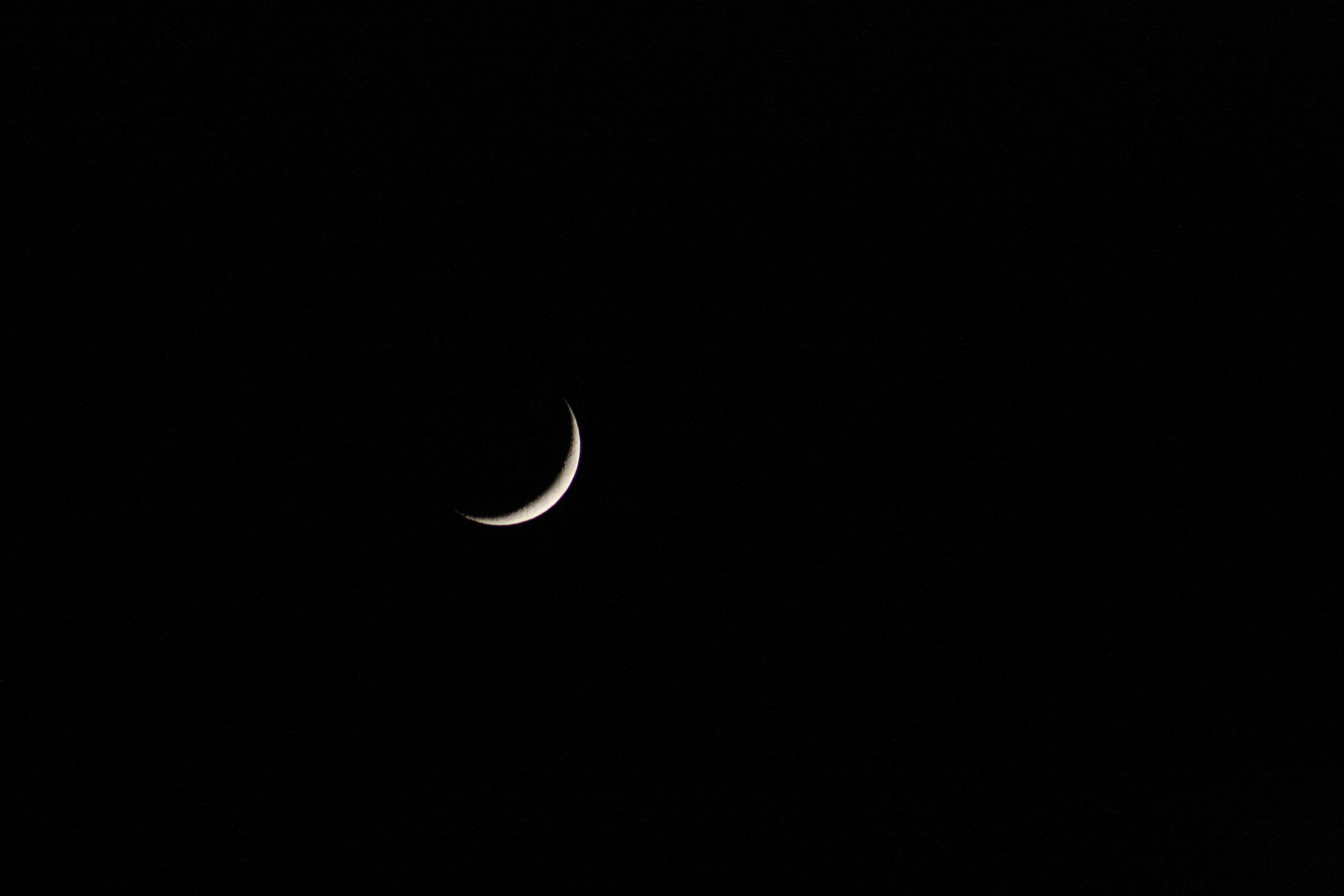
This is much closer, which is why even with a relatively simple and cheap camera system you can see craters and other features.

Aside from all of that, it’s simply very pretty to look at in the cooling evening sunset.

Then our 3rd rock from the Sun spins from in front of this view back over my head and behind us, causing the planets and Moon to appear to sink below the western horizon.

There they go, down behind the trees! Once they get down into the muck and coastal haze and we’re looking through a thick chunk of the atmosphere, it’s amazing how much the color from Mars varies every second or two. Mostly a dark orange, but sometimes much less red color and sometimes almost white for a second or two.

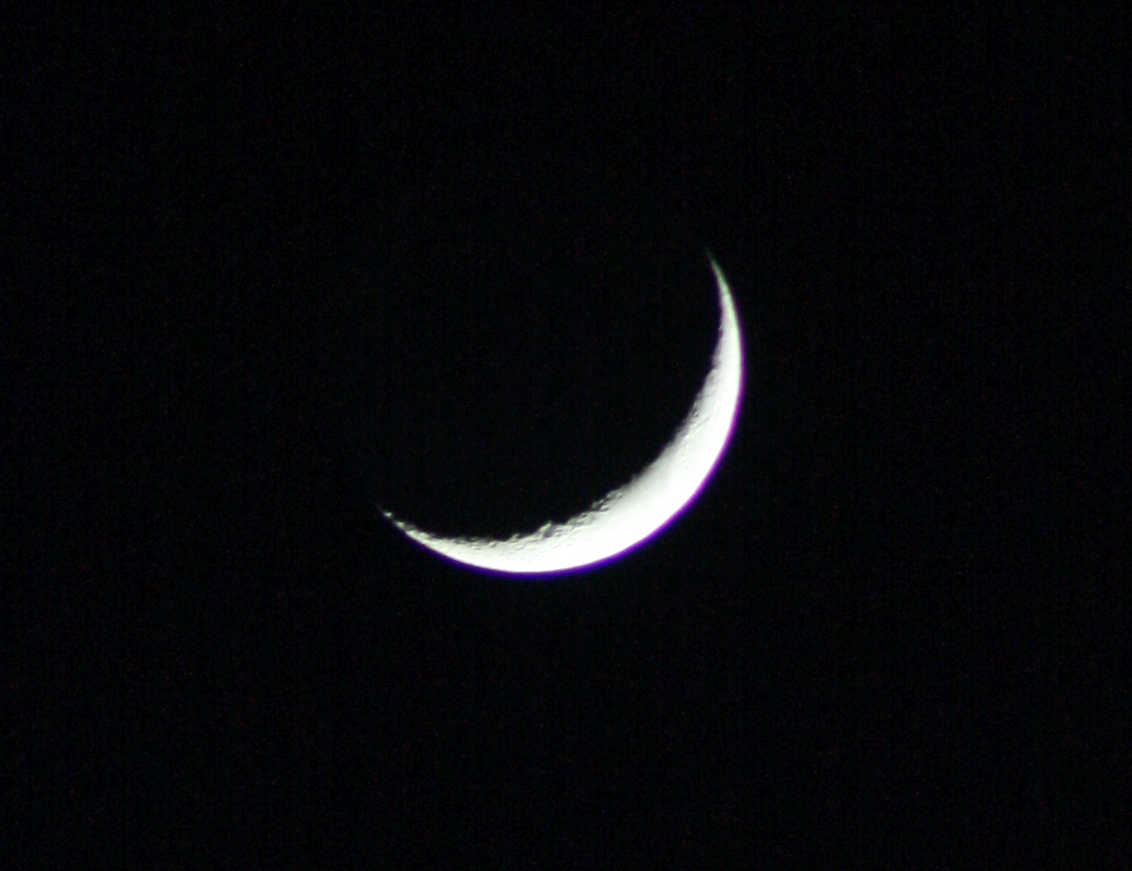
While the Moon, exposed to bring out detail at the terminator, is a fingernail crescent…

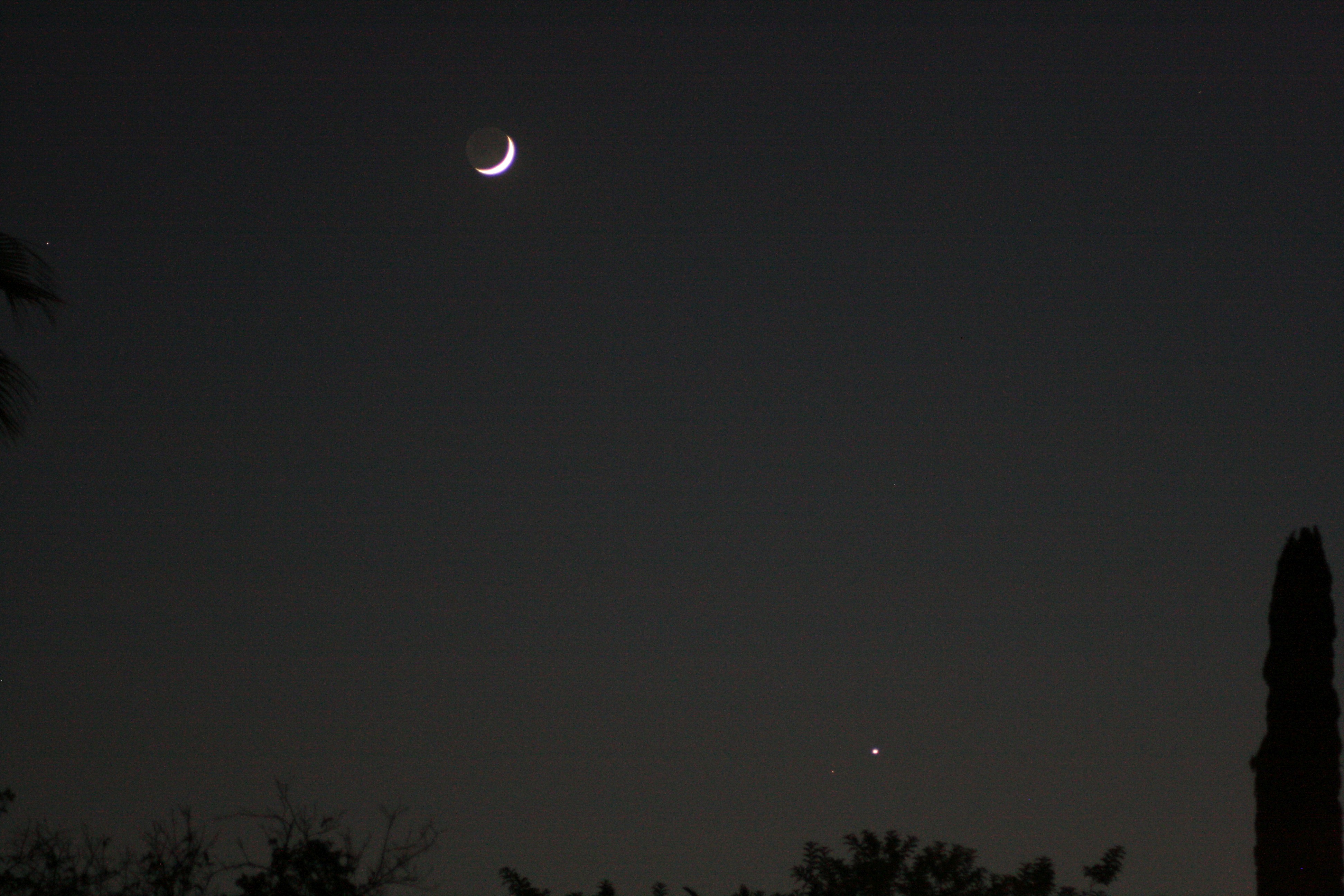
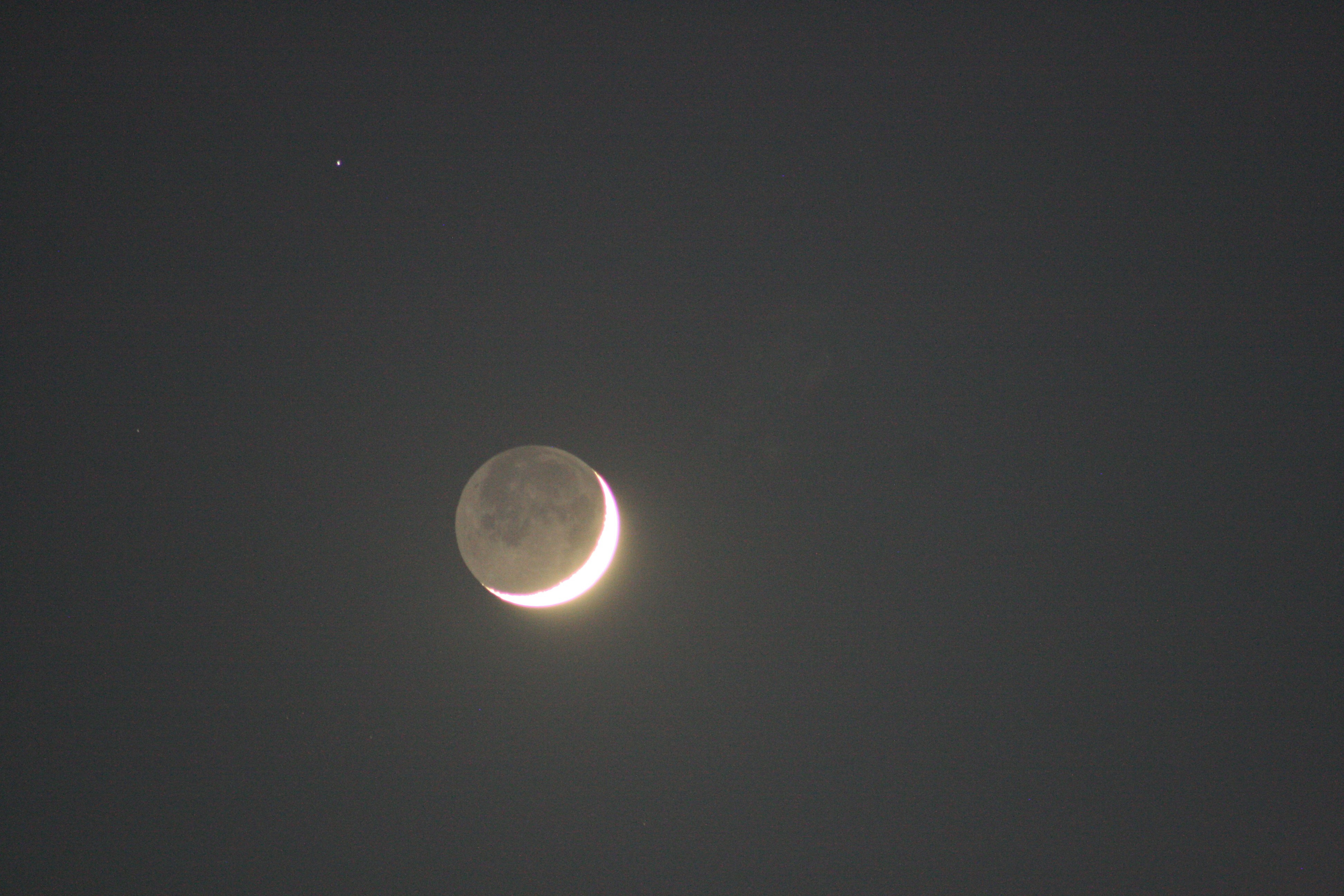
…and exposed to bring out the Earthshine, starts to also share the sky with some of the other background stars in the constellation Leo. (That’s Al Jabbah [Eta Leonis] to the upper left of the Moon, a white supergiant star about 2,000 light years from Earth.)

If you couldn’t look tonight or tried and got foiled by the weather or clouds, try to look tomorrow night! Let me know if you saw this!

Leave a comment

Filed under Astronomy, Photography, Space

From Left To Right – Mars – Venus – Crescent Moon

I think I gave a heads up about this a month or so ago but it snuck up on me.

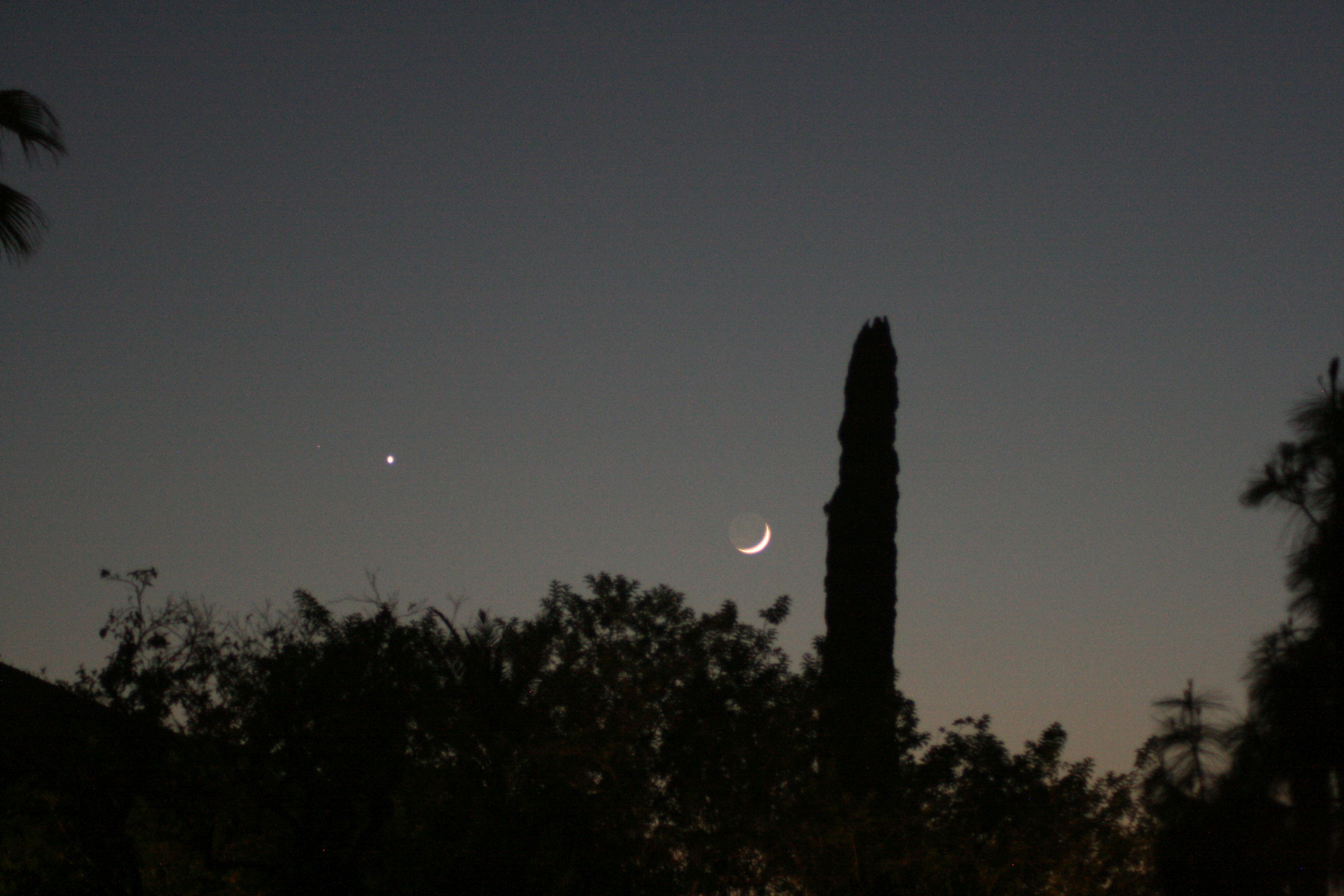
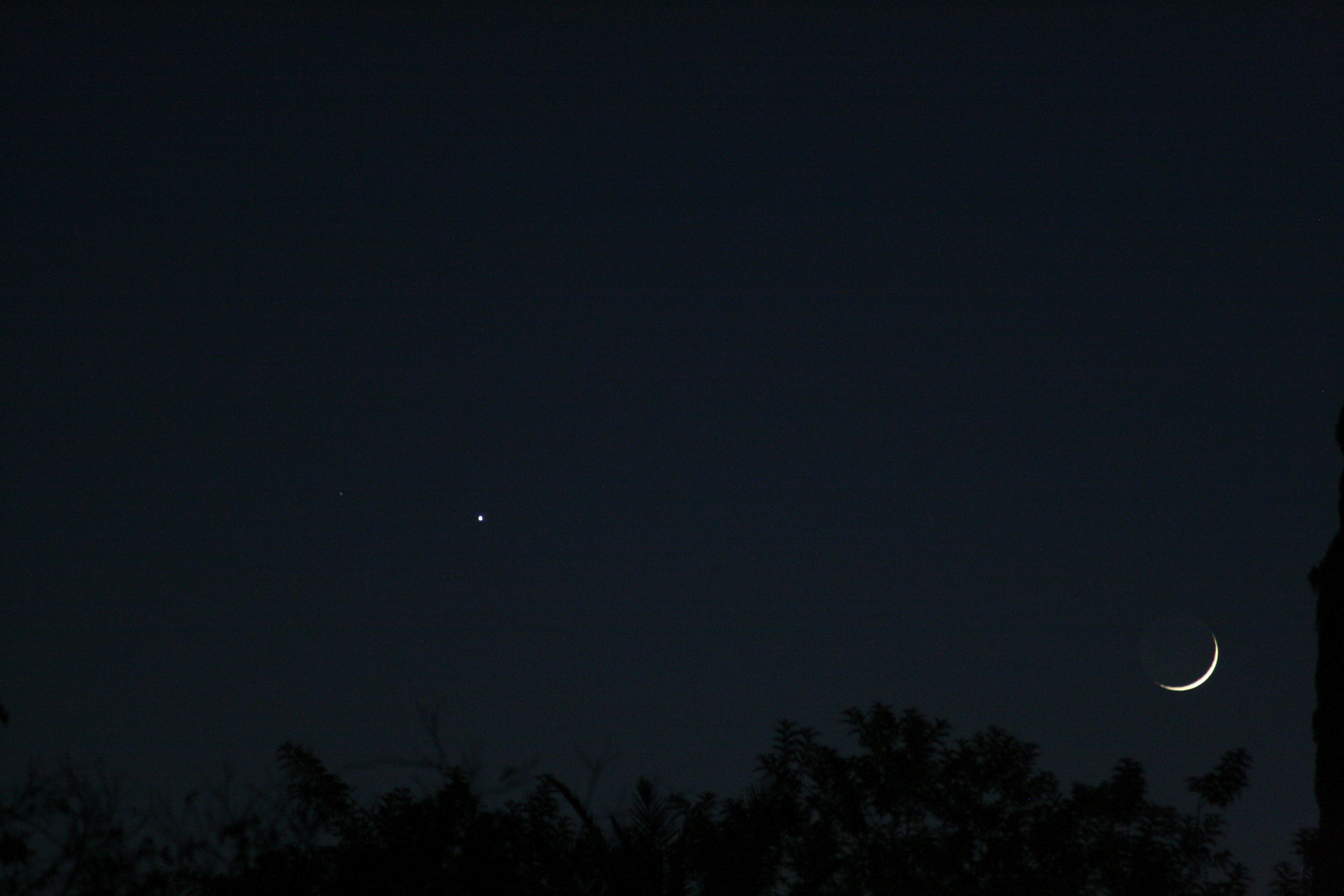
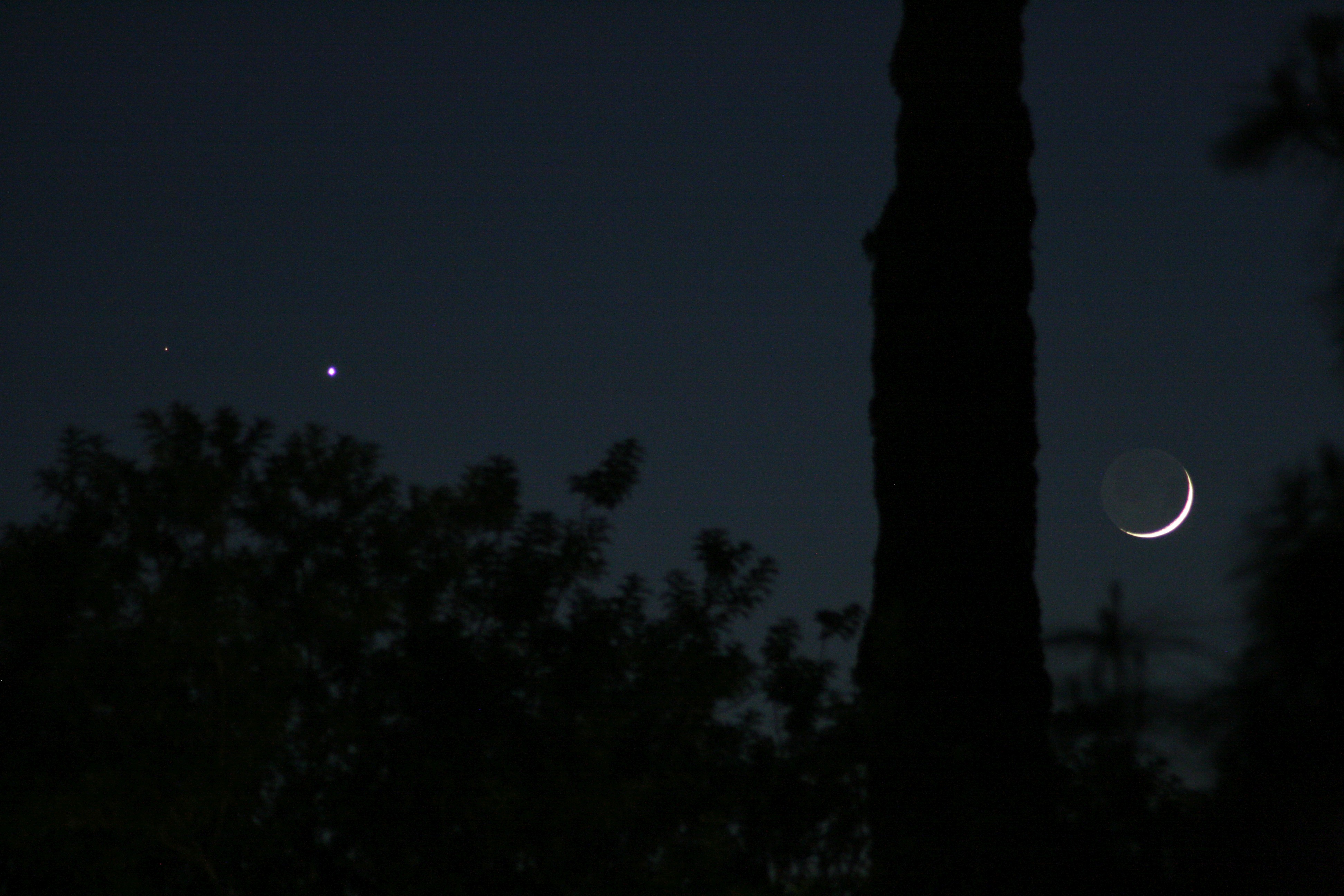
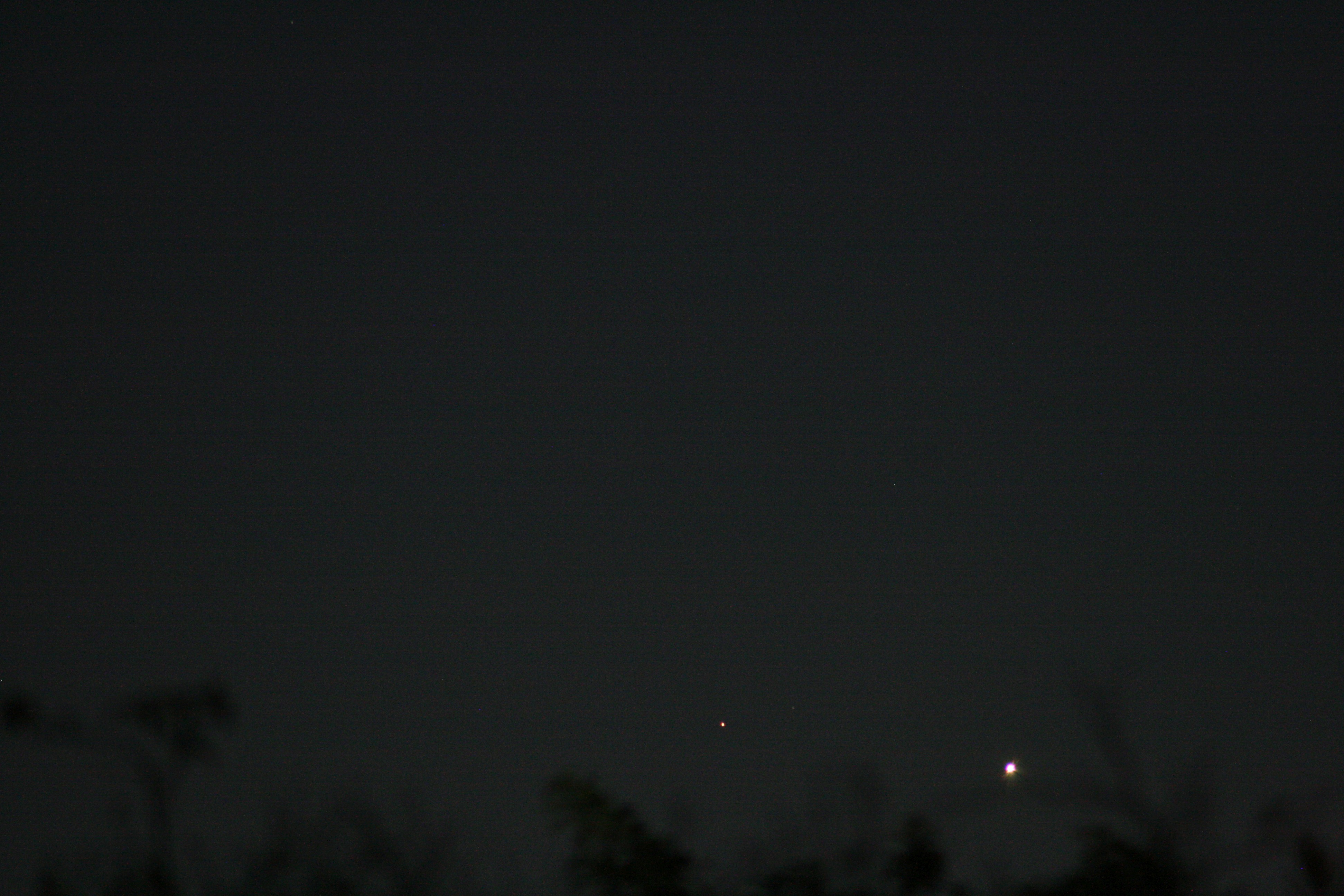
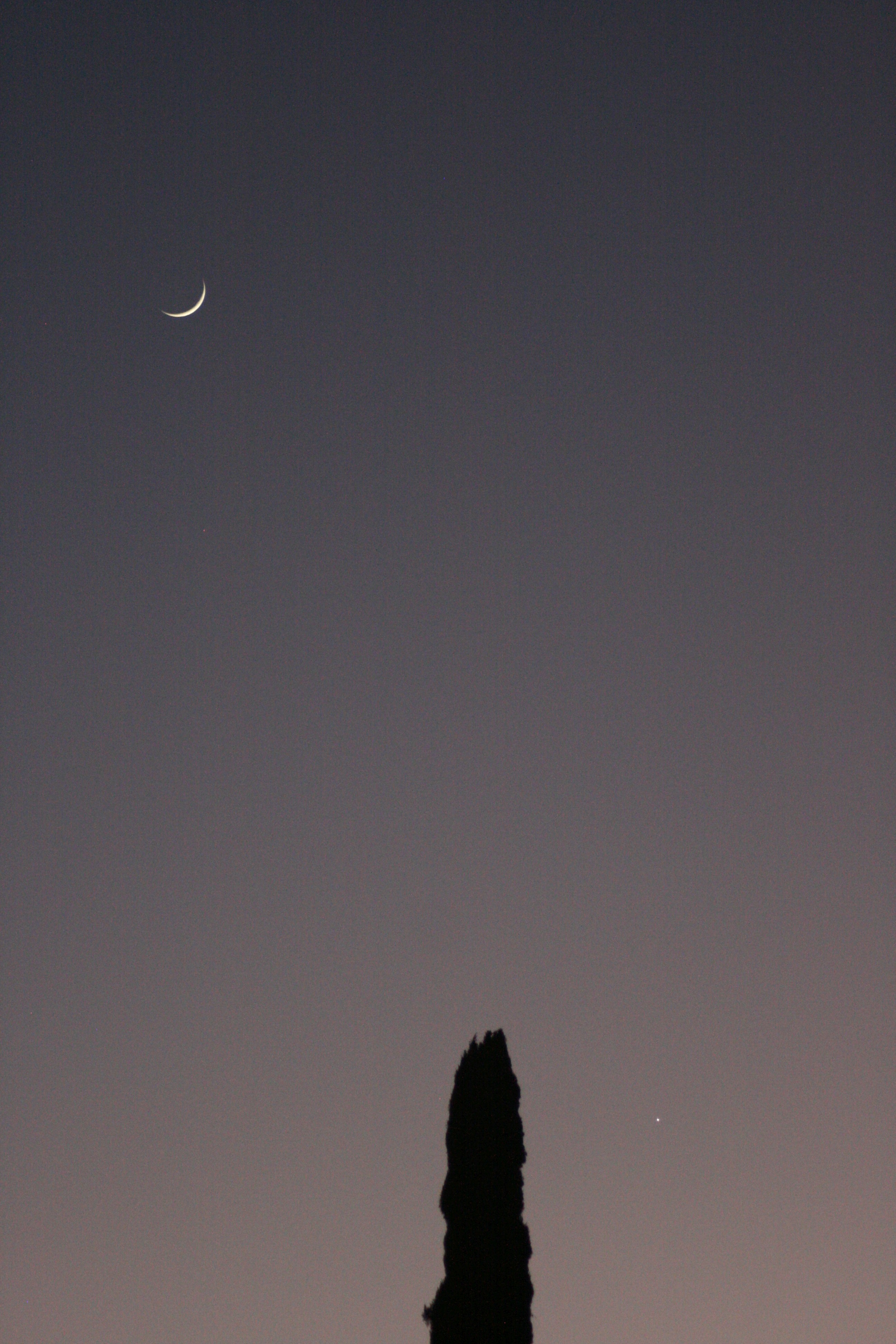
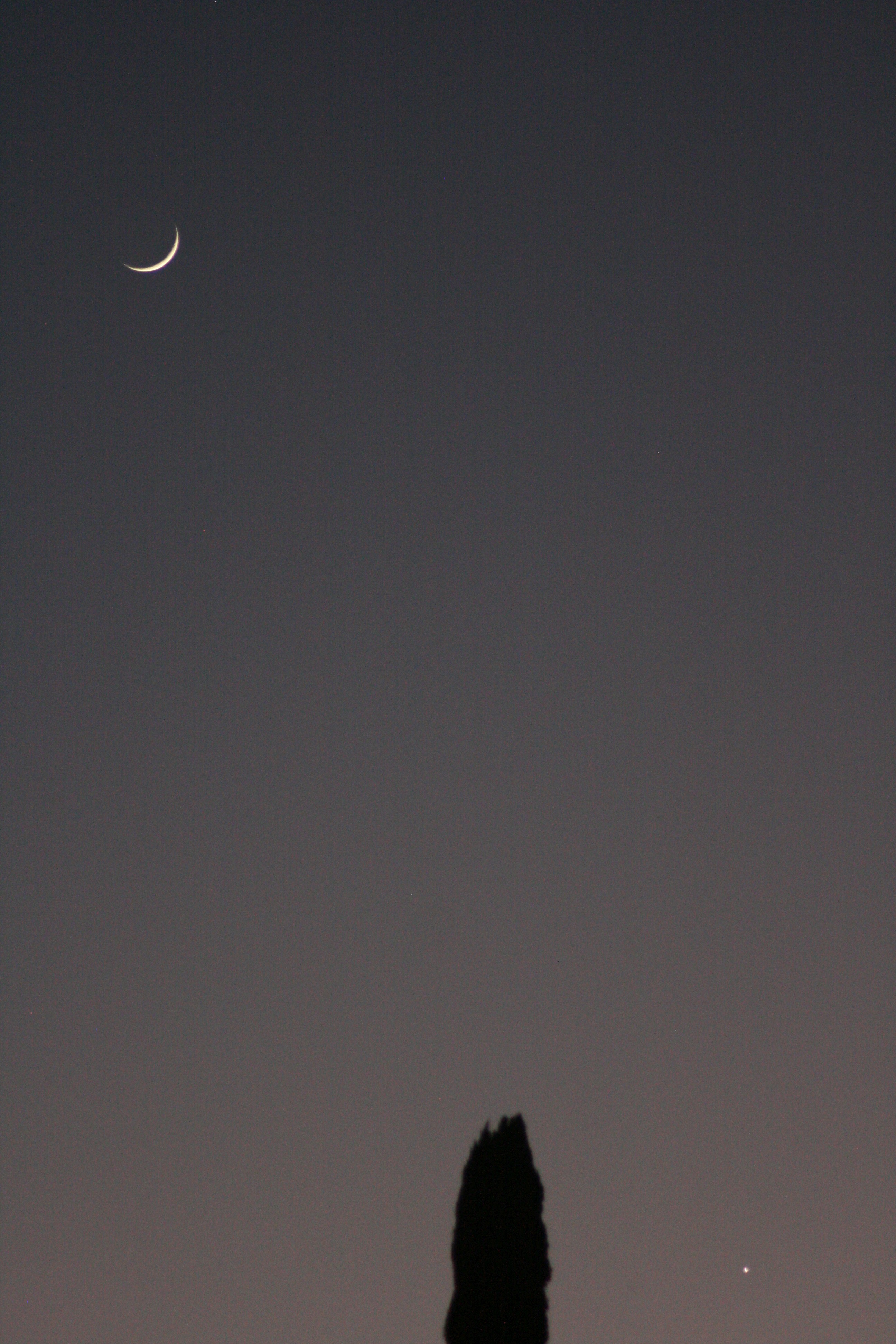
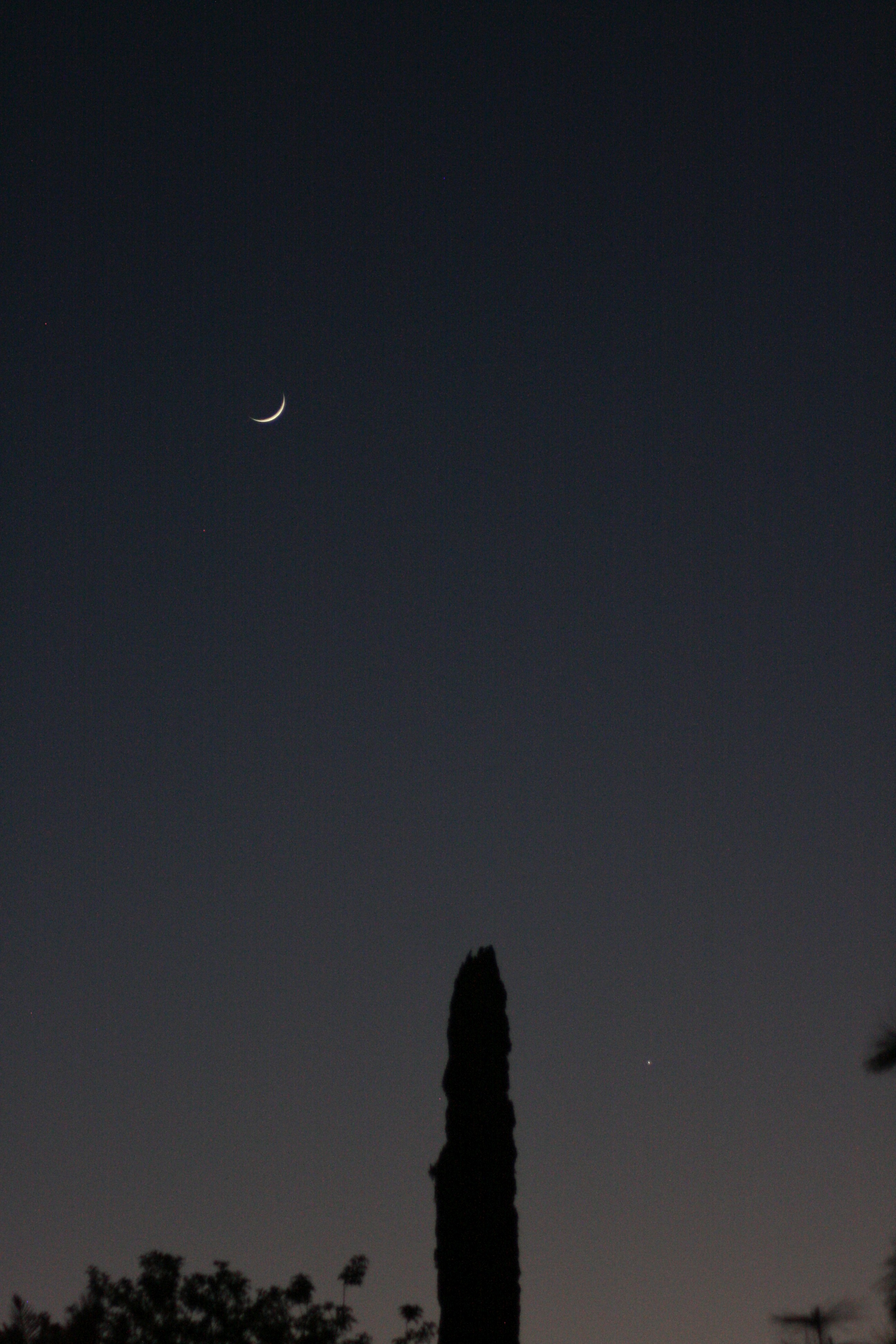
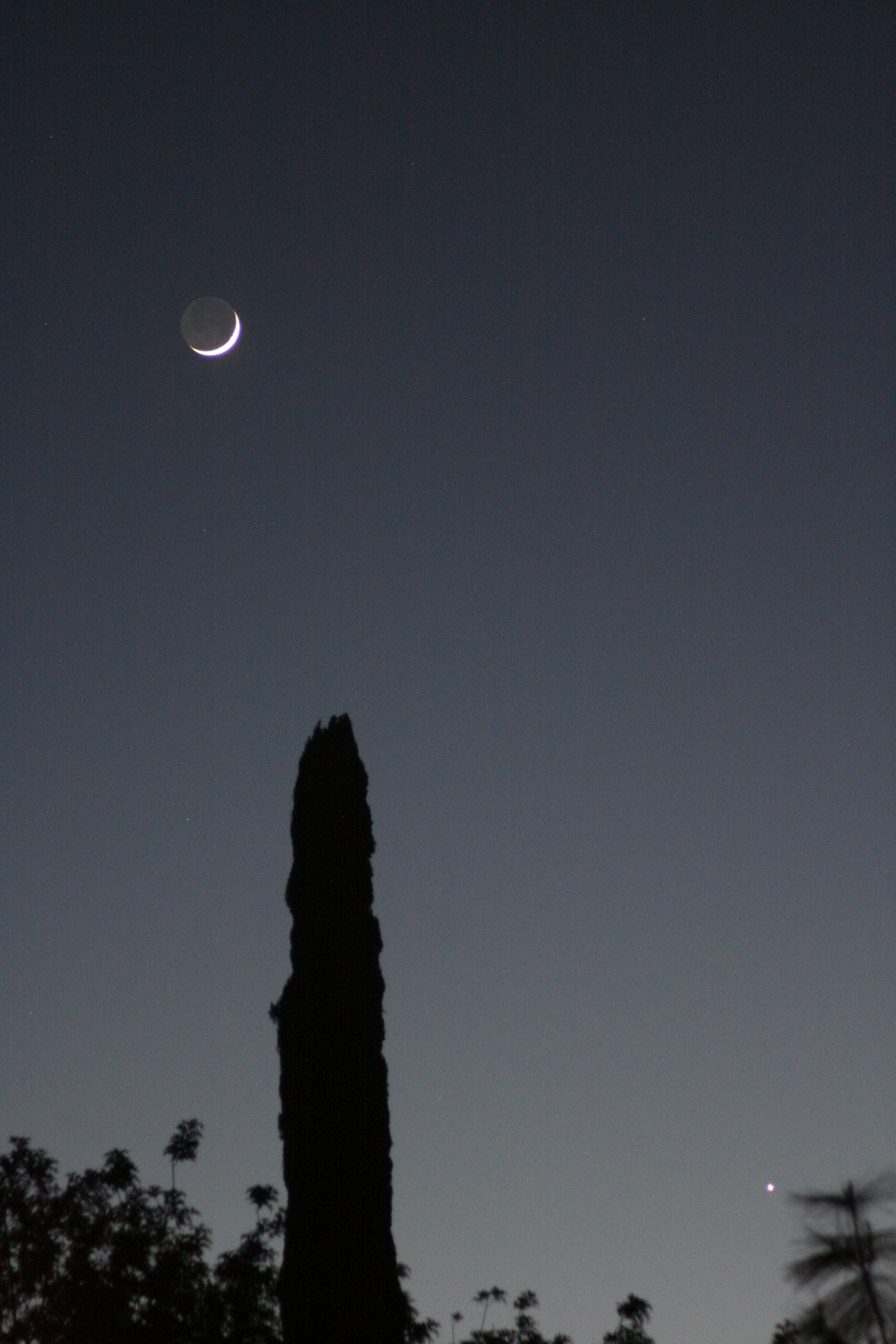
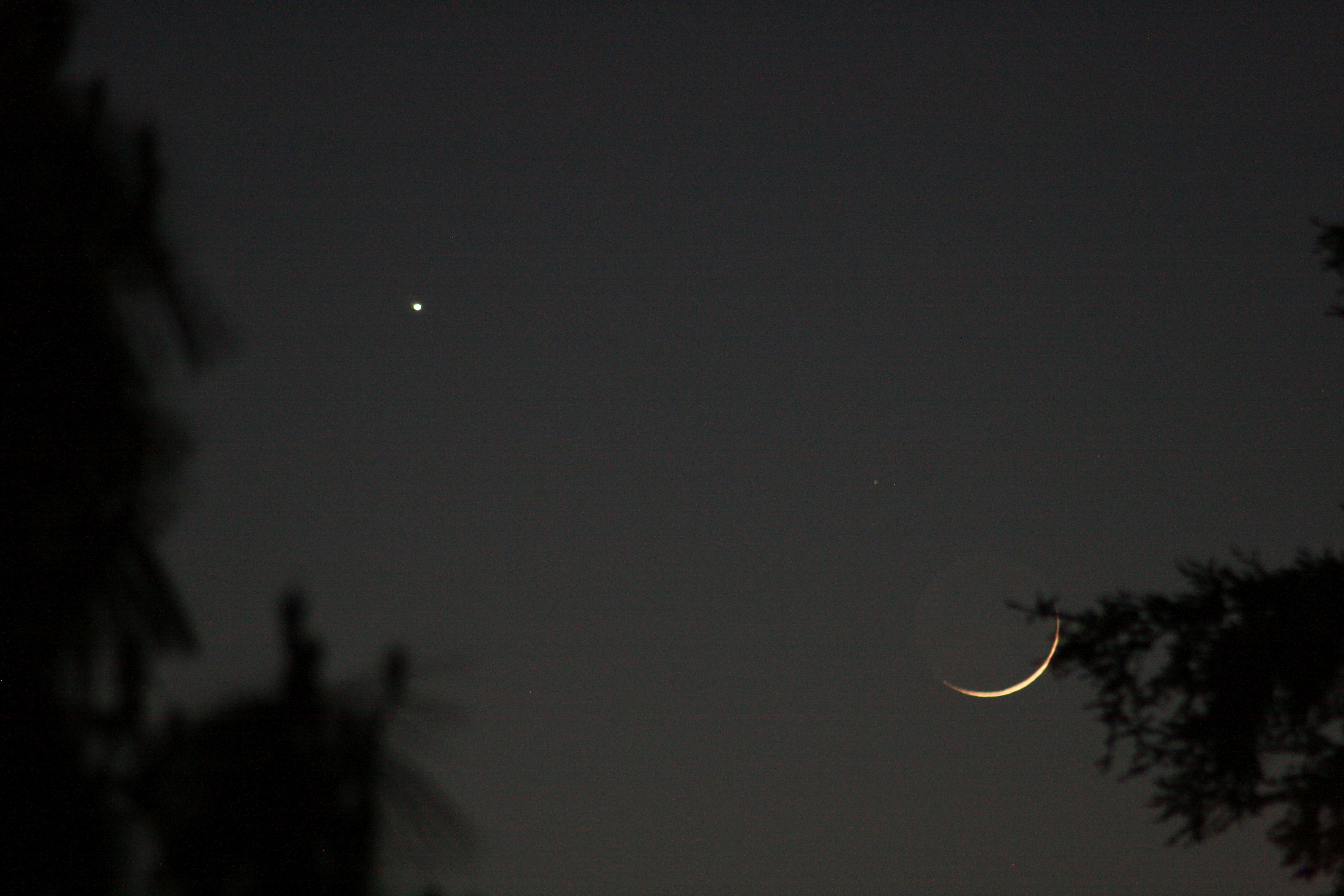
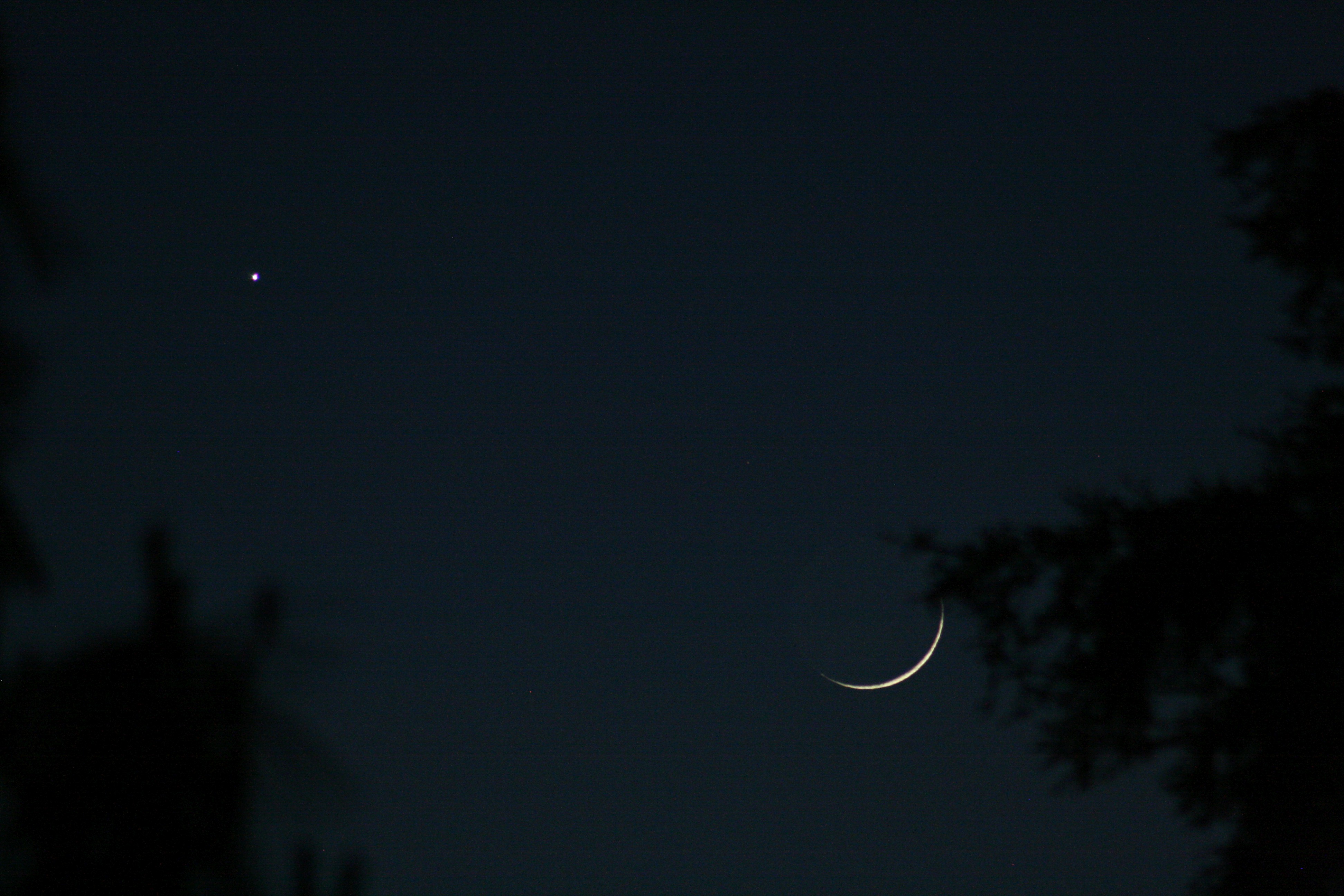
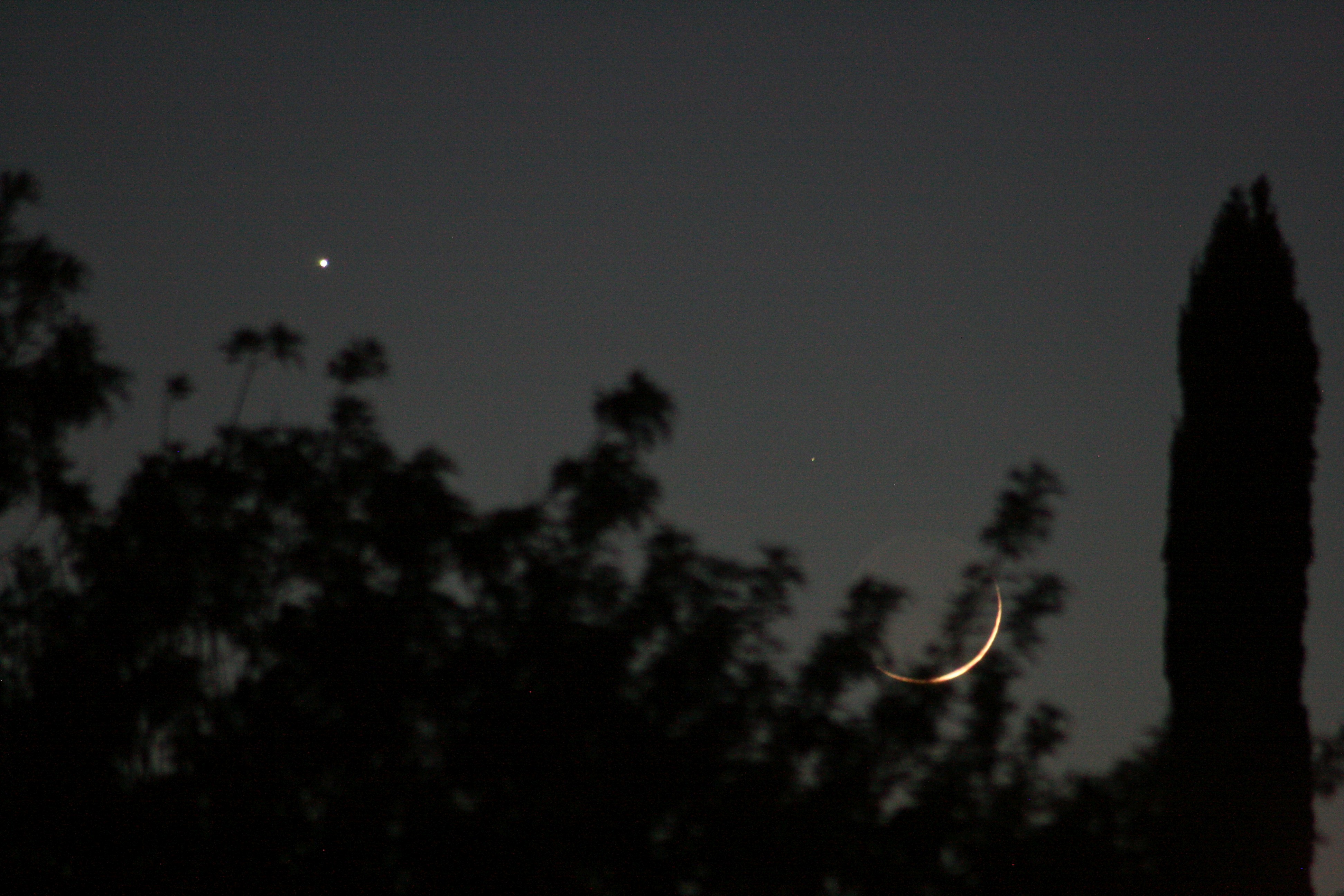
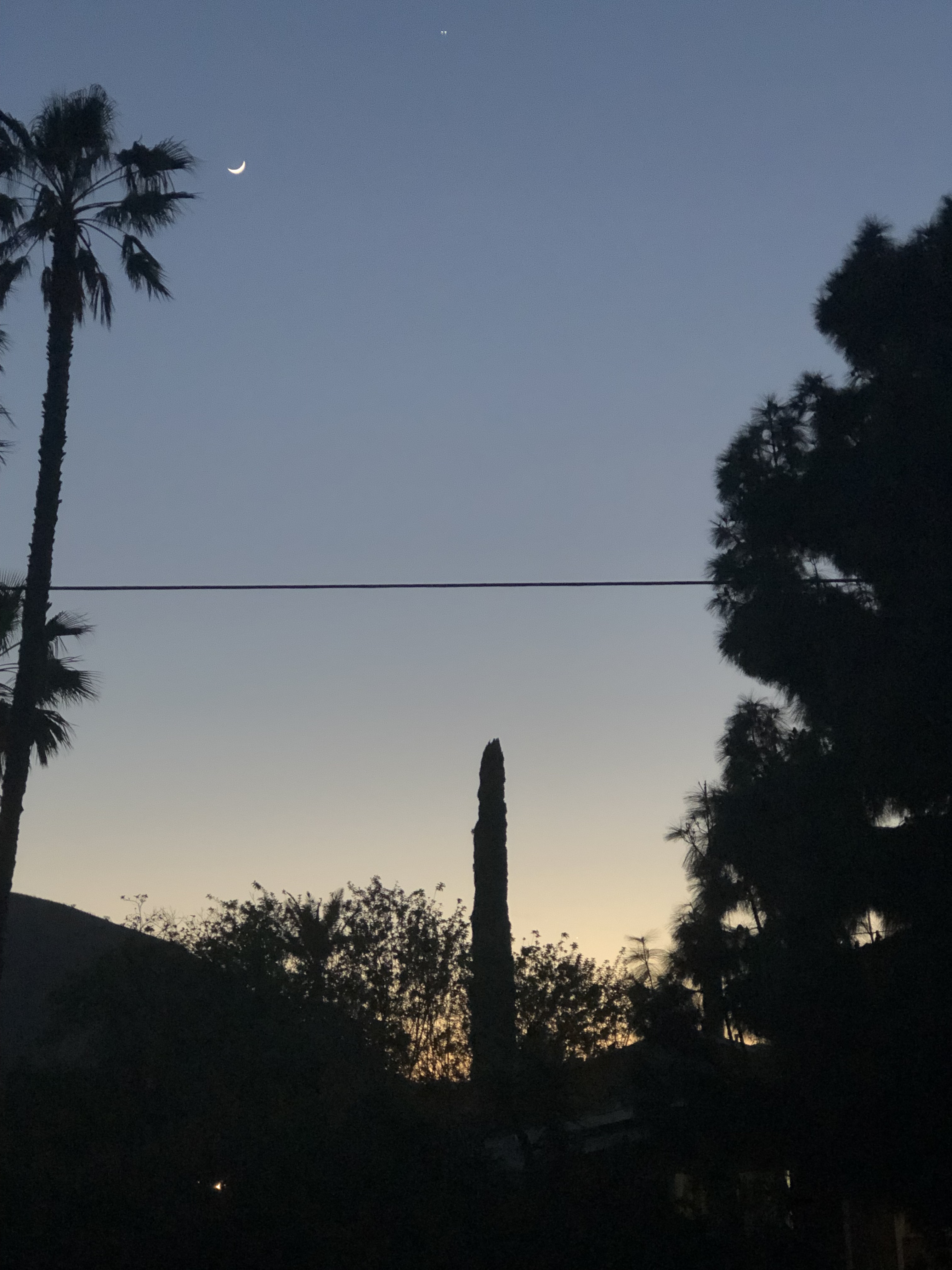
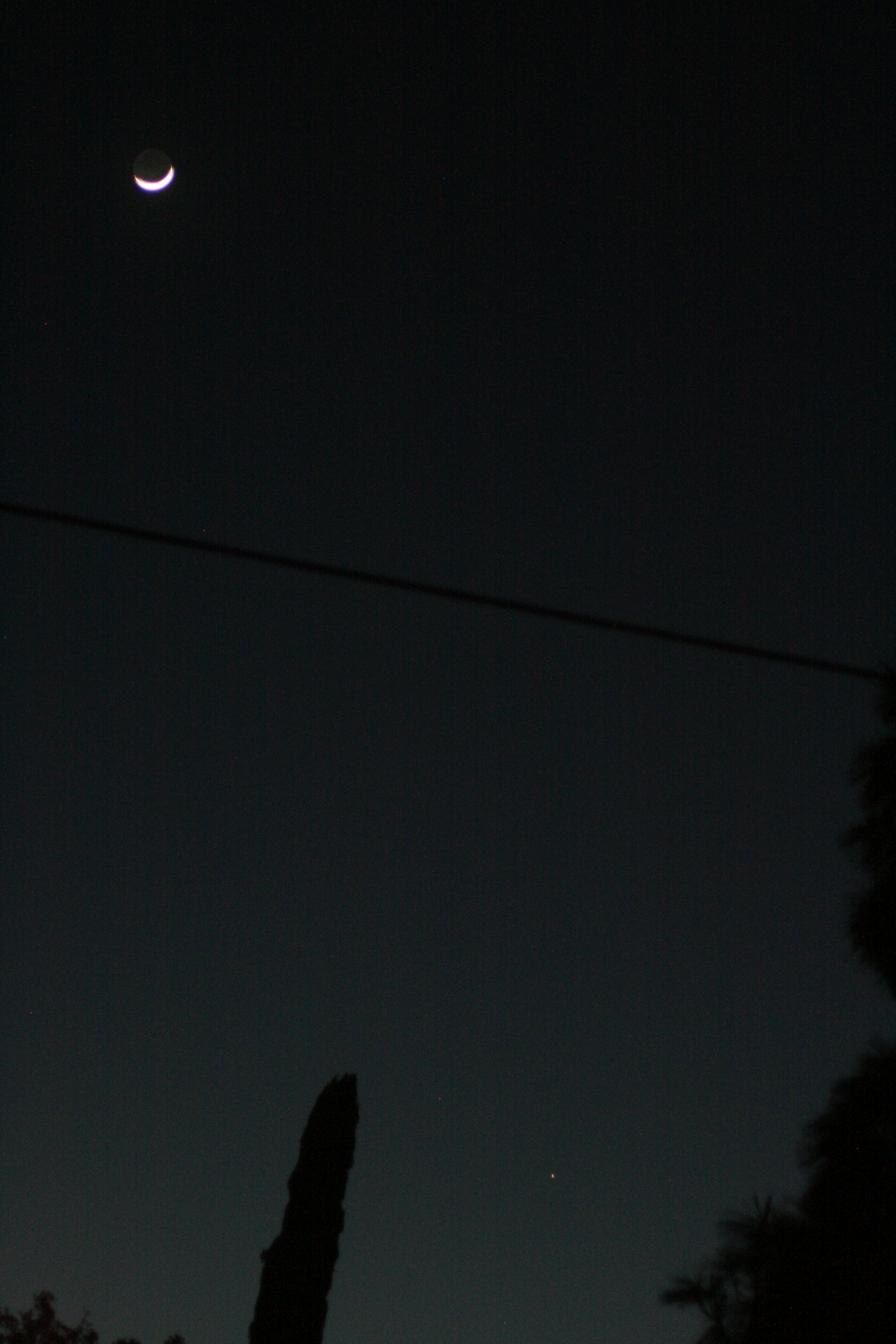
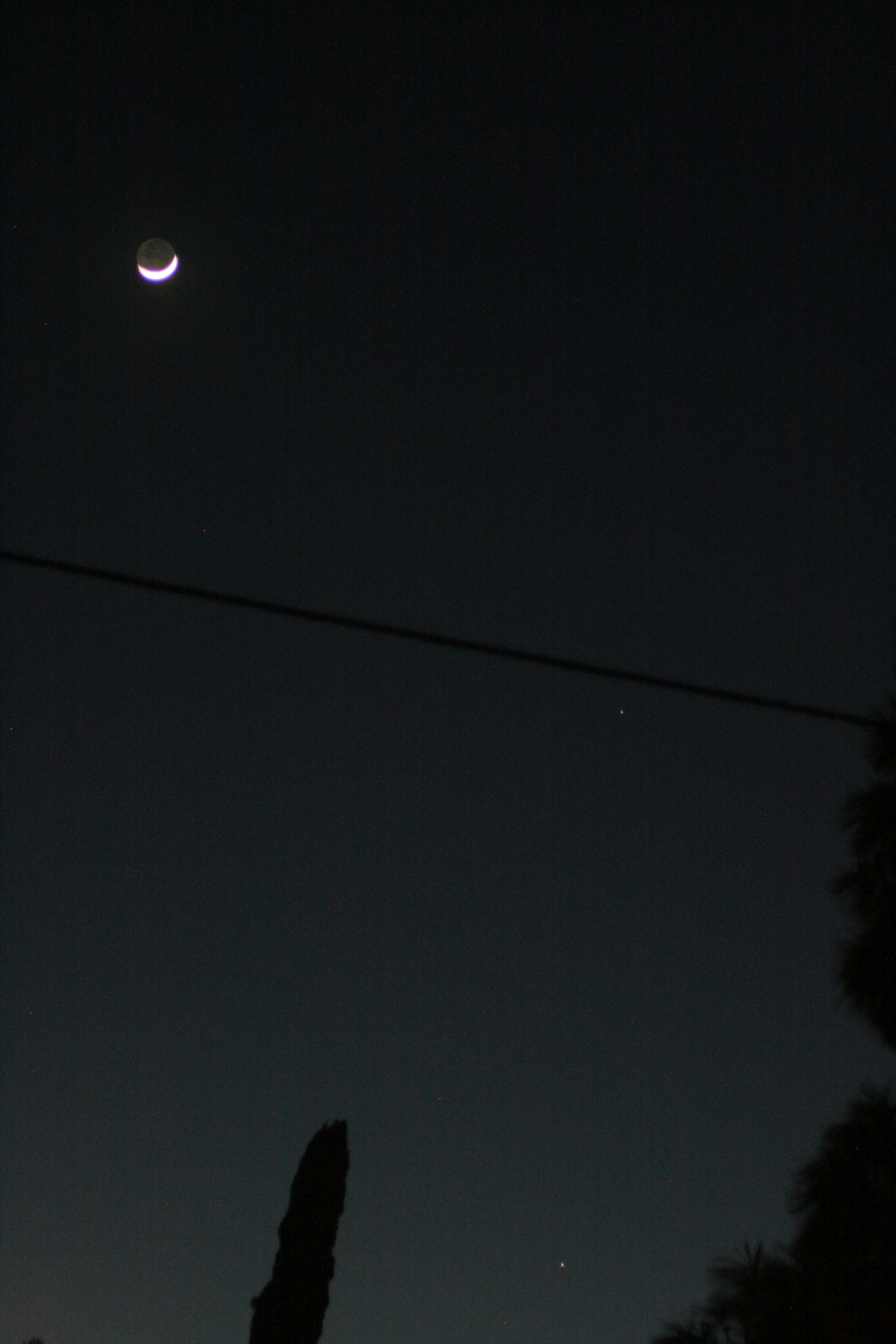
Mars (getting faint, reddish) on the left of Venus (bright white) with the two-day old crescent Moon (it’s the moon-ish looking thing over by the phallic tree, duh) lined up as advertisec.

Could have gone out and caught them a few minutes earlier, but then Mars would have been pretty washed out in the sunset. As it was I never saw Mars with the naked eye, but it was easily visible in binoculars.

Over the next few days Mars will get more dim and start sinking toward the horizon. It will be going around the far side of the Sun from our viewpoint, so if you have anything you want to tell your Martian rover or orbiter, now would be a really good time to do so. In a week or so it will be out of touch for a month or so.

Venus will be getting brighter and higher in the sky for another month or so, then starting its trip back around the gravitational race track and too near the Sun to be seen.

Tonight I had to shift a bit and put that tall tree between the Moon and the planets so that I could get one more set of photos before the Moon was down behind the trees. Stupid planetary rotation…

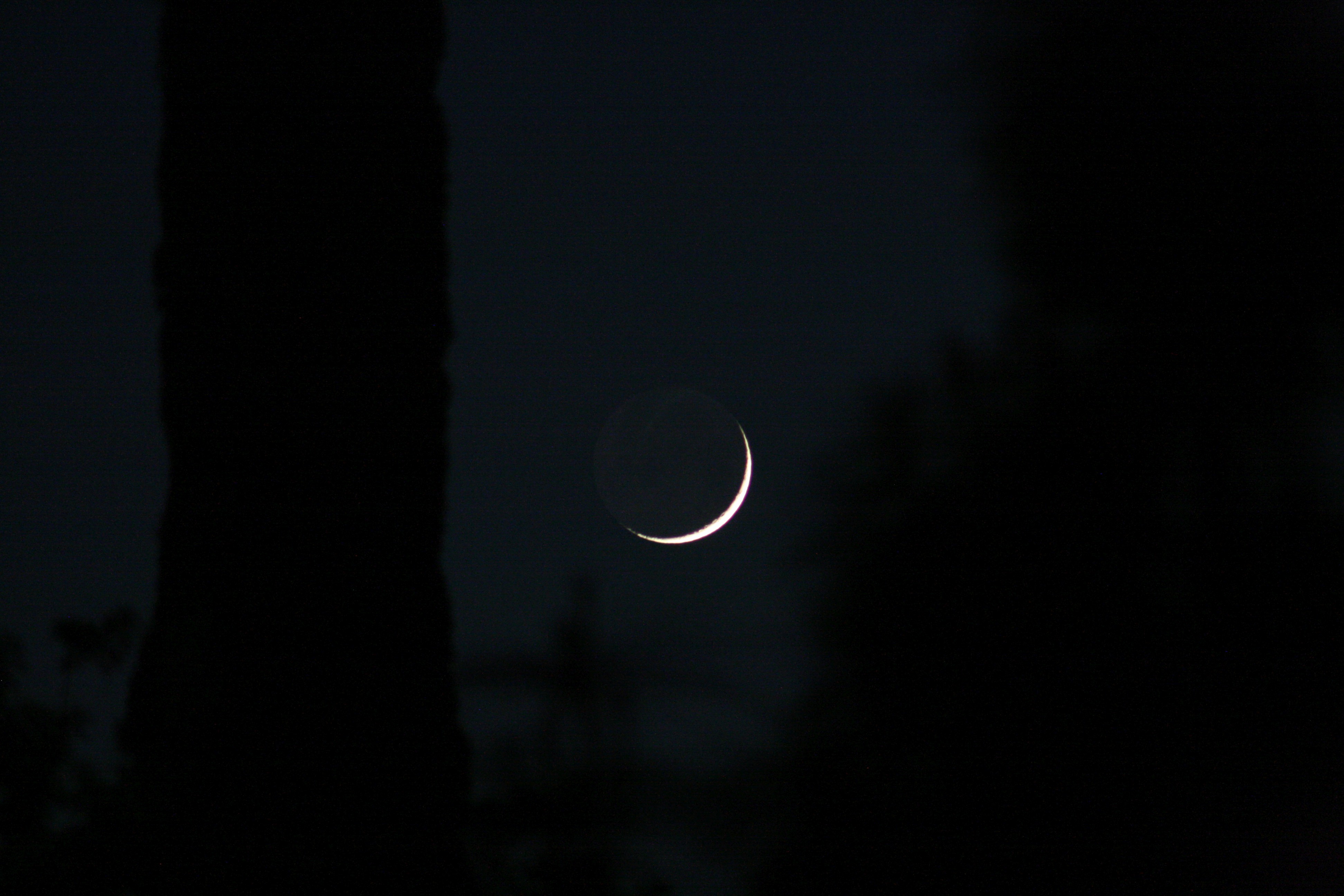
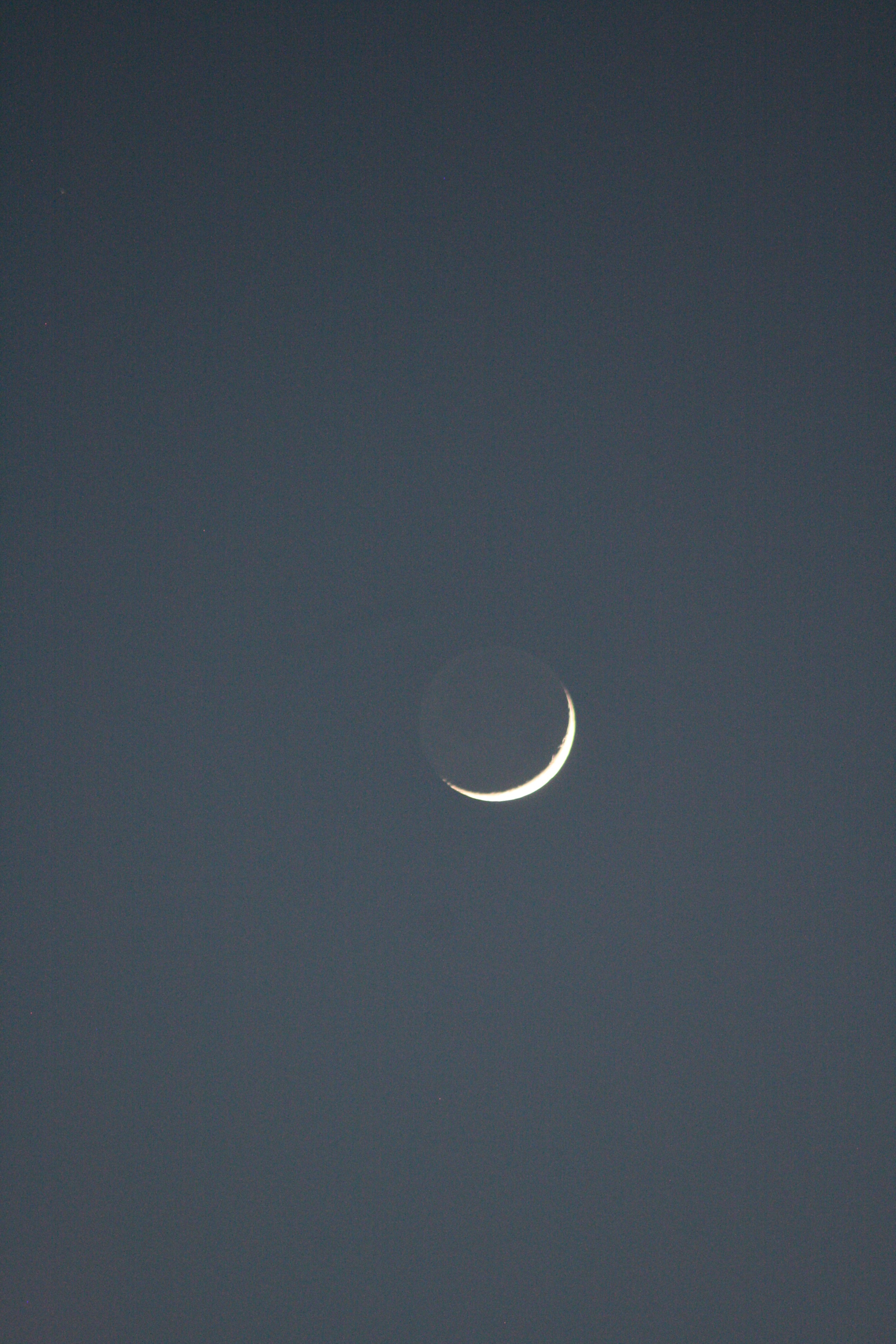
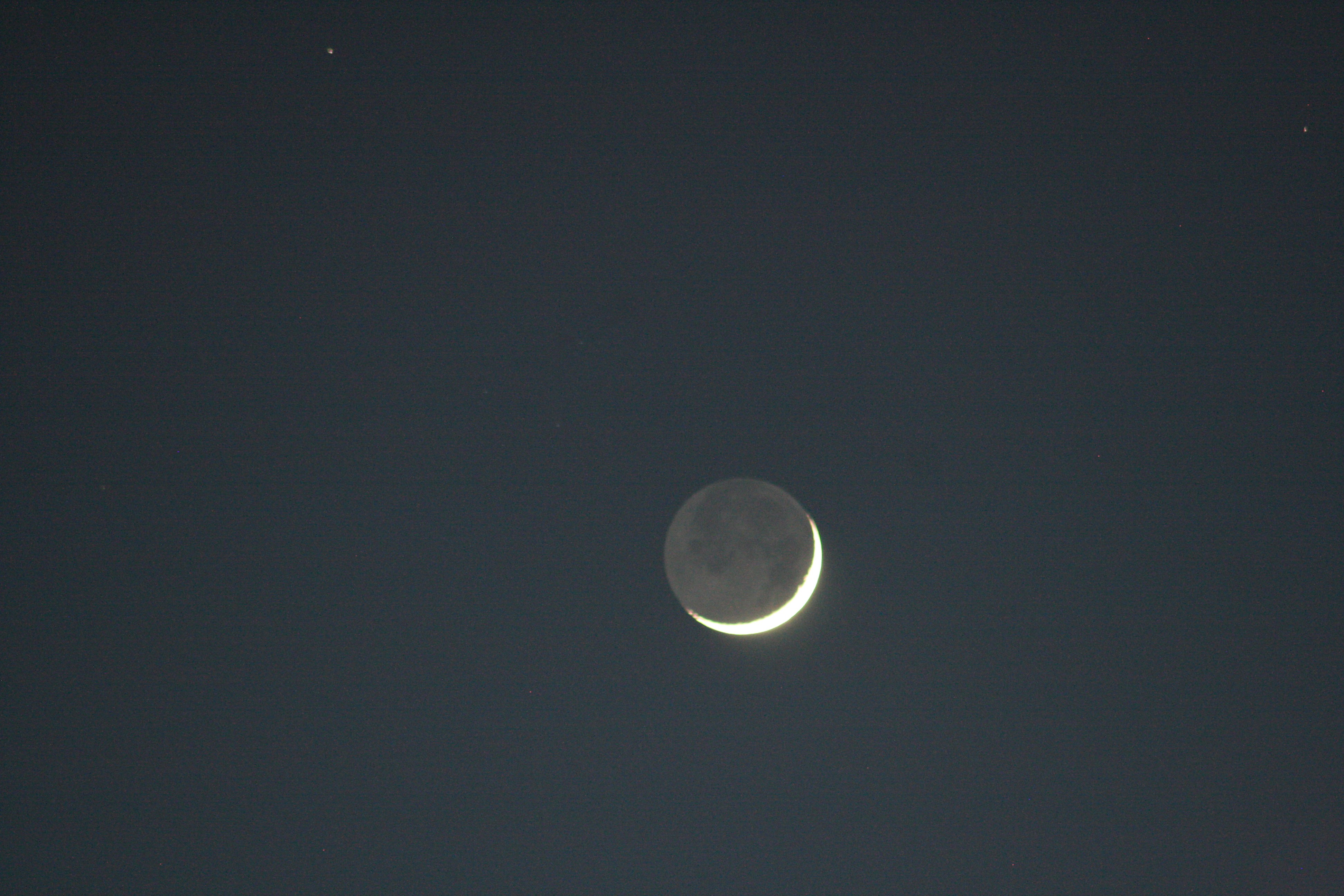
Taking individual close ups, the Moon was very cresecenty and had some details and craters visible along the terminator.

If I had better equipment and could get a better, more detailed picture of Venus, you would see that it’s in a crescent phase exactly like the Moon’s phase. It’s a geometry thing over 186,000,000 miles. (Give or take a couple million.)

As always, if click on the photos you’ll get to see them in full-screen or full size.

Also, as always, if you missed it tonight it will still (sorta) be there tomorrow night and every night at sunset for a few days, taking into account the above notes about Mars getting dimmer and sinking down below and past Venus (in a relative way) and the Moon moving up into the sky and getting more towards a quarter moon every day.

2 Comments

Filed under Astronomy, Photography, Space

Crescent Moon & Venus & Mars – June 13th

A tale of three pictures in one sky, and the different camera equipment needed to tell those three stories.

I thought that the Moon would still be close enough to Venus to be captured in one frame using the 75-300 mm zoom lens – NOPE! Too far apart tonight. So I had to go back into the house and get the camera with the 18-55 mm “normal” lens. Zoomed in to 55 mm, you can just get the Moon at top left, Mars directly below it, and Venus just quite not setting in the lower right. Good thing that gap in the trees is there and my front yard is a bit elevated. What a glorious thing a flat western horizon would be!

The Moon is about three days past new, so along the terminator line you can start to see some nice shadows in the craters. This is using the big lens at 300 mm.

But if you wait for it to get a bit darker and then you overexpose the Moon, you can spot Mars directly below it. Also using the 300 mm zoom lens, just using a 1 second exposure instead of a 1/100 second exposure.

The Moon is on it’s merry way up toward the zenith and full moon in ten days. Venus is climbing away from the Sun while Mars is sinking toward the Sun. Keep an eye on July 10th and 11th! Venus, Mars, and the just-past new crescent (AGAIN!) Moon will all be piled up in a wonderful conjunction. This June arrangement is just a rehearsal!


Leave a comment

Filed under Astronomy, Photography, Space

Crescent Moon & Venus – June 12th

Looking at how often I post variations of this exact shot, with the two or three or four-day old crescent moon and Venus or Saturn or Jupiter or some combination of them all, you would almost think that there’s some pattern here…

As the prophecy (i.e, the astronomical ephemeris) foretold, the Moon has passed Venus to the west of the Sun.

Tonight I remembered to go out about 45 minutes earlier than last night. It worked (of course).

In the not-quite-dark-yet dusk, the Moon was a crescent, two and a half days (ish) from full moon (which caused that partial and annular solar eclipse on Thursday morning, remember?) with lots of Earthshine.

It was wonderful, clear, cool, a tiny breeze and the stars starting to come out. I could hear two parties going off in the neighborhood – probably graduation celebrations.

As Venus was headed toward the horizon somewhere far beyond Santa Barbara, the Moon was perched atop this tree, with some large hawk or raptor of some sort having just glided in to roost in the tree just at the lower right.

As it got darker, even though the Moon was sinking down into the coastal haze, the Earthshine got easier to see.

I’m grateful that it was clear two days in a row – given the week’s forecast for hot, Hot, HOT weather every day, we might be able to luck out for the rest of the week. Of course, it’s also predicted to be 117° to 120°+ all week, so that’s a mixed blessing.

If you can get a chance to see these two planetary objects over the next couple of nights after sunset, take it! Just go out and sit and watch for a bit. (Put on bug spray…)

Leave a comment

Filed under Astronomy, Photography, Space

Harassing Moon

Yesterday morning the Moon was out there harassing the sun, causing a partial solar eclipse for many on the US East Coast and into Great Britain, with a few lucky folk way, way up north getting to see a short annular eclipse. Google it, there are some great photos.

Having finished with messing around with the Sun, tonight the very thin crescent moon was threatening Venus.

I caught it a couple of minutes later than I should have. It was pretty low, but there was a little bit of gap between those trees that I could just peek through from the driveway.

Any earlier and it would have been too bright to see the moon – I know, because I went and looked!

It was beautiful and clear. Wouldn’t it be nice to have a couple of nights like that to take pictures over the weekend?

Leave a comment

Filed under Astronomy, Photography, Space

Twenty-Seven Hours & Counting

Tomorrow night there’s a total eclipse of the moon, visible from all over the Pacific hemisphere. If you’re in Europe or eastern North or South America, better luck next time. If you’re in Hawaii, you’re golden. In eastern Australia or New Zealand, you’ll see it in the east not too long after moonrise. If you’re in Los Angeles or on the US West Coast, you’ll see it just before sunrise.

Unlike solar eclipses (*NEVER* look at a solar eclipse with the naked eye or any kind of magnification), lunar eclipses are 100% safe to look at with the naked eye, or with binoculars, or a telescope. In this case, if you’re in LA or San Diego or San Francisco or Phoenix or Seattle (you get the idea) your biggest issues will be possible clouds and getting up at 03:00. (I plan on being ready, getting up, checking for clouds, and if they’re there, I’m back in bed!)

Here’s a great site for information on when the different phases of the eclipse start, including detailed information for major cities. This is a short eclipse by lunar eclipse standards. The full phase of the eclipse is only fourteen minutes long, 04:11 to 04:25 in Los Angeles.

After being “clear and a bazillion” for the whole day, I rolled the telescope out late this afternoon and within second it was starting to cloud up.

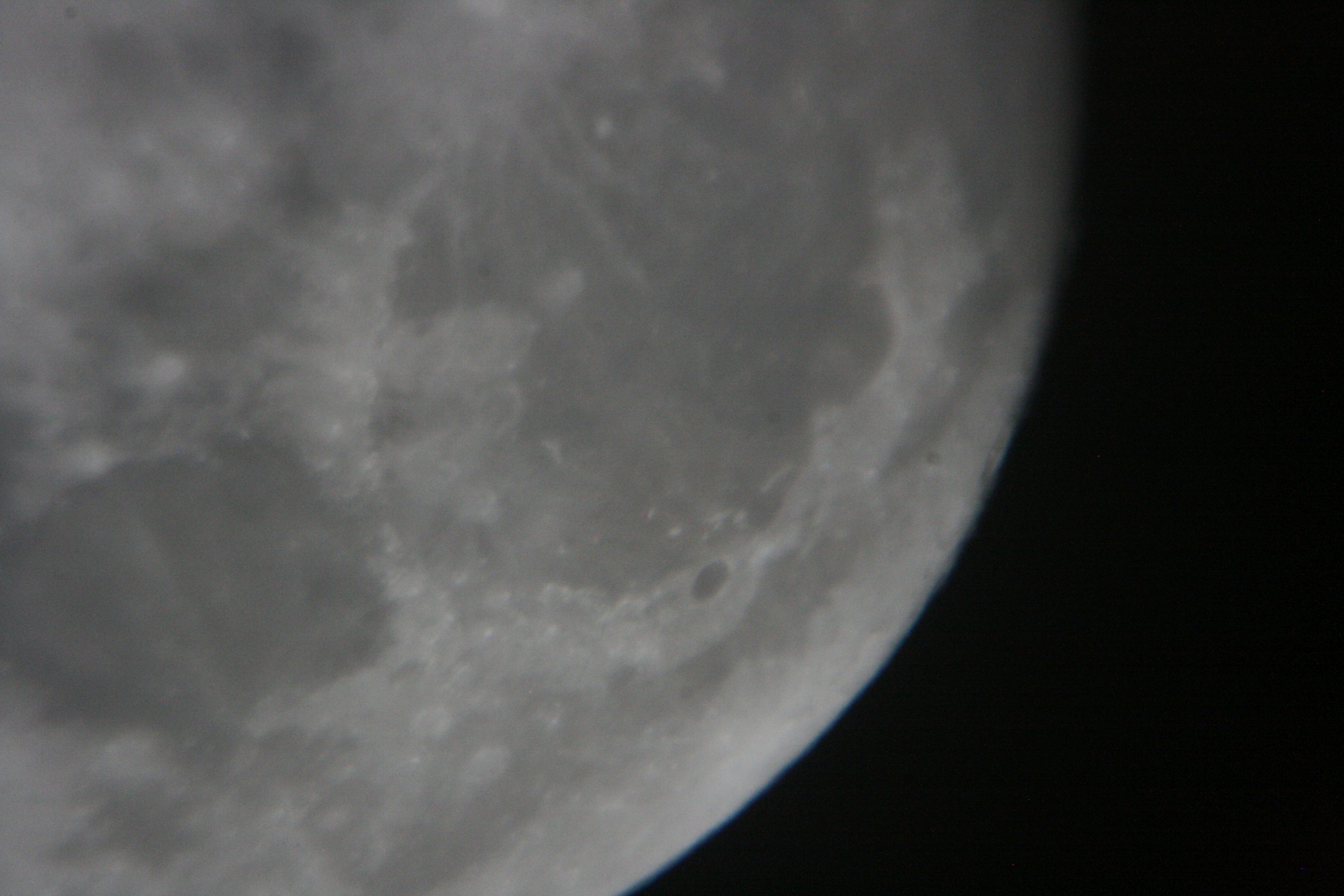
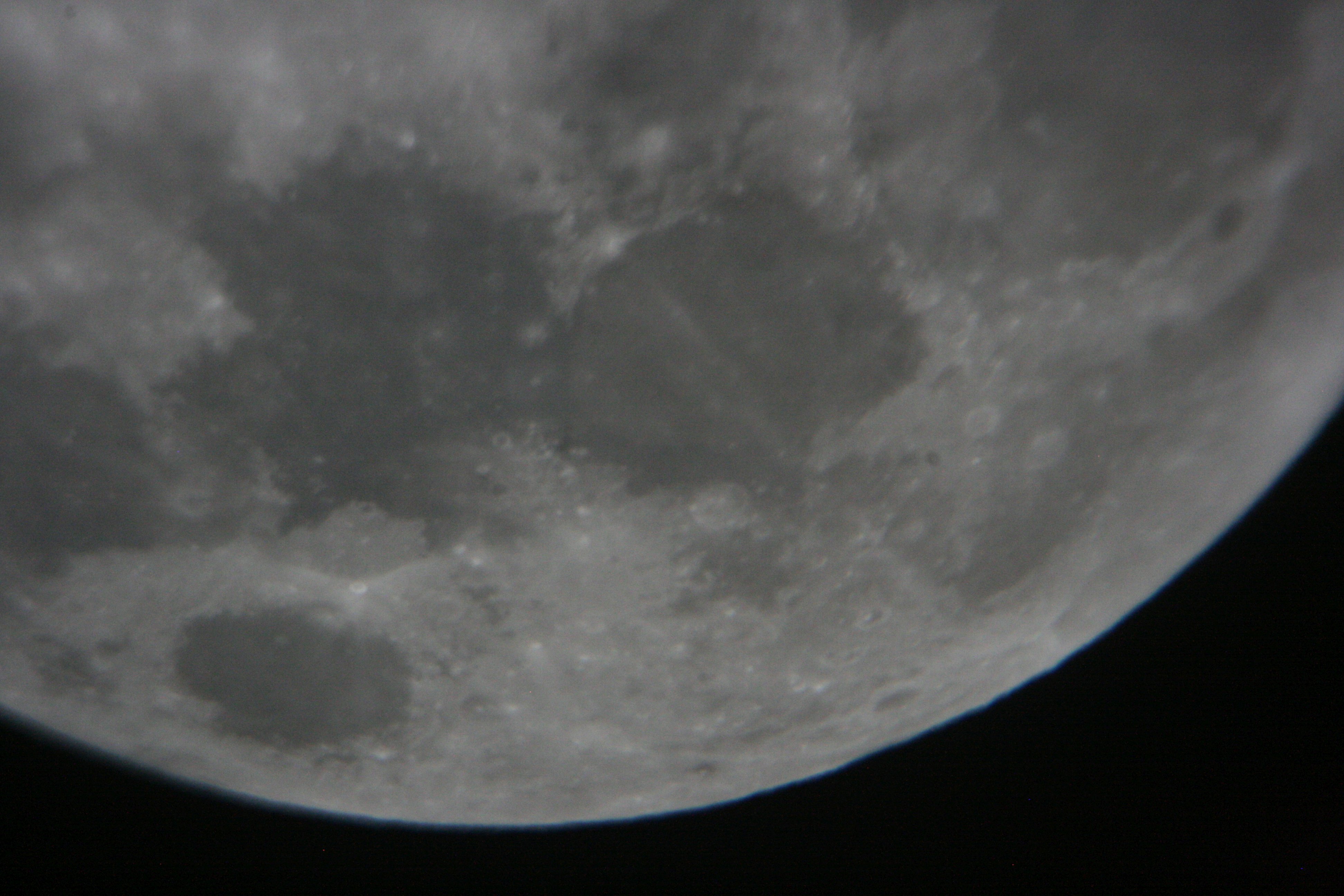
By the time the moon rose and cleared those trees, it was downright “yucky.” (That’s an official, technical, internationally recognized astronomy term by the way.) I was testing out my equipment for attaching my good DSLR cameras directly to the telescope, using it as a humongous telephoto lens.

The moon was there – the focus wasn’t.

I’m going to blame the clouds. Which is not unreasonable at all, they were an issue.

In addition, right around full moon (we’re 27 hours away, since lunar eclipse = full moon, by definition = do the geometry) most of the moon’s surface looks flat and featureless.

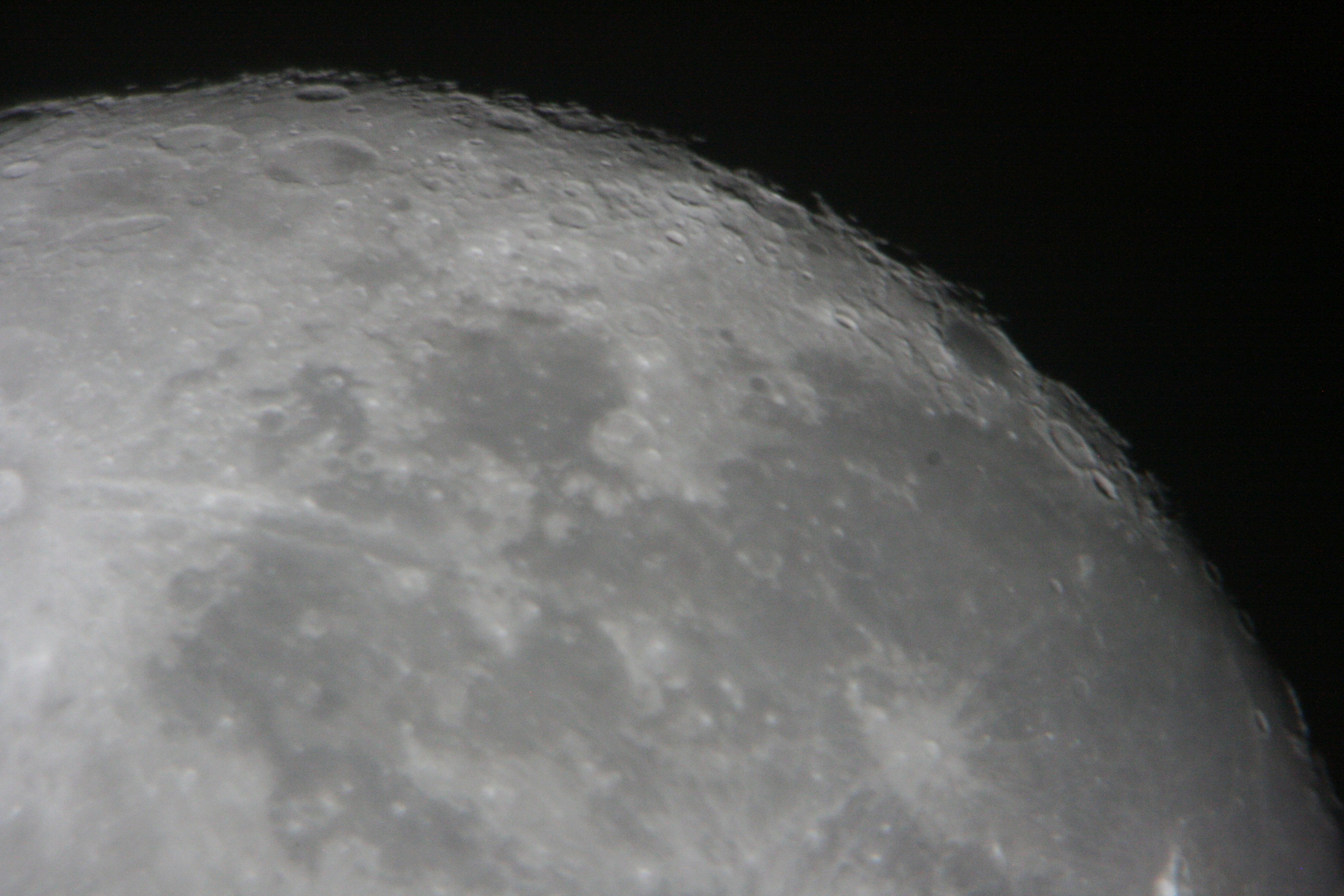
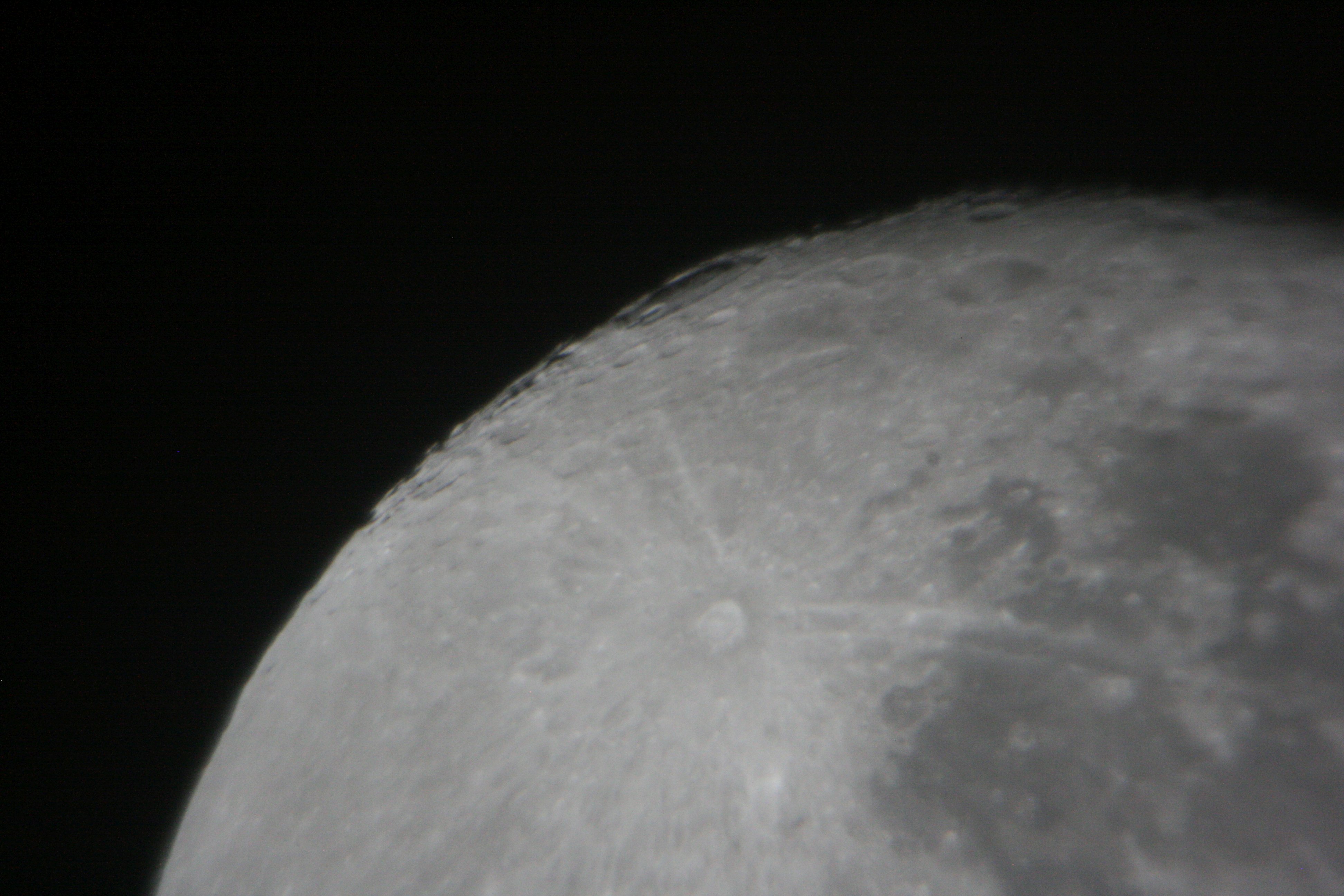
The “good” pictures are always along the terminator, the division between night and day on the lunar surface, where the shadows are sharp.

You can see a tiny bit of that along the top side, where some of the craters on the limb (edge of the visible disk) are highlighted. But not much.

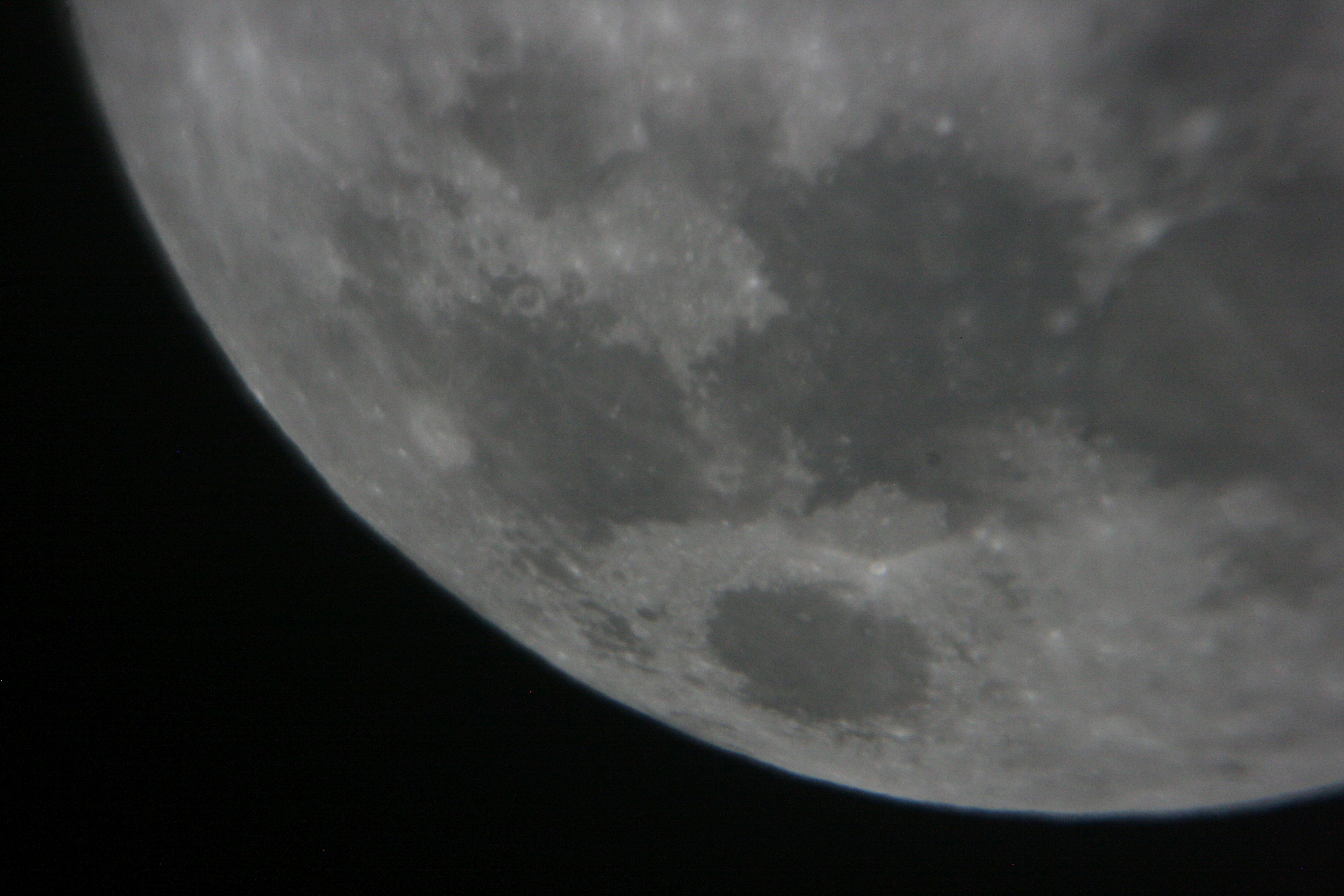
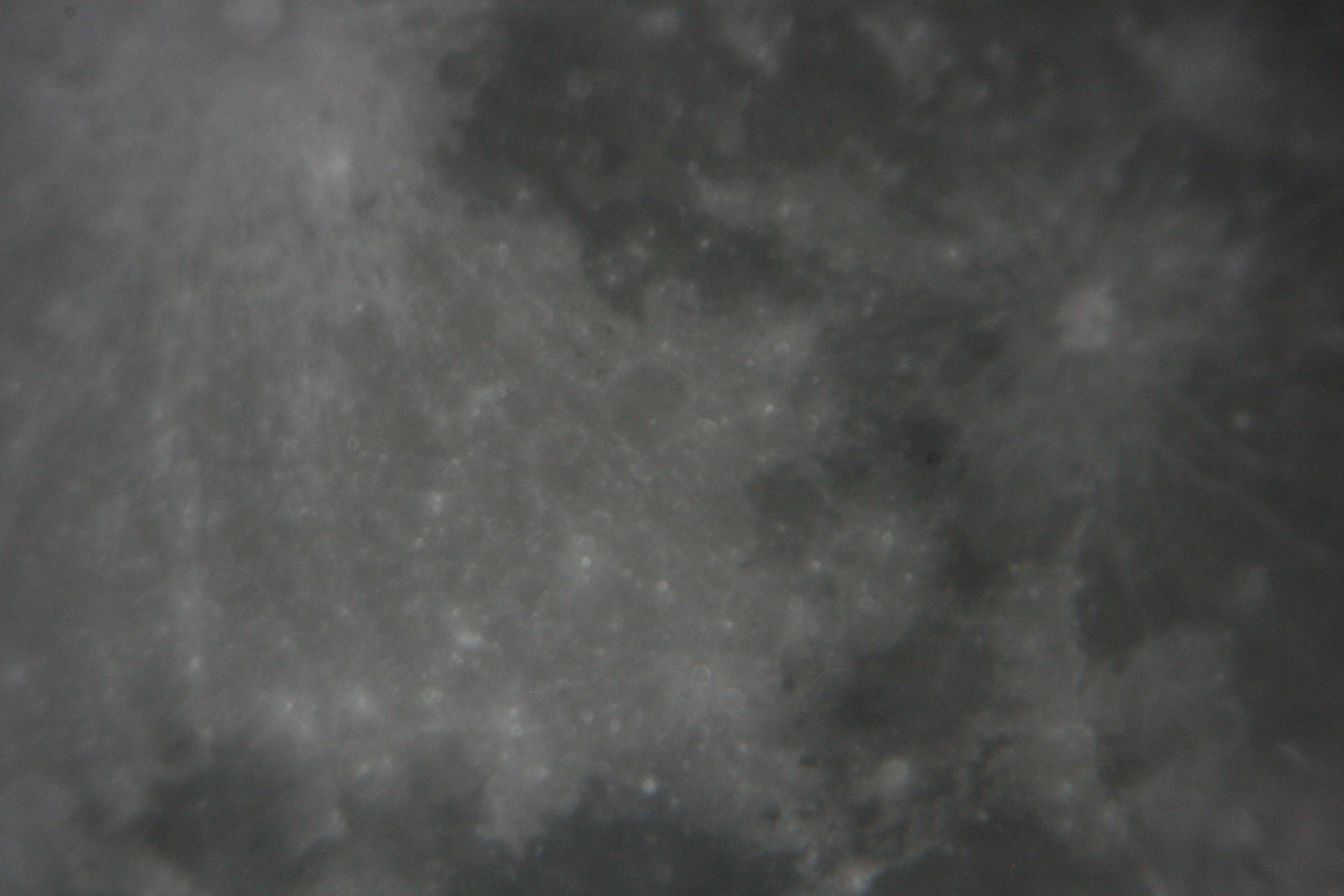
For example, this picture showing the center of the moon with no portion of the limb? Lots of rays and some bright spots, but no shadows with the Sun almost straight overhead.

We’ll see what tomorrow night / Wednesday pre-dawn brings for the eclipse. Keep your fingers crossed!

Leave a comment

Filed under Astronomy, Photography, Space, Weather

Moon & Mercury – May 14th

And Venus.

Last night the Moon and Mercury were close to one another, able to fit into the field of my 300mm zoom lens. Venus was way, waaaaaay down near the setting Sun and while folks with flat horizons were seeing it, I have trees, houses, and a small mountain to my west.

Tonight everything had moved, as celestial bodies tend to do. It’s that whole space-time, circling around in the gravity well thing. Which meant that Venus was a bit higher, and even though it was still too bright to see Mercury, Venus is a lot brighter than Mercury and I could juuuuuust see it above the trees as it was setting.
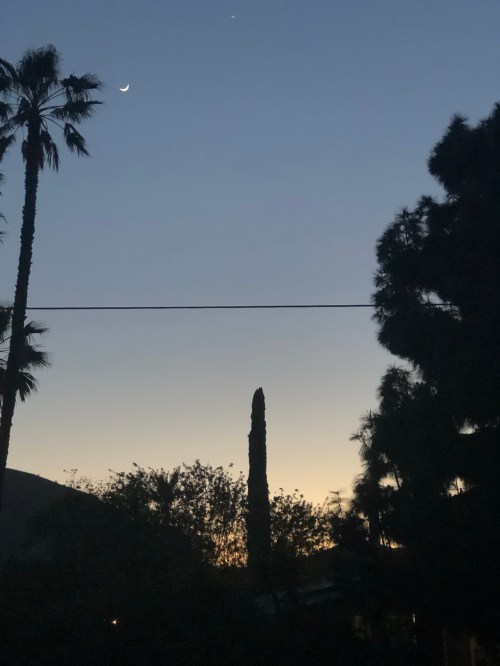
See it? To the right of the phallic tree, just barely above those trees. If you click on the image to get the full-sized photo, you’ll see it…
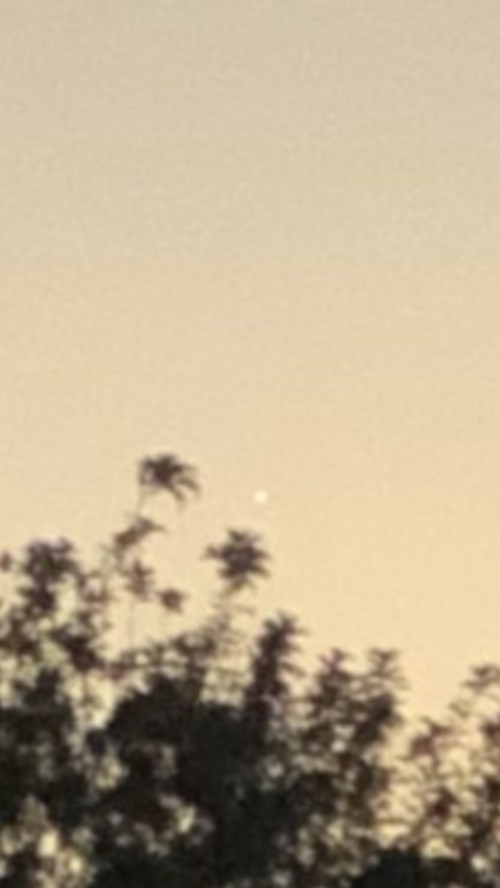
This cell phone image, blown up to the limit of resolution looks fuzzy – tomorrow night go out (assuming it’s clear) and if you can, take a pair of binoculars. Venus is very bright, looks like a diamond shining against the gathering dusk. Spectacular.
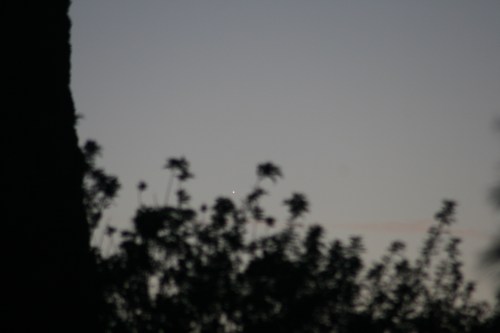
Sort of like this, with the good camera, just as it was disappearing.
Even without a lot of magnification, similar to what you would see with the naked eye, it stands out pretty well.

But there weren’t any pictures with the Moon, Mercury, and Venus. Too bright as Venus was setting. So I waited until it got darker.
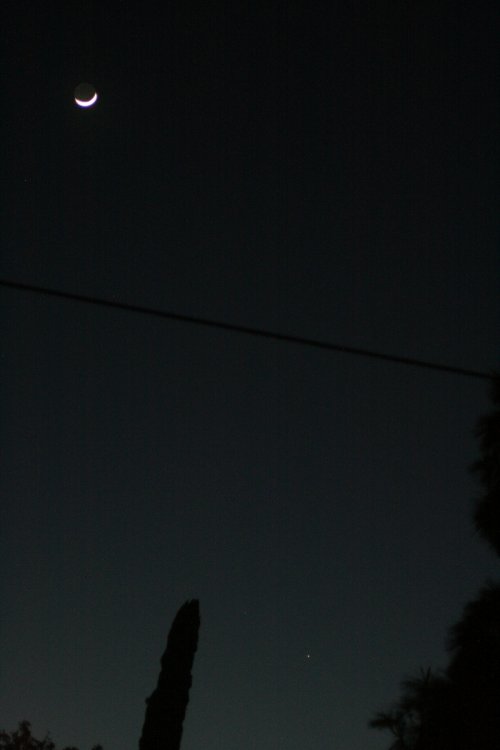
About a half hour later, the Moon in the upper left, Mercury about halfway between the trees to the right of the phallic tree, just below being level with the top of it.
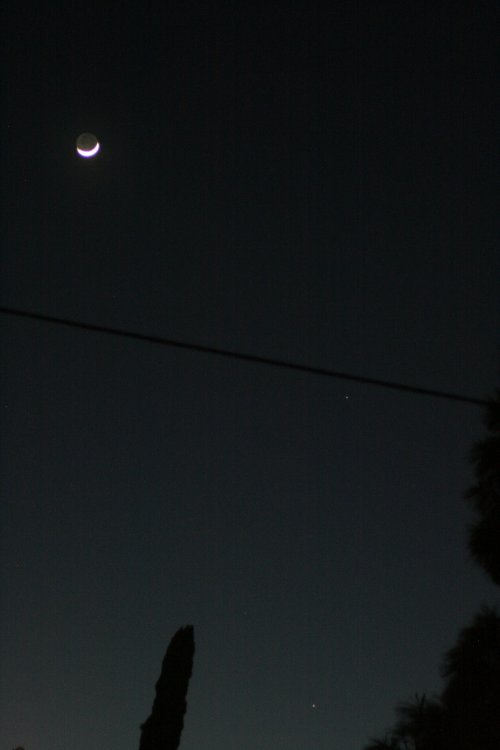
Compared to last night, it’s easy to see how much the Moon moves from one night to the next.
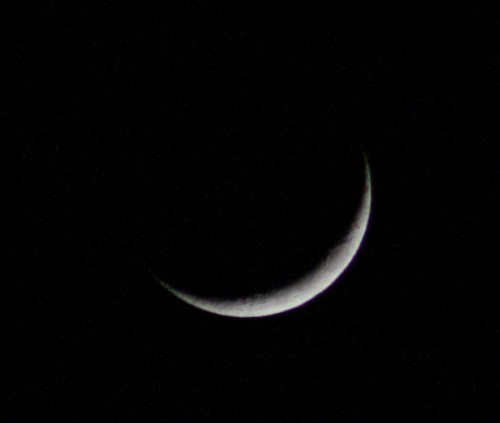
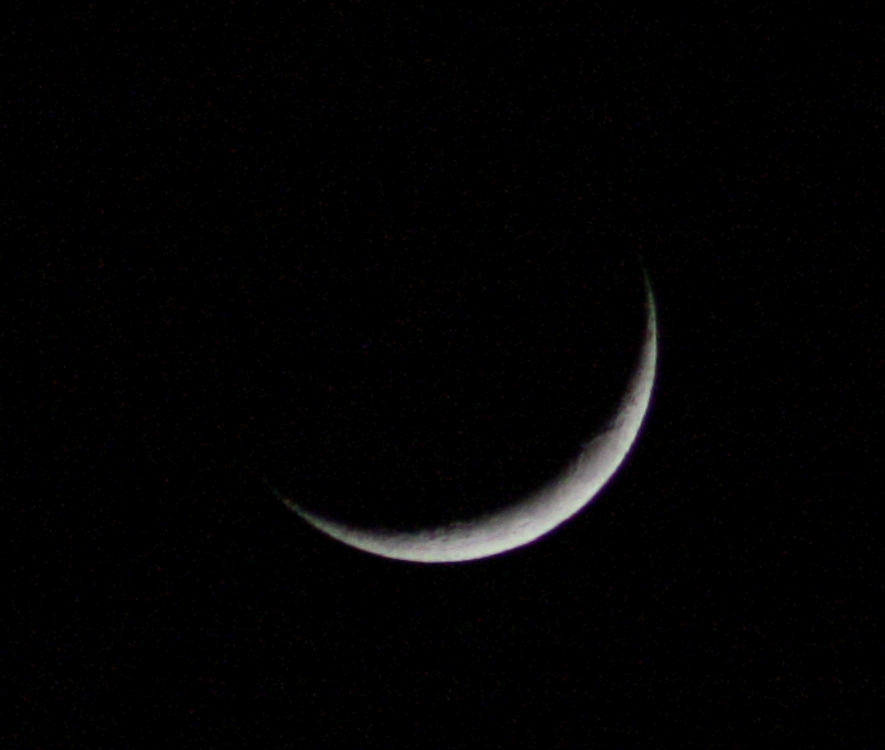
A cropped image of the crescent moon, three and a half days past new moon.
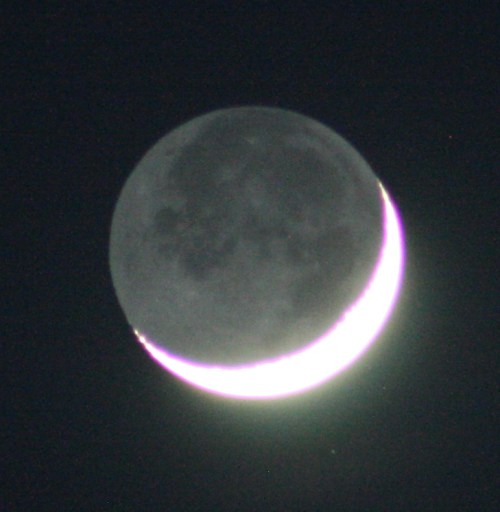
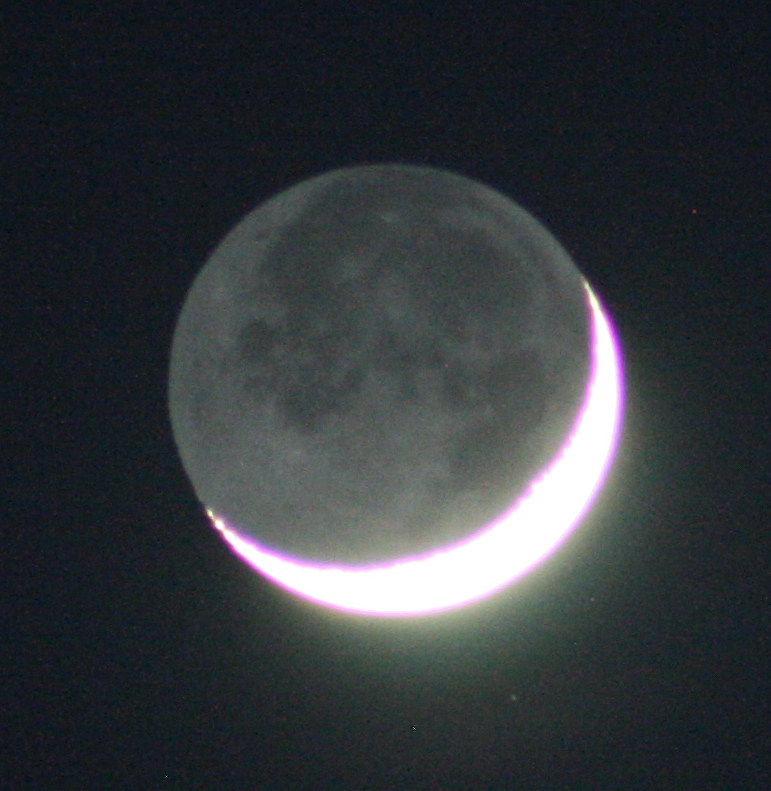
Similarly cropped image of overexposed moon, showing the dark portion of the moon in Earthshine.
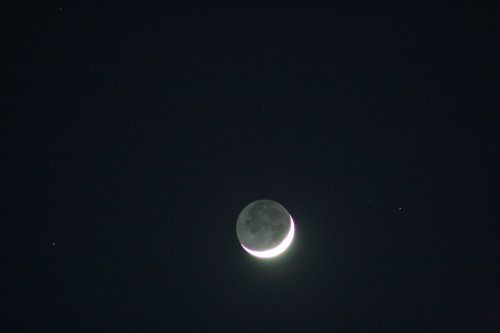
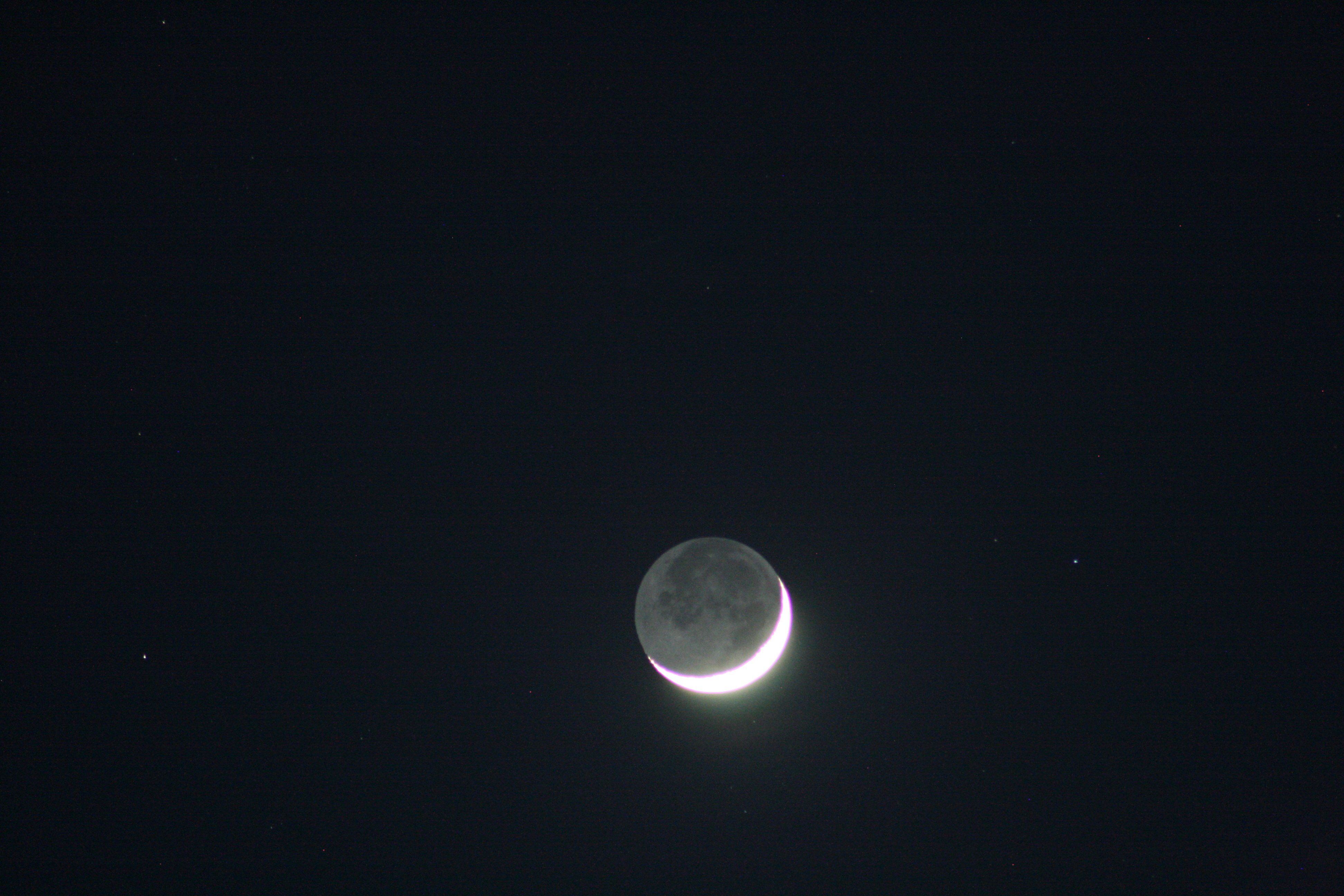
Full-frame crescent moon in Earthsine.

It will probably be a couple of days before Venus climbs up high enough to be seen in the dark sky with Mercury, and by that time the Moon will be close to or past a quarter moon, way out of this picture. Just as well, the forecast is iffy for the next couple of evenings here.

However…

On the early morning before sunrise on Wednesday, May 26th, there will be a total eclipse of the moon. (See examples of what it will look like here and here.) You won’t see it if you’re on the US east coast or Europe, but you will probably see some or all of it in eastern Asia or on the west coast of North America. In Los Angeles, the partial eclipse begins at 02:45 AM, totality begins at 04:11 AM, maximum eclipse is at 04:18 AM, totality ends at 04:25 AM, and the partial phase ends at 05:52, right at sunrise.

As they say, mark your clocks and set your calendars!


Leave a comment

Filed under Astronomy, Photography, Space