If the weather holds (it’s looking 80% likely for a “go” right now) and the rocket gods smile on us, in a little under six hours the next NASA/JPL rover will be on its way to Mars atop a ULA Atlas V rocket.
Perseverance is an SUV-sized, nuclear-powered rover packed with experiments to search for signs of life on Mars. It will also cache a handful of samples for return to Earth, hopefully being picked up by the 2026 rover. It’s got even more and higher resolution cameras than Curiosity does (Curiosity is still going strong BTW, now it its 2,837th sol of its 687 sol mission), including cameras that will give us a HD view of the “seven minutes of terror” that are what it takes to land on Mars.
Finally, Perseverance also has experiments that will start to look toward humans being on Mars. There are multiple samples of spacesuit materials that will be exposed to the Martian environment (dust, wind, perchlorates in the soil, radiation, cold) as well as an experiment that will demonstrate how oxygen can be removed from the carbon dioxide rich atmosphere and stored for human use.
Also being carried by Perseverance is Ingenuity, a helicopter drone that has been designed to fly in the extremely thin atmosphere of Mars. It’s stowed underneath the body of Perseverance, but after landing it will be unfolded, put on the ground, and Perseverance will drive away and expose Ingenuity.
(If you don’t think any of this is super, duper, über cool, then please unfollow me now…)
For the rest of us, NASA-TV coverage starts at 07:00 EDT (04:00 PDT, god help me!) with the launch window opening at 07:50 EDT (04:50 PDT).
We might be fighting COVID and actual demons, but let’s not forget that there are reasons we’re fighting. Family, friends, and freedom may be at the absolute top of the list of reasons, but stuff like this is pretty solidly in the Top Ten in my book.
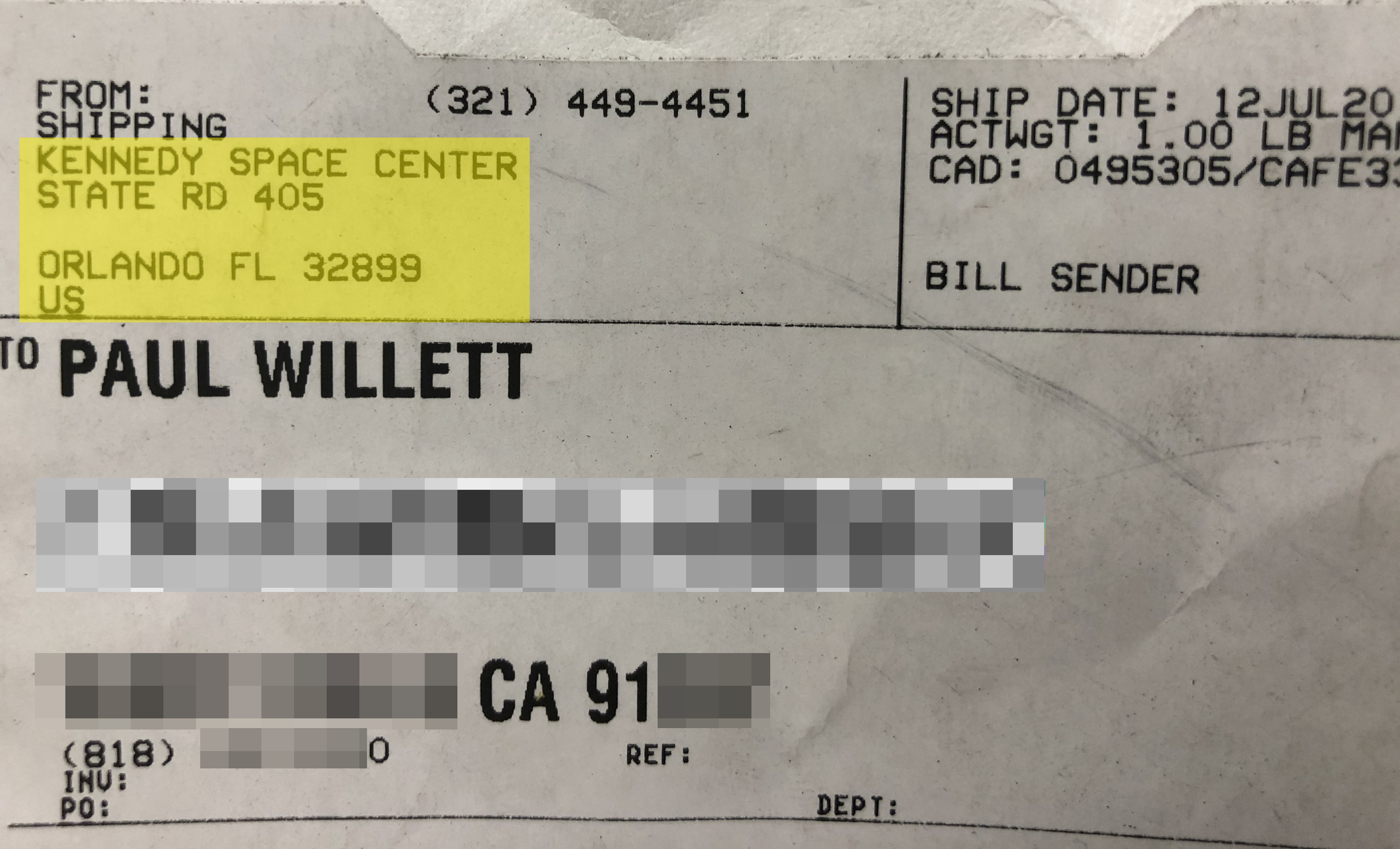
It MUST be the letter telling me that I’ve been picked to be an astronaut, RIGHT??!!
Or maybe they’ve heard about how I want to go to Mars and they want me to join NASA and head up that project, RIGHT??!!
It’s too thin and flat to actually be the keys to my very own space shuttle – but, hey, they probably don’t use keys, they probably use a credit card like ID thingie, and that will fit in here so that MUST be it, RIGHT??!!
Oh…
It’s those masks that I ordered from the KSC gift shop.
Oh…
Sniffle…
Deep, shuddering breath…
A single tear…
Well, they’re very nice NASA face masks. I’m sure they’re exactly like the ones the astronauts wear…
I think I said two nights ago that I was probably done trying to take pictures of Comet NEOWISE F3 since it was starting to fade significantly (it still is) and being a low-contrast object that has its light spread out across the tail and comet head, it was difficult to photograph well from my front yard given all of the street lights and lights from the neighbors’ houses (which are still on).
I was wrong.
The key is that the obvious finally clicked for me tonight and I realized that I was still thinking like the comet was way down near the horizon and I had to see it from the front yard just before it set. But it’s now moved way up by the bowl of the Big Dipper, so maybe I could see it from my back yard? Where the house and trees that would have blocked seeing the comet when it was near the horizon now will block the light from all of the streetlights and neighbors’ porches. Maybe?
Yes, indeedy, that works like a charm. With one little non-insurmountable problem.
It’s lovely and all, but it causes its own share of light pollution. Tonight was tolerable but in a week it will be full and freakishly bright, while the comet will continue to fade, so that will become problematic. But a problem for another night.
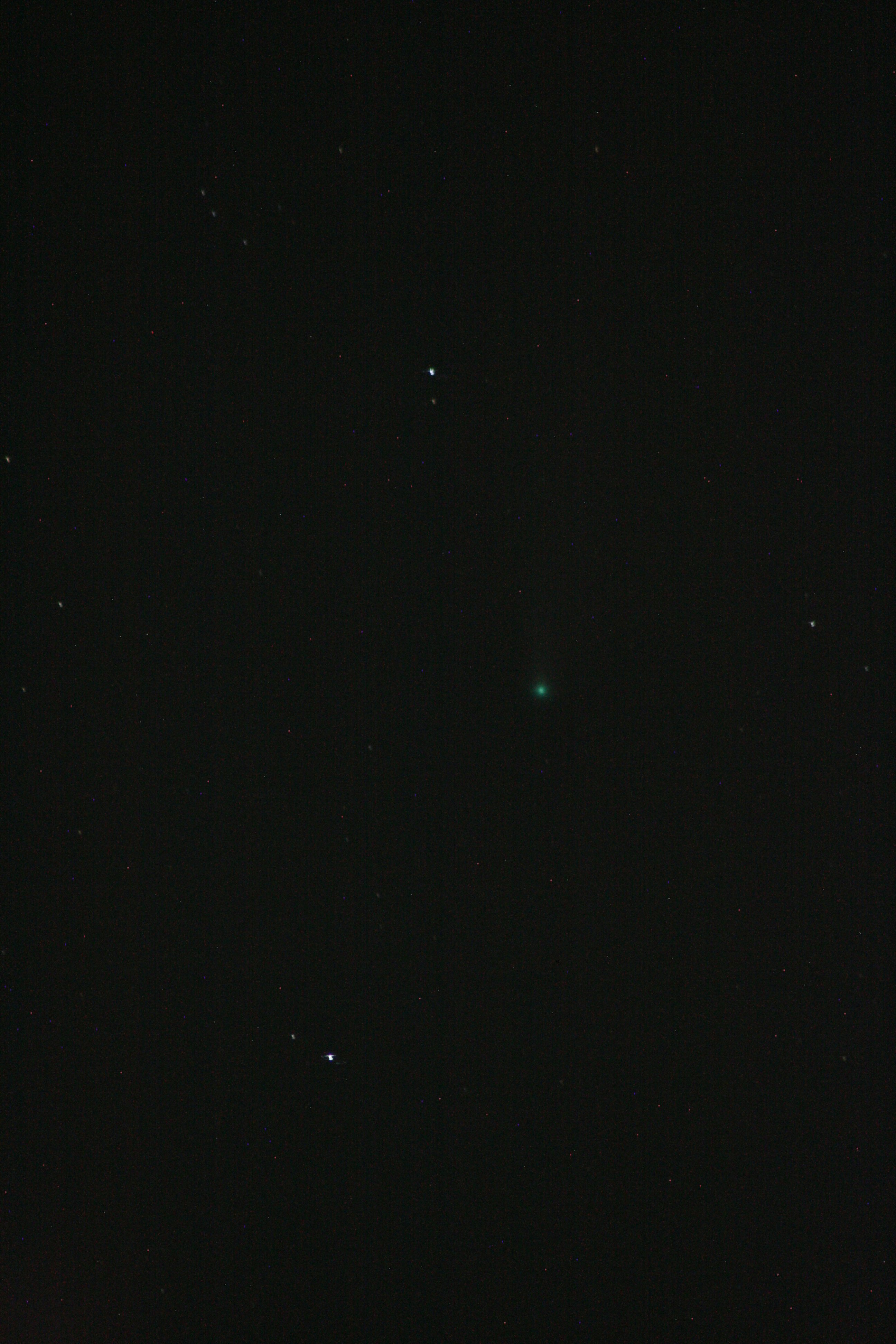
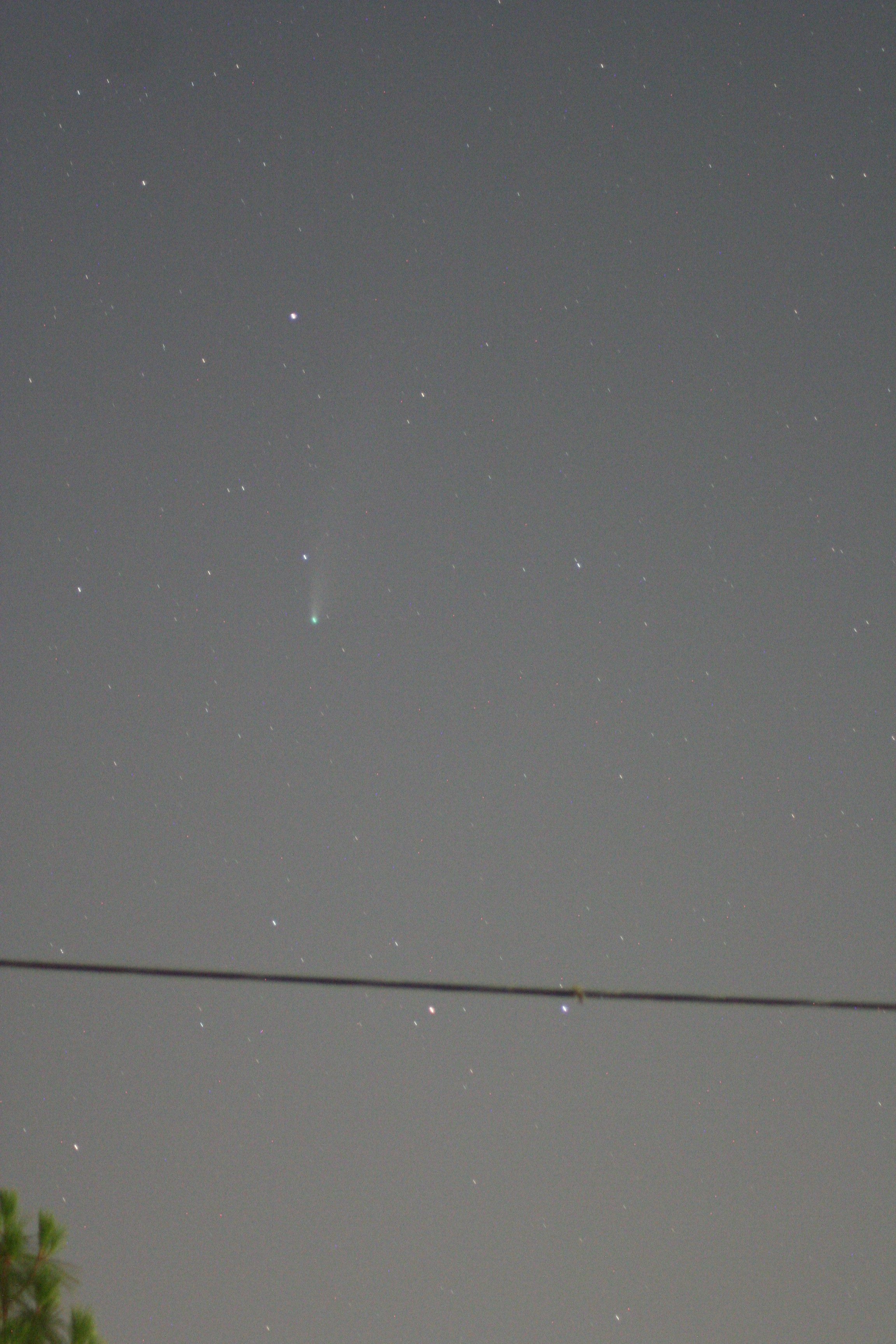
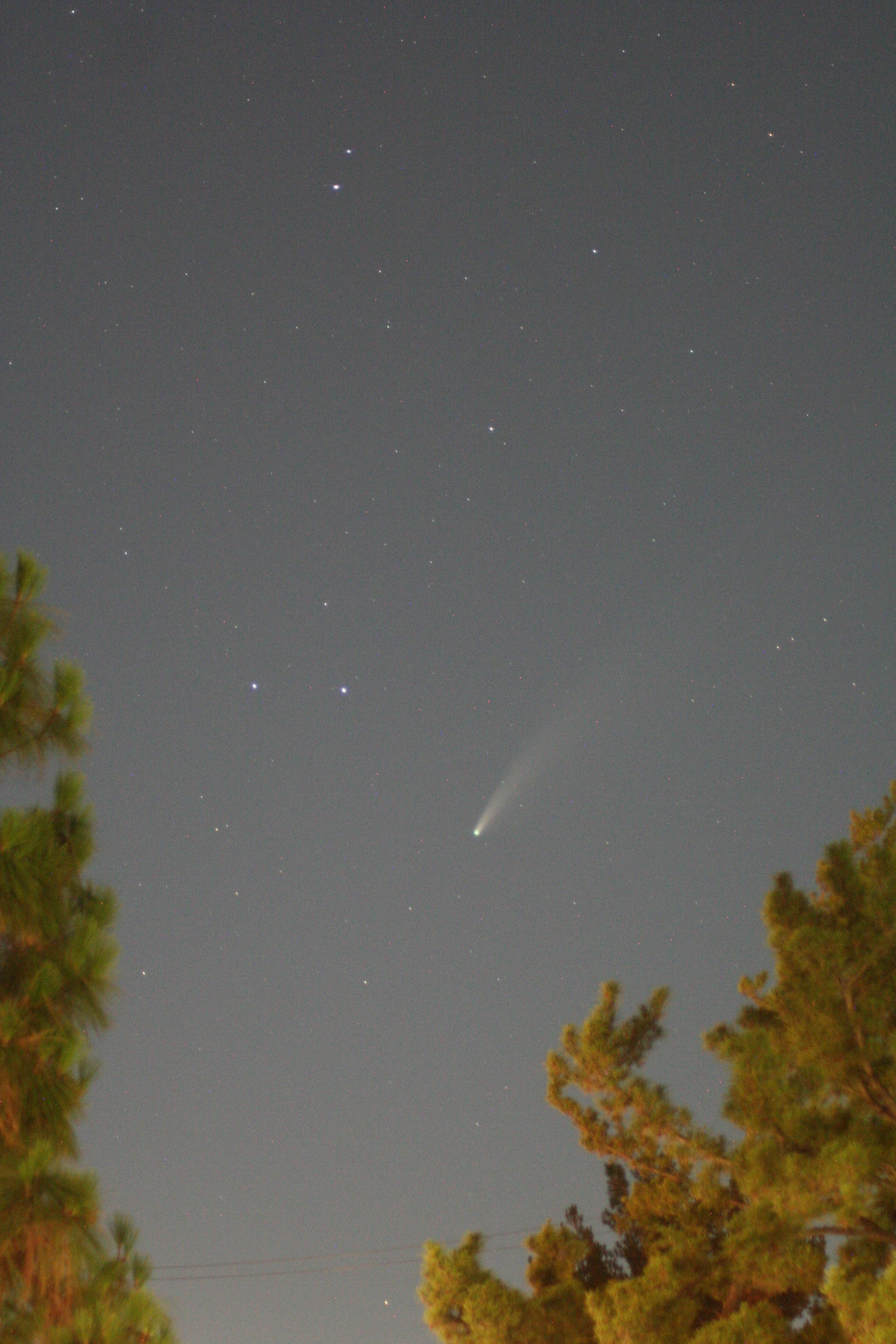
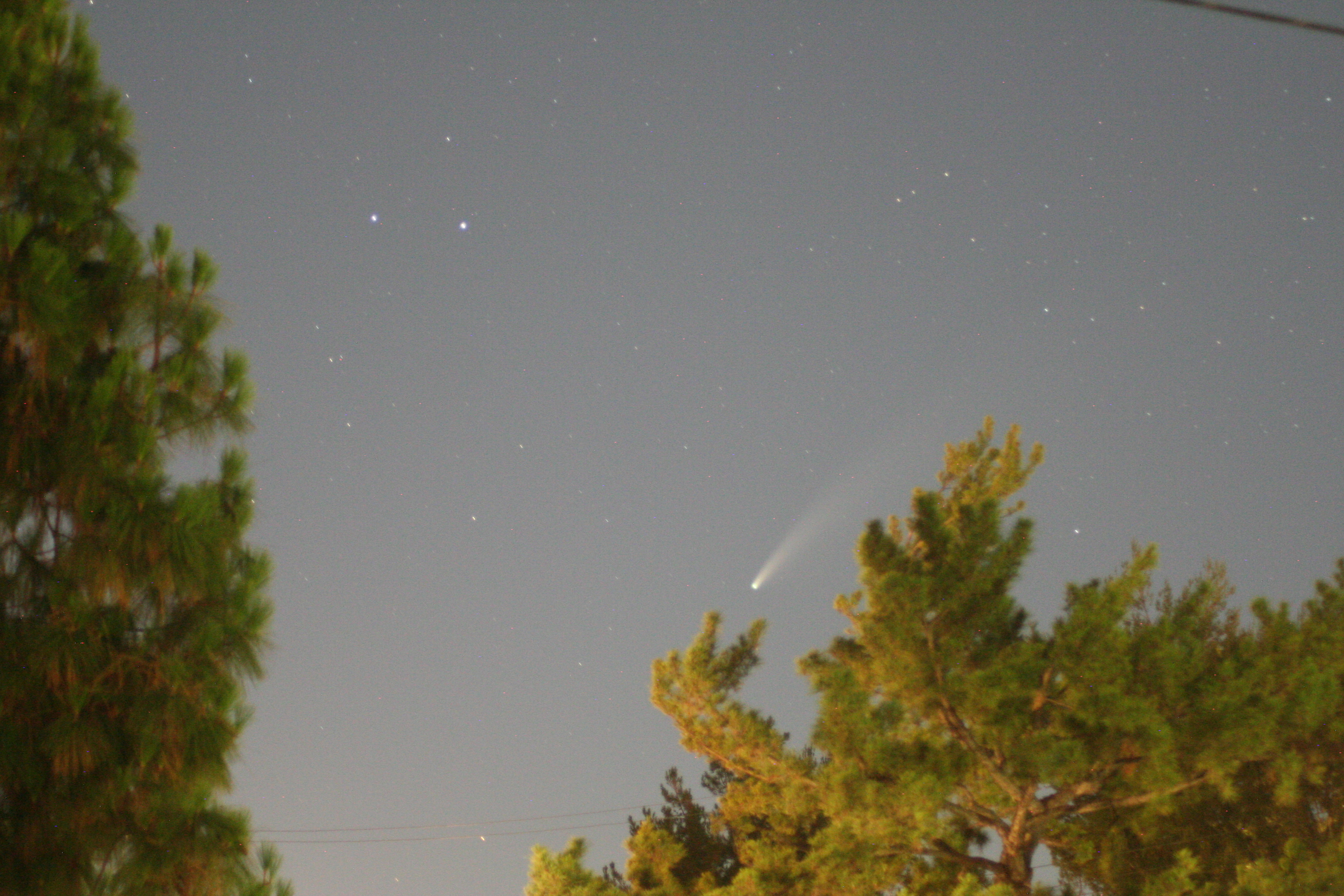
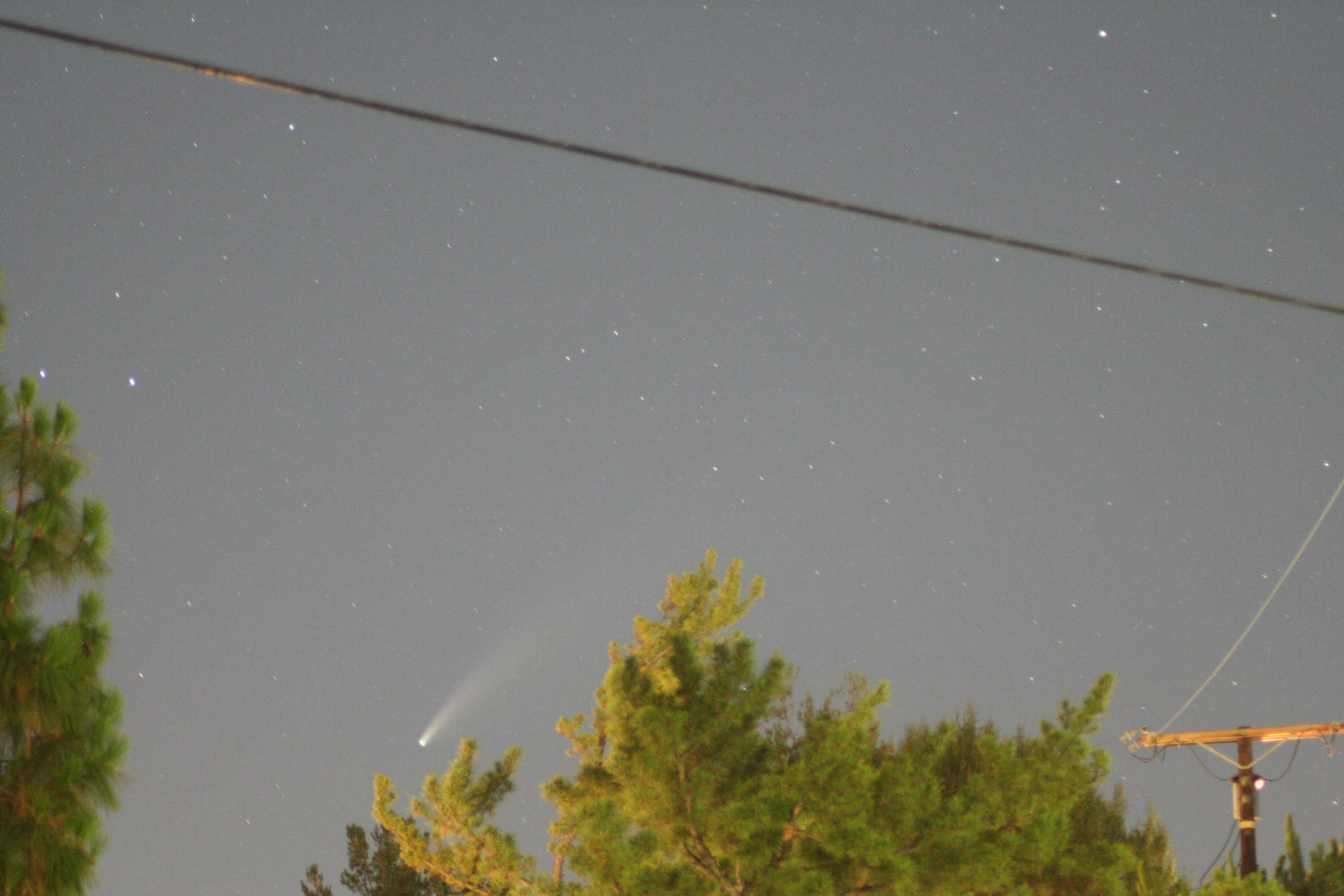
A 20-second exposure at 70mm shows where it is. It’s definitely dimmer by a lot, but the green color is still evident.
But without the street lights in view, I can go to a 30-second exposure and bring out more detail and color. The stars are no longer pinpoints, “trailing” as the Earth moves. The next step would be to mount the camera on my telescope’s equitorial mount so that it spins the camera “backward” at exactly the same rate as the Earth rotates “forward” – maybe I can try that later.
Zooming in to 300mm, a 4-second exposure keeps the trailing to a minimum and the green color really pops, but you don’t see much of the tail.
Zoomed in part way at 114mm, a 25-second exposure starts to bring out the tail.
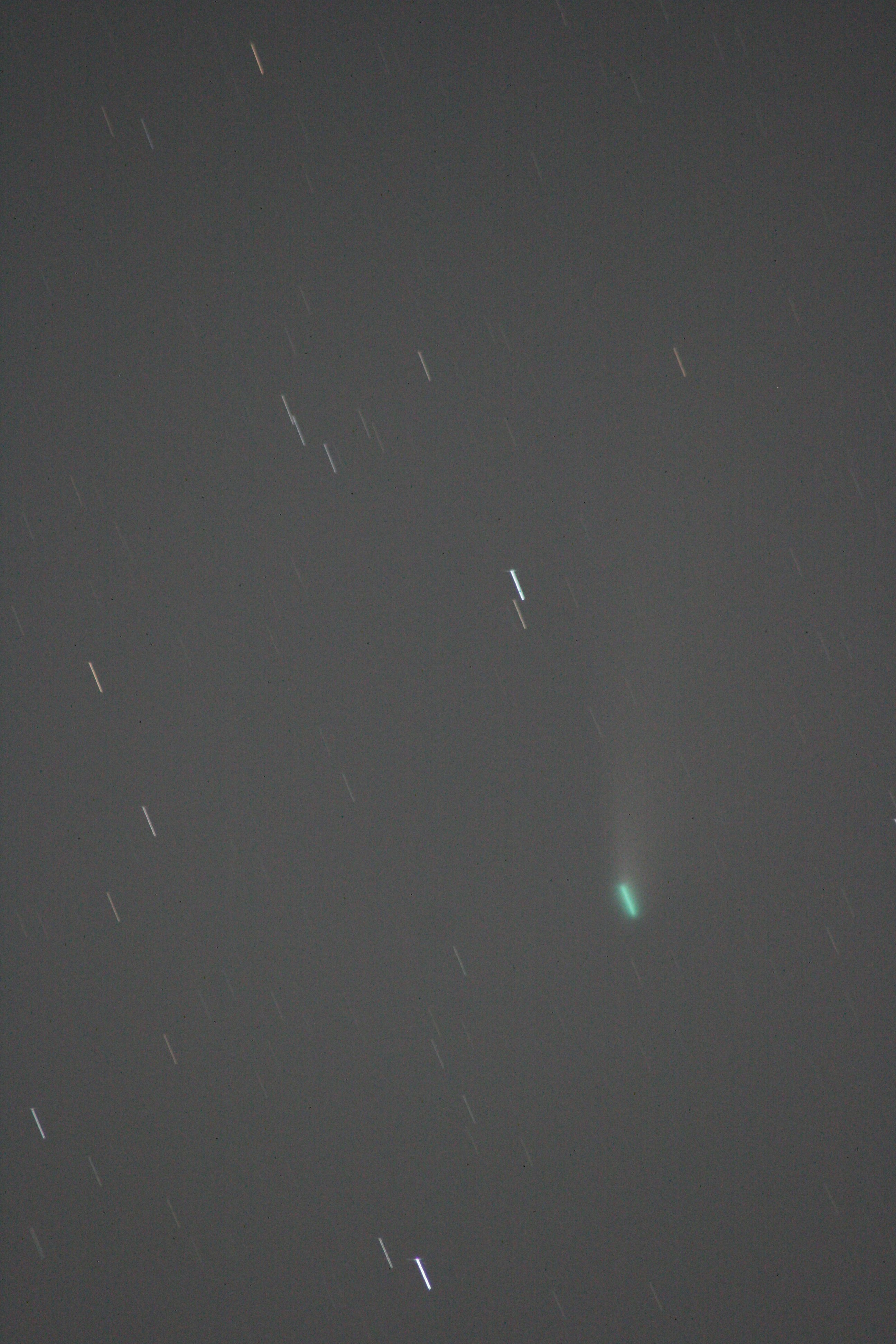
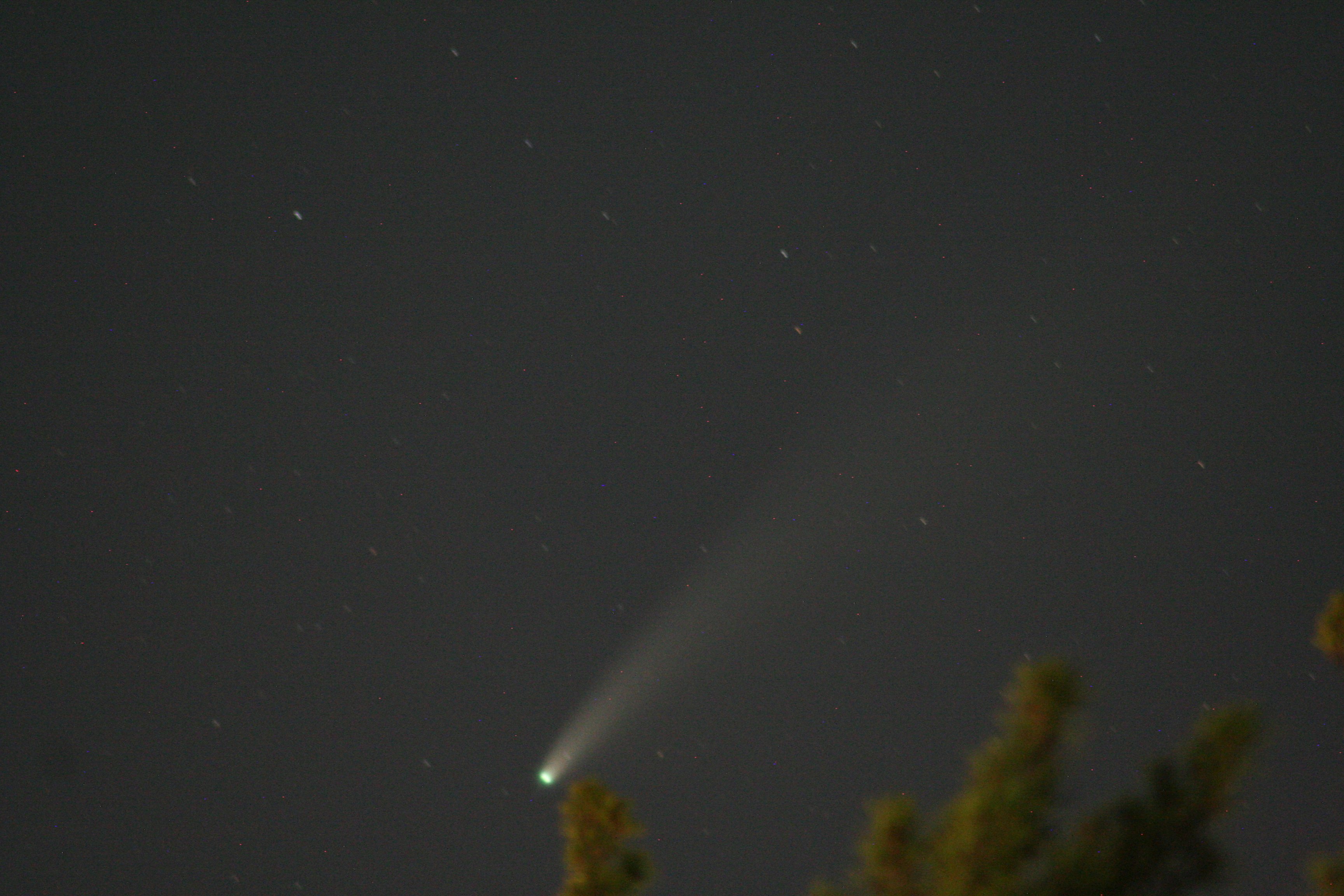
Finally, zooming in to 300mm and taking a 30 second exposure, the comet’s head is trailed but really shows it’s green color, while the tail is smeared due to trailing, but has more detail showing.
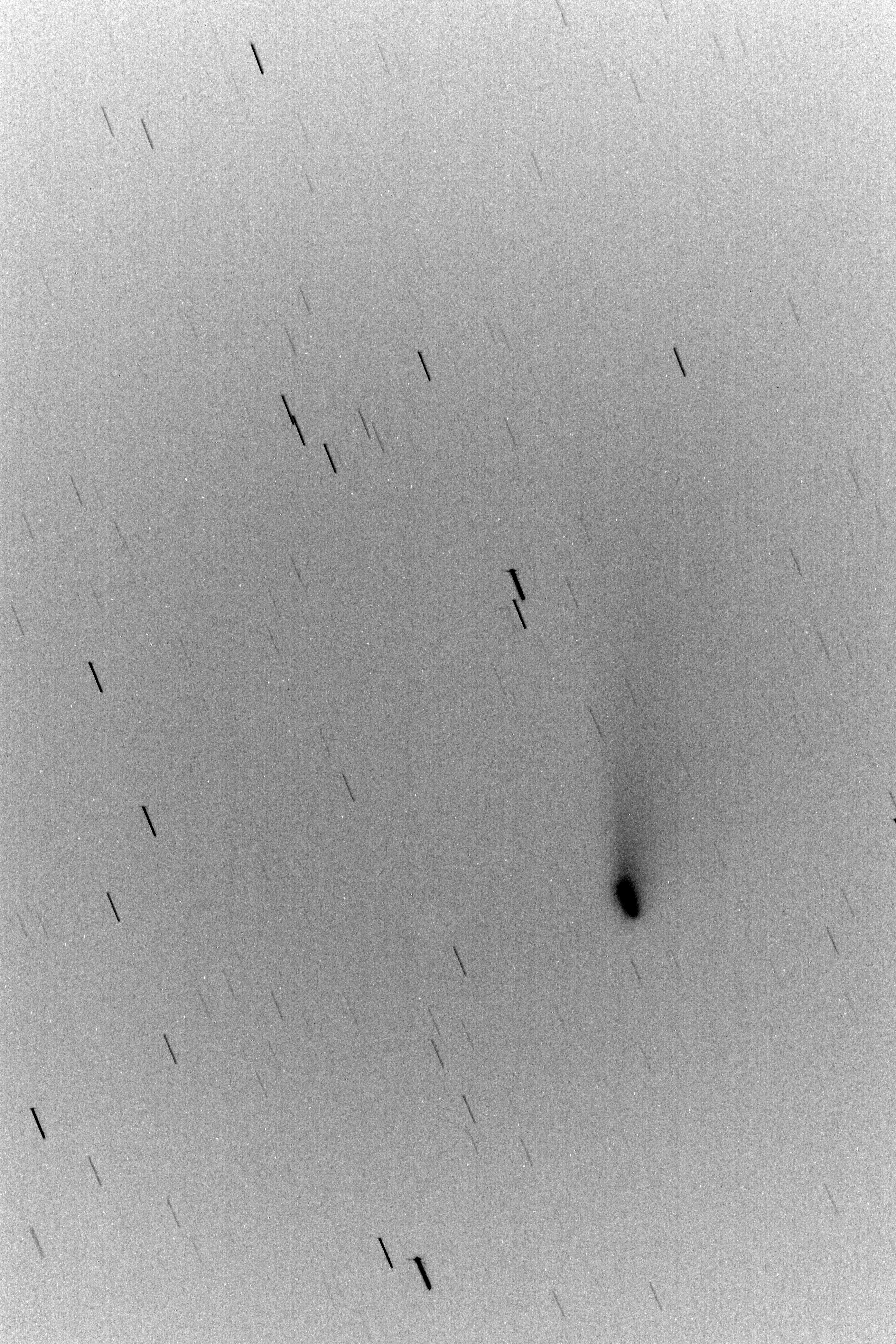
Finally, because I remembered an old trick used by earlier astronomers when searching for comets and asteroids on photographic plates, I inverted the image from black to white and I enhanced the contrast in Photoshop. Now that tail is really obvious!
Tonight’s the night that Comet NEOWISE F3 is closest to Earth. This is not to say that it’s actually really close at all (approximately 64,300,000 miles), but it is the closest it will come as it heads back out to the dim, cold, empty regions of the solar system.
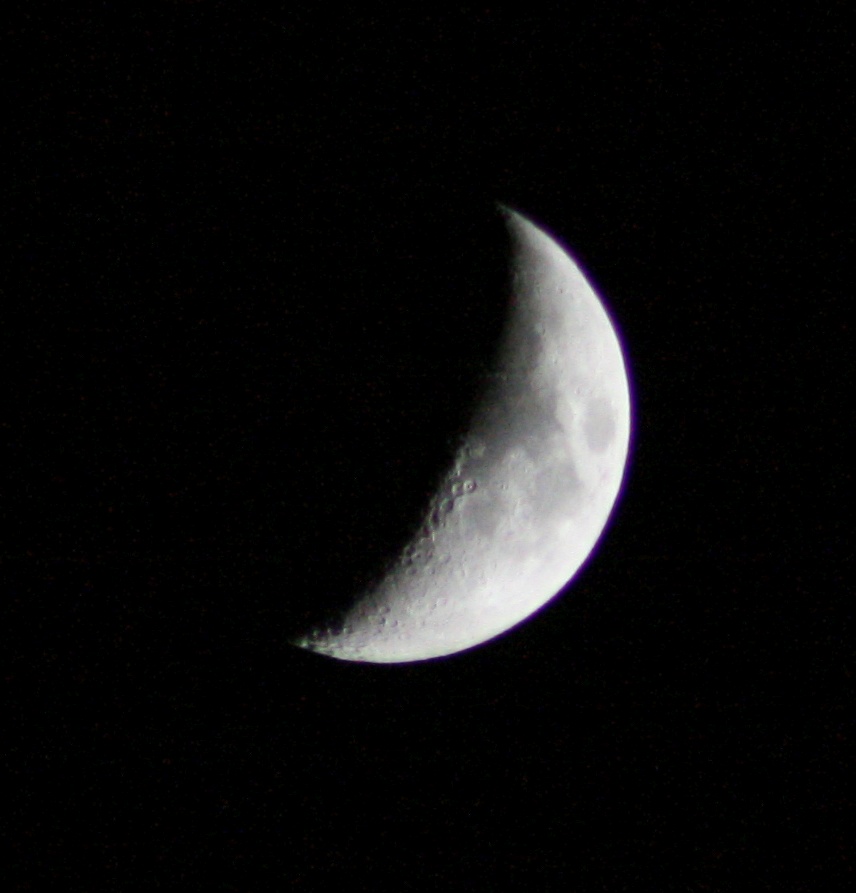
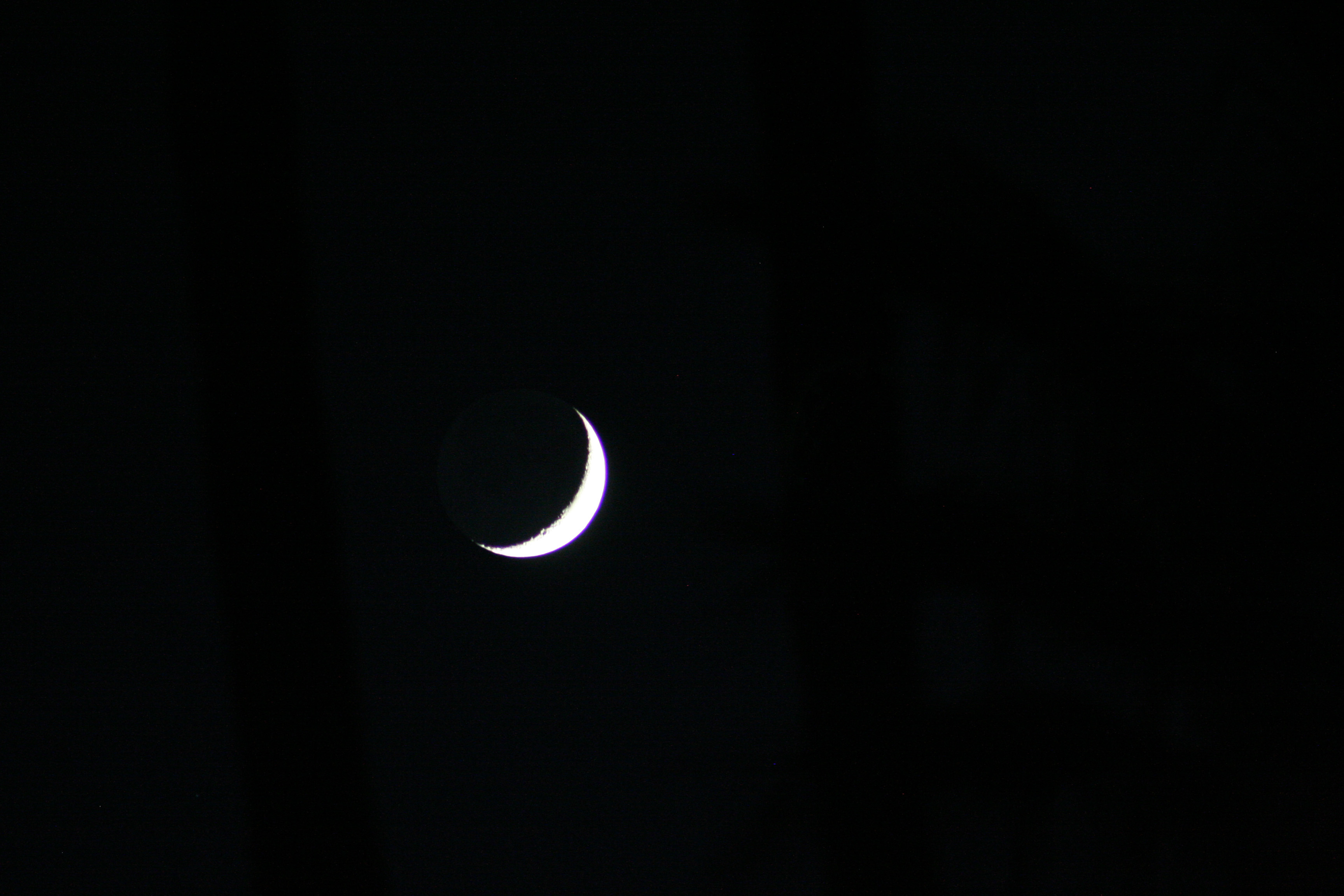
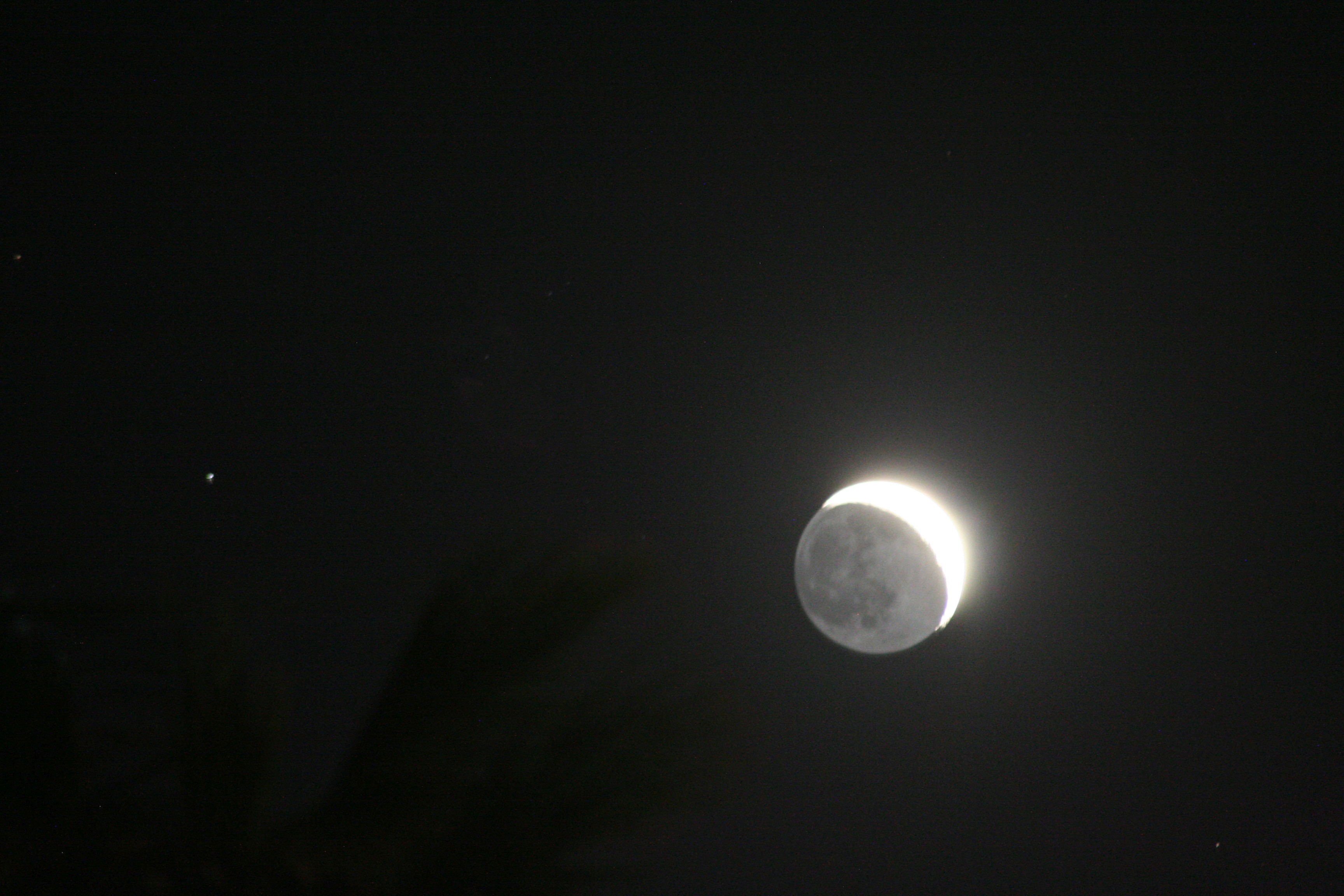
But first, before it gets dark, the monthly cycle has rolled around and the three-day-old crescent moon is back in our skies.
As always, the crescent Moon is a high dynamic range object. The illuminated crescent is quite bright, to to capture it you need a short exposure (1/25 second), but doing so makes it hard to see the palm trees that it was sharing that spot of sky with – perhaps if you have a good, high contrast monitor you can see their faint silhouettes.
Shoot a two-second exposure and the darkened face of the moon starts to come out due to Earthshine, sunlight reflected off of the Earth, onto the Moon, and then back to us. You can also start to see the brighter stars, as well as the aforementioned palm tree silhouettes. But the illuminated portion of the Moon is completely overexposed.
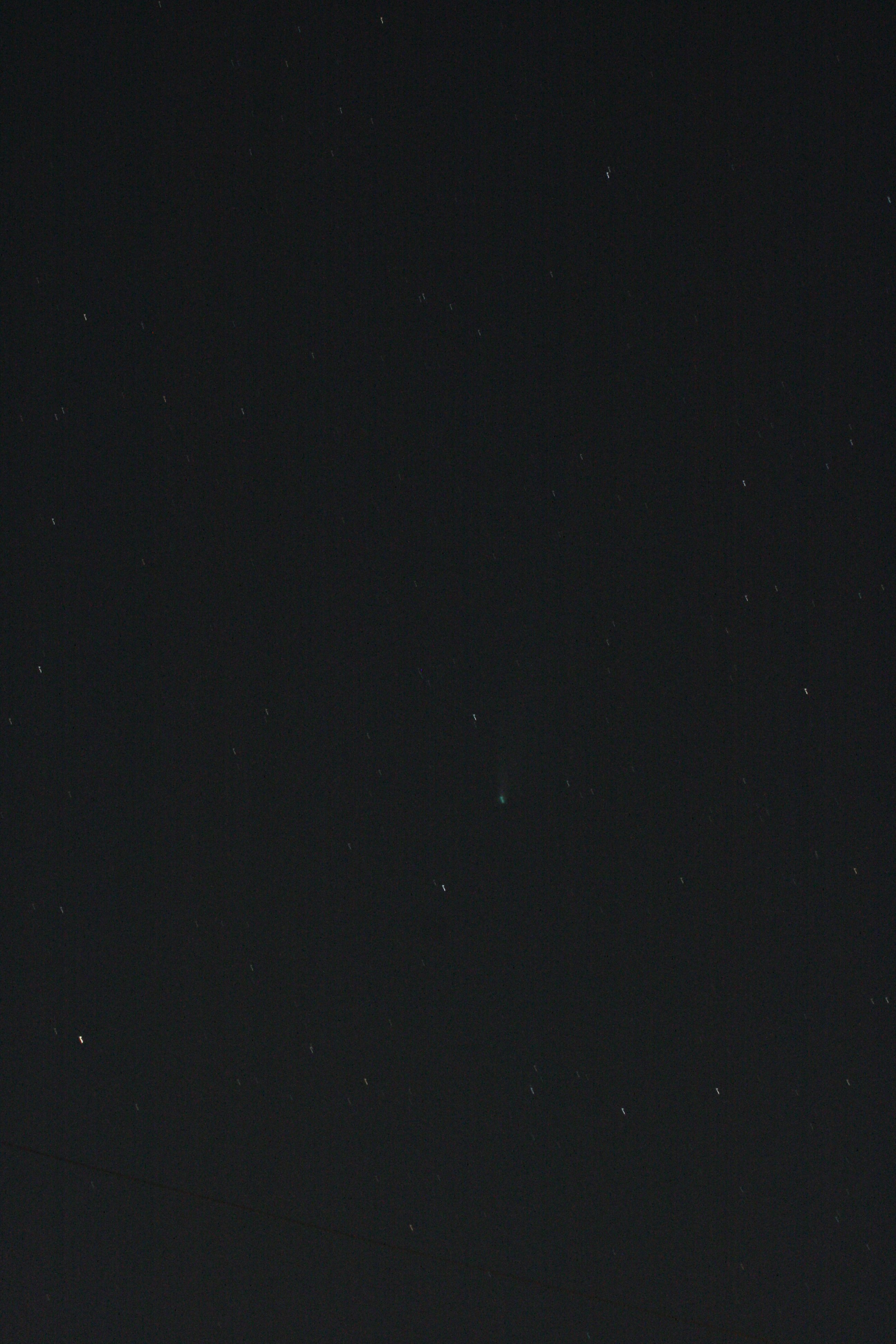
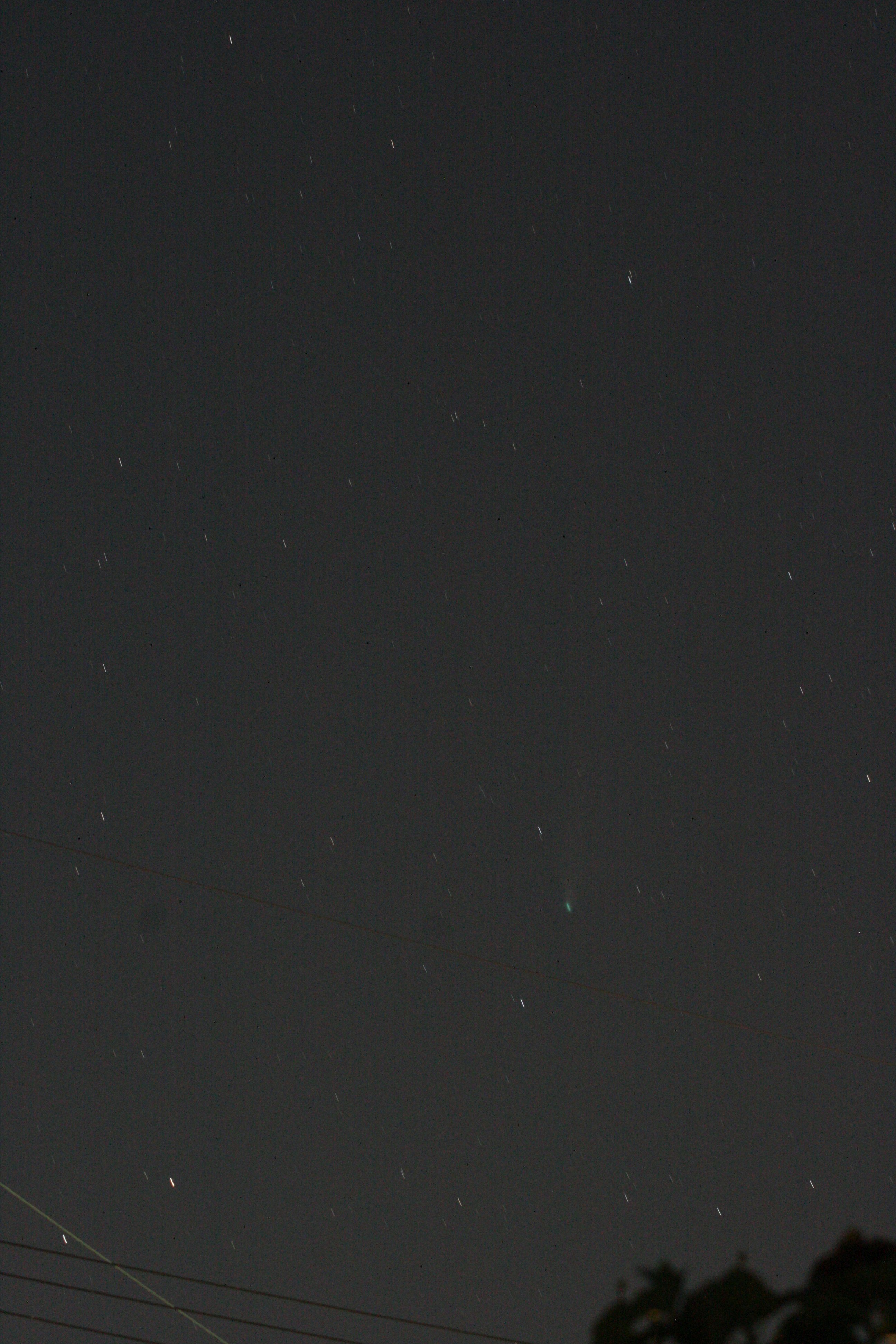
Finally, if you wait until about 21:45 and shoot a 15-second exposure, you’ll catch the comet with a distinct green color showing around the head, but not as much tail visible in the hazy, light-polluted skies of Los Angeles.
That’s the big difference in location – you’ll notice in all of the really fantastic comet photos taken from dark sky locations, the sky is almost jet black and a ton of detail can be seen in the tail, including the ion tail which is split off from the dust tail. Here in the big city, a long exposure just starts to turn everything grey.
So while I’ll still be going out and watching the comet, I don’t anticipate too many more photos, if any, unless something dramatic happens. “Dramatic” could include getting my telescope cleaned and repaired, getting the chance to drive for a few hours to get off to a dark sky location, or both.
The odds of either or both happening are…astronomical!
But the comet is still visible easily with binoculars, even from a city with all of its lights, and in a dark sky it’s still (barely) a naked eye object, so if you haven’t seen it yet, take your shot!
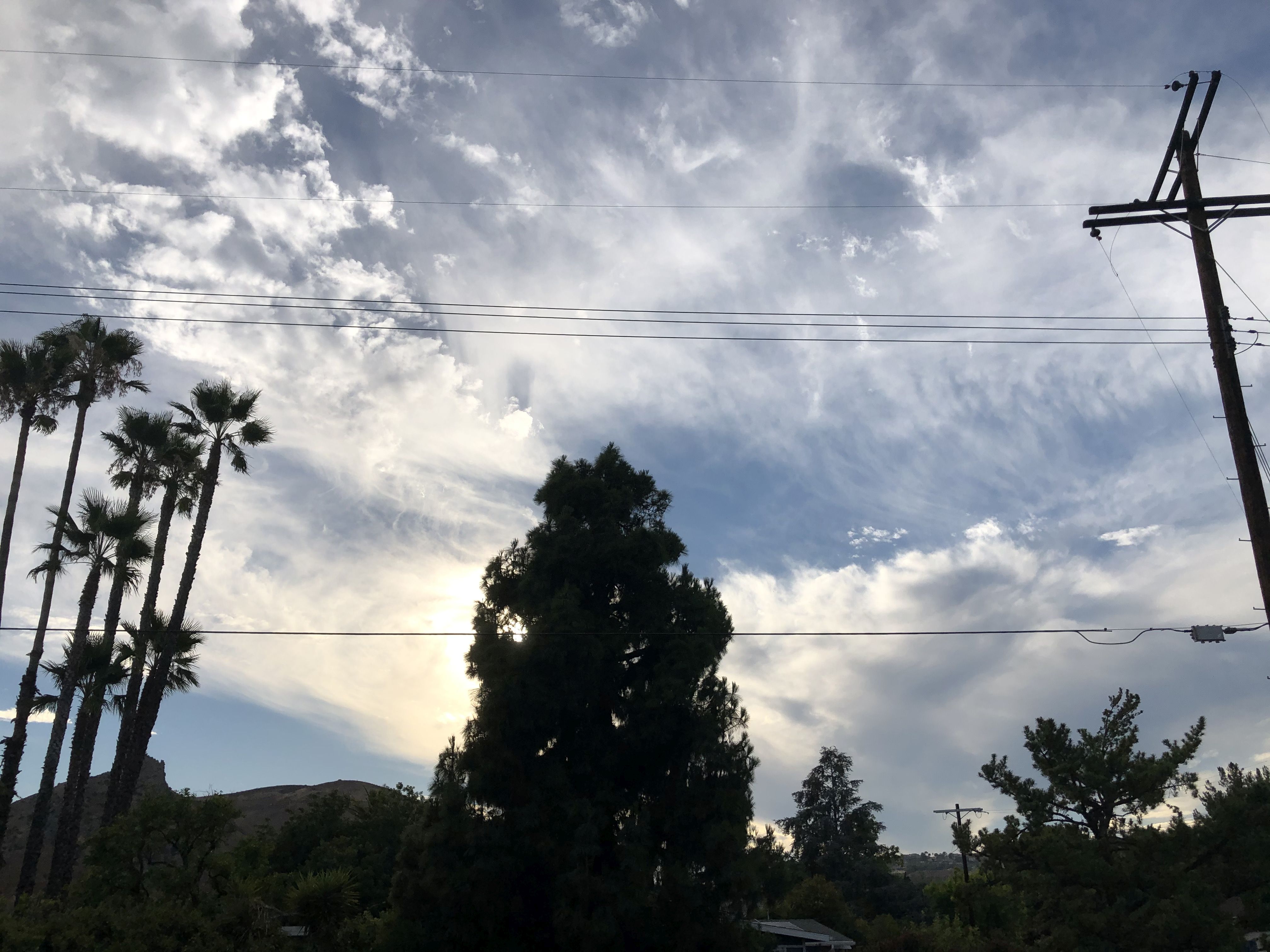
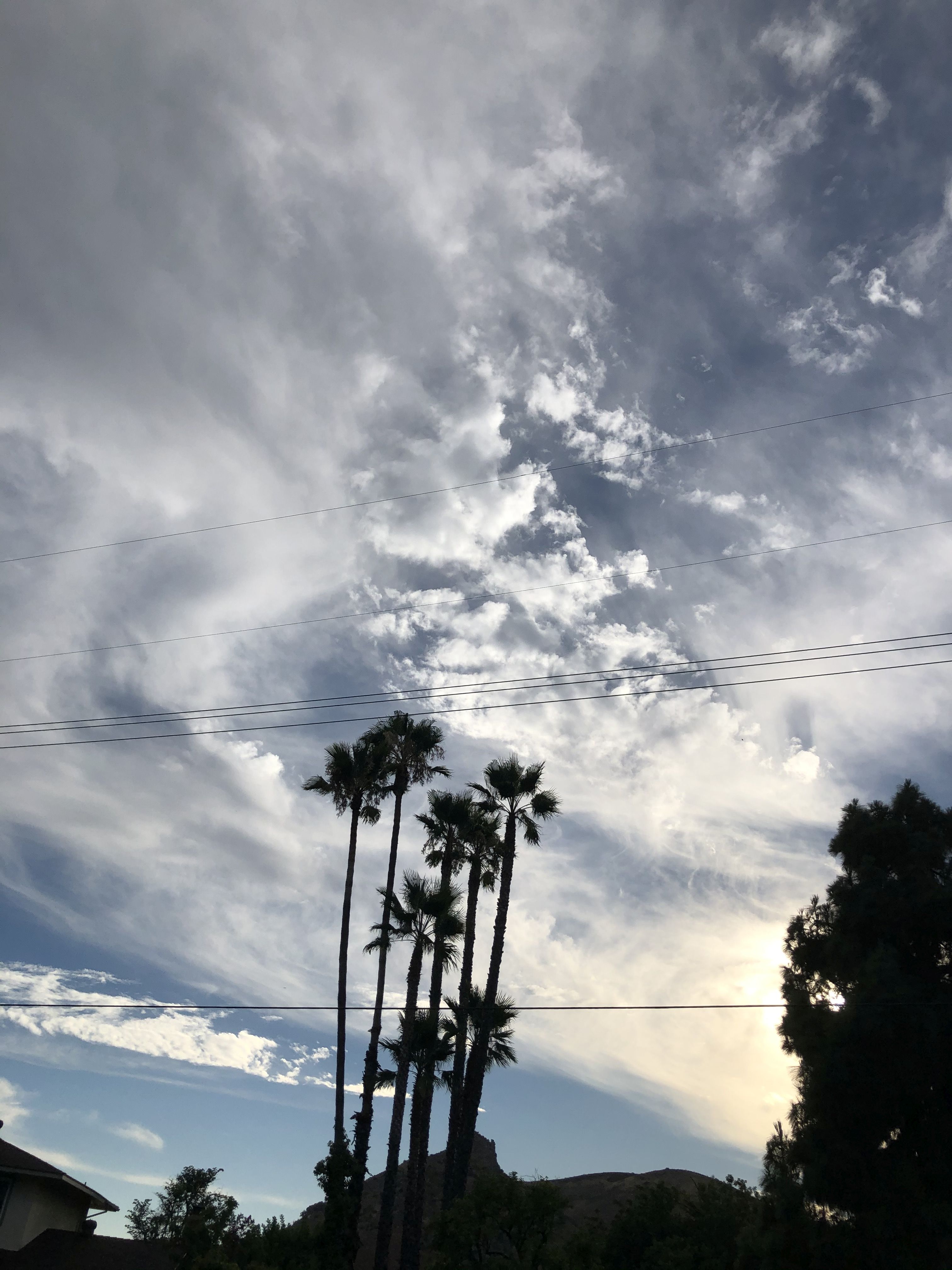
I was pretty sure for a while that I wouldn’t be seeing the comet tonight. I’ve at least gone out and looked at it for a few minutes every night for more than a week now, but near sunset it was looking marginal.
Pretty – I like clouds and sunsets – but marginal for comet watching.
It’s okay if I didn’t see the comet again tonight. Sometimes we can all use a night apart.
With the comet getting higher in the sky by 3° or more per day, I knew that it would be up for a longer time after full dark every night, so missing it tonight wouldn’t be the end of the world by any means.
I was ready to write it off, not even bother to look later when it got dark.
Yeah. RIGHT!
By 22:00 it was completely dark, almost two hours after sunset, and the skies were again totally cloudless. The comet was even higher than it had been when I was taking pictures at 21:00 to 21:20 the other night. It’s nice and high, actually above that big pine tree across the street and above those power lines. It’s still remarkably easy to see, given that comets normally fade fairly quickly. This one is hanging on.
It’s barely visible to the naked eye still here in the light-polluted Los Angeles metro area, but still an easy target with the binoculars. It took me a minute or two, but only because I didn’t realize how high it was now. I was scanning the horizon given the hour, but it was up above those wires!
If you’ve got binoculars of any kind, don’t give up if you haven’t seen it yet or it’s been cloudy. You’ve probably got at least a week more, maybe two.
It’s the 51st anniversary of the Apollo 11 moon landing, and while it’s not one of those big, fancy, “ends in a zero!” anniversaries, it’s still a great opportunity to re-live the experience. A reminder to all that the ApolloInRealTime.org site is available any time you want to listen to a number of the Apollo missions. It’s truly an incredible site, with not just *ALL* of the audio but tons of video, pictures, and other materials all synced to the mission time line. In addition, it’s not just the ground to space audio, but there are multiple side tracks from the different flight controllers all talking to one another.
At the moment one of the listening options is to have it playing in “real time” as it did in 1969, but you can listen to any part, any time.
So that’s pretty spectacular, there’s a comet that’s still up there and very visible for the next couple of weeks (and then visible in binoculars and small telescopes for another couple of months), and there are folks doing almost unbelievable feats in space every day.
SpaceX did another satellite launch, and stuck the landing on the booster on their drone ship out in the middle of the Atlantic, and for the first time caught both payload fairing halves for re-use. (They’ve successfully recovered both fairing halves on several flights, fishing them out of the ocean and then getting them refurbished for re-flight and re-use.) That’s the 57th successful landing of a first stage booster by SpaceX, something I remember first hearing about maybe seven or eight years ago and initially believing to be utterly ridiculous to even try, let alone succeed at.
Astonishing wonders 51 years ago – astonishing wonders today.
Let’s not forget, but let’s also keep pressing on.
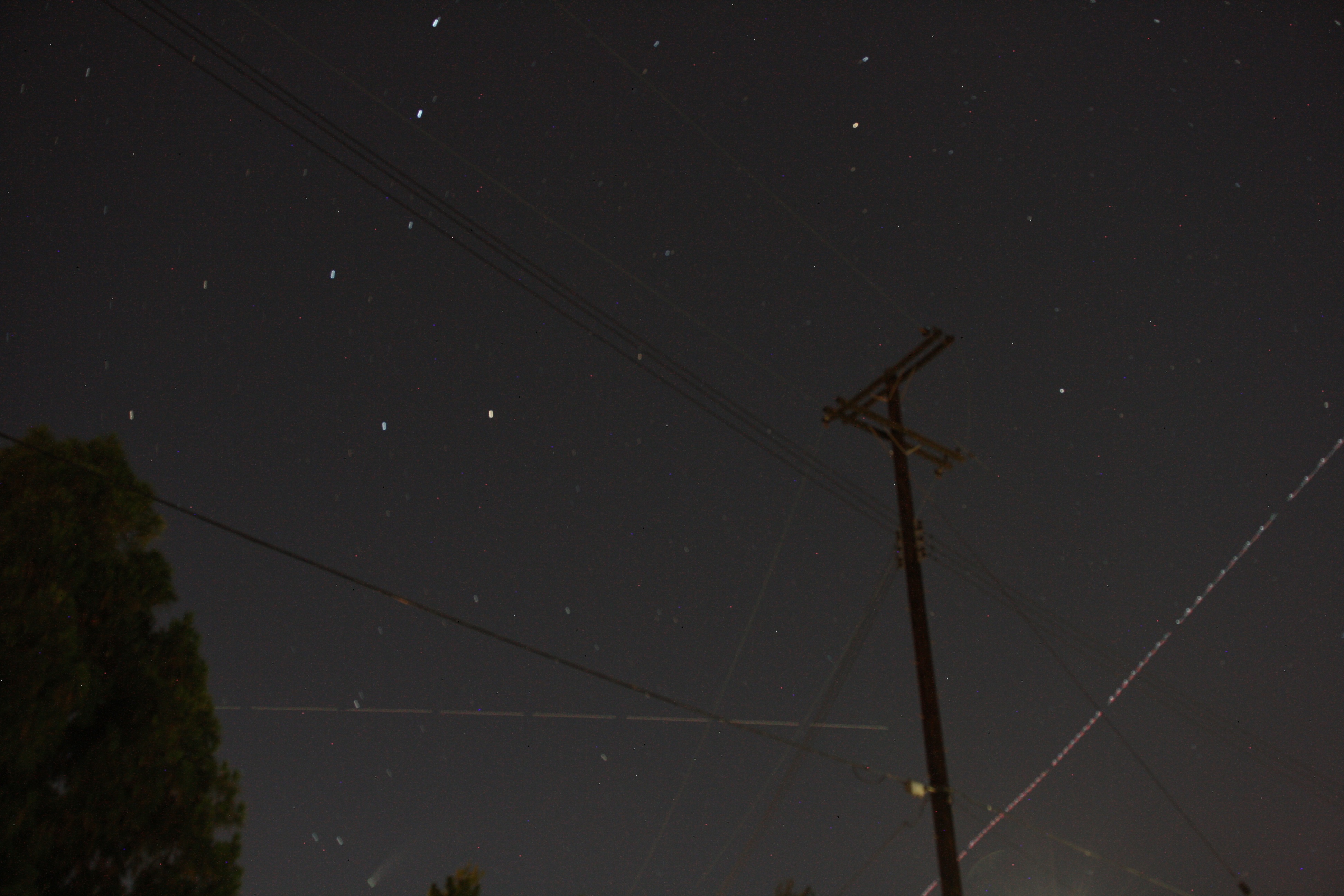
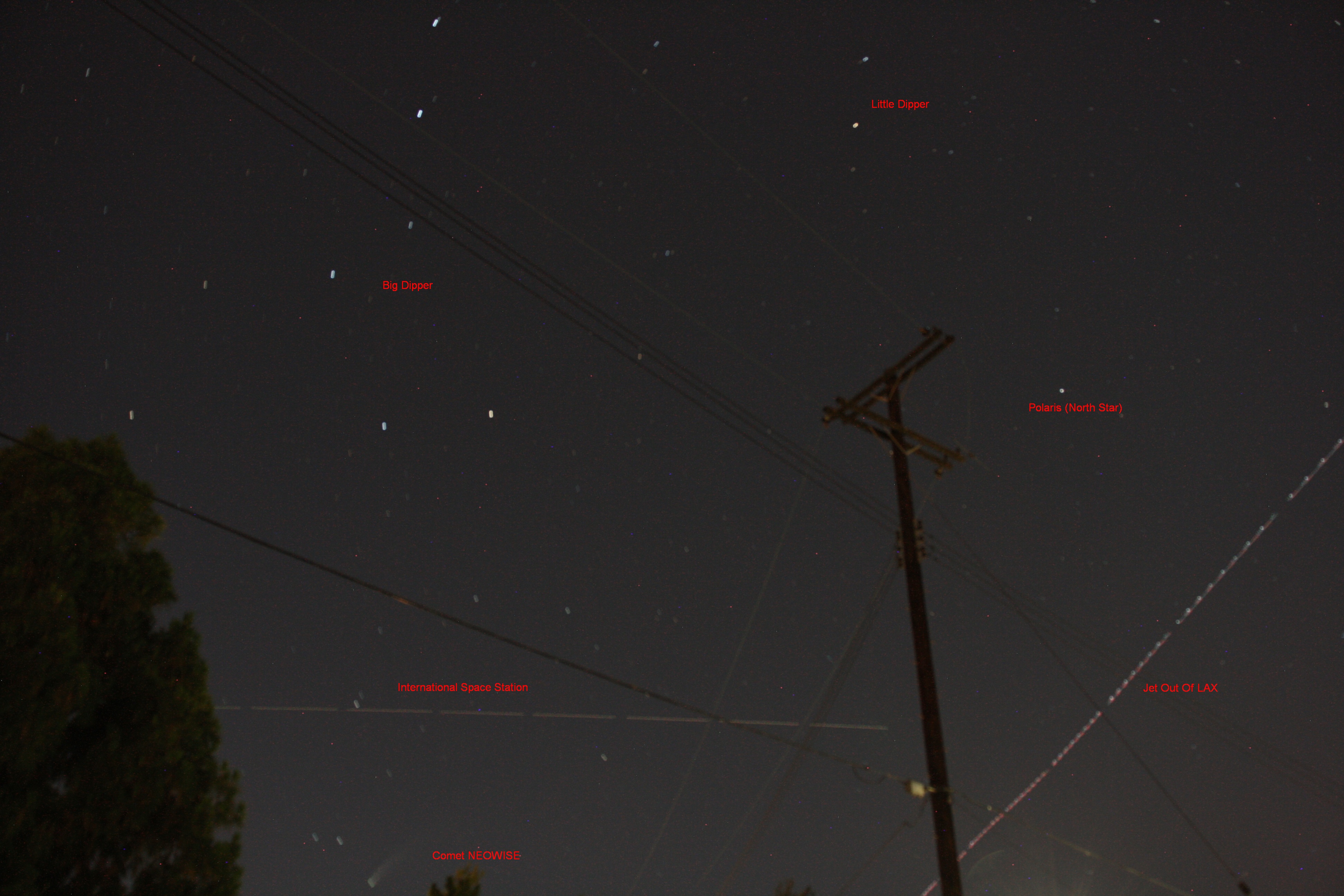
So, as I thought, or as I expected thanks to the Heavens-Above.com sky maps, tonight I got to see the ISS sail right past Comet NEOWISE!
Click on that beauty and look for the comet near the bottom, the Big Dipper way above it, the ISS passing between them, and one of the ever present commercial jets out of LAX headed toward Asia!
Did you get them all?
The comet’s a little blurry, as are the stars, since they’re stacked from a series of about ten images, each ten seconds long, and nothing’s standing still in that time, so… blur!
What was the camera with the big lens doing while all of this was going on?
The usual – taking pictures of the comet after it got dark. I missed catching the ISS & comet together in this smaller field of view. I guessed wrong and had the camera a bit low, ISS passed just over the top, out of sight for this lens.
But I shot ten second images for over 45 minutes, so there might be a good time-lapse video to come. But not tonight. I’m exhausted. It’s been a tough week.
But sometimes, even at the end of a long, tough week, you get the camera position correct enough to get lucky enough so you get to see the comet an extra five minutes as it slips down perfectly in between those branches on that tree.
As we had last night, there was a bright, glorious ISS pass to go along with better and better views of Comet NEOWISE. But orbital mechanics being what they are and out of my control, tonight we’re doing them in reverse order. First we have the gorgeous ISS pass, and then it gets dark enough to view the comet.
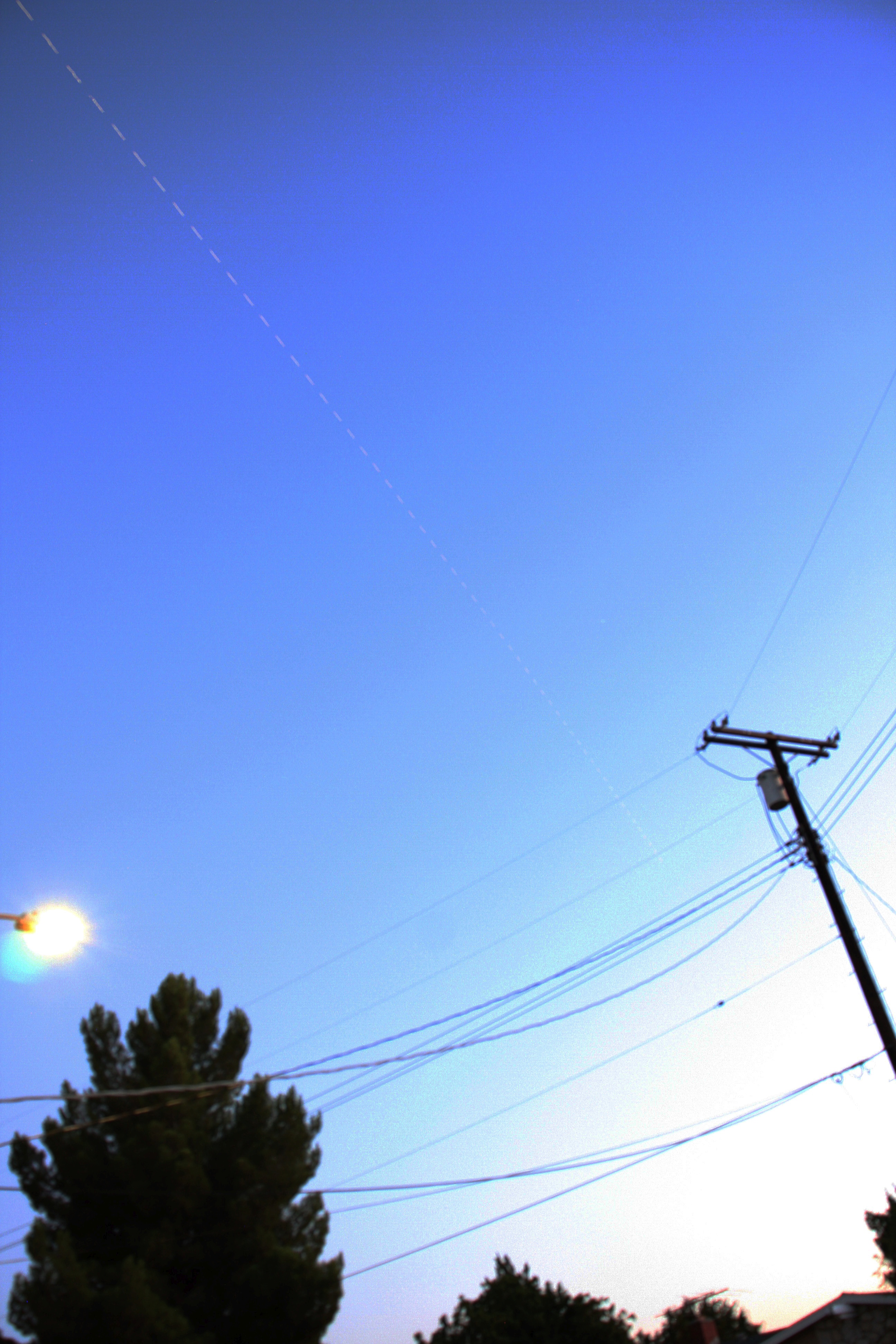
The ISS pass was wonderful to watch, but difficult to photograph because it started at 20:30 and it’s still too bright at that point to do what I did yesterday. Yesterday’s images were five seconds long because it was dark. Similar images today would have been nothing but white from border to border, completely overexposed. The camera wanted to do 1/4 second exposures at the most, but I’m the PIC (Photographer in Command, in this case) so I set it for 1 second exposures and hoped for the best.
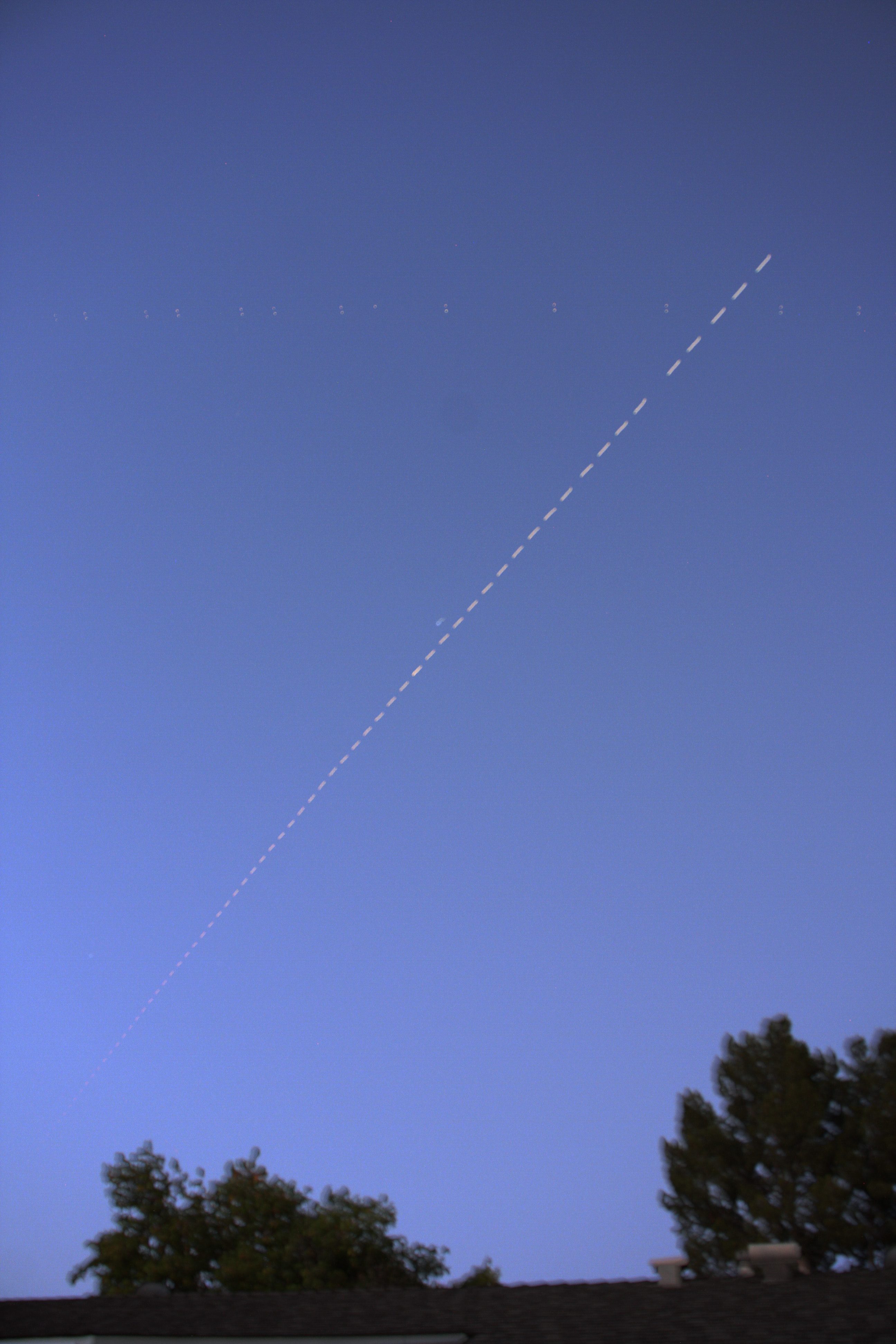
The results were marginal looking to where the ISS was rising in the west, but pushing the contrast in Photoshop at least allowed the station’s path to be seen, coming out of the glare of twilight toward the upper left corner. At least I’m getting a lot better on planning where to point the camera!
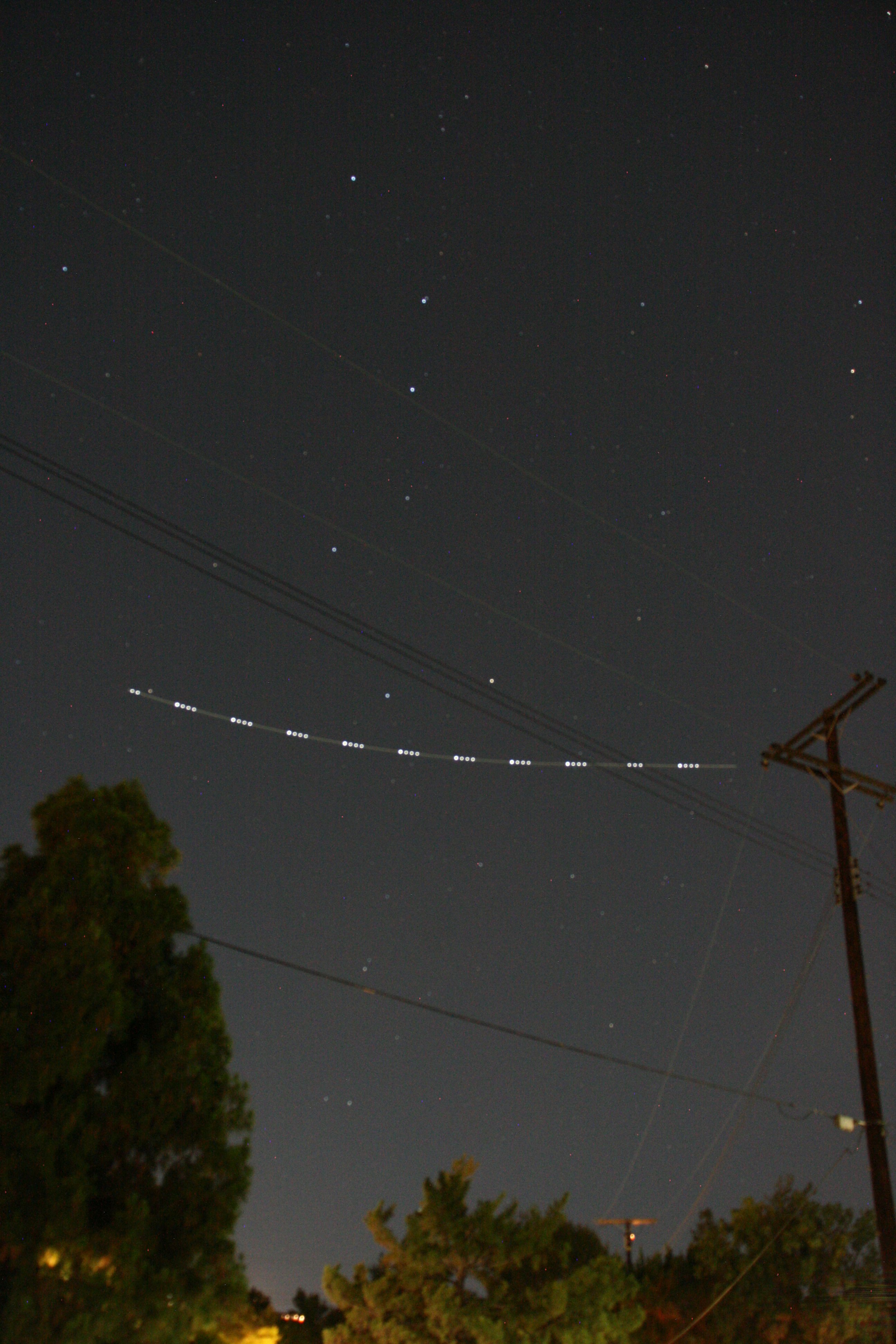
Headed over the horizon to the northeast the sky was darker, so there wasn’t as much tweaking necessary in Photoshop. You can also see where one of the big jets out of LAX was headed off to Asia at one point during the sequence. That bright star visible right next to the ISS path about half way is Vega, a very bright star, just starting to be visible as night falls.
I had to wait another half hour for it to get dark enough to see the comet. Again tonight it’s higher than it was yesterday, staying up longer while it gets darker, and easier to see. Again I’m emphasize if you’re looking – BINOCULARS! It looks fantastic.
This is a fifteen second view…
…and this is a twenty second image toward the end of the evening, shifting around the yard to try to dodge those trees blocking my view. These were both taken with the telephoto lens at 75mm.
Seeing if I could zoom in (better close ups of the comet) and take longer images (gather more light, but it’s a balancing act because the Earth’s moving and the image will smear if you’re not tracking) I tried to see what happened and got this at 300mm zoom and a ten second exposure:
It’s a little smeared and disappearing down behind that tree, but if you blow it up to full sized you can see how the comet’s tail is spread and curved. No chance with this rig, this low, and this light polluted to see the blue ion tail.
But that wasn’t my main goal for the night. From the time that the comet started to be really visible in the twilight (21:08) until it went behind that tree (21:25) I had cameras set up to take one photo after another, fifteen second exposures. Then I used that trick I learned in Photoshop…
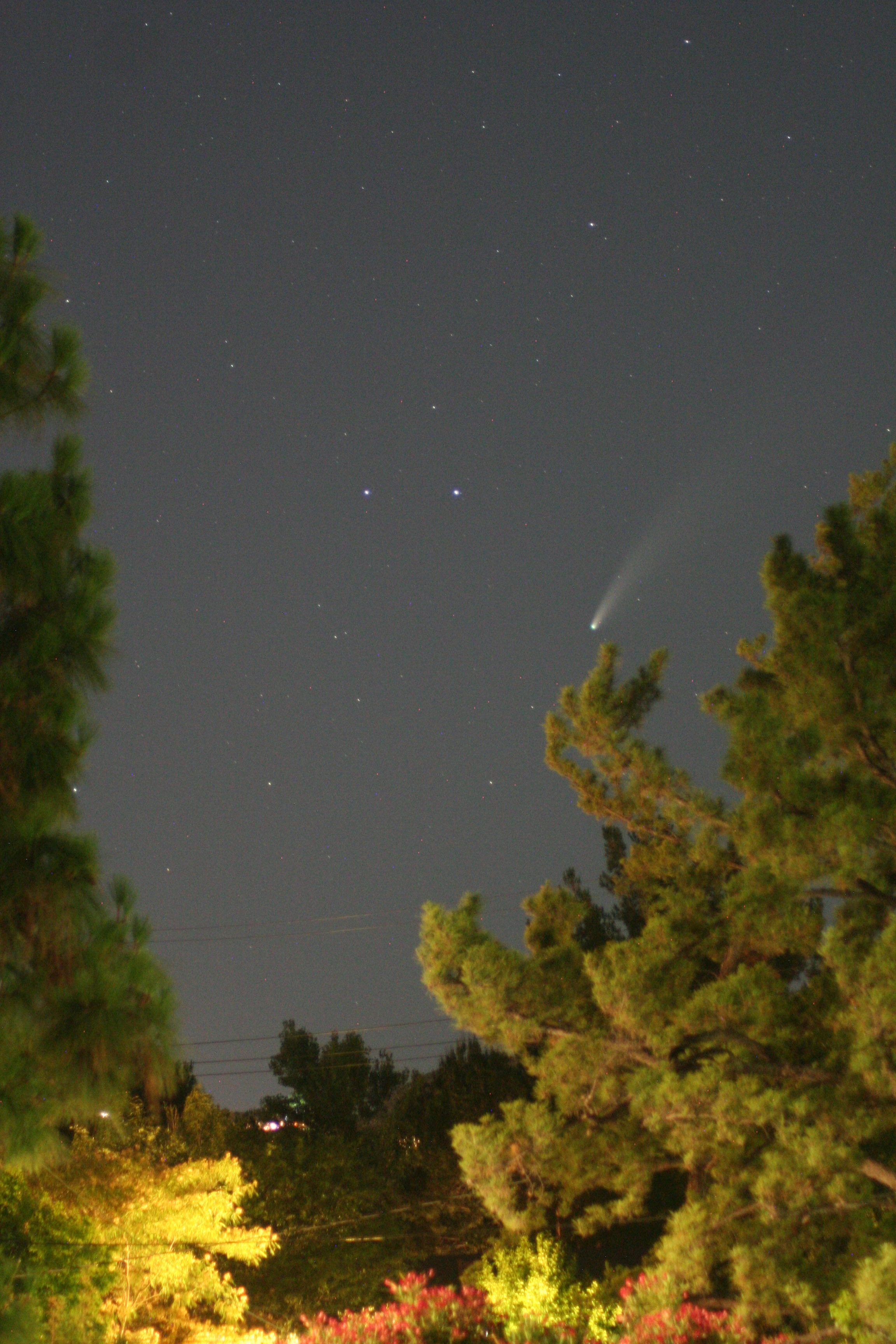
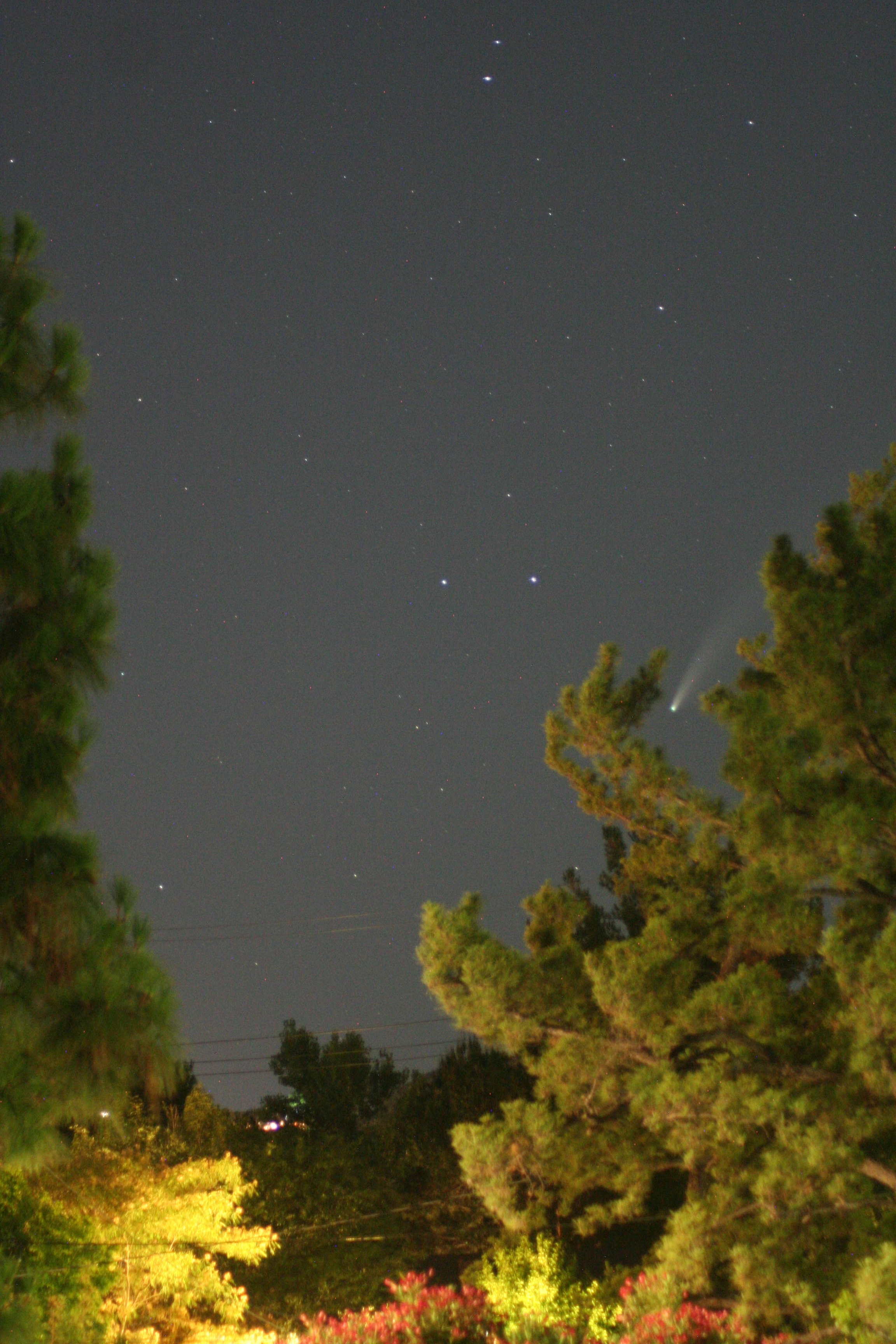
This is the “regular” lens with a taller image, so that you can see the Big Dipper at the top. The comet is at the bottom, between those trees, heading down and to the right. I love this little video, the really clear, easily recognizable constellation spinning at the top, and how some of the stars in the Big Dipper “blink” as they go behind the power lines.
But I said I had cameras set up – plural. The big lens was also running!
Watch how it gets darker as time goes by and the stars in the constellation Lynx (below the Big Dipper) start to come out and the comet’s tail just gets brighter and more prominent as twilight fades!
This is easily my best work yet. I didn’t know how it would turn out, and there’s plenty of room for improvement still, but I’m very excited with how this turned out.
I’m posting the full-sized videos above. (I hope – it’s really late.) They’re also on my YouTube channel, but at reduced resolution.
And what happens after you’re done with that? Well, the first video is made up of forty-seven images, but that’s from a series of fifty images. I didn’t know exactly when the comet disappeared behind the tree. And that forty-eighth image?
The comet can just barely, almost, maybe be seen behind that tree – but the helicopter that came by missed its opportunity to photobomb my work!
But tomorrow’s photobombing, if I can pull it off, could be on a par with tonight’s results.
Getting better… The comet’s a little higher… I’m doing fewer stupid things with the camera…
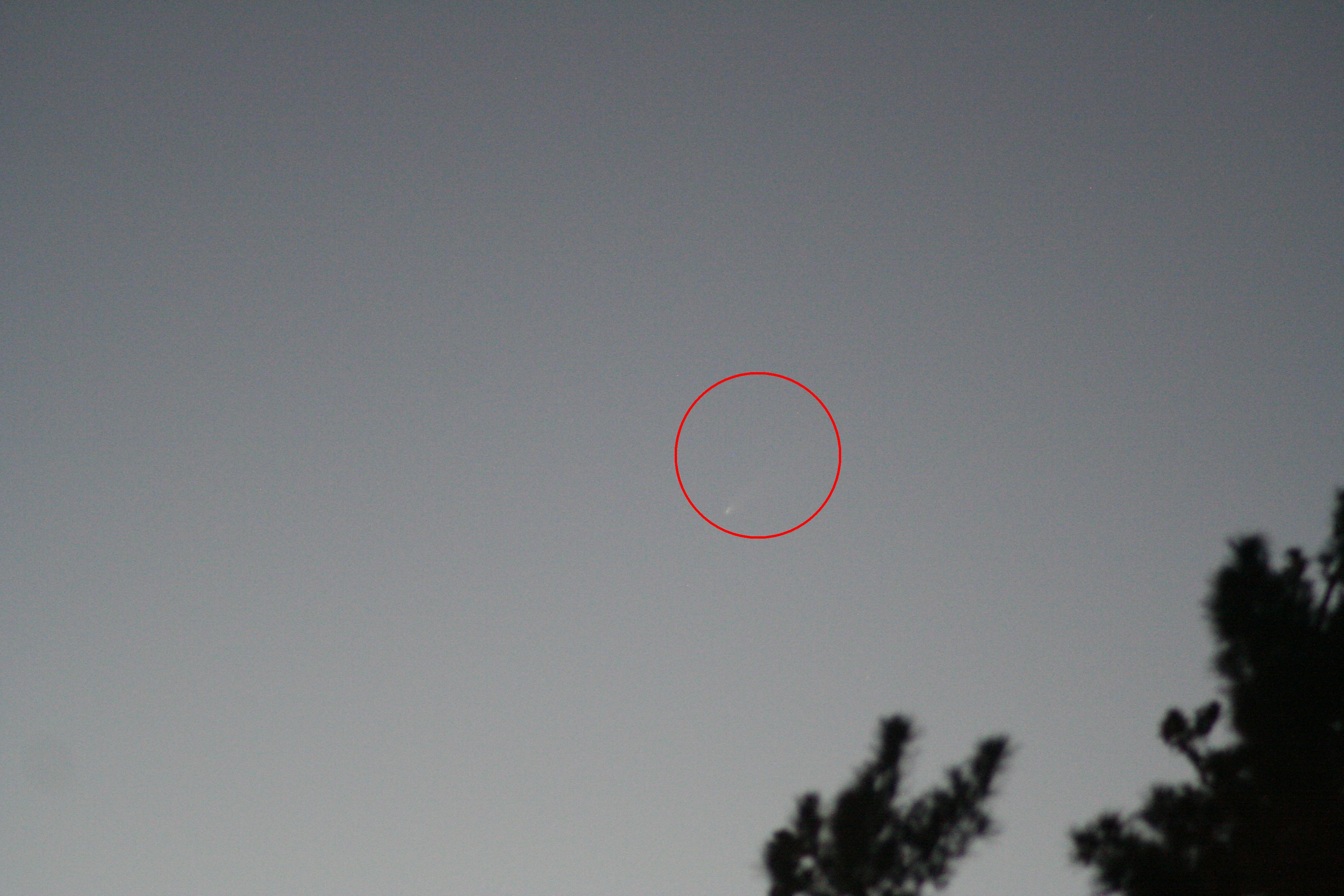
Sunset was at 20:05 so I again started hunting at about 20:35. That seems to be a bit of a waste of time because the comet is just too low contrast to be seen with that much twilight still lighting up the sky. Even with three different apps telling me exactly where it is, I didn’t spot it (right where it’s supposed to be, between these two trees) until just before 21:00. And while I was able to spot it with binoculars at that point, it wasn’t visible to the naked eye. Best efforts with the camera is marginal, to be generous.
But I hope these pictures will give you an idea of what you’ll see if you go hunting. (Get binoculars!!)
Five minutes later it was better.
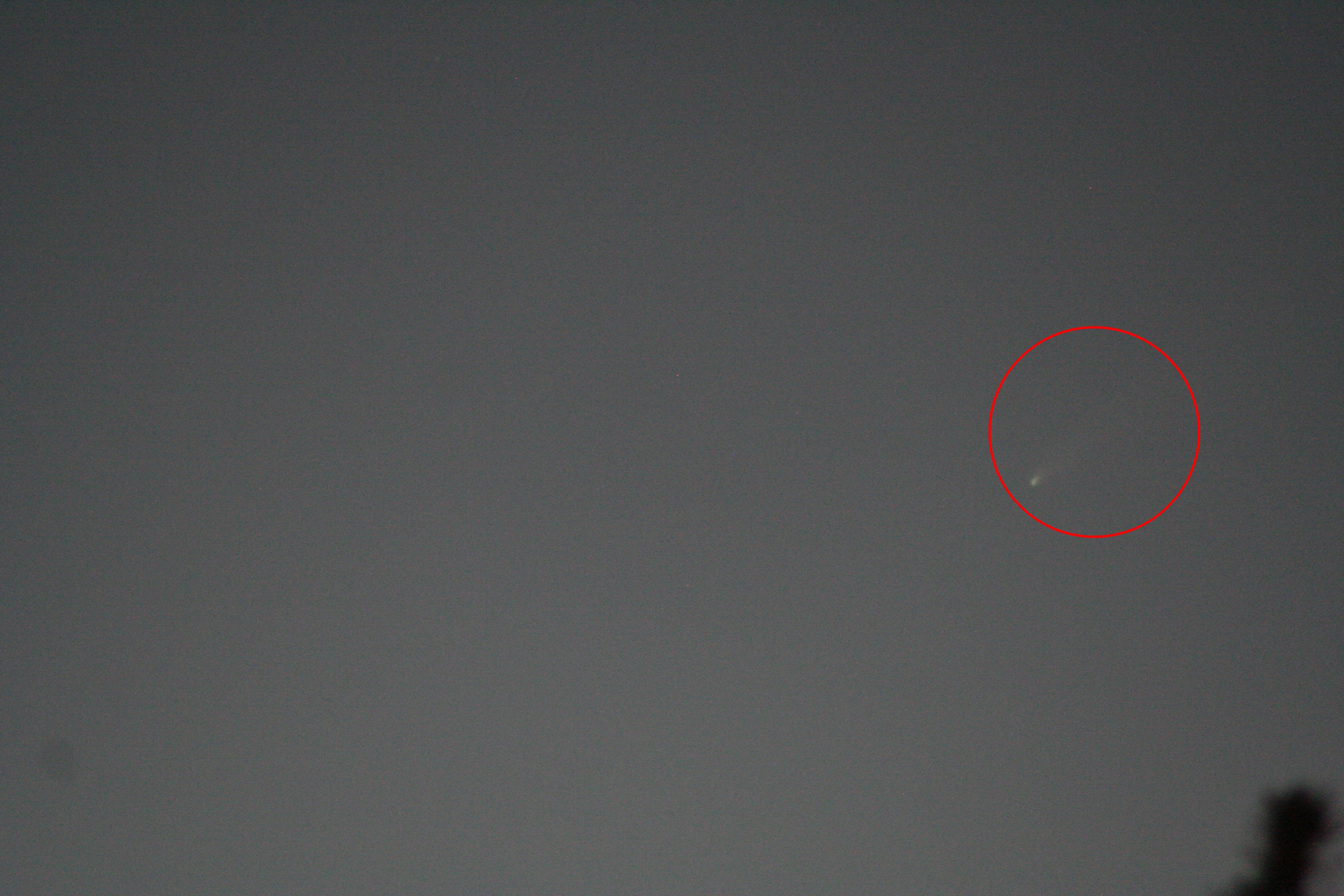
And better. Starting to zoom in with the big telephoto.
And better. This was about 21:08 and the head of the comet was just barely beginning to be visible to the naked eye, but mainly because I knew exactly where to look and I knew what (or what not) to expect.
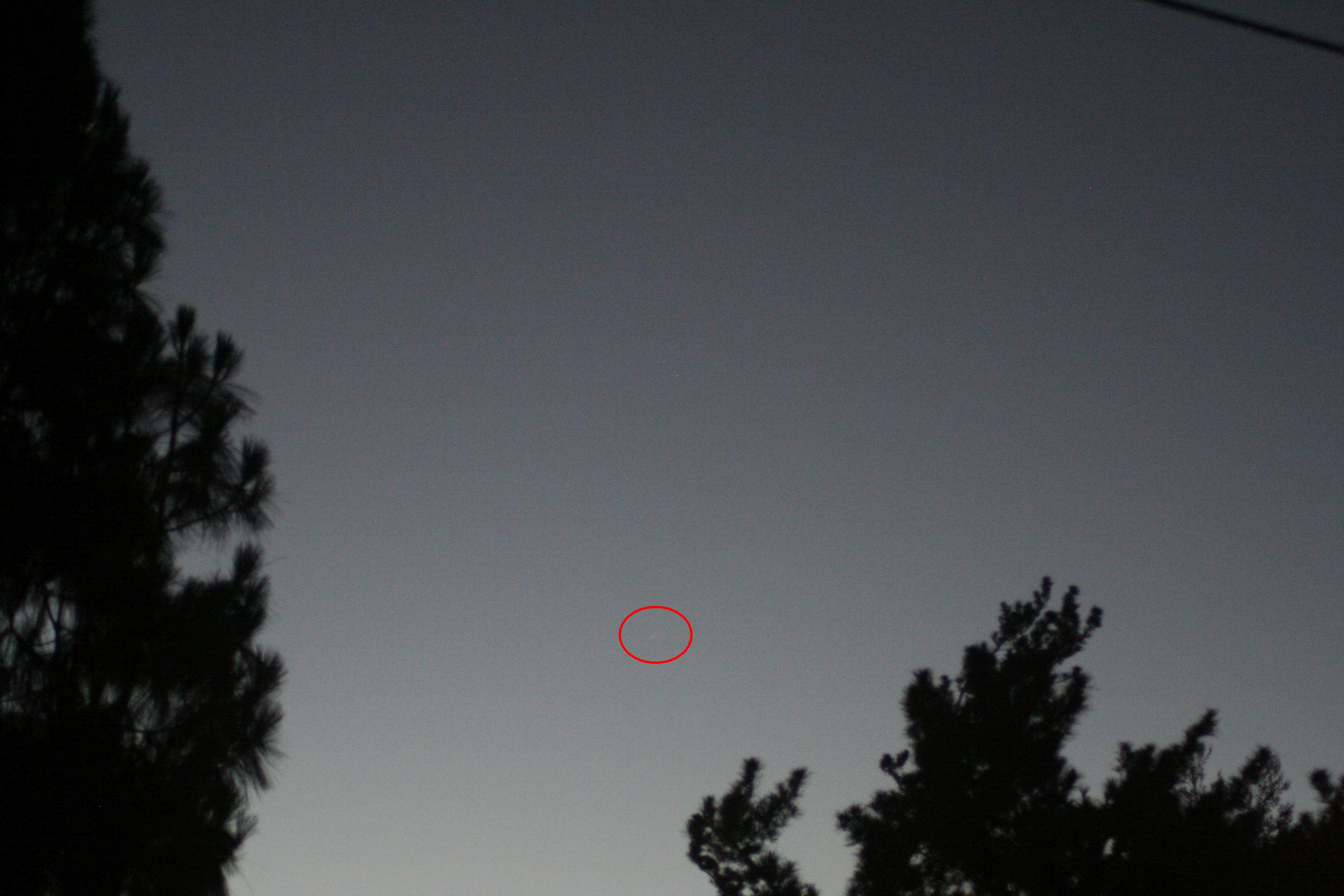
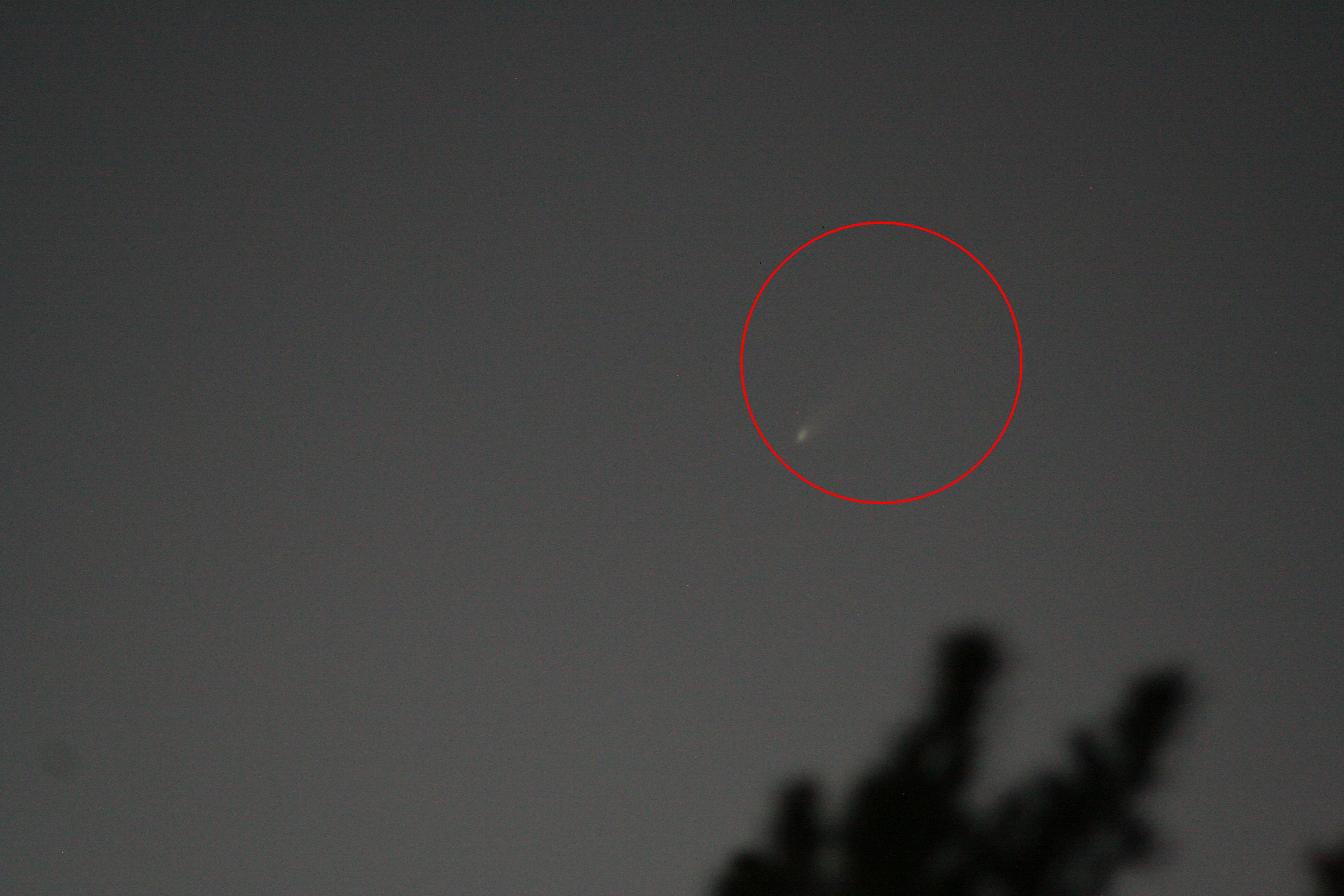
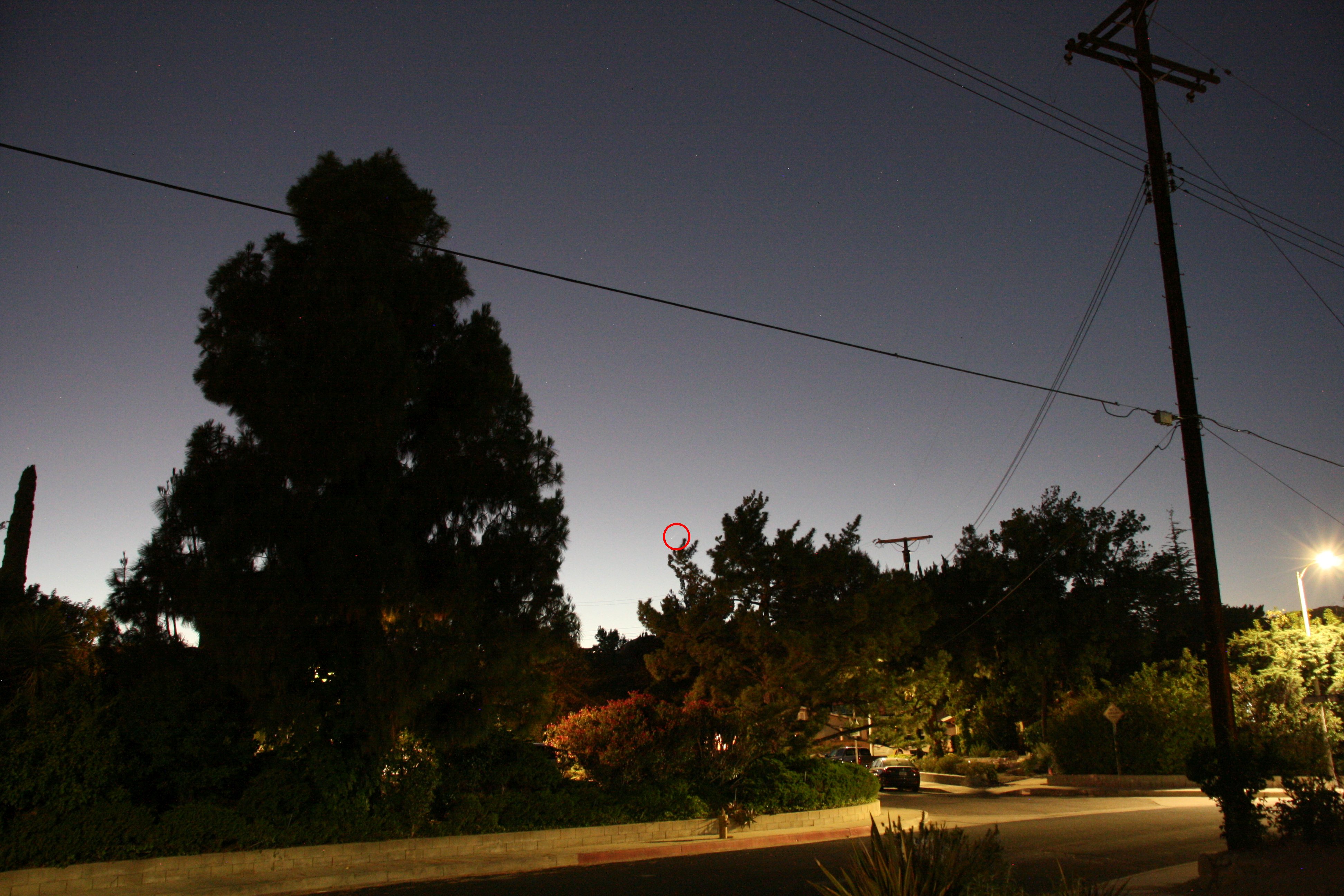
About 21:10, this is what a long, long exposure on the regular lens looked like. It was actually getting pretty dark and most of the ground lighting in this scene is from the street lights, but you can see that down near the horizon it was still bright. Click on the picture to blow it up – you can see the comet in that circle, but it’s a fuzzy dot and a smudge to the naked eye.
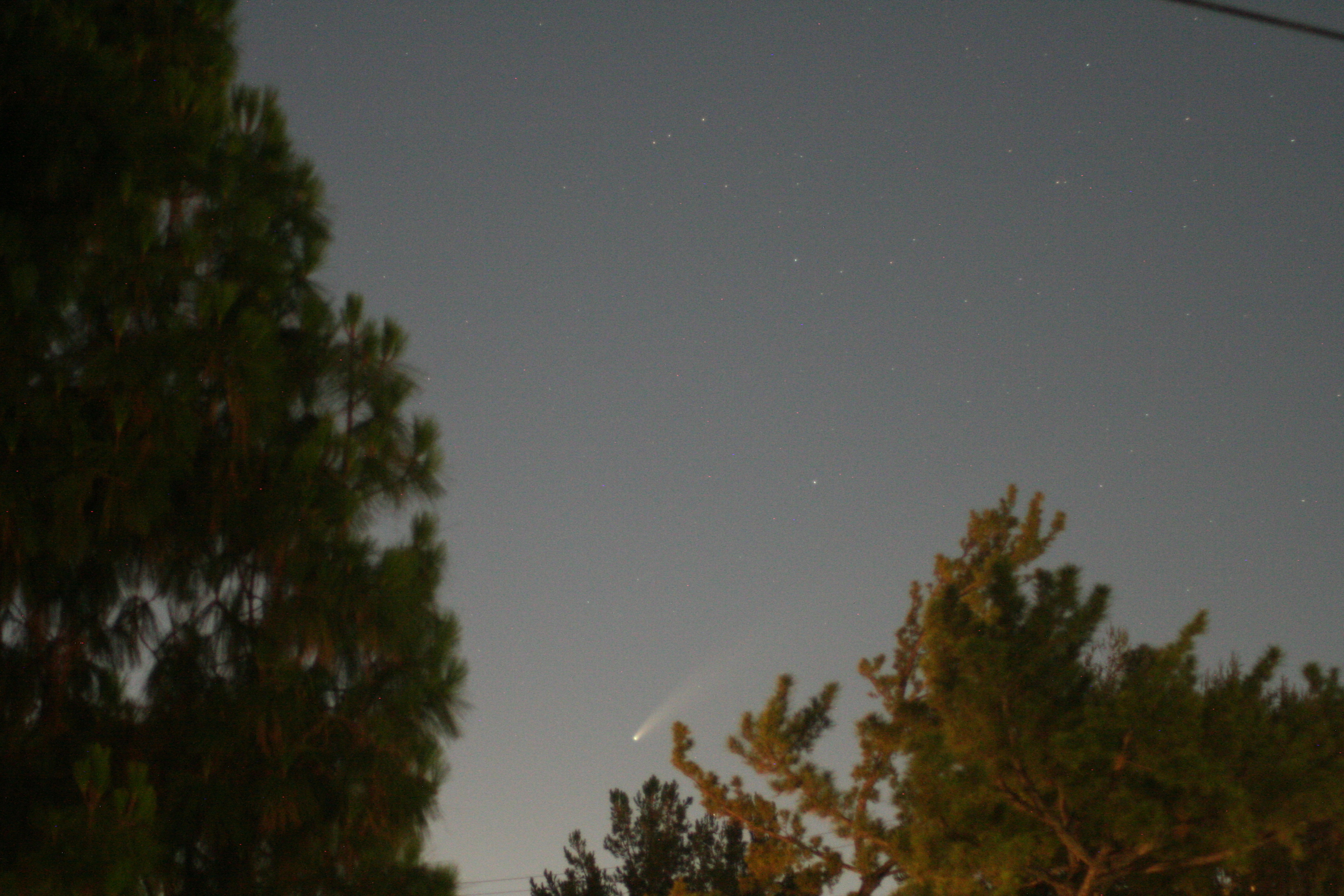
But now, just as the comet’s going down behind those trees, it’s finally dark enough so that with the bigger lens, you can start doing 3 second, 10 second, 30 second exposures without getting nothing but white. And when you do that…
Six second exposure. My best shot yet!
Then it was down behind the trees and I was scrambling, because about three minutes later…
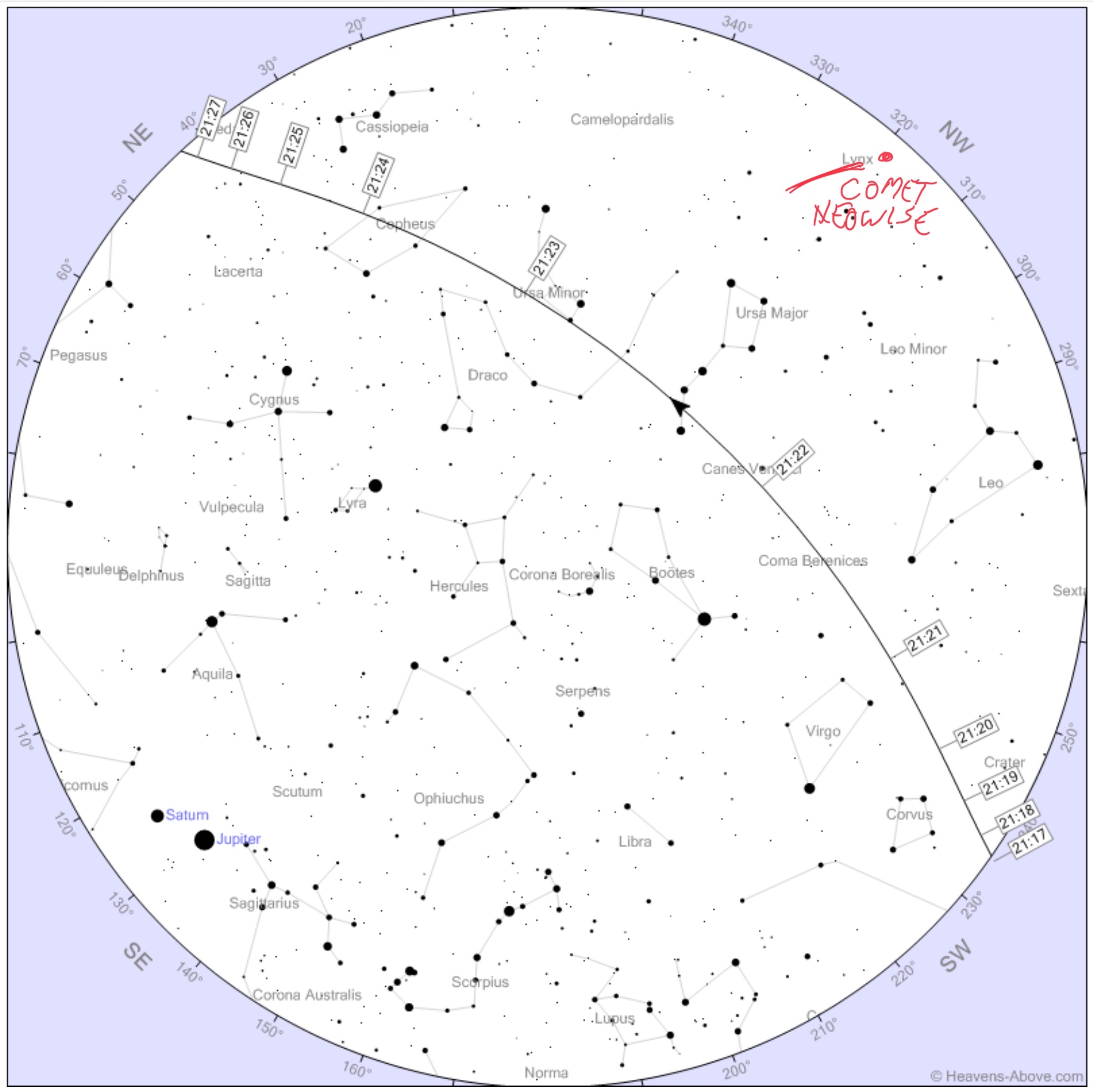
(Image: heavens-above.com)
There was a fantastic ISS pass – there will be more for the rest of the week, pretty much no matter where you are, so check out Heavens-Above.com or the NASA site or any number of other places to see where and when for your location. On this map I’ve vandalized enhanced it by drawing in the location on the horizon that NEOWISE was at.
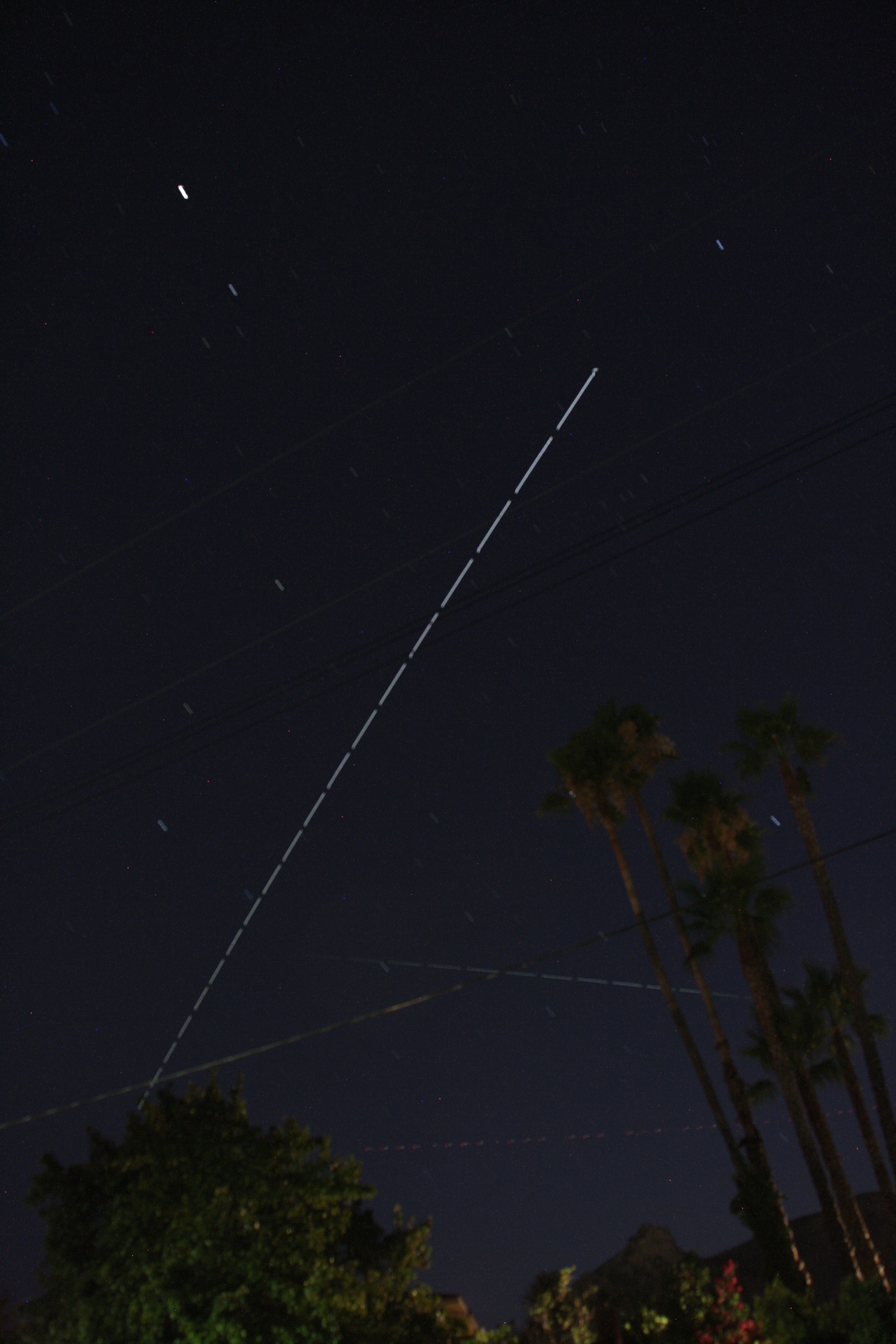
Rising from behind the neighbor’s tree, headed toward the Big Dipper which is right outside the upper right of this frame. (At the bottom you can see a jet out over the Pacific on course into LAX [the red & green lights] and another satellite, probably in a polar orbit going north to south.)
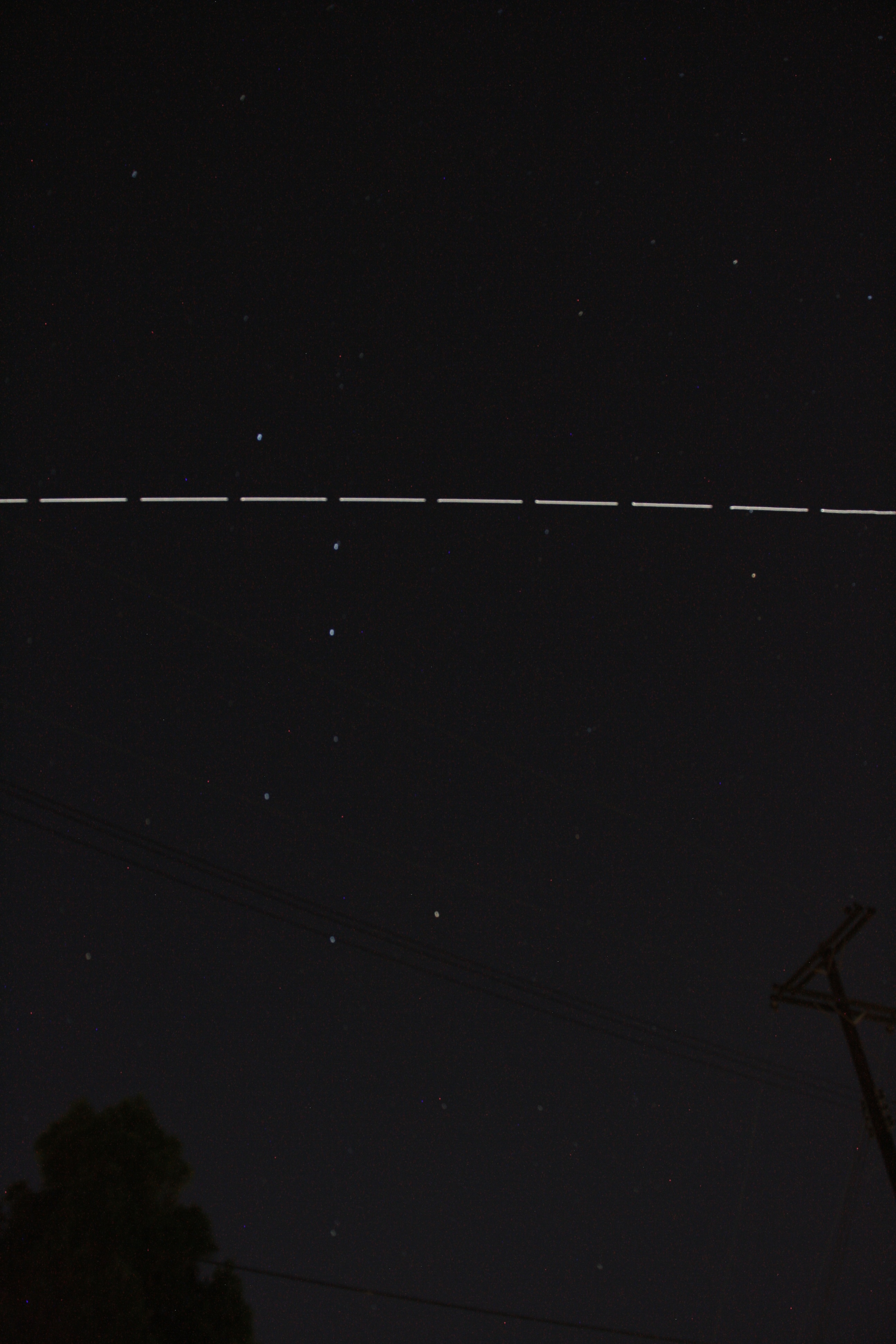
Did I mention the Big Dipper? Here it is, hanging down, with the ISS going from left to right through the handle. Ten minutes earlier we MIGHT have gotten the frame set up to catch the comet next to that tree at the bottom, but close only counts in horse shoes, hand grenades, and tactical nuclear weapons.
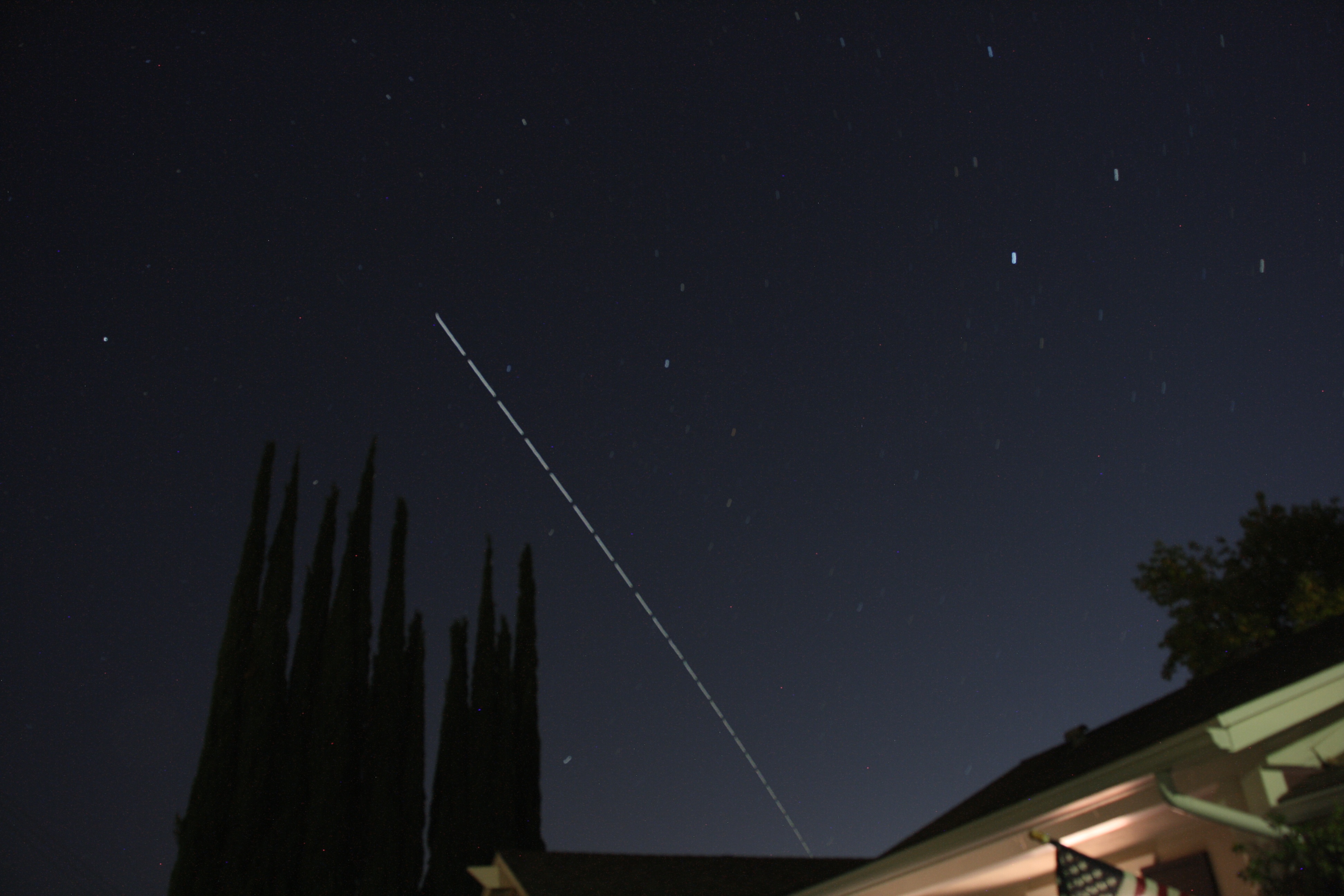
Finally watched the ISS headed from the Big Dipper, past the North Star, and down over the horizon to the northeast.
That was a pretty good night. And there are great ISS passes every night for the next week. Including one at about 21:23 on Friday night that should be going right next to the comet.
I finally found Comet NEOWISE F3 in the evening sky after three nights of failure!
Impressive, eh?
Well, don’t feel bad if you can’t see it, it’s pretty tough to see. Just a low contrast smudge, low down in the haze and coastal fog coming in from the coast, and almost wiped out by the light of the lingering dusk only an hour after sunset, still well into twilight.
Blow it up, click on it – see it right there, just barely above that middle tree?
Yep, that’s all it was from LA tonight.
There are some fantastic pictures coming out of more Northern climes – Vancouver, Chicago, England, Northern Europe, all have been producing spectacular images. That’s because there it’s not by the horizon, it’s overhead. And it’s not just after sunset, it’s up late at night when it’s dark. That in turn means that they can do exposures that are 30, 60, 120 seconds long or even longer. I could barely do 1/3 of a second before the whole frame went white with overexposure.
It looked a little better in binoculars, but not as good as it did four & five days ago in the morning sky.
Every night it’s about 3° higher at the same time, so in a week it will be up by the Big Dipper over two hours after sunset. I’ll still have to deal with the LA light pollution and haze, and the comet is getting dimmer by the day as it pulls away from the Sun, but I may get better results.
Speaking of other pictures out there, there’s one that’s getting a ton of exposure, showing a range of extremely bright rainbow colors and a ton of twirly, spiral detail in the tail.
It’s fake. (I won’t even bother to show the image or give it any additional exposure – believe me, you’ll know it if you see it.)
It might have started with an actual photo of the comet, but from there it’s had so much processing and colorizing and effects added that it’s barely even an art piece, let alone an actual representation of what the comet really looks like.
If the best scientists in the world with the best telescopes in the world are producing something that’s white, smooth, maybe with a blue ion tail (that’s an actual thing and real) but an 18-year-old kid with a 200mm lens produces an image that’s too good to be true… Yeah, do the math. It’s pretty, but it’s also 100% bogus.




 We Love The Stars Too Fondly