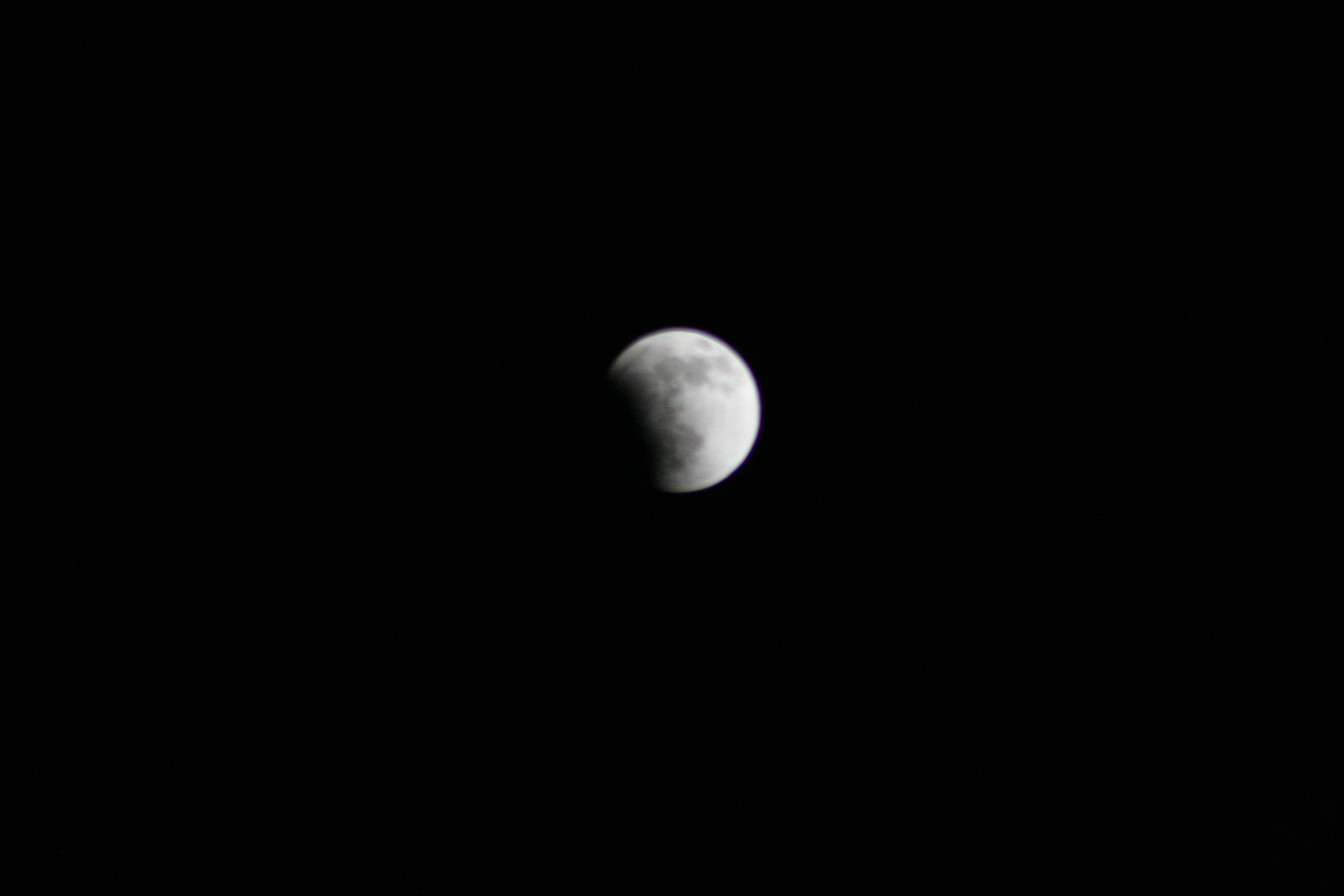
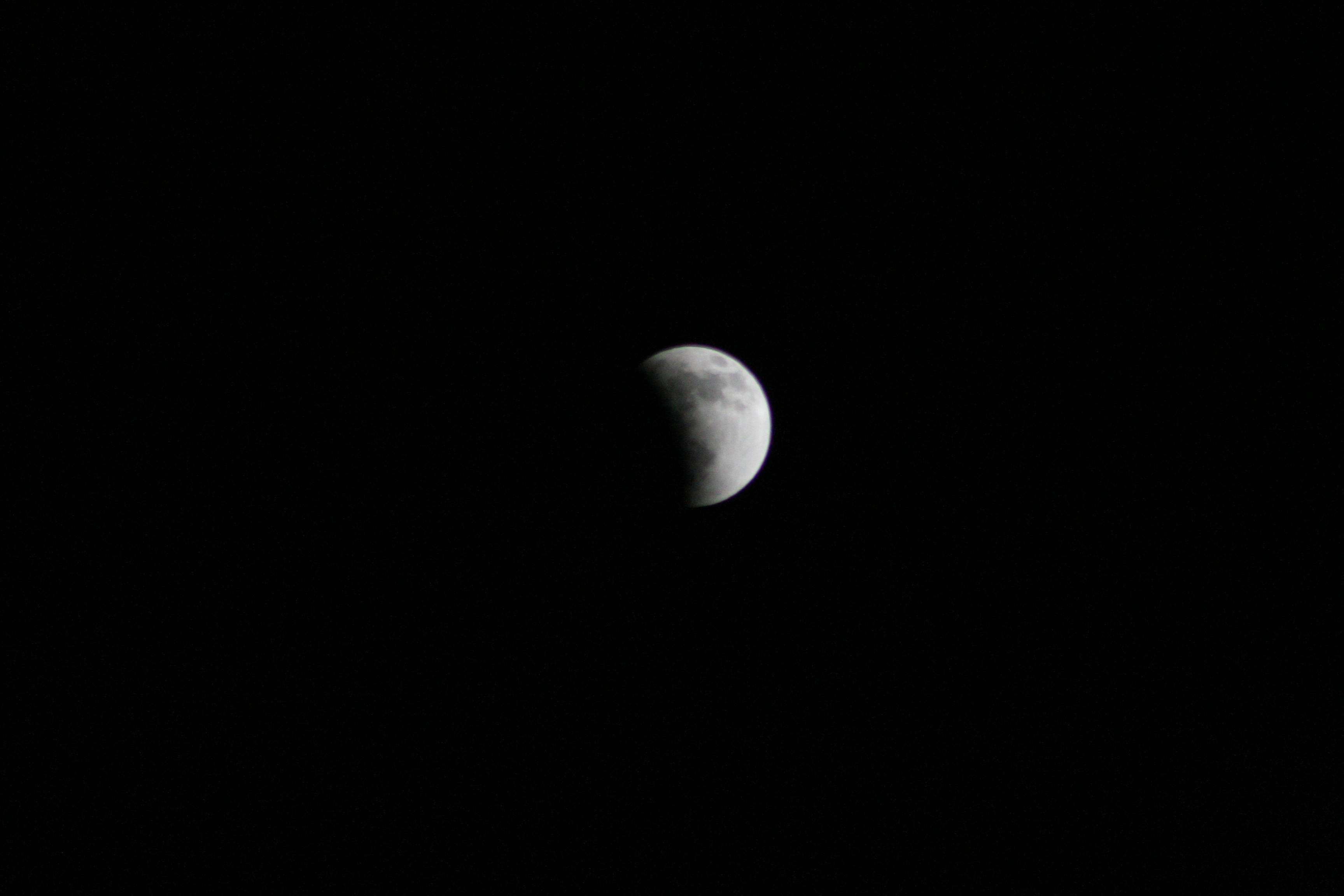
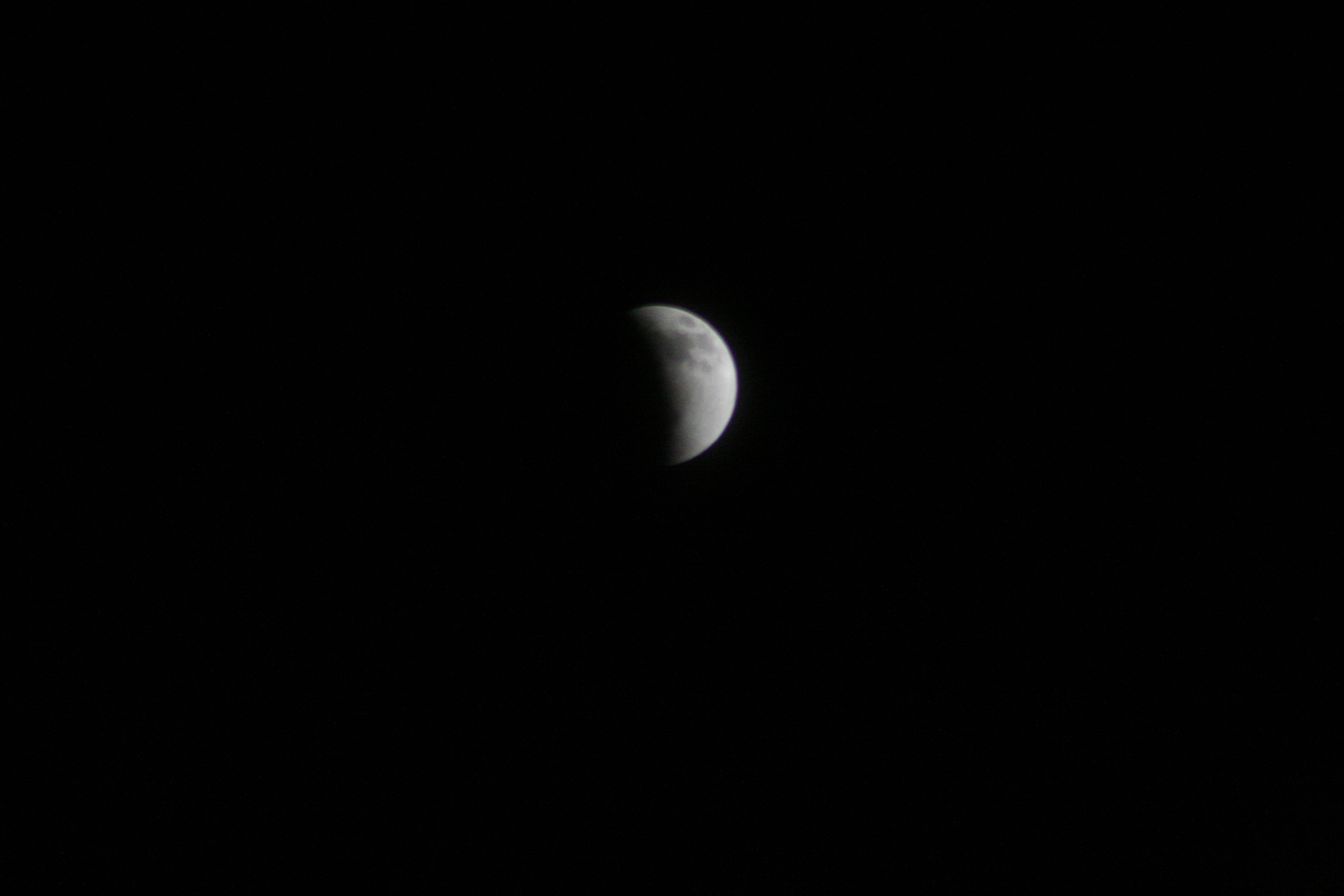
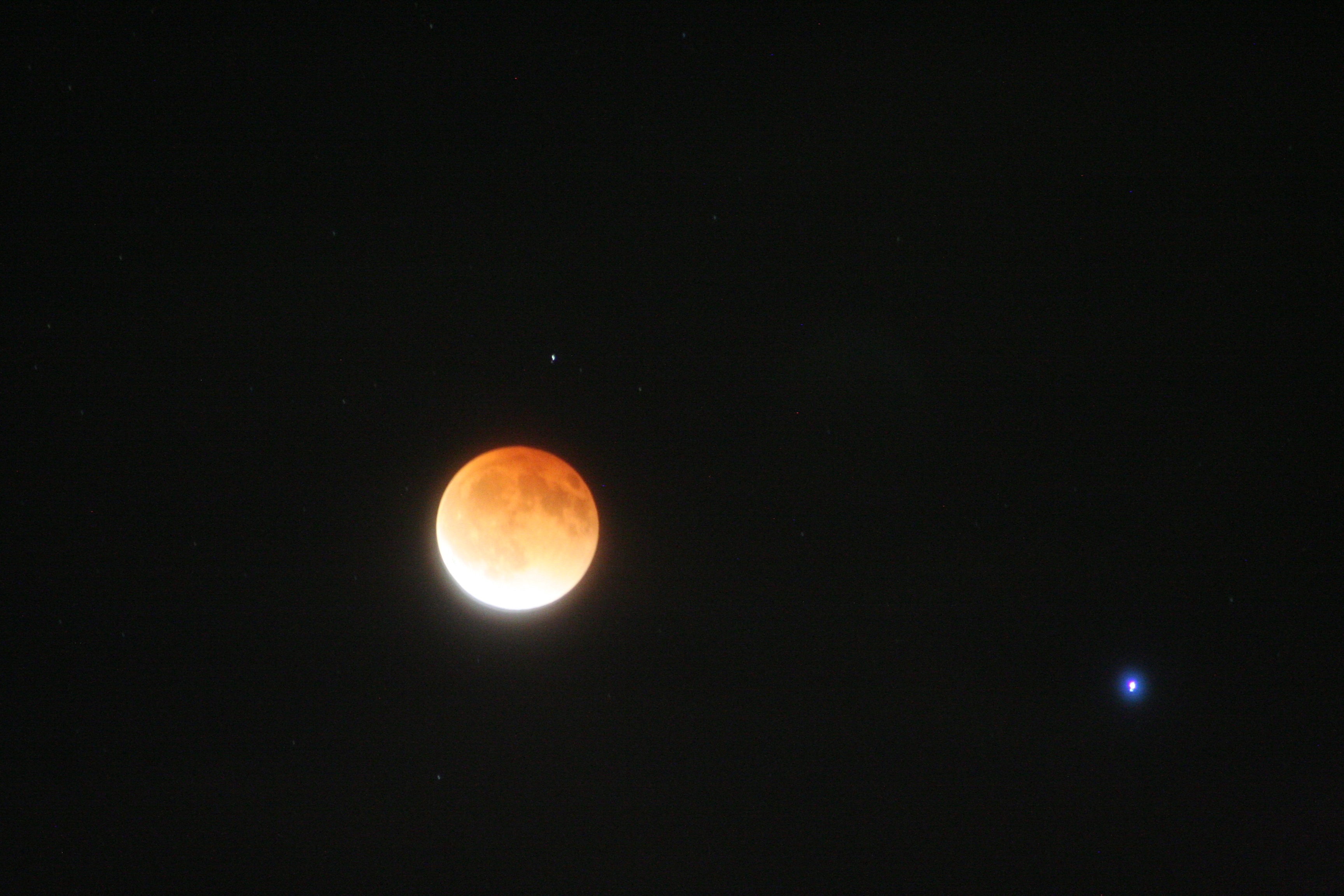
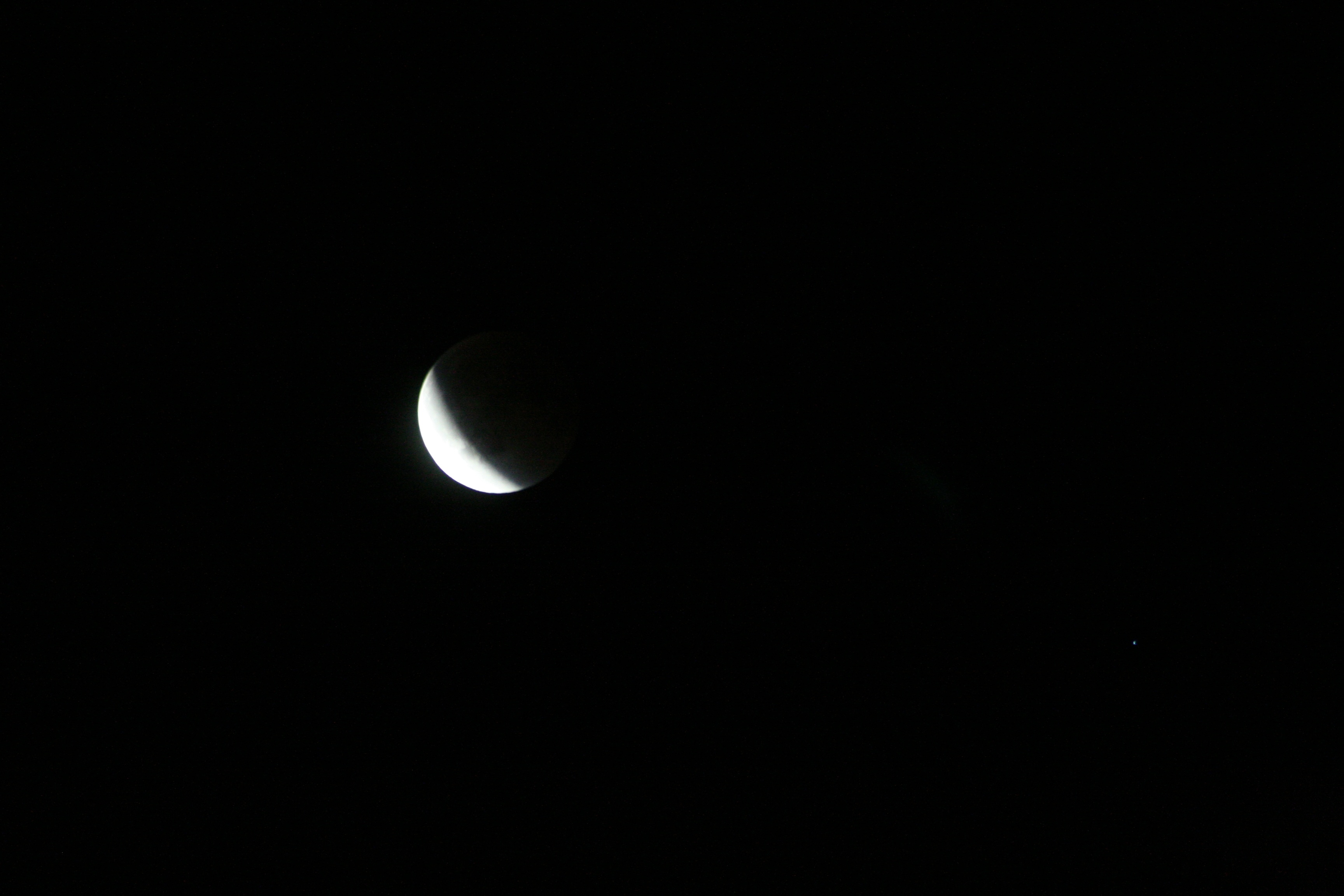
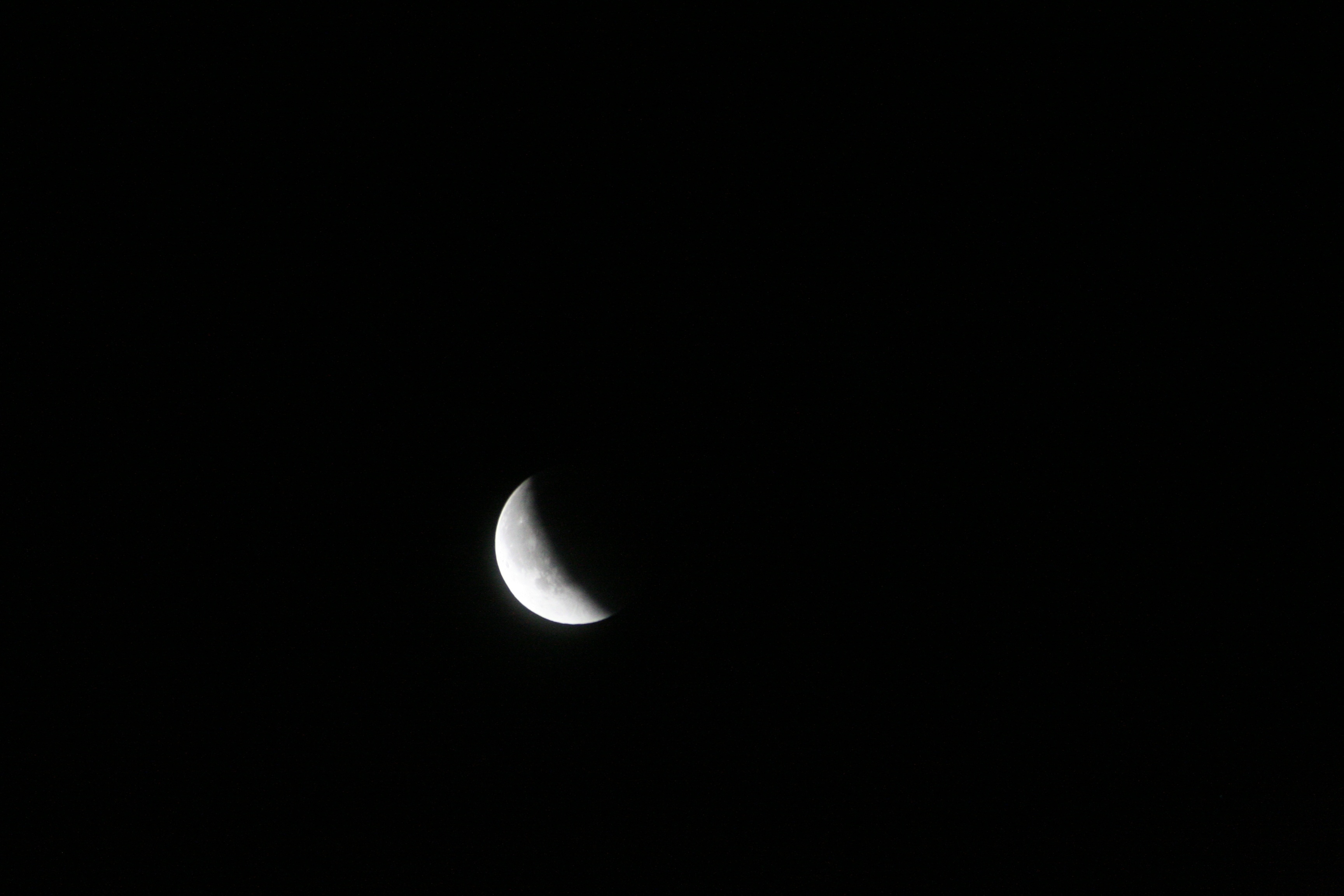
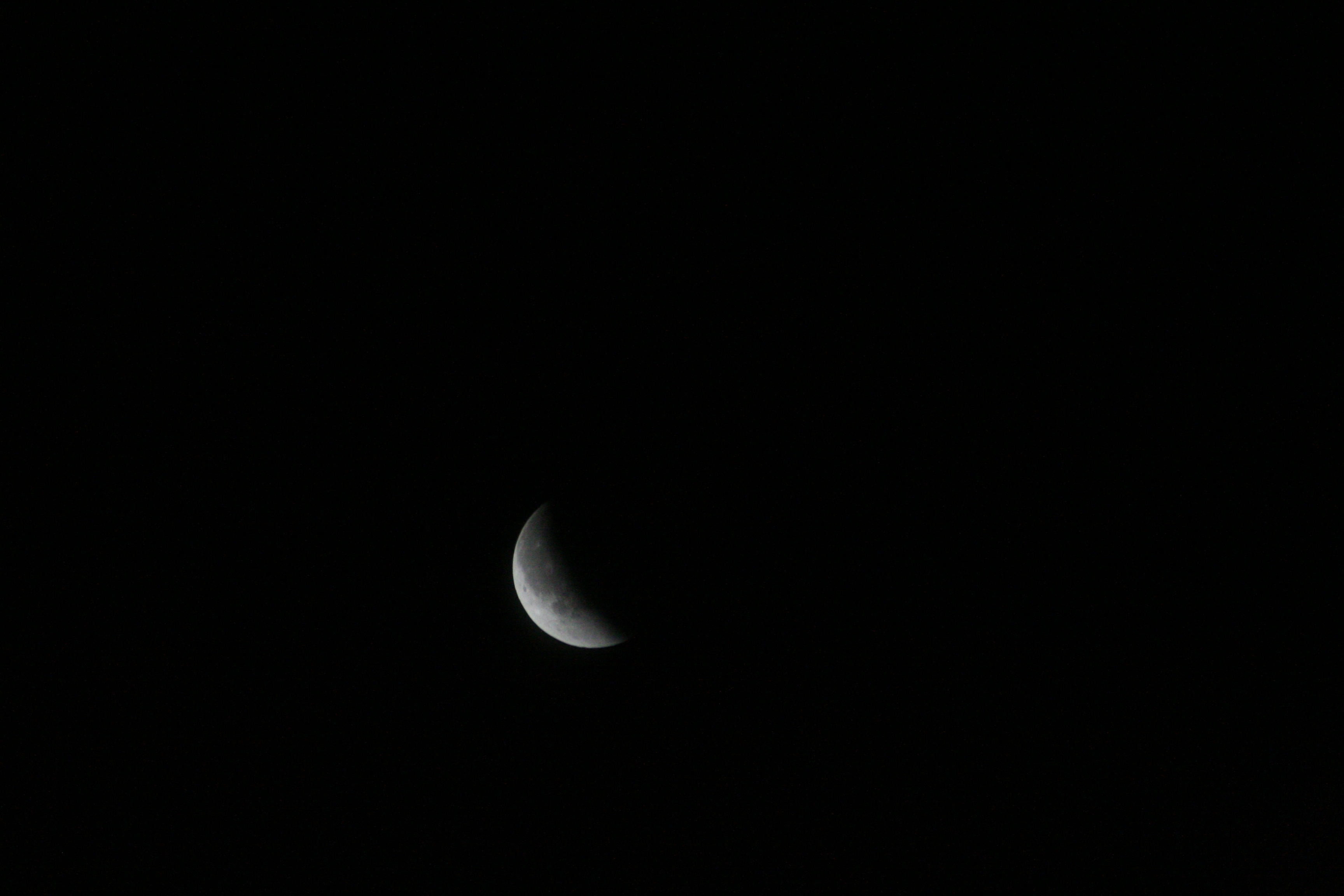
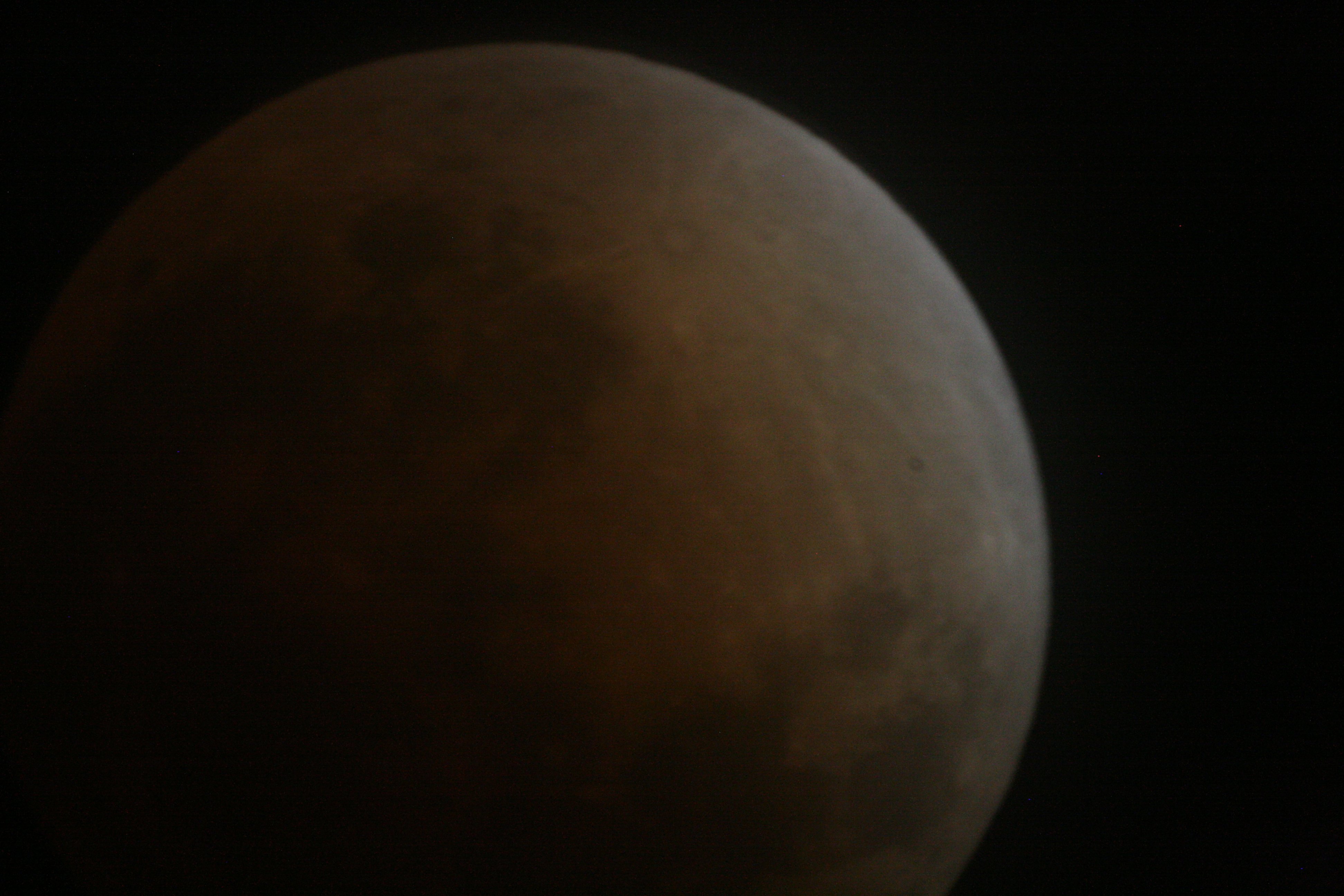
Category Archives: Astronomy

How Many Meteors Did You See Last Night?

After gushing qualifiers and spewing cautionary modifiers all over everyone’s parade yesterday, it looks like last night’s “Best Meteor Shower Of 2014!” was almost a complete bust, not just for me but for most people.

I was mildly surprised to see that the pictures didn’t 100% suck. You can in the  11:26 PM Tweet that I was expecting a total failure on the photos, but a few actually are usable. (Remember what I said about taking a LOT of pictures and bracketing your exposure times from way way low to way way high?)

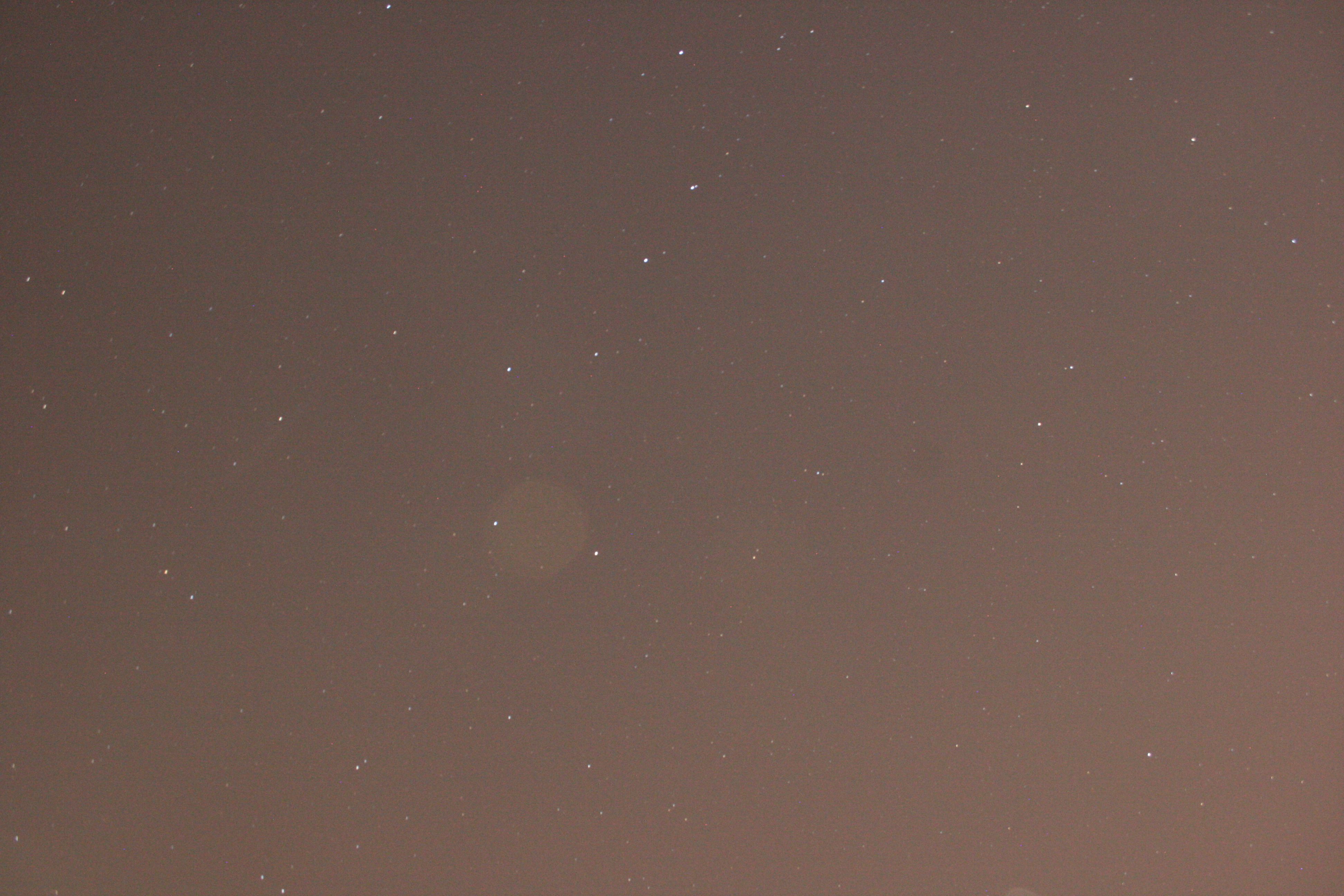
IMG_9853_smallThis grey-white hazy look is pretty close to what I was seeing with the naked eye, although the picture shows about four times as many stars as I could see without using the binoculars. The Big Dipper is right in the center to center top of the photo, “facing” right. This was an unguided 45 second exposure with the lens set at 18 mm. With that combination there’s very little trailing to be seen.

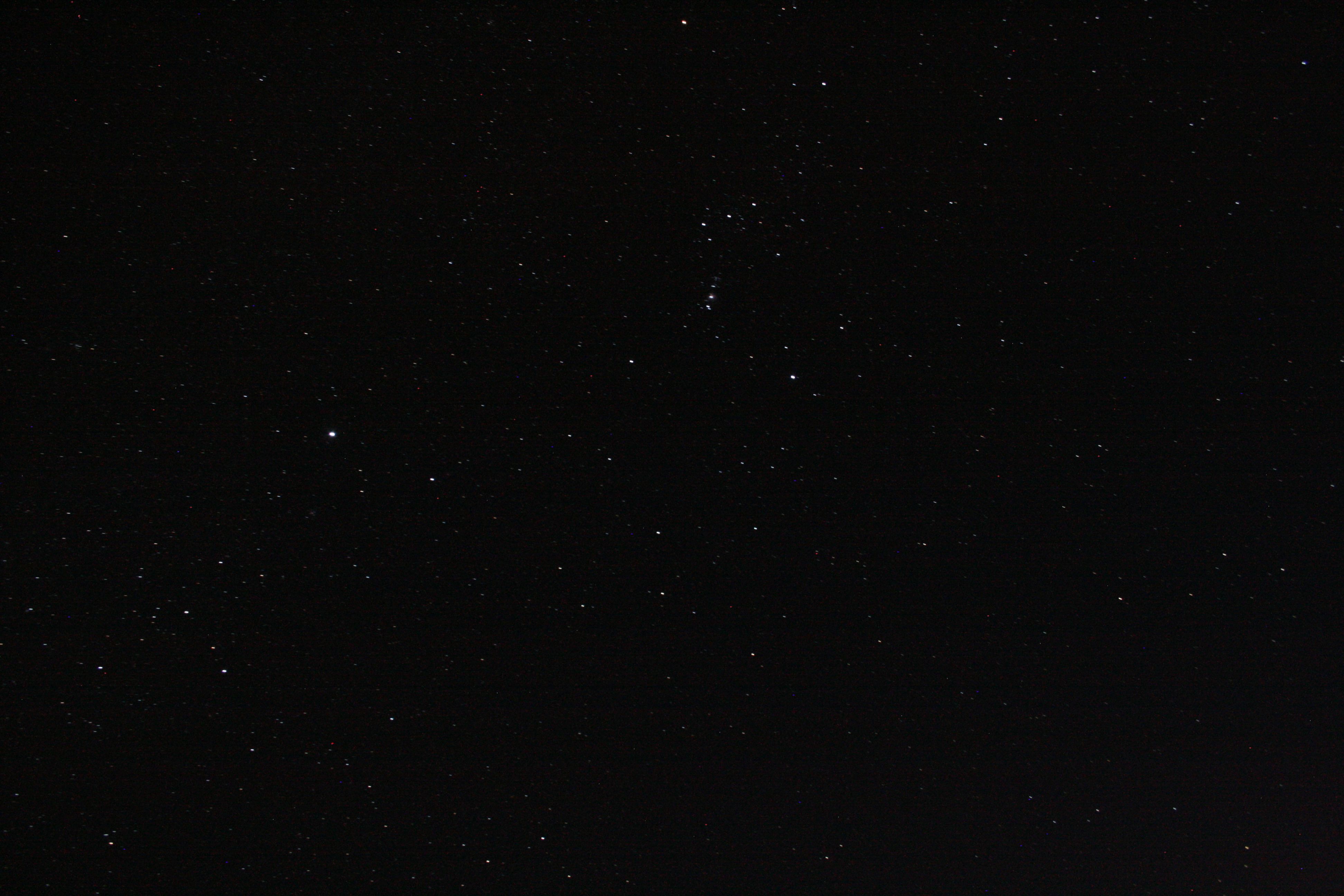
IMG_7097_smallFor contrast, here’s a picture taken March 12, 2013 from a very dark sky location in Arizona. This is an unguided 30-second exposure, also with the lens set at 18mm. Orion can be seen at the upper center, the Orion Nebula in the “sword” clearly visible. (Remember, you can click on the picture to get a full-sized version.) Not only can you see a couple of orders of magnitude more stars in an exposure that’s only 2/3 as long,you also see an almost completely flat black background.

Final count on the night was:

  • One really good meteor which almost certainly wasn’t part of the expected shower. It went right through the “dipper” part of the Big Dipper, west to east, where the expected meteors associated with the shower should have been coming from the northern horizon toward the east, west, and zenith.
  • Two small meteors that probably were part of the shower.
  • Four or five “maybe” meteors, flashes in the right area of the sky, viewed in peripheral vision, gone by the time you look directly at it. There? Not there? Maybe?
  • One flaring satellite in the northwest, possibly an Iridium, maybe something else
  • One really high, dim, slow satellite, also passing right through the Big Dipper
  • Five or six really high jets, probably from Mexico, Latin America, or South America to San Francisco, Seattle, or Canada
  • Two dozen 737’s heading into Burbank Runway 8 (we’re right under the normal flight path)

On the good side, it was quiet and peaceful (except for the bunnies or racoons or coyotes or feral cats or skunks or opossums in the bushes near where I was sitting) and the mockingbirds sounded wonderful!

Leave a comment

Filed under Astronomy, Space, Weather

Heads Up For Tonight’s (Potential) Meteor Shower!

Allow me to be the 3,279th person to use some variant on that “heads up” headline for tonight’s meteor shower.

This one’s been getting a lot of press, which is often a bad sign given the mainstream media’s track record of being clueless, hyperbolic, and totally inaccurate when it comes to science in general and astronomy in particular. If you’re in North America, you’ll probably see something in the paper today, on the local news tonight, or online about “This Year’s Best Meteor Shower!!”

Maybe.

First, the buzzkill, with lots of qualifiers emphasized.

There is a meteor shower predicted to peak tonight, and the timing’s good for most North American observers. If you want to stay up a bit (or get up early) and have a clear sky, you might get a show.

The thing is, meteor showers are almost as bad as comets when it comes to predicting how they’ll manifest. On top of that you’ve got the media’s obsession with blowing everything out of proportion. On top of that you’ve got the general misunderstanding by the public of what they should expect to see.

So the amateur astronomical community puts out the word that this may be the best shower of the year. It may be, but that’s mainly because most of the other big, bright, and predictable meteor showers will be occurring at or near the full moon, so you’ll see only the very brightest of the meteors. Everything else will be washed out by the bright moonlight. The astronomical observing community knows that it’s a crap shoot to begin with and “best” is relative. It’s possible that someone in a clear, dark sky could see close to 100 meteors an hour. But it will probably be less than that, and if you’re in a city where the dim meteors are washed out by streetlights, you might see only ten or fifteen an hour. Maybe.

Then the local news gets the story, doesn’t read the astronomical news bulletins completely, doesn’t understand the qualifiers, and doesn’t pay any attention to the actual facts or details. The headlines for folks in New York or Miami or Los Angeles ends up being something along the lines of “Go Outside After Dark, Look North, And See 100 Meteors An Hour, It Will Be Spectacular!”

Then the general public, many of whom have never seen a meteor but most of whom have seen lots of movies (remember the endings of “Independence Day”, “Deep Impact,” and “Gravity?”) go out with bad information and worse expectations. And one more time, the opinion of Joe and Jane Public is that scientists don’t really have a clue and they’ve cried wolf one more time.

Now for what I hope is an upbeat and accurate description of what we know for tonight.

This meteor shower is a fairly unknown one and comes from a periodic comet first discovered in 2004. Earth’s orbit only is in the right position to intersect the estimated position of the orbiting dust cloud that trails along behind the comet every few years. The dust clouds we’ll be passing through tonight were left behind in the late 1800’s and early 1900’s, but we don’t know how big they are or exactly where they are or how dense they are.

If the estimates are correct, there could be a shower of from 100 to 400 meteors an hour, if you’re someplace with a clear, dark sky. If you’re in a city or if it’s hazy, you might see a fraction of that.

The best news is that, like a total lunar eclipse, you don’t need any equipment at all to see the show. Get a lawn chair or a comfy spot on a blanket, face due north, give it a few minutes to let your eyes become dark adapted, relax and see how many meteors you see.

The prime viewing time is estimated to be between 2 AM and 4 AM in the Eastern time zone, 11 PM to 1 AM in the Pacific time zone. You could see meteors before that, you might see them after that, but that’s an estimate for when the peak will be.

If you want to try to take pictures, get a camera that can be set on “Bulb” to stay open as long as you hold the shutter open, and mount it on a tripod. Set the lens for as wide a field as you can, open up the lens to its lowest f-stop, turn the autofocus off, and set the focus to infinity. Point it north and if you start seeing meteors, start taking pictures. If you’re in a dark, clear sky you can probably go for exposures of three or four minutes. If you’re in the city, maybe two minutes tops. With longer exposures in the city, the light pollution will start to “fog” the image. Even in a dark sky, longer digital exposures will start to get corrupted by “noise” unless you’re cooling the camera. (That’s waaaaaay beyond the level of this discussion — some other time.)

Of course, what have we learned over and over with digital photography? Digital is cheap, take LOTS of pictures! So, as you did with the lunar eclipse and comets, take a lot of pictures and bracket your exposures. Start at maybe five or ten seconds, build up to twenty, thirty, forty, fifty, a minute, and so on. It’s going to be a game of chance no matter what you do, so play the game as many times as you can to increase your odds.

If it works and you get some pictures, please feel free to share them here, I would love to post them for you.

Unless it’s cloudy, think about going out and taking a peek for at least a half-hour or so, even if it’s not during those “peak” hours. With luck it’s a nice night, you can find a comfy spot, put on some bug spray, and just chill for a bit watching the skies. Maybe we’ll get lucky and the show will be spectacular (but don’t bet the house on it) and you’ll get to say that you saw it.

Clear skies and good luck!

Leave a comment

Filed under Astronomy, Space, Weather

Juicy Chunks O’ Wisdom For Wednesday, May 21st

‘Cause I’m really PO’d and trying not to be, that’s why.

  • As my brain shuts/melts down, the one item I try to keep on top of the memory stack is the wisdom I learned from Crash Davis: “Don’t think, it’ll just hurt the team.
  • Seven junk phone calls today to the land line, two from bots pushing political candidates and causes, two from live humans pushing political candidates and causes, and three from telemarketers. We’re getting really close to the trigger point where we take the phone off the hook until mid-November.
  • Is everyone checking in every now and then with the ISS HD Earth Viewing Experiment? I’ve stopped watching it obsessively (and come on, isn’t “obsession” too harsh of a word for what’s simply a deep and abiding appreciation for the beauty of our home planet from low Earth orbit?) and now just remember to pop it on a handful of times a day to see where they are. There’s about a 50/50 chance that they’re in darkness or out of range of the TDRS system or ground stations, but if they’re in daylight… O. M. G!
  • We’ve all seen the hundreds of “test” sites on FaceBook where you can see which Star Wars character you are, which Gilligan’s Island character you are, which kind of storm or tree or dog or insect or house you are… Cute, for about ten seconds, but do people really not realize that they are giving away all kinds of personal information to marketing companies when they do that? You already have so much data out there and once you go to one of those sites from FaceBook, you’ve agreed to let the site have access to whatever other public information you have on FaceBook. Birthday, where you live, where you work, your marital status, where you were born, what you like, what you don’t, who your friends and relatives are… Lots of small, innocent, individual pieces but not that hard for someone’s computer to pull together into a really accurate picture of who you are in detail. Yeah, they may be using that data to try to sell you cruises and insurance policies. Or they could sell it (or they could be careless and get hacked!) and the buyer could use it for blatant identity theft. Given the risk, is it really worth knowing what kind of cactus you would be?
  • Speaking of manned (or “crewed”) spaceflight, particularly on the ISS these days, can anyone explain why they’re always wearing belts on their pants when they do an interview? It can’t to prevent their pants from falling down and it seems a waste. Is it just to keep the ground-based human critters from freaking out?
  • I want one of those driverless cars from Google. The sooner the better.
  • If you’re watching that ISS HD site on your iPad regularly, I recommend that you bookmark an ISS locator site (here or here, my favorite) and the direct ISS HD video feed site separately rather than using the link above. It will look much better using the full screen on a tablet or smart phone. If you’re like me, you’ll actually create two icons on your iPad that will take you directly to the sites rather than simply bookmarking them in your browser — if you want to do that and don’t know how, just ask, I’ll be glad to walk you through it.
  • On second thought, I want everyone else to be in driverless cars even more than I want to be in one. I want one for myself so I can do other things while travelling and not see that as wasted time. I want one for everyone else because there are a lot of really stupid and incompetent freakin’ idiots out there on the road every day and I don’t one of them to make me a dead person just because they’re a stupid person. That’s not a decent tradeoff.

Remember that other timeless piece of advice from Crash Davis: “Some days you win, some days you lose, and some days it rains.” I’ve always thought that was actually pretty profound.

3 Comments

Filed under Astronomy, Freakin' Idiots!, Juicy Chunks, Movies, Space

Final Lunar Eclipse Notes & Video

I hope you enjoyed the pictures posted yesterday of Monday night’s total lunar eclipse. Before we put this event to bed, there were a few more “adventures” that I can report on.

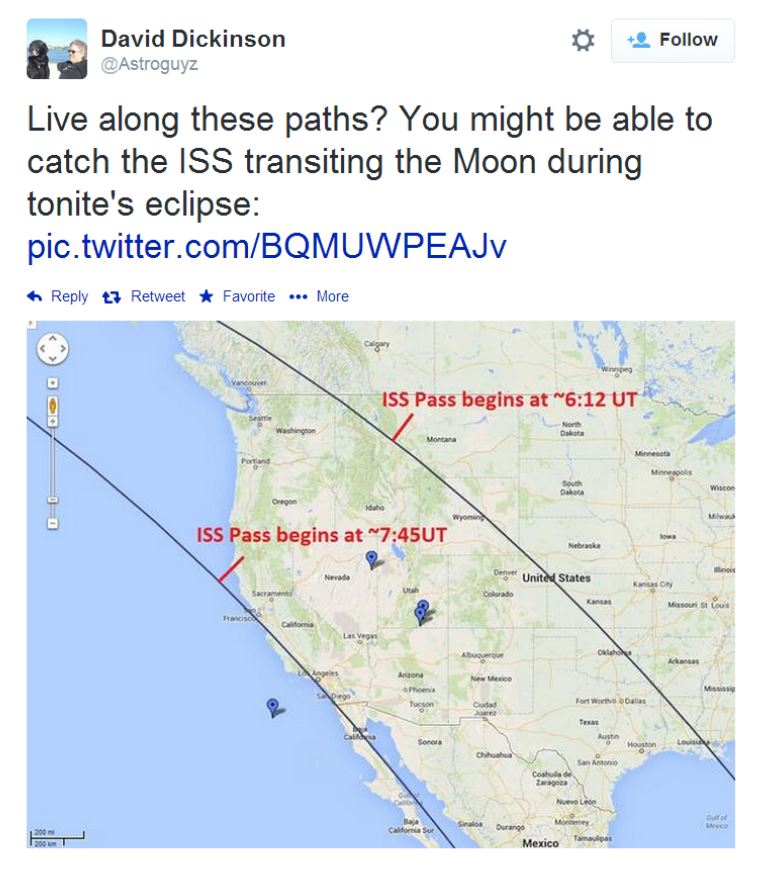
First, early on Monday afternoon, I caught the following going by in my Twitter feed:

Tweet About ISS Pass During Lunar EclipseWhy, yes, I do happen to live along one of those paths! I sent a Tweet to that effect back to Mr. Dickinson and he was kind enough to pass along a link to the CalSky site, which had generated the original image.

This would be so incredibly fantastic to catch — the ISS passing in front of the fully eclipsed moon! It would also be incredibly difficult, since the ISS would be in a “shadow pass,” i.e., not illuminated by the sun. Even if you happened to be lucky enough to set up in the right place (and there’s very little room for error), you would simply see ISS pass by in a second or so, with no advance warning. Tough.

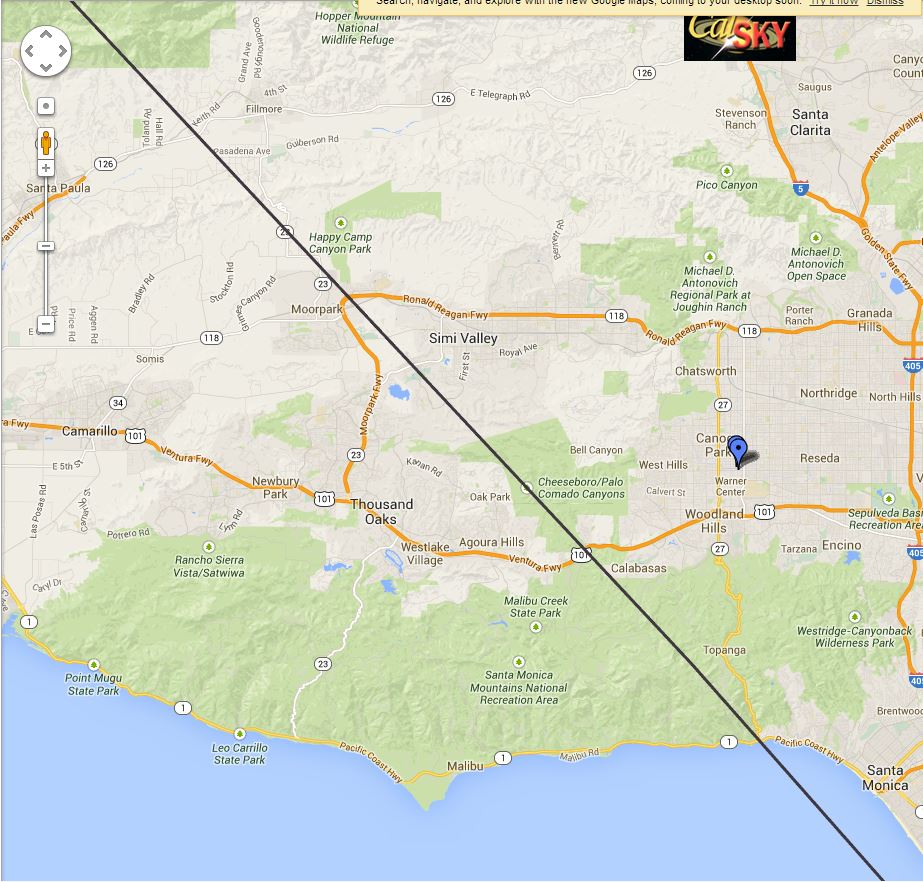
The CalSky site will lay their calculated paths over the Google Earth maps, so I zoomed in to see how close we might be to the calculated path.

Detailed Map Of ISS Pass During Lunar EclipseIt’s close (FYI, I don’t know what the blue pushpin is, but it’s not not our house), but we were still going to be about four miles or so off of the path. I don’t know how wide the viewing area is to either side of that path, and I don’t know how accurately that path is calculated, but assuming the data and the path are good, my off-the-top-of-my-head wild-ass-guesstimate is that you need to be within a half-mile or less of that line to see anything. It might be only a hundred yards or so. (I’ll be researching this more later, even if it’s not during an eclipse, this sounds like a cool thing to try to do.)

So I got all excited about the possibility of doing this, then got more cautious. I went ahead and set an alarm on my iPhone (along with alarms for the U1, U2, U3, and U4 times) and hoped for the best. Ultimately, the clouds did us in, and at the time of the ISS pass we could barely see the moon…

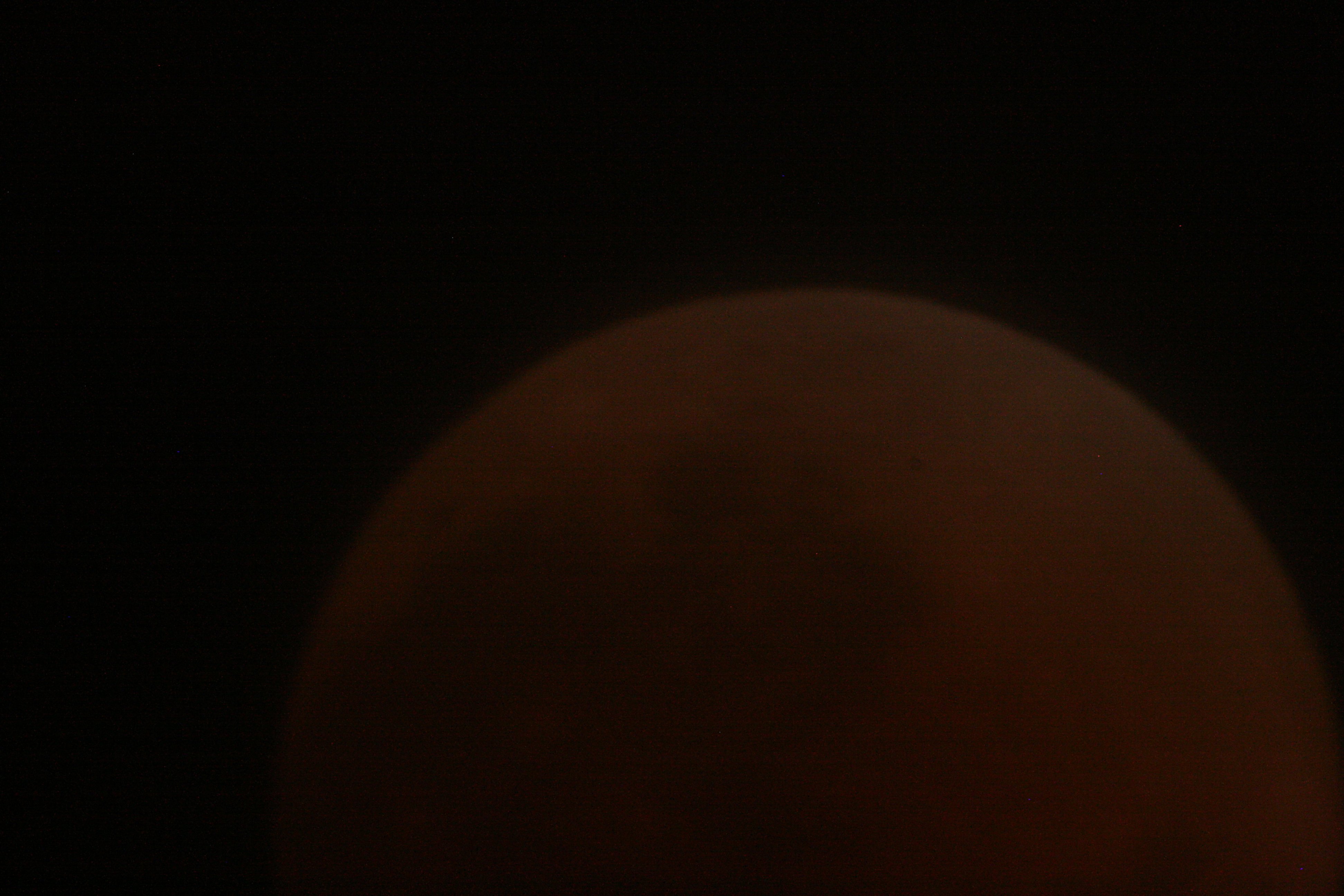
IMG_9732_small…let alone a (relatively) tiny speck passing fleetingly in front of it.

Oh, well. Fail early & fail often! Or, as the Mythbusters say, “Failure is always an option!”

What do our neighbors see when I’m out with all of the gear?

OLYMPUS DIGITAL CAMERAFrom left to right we’re blocking the sidewalk with the camera with the big telephoto lens on a tripod, the 5″ Meade with the other camera, and the 8″ Cave reflector. The chair’s actually in the street next to my car — the curb makes a great footrest! And the mailbox makes a great workspace for keeping lens covers, eyepieces, video cameras, and so on.

But what’s that big white thing on top of the mailbox? It’s a complete shot-in-the-dark experiment, as kluged up of an arrangement as you’ll ever see. And it worked! 

I had found an app for my iPad called “Timelapse Camera HD.” It’s simple, works like a charm, and does what it says it does. After I had gotten the scopes set up I remembered that I had it and figured I had absolutely nothing to lose in trying it.

The iPad had to be pointed toward that general part of the sky. It was moving from left to right in this view, and rising, so I needed to aim the iPad so that the initial image was in the lower left corner. The easiest way to do that was to grab a couple of hefty books and use them to get the aim and angle “close enough for government work.” I set the frame rate for one every three seconds, and let ‘er rip.

While the iPad may technically record HD video, the fact is that the camera lens is so-so. In addition, shooting at night at a bright object like this, there’s no way for the system to autofocus.

What you do get is a bright, overexposed blob of white, that’s moving as expected, then fading as we get toward totality, and finally actually showing up reasonably well in totality as an orange dot with a visible yellow shade in the lower right. (See yesterday’s photos.) And then the battery died, so that’s another lesson learned.

At twenty frames per minute, the 2518 frame video lasts 2:05:54. (There’s no sound.) It starts at 22:24 local time (time stamp is shown), with U1 at 22:58, U2 at 00:06, U3 at 01:24. The video replay is 1:44 long.

At about 22:35 you start to see bands of clouds passing by. The video caught them, illuminated by the full moon, very well. More clouds at 22:49 through 23:05.

After U1 at 22:58 you can see the moon (and the glare from it) declining steadily. At about 22:06 you can see a plane go by from the bottom to the top (probably something out of LAX headed for Asia) and another at about 23:15 over on the right-hand side. By about 23:46, twenty minutes before totality, the moon has dimmed enough so the glare of overexposure is gone and the moon appears as a disc. By 00:03 or so, just a minute or two before totality, the reddish-orange color is apparent. The moon’s eclipsed disc appears to flicker toward the end as it’s obscured by clouds and then peeks out again.

It just goes to show you, if you’ve got all of the electronic toys and tools that we’re carrying around in our pockets these days, experiment a bit, try something that’s not in the user’s manual, see if something that sounds totally wacky will actually work. It just might!

1 Comment

Filed under Astronomy, Photography, Space

Was It Good For You?

Did you lose a whole bunch of sleep? Do you really need to get your blog post written ASAP because you might be asleep at your desk before the ballgame is over tonight?

Did you get to see this? (Remember, click on the pictures to get the full-sized images.)

IMG_7174Or this?

IMG_9684

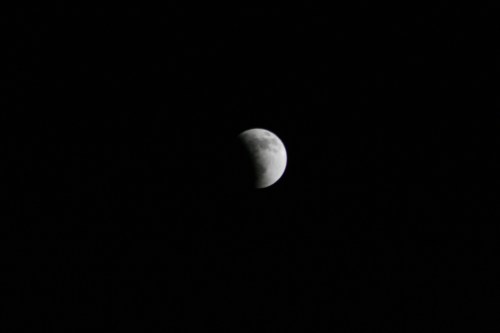
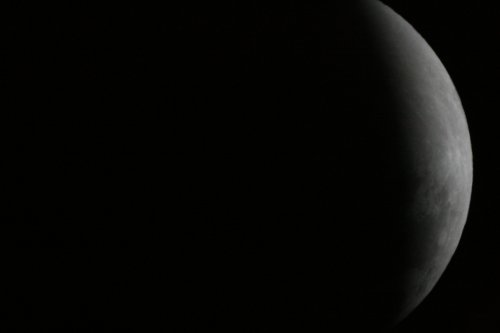
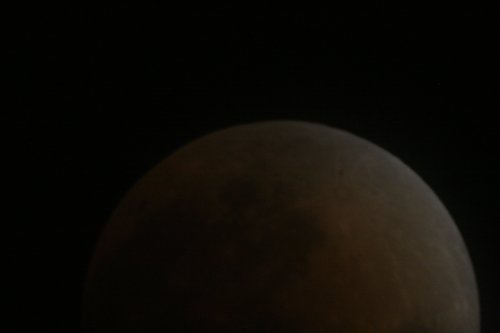
Okay, tech stuff out of the way first. The pictures with the moon only filling a small part of the frame were taken with a Canon Rebel XT DSLR using a Tamron 75-300 mm zoom lens, mounted on a tripod. The pictures where the moon fills the frame (and then some) were taken with a Canon Rebel XTi DSLR attached to a 5″ Meade ETX-125EC telescope mounted on an equatorial fork mount.

Here in the west San Fernando Valley of Los Angeles, we started the night crystal clear. By the time the moon rose enough to get over the house & trees, we were getting scattered bands of thin, high clouds with lots of gaps between them. By the time the eclipse started, the cloud bands were getting wider and thicker while the spaces between them were getting smaller and less clear. By mid-totality, we had a long time where it that part of the sky was totally overcast and you couldn’t see the eclipsed moon at all. As we started to come out of totality we again started to get the occasional less cloudy patch. But by 2:00 AM local, a half-hour or so before the umbral eclipse ended, we were totally socked in and I hung ’em up.

In practical terms what this means is that a lot of the pictures are a bit on the fuzzy side since you can’t focus well through a thin cloud layer. A few of them in mid-eclipse are really fuzzy, but I included them because you can still get an idea of the coloration of the moon, even if you can’t see any detail.

Join me as I walk you through the evening with an official boatload of pictures:

01a_Full_Moon_1-4000sec_IMG_7026_smallA full moon is actually pretty dull from an observational viewpoint. It’s very bright, easy to focus on, easy to find with your telescope — but boring, flat, without definition.

IMG_9452_smallIn a medium-sized scope (it looked great in my 8″ reflector) it’s an impressive site for people who never or only rarely get a chance to look through a telescope. But with no shadows, no terminator, no jagged craters and mountain peaks as the sun crosses their edges, the full moon is a bit bland.
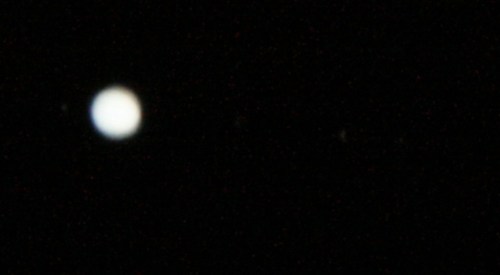
Jupiter_IMG_9468_croppedWe had over four hours between sunset and the start of the eclipse, and telescopes on the sidewalk can attract a crowd. (This is a good thing!) The other easy target in the sky was Jupiter, with three of the Galilean moons visible at first, then the fourth popping out. It looked spectacular in the eyepiece, but with a “quick & dirty” setup to try to photograph it, the results are so-so. Just to the left of Jupiter you can barely see Io, which just came out from behind Jupiter. To the right are Europa, Ganymede, and (just barely) Callisto. In the big scope it really did look a lot like this:

Jupiter Moon Positionsfrom the excellent site at Shallowsky.com.

Finally the show started. Here’s the sequence as seen with a telephoto lens, the pictures taken about ten minutes apart until we get into totality, from which point they’re on an irregular schedule whenever we got a sort of clear-ish spot in the high clouds. There are eighteen photos in this section. Next to each I’ll put the exposure — watch how it drops as we get close to and into totality.

01a_Full_Moon_1-4000sec_IMG_7026_small1/4000 sec. Was probably in the penumbra, but the penumbra is very dim and faint, so you don’t see much change at all until just before the umbral stage starts.

01b_Just_After_P2_1-4000sec_IMG_7035_small1/4000 second. Right at the beginning of the umbral stage, you can see shading starting in the lower left.
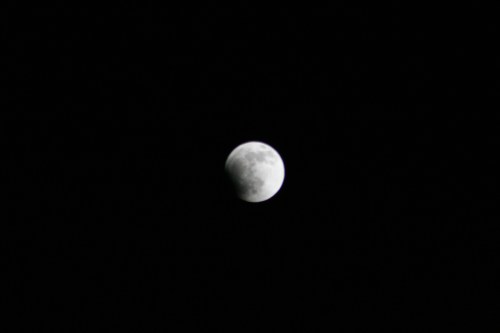
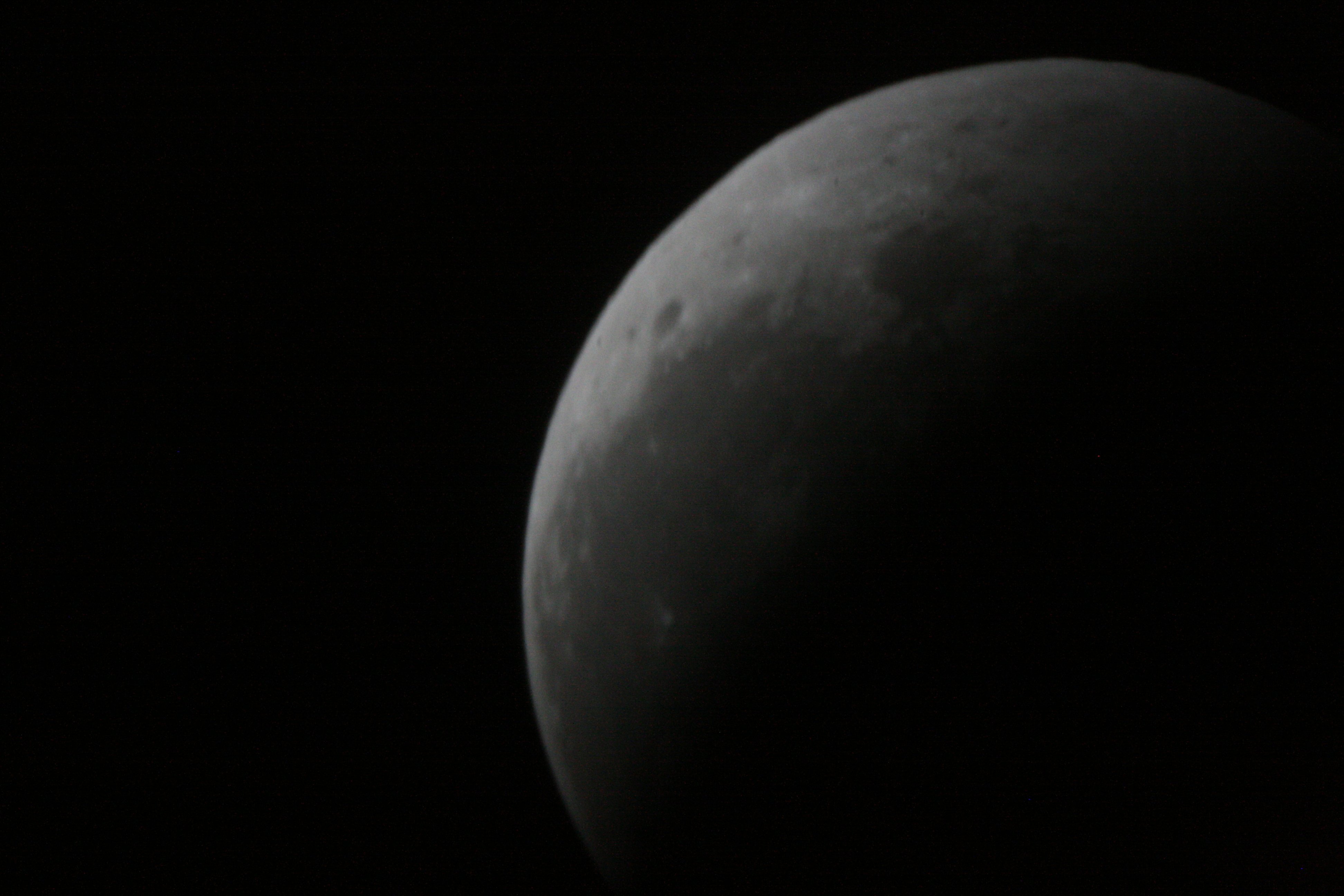
01c_1-4000sec_IMG_7041_small1/4000 second. The Earth’s shadow is now clearly seen.
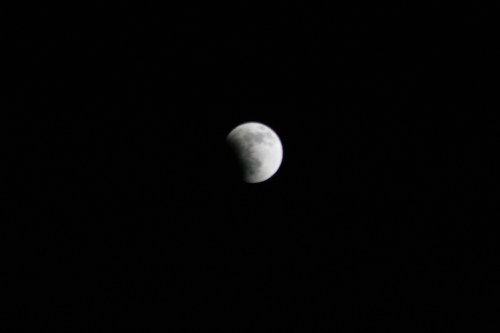
01d_1-4000sec_IMG_7048_small1/4000 second.

01e_1-4000sec_IMG_7057_small1/4000 second. Notice that the Earth’s shadow is clearly curved. This was used by the ancient Greeks as proof that the Earth was round. Don’t believe all that malarkey about Columbus being the first to figure it out.

01f_1-2500sec_IMG_7067_small1/2500 second. Starting to go to slightly longer exposures about halfway into this stage of the eclipse.

01g_1-1600sec_IMG_7078_small1/1600 second.

01h_1-1000sec_IMG_7091_small1/1000 second.

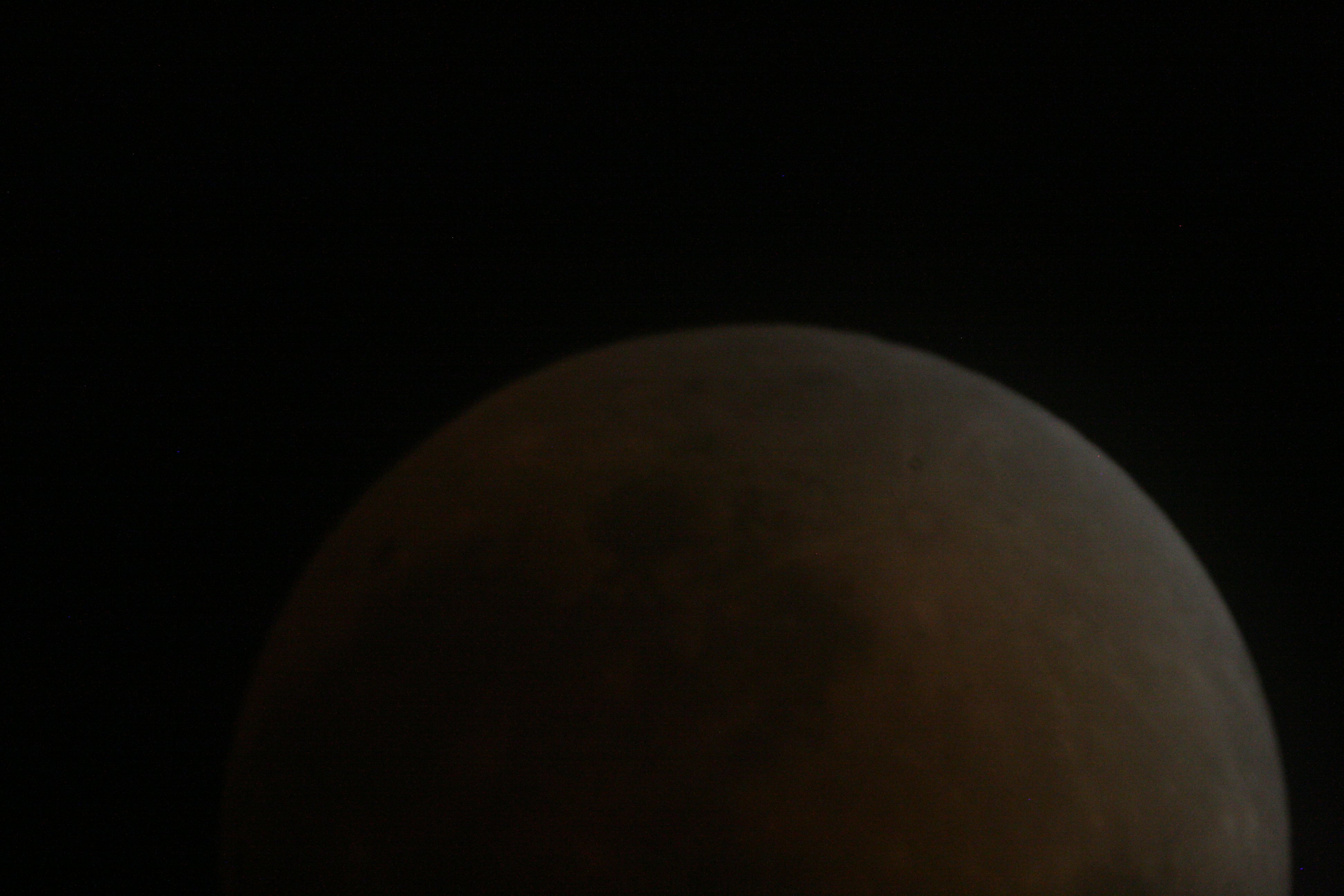
01i_Just_Before_Totality_1-400sec_IMG_7109_small1/400 second. By this time, to the eye, the shadowed part of the moon was clearly outlined and a dark, copper red. Through the big telescope and on these pictures, there was no color to be seen. Until…

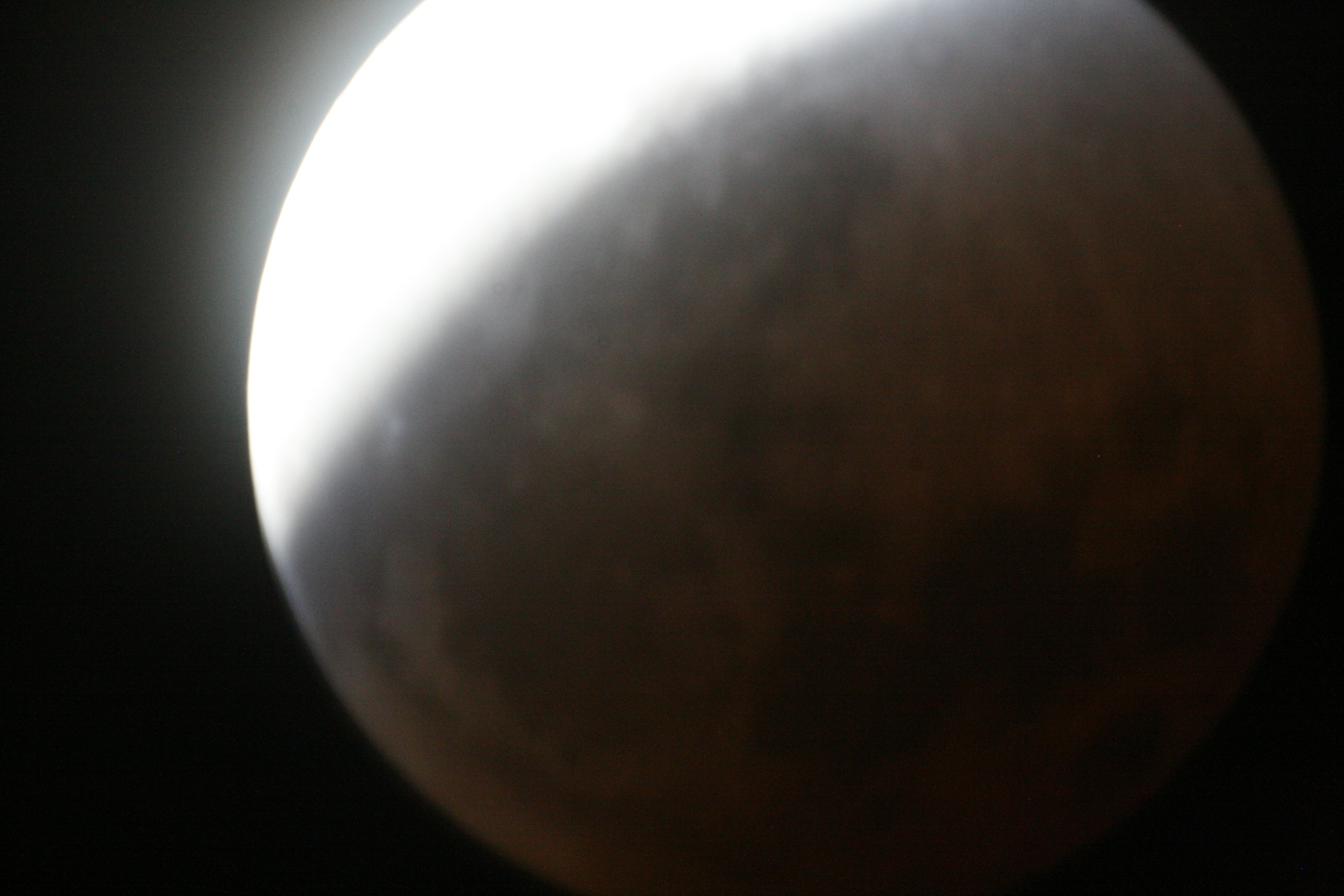
01j_Just_Before_Totality_1-4sec_IMG_7119_small…I started to really up the exposure length. This picture was taken only 28 seconds after the one above, but it’s a 1/4 second exposure, a hundred times longer. Now the remaining illuminated portion is way overexposed, but the colors showing on the rest of the moon become obvious.

01k_Totality_1-1pt7sec_IMG_7135_small1/1.7 second. In full totality now, needing an exposure of almost a full second. You can clearly see Spica, the bright blue-white star on the right. Spica is the 15th brightest star in our sky at magnitude +1.04, but an hour earlier, with the full moon right near it, you couldn’t see it at all. Now it’s easy to spot.

If you look at this and the next four photos, all taken during totality, you can see how the brightest edge of the moon’s disc, the edge closest to the edge of the Earth’s shadow, will move from the lower right to the bottom to the lower left as the celestial mechanics play out.

01l_Totality_1-1pt7sec_IMG_7148_small1/1.7 seconds.

01m_Totality_1-1pt6sec_IMG_7156_small1/1.6 seconds and it’s getting very cloudy, the images are occasionally getting very blurry.

01n_Totality_1-1pt6sec_IMG_7174_small1/1.6 seconds. Another clear spot. You can see from the little trail in Spica’s image that there was some jitter and vibration as the picture was taken, which will also help to blur it.
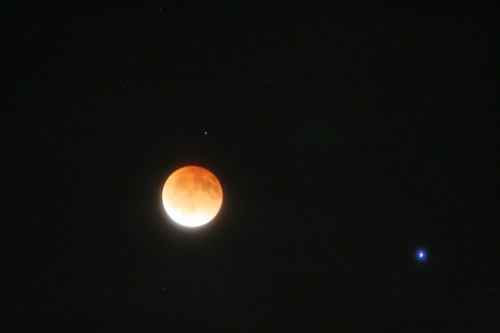
01o_Totality_2pt5sec_IMG_7179_small2.5 seconds. The longest exposure of this run. Not much jitter (Spica is round, not a line or zig-zag) but there’s some blur from clouds again.
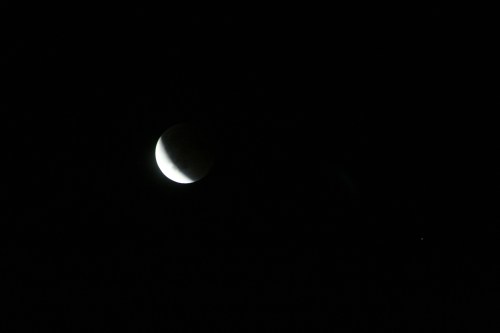
01p_1-100sec_IMG_7190_small1/100 seconds. Coming back out of totality and that quickly, with the illuminated portion of the disc growing steadily, all of the colors are gone.
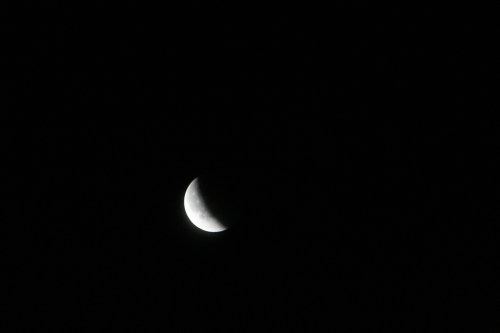
01q_1-500sec_IMG_7199_small1/500 seconds.

01r_1-2500sec_IMG_7207_small1/2500 seconds, the last shot before the clouds completely socked me in.

I had mentioned in the last couple of days that Mars would also be visible not too far from the moon. Even with the telephoto lens, pulling it back to the 75mm length let me capture the eclipsed moon and Spica at the bottom and Mars in the upper right.

02a_Wide_Shot_During_Totality_1-1pt7sec_IMG_7139_small1/1.7 seconds.

02b_Wide_Shot_During_Totality_1-1pt6sec_IMG_7167_small1/1.6 seconds. Again, notice how the most illuminated section is shifting as everything moves.

Now let’s go through the same time sequence, from the P2 point into totality and back out again, looking through the 5″ Meade telescope. Again, through the start of totality, the pictures are about ten minutes apart, more irregular after that. You’ll notice that the images appear upside down compared to the way you see them with the naked eye or using the telephoto lens. For now, let’s just say that telescopes do that.

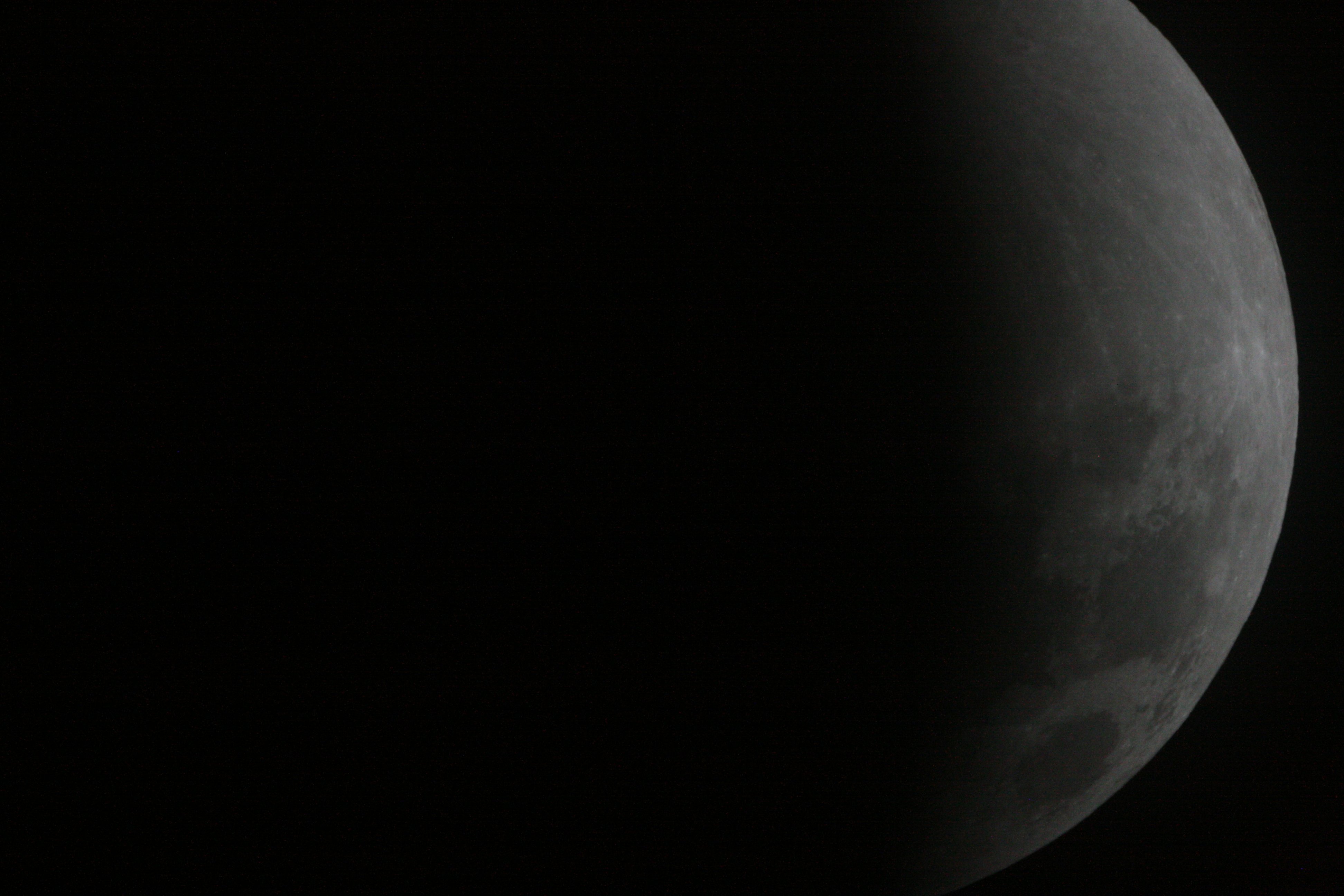
IMG_9452_small1/1000 seconds. Using the 5″ telescope, the field of view is slightly smaller than the size of the full moon’s disc.

IMG_9470_small1/2500 seconds. You can clearly see many of the lunar seas, craters, rays, and mountain ranges.

IMG_9480_small1/1000 seconds. Tycho Crater and its rays dominate the full moon’s image. Just after P2, the moon’s leading edge (right) just hitting the umbra.

IMG_9492_small1/320 second. The other thing you notice about the pictures taken through the telescope is that it’s tough to keep the moon’s disc centered in the frame. There are a number of factors, including some slop that’s worked its way in the gear drive mechanism, the fact that the heavy camera unbalances the telescope, and the way that every aiming discrepancy is magnified at higher powered views.

IMG_9502_small1/1250 second.

IMG_9523_small1/800 second.

IMG_9541_small1/640 second. In this higher magnification view, the blurring from the incoming clouds is also much more noticeable.

IMG_9561_small1/320 second.

IMG_9589_small1/125 second.

IMG_9611_small1 second. As before, this picture is taken less than two minutes after the one above, but by taking a much, much longer exposure, the colors come out.

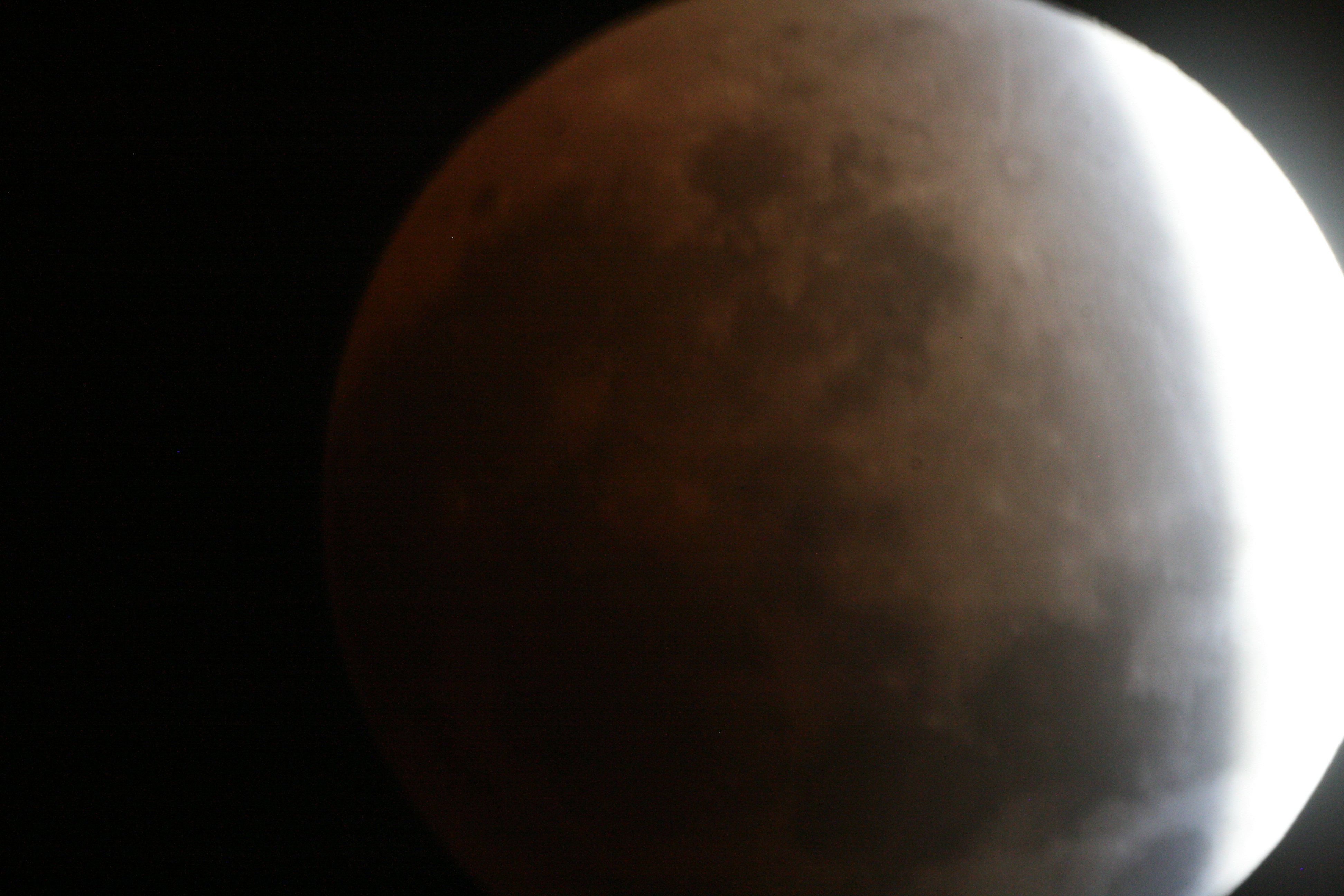
IMG_9664_small1 second. Totality through a thin layer of clouds.

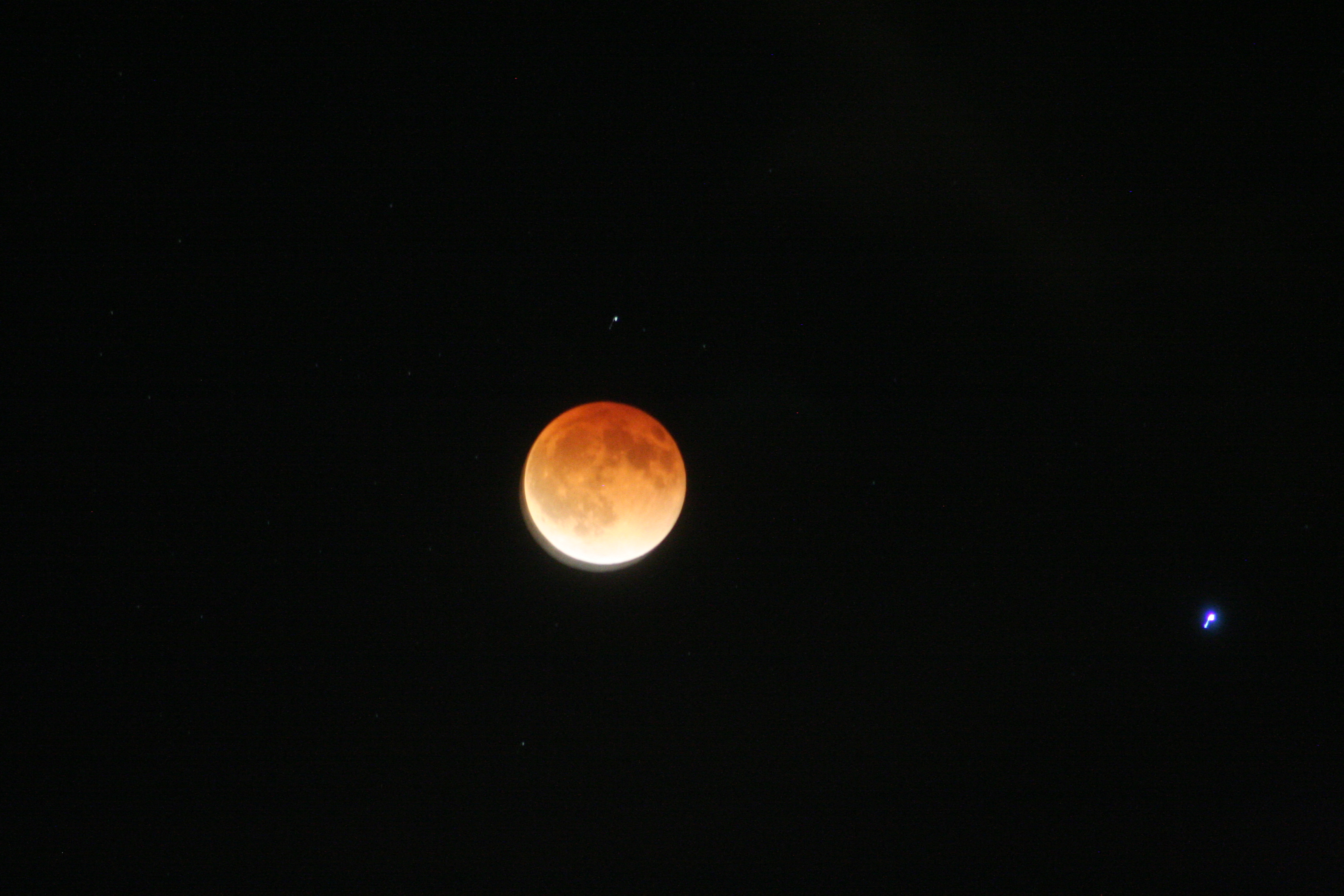
IMG_9684_small1.6 seconds.

IMG_9698_small1.3 seconds.

IMG_9722_small2.5 seconds, and the clouds can no longer be described as “thin.” “Marginally translucent” might be better. But the colors are pretty. This must be what Mars looks like from a couple million miles out.
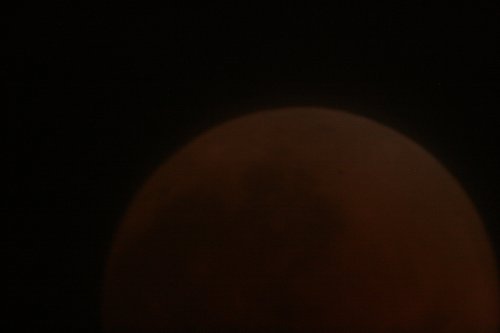
IMG_9732_small2.5 seconds.

IMG_9751_small1 second. After almost forty minutes of not being able to see anything, once we had come out of totality we got a little bit of better viewing.

IMG_9774_small1/2 second. The last try to show the fading color by totally overexposing the illuminated portion.

IMG_9789_small1/100 seconds.

With that, it was time to lug all of the equipment back into the house, trying not to wake up The Long-Suffering Wife, the neighbors, or the skunks. Then get four or five hours of sleep.

Tomorrow, I might have the results of some other photography experiments.

Finally, if you like these pictures, please let other folks know that they’re here, and I would love to hear your comments.

Leave a comment

Filed under Astronomy, Photography, Space

The Eclipse Is Ready To Start!

Last night I went on at some length about tonight’s total lunar eclipse, visible starting at about 11:00 PM on the US west coast, 2:00 AM on US the east coast. I won’t repeat much of that, except:

  • P1 — The bright, round, full moon starts to dim ever so slightly as the leading edge of the moon starts to touch the penumbra. In the penumbral phases, you may not even know that the eclipse has started, it’s not much of a change.
  • U1 — The moon’s leading edge starts to first enter the umbra. This is when you’ll start to see the curved shadow of the Earth slowly moving across the moon’s face, very noticable. “Slowly” as in “it’s going to take an hour and eight minutes for the moon to get totally into the shadow.” Tonight this phase starts at 05:58 UT, 1:58 AM EDT on the US east coast, 12:58 AM CDT, and 10:58 PM PDT on the US west coast.
  • U2 — The moon’s trailing edge enters the umbra and totality begins. 07:06 UT, 3:06 AM EDT, 12:06 AM PDT for North America.
  • U3 — The moon’s leading edge starts to exit the umbra and totality ends, 08:24 UT, 4:24 AM EDT, 1:24 AM PDT for North America.
  • U4 — The moon’s trailing edge exits the umbra, at 09:33 UT, 5:33 AM EDT, 2:33 AM PDT
  • P4 — The moon’s trailing edge exits the penumbra and the eclipse ends, 10:37 UT, 6:37 AM EDT, 3:37 AM PDT.

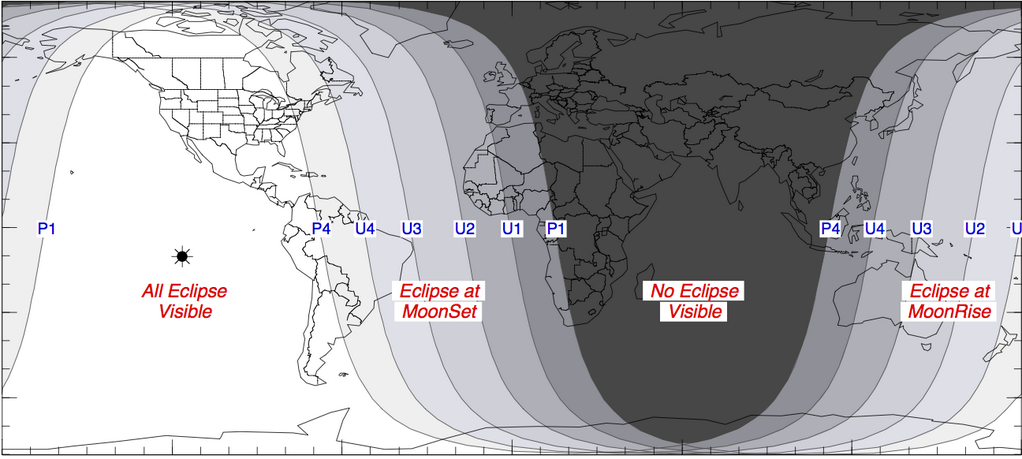
This map, from “Eclipses During 2014”, F. Espenak, Observer’s Handbook – 2014, Royal Astronomical Society of Canada, shows where those phases can be seen: 2014-04-14&15 Lunar Eclipse Map I mentioned that you will also be able to see Jupiter and Mars in the early part of the evening. Shortly after sunset/moonrise, Jupiter will be almost directly overhead, bright white. Any decent pair of binoculars will show the Galilean moons (Io, Europa, Ganymede, & Callisto), and if you watch them over a couple of hours you can see them move, just as Galileo saw. There are a number of places online that can show you in real time which moons are where. If you’re a Sky & Telescope subscriber, they have a particularly excellent one.

Mars is very bright, reddish orange, ahead of the moon by about an hour or so right now. (I could look it up, but I want to get back out to the ‘scope.) Look “ahead” of the moon as it goes from east to west, the bright red thing is Mars, only a few days past opposition.

IMG_7004_smallThis is what it looked like shortly after moonrise at our house — Mars is clearly visible upper center.

IMG_7026_smallOnce it cleared the trees, the full moon through a telephoto lens is really bright. This was taken at 1/4000 second, the fastest my Canon can go, and it’s still a bit overexposed.

IMG_9454_smallThrough the little Meade, this is the full moon a few minutes ago. Again, very bright, shooting fast. (This is at 1/2500 second, but as a lens, the Meade isn’t as “fast” as the telephoto lens.)

We’re starting to get a few high clouds here in LA, but I’m hopeful that we can dodge them or peek through them.

About 70 minutes until the umbral eclipse starts, about 2:15 until totality starts. On your marks, get set…

Leave a comment

Filed under Astronomy, Photography, Space

Tomorrow Night’s Total Lunar Eclipse

Twenty-four hours from now, the moon will look radically different than it does now. We’re not talking about the day-to-day progression of the phases. We’re talking about it going from full to dark in just a couple of hours, then back to full. It might be so dark as to vanish if you’re surrounded by bright city lights and the accompanying light pollution. It might be dark red, or coppery red, or orange, or a little bit of all of it.

Tomorrow night we have the first of four total lunar eclipses, a phenomenon known as a tetrad. The totality phase of the eclipse on the night of April 14th & 15th (TONIGHT!) will be completely visible to everyone in the continental United States, most of Canada and the Carribean, and the western 2/3 or so of South America.

Sorry, Europe and Africa and Asia — but you get the next one, on October 8th.

If you’ve never seen a total lunar eclipse, don’t confuse it with a solar eclipse and all of the warnings you have (justifiably) hear about looking at one.

  • Solar eclipse — NEVER look at the sun without proper protection (easily obtained) or you can cause permanent damage to your vision.
  • Lunar eclipse — Look at them all night long, absolutely no chance of any damage to your vision.
  • Solar eclipse — Totality visible only in a very tiny curved path across the earth, outside of that you get only a partial eclipse.
  • Lunar eclipse — Visible to everyone in the hemisphere, the entire half of the plane where the moon happens to be above the horizon.
  • Solar eclipse — Totality lasts anywhere from a few seconds to seven minutes, depending on the orbital mechanics and where you are on the path of totality
  • Lunar eclipse — Totality lasts for hours

In that last respect, lunar eclipses can be borderline boring, especially for a member of the general public who is expecting something more like a solar eclipse. You can watch the lunar eclipse over several hours. Keep in mind that there are two parts to the Earth’s shadow, the dim outer shadow known as the “penumbra,” and the dark inner shadow known as the “umbra.” Here’s the general gist of it:

  • P1 — The bright, round, full moon starts to dim ever so slightly as the leading edge of the moon starts to touch the penumbra. In the penumbral phases, you may not even know that the eclipse has started, it’s not much of a change.
  • U1 — The moon’s leading edge starts to first enter the umbra. This is when you’ll start to see the curved shadow of the Earth slowly moving across the moon’s face, very noticable. “Slowly” as in “it’s going to take an hour and eight minutes for the moon to get totally into the shadow.” Tonight this phase starts at 05:58 UT, 1:58 AM EDT on the US east coast, 12:58 AM CDT, and 10:58 PM PDT on the US west coast.
  • U2 — The moon’s trailing edge enters the umbra and totality begins. 07:06 UT, 3:06 AM EDT, 12:06 AM PDT for North America.
  • U3 — The moon’s leading edge starts to exit the umbra and totality ends, 08:24 UT, 4:24 AM EDT, 1:24 AM PDT for North America.
  • U4 — The moon’s trailing edge exits the umbra, at 09:33 UT, 5:33 AM EDT, 2:33 AM PDT
  • P4 — The moon’s trailing edge exits the penumbra and the eclipse ends, 10:37 UT, 6:37 AM EDT, 3:37 AM PDT.

This map, from “Eclipses During 2014”, F. Espenak, Observer’s Handbook – 2014, Royal Astronomical Society of Canada, shows where those phases can be seen:

2014-04-14&15 Lunar Eclipse Map

For those not familiar with the term, “UT” is Universal Time (defined as the time in Greenwich, England, at zero degrees longitude), used by astronomers and others so that no matter what time zone you’re in, we’re all comparing apples to apples and oranges to oranges when describing when something happens. The military and pilots refer to this as “Zulu” time.

If you look at the diagram, you can see that the moon will be entering the Earth’s shadow from the right as we see it, moving to the lower left.

In the partial phases, it will almost look like the moon is undergoing its normal phases — except that the terminator is curved, not straight, it’s orientation is all wrong, and it’s growing or shrinking “slowly” (see definition above).

As we get near totality and the bright white portion of the moon starts to shrink rapidly, you’ll start to see the moon turn colors, probably to some shade of red, orange, or brown. What color will we see on this eclipse? No one knows, it varies unpredictably from eclipse to eclipse. The color is affected by the amount of dust, clouds, and other conditions in the Earth’s atmosphere, which acts like a lens to bend a tiny fraction of the light passing through it back onto the moon. It’s the same effect that gives us all of those orange and red and salmon and pink colors at sunset, just on a much bigger scale.

Can you take pictures or video of the lunar eclipse? You sure can! (I thought you would never ask.) A DSLR with a telephoto lens works best, or a small telescope that you can attach your camera to. Mount the DSLR or a video camera on a tripod.

What exposures? Whatever you do, do NOT trust your camera’s automatic system to measure the light and set the exposure. I guarantee it will get it wrong. As I’ve talked about before, digital pictures are cheap, cheap, cheap, so take LOTS of pictures. Bracket a series of exposures from what might seem way too dark through what might seem way too light. Somewhere in there it will be perfect. (It’s the Goldilocks strategy!)

What I will typically do is to start taking sets of pictures every five minutes or so (or ten minutes, or whatever), with every set being probably twenty to thirty pictures, all one step apart on the shutter speed. So, get it focused, then start shooting.

In the very early or very late stages the moon will be bright, nearly full, so I’ll be shooting 1/4000 (dark & underexposed), 1/3200, 1/2500, 1/2000, through 1/125, 1/100, 1/80, and 1/60 (bright & overexposed).

In full totality the moon may be very dark, so I’ll probably be down at 1/10, 1/8, 1/6, 1/4, through to 5 sec, 6 sec, 8 sec, or even more. Note that if you’re using a telescope or telephoto lens and not guiding or tracking along with the movement of the moon, any exposures of several seconds will be blurry due to the moon’s motion (i.e., the Earth’s rotation).

There you go!

Check your weather and I hope you have clear skies. (Los Angeles is looking okay so far, but we may get some high clouds. As long as it’s not fog or the “June gloom”!)

Find a nice spot where you can see the moon clearly, especially if it will be rising at the beginning of the eclipse or setting at the ending.

Get a lawn chair, lose some sleep, and see a most beautiful and amazing sight, a demonstration of celestial mechanics at its best.

If you get bored, take a look at Jupiter, very bright and ahead of the Moon by about a third of the sky, or Mars, bright and very distinctly orange or red to the naked eye, leading the Moon by just bit as they cross the sky.

Enjoy!


Leave a comment

Filed under Astronomy, Photography, Space

It’s Yuri’s Night 2014!

It’s Yuri’s Night, the anniversary of Yuri Gagarin’s first manned spaceflight in 1961, as well as the anniversary of the first space shuttle launch in 1981.

Over the last few years, April 12th is more and more becoming an international holiday to celebrate our expansion off of this one tiny dust mote in the vast and endless cosmos.

You can celebrate tonight as well:

  • Go look at the moon that’s about 50 hours away from a full lunar eclipse
  • Go look at Jupiter high overhead and bright, with four moons easily visible in binoculars
  • Go look at Mars bright in the east, with multiple rovers and orbiting spacecraft exploring it even as we speak!

There are a growing number of Yuri’s Night parties, celebrations, and star parties all over the world. If you didn’t know about it this year or couldn’t get to one, put it on your calendar right now for next year.

HAPPY YURI’S NIGHT!!

(And you thought that I had forgotten. Shame on you!)

Leave a comment

Filed under Astronomy, Space

Well Played, Tricksters, Well Played

I’m not talking about Loki from the “Thor” movies, I’m talking about Loki, the Trickster archetype in Norse mythology, with an assist from the Coyote from Native American culture. Tonight they might have been getting an assist from Murphy.

I’ve said before that the day I go without posting here, it won’t be because I didn’t have anything to say, or even that I was on a cruise or a flight to Australia or something. It would be because “something came up” and I just forgot.

After being up until 1:00 AM last night writing (a good thing!), little sleep, a busy day at the hanger, an interminable drive home (three of four lanes blocked with no viable alternate routes), and a busy evening filling out job applications (including one in particular which sounds really interesting and I would love to have a shot at), I finished my chores and was this close to hitting the sack. Of course I had posted something, I had been on WordPress for the last hour!

Wait…

I was on WordPress looking up articles and putting links to a few choice posts into my cover letter for that really interesting job. They want to see some examples of my writing, and while many days (like today) I sort of blather on and attempt to be sporadically witty, some of the stuff I’ve written (such as the simple astrophotography series, in this case) I think aren’t half bad. So there was lots of digging and linking and searching, and now I’m about-to-drop tired and I’m done with everything for the day. Right?

Misdirection. Camouflage. Hiding the obvious in plain sight. The old three shell monty performed with the to-do list. With this, the demigods of chaos and made their play.

Not tonight, guys. Tonight I can bitch about your mythical presence for 314 words and I win.

At least for tonight.

Leave a comment

Filed under Astronomy, Job Hunt, Writing

Odds & Sods For Tuesday, March 25th

Item The First: On the second episode of the new “Cosmos” series, Neil deGrasse Tyson opened the lesson on evolution by talking about how humans had artificially bred dogs from wolves. In talking about this, he pointed out that we have bred for cuteness in addition to breeding for utility. When The Long-Suffering Dog sits in “The Desk Cave” (she loves it under there when I’m working), I’m wondering if we can breed for dogs that fart less? And can we please do it quickly?

Item The Second: Again we’ve gotten so blase about manned spaceflight. I tuned in on NASA-TV tonight at 19:25 expecting a show to start at 19:30 with live coverage of the Expedition 39/40 crew docking with the International Space Station. Instead I saw that they were already live and a lot of folks were huddled in groups around Mission Control. This is never good.

As we now thing we know, there was just a problem with the third delta-V burn needed to match orbits with ISS, so the burn was cancelled and that meant an abort of the “express” six-hour rendezvous flight plan. The failure scenario o the six-hour flight plan is the old, tired-and-true two-day flight plan. Everyone’s fine, the launch was flawless, there’s no indication that it’s anything other than some sort of software error.

But it was startling how quickly my brain went into “Apollo 1,” “Apollo 13,” “Challenger,” “Columbia” mode.

Item The Third: My Twitter feed is full of comments tonight from planetary scientists and the like (@elakdawalla, @PlanetDr, @Alex_Parker, @RonBaalke) about a news article that’s been released early. I guess there’s a major announcement coming out tomorrow from ESO. I’m assuming they’re talking about the European Southern Observatory instead of the Elder Scrolls Online, but I might be wrong.

Anyway, a couple of media places have released the embargoed story early. A part of the response, a new Twitter hashtag has been born, and it’s pretty funny. Check out #ESOrumors to see what I’m talking about. For example, @mcnees said “Hey no biggie, and totally just out of curiosity, but exactly how many nuclear missiles do we have?” @danielg1905 suggested, “Stronomers: ‘We’re not saying it was aliens . . . but it was aliens.”

Item The Fourth: Speaking of “Cosmos,” it has upset a number of fundamentalist groups that claim that Fox owes them “equal time” to talk about “intelligent design” if “Cosmos” is going to give a “one-sided” view of the arguments on evolution. A few thoughts:

  • This isn’t a political campaign, you have no right to “equal time.”
  • Hypothetically and parenthetically, if you were to win “equal time,” would you in turn be forced to give “equal time” to scientists and rational thinkers as part of every television program put on by some megachurch evangelist (i.e., blackmailing for dollars)?
  • Get over the “evolution is just a theory” argument! All it does is prove that you have no idea what the definition of “theory” means in a scientific discussion. Evolution is a “theory” the same way that gravity is and radioactive decay is. If you still don’t believe or understand, go jump off of a tall cooling tower into the core of a nuclear power plant. Enlightenment will await.
  • Not only are you not entitled to “equal time,” neither are the Flat Earth Society, the Ptolemaic fundamentalists who still believe in epicycles, the Mayan fundamentalists who believe that human sacrifice appeases the sun gods, or the Hindu fundamentalists who think that the Earth is carried around the sun on the back of a giant turtle. It doesn’t matter how big of a turtle they find. (Although, to be fair, if they could find a turtle the size of Saturn or Jupiter, I would be happy to accept at least the possibility that their theory was relevant. But can you imagine how much lettuce that turtle would eat?)
Item The Fifth: It’s so neat that our space program has taught all of us space cadets how to spell “r-e-n-d-e-z-v-o-u-s”. Is that a great spinoff, or what?

Item The Sixth: Someone the other day wanted to draw me into a political argument, and it was an argument, not a discussion. I wasn’t taking the bait, but after being pressed a bit I put it this way: “I hate all politicians these days. I don’t trust a single one of them, either party, local, county, state, or federal. On a scale of one to ten, I hate the Democrats about a twelve. You just think I’m a ‘liberal’ because I hate the Republicans about a thirteen.”

2 Comments

Filed under Astronomy, Dogs, Odds & Sods, Politics, Space