Category Archives: Astronomy

Gravity, Juggling, Fireworks, And “Cosmos”

Too much “Cosmos” tonight (the show is fantastic, can’t be “too much” of it!) to leave time for many other things. Tonight’s tale of Newton, Halley, and gravity was excellent. Catch it online or on one of the other cable networks it’s shown on if you missed it.

I’m juggling more other tasks than I have in quite some time, and while juggling a schedule doesn’t require gravity as much as juggling chain saws, the consequences of dropping things can be just as disastrous. So that’s sucking a fair amount of time out of my weekend.

Then there’s the raccoons who are again on the roof, dancing on the skylight, freaking out the cat. Anything that freaks out the cat is a good thing, but if they smash that skylight and come crashing and bleeding into the living room (due to our old friend gravity) I’ll use up my month’s allotment of adrenaline in about three seconds.

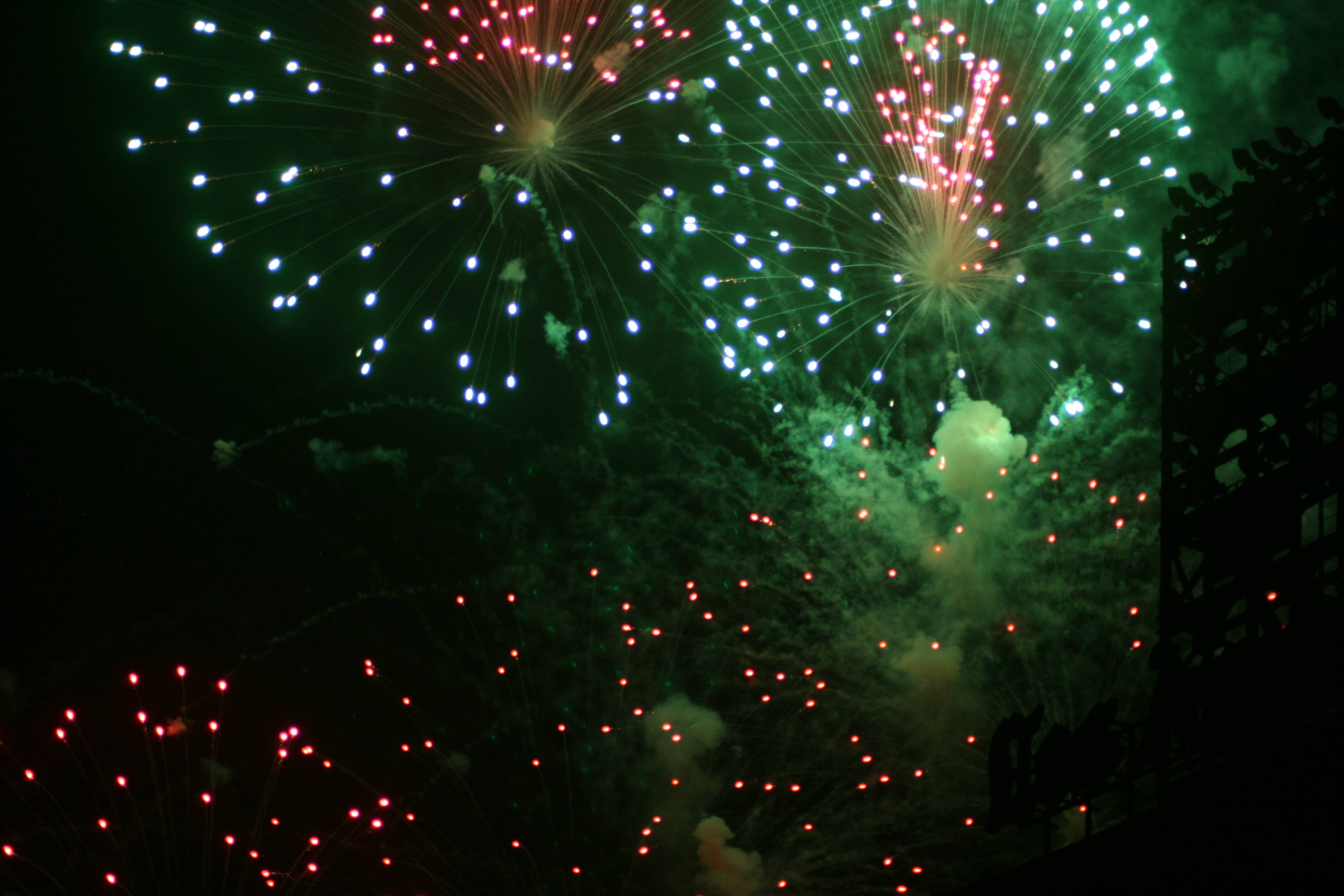
So while I deal with all of that, here are some more pictures of fireworks, which are some of the more spectacular and beautiful displays of gravity on an everyday scale.

IMG_9715 small

IMG_9739 small

IMG_9750 small

IMG_9785 small

IMG_9813 small

IMG_9847 small

IMG_9855 small

IMG_9874 small

IMG_9889 small

Leave a comment

Filed under Astronomy, Cats, Critters, Fireworks, Photography, Space

Congratulations, “Cosmos”

I just finished watching the first episode of the new “Cosmos: A Spacetime Odyssey“, and I am thrilled to report that it is spectacular.

Of course I remember the original series by Carl Sagan which aired on PBS in 1980. I loved it then and I’ve seen it several times since. Carl Sagan was a giant in our time not only being on the cutting edge of science and exploration, but also for being able to communicate to others the wonder and beauty of science and exploration. If you haven’t seen it, do so, it’s available through the usual channels.

After a generation, Fox has brought the series back with Seth McFarlane , Ann Druyan, Brannon Braga, and others as Executive Producers. Neil deGrasse Tyson is the host and he is a worthy successor to Carl Sagan’s legacy.

The concepts in the first episode are mind-boggling, from the size of the universe, to the length of time that the universe has existed. We humans and our dust speck of a “pale, blue dot” are shown to be but the tiniest piece of that whole, yet also connected to it with the vast majority of our bodies and our world made of elements created in exploding stars. For me, this was always one of the biggest take-aways to the original show. (I knew it before the original show aired since I had gotten my physics degree in 1980, but few non-scientists really were aware of it.)

The target audience for this show is not people with a degree in physics. This isn’t a graduate program lecture or dissertation. It’s aimed at anyone who is curious about our universe and our existence and who is willing and able to be taken on a journey of exploration and explanation. In our increasingly technological and scientific-based society, it’s critical that the average person have a basic understanding of fundamental concepts that have been known for centuries. When over a quarter of Americans polled believe the Sun orbits the Earth, we’ve got a problem.

This episode also does a great job of tying Tyson’s personal story to Sagan’s. The segment at the end where Tyson talks about the time he, as a teenager, met Sagan, was exceptional.

If you didn’t get to see this premiere episode, it will be on the Discovery Channel Monday night. Internationally it will be on multiple channels all over the globe within the next few weeks. And it looks like you can watch full episodes at the website given above.

I urge you to watch “Cosmos” every Sunday, in part because it’s so well done, and in part because we need to show the networks and media mavens that a well-made, intelligent, science-based show can do well. If we don’t, they’ll just keep putting out more mind-numbing, reality television crap. (I’m looking at you, Kardashians!)

This week, Tyson managed to use Sagan’s catchphrase “star stuff” when talking about what makes all of the elements heavier than hydrogen or helium. Maybe next week he’ll say “billions and billions” for us!

4 Comments

Filed under Astronomy, Entertainment, Space

Juicy Chunks O’ Wisdom For Tuesday, February 18th

‘Cause my head can’t decide if it’s going to just keep throbbing endlessly or if it’s going to explode and scatter skull shards everywhere, that’s why.

  • When did the California CHP start using radar on the freeways? I thought they couldn’t do that.
  • I hate repairing toilets.
  • Regardless of #1 above, have I mentioned more than a few hundred times how much I hate people who drive at 65 in the fast lane when it’s clear, dry, and otherwise wide open traffic?
  • I thought that these Olympics we were supposed to have four or five cable channels going 24/7 with every event available live, or at least something close to that. We have one channel on about twelve hours a day (night) with live stuff, sometimes a second channel for four hours or so, then the prime time replay stuff for three or four hours. Did I get that wrong?
  • No, I didn’t get a speeding ticket, nor did I get pulled over and then charm my way out of it
  • Computers are wonderful — right up to the point where they totally suck.
  • Speaking of NBC’s Olympics coverage (we were, weren’t we?), who is this guy they have doing color commentary on the biathlon and Nordic skiing events? Can we get this guy some decaf?
  • You know that you’re STILL in love with the convertible when you drive with the top down even when it’s only 55 degrees and foggy.
  • Spring training games start in eight days!
  • Why does a computer that was working just fine yesterday suddenly not be able to connect on ANY web browser (IE, Chrome, Safari, Firefox, Opera) while still well connected to the internet and other programs (Skype, Norton) can connect just fine?
  • I’m so glad that I can follow planetary scientists, astronauts, and other space and astronomy groups and individuals on Twitter.
  • “Game Of Thrones” Season Three is out on DVD now — time for another binge watching day! This time we’ll be ready when the new season starts next month. (“You know nothing, Paul Willett!”)

Remember, if it weren’t for the last minute, there wouldn’t be time to get anything done at all.

Leave a comment

Filed under Astronomy, Computers, Entertainment, Juicy Chunks, LA Angels, Space

Dodging The Bullet – Learning From The Experience?

A year ago, on February 15, 2013, a stony asteroid 20 meters wide weighing 12,500 metric tons entered the Earth’s atmosphere at 69,000 kilometers an hour (42,900 MPH). (Size and mass values are estimates based on the size of the explosion when it hit, but the velocity figures are pretty accurate.) The asteroid entered the atmosphere over Chelyabinsk, Russia at about 9:30 AM local time on a shallow angle. It started burning due to atmospheric friction, becoming brighter than the sun. It then blew apart due to the stresses associated with the rapid deceleration. The explosion was estimated to be larger than 500 kilotonnes of TNT, making it larger than many nuclear weapons. The resulting shock wave blew out windows for hundreds of kilometers.

Its entry was captured on hundreds of video cameras (Russian motorists often have them mounted on their dashboards due to the terrible traffic conditions) and security cameras. Go to YouTube to find many of them, such as this one or this one. Within seconds of its passing, even more people ran out with cellphones and cameras to view the meteor’s trail, only to film the blast of the shock wave arriving (here). I guess if you speak Russian you should be warned, there are a lot of very stunned, surprised, and scared citizens of the Chelyabinsk region shouting what I can only assume is Russian profanity.

The Russian government says that 1,491 people received injuries from the blast, most from flying glass and debris as windows broke, walls fell, and roofs collapsed over a wide area. Over 100 people had injuries serious enough to require hospitalization. The total damages to property was over one billion rubles (about $33-million USD).

This was a near miss. We (as in “we” inhabitants of Planet Earth, not as in “we” citizens of Chelyabinsk) dodged a bullet. A bullet the size of a building traveling over sixty times the speed of sound.

Over the past twenty or thirty years, as optics and computers have gotten faster and cheaper, there have been a growing number of more and more powerful searches for asteroids, particularly asteroids that might have the potential to come close to us at some point (“near-Earth” asteroids). We’ve found a LOT of them, almost 10,000. About 10% of those are over 1 km in size — that’s on the order of 100 to 500 times the size of the Chelyabinsk rock.

As we’ve gotten better at searching, we haven’t found all of the potential killer asteroids. What we’ve really found is that there are far, far more “smaller” asteroids (50 to 500 meters) than we previously believed. The more we find, the more we realize how many we haven’t yet found.

The Chelyabinsk asteroid wasn’t seen in advance because it was “tiny” and coming almost straight out of the sun at us. We have blind spots like that where we can’t see asteroids. We also can’t see the really small ones until they’re really close, so we often have less than 48 hours’ warning before they arrive. Since the Chelyabinsk meteor, with the additional attention given to the search for similar objects, we have seen similar sized objects that passed closer to Earth than our geosynchronous satellites, but were discovered only days before their closest passage.

Having a Chelyabinsk-sized rock come in at a sharper angle and either slamming into the ground or exploding a few kilometers up instead of thirty kilometers up would be far more destructive than Chelyabinsk. If it happened over a more heavily populated area (the US, Europe, India, China, Japan) or a major city, it could result in thousands to hundreds of thousands of casualties and trillions of dollars in damage. If a rock or comet ten times larger hit, it could wipe out an area thousands of miles across with millions of casualties. If a rock or comet one hundred times larger hit, it could cause enough damage to cripple the entire world, bringing civilization to its knees.

Of course, even larger objects exist, and they have hit the Earth in the past. Ask a dinosaur. Oh, wait…

This is the only natural disaster that has the potential to wipe out the human race. Tornadoes, floods, drought, flooding, earthquakes, tsunamis, fires — they can kill hundreds of thousand and lay waste to huge areas, but they can’t eliminate the entire human race and wipe away all of human society. A large comet or asteroid collision can.

But the most important realization in this discussion is that this is also the only natural disaster that is 100% preventable. Forget about stupid movies (even if they have Bruce Willis or Robert Duvall to save us all), in real life we have the technology available today to detect any incoming threat and to divert it before it gets here.

100% preventable.

But do we have the will to do it? Will we spend the money, or will the politicians ignore the dangers and the solutions. It’s very easy to assume that it won’t really happen. After all, it hasn’t happened in millions of years. Sure, there is Meteor Crater in Arizona, and this Chelyabinsk thing, and the Tunguska event of 1908, and all of the other “small” rocks that we’re now seeing. But what are the odds of it happening and why should we care and why should we spend the money?

The odds of it happening tomorrow are very, very small. The odds of it happening in the next hundred years are very small. The odds of it happening in the next thousand years are small. The odds of it happening in the next 100,000 years or 500,000 years approach 100% pretty quickly.

And let’s not forget the other factor in the risk management equation — the risk. The odds may be low, but the potential risk is astronomically huge. Potentially it could be the death of every human being on the planet. Even if it’s not the ultimate worst-case scenario, it could still be the immediate death of more people than were killed in all of World War II. Those kinds of monstrously huge risks balance out the small odds.

Do we all have insurance on our cars and houses? If we’re smart we do. What are the odds that our house will burn down tomorrow? What are the odds that our car will be damaged in a crash tomorrow? In the next week? In the next month? In the next year? In the next twenty years? You’re now talking about a high-probability scenario. So we pay for the insurance all the time, now and next year and beyond. We don’t know if we’re going to have that personal disaster tomorrow, or in ten years, or ever — but it’s still smart to have the insurance just in case, rather than being wiped out.

Compared to the potential cost of a major strike by a comet or asteroid, the “insurance” of a space-based detection and deflection system is pretty cheap.

Politicians are not known for their long-term strategies, vision, and ability to understand math and science issues. Rest assured, if we found something large on a collision course that will wipe us out in five years, we would spend trillions and trillions of dollars a year for those five years to try to save ourselves. With no actual threat identified, basing our arguments on science, probability, and the growing body of evidence we have, politicians won’t give us the time of day.

Fortunately, even before Chelyabinsk, private groups and individuals are stepping up and showing some leadership regarding this problem. Primary among them is the B612 Foundation, which is a non-profit organization dedicated to first finding these threats, then being able to protect against them. Their Sentinel Program is aimed at launching and operating a satellite (or satellites) with the sole purpose of mapping our skies to find as many threatening objects as they can, giving us as much warning as possible about any objects on potential collision courses. They’re also working on research into techniques for moving threatening objects out of their collision courses.

Advance warning is the key. It’s pretty hard to actually hit something in the solar system — look at how hard we have to work to put space probes on, near, or in orbit around other planets, or even our own moon. If something is found that is going to hit us in a year, we need a massive amount of power very quickly to move it into an orbit that misses us. (Forget about blowing it up like they did in those movies — there are so many reasons that’s really unlikely to work.) But if we find it ten years before it hits us, then a little bit of a nudge over months and years will easily do the same thing.

We have the technology to build space-based telescopes that can find 99.9% of these hazards, and keep an eye on them. We have the technology to gently nudge an incoming object over a long period. We aren’t even close to having the technology to save ourselves if we only have a couple of years (or less) before impact.

So, go look at those YouTube videos. Listen to the blasts, breaking glass, and cussing Russians. Think about the potential consequences of a bigger or much bigger collision. Then, if you’re a multimillionaire, maybe you could lob a few hundred thousand dollars in the direction of the B612 Foundation. Even if you’re not a multimillionaire, the next time you’ve got a couple of extra bucks and you’re looking for a tax deduction, keep the B612 Foundation in mind.

We dodged a building-sized, hypersonic bullet a year ago. Let’s learn from the experience and help find the next one before it finds us.


Leave a comment

Filed under Astronomy, Space

Jelly Doughnuts On Mars

In case you hadn’t noticed, January, 2014 has seen the celebration of the 10th anniversaries (Earth years!) of the landings of Spirit and Opportunity on Mars.

While Spirit finally got stuck in some sand in 2009, couldn’t maneuver to expose its solar array to the sun during the Martian winter, and apparently froze to death in 2010 because of it (warning, this is one of the greatest and saddest cartoons I’ve ever seen, it still makes me tear up), Opportunity is still going strong. Currently in the TENTH YEAR of its ninety-day mission.

NASA and JPL have been having seminars and talks about the two missions (catch them on NASA-TV or YouTube, well worth it) and revealed this week something bizarre even by the standards that we’ve already seen. No, not little-green-men class bizarre, but getting there.

2D11392687-mars-mystery-rock-opportunity-rover-full.blocks_desktop_largePhoto from NASA/JPL-Caltech/Cornell University/Arizona State University

Around Christmas (here on Earth) the photo on the left was taken by Opportunity, just part of a survey of what was in the immediate area after it had driven a few meters to a new spot.

On January 8th, in another routine survey picture, the white rock on the right is now seen.

The Opportunity scientists are referring to this new rock as being “like a jelly doughnut”, so I’m guessing that’s also a ballpark figure for its size as well as its looks. Even more surprising than its sudden appearance was the composition. It seems to have flipped over on arrival, so the orange surface crust is on the bottom with the interior white material being very high in sulfur, magnesium, and manganese.

The lead working theory as to how it got there seems to be that one of Opportunity’s wheels probably scraped a bigger rock when it was shifting around, fracturing the bigger rock and flipping this piece a few feet away. Opportunity does have one broken wheel that doesn’t turn any more, but instead gets dragged around like an anchor, so they’ll be taking more pictures in the upcoming weeks to test that theory and see if they can figure out where the jelly doughnut rock came from.

A less likely theory is that a meteor hit the surface somewhere nearby and threw up debris, including this piece. That seems pretty unlikely, but it can’t be ruled out yet.

Of course, the conspiracy theorists and Art Bell cultists believe that the Martians, who have been hiding just over the horizon for ten years, have begun chucking rocks at our equipment. Um, yeah…

Anyway, happy anniversary Opportunity! We’re glad to see that you’re soldiering on and continuing to commit science and surprise us.

And, FREE SPIRIT!

Leave a comment

Filed under Astronomy, Space

The Cosmos Rolls Onward (Simple Astrophotography Part Seven)

After your blood pressure and heart rate drop back down and you get a few good nights’ sleep following this, you finally realize that the Universe has not been jolted out of alignment. Rather, your perception of the Universe and your relationship to it has been clocked upside the head. The Universe just keeps rolling on, oblivious.

This was brought to me in graphic form tonight as I walked the dog. Venus, which had been amazingly bright in the west at sundown for weeks and weeks, had seemingly gone away in just a few days. (Don’t worry, it will pop out into the morning sky before sunrise in a few more days. We didn’t lose it.) But now Jupiter, only a bit dimmer than Venus, is riding high up into the sky in the early evening, sitting next to Orion. And tonight, the almost-full moon was just a couple of fingers-width away from it. (Full moon is at 20:53 UTC on the 15th. It’s currently 05:41 UTC on the 15th or 09:41 on the 14th Pacific, so full moon is about fifteen hours away.)

In Los Angeles, the haze and clouds have been swept away by very strong (and dry) Santa Ana winds, so the brush fire danger is just about off the charts — but the stars are crystal clear.

Time to grab the tripod and the camera with the telephoto lens!

There was a problem with the picture I wanted. As bright as Jupiter appears, it’s several orders of magnitude dimmer than the full moon. The full moon is really, really stinking bright!

So class, how do we approach this problem? Bracket, bracket, bracket! Digital is dirt cheap! Take a whole metric crapload of pictures across a broad range of exposures and see what happens. What have we got to lose?

No fancy equipment, just a tripod and a Canon Rebel XT with a Tamron 70-300 mm telephoto zoom lens.

Just to be on the safe side, I started with the fastest shutter speed my Canon Rebel XT will do, 1/4000 of a second. (I fully expected this picture to be seriously underexposed.) Then photos at steps of one speed slower every time, all the way up through 1/2 second. (I fully expected this picture to be completely washed out and overexposed.)

A very pretty sight. Gorgeous. Brilliant starlight. Moon so bright you could read a newspaper by it.

And then the Universe blew my mind tonight.

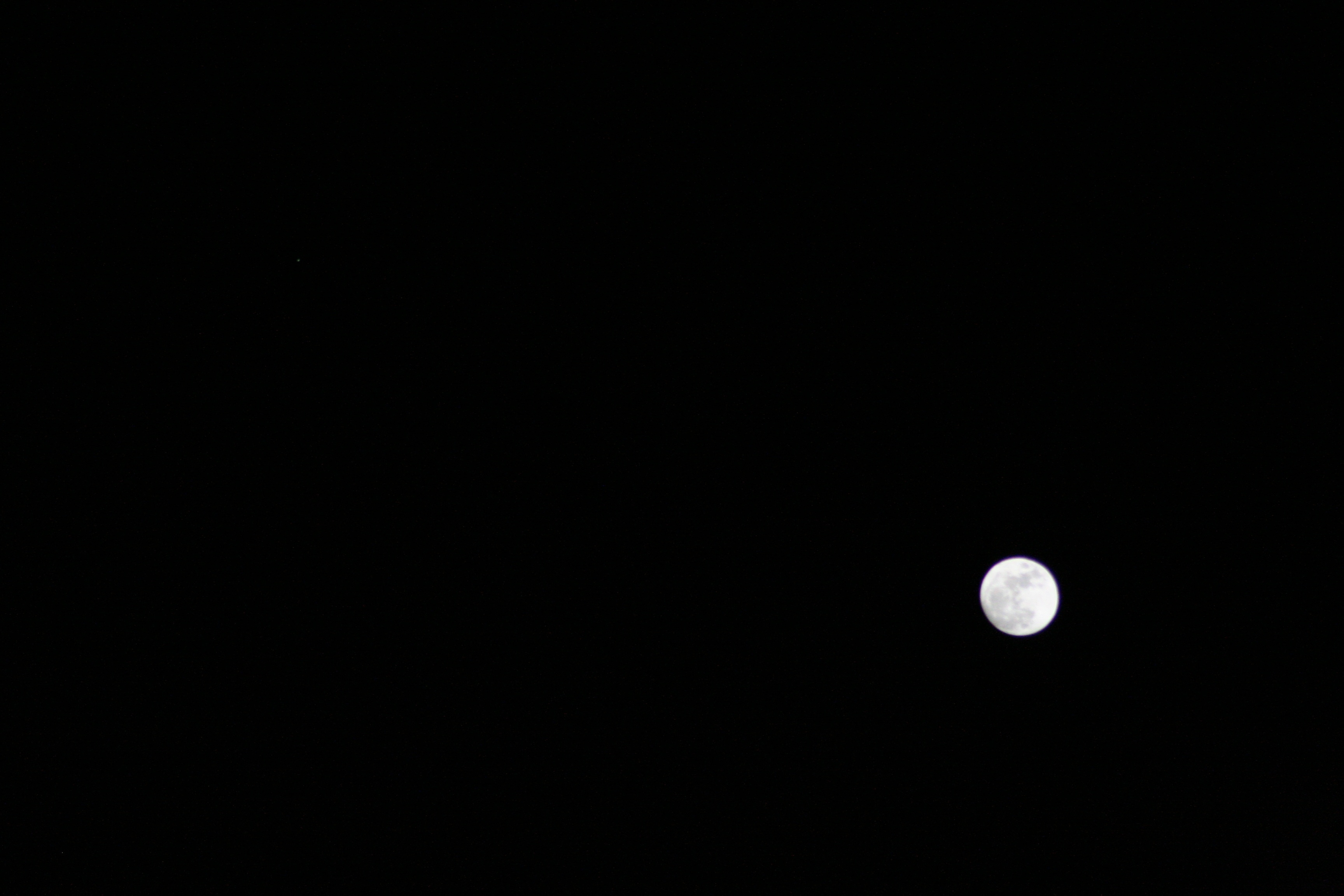
IMG_6906 (small)This is that very first picture, at 1/4000 second. In the lower right, of course, is the full moon and in the upper left is a little dot that’s Jupiter. (You should click on the images to get the full sized versions, it’s much easier to see what I’m talking about.) This is a great example of just how bright the full moon is and how big the dynamic range is between the two objects. You can actually see the big features of the moon pretty well, even with this simple setup. Even at this fast, FAST exposure, the full moon is starting to be overexposed. Yet Jupiter is just a dot, barely seen, which is not unexpected since this was a really short exposure.

I was very happily surprised to see how this image came out, especially given the seconds and seconds I had slaved over setting up and preparing to take it.

But, wait. There’s more!

Being a bit obsessive about these things (which is like saying water is a bit wet) I went flipping through the whole series of images. As expected, by 1/1250 second, the moon is completely washed out. But as we keep going and the moon more and more looks like a huge, white blob, Jupiter starts looking brighter and clearer.

IMG_6914 (small)At 1/640 second we see the last image before we start to pick up serious lens flares from the bright moon. As we keep going, these flares develop into a greenish-bluish ghost image of the moon just below Jupiter.

IMG_6928 (small)By 1/25 second this ghost image actually gets bright enough to show the same kind of detail as the primary image did in the first image. As we get beyond this, the ghost image gets brighter, the lens flares get brighter, the full moon more and more washes out almost everything. But “just because”, I flipped through the images all the way to the end.

And then…

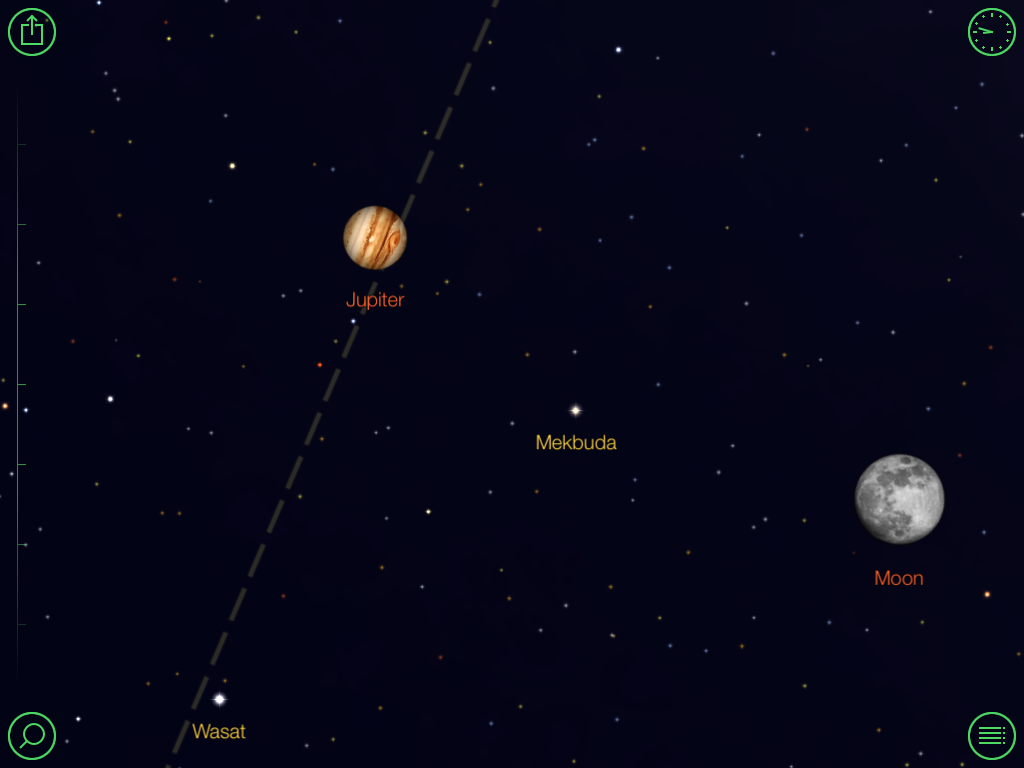
IMG_6939 (small)Other stars starting to show up in the field in this 1/2 second exposure. In between the moon and Jupiter is Mekbuda (Zeta Geminorum, mag 3.93 average). In the far lower left corner is Wasat (Delta Geminorum, mag 3.53). In the far upper left and at the very top center are two unnamed 5th magnitude stars, while outside the glare of the moonlight I can pick out at least eight dimmer 6th magnitude stars.

photoImage from the Star Walk iPad app. It looks a bit like this. Jupiter obviously isn’t shown to scale, although the moon’s size is probably close to being the correct size.

But best of all, to my utter amazement and joy — take a look at Jupiter! It’s now an overexposed blob also, actually showing elongation to an oval or a streak, the image smeared toward the upper center as the Earth beneath me rotated 314.9574 feet to the west in that 1/25 second. But even better, the best of all, look at the two small dots in a line at the seven o’clock position right next to Jupiter.

IMG_6939 (Jupiter detail)See them? That’s got to be Io (the inner moon) and Europa (the outer one). And if you look really closely, can you kind of maybe see a spike or bump sticking out of Jupiter’s glare, right on that line between Jupiter, Io, and Europa? The map says that Ganymede should just be coming out of Jupiter’s shadow at about that time, right about at that spot. Could I possibly have captured it as well?

Two of the four Galilean moons captured, and maybe a third! All with two minutes of preparation and some common, off the shelf camera equipment.

Thanks, Universe. Thanks for the reminder that there are wonders all around us, even if there are sometimes also bad things.

Given the former we’ll find a way to deal with the latter.

Leave a comment

Filed under Astronomy, Health, Photography, Space

The Dark Has Returned

I pulled the plug on all of our Christmas lights on Tuesday, but didn’t get around to start pulling them down until today. I’m not fanatical about a cutoff of January 6th and I’m not sure when I picked up the Twelfth Night tradition (if that’s what it is) but I have noticed that it’s happened enough to not be a coincidence. Maybe some time I’ll have to ask myself about that.

After having all of the lights up for a few weeks, it’s startling every year how dark the yard seems after they’re gone. When the dog goes out (repeatedly) for her evening constitutionals, it’s jarring for the first few nights because I’m still expecting to see them. It’s not just the amount of light, but also just the spectacle and color.

For the most part it’s been cloudy or hazy for days here in Southern California. Most nights, with or without the Christmas lights on, we’ve been barely able to see the moon, let alone any stars. But tonight it was clear. The winds are blowing again, the fire danger is high, and the stars were bright. Jupiter’s up at sundown and quite bright, and Orion is always a welcome sight for me. We really could have used them at Halloween, but you can’t argue with celestial mechanics. At least, you can’t argue and win.

For the first time in three or four years we didn’t have any of our Christmas lights stolen or vandalized. I can’t imagine who would steal or rip up Christmas lights, or why, but I guess it probably made sense to whoever did it.

There are a few very broad “themes” in our Christmas lights. Red, white, & blue lights by the flag. Big lights along the roof line and around the windows. White icicles along the gutters. All white lights here. Colored lights there and there and there. White lights & stars up in the birch tree. Monochrome colored lights on the rose bushes at each end of the yard. Red and white lights spiraling around the palm tree, hopefully making it look somewhat like a candy cane.

The first year we had problems, after nearly twenty years without any issues at all, someone swiped several of the small monochrome colored strings of lights off of the rose bushes. They’re right next to the sidewalk, so I guess that made them a target of opportunity. But it was a pain because those types of lights (monochrome colored) are difficult to find and replace.

So the next year, we started using little nylon tie wraps to attach those lights to the rose bush branches. Again, someone tried to swipe them, but this time found it to be harder. They may have also gotten scratched up pretty good by the rose bushes. (Go get ’em, rose bushes! ATTACK!) So they went postal on the bush and the string, actually managing to rip both to shreds with their bare hands.

All rightey, then! Merry Christmas!

Last year, we again locked down the lights on the rose bushes and they were left alone. But several strings of C7 and C9 bulbs were vandalized. The red & white lights on the palm tree as well as the big lights around the garage door all had a handful of bulbs unscrewed and stolen, maybe two dozen bulbs in all. These aren’t that hard to replace, but it’s still annoying. Again, all of the lights stolen were down at a height where they were within easy reach, so I’m guessing it was kids on a dare or some such thing. Still, geez, who in hell steals Christmas lights?!

I hope they got coal in their stockings.

There’s a bit of a sense of violation to the whole thing. Granted, not as bad as when I’ve had my car broken into and thousands of dollars of stuff and my briefcase stolen, but still… We work hard to put the lights up and make them look nice and we get lots of nice comments from folks around the neighborhood. While the total cost of everything stolen to date is maybe $25 or so, it’s the principle of the thing.

Principle is all well and good, but so is common sense. Is it worth it to spend hundreds or even thousands of dollars on security in order to protect $25 in Christmas lights? Or even ten times that many?

On the other hand, how much would it cost to hook up some web cams to monitor the yard? Motion-triggered video capture is built into some of the software that Logitech supplies with their cameras and I’ve got a couple of “spare” computers gathering dust here. Even if the police wouldn’t give a damn, it would be great to just print up the pictures and post them in the yard for some stranger shaming. (Trust me, in Los Angeles, even with hard evidence, if you’re not dead, a celebrity, or the property crime doesn’t result in thousands of dollars in losses, LAPD won’t even bother taking a report. Been there, done that, got the T-shirt.)

Whatever. For this year, the yard is dark, the garage is again stuffed to bursting with holiday trappings, and our electric bill will drop to normal.

Until Thanksgiving. Two hundred and eighty-eight days to go.

Leave a comment

Filed under Astronomy, Christmas Lights

Astronomical Christmas Lights (Segunda Parte)

It was a beautiful sight last night. Tonight, ditto, although Jupiter and the moon continue to separate (as they do).
20131219-211739.jpg

Leave a comment

Filed under Astronomy, Christmas Lights, Space

Astronomical Christmas Lights

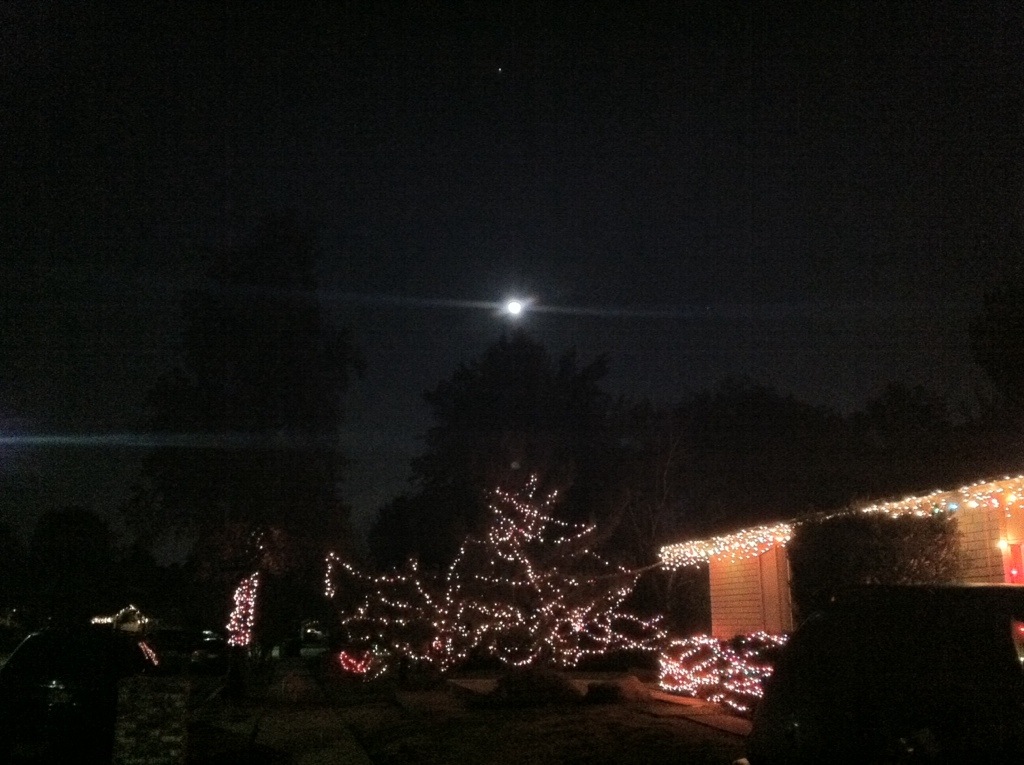
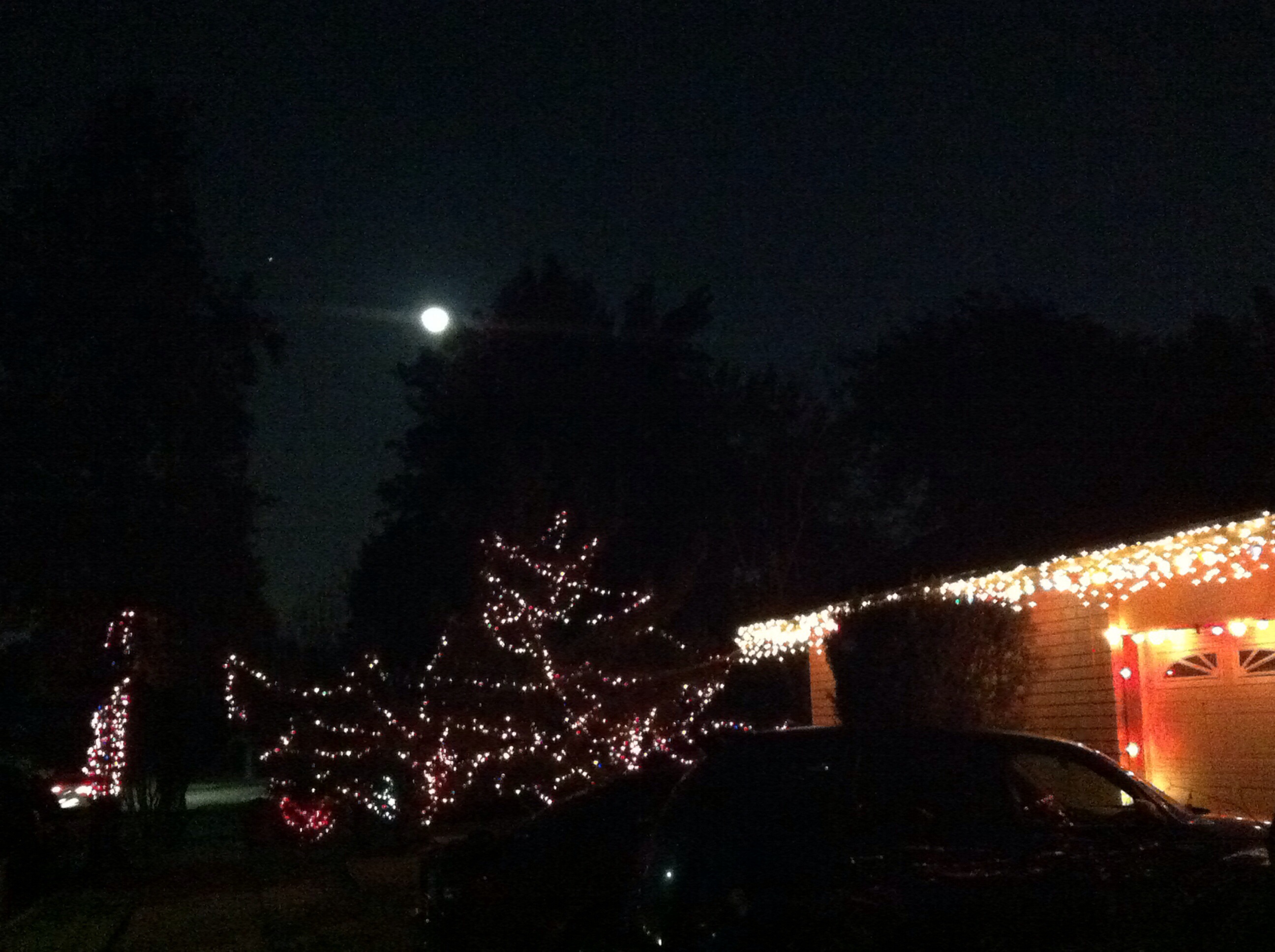
Walking the dog for her evening constitutional, the day’s solid overcast parted. Rising in the east was a nearly full moon and a brilliant Jupiter above it. They were nicely framed by the trees and the Christmas lights in our yard. (Still only about half of the lights are up, but at least the Christmas cards are finally in the mail!)

20131218-200110.jpg

Leave a comment

Filed under Astronomy, Christmas Lights, Photography, Space

Odds & Sods For Wednesday, November 27th

Item The First: Should it be “The Long Suffering Wife” or “The Long-Suffering Wife”? I’ve been going with the former, but someone suggested that could be construed as her being “nine feet tall and suffering” as opposed to “suffering for a long time”. Now, I would think that “The Long, Suffering Wife” would be “nine feet tall and suffering” and that no hyphen is necessary. Punctuation is important, you know. (Ask Grandma tomorrow when the kid either yells “It’s time to eat Grandma!” or “It’s time to eat, Grandma!”)

Item The Second: I have been known at times to rant about the “freakin’ idiots” of the world, and this often targets politicians and our legal system. (Sorry, I’m not the one who invented the system. If politicians and lawyers would like to stop being highlighted as freakin’ idiots, they’re free to stop doing freakin’ stupid things any time they want. But I digress.)

Having gone off at the mouth about some of the bad things I see, it’s time to highlight a good thing that caught my eye. NPR has an article (and I went hunting and found a more detailed article at the Chicago Tribute) about a couple in Illinois that’s being allowed to get married immediately, rather than being forced to wait until June, 2014 when the new Illinois law allowing same-sex marriages goes into effect. Their circumstances are extreme, and tragic, and I think we should all congratulate the judge, US District Judge Thomas Durkin, for making a ruling that demonstrates compassion and common sense.

Item The Third: I understand why are there television shows that start with a voice-over and a card that says, “This show is a work of fiction and is not in any way based on any actual person or event”. (Hint, it rhymes with “too many lawyers”.) What I don’t understand is why they do that after the previous two hours of sitcoms have had teaser commercials for the show at least once every half hour and every single one of them screams “AN EPISODE RIPPED FROM TODAY’S HEADLINES!” Doesn’t that by definition mean that either the marketing department or the legal department is lying? (Yes, you get extra credit if you immediately pointed out the excellent odds that both of them are lying.)

Item The Fourth: The last two days NASA-TV has been running live interviews where NASA folks (astronauts, scientists, researchers, etc) have been going through these long series of one broadcast interview after another being done and recorded. On Tuesday it was scientists from Goddard being interviewed about Comet ISON, on Wednesday it was interviews about what the astronauts eat on ISS for Thanksgiving.

I understand that TV news anchors and personalities are no longer hired for having the same journalistic chops as Walter Cronkite or David Brinkley. They’re hired because they look good in front of a camera and can be pleasant on command. This leads to a fair number of them who appear to be unable to recite the alphabet without a teleprompter. It’s never more clear than when they’re doing these interviews. Leading off with statements like, “There are three people in space right now, one American and two Russians” is not only blatantly incorrect, it’s hideously lazy journalism. How hard is it to go the the NASA website, or simply type “Who is on ISS right now?” into Google to get a dozen correct answers. (Like, here, and it’s currently six people, which breaks down as three Russians, two Americans, and one Japanese.)  You can do that on your phone, for crying out loud! I commend the various NASA personnel being interviewed for not spending their entire interview correcting the stupid things said.

That having been said, is there an astronaut training course called “1,001 Ways To Say ‘That’s A Great Question'”? You hear it when they’re doing interviews in the studio, on orbit, from Houston, or at a public event like a Google + Hangout. They say it whether they’re talking to the president, a reporter, or a fifth-grader. They say it on every, single, freakin’ question asked! Is there a Department Of That’s A Great Question at NASA? (I rant, but I still love NASA and the astronauts and the scientists, would kill to work with them.)

Item The Fifth: Tomorrow is do-or-die day for Comet ISON as it slingshots around the sun, only 730,000 miles above the solar surface. (For reference, that’s only about three times the distance between the Earth and the moon.) That qualifies it as a “sun grazer” and it will be the point where it’s most likely to shatter into pieces or simply evaporate. The astronomers who have been tracking Comet ISON think it’s big enough to survive and come around the other side toward Earth (it can’t hit us, even if it falls apart, closest approach will be over forty million miles away), which will at least give it a chance to be spectacular in December.

The reports it might be “as bright as the full moon!” are total nonsense and always have been. There have been comets that have been bright enough to be seen in daylight and some early estimates thought Comet ISON had the potential to do it, but now it doesn’t seem that will happen. But for the last week or ten days it has been visible to the naked eye as it approached the sun, and there are some truly spectacular photographs out there on the Internet. Assuming it survives, once it comes around the other side of the sun it will start to be visible before dawn and by mid-December it will have gone far enough north that it will “circumpolar”, which means it will be visible all night long for northern hemisphere viewers. (Sorry, southern hemisphere folks!)

Tomorrow, despite it being Thanksgiving in the US, there will be a lot of astronomers skipping the turkey and monitoring Comet ISON’s progress. You can do it as well online (you can’t see it yourself, it’s right next to the sun, you’ll go blind, use common sense) since NASA will be having a Google + Hangout from 13:00 to 15:30 EST, 10:00 to 12:30 PST. (Perihelion is at 13:25 EST, 10:25 PST.) You can send in questions via Twitter, or you can just watch as the satellite images come down (here‘s the latest one, with Comet ISON approaching the sun from about the 4:00 position) and see what happens.

If you want to know more, there are hundreds of articles and news stories online — I recommend you start here, with Emily Lakdawalla’s excellent live blog on The Planetary Society’s website.

Leave a comment

Filed under Astronomy, Death Of Common Sense, Entertainment, Freakin' Idiots!, Odds & Sods, Ronnie