Category Archives: Disasters

Twenty-Five Years Ago Tonight – Beyond The Aftermath

Two nights ago I described how we lived through the Northridge earthquake twenty-five years ago. We were less than five miles from the epicenter of a 6.7M quake, the largest in the Los Angeles area in over 160 years. 57 people died, over 8,700 people were injured, and the damage estimates range all the way up to $50B. We survived the initial shaking, everyone safe but full of adrenaline, and then checked the house for damage.

Last night I talked about the first few days after the earthquake, dealing with all of the utilities being out for days and starting to pick up the pieces. (Literally.)

The weeks and months after the earthquake were a different sort of hell from the first five minutes and the first five days. The first five minutes was a sprint through terror and adrenaline. The first five days was a couple of laps through a whole new world, finally ending in a modicum of normalcy returning as the utilities returned. The weeks and months afterward were an ultramarathon through that new world, realizing in many ways that it wouldn’t ever quite be the same.

There were aftershocks. Damn, I hate aftershocks. Just about the time your subconscious had forgotten to be terrified and on the edge of your seat 24/7, usually right about the time you dared to actually think, “Hey, it’s been a few days since we had a really good aftershock,” then that of course was when one would hit. Even the little ones could do that – it’s amazing how little shaking you need to get triggered while suffering through that particular form of PTSD.

Beyond that were the simple but omnipresent, pain in the ass, nagging inconveniences. It just wore you down.

There was debris everywhere. Almost everyone for miles and miles had some damage to their house or a cinder block wall that was down. An entire county, an area the size of a mid-sized state, all at once started piling tons of brick, wood, insulation, dirt, drywall, toilets, water heaters, and every other sort of construction material out on the curb. There were piles of debris for months, and as soon as the city swept through the neighborhood and picked it all up then new piles started.

On top of that, you couldn’t get there from here. The 10 Freeway through the heart of town from Santa Monica to Downtown had dozens of bridges that had collapsed or were unsafe. The original estimates were that it was going to take decades to get them all fixed. (To the credit of the mayor, governor, and everyone else involved, they did it in something on the order of a year – it was an amazing accomplishment.) A major overpass on the 118 Freeway had collapsed, blocking both the 118 and the 5 Freeways. Trying to get into the Antelope Valley was a nightmare for years afterward. The 5 Freeway, which is THE major artery between Los Angeles and Northern California, was blocked for weeks.

And yet…

Time moves on. Bridges and houses and schools and hospitals and office buildings do finally get repaired. Debris gets hauled off.

And people forget. They stop thinking of preparation for the next time. They are too busy to keep in mind that as bad as this was, it wasn’t “the Big One.” So preparation and preparedness becomes lax again.

We keep our bugout bags. Just in case.

We keep water and dry food stocked. Just in case.

I keep clothes and shoes and flashlights by my bed where I can find them. Just in case.

But it won’t be enough.

When “the Big One” hits, the power and water and gas and won’t be out for four or five days. It will be out for four or five months, if not longer.

The gas stations won’t be dark and dry for a week. They’ll be empty and useless for months.

The ATMs won’t be out of order for a few days. The grocery stores won’t be shuttered for a few days. The schools and offices won’t be closed for a week.

There won’t be 57 dead – there will be 5,000+ dead. Or 25,000+. Or 50,000+.

There won’t be 8,700 injured, there will be 100,000+. With very few hospitals, doctors, nurses, or other facilities left standing for a hundred miles.

There won’t be a dozen fires and buildings burning as they’re still shaking and collapsing. There will be thousands. (Look at the 1906 San Francisco earthquake.)

It might happen tonight. It might happen in 100 years. There’s no way to predict, no way to know, no way to warn.

But they’re working on warning. The City of Los Angeles just released a free phone app that has the potential to give a few seconds of warning. It’s technology that’s used in Japan and other places, based on the fact that different types of energy released by an earthquake travels at different speeds through the earth. Before the major shaking arrives, low-frequency sound waves have traveled much faster and give an opportunity to sound the warning that the shaking is coming.

If you’re sitting on top of the epicenter, you don’t get any warning. It all happens at once. But if the San Andreas Fault cuts loose out by Palmdale, people in the San Fernando Valley might have ten seconds of warning, those in Downtown or Santa Monica get fifteen seconds, those in Long Beach and Orange County get thirty or forty seconds. (Don’t quote me on the times – I’m discussing the concept as I understand it, not the math as CalTech calculates it.)

Fifteen seconds might not sound like much, until you think about where you might be and what you might be doing. Elevators can be programmed to respond to an alert by stopping at the nearest floor and opening up. Surgeons can be alerted to stop cutting and brace for the quake. People in offices and homes have precious seconds to shut off the stove, or get away from the big, breakable windows, or get under the big, solid desk. Drivers have a chance to slow down or stop and to get out from underneath that overpass that might collapse on them, or off that bridge that might collapse out from under them.

When “the Big One” comes, we won’t be inconvenienced for a few days or a couple of weeks or months like we were twenty-five years ago. We’ll be facing the possibility of being refugees, the only option for many of us being to move to another part of the country and start over. But for many of us, with the use of some better technology, we’ll live to be refugees instead of being casualties. And if we all take responsibility for being better prepared and doing those little things that we usually ignore, we’ll not only survive but be able to recover far more quickly when (not if) the Big One hits.
Leave a comment

Filed under Castle Willett, Disasters, Los Angeles

Twenty-Five Years Ago Tonight – The Aftermath

The aftermath to me can be summed up in one word – “aftershocks.”

Last night I described how we lived through the Northridge earthquake twenty-five years ago. We were less than five miles from the epicenter of a 6.7M quake, the largest in the Los Angeles area in over 160 years. 57 people died, over 8,700 people were injured, and the damage estimates range all the way up to $50B. We survived the initial shaking, everyone safe but full of adrenaline, and then checked the house for damage.

The aftershocks started almost immediately. There was a 6.0M aftershock less than a minute later, while I was with Janet and the kids in the relative safety of the hallway that connected all of the bedrooms in that end of the house. Another came later that same day in the early afternoon.

The size and magnitude of the aftershocks faded with time, but there were still aftershocks big enough to be felt (and startling) several years later. The first day there were dozens and dozens of M5 aftershocks, a week later there were M5 aftershocks every couple of days, a year later they occurred every couple of months. But they still kept occurring.

Immediately after the quake, when we inspected the house and got in touch with our neighbors, it was really dark. We’re used to being in a city that’s light polluted so that even in a “dark” neighborhood you’re lucky to see Orion in the sky at that time of year. But that’s the thing about light pollution. If you pull the big plug and shut off every light in an area roughly the size of Iowa, that light pollution leaves the area at 286,000 miles per second. (Remember, it’s not just a good idea, it’s the law!)

There’s a story that says some people who later reached the police, 9-1-1, and CalTech asked about the weird, bizarre lights in the sky, thinking they were some kind of side effect of the earthquake. Some people think it apocryphal – I think it’s true. I think that in the midst of this disaster at 04:31 in the morning, twenty million Angelenos went outside and for the first time in their entire lives SAW THE STARS IN A DARK SKY.

There’s a tiny bit of wonderful in a giant, economy sized, gargantuan pile of This Sucks!

All utilities were out. For days.

I don’t remember exactly, but I think it was about three to four days (it might have been five) before the electricity came back on. I remember it coming back on in the middle of the night because the lights came on and woke me up. We were all sleeping in that hallway still, due to the aftershocks.

I think the water came back on in three or four days as well. I realized somewhere along the line that we wouldn’t really know when the water came back on, so I turned on the tap in the kitchen. When the water came back, we heard it running in there.

The gas was also off for several days. We just checked the stove periodically after resetting the earthquake valve on the gas meter, which had worked like a champ.

Oddly enough, I remember the phones (land line – I don’t remember if I had a cell phone yet at that point) were back on inside of a day. That was good since it let us contact family and reassure them that we were safe.

We spent the first day just cleaning up. There were broken dishes, spoiled food, etc. We had a barbecue that still worked just fine, so we cooked up what frozen hamburgers and stuff that we had for the first day. We were pretty well off so far as having a decent supply of water, soda, and so on, as well as dry cereal, crackers, nuts, and so on.

School was out for a week or more.

I don’t remember if I went back to my office that week (remember, the quake was in the early hours of Monday) or the following week, but it was a mess. My office at the time was in Encino, about 15 miles from the epicenter, but it was up on the 4th floor of a huge six story office complex, so it had swayed and bounced quite a bit. We couldn’t get into my office at all due to the large bookcases inside that had tipped over, smashed the desk, and blocked the door. We ended up having to pop up the suspended ceiling tiles and climb up and over into the office in order to clear the door.

It also made clear why you duck and cover and get under something heavy (like that desk) in a quake. If I had been there during the quake and not able to get under the desk in time I would have experienced serious injuries or worse.

But the fun was just starting.


Leave a comment

Filed under Castle Willett, Disasters, Los Angeles

Twenty-Five Years Ago Tonight

January 16, 1994.

I don’t remember a lot of details about the evening, but no doubt it was very similar to tonight. The kids were all in grade school, none yet over the age of ten. It was a Sunday night, but Monday would have been Martin Luther King Jr Day, so it was probably a school holiday. (To be honest, I would have to go look to see if MLK Day was a LA Unified School District holiday then. That’s a weird thought.)

At that age the kids would have all been in bed by 8:00 or 8:30. For all I know I might have been watching the Australian Open, much like I am tonight. I don’t remember what we had for dinner, or if I did the dishes and loaded the dishwasher, if I was doing laundry that evening, or any other details.

There was no reason to remember any of them. It was just another Sunday night in mid-January.

Until 4:31 AM on Monday morning, January 17, 1994.

I remember jolting awake with the first strong shock. If you’ve lived in earthquake country for any length of time and felt one of the “little” ones we get, you learn to react, even if you’re asleep. I woke up to the shock, immediately knew it was an earthquake, adrenaline pumping, and waited for half a second.

It’s that half second that makes the difference. The majority of the time it’s filled with the sleep-blurred memory of the first shock, but the rest of the quake is just a few seconds of fading jolts. Maybe one or two more decent shakes. Then it’s over, seeming like a minute or two but really only five or six seconds.

That didn’t happen this time.

The shaking didn’t go away, it intensified. Within about five seconds it was like riding a bucking bronco. The floor was bouncing. Books and computer disks and papers and boxes and all sorts of junk was falling onto me from the bookshelves in the room. It was pitch dark as the electricity had gone out within seconds. The noise was incredible, like I was lying just inches from a freight train going by at hundred miles an hour.

I didn’t have time to be scared, I just reacted. I had to get to the kids and Janet.

I was sleeping in the fifth bedroom at the far end of the house. The kids were each in their rooms on the other side of the dining room, kitchen, and front foyer from me. In the pitch blackness I started screaming at the top of my lungs, “GET INTO THE HALLWAY! GET INTO THE HALLWAY! GET INTO THE HALLWAY!” I had no idea if the kids or Janet could hear me, but I was hoping they would remember what to do.

I manged to get out of the bedroom and had a decision to make. They say to get into a doorway, but the bedroom doorway was a bad place to be because there were a couple of file cabinets there and I was afraid those drawers would open up and either block the door, clock me in the head, or both. I managed to get out by feel and then had a choice to go through the kitchen (the shorter, more direct route) or through the dining room.

I could hear things smashing and flying in the kitchen. I remember some training that the local PBS station had done and a warning that was quite clear was to stay out of the kitchen. Drawers would fly open and many sharp objects might be flying about. Lots of glass things would be coming out of cupboards and breaking. Kitchen + earthquake = dangerous. I picked the dining room.

I couldn’t stand to save my life. The floor was bouncing and rippling. The chandelier was swinging and threatening to break loose. Dining table chairs were dancing around. And always, the noise. Partly from the house trying to tear itself apart, partly from me still screaming.

I crawled through the dining room, finally making it onto the carpet in the front foyer. I think I was about halfway across that area, maybe eight feet or so, when the shaking finally stopped. Or at least subsided. I was able to get to my feet, open the hallway door, and get to the kids.

Everyone was safe. Two of the kids were out in the hallway and Janet was coming out of her bedroom. If I remember correctly, one of the girls slept right through it and I had to go wake her up and bring her into the hallway.

The central hallway was the safest, most structurally sound place in the house. I got everyone bedded down there for the moment, then went to grab some clothes, shoes, and a flashlight.

I took a quick tour of the house and yard, looking for gas leaks, critical damage, broken glass, and so on. As I was wandering around outside, neighbors were doing the same and we did a quick comparison of notes. Everyone made sure that we were all okay.

Our neighborhood was lucky. Even though we were less than five miles from the epicenter, I don’t think anyone on our block got “red tagged,” i.e., had their house condemned as unsafe to occupy. There were plenty who were “yellow tagged,” but we escaped even that.

We had a couple of cinder block walls separating our yard from the neighbors that were down. Our water heater had cracked and dumped its hot contents all over the laundry room next to the bedroom where I had been, but only after I had crawled by. That would have been fifty gallons of super hot water that would have been another obstacle to overcome to get out of that room.

We had plenty of stuff dumped off of shelves and out of drawers. The kitchen was a mess and most everything in the refrigerator and freezer was out on the floor, but with the electricity out it was going to spoil quickly anyway.

Of course, electricity, gas, and water were all out. But we didn’t have any gas or water leaks other than the water heater. There was no broken glass. There were plenty of cracks in plaster and brick walls, but no structural damage that would prevent doors or windows from opening or closing.

After a quick survey I went back to Janet and the kids, who of course were scared. They were all great though, never panicked, never got freaked out. The kids wanted to go see what was going on, so after they got dressed I took them around to see what was happening.

Most importantly, we had survived. That PBS documentary on surviving “the big one” pointed out that at this point, assuming you weren’t hurt or had some other critical problem like a fire, you could take a deep breath and relax a bit. For the average person, you had survived what was statistically likely to be the most terrifying, dangerous natural disaster event of your life.

Now you just had to deal with the aftermath.

Leave a comment

Filed under Castle Willett, Disasters, Los Angeles

The Big One

We’re coming up this week on the 25th anniversary of the Northridge earthquake. For those who don’t know, it’s the biggest earthquake to hit the Los Angeles area in Southern California in about 165 years. It’s easily the biggest since we had a decent sized city here instead of a mission or pueblo. And historically on average we have them about every 100 year or so, so we’re overdue.

In part related to that, one of the local NPR stations has started a new podcast series.

I rarely listen to podcasts simply because I don’t have the time, but this intrigued me. I listened to the first episode tonight and it scared the shit out of me, as much as any horror story.

It’s very well done. I think what triggered me was not where they talk about Northridge (although that didn’t help) but the segment with a woman who survived being buried in a building collapse in a New Zealand earthquake.

If you’re interested, I recommend subscribing to the podcast. This first episode was about the actual quake and what happens in the first few minutes afterward. Subsequent episodes will follow up how we all try to survive the aftermath in the chaos of the weeks and months that follow.

One of the biggest problems that emergency planners have with getting the public ready to survive a major earthquake is that people don’t focus on a danger that’s neither imminent nor predictable. We know statistically that it’s going to happen, but we don’t know if it will happen tonight or forty years from now. When it does happen, we don’t know if it will be in the middle of the night (like Northridge) when most people are at home asleep in relative safety, or if it will happen in the middle of a work day or rush hour when tens of thousands of people could be killed on the freeways and in collapsing office buildings.

I like to think we’re above the curve on preparation. We have bugout bags prepared with water, flashlights, food, and so on. We have made a habit of having a flashlight at our bedsides, with shoes and clothes next to the bed if we should need them in the middle of the night.

But I have no illusions about how quickly those preparations will be proven to be woefully inadequate when the 8.0 quake hits, tens of thousands die, multiple tens of thousands are injured, hundreds of thousands are homeless, and there’s no water, electricity, gas, internet, cell phone service, or any other utilities for weeks or even months.

This week’s reminders in general, and this podcast series in particular, will help to remind all of us who live on shaky ground that no matter what we think we’ve done, we need to do much better. With luck, we’ll pay attention and do better.

First resolution to remember, courtesy of this episode’s simple tips at the end of the show – try to never let your gas tank get less than half full. Don’t go until you’re on fumes and then fill up as most of us (myself included) do. When the big one hits, there might not be any gasoline available for weeks. If you have to evacuate and it happens to hit on a day when you’re on fumes, you’re screwed.

Just what I needed, one more thing to worry about.


Leave a comment

Filed under Disasters, Los Angeles

No Context For You – December 01st

A dark month, December. The days get shorter, the nights get longer, the temperatures drop, the winds howl, the rains arrive.

Is it any wonder that at the solstice we celebrate, no matter the religious or cultural justification?

Do we think we can frighten the night and the cold away with frantic noises and celebration? Do we as an “enlightened” people simply recognize the results of axial tilt and recognize the circumstantial passing of a defined point in the calliope of Newtonian mechanics? Or does it even matter?

We’ve made it through 11/12ths of this 2018 ordeal. Let us gather our strength to finish strong and bravely meet 2019 head on.

Leave a comment

Filed under Disasters, Paul, Photography, Politics

No Context For You – November 22nd

Thankful for many things on this American Thanksgiving Day…

…yet also conscious of how many items include the concept of “thankful that it’s not so much worse and hoping that this time next year it won’t be this bad.”

Adventures can be simple things and exhilarating.

The big adventures, the ones that make front page headlines day after day after month after year – technically exhilarating, but usually not in a good way. The Space Race fifty years ago was one of the good ones. The current political situation and climate change (in general – brush fires, hurricanes, blizzards in particular) are bad.

Let’s all hope that next Thanksgiving we can all be thankful that those crises are less threatening than they are this Thanksgiving. And let’s all spend the next 365 days doing what we can to make that happen.

Leave a comment

Filed under Disasters, Paul, Photography, Politics

Standing Down

The wind continues to howl. It’s got to be 25-35 steady with gusts to 50+, if not more.

But there is no known fire near us.

The air has more than just a whiff of smoke and ash to it, along with the calling card of a particularly pissed off skunk somewhere nearby upwind. They’ve been telling us to watch out for wildlife displaced into urban areas by the destruction of their natural habitat. Perhaps that’s why the skunk is pissed off. Can’t say that I blame him.

But they’ve taken down the police barricades two blocks away from home.

It’s gotten cold, which I guess is good, but it’s staying dry, which is horrible. There were spots this weekend reporting relative humidity in the single digits for days on end – THAT’s a huge problem when fighting brush fires. One report I saw had a reading of 1% relative humidity! That’s rivaling what it would be like on Mars.

But as of about 20:30 tonight, the mandatory evacuation order for all of the neighborhoods on the west side of Valley Circle have been lifted.

So tonight I started standing down. I started unpacking the cars. I started putting all of those valuable pictures, documents, video tapes, jewelry, and priceless memories back away in the house instead of leaving them pointing out of the driveway, ready to be scrambled like a couple of SAC bombers when the ICBMs start streaming over the Pole.

It’s time to stand down.

And maybe get some sleep.

Leave a comment

Filed under Castle Willett, Disasters

The Roller Coaster

The thing I have learned today is that when you live close enough to the open brush areas in California and the conditions are right, you’re going to spend a few days on a roller coaster of emotion and adrenaline. If you think you know what’s going to happen, you’re wrong.

First of all, the winds that had been predicted to kick back up overnight had failed to do so. It was calm as could be when I got up at 07:00. It was fairly clear, not nearly as much smoke in the air as on the previous couple of mornings. Looking out at Castle Peak it was interesting to see some grey-ish areas that almost looked like some sort of ground fog or giant spider webs clinging to the side of the mountain – I realized it was just the slightest traces of smoke from smoldering hot spots.

But it was so nice out. Most of the smell of smoke was gone. I figured that we would be able to unpack the cars and get back to normal. I sort of planned on doing it after the Chiefs’ game.

I was wrong.

We went out to our usual Sunday morning breakfast and while there I noticed the winds picking up. And then they were blowing fairly hard. When we were done with breakfast we went across the street to do our weekly grocery shopping.

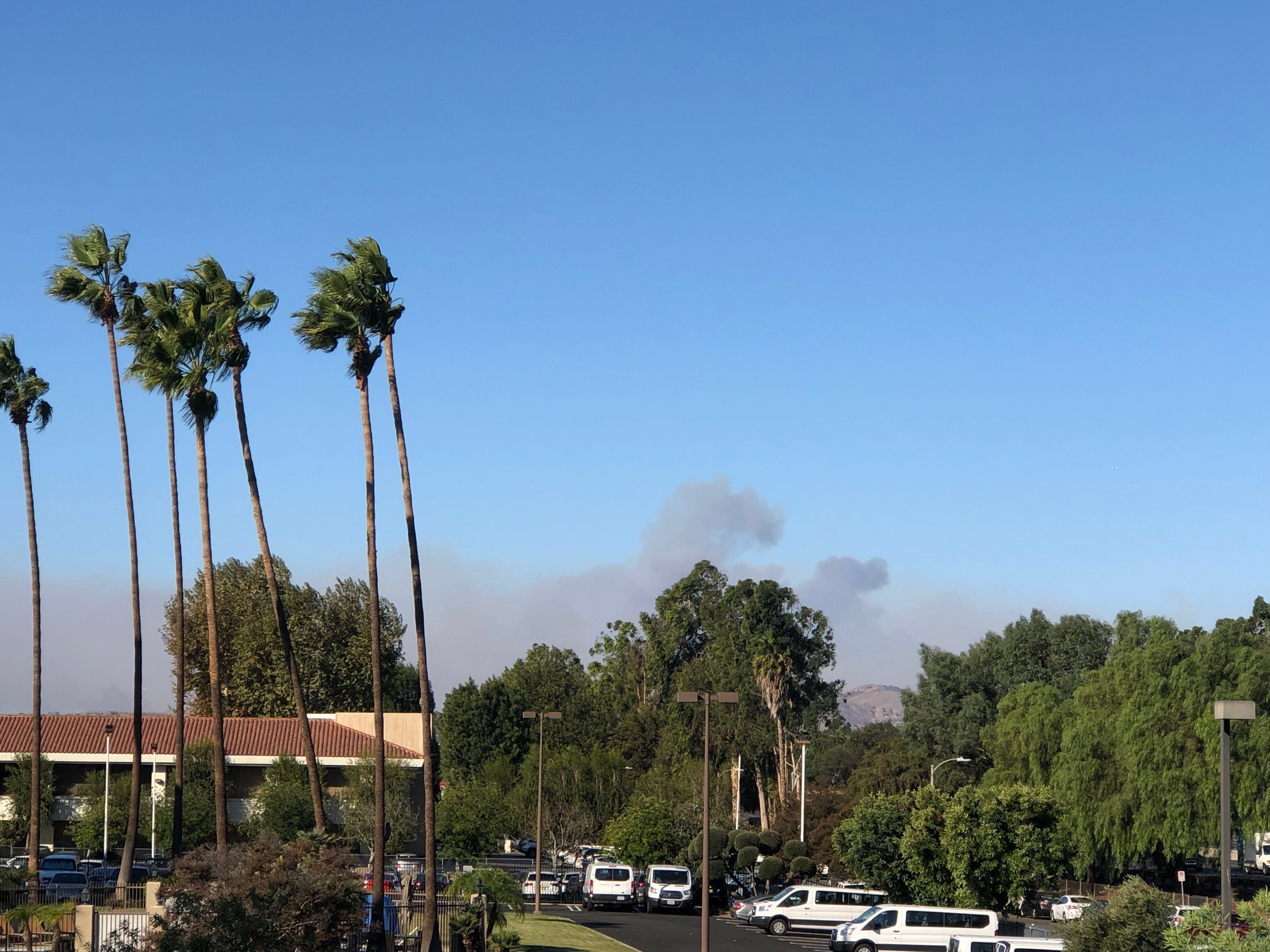
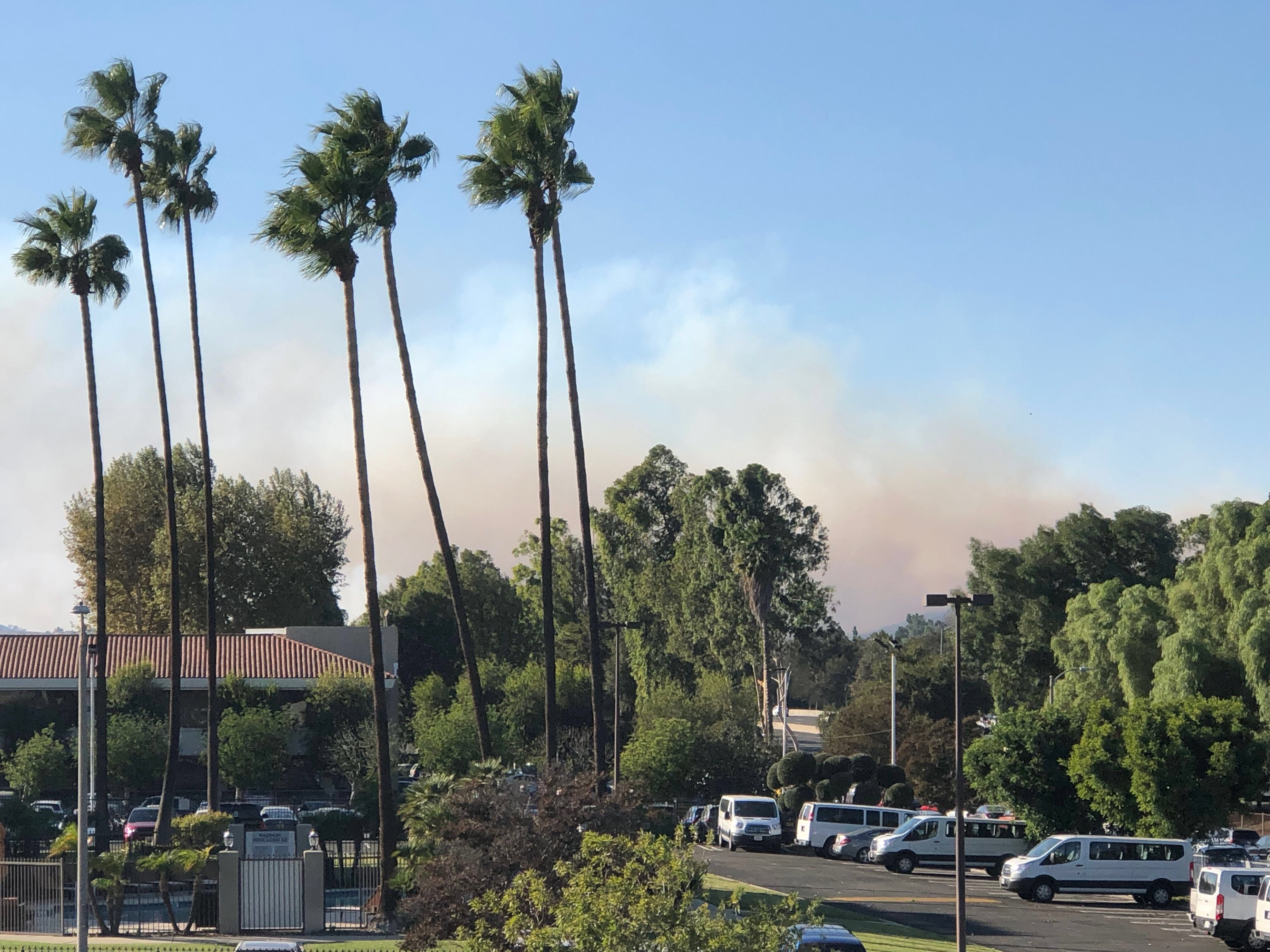
From two miles away, this is what we saw. Our house would be right about under that tallest column of smoke. Needless to say, we burned our way through the grocery list and hustled our way back home.

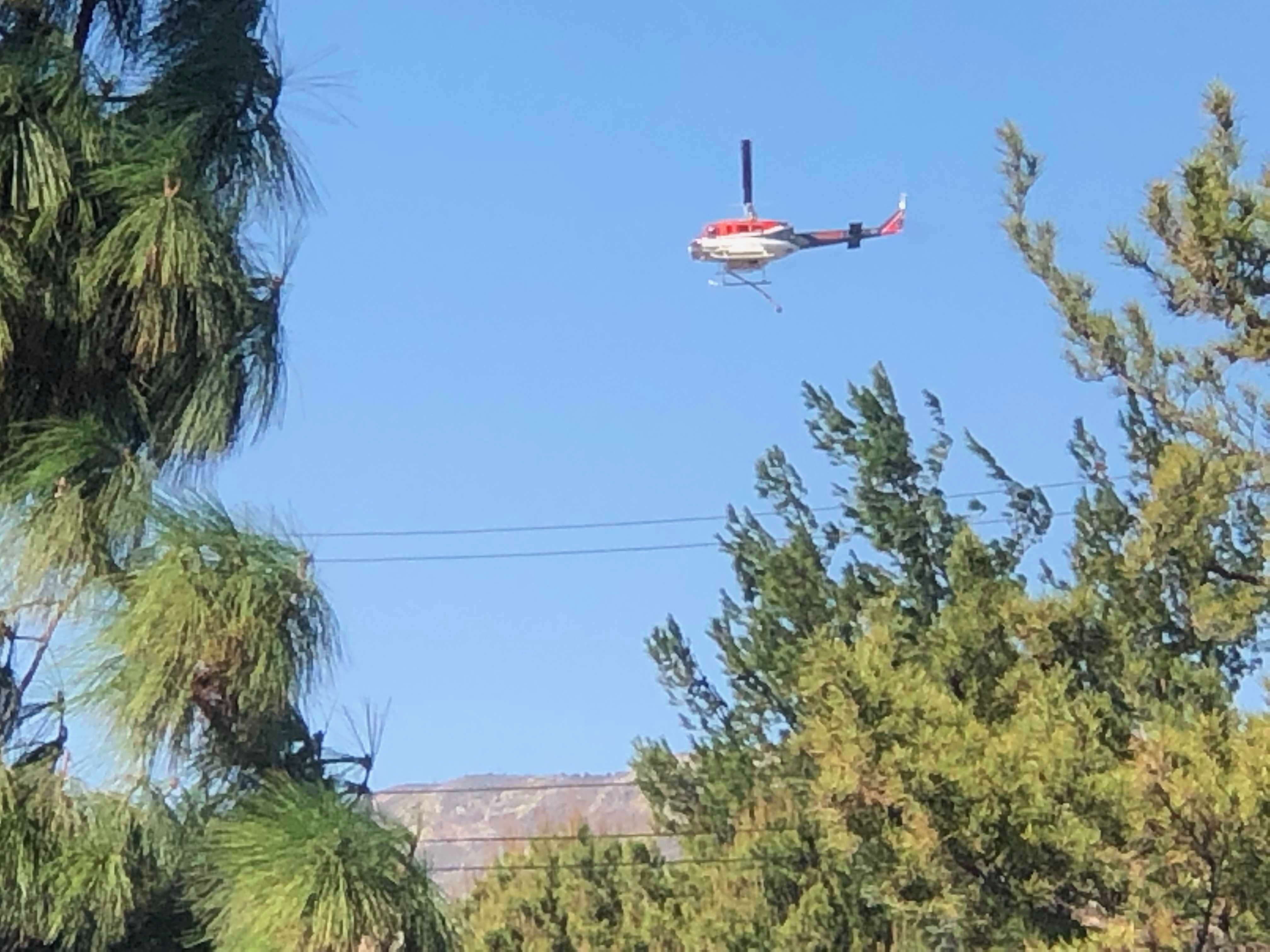
That flare up was a bit north of us, on the north side of Bell Canyon Drive, up by Roscoe, a mile or so away. By the time we got home there were several large aircraft called in to make repeated passes dropping Phos-Chek, the fire retardant with the red coloring which they use so the pilots can see where they’ve already sprayed on earlier passes. It was interesting to watch it live on television from the TV helicopter’s point of view from 6,000 feet while also watching them roar north up Valley Circle outside our front window. It’s also bizarre to see your house on television when they’re showing a disaster in progress.

After an hour or so that hot spot was out and I figured the excitement was over. They had hit it pretty hard and that Phos-Chek will last for a while.

I was wrong.

An hour later I started to hear helicopters again, low and fast. We had another flare up, this time over behind the baseball fields.

An hour later there was another flare up, this time with some pretty significant (i.e., “freakin’ huge!”) flames shooting up over one of the lower ridges down in Bell Canyon.

At least then the wind started dying down. We’re done, right?

I was wrong.

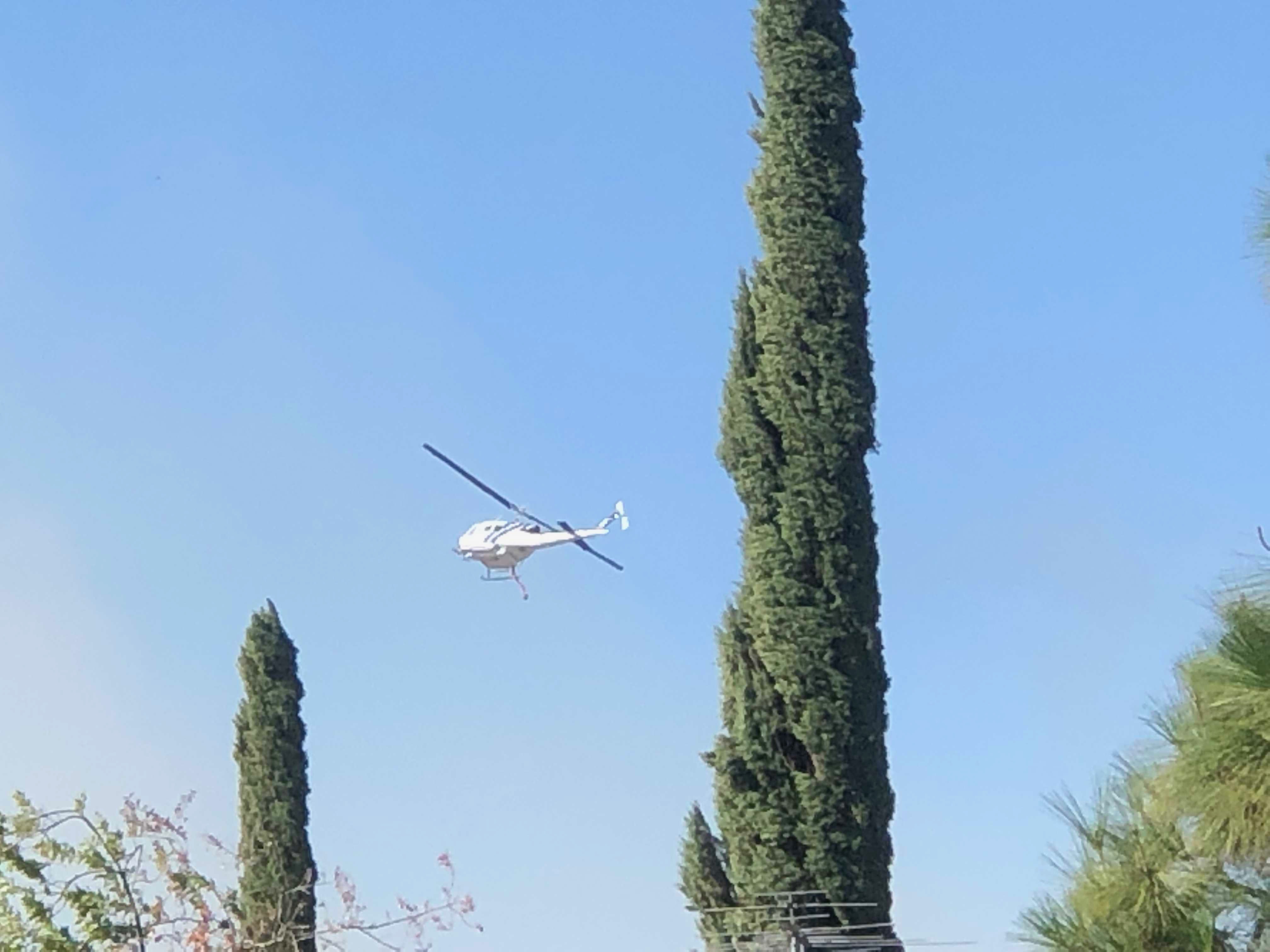
While we were okay for the moment, back to the south along the Calabasas western border and down to the ocean in Malibu things were getting extremely hot again. In between the two trees on the left you can see a dot which is a water-dropping DC-10 heading that way. (That’s an impressively HUGE plane to be getting down among them in the canyons while that heavy, that slow, and in that kind of turbulence!!)

So much for unpacking the cars. I was tired of being wrong. All of the areas on the west side of Valley Circle, which is less than a quarter mile away as the crow flies, are still shut off and evacuated with no one allowed back in. Until that evacuation that close to us gets lifted, we’re going to stay ready to bug out. Cars packed, face out of the driveway for a quick exit.

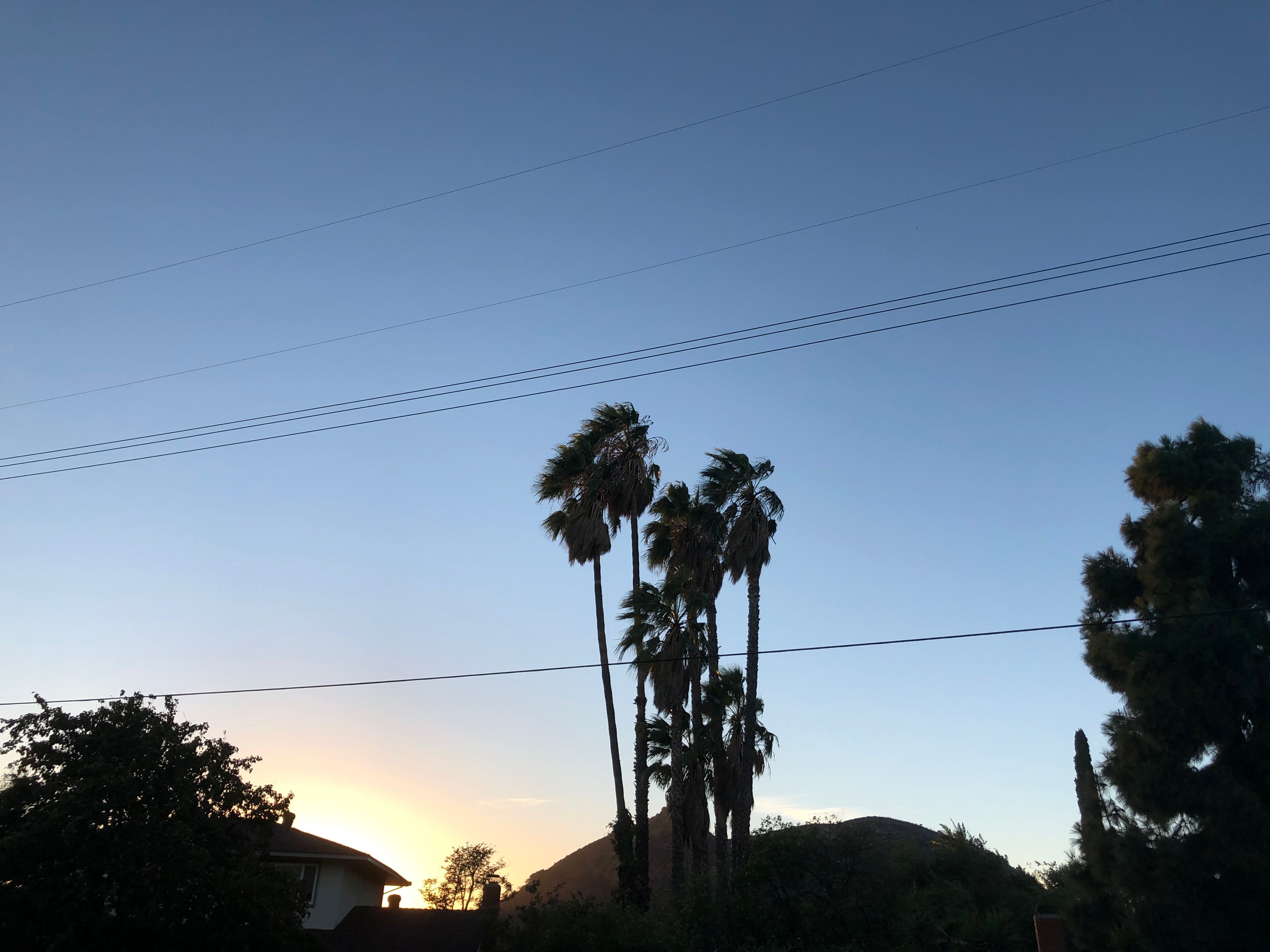
This evening the wind was still blowing (you can see the palm trees bending to the left) but it was again calm and smoke-free.

For now.

We’ll see how early tonight or tomorrow morning I’m proven wrong again.

Leave a comment

Filed under Disasters, Photography, Weather

Calm After The Ordeal

A certain measure of calm has returned after the last two days of anxiety and fire.

(It’s a panoramic image – click to enlarge to all of its glory!)

The winds stayed calm last night. That helped a lot, at least in our area. There were still some massive areas burning down toward the ocean, especially around Pepperdine University, but many areas saw the fire’s spread slowing or coming to a halt.

Thursday night, when we first started dealing with the Woolsey Fire it was at 2,000 acres. This morning it was at 37,000 acres with 0% containment. (Thus the anxiety and packing of cars and mandatory evacuations of 250,000 people.)

When we got up it was smoky. We couldn’t see any open flame where we were, but everything that burned yesterday was smoldering. By noon there were a couple of spots down where Victory, Vanowen, and Kittridge all end at the Ventura County line (maybe two miles south of us) that had lit off again, but the water-dropping helicopters were on them pretty quickly.

We’re not out of the woods yet. Late tonight through Sunday we’re supposed to have the winds kick back up, possibly as bad or worse than they were yesterday. Given that most all of the brush in open areas has already burned near here, I’m not too worried about it for us, but we’ll keep the cars loaded overnight just in case. If the winds get chaotic and blowing from different directions through the canyons, smoldering brush lights off again, embers start getting thrown into new open areas (like Chatsworth Reservoir, let’s say), things could get exciting again.

But it’s like wearing your seat belt. You never expect to have an accident (well, at least *I* don’t, YMMV) but unless you’re an idiot you always wear a seat belt. I don’t expect to have to bug out at this point. I consider it far less likely than it was 24 hours ago. But I would hate to hit that one-in-a-whole-bunch circumstance, need to bug out, and do it with just the clothes on our backs just hours after unloading the cars.

We’re fine. We’ll be fine. It was nice to have a calm day. Let’s have another one tomorrow.

You too! We all deserve a little bit of calm.


Leave a comment

Filed under Disasters, Panorama, Photography

Trial By Fire

It’s been a really, really long day.

For the longest time this afternoon and evening I thought that I might be writing this tonight (if I were able to write anything at all tonight) from a hotel or a Red Cross evacuation center.

I’m still at home and it’s now looking like there won’t be a need to evacuate tonight, but it’s been touch and go for hours. We’re still packed into two cars and ready to go in 60 seconds if we get the word.

I was up a couple hours early for a big, all-day work event – that was cancelled early due to many of the key people either having to evacuate last night out of Westlake Village, Thousand Oaks, or Agoura, or because they were up all night preparing to evacuate if necessary, or because they couldn’t get here either way due to the multiple massive freeway closures caused by the fires.

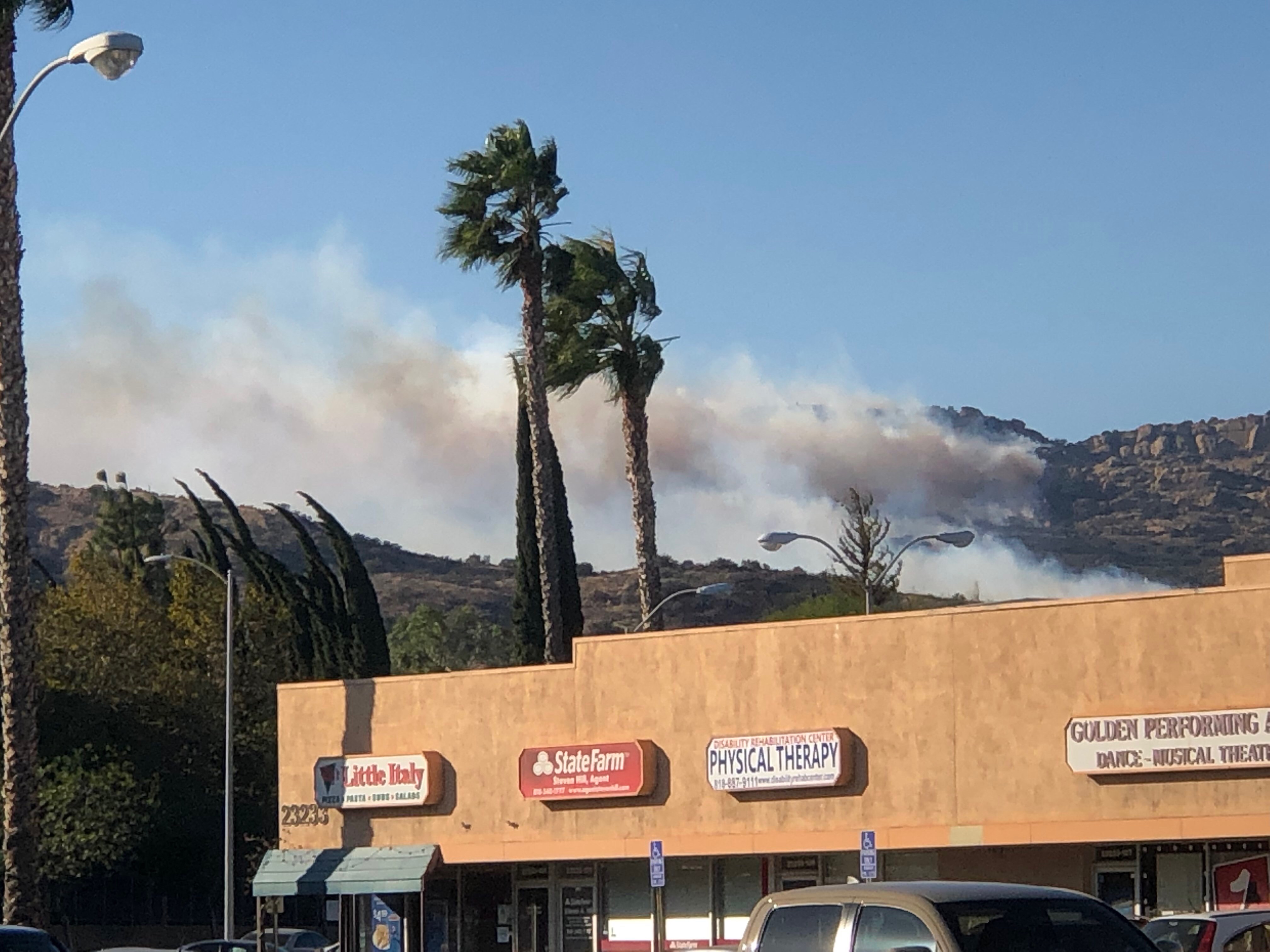
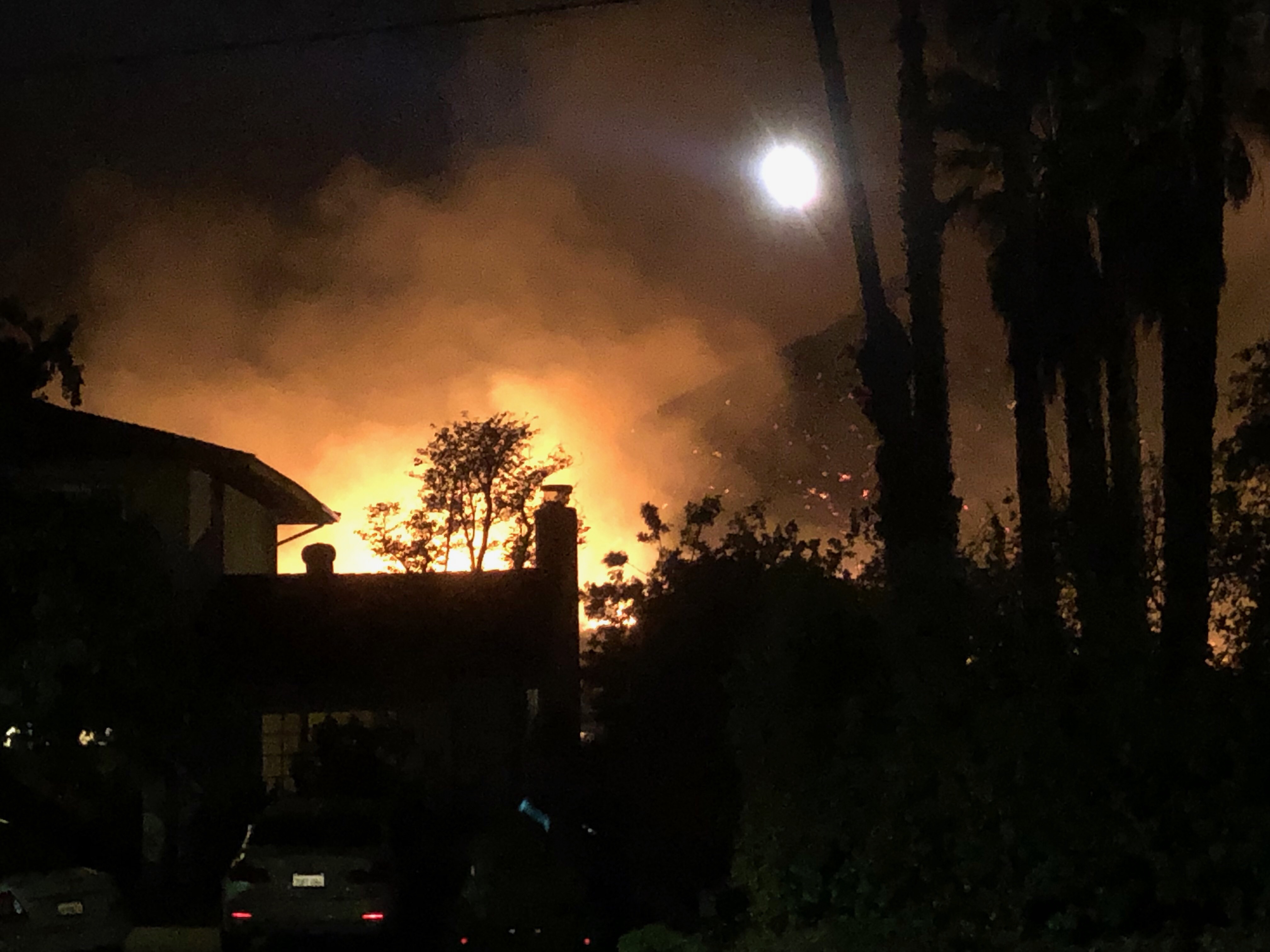
This was what that fire looked like when I first got up this morning, off in the distance, pyrocumulus clouds billowing up to 8,000 feet or more.

But from the office, the smoke rising up from the fires smoldering near our house was pretty benign.

By the middle of the afternoon, that had started to change. While everyone pretty much thought that the fire near us had died down and was almost done, the right combination of wind and terrain kicked it up and I needed to bail out of the office early and get home.

I couldn’t even get home by the shortest route, so ended up by the old house where for the first time I saw that the fire had crossed the ridge from Ventura County into LA County. This view shows the northern end of the ridge, up by Chatsworth, but it was the same for ten miles, all the way south to Calabasas.

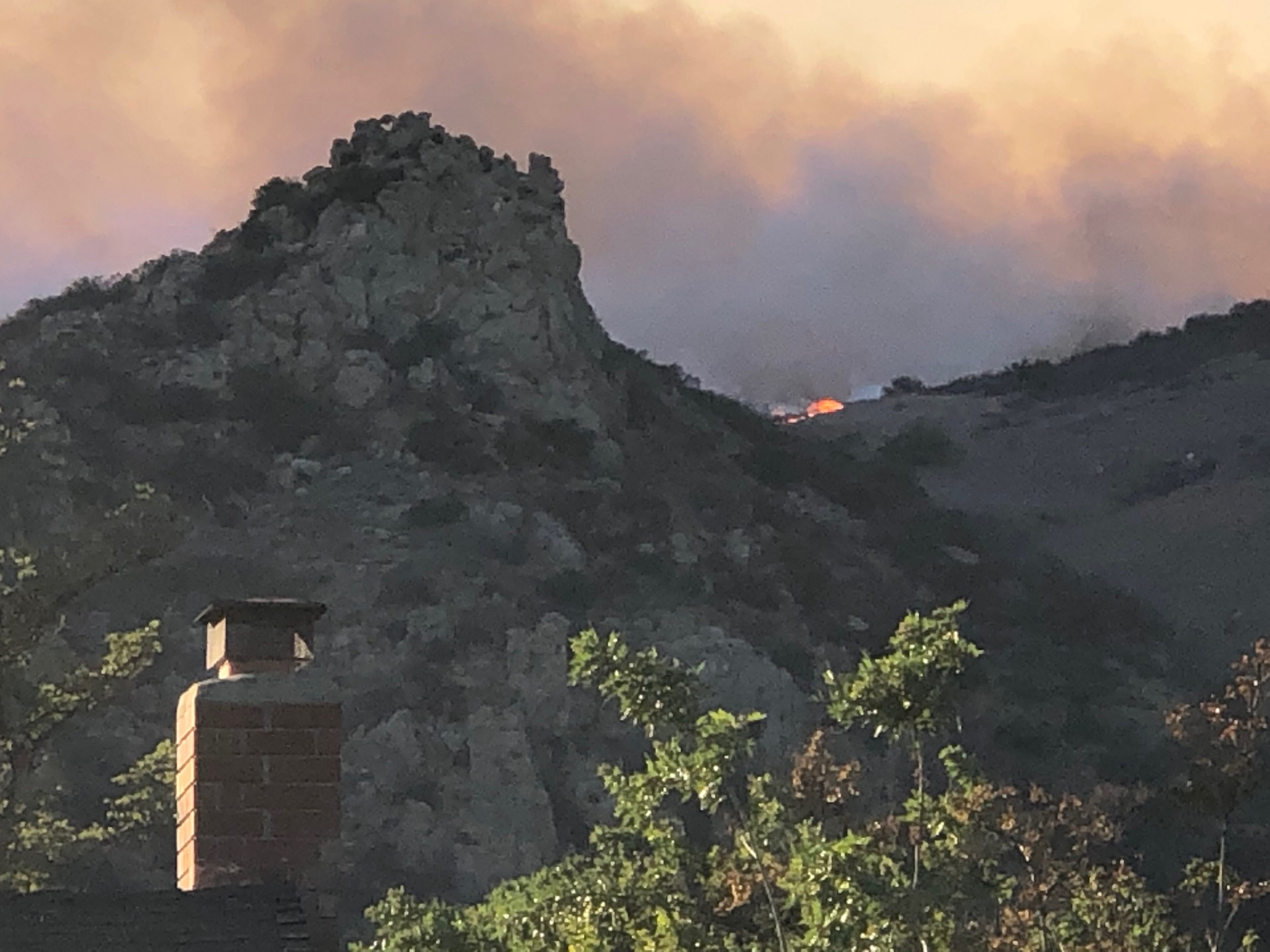
Remember how I said last night that I wouldn’t worry until I saw active flame coming over the ridge at Castle Peak? Here it is.

For the longest time I wasn’t too worried about it. It took a couple hours to burn from the top of the ridge down to here. At that rate it was never going to be a threat. I started loading up the cars with the valuables (photos, hard disks, overnight bags, important documents, etc) but figured it was just to get my exercise, not because we were going anywhere.

Then, about an hour before sunset, all hell broke loose. All along this ten-mile ridge line the fire just exploded.

The wind kicked up, the smoke started rising, and the flames started marching down the east flank of Castle Peak toward the homes at the bottom.

I was betting that the firefighters’ strategy was to let it burn like this as long as it was burning brush and open space. Then, when it gets to the houses, which should all be properly prepared with set back areas from the brush and defensible spaces all around, the fire gets hit hard and stopped in its tracks.

That’s pretty much what happened – here you can see the fire as it got to the base of the hill and the houses there, with a water-dropping helicopter above.

It’s a good thing that it worked. If the houses at the bottom of the hill had gone, a lot of embers and debris would have been thrown up into the air. The high winds would have pushed those embers out downwind into houses blocks away, starting new spot fires, with the pattern just repeating over and over. (Look at what happened last year in Northern California, or two days ago up by Chico, or a couple decades ago in Oakland for examples.) From those houses it’s about three blocks to Valley Circle – once the flames crossed Valley Circle it’s only three blocks up hill to us, and we all know how much flames love to climb up hill with a 45 mph wind pushing it!

So we had our two cars packed, on a hair trigger. Several of our neighbors found the point when their bug-out button gets pushed. I decided to stick it out.

And that’s worked. There are some hot spots out there along the fire lines tonight, but none of them are near us and shouldn’t be a threat. (Yes, I’m being selfish. I mean that it shouldn’t be a threat to my neighborhood. There are still some massive fires burning in Calabasas, Thousand Oaks, and Malibu. In particular, the Pepperdine University campus in Malibu is under a massive threat.)

Now the wicked winds have died down. I knew it even before I stopped noticing the wind – for the first time in this mess I can smell the smoke. Even though it was so close, less than a half mile, I haven’t smelled any smoke at all because of the ways the winds have been blowing . Not now. With no winds, the smoke just sits in the valley at the west end of the San Fernando Valley, starting to choke me.

So tonight I might sleep fully dressed and with one eye open and one ear listening for sirens and someone pounding on the door, but I will be sleeping at home.

And don’t worry, I *WILL* be able to sleep. I thought I was exhausted before this – I had no clue what real exhaustion was.

If you’re interested, you can probably catch live coverage on KTLA 5, CBS LA 2, or any other Los Angeles television station’s website. Or you can watch several Facebook Live posts that I put up today.


2 Comments

Filed under Disasters, Photography, Weather