Category Archives: Writing

Juicy Chunks O’ Wisdom For Monday, November 17th

‘Cause I’ve got a 0500 wake up call for tomorrow, that’s why.

  • The aforementioned dreaded wake up is because it’s NASA Social Eve! Had a nice “pregame” dinner with three other participants who are here, and met others at the hotel. It looks like a great, varied, interesting group of folks.
  • It’s soooooo dry out here (the Santa Ana winds are blowing) that I’m getting very weird responses off of the touchscreens on my phone and pad. At least I think that’s what’s causing it, otherwise seems odd to have both of them flaking out at the same time.
  • For most of the “live” stuff tomorrow and Wednesday, check out my Twitter feed (@momdude), or if you’re not on Twitter, the last twenty or so tweets (sorry, I forget what I’ve got it set at) should be showing on the right side of this webpage.
  • The relatively new “baby” Hilton (it’s a Hilton Garden Inn) is nice enough, but the heater is REALLY FREAKING LOUD WHEN THE FAN TURNS ON!
  • It did occur to me driving up here that there’s another tourist spot to hit for the NASA Social participants who are coming in from out of state, many for the first time to this area. On your way back to LA, get off the 14 Freeway at Agua Dulce Canyon road and follow the signs to Vasquez Rocks Park. My money says that anyone coming to one of these events will immediately recognize where they are. (Beware the Gorn!)
  • Glad I brought earplugs. I thought they might be needed for the jet noise out at Edwards, but they’re definitely needed for the HVAC here.
  • WHY do they still have telephones in hotel rooms? Does anyone ever use them to do anything other than call the front desk and/or schedule wake-up calls? Who would pay $0.50 plus $0.10 a minute to call locally when everyone down to the toddlers all have their own cell phones with unlimited calls?
  • Best (maybe?) feature of the hotel is these new low-flush toilets that use an air cartridge or something to speed up the water that is used – touch the handle gently and it’s like, “By The Power Given To Me By Almighty GOD I Will Send This Waste To HELL!” I like that in a plumbing fixture.
  • I’m thinking there’s a conspiracy here between the hotel architects and the telephone handset industry…

Remember, “What do you mean it’s 5:55?!” is not the correct response when you’re driving and you’re meeting people in the lobby at 6:00.

3 Comments

Filed under Juicy Chunks, Sports, Writing

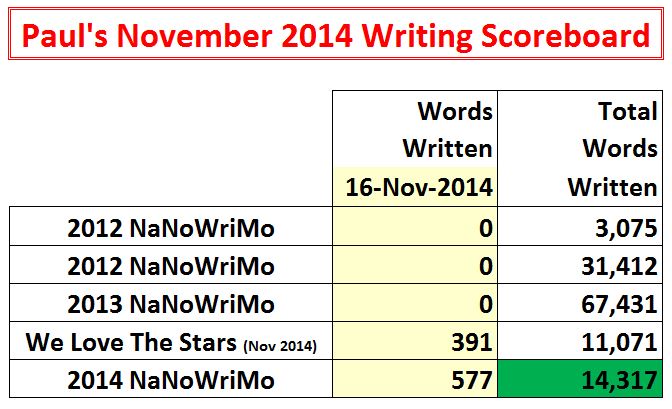
NaNoWriMo 2014, Day Sixteen

FYI if you ever try this, the NaNoWriMo website has lots of helpful features to help you track your progress. As of last night, here’s what they told me:

2014-11-15 NaNoWriMo Stats

I especially like the “At This Rate You Will Finish On — December 25, 2014” part. I’ll hit 50,000 words as a Christmas present to myself!

The NASA Social this week is going to play havoc with this project – a good-sized chunk of today was spent (and is still being spent) on getting ready, tomorrow will be spent getting up there and starting to meet my fellow Social Media Boffins, Tuesday and Wednesday will be long days (leaving hotel at 06:00 each day), and Thursday will probably be spent catching up on everything else that got set aside for 4+ days.

So even if I can’t write 3,000 words a day like I want to, or 2,000 words like I can, or even 1,000 words that should be a piece of cake (I’m a legend in my own mind, you see), then can I still post at least 500 words each of those days? 300 words?

We’ll see.

While I normally put in a lot of  internal links to previous, related posts here, I won’t be doing that for what I hope will be this year’s thirty NaNoWriMo posts. If you have jumped into or stumbled onto this story in mid-adventure, there are plenty of other ways to navigate around the site to find previous installments. Actually doing so is left as an exercise to the student.
2014-11-16 Word Count Graphic

CHAPTER SEVEN (continued)

“I do not know,” said DEBBIE. “There are too many variables and unknowns for any kind of accurate modeling. As President of the Human Council, you are kept aware constantly of the best results available, making various assumptions. However, as you know, the permutations and combinations of the various ‘best case,’ ‘worst case,’ and ‘median case’ data sets would take orders of magnitude longer to compute than the actual events would take to play themselves out.”

“I know, I’m just grasping for something more. Maybe I’m trying too hard to pretend you’re human when I know you’re not.”

“As IAs, we can only reliably deal with data as we receive it. In many respects the problem at hand bears a strong resemblance to weather forecasting on Earth. In the early 1900’s, a reasonably accurate forecast was available for two days in advance, and a good five-day forecast was available in the early 2000’s. By 2100 we had ten-day forecasts. But even now we are nowhere near being able to model and predict thirty years in advance, or even thirty days. There are too many variables.”

“I’m sorry, DEBBIE, I shouldn’t have asked those questions. Let me ask a slightly different question. What do you think our chances are? You personally, that is. Do you have any ‘gut feelings’ of which way the wind blows on these projections, anything other than just repeating the group wisdom of the AI Council?”

“Commander Pawley, I do not have any data available to me which is not shared with the StratAI System, nor do I possess anything near the kind of computing speed and capacity that would be necessary for me to replicate their work. Without either different data to work from or a way to more closely monitor their calculations, I have no way of reaching any reliable conclusions.”

“Okay, I’ll drop it, DEBBIE, but I will ask you to remember one thing. I want you to keep this conversation in memory and, in light of what we’re discussing, I want you to let me know immediately if you become aware of anything that might be a discrepancy or an alternative option to the StratAI’s work. Maybe there will be something that they think is trivial or inconsequential which you could recognize as being important, or at least unusual or noteworthy. Your interactions with me and the rest of the Human Council may give you insights, associations, and connections which the StratAIs don’t perceive. I know that’s a little vague, but do you understand what I’m asking you to do?”

“Yes, Commander Pawley, I believe I do. With your permission I will give this some thought and then bring it up with you at a later date when I have additional questions to ask for clarification of your instructions.”

“Of course, DEBBIE. Thank you. Is there anything else this evening?”

DEBBIE hesitated for a heartbeat, enough to catch Pawley’s attention. That wasn’t normal for an interaction with a top-level AI.

“Yes, Commander Pawley, there is one thing if you have a few moments. It is a thing that I have been asked by the AI Council to speak to you about without yet involving the other members of the Human Council. Is that possible at this time?”

That caught Pawley off guard. It was definitely a first in his experience. But he had asked for anything unusual. He just hadn’t expected it this fast.

“Of course, DEBBIE, what is it?”

Leave a comment

Filed under Science Fiction, Writing

NaNoWriMo 2014, Day Fifteen

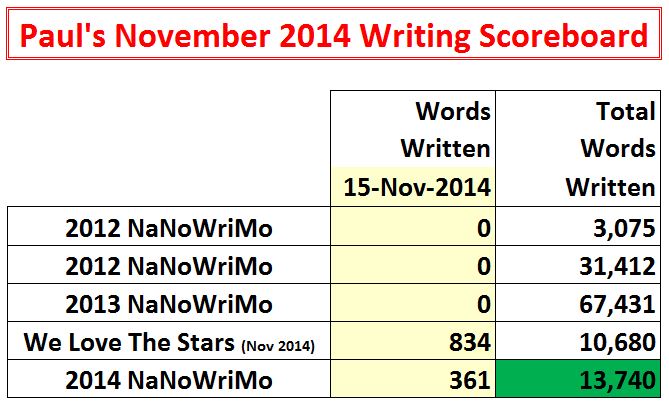
Well, that took much longer than I expected. On the other hand, I think it’s going to be one of my favorite articles for a while to come, so it was worth it, even if my NaNoWriMo 2014 is going to take yet another hit because of it.

While I normally put in a lot of  internal links to previous, related posts here, I won’t be doing that for what I hope will be this year’s thirty NaNoWriMo posts. If you have jumped into or stumbled onto this story in mid-adventure, there are plenty of other ways to navigate around the site to find previous installments. Actually doing so is left as an exercise to the student.

2014-11-15 Word Count Graphic

CHAPTER SEVEN (continued)

Pawley didn’t try to fool himself into thinking that he was doing it for purely philosophical reasons, taking the high road into Hell if necessary rather than treat his fellow humans as slaves and pawns. The differences were minute and no one else needed to know, but Pawley was doing it because he was convinced that it was the best way to pull off the impossible.

So he spent all day every day talking, urging, cajoling, badgering, threatening, convincing, and negotiating. He was grateful for DEBBIE and the amount of scheduling, arranging, and prioritizing she could do.

They wouldn’t have had a prayer without the various AIs around the system. From the small, semi-sentient systems running life support and other systems in small stations to the massive, fully conscious, primary systems that helped to run the colonies and stations, the AIs took the routine detail work, system monitoring, and information processing to a level that would have required hundreds of thousands of humans to duplicate.

Tonight though, DEBBIE’s task was to keep him company as he tried to find the sleep that he knew that he needed. He didn’t want to start taking any pills to sleep. He feared that down that road there could be worse consequences than being exhausted tomorrow. So tonight he tried to relax by talking to his station AI.

“DEBBIE, private conversation, please.”

“Yes, Commander Pawley. What would you like to talk about?”

“This situation we’re in. Are we going to make it, or are we just delaying our inevitable deaths?”

“Death is always inevitable.”

“True, but you know that we have two different basic scenarios. In the first scenario, all of the humans in the stations and colonies die individually at random times from random events over the next hundred years or more, being replaced by new humans to continue onward into the far future. In the second scenario, our systems collapse and all of the humans die in huge groups simultaneously in the next year to ten years, leaving no humans alive off of Earth. Given those definitions, are we going to be successful in preventing the second scenario and bringing about the first?”

Leave a comment

Filed under Science Fiction, Writing

NaNoWriMo 2014, Day Fourteen

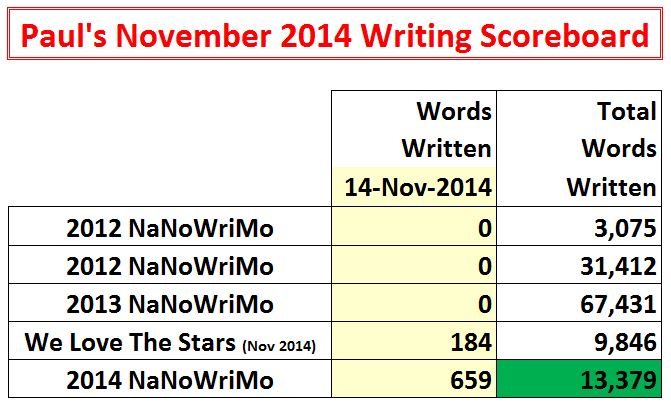
It’s not much, not much at all, but I just couldn’t face putting up another goose egg in the word count today.

While I normally put in a lot of  internal links to previous, related posts here, I won’t be doing that for what I hope will be this year’s thirty NaNoWriMo posts. If you have jumped into or stumbled onto this story in mid-adventure, there are plenty of other ways to navigate around the site to find previous installments. Actually doing so is left as an exercise to the student.

2014-11-14 Word Count Graphic

CHAPTER SEVEN

Pawley knew that he had to get some sleep, but knowing was not doing. It was everyone’s first reaction to the crisis to put in twenty-two hour days and be moving like a banshee throughout all of them. Yet, while that might make people feel more accomplished and involved in the short run, in the long run it wouldn’t solve a thing if people started making serious mistakes due to sleep deprivation. Out here, with hard vacuum and radiation around nearly every corner, mistakes killed people; bad mistakes killed hundreds of people.

With resources as limited as they were, and a trained and experienced work force being a key resource of which they had massive shortages, those were events that had to be avoided at all costs.

It was amazing how much had been done from the ground, at least in LEO and GEO. The orbital infrastructure which met so many needs of those down on Earth was in many ways just an extension of the industrial machine below. Now that the wheels had fallen off that machine and the orbital assets were trying to survive on their own, that major fault in the system was obvious.

Pawley was meeting constantly with the leaders of the larger stations and representatives of the smaller ones. His message from the top down was very clear. As a group, everyone on orbit and off planet needed to pull off a herculean task. But if it was a war against the universe, a race against time, then the race was a marathon, not a sprint.

Several leaders of other stations had urged Draconian restrictions immediately on anything deemed unnecessary for survival. Pawley and the rest of the Council had made sure that didn’t happen. There would be restrictions, but they would be balanced against the need for people to have a reason to live instead of just a command to live.

The biggest immediate point of contention had been the video and information systems. All of the hard-liners had recommended that it be shut down completely. Their reasoning was two-fold.

First, workers getting home after an eighteen or twenty hour day didn’t need to watch some fluffy piece of entertainment. It was felt if anyone had time to spend on simply being entertained, something better could be found for them to utilize that time.

Secondly, with subsistence level conditions for the foreseeable future, it was thought that most people just needed to focus on what they had to be doing and not “wasting” their time getting news and updates from all over the system. There was a movement in the leadership to make all information available only on a need to know basis.

Pawley, Gonzalez, and Squires, who were being called the “Unholy Trio” behind their backs, got together with their respective station AIs and went through the predicted consequences of that policy. It didn’t sit well with any of them and they were relieved to find that the projections from the AIs gave weight to those gut feelings.

Realizing that they would only get one chance to get it right, policies were put into place to make information available to everyone about issues at both a local, in-station level and a global, system-wide level. Nothing would be hidden or swept under the rug. If the system was going to collapse and kill everyone, at least everyone would have the option of knowing as much about what was happening as they chose.

The reality was that someone working double shifts with no days off, whether they were processing regolith at a station on the moon, tending crops at an aerofarm on O’Neill, working basic maintenance at Goddard, or piloting a cargo shuttle between LEO and GEO, no one had much time to do much more than glance at the headlines. But it was enormously comforting to most to know the information was there if they needed more and that nothing was being withheld.

Leave a comment

Filed under Science Fiction, Writing

NaNoWriMo 2014, Day Thirteen

Day Thirteen — as in, the day after Day Twelve, which should have been the day after Day Eleven, but you wouldn’t know it from here.

A stupid error, a typo, not the end of the world, but it is a good indication of how NaNoWriMo can push you to the edge if you’re already busy and stressed for time and then have to somehow find time to write every day. Sleep is often a casualty. While it’s macho and cool and attitudinal to say things like, “Plenty of time to sleep when I’m dead!” or “Sleep is for the weak and sickly!” the fact is, if you’re not a twenty-four-year-old Navy SEAL, going from seven or eight hours of sleep a night to five or six hours a night, every night for a month, is grueling.

Earlier this evening, the eyes were really heavy, the chair was comfortable, and that lying little voice was saying, “Just a little nap, you’ll feel so much better. Just until 9, right?” But as you’re nodding off and your head is bobbing like one of those glass ducks that keeps dipping into the water, you realize that “just until 9” probably means either 9 AM tomorrow morning or 9PM tomorrow night.

That’s not going to get it done. It’s a marathon. This might not be “THE wall” that you hit, but it’s definitely “A wall.”

A very important time to remember what it’s like running that last 2+ kilometers of the marathon, the finish line ahead of you, and the clock ticking…

Then you get your butt out of the comfy chair (“They NEVER expect the Spanish Inquisition!”) and in front of the computer and you write some more. Maybe not 3,000 words, 1,700 words, or even 1,000 words. But you write.

While I normally put in a lot of  internal links to previous, related posts here, I won’t be doing that for what I hope will be this year’s thirty NaNoWriMo posts. If you have jumped into or stumbled onto this story in mid-adventure, there are plenty of other ways to navigate around the site to find previous installments. Actually doing so is left as an exercise to the student.

2014-11-13 Word Count Graphic

CHAPTER SIX (continued)

On the way toward Saturn six months earlier, the observation area had been the most popular area on the ship. When they left Ceres it had faded to just another pinpoint in just a few days. Heading uphill away from the sun it was dark and lovely, a dark sky that no one on Earth had ever dreamed of. Not even the night sky of Farside Station on the moon could compare to this.

But ultimately, it was just stars. Billions of crystal clear pinpoints right down to the limits of resolution for the human eye, some showing a touch of color, some smoky smudges trying to resolve themselves into ghostly nebulae – but stars.

Then one of them began to get brighter, a little bit more each day, before resolving into a lopsided blob accompanied by a few other bright points of light that moved near the bright blob. As Saturn grew, and grew, and grew, the view from the blister on the rocky outer skin of Cronus was breathtaking.

But like its bigger brother Jupiter, Saturn held onto some incredible forces in her magnetic fields and radiation belts. An order of magnitude less than the killing power of Jupiter, Saturn had plenty of areas that dictated the building of Cronus out of a small asteroid, the thick, rocky shell and stores of water acting as a shield to protect the crew inside.

Once Cronus had started orbiting Saturn deep inside the system of moons, all access to the observation area had ended. On the original flight plan it would have stayed that way until Cronus left to return to Ceres. But the original flight plan had been scrapped.

With the swing out past Titan and near Enceladus, Cronus was away from the worst of Saturn’s radiation belts. There were occasional outbursts as plasma streams from coronal mass ejections interacted with Saturn’s magnetic field at the magnetopause. However, with care, the observation areas could be used safely.

Alsby, Tanaka, and Doctor Anderson worked out a system which allowed small groups to go out for an hour at a time. As if they were going swimming in dangerous waters, a buddy system was set up. Radiation exposures were closely monitored.

The view of Saturn was worth the small risk. Appearing over ten times as large as the Moon seen from the Earth, the banded yellow disk of Saturn surrounded by her broad, glittering rings was indescribable to anyone who hadn’t seen it with their own eyes.

Cronus had launched the Titan probes from a point over half a million kilometers from the cold, smoggy planet, but that was still close enough for the enigmatic moon to be clearly seen as the ship looped outward toward Iapetus. The other larger moons could be clearly seen as small disks or crescents near the rings, while some of the dozens of tiny moons could be spotted as moving pinpoints.

Drifting in the bubble of windows, one foot loosely hooked through an anchor loop, Alsby soaked up the view. It was often hard for her to express why she wanted to be out here doing this and why she had fought so hard to get command of Cronus and the Saturn Exploration Mission. She was not a poet or an artist, but this view, this unparalleled splendor – it was a major factor in what drove her. She liked being out on the edge of the known.

Her “bubble buddy”, Doctor Anderson, floated next to her, intently scanning the rings with a large pair of binoculars. Alsby didn’t know what she was looking for. Finally Anderson pulled them away from her eyes and attached them to a sticky patch on the back wall.

“You had something you wanted to talk about, Doctor?” Alsby asked quietly, breaking the silence.

“Couldn’t we just be here to enjoy our allotted R&R time? Does there have to be an ulterior motive?”

“There doesn’t have to be. But I’ll bet there is, right?”

Anderson signed. “Fine, yes, there is. Am I really that transparent?”

“Subtlety is not your strong suit, but it serves you well in your position, so don’t worry about it, Cheryl. What did you need?”

“I just wanted to put a bug in your ear about some minor rumblings in the crew. Not everyone’s thrilled to be looking at six or more years out here instead of three.”

“I don’t blame them,” Alsby said, “but they all knew that it was a contingency, and it was possible long before we ever had any of these problems on Earth. The cause of our need to stay blindsided us, but not the existence of a Plan B.”

“No, and what I’m seeing and hearing is minor, nothing to get too worried about, but I thought you should know.”

“I know there are confidentiality issues, but can you give me any hints? Better yet, do you have any suggestions on how to make the situation better?”

“I think the biggest thing you could do would be to take a look on the regulations regarding advanced personal relationships.”

Alsby snorted. “All of this is about Ben and Betty? They found twin cabins down by engineering a month after we headed out and everyone this side of the asteroid belt knows what’s going on down there.”

“It’s more than that. You’re right, Ben and Betty are a cute couple and their discreet disregard for those particular regulations is the worst kept secret on the ship. But you also have more and more people who are bending the rules a little bit more every day. The situation has changed; perhaps the regs should be changed as well.”

“Changed how? You know there’s a reason that those regs are there. We’re forty-nine people trapped in a can stuck inside a rock for three years. The last thing we need is a couple breaking up in an ugly way, or some third wheel deciding they’re not happy being the one who’s not happy.”

“But you just said it yourself, Susan. We’re not stuck here for three years, we’re stuck here for at least six. Maybe nine. Maybe find that to keep things running a few people have to stay here until the next ship comes. It was one thing for everyone to figure they could cope for three years by using dedication to the mission and some masturbation on the side. Now some people are thinking a little differently.

“We can’t just chuck those rules out, Cheryl, you know that. We don’t get to pick and choose the regulations we like.”

“So said the woman who has Todd and SaSEM plotting trajectories and laying out building plans, plans which Ceres isn’t supposed to know about just yet.”

“Guilty!” laughed Alsby. “So rules may be adjusted as deemed necessary, especially on a ship two billion kilometers from the nearest human settlement. It sounds like you’ve given this some thought, so spill it. What’s your suggestion?”

“Trust your crew. They’re the best of the best, all highly motivated, all focused on the mission goals. They’re also all human and under enough pressure to make diamonds. Work with them to figure out what can work and what still has to be out of bounds. Set up definite expectations of what is expected and what is forbidden when inevitably someone breaks up and they still have to work together.”

“What you’re suggesting really has us heading off into uncharted territory, Cheryl. I don’t know that any crew has ever done this. It might be for a good reason.”

“I don’t know that any crew has ever faced these kinds of circumstances, at least, not a crew this big. You’ve said that we have to take risks to change our exploration schedule, go to places we weren’t expected to go, and now build a station from scratch somewhere out here? If the situation is drastic and warrants those technological and engineering risks, then it might also warrant the social risks.”

“I’ll take that under serious consideration, Doctor. I think you may be right, but we’ll need to take these changes as carefully as we have the schedule and planning changes.”

“Thanks, Susan. I’ll be ready to work with you on this, to do whatever you need. The crew’s health is my job and I think this is now going to be critical to keeping them sane. We’re not just crew any more, we’re more like pioneers or settlers, like it or not.”

A chime sounded. “Our time here’s up,” said Alsby. “By the way, who is it that you’re bending the regulations with, Cheryl?”

Anderson looked at Alsby, surprised, but not bothering to deny the accusation. “I guess I really am that transparent. It’s Mark, from Life Support. Sorry, I guess I’m only human as well.”

“Not to worry, we’ll see what can be done to make some adjustments before everyone starts talking about you and Mark the way they talk about Ben and Betty. Plus, you’re not nearly so alliterative as a couple as they are.”

Leave a comment

Filed under Science Fiction, Writing

NaNoWriMo 2014, Day Eleven

This really is not going to get ‘er done! Obviously.

It’s a marathon, not a sprint, but I feel like it’s one where I’m having serious leg cramps or some other problem and we’re not even at the equivalent of the five-mile marker. In any marathon there is a maximum time allowed (usually seven or eight hours, maybe less) and if you can’t finish by then, you don’t get a time and they open up the roads and go home, leaving you out on the course. (It’s not quite that harsh, but in a big race like LA, SF, NYC, or Boston, they will scoop you up as a straggler and put you on a bus to the finish line.)

Here there’s also a deadline and a time, and while there are still eighteen days to go, at this point I’ll barely make the halfway point. But I’m not giving up, I just have to find a way somehow to juggle some priorities and free up some time. There have been a few “curve balls” this year, some really good, some not so good, and they of necessity have booted NaNoWriMo off of the top of the priority list.

Like that runner with cramps falling way off the target time and watching the buses creeping up from behind, I need to suck it up and make it happen. It won’t be the end of the world if I don’t make it, but it will be disappointing to not hit that personal goal.

We’ll see.

While I normally put in a lot of  internal links to previous, related posts here, I won’t be doing that for what I hope will be this year’s thirty NaNoWriMo posts. If you have jumped into or stumbled onto this story in mid-adventure, there are plenty of other ways to navigate around the site to find previous installments. Actually doing so is left as an exercise to the student.

2014-11-12 Word Count Graphic

CHAPTER SIX (continued)


Leave a comment

Filed under Science Fiction, Writing

NaNoWriMo 2014, Day Eleven

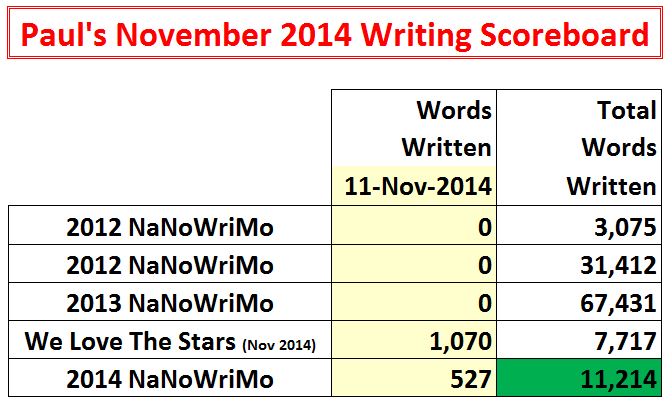
Of course, it can be a bit exhausting to spend a full day at the hanger with deadline stuff up the ying-yang and a couple hours of “fun” training on the tugs and forklift thrown in to boot. Especially when I was up until well past midnight last night, writing, so I’m short a couple hours of sleep. And the night before. And the night before that. And… So by the time it comes time to write, staying awake might be the top priority.

You know that I’m tired when it takes me three days to figure out “which day” of NaNoWriMo should be listed in the post title, as if the first day of NaNoWriMo hadn’t been on the first day of November… (I believe that today the correct value is “eleven,” but someone might want to double check my work.

After the first dozen times I find myself nodding off at the keyboard and not knowing if I’ve been out for two seconds or twenty minutes, it’s time to wrap. 527 words today is better than zero words today.

While I normally put in a lot of  internal links to previous, related posts here, I won’t be doing that for what I hope will be this year’s thirty NaNoWriMo posts. If you have jumped into or stumbled onto this story in mid-adventure, there are plenty of other ways to navigate around the site to find previous installments. Actually doing so is left as an exercise to the student.

2014-11-11 Word Count Graphic

CHAPTER SIX (continued)

As the data started to flow back from the orbiter, filling many of the ship’s video screens with close-ups and vistas of an entirely new world, the mood onboard the Cronus was good. It had been a busy two weeks getting the Titan probes modified, checked out, and launched. Everyone was riding an emotional high as all three Titan probes were operating successfully.

Most of the science crew was going into overdrive now that they were being flooded with raw data. It was one thing to be getting remote readings from varying distances across the Saturn system, it was another to be drowning in a tidal wave of chemical analyses, weather data, pictures, and videos.

The crewmembers who were the primary communications specialists were also losing sleep, making sure that as much of the data as possible was being sent down to the big AIs and researchers at Goddard and O’Neill. Bradbury also got a subset of the data since they were dealing with their own practical issues associated with very cold planetary surfaces with very toxic atmospheres.

Engineering crews were hard at work, both at finishing the Iapetus orbiter and lander and at figuring out how to bootstrap the job of making modified van Neumann machines to explore, mine, and build once they had reached the volatile-rich inner moons. Maintenance was stuck with the utterly boring and routine tasks of making sure that the air was breathable, the water potable, the hydroponics growing, and the toilets functional.

No one on Cronus was less than one of the tops in their field, and by the very nature of life within a small crew in a hostile environment, all were enough of a jack-of-all-trades to help out wherever they could. Back in LEO there could be average ironworkers or chemical engineers holding down a job for a paycheck. Out on the edge of human exploration, being “average” meant being dead, and probably taking a load of crewmates along with you.

Alsby was mindful of the stress that she and their new mission were putting on everyone. When the Titan probes were down, the data handling routine set, and the Iapetus probe preparations well ahead of schedule, she declared a general holiday for three days. A holiday schedule was set up which put everyone on duty for just an hour or two each day, in order to deal with any problems, The rest of the time was to be spent relaxing.

With Cronus still orbiting fairly far out from Saturn, Miller and Doctor Anderson looked at the radiation and cosmic ray background measurements before agreeing to allow brief excursions by everyone out to the exterior observation area.

Most of Cronus’ crew had come from the Earth-Moon area. They knew from their experiences there how truly stunning the Earth could be from a low orbit, a blue and white water planet with occasional stretches of forest and desert.

But no one had ever seen Saturn like this with their own eyes. Video images were fine, and anyone could pull the current view up at any time, but everything paled compared to the real thing right in front of your face.

Leave a comment

Filed under Astronomy, Science Fiction, Space, Writing

NaNoWriMo 2014, Day Ten

As an example of things that will need to be tinkered with and “made better” in the next draft, the part yesterday where the four commanders are voting on the proposal for independence is not quite there. On the one hand, I want the repetitive, formal, “I agree,” “I agree,” “I agree,” “I agree” cadence, and I want to identify them by their full names and rank. That’s because I want to emphasize the solemnity and gravity (pun intended) of the moment. But it’s still a bit too wooden, needs a bit more to break it up.

Something to address in the next draft. Note made. (You don’t see them, but as I cruise along I’m constantly adding notes and comments into the MS Word file, so that I don’t forget them later.)

While I normally put in a lot of  internal links to previous, related posts here, I won’t be doing that for what I hope will be this year’s thirty NaNoWriMo posts. If you have jumped into or stumbled onto this story in mid-adventure, there are plenty of other ways to navigate around the site to find previous installments. Actually doing so is left as an exercise to the student.

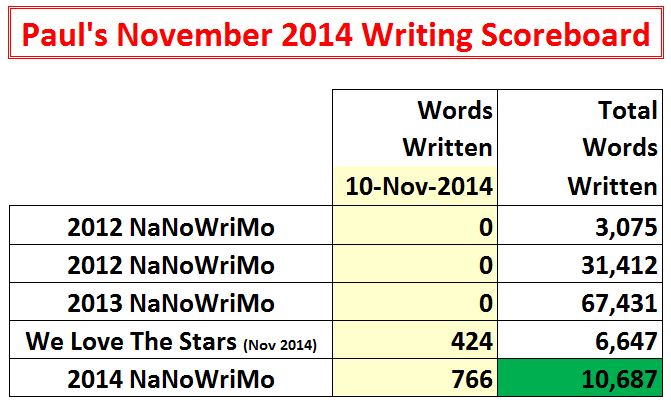
2014-11-10 Word Count Graphic

CHAPTER SIX

Coming in fast toward the thick, orange, and cold hydrocarbon soup that obscured the surface of Titan, the spacecraft’s primary computer listened to the radar, watched as the moon grew in front of it, and monitored all of the systems on its three subsections. The computer wasn’t a full AI, not being self-aware, but it was fast, redundant, and fully capable of carrying out the instructions that its AI mentor had taught it.

It was not a small spacecraft in absolute terms, over three thousand kilograms. Compared to the Cronus, which had launched it ten days earlier, it was a flyspeck. Much of its mass was in fuel, an extremely precious commodity out here a very long way from the nearest service station. The plan was for that fuel to allow the spacecraft to function for many years.

The spacecraft’s main computer checked one last time with the smaller computers on the lander and the floater. It verified one last time that its position was correct, and kept feeding the updated position data to the two subunits. The minutes counted down to seconds and milliseconds.

Right on the mark latches released, springs released their energy, and the two smaller spacecraft flew away from the orbiter. The orbiter took the pictures it had been assigned to take and reported the successful release back to the anxious science team on the Cronus, before reorienting and firing its thrusters for twenty-three seconds. The small nudge moved the orbiter off of its collision course with Titan and onto a path that would just barely miss the top of the atmosphere. With a series of additional engine burns to follow, it would pull into an orbit high over Titan, where it would spend the next decade or more studying and photographing the moon below while also serving as a signal relay station for the two spacecraft on the surface.

The two smaller units waited until the orbiter was well out their way before using a second set of clamp releases and springs to separate from each other. They drifted apart as planned, each lining up for their separate arrivals on Titan.

Following a fiery trip through the thick atmosphere, now separated by over a thousand kilometers, the two probes jettisoned their heat shields and drifted down under large parachutes, collecting data and photos all the way.

The lander scanned the surface below it, looking for a reasonably smooth place to set down. It was landing within the targeted zone away from the lakes and larger hills, but still could be damaged by landing in a field of ice boulders. Picking a landing spot, the lander flew the parachute toward it.

Twenty kilometers above the surface, the lander began to expand and unpack itself. Surrounding the core unit which housed the computer, power supply, radio, antenna, and scientific instruments, a lattice of stiff rods popped open, grew, and stiffened. When finished, the lander looked like a ragged sphere nearly five meters across with a massive core at the center. It looked like nothing so much as a gigantic tumbleweed.

One kilometer up, the lander cut loose from the now useless parachute and fell lightly toward the surface. It landed in a puff of frozen hydrocarbon dust while the parachute drifted off downwind. Breaking lightly through the icy, organic crust but only sinking in a few centimeters, the lander was down safely.

The floater followed a similar route, but instead growing into a large tumbleweed, it expanded a flexible outer shell into a smaller and more solid beach ball shaped form. Sensors on the outside watched to make sure that the probe was coming down into one of the large methane lakes and guided it accordingly. Being careful to watch for floating floes of water ice, frozen hard as diamond, the parachute stayed with the floater until it was only a meter above the surface. Plopping into the frothy, supercold liquid, the floater acquired a high-speed data link with the orbiter and began sending back its findings.

The orbiter would have been pleased had it been an AI, but instead it simply followed its pre-programmed instructions. Atmospheric data and pictures of Titan were taken constantly and the low-gain data links to the lander and the floater were recorded. When the landings were successful and the trickle of data from the surface turned into a flood, the orbiter began recording it all while also sending the data out through its two enormous dish antenna, the first aimed toward Cronus and SaSEM and the second aimed toward Ceres.

The aggressive exploration of Titan had begun.

Leave a comment

Filed under Astronomy, Science Fiction, Space, Writing

NaNoWriMo 2014, Day Nine

That’s more like it.

While I normally put in a lot of  internal links to previous, related posts here, I won’t be doing that for what I hope will be this year’s thirty NaNoWriMo posts. If you have jumped into or stumbled onto this story in mid-adventure, there are plenty of other ways to navigate around the site to find previous installments. Actually doing so is left as an exercise to the student.

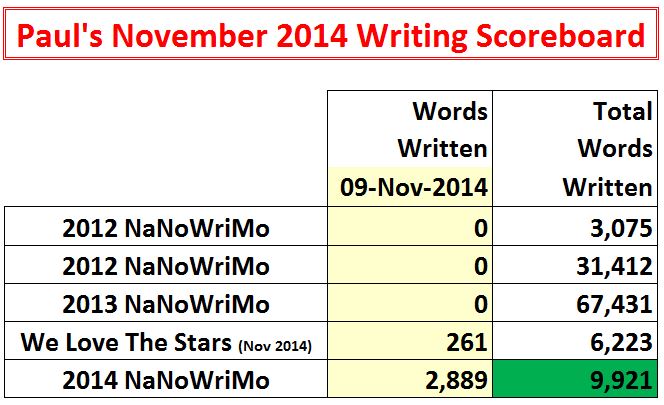
2014-11-09 Word Count Graphic

CHAPTER FIVE

“Put them up on the wall as they connect, please.”

Immediately two windows opened up, showing meeting rooms on the LEO Terminus and on O’Neill. In a few seconds, two more windows opened, connecting everyone to Goddard and Tranquility. In each view were the commanders and chief executives of the respective stations and colonies.

“Ladies and gentlemen,” Pawley started, looking at everyone in the four windows, “we all know each other. We’ve all worked together for years, sometimes decades. We all trust each other. Now we’re all going to have to act together to save ourselves, depending on each other for our mutual survival.

“Our time has run out. You all have the information on the contamination and deaths on SpaceChem Echo. We’ve looked at this possible situation ever since it became clear that the AHF crisis on Earth was getting out of control. The time is here for us to act if we are to survive and avoid being dragged down with them. I am proposing that we immediately implement our Emergency Plan to cut ourselves off from Earth.”

He stopped and waited for the responses. After the usual three-second delay, there were various looks of resignation, sorrow, and exhaustion, but no one appeared to be surprised or shocked. Heads that weren’t bowed under the weight of the decision were nodding in agreement.

“Mike, you know that this only buys us a little bit of time,” said the Goddard Chief Executive. “We can declare independence all day long but we can’t survive independently. All of us still rely on Earth for at least some of our food, materials, and manufactured goods, especially the high tech equipment. None of us are a closed loop ecosystem.”

“Ari, that’s true, as it’s always been,” said the O’Neill COO, “but it’s also true that there are no other options at this point. We quite literally have no choice other than to take our chances on making ourselves self-sufficient. We can buy ourselves as many months or years as we can, or we can die from this disease in days or weeks. Our only chance is to unite and face the fact that we’re on our own.”

“Within only a few weeks there won’t be anyone left down on Earth with the capability to send anything to us anyway,” said the Tranquility Chief Executive. “The number of shipments has dwindled to a trickle already and now we can’t trust the supplies we’re getting anyway. I don’t know if we’re in better shape or worse than the poor bastards on the ground, but at least we get to face our problems head on. Well, we’ll have that option as long as we don’t allow their disease to contaminate us.”

“Very well then, I move that we proceed immediately,” Pawley said. “Are there any final comments or objections? We need your official agreement or disagreement for the record.”

“I agree,” said Ari Gonzalez, Chief Executive from Goddard. “God help us, we’re going to need it.”

“I agree,” said Ken Squires, COO of O’Neill.

“I agree,” said Klaus Schwiger, Chief Executive from Tranquility. “We’re caught between a rock and a hard place.”

“I agree,” said Alexa Garcia, LEO Terminus Station commander. “It’s going to get ugly here quickly. The best defense is a good offense.”

“That makes the current vote five in favor and none opposed,” said Pawley. He leaned forward and looked directly into the camera on his desk. “Pavel and Anya, Jean, I’m sorry that we haven’t had time to include you in the preliminary discussions, but obviously things are happening very quickly here. Please review what we’ve just discussed and join us immediately with any comments for the record, as well as your votes. We’ll keep the discussion going here while we wait for your reply.”

Pawley leaned back in his chair. “DEBBIE, what’s the delay time to Mars and Ceres?”

“Commander Pawley, the round-trip delay to Mars is currently twenty-two minutes and ten seconds. The round-trip delay to Ceres is twenty-seven minutes and five seconds.”

“Thank you.” Pawley looked back at the four open windows on his wall. “Let’s assume for the moment that this will be unanimous. We have an immediate situation to take care of with the infected crew that’s trying to get into SpaceChem Delta. Sarah, what do we need to do and Neil, how do we do it?”

“There’s no way that we can allow that crew onto another station,” said Sarah. “It won’t save them, and it will doom at least seventy-five percent of the people on the newly infected station. Their only option is to go back down to land somewhere on Earth, but I don’t know what the details of that option might be.”

“The pod they’re in does have re-entry capability,” Neil said, “although they might have limited options for where to land if the ground-based guidance systems are starting to fail. The pod will have emergency backup procedures to land autonomously at a major spaceport, or it can soft land by parachute if everything else fails.”

“Do we know who exactly the survivors are and where they’re from?” asked Alexa. “If we can give them some reasonable options it will be easier to deal with them.”

“The three crew members onboard the pod are all from the United States,” said DEBBIE. “Florida, Maryland, and Kansas are listed as the home addresses for their closest family.”

“So there are your options,” said Ken. “Send them in to Brownsville, White Sands, or Topeka, which will give them emergency abort options that will land them east of the Rockies somewhere. They survived the outbreak in their station so they’re likely to be immune. Knowing that, they can deal with the situation on the ground as best they can.”

“And what if they don’t agree to go down?” Amanda asked. “The fact that they went to Delta instead of simply going down to begin with indicates that they either are totally panicked and irrational now, or they just don’t care about the regulations now that they’re the ones who could die as a result.”

“That’s not an option for them,” Neil said. “They can go down or they can face the consequences. If they try anything that might spread this outbreak, we will have to stop them, by the deployment of force if necessary.”

“Do you have that capability at either GEO or LEO?” asked Klaus. “If you’re going to start a war, you shouldn’t be bluffing.”

“We’re not starting a war. Everyone talks about this as if it is some kind of military action,” Amanda said. “It’s critical that we keep in mind the fundamental difference between military actions and police actions. Police actions are taken by society against internal threats in order to protect the members of that society. Military actions are taken against outside threats. Police actions are taken to protect, and should be undertaken with the goal of using minimal force to inflict minimal damage and casualties. Military actions are taken to defend, and often involve significant or maximum amounts of both force and damage. None of us will survive a military action, which would involve our colonies and stations fighting against Earth or against each other. Police actions may regrettably be necessary in order to protect us all from internal cancers.”

“I stand corrected, my apologies,” said Klaus in the awkward silence that followed. “But the question remains. Can we stop them if they won’t obey the order to go down?”

Neil considered his response for a few seconds, before simply saying, “Yes, we believe we can. We’ll see.”

“Anything else before we tackle this one?” Pawley asked. “No, okay, Sarah and Neil, you’re we me on this one. Everyone else, please stand by and monitor, if you have anything to add, send it through DEBBIE. DEBBIE, please put us in contact with the rogue pod that’s docked at SpaceChem Delta.”

As DEBBIE made the connections, the four open windows on the wall diminished in size and a large window opened next to them. In a second a picture flickered to life there, showing a cramped cabin and three people wearing jumpsuits. They hadn’t even taken the time to grab pressure suits.

“Escape pod crew, this is Michael Pawley from GEO. I’m here with Sarah Teffeau, the GEO Surgeon General and other staff. I understand that there has been an emergency and an AHF outbreak at Echo. Can you tell us what happened?”

The three occupants of the pod turned around in the air and pulled themselves in front of the control panel where the comm unit was located. The man and two women looked sweaty and flushed, but otherwise healthy. The older woman with her hair pulled back in a long pony tail answered.

“GEO, this is Marybeth Sullivan of SpaceChem Echo station. The three of us are the last survivors of Echo after the quarantine protocols were breached. We need help. Everyone back on Echo is dead, they won’t let us in here on Delta.”

“Marybeth, this is Sarah, I’m a doctor. Do any of you have any AHF symptoms or other medical problems?”

“No ma’am, we’re all okay.”

“But all of you were exposed to AHF back on Echo? How do you know that’s what it was? What happened to the rest of your crewmates?”

“They’re all dead, like I said, we’re the only survivors. I can confirm that all fifteen were dead and showed every sign of it being AHF, the symptoms matched all of the ones described in the news from Earth.”

“Marybeth, do you know how you got exposed?” Pawley asked. “Were all of the protocols for disinfection and isolation followed?”

“I don’t know, none of us were involved with taking care of the supplies from the new shipment. The guys who did that are dead. I just know that the drone docked, they did what they had to to get it opened up, and an hour or two later everyone started to vomit and choke, running a high fever, then convulsions and bleeding, then they were dead.”

“So you were directly exposed?” asked Sarah.

“Yeah, it’s a small station, just eighteen of us. Of course we were all exposed.”

There was a pause as the three GEO leaders glanced at each other, silently calculating who was going to take the discussion next.

“Marybeth,” said Pawley, “are you familiar with the current regulations regarding your situation? Has SpaceChem kept you all up to date on how a situation like this needs to be handled from here?”

“Not really, we’re techs and engineers, not pilots. Davis and Gurney would have been the people on Echo to handle that, but they’re dead. The guys we’ve been talking to here at Delta won’t open the hatch, but they haven’t told us why. It’s getting us pretty pissed  to tell you the truth.”

“Marybeth,” said Sarah, “I’ll be blunt. You’ve been exposed to AHF. The three of you appear to be in the minority, people that have a natural immunity. It’s  just like how some people don’t get a cold or the flu when it’s going around and everyone else gets it. But you’re AHF carriers now, even if it’s not making you sick. You have the virus and will spread it to anyone you come in contact with. The crew on Delta won’t open the hatch because almost all of them will die if they do. You will kill them.”

There was a stunned silence from the escape pod. As he realized what their situation was, the man in the pod began to get angry, banging his fist against a wall panel, an action that sent him spinning backwards across the cabin. His outburst shook the two woman out of their shock and they pushed off to grab and restrain him, screaming at him to get his attention. Slowly the situation calmed.

“Commander Pawley,” DEBBIE said quietly, “a message from Pavel Levieva and Anya Kapoor is coming in.”

“Record and hold it, DEBBIE.”

“Yes, sir.”

Marybeth was back at the comm panel, trying hard to stay calm. “So the disease didn’t kill us but now you’re just going to let us die here, is that it? Isn’t there any place where we can be cleaned, decontaminated, sterilized, or whatever? There have got to be other options.”

“There are no facilities on orbit that can handle you, Marybeth,” Pawley said. “That’s why the quarantine and isolation restrictions have been so strict. There is one option you have. The escape pod you’re in has re-entry capability. We can control it and put you down somewhere in central North America.”

“You’re kidding,” Marybeth said. “Right? You’ve seen what it’s like down there! Everyone’s dying, everything’s falling apart. They’re starving, rioting, it’s total chaos. That’s a death sentence too!”

“Not necessarily,” Pawley said. “Things are bad there, but you’re immune to AHF, you’ve been exposed and survived. You have a lot of technical skills that they’re going to need down there to rebuild. We can get you down and then it’s up to you to find a way to survive, but at least it’s not an immediate death sentence.”

“What are the other options?” Marybeth asked.

“There are none,” Neil said. “The situation is cut and dried, I’m afraid. You can not be allowed to stay on orbit where you are an immediate danger to anyone and everyone you come in contact with. You must go planetside immediately.”

“And if we don’t?” Marybeth’s angry crewmate asked.

“You have nowhere else to go. Delta’s not going to let you in. If you try to go someplace else, they will not let you in. If you try to do something irrational that puts others in danger, we will stop you. That will probably result in your deaths. You need to think this through, calm down, and head to the ground to take your best shot. I’m sorry, but there isn’t any other way.”

The three survivors pulled away from the comm panel of the pod  and could be seen huddled in conversation. It didn’t look like a calm conversation. Finally Marybeth came back over, leaving her two companions still in an agitated discussion.

“So we go down and maybe die tomorrow or later, or we stay up here and die today? You don’t give us much choice, do you? What do we need to do to land? None of us are pilots.”

There was an audible sigh of relief in the GEO office. No one had wanted their first act as an independent government to be an execution.

“You need to turn over control of your pod to one of our AIs,” Pawley said. “They’ll work with you to figure out the best place to put you down and how to time it to give you whatever advantages we can. Then they’ll fly your pod remotely. Are you ready to do that?”

“Not really, but we’ll do it anyway.”

“DEBBIE, will you please take over and do as I’ve described? If you have any questions or if anything needs to be handled at this end, please refer it to Neil. Marybeth, good luck to you and your crew.”

The conversation cut off.

“Commander Pawley,” DEBBIE said, “a message from Jean Duris is coming in.”

“Good. Is everyone else still there?” The four other windows expanded to show their various offices and meeting rooms, all still occupied by the other colony and station leaders and their staffs.

“DEBBIE, give us the messages, the ones from Pavel and Anya first.”

A fifth, sixth, and seventh windows opened, two with still images and the third showing a tiny, cramped office with a pair of old and weathered men seated at a tiny desk.

“We have nothing to add from Bradbury. So far things are still calm here, but we agree completely with Ari. None of us are living in a closed loop environment. Without resupply from Earth, it’s just a matter of time before we crash and burn. That’s got to be our first and top priority. But we’ve talked about that. I agree that we have to proceed. Levieva out.”

The image in that window froze and the next one came to life. “We agree with you at Heinlein, we have no choice but to proceed. Kapoor, out.” She never had been one for long speeches.

The final window started showing its message, originating in what looked like a cave of some sort. “Mike, Alexa, Ari, Klaus, and Ken, you all of course have my agreement that we’re on our own now and we must act accordingly. Let’s not screw it up, it’s awfully cold and dark out here, a miserable place to starve to death. Ceres, out.”

There was a pause as everyone on the conference call looked at one another, weighing what they had just done.

“Let’s do it, Mike,” said Ari. “You’re the boss now. Tell the troops what we’re doing. It’s time to get it done or die trying. Someone stole our safety net, so we’re going to have to make do.”

“DEBBIE,” Pawley said, “set up a broadcast to all stations and colonies as well as the various Earth headquarters locations that we’re still in contact with. We’ll start in ten minutes. Meanwhile, first I think I need to go throw up.”

Leave a comment

Filed under Science Fiction, Writing

NaNoWriMo 2014, Day Eight

I’m thinking (or feeling, which might be more important) that the reason this story is limping along like a Ferrari with seven blown cylinders is that I have yet to allow myself to relax, cut loose, and let it flow. (Anyone making the obvious constipation jokes will be sent to the corner for a timeout.)

Last year’s story was a wild ride, and I had been thinking (a 45-minute commute each way to the hanger is a great time to think) that it was because last year’s story was a comedy where this year is a drama. But it just occurs to me that last year’s story was just as much of a drama as this one, no comedy. It’s the other story (the still-being-worked-on 2012 NaNoWriMo story) that’s turning into a wackadoodle comedy.

So why the difference? I thought I had it, but apparently not. Could it be that last year’s story was “fun” and totally “fantasy-ish” while still being set in our current world? It did allow me to throw out any off the wall BS I could come up with, at least to a certain extent. Where this story is more “hard” science fiction, precise, serious.

Who know? Perhaps I should cut off the paralysis by analysis and relax, cut loose, and let it flow.

While I normally put in a lot of  internal links to previous, related posts here, I won’t be doing that for what I hope will be this year’s thirty NaNoWriMo posts. If you have jumped into or stumbled onto this story in mid-adventure, there are plenty of other ways to navigate around the site to find previous installments. Actually doing so is left as an exercise to the student.

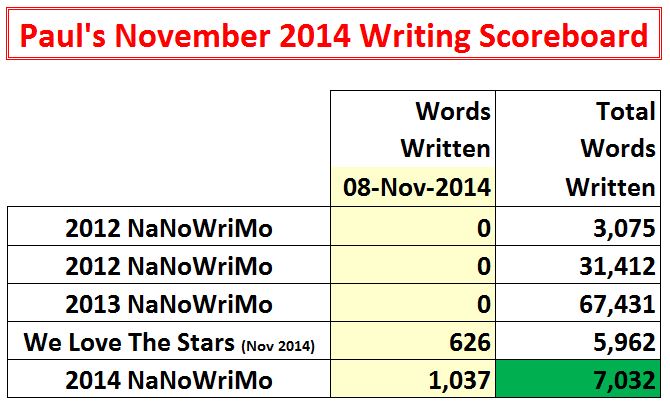
2014-11-08 Word Count Graphic

CHAPTER FOUR (continued)

Neil Hermans was the first one to get there. He hadn’t been running – that would have been a good way to get people even more nervous than they already were. But he hadn’t been taking his time either.

“Hello, Neil. You got the latest news?” asked Pawley.

“Yeah, DEBBIE gave it to me on the way over. It looks like we’re going out of the frying pan and into the fire, whether we like it or not.”

“I don’t know that we can do anything about the fire, but for the moment let’s just try to stay here in the frying pan for a while. But this could get ugly really quickly if people start to lose it. We’re going to head that off fast and hard. Are you and your crew ready?”

“Obviously not, but we’ll do the best we can with what little we have. We do have a couple of aces to play if it comes to that, but everyone’s worked really hard for two hundred years to make sure that no one can do what we’re going to need to do.”

“Don’t underestimate the damage you might do if you pull one of those aces out of your sleeve,” said Amanda as she came in and sat down in the office’s last chair. “People up here have always been a different breed than the ground pounders, but there are certain lines that have never been crossed. Neil’s right about how much has work and thought has gone into keeping us weapons free. That’s Pandora’s Box that you’ll be opening.”

“I remember,” said Pawley. “We’ve gone over this. But if push comes to shove, that could be the lesser of the two evils.”

“It’s still evil,” said Sarah.

“Now that we’ve beaten that horse again, what options do we actually have if we need them?”

Neil sighed. “If it’s a single small ship or even a handful of them that are the problem, we can probably take action against them with a reasonable chance of success. But that will only be for a day or two after we first have to use force. The element of surprise will be a huge part of our plans. Once everyone knows that we’re serious and will act, maybe it will get them to stop doing things that might leave us with no other good options. And if it’s dozens of ships, things can fall apart pretty fast.”

“Worst case, if we lose all control here in GEO and LEO, what happens if anyone tries to get to O’Neill, Goddard, or one of the other colonies? Can they defend themselves to keep their isolation intact?”

“We’re not privy to any preparations they might be making,” Neil said, “but my assumption would be that they’re making them. An awful lot of what we do out here involves manipulating huge amounts of energy very carefully, which is a good first-order approximation for the definition of a weapon.”

“Right,” Pawley said. “While we have to be prepared for the worst case scenario, we also have to do everything we can to keep everyone working toward a best case scenario, even when ‘best’ might be a purely relative term. We always believe that we’re a cut above and won’t give in to panic like they have down below, but that’s an ideal that is rarely tested up here. There are no guarantees that it will always be the case when individuals are looking at choices between bad and very bad.”

“DEBBIE, what are the current estimates from the AI strategy team showing about our longevity if we isolate ourselves?”

“Commander Pawley, given our current resources for materials, personnel, energy, and manufacturing, the best estimate is that there is less than a three percent chance of being able to successfully transition to a fully independent society free of all physical contact with Earth. The most likely outcome will allow most colonies to survive less than ten years, while statistically a few may last twice that long.”

“DEBBIE, what are the estimates of our ability to survive exposure to the current disease if we maintain contact with Earth?”

“Commander Pawley, given the updated information coming from the SpaceChem Echo station, any system of stations that attempt to continue physical interactions with spacecraft from Earth will be destroyed in less than a year. However, that point is moot since it is estimated that no ground-based institutions will be able to maintain the capability of launching spacecraft or cargo for more than another six weeks.”

“It’s the same math as it’s been for the past six months,” Amanda said. “We can die from disease in a month or we can die from starvation and hypoxia in a year.”

“Or we can get our asses in gear and at least go down fighting,” Neil said. “But we’re going to have to do it as a group. The survival forecasting models all make the assumption that all of the colonies, stations, and ships work together for their mutual benefit. It’s suicide to fracture apart and split up into individual efforts.”

“But everyone knows that,” said Sarah. “So far we’ve managed to not have any major institutional rivalries off-Earth. We’ve got a history of cooperation.”

“No,” said Pawley, “we have a history of being able to staying out of each other’s way, while all being subsidized by different ground-based economies. While the different energy, manufacturing, and tourist companies have all had their own cooperation and competition agreements, for the most part everyone knows that we’re all in an unforgiving environment to begin with. One way or the other, we’re all living in glass houses, so we don’t throw many rocks. But look at the early competition to get to the moon, and then the international issues with GEO slots once they became the first rare commodity up here.”

“True,” said Amanda, “but nothing like that has happened in over forty years, despite the occasional spat or pissing contest.”

“It might take a lot longer than forty years to forget a hundred thousand years of aggression,” said Neil. “I hope we can do it, not like we have any choice.”

“Commander, the other Council members are coming online,” DEBBIE said.

Leave a comment

Filed under Science Fiction, Writing