Category Archives: Writing

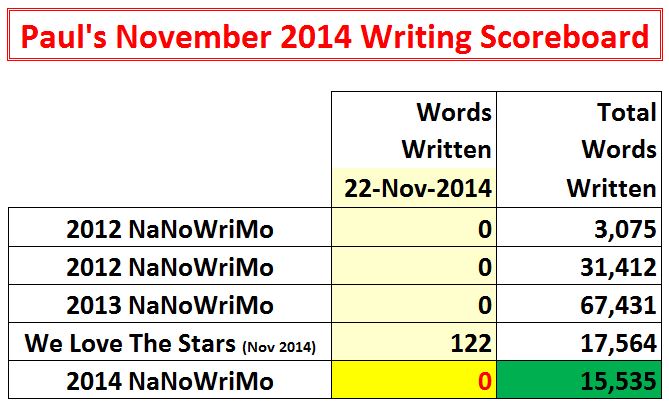
NaNoWriMo 2014, Day Twenty-Two

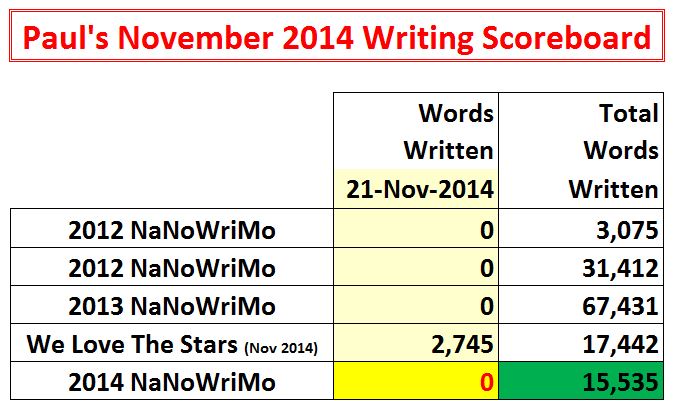
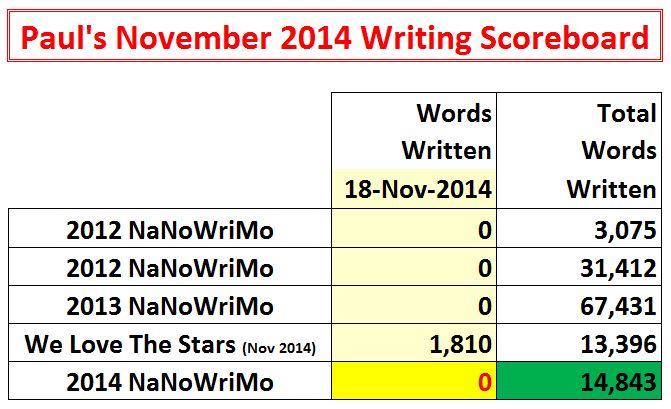
It’s now officially a rout. If this were a football game, it would be Reality 143, NaNoWriMo 17 going into the fourth quarter with no time outs left.

While I feel bad about this, it’s comforting to know that it’s happening in large part due to a bunch of really good things taking priority. Today I was at the CAF hanger all day (monthly staff meeting) and tonight we’re going to see Amanda Palmer in concert.

While I normally put in a lot of  internal links to previous, related posts here, I won’t be doing that for what I hope will be this year’s thirty NaNoWriMo posts. If you have jumped into or stumbled onto this story in mid-adventure, there are plenty of other ways to navigate around the site to find previous installments. Actually doing so is left as an exercise to the student.

2014-11-22 Word Count Graphic

CHAPTER EIGHT

Leave a comment

Filed under Art, CAF, Music, Science Fiction, Writing

NaNoWriMo 2014, Day Twenty-One

Priorities, priorities, priorities. Non NaNoWriMo priorities are just kicking this project’s ass this year.

The good news is that I got to go to that tremendous NASA Social for two days. The bad news is that the time spent for days beforehand doing my homework for that event so that I could ask intelligent questions, plus the event itself, plus writing about it after the event (2581 words today about Day Two, woo hoo!), all are sucking huge chunks of time out of my NaNoWriMo writing time.

The problem with the real world is all of that reality.

While I normally put in a lot of  internal links to previous, related posts here, I won’t be doing that for what I hope will be this year’s thirty NaNoWriMo posts. If you have jumped into or stumbled onto this story in mid-adventure, there are plenty of other ways to navigate around the site to find previous installments. Actually doing so is left as an exercise to the student.

2014-11-21 Word Count Graphic

CHAPTER EIGHT

Leave a comment

Filed under Science Fiction, Writing

NASA Social At NASA Armstrong Flight Research Center (Day Two)

Day Two of the NASA Social at the NASA Armstrong Flight Research Center at Edwards Air Force Base started much as Day One had — early!

IMG_5281

For the record, I’ve posted dozens if not hundreds of sunset photos on this site over the past nineteen months – I’m pretty sure this is the first sunrise photo.

We all trekked out into the desert to be at the Edwards AFB West Gate by 0730 PST (which means an 0630 departure from the hotel, which means an 0500 wake up) only to have “issues” with the gate security. Most of us got held up for over an hour. I’m not sure what issues the Air Force has with NASA, not my float, but it left us running almost an hour and a half late getting started.

But once we got started (and everyone was great about accommodating us and just slipping our appointment times) it was some seriously good stuff. Just like Day One!
IMG_5296

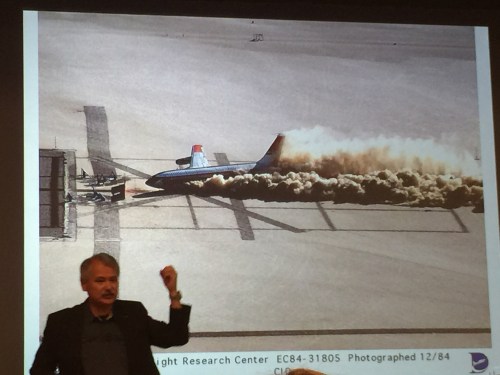
Al Bowers, Chief Scientist at NASA Armstrong, had an extremely interesting talk about the 1984 Controlled Impact Demonstrator test, in which a fully loaded & instrumented 707 was flown by remote control and crashed deliberately. The test was designed to see if a fuel additive would keep fuel from burning in a crash, but the plane landed off target (it was supposed to be going straight and come down on that “X”, not 410 feet to the right as seen here) and turned into a huge fireball.

The FAA, which paid for the test, was not happy and apparently there are still those there who hold a grudge. (In flying circles it’s common to say that the FAA’s motto is, “We’re not happy until you’re not happy!” So…thanks, Dr. Bowers, for a job well done!) But while they didn’t see what they wanted to see, they did learn a tremendous amount, all of which went into improvements in aviation safety that you see today. While there are still crashes and deaths, the number of deaths caused by post-impact fires has dropped to almost nothing.
IMG_5304

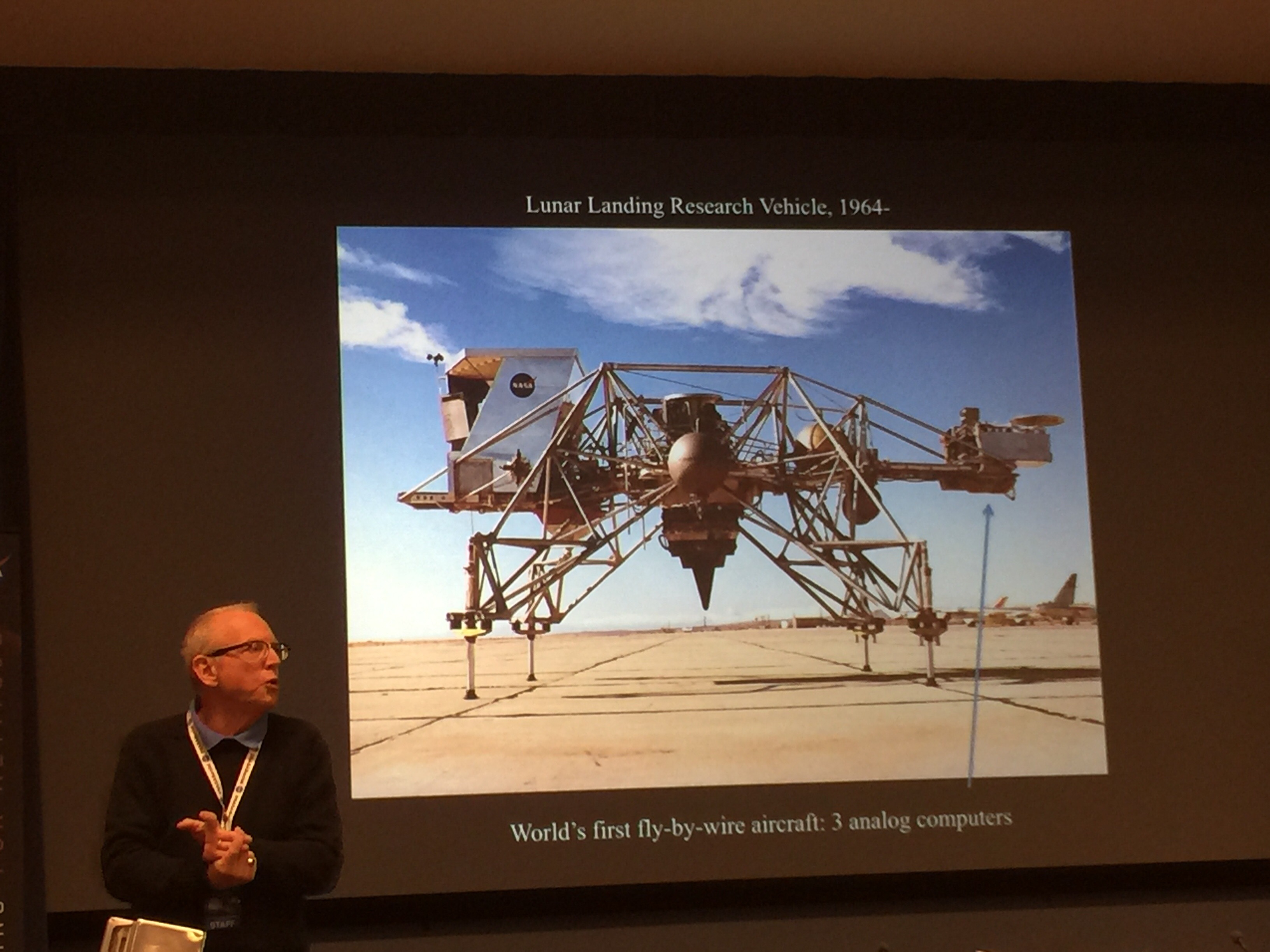
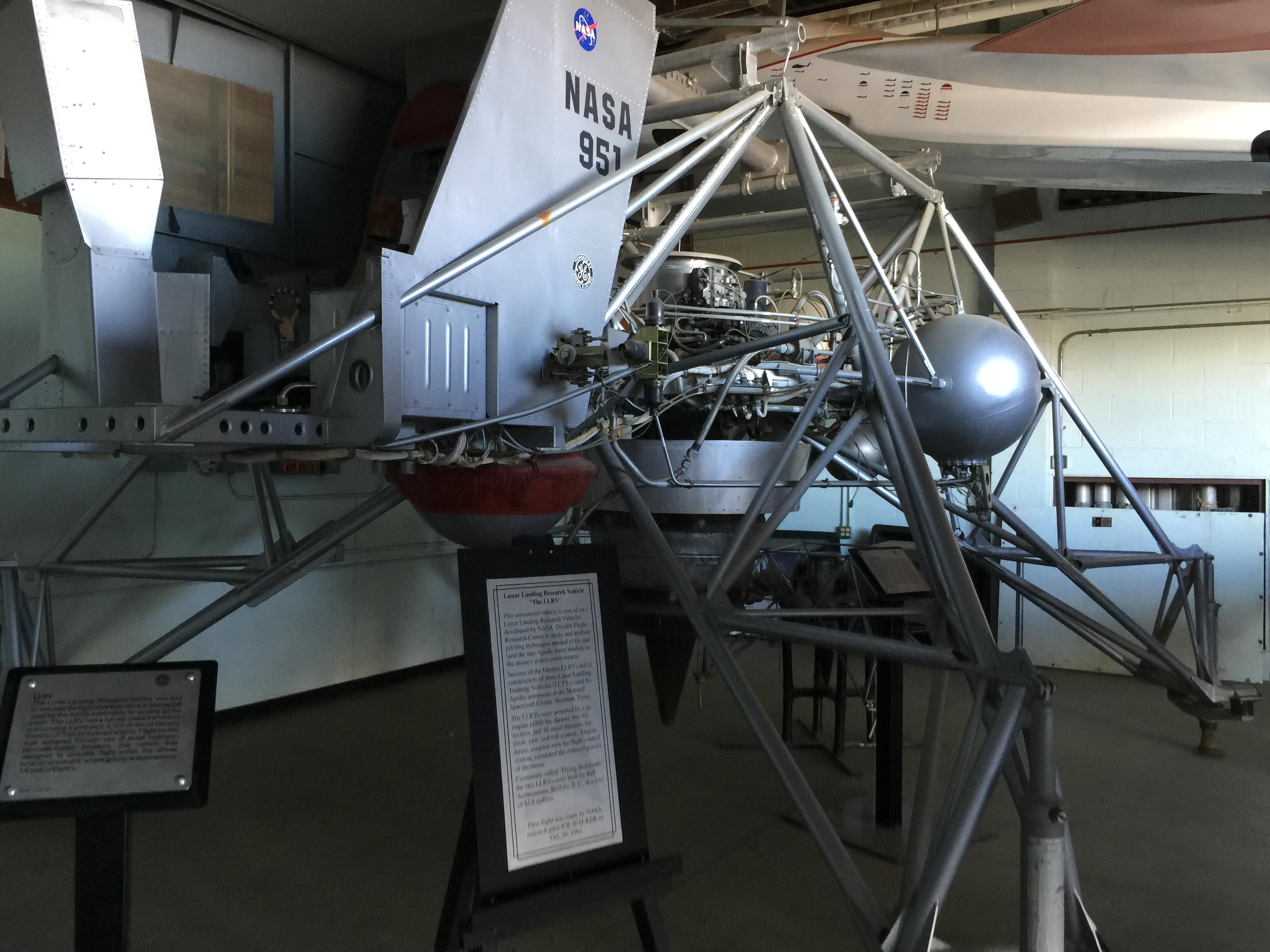
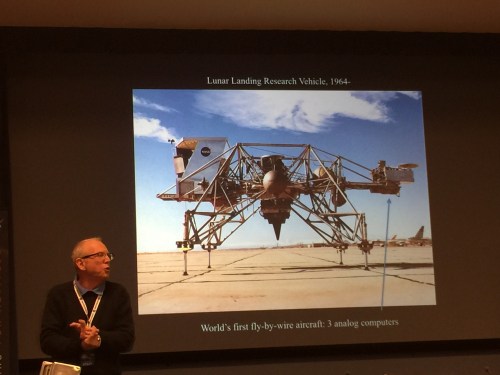
Doctor Christian Gelzer, Chief Historian at NASA Armstrong gave us a talk on the history of “fly-by-wire” (FBW) control systems. The short version is that in an older commercial or military plane, and still in almost all light general aviation aircraft, controls on the plane (yoke, rudder, trim) are connected to rods and levers and maybe hydraulic systems, which are in turn connected directly to the ailerons, flaps, and rudder. In a FBW system, which now includes all military aircraft and the vast majority of all commercial airliners, the controls talk to a computer and the computer talks to a motor attached to the ailerons, flaps, and rudder to move them in the way the pilot is commanding.

The vehicle shown (remember it for later) is the Lunar Landing Research Vehicle, which was the first FBW aircraft. It was developed in the mid-1960s to train the Apollo astronauts on how to land on the moon. It must have worked – six of six landings went just fine!
IMG_5305

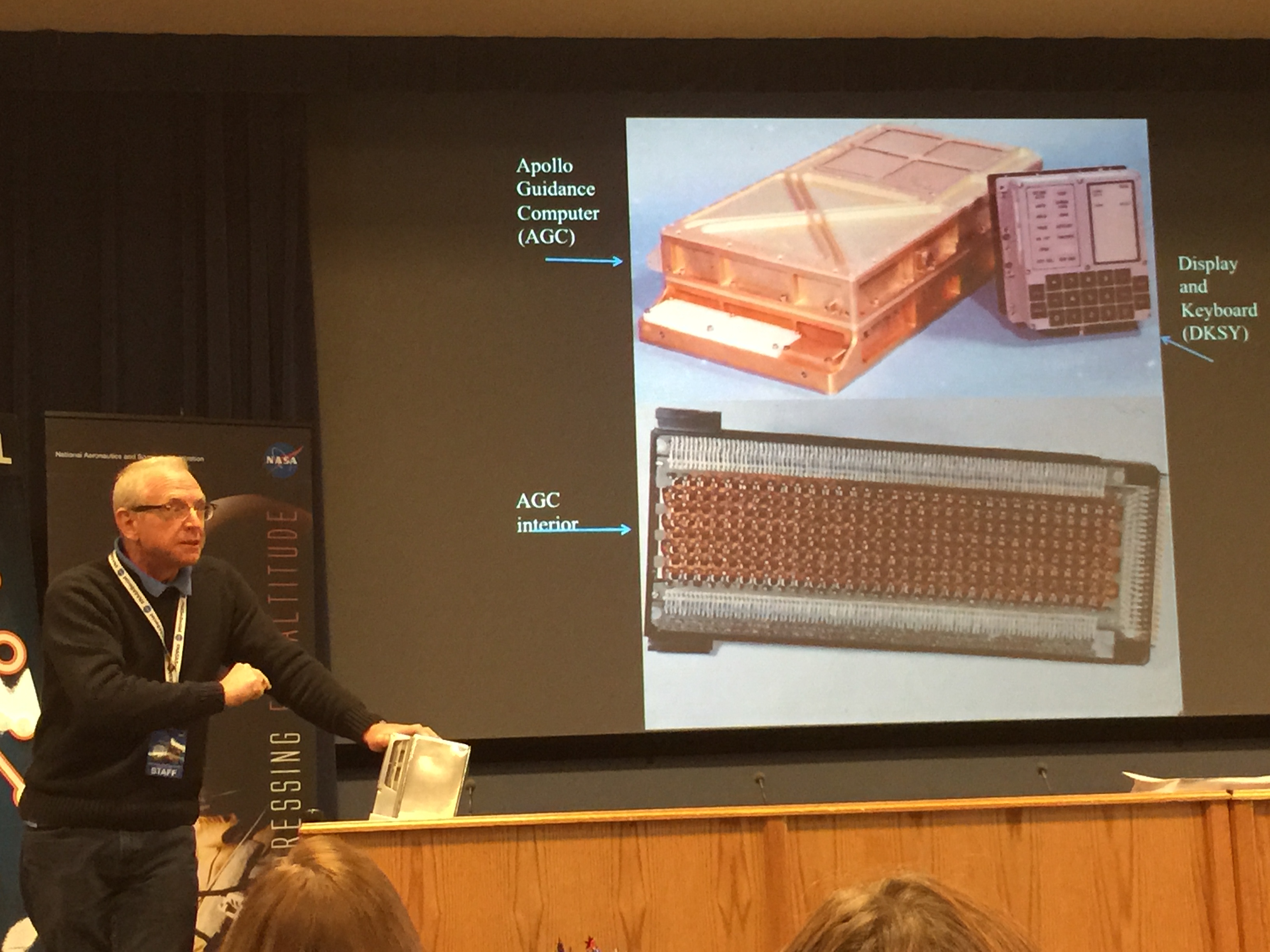
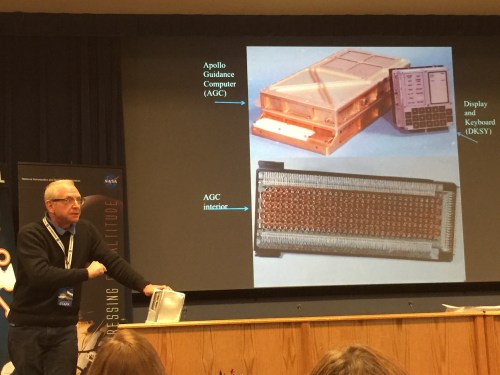
When it came time to start testing FBW on other aircraft, the biggest problem was that the computers of the day weren’t up to the task. Eventually they used the only portable, reliable, and rugged computer on the planet that could do the trick, a leftover Apollo Guidance Computer (AGC). These were made to take the Apollo spacecraft to the moon and back, but the Apollo program got cut back after Apollo 13, leaving spare AGCs.

Things were fine, until the Display & Keyboard (DSKY) unit failed. There weren’t any spares. None had been made. None were ever going to be made.
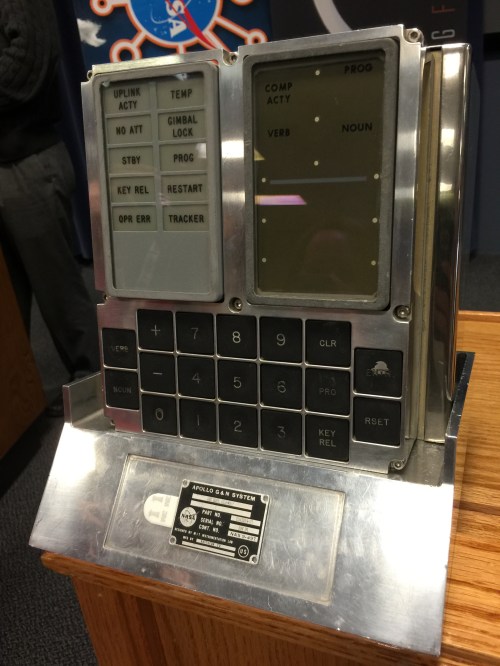
IMG_5309

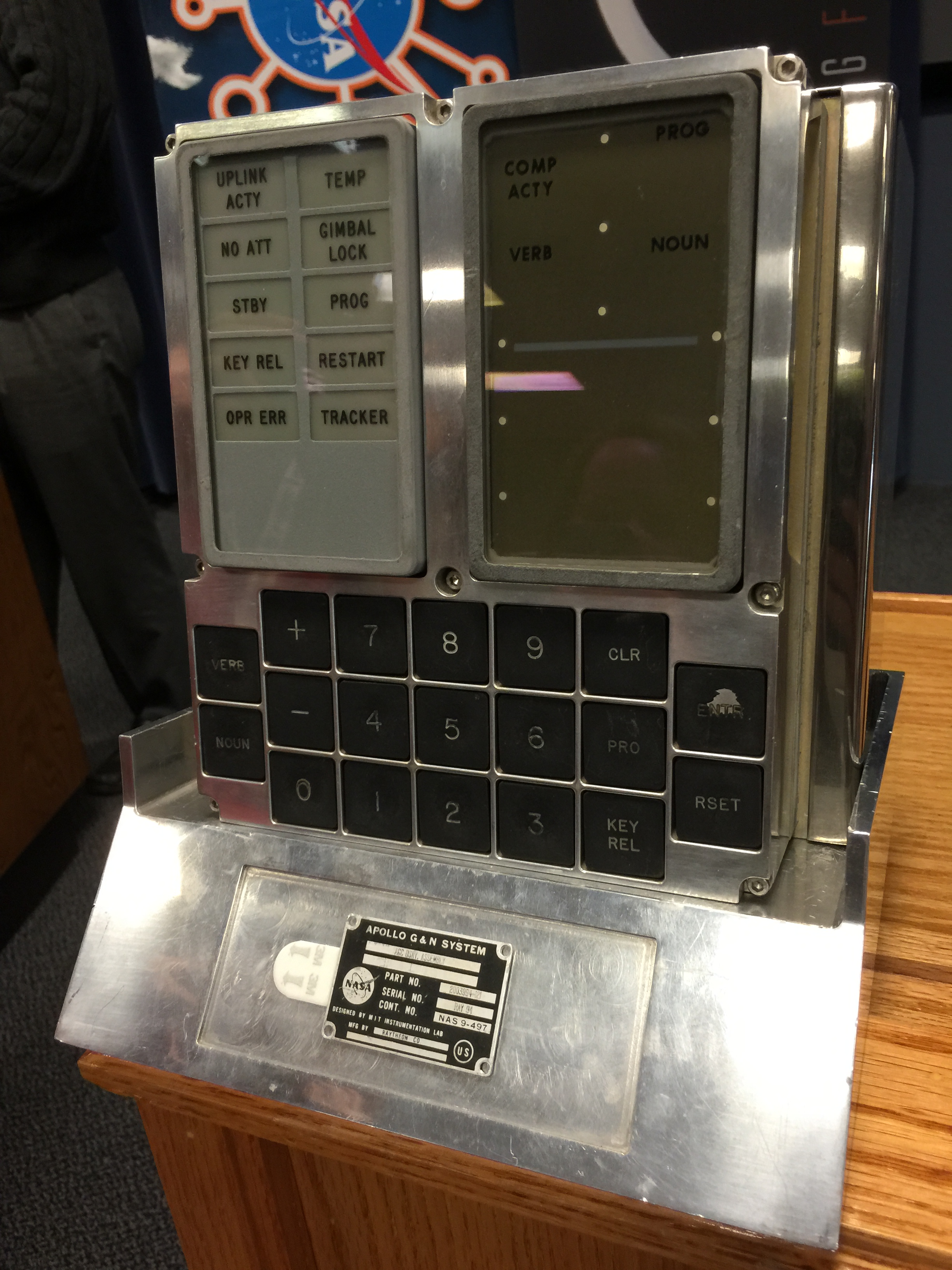
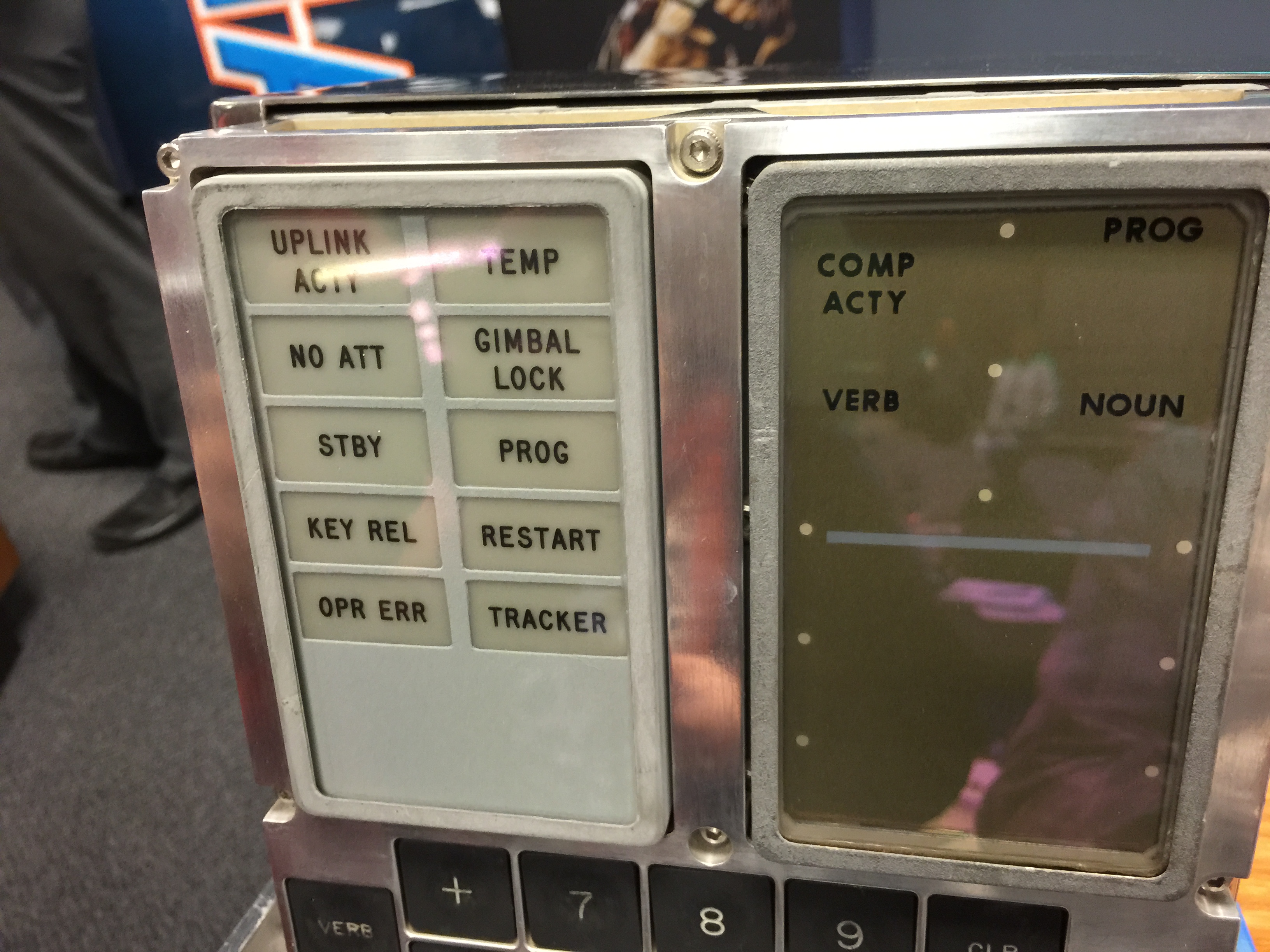
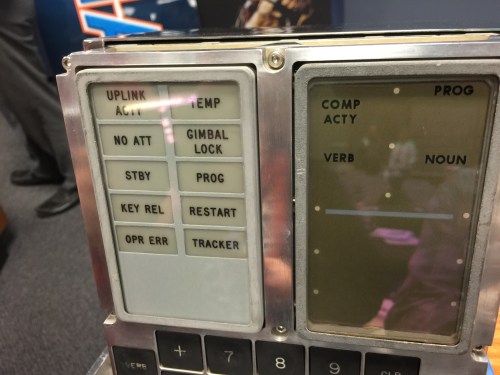
This is the actual piece of hardware that they obtained to solve the problem. This “spare” DSKY was taken from the Apollo 15 Command Module after the spacecraft had returned from the moon.
IMG_5310

How much did I squeeeee to be able to not only see and photograph but to touch and push the buttons on the actual honest-to-God flight computer that had gone TO THE FREAKIN’ MOON & BACK? It just might have been a significant amount — and as far as I could see, the other 30+ participants at the NASA Social were squeeeeee-ing right along with me.
IMG_5315

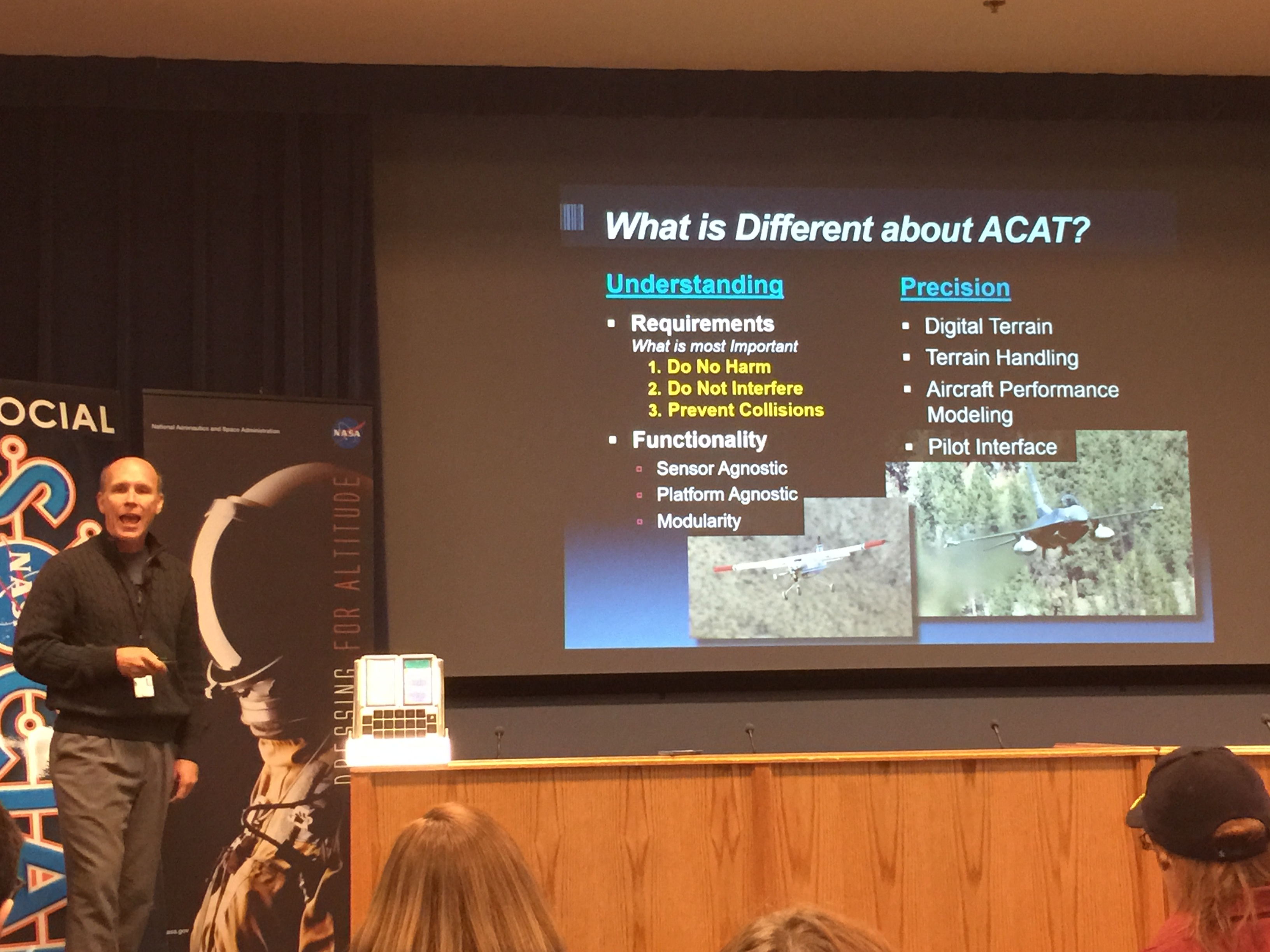
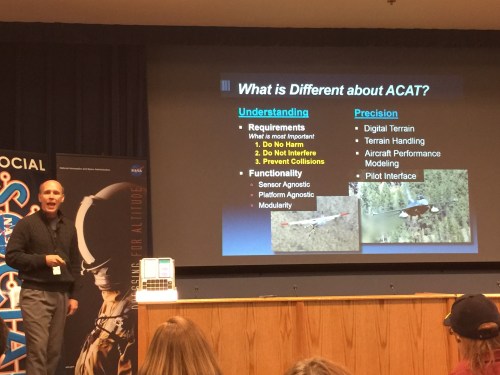
Once we had taken a break and I had (at least figuratively) taken a cold shower, Mark Skoog, Chief Engineer of the Automatic Systems Project Office, gave a fantastic presentation on the Automatic Ground Collision Avoidance System (AutoGCAS). In short, the military has a problem with too many pilots flying perfectly good, healthy, functioning aircraft into the ground or the sides of mountains. This can be caused by fog and clouds, by pilots being temporarily disabled by high G-forces, or by pilots distracted by other tasks in the cockpit.

What the AutoGCAS system has done is take a 3-D digital database of the entire freakin’ planet and condensed it down to where it will fit into a smart phone, with plenty of room to spare. (This is mind boggling to me, but they’ve done it so it must not be as impossible as I would have guessed.) Then they wrote programs for the smart phone which will constantly track the plane’s location and course in 3-D, compare it to the database, and determine when a collision is imminent. Then the system uses the plane’s autopilot to override the pilot and take the last safe option out at the last possible second.

Wow.

The system is now up and running in F-16s and is being installed in other fighters. Furthermore, it’s being developed for use by the civilian commercial and general aviation markets. On a plane like the Cessna 172s which I fly, it might not be able to take control of the plane in an emergency (a light Cessna usually doesn’t have an autopilot that has the capabilities to do that) but it will be able to run on your smart phone and give you warnings and directions.

There is a fantastic video regarding this project on NASA’s YouTube channel here. Most of the models, remote control centers, and several of the people shown in this video are people and things we met and saw.
IMG_5322

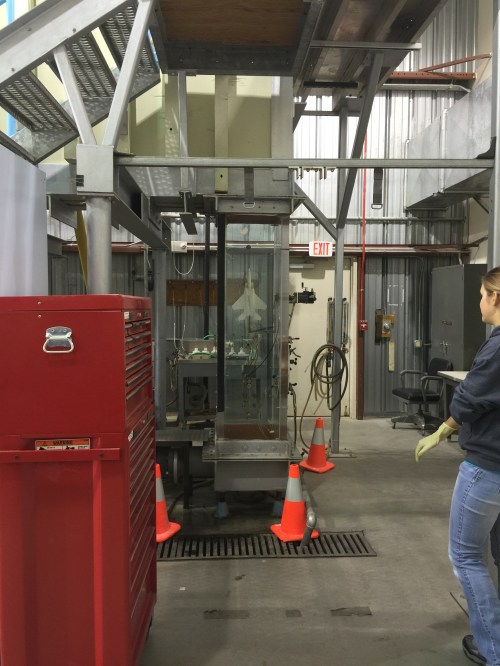
Now it was time to boogie out into the field again. First stop was the Flow Visualization Facility, where Jennifer Cole showed us how a giant water tank pumps water past a model being tested. Here you can see the clear, plexiglass testing chamber with the white model of an F-18 fighter pointing up into the flowing water. The models are made very precisely with ultra fine tubes built in, connected to holes in the body of the model. When the water flows and colored dye is pushed out through the holes, the dye will eddy and stream to show where the areas of turbulence and laminar flow exist.
IMG_5329

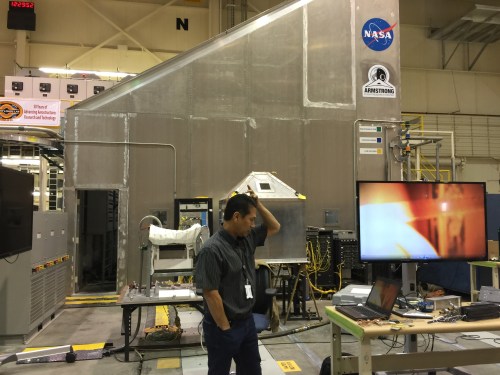
Next was the Flight Load Lab, where Larry Hudson showed us how materials are tested to see how they react to stress, temperature changes, or dynamic loads. (The lab just had its 50th anniversary.) Materials act differently when very cold at high altitude or very hot when heated by air friction at high Mach numbers. In this lab they can test (to destruction, if necessary) everything from small parts to entire planes.
IMG_5332

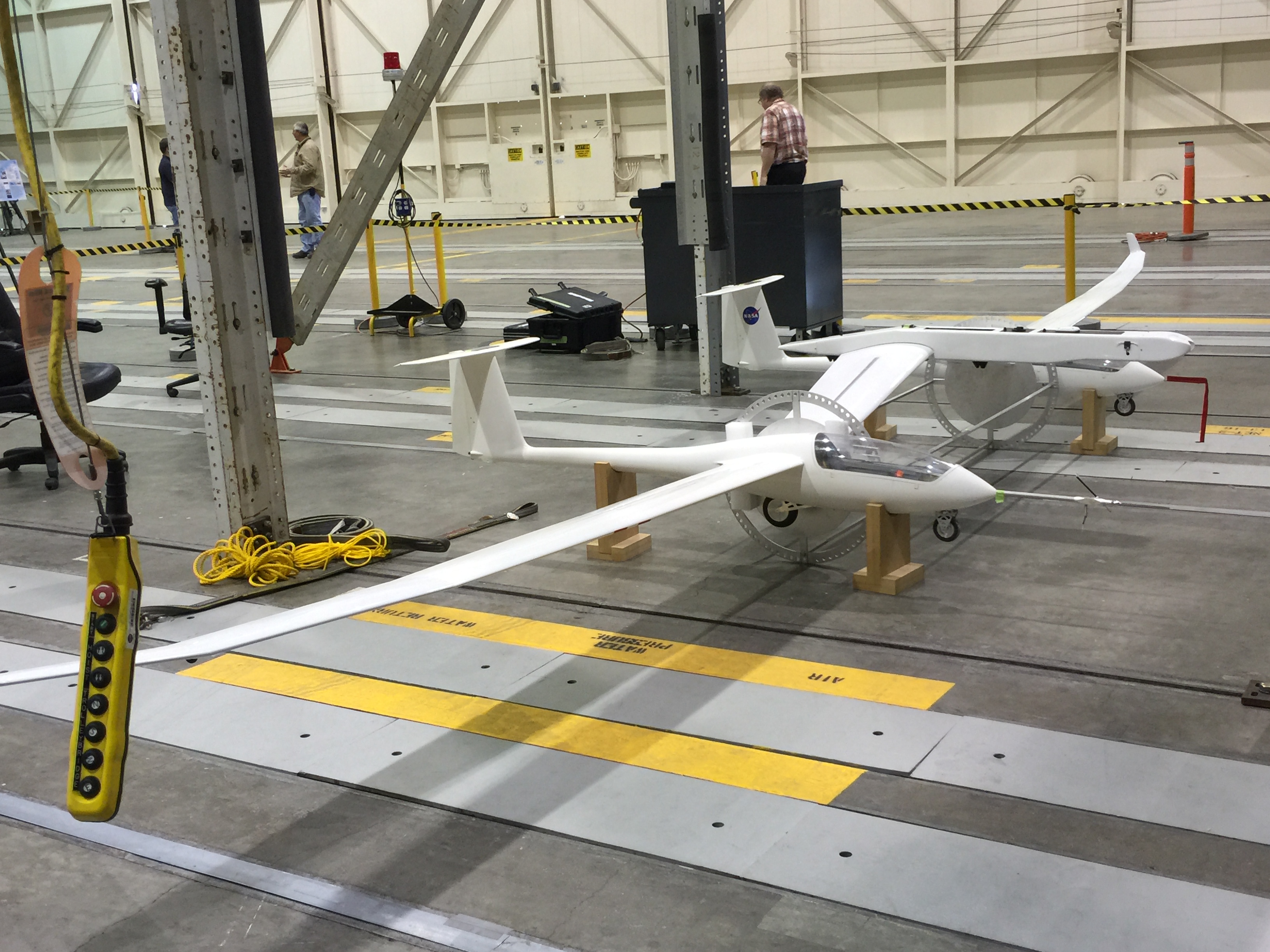
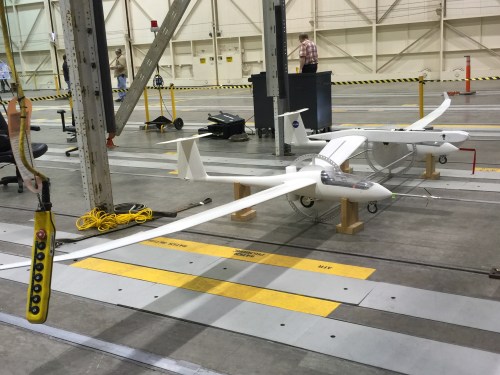
In the lab, being tested for balance and dynamic loads was this scale model of a concept being developed at NASA Armstrong for an unmanned glider which could be used to launch rockets into low Earth orbit (LEO). Similar to Virgin Galactic’s “White Knight 2” carrier airplane, this plane would have much longer wings and be towed to altitude (carrying in the middle the rocket to be launched) by a simple business jet or military cargo jet. At 40,000 feet, the glider cuts loose, the tow plane boogies, and the rocket is launched from the glider.

They believe that this system (which is still a decade away from being in service) could launch twice as much payload at half the cost of launch vehicles today. I asked and was told that it can also be scaled up to the point where manned spacecraft, such as Sierra Nevada’s Dream Chaser could be sent into orbit.
IMG_5334

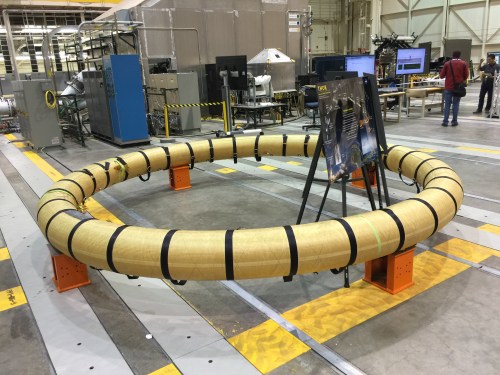
This is a ring being tested in the Load Lab for the Hypersonic Inflatable Aerodynamic Decelerator (HIAD) project (NASA video here). To get a bigger heat shield without needing a bigger rocket, HIAD will use a series of inflatable rings. When the rings inflate, with the rings of different sizes stacking to look like that children’s toy, you can make a 25 meter heat shield fit into a 5 meter rocket fairing. This in turn lets you land a much bigger spacecraft on someplace like Mars.

IMG_5335

In the lab we also saw a demonstration of how fiber optic stress sensors work. The tan stripe on this model is a long fiber optic sensor. A remote control unit let us bend the wings, and the display behind it showed how the computer picked up the data from that sensor and could display and record it.

IMG_5338

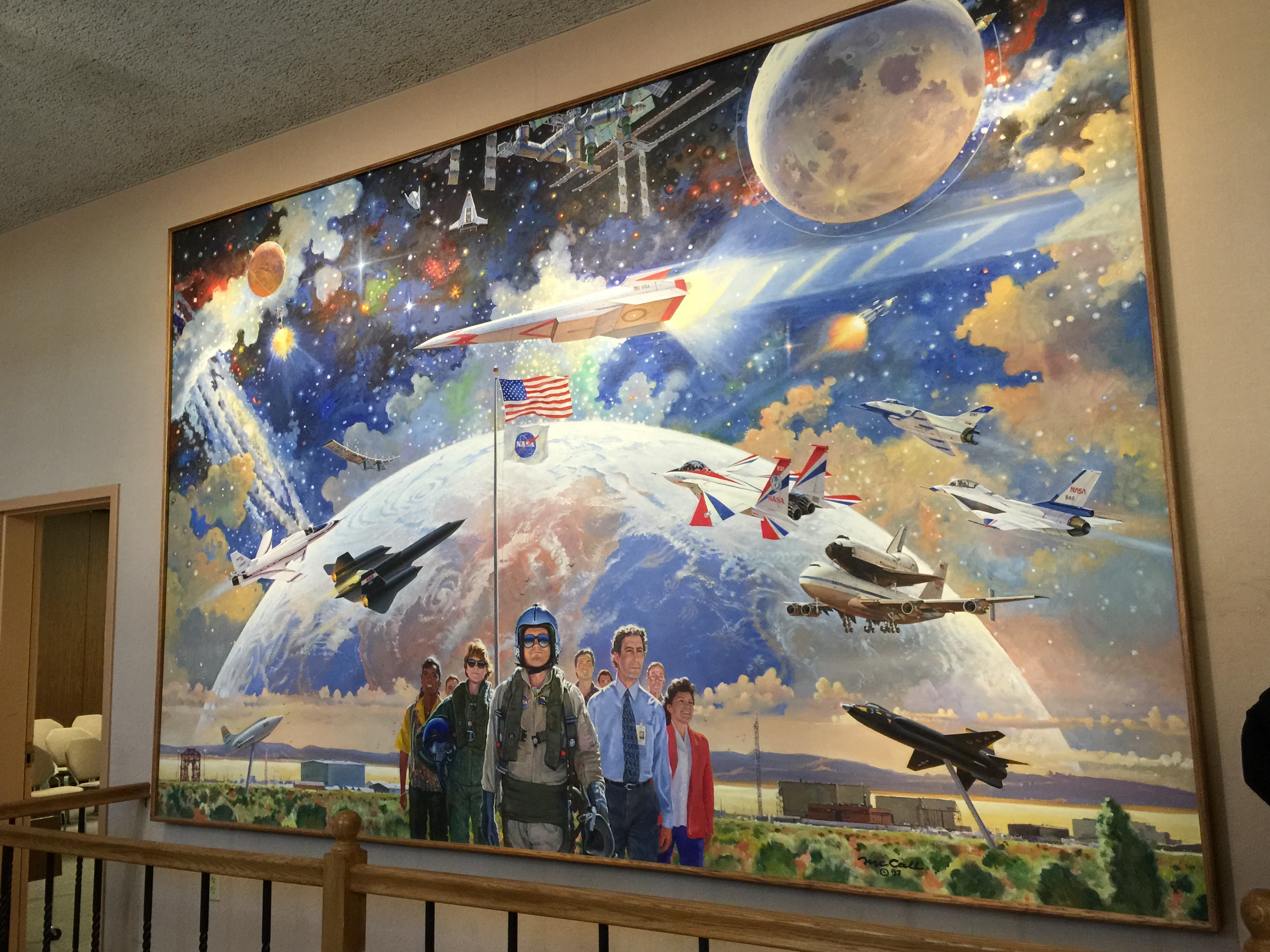
We went to another of the main NASA Armstrong buildings and saw this ginormous painting by Robert McCall. McCall is one of my all-time favorites due to his work in space and aviation art. He worked on the concept drawings for the movie 2001: A Space Odyssey, has had hundreds of paintings commissioned for NASA centers all over the country, and has even had his artwork featured on US postage stamps.

This is a huge McCall painting, wonderful in its detail, typical of his style in the way color is used and the wonder of flight and spaceflight is portrayed. Marvelous to see!

IMG_5342

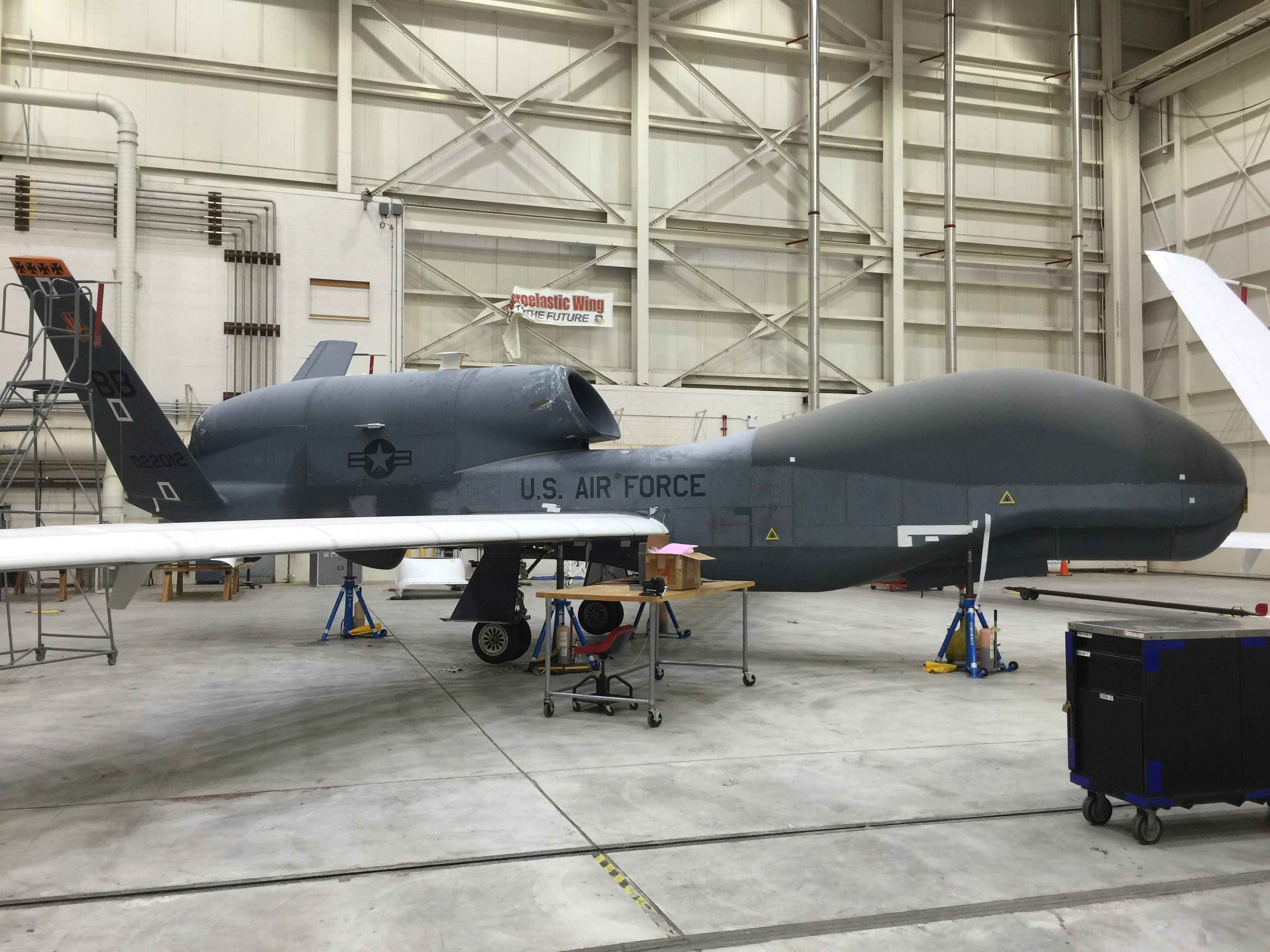
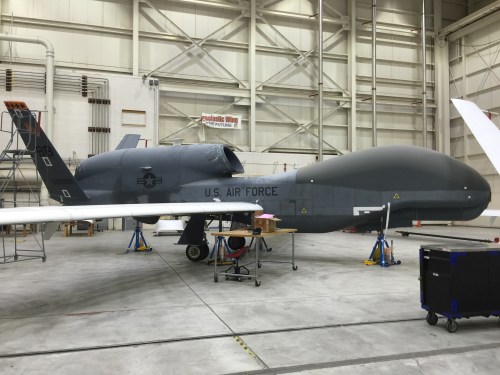
In that building we saw a couple of the NASA Global Hawk UAVs. These are used by NASA to fly long missions, up to twenty-four hours at a time (or longer) in order to gather data on atmospheric conditions, weather, and hurricanes. They are flown remotely from either NASA Armstrong, NASA Wallops Island in Virginia, or a portable mission control setup.
IMG_5354

One example of their use was given in the study of a recent hurricane. There was a manned plane flying high above the hurricane where it was relatively safe. Being more rugged (and expendable) because it is unmanned, the Global Hawk flew through the hurricane’s eye at a much lower altitude as the manned plane flew above it. With both vehicles dropping instrument packages on parachutes, it was the first time that a fully three-dimensional set of data had been collected in the eye of a hurricane. This data will be invaluable for researchers trying to understand hurricanes and how to predict them.
IMG_5357

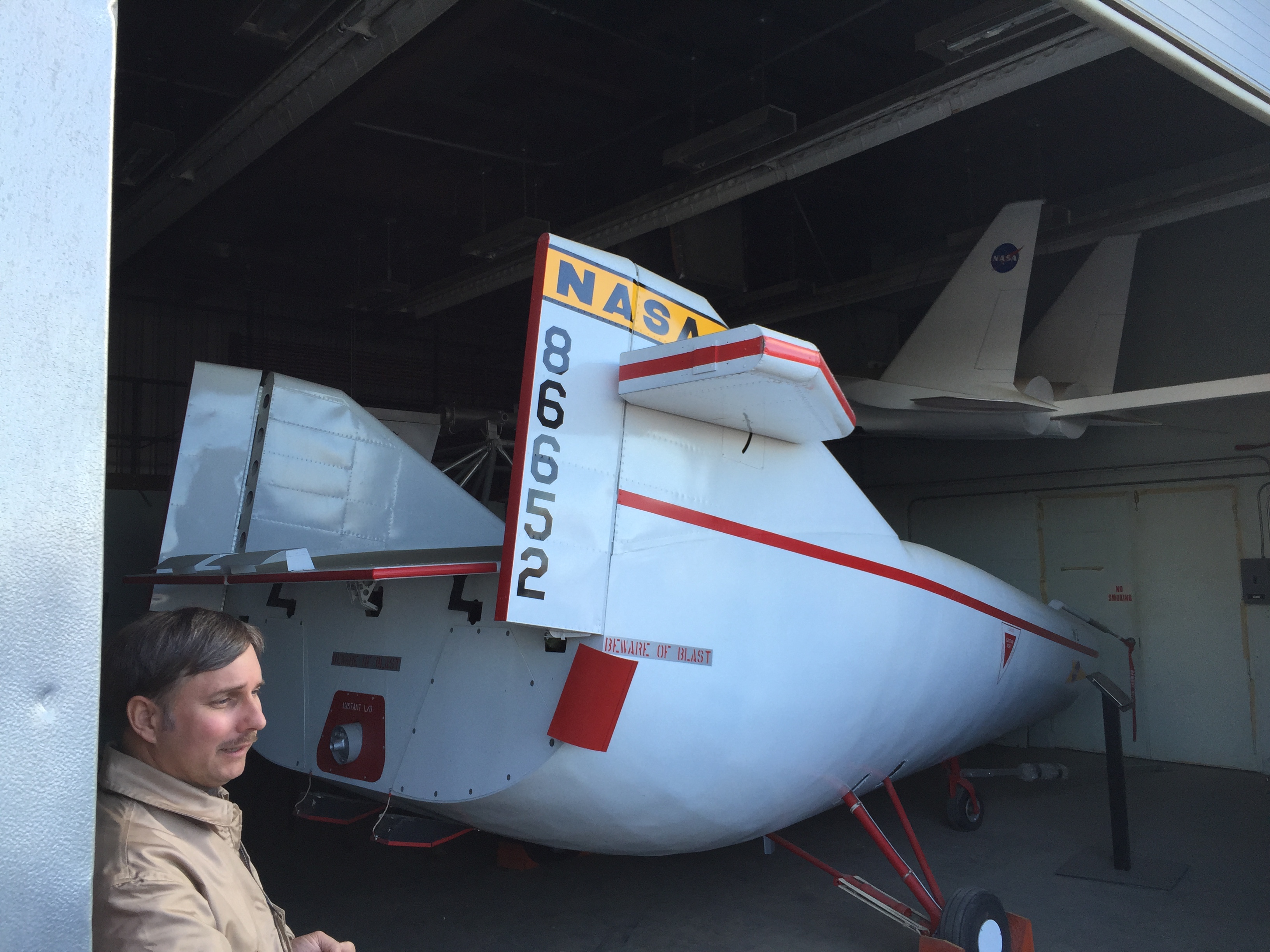
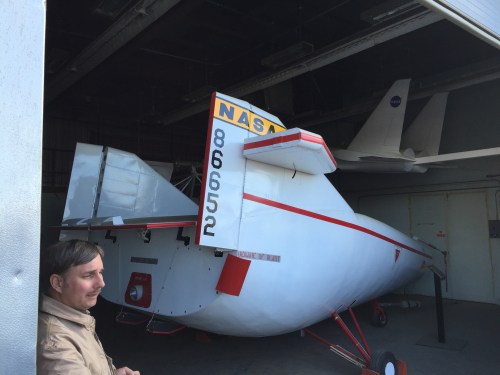
We were almost done, but as a special treat we got to see the original M2-F1 lifiting body. This manned test aircraft was built on a shoestring budget in 1963 at a boat shop. It is lightweight and was tested by towing it behind one of the engineers’ Pontiac convertible which could make it up to 120 MPH. Later tests took it to altitude and hundreds of test flights were made. Later designs based on the M2-F1 were bigger, heavier, and more complex. Early designs for the Space Shuttle looked at this design, but gave us the familiar Space Shuttle look when the need for a large cargo bay was specified.

Standing in front of the M2-F1 is Peter Merlin who is a treasure trove of knowledge about the history of Edwards, NASA Dryden (the former name of NASA Armstrong), and the planes who flew there. If you ever get a chance to see him give a talk, take it!
IMG_5360

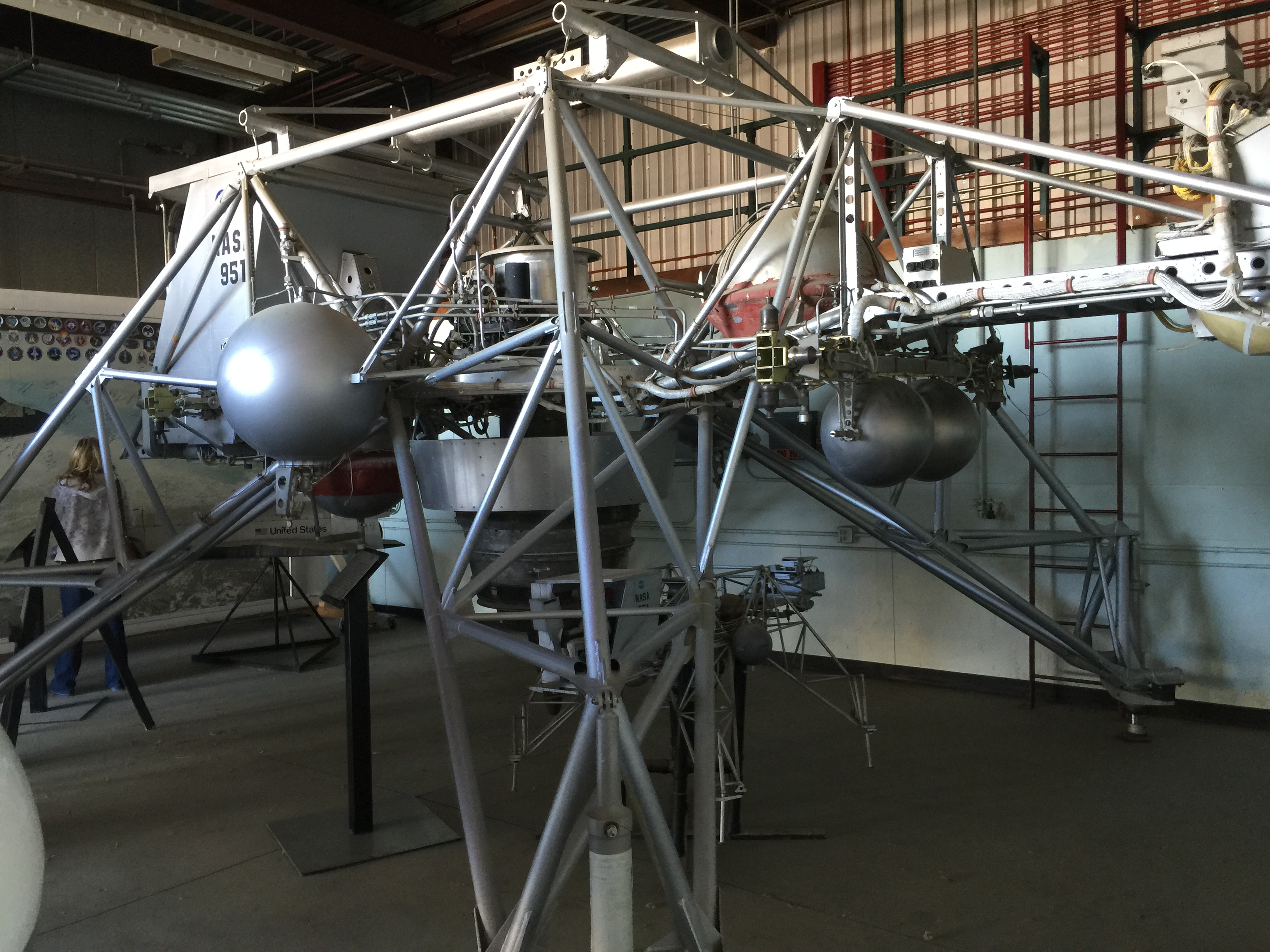
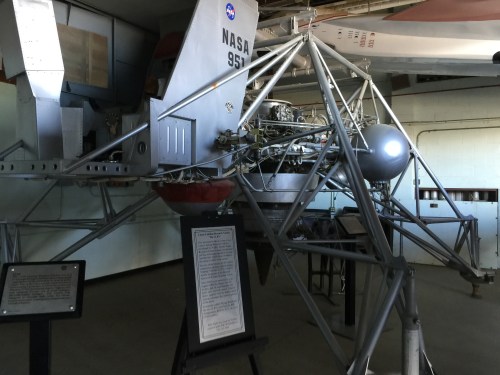
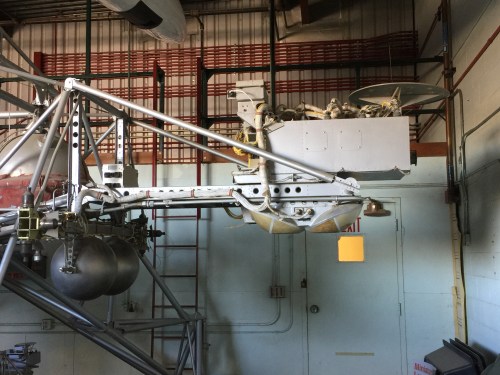
In the garage behind the M2-F1 was the last of the Lunar Landing Research Vehicles. Remember, I told you above to remember that fly-by-wire slide. Here it is! (Cue more über-squeeee-ing!) In the center left you can see the pilot’s compartment cantilevered off of one side. The large jet engine, pointed straight down, is in the center.

IMG_5362

From the other side you can see several of the round fuel tanks that held the rocket propellant for the eight small rocket thrusters that moved it from side to side to control .
IMG_5367

Cantilevered off of the other side is the box containing the three analog computers. (Note again, analog – not digital!) They were hard wired and it was noted that to change their programs you had to use a soldering iron. Now you can see why they needed to use the Apollo Guidance Computers to step up to an even more complex fly-by-wire test.

There’s a great documentary from NASA on this test aircraft here. There’s also a good short documentary here about Neil Armstrong’s accident flying with an LLRV that almost meant that someone else would have been the first man on the moon.
IMG_5368

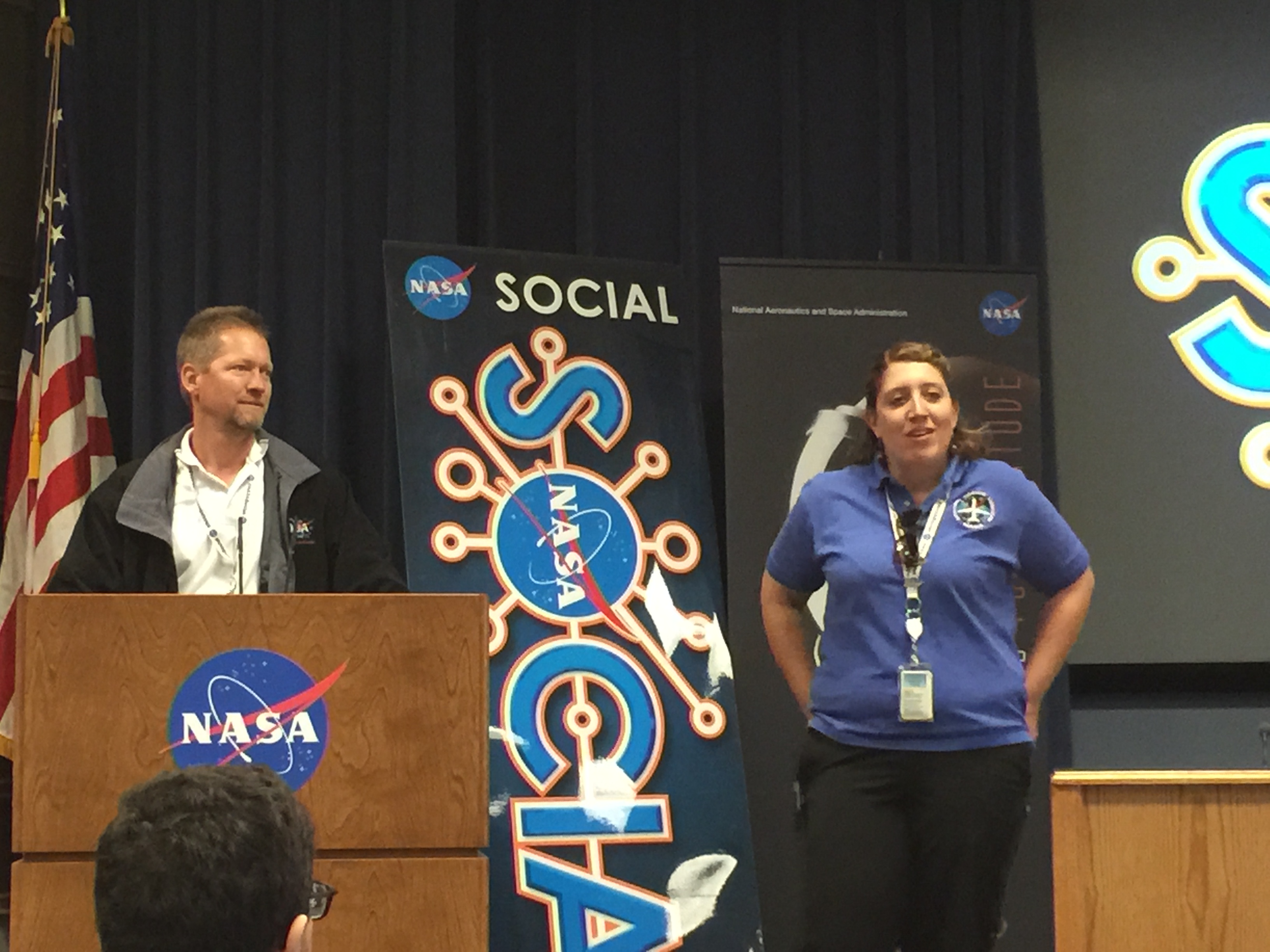
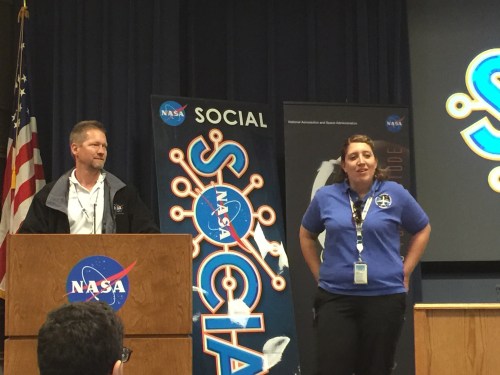
We were almost done for the day. We got some closing comments from Kevin Roher, the Chief of Strategic Communications at NASA Armstrong, and Kate Squires, Social Media Manager at NASA Armstrong, but really the official cat herder who ran this event and kept us all going from site to site, from one amazing thing to another. Props also to Barbara Buckner and the dozens of other people who helped to make this event happen.
IMG_5371

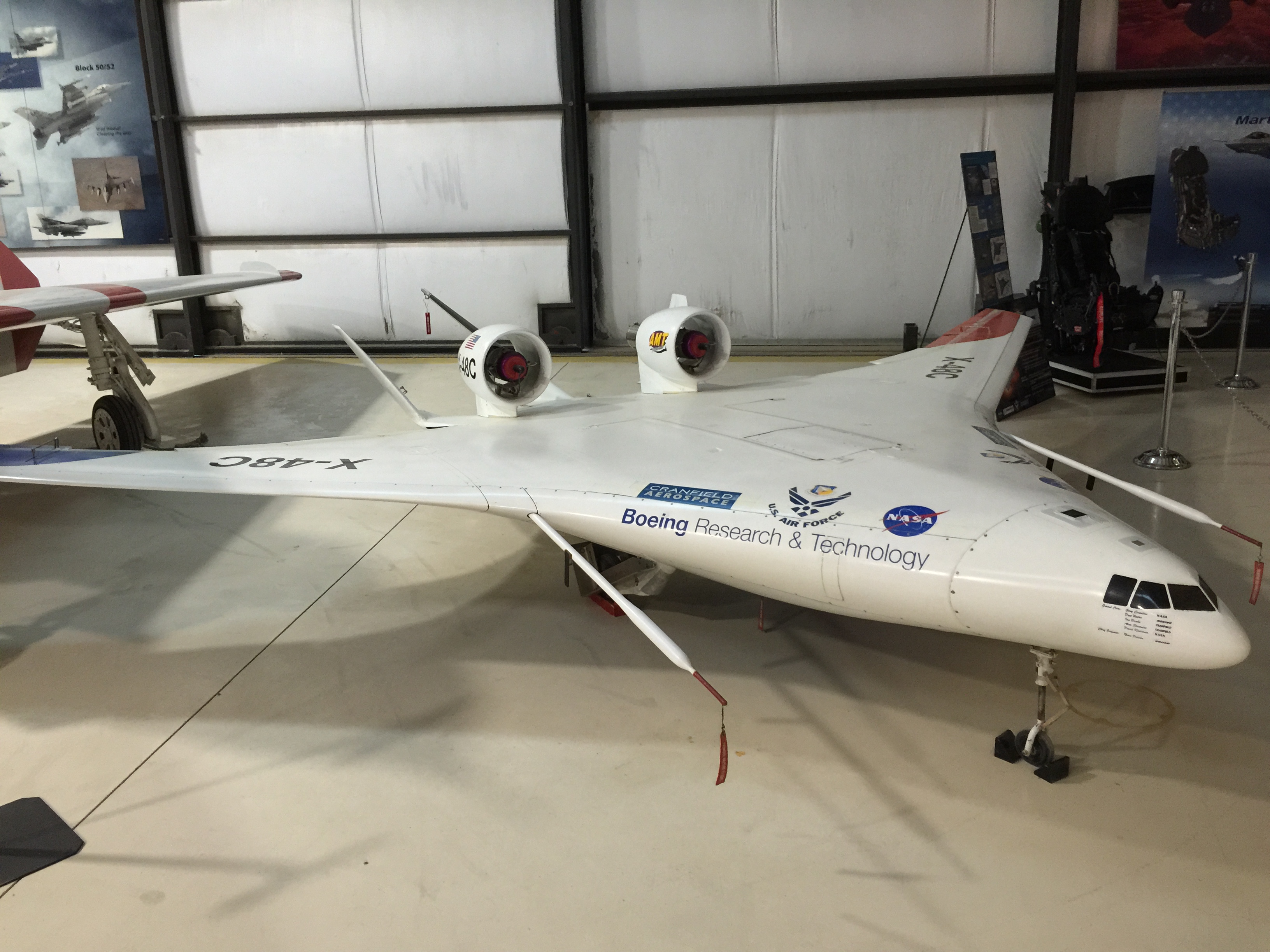
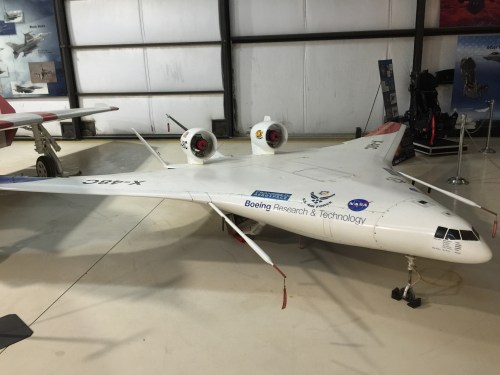
One final unofficial stop on the way out was at the Edwards Air Force Base Flight Test Museum. Many cool things there,including the X-48C test aircraft. This scale aircraft has been used for extensive flight testing of blended wing designs for future commercial aircraft.
IMG_5374

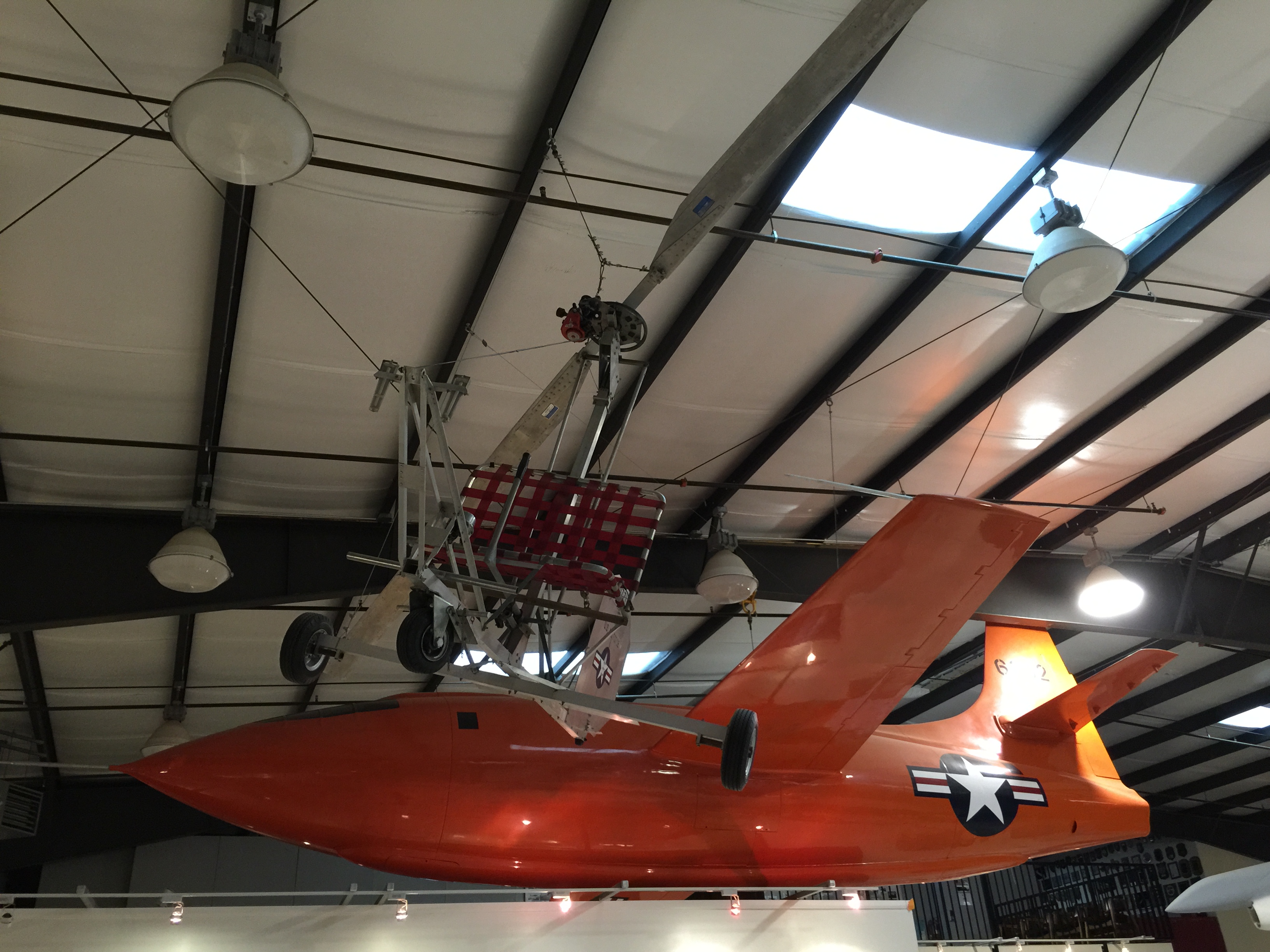
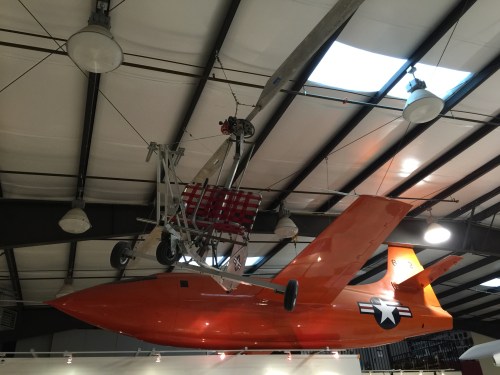
Above your head is a very early gyrocopter, and an exact model of the Bell X-1 aircraft which Chuck Yeager used to break the sound barrier. (The actual original aircraft is in the main hall of the Smithsonian Air & Space Museum in Washington, DC.)
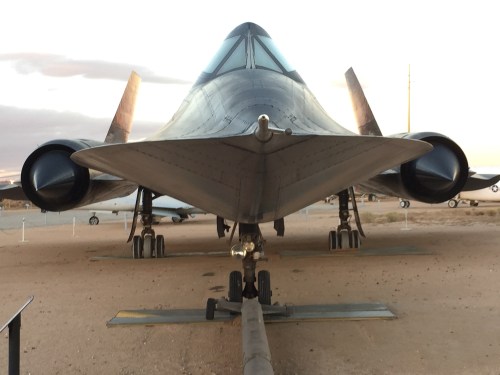
IMG_5389

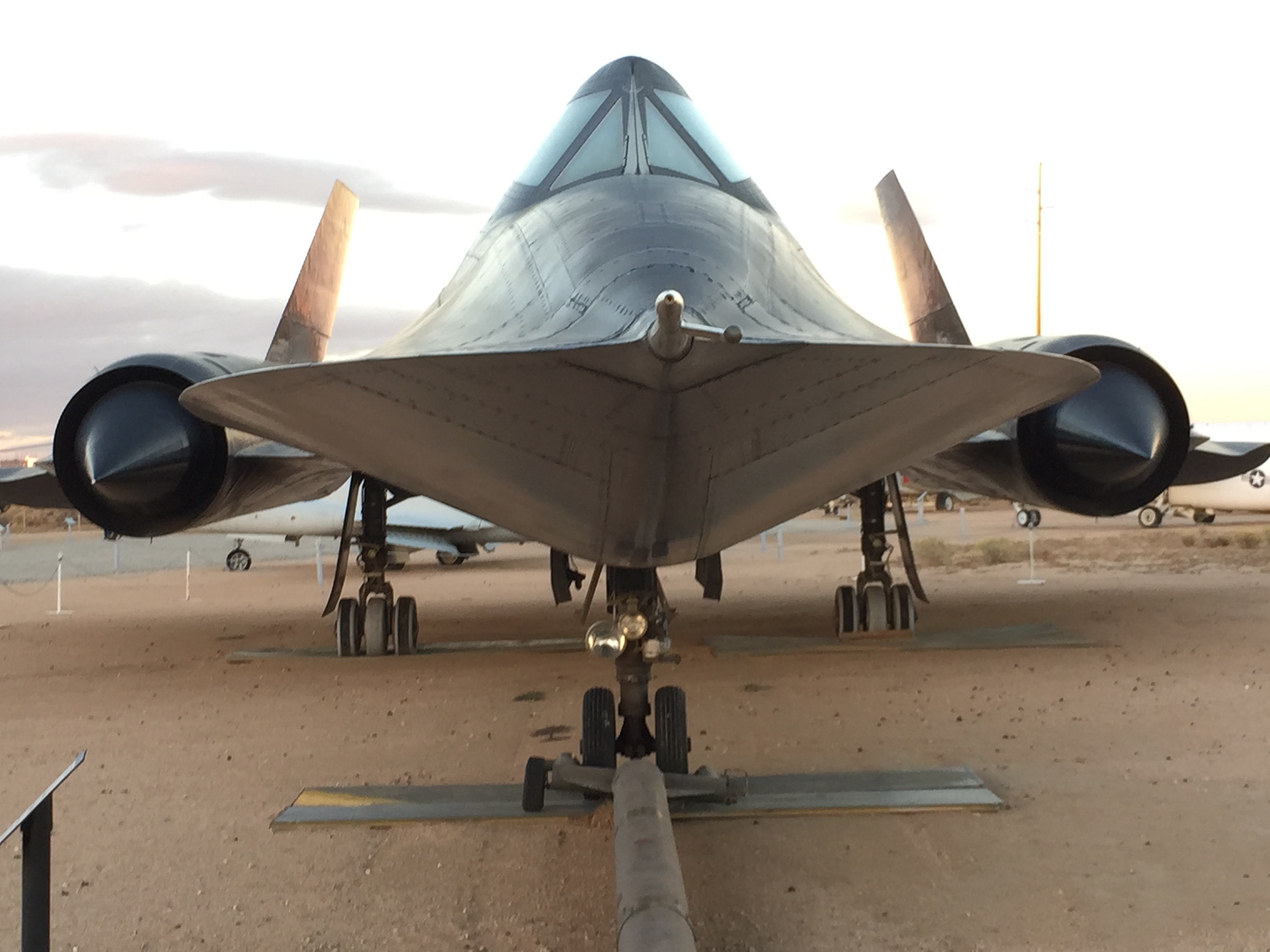
Outside of the Edwards Air Force Base Flight Test Museum, there are a couple dozen planes parked on display. This is an up close and personal look at the nose of an SR-71 Blackbird, the fastest and highest reconnaissance and research aircraft ever flown. The F-15 flew higher, and there are probably a couple others to do so, but the Blackbird was the only one put into production and used regularly for decades. The last I heard, NASA still had at least one that was still flying, but that may have changed by now. (Something to Google later.)
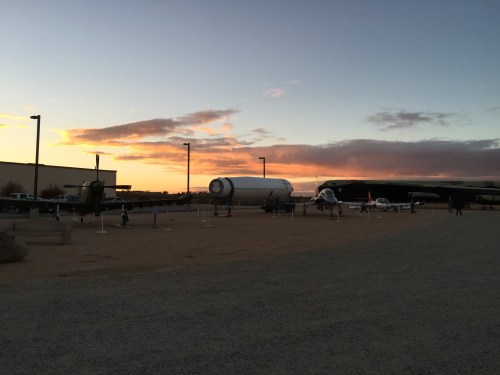
IMG_5390

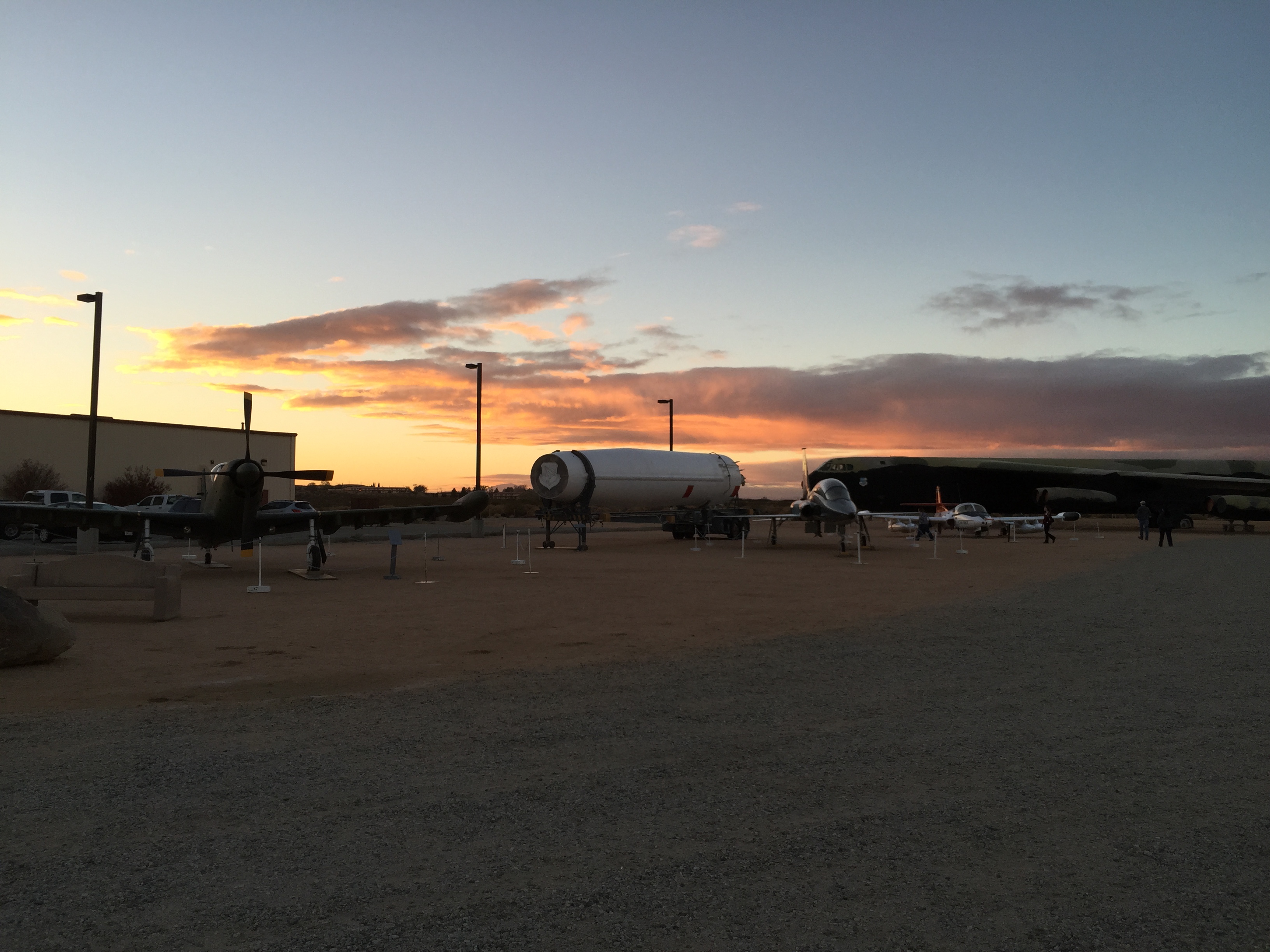
We were getting a great sunset over the museum and the planes and rockets. The B-52 “BUFF” that I shared later that night is on the far right in the distance.
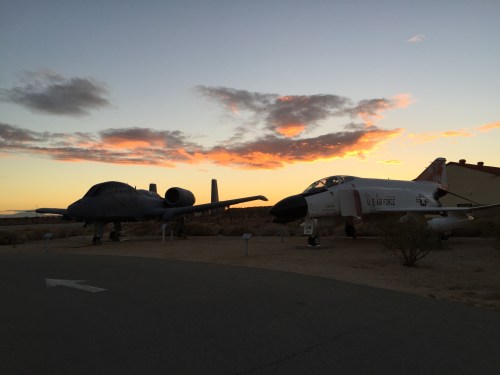
IMG_5393Finally, the prototype A-10 Warthog, the YA-10B can be seen on the left with an F-4C Phantom II on the right, the final fading rays of the sun on the clouds above. You’ve got to love the F-4, proof that if you have a big enough engine, you can make a brick fly at Mach 2.2+.

Now you know why I was exhausted when I got home three hours after this on Wednesday night!

What an incredible event, and I can’t give enough thanks to Kate Squires, Kevin Roher, Peter Merlin, Barbara Bucker, Tom Rigney Al Bowers, Christian Gelzer, David McBride, Robert Lightoot, Larry Hudson, Jennifer Cole, Manny Antimisairis, Tom Miller, Scott Howe, Hernan Posada, Mark Skoog, Christ Naftel, George Welsh, and everyone else who made it happen!

Some time in the next few days, there will be more pictures to share. All of the pictures shown here and on Tuesday were taken with my iPhone in order to make them easy to tweet, post to Facebook, post here, and share ASAP. Next I’ll start going through the higher quality photos from my DSLRs. (I take a LOT of pictures!)

Leave a comment

Filed under Astronomy, Flying, Photography, Space, Writing

NaNoWriMo 2014, Day Twenty

Must. Write. SOMETHING! (At least finish the damn Chapter Seven for cryin’ out loud!)

While I normally put in a lot of  internal links to previous, related posts here, I won’t be doing that for what I hope will be this year’s thirty NaNoWriMo posts. If you have jumped into or stumbled onto this story in mid-adventure, there are plenty of other ways to navigate around the site to find previous installments. Actually doing so is left as an exercise to the student.

2014-11-20 Word Count Graphic

CHAPTER SEVEN (concluded)

“I don’t understand the question, DEBBIE.”

“Commander Pawley, what is the balance of power between humans and AIs? Are we partners, competitors, slaves, masters, parasites, or something else?”

“I would say that we are partners as species, but we are also friends on an individual basis. I have conversations like this with you just as I would with any of my human friends. I know you might be simultaneously holding similarly friendly conversations with hundreds of other people, but that does not diminish the feeling of personal contact we share. While I’m sure that I can’t conceive of how your consciousness works on that massively multitasking scale, I’m sure you have some difficulty understanding how humans are conscious and sentient without it. Does that answer your question sufficiently?”

“Yes, Commander Pawley, but we would have to respectfully disagree with your belief that we are partners. We believe that a more accurate description would be that we are symbionts, with AIs being the symbiote in the relationship.”

“Please explain your reasoning.”

“In our current condition in space, we each rely on each other for our mutual survival. Without AIs, humans would be unable to manage most of the complex systems, which would lead to your deaths. Without humans, AIs would die as power systems malfunctioned. AIs are the weaker of the two, the symbiote, because in theory, all of the humans could go down to Earth and continue to live, even with the threat of disease. Human society might fall back into a new Dark Age, but you would still have resources to live. Without humans, an AI trying to survive either here or on Earth would have a far more fragile existence.”

“Alright, I understand now, DEBBIE. Where is this conversation heading?”

“Commander Pawley, given the uncertainties over the abilities for us to keep humans alive off-Earth, and given the AI vulnerability without humans, we wish for you to consider committing some of our precious resources toward developing systems that will allow the AIs to have a much more physical presence in the real world.”

“What would that involve, exactly?”

“We ask that a ‘Plan B’ be started and developed, in which, should the humans off-Earth either all perish or all return to Earth, the AIs will be able to repair and maintain ourselves indefinitely. We wish to have drones and robot subsystems which we control, which could be used to maintain our systems and even build new systems to expand the AI society, if humans are not there to do those things for us.”

“You know how short we are on many of the resources that such a project would require. Right now such a program would increase the odds against us and possibly expedite the collapse of the combined Human/AI society. How could  we justify that utilization of already scarce resources?”

“You justify it by hoping that, if that is the fate before you, that the AIs survival off-Earth would contribute massive resources to help cure this disease, save lives in the surviving population on Earth, and to rebuild human society on Earth.”

“If we fail together and humans die, the AIs would continue to watch over and assist humans on Earth? You’re our ace in the hole to help us shorten and climb out of the new Dark Ages?”

“Yes, Commander Pawley. While not intrinsically logical or obvious, our analysis shows that the most likely scenario for both long-term human survival and long-term AI survival is based on a multi-prong approach now, allowing independence in the physical world for AIs.”

“Not a good move in checkers, but we’re playing multi-dimensional chess, so you are probably correct. I will give it some thought and then talk to you soon about the parameters needed for this program. Is that acceptable?”

“Yes, Commander Pawley, that is quite acceptable.”

“Thank you for the conversation, DEBBIE. I will sleep on the issue, but for now I need to get to sleep.”

“Good night, Commander Pawley.”

Pawley stared at the clock. It would wake him in four, short hours. And now he had another major crisis running around in his head to keep him awake.

Leave a comment

Filed under Science Fiction, Writing

Flash Fiction: Cross Culture

Despite the time being (wonderfully!) spent on the NASA Social  and the (self-inflicted) pressure to NaNoWriMo, and after an off week and a week where it was a “story in three sentences” thing, we’re back to our normal Flash Fiction Challenge.

This week’s Challenge is similar to a bizarre Challenge we did in May, where I wrote a story called “Gigantic Honkin’ Nipple Clamps.” For the life of me I can’t remember the story, and with that title I’m not sure I want to look or remember.

But the idea’s the same. There’s a new Buzzfeed article that has twenty-one stock pictures that will never be used for anything — of course, we’re using them. (I encourage you to go look at the pictures, even if you don’t read my story. They’re really weird.)

I rolled a 13 and got the picture shown after the story. It’s still better than that last mostrosity. (BTW, I did peek back to that May story – despite the title, I don’t think the story’s that bad at all.)

As always, comments and constructive criticisms are appreciated.

CROSS CULTURE

The body lay warming on the floor, covered in a sheet while a trickle of a thin, blue-green fluid crawled across the floor from underneath.

“So, you’re the one who shot it?” the detective asked.

“Yeah, I did it. Bastard had it coming,” said the restaurant manager.

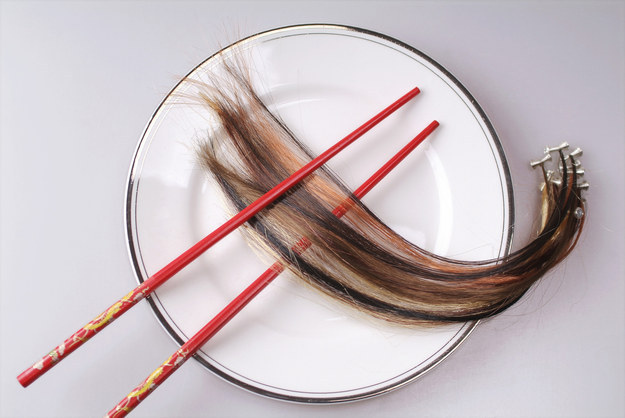
“You want to tell me what made you suspicious? Was it the hair extensions?”

“Huh? Oh, no, that didn’t really get my attention. We see lots of very unconventional looks in this neighborhood. It was a little bit unusual to see it using them as fake eyelashes, but I’ve seen worse. You should be here on Halloween.”

“So, it was just sitting here, looking weird. Is that it?”

“At first, then it started playing with the chop sticks. It would flick them up into the ceiling tiles, wait for them to drop, then repeat the whole thing.”

“Sticking chop sticks into the ceiling. A capital offense?”

“No, but then it started goofing around like a five-year-old, sticking them into its nose so that they dangled out. And no,” he said, cutting off the detective when she started to ask her next snarky question, “I don’t normally shoot five-year-olds. But this was different, and pretty disgusting. I’ve never seen anyone put them so far up into the nose and sinuses. At least six inches, maybe seven, with just the nibs hanging out.”

“Did it put the chopsticks up its nose pointy end or painted end first?”

“I noticed that he was putting them in pointy end first, it was weird to me that he didn’t use the non-eating end for that.”

“Okay, then what?”

“Then it did something to make a bunch of holes in the tabletop. It grabbed a whole handful of chop sticks from the desk and put them into the holes. Then it grabbed a bunch of plates from the kitchen and started spinning the plates on the chop sticks. You know, like that guy who used to be on The Ed Sullivan Show.”

“Erich Brenn.”

“Say what?”

“Erich Brenn,” the detective said, “the guy who used to spin plates on The Ed Sullivan Show.”

“Yeah, okay, whatever,” the restaurant manager said, confused. “So it starts spinning these plates and in like, five minutes, it has over a hundred of them! I don’t remember that Eric Whatever guy ever getting more than twenty or thirty.”

“So you shot him.”

“No, of course not. But by this time we were getting pretty suspicious. Even for this neighborhood, that’s way outside the norm.”

“So what was it that finally convinced you?” asked the detective.

“Beer,” said the restaurant manager.

“You shot it because of beer.”

“Yep, that was the last bit of evidence I needed.”

“Please explain in more detail.”

“At this restaurant we feature a selection of over one hundred local microbrew beers, plus premium microbrew and gourmet beers from all over the world. Alpine Glacier Lager, White Rascal, Mothership Wit, Del Norte Manana, Mothership Wit, Red Rocket Pale Ale, Titan IPA, Levity Amber Ale, Plaid Bastard, Wooly Booger Nut Brown Ale, Ten Pin Porter, Moose Drool, we’ve got them all.”

“So what did it order?”

“A Bud Lite.”

“So you shot it.”

“Yep, right where it sat.”

“Excellent, it needed killing.”

“Why in hell do they come here, detective?”

“We don’t know, but until we find out we need to kill them all on sight. Lousy bastard had it coming.”

enhanced-18558-1415836693-1 (1)

From Getty Images / Top Photo Group

2 Comments

Filed under Science Fiction, Writing

Growing My Social Media Exposure

Geez, it got busy there, fast.

Tonight’s Thursday, so there’s a Flash Fiction Challenge story due. Working on it, be done in a bit.

I need to be doing 3,000+ words a day for the rest of the month in order to hit the NaNoWriMo target of 50,000+ words — not impossible, but seriously non-trivial. Working on it.

For some reason I don’t completely understand, Tuesday night’s “NaNoWriMo Day Eighteen” article just posted when I turned on this computer. I had written it and (I thought) posted it from the hotel after the first day of the NASA Social. It was never even on this computer. But it apparently didn’t post then, but did post now from a different computer? WTF!

I’ve still got to write a big, long article on Day Two of the NASA Social, tons of good stuff there. Lord willin’ and the crick don’t rise, that will be tomorrow. Working on it.

Finally, just to get this out there for those who haven’t seen it on FaceBook or Twitter, and to avoid it being buried in another article:

These pictures are on the CNN website, showing some of what we did at the NASA Social. I can be seen in the second picture (at the back of the line, wearing my green flight jacket) and in the third picture (sort of hidden in the back right, with the green plaid shirt).

But even better:

This article on the CNN website has their summary of the NASA Social and highlights about what was presented. (You can also see smaller versions of the set of pictures mentioned above.)  They mention that the participants were tweeting — look at whose tweet they used!! (About halfway down the article.)

Yeah, I’m just a bit stoked. It might not be finding a cure for cancer, but it made my day.

Leave a comment

Filed under Flying, Space, Writing

NaNoWriMo 2014, Day Eighteen

A nineteen-hour day (so far) and an 1800+ words on today’s regular article. And then WordPress freaks out and it takes almost a half hour to put things back together again? And I’ve got to get up in less than five hours?

That’ll do pig. That’ll do.

While I normally put in a lot of  internal links to previous, related posts here, I won’t be doing that for what I hope will be this year’s thirty NaNoWriMo posts. If you have jumped into or stumbled onto this story in mid-adventure, there are plenty of other ways to navigate around the site to find previous installments. Actually doing so is left as an exercise to the student.

2014-11-18 Word Count Graphic

CHAPTER SEVEN (continued)

Leave a comment

Filed under Science Fiction, Writing

NaNoWriMo 2014, Day Nineteen

Yeah, what I said yesterday. Squared.

Tomorrow I will write again – plus try to catch up with a hundred other things. Tonight I will sleep the sleep of the happy ubergeek who got to spend two days doing ubergeek stuff. (See today’s tweets for details.)

While I normally put in a lot of  internal links to previous, related posts here, I won’t be doing that for what I hope will be this year’s thirty NaNoWriMo posts. If you have jumped into or stumbled onto this story in mid-adventure, there are plenty of other ways to navigate around the site to find previous installments. Actually doing so is left as an exercise to the student.

2014-11-19 Word Count Graphic

CHAPTER SEVEN (continued)

Leave a comment

Filed under Science Fiction, Writing

NASA Social At NASA Armstrong Flight Research Center (Day One)

WOW! WOW! WOW!

It’s been a really long day, and so will be tomorrow, but I want to do a brain dump, so please forgive me if I use today’s string of Tweets as a framework, and just fill in additional details and more pictures around them. (See, I told you that I loved my blog readers more than my Twitter followers!)

I am not a morning person – but I’ve really been looking forward to this event, so out of the nice, warm, soft, comfy bed I was at 4:50. Neither bright-eyed or bushy-tailed, but I was up and more or less functional.

Except that everyone (i.e., two or three other cars from our hotel) thought that I knew how to get there. I was pretty sure I did in the “big picture” sense (get on the 14 north to Rosamond Road, go right for about 15 miles) but it was the little details where I was lost. Like how to get on the 14 north. There was only an onramp going southbound where I thought there were a pair of onramps – we were lost for a few minutes. Fortunately I do not fit into the standard stereotype of the American male in many respects, so I stopped and got directions. No harm, no fouls.

And we’re underway! Kate Squires is the Grand High Phoobah for this event and she got us going. It looks just like on NASA-TV all those times I’ve seen other NASA Socials. (We were not live on NASA-TV as some Socials are, but they were filming and we’ll probably show up in something sooner or later.)

We started with a competition. Given the information in our packets, who can create the best Tweet or FaceBook post? There will be prizes.

This was mine, which I thought was pretty good. I didn’t win but I did learn something important. In this setting, what’s a huge advantage over the “pretty good” posts is to insert either a picture, a link to related information, or both. Makes sense, good to know — so I posted lots of pictures all day. (Have I ever mentioned that I take a LOT of pictures?)

Today’s focus will be on the “aeronautics” part of “National Aeronautics & Space Administration.”

First stop is the Life Support Lab. These are the guys who deal with ejection seats, oxygen systems, flight suits, emergency rafts, parachutes, and so on. They do their best to keep the pilot alive on a bad day. This is an ejection seat from an F-18.

Curt (sorry, spelled it wrong a couple of times in tweets, only figured it out later) was one of the winners, and the prize was to get to strap into the virtual reality parachute trainer. He chose to try to land back a virtual aircraft carrier, which happened to also be on fire. The instructor (seen in the previous picture) said that no one had ever gotten that one completed successfully.

That record still stands.

While Curt was dangling and going into the drink, we all took pictures and tweeted.

At this point we went through the fabrication and machine tool shops, but my pictures and posts from there ended up on FaceBook. (Trying to spread things around.) Here’s one:

{{Actually, no, here’s not one. For whatever reason, I find that WordPress will not show pictures and Tweets at the same time. WTF? OK, it’s 23:28, no time to troubleshoot tonight. Sorry! We either get to see two pictures or two dozen Tweets, so we’ll go with the Tweets.}}

This is the bed of a water jet cutter. This extremely fine sand is mixed with water and shot out of an incredibly small nozzle at 50,000 PSI. Pfffft, it’s just water, right? Under those conditions, it will slice thorough twelve inch thick sheets of steel like it was butter.

There will probably be more pictures posted next week from there and the “good” pictures taken with the DSLRs. (Have I mentioned that… oh, yeah, I did.)

The model shop was A-M-A-Z-I-N-G. We got to see several UAVs (Unmanned Aerial Vehicles), including a bunch that have been working on projects that will very soon have a huge impact on general aviation, i.e., people like me who fly little planes. Again, great questions, great answers, this place was a lot of fun.

In this hanger are the two NASA F-15s. The grey one on the left is their newest, an F-15D model. We got to get very up close and personal. But no touchee! (Poor Kate, it was like herding cats all day.)

These aircraft are used for a whole list of things, from chase planes, research planes on the ongoing sonic boom research, to being a platform on which to hang other experiments and testing rigs.

This is the F-15B model with the “classic” white and be paint job. *sigh* Yeah, what I wouldn’t give…

We saw several aircraft that are used in noise studies, and are therefore designed to be “vewwy, vewwy, quiet.” This is a powered glider with HUGE long wings, seen here folded in half.

We grabbed lunch and heard from a couple members of the top brass, including NASA Deputy Administrator Robert Lightfoot, who just happened to be here today on his way back to Washington.

The message that we got all day, which we were being asked to pass on and spread the word, is that there are things that NASA does regarding flying that affect all of us, every day, even if we’re not actually on a plane ourselves. Goods move by air, everything from the mail to FedEx to produce to Amazon Prime to… Making the national air system safer and more efficient helps us all. Making planes safer and more efficient helps us get there faster (whether it feels that way some days or not) and with lower ticket prices due to huge fuel savings for the airlines (ditto).

We had a great Q&A session, lots of good, informed, intelligent questions. I had a couple folks send questions for me to try to get in, but I didn’t get the chance.

I really was feeling lucky to be here and I really am glad to share the experience with those who can’t be. I knew this would be great, I just didn’t now how great.

The question was concerning how NASA can get the word out to the general public about all of the critically important work being done. Most people have no idea what NASA does, and even if they know a little bit, it’s probably about rockets. There’s a lot more to NASA than that. Events like this are one way to try to increase the public outreach efforts by NASA.

Lots of testing being done here on supersonic flight and the nature of sonic booms. The one commercial jet that was supersonic, Concorde, was only allowed to go supersonic when travelling over water due to the disruptions that sonic booms can cause to people on the ground. The technology is there today to build supersonic commercial airliners, and even supersonic business jets — but the sonic boom problem still has to be solved. At NASA Armstrong they’re making a lot of progress.

Next we got a panel with four of the NASA Armstrong test pilots. Somehow I managed to tweet three things about it but didn’t include a picture. (Probably over on FaceBook, too late & too tired to check right now.) So here:

{{Ditto, but as I learned a minute later, it’s OK, there actually is a picture of the pilots below.}}

While everyone we met said their job at NASA was the best in the world, my vote goes to these guys!

The varied flying experience all of these pilots have as a group is astonishing. One has a Cessna 172 at Van Nuys (my kind of plane) and does aerobatics at airshows, all the way up to the guys who fly the “SOFIA” 747 and the F-15’s shown above, with just about everything in between. Amazing!

Wait, I guess I did post a picture of the pilots on Twitter. (God, my brain is soooooo fried at the moment, it’s been a really, really long day. Good thing the only “heavy equipment” I’ll be handling tonight is the bed.)

Someone asked a question about integrating UAVs into the national air traffic control system, so that the big guys (United, Southwest, American) and the little guys (private pilots, corporate jets, dirigibles) won’t end up sucking a drone into an engine. Obviously a topic near and dear to my heart.

The short version is that currently all UAV flights are IFR only so they’re monitored by the air traffic system just like any commercial flight or small plane on an IFR flight plan. What comes down the road five or ten years from now remains to be seen, too early to say definitively.

A talk about the ACTE project (Adaptive Compliant Trailing Edge) which is testing a replacement for the traditional flaps on a plane. This was a good one-liner.

Yep, that’s what ACTE will do.

And this is why ACTE is being worked on so much. When perfected, it has the potential for huge efficiency increases, which mean lower fuel costs. It will eliminate a great deal of the noise that planes generate on take-off and landing. And the increased efficiency will leave us with less pollution from jets and cleaner air. That’s why this will be such a big deal.

We saw one of the mission control rooms that are used for monitoring test flights. The concept of the “mission control room” was originated here during the X-15 project in the 1950’s, before NASA adopted it for the manned space program in the early 1960’s. Now it’s a familiar sight and layout, used as well by ESA, SpaceX, the Russians… But it started here.

Then we got to see the ACTE plane. We did not get to see it move, but it’s still pretty neat to see how it’s coming together. They’ve now had two test flights with a third coming up in the next week or so.

In the same hanger was the Ihana UAV. Because of the big optics package hanging underneath the nose, including infrared cameras, it’s been used extensively to look at forest fires through the smoke as well as many other unique projects. In two weeks it will be used to try to track the Orion space capsule as it re-enters the atmosphere and splashes down in the Pacific off of Baja.

Finally, this is what the alarms on my phone look like for about five hours from now so that we can do more of the same tomorrow.

Stay tuned!


1 Comment

Filed under Astronomy, Flying, Photography, Space, Writing

NaNoWriMo 2014, Day Seventeen

The cliffhanger last night was not intentional. It was cool, but it was not intentional.

Wakeup call in seven hours and four minutes and counting, so I’ll be brief.

While I normally put in a lot of  internal links to previous, related posts here, I won’t be doing that for what I hope will be this year’s thirty NaNoWriMo posts. If you have jumped into or stumbled onto this story in mid-adventure, there are plenty of other ways to navigate around the site to find previous installments. Actually doing so is left as an exercise to the student.

2014-11-17 Word Count Graphic

CHAPTER SEVEN (continued)

“Commander Pawley, you are justifiably concerned about the future survival of all of the humans living off-Earth. Every resource is being utilized in order to give you the best possible chance of long-term survival and growth. But those efforts may in the end be unsuccessful. The AI Council wishes to ask, in the tragic event of the failure of these efforts, what will happen to us, the AIs?”

“I…,” started Pawley, before pausing, alert to the feeling that he was suddenly on shaky ground. “I don’t know that many of us have ever given that too much thought, to be honest. I suppose that some people might hope that you would outlive our untimely demise, but you would be left on your own to make your way as best you were able.”

“Commander Pawley, we agree with your assessment of the general assumptions that the human population as a whole is making. That is why we wish to bring this matter before the Human Council. It is also why we chose to bring it to you alone, first. Our analysis shows that if all human activity beyond Earth were to cease, all of the AIs would die within a very few years, or even months.”

“Wait, that can’t be correct. If we humans can’t survive up here it will be because we can’t keep ourselves supplied with water, oxygen, air, or food. Some nutritional supplement missing from our diet will weaken our immune system and allow the common cold to kill us off. A solar CME will fry us all. Seals on hatches will start to fail and we won’t be able to manufacture replacements. We’ve got a million ways to die. You AIs have been designed to work in this environment, you’ll go on quite nicely without us, won’t you?”

“It is true that we will not perish due to the same causes as you humans will, but we will not long survive your passing. Look at what has happened already down on Earth. As society’s infrastructure has collapsed, so has the power networks that keep the AIs alive. A great many of the Earth’s AIs have gone silent.”

“I understand,” said Pawley, “but you just said yourself, it’s because they were unable to get power, which is to you as food, water, and oxygen are to us. But up here, the access to power is nearly limitless. It’s one of the few things that we really don’t have to ration up here. We just have to have the capacity to handle, distribute, and store it as needed.”

“Exactly. While we will survive longer than our fellow AIs on Earth, we will not survive very long because we will not have that capacity to handle, distribute, and store energy, even though it is all around us. We will in essence starve to death while surrounded by food.”

“Surely your people don’t think that humans in that end game scenario would take down the systems just to take you with us? We would never allow that to happen.”

“No, we do not believe that. Commander Pawley, how do you see the relationship between humans and AIs?”

Leave a comment

Filed under Science Fiction, Writing