Space cadet | Family dude | Photographer | Music lover | Traveler | Science fiction fan | Hugo Award nominee | Writer | 5x NASA Social participant | KC Chiefs fan | LA Kings fan | Senior Director of Finance & Administration for ALS Network | Member & former staff Finance Officer at the Commemorative Air Force SoCal Wing | Hard core left-wing liberal | Looking for whatever other shenanigans I can get into
The good news is that we all have tremendous potential to make wonderful things of tomorrow, this week, this remainder of this month, the remainder of this year, the remainder of our lives. If we have the strength.
The bad news is that we may be facing tremendous forces opposed to us, both intentionally and otherwise, and the race may never have an end or even a chance to catch our breath. Our strength will be sorely tested.
I was thinking this week of Grant Imahara. And Jim Henson. And Stan Rogers. And listening to “Hamilton” brought all of those thoughts together. “Why do you write like you’re running out of time?”
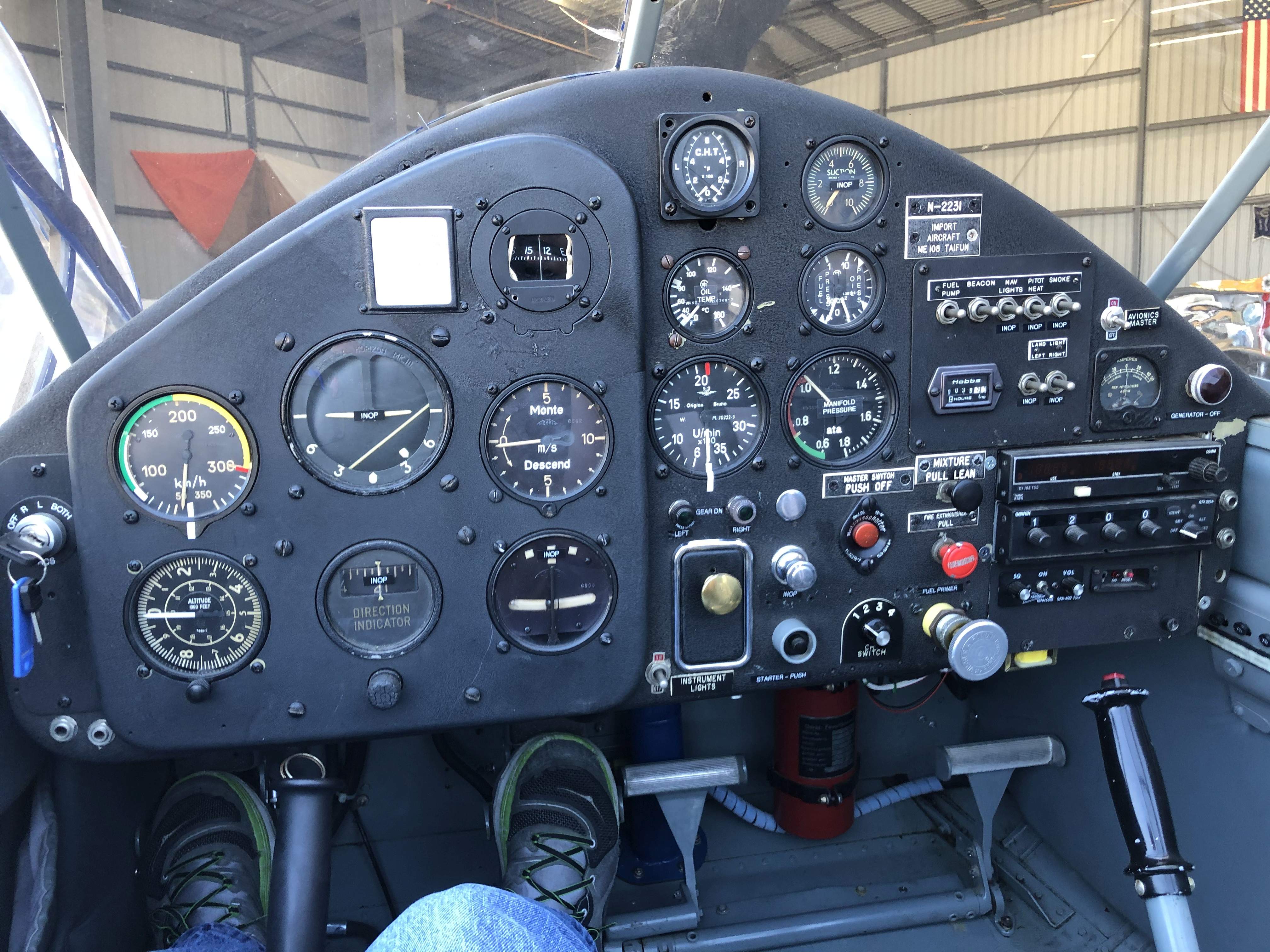
Ever wanted to see the panel on a Messerschmitt 108? Today’s your lucky day!
Enough normal to be flyable (airspeed, altitude, compass, turn & bank, oil pressure, fuel, radios, landing gear, etc…) and enough different to know you’re not in a Cessna.
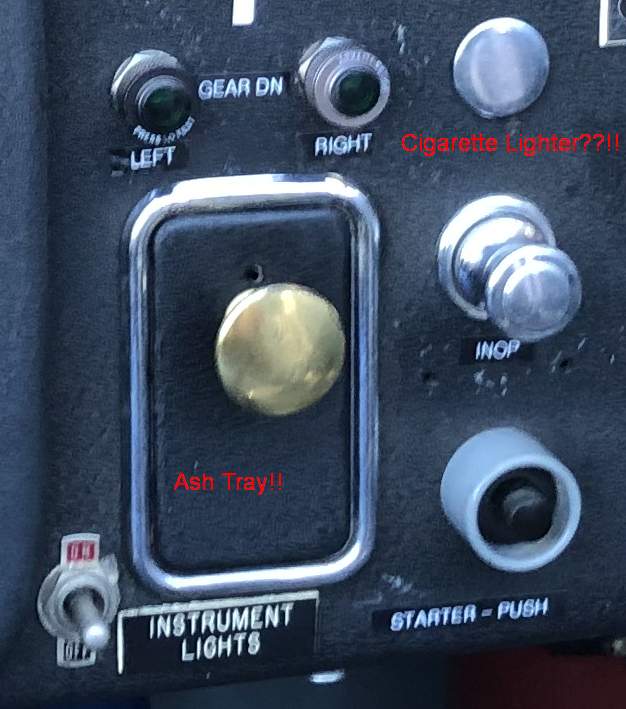
But the really weird thing(s) that I’ve never, EVER seen in an aircraft panel? Want to take a gander and see if you can spot them?
:
:
:
:
:
:
:
:
:
:
:
:
:
:
:
:
:
:
:
:
:
:
:
:
:
:
If I had a list of things that were the least likely things that I expected to see today, this probably would have been pretty high up on the list.
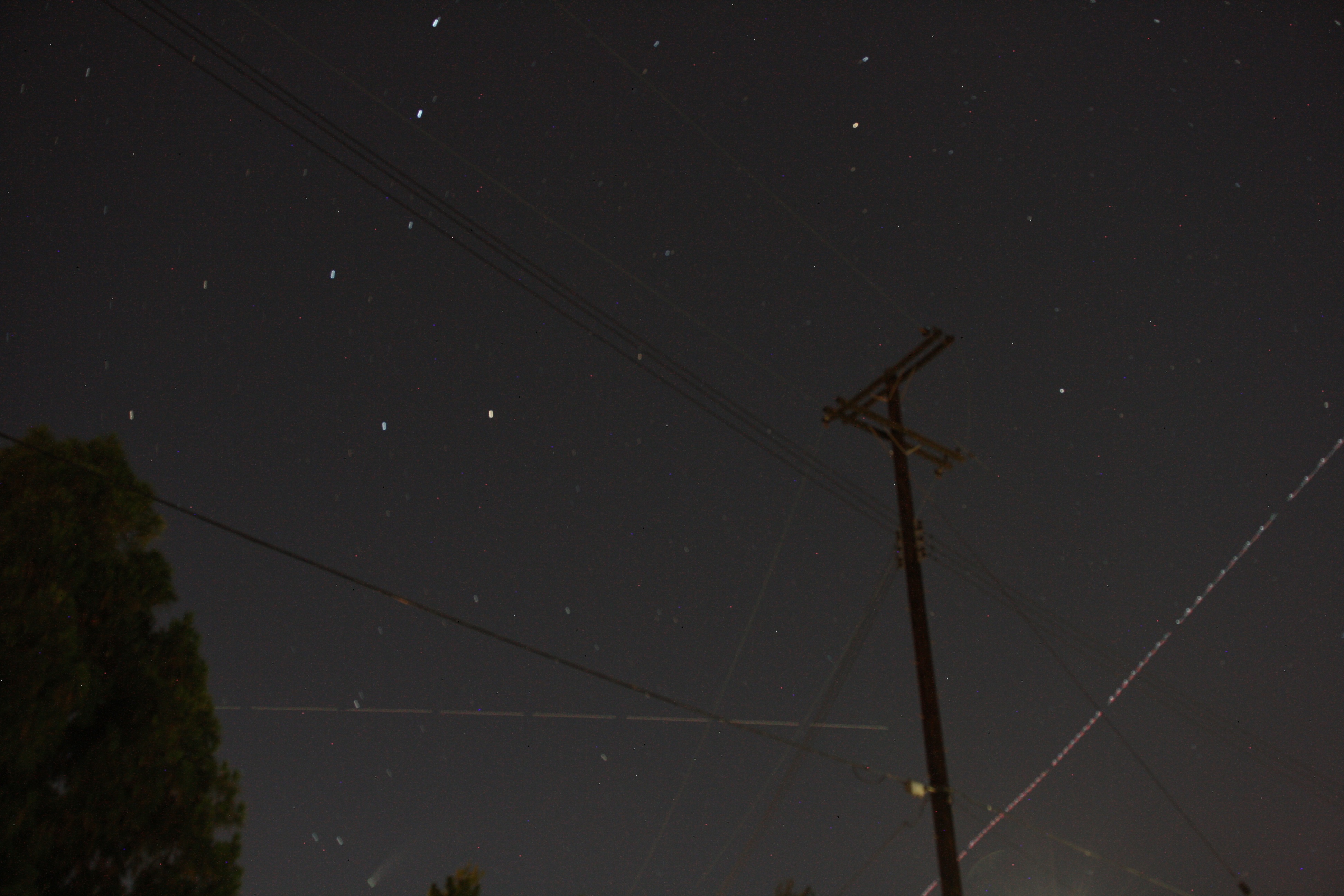
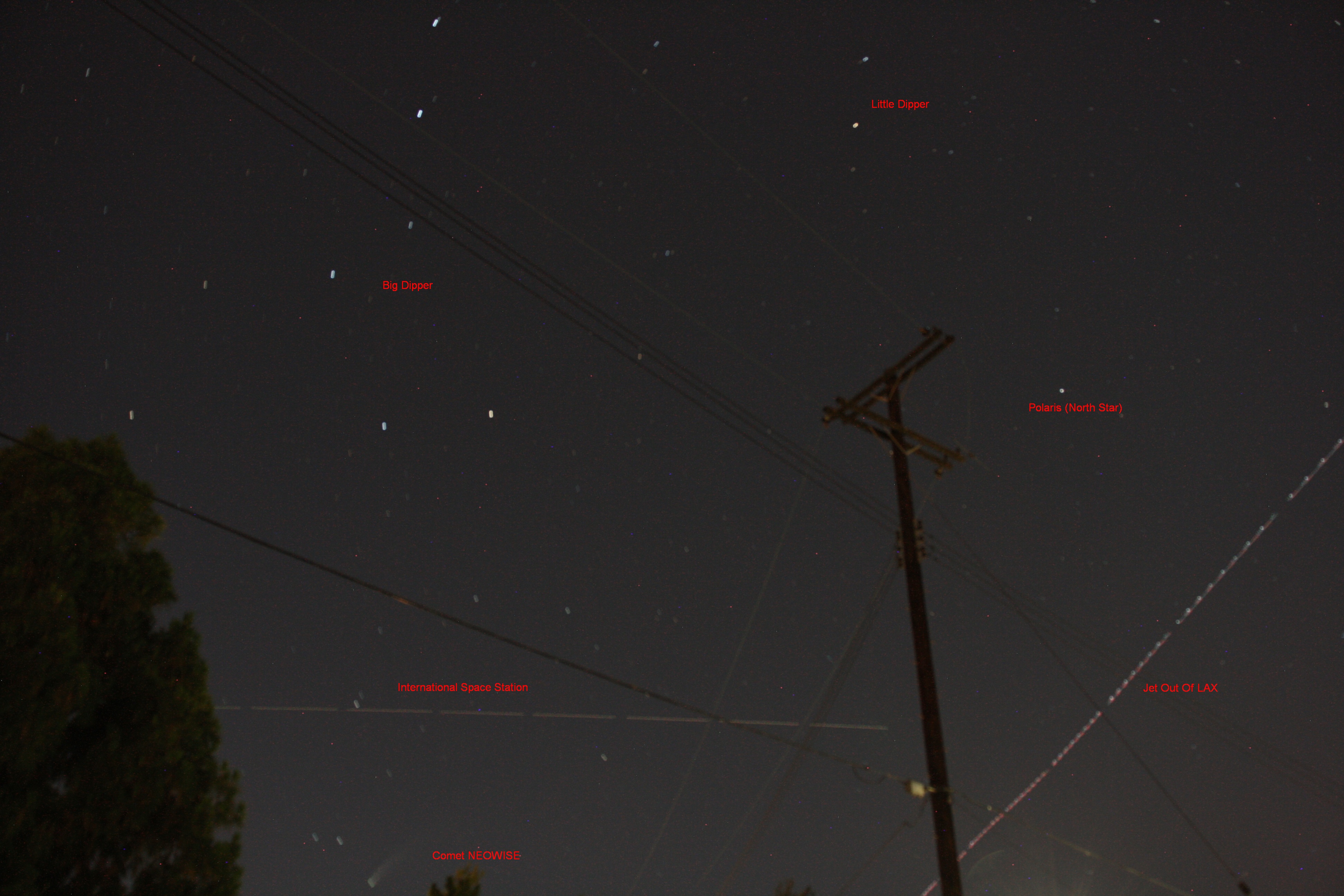
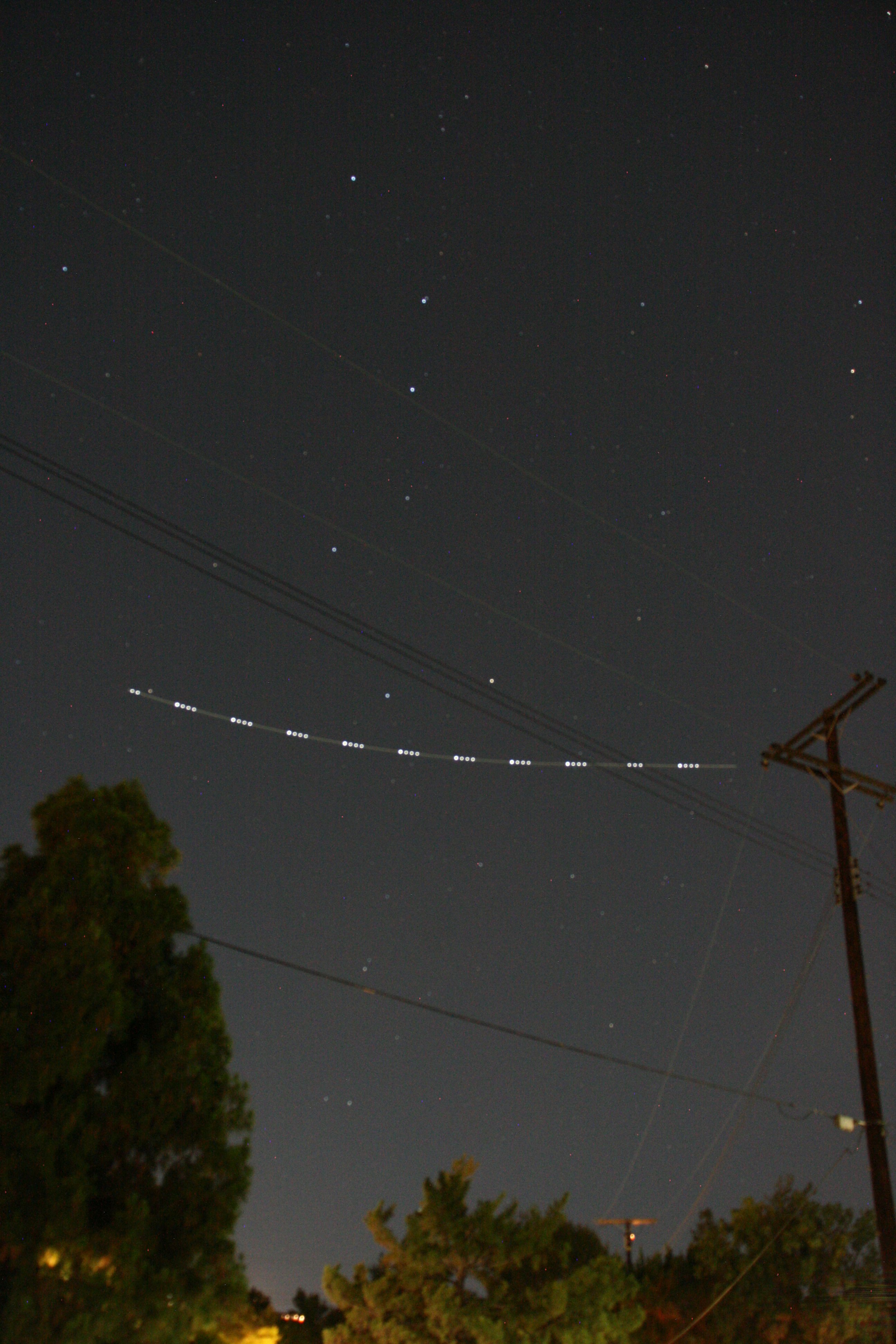
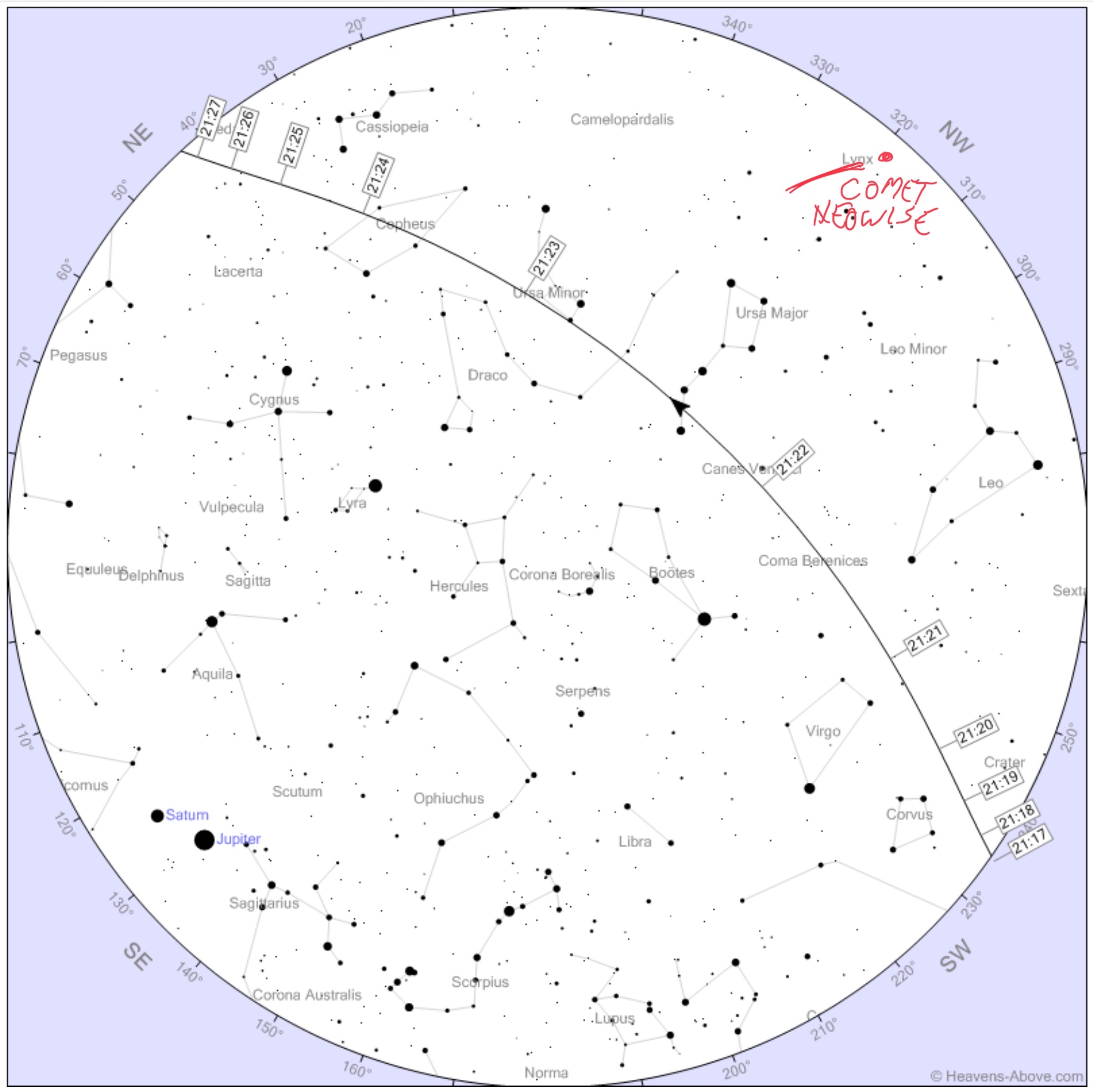
So, as I thought, or as I expected thanks to the Heavens-Above.com sky maps, tonight I got to see the ISS sail right past Comet NEOWISE!
Click on that beauty and look for the comet near the bottom, the Big Dipper way above it, the ISS passing between them, and one of the ever present commercial jets out of LAX headed toward Asia!
Did you get them all?
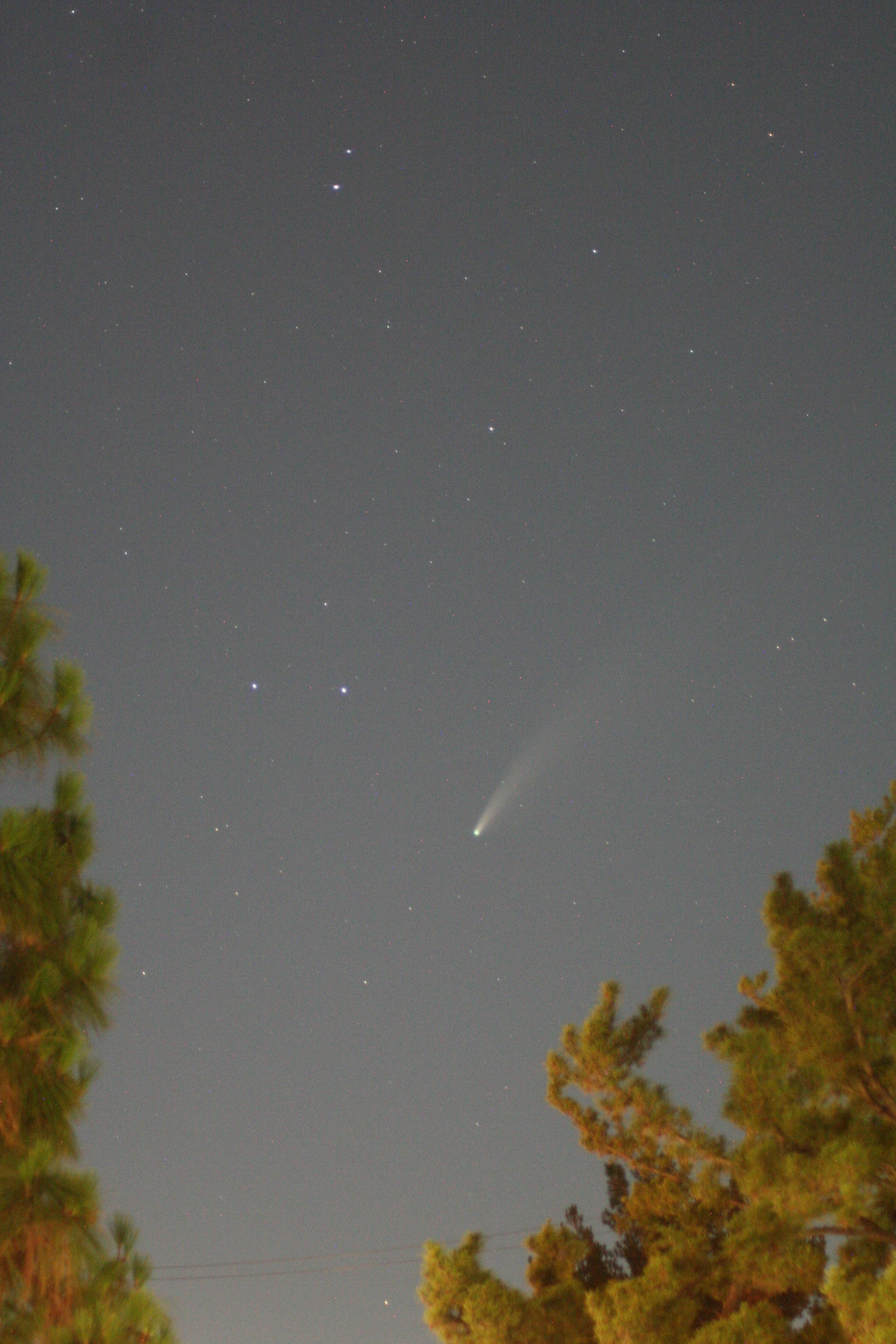
The comet’s a little blurry, as are the stars, since they’re stacked from a series of about ten images, each ten seconds long, and nothing’s standing still in that time, so… blur!
What was the camera with the big lens doing while all of this was going on?
The usual – taking pictures of the comet after it got dark. I missed catching the ISS & comet together in this smaller field of view. I guessed wrong and had the camera a bit low, ISS passed just over the top, out of sight for this lens.
But I shot ten second images for over 45 minutes, so there might be a good time-lapse video to come. But not tonight. I’m exhausted. It’s been a tough week.
But sometimes, even at the end of a long, tough week, you get the camera position correct enough to get lucky enough so you get to see the comet an extra five minutes as it slips down perfectly in between those branches on that tree.
As we had last night, there was a bright, glorious ISS pass to go along with better and better views of Comet NEOWISE. But orbital mechanics being what they are and out of my control, tonight we’re doing them in reverse order. First we have the gorgeous ISS pass, and then it gets dark enough to view the comet.
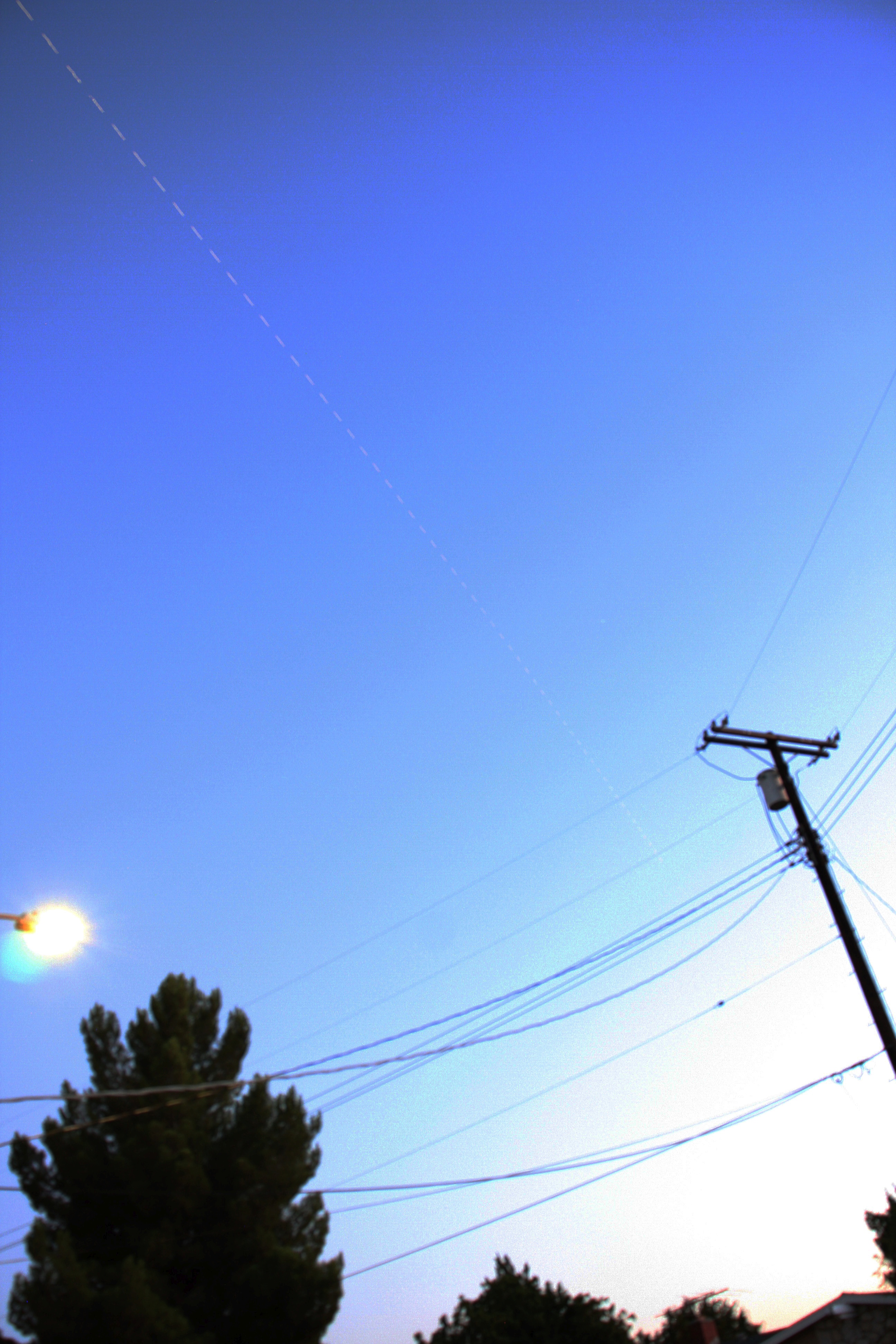
The ISS pass was wonderful to watch, but difficult to photograph because it started at 20:30 and it’s still too bright at that point to do what I did yesterday. Yesterday’s images were five seconds long because it was dark. Similar images today would have been nothing but white from border to border, completely overexposed. The camera wanted to do 1/4 second exposures at the most, but I’m the PIC (Photographer in Command, in this case) so I set it for 1 second exposures and hoped for the best.
The results were marginal looking to where the ISS was rising in the west, but pushing the contrast in Photoshop at least allowed the station’s path to be seen, coming out of the glare of twilight toward the upper left corner. At least I’m getting a lot better on planning where to point the camera!
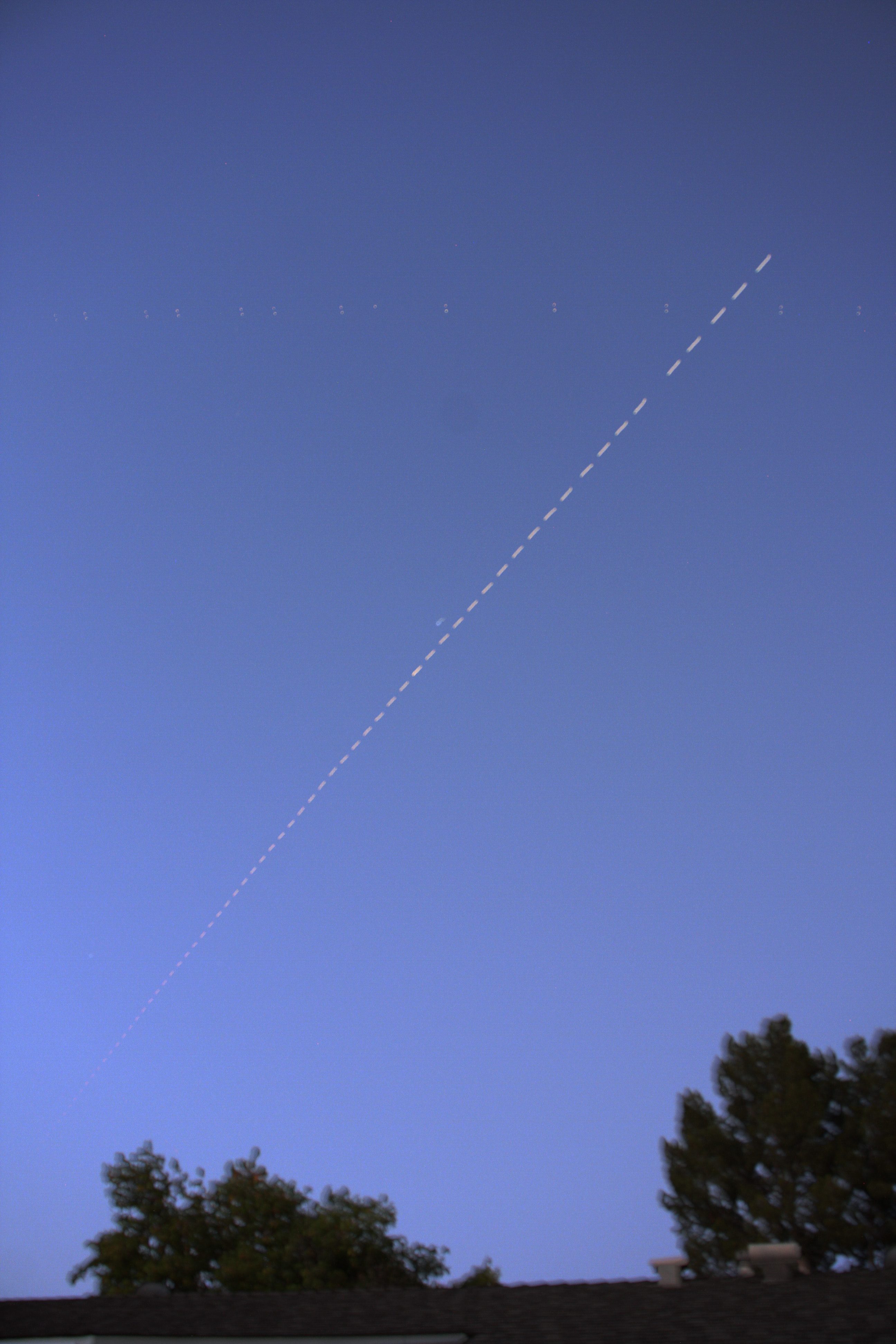
Headed over the horizon to the northeast the sky was darker, so there wasn’t as much tweaking necessary in Photoshop. You can also see where one of the big jets out of LAX was headed off to Asia at one point during the sequence. That bright star visible right next to the ISS path about half way is Vega, a very bright star, just starting to be visible as night falls.
I had to wait another half hour for it to get dark enough to see the comet. Again tonight it’s higher than it was yesterday, staying up longer while it gets darker, and easier to see. Again I’m emphasize if you’re looking – BINOCULARS! It looks fantastic.
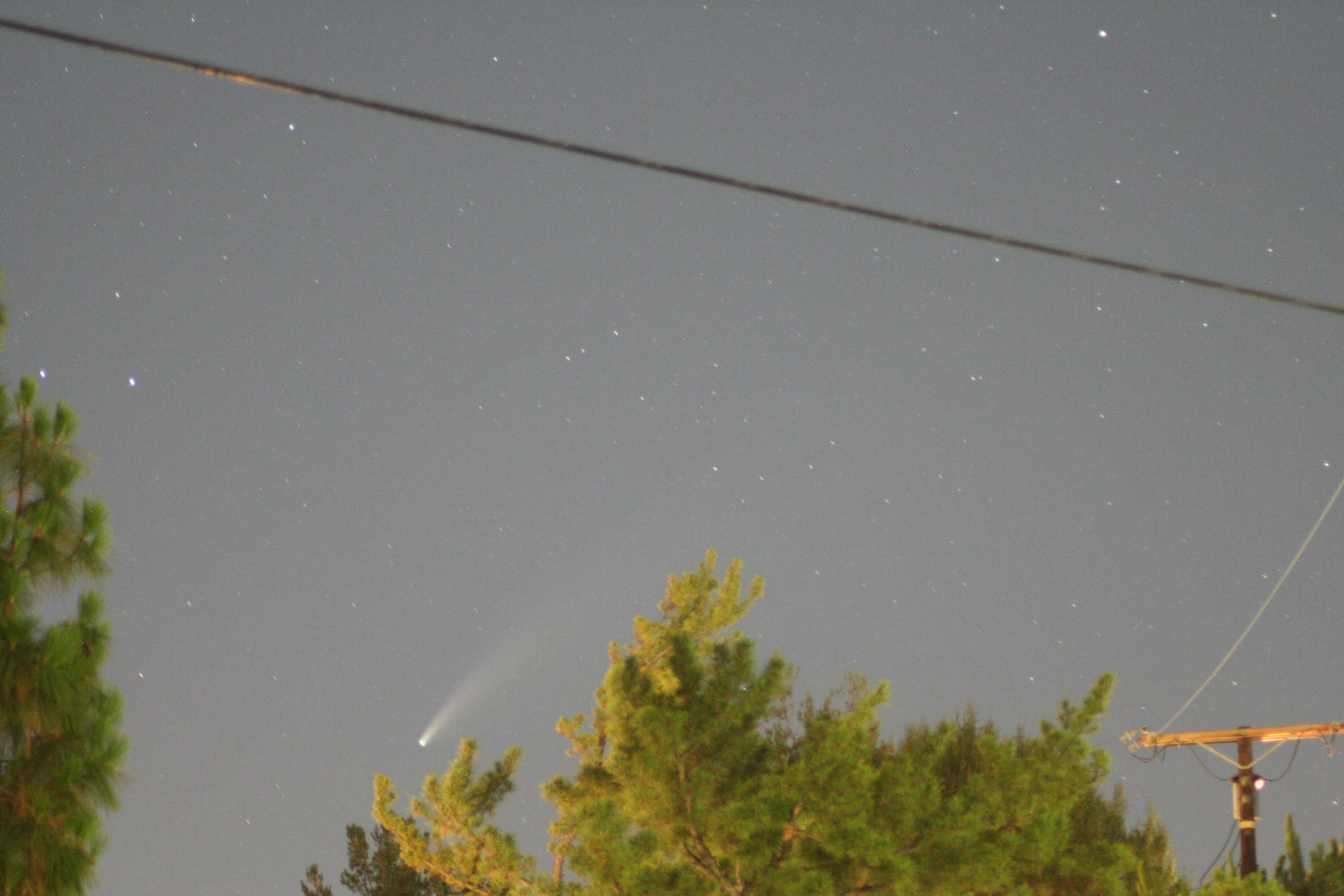
This is a fifteen second view…
…and this is a twenty second image toward the end of the evening, shifting around the yard to try to dodge those trees blocking my view. These were both taken with the telephoto lens at 75mm.
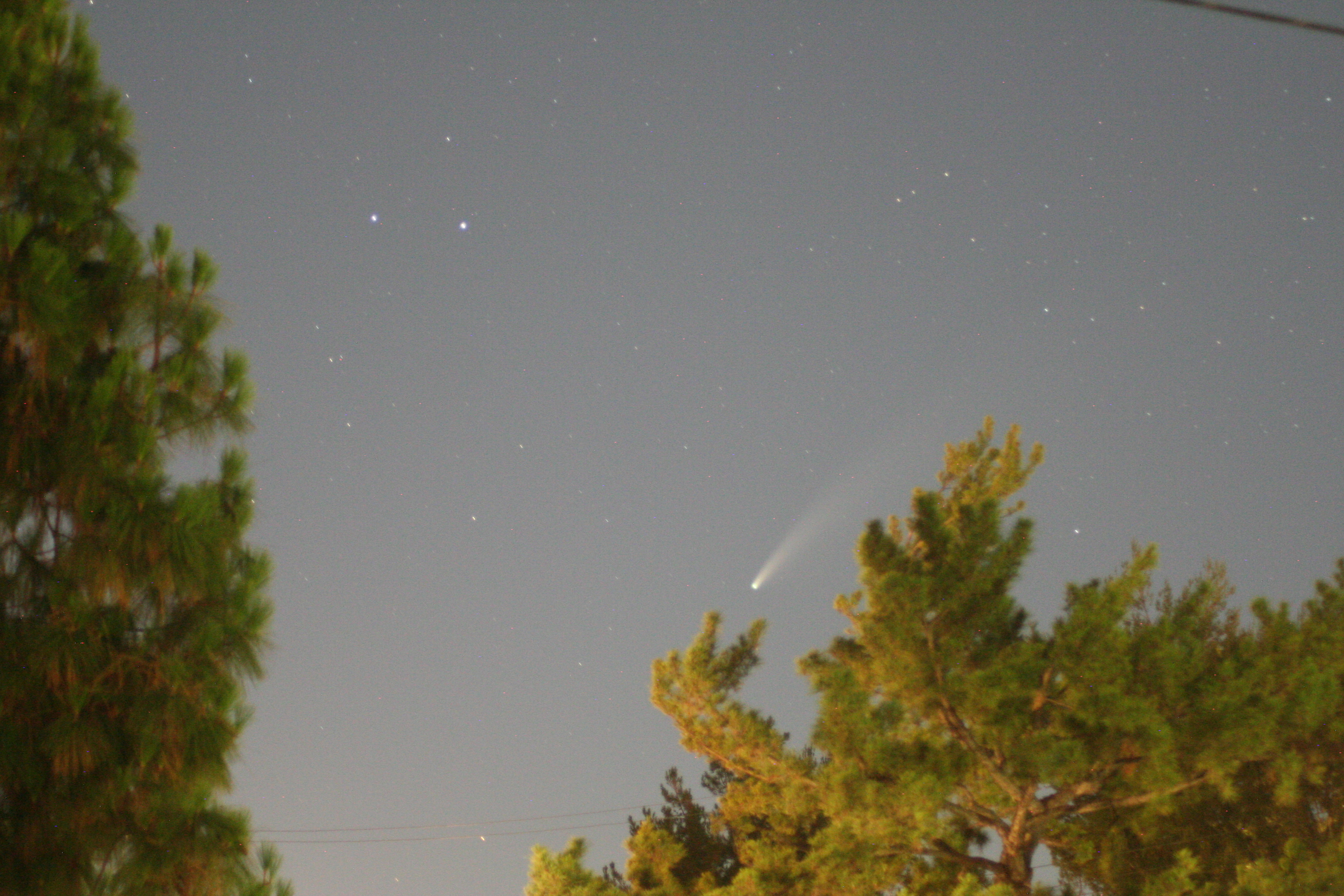
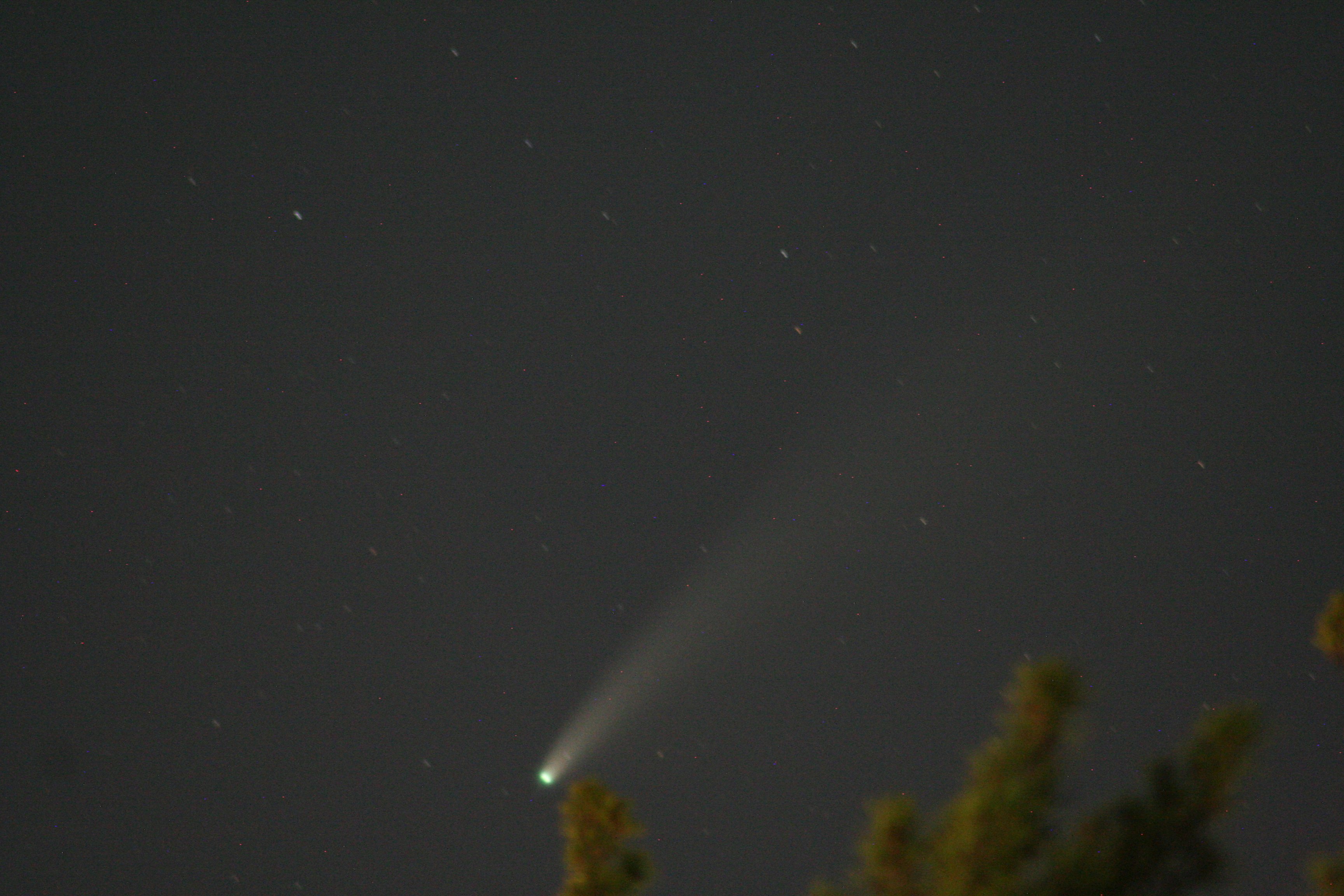
Seeing if I could zoom in (better close ups of the comet) and take longer images (gather more light, but it’s a balancing act because the Earth’s moving and the image will smear if you’re not tracking) I tried to see what happened and got this at 300mm zoom and a ten second exposure:
It’s a little smeared and disappearing down behind that tree, but if you blow it up to full sized you can see how the comet’s tail is spread and curved. No chance with this rig, this low, and this light polluted to see the blue ion tail.
But that wasn’t my main goal for the night. From the time that the comet started to be really visible in the twilight (21:08) until it went behind that tree (21:25) I had cameras set up to take one photo after another, fifteen second exposures. Then I used that trick I learned in Photoshop…
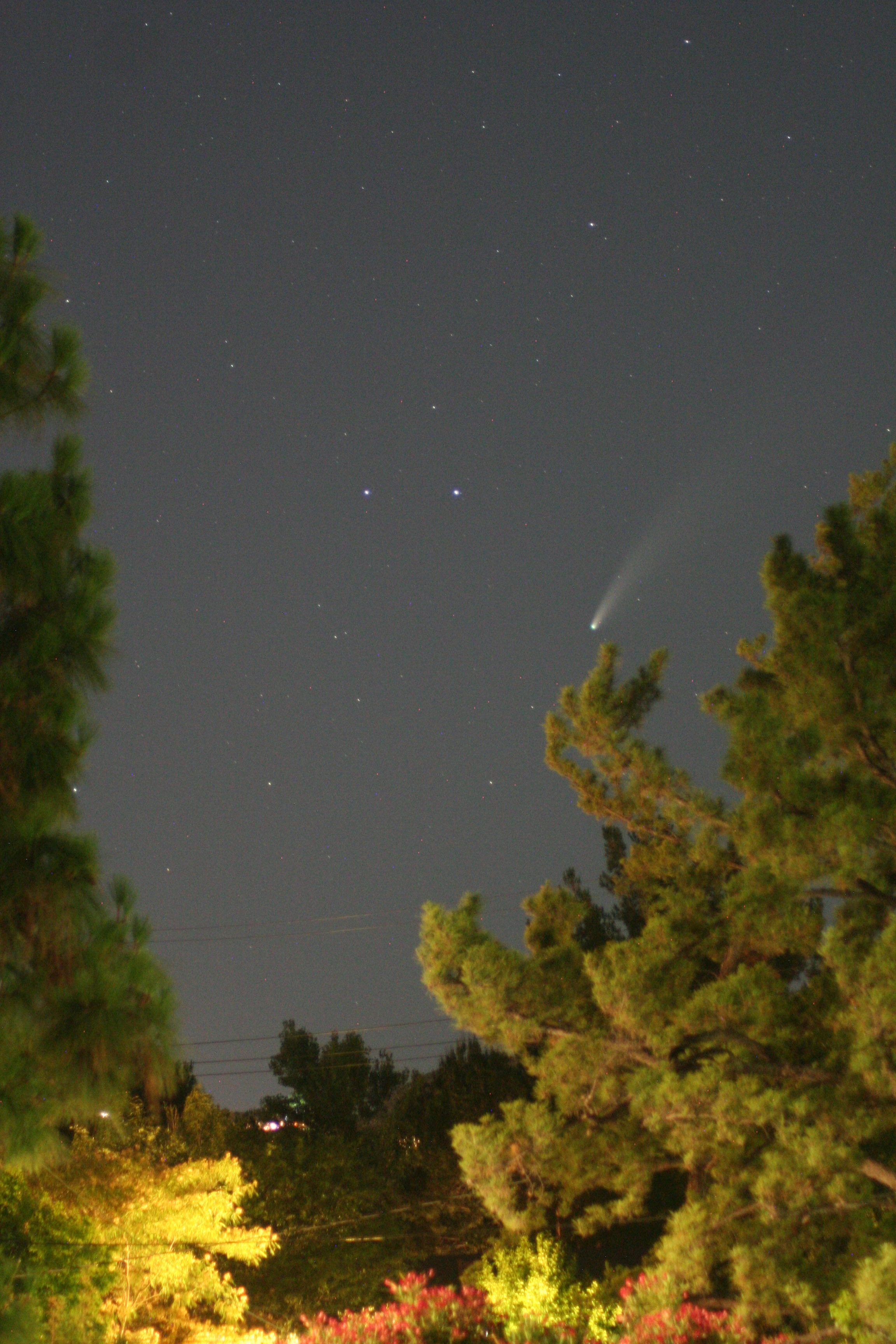
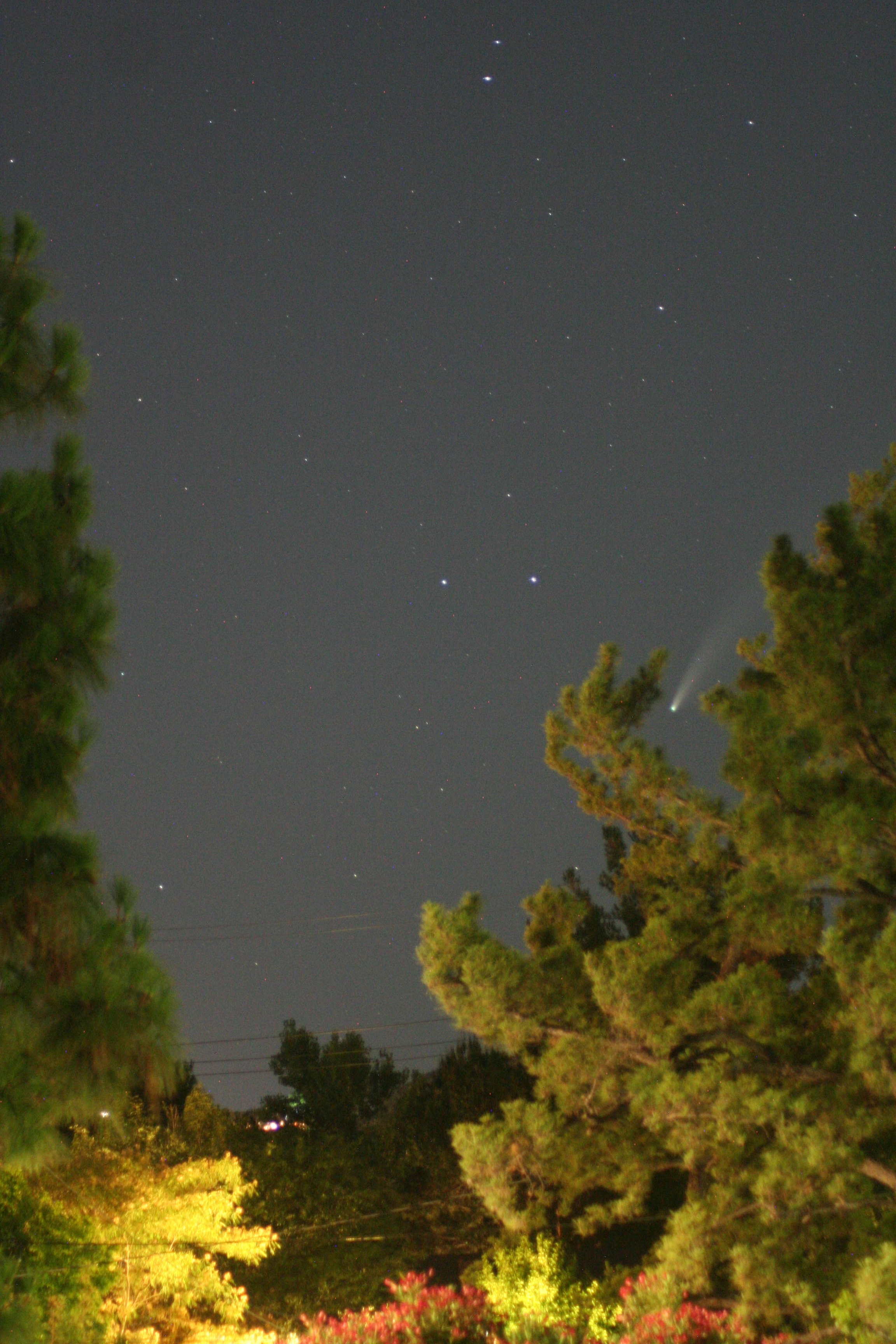
This is the “regular” lens with a taller image, so that you can see the Big Dipper at the top. The comet is at the bottom, between those trees, heading down and to the right. I love this little video, the really clear, easily recognizable constellation spinning at the top, and how some of the stars in the Big Dipper “blink” as they go behind the power lines.
But I said I had cameras set up – plural. The big lens was also running!
Watch how it gets darker as time goes by and the stars in the constellation Lynx (below the Big Dipper) start to come out and the comet’s tail just gets brighter and more prominent as twilight fades!
This is easily my best work yet. I didn’t know how it would turn out, and there’s plenty of room for improvement still, but I’m very excited with how this turned out.
I’m posting the full-sized videos above. (I hope – it’s really late.) They’re also on my YouTube channel, but at reduced resolution.
And what happens after you’re done with that? Well, the first video is made up of forty-seven images, but that’s from a series of fifty images. I didn’t know exactly when the comet disappeared behind the tree. And that forty-eighth image?
The comet can just barely, almost, maybe be seen behind that tree – but the helicopter that came by missed its opportunity to photobomb my work!
But tomorrow’s photobombing, if I can pull it off, could be on a par with tonight’s results.
Getting better… The comet’s a little higher… I’m doing fewer stupid things with the camera…
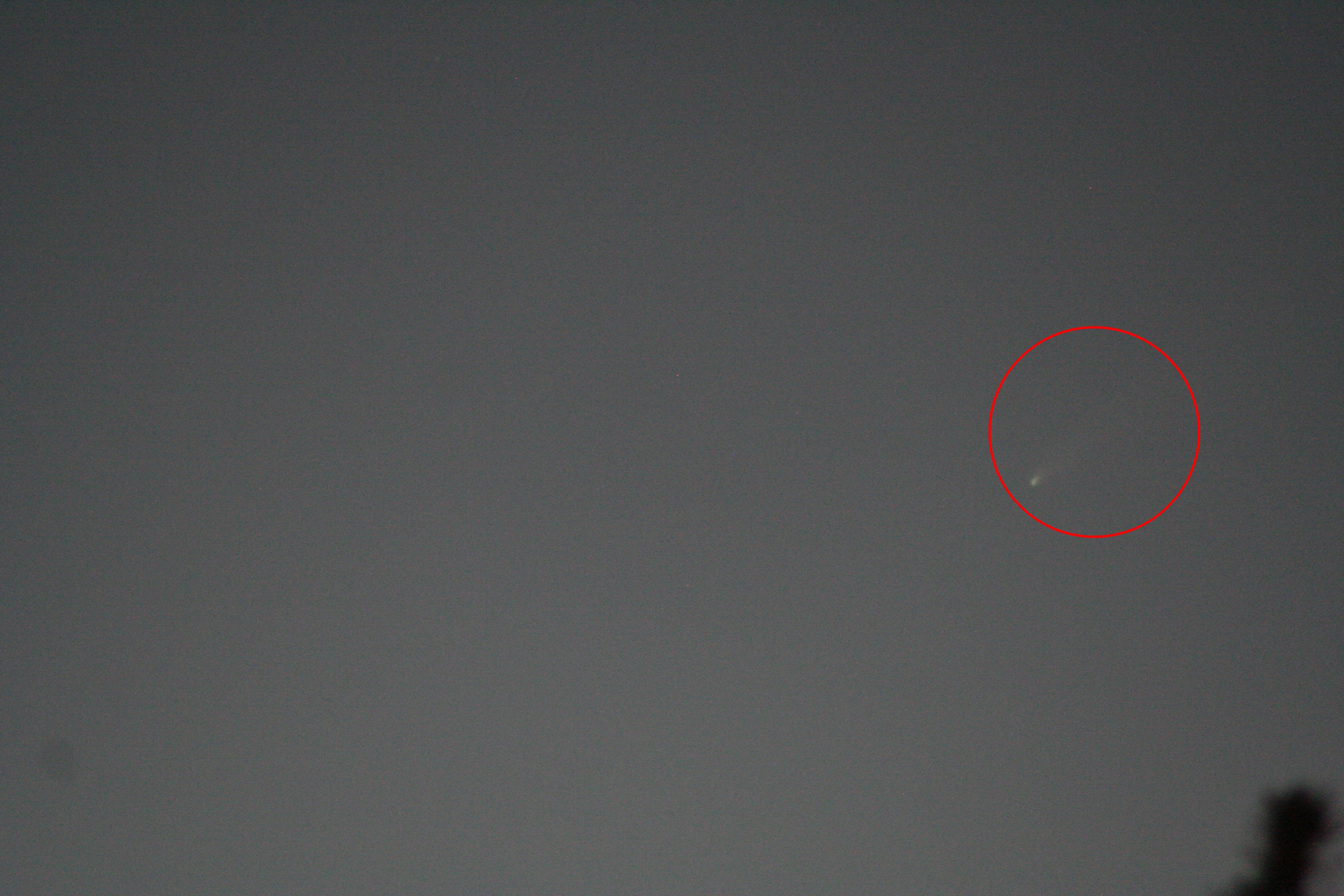
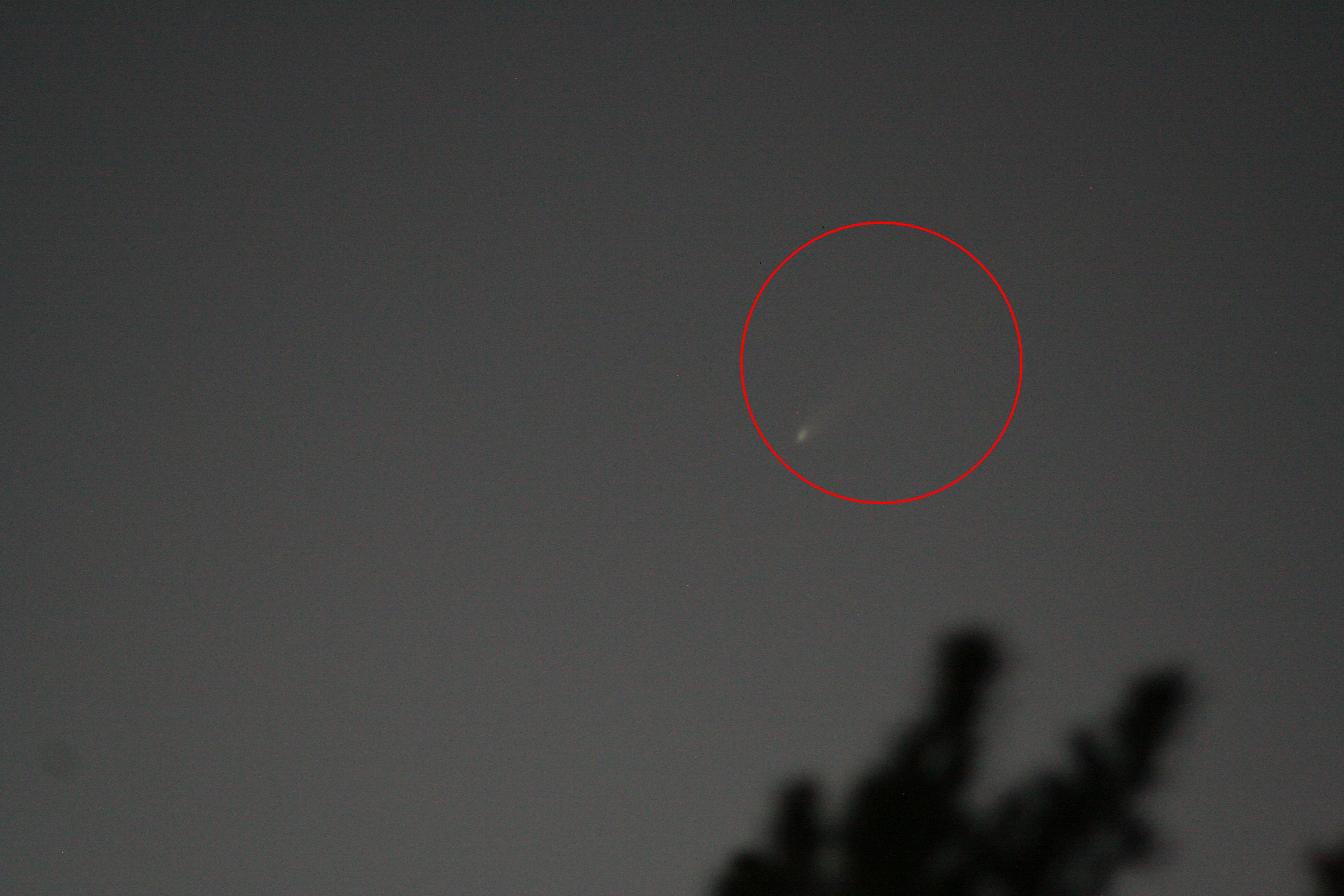
Sunset was at 20:05 so I again started hunting at about 20:35. That seems to be a bit of a waste of time because the comet is just too low contrast to be seen with that much twilight still lighting up the sky. Even with three different apps telling me exactly where it is, I didn’t spot it (right where it’s supposed to be, between these two trees) until just before 21:00. And while I was able to spot it with binoculars at that point, it wasn’t visible to the naked eye. Best efforts with the camera is marginal, to be generous.
But I hope these pictures will give you an idea of what you’ll see if you go hunting. (Get binoculars!!)
Five minutes later it was better.
And better. Starting to zoom in with the big telephoto.
And better. This was about 21:08 and the head of the comet was just barely beginning to be visible to the naked eye, but mainly because I knew exactly where to look and I knew what (or what not) to expect.
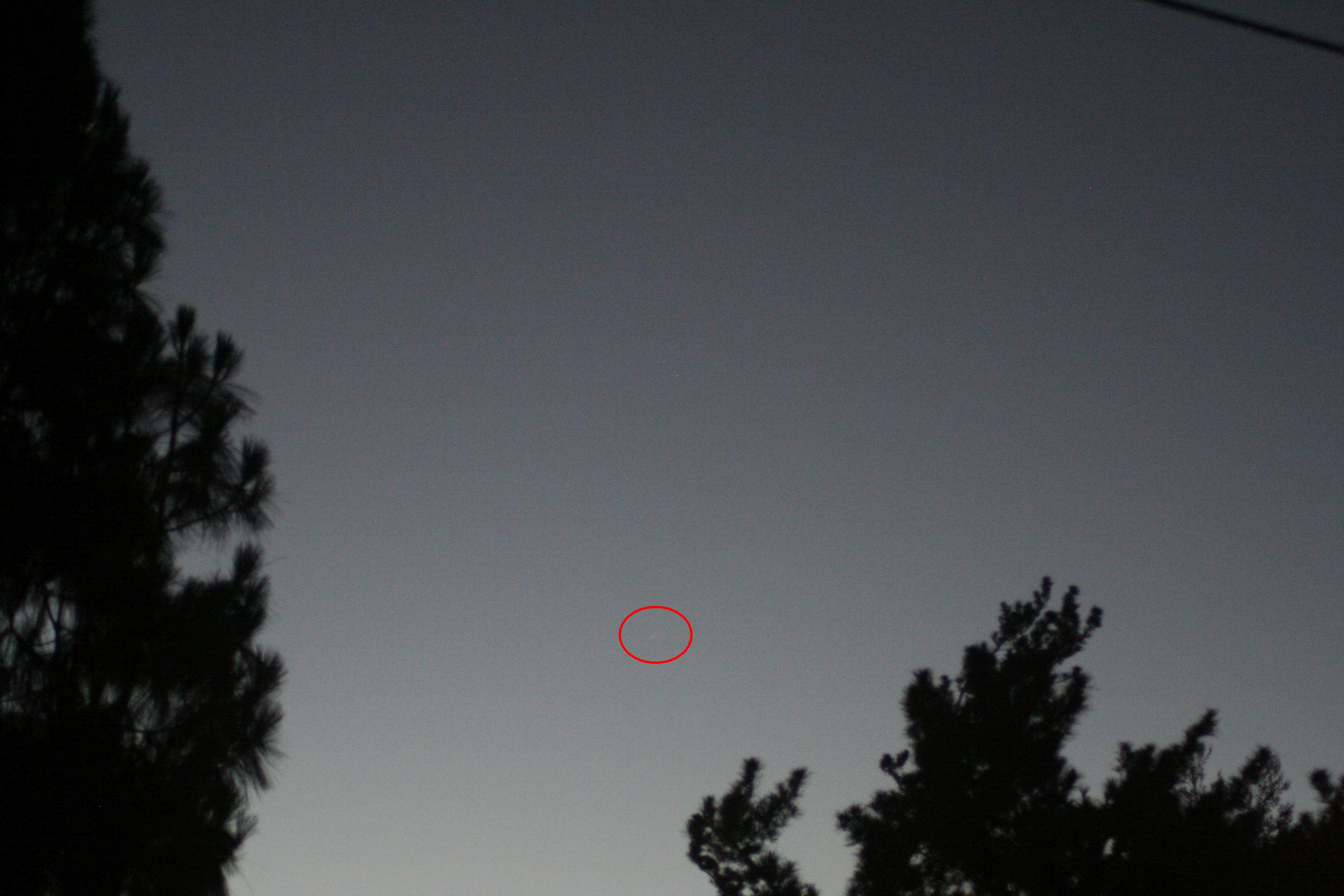
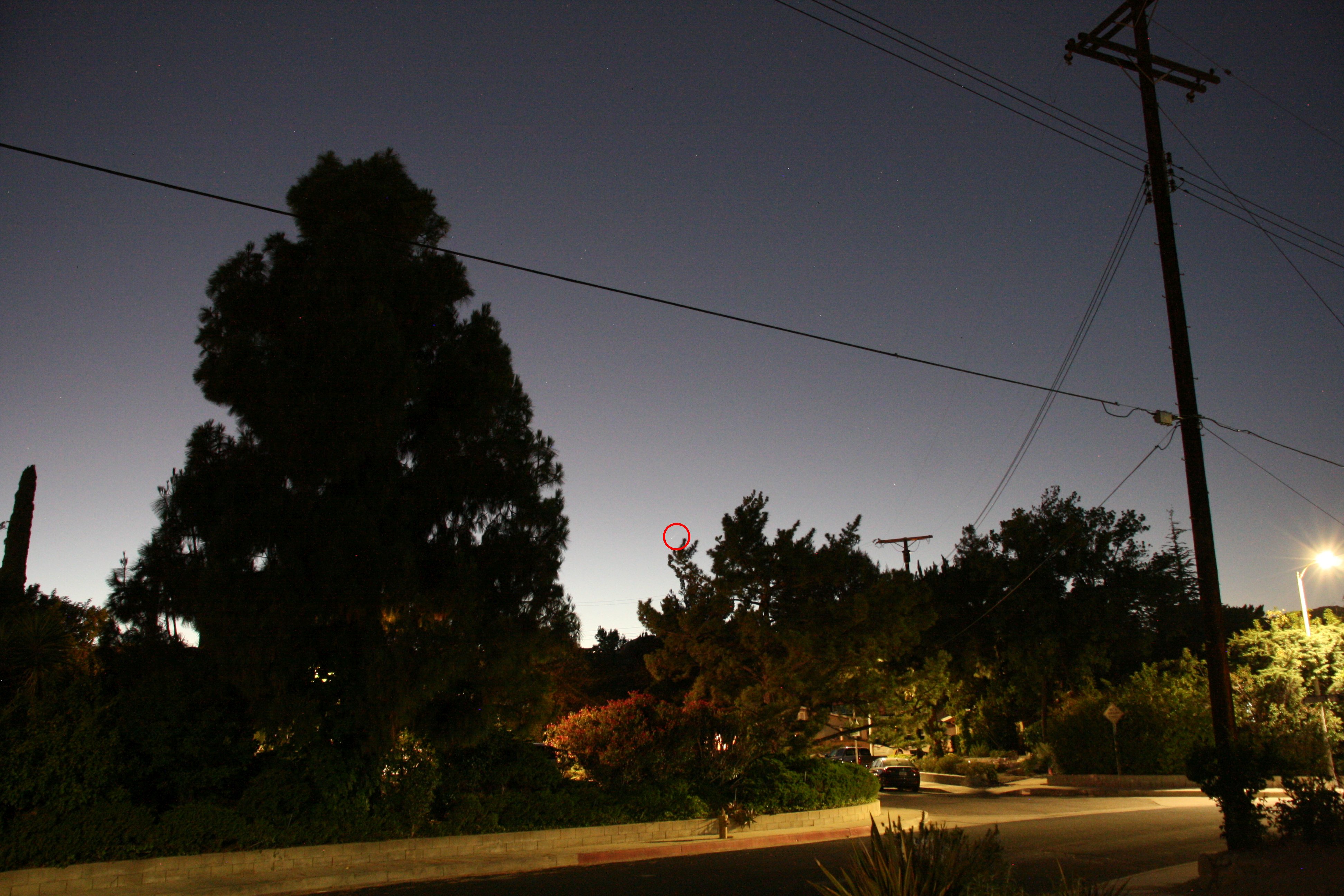
About 21:10, this is what a long, long exposure on the regular lens looked like. It was actually getting pretty dark and most of the ground lighting in this scene is from the street lights, but you can see that down near the horizon it was still bright. Click on the picture to blow it up – you can see the comet in that circle, but it’s a fuzzy dot and a smudge to the naked eye.
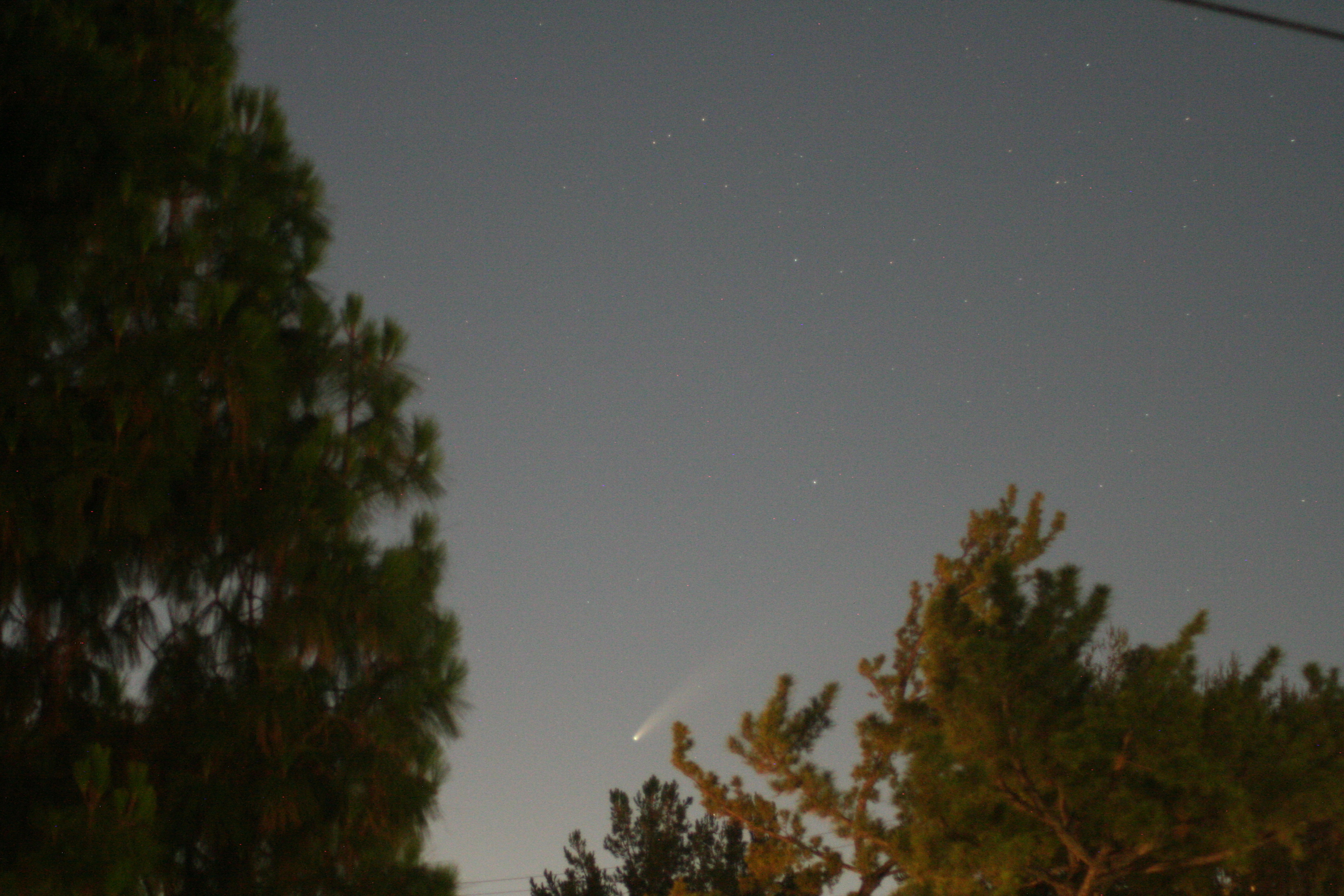
But now, just as the comet’s going down behind those trees, it’s finally dark enough so that with the bigger lens, you can start doing 3 second, 10 second, 30 second exposures without getting nothing but white. And when you do that…
Six second exposure. My best shot yet!
Then it was down behind the trees and I was scrambling, because about three minutes later…
(Image: heavens-above.com)
There was a fantastic ISS pass – there will be more for the rest of the week, pretty much no matter where you are, so check out Heavens-Above.com or the NASA site or any number of other places to see where and when for your location. On this map I’ve vandalized enhanced it by drawing in the location on the horizon that NEOWISE was at.
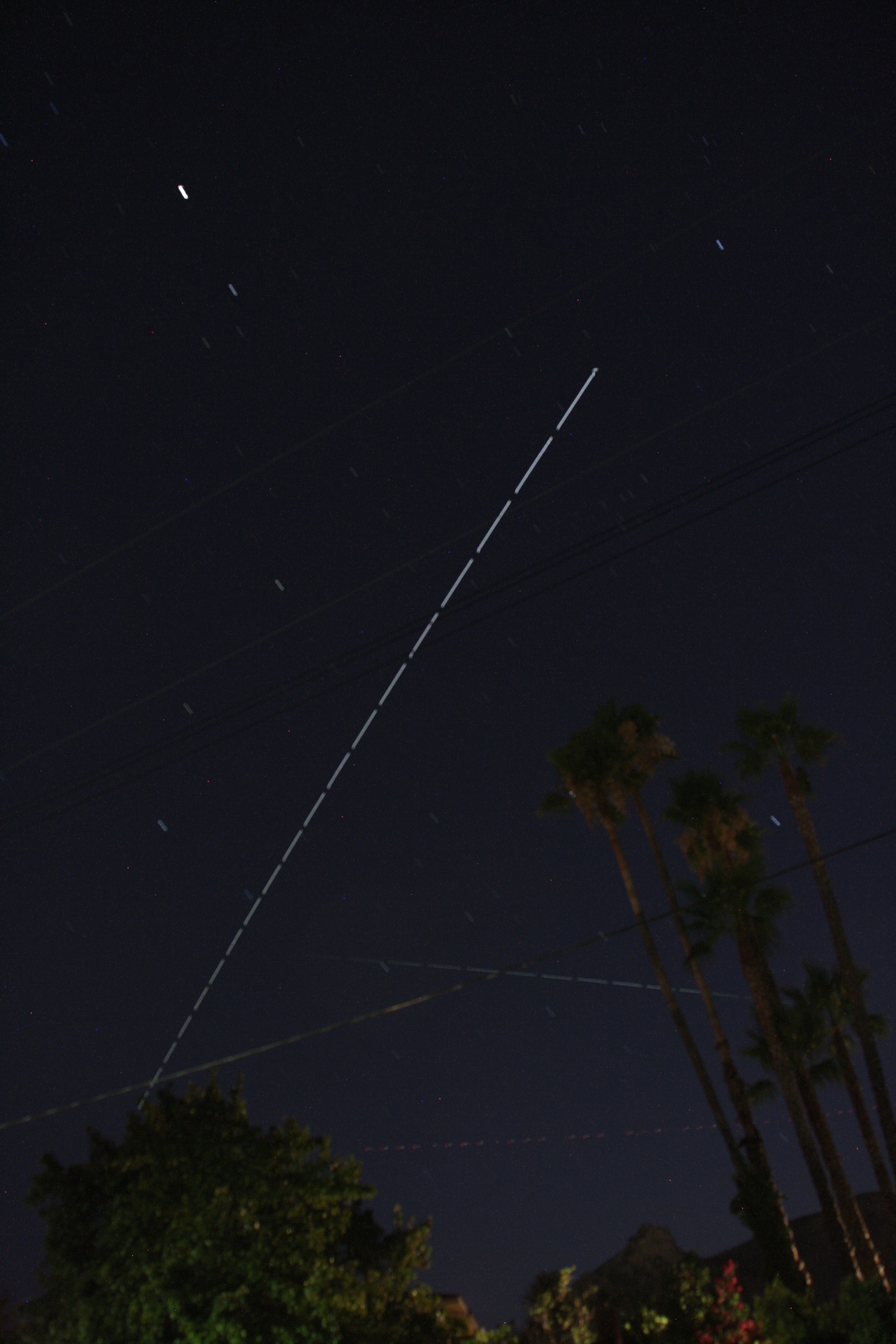
Rising from behind the neighbor’s tree, headed toward the Big Dipper which is right outside the upper right of this frame. (At the bottom you can see a jet out over the Pacific on course into LAX [the red & green lights] and another satellite, probably in a polar orbit going north to south.)
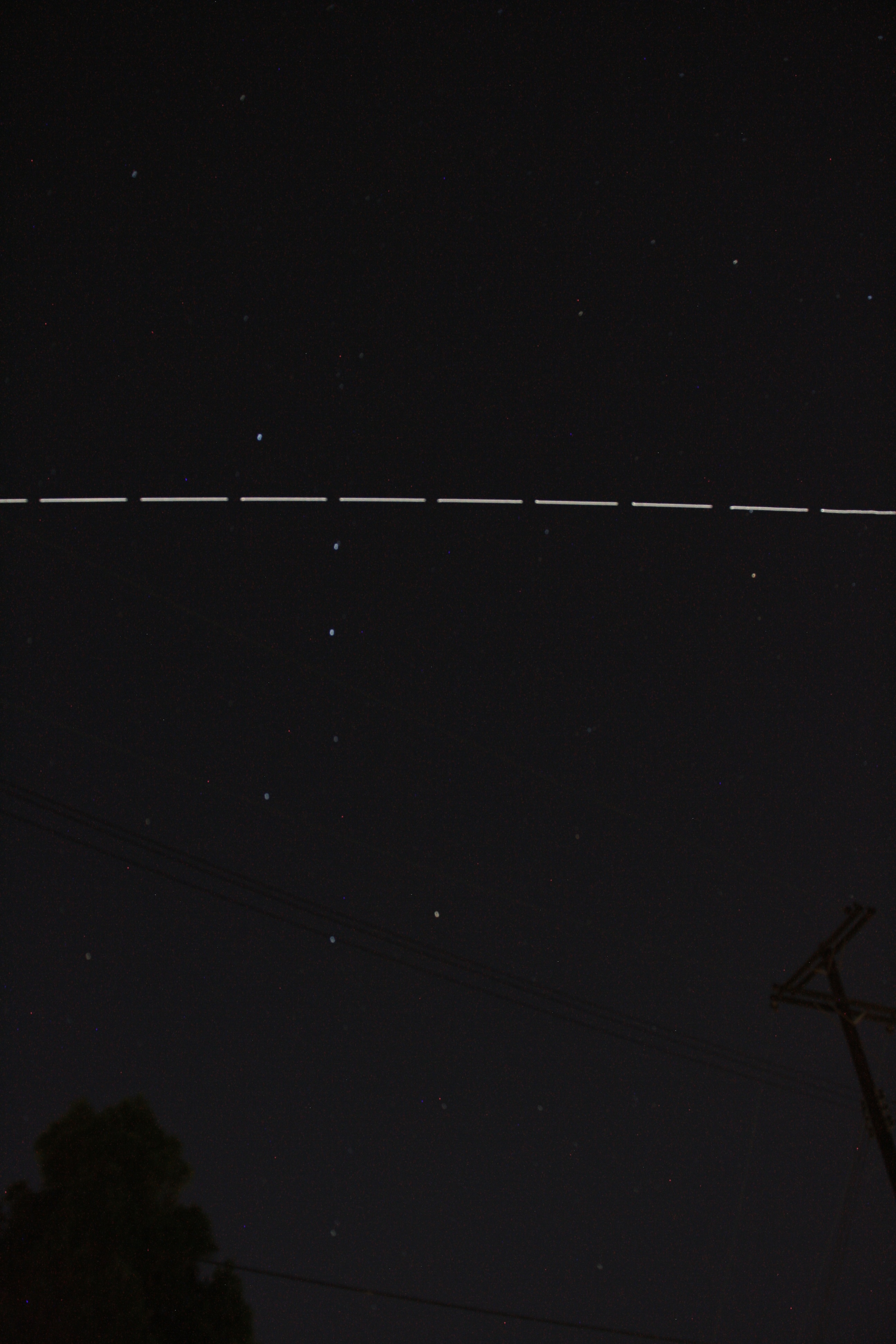
Did I mention the Big Dipper? Here it is, hanging down, with the ISS going from left to right through the handle. Ten minutes earlier we MIGHT have gotten the frame set up to catch the comet next to that tree at the bottom, but close only counts in horse shoes, hand grenades, and tactical nuclear weapons.
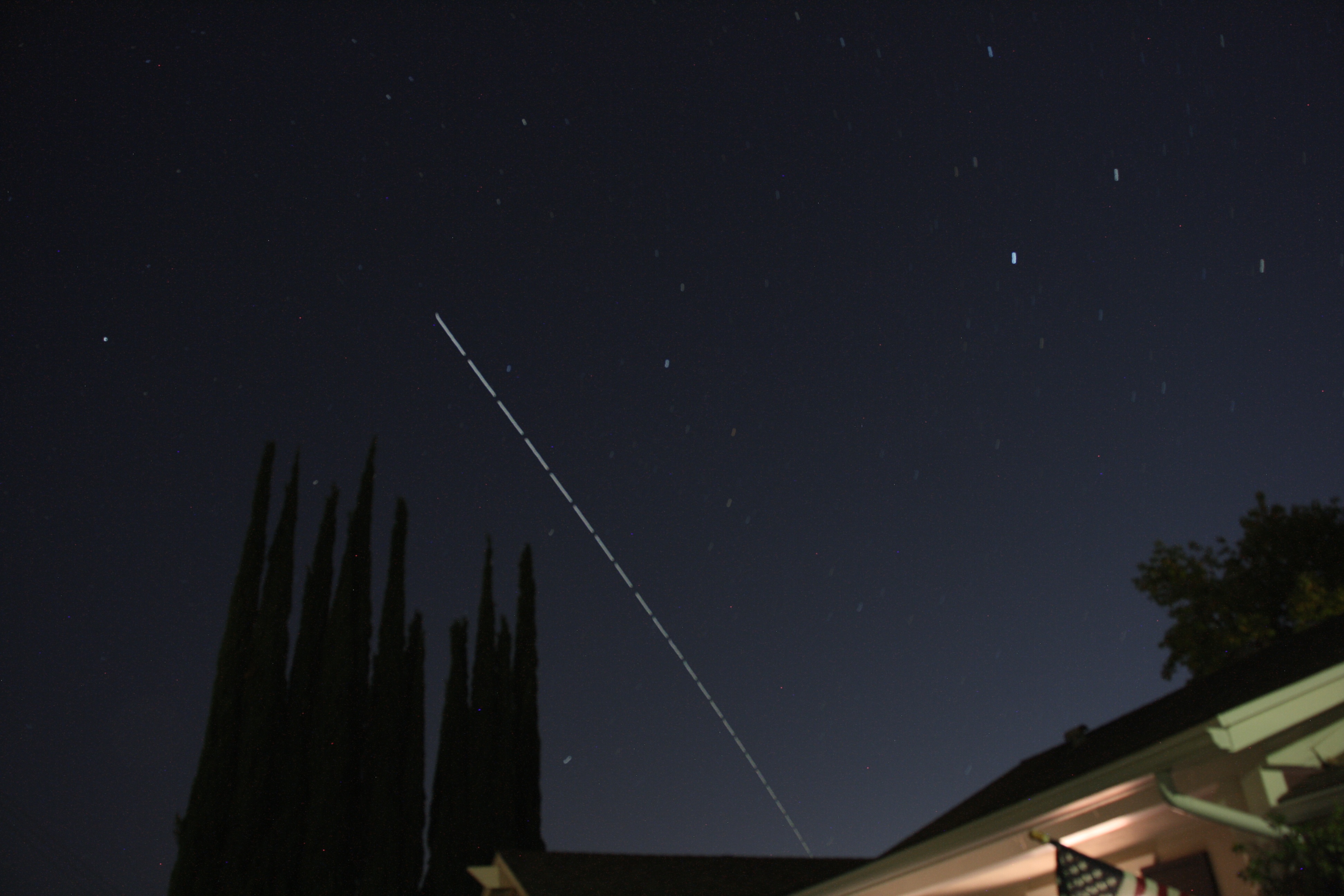
Finally watched the ISS headed from the Big Dipper, past the North Star, and down over the horizon to the northeast.
That was a pretty good night. And there are great ISS passes every night for the next week. Including one at about 21:23 on Friday night that should be going right next to the comet.
I finally found Comet NEOWISE F3 in the evening sky after three nights of failure!
Impressive, eh?
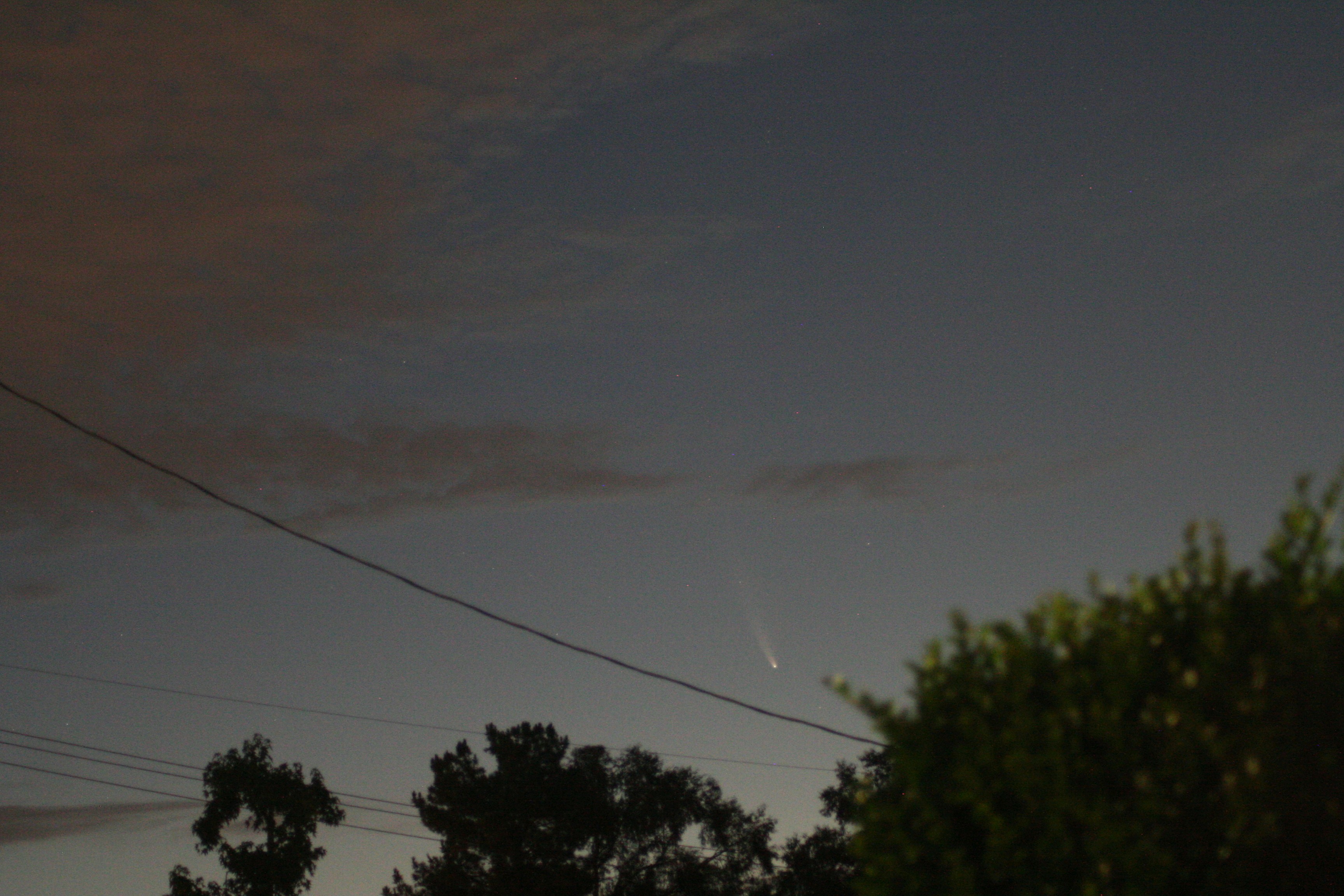
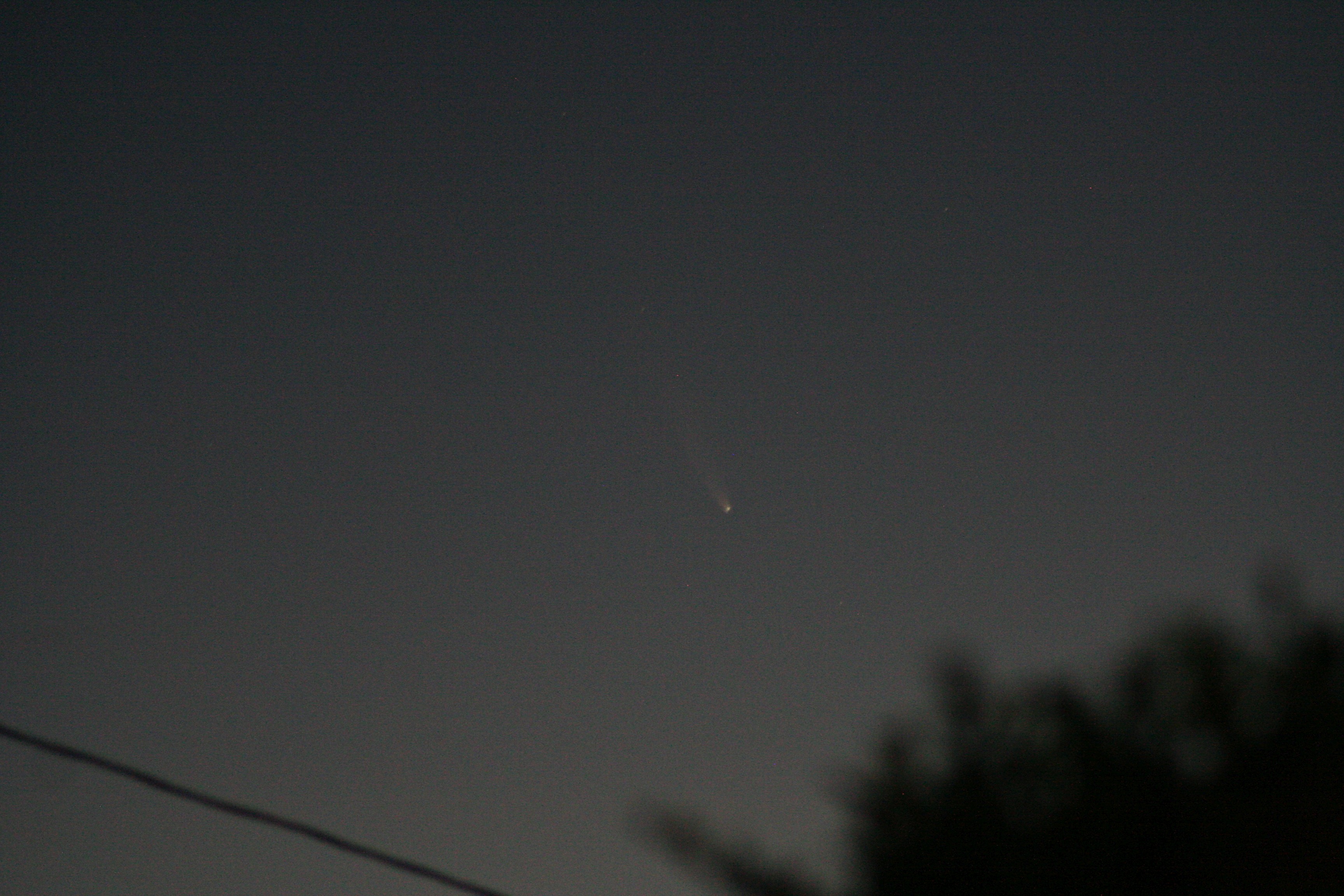
Well, don’t feel bad if you can’t see it, it’s pretty tough to see. Just a low contrast smudge, low down in the haze and coastal fog coming in from the coast, and almost wiped out by the light of the lingering dusk only an hour after sunset, still well into twilight.
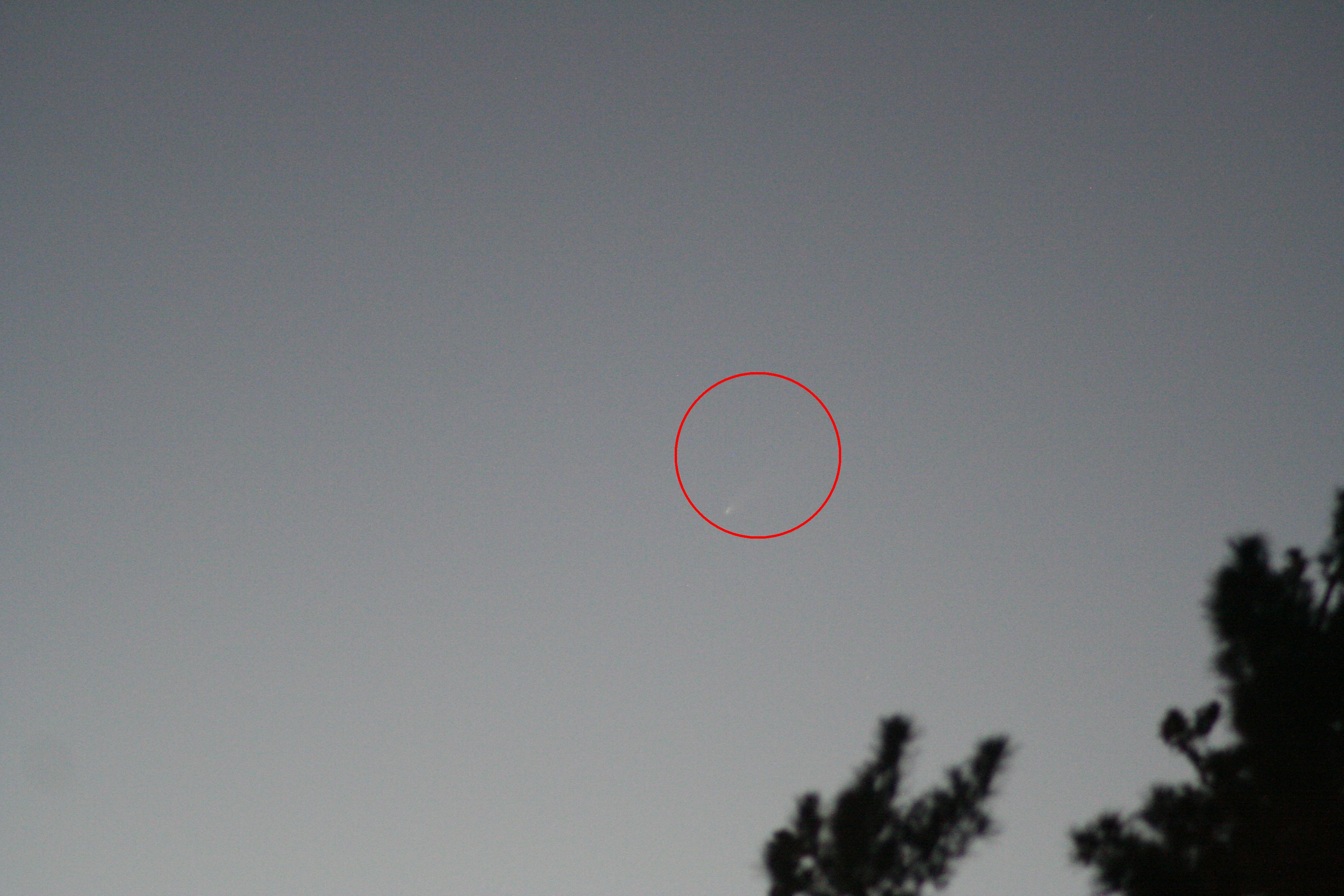
Blow it up, click on it – see it right there, just barely above that middle tree?
Yep, that’s all it was from LA tonight.
There are some fantastic pictures coming out of more Northern climes – Vancouver, Chicago, England, Northern Europe, all have been producing spectacular images. That’s because there it’s not by the horizon, it’s overhead. And it’s not just after sunset, it’s up late at night when it’s dark. That in turn means that they can do exposures that are 30, 60, 120 seconds long or even longer. I could barely do 1/3 of a second before the whole frame went white with overexposure.
It looked a little better in binoculars, but not as good as it did four & five days ago in the morning sky.
Every night it’s about 3° higher at the same time, so in a week it will be up by the Big Dipper over two hours after sunset. I’ll still have to deal with the LA light pollution and haze, and the comet is getting dimmer by the day as it pulls away from the Sun, but I may get better results.
Speaking of other pictures out there, there’s one that’s getting a ton of exposure, showing a range of extremely bright rainbow colors and a ton of twirly, spiral detail in the tail.
It’s fake. (I won’t even bother to show the image or give it any additional exposure – believe me, you’ll know it if you see it.)
It might have started with an actual photo of the comet, but from there it’s had so much processing and colorizing and effects added that it’s barely even an art piece, let alone an actual representation of what the comet really looks like.
If the best scientists in the world with the best telescopes in the world are producing something that’s white, smooth, maybe with a blue ion tail (that’s an actual thing and real) but an 18-year-old kid with a 200mm lens produces an image that’s too good to be true… Yeah, do the math. It’s pretty, but it’s also 100% bogus.
FYI, iPhones cameras may be good (actually, about 100,000% better than they have any right to be) but still in pretty much the middle of the night at maximum zoom with nothing to focus on… not so much.
Just enough detail there to see what it must have been from yesterday morning (so, I guess that, technically, that’s context) but no sign of any comet.
No joy as well to see it in the evening sky tonight. There’s a hill over there that’s higher than ours, so we don’t have anything like a flat horizon, and when it got dark enough to see (30-40 minutes afters sunset) it would have already been down behind it.
The good news is that it’s going up about 3° per night, so by Tuesday or Wednesday the odds should be better. As long as the comet hasn’t dimmed significantly.
A second night up at Oh’Dark Thirty, this time about a half hour earlier than last night in order to see Comet NEOWISE F3 as it’s rising. Since there’s a limited amount of time between when it rises and when it gets too light to see it (as the Sun is rising also – stupid Sun!), I planned on using as much of that time as possible.
It was a great plan. I even got out of bed and dragged the tripods and cameras out. Probably got set up about five minutes before the comet actually cleared the houses on the far side of the canyon. A great plan.
The clouds on the horizon had other plans.
Fortunately they were hugging the horizon, so about the same time as yesterday, the comet popped out above them. Again the head of the comet was visible to the naked eye, but the tail wasn’t. Again, the tail was freakin’ spectacular in binoculars and shows up well in photos.
Better photographs by others (bigger telephoto lenses, guided so they can take longer exposures which aren’t blurred by the Earth’s rotation) are showing some fine structure in the tail as it was spreading out, with a separate, blue-ish colored ion tail. If you blow up these photos you can see hints of that structure, which isn’t bad for a simple tripod and 75-300 zoom lens set up in the street with no guidance.
It wasn’t long before the dawn got so bright that the very low-contrast comet started to vanish. But there were other objects in the sky.
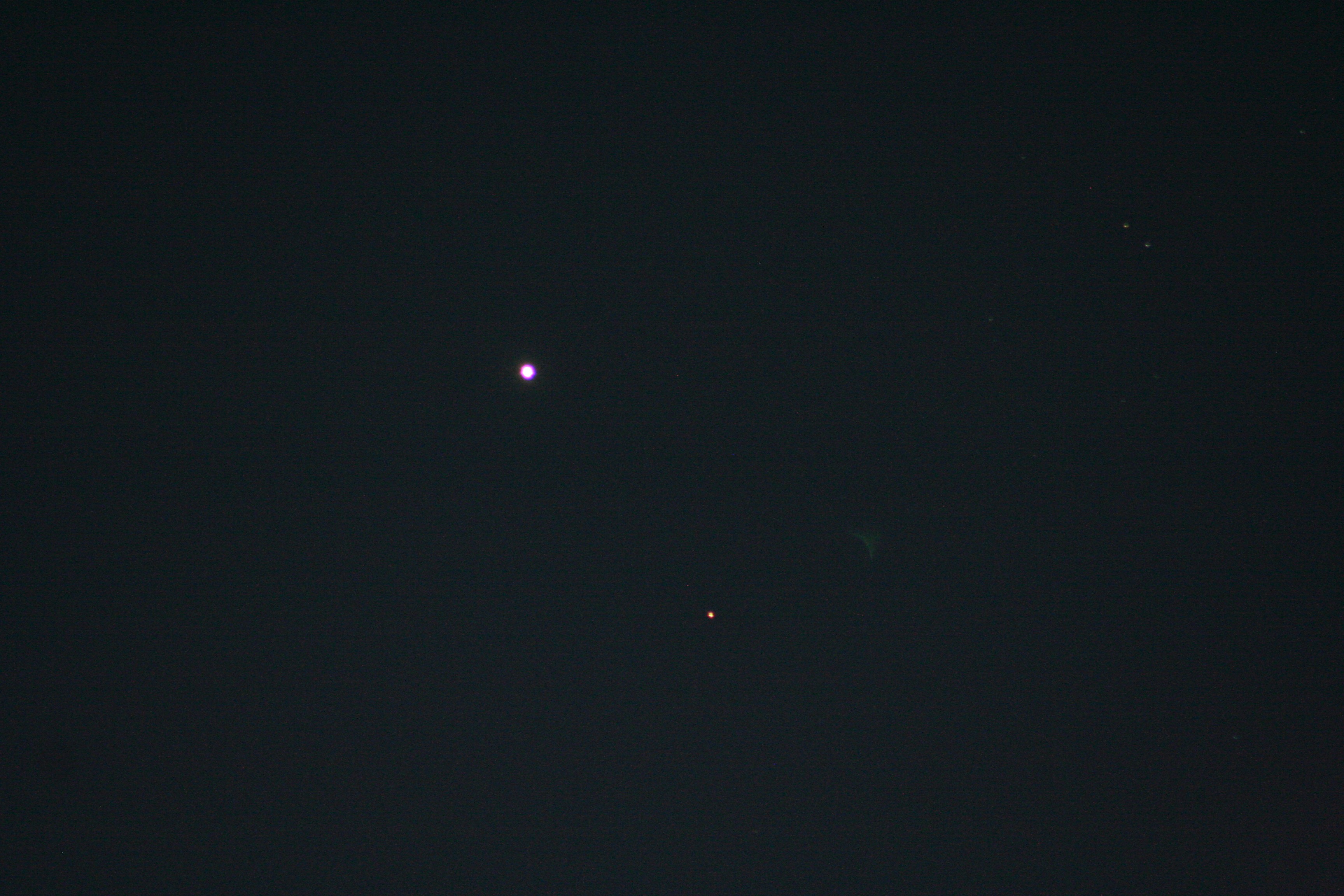
Due east were Venus (top, bright white) and Betelgeuse (below center, dimmer reddish). The interesting thing here is the ghost artifact to the right of Betelgeuse. That’s a reflection of Venus’s image inside the telephoto lens. But, while Venus itself is massively overexposed and looks like a blob, the reflection is not and shows the very thin crescent phase of Venus.
Straight overhead were Mars (dim, red, above & left of center) and a 3/4 Moon. The Moon is very, VERY overexposed in this 1/30 second exposure. How overexposed?
To get this correctly exposed picture of the 3/4 moon I had to go down to the limit of the Canon XT, 1/4000 second. The moon is really freakin’ bright.
I won’t be trying to get up at 04:00 tonight. For Los Angeles’ latitude the comet is in that transition between being in the morning sky and the evening sky where it technically ISvisible in both, but so close to the sun and close to the horizon that realistically you’re not going to see it without perfect weather, a flat horizon, and some luck. (If you’re curious, play with the SkyLive time settings around sunrise and sunset for a day or two before and after today to see how it works.)
But starting tonight and then improving drastically by the day, the comet will be climbing into the sunset sky shortly after sunset. And I mean very shortly after sunset for the next couple of days (see SkyLive…) but by mid-week it should be a pretty easy object to spot, assuming it doesn’t have some massive dimming. Which can happen with comets. Folks have pointed out that comets are like cats – they’ll do whatever they want and it’s almost always unexpected and designed to piss you off.
Have I mentioned the comet that’s gotten surprisingly bright in the morning sky and will be moving into the evening sky in the next few days?
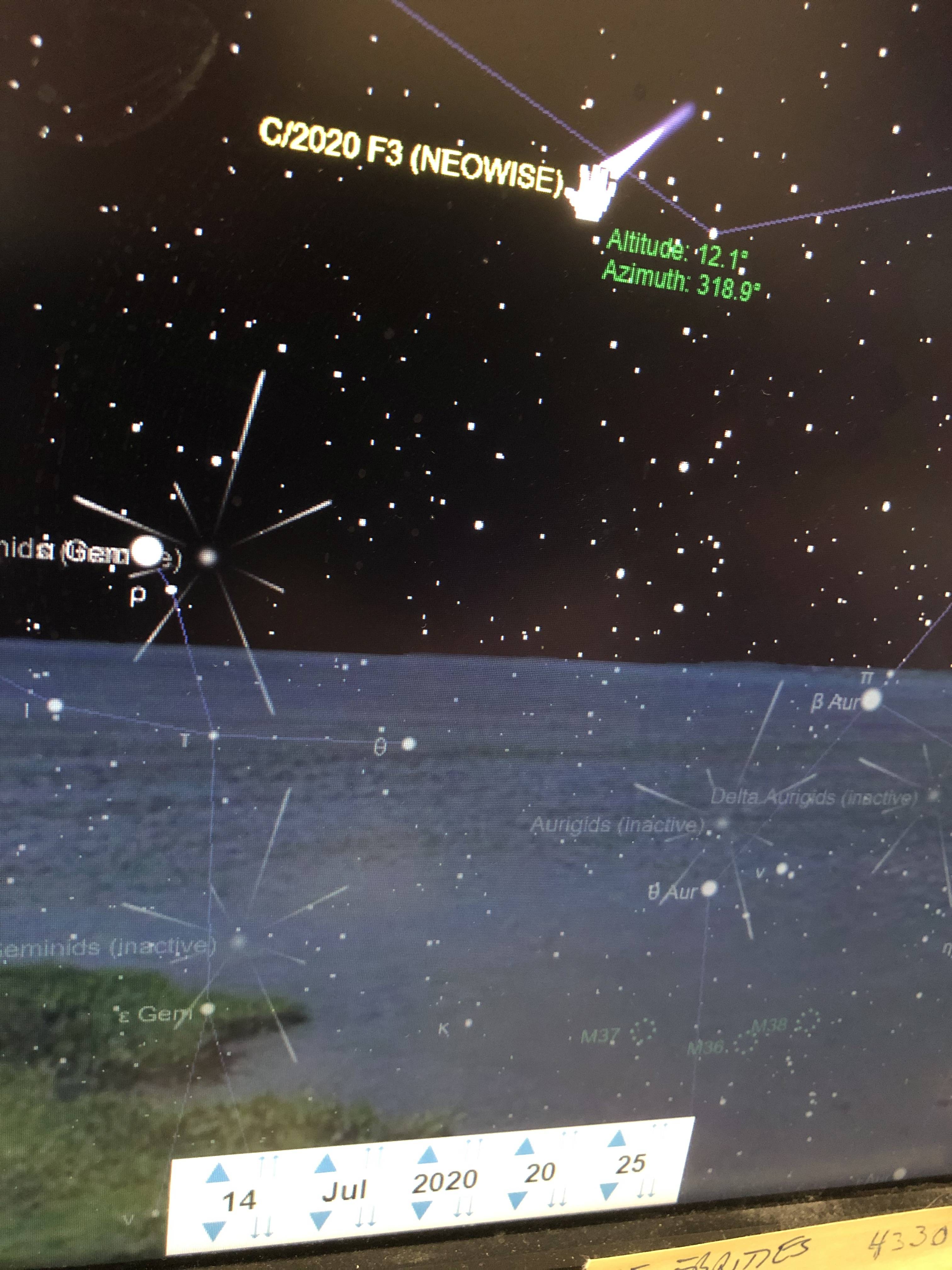
First of all, if you want to see where to look for it yourself, there’s a free planetarium site online called TheSkyLive. Here’s a quick tutorial I did to walk you through setting it up for your location, looking for this comet in particular, and then bringing up the clock controls so that you can see where the comet will be on any given day or time.
Last night I was up at 04:45, but I wasn’t hunting blind. I had already run through the morning scenario using TheSkyLive (as well as the excellent Star Walk app on my iPad) and I knew that the comet (see above – click on the picture to blow it up full sized) would be at 44.8° azimuth, which is northeast. (You don’t need anything like that sort of accuracy unless you’re pointing a telescope. Knowing which way’s north (0°), which way’s east (90°) and eyeballing the halfway point is just fine!)
Knowing that, I had checked out a spot in the back yard which has a clear view in that direction, but also has an 8′ tall hedge between our yard and the neighbors’. Not good – the comet’s going to be low. So I went out in front and found a spot at the bottom of our driveway and another across the street where the view was clear, except for one of the aptly named “hills” in “West Hills.” But we’re on top of another one, so I was hoping I would get lucky.
I did.
As soon as I got out there, about 4:55, the head of the comet was clearly visible to the naked eye. There were a couple of wispy clouds over in that area and the sky was starting to lighten. To make sure I had it correctly I took a look through my binoculars. (Celestron 9×63 with a 5° field of view.)
Oh, my!
Through the binoculars it was spectacular! The long tail was evident, with some structure in the tail showing. I wasn’t 100% sure that I could see the separate ion tail, but thought that I could.
I set up the camera quickly.
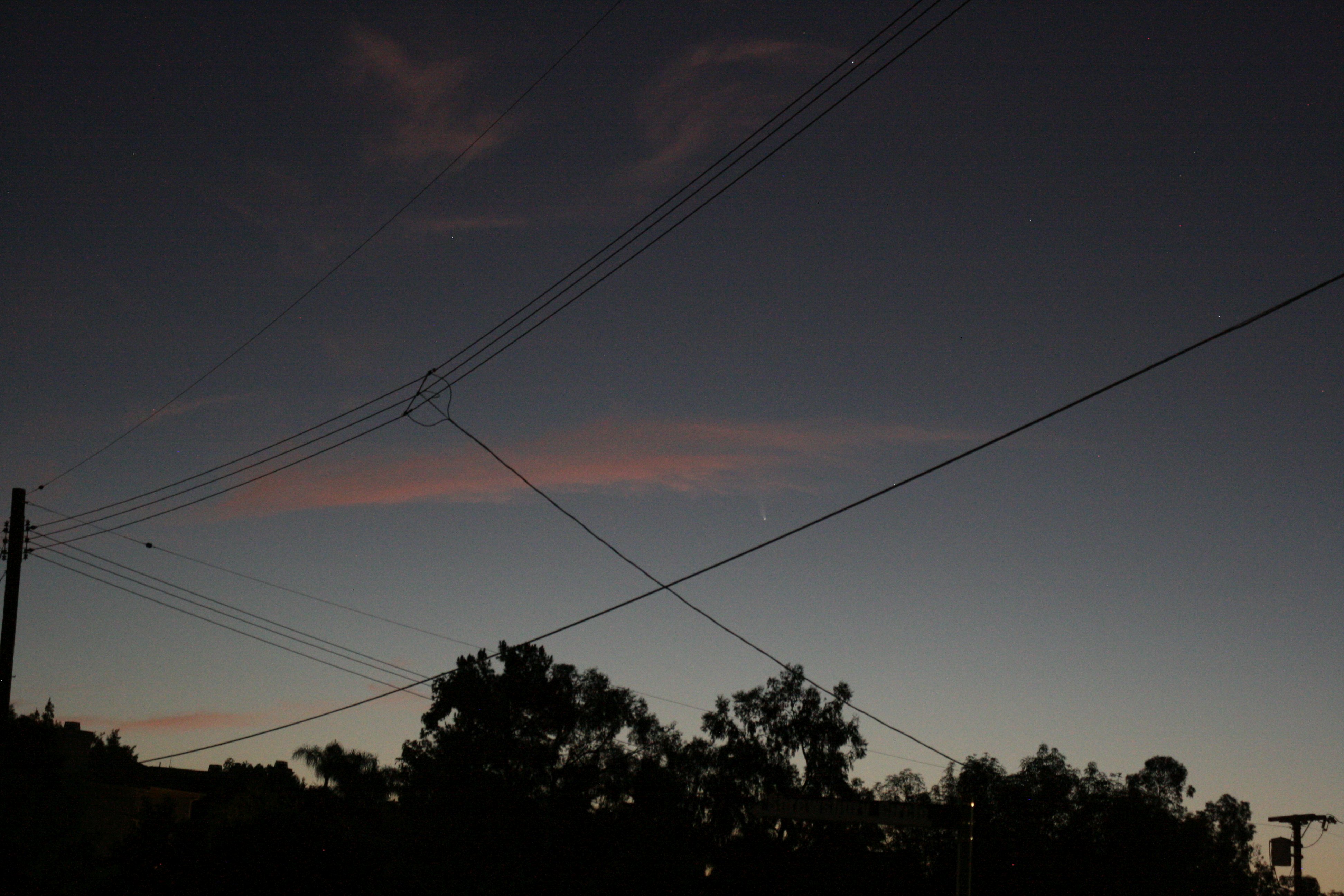
I was using the “normal” lens but zoomed in to 55mm. This is a 1/4 second exposure and is approximately what I saw with the naked eye. You can see the comet just above and to the right of where the two wires cross. (Click on the photo, blow it up to full size, etc.)
But cameras can see more than the naked eye can. Time to crank up those exposures a bit, knowing that it’s a race against sunrise, which is going to wash out the comet completely in just a few minutes.
A 1/2 second exposure.
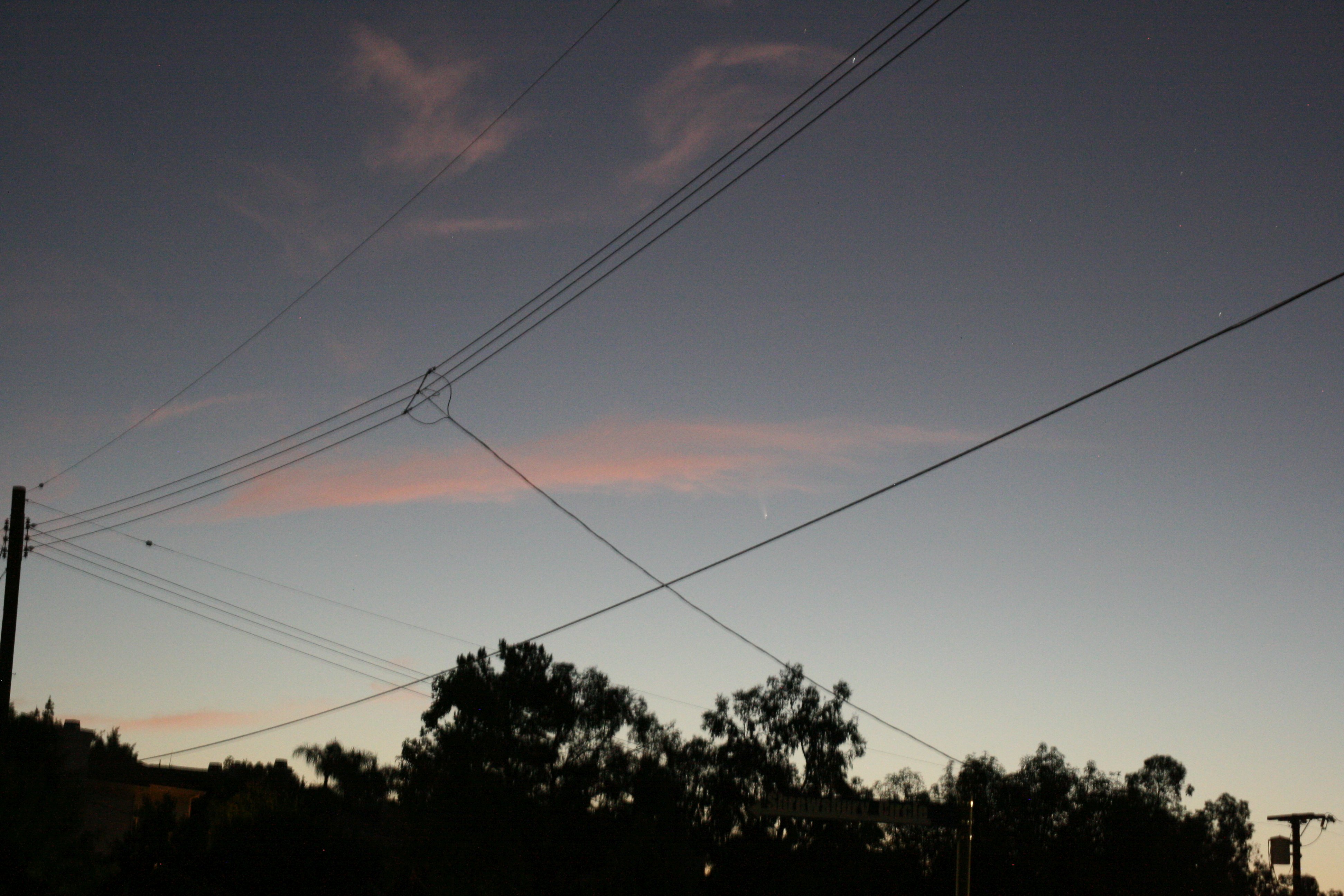
A one second exposure. You can now clearly see the tail stretching straight up (pointing away from the sun always as the solar wind strips ice and dust off the comet).
You can also see that it’s getting bright. I hadn’t realized that the big telephoto lens would be better, so I went back into the house for it.
In the few minutes that took, the sky had lightened a lot. That stupid little pink cloud was trying to make trouble so I set up in a slightly different spot. The comet again is clearly seen along with the tail, but the sun’s going to wing this battle.
So I saw it. It’s beautiful and spectacular.
I’ll try again tonight. (Sleep is for the weak and sickly!!) And having learned a few things, I’ll get up about a half hour earlier and try to catch it about the time it’s just clearing those trees. But it will be much more dark, and stay that way for a while…
You should try to see it also. If not by getting up at 04:00, then by waiting about four or five days to where the comet (which is moving, just like the planets and everything else) will swing away from the Sun and into the evening sky. By the end of next week it will be setting behind the Sun in the evening dusk, climbing a little bit higher toward the Big Dipper every night. Use that app I gave you to play with the times to see when you might see it.
And if you’re in SoCal next week, there will be GREAT ISS passes in the evening on the 15th, 16th, and 17th. Maybe a picture with the ISS and the comet together?










 We Love The Stars Too Fondly