Category Archives: Disasters

Another “Bad Day”

Another rocket launch, another “bad day.” Another thrilling launch, followed by a very brief moment of, “Huh, what’s that?” Then nothing but blue sky and falling bits of smoking debris. Another punch in the gut.

Very preliminary indications are that something happened with the second stage as it was being pressurized prior to being lit off after the first stage disconnected. There may have been some sort of rupture in the fuel tank, but the first stage seemed to be running just fine right up until the point where all of that venting fuel from the second stage hit the exhaust plume and ignited.

We have no idea how long the investigation will take or when SpaceX will return to flight. It won’t be the two years or more that NASA took after Challenger and Columbia, but it won’t be just a month or two either.

Last October, the Orbital Sciences Antares exploded just above the pad at Wallops Island in Virginia. They’re still figuring out what went wrong with their rocket and trying to fix it, but in the meantime they’re getting ready to return to flight using an Atlas V rocket to take their Cygnus vehicle to ISS.

Just a few weeks ago, a Russian Soyuz malfunctioned after reaching orbit and sent the Progress cargo vehicle tumbling out of control and unable to reach ISS.

Now with the SpaceX accident, that’s three cargo launch failures on three separate vehicles in the last eight months. We’re running out of ways to get supplies and materials up to ISS, and with Dragon down for an undetermined time, we have pretty close to zero ability to get anything down from ISS other than the crew. Returning Soyuz crews have enough room for a couple of pounds of stuff, but that’s nothing compared to the hundreds and thousands of pounds that Dragon can bring down. And don’t even get me started on the tons that the Space Shuttle could bring down if they weren’t in museums…

Dragon, like the Cygnus and Progress vehicles before it, was uncrewed, carrying only supplies to ISS. No lives were lost, just material. Some of it (a replacement US space suit, a docking port for the upcoming crewed Dragon and crewed CT-100 from Boeing, science experiments) will be a pain to rebuild and replace, but it can be done. Some of the scientific hardware destroyed was actually rebuilt experiments from students, replacing experiments destroyed in the Cygnus accident.

The ISS crew’s in no danger, they have provisions (food, water, air, experiments, replacement parts) to last them until the end of October if nothing else gets to them. There is another Progress scheduled for Thursday night (in the US) this week, and the next Japanese HTV cargo ship in August. The Antares launch on the Delta V might also be able to be moved up into late October or November.

Long term, the most significant effect might be to cause delays in the Commercial Crew program. Right now the only way to get humans up to the ISS or back down is by using a Russian Soyuz. The SpaceX Crewed Dragon and the Boeing CT-100 are supposed to launch in 2017, but this could get delayed. It was already being threatened with delays because Congress, in their completely finite wisdom (or complete lack thereof) has cut about $250M from this year’s budget for Commercial Crew. Part of the reason that Congress cut the Commercial Crew budget seems to be that they don’t want to fund development by both Boeing and by SpaceX – they just want one or the other. Some of them will point at today’s accident and say, “See, we were right!”

In fact, it proves the exact opposite, showing just how wrong they are. Getting off the planet into space remains one of the single most difficult tasks ever faced by humans. It’s dangerous, it’s risky, it allows for almost zero tolerance for mistakes or bad luck. 99.9999999% of a million or more complex events all have to work perfectly, or it’s “a bad day.” When an accident happens, the organization flying that vehicle has to figure out what happened and how to prevent it in the future. That always takes months and sometimes takes years. While that organization is grounded, you MUST have other independent organizations with similar capabilities that can keep flying and take up the slack. There truly are no other options if we intend to be a spacefaring species.

Here’s another thing for our Congress critters to think about. Right now we’re 100% dependent on the Russians to take our astronauts up to ISS and to bring them back down. We’re paying the Russians for this service. Last I looked it was about $65M per seat, but may have gone up again. So when Congress says they want to save money by cutting the Commercial Crew budget by $250M, do they not realize that the delays that cut will cause will force us to spend over $550M to buy more Soyuz seats from the Russians? Tell me again, Senator, how is paying $550M to the Russians a better deal than spending $250M here in the US?

More importantly yet, our political relationship with the Russian government continues to deteriorate. While the personnel at NASA, ESA, and Roscosmos all work together well, without any regard for international politics, the upper levels of both governments are a different story. Things got frosty after Russian invaded Ukraine, and they continue to go downhill. We’re now putting heavy weaponry back into Eastern Europe just in case it’s needed should Russia decide to invade anyone else. At what point do the Russians just flat out say, “Keep your cash, get your astronauts up and down on your own. Oops, right, you can’t! Sucks to be you!!”

Congress’s response if that happens will be…what? “Our bad, never saw that coming.” Or maybe, “It’s all NASA’s fault!! Fix it!!” (Two guesses, first one doesn’t count.)

SpaceX will figure out what happened today, they’ll make changes, and they’ll re-launch. With luck it will only be six to eight months, during which time our Japanese friends will launch their HTV, the Russians will get the Progress vehicles going again (no pressure for this week’s launch, guys!), and Orbital Systems will get their Cygnus flying again. Eventually SpaceX and Boeing will start launching crewed vehicles from US soil, even if it doesn’t happen in 2017.

I have no doubt that there will come a day, hopefully in my lifetime, when SpaceX, Boeing, Orbital, ESA, Sierra Nevada, JAXA, Roscosmos, and NASA are just the oldest and most experienced of dozens of launch providers.

I’m waiting for a day when there are multiple space stations in LEO (Low Earth Orbit), some as research labs, some as factories, some as solar power plants, some as construction sites for deep space vehicles, and some as hotels and recreation centers.

I’m waiting for the day when going for a week in zero-G at a LEO hotel is no more expensive or exotic than a week’s cruise through the Caribbean or Mediterranean is now.

But today was not that day. Today was a bad day.


We did not go to space today.

Leave a comment

Filed under Disasters, Space

Random Photo For June 7th

  • Random number between 1999 and 2015 = 2005
  • Random number between 1 and 12 = 8
  • Random number between 1 and 31 (or 30 or 28 or 29) = 18

DSCN5464 small

We were in Seattle, our first trip there, a family vacation. In the iconic Farmer’s Market, I saw this sculpture of a giant squid suspended above us.

By all accounts, squid can get quite large, and they’re not stupid. The exhibit curiosity and non-random, non-instinctive behaviors. There have been instances of remote vehicles thousands of feet down in the ocean seeing giant squid and having the squid come back several times to investigate and even play with the submarine.

Better yet, their aquatic relatives, the octopus, are in some cases being shown to be as intelligent as a chimpanzee or dog. They can be trained to perform complex tasks and can use simple logic and reason to solve problems. For example, in this video (which has Spanish titles, but a favorite Jean Michel Jarre soundtrack) an octopus figures out how to unscrew a jar in order to get at the food inside.

I’m hoping that we don’t manage to kill off all of the squid and the octopus as we continue to screw up the planet. We’re seeing significant temperature increases in the oceans as the atmospheric temperatures rise. We’re also seeing the oceans getting more acidic as the warmer water combines with the increased CO2 levels in the atmosphere, creating increased amounts of carbolic acid at the sea/air interface. Of course, we also have issues like oil spills that are causing major amounts of damage in the areas where they occur – look at how much oxygen levels in the water fell and marine life suffered after the British Petroleum spill in the Gulf of Mexico in 2010. Then we overfish for many species, depleting them to the point where they’re near extinction, which in turn depletes the species which feed on them, which in turn…

Given the increasing odds that at some point we’re going to screw up so badly that we put ourselves on the endangered species list, I hope that species like the squid and the octopus are able to survive. I know that in the long run, Mother Nature will do just fine without humans, just like she did just fine without dinosaurs and millions of other species before us. Something else will rise to the top of the food chain when primates are gone, just like mammals and primates rose when the dinosaurs faded into history. The planet will be just fine without us.

Maybe it will be octopus that get the next crack at it. If we don’t take them with us.

Leave a comment

Filed under Critters, Disasters, Photography, Travel

Burn Area

A week ago I talked about hearing sirens and how sometimes here that means there’s a brush fire in the area.

After the fire’s gone, large areas can be left scorched and burnt. This in turn leads to all kinds of problems from mudslides and flooding if there should be heavy rain, even months later. (Now however, we would probably trade the mudslide danger for the heavy rain and take our chances.)

While we think of the burn area as being all black, burnt, and smelling of soot and smoke — and that really is the way it is for the most part — given a couple of months Mother Nature will come back and some of it starts to look quite stunning.

OLYMPUS DIGITAL CAMERA

Leave a comment

Filed under Disasters, Los Angeles, Photography

Sirens

When it’s quiet at night it’s always spooky to hear the sirens on emergency vehicles echoing through the hills.

We have a hospital a mile away, so usually you hear the ambulances going of in that direction and then stopping. Someone’s having a bad night.

Sometimes you’ll hear police cars on one of the major streets that crisscross the area. If it’s something big, there will be police helicopters. If it’s big and goes on for a while, the police helicopters will be joined by the television station helicopters.

If you see or hear the TV helicopters out there, flip on the news.

When you hear the fire trucks, normally they’re coming from the fire station that’s a mile or so off in the other direction. Generally they’re heading off down one of the major streets as well, maybe to meet up with the police, ambulance, and assorted helicopters for a major freeway accident.

Rarely, you’ll hear the sirens of one sort or another getting closer, then pulling into our neighborhood. Never a good sign, but fortunately rare in these parts. Generally it indicates some sort of medical situation.

The worst is when the Santa Ana winds blow, and it gets hot and dry. The wind can be gusting to 50 or 60 knots, it’s dry as a bone, and into triple digits during the day and only getting down into the 70’s at night. Then you hear the sirens — and pray that it’s an ambulance or police car. If it’s a fire truck, you pray that they head into the city for some sort of traffic accident. If it’s a fire truck and they’re not going into the city, you pray you don’t hear a second, or a third — or a tenth.

If you hear the second or third fire truck heading up into the canyons and hills, check the news. Check the skies for smoke. Double check to make sure you know what your evacuation plan is.

What to you grab if you only have two minutes to get out? Ten minutes? Sixty minutes?

There’s smoke? It looks closer than you like? Maybe it’s time to put at least the first couple of those boxes of vital documents and your bugout bags into the cars and get the cars turned around in the driveway so they’re easy to load and easy to drive straight out.

Tonight it sounded like two ambulances, a police car or two, and at least one fire truck, all heading to either one of the main streets or back to the hospital. No smoke. No news. The winds are calm tonight.

Tomorrow we might not be so fortunate.

DSCN5595

3 Comments

Filed under Castle Willett, Disasters, Los Angeles, Photography

Drones

The FAA has issued some preliminary outlines for regulations it wants to put on remote-control drones. Folks are starting to have all kinds of concerns over their use, whether or not they’re safe, what privacy concerns they may pose, and so on.

The short version is:

  • Daylight only
  • Must remain in sight of the operator
  • Max speed: 100 mph
  • Max altitude: 500 ft
  • Max weight: 55 pounds
  • Operators must be certified, at least 17 years old, pass periodic reviews to stay certified, and be vetted by the TSA

I’m sure there’s more to it, but let me share a few thoughts (in no particular order) given that initial information.

  1. There’s got to be a distinction between “hobby-class” drones and “military-class” drones. (I made up those labels, but I think you get the drift.) The rules for a 50 pound, $1,000 machine, bought through Amazon or at a R/C hobby shop, with 15-minutes of fuel don’t make sense to apply to a 5,000 pound, $17M+ machine, built for the military, with a 24-hour fuel load. (See my pictures of Ikahna from the NASA Social at Armstrong.)
  2. Having seen what NASA is working on at Armstrong in order to bring Unmanned Aerial Vehicles (UAV’s = drones) into the National Airspace System (NAS), there’s every expectation that large UAV’s will be integrated into the system within the next few years. It’s going to happen, it’s just a matter of when, not if.
  3. But it sounds like NASA’s getting ready for some version of  the “military-class” UAVs (possibly both military and civilian, i.e., commercial), not “hobby-class” drones. (I’m no expert by any means, but phrasing that way might be closer to the facts than what I’m seeing in the press about this.) If these new proposed regulations apply to the latter group, fine.
  4. These proposals are a start.
  5. Enforcement’s going to be a real bitch. These things can be small, zippy, and if you’re on the ground being bothered by one, there won’t be any good way to ID it. If you see a plane or helicopter going overhead, you can get the “N-number” to ID it, or at least describe it. A small drone at a couple hundred feet is going to be a dot. If you see it at all, you probably won’t even be able to tell if it’s got four or eight or sixteen rotors, if it’s got a camera, or what kind of other equipment. Unless you see someone launching and/or retrieving it, you’ll never know who it was.
  6. They need to put a 100% no-fly zone around any and all airports. Let’s say, two miles, or better yet, three. As a private pilot, I’ve landed at night in early July and had fireworks bursting all around me like I was on a bombing run deep in enemy territory. Not fun. I’ve also come way to close to sea gulls and other birds, which can leave you really dead in a small plane, or even in a large one. (Ask Captain Sullenberger.) Smacking into a 5-pound drone at 100 knots isn’t going to be any different from smacking into a pigeon or seagull. I doubt too many of the hobby-class drones will go up to 1,000 feet or more, but when you’re landing and at 500 feet on short final, a collision would be a disaster.
  7. While you’re at it, put no-fly zones around large sporting events and places like amusement parks. Get a couple dozen (or more) drones buzzing around over the Rose Bowl during the UCLA-USC game and then have a couple of them collide and come down in the crowd…
  8. What happens the first time that someone actually uses one to kill someone or cause a huge problem? For example, what if someone starts buzzing trucks on the freeway until they get one to swerve and crash, causing a multi-vehicle, multi-fatality accident that ties up the interstate for hours? What happens when someone (certified or not) flies up over a hostage situation or a major fire and gets tangled up with a police or news helicopter?
  9. There are already people loading good-sized hobby-class drones with drugs and flying them across the border from Mexico into the US. If the cops knew about it they couldn’t or didn’t stop it – it only hit the news when one crashed. Do they really think that the people doing that will pay attention to any new regulations?
  10. On the other hand, while everyone’s all up in arms about the possible problems with hobby-class drones, there are also some pretty neat things that can be done. From real-estate sales videos (something that they’re used for a lot here in LA already), photography for getting a new viewpoint or photographing an event such as a wedding, monitoring a disaster (I’m sure fire fighters on a large forest blaze would love to have fast, accurate aerial views), news reporting — there will be a million other good, legitimate, honest, incredibly useful applications.
  11. They’re a tool, just like any other. Used correctly and intelligently, they can do amazing things. Use stupidly and irresponsibly, they can be the cause of a disaster.

Pandora’s Box is open on this one. It’s going to be interesting, to say the least.

Leave a comment

Filed under Disasters, Flying, Politics

I Hope I Don’t Die For A Stupid Reason

There was an event today, probably minor in the big scheme of things, but it was a problem at the time. In the course of dealing with that, the thought crossed my mind that, somewhere, somehow, I had heard that people had been known to die while dealing with such a problem. It was rare, it might be apocryphal, but it wouldn’t surprise me if it were true.

That got me to thinking not-so-deep thoughts about my (presumably) inevitable demise. I say “presumably” because I still like Kurzweil’s ideas about The Singularity. He might be a full of crap and just as batshit crazy as Hubbard was with Scientology, but we’ll see. Maybe I did make it in time to have medical miracles, DNA-rebuilding nanobots in my blood, anti-aging regimens, and a lifespan into the hundreds of years.

But probably not.

So, back to my (probably) inevitable demise. Of course, if we’ve gotta go (and we do), it would be great if we could all go saving a building full of orphans from a fire, throwing ourselves on the grenade to save our whole platoon, or anything generally noble, sacrificial, and leaving the world a better place despite our passing.

That would be great.

More realistically (I’m getting there, slowly but surely) most of us are going to die from some useless disease that has us wasting away for our last few months or years, or else some moron on the freeway is going to be texting and drunk when that light turns red and we’re going to be a somewhat squishy hood ornament.

I could live with any of those – well, maybe “live” isn’t the right term. But at least my final thoughts wouldn’t be something along the lines of, “How am I ever going to explain THIS to St. Peter with a straight face?”

Given the choice (and I won’t be), I would prefer to not die of something STUPID.

Because those methods of passing also exist all around us. The odds may be in favor of disease (eight of the top ten causes of death are medical conditions) or accidents (cars seem to be first, guns second) but there are all of those weird and low-odds accidental causes of death that just linger for us, out there in the long tail of the bell curve.

Some of those are just “sucks to be you” accidental deaths. You’re in the wrong place, wrong time, and all the planning and precautions in the world aren’t going to mean a thing. There’s a gas explosion, an earthquake, your cruise ship sinks, a tidal wave hits the beach, the plane crashes…

Actually, in my case, being in a plane crash is probably higher on the list than for most folks, simply because I have my pilot’s license and I occasionally (i.e., every chance I get) fly in old WWII planes and go fly aerobatics. I also want to go skydiving, and scuba diving, and hike the Appalachian Trail, and learn to fly a glider, and…

You get the idea. I don’t want to go out in an easy chair watching “Star Trek” reruns unless I’m at least 110. But at least none of those flying- or adventure-related deaths would qualify as “stupid” in my book.

Being hit by lightning? If it’s a “shit happens” event, fine. If you’re standing out on a golf course holding a metal club and ogling that odd-shaped cloud with your mouth open — stupid.

Watching fireworks which you dearly love and a freak accident detonates thirty tons of skyrockets all at once and you catch a piece of shrapnel while sitting a half-mile away? Not your day, sorry! Dying while making a “Jackass” video and lighting off M-80’s while drunk — stupid.

Pretty much anything that involves being a victim in a major natural disaster or catastrophe gives you a good story to tell while you’re in line at The Pearly Gates. If the National Guard, NTSB, and CNN are out there picking through rubble or debris looking for you, it’s probably not your fault. Tornado, earthquake, thermonuclear weapons, all are acceptable, at least so far as this particular idiotic rant goes.

Anything that involves the paramedics coming in and taking pictures to pass around at the station along while playing “Can You Top This?” — stupid.

“Yep, you think that’s good? We found this guy, wearing just a thong and his wife’s wig, covered in whip cream, spread-eagle, with this weird opera music playing full blast, and a goat in the room…”

No paramedics laughing so hard that they can’t even check to see if you’re still breathing. Please.

4 Comments

Filed under Disasters, Farce, Flying, Health, Religion, Tornadoes

Ammonia

For those of you who might have missed it, or more importantly, for those of you who only heard about it in the mainstream media, there was an emergency declared this morning on the International Space Station. The “tl;dr” version is that everyone followed the procedures that they’ve practiced hundreds of times, everyone’s safe, the emergency turned out to be a faulty sensor, and everything’s getting back to normal.

Not that you would know it from looking at the stupid clickbait headlines in a vast number of online “news” sites. I don’t know which worries me more, the fact that so many of our traditionally reliable and trustworthy news sources are turning into happy-talk, sensationalist, fear mongering, nonsense sites, or that so many of the general populace doesn’t know and/or doesn’t care that it’s happening and believe every word without question.

Anyway…

Up on ISS, there are three BIG problems that are top of the list in potential crises. First, depressurization, perhaps if they’re hit by a piece of debris or a micrometeorite. Secondly, fire and smoke, which can get out of control, behave in an unusual way, and get very deadly very fast. Third, an ammonia leak from the cooling system, which can get into the cabin air and become extremely toxic and poisonous.

All of the equipment running on ISS creates a lot of heat, which has to be dissipated. There’s a water cooling loop inside – but it can’t go outside because the water would freeze and/or boil in the temperatures, breaking the system. So outside there is a coolant loop of ammonia, which is very good for the job but also very poisonous in high concentrations and being pumped around under pressure. In between the two systems are a series of heat exchanging radiators.

That’s where the problem could come in. If something cracks in one of those radiators and fails despite the safeguards, ammonia could get into the cooling water, and from there into the air.

What controllers on the ground at NASA saw about twenty-one hours ago was a rise in pressure in the water cooling system. This is a potential sign that ammonia is possibly leaking into the system. Then they saw a rise in the cabin air pressure, which would be a second sign of possible ammonia contamination.

As planned in such a situation, the astronauts in the American side of the station (where the ammonia/water cooling loops are) put on gas masks, retreated to the Russian side of the station (where there is no ammonia system), and closed the hatches. (Each segment of the station has a hatch at every entrance that can be closed, sealed, and locked quickly, just like in a submarine. In an emergency, it limits the potential damage.)

From there they tested the air in the Russian segment (it was fine) and the controllers on the ground started shutting down systems on the American side to save power and minimize the load on the cooling system. From there, the crew could stay for a considerable time (weeks if necessary) using just the Russian food, oxygen, and toilet. It would be crowded and inconvenient, but it would be safe.

Once in a safe mode, ground controllers began testing the cooling system and double checking the monitoring sensors and computers. At no point was there every any evidence that an ammonia leak had actually occurred. All that was seen were the two pressure readings that might possibly be early warning signs of a leak.

After several hours, the controllers on the ground were convinced that it was in fact a false alarm, caused by a problem with one of the interface cards that connects the computers to the sensors. The go-ahead was given to start procedures to re-enter the American side of ISS.

With the three Russian cosmonauts and one Italian astronaut all going into the two Soyuz vehicles (which in an incredibly extreme scenario could be detached from ISS and bring the occupants back down to Earth), the two American astronauts donned protective gear (gas masks and so on) and cracked the hatch between the American and Russian sides. The air tested fine. They went through the hatch and then shut it behind them, then went slowly through the entire American side. The air all tested fine.

The “all clear” was given and everyone was given the go-ahead to put away the safety gear and start restoring everything to normal operations. The ground controllers do a lot of this, bringing systems back online slowly and in a controlled fashion so that nothing gets overloaded, much like how the power grid is brought back up after a large blackout.

Tonight the two American and one Italian astronauts all slept in their normal quarters in the American segment. No damage was reported to any of the science experiments running and no science data was lost, just some time. They’ll have to juggle schedules and might miss a few hours of their nominal off-duty time on the weekend to get caught up, but that shouldn’t be a big deal.

So, a couple of things to remember:

First, as always, if you run into anyone who says that NASA doesn’t exist anymore and we don’t have anyone in space, either straighten them out yourself or sent them to me for some references and factual information. Don’t be mean to them — they’ve probably just been getting their information from that “mainstream media” and don’t know any better. We can fix that, one person at a time if necessary.

Secondly, don’t ever forget just how dangerous it can be to be off-planet. We’ll always do our best to keep everyone safe, but it is an extremely harsh, hostile, and dangerous environment. It can kill you in a heartbeat if you’re not constantly vigilant and prepared.

The fact that it’s dangerous doesn’t mean that we can’t go there, or that we shouldn’t go there. There are environments just as hostile and dangerous here on Earth that we have tens of thousand of people living in every day. Think about life on a nuclear sub, for example. Very similar — isolated, crowded, cramped, a hole in the hull will kill you, a fire onboard can kill you, and a contaminated atmosphere in an small, enclosed space can kill you. Yet we still have hundreds of submarines with tens of thousands of sailors aboard.

We can survive in those environments, in particular by doing our best to think through in advance what emergencies might arise and how we’ll deal with them. Today everyone did what they were supposed to, and the system worked like it should have. Even if it had been a major ammonia leak, there are procedures beyond what was done today to seal it, clean or vent the contaminated atmosphere, and restore the contaminated areas to normal use.

Just don’t panic if you see a sensational headline on a normal news source or website. (That goes for everything else such as plane crashes or terrorist attacks or local traffic accidents.) Double check your facts and never believe everything you read or see on the internet.

(Except for here, of course! NOT!)

2 Comments

Filed under Computers, Disasters, Space

Flash Fiction: The People’s Plague

It’s All Hallow’s Eve Eve, so this week’s  Flash Fiction Challenge of course involves horror. Inspired by the fact that Ebola hysteria is running rampant through the mainstream media and the halls of government, our assignment is to write a horror story involving some sort of disease.

This might not have turned out as well as I wanted — too serious to be slapstick, trying too hard for a punchline to be horror. But the dozen political calls a day and hundreds of TV ads every day may be having an effect on my brain.

THE PEOPLE’S PLAGUE

“We have another one, ma’am. This report just came in from Phoenix.”

Doctor Helen Fletcher, the CDC’s lead investigator, looked at the window that popped up on her console, attached to a pin dropped on the map in Arizona. Ten cases already there, along with all of the other boxes and pins displayed all over the country. Thousands of cases nationwide and spreading like wildfire.

“We’re running out of time to get this under control,” she said to the row of faces shown in the small boxes lining the bottom of her computer screen.

“Doctor Fletcher,” the Midwest section head said, “it’s too early to even tell if it’s airborne or not. We’re going to need at least a couple of days to determine the distribution vector.”

“You do all realize this is an attack, not a disease, don’t you?” A new window had opened up, with the medical liaison to the FBI shown. “Look at the pattern that’s showing up. The first cases were seen in New York, Los Angeles, Washington, and Chicago, but now it’s popping up everywhere overnight. Boston, Atlanta, Denver, Indianapolis, now Phoenix. But also Trenton, Hartford, Nashville, Richmond. Can’t any of you see what that means?”

There was a pause while all of the medical experts tried looking at their data for a pattern they had missed so far. Most of them had been awake for the better part of seventy-two hours and were function solely on caffeine and adrenaline.

“What are we missing? I don’t see it,” Doctor Fletcher said. “It looks like it’s spread all over the country at random. They’re all metropolitan areas, but there’s no obvious vector based on wind, weather, animal population, food distribution, or transportation routes.”

“Another report coming in,” said the sergeant. “Juneau, eight cases suspected.”

“How in hell did it jump so fast to Alaska?” asked the CDC director for the Pacific Northwest. “That can’t be natural, it’s got to be based on travel, some agent introduced into the air transportation fleet somehow, or…”

“Stop it!” shouted the FBI agent. “Did any of you study anything other than biology in high school?”

“State capitals,” said the CDC Southwest director. “With the exception of New York, Chicago, and Los Angeles, they’re all state capitals.”

“Exactly,” said the FBI agent. “This is an attack on the government of the United States. I’m going to be briefing the President on this in ten minutes. What else can I tell him?”

“If it’s an attack on the government with a biological agent,” asked Southwest, “wouldn’t it be aimed at the people who run the government, the politicians themselves and their staffs? Do any of the infected fit that profile?”

“Not that I’m aware of,” said Doctor Fletcher, “we certainly would have heard if any of the infected were governors, Senators, or Members of Congress.” She gestured to one of her aides hovering behind her. “Start checking on who the infected people are, what they do, where they work.”

A new window opened up on the conference call screen, showing columns of data including names, location, age, sex, religion, and occupation. Data fields started to populate the chart, seemingly at random.

“Lawyers, advertising, film editors, clerical workers, computer programmers, graphic designers, sound engineers, CPAs – it seems random.”

“Wait, it’s not what we see, it’s what we don’t see,” said the FBI agent. “There aren’t any housewives, any unemployed, any students, or any children. I want to see something. Can you show just the people in the cities that are not state capitals, and also show the company they work for?”

The data once again shifted and shuffled and finally pieces of the puzzle began to fall into place. The data for the infected patients began to clump into groups with multiple data records showing people working together at the same companies.

“Does anyone recognize any of these companies?” asked the FBI agent. “Can we see a couple of their web pages real quickly?” The new windows popped open. “See, they’re all related to advertising in some way. Most are ad agencies or production companies for television or radio. A few are printers. Now, let’s look at a couple of the state capitals.”

The data set expanded, to include the infected patient data for five of the smaller cities.

“There’s your link. It’s an election year. I’ll bet when we dig deeper, every one of these people is involved in some way with a political campaign.”

“Doctor Fletcher,” said Mid-Atlantic, “we’re just getting word from Annapolis and Richmond that new cases include a couple of state politicians and candidates.”

“Same here,” said Northwest. “We’re taking a closer look at the data for patients in Salem and Boise, and some of them are state legislators.”

“Okay, I’m going to go brief the President,” said the FBI agent. “Am I correct that so far there have been no fatalities or permanent disabilities?”

“You are correct, no fatalities,” said Doctor Fletcher. “It’s too early to tell about long term disabilities, and given this new information, we might have to reassess how we use that term.”

“Please clarify that for me and do it quickly, the President’s waiting.”

“The symptoms we’ve been concentrating on were the fever, dehydration, convulsions, and unexplained breathing difficulties. But there have been other symptoms reported which we’ve discounted, assuming they were side effects of the fever, perhaps delusions or hallucinations. We need to reevaluate that.”

“Why?”

“We’ve had reports the convulsions and breathing difficulties were experienced specifically when people tried to lie. The more egregious the lie, the more severe the symptoms appear to be.”

“You don’t mean…”

“Yes, I do. This might be an engineered virus which forces the victims to tell the truth or suffer horribly. And it’s targeting politicians.”

There was stunned silence across the conference call.

“Alright, I’ve got to go,” said the FBI agent. “I’ll get people at my end started on tracking down the terrorist monsters that might have done this.”

“’Monsters’? Don’t you mean ‘geniuses’?” Doctor Fletcher muttered under her breath.

“Say again, Doctor?”

“Nothing. We’re on it.”

3 Comments

Filed under Disasters, Health, Politics, Science Fiction, Writing

A Bad Day At Wallops Island

Unless you’ve been under a rock (or asleep, I guess, but if this is the first thing you’re reading when you wake up, please let me know) you’ve heard there was a catastrophic failure this evening of the Orbital Sciences Antares rocket carrying the Cygnus spacecraft on the ORB-3 resupply mission to the International Space Station.

In the black humor parlance of the rocket and space industry, this is referred to as “a bad day.” (Seriously.)

It’s way, way too early to have any definitive answers. The launch occurred just after sunset, so the area is dark, and with toxic fuel and other safety issues in the crash site they’ll be waiting until dawn to start moving in, picking up the pieces, and starting to figure out what happened. So there are lots of terms such as “appears” and “probably” and “might be” below. Nobody knows anything much at this point. But with that said…


The vehicle appeared to lift off normally, rose for six to eight seconds to maybe a couple hundred feet, when there was a huge gout of flame from the engines (much bigger than the already huge tail of fire that’s left behind a normal launch), followed almost immediately by what appeared to be a shower of burning pieces falling off of the engine. The rocket’s lift ceased, it started to tip over and fall backward toward the pad, there was another explosion (probably caused by the Range Safety Officer hitting the Big Red Button to blow it up before things got worse), at which point the whole thing fell back to the ground near the pad and then ALL of the fuel went up in a monstrous fireball.

Yes, I was watching live and, yes, it was like a punch in the gut to watch. Not as bad as Challenger, Columbia, or Apollo 1, but still, it’s a shock.

The good news is that the Cygnus was uncrewed, carrying only supplies to ISS. The manifest included water, compressed nitrogen, food, clothing, spare parts for various ISS equipment, and equipment and materials for scientific experiments being conducted on ISS.

The bad news is that a lot of scientific hardware was destroyed, representing years of work by thousands of students and scientists. The launch facility at Wallops Island in Virginia probably suffered some damage, but it will be days or weeks before we know how much and how long it will take to repair. And a big link in the supply chain to keep ISS going will be down for a while.

Let’s just hope it’s not the 2+ years that NASA was grounded after the Shuttle accidents. Maybe more like the six to eight months that the Russians are grounded after their Proton launch failures earlier this year. But the most important point is to be thorough, find the cause of this accident, and fix it.

A few points and observations (see my Twitter comments, which should be displayed over on the right side of the screen):

  • After the accident I had one TV showing the NASA-TV feed, while channel flipping on another to see how the mainstream media handled it.
  • None of the major news networks had anything for almost a half hour, then it was only a quick flash on Fox Business News before CNN started more extensive coverage.
  • In Fox Business’ brief first report, the anchor twice called the explosion “spectacular.” Okay, I guess, he was probably seeing it for the first time, but given the tragic nature of the footage, couldn’t he have chosen a better word? Isn’t that what he does for a living, deal with words? Perhaps “catastrophic” or “horrific” would work better, and we can save “spectacular” for a glorious sunset or a picture of a rainbow in the Grand Canyon.
  • When did CNN stop reporting news and instead put on uninformed talking balloon heads who try to make every story into something filled with hysteria and panic?
  • The CNN coverage was so-so when they broke into their normal show at about eight to ten minutes before the top of the hour. The anchor there was a bit clueless, but at least he wasn’t horribly wrong on all of his facts.
  • After the top of the hour when they went into the “Erin Burnett OutFront” show, things went into the toilet quickly as far as the quality of reporting went. In part I’m sure it was coming from the producers, but they heard something on the NASA or Orbital Sciences audio feed about the crash area being closed off because of “classified crypto equipment.” The reporting went straight into paranoid hysteria, with that phrase being on the screen almost constantly for the next twenty minutes or so, and Ms. Burnett repeating it at least a dozen times. It was as if someone thought they had figured out that this was some sort of super secret spy mission launch and they were going to break the story! Ta-dah!!
  • Except that, even if they heard that phrase correctly (others on Twitter noted it as well), it almost certainly didn’t mean what they kept trying to make it mean. CNN correspondent Miles O’Brien, CNN reporter Tom Foreman, and retired NASA astronaut Mark Kelly all got asked about it and all said that it was almost certainly nothing. All three emphasized repeatedly that this was an ISS resupply mission, its cargo was made up of supplies, equipment, and science experiments, and there is ZERO military or spying use for ISS. None of that mattered. Kudos to Mr. O’Brien, Mr. Foreman, and Captain Kelly for being calm and factual when dealing with this lack of professionalism on CNN’s part.
  • I never saw anything from any of the major networks (ABC, CBS, NBC, Fox) except for segments in their evening news half hour shows.
  • At the top of the next hour, every single news network had something about it — but only as the third, or fourth, or fifth piece, even though the news was less than two hours old. Instead we heard first about the police chief in Ferguson resigning, Ebola, the upcoming election…
  • When did we all get so blase about spaceflight that even a graphic disaster is less newsworthy than same-old-same-old political mudslinging?
  • Was that dismissive attitude because the mission was uncrewed? (No blood for the “If it bleeds, it leads!” editorial standard.)
  • Getting into space is HARD! The press forgets it quickly, as does the general public, but the people working in the space industry never forget. The fact that we do it so successfully so often is a tribute to the amazing job that all of these people do. If they didn’t, we would have accidents like this 98% of the time instead of 2% of the time. (Those are ballpark figures for illustration purposes only – but they’re close.)
  • The crew of ISS is in no danger of running out of food, air, water, or other supplies because of this accident. (This was the next thing that CNN and others wanted to panic over, even when they stopped obsessing over “classified crypto equipment.)
  • The mission managers at NASA plan ahead with a four to six month reserve, so even if no other spacecraft got to ISS, they would still be fine until at least March or so. But the fact is, there are other cargo spacecraft in use. SpaceX is scheduled for another cargo mission in mid-December, and the Russians are launching a Progress cargo mission in about an hour.
  • In addition, Sierra Nevada is independently continuing to develop their Dream Chaser spacecraft. Also, the Japanese space agency JAXA has their H-II Transfer Vehicle, with the next one scheduled for mid-2015.
  • THAT‘s why we need to have multiple, independent methods of getting into space! If one method has a problem and needs to shut down for a few months or a year, the others can pick up the slack.
  • Remember that the next time that the idiots in Congress suggest that we should pick either SpaceX or Orbital Sciences and get rid of the other.
  • There’s an interesting video on YouTube (here) taken from the press viewing site. (Do NOT read the comments, they’re full of troll bait and BS.) There’s more than a bit of panic since they’re closer than the general public and need to evacuate fast. There is some (small) danger there from debris, but a much bigger one from the shock wave (that was one freaking big “BOOM!”) and from possibly having the fumes from the burning fuel drift over them. That crap can be toxic.
  • There’s another interesting video (here) taken from a small plane flying inland from the launch site maybe twenty to thirty miles or so. I would have been more worried about that shock wave than this guy was, but perhaps ignorance is bliss.
  • Kudos to the Orbital Sciences and NASA leaders who stood up and faced the press in a news conference just two hours after the accident. That’s got to be tough, really tough.
  • Kudos to Orbital and NASA for keeping the televised feed and audio going on and on after the accident, rather than cutting it off and trying to cover things up. That kind of openness and transparency is badly needed and greatly appreciated at times like this.

The biggest takeaway isn’t that getting into space is hard. It’s that despite how hard it is, even when we have a problem like this (and we will have more in the future) we don’t stop. We pick up the pieces, figure out what went wrong, correct it, and move forward to launch again.

THAT‘s rocket science.

Leave a comment

Filed under Disasters, Space

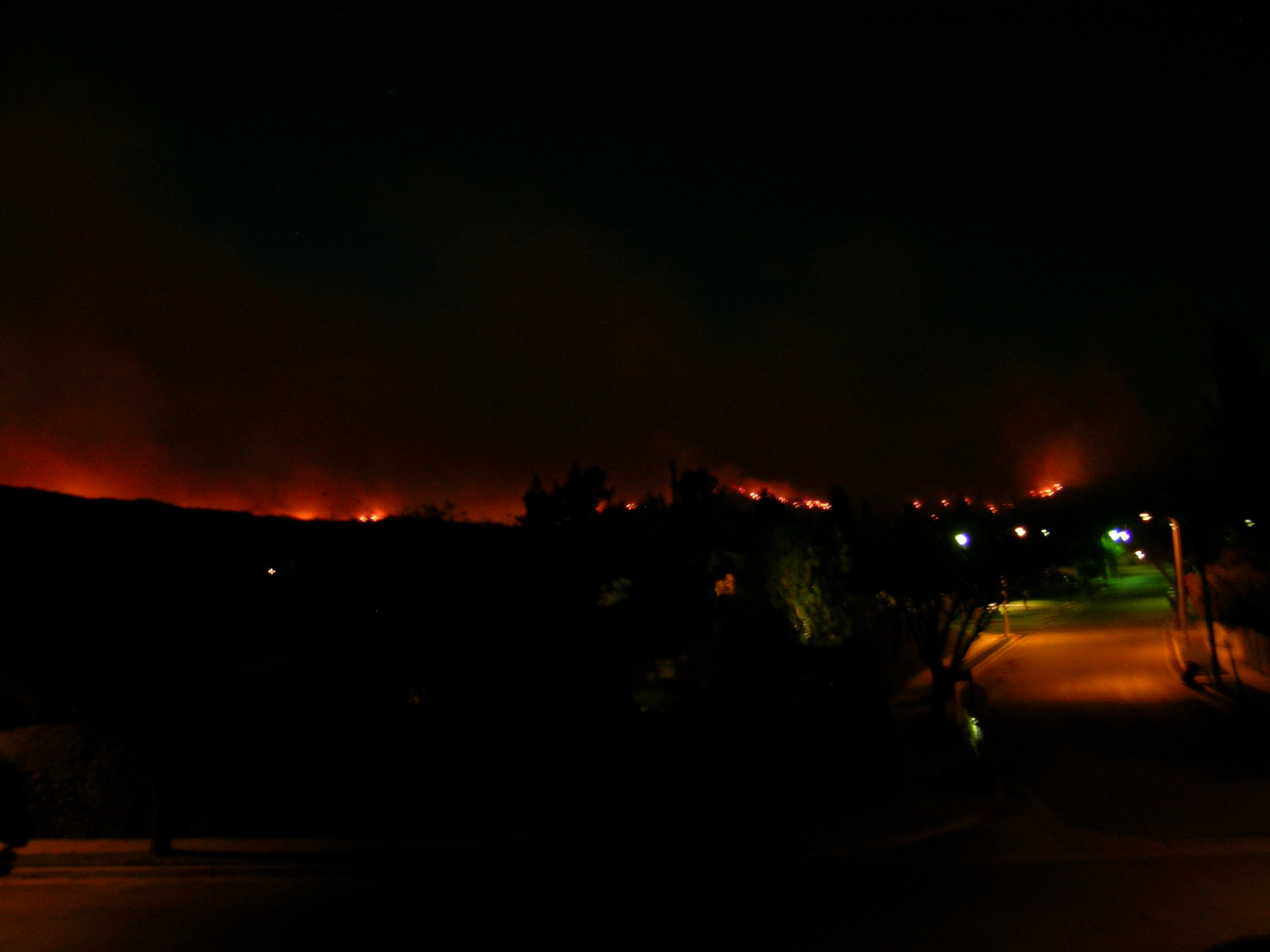
Who Needs A Fireplace Tonight?

That was my first thought when I took Jessie out a while ago.

In the winter, when we have a night that’s cool (in the 50s F) as opposed to cold (30s F), you’ll smell the smoke in the air as some folks light off their fireplaces instead of turning on the furnace. (I know, it’s not -30F like in Vermont, but it’s cold for LA.) But today it was almost 105F here and it’s still in the low 80s, so who’s the yahoo with the fireplace?

It only took a second to realize the truth. That wasn’t wood smoke — it was grass & brush.

The good news (or really, really bad news) was that I couldn’t hear any sirens. If it were a big brush fire anywhere within ten miles, we would have heard lots and lots of fire trucks. But if a brush fire had just now started and was near enough for me to smell, the first engines might not be rolling yet…

A quick look around at the hills showed no obvious flames or orange glows (just the blue-white glow from the football game over at the high school), nor any obvious smoke clouds. Once inside, a quick check of the local news sites showed that there had been a small (three or four acres) fire about five miles away, but they had hit it hard and got it out before it could spread much.

Brush fires are always an issue in California, and this year could be a doozie. So far all of the really big fires have been up in Northern California, but it’s just a matter of time before we have them in SoCal this year. In the third year of a historic drought, there’s a lot of brush to burn. Meanwhile, the hundreds and hundreds of fires to date this year have already exhausted the funds budgeted to fight them, despite the fact that the heart of the fire season is just getting here.

The drought’s getting critical (there are already small towns in central California that haven’t had water AT ALL in weeks), the temperatures are rising (on average, in this part of the world it’s the hottest year since they started keeping records in the mid-1800s), and the hoped-for El Niño rains are now being described as “unlikely.”

The next time I smell smoke, the proper first thought won’t be “Who’s using their fireplace?”

The correct questions will be, “How big? How close? Where are the critical documents? Where’s that bug-out plan? How soon do we have to start packing the car and how much time do we have?”

4 Comments

Filed under Disasters, Dogs, Los Angeles