Category Archives: Space

Planetary Bodies Moving On

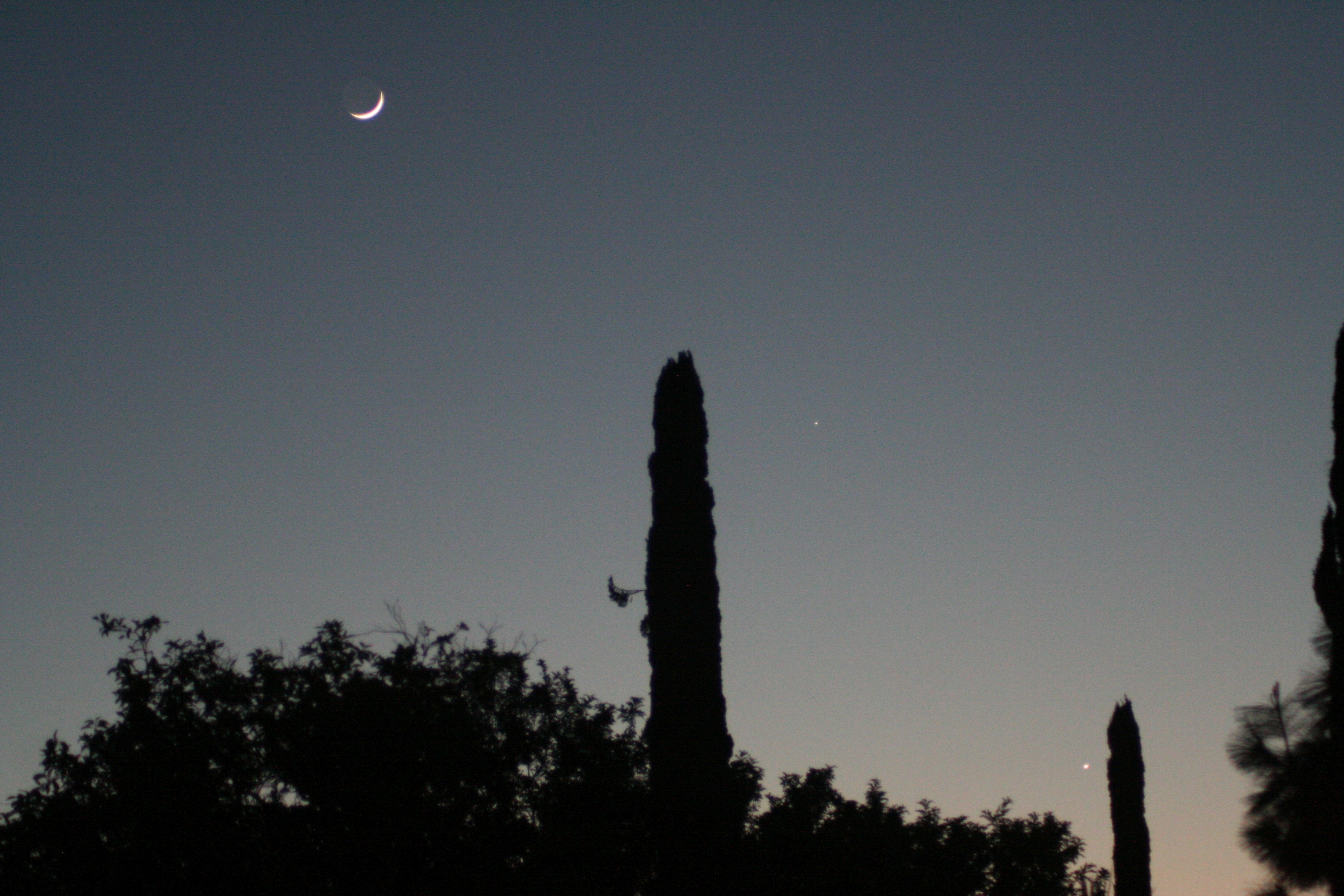
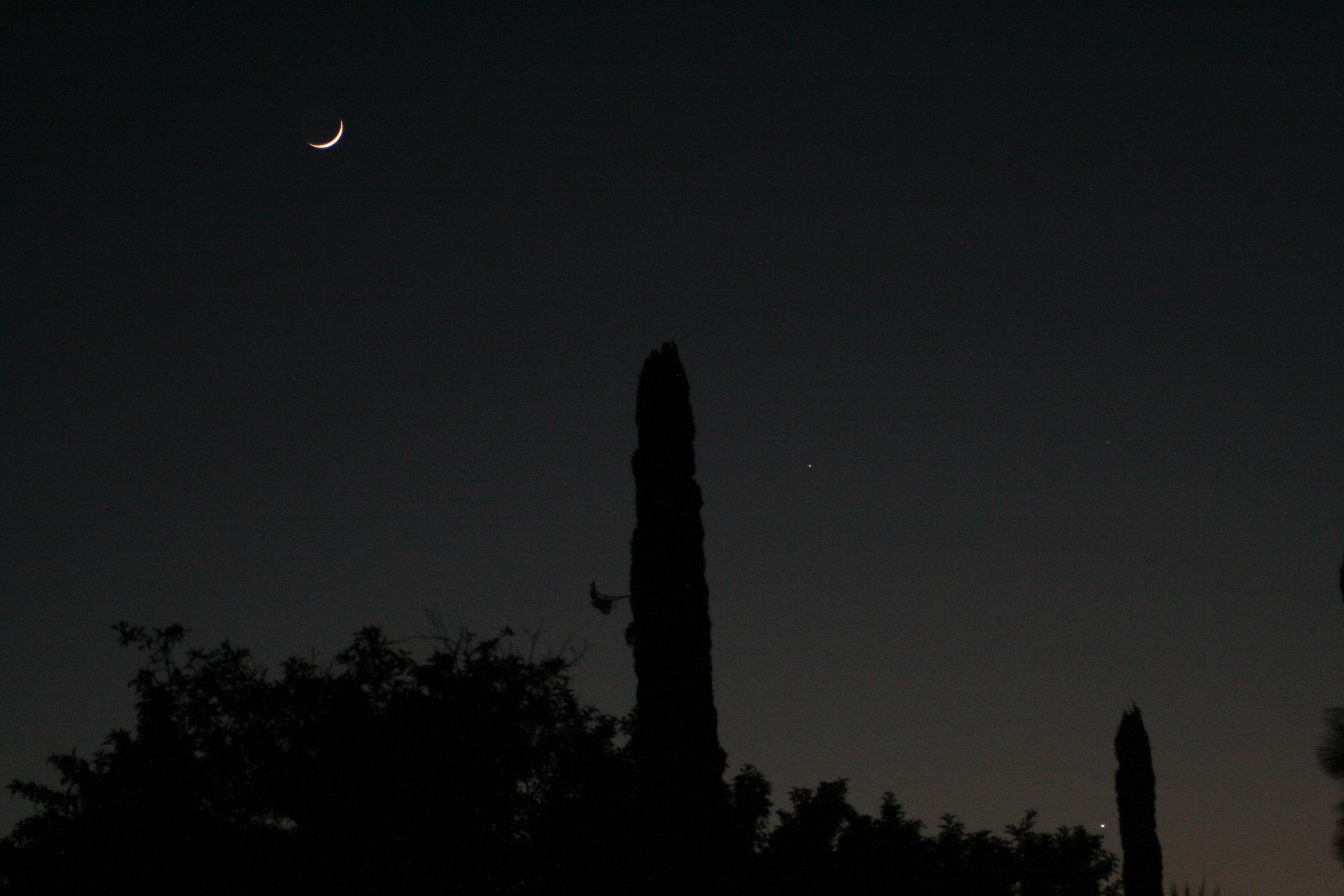
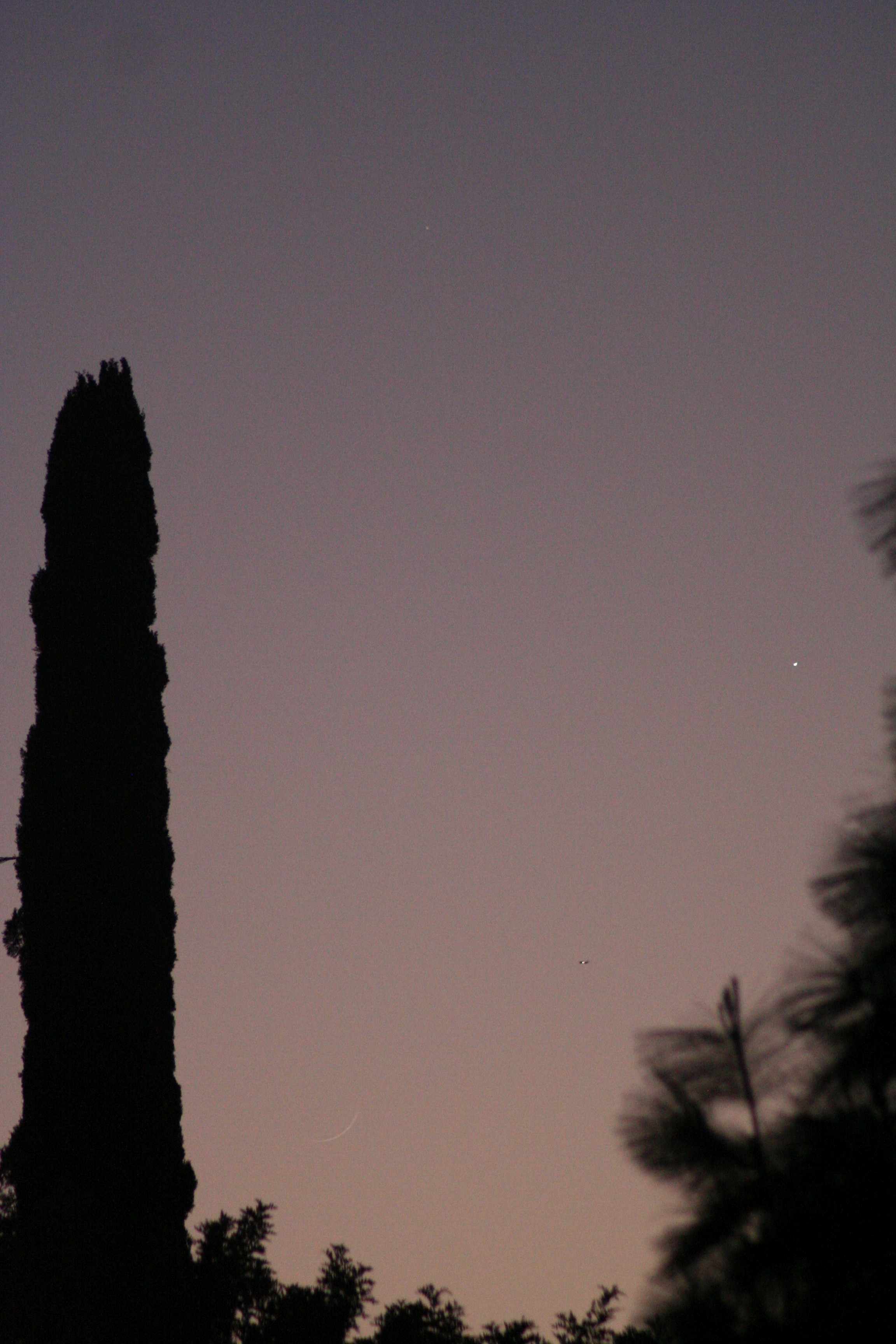
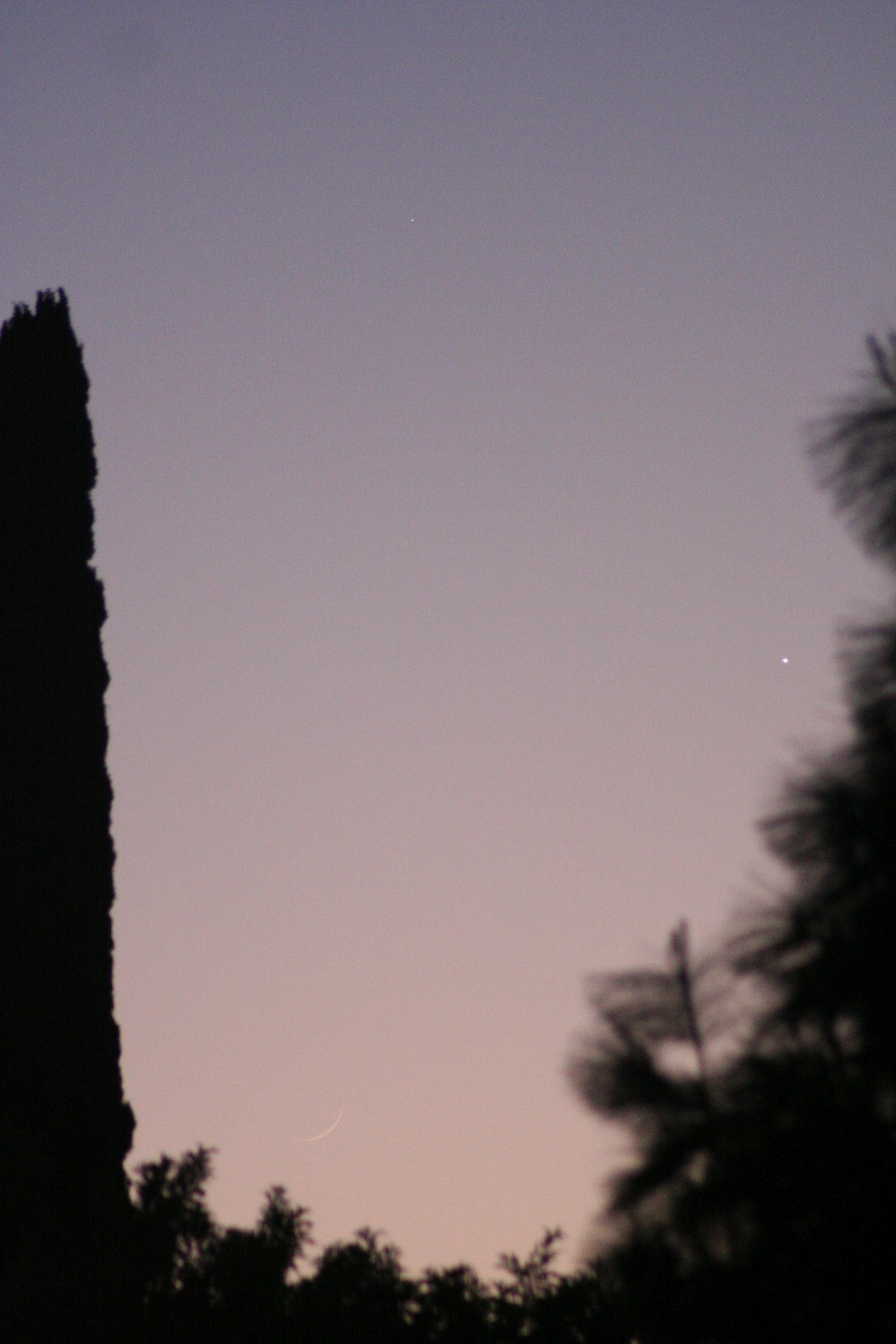
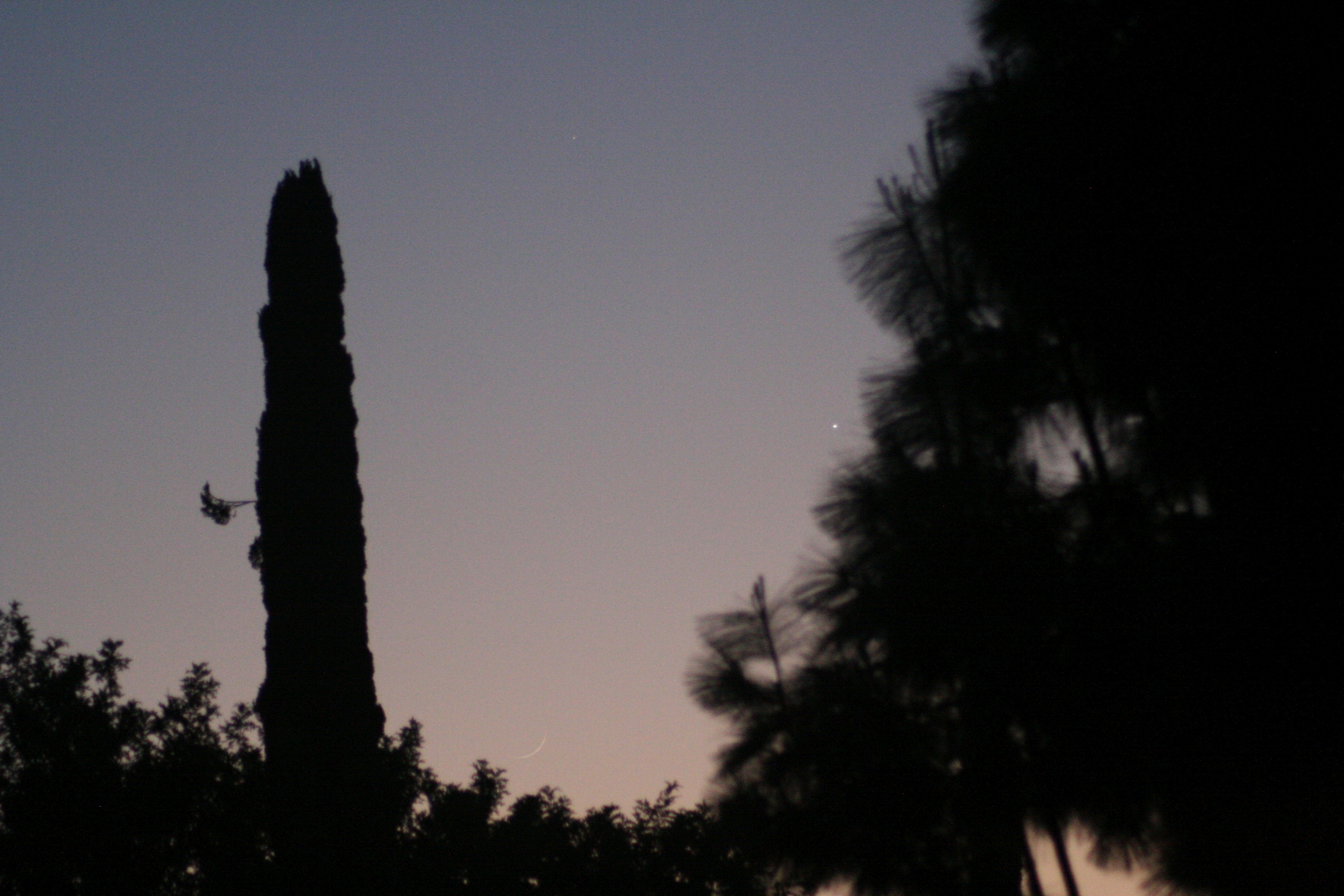
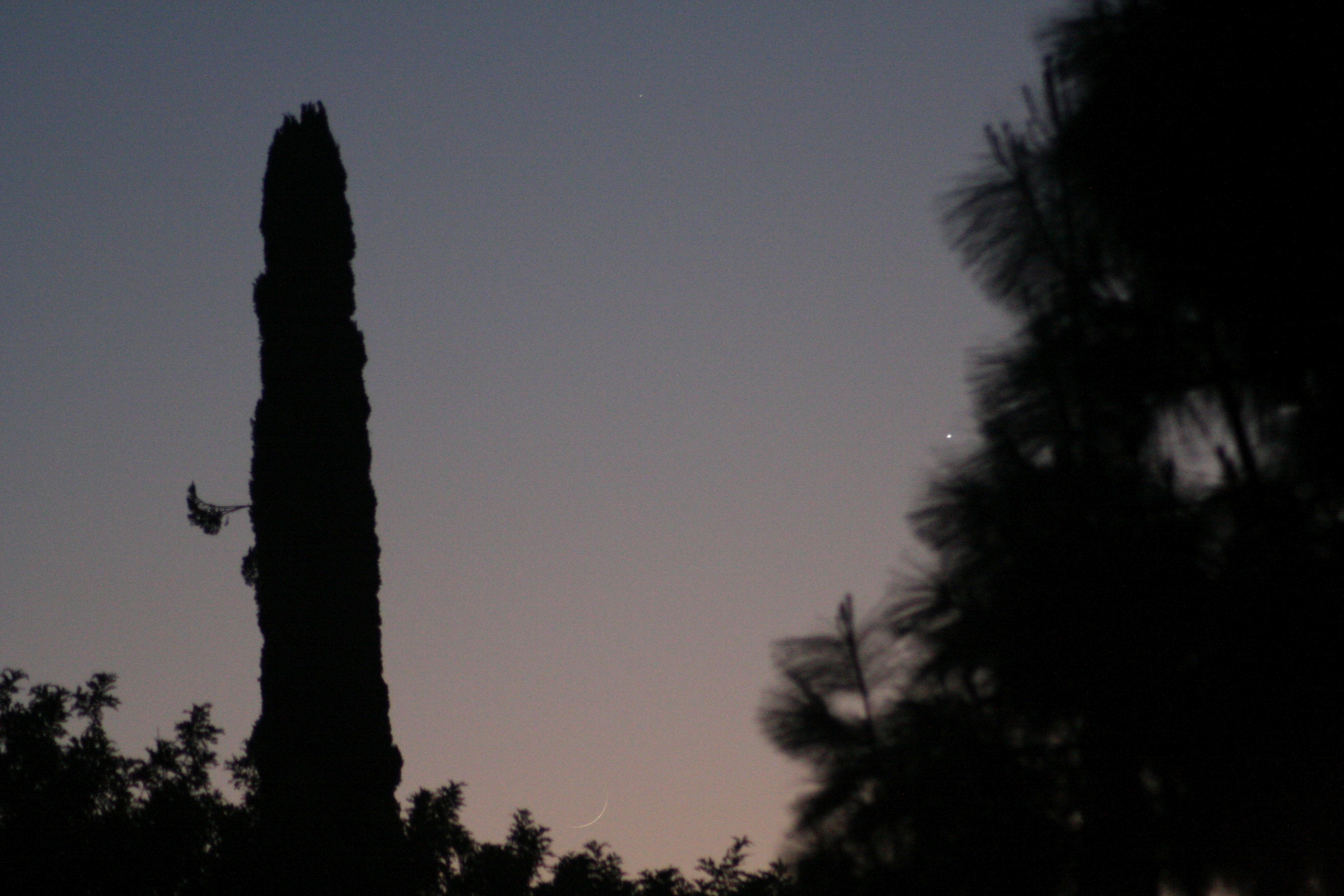
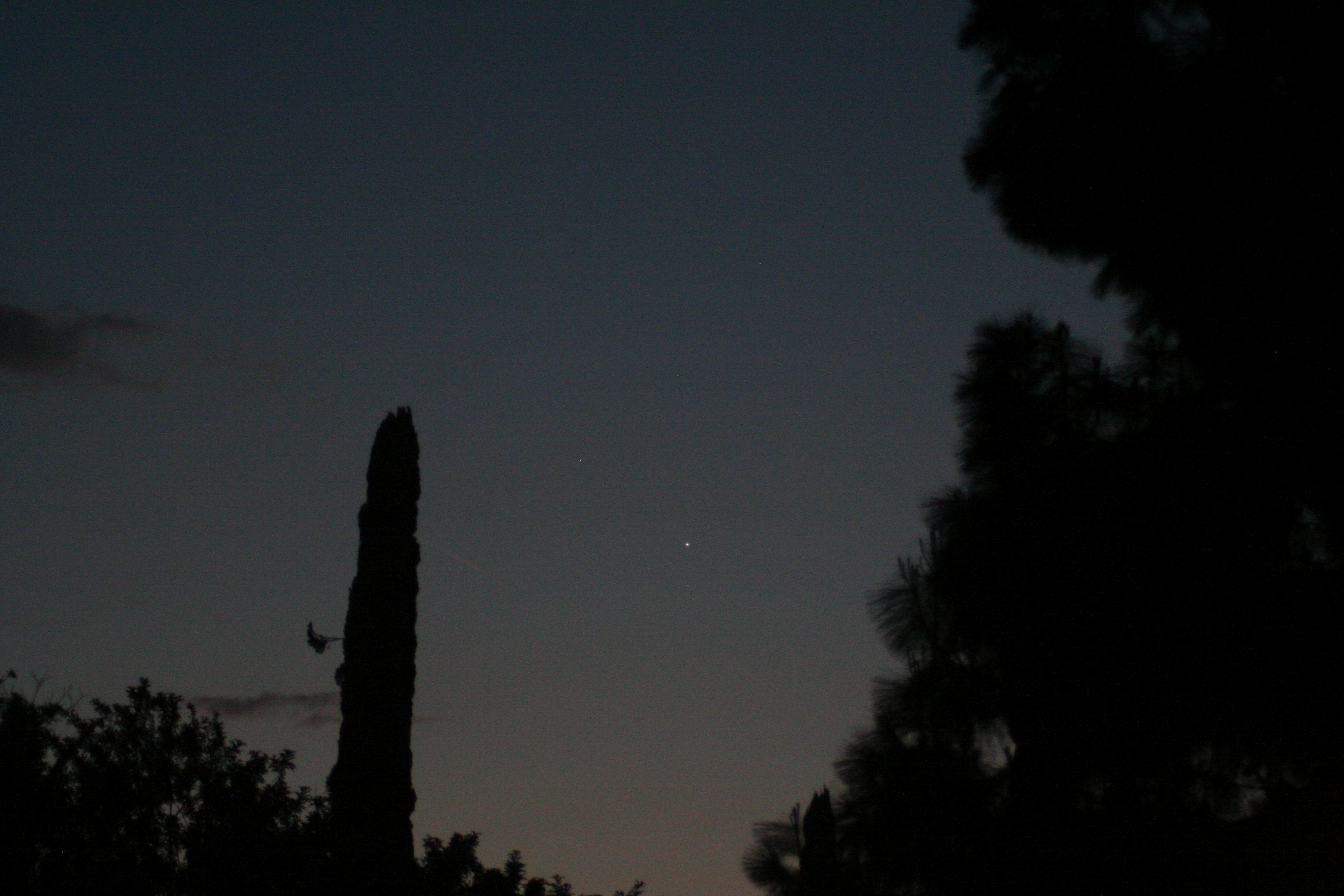
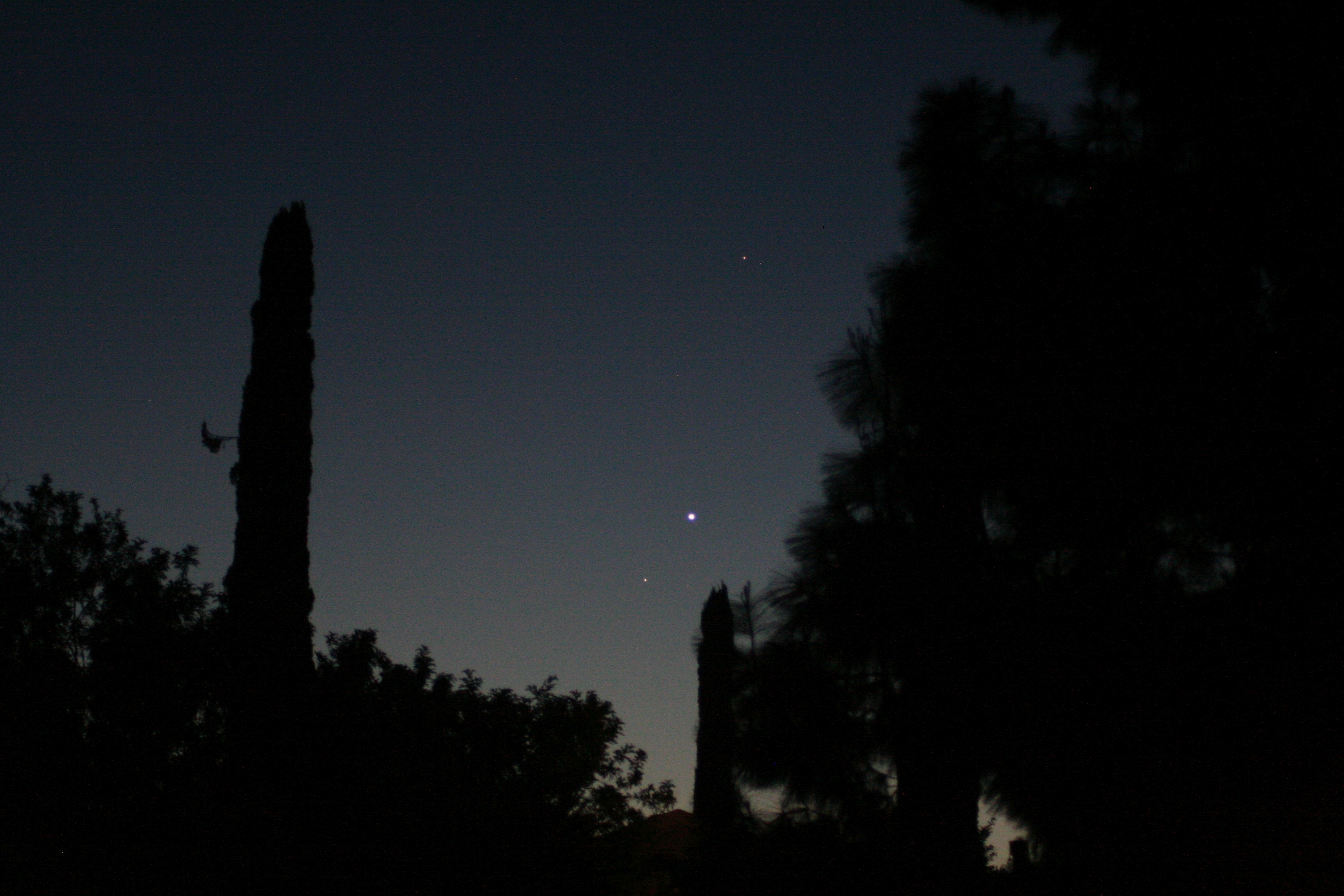
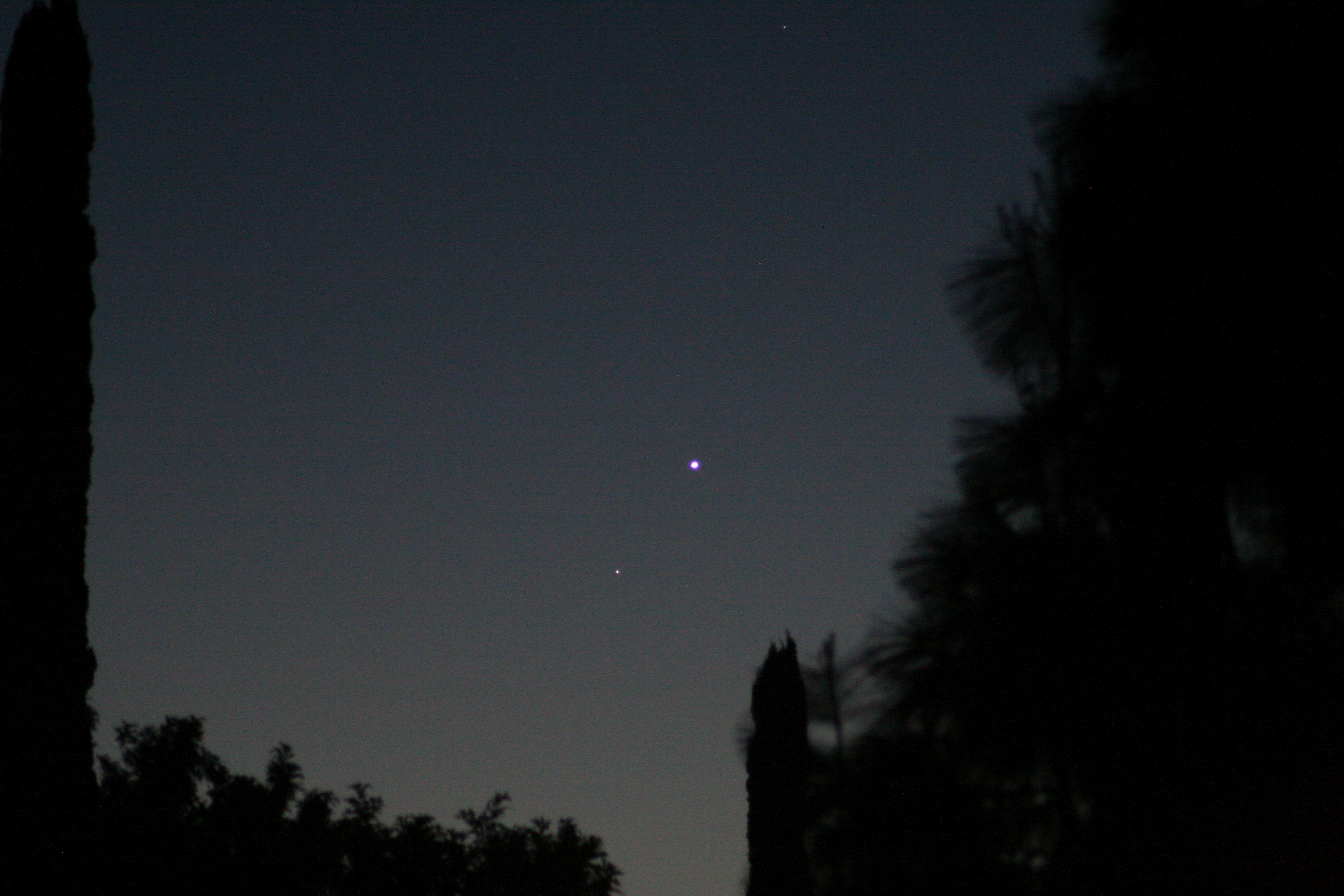
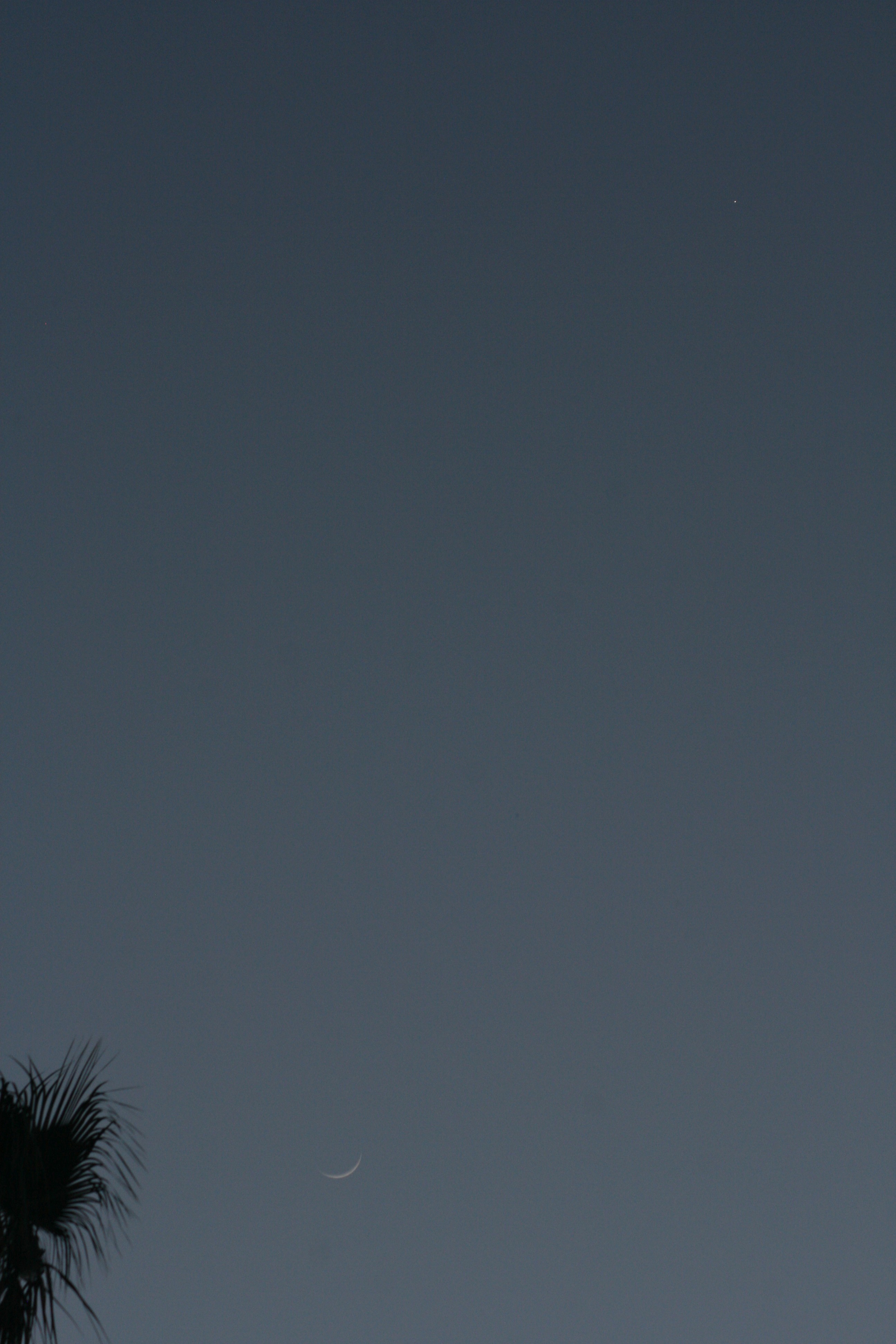
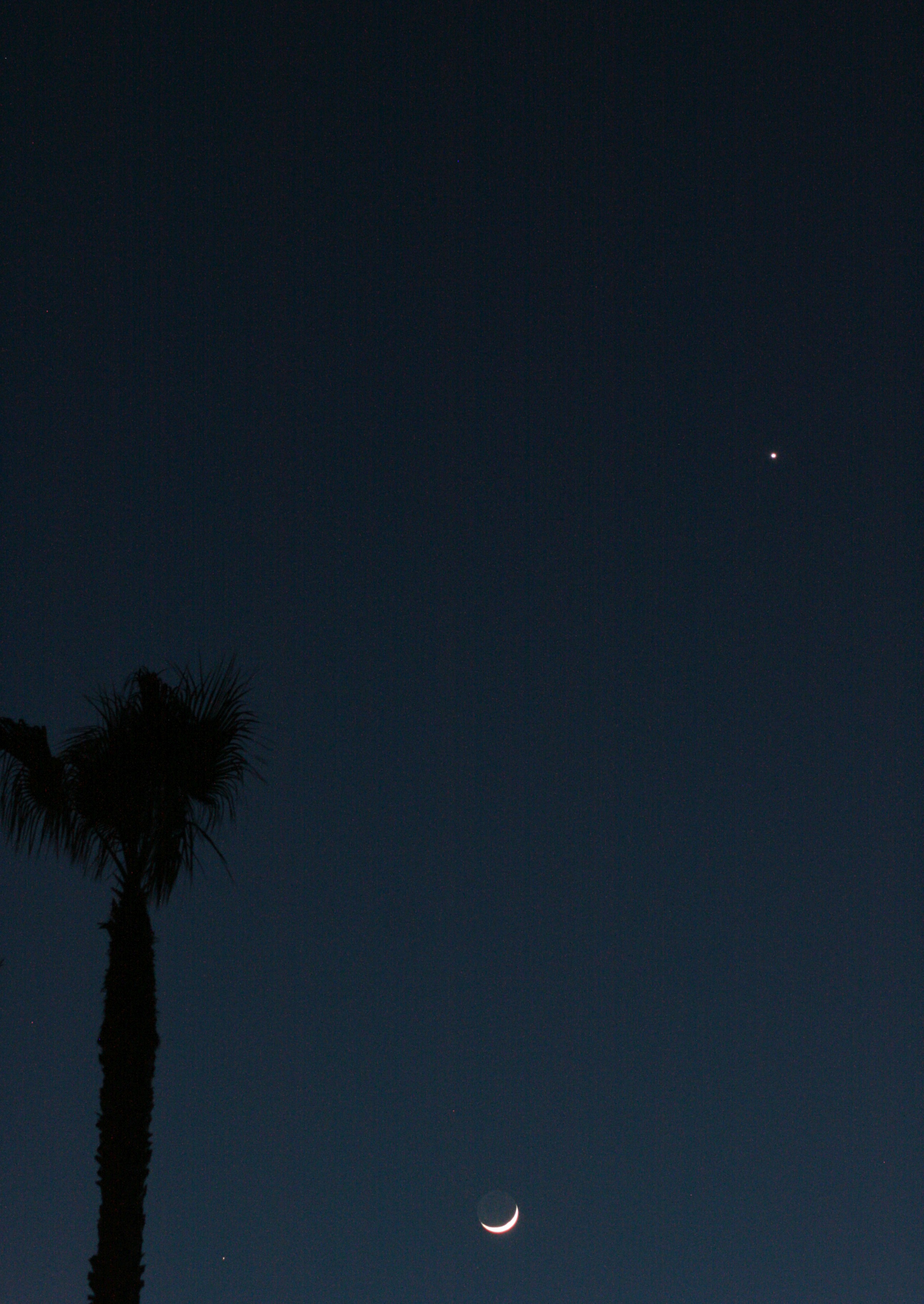
This will be the last night that I can fit all of these objects into the 70mm “wide” angle view on the 70-300 telephoto lens.

Venus (way down in the lower right) will only be visible for a few more nights before reappearing in a couple of weeks in the morning sky.

The moon moves quite a bit from night to night, so tomorrow it will be high out of this view at sunset.

Only tiny, faint-ish Mercury, visible just to the right of the top of the cedar tree at the center of the frame, will be more or less in the same position for the next few nights, before it follows Venus toward the morning sky.

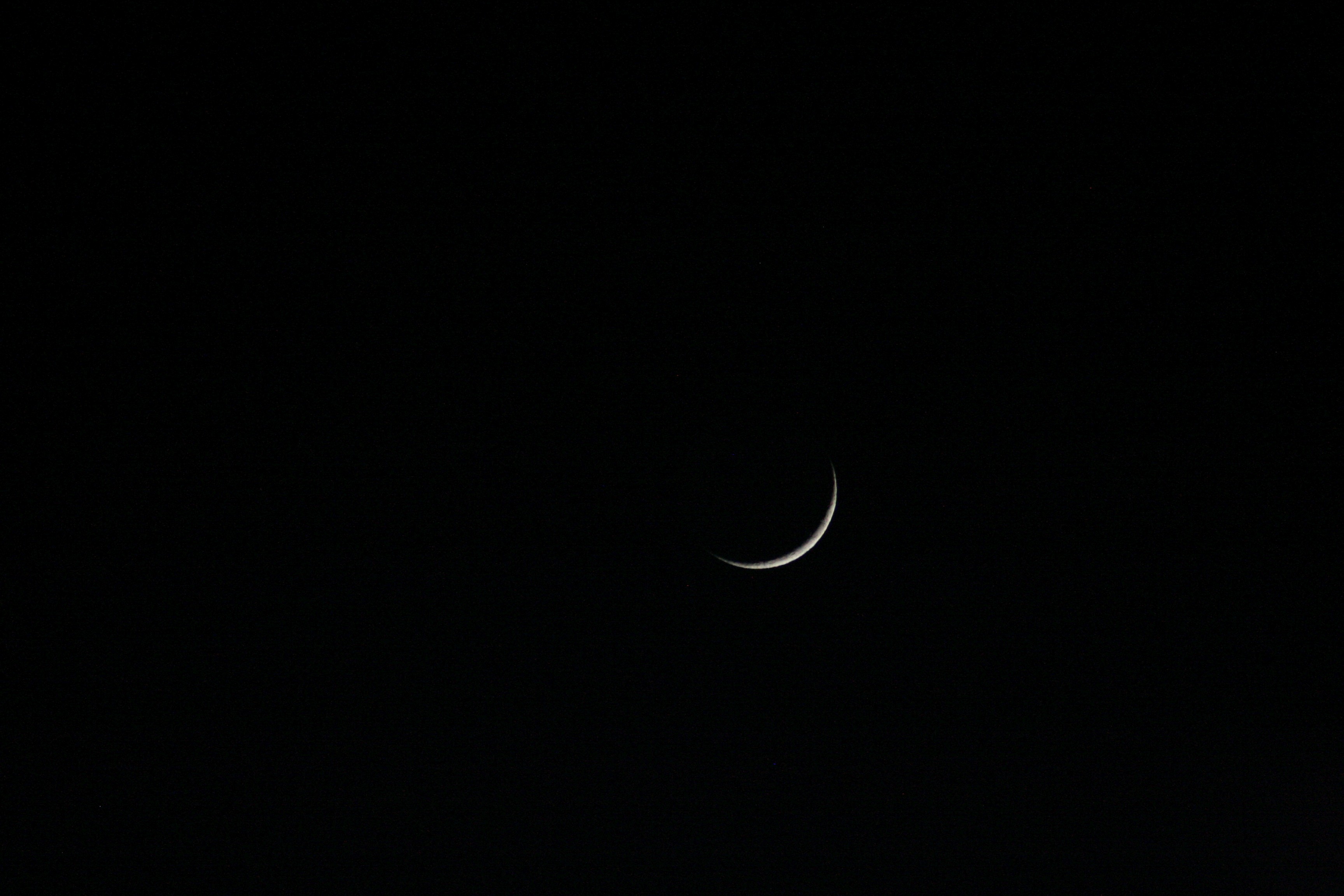
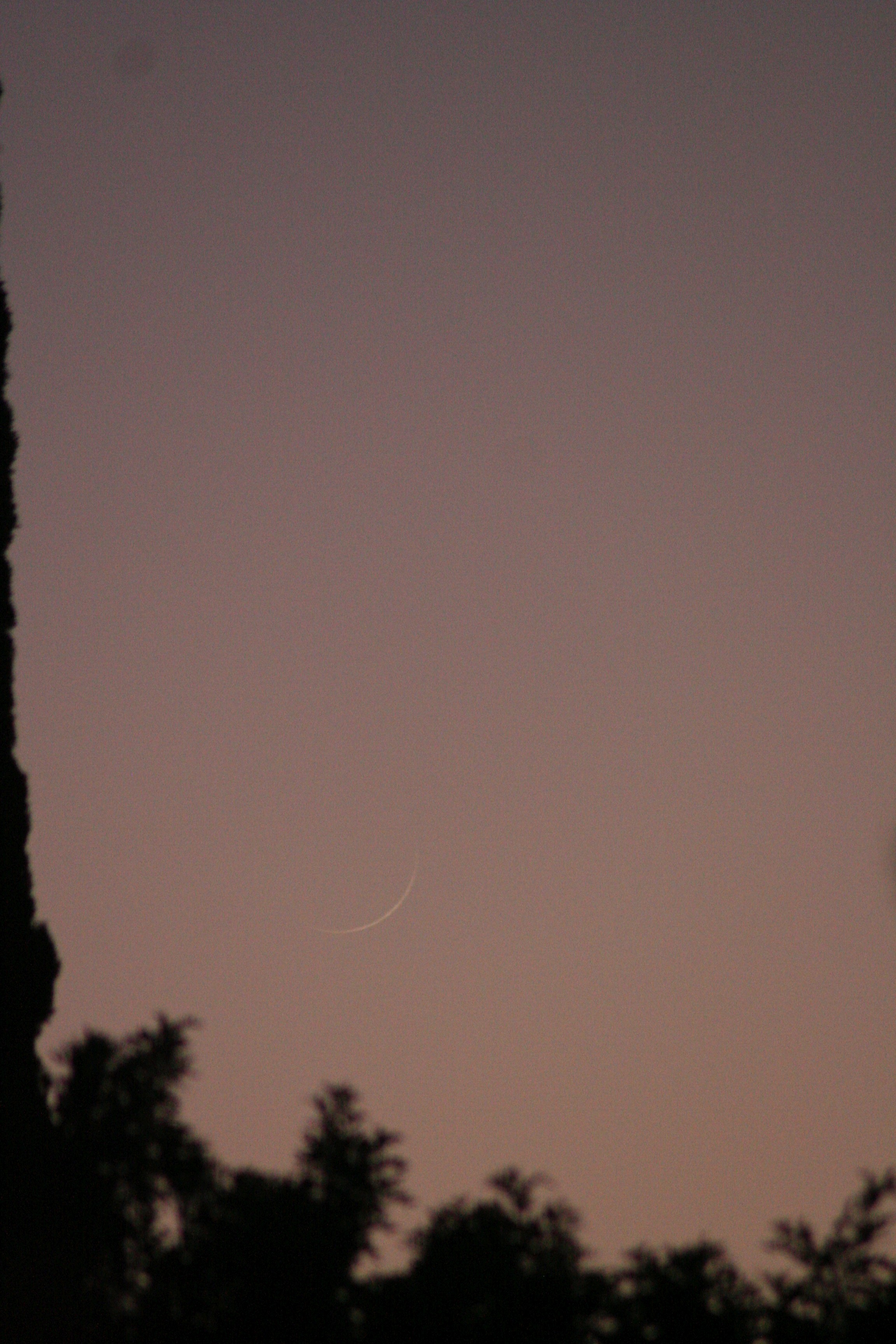
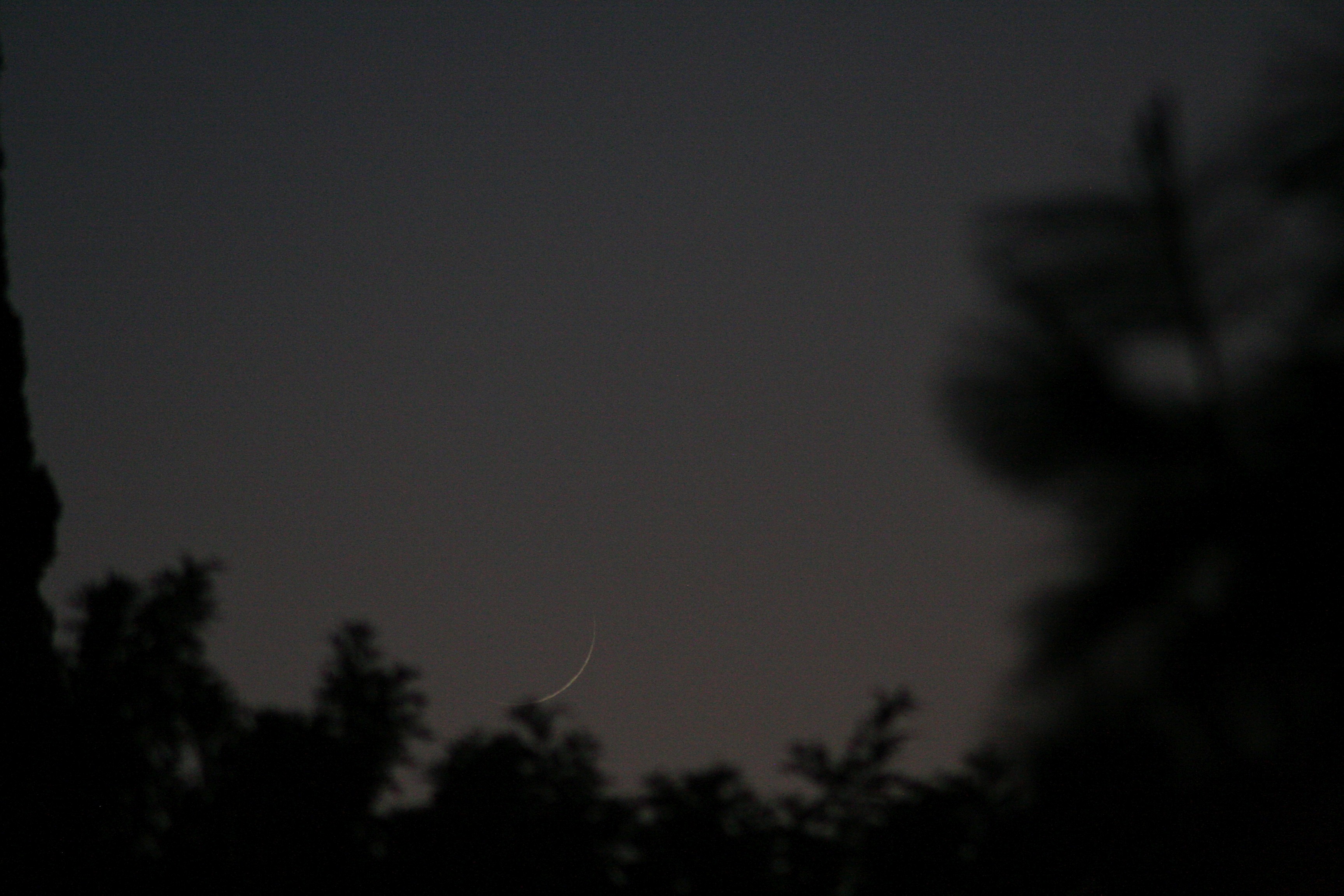
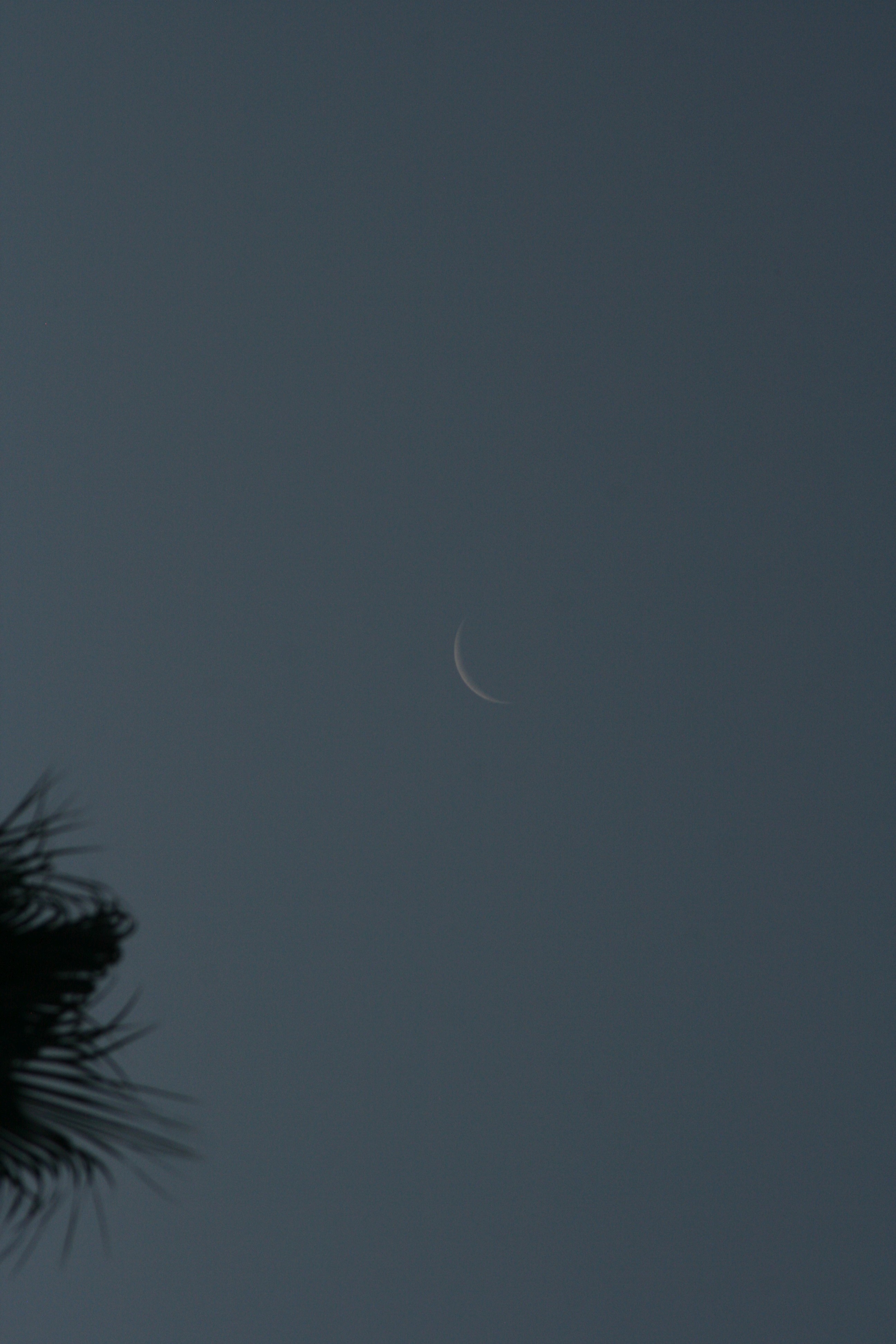
A short exposure shows the moon for the crescent it is, easily visible now, a delight to see hanging in the evening sky. Blow up the picture to see craters and details along the terminator.

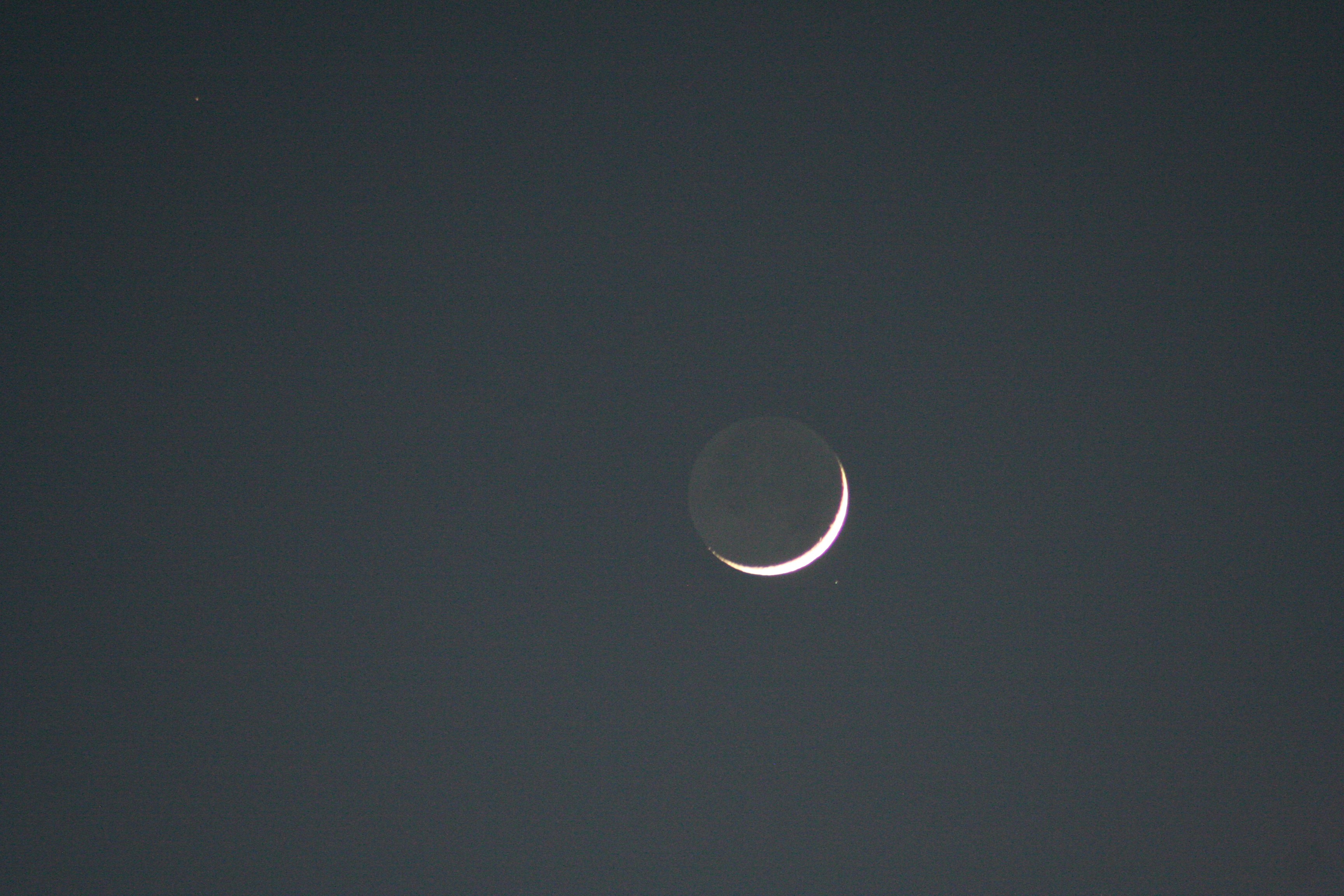
A longer exposure will show how the dark part of the moon is partially visible in reflected earthshine. This has always been one of my favorite, simple things to see in the night sky.

Farewell, y’all. Without a doubt your travels and Newton’s laws of motion will bring you back together again some day soon.

2 Comments

Filed under Astronomy, Photography, Space

Mercury & Venus & New Moon

Let’s up the difficulty level tonight thanks to celestial mechanics!

The last three nights I’ve been posting pictures of Venus (bright, but fading) and Mercury (dim-ish, never easy to see) as they move close to each other in the evening twilight. I’ve mentioned how it’s a race and a balancing act, trying to wait until it’s dark enough so that dim Mercury isn’t washed out in the sunset sky, while also looking and finding them early enough so they haven’t set.

Tonight the 34-hour-old new moon is moving into the picture, below Venus. Which means that it will be setting before the two planets. In addition, I don’t believe that I’ve ever seen a 34-hour-old new moon. At that point it’s close to the sun, it’s only illuminated on a razor thin line of a crescent, and as a result it’s very dim, even harder to spot in some ways than Mercury.

So, earlier, brighter sky, dimmer object, closer to the horizon – NO SWEAT! Let’s do this!

For reference, last night’s pictures were taken between 20:41 and 20:50. Sunset both nights was about 19:55. But that’s probably too late to see the moon. So this picture was taken at 20:33. Venus is visible. With the naked eye, I could not see the moon or Mercury. But I shot a quick series of pictures anyway, cautious that the moon might be already disappearing.

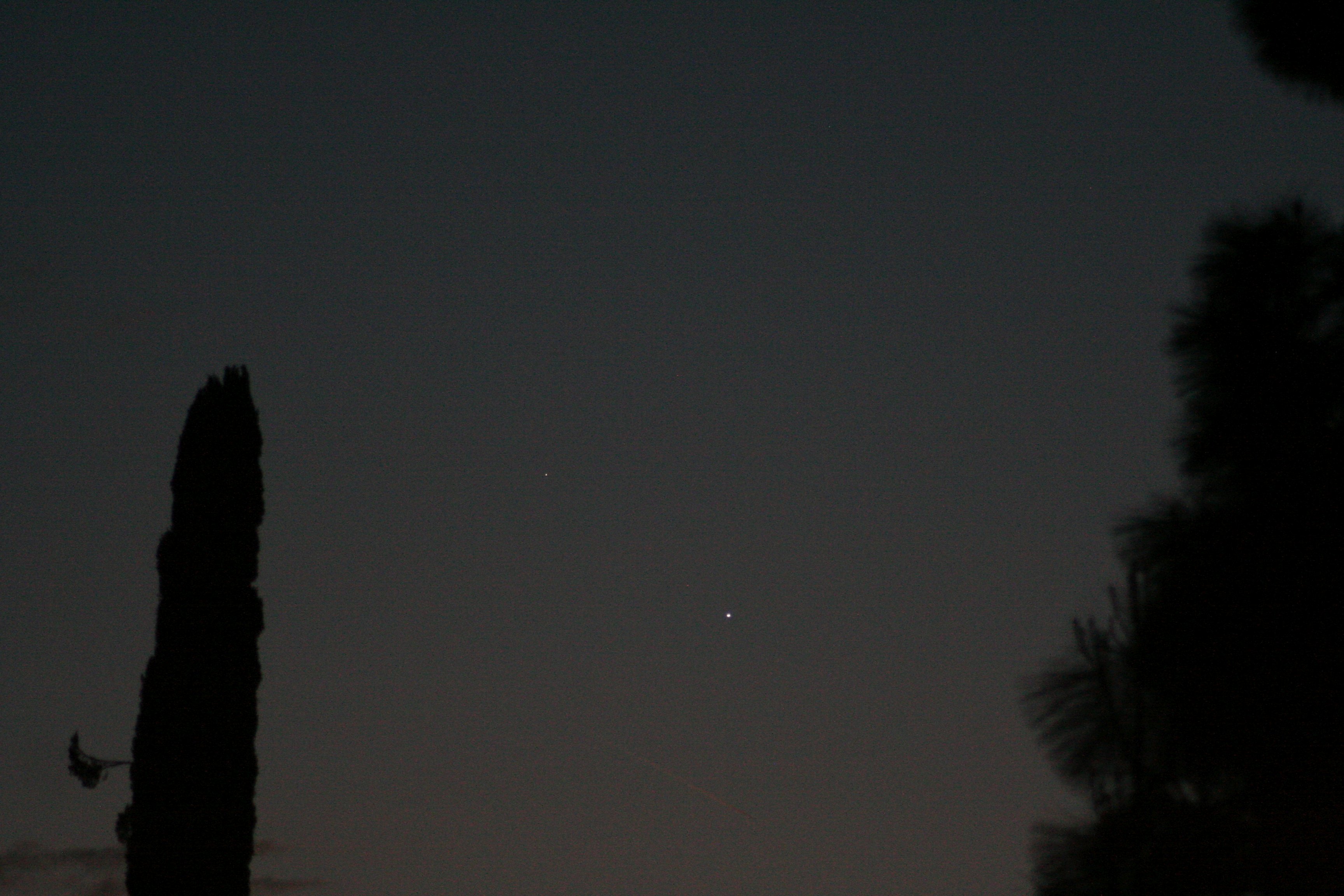
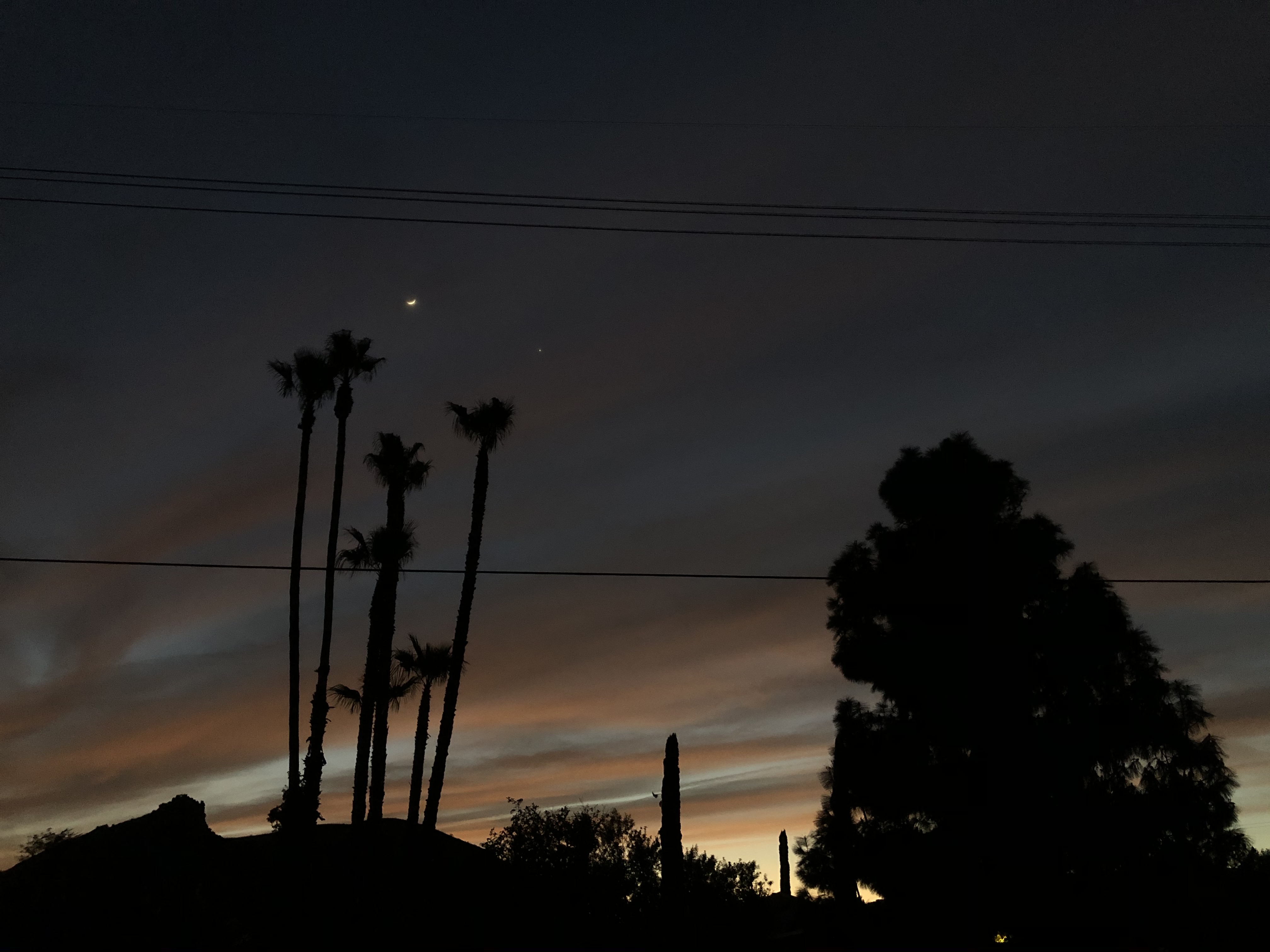
Then I grabbed the binoculars. Holy guacamole, Batman! Mercury’s there, a bit more distant from Venus than yesterday, higher. But the moon? Stunning. A hair-thin crescent floating just above the trees. Now that you know where to look, can you see them in this first picture? (Click on it to blow it up full sized.)

20:34, and I can just start to see both Mercury and the moon with the naked eye.

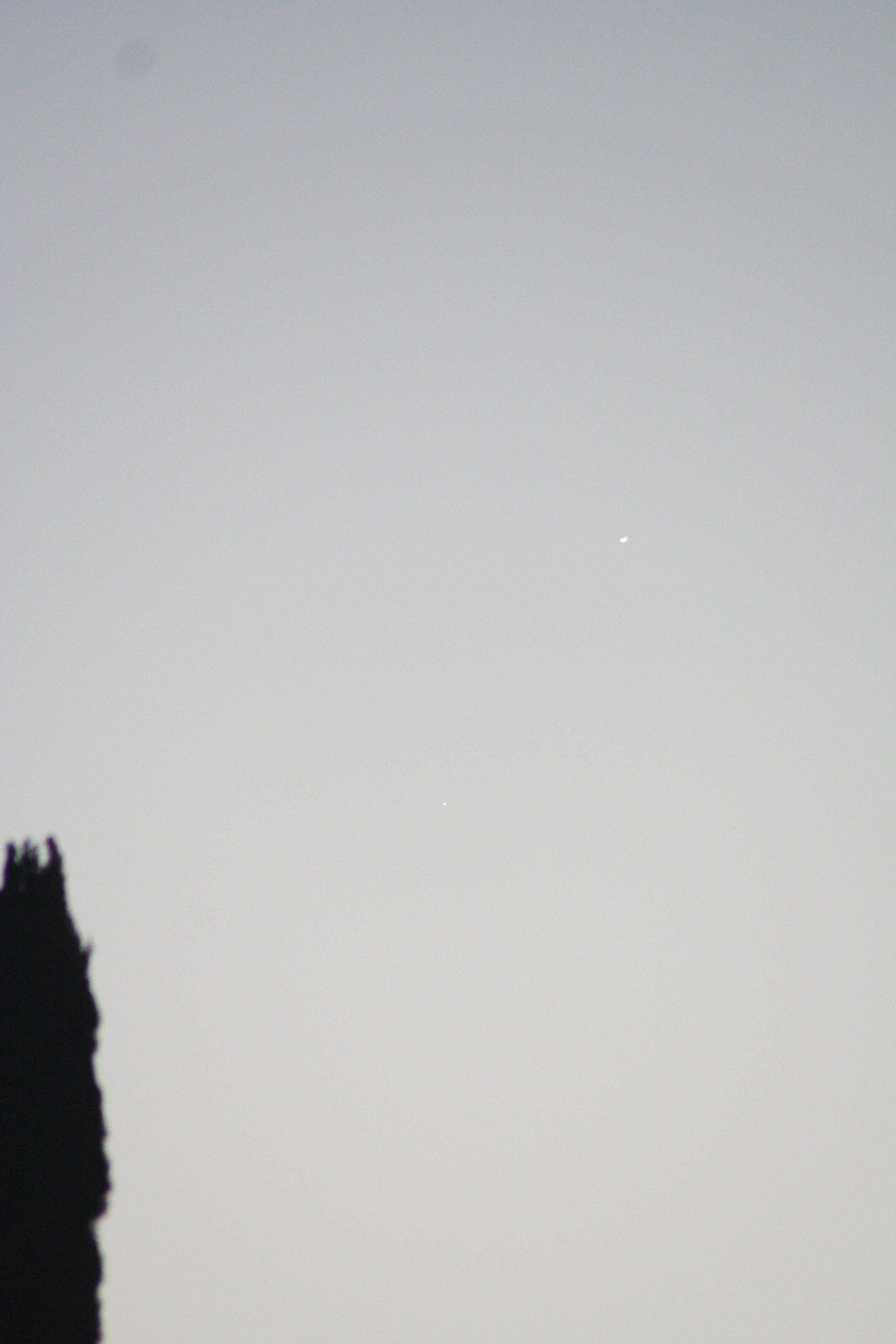
20:35 – I’ve zoomed in on the moon. Oh, and by the way, Eid Mubarak!

20:36 – getting a touch darker, contrast getting better. Now knowing where the moon is it’s easy to spot. Mercury still dim and hard to spot – it’s right about on the vertical center line of the picture, just above the level of the top of the cedar tree on the left. See it?

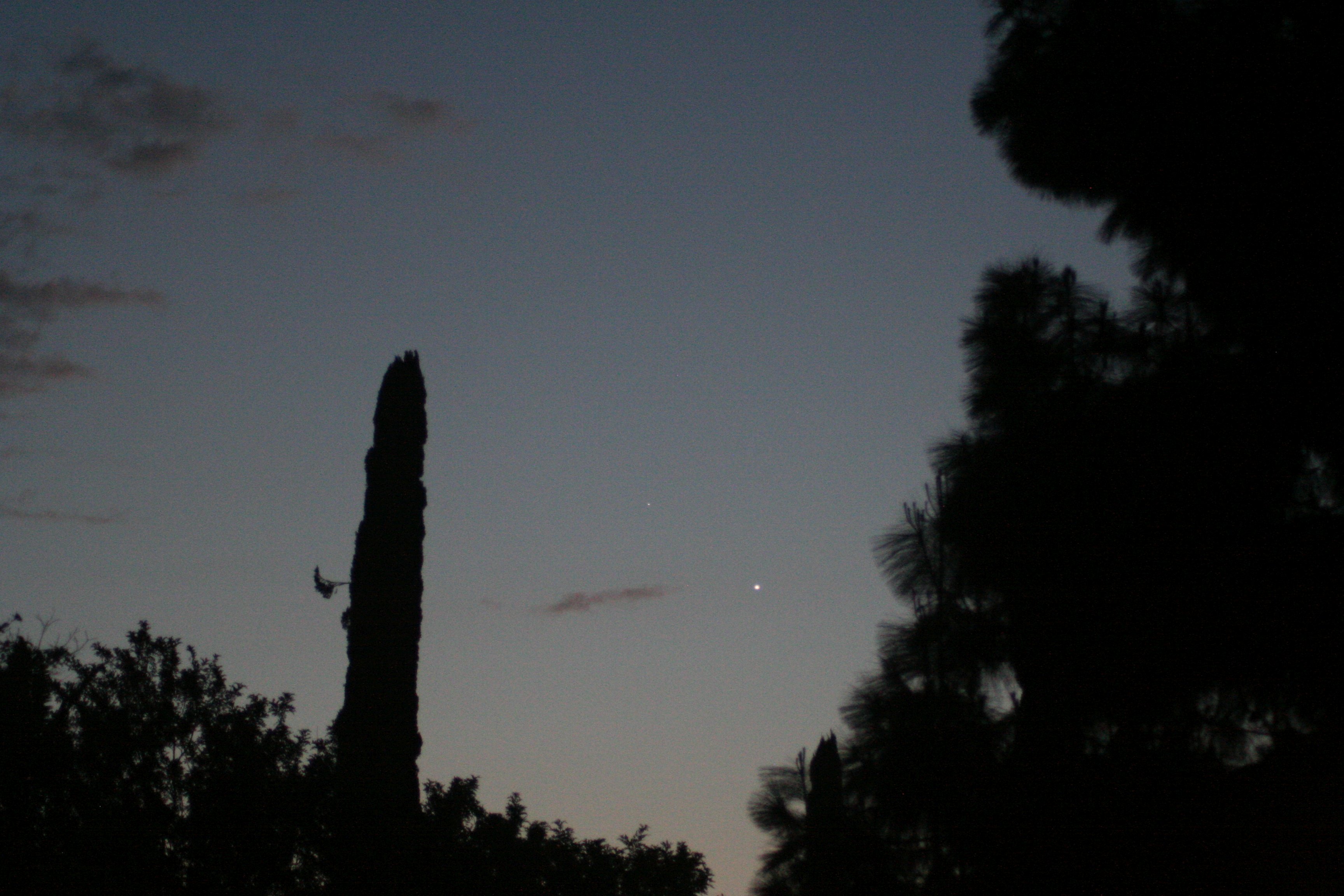
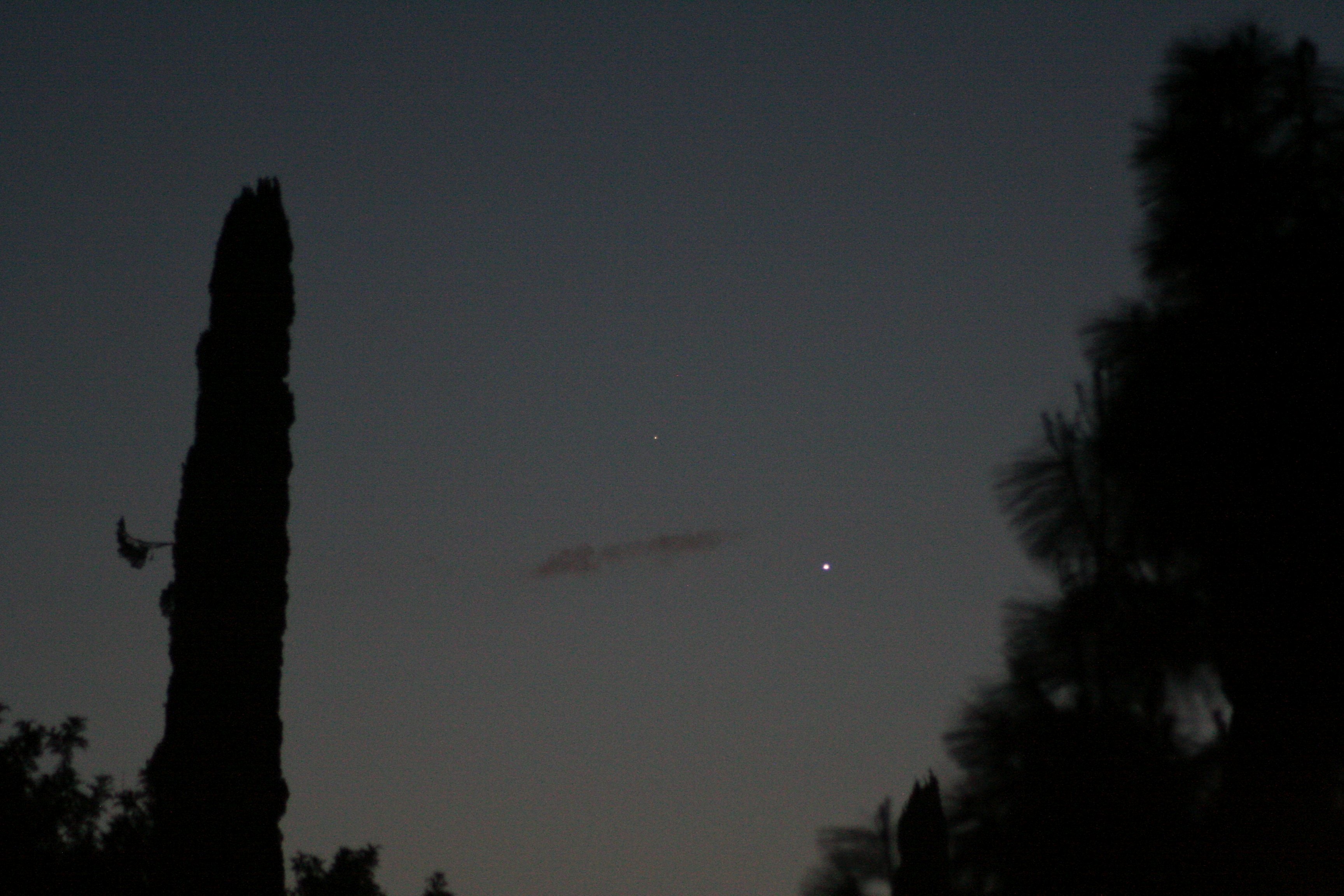
20:37 – the slightly larger picture. For the record, I was using the Canon Rebel XT camera with a Tamron 70-300mm zoom lens. This picture was taken at a 100mm focal length. Pictures #1, #2, and #4 were at about 130mm, and #3 (the closeup of the crescent moon) was at 300mm. Each of these pictures is the best of a bracketing set starting at about 1/2500 second and going through about 1/4 second. In this twilight, the short exposures are really dark, the long exposures are totally washed out and bright, but in between lies the promised land. There are about 12-14 pictures in each set and it takes about sixty seconds to shoot it and set up for the next set.

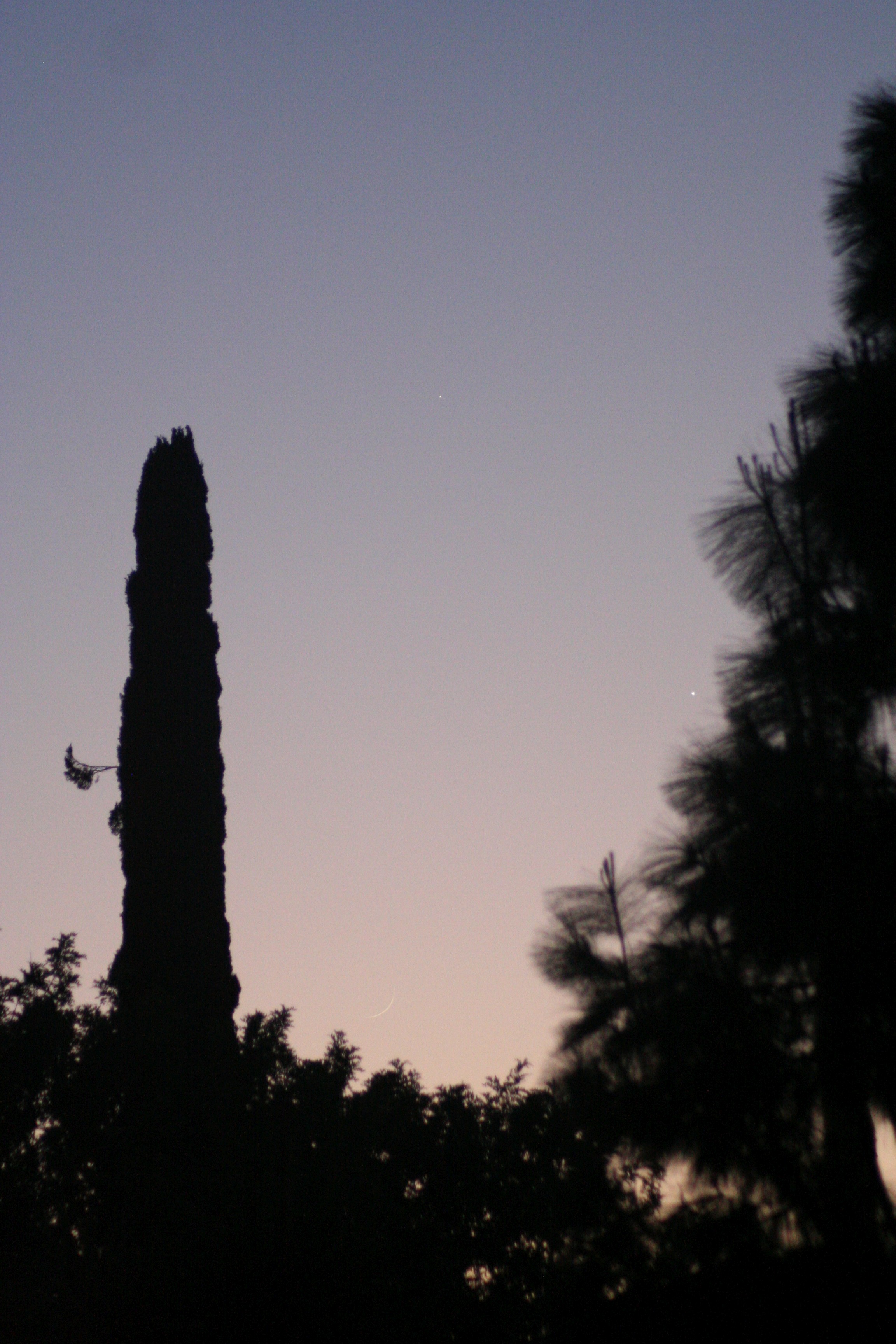
20:38 – will all of this fit into the frame in landscape mode? Yes, it will! Again, Mercury just higher than the top of the cedar tree, Venus about to disappear behind that big pine tree on the right, and the moon about to disappear behind those trees at the bottom.

20:39 – the best picture of the night! About to start losing objects behind trees, but it’s finally dark enough to see them all! We’re winners!

20:40 – remember when I said that last night’s range of 20:41 to 20:40 probably wouldn’t work? Good planning! Say goodnight to the moon! Ditto for Venus, Mercury, and the mosquitoes! (I don’t know what’s up with the mosquitoes. We rarely have a problem with them, but they’re out in force this year. My hands are covered with bites from the last two nights!)


6 Comments

Filed under Astronomy, Photography, Space

Mercury & Venus

Mercury’s climbing (slowly-ish).

In mid-twilight (20:40 after sunset at 19:55) Venus stands out, but Mercury is just becoming visible.

It’s passed Venus now, higher and to the left.

If you want a simple demonstration of the planets moving, just show someone matching pictures from the last three nights.

Ten minutes later, it’s easier to spot Mercury. But again, it’s a race between night and the horizon. It’s just not that far away from the Sun, and never will be from our viewpoint.

Venus, on the other hand, is diving toward the morning sky like a bat out of hell. Given the surface conditions on Venus, “hell” is a perfectly good description.

But for that couple of minutes they’re still high enough to be above the trees and hills, but it’s just barely dark enough to let them shine through.

Wait a day. It will change again.

1 Comment

Filed under Astronomy, Photography, Space

Venus & Mercury

Venus is tracking back toward the sun and sinking a little bit every night in the evening sky. Mercury is rising a bit each night toward its greatest elongation, the furthest it gets from the sun, which isn’t far.

Last night they were a dozen or so degrees apart. About 20:20 or so I started looking. Venus is easy to spot a couple times a year, Mercury is much more elusive. But this is an excellent opportunity using Venus as a guide.

Tonight…

Tonight it was closer to 20:30 when I was able to spot Mercury with the naked eye. It had moved closer and a bit to the left of Venus since last night. I could see it easily in binoculars.

As it got darker we were in a race. It was easier to see as it got dark, but the pair of planets were also setting.

This is probably one of the best opportunities that I’ve ever had to spot Mercury. It will continue to drift upward in the evening sky until June 4th, when it be 20° away from the Sun, after which it will rapidly follow Venus toward the morning sky on the other side of the Sun.

If you want to see the two planets together, go take a peek over the next couple of nights. By tomorrow Mercury will appear level or above Venus, but that’s due to how fast Venus is moving toward the Sun.

EXTRA CREDIT – Saturday and Sunday you’ll start to see a very thin crescent moon popping into the picture!


1 Comment

Filed under Astronomy, Photography, Space

Practice Makes…Better

Forget about that “perfect” fantasy. But practice does make things better.

My ISS photos (before last night) have recently sucked. You haven’t seen them because they’ve all be blurry and out of focus. This is because the original lens on my Canon Digital Rebel was something like nine years old, had taken literally tens of thousands of pictures on three continents, and started to finally act glitchy. I got a replacement which is new and fancy – and wants to do EVERYTHING for me instead of giving me override capabilities and control. In particular, it wouldn’t let me set the focus easily and then in the dark, when doing astrophotography, it wouldn’t focus on it’s own worth beans.

Out in broad daylight in auto focus mode? It’s a miracle, incredibly fast, some image stabilization built in, really sweet. In the dark when I simply want to set it to ∞ and leave it alone? Meh. But I’ve been working on it and finally started to get some good results last night.

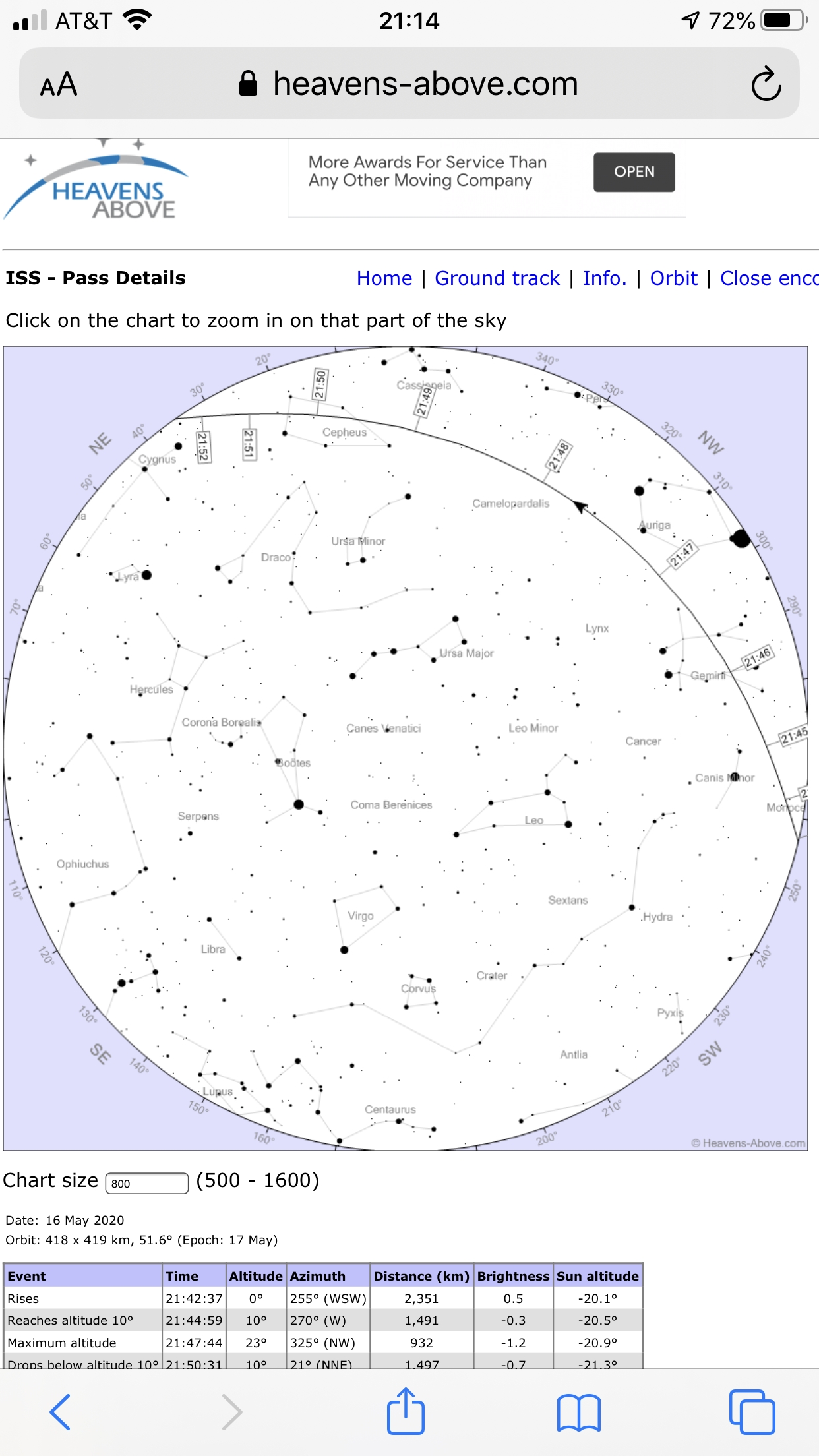
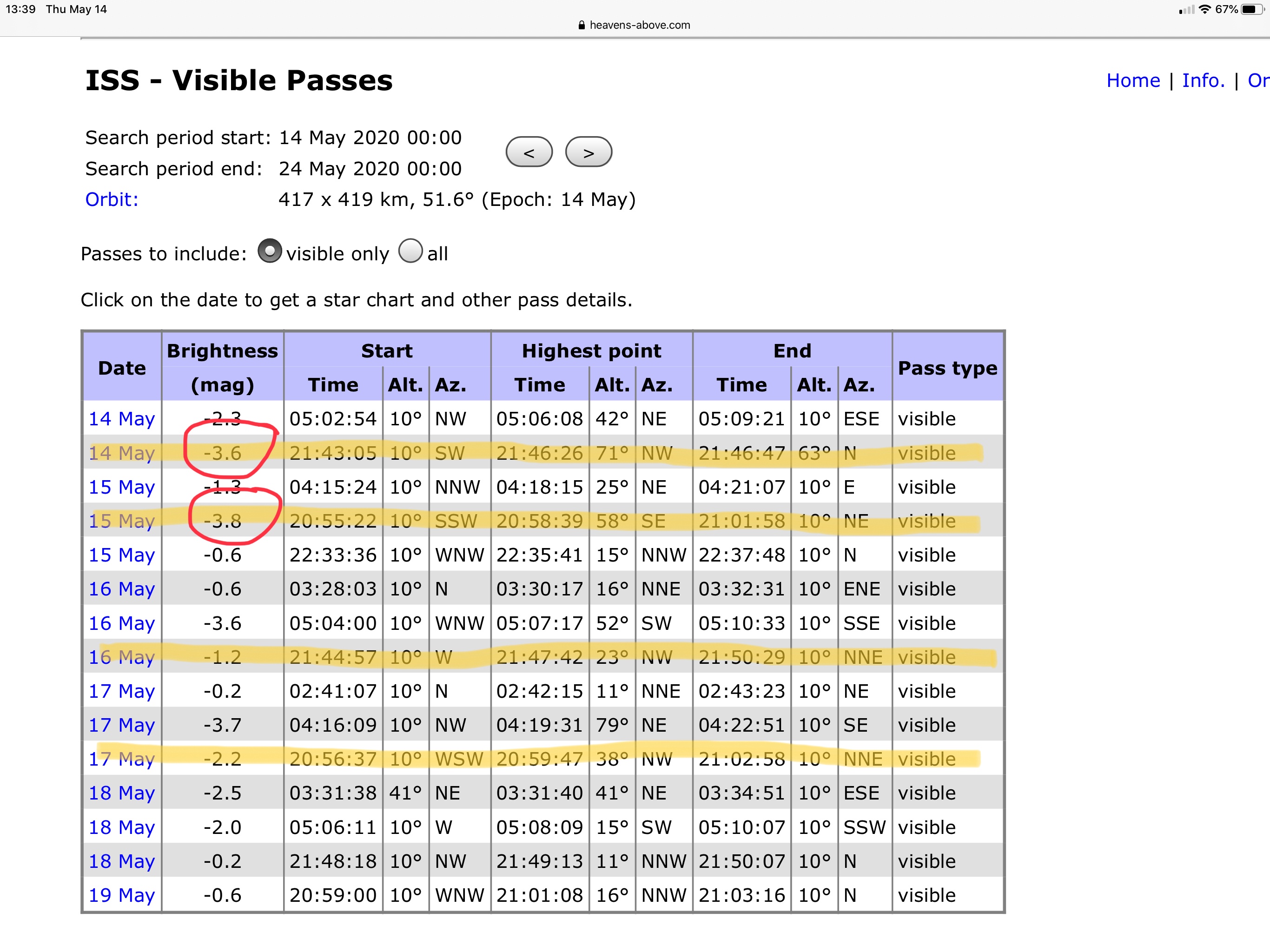
Tonight’s ISS pass was much lower and dimmer than last night.

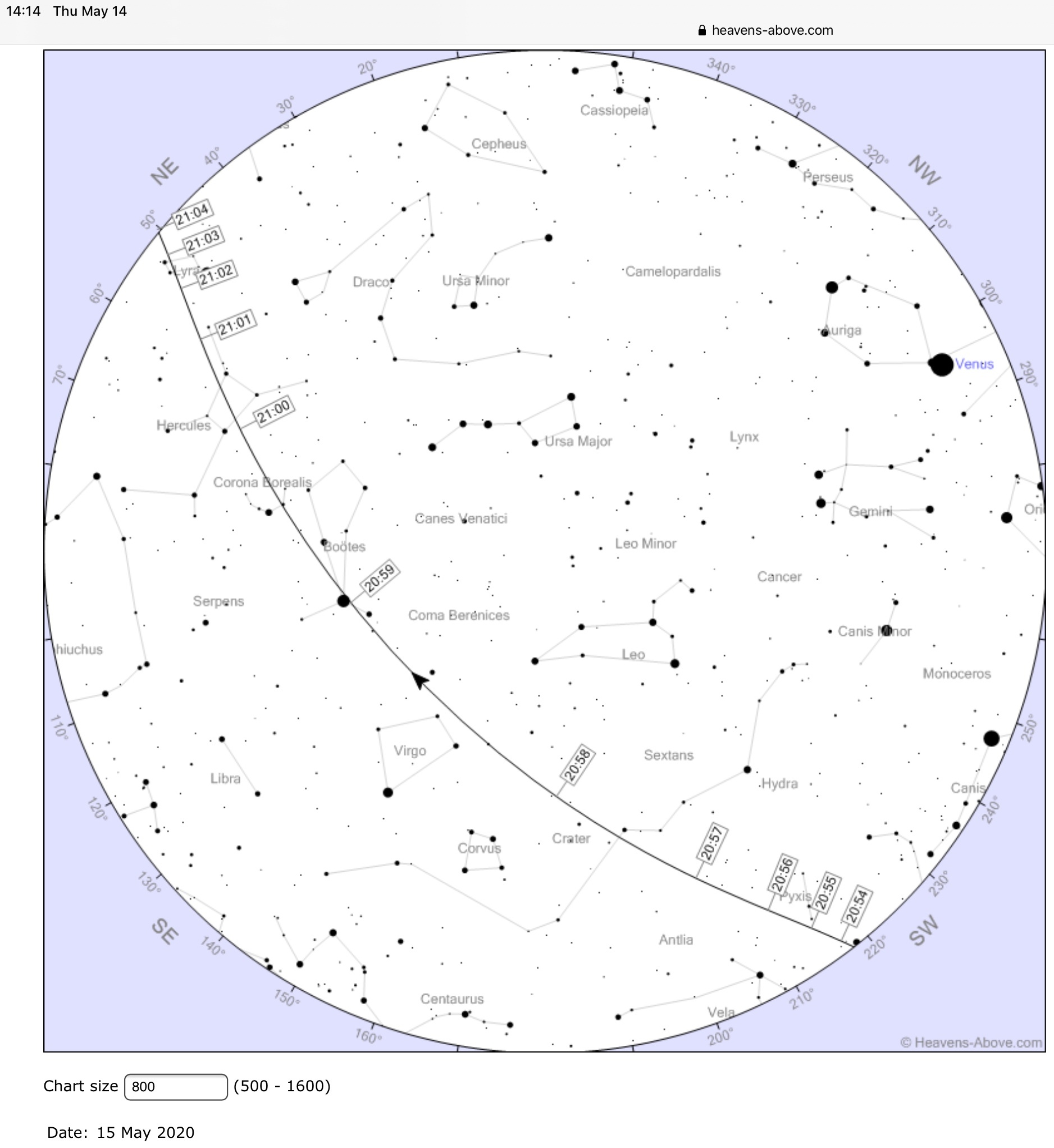
(Image from Heavens-Above.com)

Not worth the bother? Maybe I’ll just go watch it and not try to take pictures. (I can still do that, you know!) But then I realized that we might get clouds moving in for the next couple of nights when there are slightly better passes, so it might be now or wait a few weeks. I went with “now.”

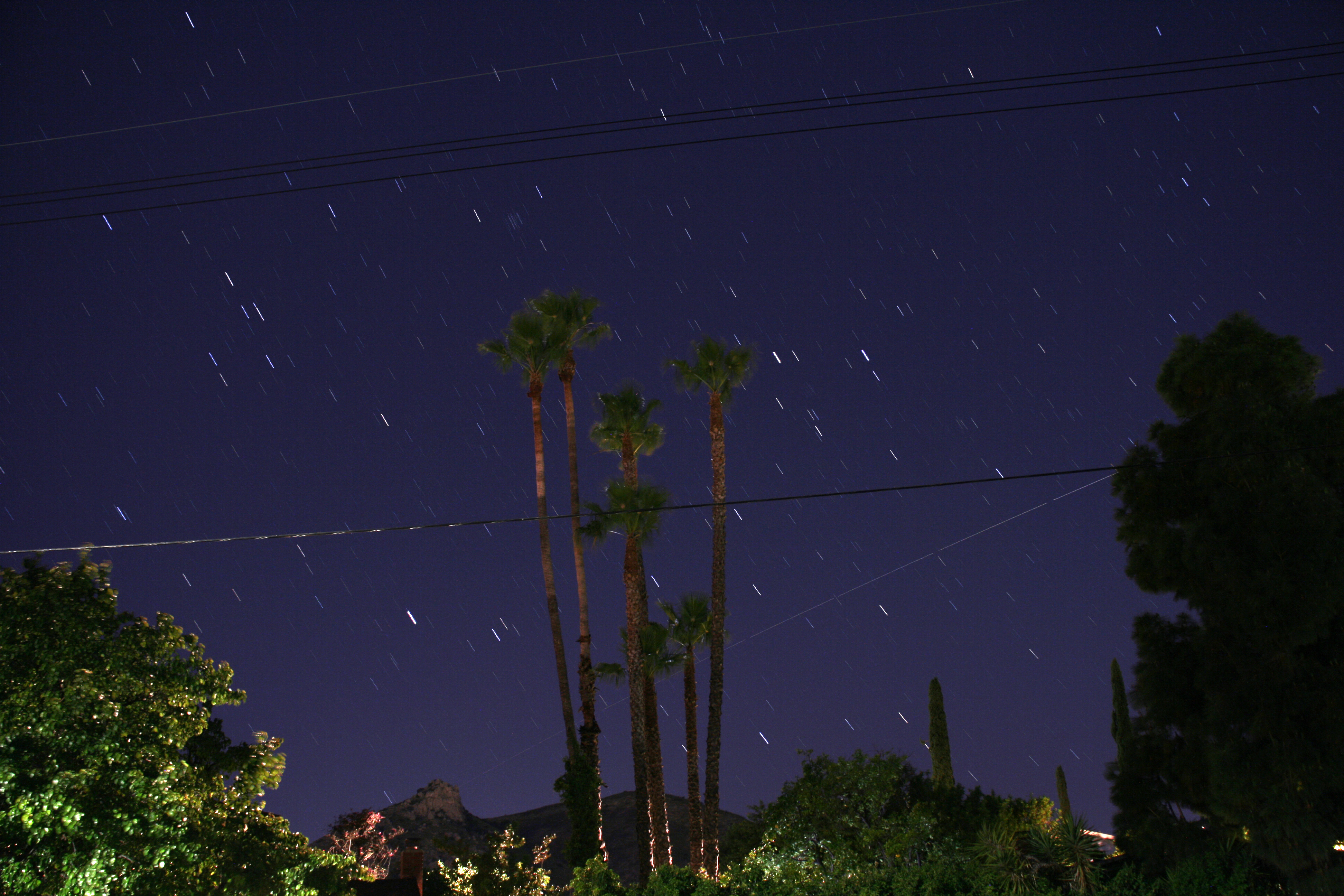
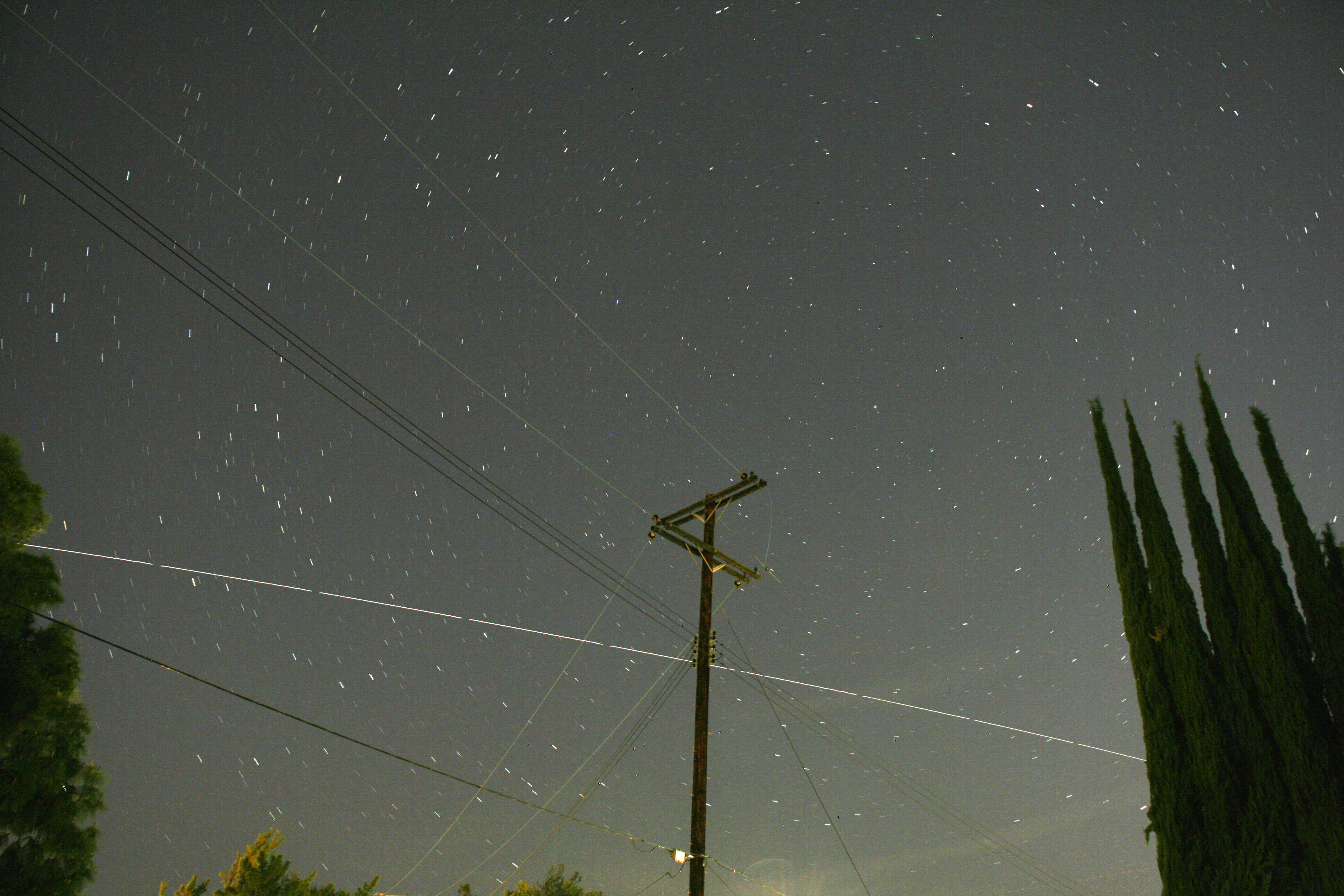
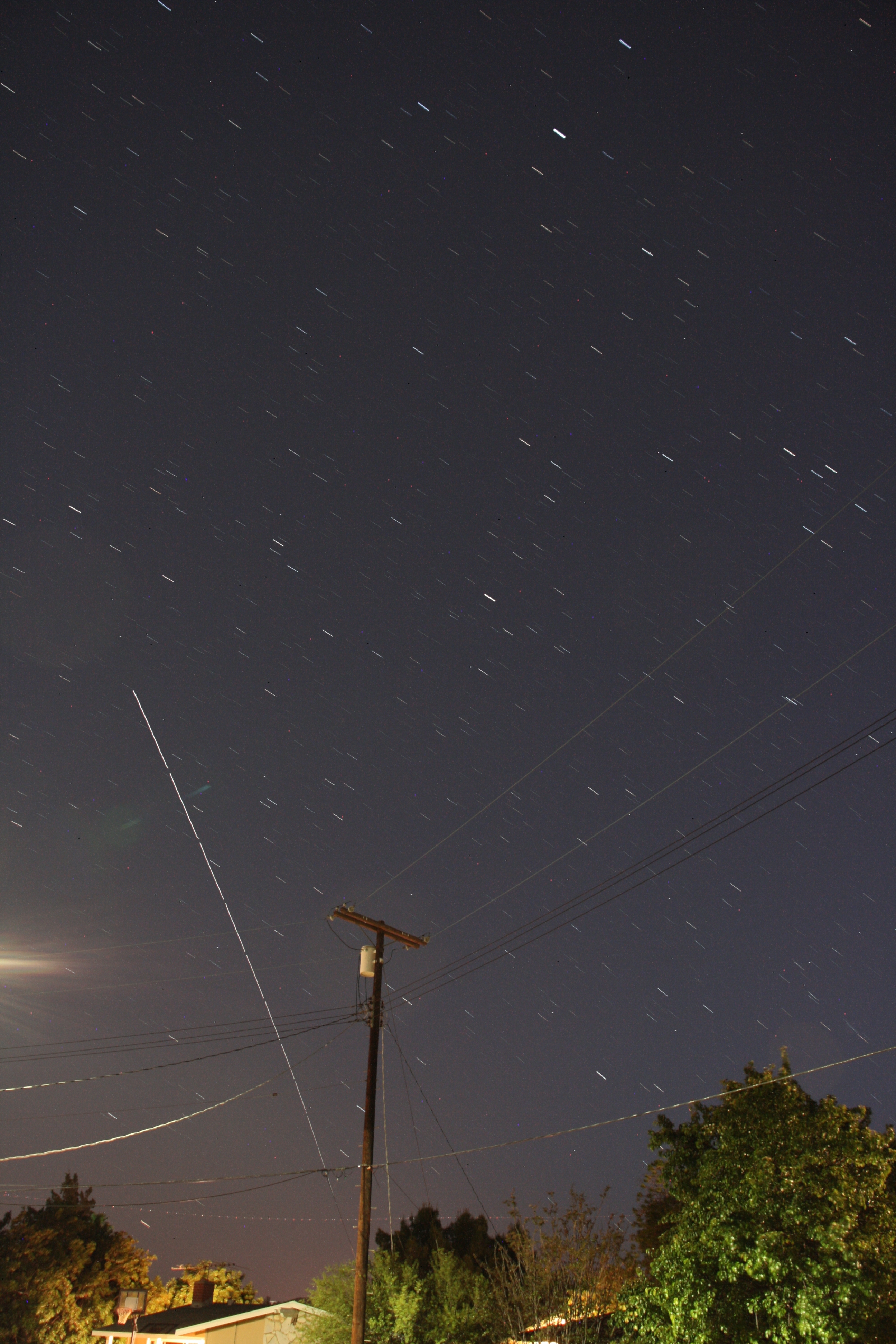
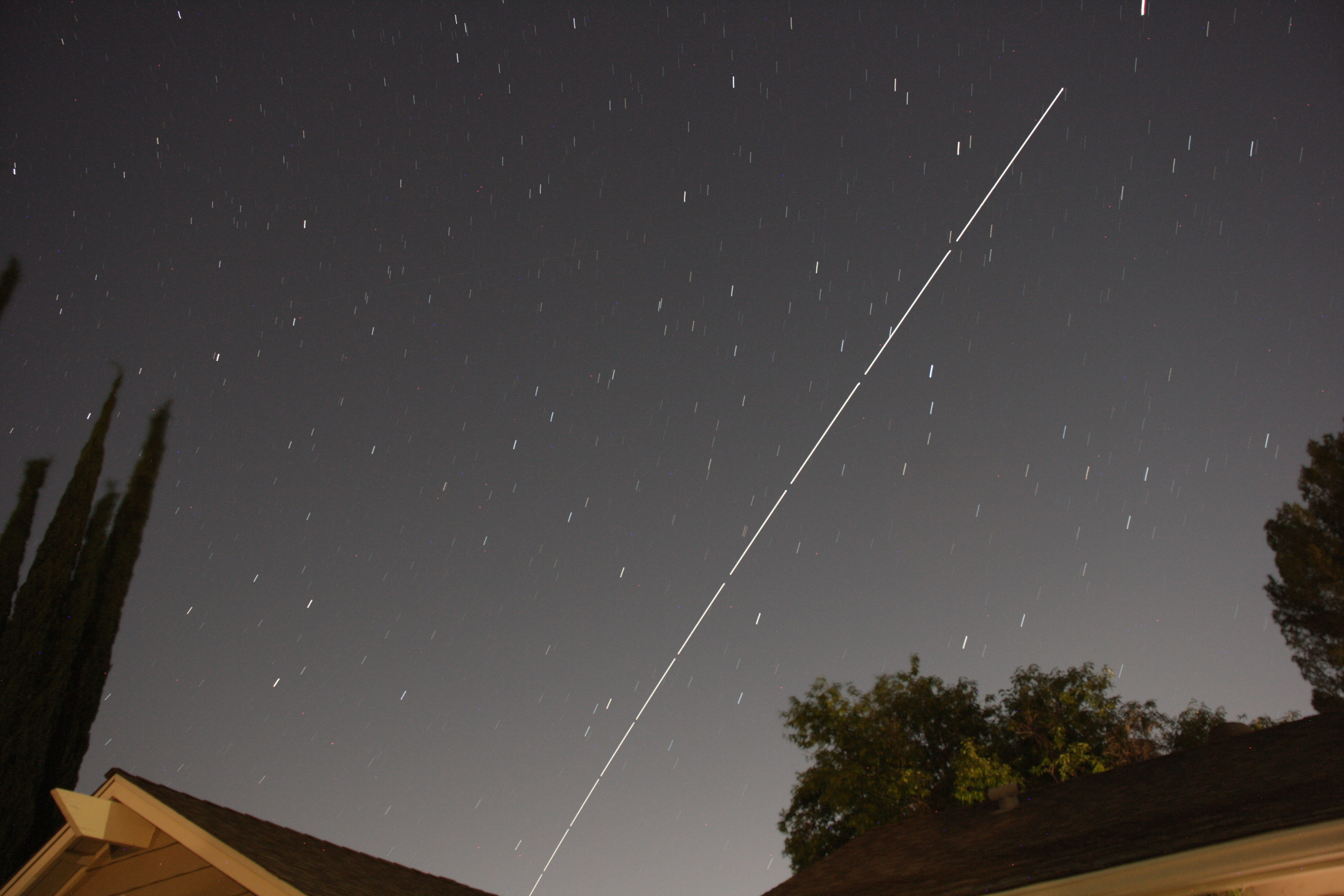
I really like the results. I’m going to give you the 7.1MB and 9.7MB files (because I like you!) instead of compressing them down to under 2MB. Click on them to look at or download the full-sized images – it’s worth it.

As you can see, much dimmer than last night. But looking at the original images (this is a composite of ten 15-second exposures) you can actually see it rising from right behind Castle Peak. Very nice! And with all of the trees and rooftops lit up by street lights and yard lights and other house lights on the hilltops off in the distance, I really like the colors and framing. I like this picture a lot.

Coming around the right side of that big pine tree on the left (the first picture shows ISS disappearing behind it from my viewpoint about fifteen seconds earlier) I was able to track ISS all the way until it disappeared on the right behind our cedar trees. Most importantly, the focus is great, so I may have (“Don’t get cocky, kid!”) figured that part out.

The other really neat thing about this second image, which I take for granted but which many folks wouldn’t, is how it shows the stars spinning around the Polaris, the North Star. If you haven’t ever seen or noticed it before, blow this image up to full size and then look at the stars on the left and right. They’re all trails, little curved arcs, since the camera was fixed and the planet it was fixed to was spinning. The further you are from the pole, the longer the trails. Look at the first picture to see this demonstrated as well.

But in this picture, there are curved arcs on the left, right, top, and bottom. But near the center, those arcs get shorter and shorter and there’s one star that’s a dot with no trailing at all. You’ve found Polaris! It’s the star that’s at the “end” of the “handle” of the Little Dipper.

Leave a comment

Filed under Astronomy, Photography, Space

ISS Passed Over SoCal

As the prophecy foretold…

Rising behind the stinking streetlight in the southwest. (At the bottom of that arc is Malibu…sort of.)

Setting behind the house off to the northeast. (Toward Salt Lake City at 17,500 mph.) Currently over Africa only 35 minutes after being over LA. Orbital mechanics, gotta love them!

These are all 13 second exposures, stitched together into one image using StarStaX.

Leave a comment

Filed under Astronomy, Photography, Space

Upcoming ISS Passes Over SoCal

If you live in the Southern California area, heads up for the next few evenings, ESPECIALLY TOMORROW.

We’ve gotten to the time of year where the planetary tilt and the orbital plane of the International Space Station (ISS) align and there are a LOT of excellent evening passes coming up.

(Image from Heavens-Above.com)

Tonight we saw a wonderful, bright, high pass that went right through the Big Dipper almost directly overhead and then faded into shadow.

Tomorrow night at 20:55 the ISS will rise in the south-southwest, go high through the sky, get VERY bright, and then disappear over the horizon to the northeast.

(Image from Heavens-Above.com)

There are other evening passes later in the week that will be lovely, just not as high and as bright as Friday’s.

There are also some spectacular passes before sunrise this week, but the odds of me dragging my butt out of bed at 04:15 or the like to see it are very, VERY close to zero. I’m about a thousand hours short of sleep in the last six months, unless the alien mothership is coming in, I’m staying in bed.

As Dirty Harry said, “A man has got to know his limitations!”


Leave a comment

Filed under Astronomy, Space

Starlink Sighting

(Prelude – a word about “apparent magnitude,” i.e., how bright stars are. It’s like golf where the scoring is backwards – small or negative numbers are brighter, big or positive numbers are dimmer. The brightest stars in the sky are about M+0 (“magnitude zero”) to M-1.5. Venus right now is very bright, M-4.7. The full moon gets up to M-13. Getting dimmer, you get into positive numbers. The stars in the Big Dipper are M+1.8 to M+3.3, which will be relevant later in this article. The human eye in a dark, clear sky can see down to about M+6, but in Los Angeles on a light polluted night, you’ll be lucky to see down to M+4.)

SpaceX is in the process of launching a whole constellation of small-ish satellites called Starlink. When done, they’ll offer high-speed internet to just about any spot on Earth.

The positives and negatives of Starlink are complex. The positive of offering reasonably priced high-speed internet anywhere is obvious. The negatives are more subtle for the general public and involve the potential for catastrophic space debris events and the disruption to ground-based astronomy.

If you’ve hung out on this site for any length of time you know that I’m a bit obsessed with the sky and love to watch the ISS pass over. (There’s a “search” button over there on the right – put in “ISS” – waste the next few hours.) Since the Starlink satellites launch sixty at a time, all into the same orbit, gradually spreading out and separating over time, the effect is that of a “string of pearls,” one satellite after another following each other in the same orbit.

This is how the internet delivery system works. You launch a bunch of satellites into the same orbit and they gradually fill that orbital plane. Then you do another plane at a slightly different inclination. And another. And another. And finally you get that picture from the Starlink site like a web filling the sky, so that at any given time at any given point on the planet you have at least one, maybe two or three satellites above the horizon for you. While they’re all travelling and will disappear over your horizon in eight to ten minutes, there will be others following right behind. You’ll always have some of them up there.

So the first reaction of many folks was, “COOL!! At night, where now we see things like ISS going over every now and then, once Starlink is up we’ll have these ‘trains’ or lines of satellites following each other any time, every night!” And about two seconds later, those who want to observe the sky and take pictures said, “SHIT!! At night, where now we see things like ISS going over every now and then, once Starlink is up we’ll have these ‘trains’ or lines of satellites following each other any time, every night!”

For the record, SpaceX is aware of the issue (and the bad publicity) and is working on minimizing the disruption to astronomy and visibility of the satellites in upcoming models. It’s not clear if this latest batch had any of the new designs incorporated into their construction.

There have been a half dozen or so Starlink launches to date, the last one earlier this week. There is, of course, a site for letting you know when you can see them, findstarlink.com. And you can use Heavens-Above.com if you’re already using that to track ISS sightings like I’ve been bitching at you to do for seven years. (In either program, obviously, put in your location, not mine. Unless you live near me.)

Tonight, I was told there was a GREAT pass of some of the Starlink 6 satellites. Great! I went out to see what the hubbub was about.

Earlier today there was supposed to be a GREAT pass of these same satellites over Florida, and a number of the launch photographers and NASA Social types I follow on Twitter were going to be looking. They universally reported a complete bust, saw nothing. So maybe those design changes are working?

I went out into the front and saw nothing at first. But it was a little hazy, the moon is bright, there are two street lights out there (you’ve seen them in my ISS photos), and the rabbits running around the front yard had triggered the motion activation on the security light over the garage. I saw nothing. A bust? Maybe those design changes are working?

Maybe.

I went out into the back yard where I’ve got trees and the house blocking big chunks of the sky, but also a lot more dark. And a chair to sit down it. I spent about ten minutes sweeping the sky with binoculars, figuring the Starlink satellites might be really dim. With the binoculars I’m looking at stars down to about M+5 or M+6, even with the haze and moonlight and light pollution. That’s dim, less than you can see with the naked eye even in a clear, dark sky. But I’m also looking at a very small spot of sky, so I would have to be lucky to spot a satellite.

Nada. Until…

Until something BRIGHT flashed through the field of view. I figured at first it was an airplane, a trans-Pacific flight out of LAX. I put down the binoculars and looked up toward the moon.

HOLY. SHIT.

The first one I saw was right by the quarter moon, which is bright. Even near the moon, it was easily visible. Comparing it other stars (particularly the stars in the Big Dipper), it was probably about M+1 to M+1.5. All of them I saw were definitely brighter than all of the stars in the Big Dipper, which range from M+1.8 to M+3.3 (see the prelude above).

Then I saw the second one coming up behind it. And I had the sense to look back to the northeast where they were headed. And I saw one, two, three, possibly a fourth “ahead” of the first one I had seen. They were fading as they got down into the heavier haze near the horizon.

And. They. Kept. Coming.

The were about 25° to 30° degrees apart. I base that estimate on the size of the Big Dipper – from the tip of the “handle” to the far side of the “dipper” (Alkaid to Dubhe, if you want to use the stars’ real names) is about 25.3° and the separation between Starlink satellites was about the same order of magnitude.

All told I saw fifteen or sixteen satellites. I don’t know if this was a smaller subset that’s broken off into a different orbit from the rest of the sixty launched earlier this week or if I just missed the first forty-plus when I was using the binoculars.

The next to last one in the train was odd, sort of in between the two last bright satellites, dimmer, and while going in the same direction, it was a couple of degrees off to the east of the track that the rest were on.

So…

Really mixed feelings about all of this. On the one hand, seeing dozens of satellites in the same orbit, following each other like that for what had to have been ten minutes or so… The five-year old deep down inside of me was just thrilled shitless to see that. I’m not gonna kid you about it.

But at the same time, as someone who has sat up all night with a set of cameras and a telescope, taking exposures from five minutes to sixty minutes, with mosquitoes or hip-deep snow and everything in between, I can see where this is going to really mess with both the amateurs and the pros doing astronomy. And folks who are trying to hunt for comets and asteroids are going to have fits.

That last bit probably worries me the most. Comets and asteroids are a one in a bunch of millions danger to the planet, but if you lose the odds you end up following the dinosaurs into oblivion. I would sort of like the folks hunting for those, many of them amateurs, to have the best conditions possible. They have enough problems with clouds, weather, light pollution, and airplanes. I don’t want to handicap them with a few thousand moving targets passing through every couple of minutes.

I mean, 2020 – right? With our luck there will be that rock with our name on it out there just passing Pluto and we could spot it and have twenty years to figure out a way to deflect it and save ourselves, but we’ll miss it because someone in East Podunk needs to be streaming high speed, high definition porn while also playing Animal Crossing…

On the other hand, if those next twenty years are like the last three, I might be on Team Asteroid.

In the meantime, now that I know what to look for, the next question is obvious.

How do I take pictures of it?

1 Comment

Filed under Astronomy, Space

Clouds Adding Character

Tonight’s layers of clouds didn’t “partially obscure the conjunction of the crescent moon and Venus.” Nah!

Such negativity! “Obscure” is such a judgmental term!

Nah, let’s say that they added color and character!

“Character!” Yeah, that’s it!

It was a group effort tonight! Clouds, moon, Venus!

Leave a comment

Filed under Astronomy, Photography, Space, Weather

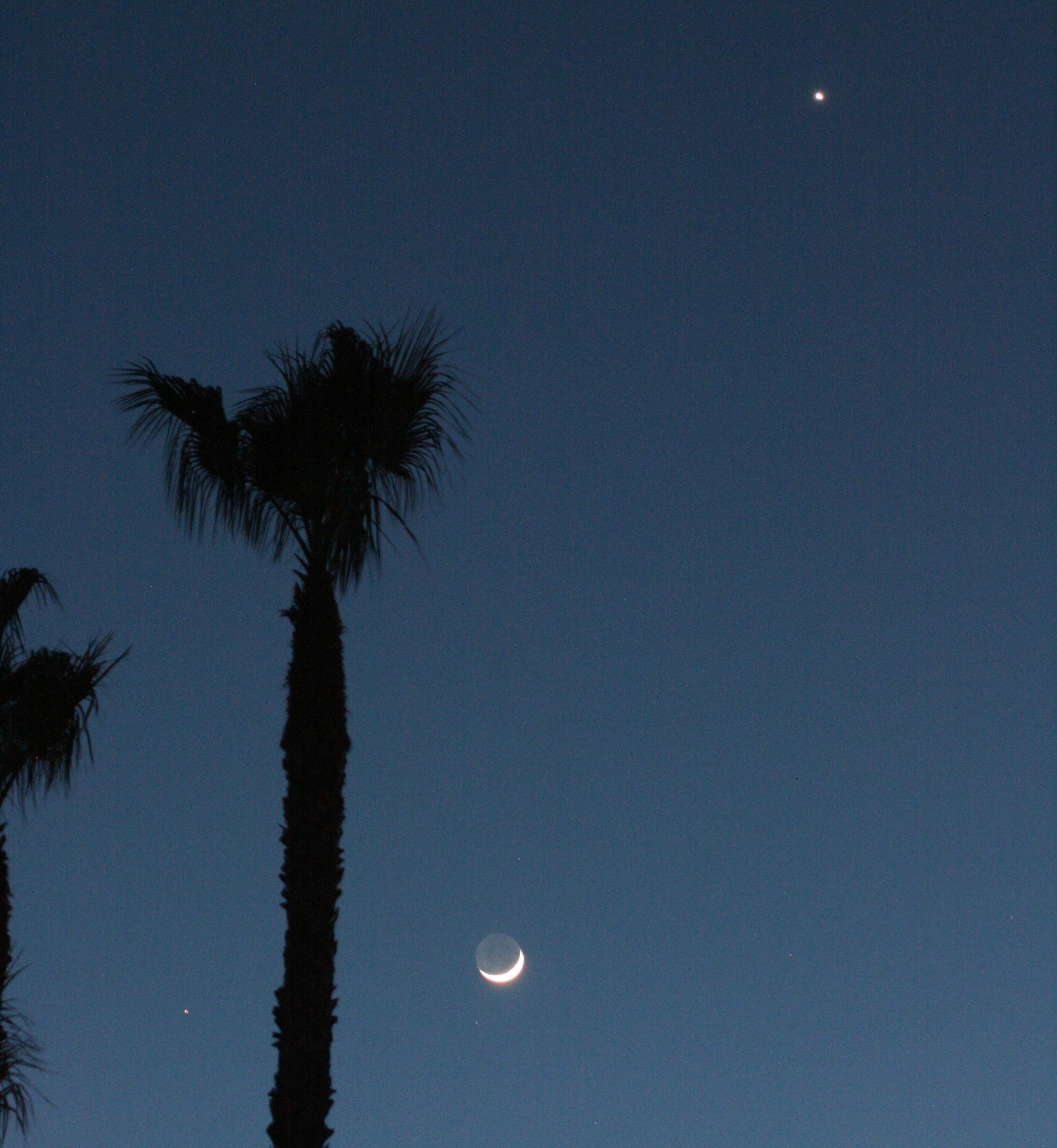
Again Look To The West After Sundown

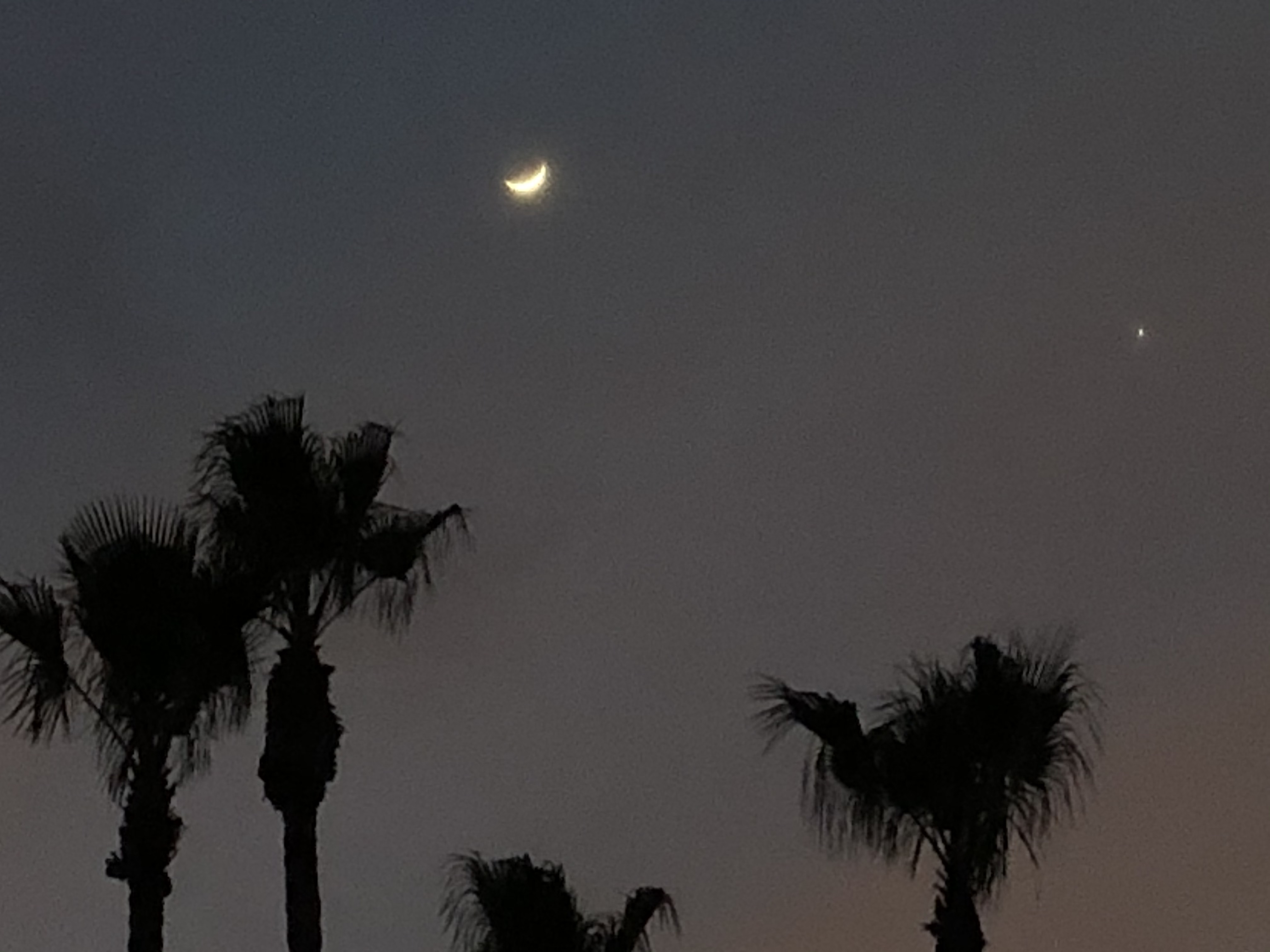
For the next few days, the moon will be gorgeous and getting closer to Venus and then moving past it. If you didn’t see it tonight, look tomorrow, or Monday, or Tuesday…

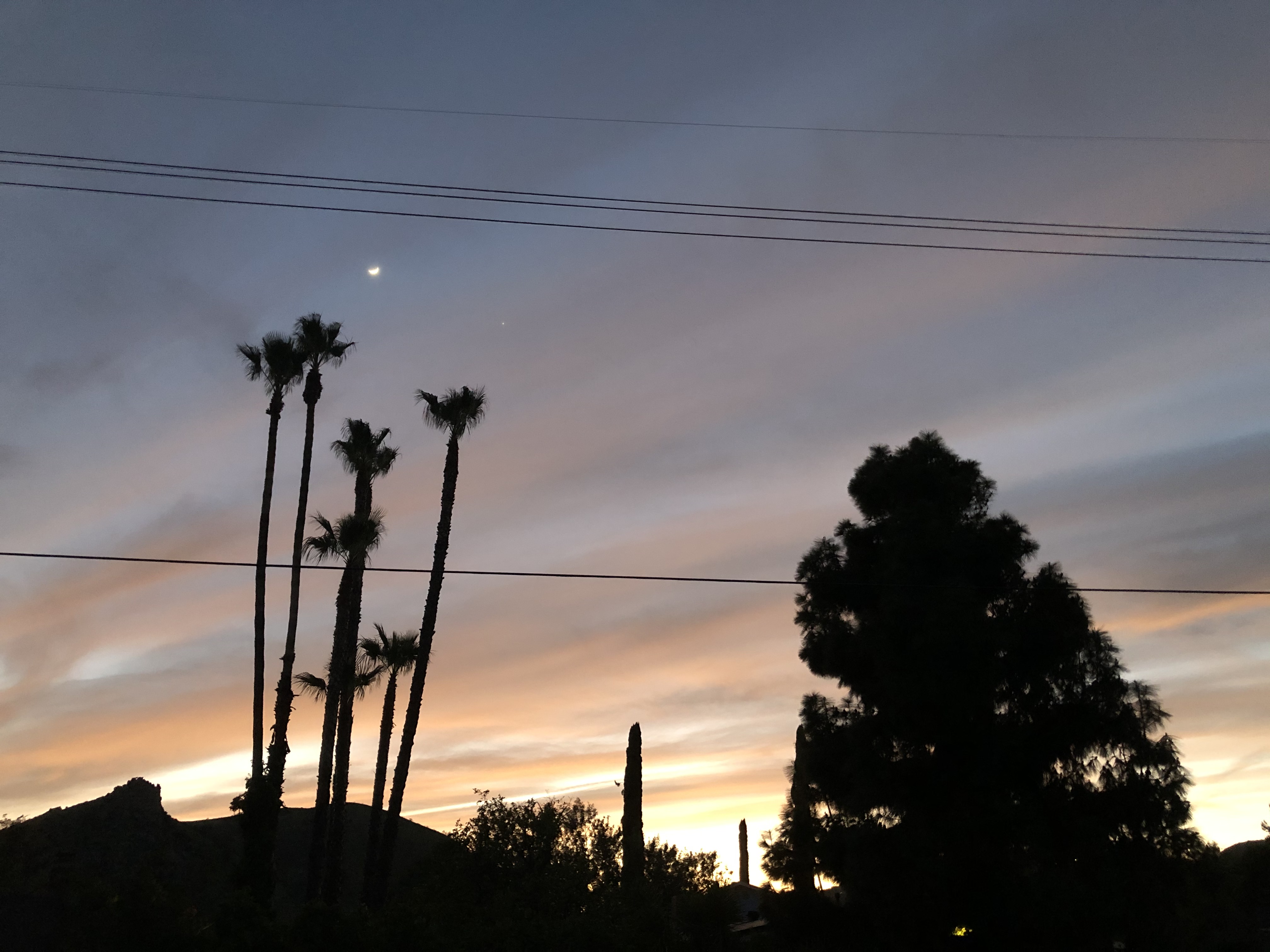
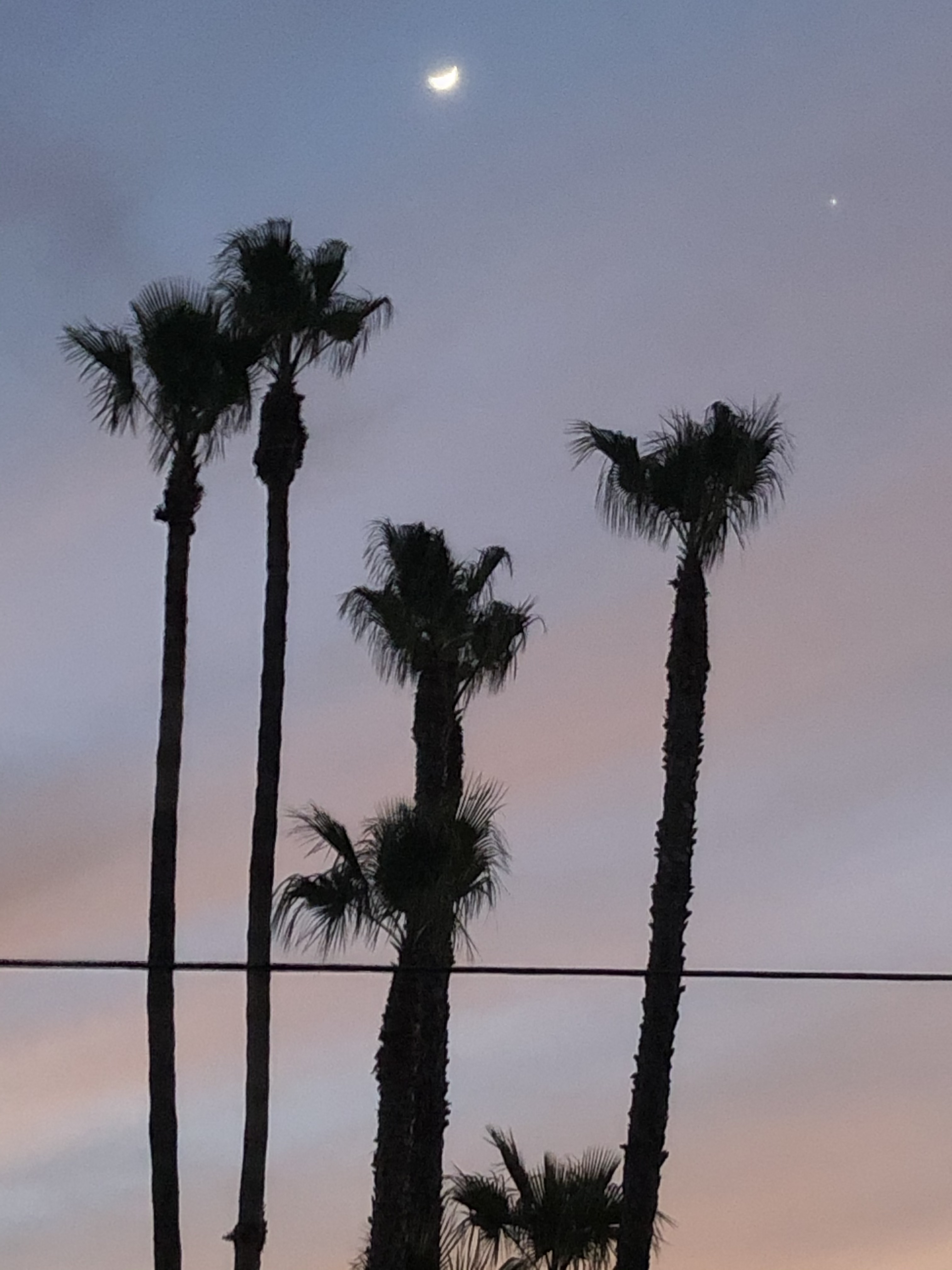
Even early after sunset, way before it’s dark, you’ll spot the moon in the blue sky. It’s almost ludicrous how bright Venus is as well. I spotted it in the blue sky just a few minutes after sunset, when it was till plenty bright enough to read outside.

Tomorrow the moon will be a little more illuminated and will appear closer to where Venus is.

As it gets darker you’ll see other stars coming out. Just off to the left in this view is Orion, and just a bit higher than Venus you’ll see Castor and Pollux in the constellation Gemini.

To the left of the moon (on the left side of that palm tree) is Aldebaran. Once it gets a little bit more dark, you should be able to easily spot the Pleiades. (Remember?)

Leave a comment

Filed under Astronomy, Photography, Space