Monthly Archives: February 2015

Smellfungus?

Let me preface this by saying that after a couple of long weeks, with TONS of NASA Social posts and pictures, a family crisis, and being at the thirty-six-hours-after-the-first-good-exercise-in-a-long-time-and-my-legs-are-killing-me point, I had nothing for tonight. But, there are tricks to get around that! Which all bombed and produced nothing for tonight. Until I remembered that The Long-Suffering Wife had gotten me a Christmas gift of a box of “Silly Word Flashcards” to be used in just such a situation. How much less effective could it be?

The card I drew was for “smellfungus,” a noun meaning “a person who always seems to find something wrong and likes to complain.”

C’mon, they made that one up! Right?

Nope, Mirriam-Webster online has it, describing it as “a captious critic; faultfinder.” It also goes on to say the term originates from a 1768 satire called A Sentimental Journey Through France And Italy.

But of course! Why didn’t I know that? Well, at least now when it comes up on Final Jeopardy I’ll be ready to mop up and win!

Which makes me wonder about my readers – do we have any smellfungus among us?

(P.S. – as I’m proofreading and getting ready to hit the “Publish” button, something lands on the roof and starts stomping around, scaring the crap out of me. Either it’s a bear or the biggest freakin’ raccoon in Los Angeles County. What I need now is a blunderbuss, which is probably another silly word in that deck of cards.)

3 Comments

Filed under Farce

Juicy Chunks O’ Wisdom For Saturday, February 7th

‘Cause I ran a 5K today without benefit of any training, that’s why.

  • My 5K time was 44:03 officially. How “good” that might be is a matter of perspective. If I were in the kind of shape I would prefer to be in, that would completely suck. Under 30 minutes would be a good time. On the other hand, given the absolute zero training time, 44:03 and still breathing and not needing an ambulance is pretty good.
  • Every cell phone company is running ads where they show you a US map with their SuperDuper 5G+ coverage in a bright color, their 4G coverage areas in a slightly less vibrant shade, their 3G coverage area in a pale shade, and some grey areas out in Nevada, Montana, Wyoming, and about 99% of North Dakota. There’s some fine print there that I can never read, but I’m betting that part of it says something like, “Grey areas represent areas where you are up the creek without a paddle. Have a nice day.”
  • Where everyone else was in a 5K “race”, we were in a 5K “run.” (I ran with my LA Marathon training partner from 2012, who happened to live a couple blocks away and be neighbors with one of the organizers.) Early on, when everyone else was taking off into the distance and I was trying to get at least one lung to work, my goal for the day became obvious. There was a young woman who was running while pushing a stroller with twins and a seven or eight-year-old in tow. The only “racing” I wanted to do was beat her.
  • Sunday morning, grocery shopping, about 10:30. I’m passed by a frazzled looking guy who’s wearing a sweatshirt, red checkered pajama bottoms, and slippers. He’s carrying a jar of peanut butter, a bottle of vodka, a quart of orange juice, and a pint of Ben & Jerry’s ice cream. No one bats an eye — this is Los Angeles after all. The only question I had was, “Chunky or smooth peanut butter?”
  • The mom with the twins in the jogging stroller? We totally kicked her ass, finished at least two minutes ahead of her! WIN!! (At this point, I’ll take them where I can get them.)
  • The Long-Suffering Wife notes that I missed a couple of things in my analysis of how we’re looking for a good place to retire in a few years. I guess I thought they were obvious “givens,” but we will need someplace with good, high-speed internet. She would also like to find a place which has a good deli, but would settle for a place that has decent bagels.
  • Old note found — “Having a cat asleep on your lap when the Raccoons Of An Unusual Size start romping around on the roof can be…unpleasant.” Yes, yes it could.
  • Someone else noted that the title “Where’s A Good Place To Retire To?” should be “Where’s A Good Place To Which To Retire?” Never finish a sentence with a preposition. Fine. Granted. By the way, have you heard the joke about the cowboy and the snooty, uppity Brit?
  • Overall for my age group (male, 55-59) I finished eleventh. And no, it wasn’t out of eleven! (You know that you were thinking it, weren’t you.) It was out of thirteen. Since I was expecting to finish fifteenth out of thirteen, again, WIN!!
  • On the 101 Freeway headed toward Ventura, where they often have a 5th lane on the far right that begins where an onramp dumps traffic onto the freeway and ends at the next exit where it is a mandatory exit lane. Traffic is reasonably heavy. A handful of cars are getting on the freeway, and the first three or four are having a difficult time getting into the through-traffic lanes. As the “exit only” ramp approaches, I see that the final car isn’t hanging back to find an open spot. It’s a classic, cherry red, convertible Mustang, probably a ’65 or ’66, top down, and the driver is making an extremely aggressive move to gun it and squeeze into an open spot several cars ahead, barely making it before the lane exits. I’m figuring that it’s some kid who’s got more testosterone than brains. Then I pull up next to it a couple miles later and see that it’s a woman, probably in her late 60’s or early 70’s, boufant hairdo like something straight out of an “Animal House” sorority, wrapped up in a thin, transparent scarf like my mom always wore. She’s grinning like she just stole the car. YOU GO, GIRL!!

Remember, “I may be old, overweight, and slow — but I’m ahead of you” (Gotta get me one of those running shirts!)

Leave a comment

Filed under Cats, Critters, Juicy Chunks, Paul, Running, Sports, Writing

NASA Social At NASA Armstrong (Palmdale – Part Two)

Summary:

  1. My third NASA Social, the “State Of NASA” event
  2. I went back to NASA Armstrong, this time at their Palmdale facility
  3. Posts for previous NASA Armstrong events here, here, here, here, here,and here
  4. The first part of this post, focusing on SOFIA, is here (with an extra bit here)

2015-02-03 iPhone6 1857 (small)

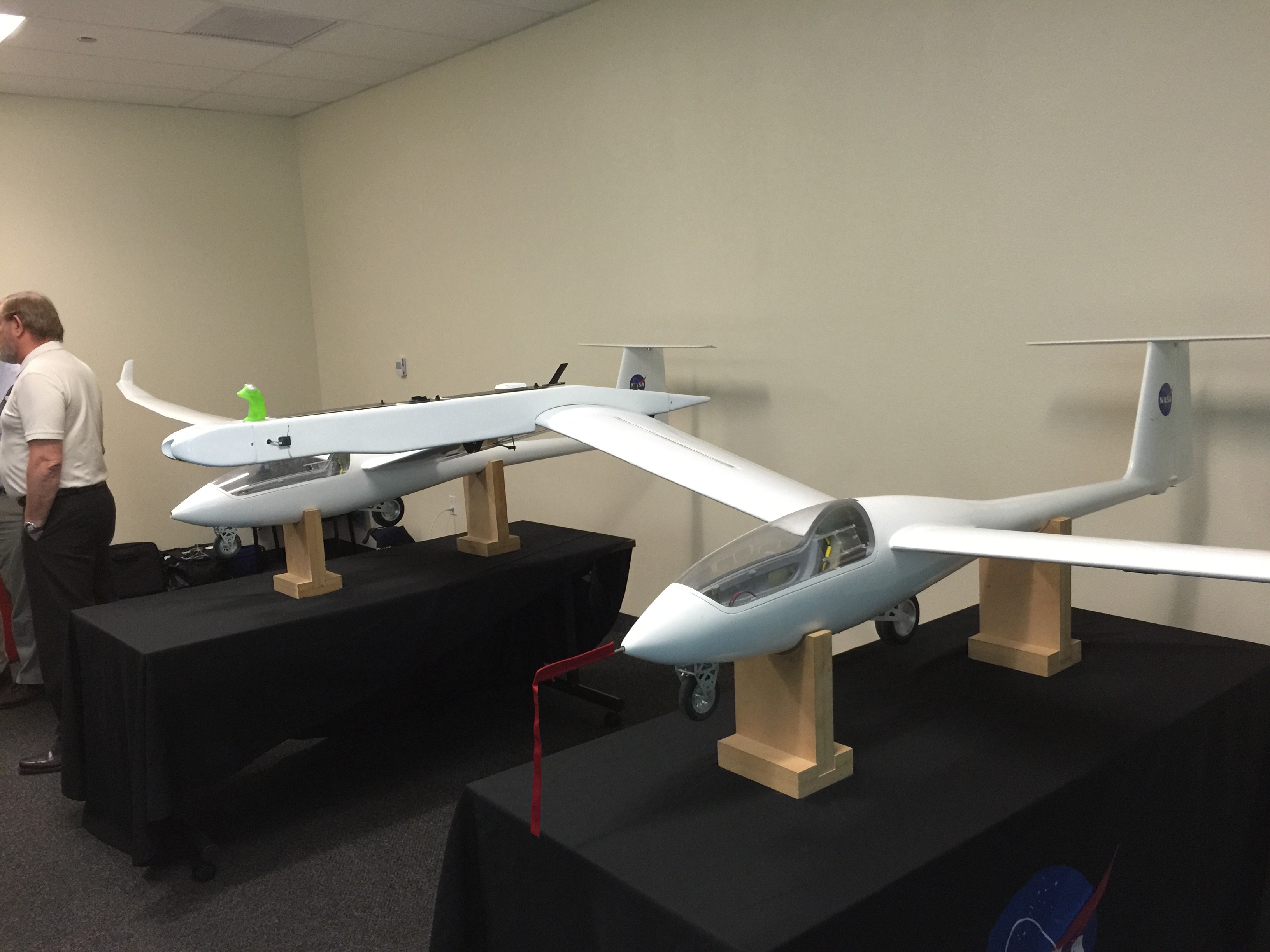
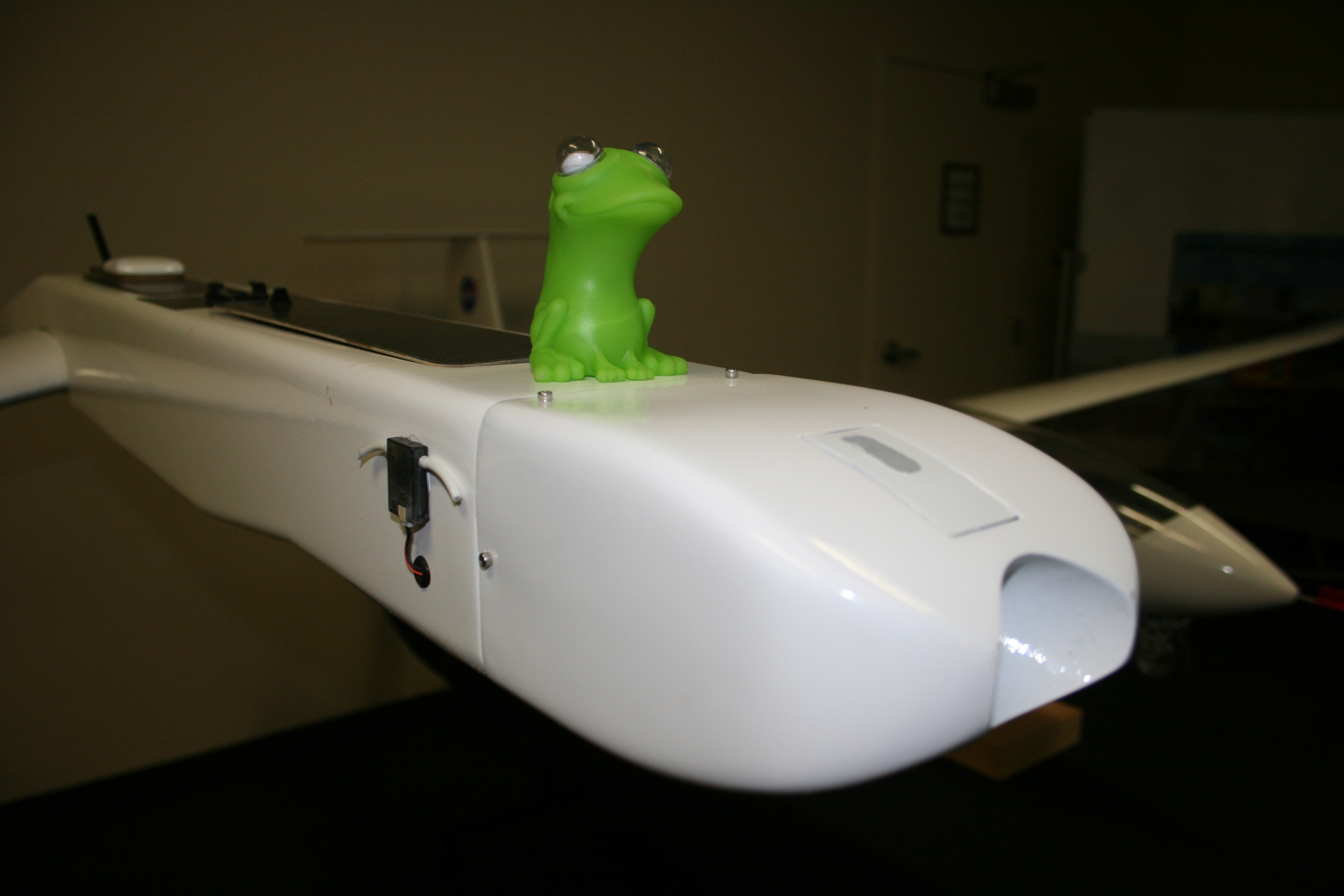
This is the remote-controlled model for the Towed Glider Air-Launch System being developed at NASA Armstrong. The concept is similar to Virgin Galactic’s “White Knight” aircraft, except that it’s a remotely piloted glider instead of a jet with a pilot and co-pilot.

Doing it this way introduces (they believe) some serious economies into the system. By increasing the “carry efficiency” (ratio of cargo weight to carrier vehicle weight) they can take bigger payloads (rockets). By being a glider, they can reduce the development and operational costs — all the expensive stuff (engines, life support, heavy airframe, fuel tanks) is on the standard jet (such as a military cargo jet or even a commercial business jet) used for towing.

This model has flown already, being towed by a small drone. Next they’ll fly it up to 10,000 feet, then fly it with a small rocket, then test the releasing of the rocket, then test taking it up to 10,000 feet with the rocket attached, and finally taking it up to 10,000 feet with a rocket attached and dropping the rocket (which may or may not fire).

Right now there’s no launch capability that allows someone to put 100 pounds into LEO (Low Earth Orbit). About the smallest rocket available will put 1,000 pounds into orbit for about $50M. This could allow a 100 pound payload to get into orbit for $1M or even less. Once that capability is available, there are a lot of businesses and universities that would like to use it.

Furthermore, the idea should scale up. In theory, if you build a glider the size of a 747, you could tow a rocket big enough to carry a crewed vehicle to LEO, for small fraction of the $75M+ that the Russians are currently charging for a Soyuz seat.

IMG_3275 (small)

On the other hand, some folks are still confused about the difference between a “towed glider” and a “toad glider.”

2015-02-03 iPhone6 1936 (small)

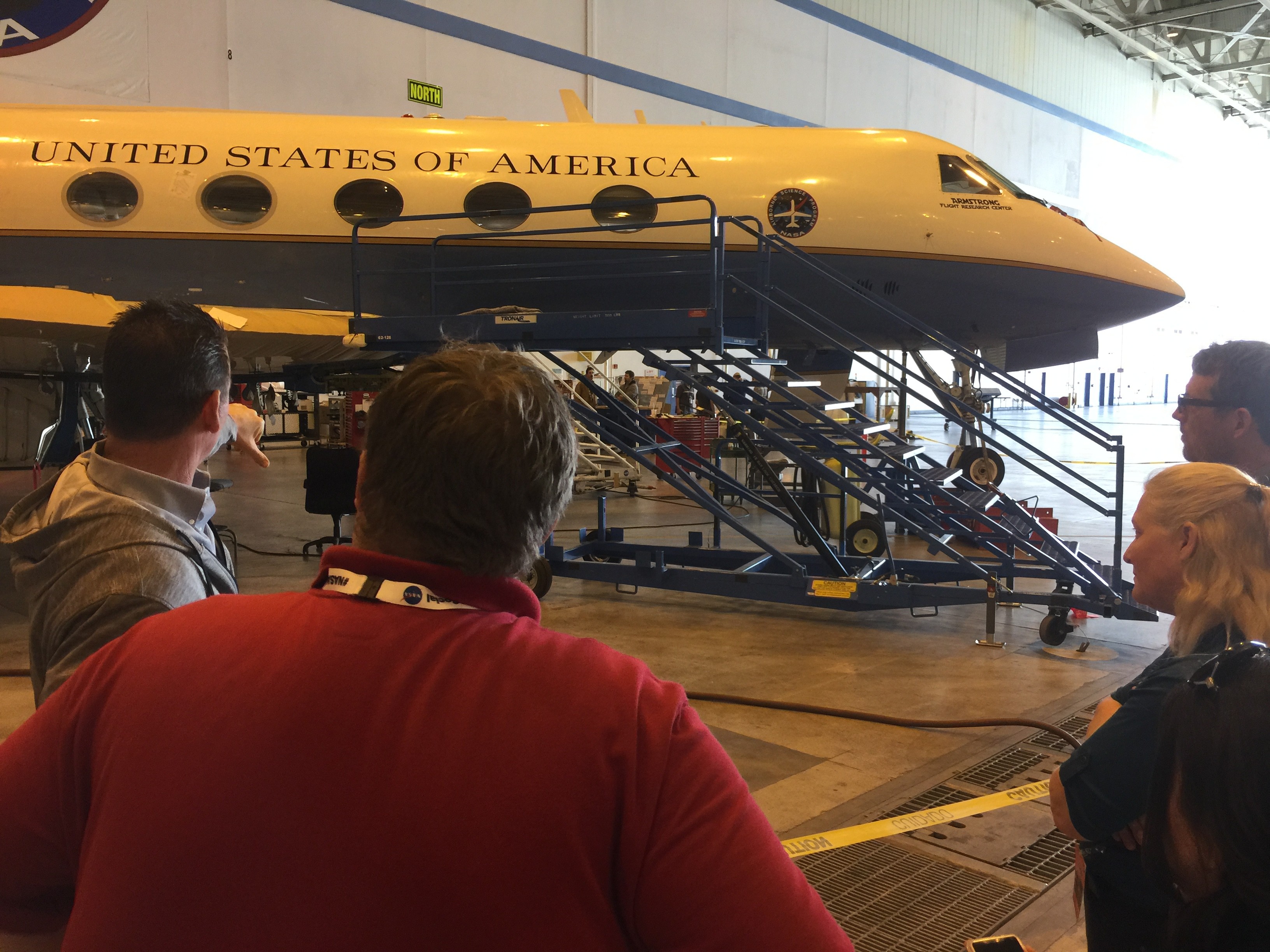
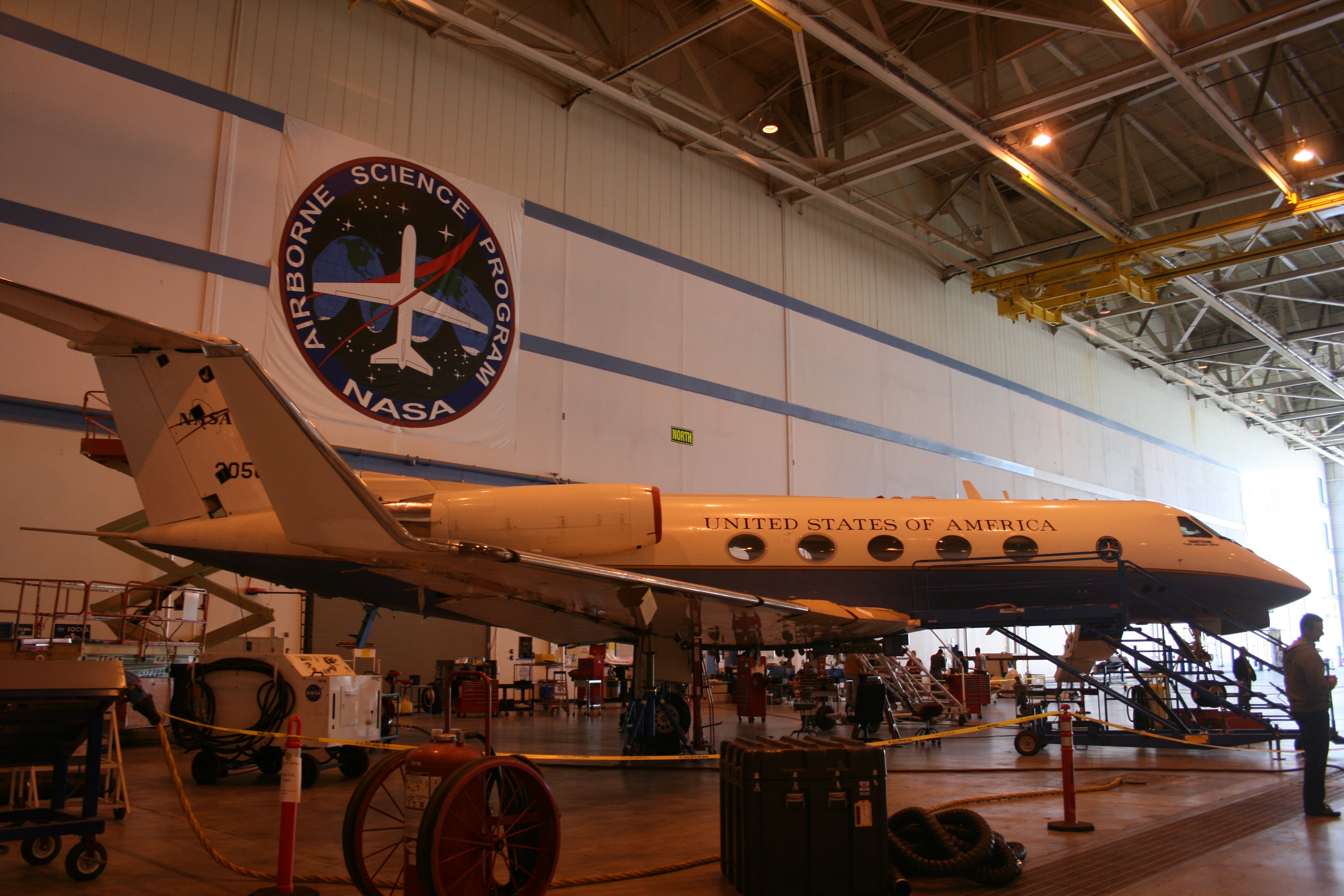
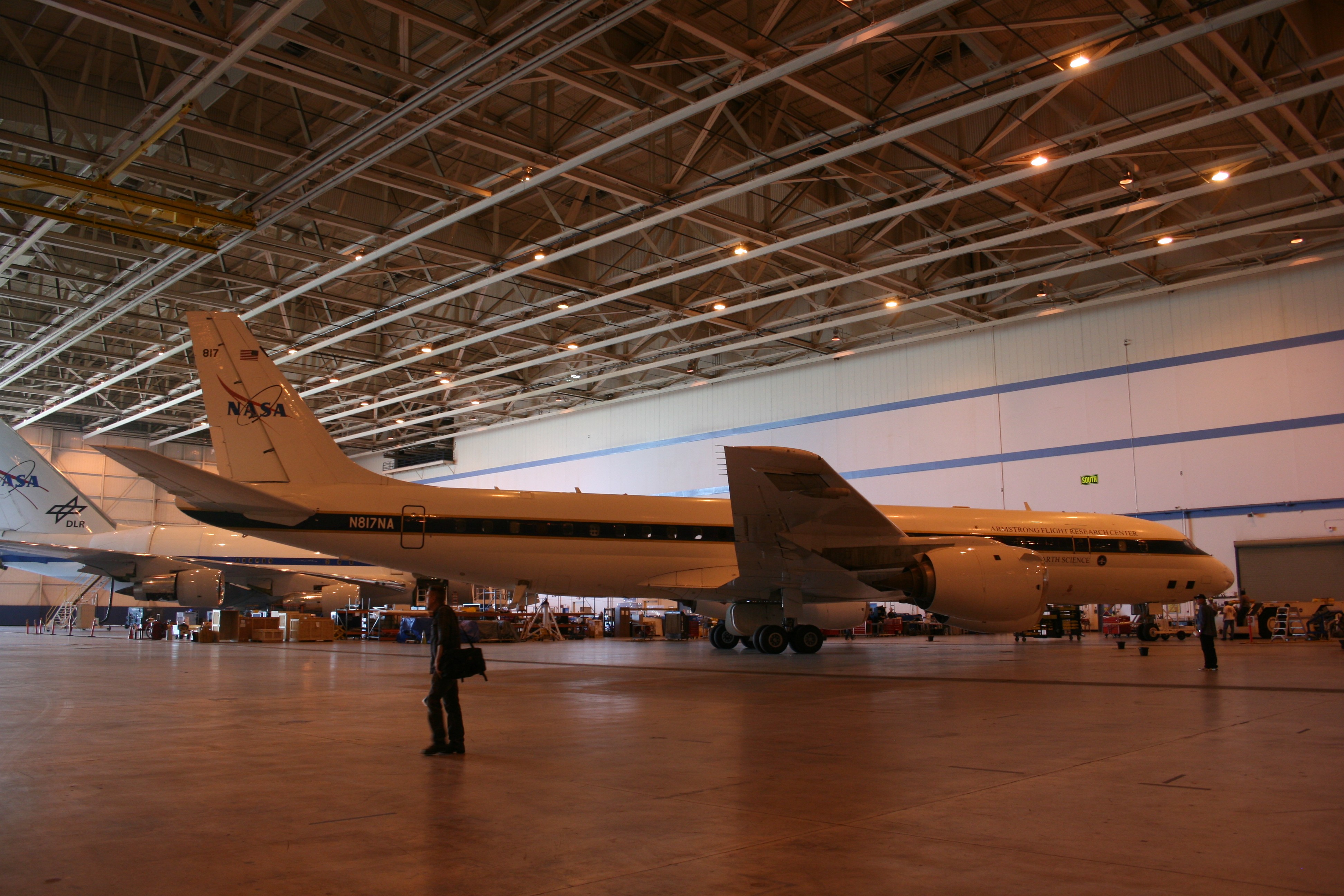
Back down in the hanger after lunch, John McGrath showed us the two C-20 UAVSAR aircraft, known to us civilians as Gulfstream III business jets, albeit heavily modified.

IMG_3347 (small)

The Airborne Science Program at NASA Edwards covers all of the aircraft-based scientific research being conducted. Out at the NASA Armstrong facilities on Edwards Air Force Base, the primary focus is on aeronautical research. (See my posts regarding the November NASA Social there.) In Palmdale, the aircraft are operated in order to provide a platform for researchers to gather the data they need.

IMG_3355 (small)

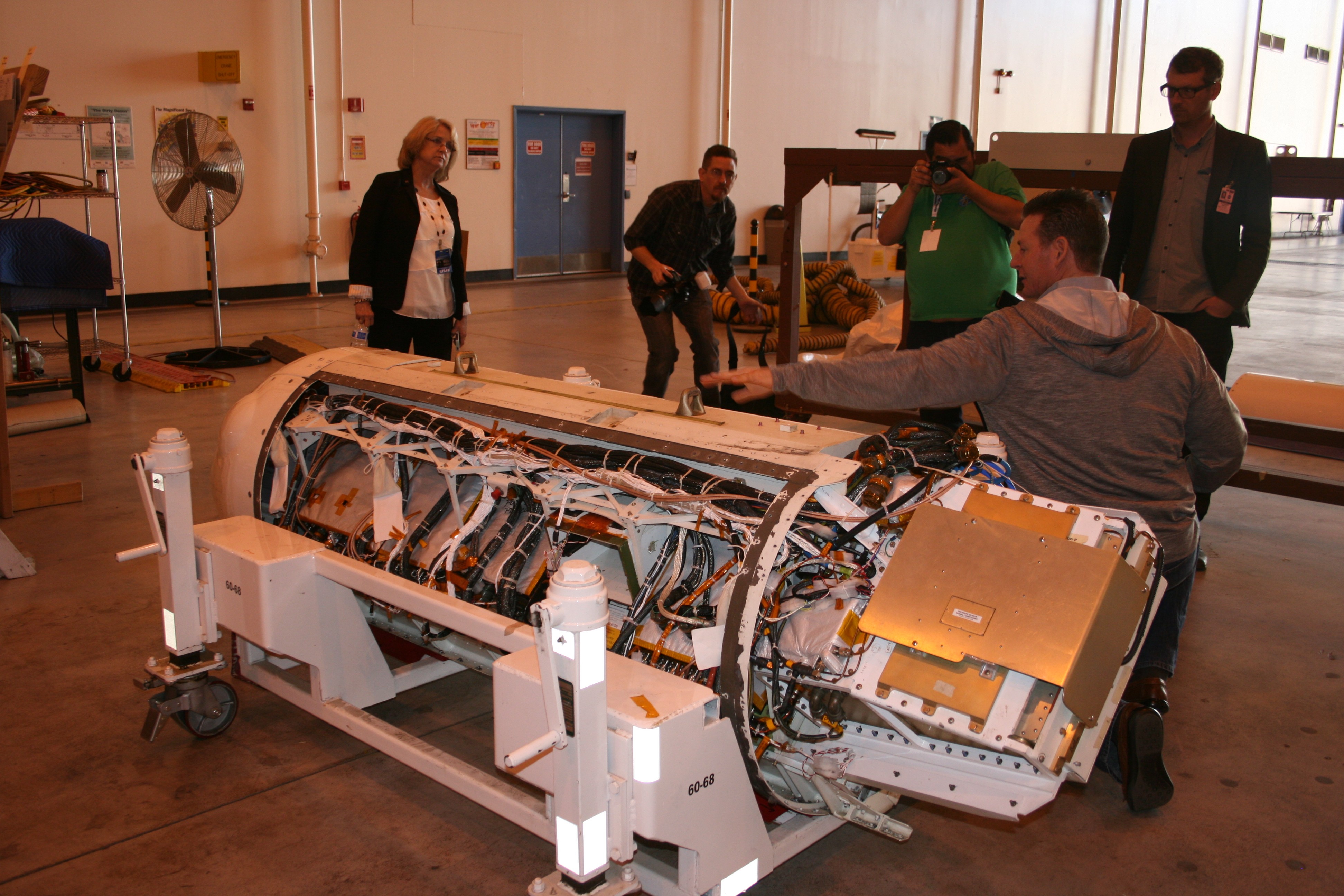
Here Mr. McGrath shows us one of the pods that gets mounted under the belly of the C-20. These pods are more or less “plug and play,” so researchers and outside institutions can fill one with their instruments and equipment, then “simply” get it attached to the C-20. I suspect that it’s a bit more complex than that, but the system has been substantially streamlined to make it much faster and easier than it would be if everyone did their own designs and each one started from scratch. In this case, the pod’s instruments had just undergone a major upgrade since the newer instruments were far more sensitive than the previous instruments.

IMG_3362 (small)

Here you can see how this C-20 is up off its gear and surrounded by equipment. Underneath the aircraft, in the center near where the short, orange ladder is, you can see where the pods get attached, with a couple dozen connecting wires dangling down.

IMG_3351 (small)

This is the NASA Edwards DC-8, known to us civilians as a DC-8. It also has many modifications, including ports that allow instruments, sensors, and cameras to stick outside the airframe. In addition, many of the stock windows have been replaced with perfectly clear, optically flat windows so that cameras can be used through them without distortion.

The DC-8 allows instruments and the scientists running them to get wherever they need to be. For example, in a couple of weeks the European Space Agency’s ATV-5 cargo spacecraft will be leaving the International Space Station and re-entering to burn up and be destroyed over the South Pacific Ocean. But rather than do a “normal” destructive re-entry, the ATV-5 is heavily instrumented and will re-enter at a shallow angle to the atmosphere. This simulates how satellites enter the atmosphere when they’re making unplanned re-entries, as well as how they ultimately intend to de-orbit the International Space Station.

The instrumentation on the ATV-5 will give the engineers data on how spacecraft break up and are destroyed. The DC-8 will be based out of Tahiti for a few days, and with the ATV-5 re-enters, all of the instruments and cameras onboard will be gathering outside data to complement the data being transmitted from inside the ATV-5 as it is destroyed. (Tahiti for a few days – tough gig!)

IMG_3370 (small)

Brian Hobbs showed us the ER-2 aircraft, which is a civilian version of the U-2 spy plane. It can get all the way up to 70,000 feet, flying in an environment that’s very similar to actual conditions in outer space. That allows instruments being designed for use on satellites to be tested before launch and modified as necessary. In addition, the ER-2 can fly over a ground location at the same time that an orbiting satellite is flying over, allowing the instruments on the ER-2 to get the data needed to calibrate the instruments on the satellite above.

Another application the ER-2 is excellent at is meteorological research, such as the study of hurricanes. If you have instruments at the surface, instruments at several elevations up in the hurricane on aircraft or drones (see the Global Hawk or Ikahana remotely-piloted vehicles in my November posts), the ER-2 lets you get an even higher set of data by flying over the top of the storm. Having this vertical set of data can tell researchers far more than a single set of data from one altitude.

2015-02-03 iPhone6 1965 (small)

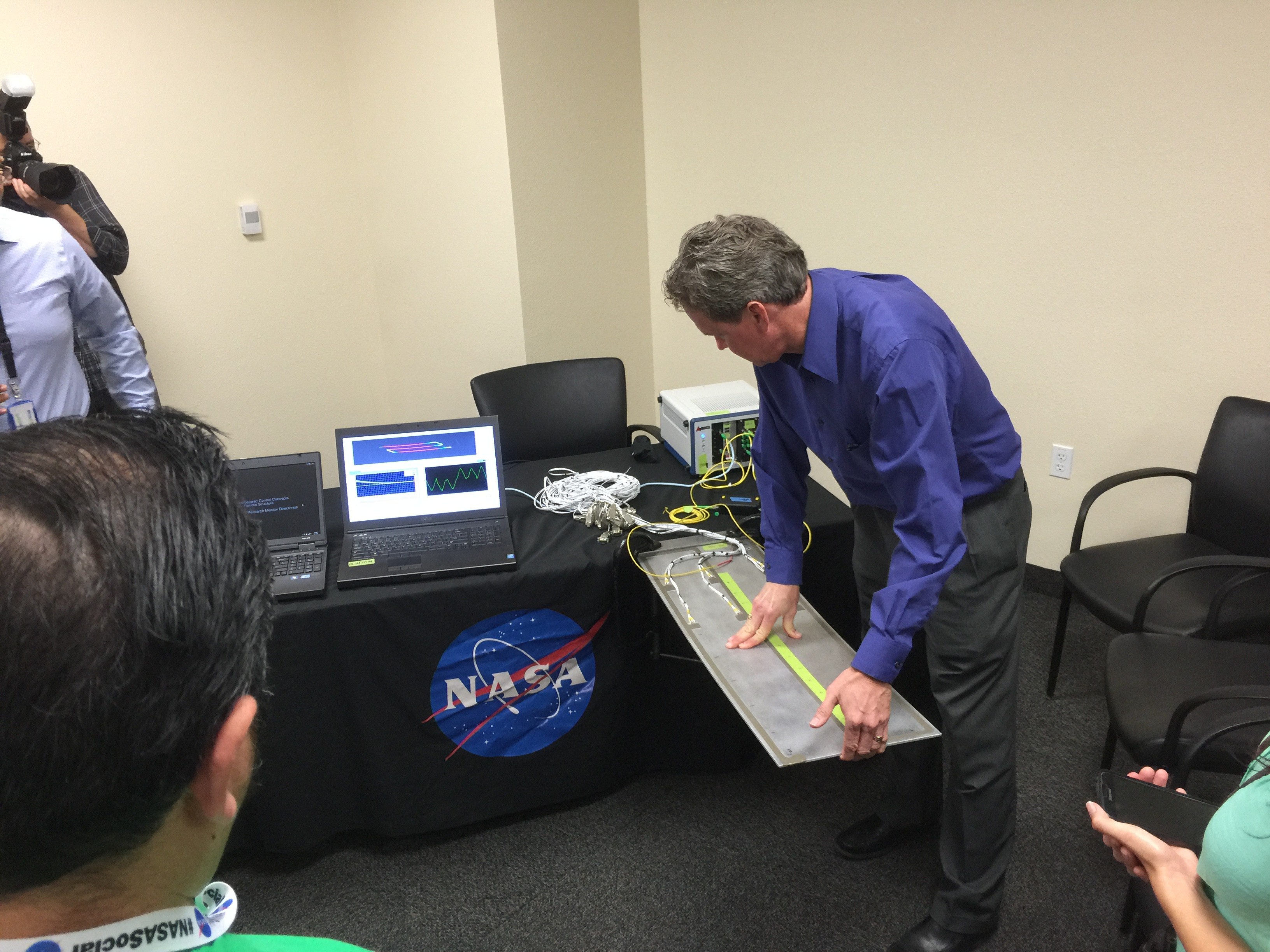
Back in the conference room we got a demonstration of a new technology in strain gauges. On this metal plate, you can see the yellow strip down the middle – it contains sixteen sensors, which connect to that huge bundle of white cables on the desk. This is the way things are done now. On the other hand, the plate also has a “W”-shaped string of fiber optic cable coming down the right side, going back up to the right of the yellow strip of sensors, then back down and back up on the left side. That hair-thin cable has 500 sensors in it, and it connects to the one, thin, yellow cable on the desk.

Obviously if you are building a new plane, ship, car, rocket, bridge, building, or whatever and you need data on the stresses being put on the structure, it’s a lot easier and lighter to have thousands and thousands of sensors on fiber optic cables instead of dozens of sensors using conventional equipment. In addition, where now the conventional sensors are used on the first few test aircraft of a new design and then stripped out due to their weight, the fiber optic sensors can be left in place forever, giving you continuous data over the life of the aircraft.

Other potential uses of this technology would be to embed it into new buildings or add it to existing structures such as bridges. Given the way our national highway infrastructure is starting to crumble, it would be really useful to have a relatively cheap, easy, and highly accurate way to know if the girders on a bridge are cracking and failing.


IMG_3379 (small)

This is John Kelly, the Principal Engineer on the Towed Glider Air-Launch System (discussed above). Some of the figures he gave us were impressive.

For example, the real world carry efficiency of Virgin Galactic’s WhiteKnightTwo is 0.71, which is pretty good – it carries 29,000 pounds with a 70,000 pound aircraft. The L-1011 Stargazer system from  Orbital only has a carry efficiency of 0.14, and the B-52 used by NASA to launch the X-43 test vehicle only has a carry efficiency of 0.17. But the models being tested have a carry efficiency of over 1.00 and they believe that the system eventually could have a carry efficiency as high as 2.00.

IMG_3384 (small)

Finally, Ron Young told us about the Flight Opportunities program that NASA Armstrong runs. In short, by using drones, balloons, and parabolic-flight aircraft (also known as a “Vomit Comet”), NASA Armstrong tried to assist businesses in getting their experiments and instruments into a “space-relevant environment.” They may not quite get you into LEO, but they can get you close or in a simulated environment. This allows you to test and refine your equipment before taking the big (and expensive) step of going to LEO.

For example, the Zero-G 3-D Printer that’s currently running experiments on the International Space Station was first tested on a parabolic-flight aircraft. Operating in twenty-second intervals of microgravity, the major bugs were worked out of the system before it went up to ISS, where it’s now working. In fact, you may have seen a picture of a small ratchet wrench that was printed on ISS just before Christmas. Mr. Young had an identical wrench that was printed on the ground for us to examine and play with – amazingly light, and it’s astonishing that it was printed in one piece, not several pieces and then assembled. This could really be the next big thing in allowing crewed spaceflight into deep space.

And there you have it! A full day of information and some incredible hands-on experiences with the people and the equipment that are doing science and pushing the boundaries of aeronautics and space flight. The NASA Armstrong staff did a wonderful job of taking care of us and I can’t wait for another chance to go back for another NASA Social in the future.

Leave a comment

Filed under Astronomy, Flying, Photography, Space

Flash Fiction: Deaders

This week’s Flash Fiction Challenge is another genre mashup. Two lists, two random numbers (in my case, 7 and 5), the resultant “2,000 words or so” must contain a story combining elements of “Zombie” and “Heist/Caper!”

Time. Again, I really should work on these assignments earlier in the week. It would give me time to edit, re-write, make it better. If nothing else, I need to work earlier in the night, so I can get it posted by midnight instead of at 00:13. On the other hand, after almost two years of daily posts on this site, thirteen minutes late can still count as a Thursday post. Government work, and all of that.

But I like the gist of the story I wrote!

DEADERS

“You brought what?”

“It’s an infrared night scope, so that we can see them moving around in the dark, just like they see us.”

For the five thousand and third time I wondered how Ryan had possibly survived this long while being as freakin’ stupid as he was. Ryan was the poster boy for the theory that Darwin was wrong.

“Ryan, do you know what ‘infrared’ means?”

“Huh? No, but it says ‘night scope,’ so it’s got to be useful, right? What’s wrong?”

“This thing works by detecting heat, Ryan. That’s what ‘infrared’ is, heat. The police would use this to see people or cars in the dark, because they’re hotter than the bushes and buildings around them. Have you ever seen a warm Deader?”

I couldn’t see Ryan’s face in the dark, but I was pretty sure his lips were moving while he thought through the problem. It’s a good thing that he was good in the sack. Well, that plus the fact that he was about the size of a small tractor and the only live human that I had seen in months.

“I’m sorry, Becca. I thought that it was a good idea. I thought it would let us see like they do.”

Great, now he was going to pout. “It’s good that you’re trying to help, but next time check with me. I don’t know how the Deaders see us so well in the dark, but I’m sure this won’t let us see them. Okay? Where’d you get that thing, anyway?”

“That police station two towns back. I had already grabbed all of the guns and ammo they had and I found this. I thought that it was a good idea.”

Wonderful, now he was going into some sort of OCD loop and repeating himself. It always seemed to happen when I really, really needed him present in the here and now. Maybe it was his coping mechanism. I usually waited until after we were done trying not to die before I fell apart, but that was just me. To each his own.

“Ryan, it was a good idea. You did fine. I just don’t think it will help us tonight. Maybe if you leave it right here, we’ll pick it up on the way back to the truck when we’re done. Then we can look at it and figure out some way to use it. Can we do that?”

There was a pause as he thought about it, then the soft crunch of him setting the case down in the pine needles. “I’ll put it right here next to this big tree so that we can find it.”

“Good plan.” It was a lousy plan, but it would shut him up and move him on to the fun part of the night. And by “fun” I meant “incredibly dangerous.” “When we come back up the ropes it will be right there. The ropes are ready, right?”

“Yeah, Becca, we just have to toss them down. They should put us right on the roof.”

“Did you double check your guns? You have your knife? And no lights. We go in there in the dark, we come back out the same way.”

“I know the plan, Becca. Get in, grab all the food we can stuff into the baskets, and get out. No lights, stay quiet, try to avoid stirring up the Deaders.”

“Good, Ryan. Let’s do this before we realize what a stupid idea it is.”

In the dim starlight coming through the breaks in the clouds, I could just see the edge of the bluff. Not quite high enough or steep enough to qualify as a cliff, it would still be almost impossible to climb up in daylight without climbing gear or a rope. In the middle of a moonless night pursued by a horde of pissed off Deaders it would be worse.

One by one, Ryan picked up the coiled ropes, swung them, and flung them out into the darkness. All of them had large, crude cloth bags on the end for us to fill with our hard earned booty. After all six lines were set, we groped our way through the dark, grabbed a rope, and started backing slowly down the slope.

As quiet as we were trying to be, there wasn’t any way that the Deaders wouldn’t be aware that something was going on. Their sense of hearing wasn’t nearly as good as their vision, but the sound of the ropes banging down onto the warehouse roof would have tipped them off, and our descent wouldn’t be very stealthy.

We were going to do our best to avoid confronting any Deaders to begin with. Our reconnaissance earlier in the day hadn’t shown any of them on the roof or visible in any of the windows. While there might be thousands of them shuffling around in the parking lot outside, we were betting our lives that they hadn’t gotten inside.

As we finally reached the flat, gravel topped warehouse roof, there was just enough starlight to see where the six dark ropes were against the white roofing material. Not for the first time I wished that we could have just a little bit of light pollution bouncing off the clouds to make things easier. I was not blind to the irony of spending a life wishing for a truly dark sky only to have my fulfilled wish be the thing that might kill me.

We gathered the ropes together and spread out the bags at the edge so they could be filled quickly. Whenever we got close to the edge, we could now hear the Deaders shuffling around below us. When everything was set, it was time to see if we would get lucky and live tonight.

Holding onto Ryan’s hand to keep him near, we went over to the fire escape hatch near the center of the roof. Ryan pulled a crowbar out of his backpack and started to open it.

The explosion was the last thing I had expected.

I heard Ryan grunting as he pried the hatch opening up. Without any warning there was a blinding flash and the loudest noise since the last space shuttle launch. I was flying through the air and hitting the roof hard, face first, a bit like a rag doll. Not my most graceful performance.

As I sat up I decided that I probably wasn’t broken anywhere, but I was scratched and bleeding. My shoulder was protesting with every move, but if I had to climb a two hundred foot cliff with it while a horde of zombies were on my trail, I could probably make do. Good thing, too.

My ears were ringing and I strained to hear anything through the internal noise. Nothing, or rather, I couldn’t hear anything. Not the wind, not my own movements, not the possible screaming of the Deaders or Ryan.

What had happened to Ryan? I looked around as best I could, but the flash of the explosion had destroyed any semblance of dark adaption my eyes might have had. The clouds had started to thicken and cut off what little light I had. Ryan could have been five feet from me and I wouldn’t have seen him.

Heart pounding, high on adrenaline, there was no time to lose. I started crawling around in a  circle, slowly moving out, feeling my way and trying to find anything. I never found Ryan, but I did find the hatch.

The good news was that I now had a vague idea of where I was on the roof and which way my escape ropes were. The bad news was that I could feel the fire escape ladder vibrating and shuddering as something slowly climbed it. Probably several somethings. There was no way to see that scenario ending well.

Crawling as quickly as I could toward the ropes, I grabbed the first one I found. I was getting a bit of my vision back and could see where the other ropes were lying. I considered taking them all back up with me so that the Deaders couldn’t use them to climb up behind me, assuming that Deaders could climb a rope, but doing that would strand Ryan. I needed to leave him a chance at saving himself, so I left the other ropes.

The climb up was sheer terror. The last year had forced me to get into the best physical shape of my life, but it was still tough pulling myself up the steep face of the hill, through the brush, in the dark, deaf and almost completely blind. The constant fear of grabbing hands from below just added the icing on the cake.

After an eternity of maybe five minutes I reached the top and pulled myself over the edge. I wanted to lie there to rest for an hour or two, but the life expectancy of doing that worried me. Instead I needed to see if I could find Ryan and help him in some way. If that failed, I needed to make sure that I wasn’t being followed by any Deaders.

The clouds had now completely covered the sky and started to descend. I looked over the edge and couldn’t see a thing in the inky black below me. But lying on the ropes connected to the tree, I could feel three of them jerking and pulling, like I had a marlin hooked on the other end. I guess that answered the question of whether or not Deaders could climb a rope. Even if one of the climbers was Ryan, I was in deep guano.

Looking back from the edge, I tried to see where the truck was parked. The edge of the road was only about a hundred yards through the trees, but in the dark it might as well have been a hundred miles. I could see nothing. Running through the trees might not be a good choice either, even if I could figure out which direction to go through.

The jerking on the ropes was getting more pronounced, and two more of the ropes now had activity. I didn’t know how to help Ryan, but I could buy myself some time. Pulling my knife from my boot I stumbled to my feet to find where the ropes were attached to the tree. Stepping forward to start cutting them, my foot hit a box.

The infrared night vision goggles.

Any port in a storm. I grabbed the goggles and slipped them on my head, then groped around for some kind of controls. A switch on the left side activated them, and suddenly I was a bit less blind. Holding my hand up in front of me I could see it clearly. Turning away from the bluff, off through the trees I could see the truck, its engine still cooling where we had parked it, but still warmer than the trees and hill behind it.

Dropping to my stomach, I leaned over the cliff and looked. There wasn’t much to see since the vegetation, dirt, and building had all reached thermal equilibrium hours ago. But there was enough to see.

Coming up one of the ropes, glowing brightly as he sweated and scrambled for his life, was Ryan. The other five ropes all were jerking, but the climbers were still invisible to me.

Quickly I cut the five ropes holding Deaders and started pulling on the rope that Ryan was on. With my help he was up next to me in a few seconds. While he lay gasping for breath, I looked over the bluff again, but couldn’t get any clues about the progress of the Deader’s pursuit. But I knew it was there, one way or the other. They were like pit bulls crossed with rats. They would find a way.

I pulled Ryan to his feet. I still couldn’t hear much of anything, and I was sure that he was still blind as a bat, but I put his hands on my shoulders and whispered, “Hold on, we’re going.” He must have gotten the idea, giving my shoulder a squeeze. The semi-blind leading the blind, we started through the trees.

Good plan indeed, Ryan.

2 Comments

Filed under Science Fiction, Writing

RIP Joey Chan

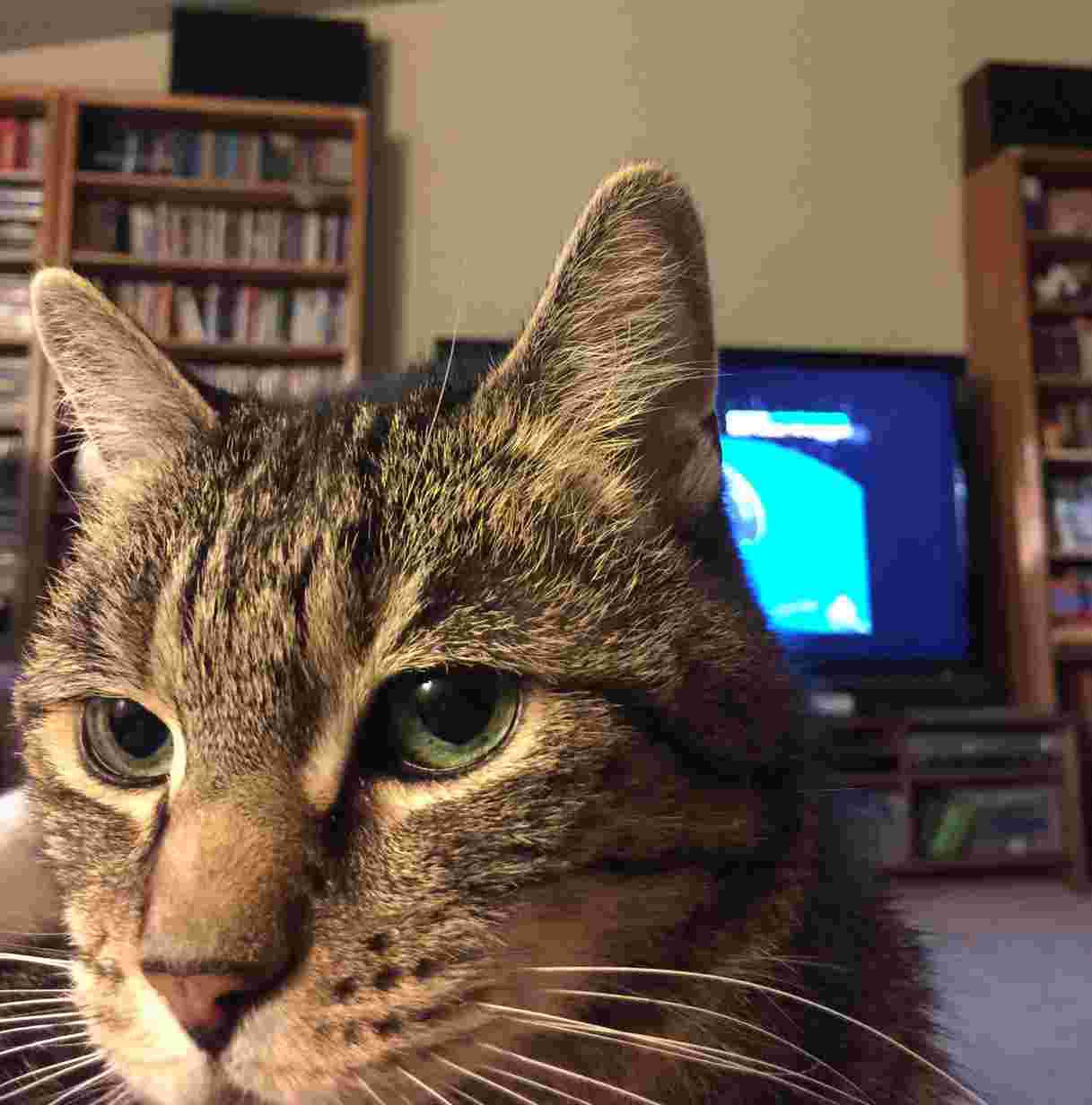
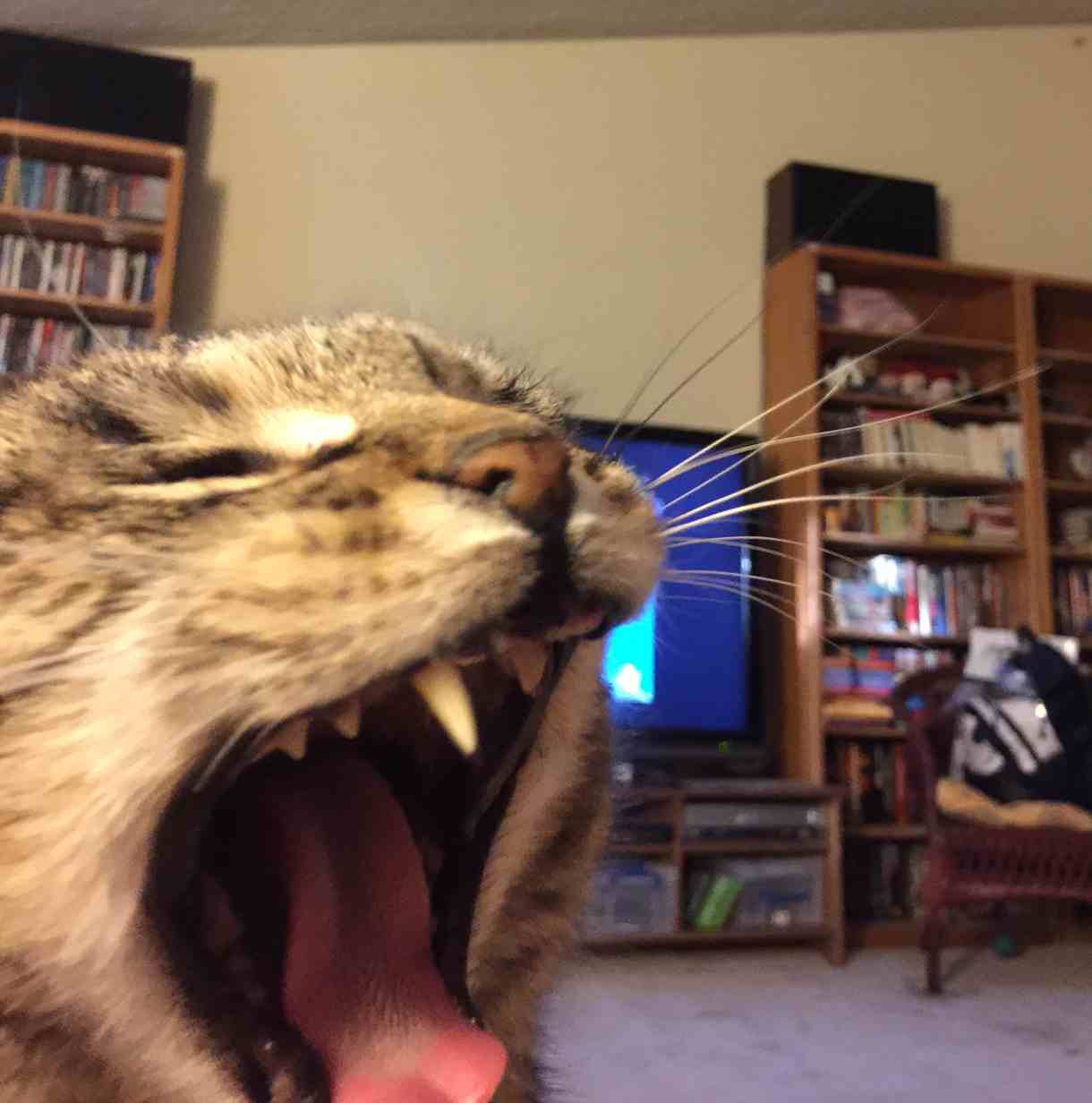
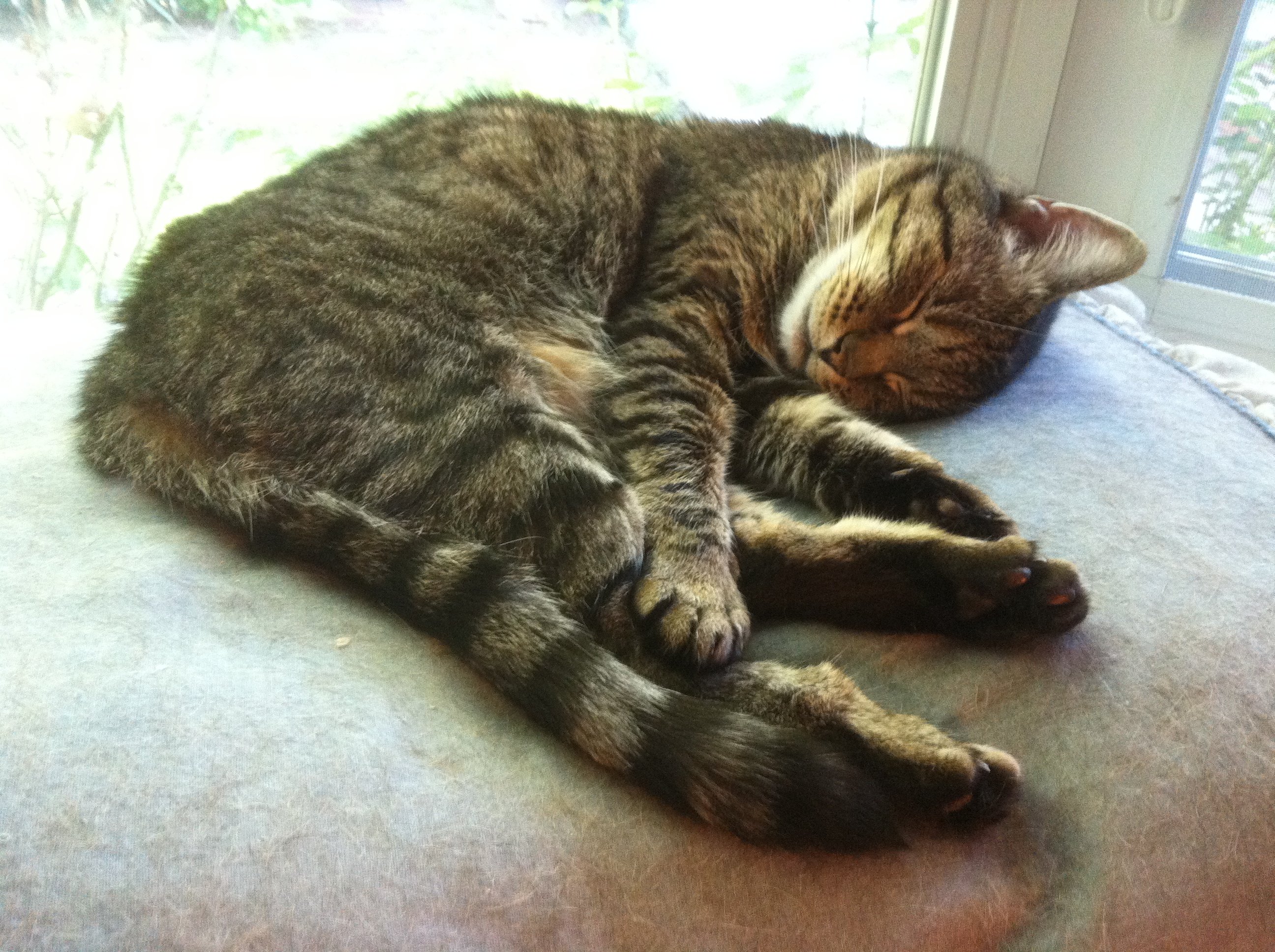
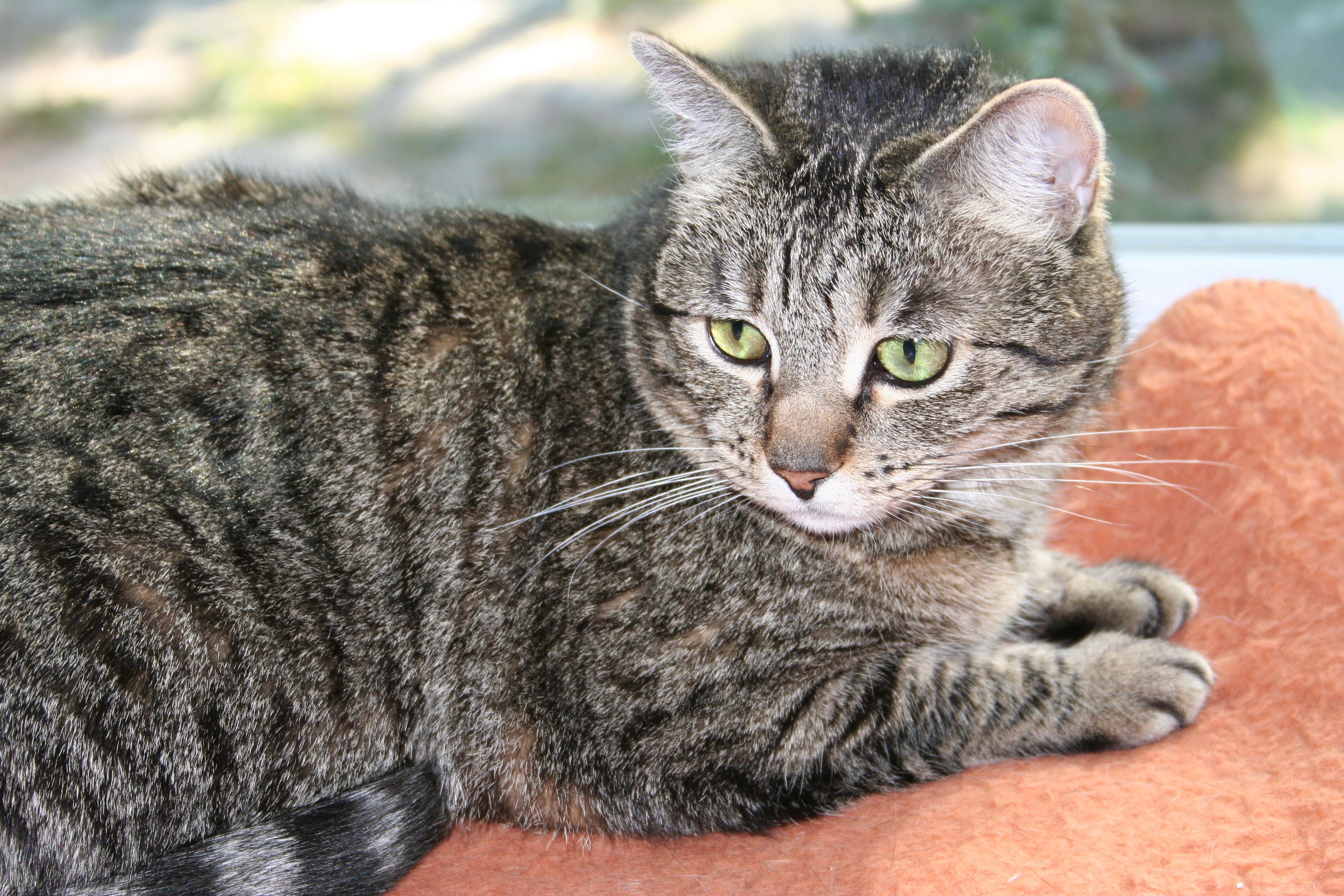
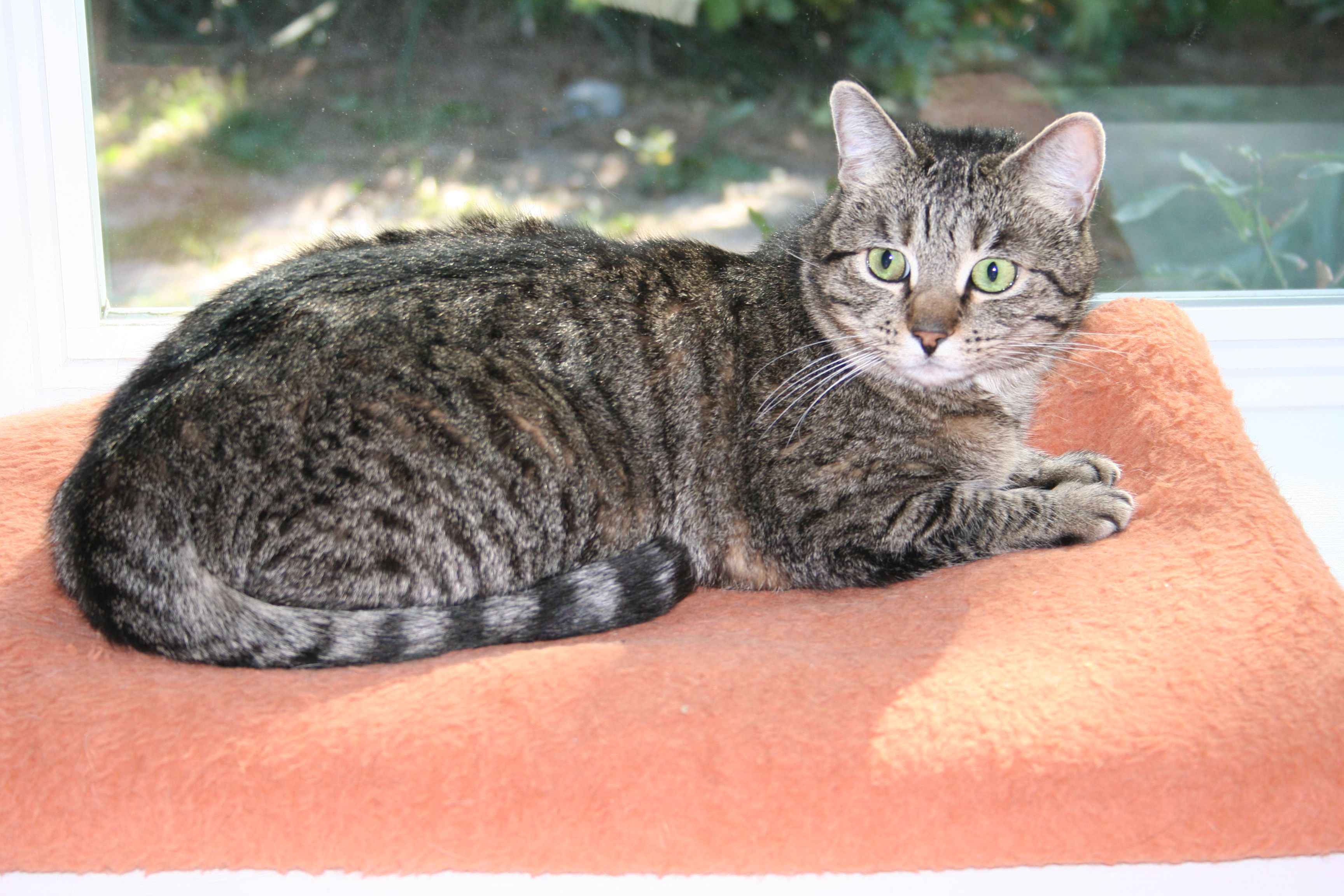
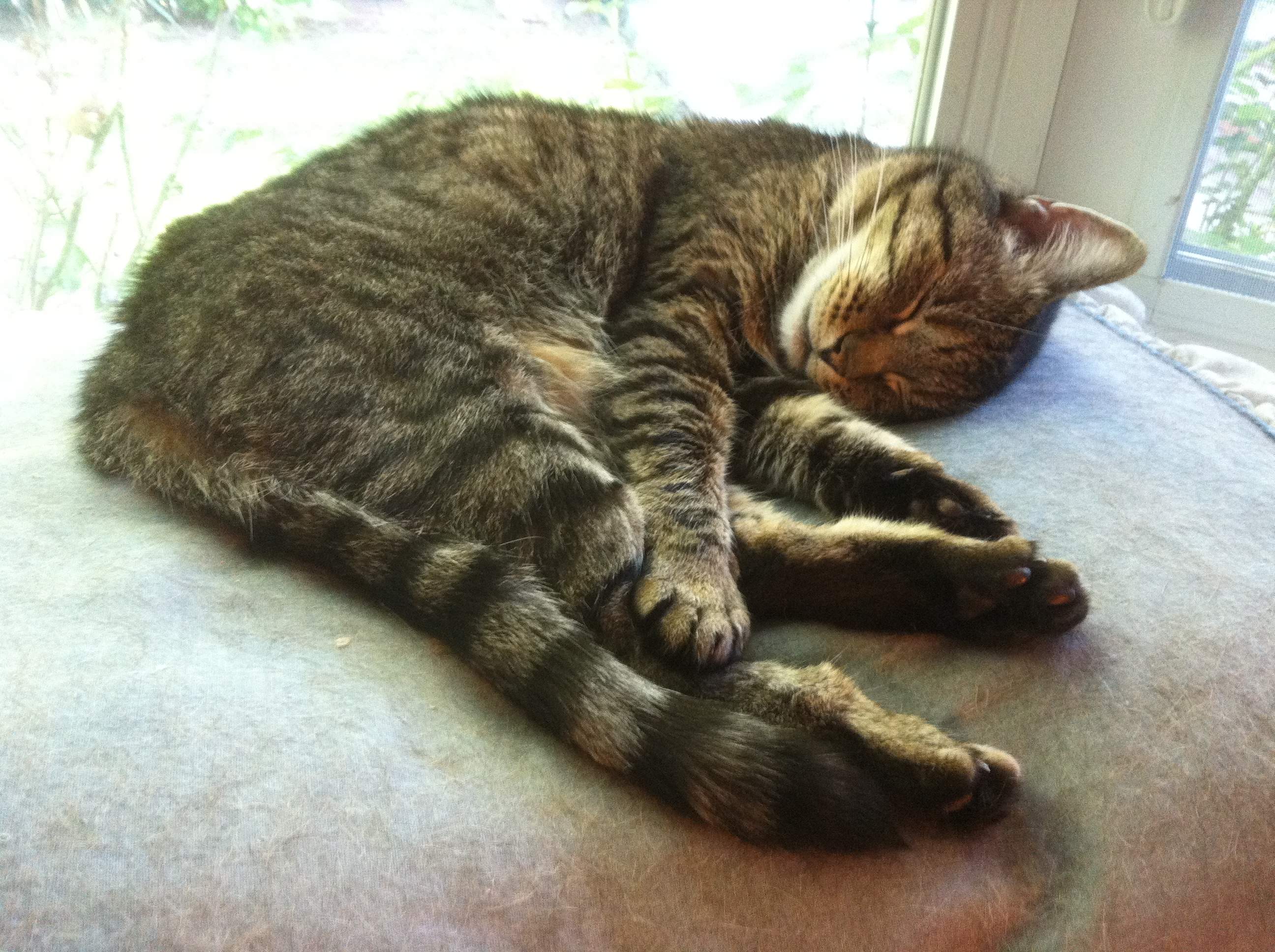
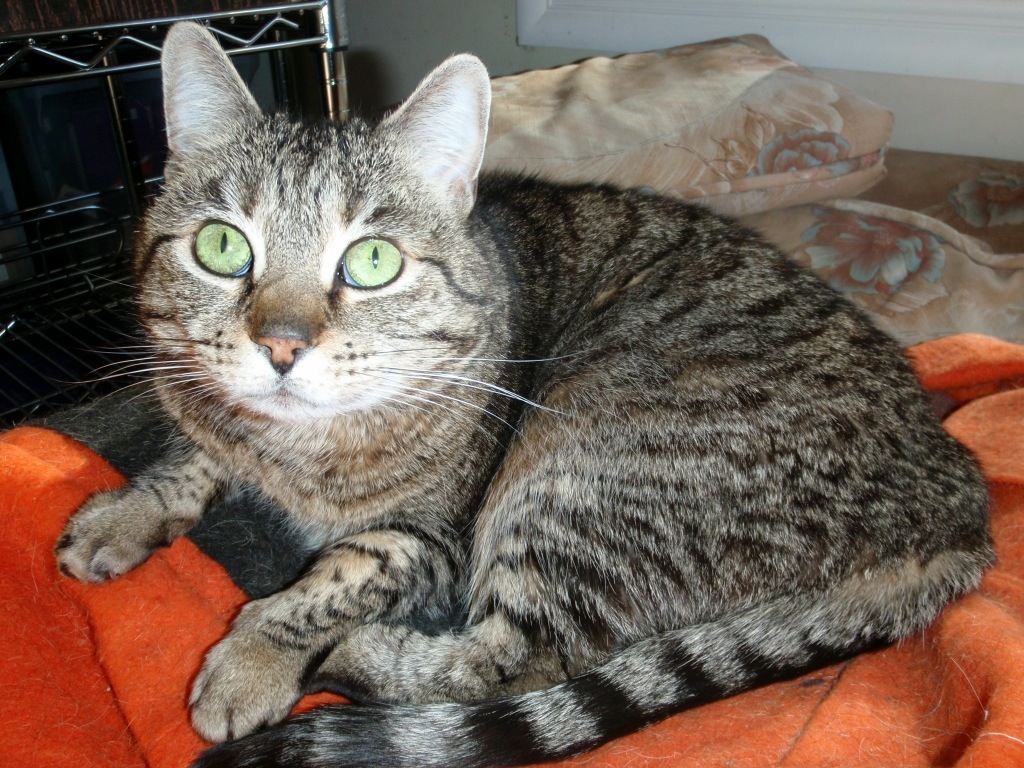
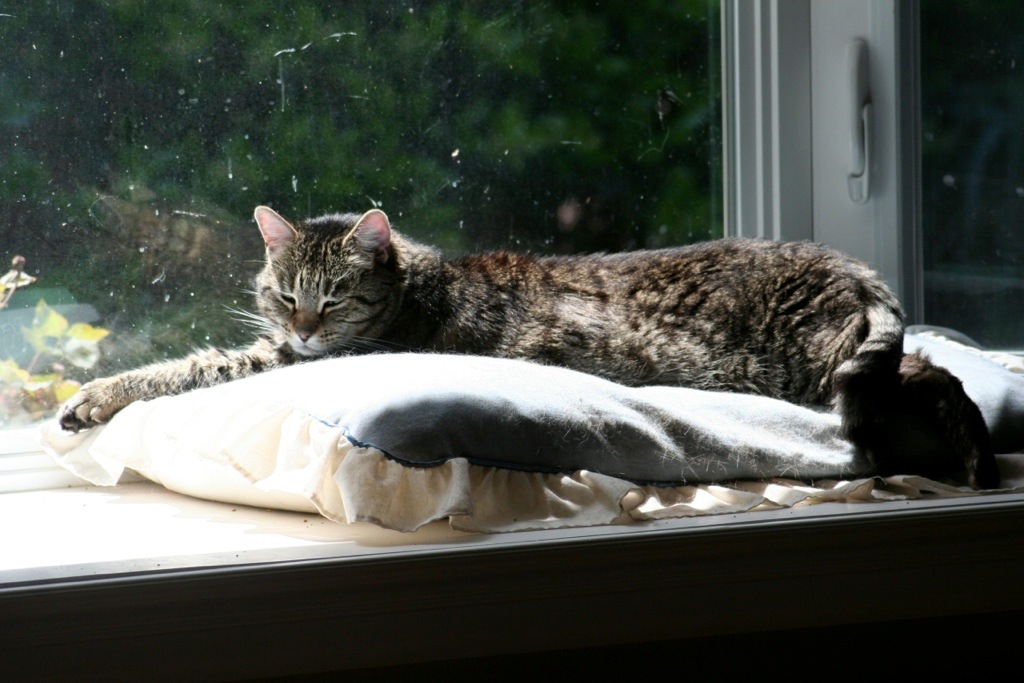
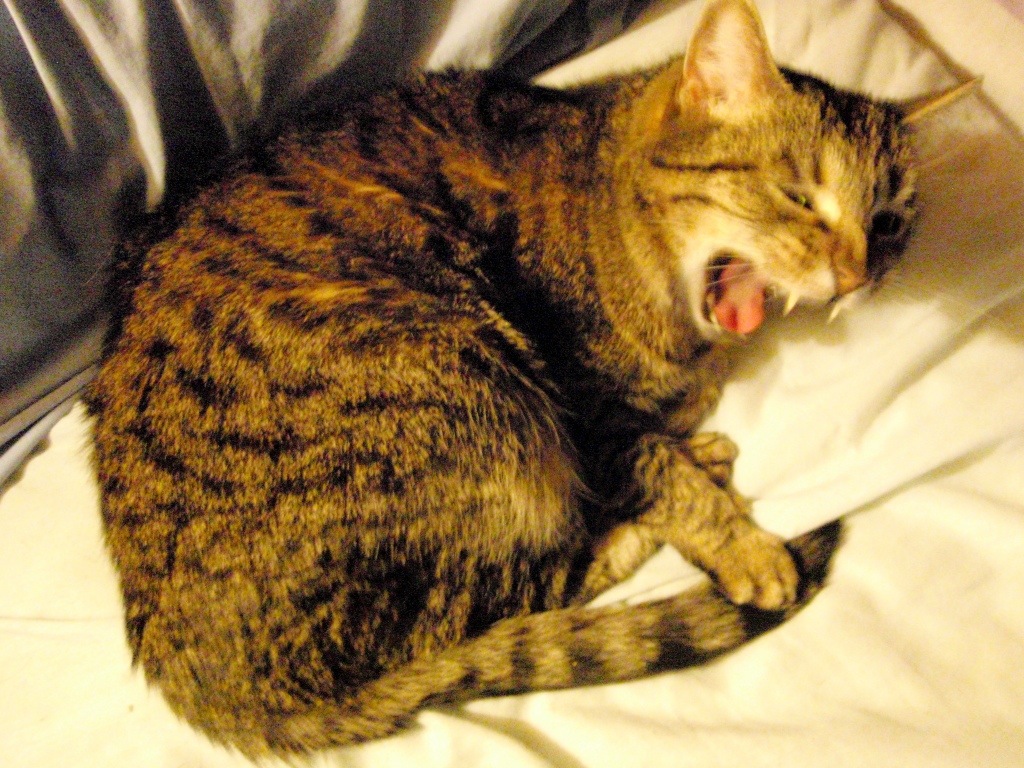
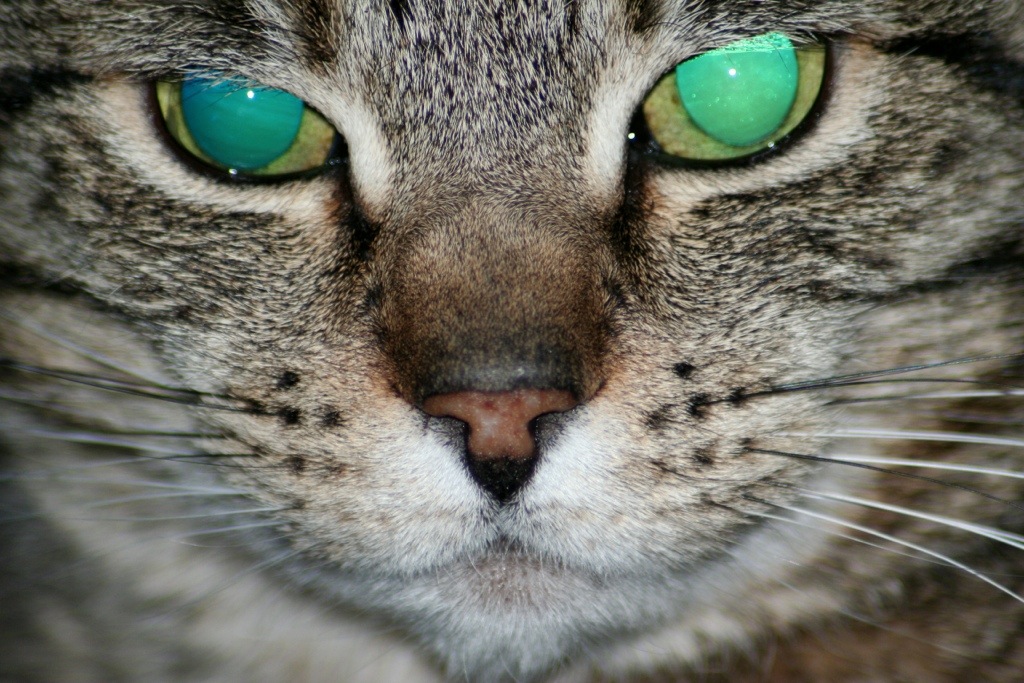
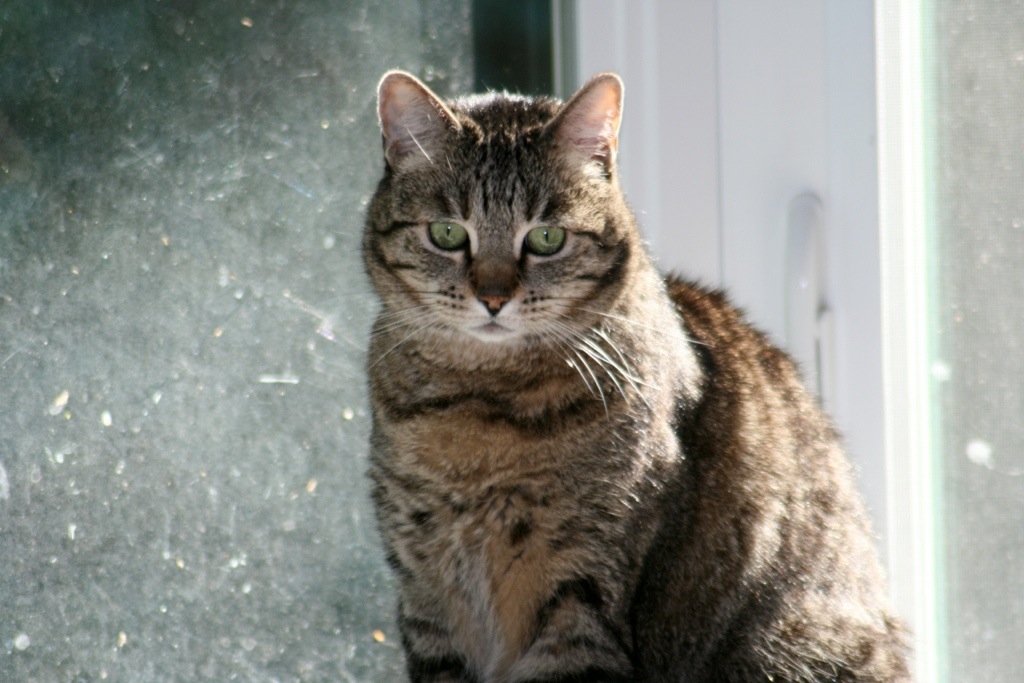
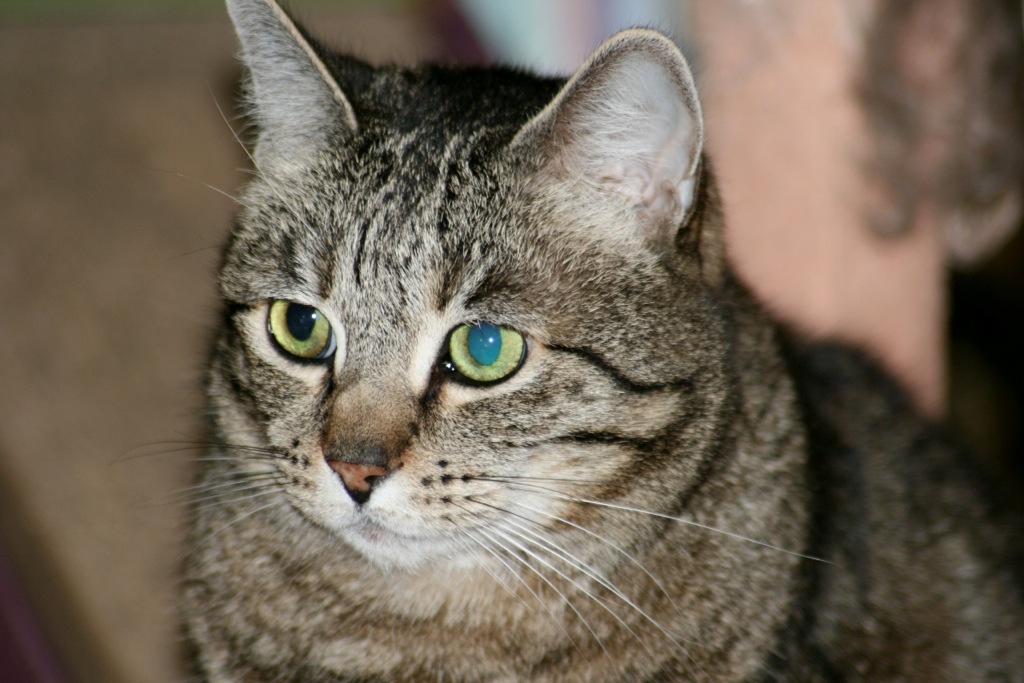
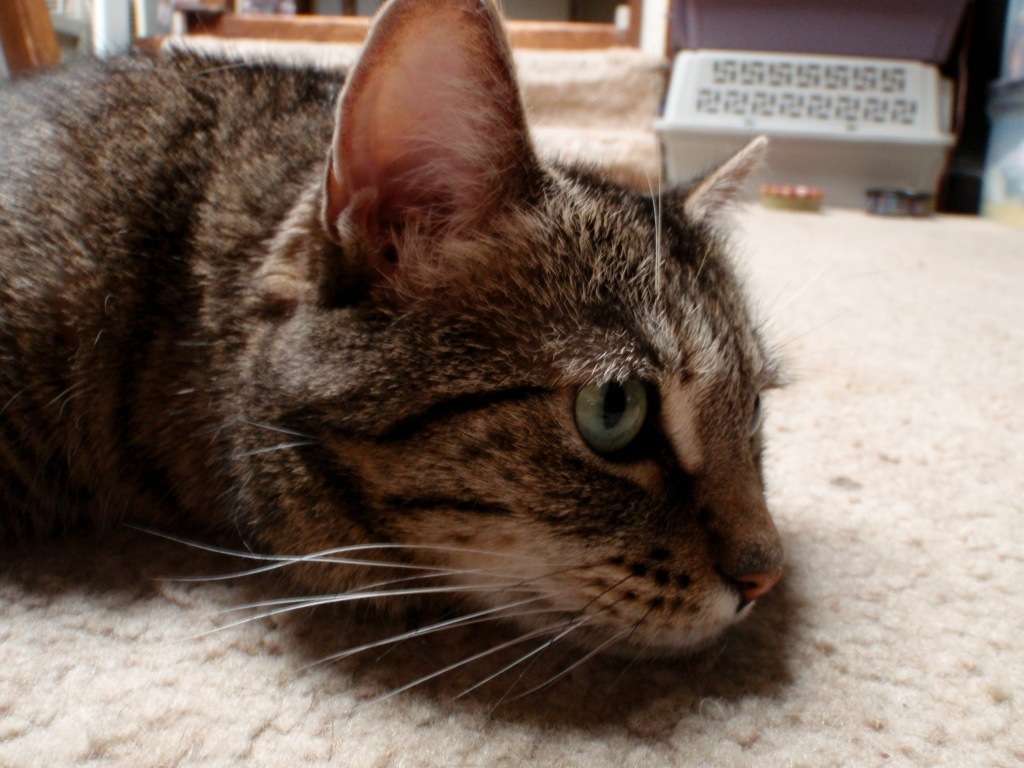
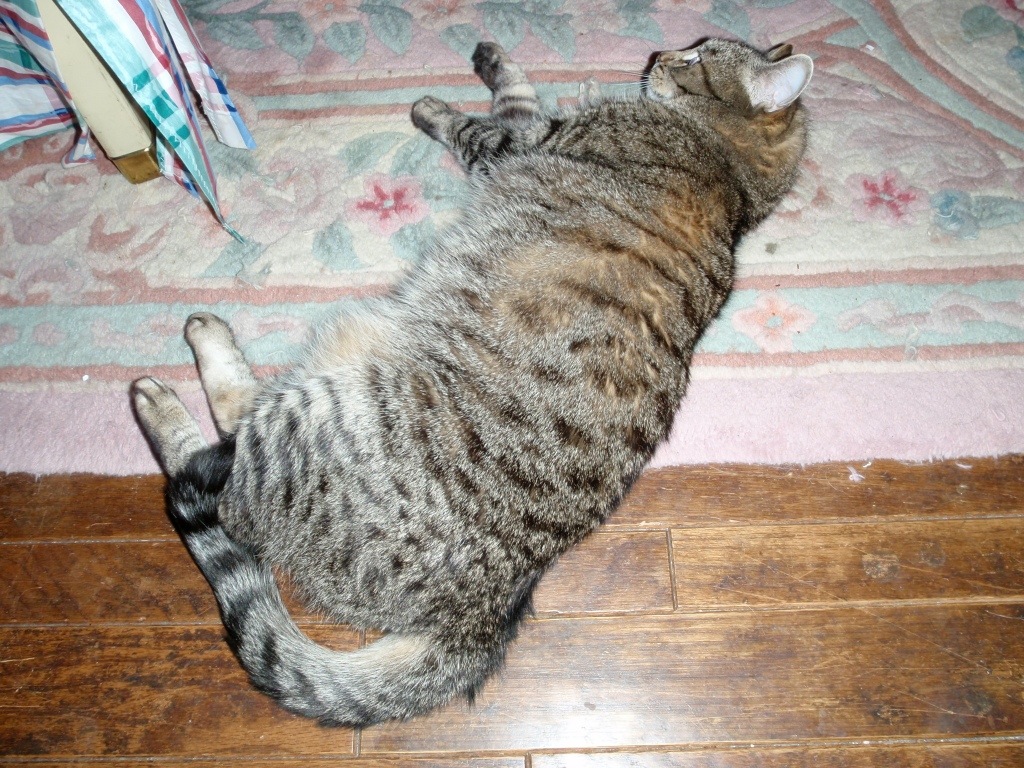
Joey Chan, the remaining domestic feline at Casa Willett, started having some disturbing symptoms in the last two weeks or so, initially showing up as an occasional diminished appetite. By the middle of last week it was getting serious, and by yesterday it was time to see the vet. The results were grave and it was pretty clear that Joey’s remaining time with us was short. Since our society treats our pets with compassion, we did what was necessary to make sure she passed on peacefully and painlessly.

I’m grateful that her medical problems only manifested themselves very recently and didn’t result in any prolonged problems or discomfort for her. She was almost fourteen years old and had a good life. She will very much be missed.

IMG_6844

IMG_6203 cropped

IMG_6201 cropped

004 small

IMG_4646

IMG_4645

photo 2

photo 1

IMG_0228_small

IMG_0225_small

Joey_small

004 small

20130703-212846.jpg

20130703-212256.jpg

20130703-211840.jpg

20130703-211501.jpg

20130703-211352.jpg

20130703-211248.jpg

20130703-211134.jpg

20130703-210903.jpg

20130511-211502.jpg

20130511-211651.jpg

20130429-201355.jpg


6 Comments

Filed under Cats, Family

NASA Social At NASA Armstrong (Palmdale – Part One)

For my third NASA Social, I was part of the national “all hands on deck” event for the “State Of NASA” speech by NASA Administrator Charlie Bolden. There were simultaneous events at ten NASA centers around the country. I went back to NASA Armstrong (posts for previous NASA Armstrong events here, here, here, here, here, here, and here), but this time instead of being at Edwards Air Force Base we were at their satellite facility at Palmdale Airport.
All of the NASA centers were connected for Administrator Bolden’s speech, while each of the ten NASA centers then had presentations which highlighted some of their specialties. For example, at NASA Stennis in Mississippi, they showed off their facilities for testing rocket engines. At NASA Johnson in Houston, they highlighted the International Space Station mock-ups and training facilities. Locally here, at NASA JPL the attendees learned about the various “icy bodies” spacecraft, including Dawn which is approaching Ceres, and New Horizons which will fly by Pluto later this year.

2015-02-03 iPhone6 1855 (small)

At NASA Armstrong, first of all it was great to see friends that I’ve made at previous NASA Socials. Running the NASA Socials at NASA Armstrong are Kate Squires (in red) and Kevin Rohrer (on right, talking to Kate). They did a fantastic job!

Being on the west coast, we were three hours behind all of the east coast Socials. We had a few introductory comments, all got attached to the wi-fi and started charging our mobile devices (there is no such thing as too many charging opportunities at a NASA Social), introduced ourselves, then watched Administrator Bolden’s speech from Florida.

IMG_3272 (small)

Following the national speech, NASA Armstrong Director David McBride gave us a review of the budget data specific to what’s happening at NASA Armstrong. If you’re interested, you can download a PDF of his slides here.

The rest of the day was full of a whole slew of presentations and tours to see flying hardware up close and personal. In picking and preparing pictures for this article I see that there are too many for one post, so I’ll post the second part on Friday. (Tomorrow and Thursday are already committed to other posts.)

In addition, I’ll remind everyone again that I was Tweeting like crazy (my thumbs were on fire!) with even more pictures, wisdom, and insight delivered in 140 characters or less. You can either see that over in the sidebar on the right (if you’re on a desktop browser) or you can find me on Twitter as “@momdude56”.

Today, I’ll talk about the unquestioned star of the show — SOFIA, the Stratospheric Observatory For Infrared Astronomy.

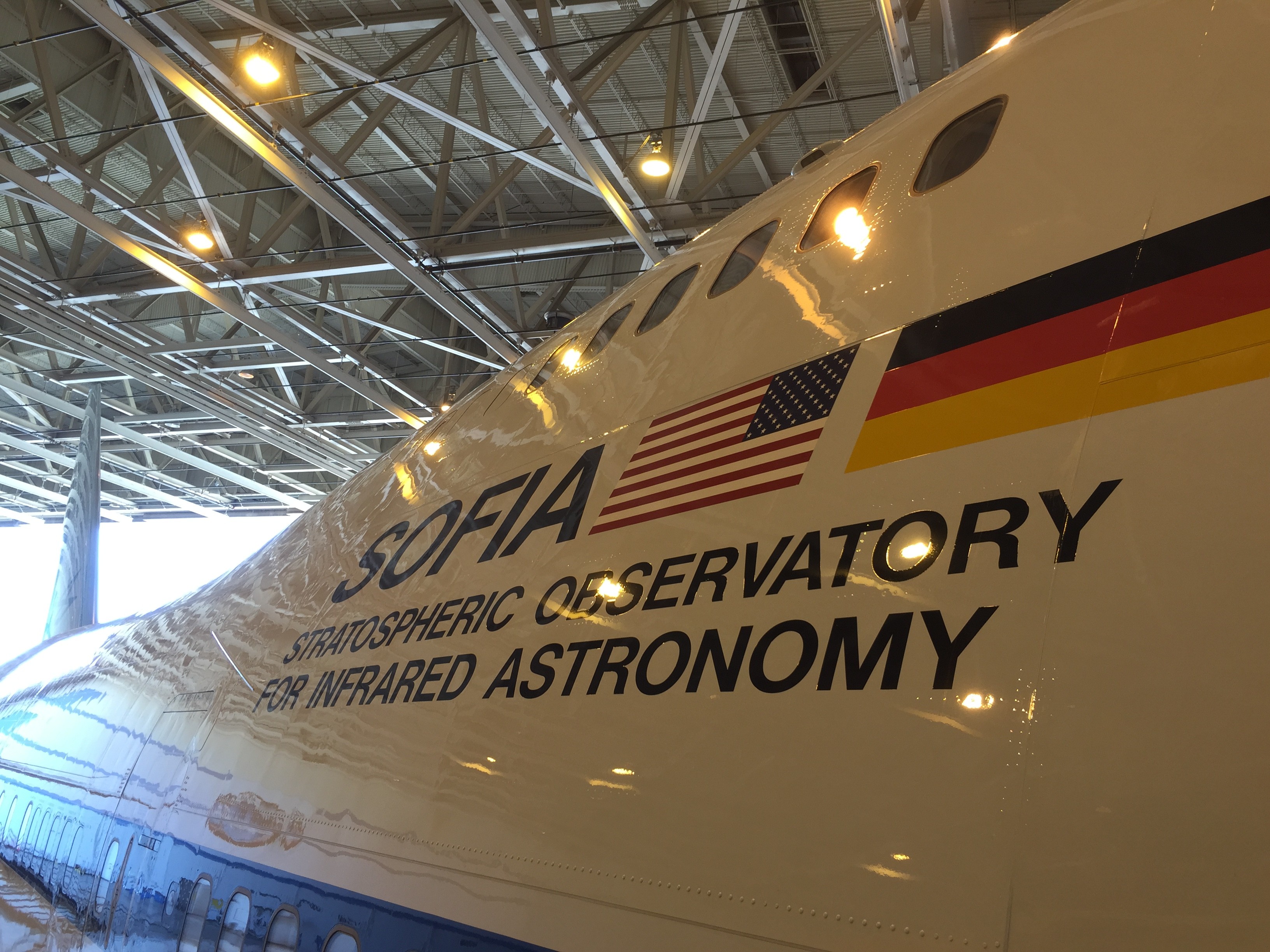
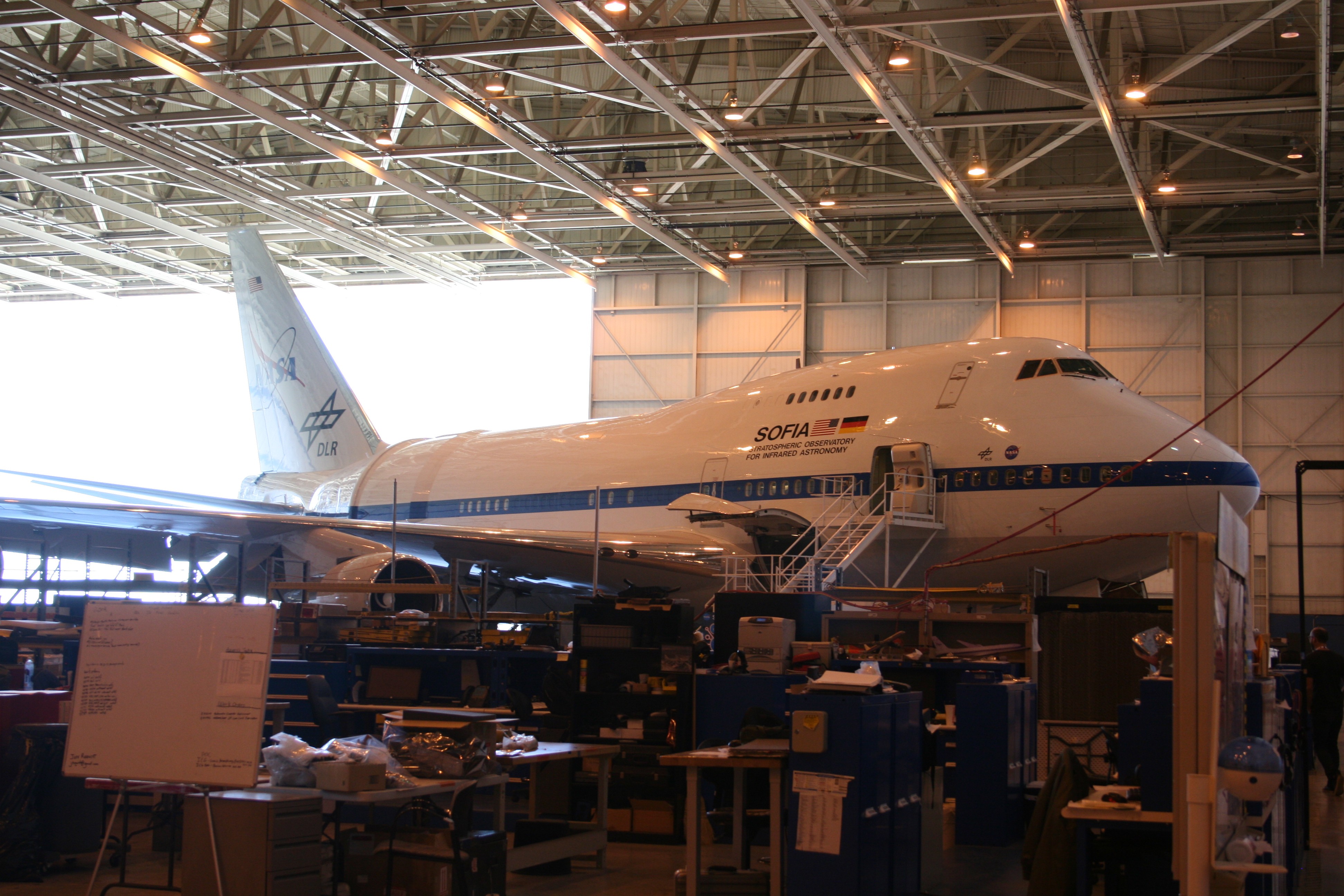
IMG_3283 (small)There she is! A heavily modified 747-SP, operated in cooperation with the German Aerospace Center (DLR – Deutsches Zentrum für Luft- und Raumfahrt). In fact, she just got back to the US and resumed astronomical observations in the last month or so after an extensive period of maintenance and upgrades performed in Germany.

The concept is simple on paper. You can see many different things in astronomy by looking at the sky in different wavelengths than visible light. Radio telescopes, X-ray telescopes, gamma ray telescopes, infrared telescopes — they all see a different sky by looking in different parts of the electromagnetic spectrum. Combining all of those different views lets us know far more about the universe than by simply looking in the visible spectrum, which is a tiny portion of the entire spectrum.

The problem with infrared astronomy (and others listed) is that some types of light are absorbed by our atmosphere. The light we’re looking for simply doesn’t make it to the ground. In the case of infrared radiation, it’s absorbed by the water vapor in the atmosphere.

If you could get above that water vapor, you could see the infrared radiation. Outer space is ideal since it’s above 100% of the water vapor, but it’s hard to get there, expensive, and once you’re there you can’t fix or upgrade things. But what if you could get above 99% of the water vapor? Say, by flying at 40,000 feet or so. Then you could also upgrade and change and repair things as needed every time the plane lands.

IMG_3300 (small)

Thus was SOFIA born. See that bulge in the body just ahead of the aircraft tail? That bulge contains a huge roll-up door that can open when the plane’s flying at altitude. Why would any sane person want to open a huge door in the side of a 747 at 40,000 feet? In order to expose the 2.5 meter, 19-ton high-precision infrared telescope that’s sitting in there, of course!

2015-02-03 iPhone6 1889 (small)

Here we’re getting a rundown on how SOFIA was modified. (I’m sorry, I didn’t catch the name of our presenter – perhaps Kate Squires will read this and drop the information into the comments? Hi, Kate!)

One of the critical side effects of opening a gaping hole in the side of an airplane at 40,000 feet is that anyone inside would be sucked out to a horrible, terrifying fall to their death. Scientists and engineers (as well as OSHA and NASA) frown upon such situations, so just forward of the telescope is a pressure bulkhead, allowing everyone on board to comfortably (and safely) run the telescope and collect their data.

2015-02-03 iPhone6 1915 (small)

Then we got to not just ogle SOFIA from the outside, but to go inside and see how she works in detail.

IMG_3326 (small)

While the seats are comfy, first-class sized seats (the typical size of the crew for a flight is only forty or so), there’s no in-flight entertainment other than what you bring yourself. Despite my enthusiasm for the idea of flying in SOFIA, I’m told that the technicians, engineers, and scientists are busy gathering data, it’s night, it’s a long flight (typically most of the night), and if you’re not doing something, it can be pretty boring. (I would love to have the chance to judge that for myself!)

IMG_3327 (small)

Up front, the passengers share space with banks of computers and data collection hardware. A good night of observing can generate many terabytes of data.

2015-02-03 iPhone6 1896 (small)

In back, you get all of the consoles that control the telescope once SOFIA’s on station and at altitude.

You might ask yourself (correctly) how you can keep a telescope pointed accurately at a star while in a plane. We’ve all been in planes, and even on a calm flight there’s a bit of rocking and rolling, minor turbulence, bumps and jiggles. Yet SOFIA is accurate to one-half of an arc-second. (That’s the size of a nickle seen at a distance of five miles.) How can that be?

Well, the telescope optics, despite weighing 19 tons, float freely, independent of the plane. They float on a bed of oil and then there are servos and motors that detect the motion of the plane and instantly move the telescope in the opposite direction. The plane bounces around as it flies, but the telescope stays locked on its target like a laser.

The result of this (I’m told) is that the telescope is a wonder to watch when you’re flying. To you, bouncing along with the plane, it looks like the telescope is twitching and shaking constantly. But that’s relative. In reality, you’re twitching and shaking, the telescope is rock solid in staring at its target.

2015-02-03 iPhone6 1907 (small)

So what does this wonder look like? Like a dream!

Here you can see the pressure bulkhead, with the back end of the telescope (the blue part) sticking out into the cabin. On the other side, the one-hundred inch diameter mirror (okay, 2.5 meters) is in its framework, with a series of mirrors that take the light gathered and send it into the centerline of back end here.

2015-02-03 iPhone6 1902 (small)

Up close, you can see several instruments being run by Cornell University attached. There are six different instruments that can be attached, with dozens of combinations.

In addition, around the rim you can see blue plates that are bolted on. These balance the telescope and are changed as instruments are changed. When balanced, despite weighing 19 tons, the telescope can easily be moved by hand.


So, yeah, you may have noticed that I thought that seeing SOFIA was pretty great. (That would be completely accurate.)

But wait, there’s more! On Friday I’ll have more pictures and information on seven other programs we heard about, some of which have the potential to be even more spectacular than SOFIA in ten to twenty years. Remember, “aeronautics” is “The First A In NASA,” and that’s what NASA Armstrong does.

Leave a comment

Filed under Astronomy, Flying, Photography, Space, Writing

Panorama: SOFIA

What a great day at my third NASA Social!

What a long day that leaves me wanting to flop face-down into my keyboard!

Tomorrow you will no doubt be inundated with me sharing what I learned at NASA Armstrong today. If you want a preview, there’s a list of my tweets & pictures from the day in the sidebar on the right-hand side of the screen. (If you’re reading this on the website using a desktop computer and not in an email or on a mobile device. It’s complicated.)

In the meantime, I have I mentioned how much I like the “panorama” function on the iPhone 6 and how it’s fast and easy and the pictures can be shared and emailed immediately, a fair trad off for the fact that they’re slightly less robust than panoramas stitched together from a series of megapixel DSLR photos? (Why, yes! Yes, I have!)

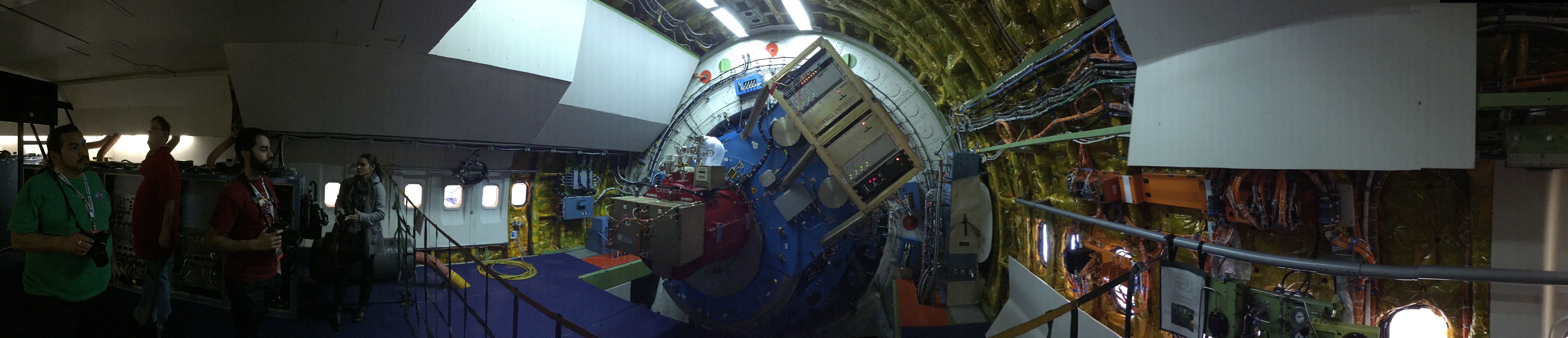
This is the interior of SOFIA, the Stratospheric Observatory For Infrared Astronomy. So, so, so, so über cool!

IMG_7133

Tomorrow, much, much more!

1 Comment

Filed under Astronomy, Flying, Panorama, Photography, Space

NASA Social Follow-Up (For Dec 03 2014)

Summary:

  1. I’m going to my third NASA Social, tomorrow, February 2nd (I’m really looking forward to it, it’s a big deal for me).
  2. Last November I spent two days at NASA Armstrong (here and here) for my first NASA Social.
  3. In December at JPL, I had the privilege of attend my second NASA Social.
  4. The posts accompanying those events had lots of my Tweets and cell phone pictures, but the better quality pictures were promised for “later.” Now it’s later!
  5. Friday I posted the DSLR hi-res pictures from November 18th, the first day at NASA Armstrong, and yesterday I posted the November 19th pictures from NASA Armstrong.
  6. Tonight, the hi-res pictures from the December 3rd NASA Social at JPL for the first Orion launch (which actually didn’t get off until December 5th). As I did yesterday, I’ll try not to repeat too much of the material already in the original post.

IMG_2695 (small)

The talks we saw were held in Von Karman Auditorium. This is a neat place to be, in that there have been many, many historic press conferences held here as JPL sent spacecraft past Jupiter, Saturn, Uranus, Neptune, Venus, Mercury, landed on Mars, landed on Titan, landed on Mars again and again and again and again…

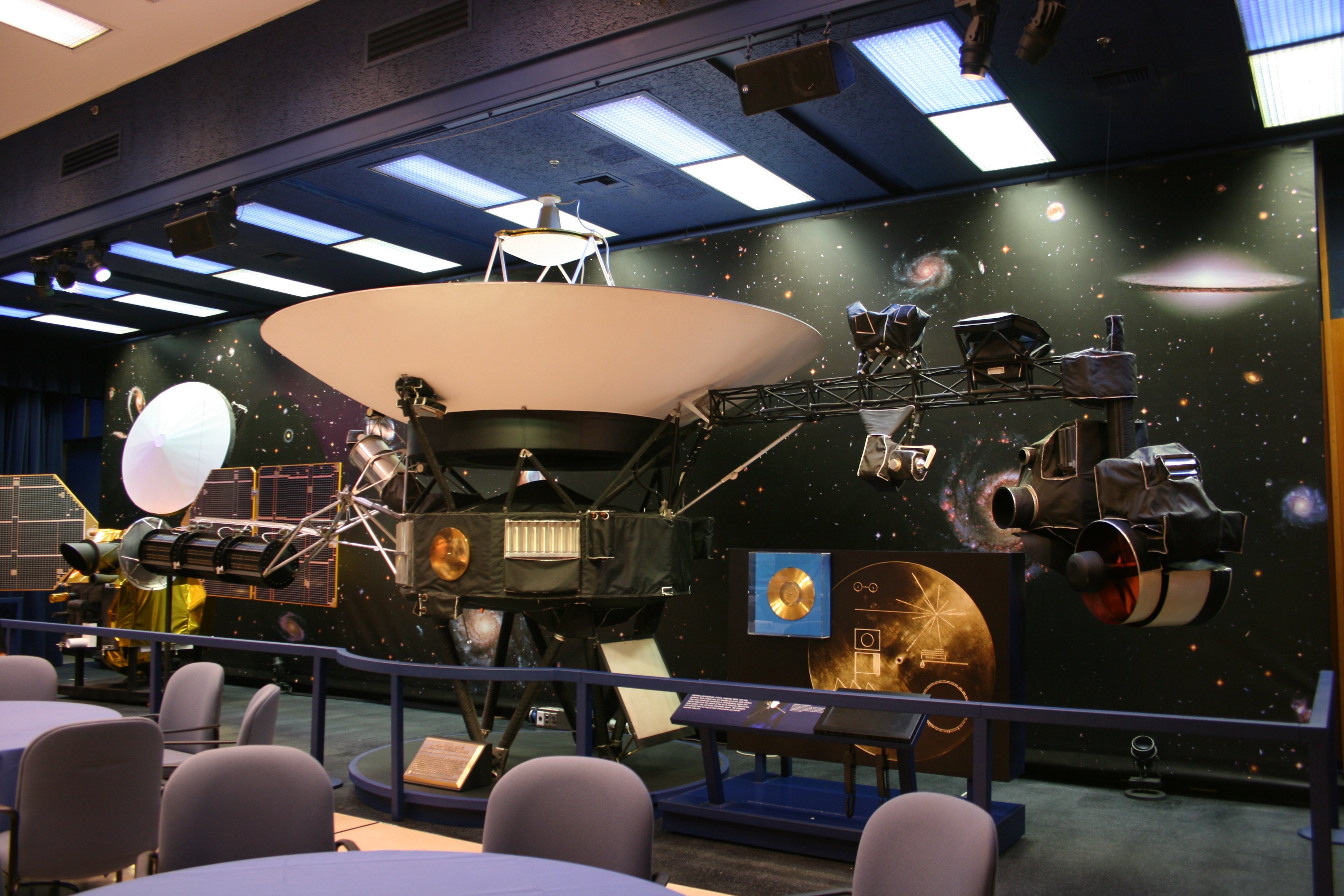
This is a full-sized model of the Voyager spacecraft, both of which have now left the solar system and are the first artifacts created by humans to enter interstellar space.

IMG_2699 (small)

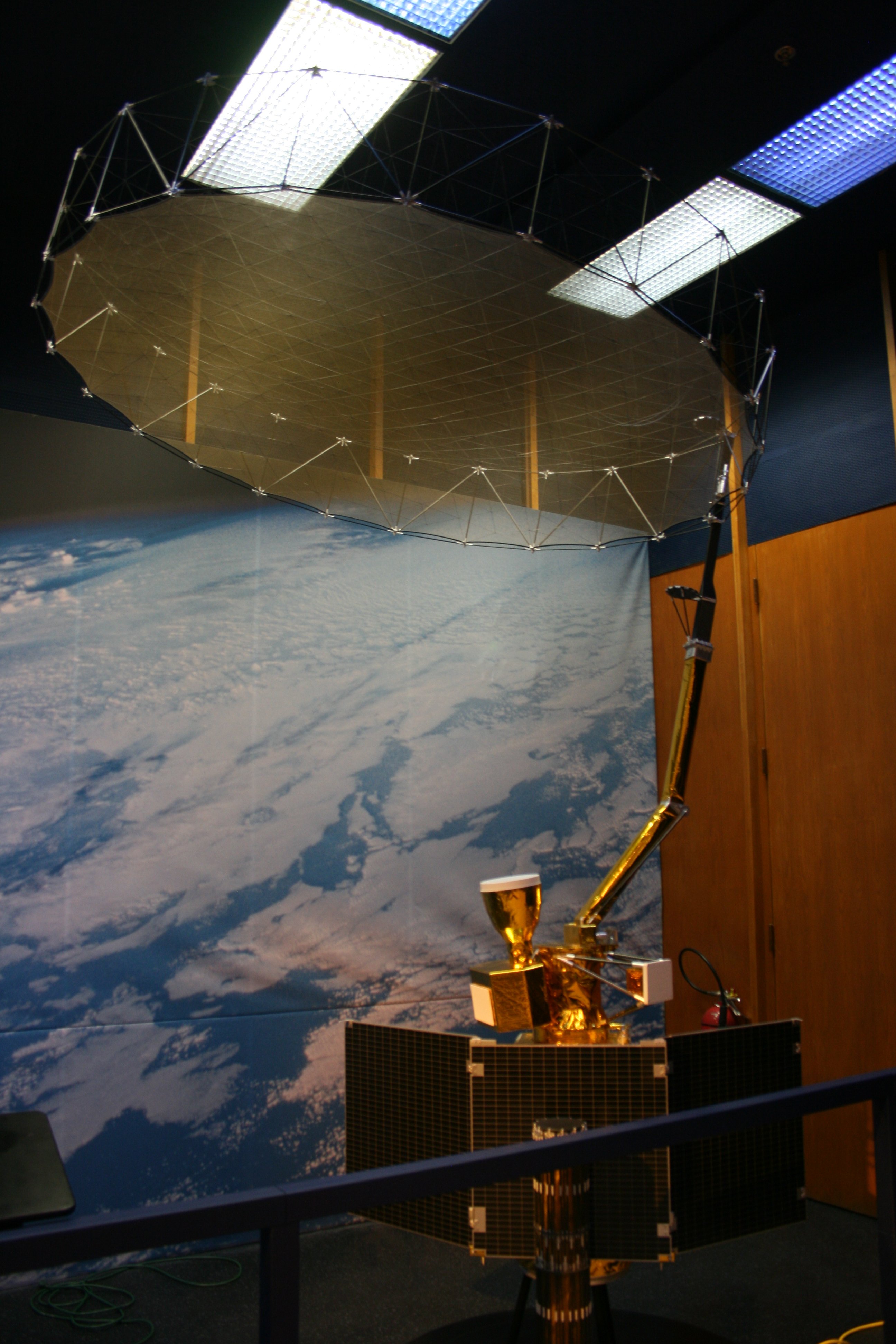
This is a (half?) scale model of the SMAP (Soil Moisture Active/Passive) spacecraft that launched earlier this week from Vandenburg Air Force Base in central California. The antenna on top launches in a folded up configuration (the model of the folded antenna is the tube on the floor in front of the middle solar panel) and then opens up after reaching orbit. SMAP will be used to get global readings on whether the soil is frozen or thawed (critical data relating to methane release from the Arctic regions as the area warms) and to measure how much moisture is in the soil (critical to improving long-term weather forecasts).

IMG_2705 (small)

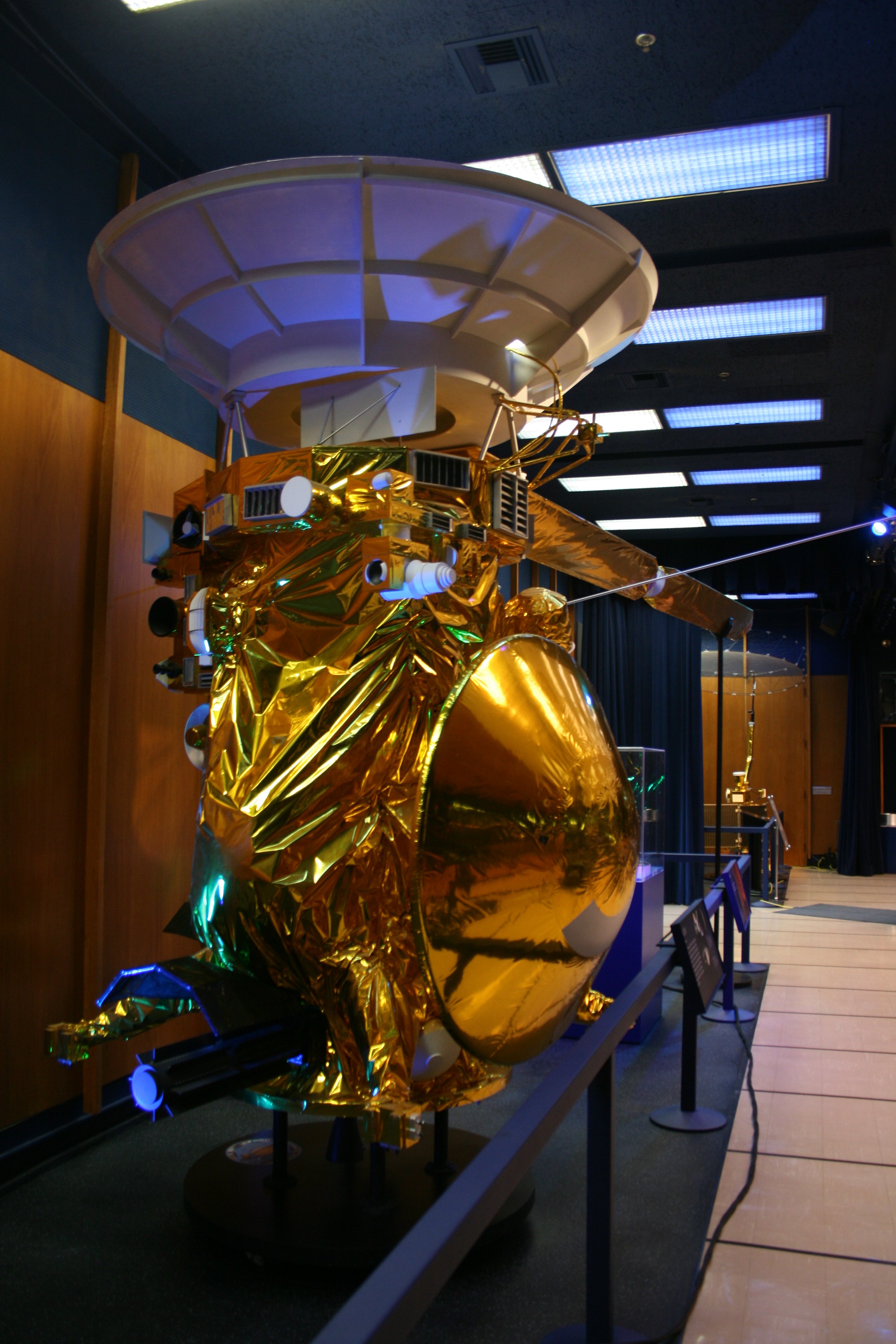
On the other side of Von Karman Auditorium is a half-scale model of the Cassini spacecraft, with the shield-like Huygens probe attached. Cassini has been orbiting Saturn and returning a massive number of pictures for over ten years, while Huygens was dropped into the atmosphere of Titan, Saturn’s largest moon, where it parachuted down and landed, sending pictures and data from the surface. (That landing video, as well as this one, are spectacular!)

IMG_2711 (small)

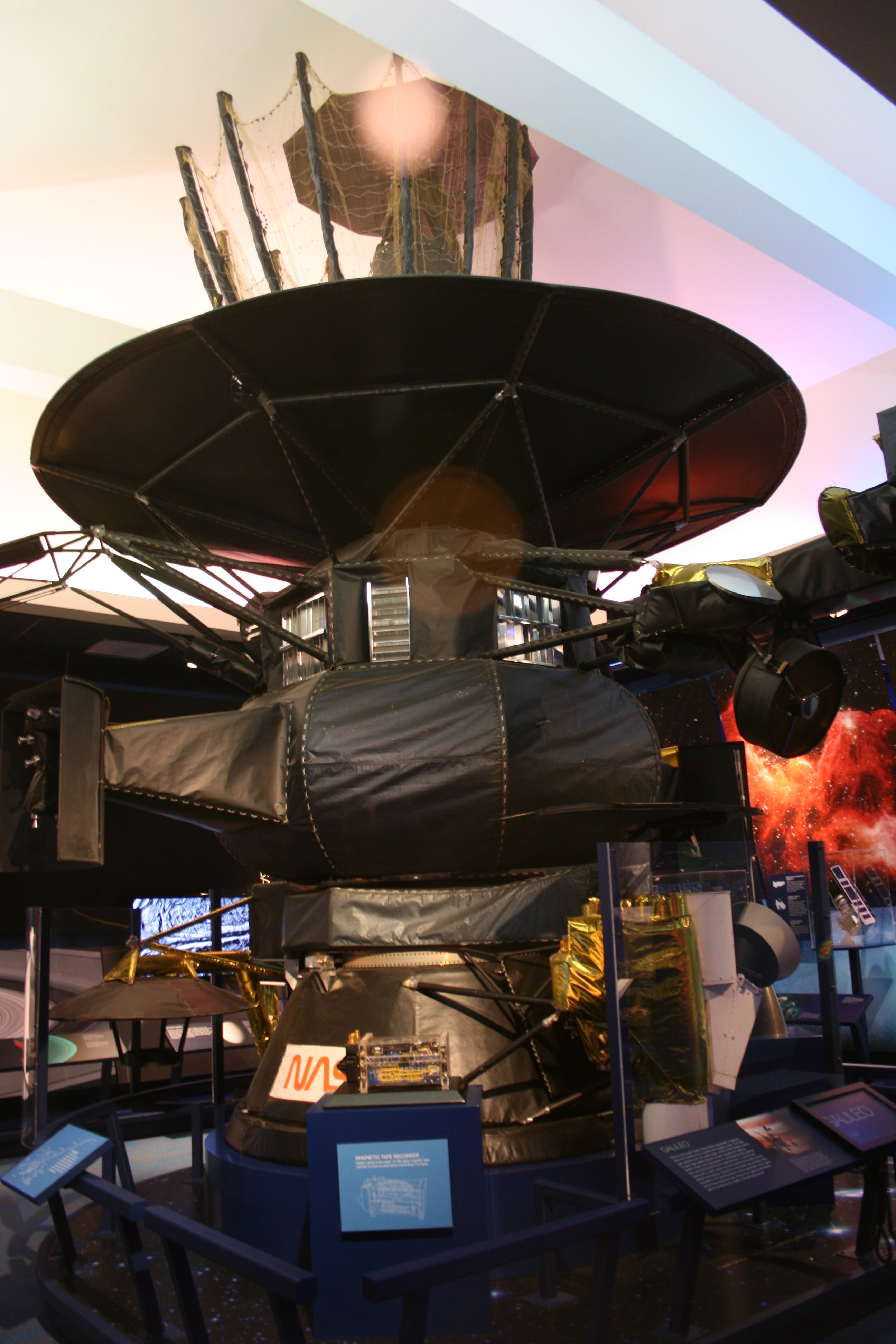
In the JPL visitor’s center next to Von Karman Auditorium are many other spacecraft models, pictures, and information on JPL planetary exploration missions over the past fifty years. This is a full-sized model of the Galileo spacecraft that was launched from the Space Shuttle toward Jupiter. The model is accurate to the point where it shows the primary antenna on top in the partially deployed condition that it got stuck in, seriously decreasing the rate at which data and pictures could be sent back to Earth. Despite that, all of our best knowledge to date about Jupiter and its moons come from Galileo and the work that the JPL engineers did to work around that antenna problem as best they could, performing minor miracles in the process.

IMG_2720 (small)

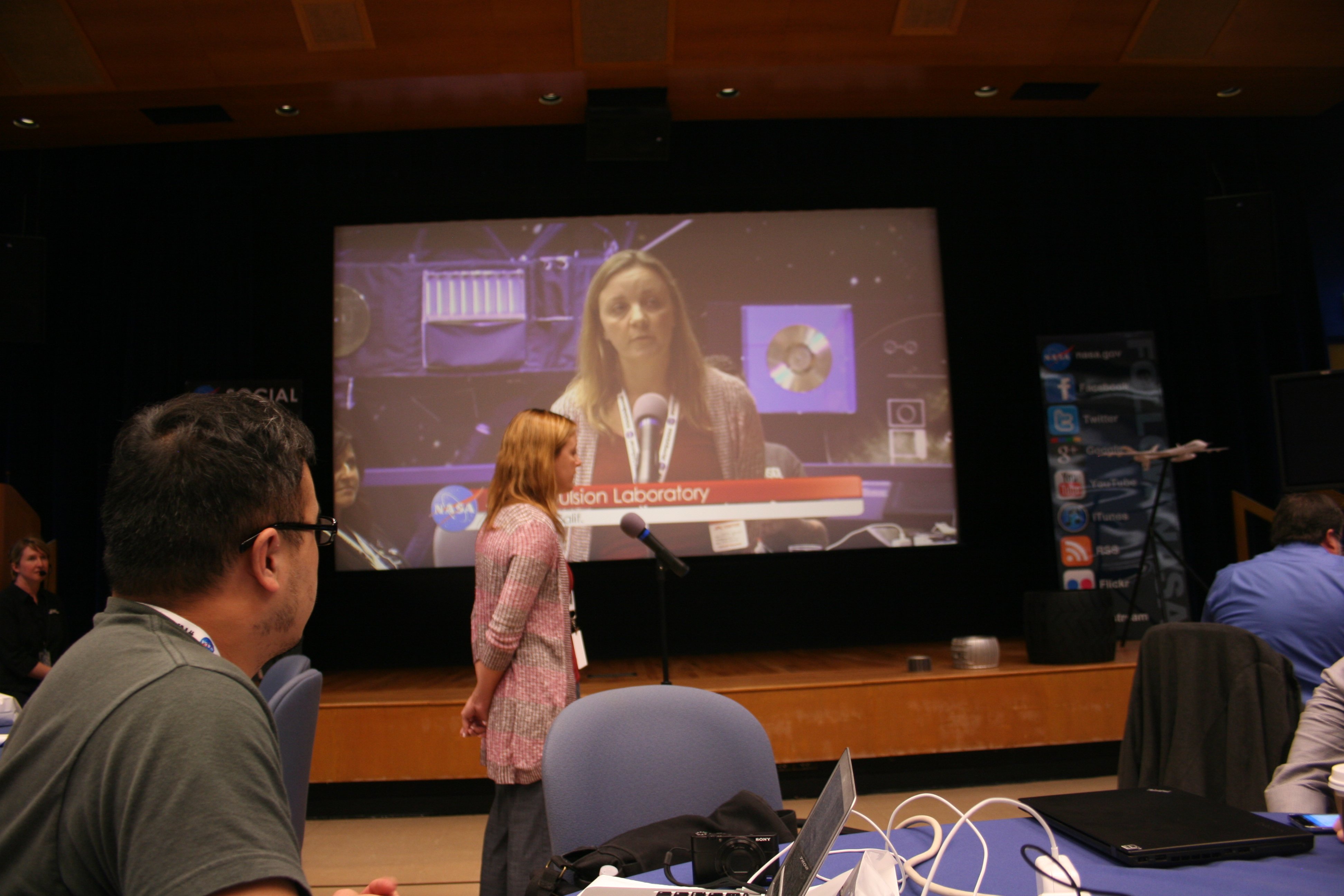
During the event there was a long session televised on NASA-TV, originating from Kennedy Space Center in Florida, but also taking questions from the other centers which were having simultaneous NASA Social events, such as JPL.

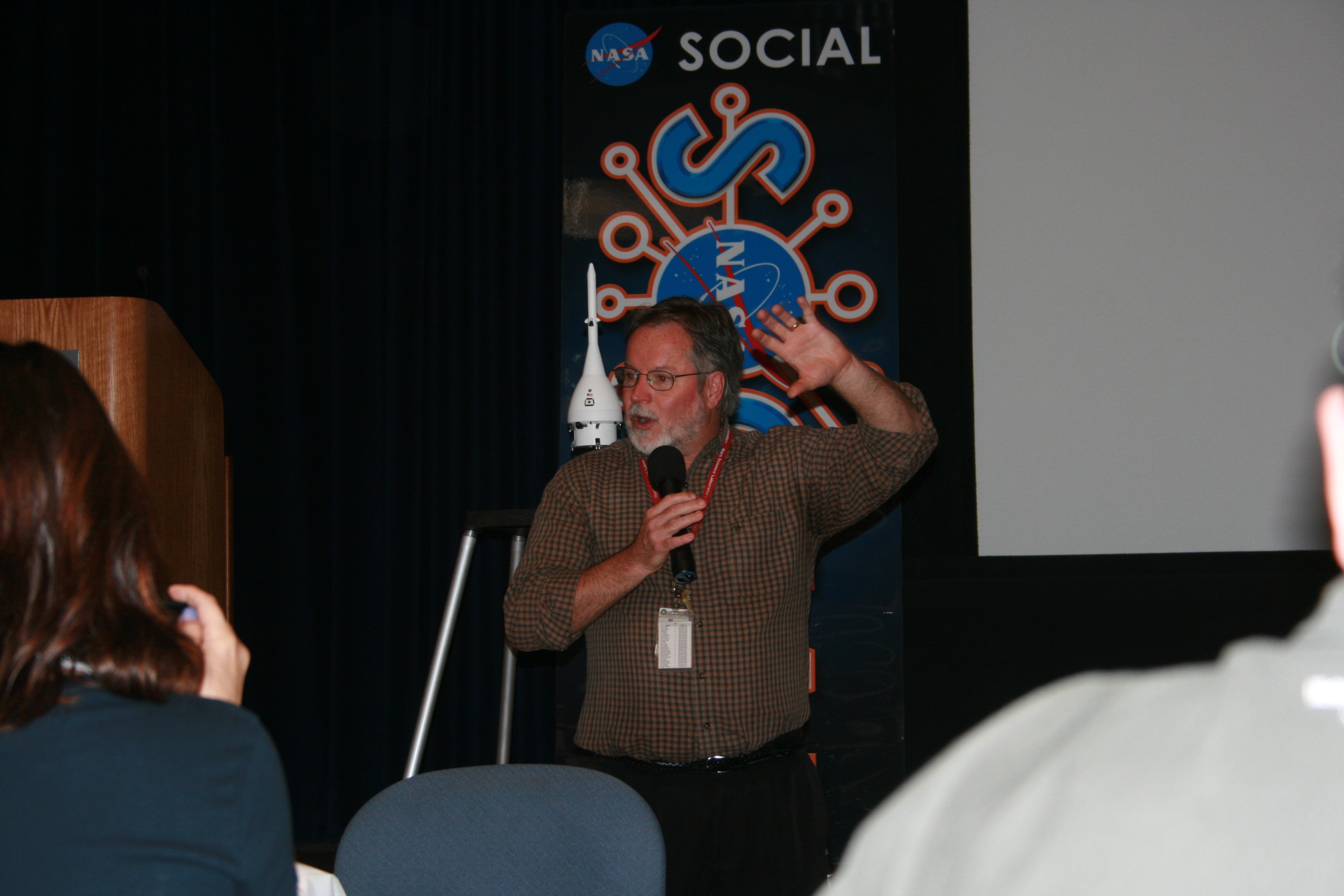
IMG_2723 (small)

An unexpected surprise was an impromptu talk by Rob Manning who is currently the Chief Engineer of the LDSD project at JPL (see below) and was formerly the Chief Engineer on the Mars Science Laboratory (aka, “Curiosity”) which successfully landed on Mars and has now been climbing Mt. Sharp there for over two years.

When it comes to putting spacecraft on other planets and successfully doing what was previously thought to be impossible, the engineers and scientists at JPL are truly giants in the field, and “rock stars” to us space geeks and nerds. Rob Manning is one of those rock stars and it was a real treat to get to talk to him.

IMG_2743 (small)

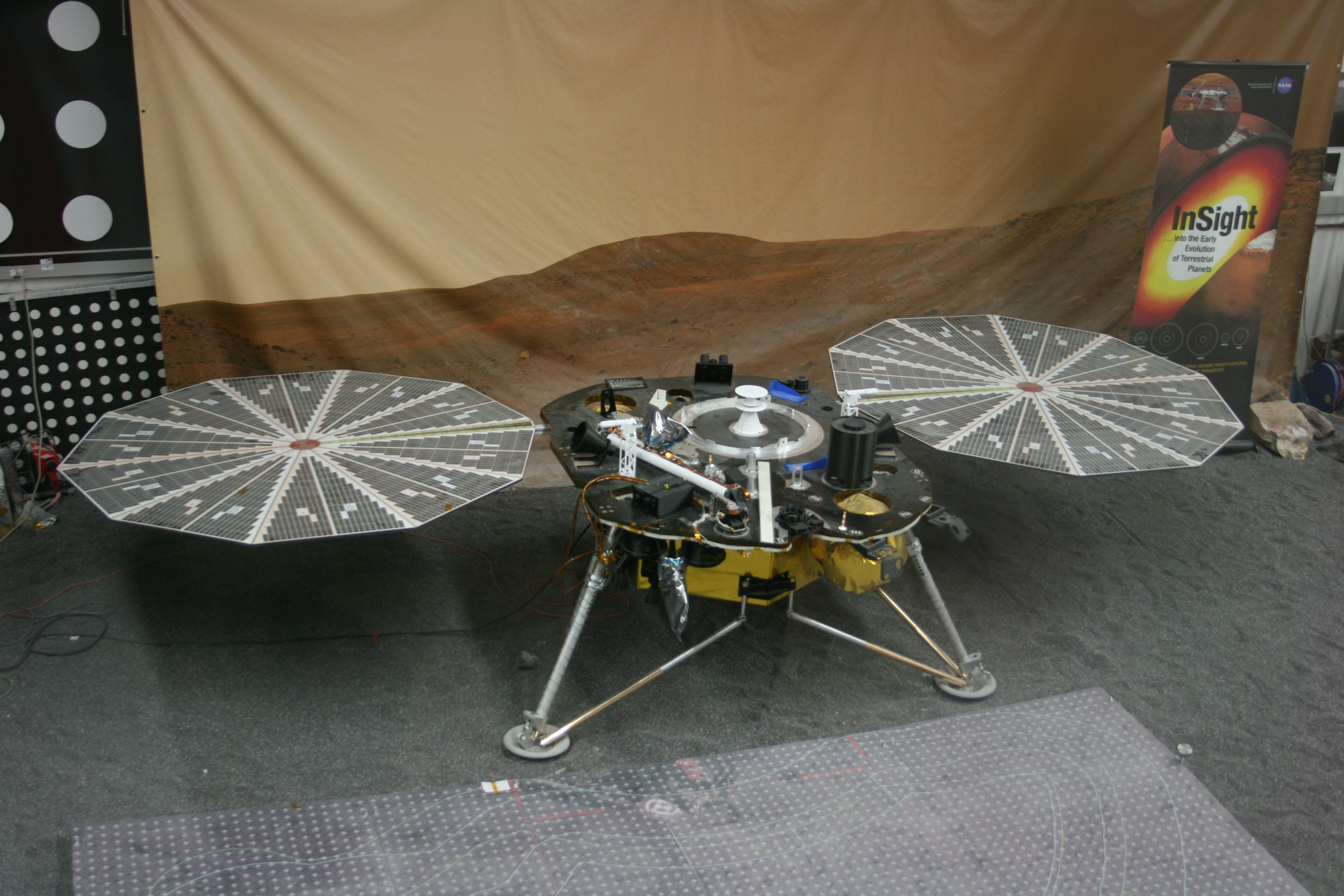
Once we got out of Von Karman (and into the rain) we saw several projects that are in the process of being built and tested. We got a talk by Deputy Project Manager Jennifer Trosper, another Mars rover exploration “rock star,” about both the current Mars Exploration Rovers (Spirit and Opportunity) and the Mars Science Laboratory (Curiosity). We also saw an engineering model of the InSight lander which will be launched in March 2016 to land on Mars and study the deep interior of Mars. A lander, not a rover, here you can see the grid laid out in front of the spacecraft as they test the arm to see where it can reach and to calibrate the mechanics of that motion.

IMG_2747 (small)

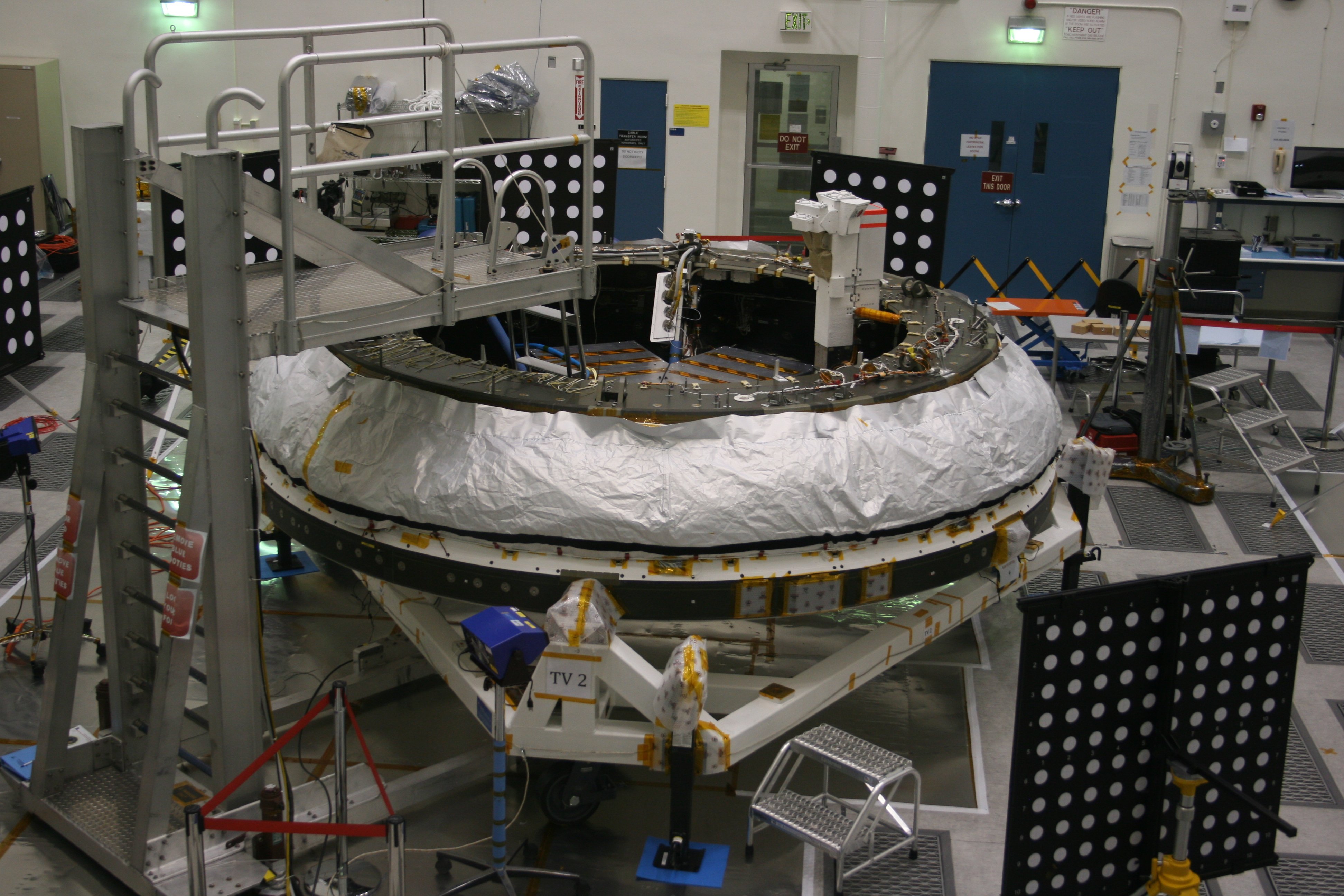
This is the next Low Density Supersonic Decelerator (LDSD) test vehicle which is being prepared for a launch and test later this year. Last year’s first LDSD test off the coast of Hawaii validated the concept and gathered vital data, but it also shredded the parachute immediately, which was highly unexpected. That’s okay, that’s how you learn in this business. If you’re not breaking things, you’re not trying hard enough.

IMG_2752 (small)

Finally, a completely unexpected surprise and more über-squeeing moments for me. First of all, the room we’re sitting in is the primary control room, the room you see in the videos of the JPL engineers and scientists celebrating wildly when a spacecraft lands on Mars or otherwise succeeds. (Like this one from when Curiosity landed, that whole “seven minutes of terror” experience.) THAT room.

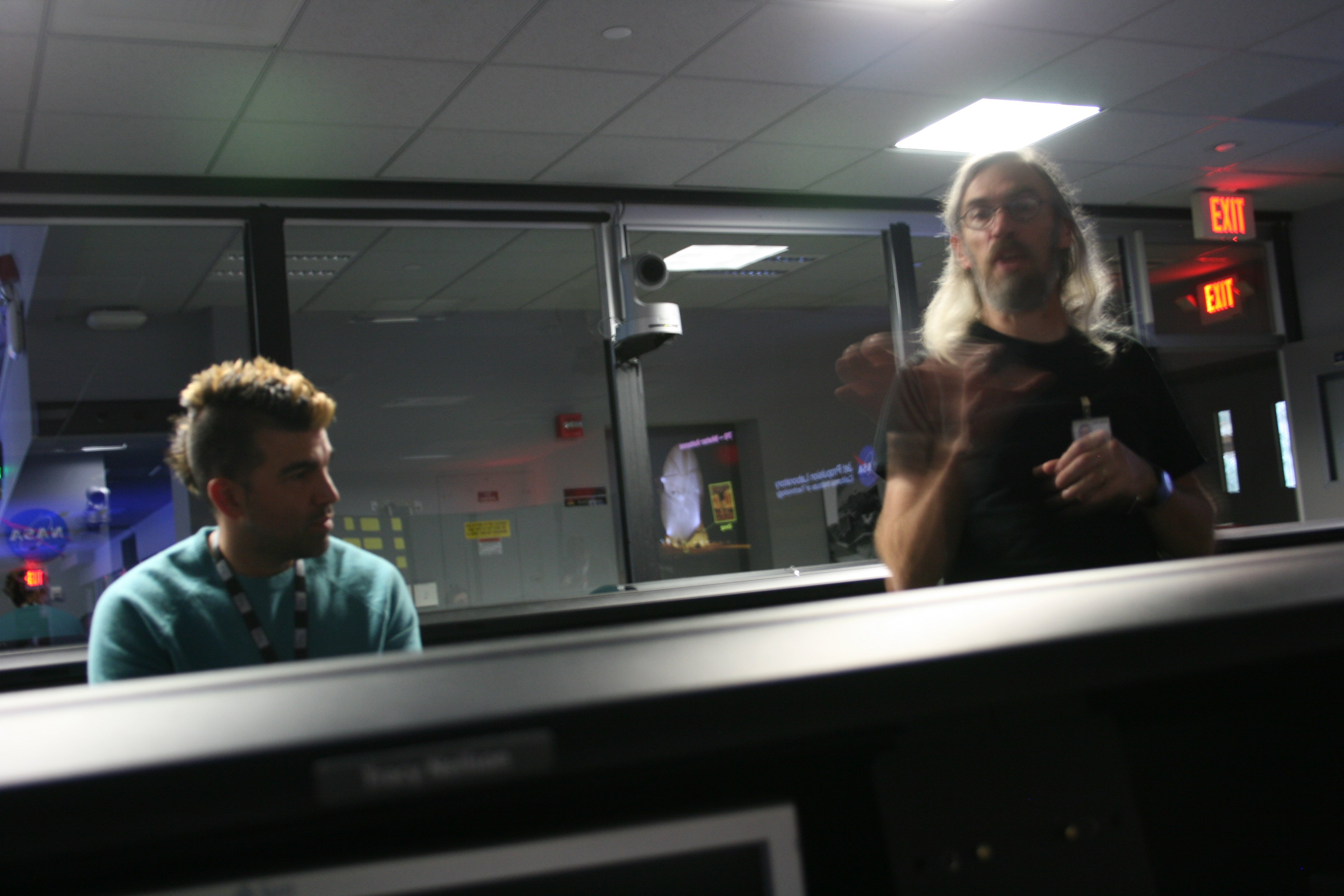
Better yet, our escorts and speakers were Bobak Ferdowsi (on the left, aka “Mohawk Guy”) and Steve Collins (aka “Long Haired NASA Guy”). Space geek “rock stars” with a BIG “R”! And both of them two of the nicest guys you could ever meet, they answered all of our questions, posed for pictures and selfies, and put up with all of us geeking out.

IMG_2755 (small)

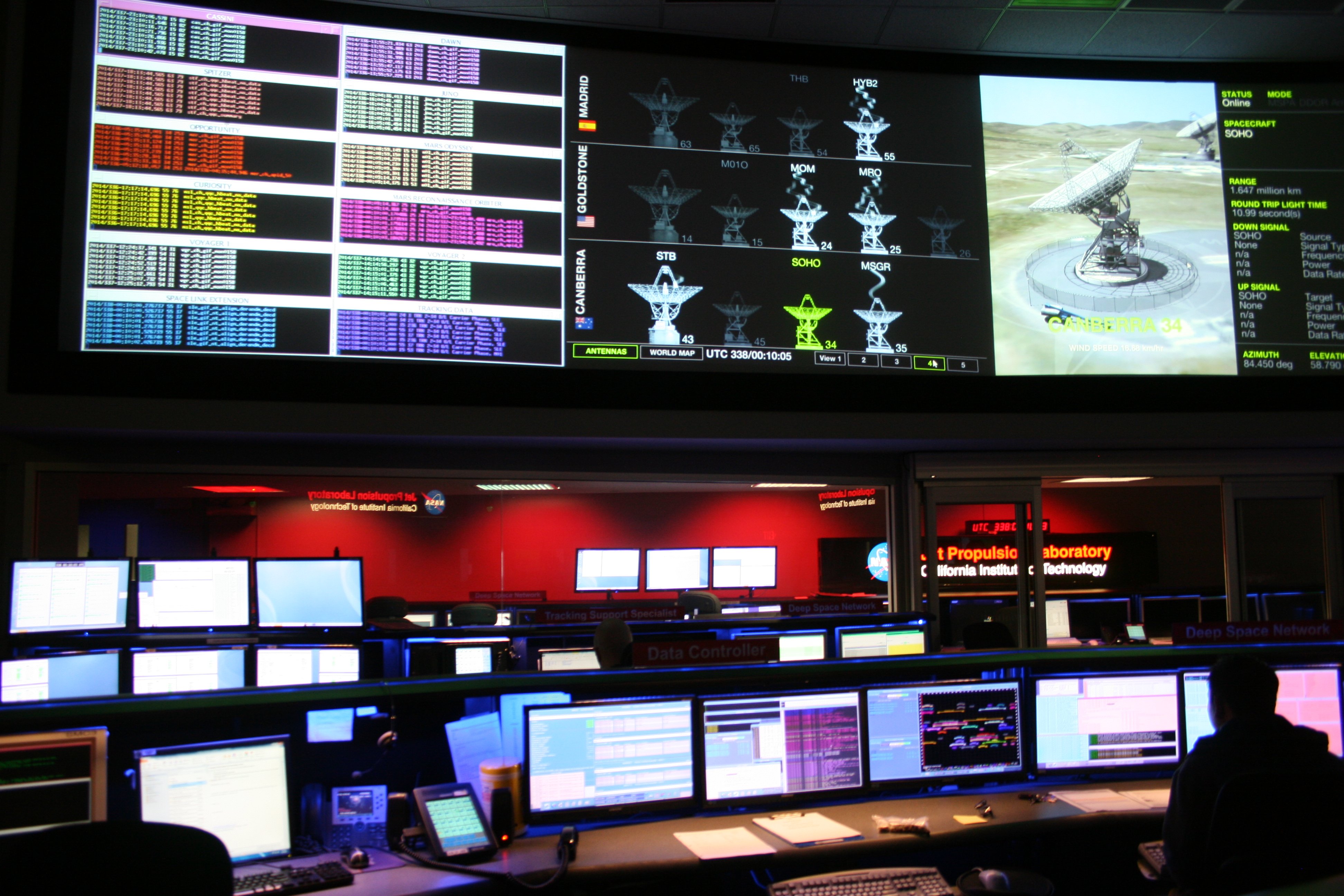
But wait, there’s more! Not only did we get to go into the primary control room, but then we got to go out onto the floor of the JPL Mission Control Room. Being here was way, way up on the bucket list! Places where they launch rockets and places where they run them are as close to “sacred ground” as I get, and the JPL Mission Control Room is close to the top of the list.

by the way, in the middle of the big screens at the top you can see the status of the Deep Space Network antennas, showing which ones are active at the three DSN sites (Goldstone, Canberra, and Madrid) and which spacecraft they’re talking to. Even better, that information, in fact, that exact up-to-the-minute DSN status display is available here on the NASA-DSN web page. It makes a great screen saver!

So there you have it! Now to bed and off to NASA Armstrong in the morning for my third NASA Social! Tweets and pictures galore to follow, I promise!

Leave a comment

Filed under Astronomy, Flying, Photography, Space