Category Archives: Astronomy

NASA Social Follow-Up (For Nov 18 2014)

Late last night I got some great news – I’m going to another NASA Social! Next Monday, February 2nd, I’ll be up in Palmdale for the “State Of NASA” event being hosted there by the NASA Armstrong Flight Research Center. There will actually be ten simultaneous NASA Socials going on next Monday at NASA Centers all over the country, including Kennedy in Florida, Johnson in Houston, Goddard in Maryland, Langley in Virginia, Marshall in Alabama, Stennis in Mississippi, Glenn in Ohio, JPL in Pasadena, and Ames in San Jose.

Each center will have their own unique activities and presentations, and all centers will join together for a 1:30 PM ET (10:30 AM PT) news conference with NASA Administrator Charlie Bolden. The news conference will be shown live on NASA-TV.

The NASA Armstrong presentation will center around how NASA performs astronomical research from aircraft, as well as other aircraft-based experiments. The highlight of the day will be a presentation and viewing (dare we hope for an actual tour inside?) of the Stratospheric Observatory For Infrared Astronomy (SOFIA). Rest assured, you’ll get plenty of information about SOFIA from me over the next few days, but the short version for those unfamiliar with the program is that it’s a honkin’ huge infrared optical telescope mounted into the open side of a 747. It’s an incredible vehicle, telescope, and program – I’m really looking forward to seeing it!

The schedule currently says that we’ll also see the DC8 ATV-5 Reentry Mission, briefings on the ER-2 (civilian version of the U-2 spy plane) and C-20A (modified Gulfstream III business jet) research platforms, electric propulsion systems (for aircraft or for spacecraft, I wonder), FOSS (Fiber Optic Sensing System) technology, the Towed Glider Air Launch System, and more.

I’ll be reporting on activities in Palmdale all day Monday. My primary methods of communication during the day will be Twitter and FaceBook. If you’re on Twitter, you can see my tweets at @momdude56. If you’re not on Twitter, you can see my tweets and photos showing up in the sidebar on the right. And, of course, there will be many pictures and much blatheration about it all here on Monday night and beyond. If you’re on Twitter, you can also see what’s being tweeted by other event attendees at all ten sites by following the hashtags #NASASocial and #StateOfNASA.

You’ll remember that I spent two days (here and here) at NASA Armstrong last November at my first NASA Social. It. Was. Freakin’. AWSOME! I also was at a NASA Social in December at JPL, which was also amazing almost beyond description. So, yeah, I’m looking forward to another one.

In reviewing those articles, I realized that I those posts had only used pictures from my cell phone, not the higher quality pictures from my DSLRs. No time like the present to fix that!

Tonight, the hi-res pictures from Day One at NASA Armstrong on November 18th. I’ll try not to repeat too much of the material already in the original post.
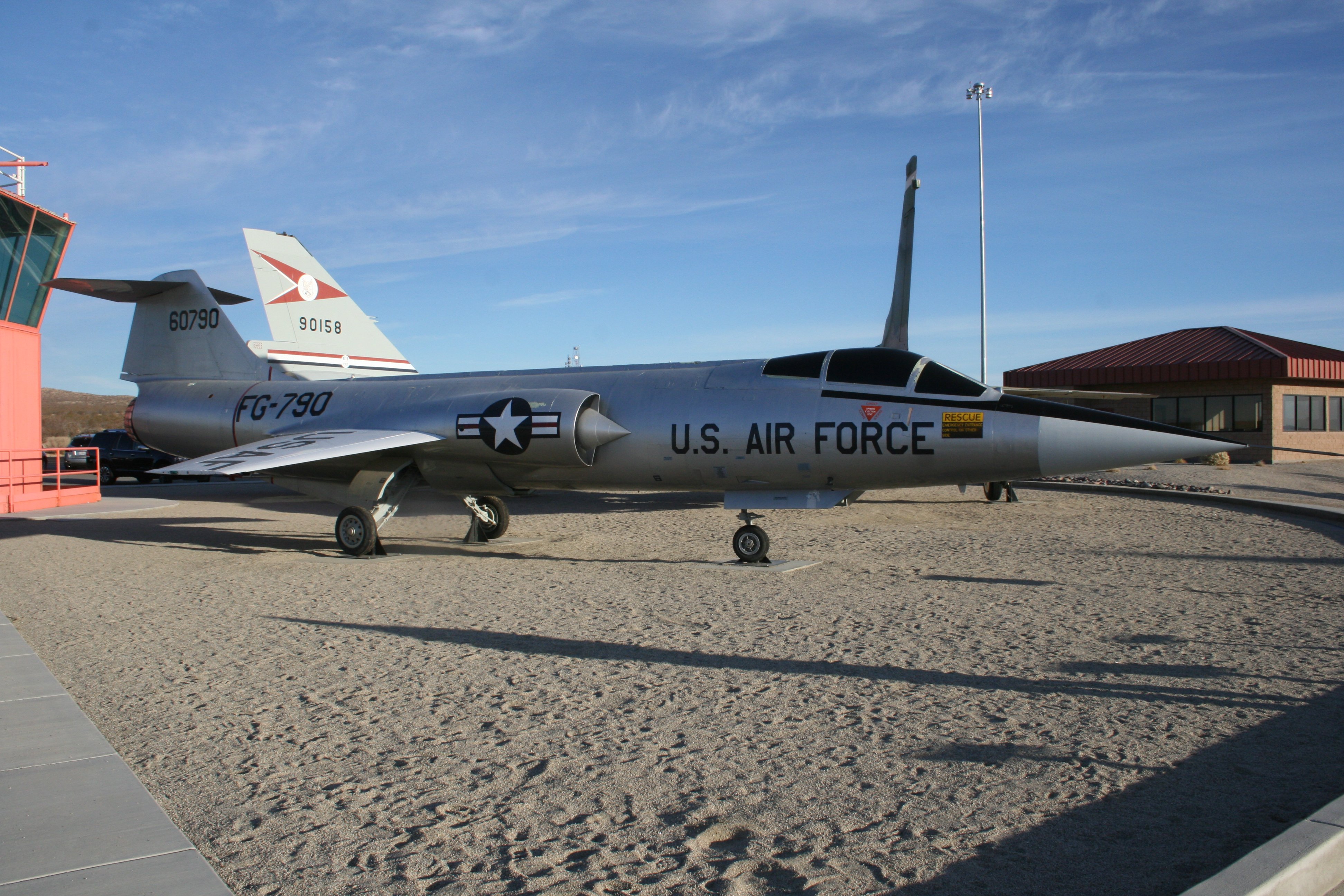
IMG_2450 (small)

At the gates of Edwards Air Force Base there are a dozen or more retired planes parked, many of them “century” fighters (F-101 “Voodoo”, F-104 “Starfighter”, F-105, F-106, F-108, and so on), as well as other fighters and cargo aircraft. Shown is the F-104 “Starfighter”.
IMG_2457 (small)

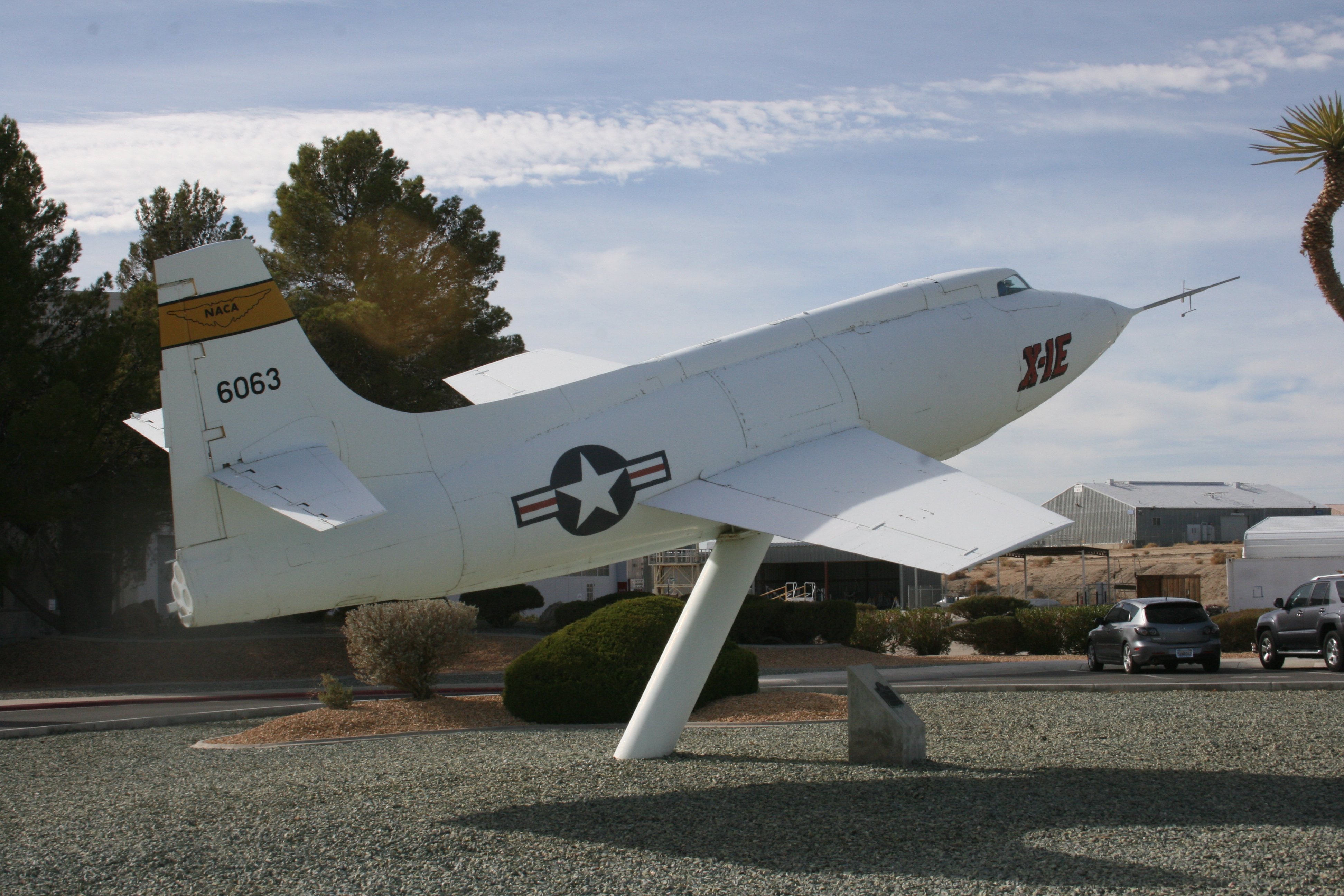
On base, outside of the NASA Edwards facilities, is the Bell X-1E. A sister aircraft to the Bell X-1 which Chuck Yeager used to break the sound barrier in 1947, the X-1E flew twenty-six test flights from 1955 through 1958, reaching a top speed of Mach 2.24.
IMG_2462 (small)

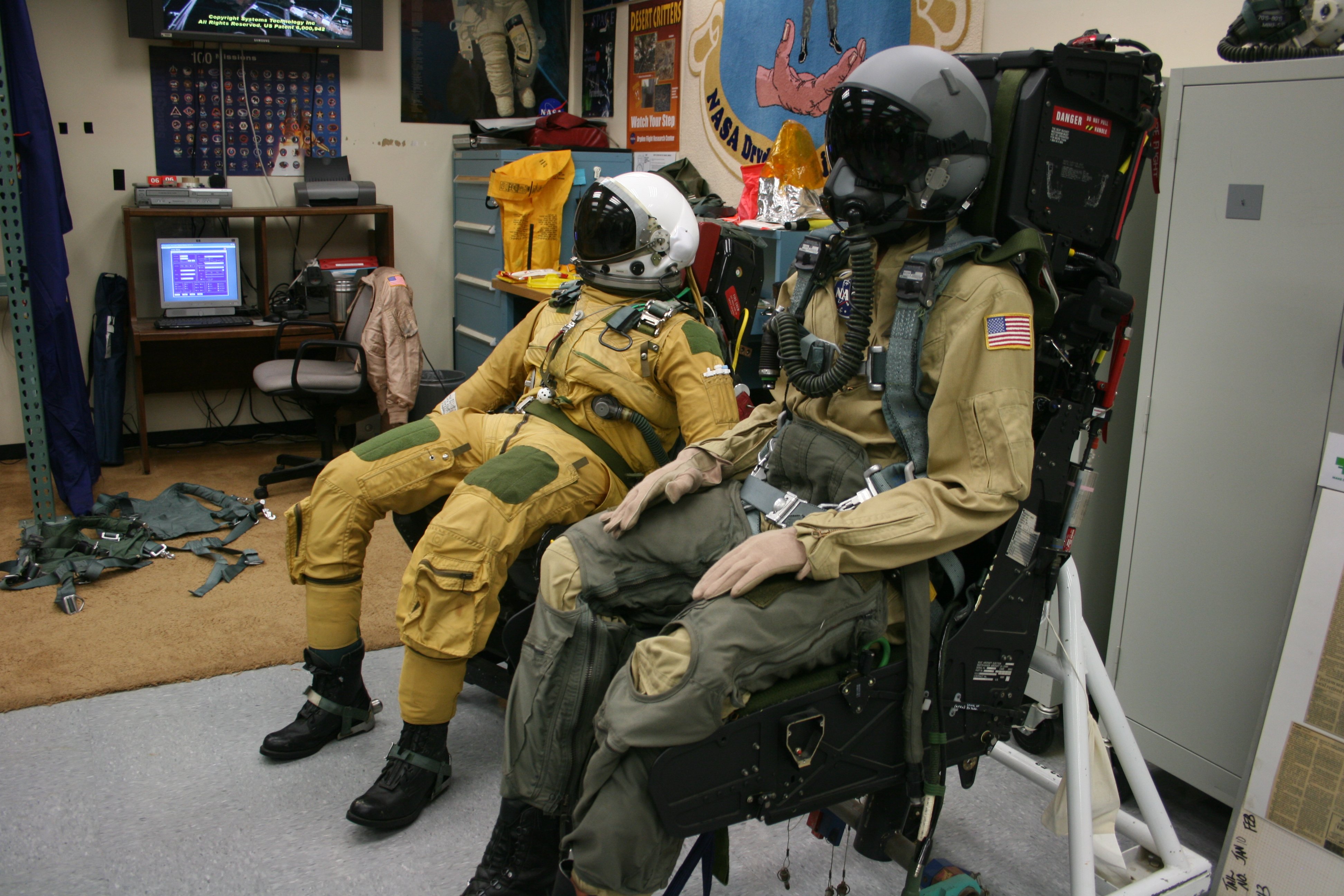
Protecting the test pilots is a key activity at NASA Armstrong and Edwards AFB. Here we see demonstrations of flight suits and ejection seats.
IMG_2483 (small)

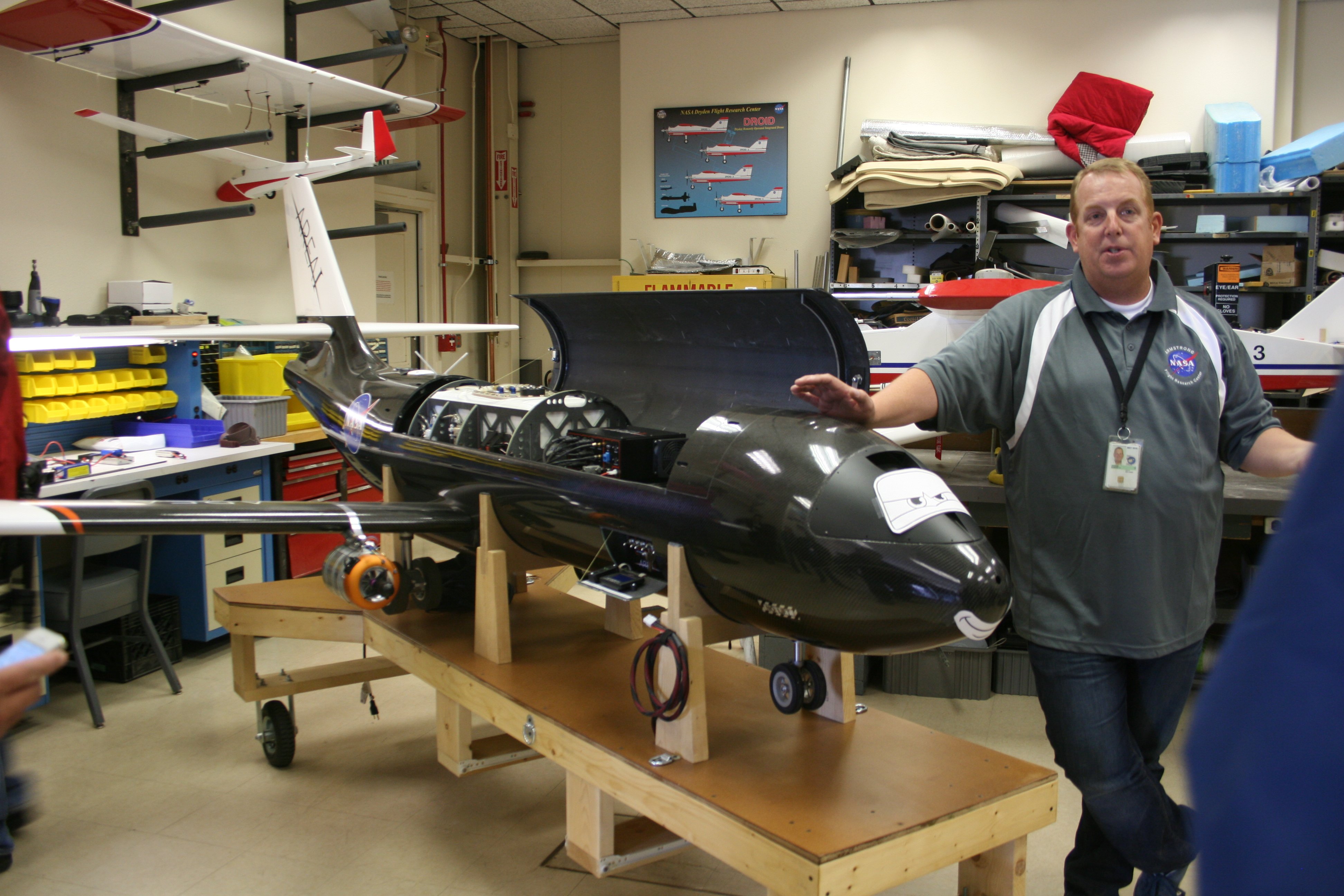
We toured the model shop, where scale test vehicles are built to be flown by remote control to test new systems. This is a newer large-scale model, while other smaller models can be seen around on the walls and in the background. If you want to see what these kinds of drones are used for, there’s a great video here of a recent breakthrough program, showing how the models were used, and featuring interviews with several of the people we talked to during our visit.
IMG_2493 (small)

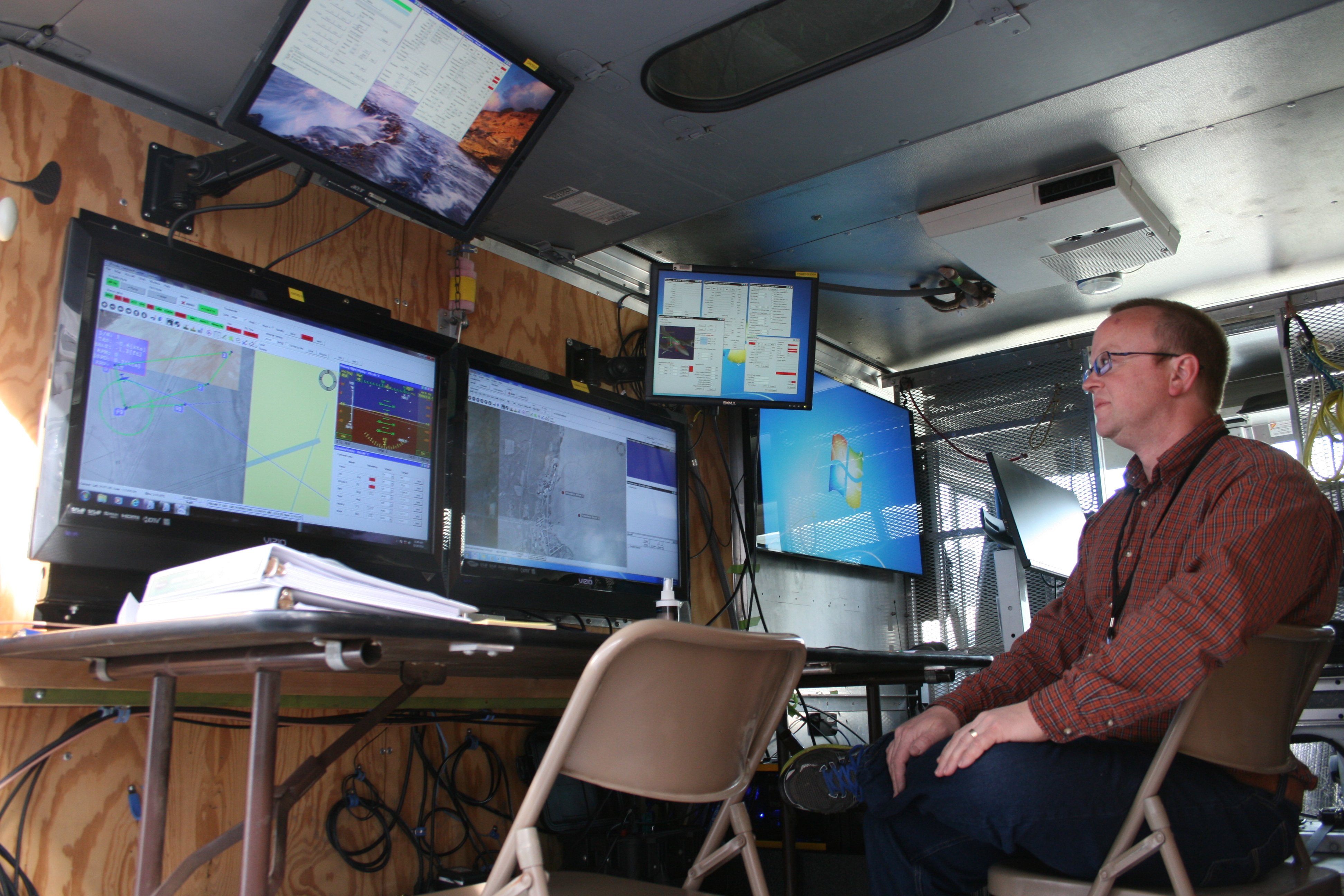
The scale models are often flown out in remote locations, where they need to be controlled using line-of-sight radio and data connections. In order to do that, this truck is outfitted as a mobile command base for remote operations. Given how hot it can get out in the Mojave Desert in the summer, I suspect that most important piece of equipment in the whole place is that air-conditioning unit on the ceiling.
IMG_2503 (small)

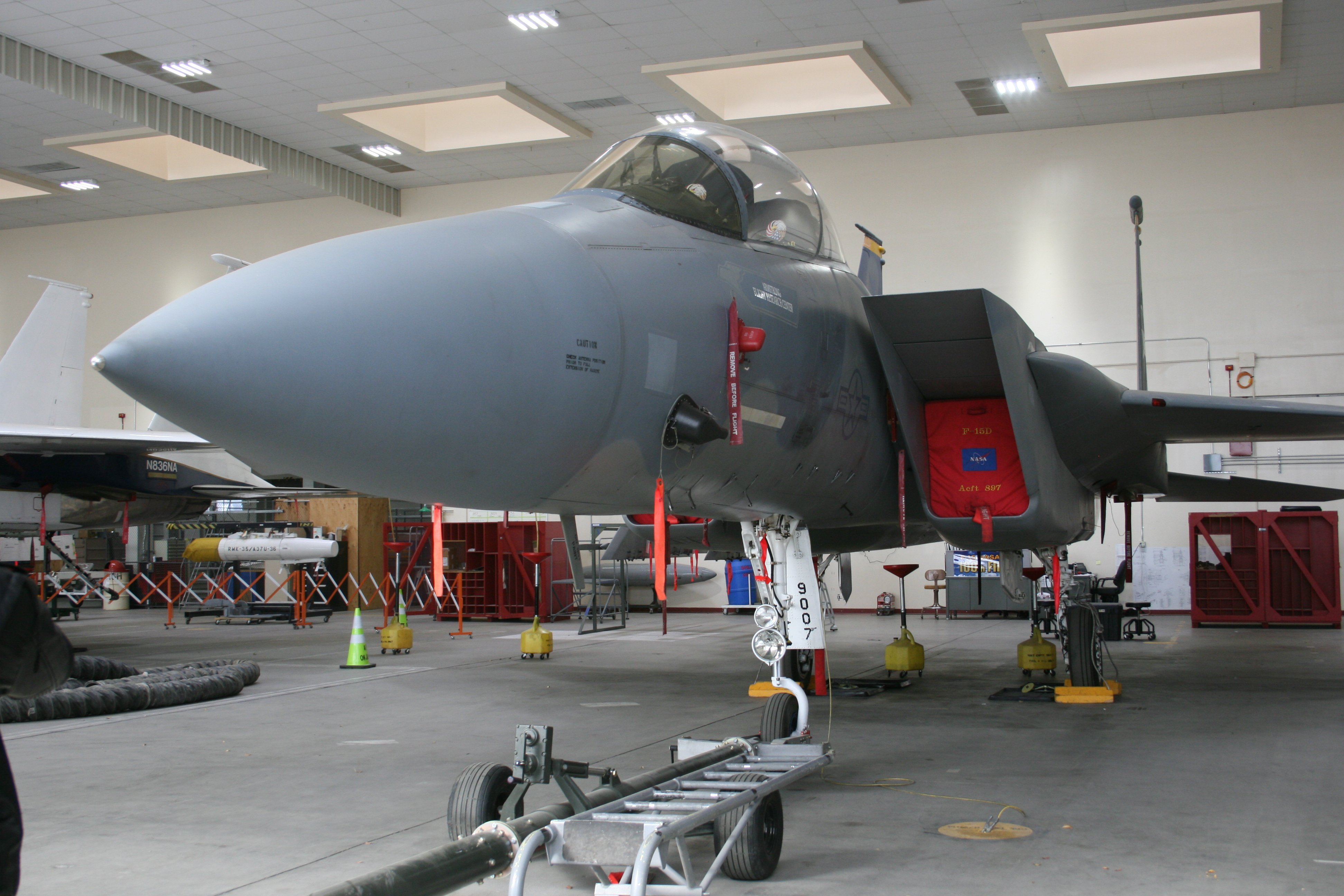
NASA Armstrong uses a number of high performance aircraft, often modified military fighters. This is one of their newest, an F-15D.
IMG_2522 (small)

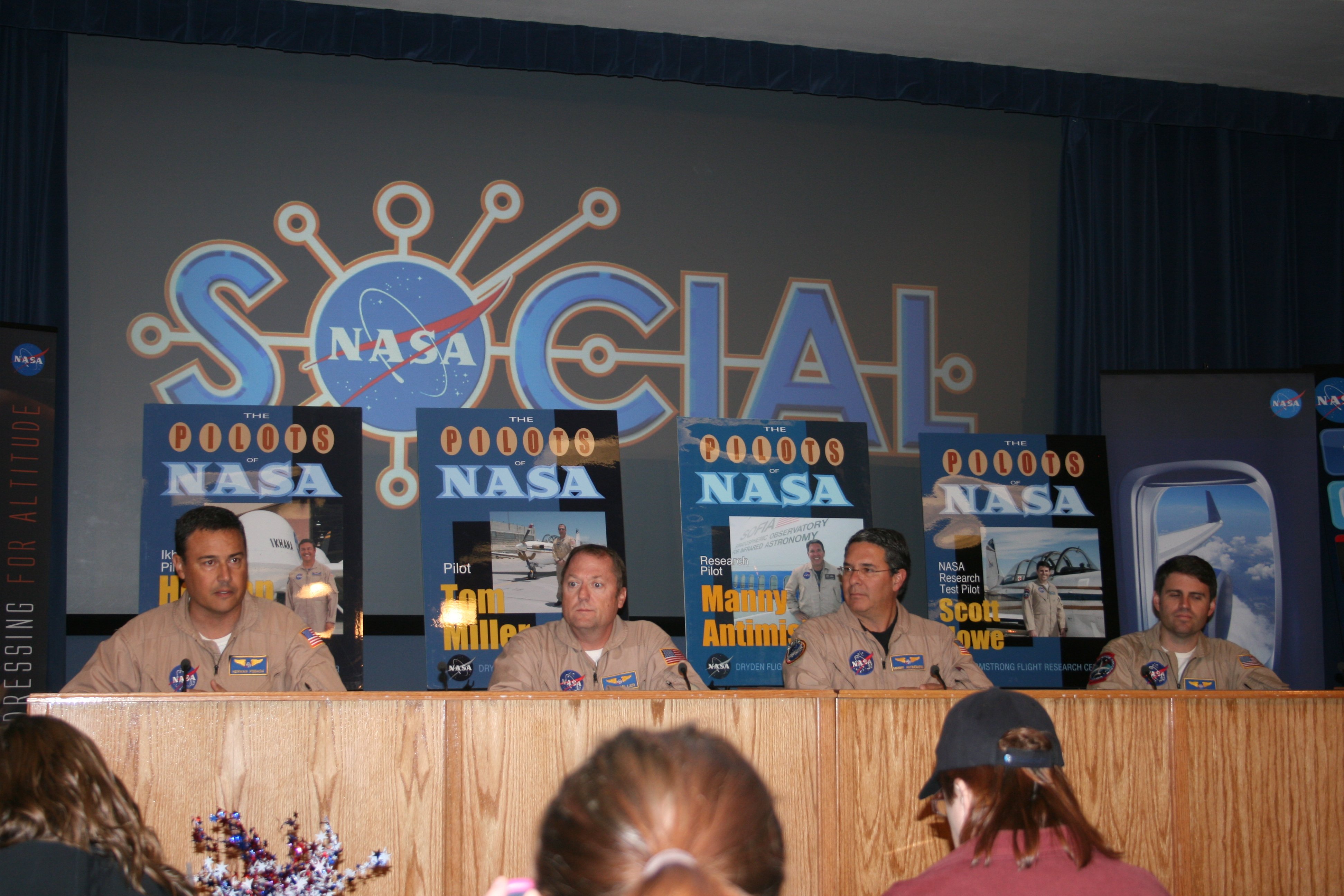
We had a great talk with four of the NASA Armstrong test pilots who fly the whole range of test aircraft, from the slow and small propeller-driven planes (used for noise studies) to the F-15s and the P3-B used for the Operation Icebridge. They also fly the remotely controlled drones which conduct atmospheric research all over the world.
IMG_2527 (small)

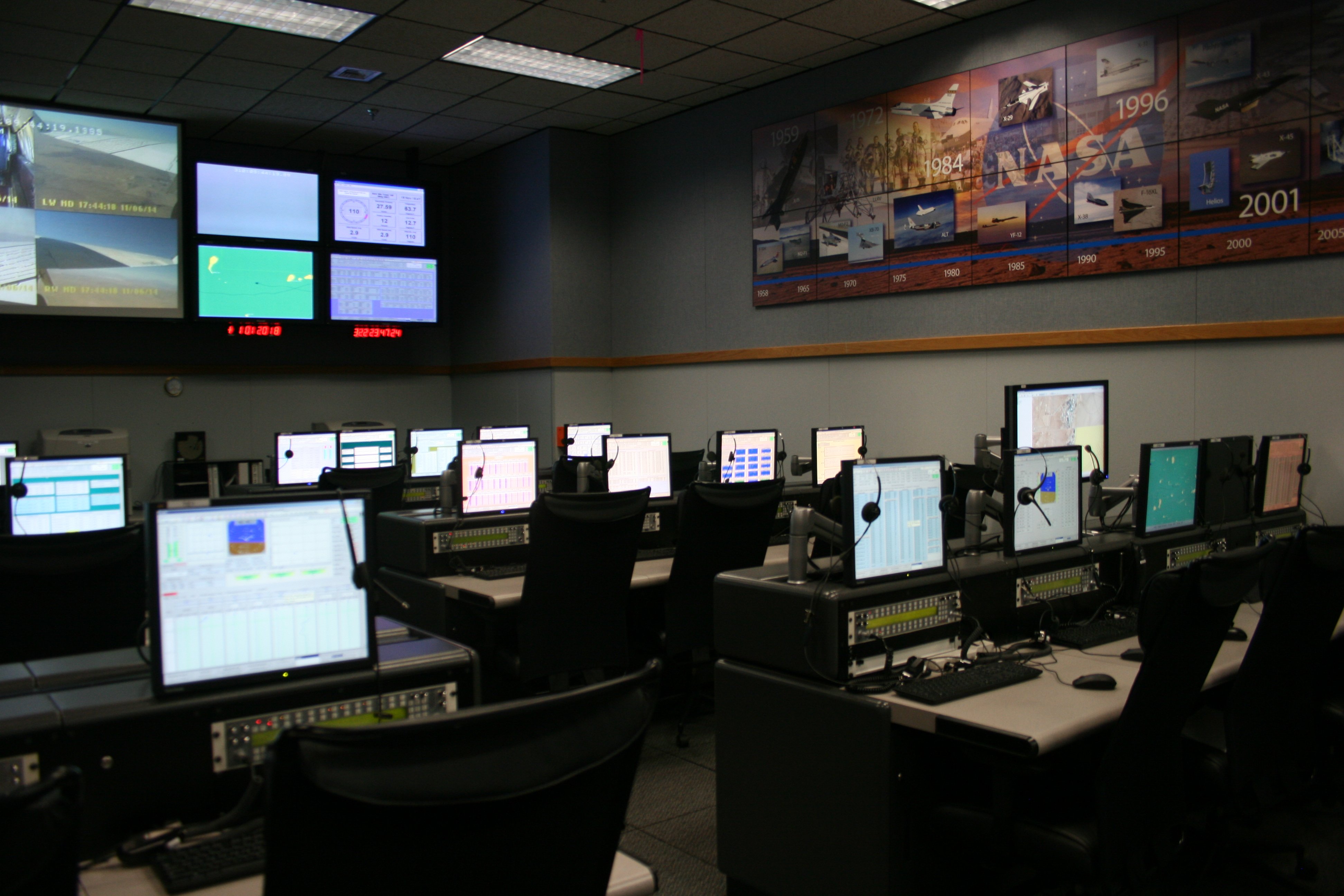
This is one of the two mission control rooms which run the test flights.
IMG_2531 (small)

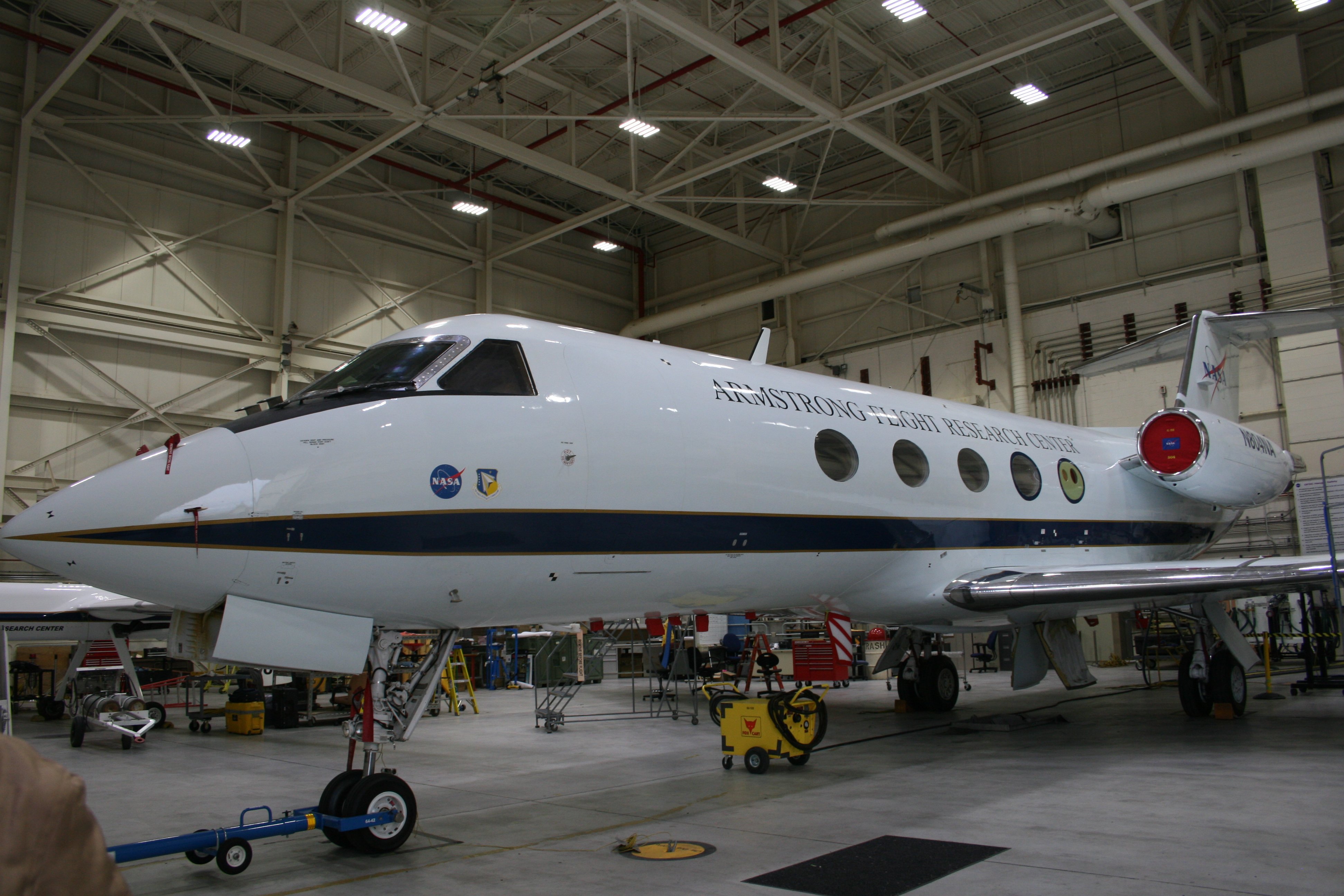
This is the modified Gulfstream III with the experimental shape changing wing that could someday reduce aircraft weight, noise, and fuel costs.
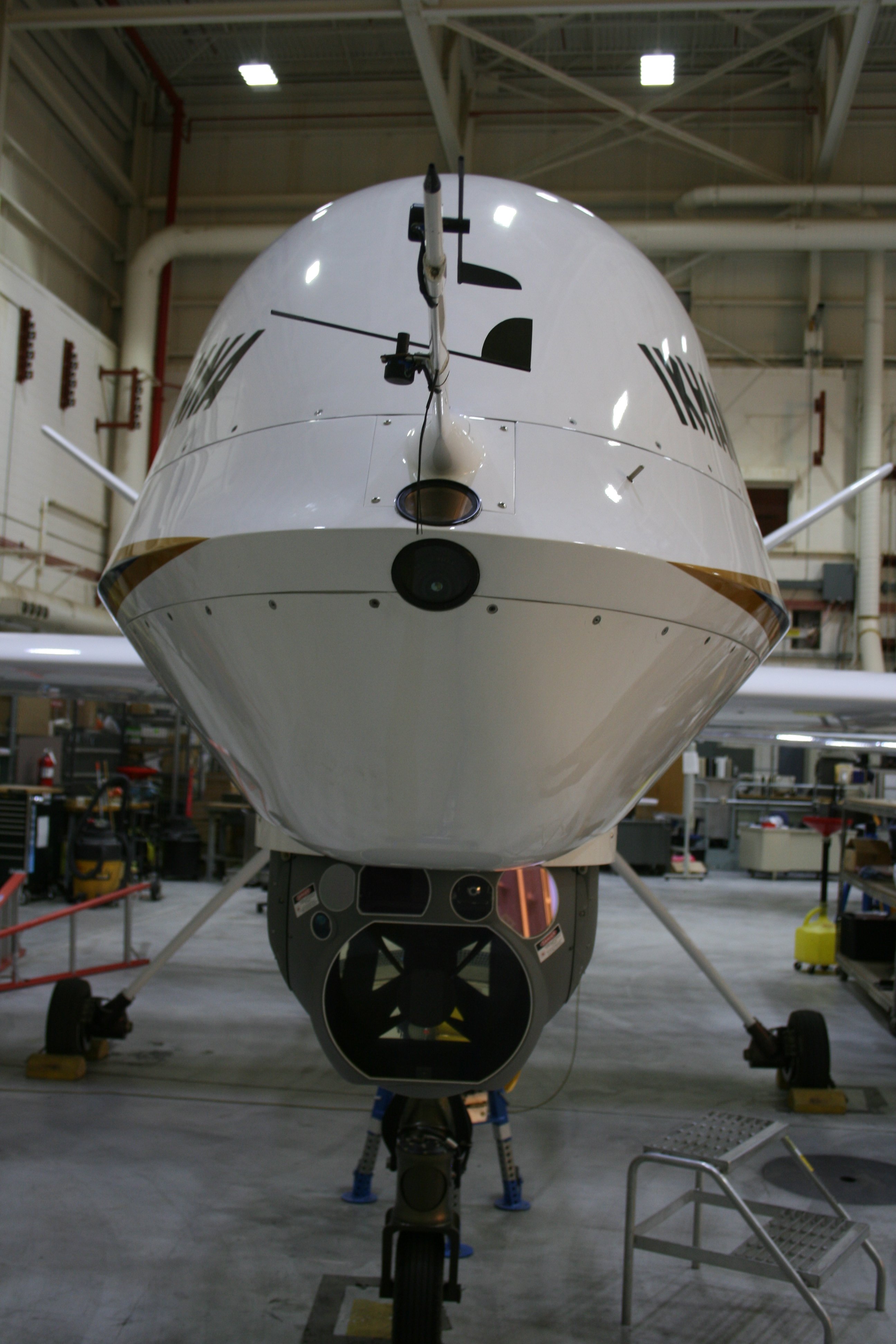
IMG_2539 (small)Finally, this is the Ikhana Unmanned Aerial Vehicle, a modified Predator B drone equipped with advanced optical systems and capable of carrying instrument packages all over the world. A couple of weeks after we were there in mid-November, Ikhana was used off the coast of Baja California to record and show us the re-entry and splashdown of the first Orion spacecraft.

Yeah, it was a pretty fantastic day for a space cadet like me. Next Monday’s going to be another one!

Leave a comment

Filed under Astronomy, Flying, Photography, Space

Thirty-Eight Hour Moon

It’s been easy to watch Comet Lovejoy every clear night, although most nights here recently have been hazy to foggy and completely overcast. But tonight was clear and there were special, non-cometary treats at sunset.

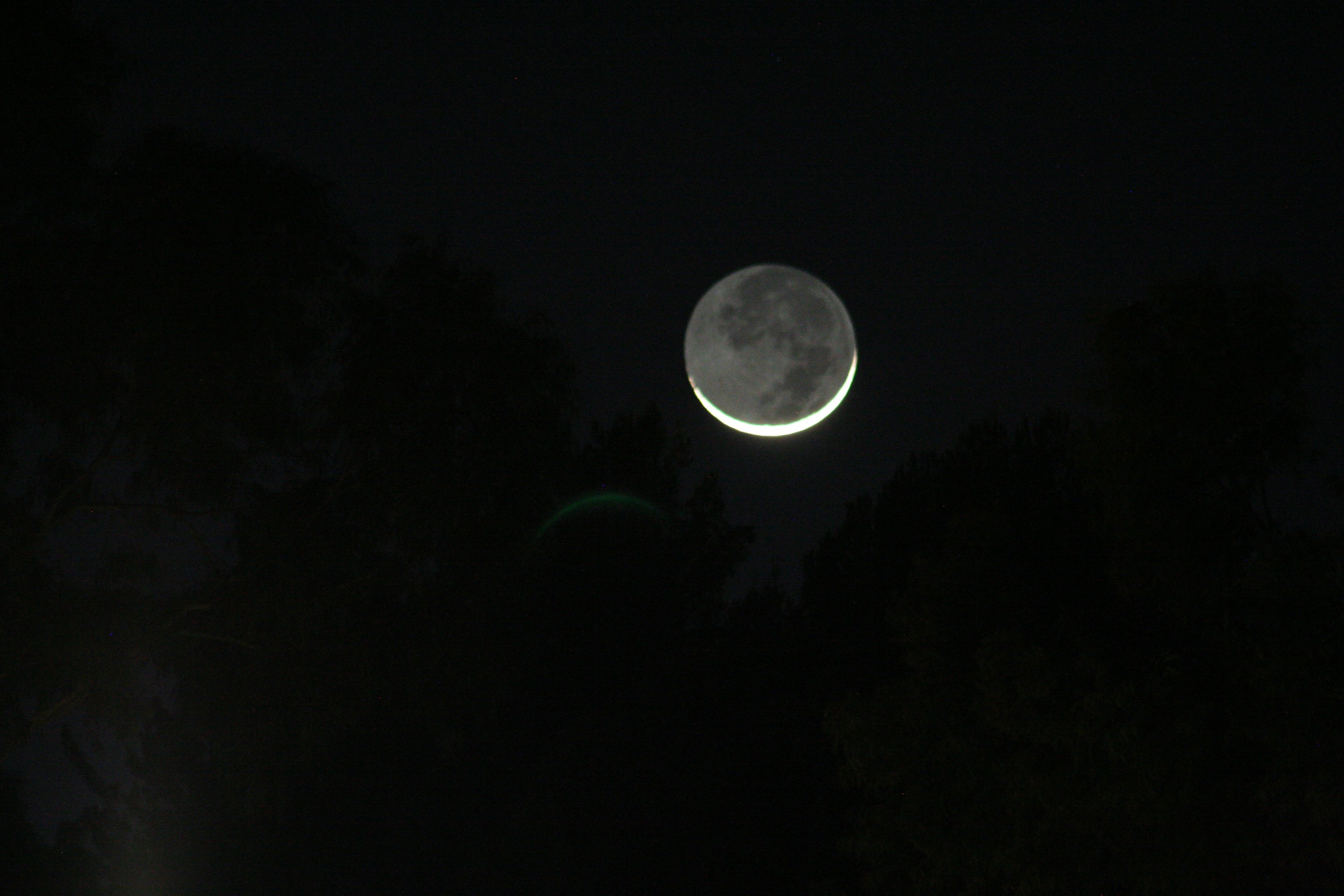
The thirty-eight hour old moon was hanging above the western horizon, right next to Venus. Those a few time zones to the east (Europe, US East coast) got to see it even slimmer and tinier, but it was gorgeous here. And if I’m lucky, there might still be a chance to see Mercury, which has been heading back closer to the sun. After a very long, productive, and intense day, it was time to grab the gear and head toward the park to see if I can get a better view than I can from my yard.

Here’s how the hunting went.

IMG_0999 small

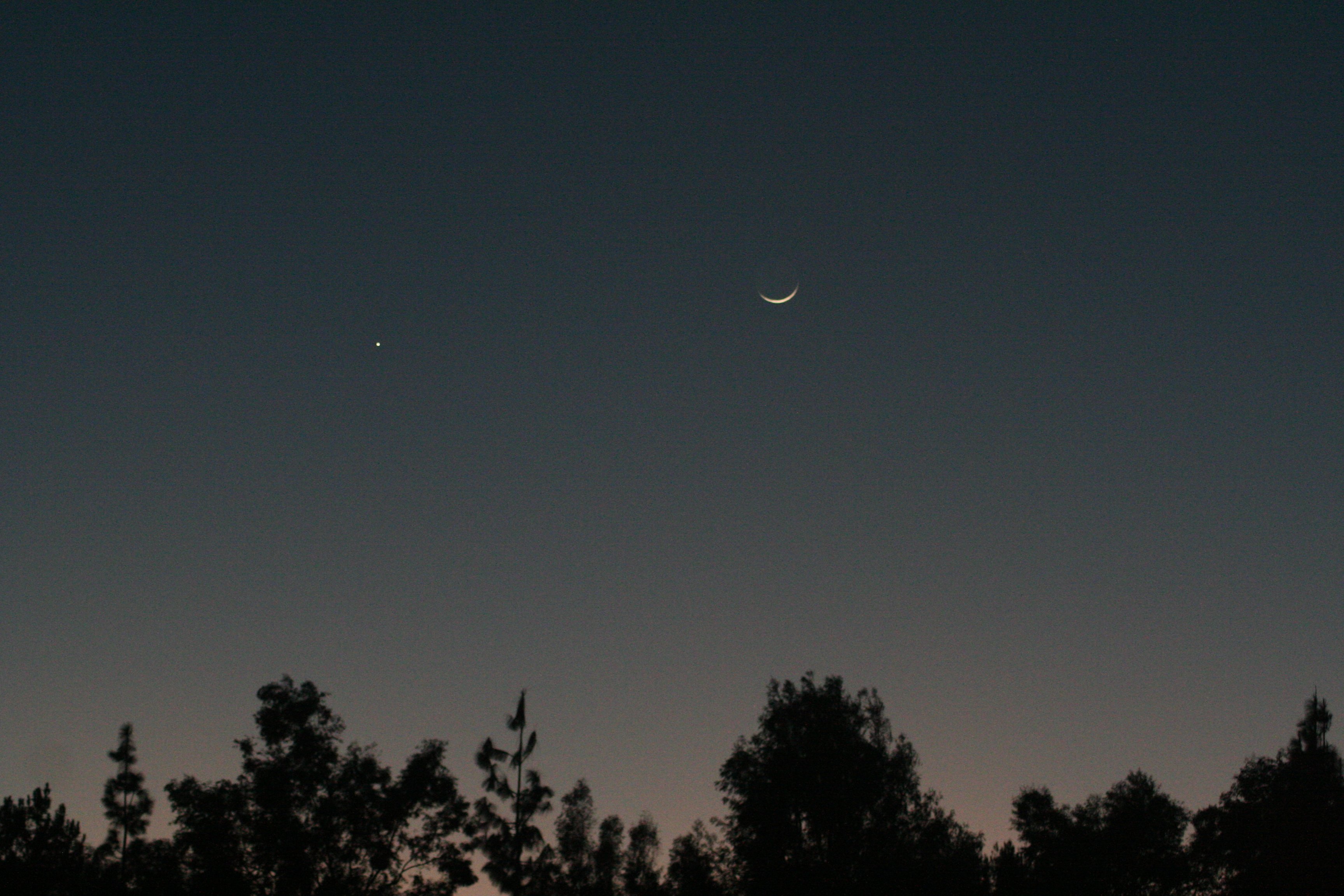
Sunset was at 17:08, this first set of pictures were at 17:43. There’s a hill off in the distance with houses and trees so I don’t have a clear horizon, but it’s better than at my house. In the upper left, Venus was clearly visible, as was the sliver of a crescent moon. Mercury is somewhere down below them, not quite at the other point of an equilateral triangle. No sign of it here.

IMG_1027 small

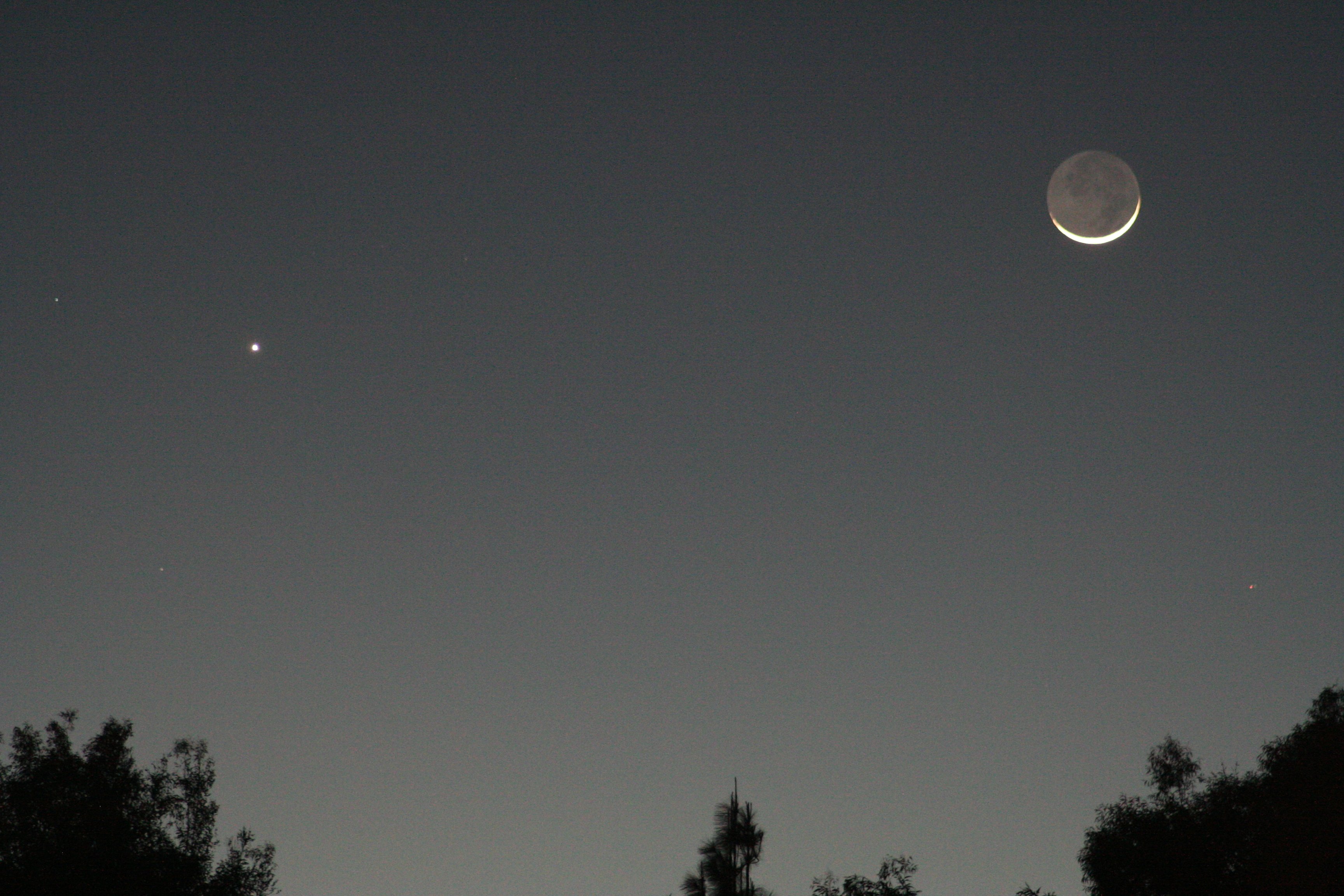
Looking at Venus and the Moon close up, it’s still light enough so most of what you see on the moon is the illuminated part. That will change as it gets darker.

IMG_1041 small

17:49, Mercury should still be above the trees, but it’s getting close. Still no sign of it.

IMG_1070 small

As it gets darker you can see more “earthshine,” the illumination of the dark part of the moon’s surface by sunlight reflected off of the Earth. If the moon is nearly new as seen from the Earth, then the Earth is nearly full as seen from the moon. Since the Earth is also much larger in the moon’s sky than the moon is in the Earth’s sky, there’s a lot more surface to be reflecting. when it all gets added up, there’s a fair amount of light on the moon when it’s dark like this.

IMG_6996

Here’s the diagram taken at this time from the Star Walk app. (A bit pricey for an app, but so wonderful and worth it!) You can see the relationship between the moon, Venus, and Mercury.

IMG_1103 small

18:00. Mercury should be somewhere down around the top of that big, full tree under the moon. I’m sure it actually IS there, it’s not like we lost it or anything, it’s just too dim to be seen in what are still twilight skies.

IMG_1115 small

Moving a bit to see if maybe Mercury might have been hiding behind that tree. Unfortunately, still no sign of it.

IMG_1145 small

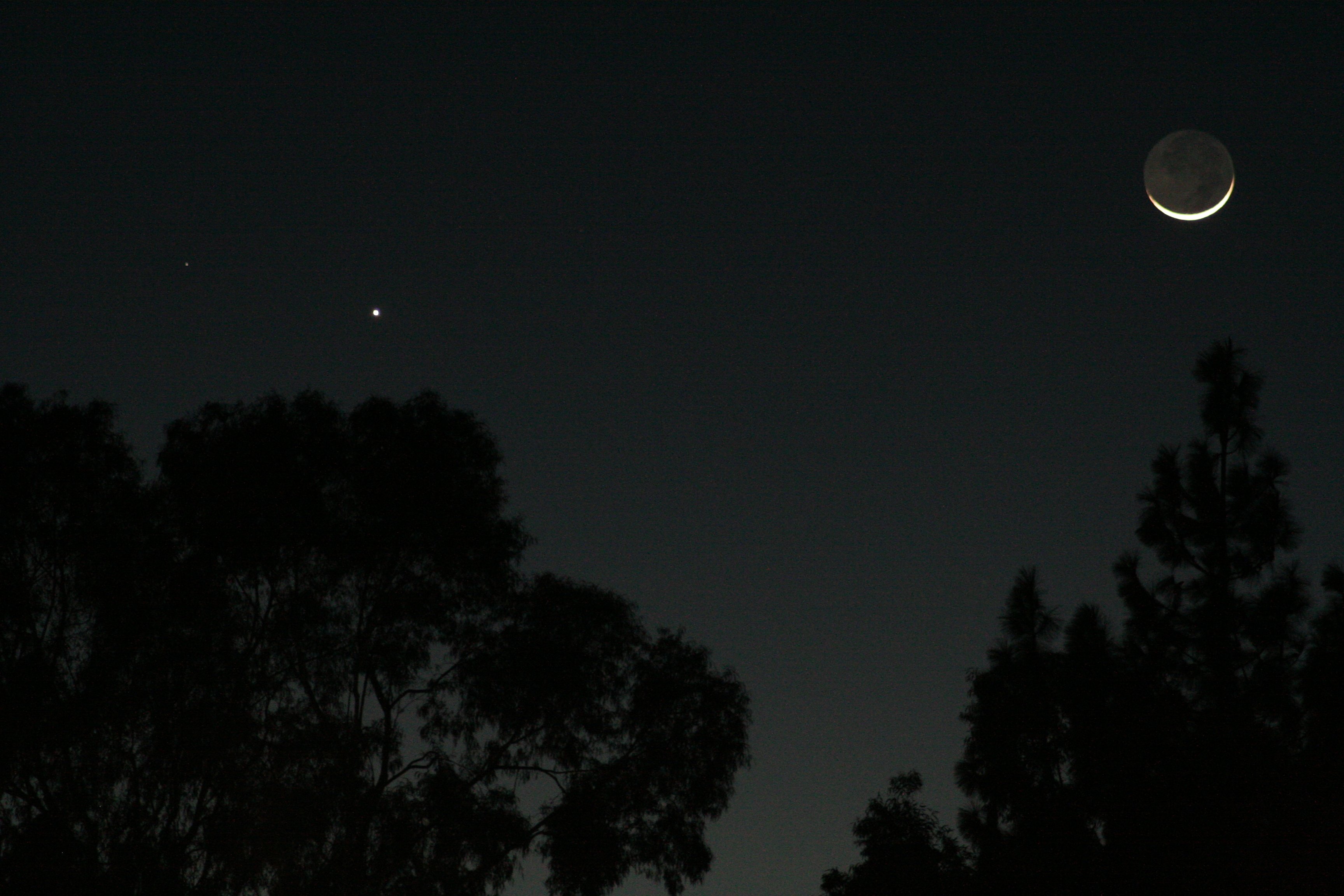
19:04 and we’re probably past the point where Mercury is above those trees. but the Earthshine on the moon is looking wonderful!

IMG_1160 small

Looking closely at the moon we can clearly see the dark and light areas lit up by the reflected sunlight.

IMG_1172 small

17:08 and the other stars are starting to be visible in the west (they’ve been visible in the east and overhead since I got here). The pair of Venus and the thin crescent moon are beautiful above the trees.

IMG_1184 small

Now that it’s getting dark in the west, look waaaaaaay up there in the upper left corner. Just barely sneaking into the frame is Mars.

IMG_1205 small

19:14, as Venus and the moon start to go behind the trees, shift locations again so that they can straddle a tree and we can more easily see Mars in the upper left.

IMG_1260 small

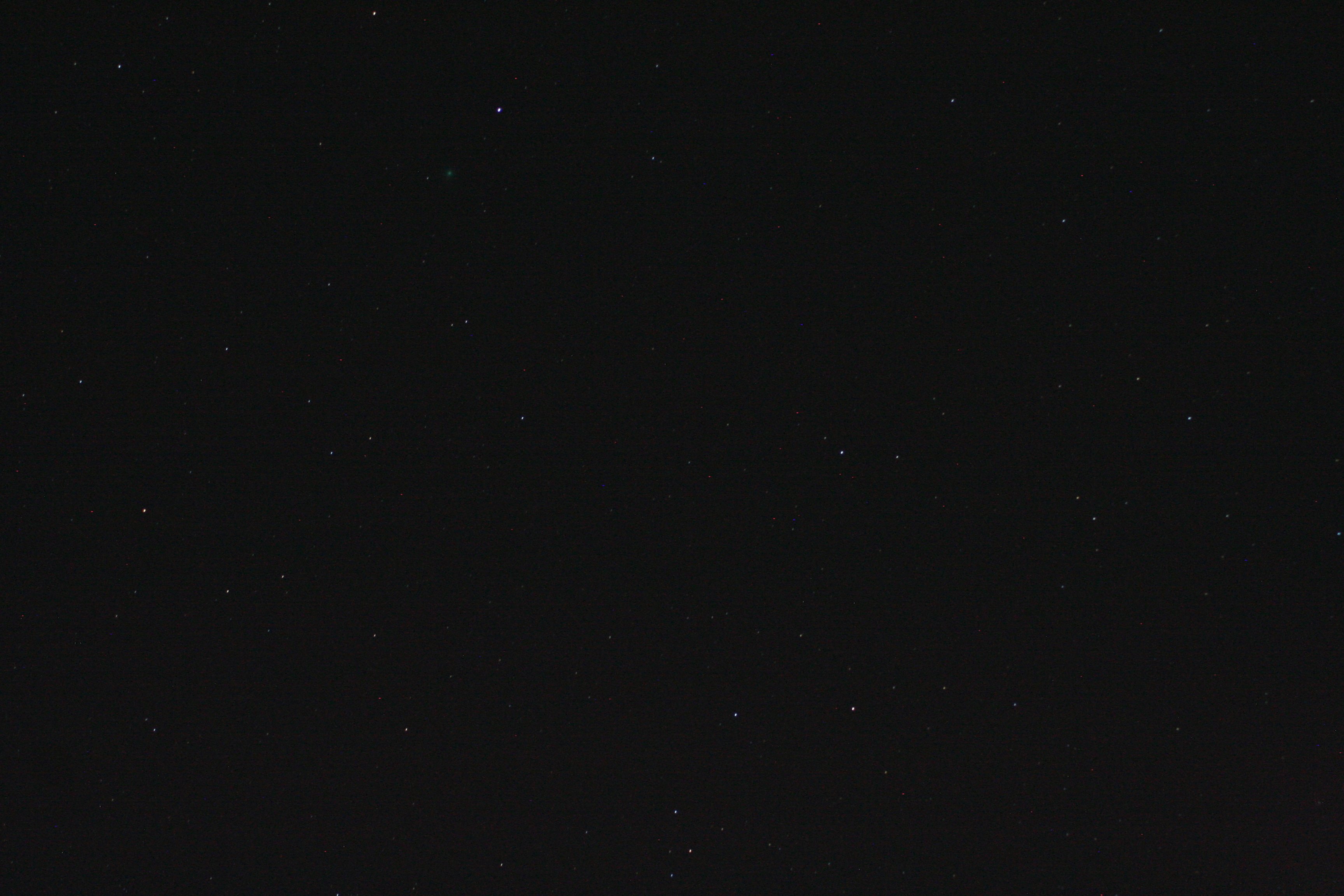
19:24, as long as it’s clear and the moon’s not lighting up the sky, let’s look one last time for Comet Lovejoy. It’s gone to the west past the Pleiades and is nearly overhead. Still easily visible in binoculars it is starting to fade. With the moon getting brighter every day, making Lovejoy harder to see, this is probably it for naked eye viewing of the comet. By the time the moon has moved past full so it’s rising later in the evening, Lovejoy will be a binocular and telescope object only. (See it, that green fuzzy blob in the left-center, at about the 11:00 position?)

IMG_1264 small

19:25, one last look at the crescent moon as it goes behind the trees. This is often referred to as “the old moon in the new moon’s arms.” Whatever you call it, it’s gorgeous. Look for it tomorrow night again, a bit more illuminated and a bit higher up in the sky at sunset.

4 Comments

Filed under Astronomy, Photography, Space

Mercury & Venus

I know, today’s supposed to be my nominal Flash Fiction day, but that’s going to have to wait. (I’m working on it.) In the meantime, celestial mechanics grabbed my attention and gave me a treat.

Mercury’s hard to see. It’s never far from the sun, so the only time to see it is right after sunset or right before sunrise, when the sky is still partially illuminated. The times when it’s furthest from the sun from our point of view is called “greatest elongation” and sometimes even that doesn’t help. If the plane that we’re seeing Mercury in is shallow to the horizon (it changes as the Earth moves around the sun because the earth’s axis is tilted) it’s almost impossible to see.

Dim object in a still bright sky is not a good thing.

Mercury’s was at greatest elongation a day or two ago but this time the plane of the ecliptic is up high, and to boot you’ve got Venus really close (called a “conjunction”) which makes it easier to know where to look for Mercury, because Venus is really stinkin’ bright even when it’s close to the sun.

I knew all of this, but I have hills to my west and it’s been cloudy and hazy. I was seeing pictures that others were taking and figured if I got a clear night I would go over to a local spot where there’s a nice hill with a decent western horizon. Tonight might have been a good night, but I had other things to do and wasn’t going to be home until nearly an hour after sunset.

Then, driving home, headed west…

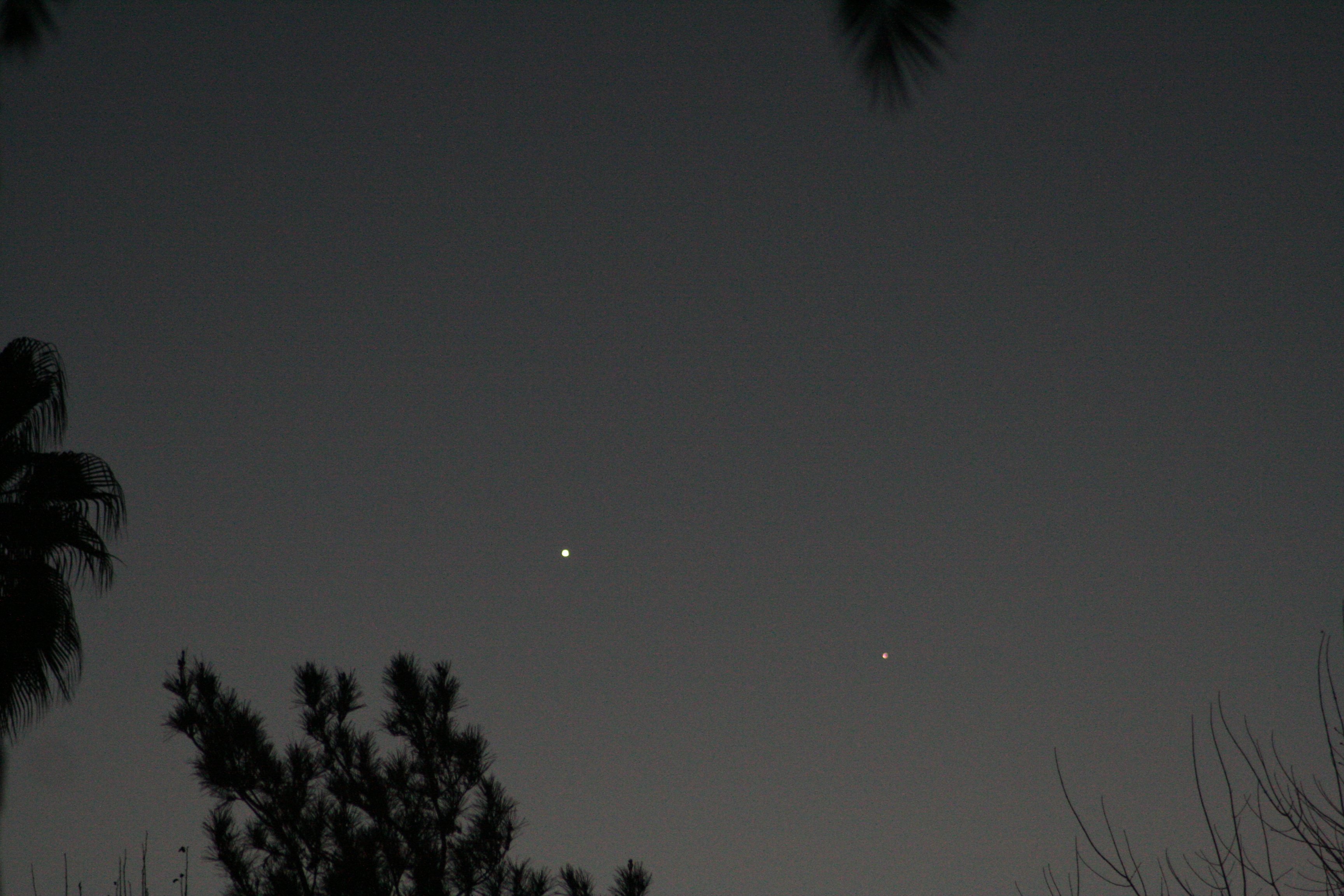
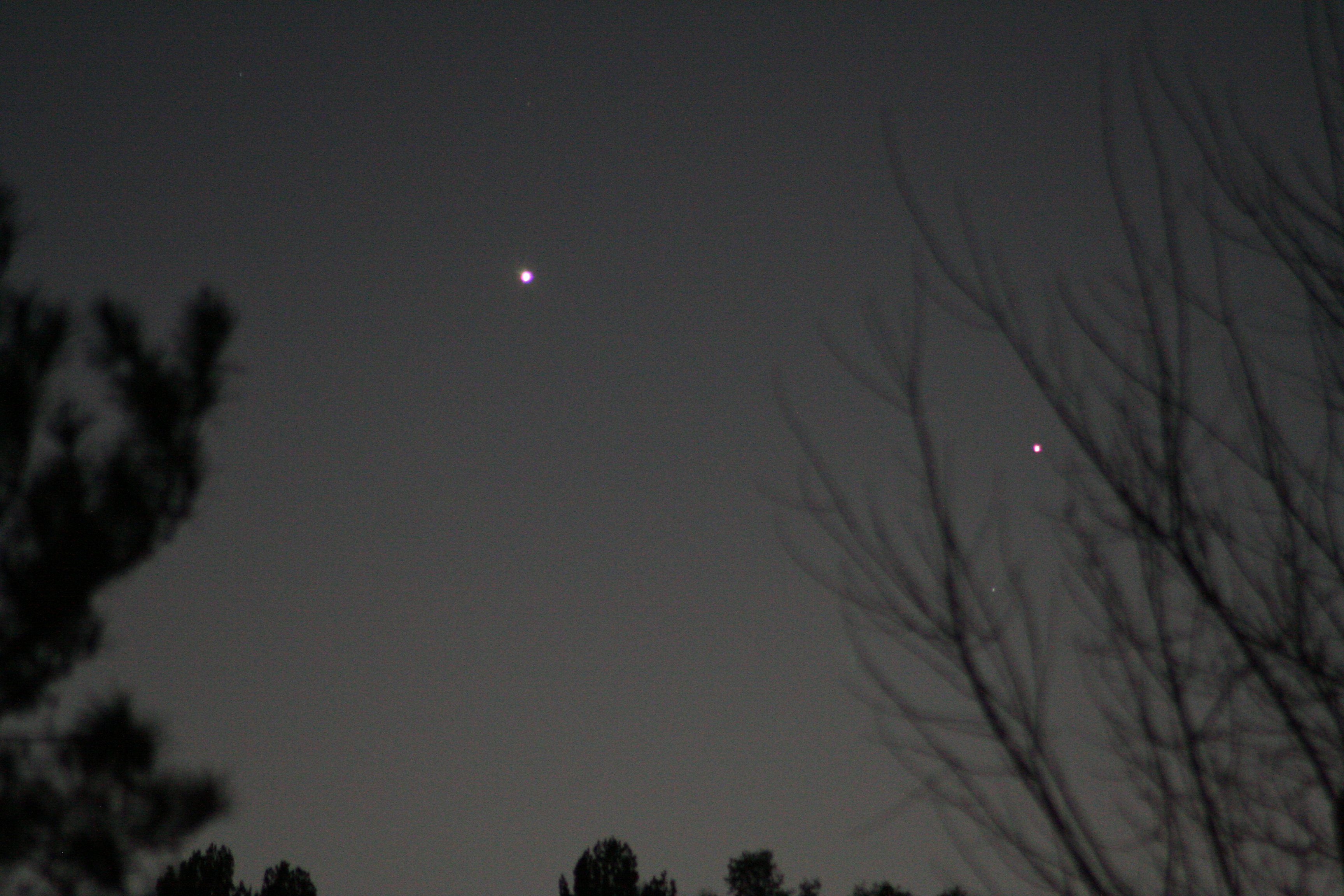
Hanging in the sunset, right next to Venus shining so bright it looks like the landing lights on a 747, was Mercury, more clear to see than I’ve ever imagined. Mercury was as clear as day, even dealing with traffic and street lights and the lights of oncoming cars.

More importantly, as I pulled up at home and looked again, the pair was more than high enough even to be seen over the hills to my west! Run into the house, kiss The Long-Suffering Wife, grab the camera (fortunately still set up  on the tripod for Comet Lovejoy hunting), and sprint back out into the front yard.

I think that I’ve only seen Mercury with the naked eye once before, maybe twice. No, just once. Anyway, it was hard to miss tonight. Spectacular!

IMG_0917 small

180 mm zoom, 1/20 second

Remember to click on the image to see the full-sized versions.

IMG_0957 small

300 mm zoom, 1/4 second

IMG_0965 small

154 mm zoom, 1/3 second

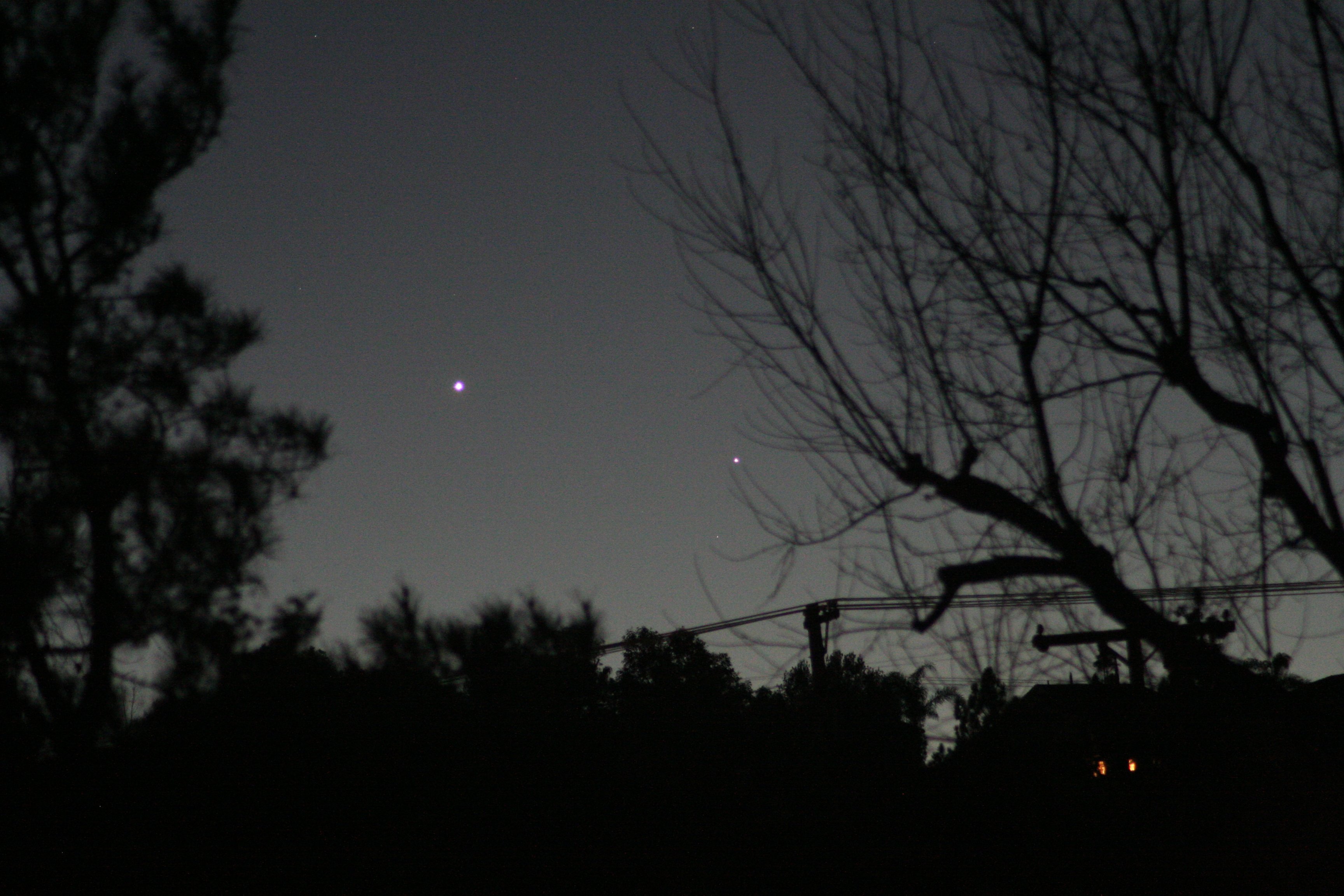
IMG_0993 small

192 mm zoom, 1 second

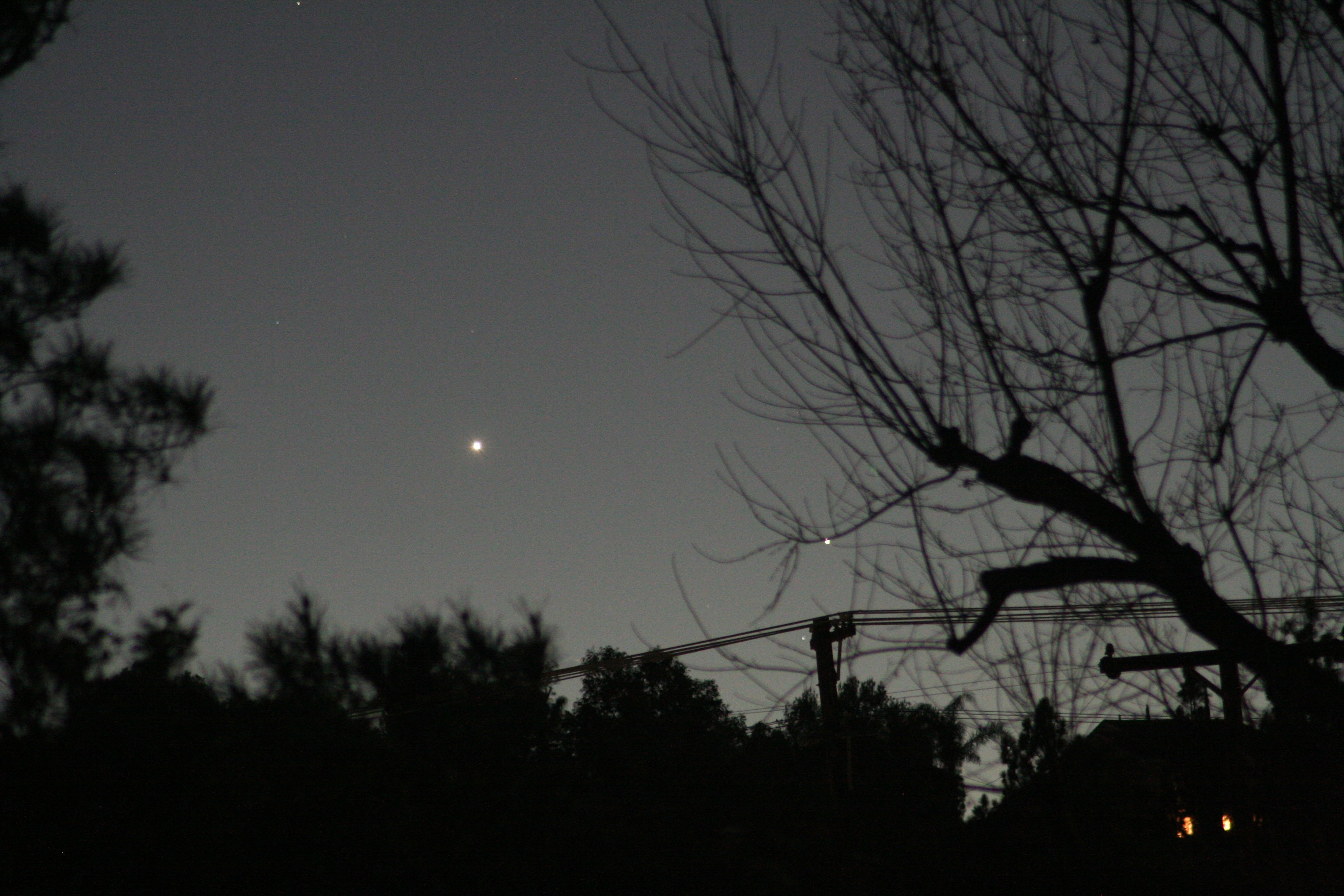
As it got darker, you can see a few other stars starting to pop out, like the one that’s disappearing underneath the phone wires at the bottom and the one that’s just coming into view at the top of the frame.

If it’s clear out tomorrow, the next goal might be to try to get a wider picture — Mars is off to the upper left but would require a much wider angle picture. Worth trying. Of course, if I really had some good hear set up and could get Mars included in the picture, Neptune is fairly close to Mars… It would be fantastic to get all four of these planets in one picture, but that might be a stretch for me with just a camera on a tripod.

Mercury will be slowly pulling away from Venus and sinking back down toward the sun over the next couple of weeks. If you get a chance in the next couple of days to take a look and you’ve got a clear western horizon at sunset, take a gander at Mercury, the closest planet to the sun!

Now, back to writing Flash Fiction…

3 Comments

Filed under Astronomy, Photography, Space

Comet Lovejoy, January 12th

Despite my earlier misgivings,

the fog and haze sort of settled in toward the ground, so there was a halo around all of the street lights, but it was reasonably clear up higher.

Fortunately, that’s where Comet Lovejoy is these days, and from there I can actually see it through the trees from the back yard, where it’s much darker than the front. Tonight Lovejoy formed close to an equilateral triangle with one leg being between Taurus and the Pleiades, with Lovejoy below them at the third point.

It was actually the first time that I’ve seen it with the naked eye. Knowing where it was at was a help, not sure I would have identified it without knowing which fuzzy spot and/or dim star it was in advance. But since it was a very easy object to spot in my binoculars, knowing where to look was easy.

All pictures are 3.2 second exposures with the lens at 75mm, ISO 1600, Canon Digital Rebel xT, no additional processing:

IMG_0837 small

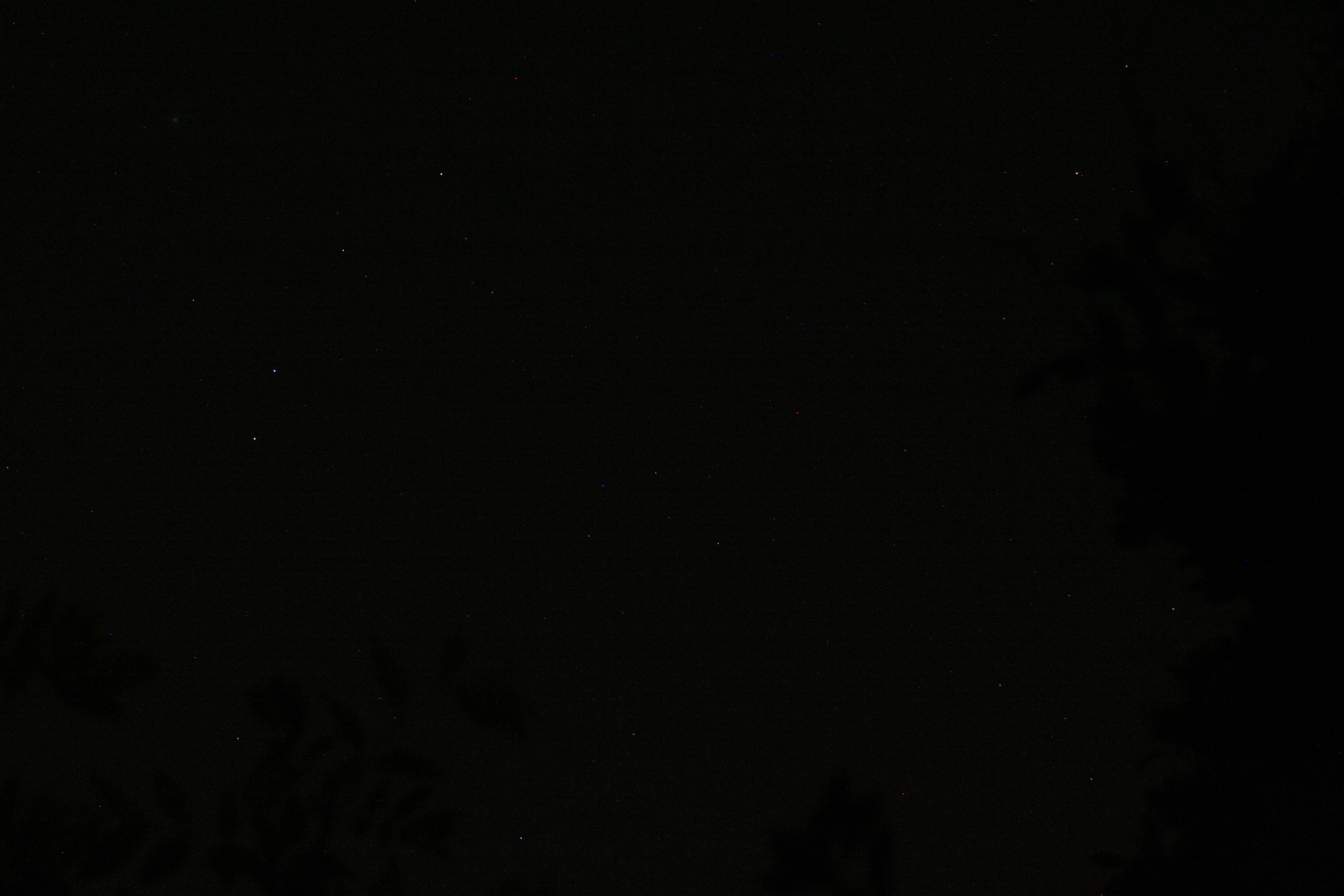
To make sure I got some pictures of the comet, I covered that whole section of sky with overlapping wide angle (75mm instead of 300mm) pictures. First aiming low and to the right, Lovejoy can be seen in the upper left corner, a green fuzzy spot.

IMG_0843 small

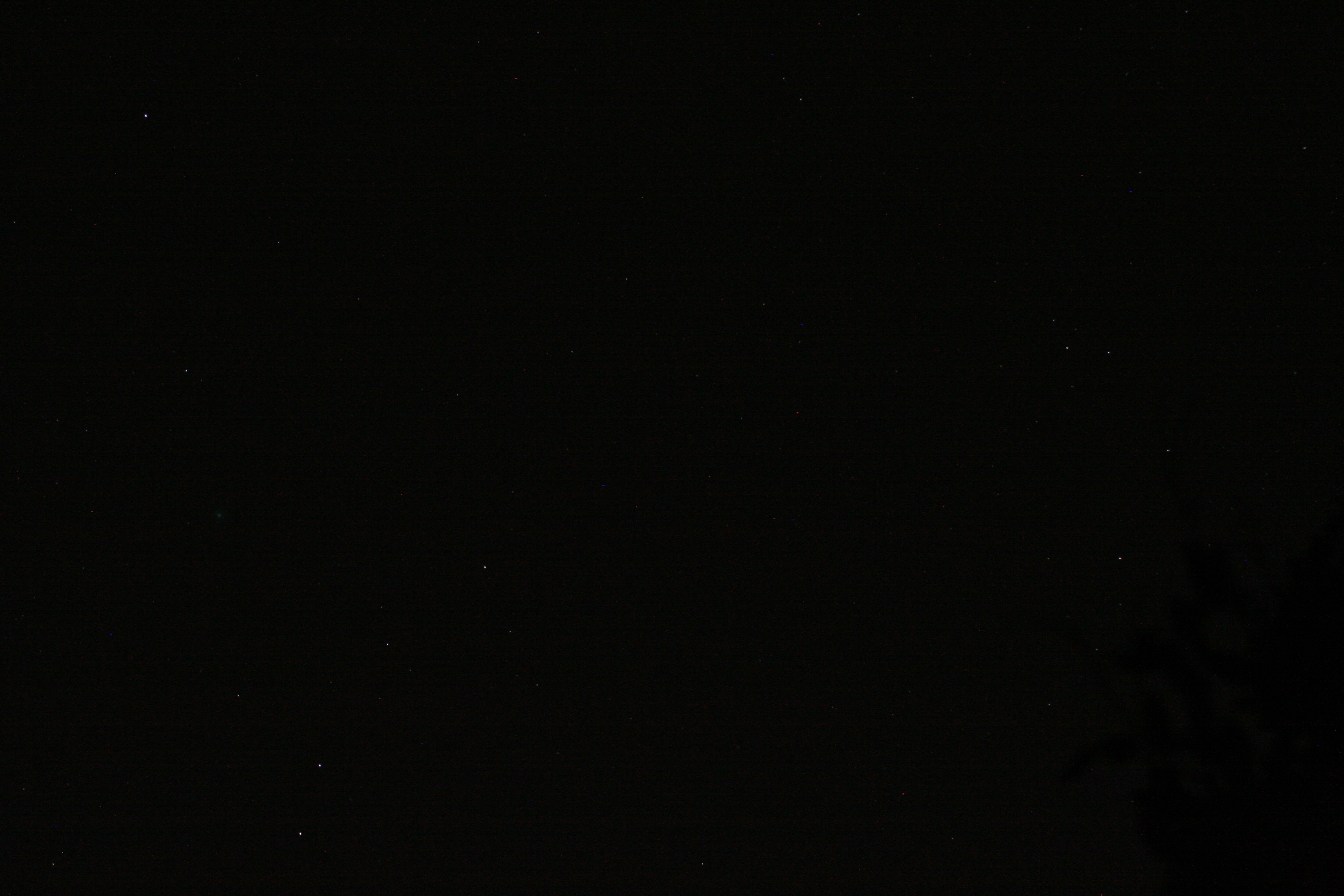
Aiming higher, it’s now in the middle left, a bit in from the left edge.

IMG_0849 small

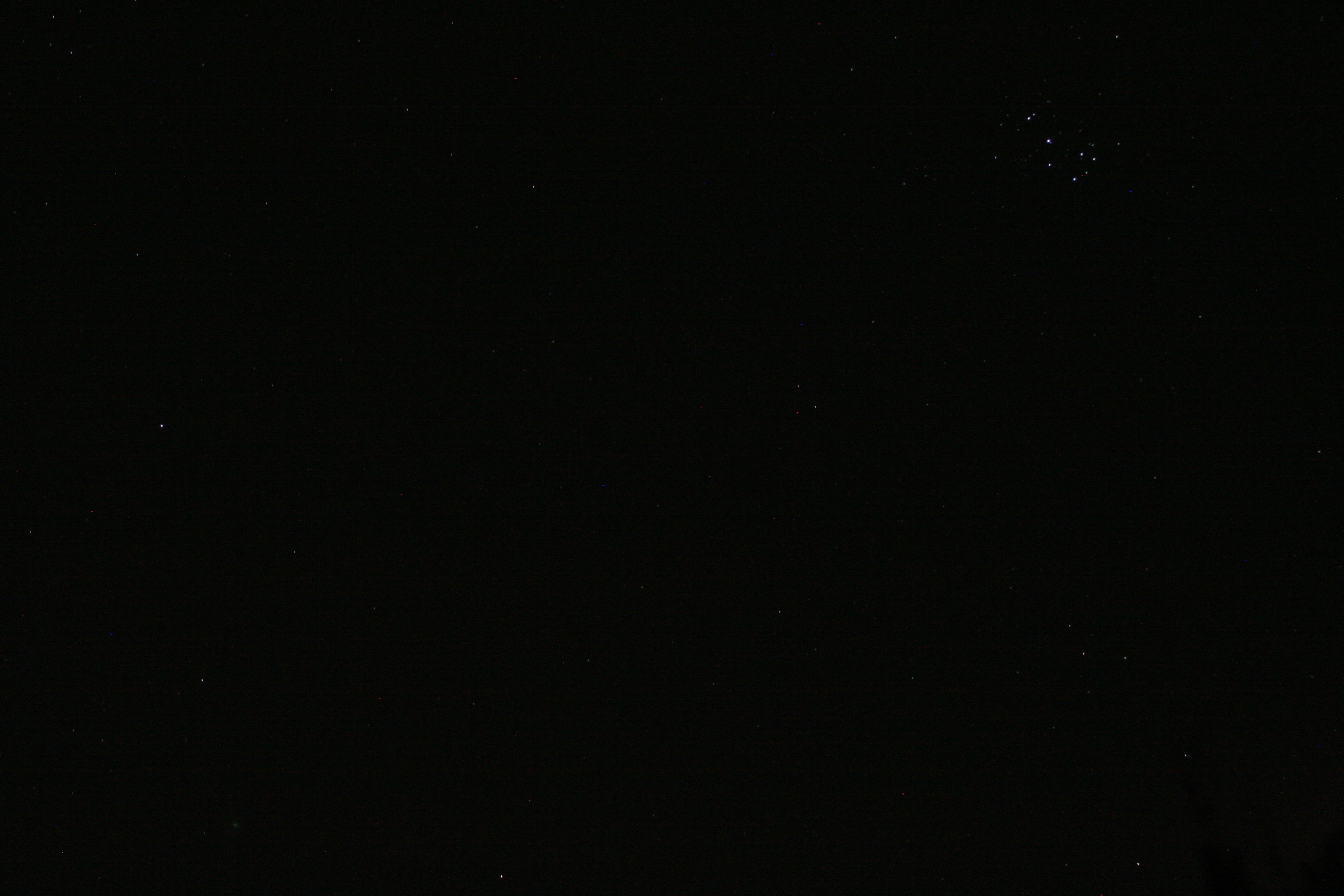
Aiming still higher, Lovejoy’s now in the lower left, just above the bottom edge. You can see the Pleiades at the upper right. If the frame were slightly bigger, just up out of the frame’s upper left corner you would see Taurus.

For spotting Lovejoy over the next few nights, keeping Taurus and the Pleiades as reference points, Lovejoy will be in a shallow climb through this view, in a line up and to the right. By January 18th or 19th it will be directly below the Pleiades about where the top of that blurry tree branch is in the lower right.

IMG_0879 small

Coming back down and over to the left a half-frame or so, Lovejoy’s now just to the lower right of center at about 5 o’clock.

IMG_0885 small

Getting down to just over the treetops again, Lovejoy is near the top, just to the right of center.

IMG_0823 small

Finally, even though it doesn’t show Comet Lovejoy, this picture does show something we get to deal with living where we live. The approach to Burbank Runway 8 is pretty much right over our heads. Here’s Taurus in the upper left, the edge of the Pleiades at the center edge right, (Lovejoy is out of the picture, approximately a third of a frame below the lower left corner) and a Southwest 737 going overhead.

3 Comments

Filed under Astronomy, Photography, Space

Juicy Chunks O’ Wisdom For Thursday, January 8th

‘Cause it’s cloudy and I can’t go comet hunting tonight, that’s why.

  • But there was a break in the clouds at sunset and I was at a location where I had a good view of the western horizon. Venus and Mercury are only 1° apart and while I could clearly see Venus of course (REALLY STINKIN’ BRIGHT!) I could not see Mercury.
  • How did people playing poker become a television “sport” complete with breathless color commentary? And why does it have to come on after the hockey game so that I have to either stop what I’m doing to change the channel or just put up with it? (Yeah, #FirstWorldProblem!)
  • There’s no “Flash Fiction” tonight (or last week) because our Grand High Phoobah Chuck Wendig hasn’t given us new assignments. Probably a holiday break sort of thing. And I didn’t participate two weeks ago just because it was about 23:30 before I realized that it was Thursday…
  • So that’s another “next clear night” thing – get the binoculars (and camera, of course), get to someplace with a good western horizon (the hill at Pierce College sounds good) and go hunting for Mercury.
  • A thing going around The Intranets today showed where it was colder here (mainly northern tier states, New England, and 99.9999% of Canada) than it was on Mars. Cool meme (yeah, I passed it on) but the “spin” on the facts that makes it true(ish) is that we’re comparing high temps for the sol on Mars to low temps for the day on Earth. The lows on Mars (apples to apples) was about -75°. Plus there’s that whole total lack of a breathable atmosphere thing.
  • Re: not realizing that it’s Thursday until 23:30 – I might have a rotten brain. Or I might just be trying to stuff ten pounds of thinking and stress into a five-pound brain pan. (That old figure of speech got mangled pretty badly there, didn’t it?)
  • In thinking about a good local place with a slightly darker sky (to do it right I would need to drive up into the San Bernadino mountains, or better yet, out to someplace like Joshua Tree, but that’s four hours each way) I realized that there’s a “wilderness” park up in the canyons near our home, between LA County and Ventura County. It’s listed as “closed at dusk” but I called, got some administrative dude, and got told that I “probably” would be fine going there after dark with a camera and/or telescope. A ranger or cop might see me, but they “probably” would leave me alone once I explained why I was there. And I was “unlikely” to have anyone close the gate and lock me in for the night. But I did need to be cautious about the coyotes. And rattlesnakes. And possibly mountain lions. And skunks, especially skunks…
  • Bitch, bitch, bitch, bitch, bitch!
  • I’m going to check out that park and see if there’s a gate to be locked. If not, it might be critter time!

Remember, “There are two types of people in this world – 1) Those who can extrapolate from incomplete data”

1 Comment

Filed under Astronomy, Juicy Chunks, Space, Sports, Weather, Writing

Comet Lovejoy, Jan 6th & 7th

When last we left our plucky hero (i.e., me) we had spotted Comet Lovejoy and managed to get a couple of blurry photos of it. There was considerable room for improvement.

Last night I went out and spent some time playing with the manual focus on the Tamron 70-300mm zoom telephoto lens that I’m using on my Canon Rebel xT camera. Eventually I got better (leaving more room for improvement yet) by concentrating on bright constellations, such as the Pleiades and Orion. Eventually I ended up with this (remember, click on any image to get the full-sized version):

IMG_0109 small

This is an eight-second exposure at 70mm. The “belt” of Orion is in the upper left corner (three bright stars in a row) and you can just see the Orion Nebula (the middle star in the “sword”) at the far left edge, right about in the middle. Minimal blurring, which is good. No comet, which is bad. On January 3rd, it would have been visible in the lower right corner — but of course, it’s moving (up and to the right in this view), so it’s now out of the frame.

IMG_0126 small

It wasn’t that hard to find, pretty easily visible in just a few seconds through binoculars. This is another eight-second exposure at 70mm. Unfortunately, despite my practice earlier in the evening, all of my 300mm exposures (and we’re talking a couple hundred here) were all out of focus and trash. (Frustrating!)

Again, if you’re looking yourself (and you should be, assuming you’re not in one of those places with -40°F temperatures tonight), it will just be a hazy, grey or white patch through binoculars, almost like a vague and dim cloud. Sorry, the human eye doesn’t have enough receptors to see it like a camera can and give you that bright green glow that you see in pictures. For example, that picture is from a 12″ telescope in dark skies with almost 18 minutes of exposure on eight frames combined. Compared to that, your eye doesn’t stand a chance!

IMG_0185 small

Tonight we have scattered clouds that are getting thicker as the evening wears on. I managed to get this eight-second image at 81mm…

IMG_0195 small

…and this one (also eight-seconds at 81mm), both of which clearly show the green comet as a small, fuzzy ball. Both of these images are in pretty good focus, but the stars are a tiny bit blurred because of “trailing”. I’m using the camera on a fixed tripod, but the Earth is moving, so in a longer exposure the stars look like little streaks. For example…

IMG_0115 small

…compare this image to the first one above. This is the 30-second exposure taken in the same set as that 8-second exposure, and you can see how all of the stars are little arcs/lines going from the upper left toward the lower right. Proof that Galileo was correct — the Earth DOES move! (The “fix” for this is a telescope mount which is designed to counter-rotate at the same rate as the Earth does, so if it’s aligned correctly, the stars stay motionless relative to the camera. But I didn’t want to go to all of the effort tonight of hauling the big scope out and setting it up in the yard. Maybe after these clouds clear in a couple of days.)

Now, it’s 22:46 PST — let’s save the draft of this and take go back out to take one more shot tonight at getting some 300mm shots that don’t suck.

23:16 PST — The good news is that I got some 300mm images that are in much better focus than before. The bad news is that I wasn’t pointed at the comet.

You can’t actually see the faint, fuzzy comet through the camera viewfinder. You can only the brighter stars that way. Also, with the lens zoomed in like that you’ve got a much smaller field of view. So I sort of get it “close” to where I need to be, then take sets of pictures in a “search pattern” — sort of like playing “Battleship”. But midway through the first set the clouds rolled in with a vengeance. Right now you can’t even see the moon except as a brighter blotchy area in the thickening clouds, so I think that’s it for tonight.

But the next clear night, we’re going to kick that comet’s ass!

2 Comments

Filed under Astronomy, Photography, Space

Panoramas From Space!

I’ve been posting panorama pictures that I’ve taken, the newer ones from my iPhone 6+ which has a built-in feature to take them, the older ones generated by software from dozens of individual frames taken by a DSLR.

But before that, there was film…

When the Apollo astronauts got out on the lunar surface during our six landings there, one of the first things they did was to take a survey panorama, using their 70mm Hasselblad cameras. They did it just like I do (maybe that’s where I learned it, back in my lost youth), overlapping frames as you turn.

A group at the Lunar & Planetary Institute has put together those panoramas and they’re yours to peruse, along with all of the original 70mm frames.

JSC2004e52777Photo from Lunar & Planetary Institute, NASA, and Universities Space Research Association

Apollo 17 took fourteen panoramas. This is the “preview” file, i.e., the small, low-resolution version. If you want to see any of the full-sized, high definition files, visit the site.

Then there was the release today of a new panorama from the Hubble Space Telescope, the image of the Andromeda Galaxy being the largest panorama ever made from Hubble images. Over 100,000,000 stars can be seen, so go get your big monitor, load up the huge & zoomable image (if you can get through, their server seems to be a bit overloaded at the moment), put some Pink Floyd on, and go visit Andromeda for an hour or two!

1 Comment

Filed under Astronomy, Panorama, Photography, Space

Perspective Views

A tweet today from a fellow NASA Social participant, Amy Shira Teitel (@astVintageSpace), alerted me to some really spectacular images on the European Space Agency (ESA) website.

For example, I just have been browsing (search for “perspective view”) and found this view of the rim of the Martian crater Hygens.

Image from ESA, Mars Express

While ogling (and oooohing and aaaaahing – and drooling over) some of these images, it occurred to me that in a thousand years or five hundred years there will be people seeing these views in real life with their real eyes in real time — and they’ll be bored and oblivious to it.

They’ll be bored and oblivious to what we consider stunning, beautiful, and fantastic because for the them it will just be a part of their daily world. It won’t be amazing, it will be routine. It won’t be fantastic, it will just be what’s outside the window while they’re doing what they do every day.

We see these images as wonderful and amazing because of their scarcity, their newness, and the fact that in our daily world they’re so far away and so hard (i.e., next best thing to impossible) to journey to. We dream about seeing these views (and a billion more just like them) because of scarcity, because they’re currently out of our reach. We currently can’t see them in person, but our ambitions want to take us over that horizon to see new things, to see what’s never been seen before.

Then the idea flipped itself.

What do we ignore out of our windows that’s just a routine part of every day life, just what’s outside when we’re doing what we do every day? What do we take for granted that would be almost beyond belief for the dreamers of a hundred, two hundred, or five hundred years ago?

In the early 1500’s, when word was spreading through Europe and Asia of strange lands, people, animals, and sights, what did dreamers then hear tales of or see paintings and drawings of that made them long to see them in person, but know that it was nearly impossible? What of those things do we see every day and take for granted?

The Grand Canyon? The Rocky Mountains? The Great Wall of China? The Amazon?

Or would it be something as simple as a Florida swamp, an Arizona desert, or the Great Plains of the American midwest, totally trivial to us, but the stuff of dreams for that ancient dreamer?

Keep on dreaming of seeing Saturn’s rings from the surface of Enceladus, Olympus Mons from Phobos, or Jupiter from Io. But don’t forget to appreciate the daily view out the window that would have been the ultimate fantasy for your dreamer great-great-great-great-great-great-great-great-great-great-great-great-great-great-great-grandparents.

It’s all just a matter of perspective.


Leave a comment

Filed under Astronomy, Space, Travel

Comet Lovejoy, Jan 3rd 2015

In the winter of 1973, I spent many a sub-zero night standing knee-deep in snow, trying to see that decade’s infamous “Christmas comet”, Comet Kohoutek. I had no telescope, just a “Sears grade” pair of binoculars. I had no digital or video camera (of course, it was 1973!) but only an Argus C3 film camera.

In Vermont that winter, at night, it was really, really cold. I remember seeing the comet a few nights, just a fuzzy, white patch in my low-power binoculars.

Tonight, it’s not quite that cold in Los Angeles, but it’s down into the mid 30’s. This time with high-quality, astronomy-grade, Celestron binoculars and a pair of good DSLR cameras and telephoto lenses, I was after Comet Lovejoy.

The full moon wasn’t far away, and Los Angeles isn’t any less light polluted than it’s ever been. While I was not able to see Lovejoy with the naked eye (that should come when the moon’s not so bright in a few days), in the binoculars it was pretty easy to spot.

It’s not going to look like the pictures you might be seeing. (And you really, REALLY should click on that link!) In particular, at least here tonight, none of the distinctive green color of Lovejoy could be seen by eye. Through binoculars tonight, it was a white smudge, a powder puff. Where the stars were all pinpoints, Lovejoy looked like a small, round, pale white cloud.

So what happens when I try to get it with the camera?

First, the technique. This was fast and dirty, the cameras on a tripod, shooting a whole lot of frames from about 1/6 second all the way up to 25 seconds. Using the camera it was impossible to see the comet directly, so I went through series of pictures, moving the camera a bit for each set, changing the zoom and field of view for each set of sets.

It’s sort of like carpet bombing the sky with the camera, hoping to get lucky.

With the 28mm wide angle lens, the first thing that’s obvious is that the full moon is really messing with the pictures.

IMG_3180 small

Here the moon is just out of the picture at the upper left corner.

IMG_3180 annotated

Annotating that first picture, Orion is obvious, as it Taurus, and the Pleiades.

Tonight Comet Lovejoy is somewhere around where that yellow circle is. The way I found it (tonight — it’s moving so it won’t be quite in the same spot tomorrow) was by first finding Orion. In my binoculars, the field of view just covers the distance between Orion’s belt and Rigel, the really bright star that makes up the bottom of Orion’s right leg. Using that distance/FOV as a unit, I was seeing Lovejoy about two “FOV’s” to the right (east) of Rigel.

But with this picture and that bright moon, I couldn’t see Lovejoy. It might be the dot that’s inside that circle (click on any of the images to enlarge to the full sized image), but it might not be. Any longer exposures aren’t any better because the moon just washes them out even more.

IMG_9779 small

I moved to the telephoto lens at 75mm. In these pictures you can clearly see Lovejoy, and you can clearly see it’s green color. In this picture, Rigel is the bright star at the mid upper left, where Lovejoy is on the right side, about halfway out from the center to the edge of the picture, between the 3:00 and 4:00 positions. This was a 4 second exposure.

IMG_9788 small

Again, I was shooting blind, trying to blanket the area with different overlapping series of pictures. In this 4 second exposure, Rigel’s right at the center of the left side, while Lovejoy is at the 6:00 position, again about halfway from the center of the picture to the bottom edge. The green color is clear, as is the fact that it’s a bigger, fuzzier object compared to the stars, which are more or less pinpoints.

IMG_9818 small

The big problem of the night occurred when I tried to zoom in to 300mm. Again, blanketing the area with hundreds of pictures pointed in slightly different directions with a series of exposures, I got a couple of photos that are recognizable, if not good. Here Lovejoy’s at the far left side, near the top.

IMG_9827 small

Here Lovejoy’s at the far right side, again near the top.

The problem with the 300mm pictures is obvious – they’re out of focus. Focusing through the eyepiece is tricky at best, since the difference between in focus and out is absolutely miniscule. One might think that you could simply set the lens at ∞ and forget about it, but like 99.9999% of all lenses, the Canon lenses actually stop at a focus point just beyond ∞, so you can’t rely on that.

So Lovejoy’s there, I can see it, I can sort of take pictures of it, but I have to figure out something to get the focus right on the high magnification settings for the zoom lens. Something to work on over the weekend and into next week.

Look back at that annotated picture (above) or any of the sky maps showing Lovejoy’s path. Over the next month it will head up past Orion, past Taurus, and past the Pleiades.

You keep looking for it — I’ll keep trying to figure out how to get better pictures.

Clear skies!!

2 Comments

Filed under Astronomy, Photography, Space

Comet Lovejoy For The New Year

In case you haven’t heard, there’s a “new” comet that’s just now brightening to the point where it can be seen (in a dark sky) by the naked eye, and should be visible in binoculars even from the city.

Comet Lovejoy is visible over pretty much all of the Northern Hemisphere. If you can see Orion (one of the brightest and most easily distinguished constellations in the sky) you will probably be able to see Comet Lovejoy over the next couple of weeks.

Right now it’s down “below” Orion’s feet, but it will be coming up past Orion, Taurus, and the Pleiades during January. It should brighten even more over the next week or so before starting to fade. You can find plenty of sites out there with maps and suggestions on spotting it – try the Sky & Telescope page for starters.

Tonight Comet Lovejoy went right past the globular cluster M79. All over the web tonight there have been popping up some truly spectacular pictures, such as this one from  Chris & Dawn Schur. (Trust me, open that picture up!) It was taken from Payson, Arizona, which is out a long way from any city lights, about eighty miles northeast of Phoenix.

While the S&T article says that they were able to see Comet Lovejoy from their light-polluted location (in the Boston area), I wasn’t so lucky tonight. I went out a couple of times and kept coming back in to check the star charts to figure out where I was looking and where the comet was. It’s pretty easy to “star hop” from Rigel (the really bright star that’s Orion’s right foot) down into the bright stars of the constellation Lepus.

Capture

From IAU and Sky & Telescope magazine (Roger Sinnott & Rick Fienberg)

Using binoculars, you can find that pattern of bright stars that make up the body of Lepus pretty easily, particularly the top row of stars (θ, η, ξ, α, μ, λ, κ) that by themselves look like a mini-sized Big Dipper. (No, this isn’t the Little Dipper either – it just looks sort of dipper-esque to me!) From there it’s pretty easy to see where β and ε are, and from there it’s a piece of cake to see where M79 is.

Over the next few nights, Comet Lovejoy will be moving toward the upper right corner and past Orion, but tonight it was right by M79, so if I could spot M79…

No joy. We’ve got some high haze moving in as the front of a cold storm that’s going to last a couple of days (they’re expecting SNOW in Las Vegas for New Year’s!). That haze, combined with the bright quarter moon, combined with the normal Los Angeles mega-ultra-gonzo light pollution levels, didn’t let me positively identify either M79 or Comet Lovejoy.

It should have been right there… I could spot all of the stars I was using for guidelines and even the next dimmer layer of stars that aren’t shown on the chart above, but I never did see the dimmer, more diffuse comet or globular cluster.

It’s well known in observing that the best low-light detection in the eye is off to the sides. It’s called “averted vision” and you use it by looking just a bit off to one side, then concentrating on what you see at the corner or side of your field of view. Doing that I thought that I might have just barely, kinda sorta seen two fuzzy patches where they were supposed to be — but not enough so that I would swear to it in court.

Oh, well. It’s too late and too cold to disassemble the big 8″ scope, haul it out into the front yard, set it up, then reverse the process. Maybe after this next batch of clouds clears toward the weekend, if I can’t see it yet in the binoculars, I’ll haul out the big scope and/or head toward darker skies.

How about you? Now that I’ve given you the road map and clues, is anyone else spotting Comet Lovejoy yet?

Let me know if you do, and I’ll keep you updated on my progress.


3 Comments

Filed under Astronomy, Space, Weather