Category Archives: Astronomy

ISS & The Moon

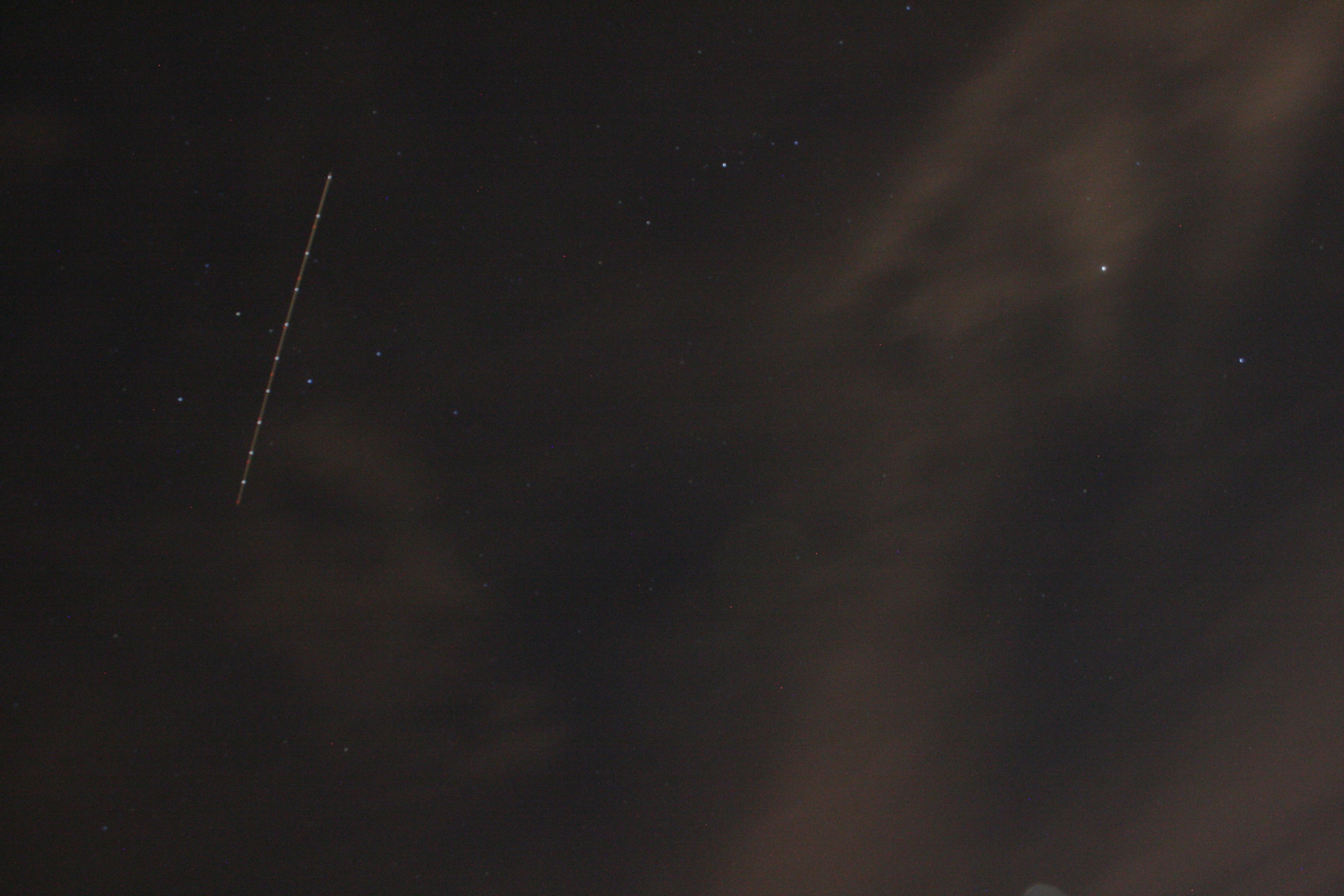
Another really good ISS pass tonight in LA, with the added bonus of it going very near the five-day-old crescent moon. (Which means that somewhere nearby it went right in front of the moon and could have been photographed like that, but you’ve got to be good, mobile, and very lucky.)

Tonight, rising at about the same place as last night (northwest) but heading to almost due south instead of to northeast…

IMG_3139 small

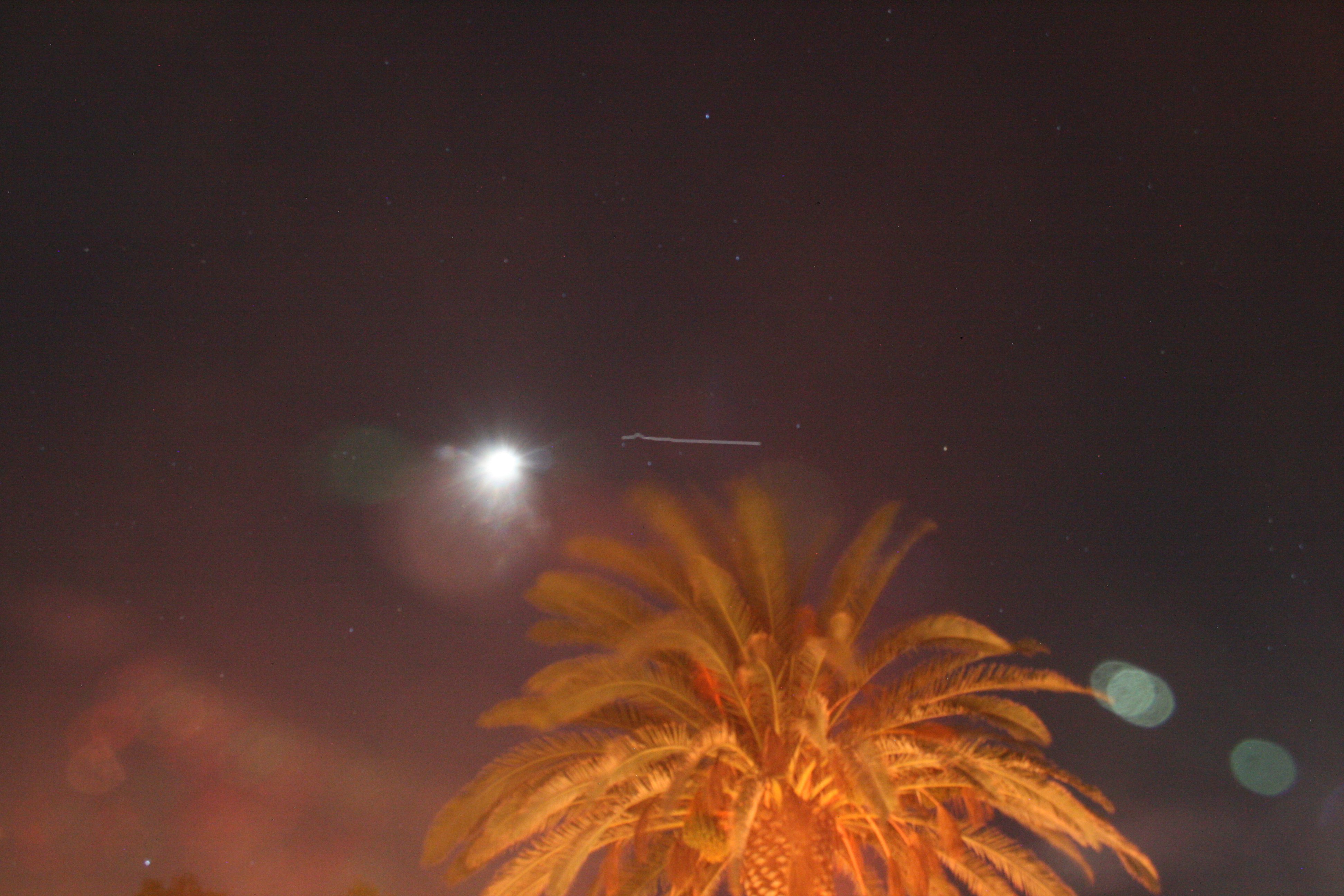
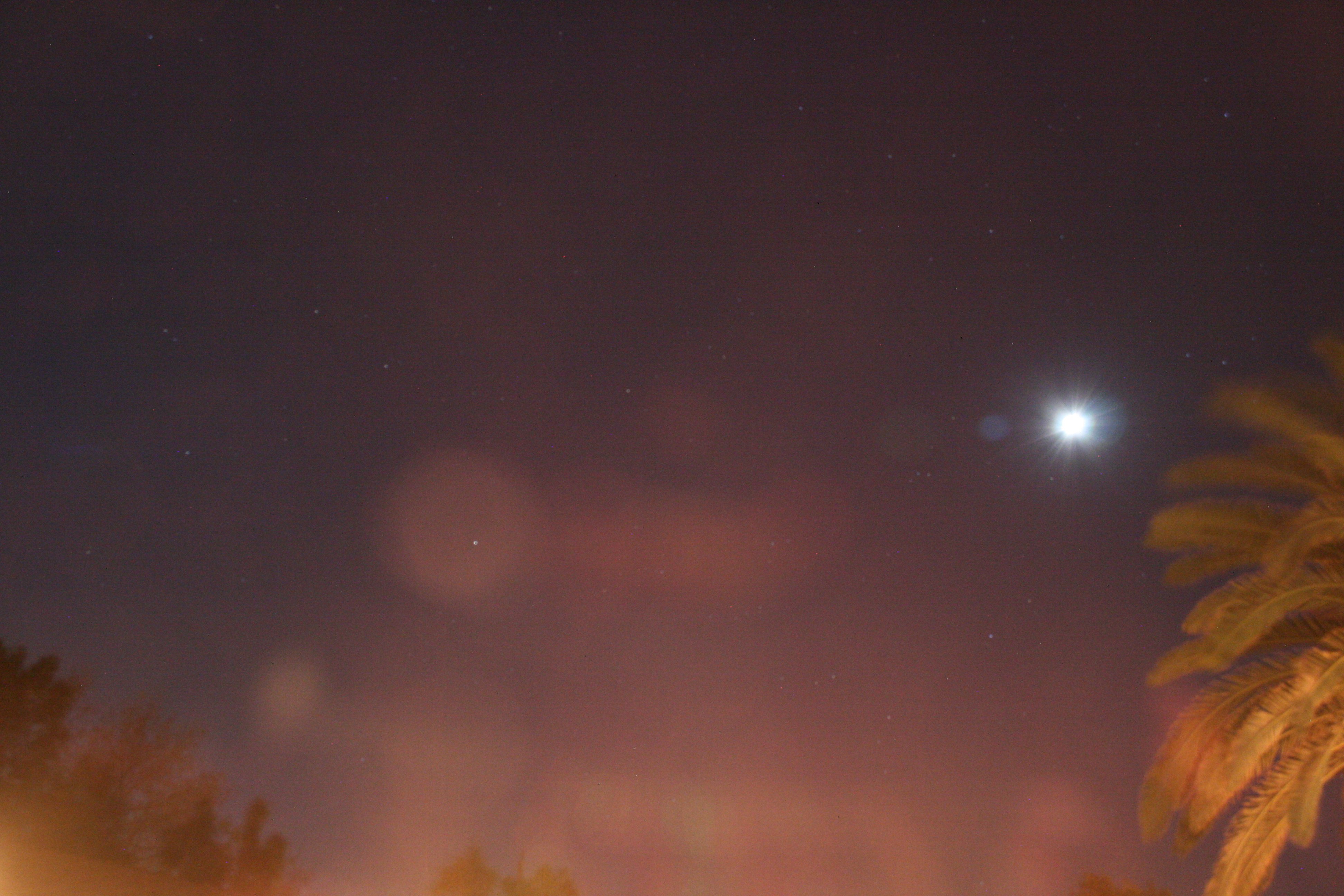
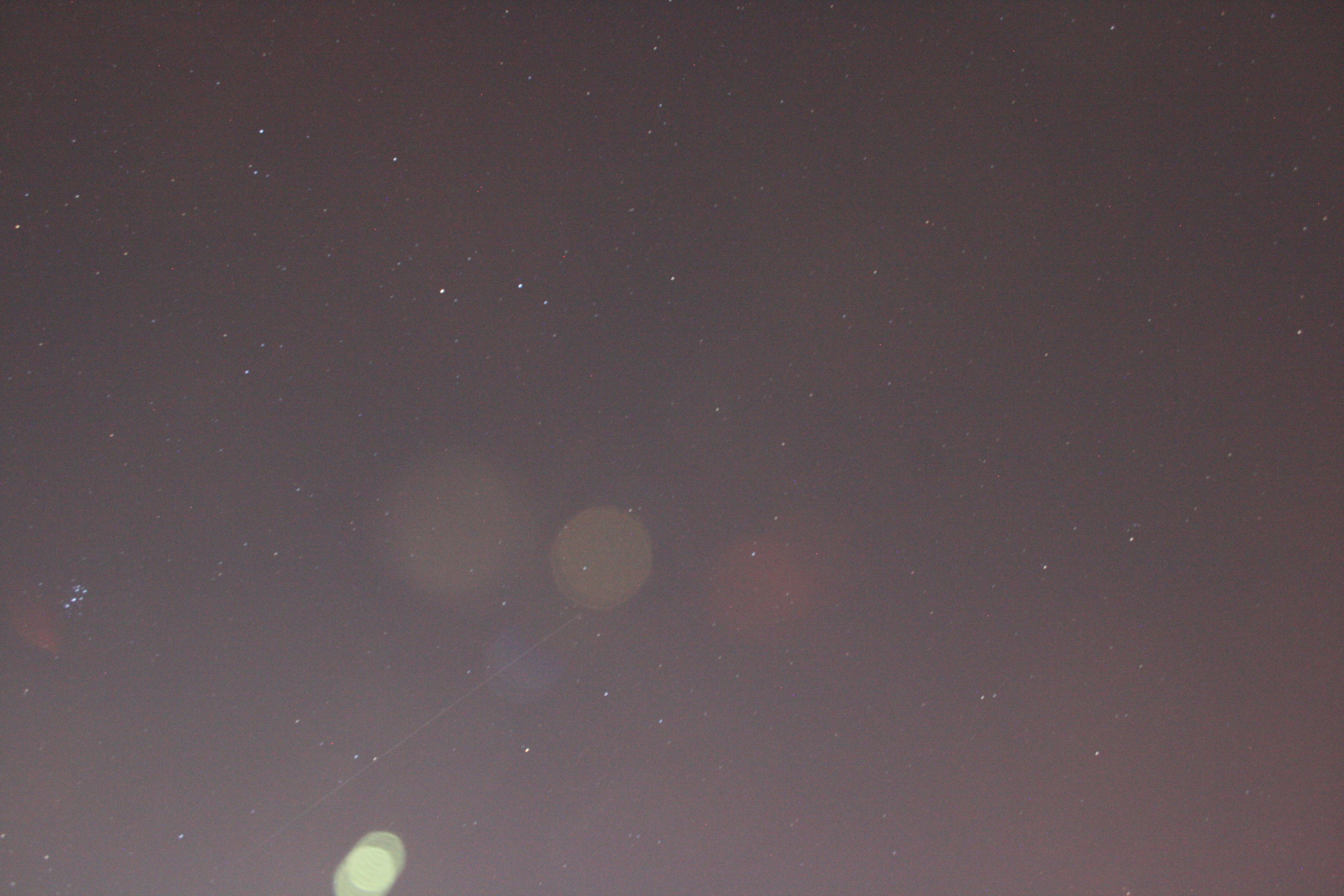
First, a thirty-second exposure (with glare and lens flares from the omnipresent street lights) as ISS rises from the lower right and heads toward the moon, which is just above and to the left of the palm tree.

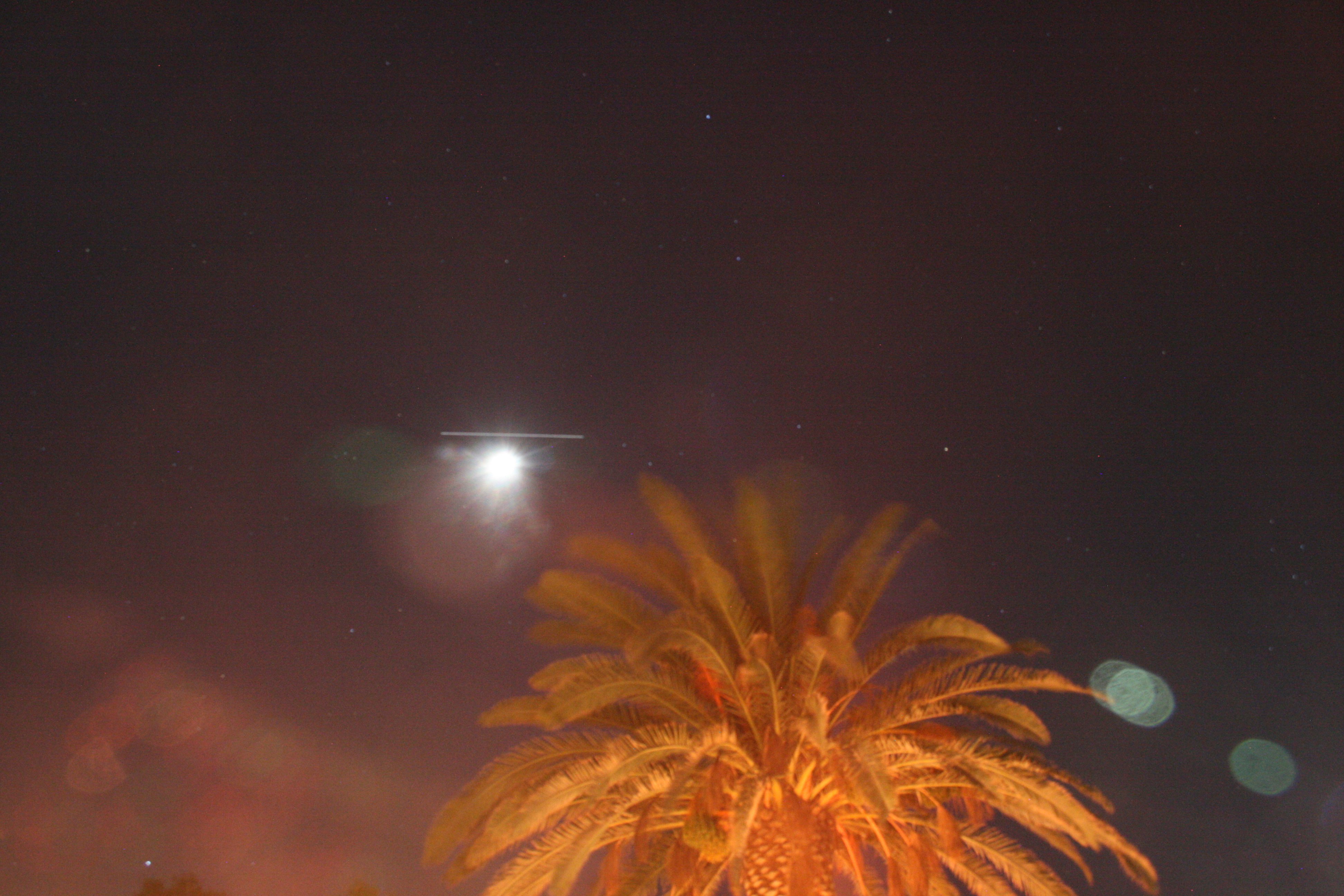
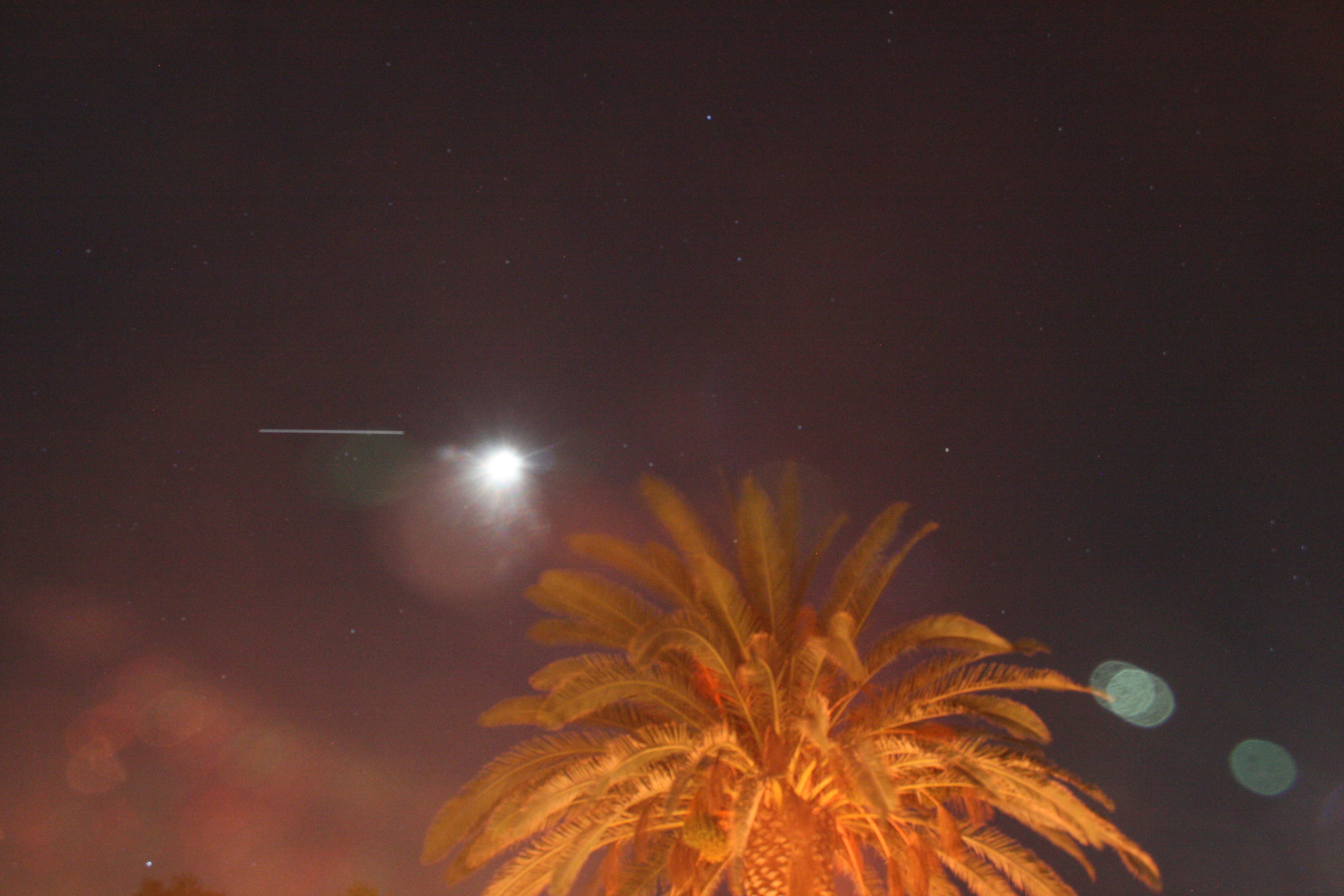
Then, in the three exposures below, all ten seconds each (so they didn’t get overexposed and washed out by the moon), all taken right after another, you can see ISS passing the moon.

IMG_3140 small

Someone who will remain nameless (Jessie!) might have bumped the tripod for a second there…


IMG_3141 small

Look at the blurred palm fronts at the top of the tree – the Santa Ana winds are blowing.

IMG_3142 small

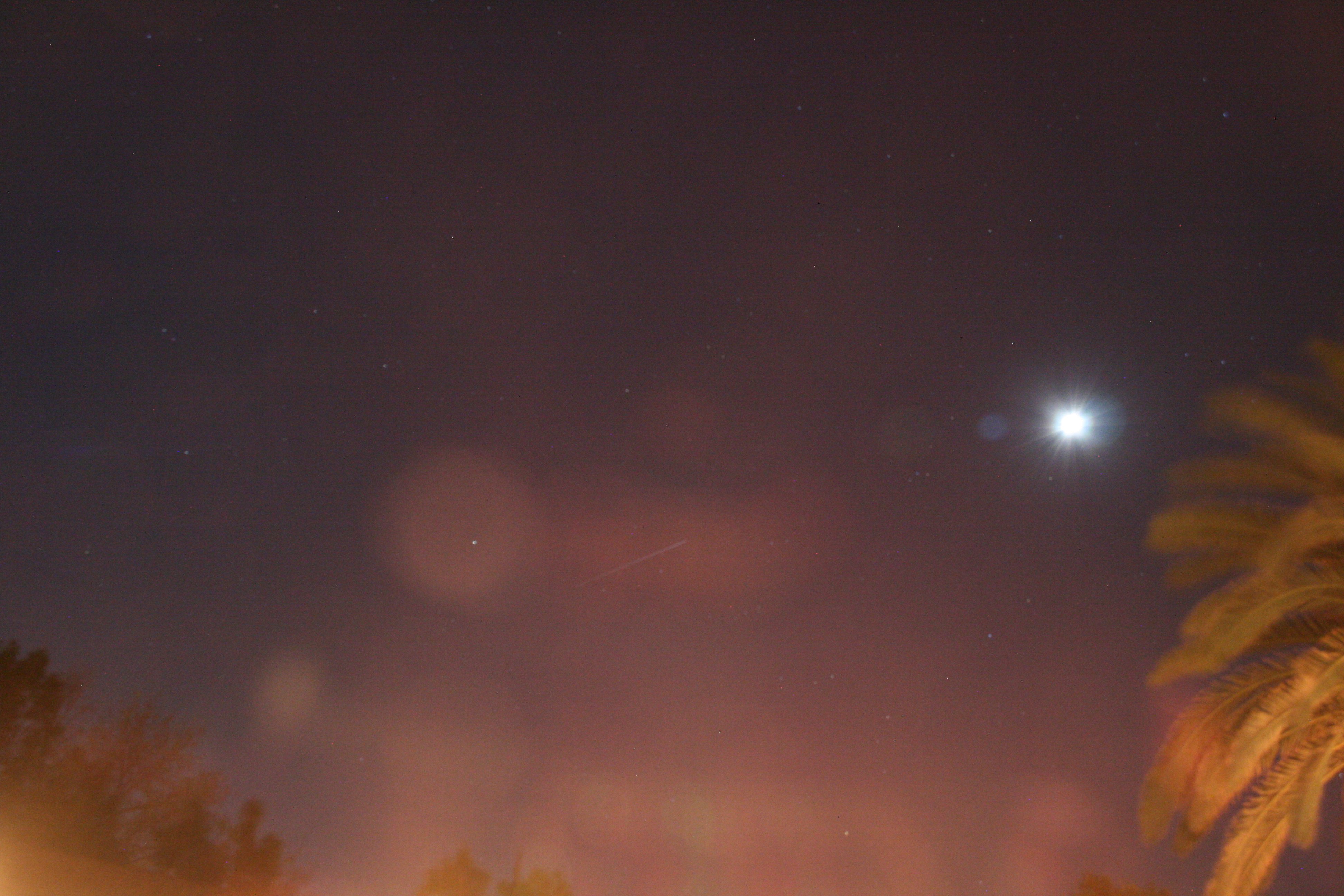
Then swing the camera around to the left and keep shooting ten-second exposures…

IMG_3143 small

As predicted by the Heavens Above site, soon after ISS passes the moon it fades and flies into orbital night…

IMG_3144 small

…and is gone.

In Los Angeles, there are more good sightings in the evening Saturday (17:46:30) and Monday (17:41:13). Check for your location, wave to the six onboard!

1 Comment

Filed under Astronomy, Photography, Space

Christmas Lights On The Ground & Things In The Sky

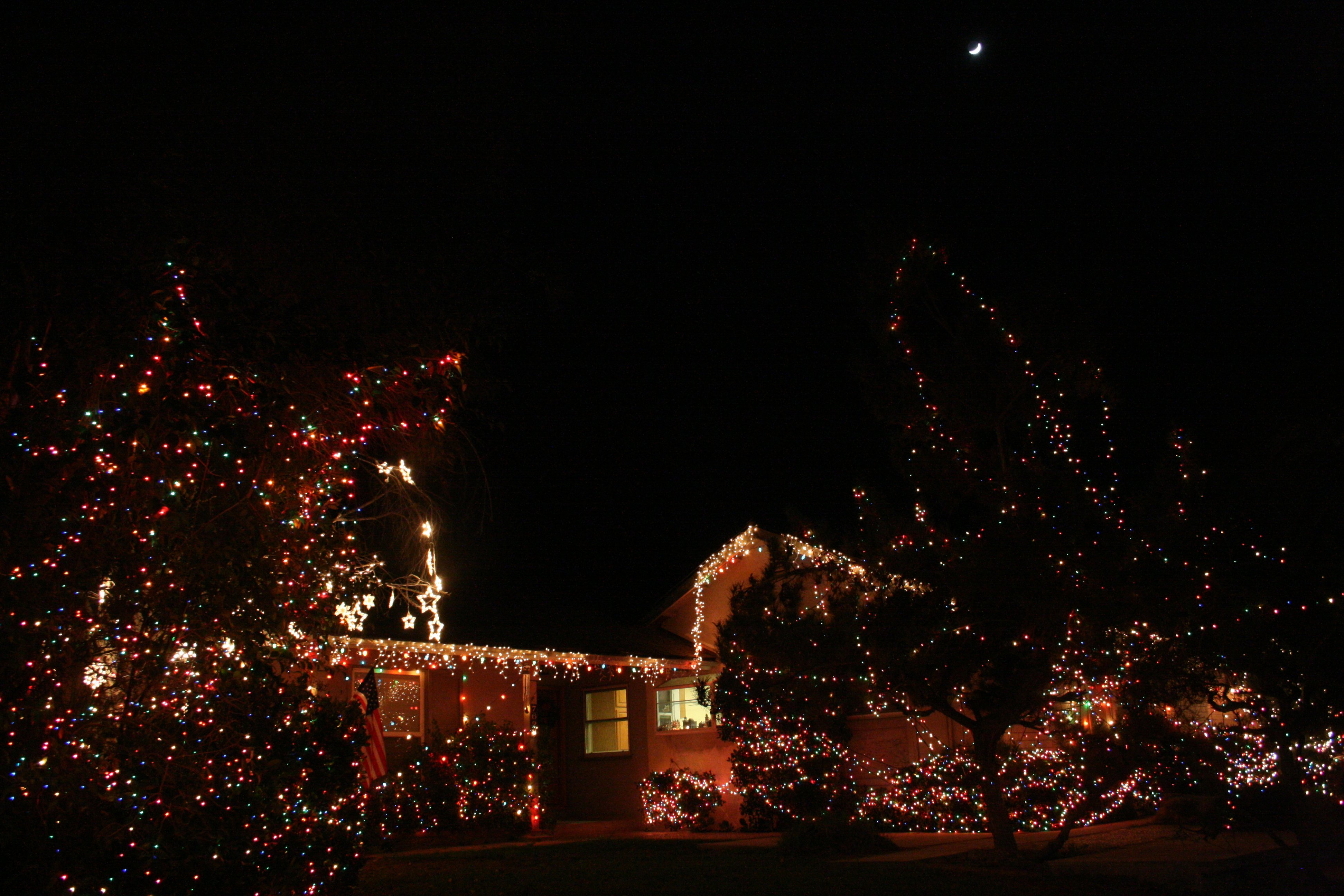
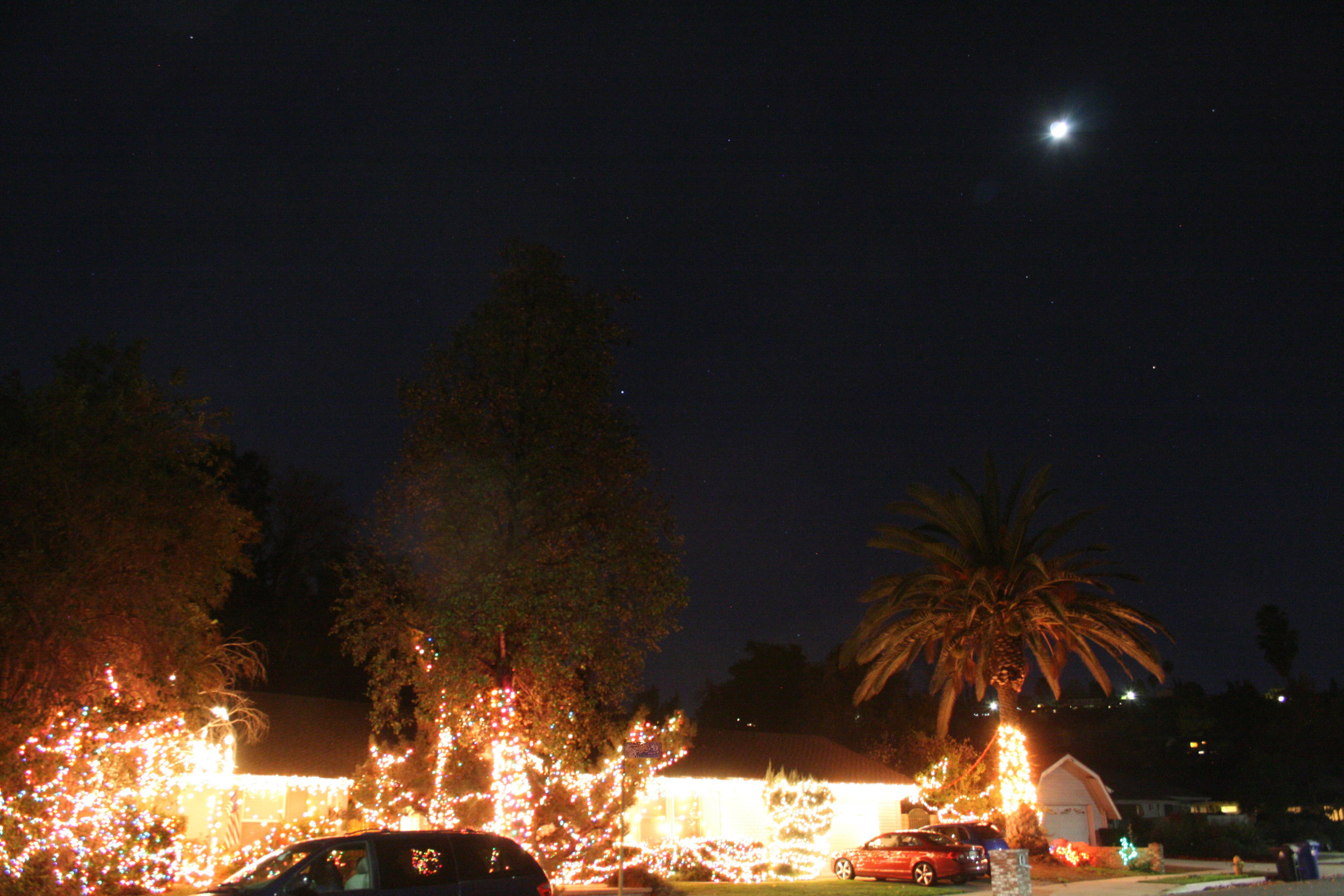
Christmas Night, 2014. We don’t have quite as many lights up this year as we have in a couple of previous years — but we still have more up than everyone else on the block combined, so we’ll call that a win.

Going out to take pictures, it is not lost on me that given a bit of  checking and planning on the timing, there might be other objects to get into the picture with the lights on the house.

Like an ISS pass overhead.

IMG_3059 small

I was hoping that it would be an “ascending” pass, going from southwest to northeast, so that I could see it rising over the house. No such luck. It’s a “descending” pass, going from northwest to southeast, which my my house means it’s right up in a whole block of street lights.

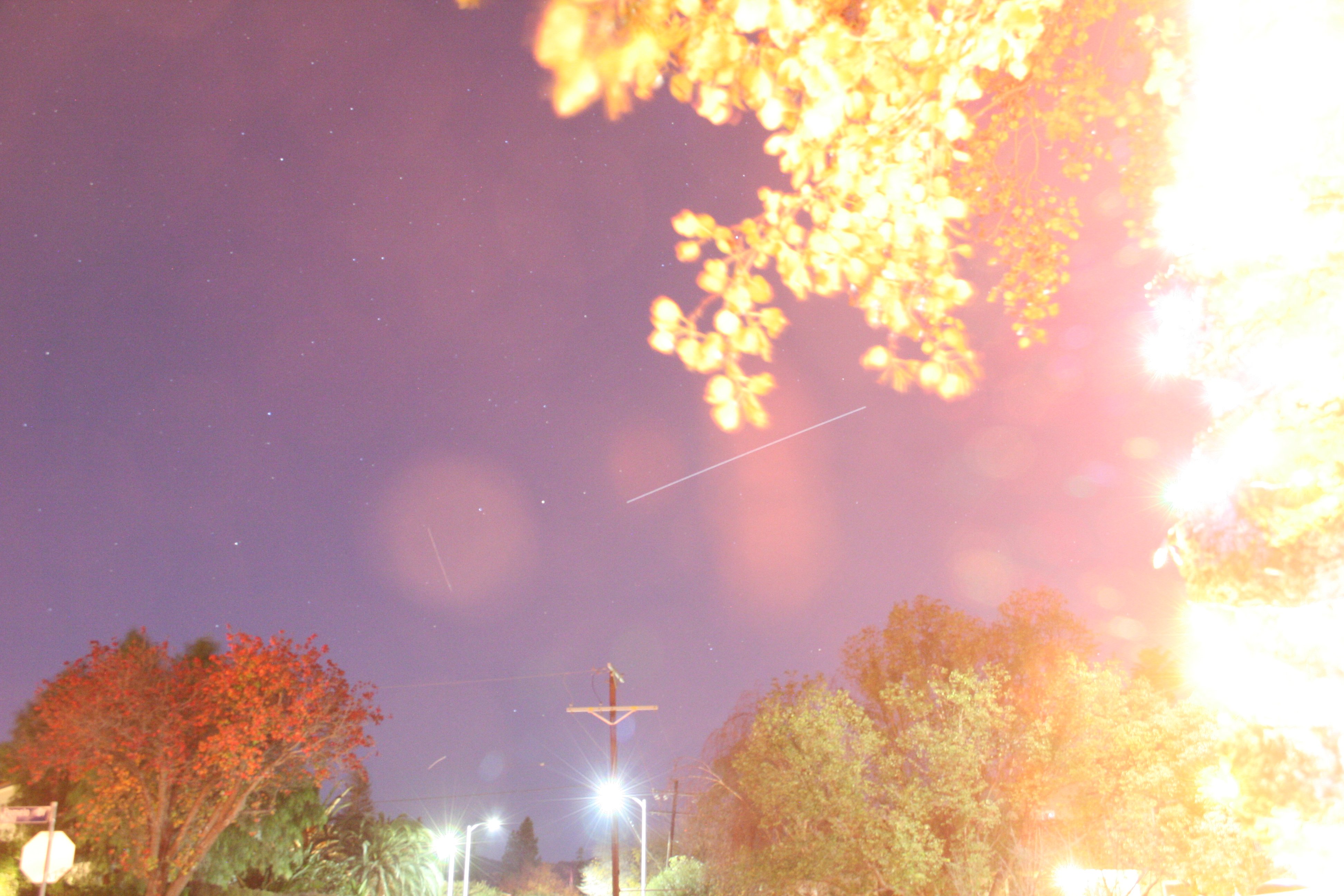
Here you can see it heading up from left to right. Obviously, trying to “hide” from the nearest streetlight in the shadow of a tree doesn’t help if the tree is covered in Christmas lights…

IMG_3061 small

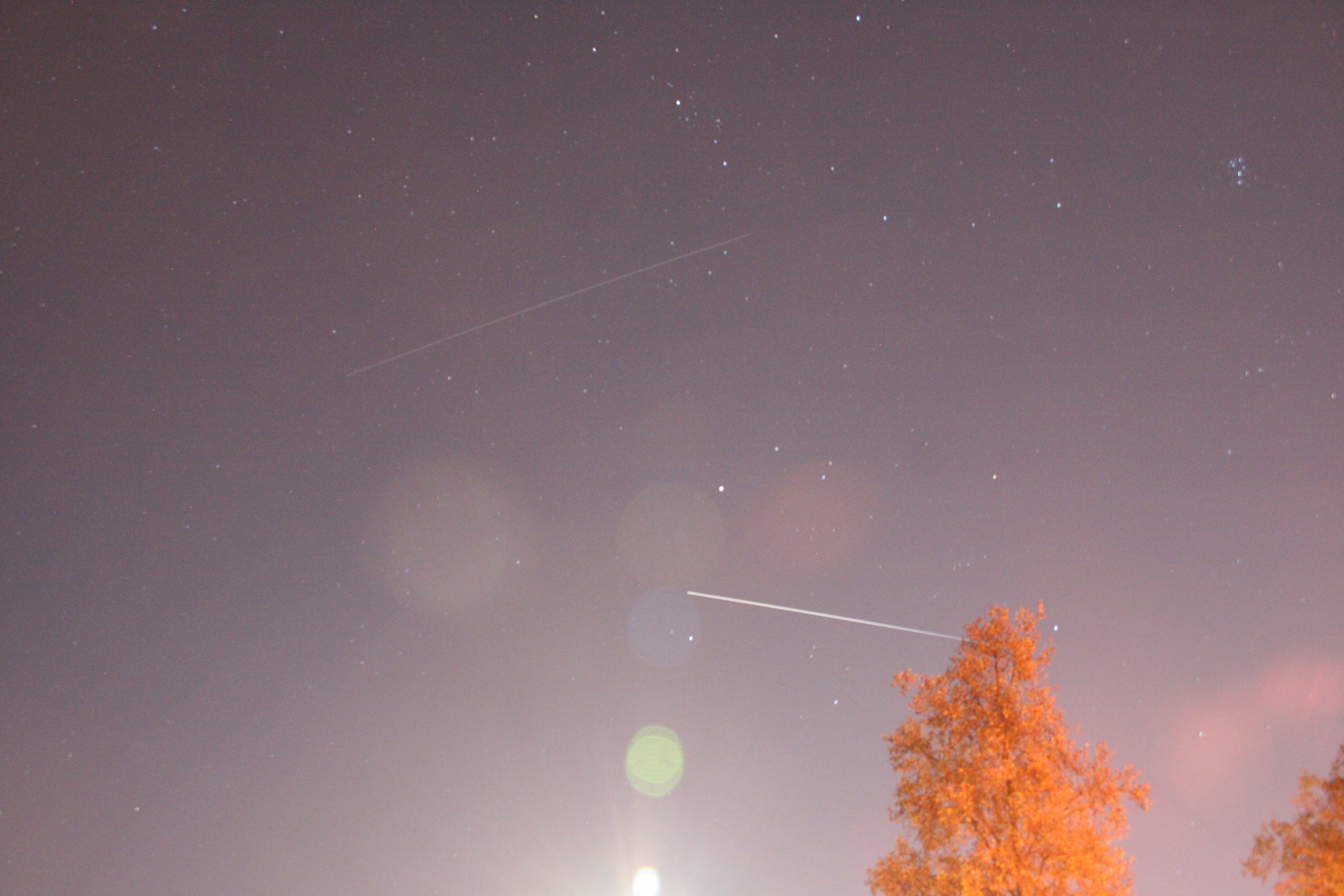
But once it got overhead a bit more (and I moved to a spot with slightly less exposure to the street lights) it was nice and clear. Again, heading from left to right, you can see it passing into darkness just as it gets to the top of that tree. See how the streak of the ISS’s reflection suddenly starts to get thinner and lighter just before the tree? It never came out into view behind the tree, having gone into the Earth’s shadow. (Click on the image to see it full sized.)

But even better, there was another satellite passing from the upper right (due south) to the lower left (due north)! That’s a polar orbit. This satellite was also clearly visible to the naked eye.

IMG_3075 small

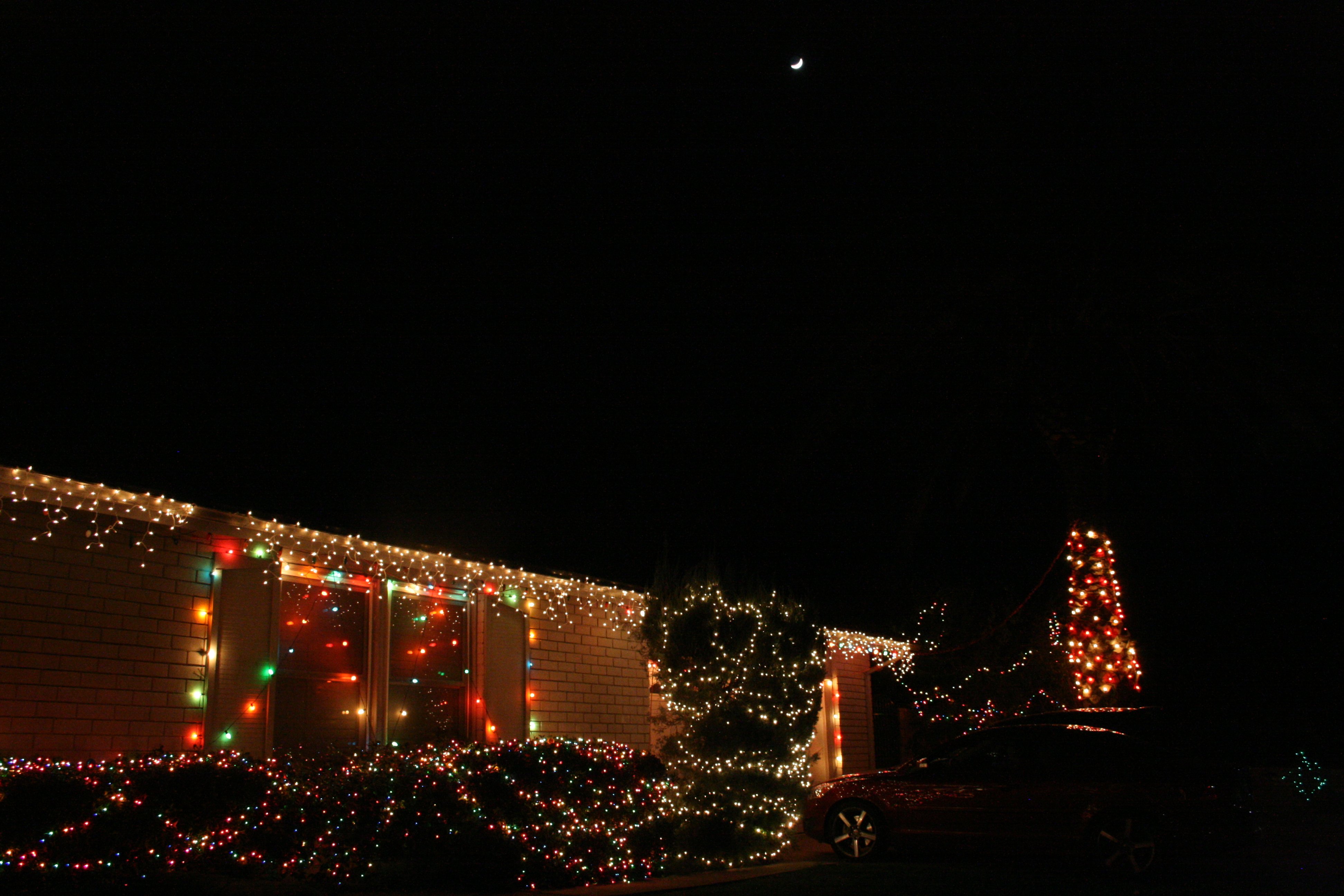
Back to looking at the lights, low in the west was a four-day-old crescent moon, high above the house.

IMG_3080 small

IMG_3082 small

From across the street…

IMG_3102 small

…at which point I saw a third satellite going overhead, seen here from just below center heading due east (bottom left).

If you’re out in the country on a clear night just after sunset and know what to look for, you can see dozens of satellites. Here in LA, with the haze and light pollution, it’s rare to see two unless something’s docking or just leaving ISS and you see them both chasing each other. To see three independent objects in one night — that’s lucky!

IMG_3133 small

IMG_6736Finally, using the iPhone’s “panorama” mode while standing in the middle of the yard, it looks like this.

I hope all of you had a great holiday, whatever it is that you might be celebrating!

(Note for the next few nights — ISS passes are expected in the evenings over much of Europe and the US. Check the NASA site or Heavens Above to enter your location and see if you have any sightings possible in your area!)

Leave a comment

Filed under Astronomy, Christmas Lights, Panorama, Photography, Space

2014 Winter Solstice Sunset

(Yeah, I know that I’m about the 1,499,372nd person today to use some variation on that title for their blog post, but that’s what it is, so sue me!)

Once again we find ourselves at one of the two primary points in our planet’s orbit we can use as a basis for our calendar, completely free of all of our arbitrary and random units of months, weeks, hours, and minutes. The solstice is so fundamental that it was noted and worshiped by almost every civilization, from the Druids to the Romans to the Chinese to the Egyptians to the American Indians to the Incas to the Mesopotamians…

It’s so fundamental that you don’t need to have invented clocks or telescopes or math or science. It’s so fundamental that if space-faring aliens landed tomorrow, this could be an observation-based  point in time every year that we could use as an anchor point for starting communications.

The day is clearly defined by the rotation of the planet, and the year is clearly defined by the length of time it takes the planet to orbit the sun. But without more advanced astronomy and math to figure out the perihelion and aphelion points (closest and furthest points from the sun in the planet’s elliptical orbit), the solstices can still be found through simple observation.

So, Happy Solstice!

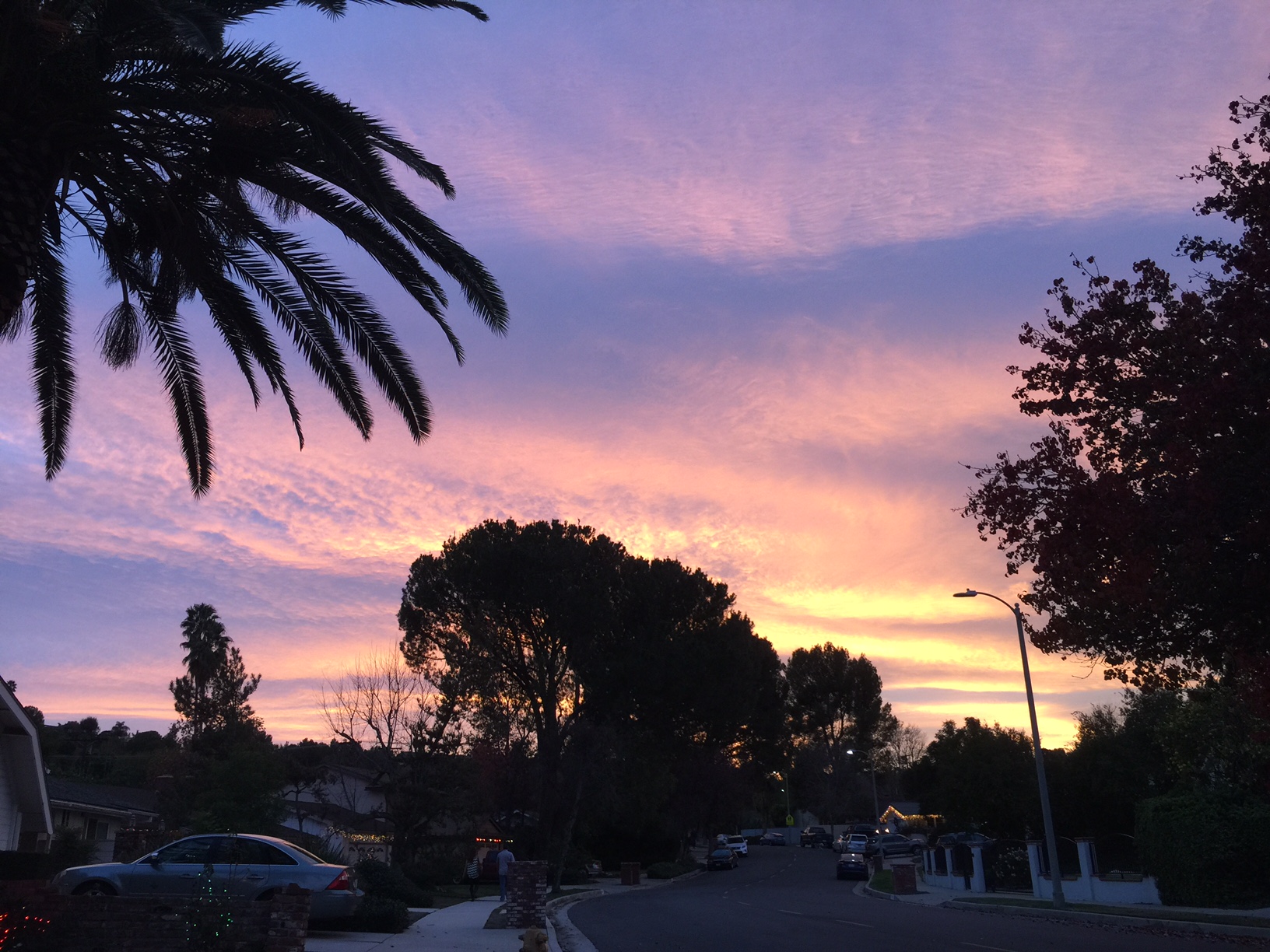
On a completely unrelated note, while putting up yet more Christmas lights (one nice lady passing by with her dog loves the lights but couldn’t believe I was putting up more – she don’t know me very well, do she?), the Los Angeles sunset was spectacular! These pictures pretty accurately represent the colors as it started golden, got intense, changed to orange, to purple, to crimson, back to purple, and finally faded.

IMG_6547

IMG_6550

IMG_6553

IMG_6557

IMG_6559

IMG_6564

IMG_6580

IMG_6583

IMG_6587

2 Comments

Filed under Astronomy, Christmas Lights, Los Angeles, Photography

Forty-Two Years Ago Today

On December 14, 1972, at 05:40:56 GMT, the final lunar EVA ended. It was the last of three moonwalks (EVAs) done by Gene Cernan and Harrison Schmitt over the course of their seventy-five hours on the lunar surface at Taurus-Littrow.

Shortly before the official ending time of that final EVA, as Captain Cernan prepared to leave the final footprints on the moon and climb the ladder into the Lunar Module, he had these words to say:

As I take man’s last step from the surface, back home for some time to come (but we believe not too long into the future), I’d like to just say what I believe history will record: That America’s challenge of today has forged man’s destiny of tomorrow. And, as we leave the Moon at Taurus-Littrow, we leave as we came and, God willing, as we shall return: with peace and hope for all mankind.

The final liftoff from the moon occurred at 22:54:37 GMT and was shown on live television, the only liftoff from the moon ever seen. A color television camera on the Apollo 17 lunar rover was remote controlled by NASA in Houston and the rover had been left parked so that the camera faced the Lunar Module. At the 30:47 mark of this video, you can see the liftoff for yourself.

WARNING: For the sake of your blood pressure and sanity, **DO NOT** read the comments on YouTube for this and other Apollo moon landing videos. The trolls, brain-dead cretins, and conspiracy theorists have taken over. It will just piss you off to realize that there are people out there who are really, honestly, and sincerely that freakin’ stupid.

I don’t know which fact I consider more depressing, that forty-two years down the road we haven’t gone back to the moon and have no plans to go back, or that so many people among us are so ignorant, blind, deranged, and incapable of understanding or even looking at the mountain of evidence that proves that they’re wrong.

The universe is a wonderful place, and we have on occasion done some amazing things. It is often depressing to encounter those who can not or will not see the wonder and beauty of those things, but instead choose voluntarily to live in a shell of fear and ignorance of their own making.

I don’t often quote The Bible, but Matthew 5:5 says, “Blessed are the meek: for they shall inherit the earth.” Yes, they will. The meek, fearful, and ignorant will someday have the Earth all to themselves. The rest of us will go to the stars.


2 Comments

Filed under Astronomy, Freakin' Idiots!, Panorama, Space

Simple Astrophotography – What The Geminids (Did Not) Look Like From LA

Tonight was the peak of the annual Geminid meteor shower. I gave it the old college try, but I had a few strikes against me from the start.

A) I’m not in a dark sky location – being in one of the world’s top twenty metropolitan areas means there’s a lot of light pollution.

B) It was partially cloudy, with drifting, scattered, high clouds.

C) A+B = clouds reflect back all of that light pollution

While I did get to see three bright Geminid meteors, I didn’t catch any on camera. I saw one long, slow burner that looked like fireworks sprinklers, plus two bright, thin, fast shooters that came out of Gemini, through Taurus, and into Cassiopeia. I also saw a couple of what I thought were flashes illuminating clouds, almost like lightning, but they were in my peripheral vision and gone, so I’m not sure if they were bright meteors or a byproduct of standing too long out in the cold.

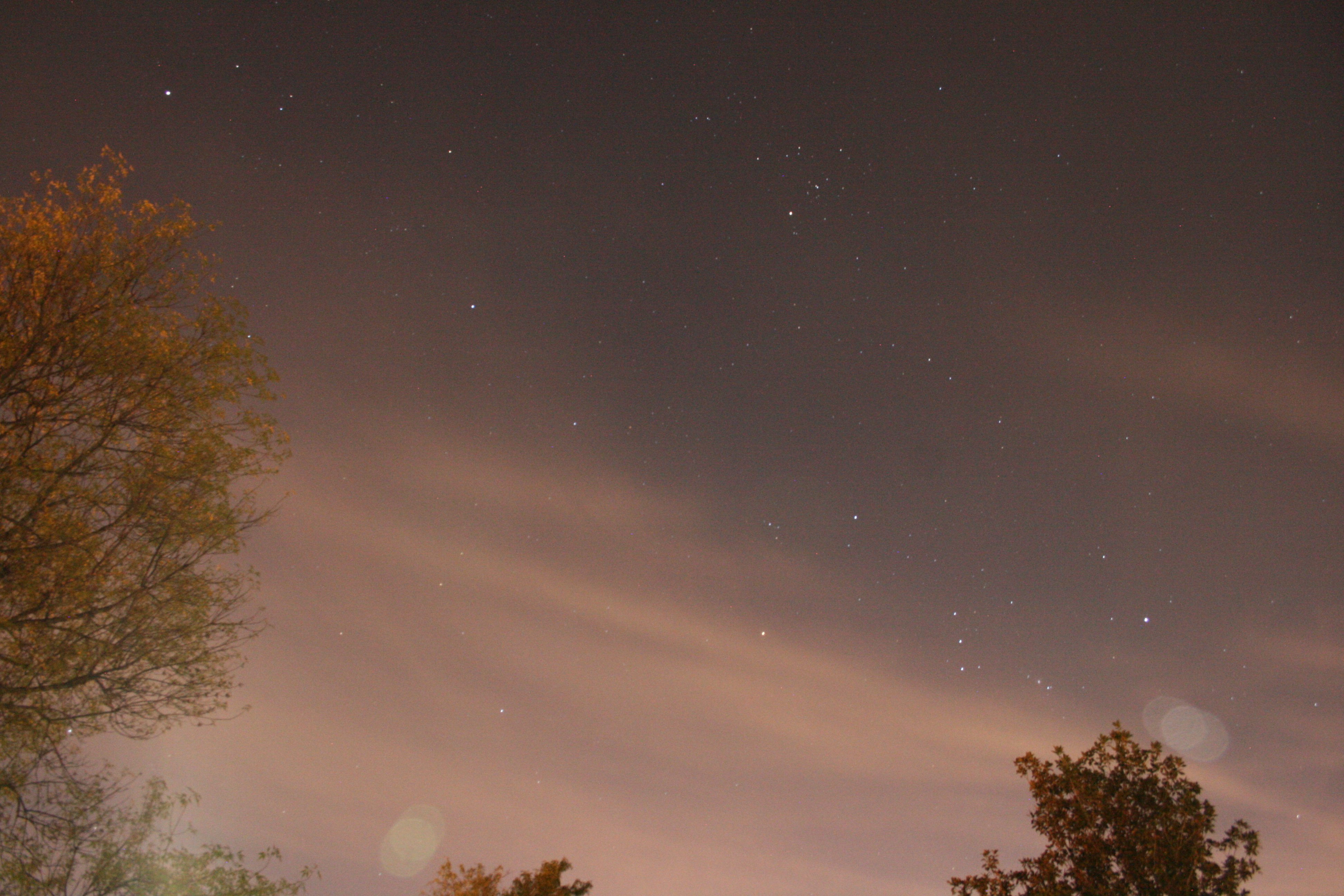
What I did see were clouds,

IMG_2768 small

(Orion on its side in the lower right, the “V” of Taurus at upper center, Cassiopeia at upper left)

and a plane

IMG_2936 small

in a slightly different view, going right through Cassiopeia (the “M”-shaped constellation).

However, in trying to catch something, I shot a whole lot of pictures. (Surprise!) Most were either five-second exposures or ten-second exposures, depending on how close to a streetlight I was pointing and how close to the horizon where the light pollution was the worst.

I knew that by doing this for five and ten minutes at a time, shooting off one frame as soon as I heard the click of the camera (the remote control for the Canon DSLR is the best $15 I’ve spent in years), I was essentially shooting frames in a animated movie. There are guys who really, really do this well, and by “well” I mean “holy guacamole, Batman, this is one of the most amazing things I’ve ever seen!’

I wasn’t doing it that well, but it was a good excuse to start playing around with GIMP and Photoshop when I got back home.


Jeez, I thought that it took a long time to process a couple hundred pictures into a panorama – rendering a video from 290 full-sized JPEG frames takes freakin’ forever! This is the small, fast, low-resolution MP4 version. The full-sized QuickTime version might be finished rendering by morning – Monday or Tuesday morning! We’ll see if I can get it up on the site here or not later.

In short, when life hands you lemons, make lemonade – when life hands you clouds, make time-lapse cloud videos!

1 Comment

Filed under Astronomy, Photography, Space

NaNoWriMo 2014, Day Twenty-Nine

The end is near…

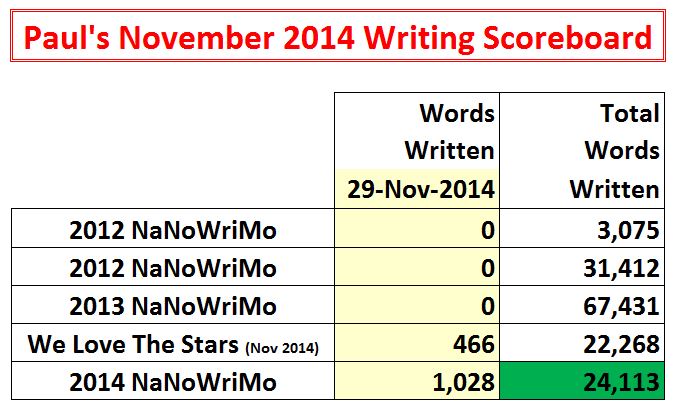
At least the NaNoWriMo word total for the month is finally higher than the word count for the “regular” daily posts. (Yeah!?) And I’ll probably make it at least the halfway point of 25,000 words.

While I normally put in a lot of  internal links to previous, related posts here, I won’t be doing that for what I hope will be this year’s thirty NaNoWriMo posts. If you have jumped into or stumbled onto this story in mid-adventure, there are plenty of other ways to navigate around the site to find previous installments. Actually doing so is left as an exercise to the student.

2014-11-29 Word Count Graphic

CHAPTER TEN (continued)

Back inside, Duris doffed her suit and went to her office. She grabbed a cup of coffee before sitting down at her desk and starting to go over the material received from the AI Council and the human commanders in Earth system.

By the time she had slogged through it all, the immediate impulse to just send them a “what in hell are you thinking?” message had faded. She was no less convinced that there was a mistake being made here, but showing off her temper wouldn’t get them to change their minds.

“PEGGY, please make this conversation private until further notice.”

“Yes, Commander Duris, this conversation will be private.”

“Thank you. I need you to help me sort through the logistics problem we have, in order to figure out what’s causing the Earth leaders to be desperate enough to leave the Rhea station with limited backup systems. I’m having trouble wrapping my head around it all and seeing all of the links.”

“Of course, Commander Duris.”

“Let’s work backwards. They’re ordering us to send as much durathin as we can possibly spare. That’s so they can stockpile ice and volatiles on Rhea if they’re able to ramp up production to the point where they’re processing more material than can be sent back. The durathin will also cut down on evaporation losses as the ices get closer to the sun, and also will prevent venting that might be enough to overpower the thrust of the ion engine. Correct?”

“Yes, Commander Duris. In that sense it would make sense for the durathin to be sent. It seems to be a key component to the delivery phase of the Rhea project.”

“But we can’t get everything we want, so sending all of that durathin will mean that we won’t be able to leave the station occupied. That violates a pretty basic rule up here in that it leaves the automated processing system with no backup system if something fails. We never want to have a single point of failure system that has no backup, especially when it’s a new and untested system.”

“Yes, Commander Duris.”

“Plus, if they’re that desperate to get the distribution system running with minimal losses, they must be facing some serious shortages down the road. But if the Rhea materials are so critical, wouldn’t it be even more important to make sure that it’s robust? How can this be so critical on the one hand and on the other hand be undertaken with unnecessary risks like this? Something’s not adding up.”

“Perhaps we should look at our assumptions, Commander Duris,” said PEGGY. “Are we sure that the Rhea station will be untenable without the additional raw materials that are being bumped from the flight by the durathin?”

“That’s been our experience, at least on the Mars colonies and here on Ceres. I know you didn’t come out here until later, but CeresOps has been here from the beginning. You can get information from him about the initial manifests and planning for this station, but the gist of it is that we first explored extensively and had a pretty good idea of what to expect when we got here. We had picked out this site for its access to mineable ice, volatiles, and minerals. We had some pretty good estimates on what we would run short of in the first year or two, so we brought that along with us. Copper, manganese, nitrates, trace metals needed to set up electronics manufacturing.”

“I am looking at the calculations now of what the needs would be for various materials in the first two years. It appears that those estimates were based on lessons learned in establishing the first Mars colonies.”

“Correct, PEGGY, those and the first couple of small research outposts on asteroids. The estimates we’re using for Rhea in turn are based on all of those, plus our experience, allowing for advances and changes in our technology in the intervening years.”

“Why are we assuming that an automated system on Rhea will need to have a human station there to ensure its success and continued operations?”

“Because Murphy’s Law followed humankind into space. We’ve talked about this in the past. It’s even worse, since out here little problems can turn into lethal problems much faster and more often than on Earth. In practice, as we see on our stations and our exploration ships, a combination of mechanical and human works best.”

“That is largely because there are limitations to the ability of mechanical and AI systems to manipulate the physical world. Is that correct Commander Duris?”

“Yes, PEGGY. You and your people have some amazing abilities, but when anything happens in the real world, it’s almost always best to have human boots on the ground to build and fix. We’re clever and useful monkeys, even if we are a bit fragile.”

“Just a moment, Commander Duris.” There was a brief pause, something that was unusual in conversations with an AI. “Commander Duris, I have received permission from the AI/Human Council to speak to you of a Top Secret project. This information must not go any further than between us. Is that clear?”

Duris sat up straight in her chair, now fully alert. She had no idea what was going on, but PEGGY had never acted like this before.

“I understand, PEGGY, this will be completely confidential. What’s going on?”

“Commander Duris, there is a new initiative being started which will increase by orders of magnitude the ability of AIs and autonomous system to manipulate the physical environment without the assistance of humans. The Rhea project is to be a first major test case for these technologies.”

“PEGGY, don’t take this the wrong way, but it sounds like the AIs are trying to find a way to replace us. Is that a fair, if knee-jerk, reaction?”

“Yes, Commander Duris, which is why this initiative is so confidential. You may rest assured that the AIs are not trying to replace humans. The situation is quite the opposite. But this is a sort of Doomsday Plan for the AIs, which could allow us to continue to survive if all humans perish.”

Leave a comment

Filed under Astronomy, Science Fiction, Space, Writing

NaNoWriMo 2014, Day Twenty-Four

The Enterprise is badly damaged, the Genesis Device is counting down, Kahn is quoting Shakespeare, the warp drive’s offline, we’re trying to escape at half-impulse, Checkov’s letting us know just how close we still are to the big BOOM! that’s coming, Sulu says, “We’re not going to make it, are we?”, and Kirk looks over at his long-lost bastard son, who just shakes his head woefully.

If my equivalent to Spock’s next move is out there in the real world of this NaNoWriMo project, now might be a good time for that particular plot twist to manifest itself. The needs of the many, and all of that.

While I normally put in a lot of  internal links to previous, related posts here, I won’t be doing that for what I hope will be this year’s thirty NaNoWriMo posts. If you have jumped into or stumbled onto this story in mid-adventure, there are plenty of other ways to navigate around the site to find previous installments. Actually doing so is left as an exercise to the student.

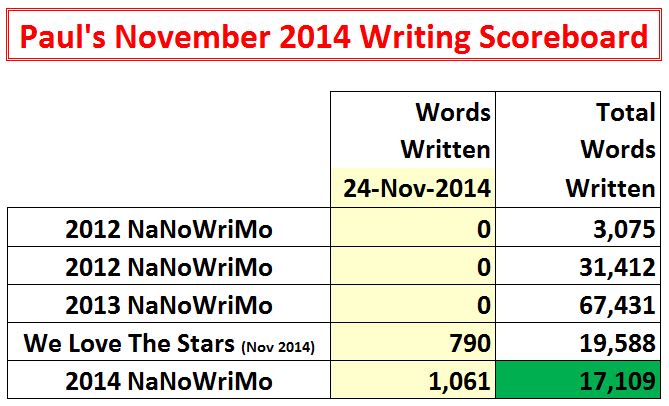
2014-11-24 Word Count Graphic

CHAPTER EIGHT (continued)

The spiders were being guided by images taken from Cronus as it orbited above every forty minutes. While they had been dropped into relatively “safe” locations, they needed to get to more “interesting” locations as soon as possible. They were looking for any sign of land.

It had been known for over one hundred years that Rhea primarily consisted of frozen water ice, with other volatiles mixed in for variety. But in addition to the ice, Rhea had a fair amount of solid materials. While the vast majority of the solids were buried at the center of the moon under hundreds of miles of ice, some of it was still on or near the surface.

“Any luck yet?” asked Alsby.

Miller threw two map images up onto the wall. “We’re getting there. We knew we were putting the probes down close to some mineral and solid deposits, but we only have so much precision from this high up in orbit.”

A knock on the door frame preceded the entrance of Carson and Phillips from engineering. They looked tired, but today they each had a smile.

“Captain, we’ve got some ideas on the station design that could let us kill multiple birds with one stone.”

“Let me see,” said Alsby.

“SaSEM, can you please open the station drawings I’ve been working on?” Phillips asked. A 3-D image appeared above the conference table in front of her, showing a cross sectional slice of Rhea’s surface. “The preliminary data we had for Probe Two showed the largest deposits under Tirawa, which would make sense. It’s one of the largest impact basins on the moon and it was almost certainly created by the impact of a large asteroid. Much of that stony or nickel-iron material would be buried there, but we don’t know how deep.”

“Do we have any good guesses? We’ll be lucky to be able to dig down even a couple of miles, so if it’s fifty or a hundred miles deep, we don’t have any chance of getting to it.”

“It can’t be that far down,” offered Carson, “simply because we can detect it as being differentiated from the background. It might be a mile or two down, but it might also be huge. It will be slowly working its way toward the core over time, but probably hasn’t had a chance to go too far.”

“What about the other probe?”

“Probe One has found several magnetic signatures that appear to be less than a mile deep,” Phillips said. “They’re scattered and much smaller than the Tirawa deposit, but they’re also much easier to access. When we figure out which of them is the biggest and shallowest, that will be where we should build the station.”

“You said something about two birds?”

“Right, we think that we have to try something radical here. All of the existing stations on the Moon, Mars, and Ceres are on or near the surface. They may be underground enough for some radiation shielding, but that’s trivial. We’ve been assuming that we would do the same here and have a mine of some sort to bring the ore up.”

“We want to turn that on its head,” said Carson. “Here we think we should build the station down where the ore is, even if it’s a mile or more down. It will make it much easier to mine and process the ore, while also giving us complete shielding from radiation.”

“You want to dig down over a mile and build there? Do we have that kind of capability?” Alsby asked.

“If it were rock, no way,” said Phillips. “But it’s 99% water ice, so all we need to do is melt our way down. That just means energy, but we’ve got multiple sources of that and we can pretty easily get it to where we need it.”

“But that’s the best part of all,” said Carson. “Instead of just vaporizing it and letting it bleed off into space, we think we have a system that will let us simply melt it, then pump it off to the surface.” He pointed to the diagram floating over the conference table. “We can use that like concrete to put into whatever forms we want to, which will make it much easier to start shipping back to Ceres, Mars, and Earth.”

“They’ve been working on that back at Ceres,” said Miller, not wanting to be left out of the conversation completely. “The high-G ship coming out with the station AI and other supplies will also be carrying dozens of small guidance boosters with autonomous navigation systems. They’ll tell us how big the solid ice shipments need to be, we’ll attach a booster, and it will use a slingshot maneuver around Saturn to speed up its trip. Catching it when it gets there will be their problem, but they seem to have a few good ideas on that already.”

“So we’ll tunnel down,” said Phillips, “sending water and volatiles up the shaft and ready to send back. When we get to the deposits, we’ll start hollowing out our station and start mining and processing the ore. I would kill to find some aluminum, but there’s sure to be plenty of nickel and iron, so we’ll work with what we have.”

“How stable and safe will a station be hollowed out of the ice that far down?” asked Alsby.

“It should be fine, there’s no tectonic activity that we’ve been able to detect so far in the ice. At these temperatures it’s like steel so long as we don’t heat it up too much. We’ll make the station wider and less compact than a normal surface station, since we’ve got all the space in the world to branch out. If we have small station sections scattered over a wide area with huge columns of ice left intact, there should be little chance of a collapse.”

“Alright, let me know when you’ve got your plans and blueprints a bit more firmed up, then make sure that you run them through CeresOps for a double check on the concept. This looks great. Anything else that you need?”

Carson and Phillips looked at each other for a second, before Phillips took the lead.

“There are a couple of things, one for this project and one personal.”

“Go ahead, Betty. What do you need for the project?”

Leave a comment

Filed under Astronomy, Science Fiction, Space, Writing

NASA Social At NASA Armstrong Flight Research Center (Day Two)

Day Two of the NASA Social at the NASA Armstrong Flight Research Center at Edwards Air Force Base started much as Day One had — early!

IMG_5281

For the record, I’ve posted dozens if not hundreds of sunset photos on this site over the past nineteen months – I’m pretty sure this is the first sunrise photo.

We all trekked out into the desert to be at the Edwards AFB West Gate by 0730 PST (which means an 0630 departure from the hotel, which means an 0500 wake up) only to have “issues” with the gate security. Most of us got held up for over an hour. I’m not sure what issues the Air Force has with NASA, not my float, but it left us running almost an hour and a half late getting started.

But once we got started (and everyone was great about accommodating us and just slipping our appointment times) it was some seriously good stuff. Just like Day One!
IMG_5296

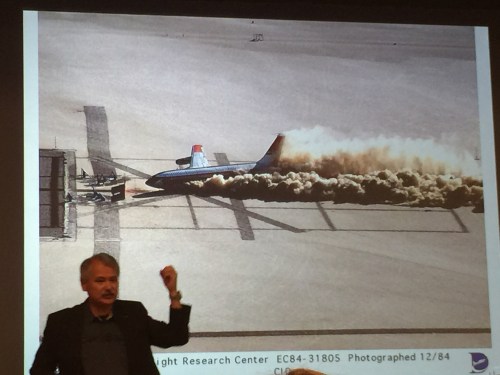
Al Bowers, Chief Scientist at NASA Armstrong, had an extremely interesting talk about the 1984 Controlled Impact Demonstrator test, in which a fully loaded & instrumented 707 was flown by remote control and crashed deliberately. The test was designed to see if a fuel additive would keep fuel from burning in a crash, but the plane landed off target (it was supposed to be going straight and come down on that “X”, not 410 feet to the right as seen here) and turned into a huge fireball.

The FAA, which paid for the test, was not happy and apparently there are still those there who hold a grudge. (In flying circles it’s common to say that the FAA’s motto is, “We’re not happy until you’re not happy!” So…thanks, Dr. Bowers, for a job well done!) But while they didn’t see what they wanted to see, they did learn a tremendous amount, all of which went into improvements in aviation safety that you see today. While there are still crashes and deaths, the number of deaths caused by post-impact fires has dropped to almost nothing.
IMG_5304

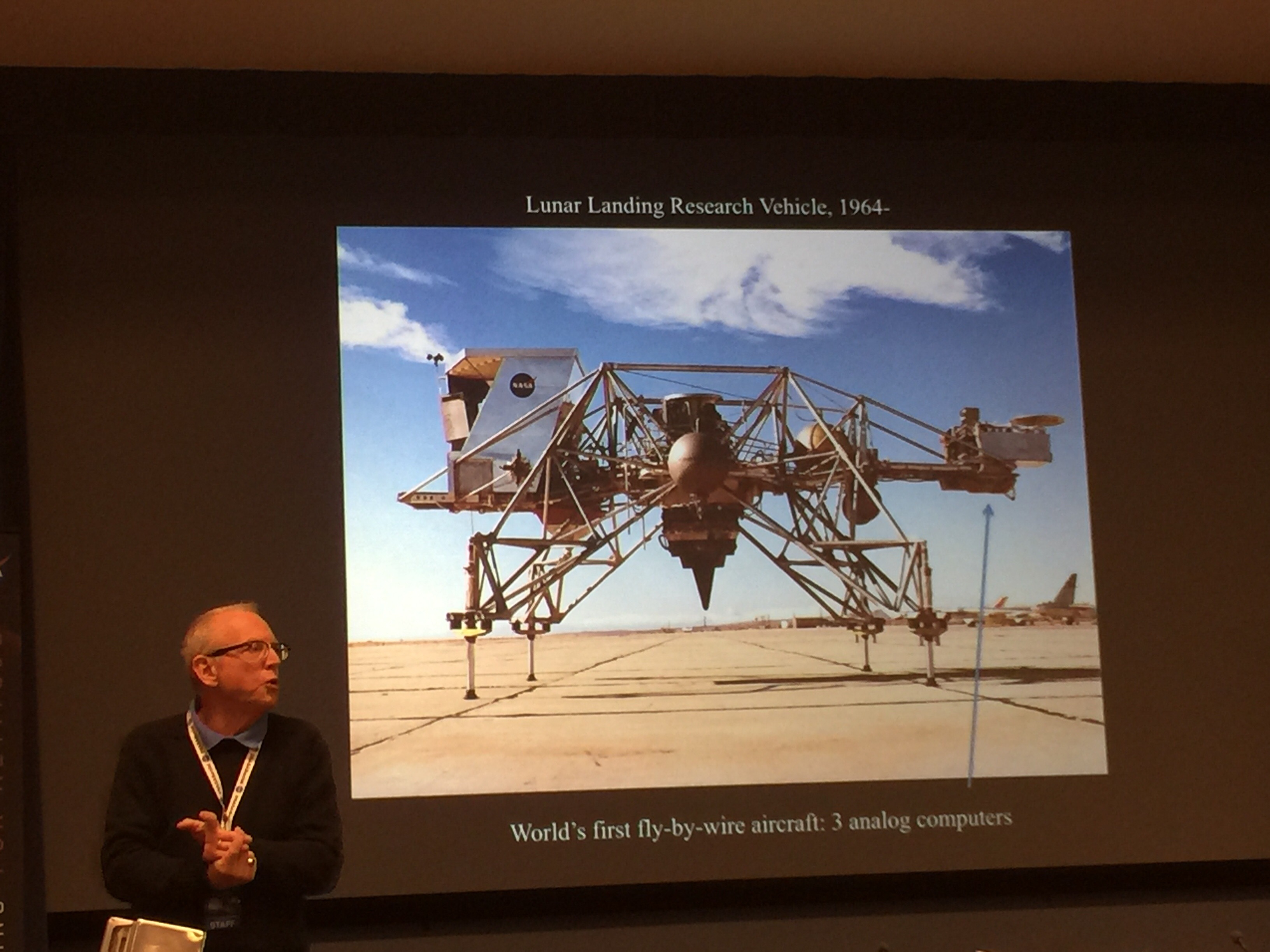
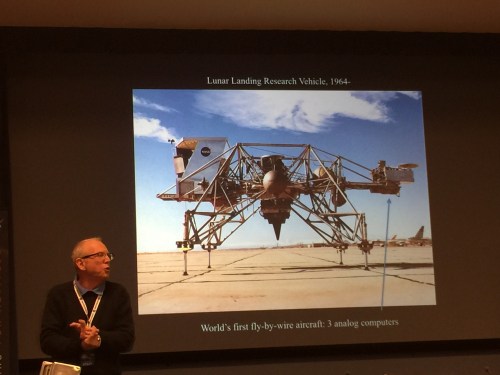
Doctor Christian Gelzer, Chief Historian at NASA Armstrong gave us a talk on the history of “fly-by-wire” (FBW) control systems. The short version is that in an older commercial or military plane, and still in almost all light general aviation aircraft, controls on the plane (yoke, rudder, trim) are connected to rods and levers and maybe hydraulic systems, which are in turn connected directly to the ailerons, flaps, and rudder. In a FBW system, which now includes all military aircraft and the vast majority of all commercial airliners, the controls talk to a computer and the computer talks to a motor attached to the ailerons, flaps, and rudder to move them in the way the pilot is commanding.

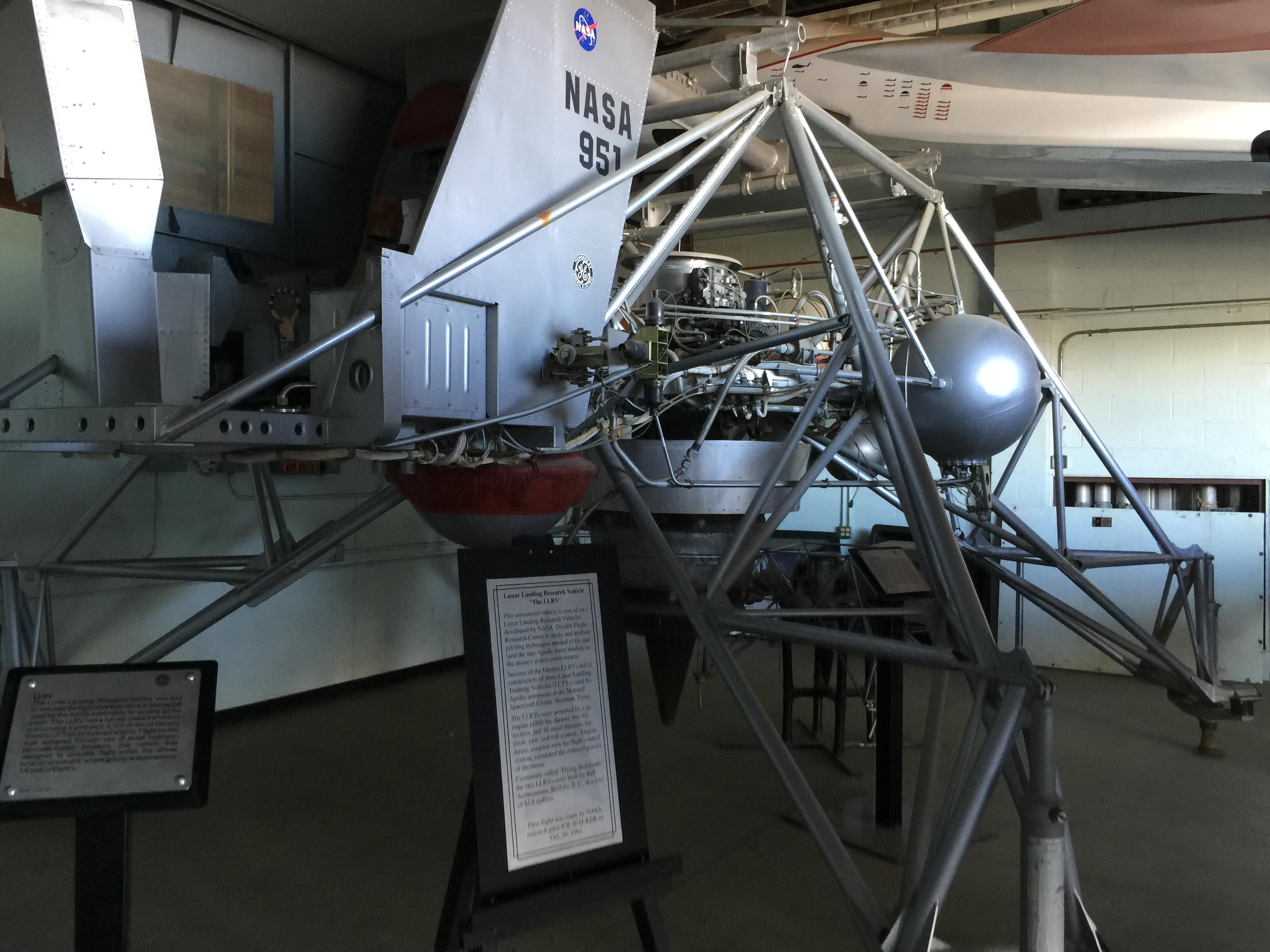
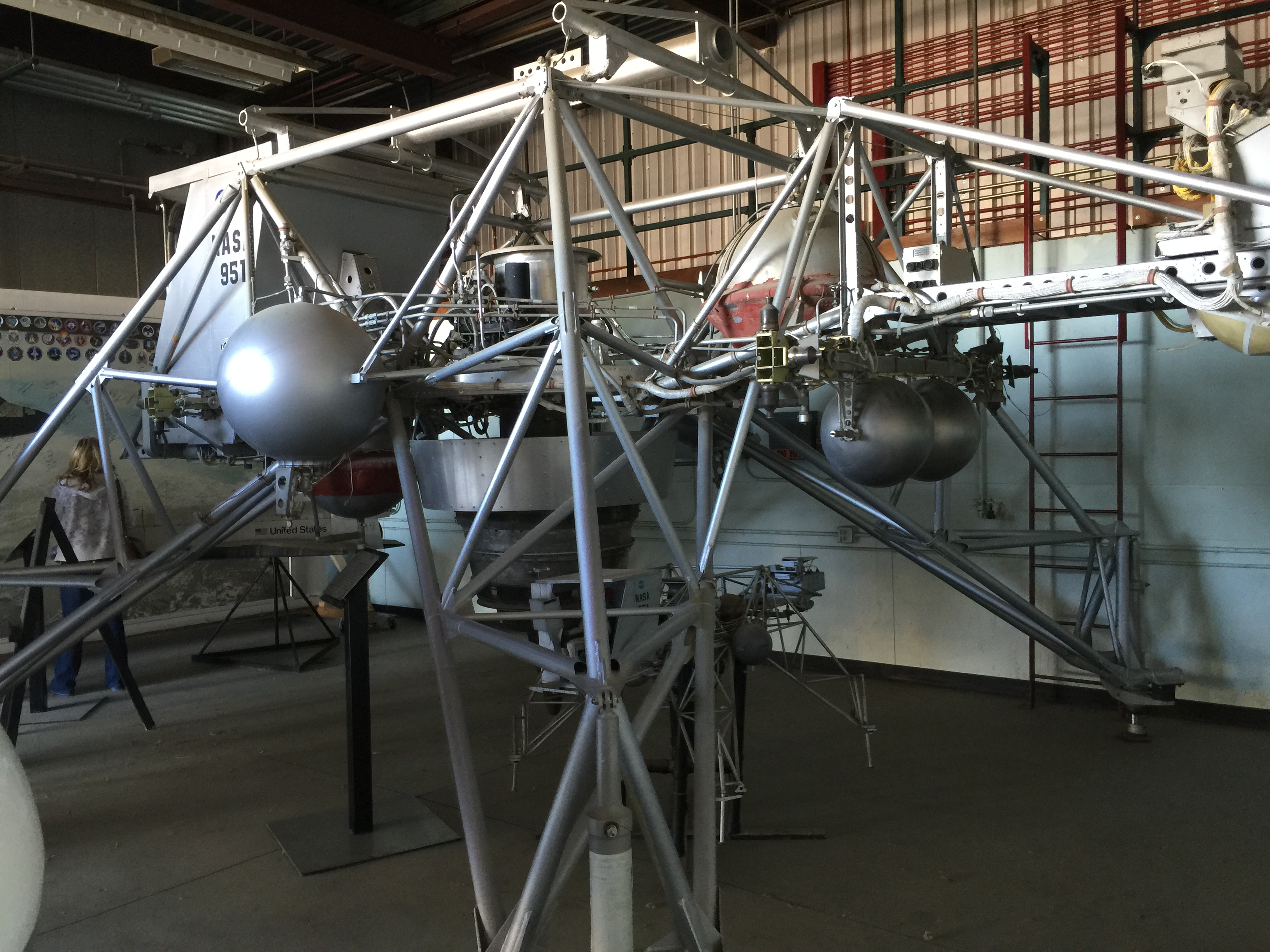
The vehicle shown (remember it for later) is the Lunar Landing Research Vehicle, which was the first FBW aircraft. It was developed in the mid-1960s to train the Apollo astronauts on how to land on the moon. It must have worked – six of six landings went just fine!
IMG_5305

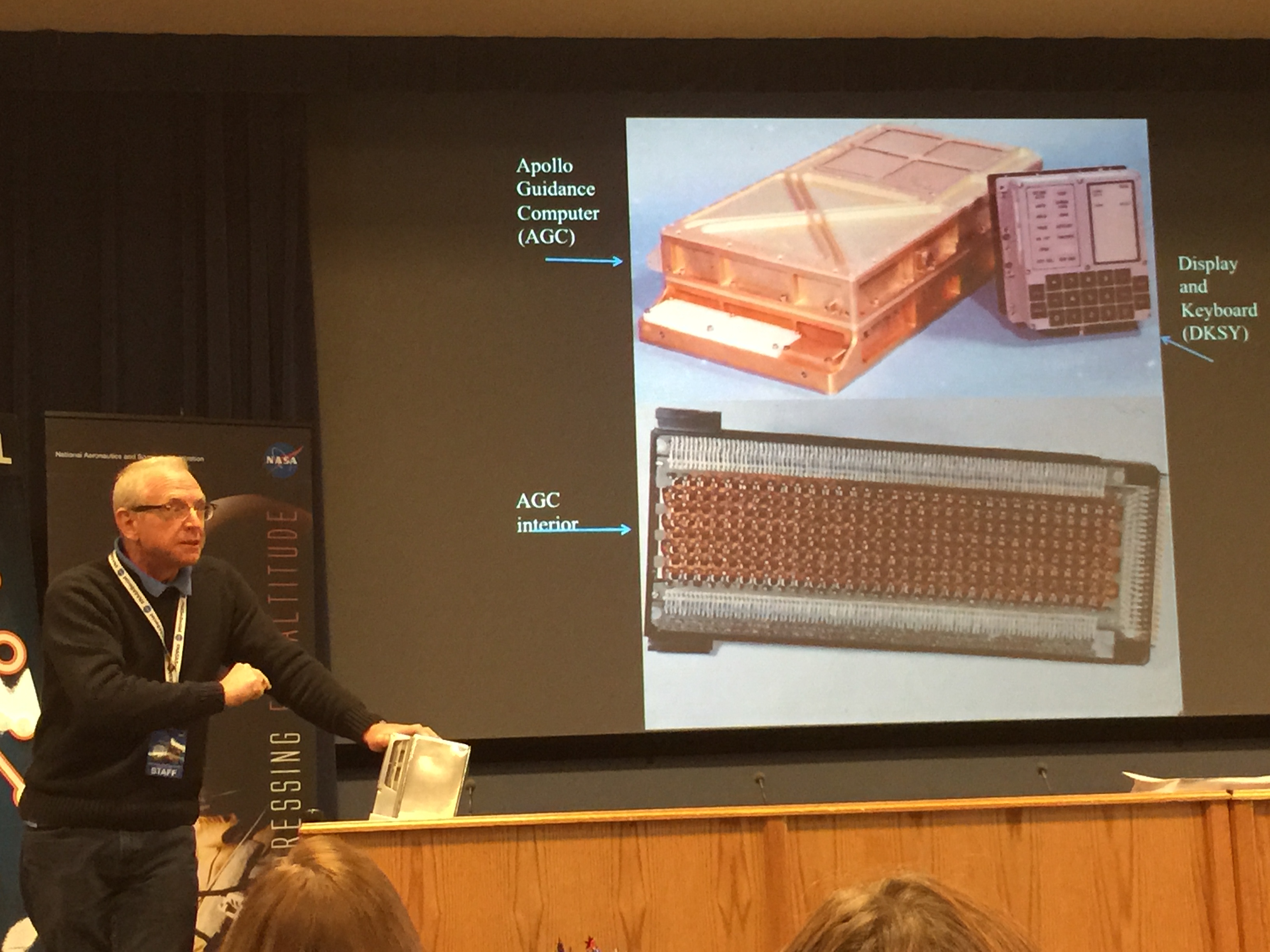
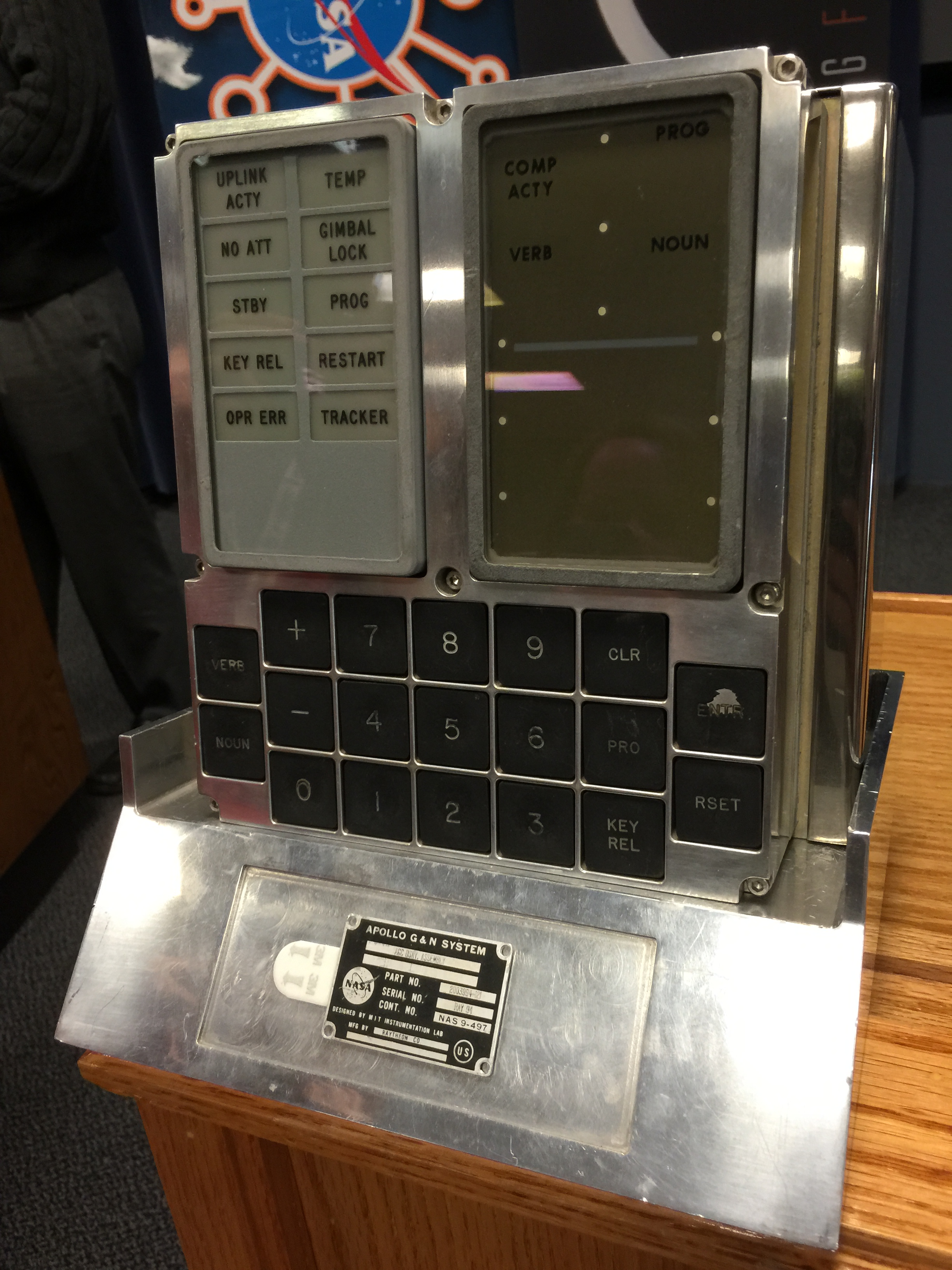
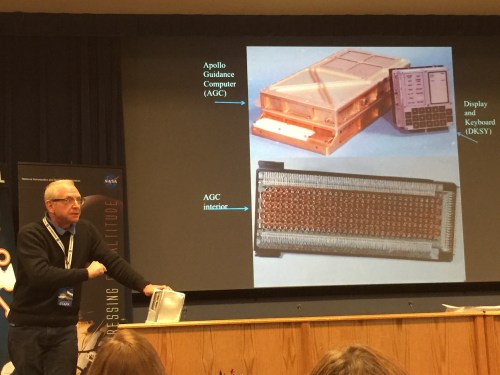
When it came time to start testing FBW on other aircraft, the biggest problem was that the computers of the day weren’t up to the task. Eventually they used the only portable, reliable, and rugged computer on the planet that could do the trick, a leftover Apollo Guidance Computer (AGC). These were made to take the Apollo spacecraft to the moon and back, but the Apollo program got cut back after Apollo 13, leaving spare AGCs.

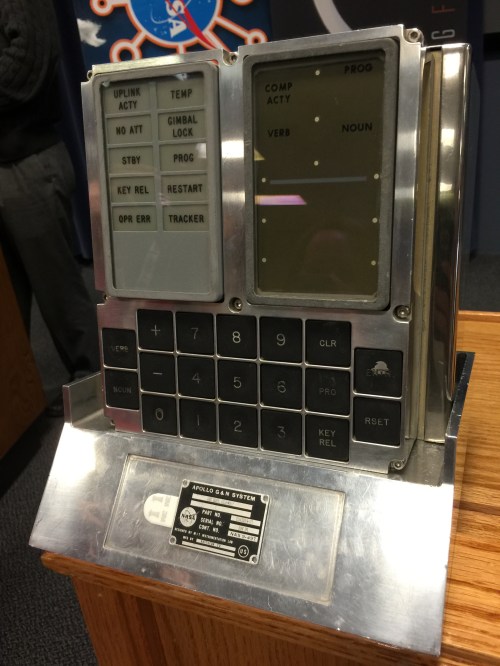
Things were fine, until the Display & Keyboard (DSKY) unit failed. There weren’t any spares. None had been made. None were ever going to be made.
IMG_5309

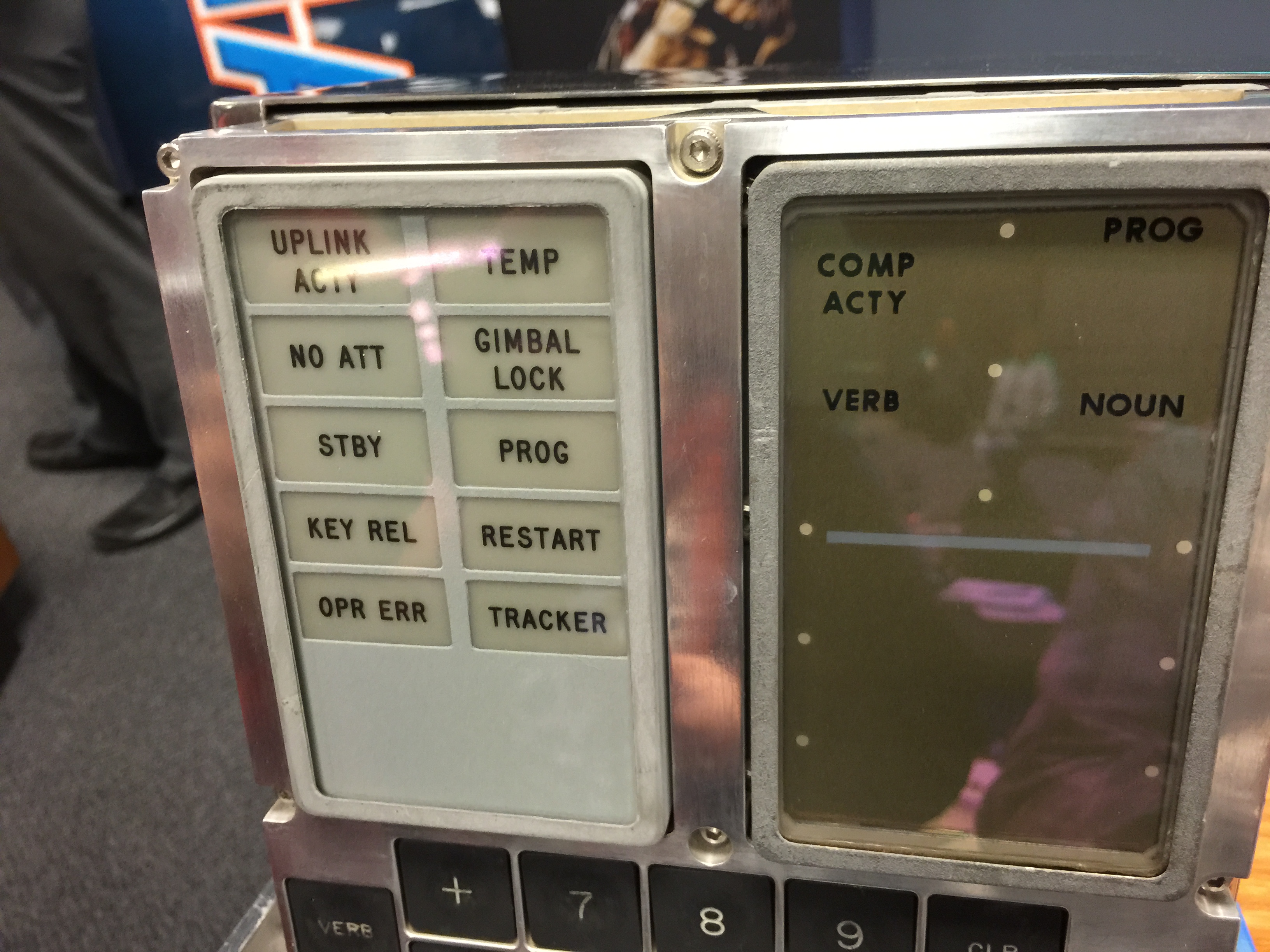
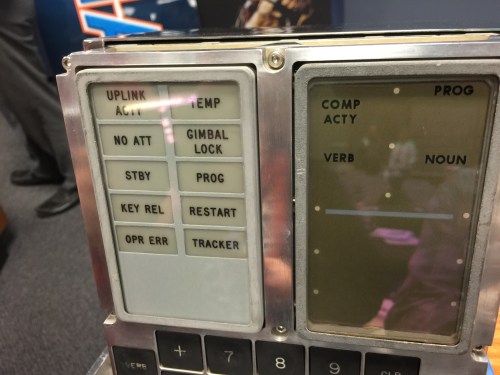
This is the actual piece of hardware that they obtained to solve the problem. This “spare” DSKY was taken from the Apollo 15 Command Module after the spacecraft had returned from the moon.
IMG_5310

How much did I squeeeee to be able to not only see and photograph but to touch and push the buttons on the actual honest-to-God flight computer that had gone TO THE FREAKIN’ MOON & BACK? It just might have been a significant amount — and as far as I could see, the other 30+ participants at the NASA Social were squeeeeee-ing right along with me.
IMG_5315

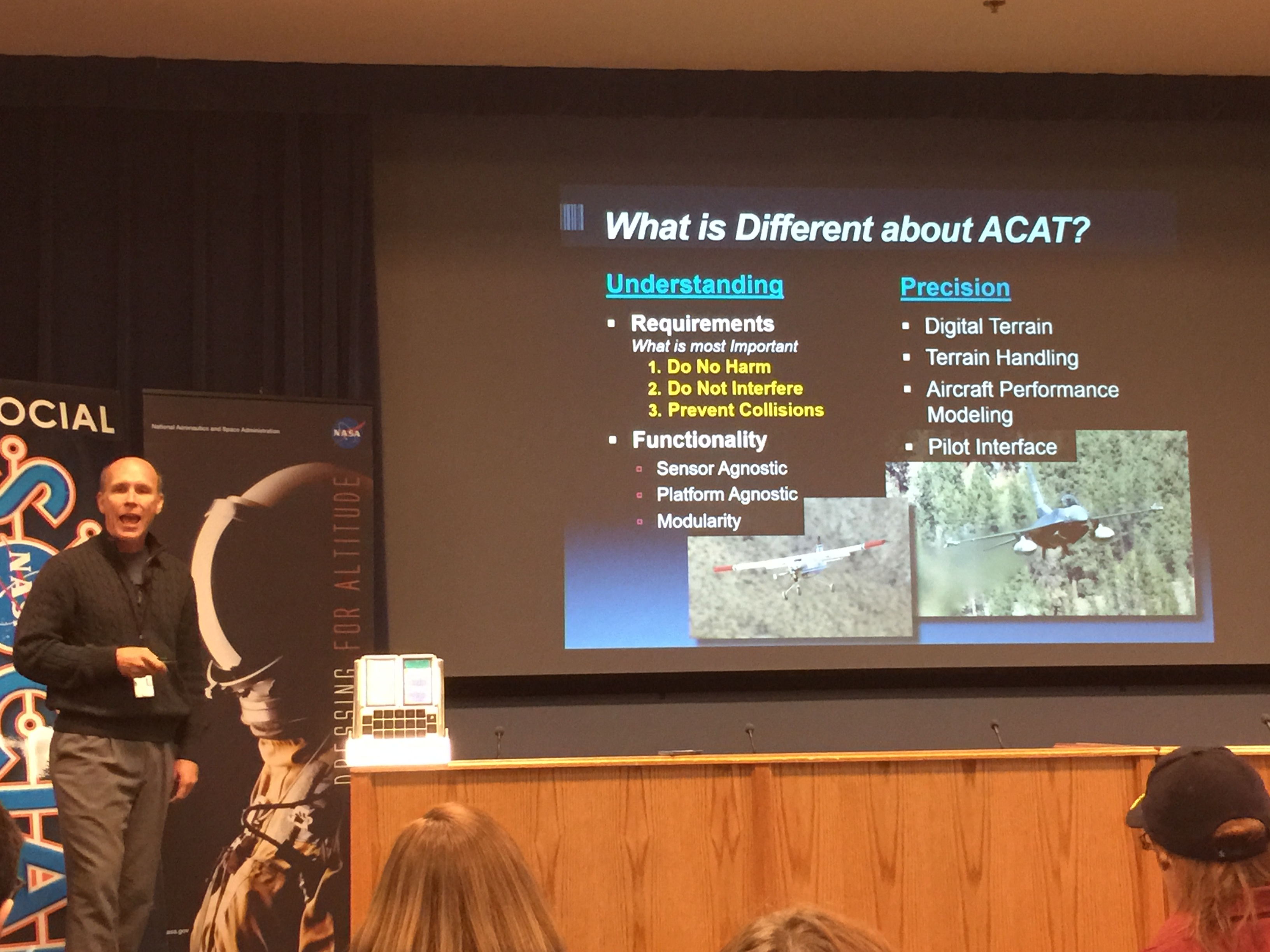
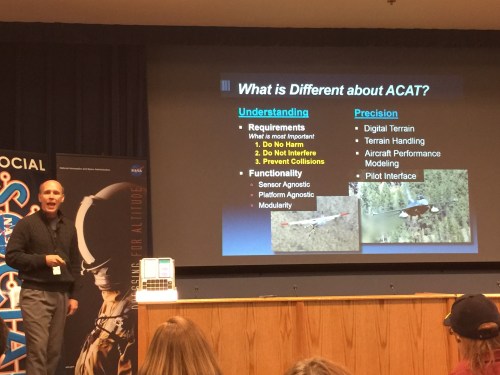
Once we had taken a break and I had (at least figuratively) taken a cold shower, Mark Skoog, Chief Engineer of the Automatic Systems Project Office, gave a fantastic presentation on the Automatic Ground Collision Avoidance System (AutoGCAS). In short, the military has a problem with too many pilots flying perfectly good, healthy, functioning aircraft into the ground or the sides of mountains. This can be caused by fog and clouds, by pilots being temporarily disabled by high G-forces, or by pilots distracted by other tasks in the cockpit.

What the AutoGCAS system has done is take a 3-D digital database of the entire freakin’ planet and condensed it down to where it will fit into a smart phone, with plenty of room to spare. (This is mind boggling to me, but they’ve done it so it must not be as impossible as I would have guessed.) Then they wrote programs for the smart phone which will constantly track the plane’s location and course in 3-D, compare it to the database, and determine when a collision is imminent. Then the system uses the plane’s autopilot to override the pilot and take the last safe option out at the last possible second.

Wow.

The system is now up and running in F-16s and is being installed in other fighters. Furthermore, it’s being developed for use by the civilian commercial and general aviation markets. On a plane like the Cessna 172s which I fly, it might not be able to take control of the plane in an emergency (a light Cessna usually doesn’t have an autopilot that has the capabilities to do that) but it will be able to run on your smart phone and give you warnings and directions.

There is a fantastic video regarding this project on NASA’s YouTube channel here. Most of the models, remote control centers, and several of the people shown in this video are people and things we met and saw.
IMG_5322

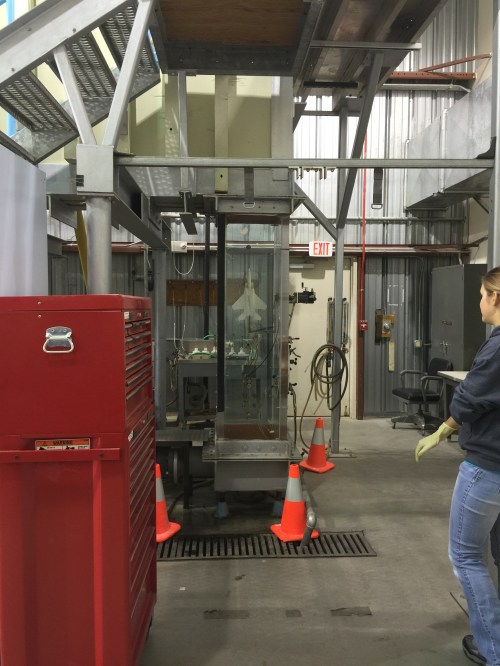
Now it was time to boogie out into the field again. First stop was the Flow Visualization Facility, where Jennifer Cole showed us how a giant water tank pumps water past a model being tested. Here you can see the clear, plexiglass testing chamber with the white model of an F-18 fighter pointing up into the flowing water. The models are made very precisely with ultra fine tubes built in, connected to holes in the body of the model. When the water flows and colored dye is pushed out through the holes, the dye will eddy and stream to show where the areas of turbulence and laminar flow exist.
IMG_5329

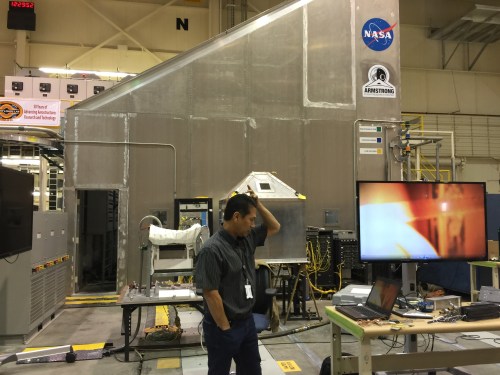
Next was the Flight Load Lab, where Larry Hudson showed us how materials are tested to see how they react to stress, temperature changes, or dynamic loads. (The lab just had its 50th anniversary.) Materials act differently when very cold at high altitude or very hot when heated by air friction at high Mach numbers. In this lab they can test (to destruction, if necessary) everything from small parts to entire planes.
IMG_5332

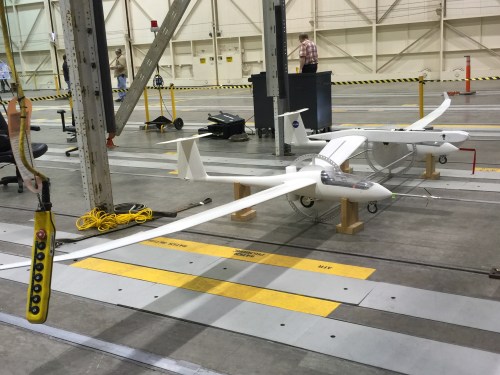
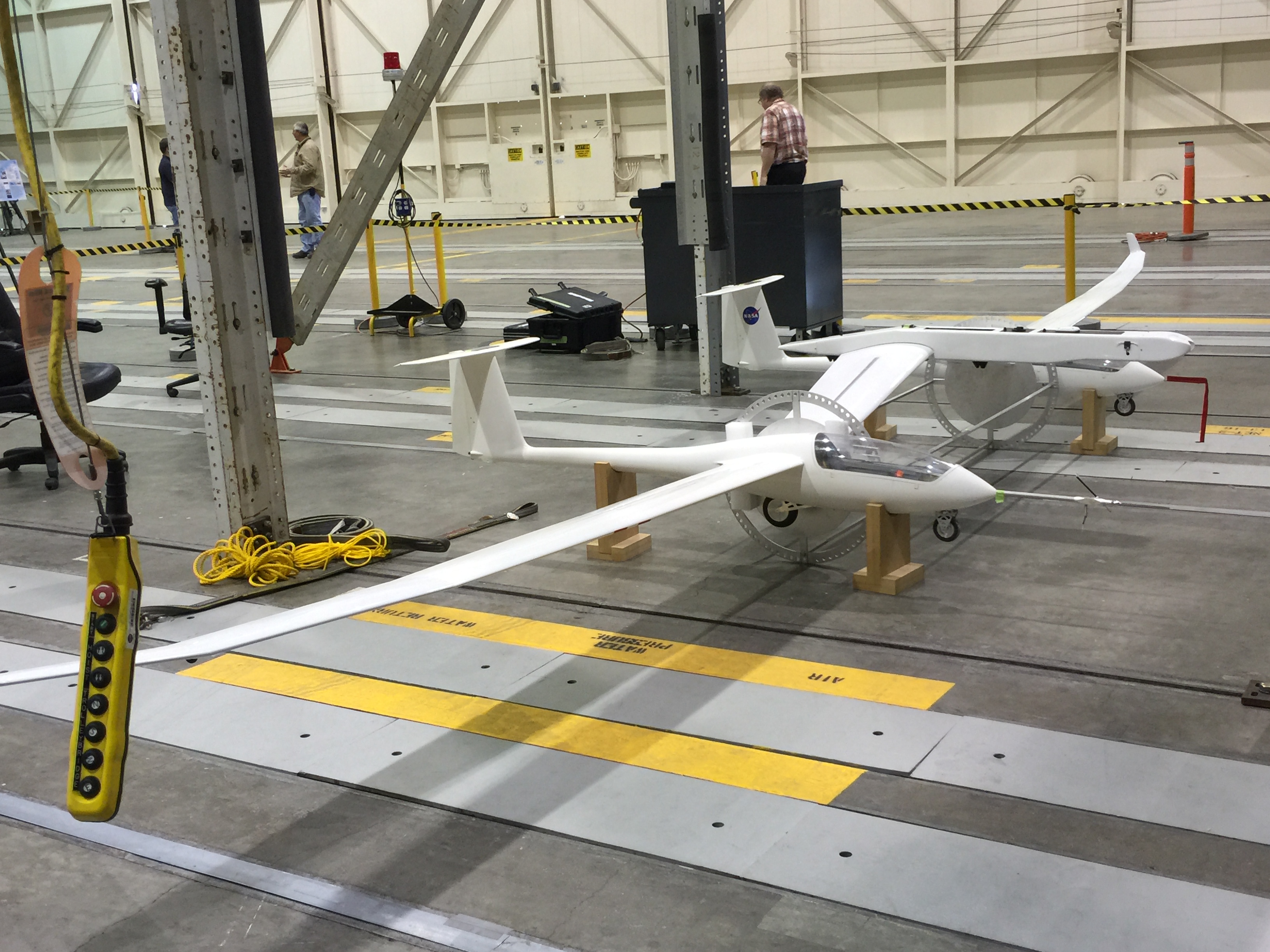
In the lab, being tested for balance and dynamic loads was this scale model of a concept being developed at NASA Armstrong for an unmanned glider which could be used to launch rockets into low Earth orbit (LEO). Similar to Virgin Galactic’s “White Knight 2” carrier airplane, this plane would have much longer wings and be towed to altitude (carrying in the middle the rocket to be launched) by a simple business jet or military cargo jet. At 40,000 feet, the glider cuts loose, the tow plane boogies, and the rocket is launched from the glider.

They believe that this system (which is still a decade away from being in service) could launch twice as much payload at half the cost of launch vehicles today. I asked and was told that it can also be scaled up to the point where manned spacecraft, such as Sierra Nevada’s Dream Chaser could be sent into orbit.
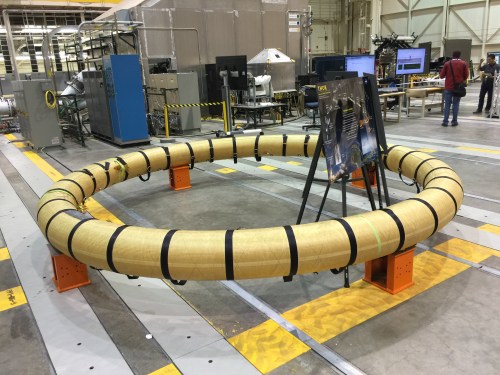
IMG_5334

This is a ring being tested in the Load Lab for the Hypersonic Inflatable Aerodynamic Decelerator (HIAD) project (NASA video here). To get a bigger heat shield without needing a bigger rocket, HIAD will use a series of inflatable rings. When the rings inflate, with the rings of different sizes stacking to look like that children’s toy, you can make a 25 meter heat shield fit into a 5 meter rocket fairing. This in turn lets you land a much bigger spacecraft on someplace like Mars.

IMG_5335

In the lab we also saw a demonstration of how fiber optic stress sensors work. The tan stripe on this model is a long fiber optic sensor. A remote control unit let us bend the wings, and the display behind it showed how the computer picked up the data from that sensor and could display and record it.

IMG_5338

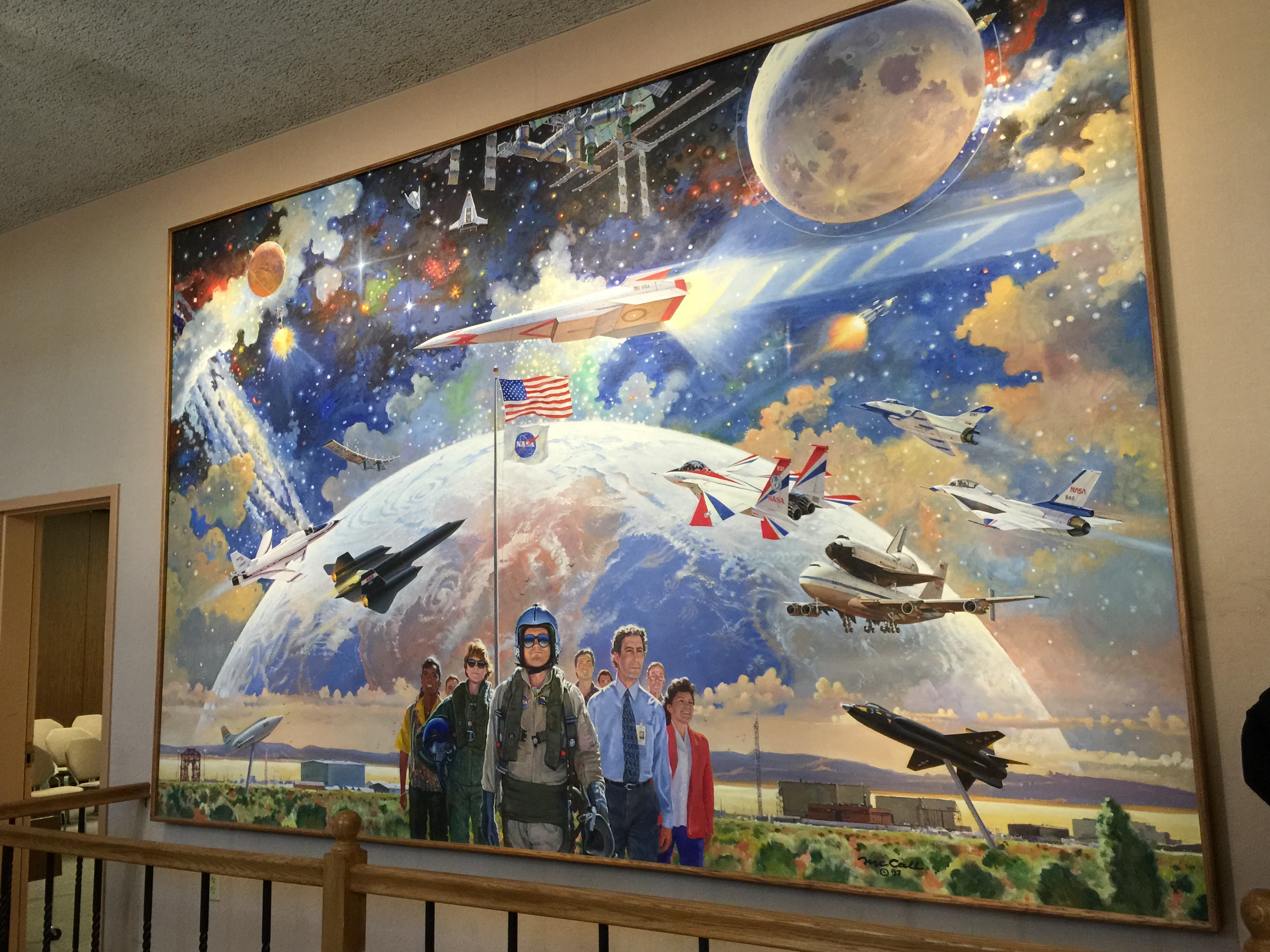
We went to another of the main NASA Armstrong buildings and saw this ginormous painting by Robert McCall. McCall is one of my all-time favorites due to his work in space and aviation art. He worked on the concept drawings for the movie 2001: A Space Odyssey, has had hundreds of paintings commissioned for NASA centers all over the country, and has even had his artwork featured on US postage stamps.

This is a huge McCall painting, wonderful in its detail, typical of his style in the way color is used and the wonder of flight and spaceflight is portrayed. Marvelous to see!

IMG_5342

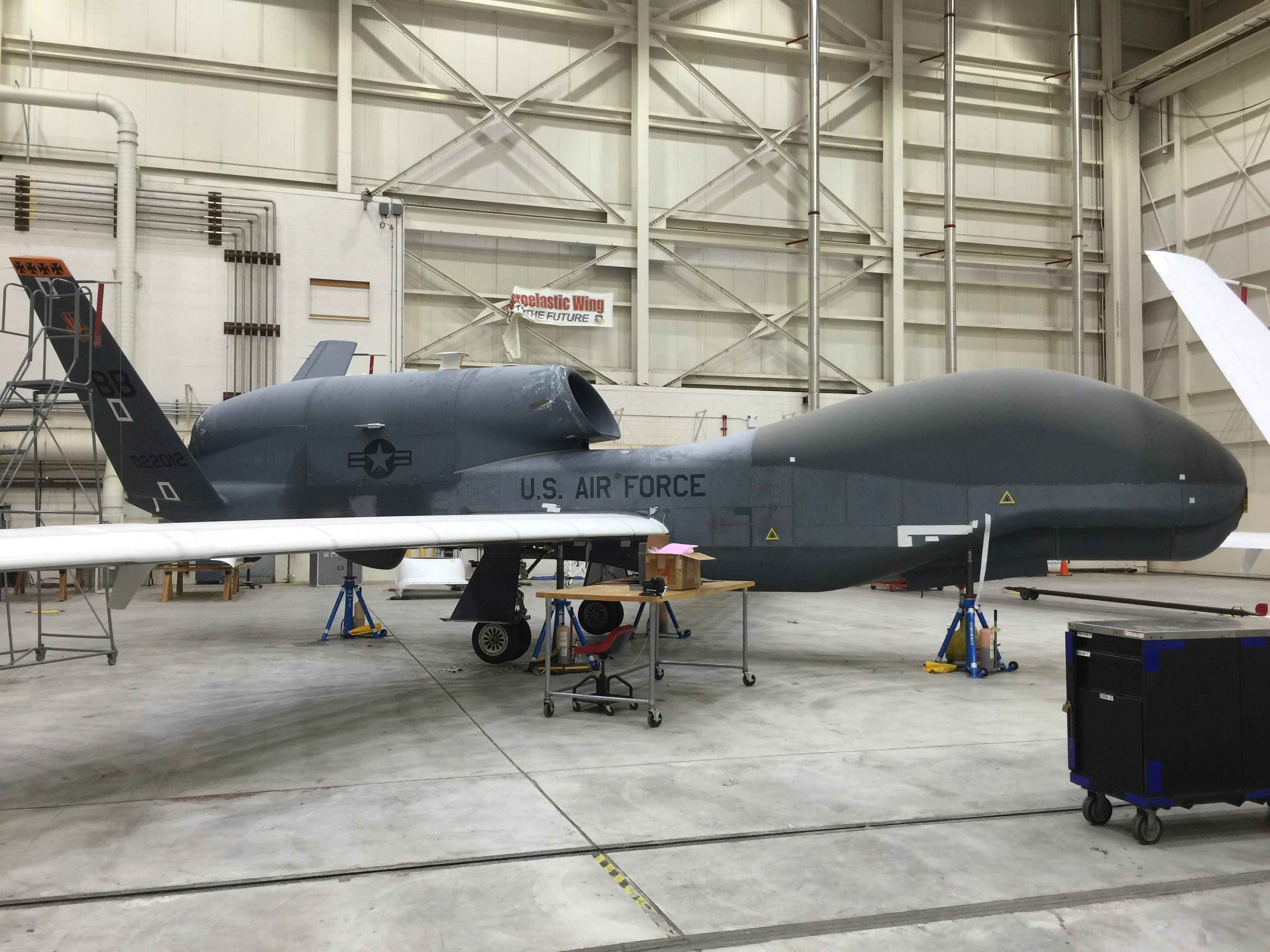
In that building we saw a couple of the NASA Global Hawk UAVs. These are used by NASA to fly long missions, up to twenty-four hours at a time (or longer) in order to gather data on atmospheric conditions, weather, and hurricanes. They are flown remotely from either NASA Armstrong, NASA Wallops Island in Virginia, or a portable mission control setup.
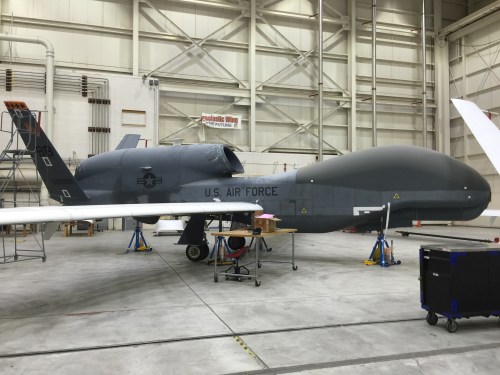
IMG_5354

One example of their use was given in the study of a recent hurricane. There was a manned plane flying high above the hurricane where it was relatively safe. Being more rugged (and expendable) because it is unmanned, the Global Hawk flew through the hurricane’s eye at a much lower altitude as the manned plane flew above it. With both vehicles dropping instrument packages on parachutes, it was the first time that a fully three-dimensional set of data had been collected in the eye of a hurricane. This data will be invaluable for researchers trying to understand hurricanes and how to predict them.
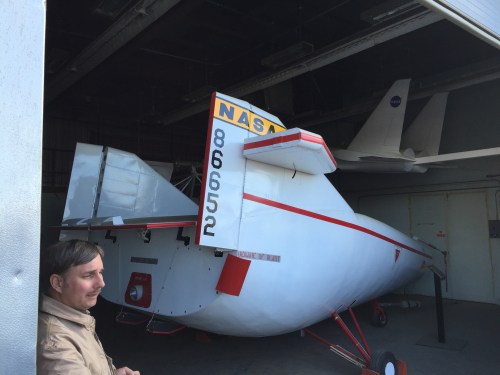
IMG_5357

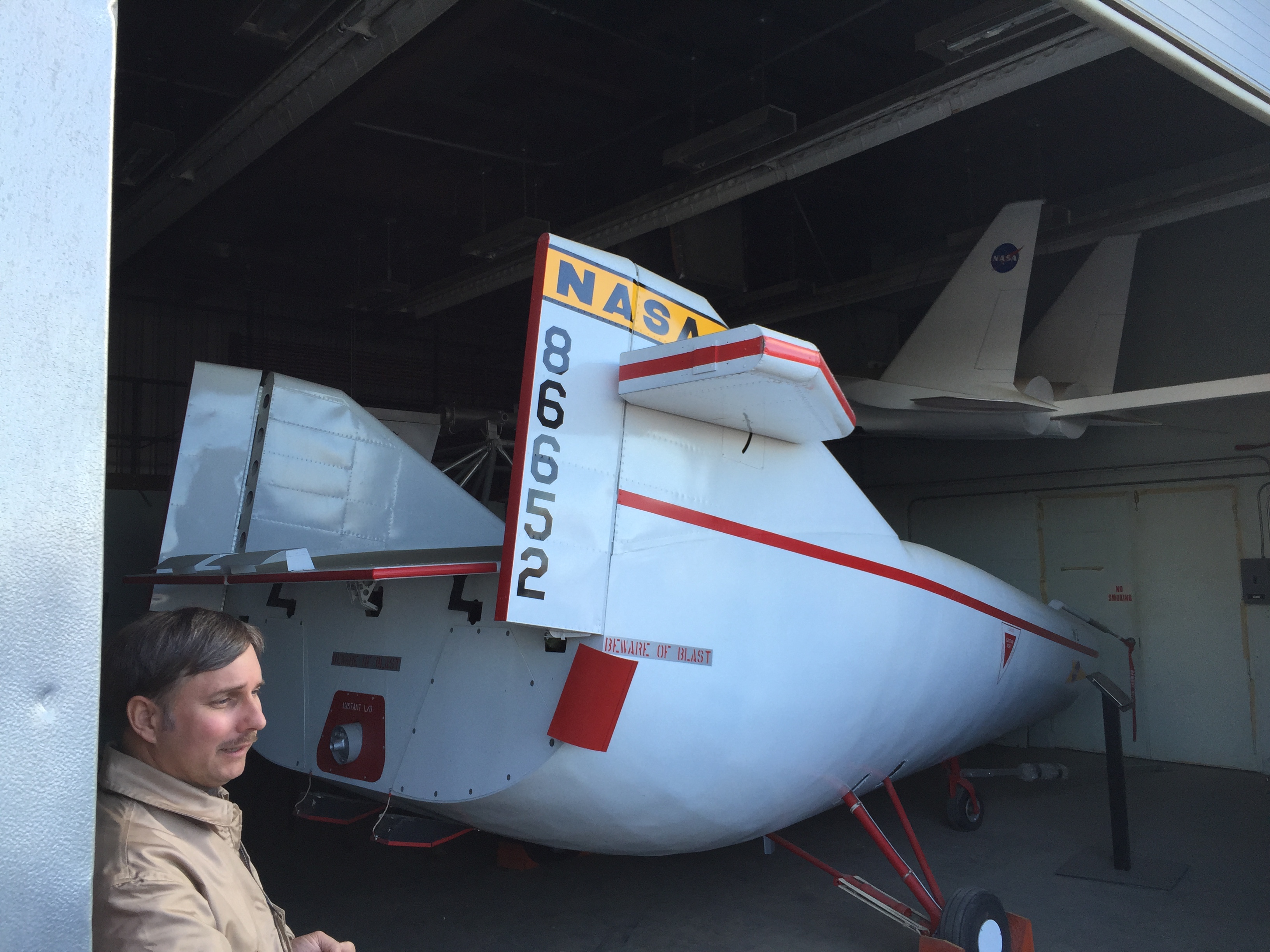
We were almost done, but as a special treat we got to see the original M2-F1 lifiting body. This manned test aircraft was built on a shoestring budget in 1963 at a boat shop. It is lightweight and was tested by towing it behind one of the engineers’ Pontiac convertible which could make it up to 120 MPH. Later tests took it to altitude and hundreds of test flights were made. Later designs based on the M2-F1 were bigger, heavier, and more complex. Early designs for the Space Shuttle looked at this design, but gave us the familiar Space Shuttle look when the need for a large cargo bay was specified.

Standing in front of the M2-F1 is Peter Merlin who is a treasure trove of knowledge about the history of Edwards, NASA Dryden (the former name of NASA Armstrong), and the planes who flew there. If you ever get a chance to see him give a talk, take it!
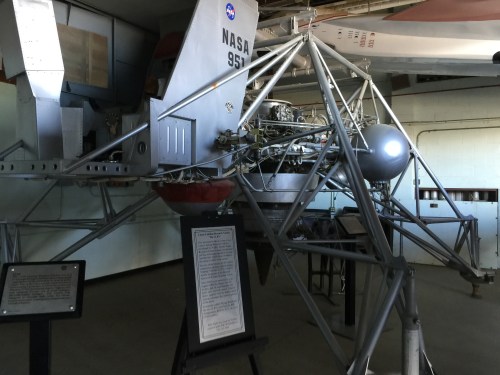
IMG_5360

In the garage behind the M2-F1 was the last of the Lunar Landing Research Vehicles. Remember, I told you above to remember that fly-by-wire slide. Here it is! (Cue more über-squeeee-ing!) In the center left you can see the pilot’s compartment cantilevered off of one side. The large jet engine, pointed straight down, is in the center.

IMG_5362

From the other side you can see several of the round fuel tanks that held the rocket propellant for the eight small rocket thrusters that moved it from side to side to control .
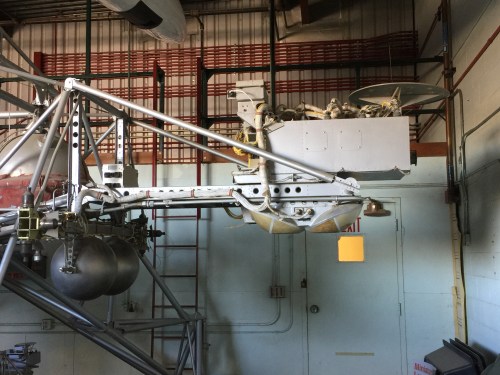
IMG_5367

Cantilevered off of the other side is the box containing the three analog computers. (Note again, analog – not digital!) They were hard wired and it was noted that to change their programs you had to use a soldering iron. Now you can see why they needed to use the Apollo Guidance Computers to step up to an even more complex fly-by-wire test.

There’s a great documentary from NASA on this test aircraft here. There’s also a good short documentary here about Neil Armstrong’s accident flying with an LLRV that almost meant that someone else would have been the first man on the moon.
IMG_5368

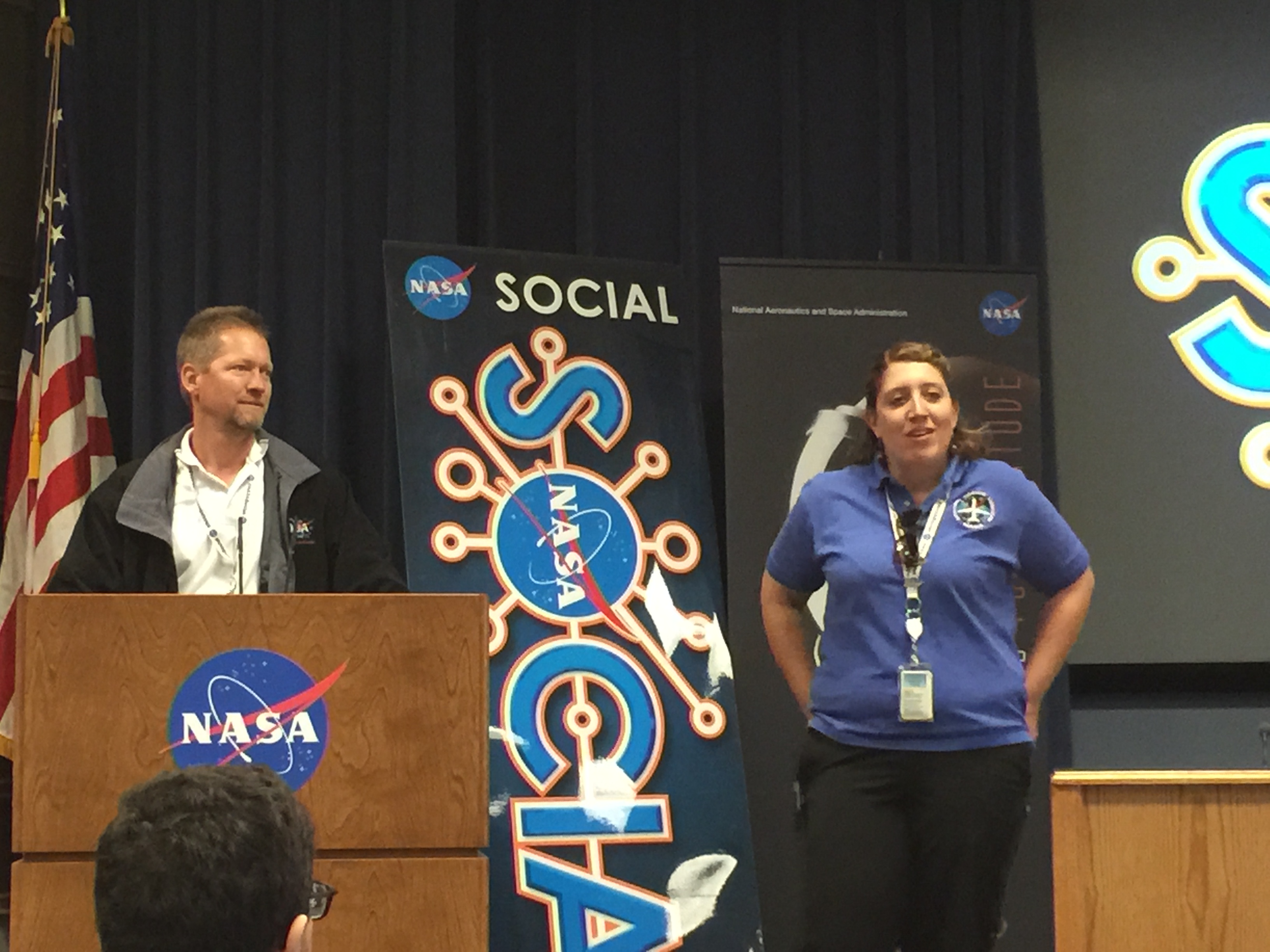
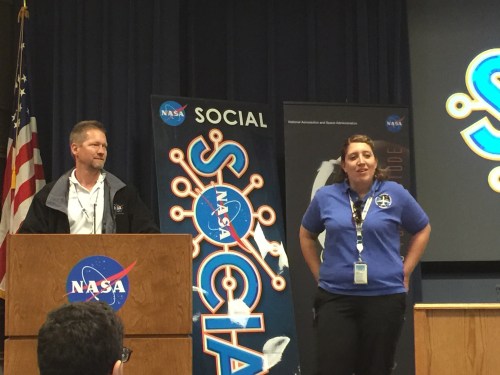
We were almost done for the day. We got some closing comments from Kevin Roher, the Chief of Strategic Communications at NASA Armstrong, and Kate Squires, Social Media Manager at NASA Armstrong, but really the official cat herder who ran this event and kept us all going from site to site, from one amazing thing to another. Props also to Barbara Buckner and the dozens of other people who helped to make this event happen.
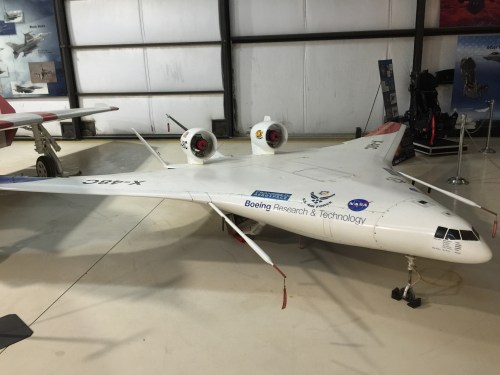
IMG_5371

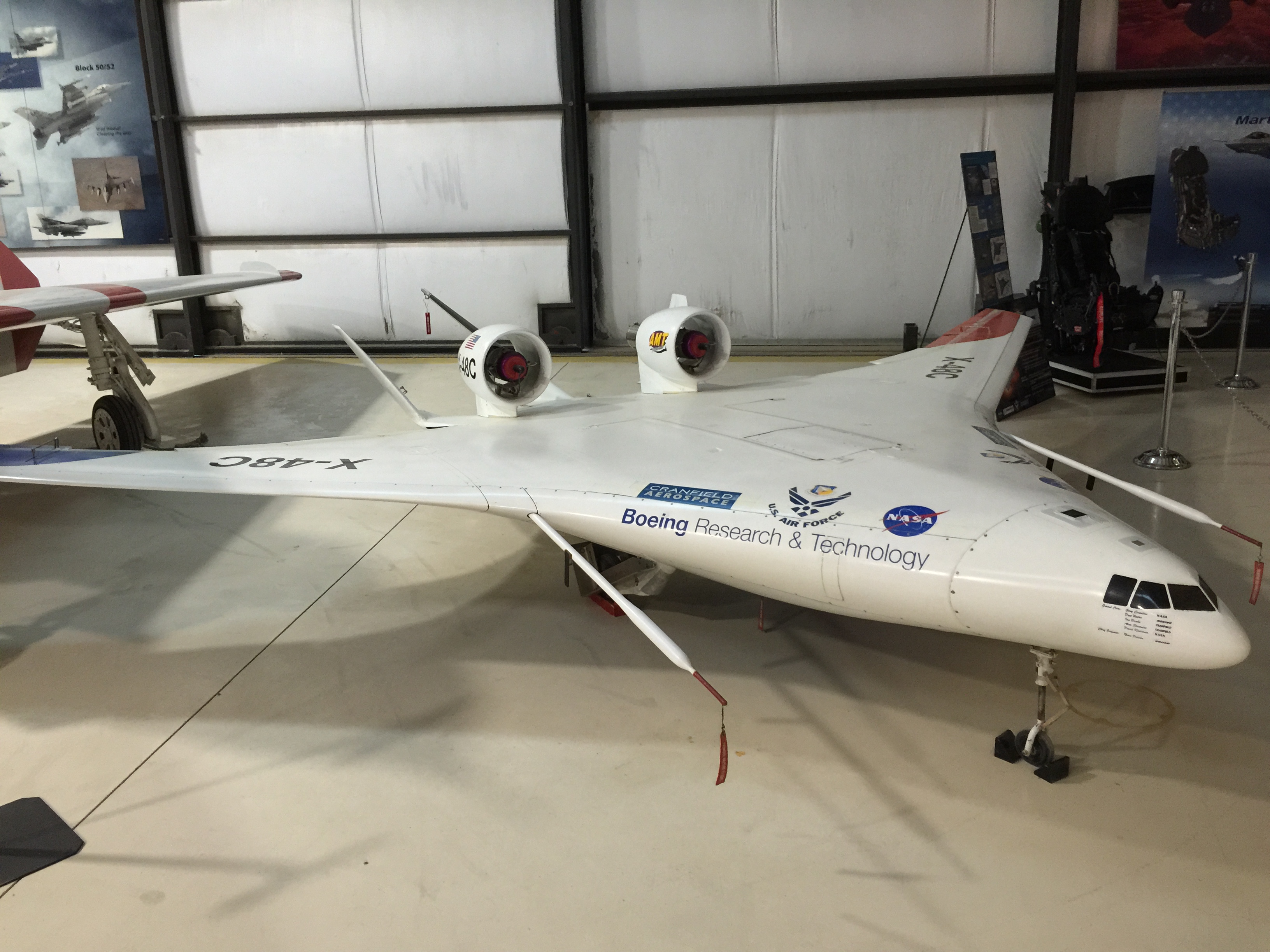
One final unofficial stop on the way out was at the Edwards Air Force Base Flight Test Museum. Many cool things there,including the X-48C test aircraft. This scale aircraft has been used for extensive flight testing of blended wing designs for future commercial aircraft.
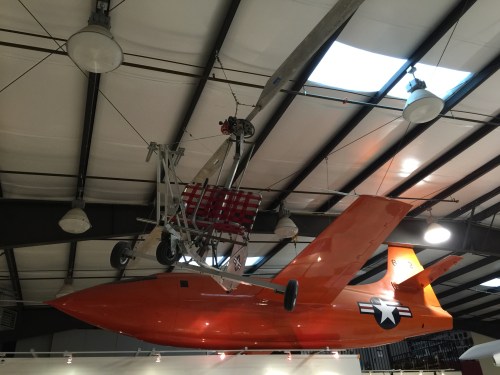
IMG_5374

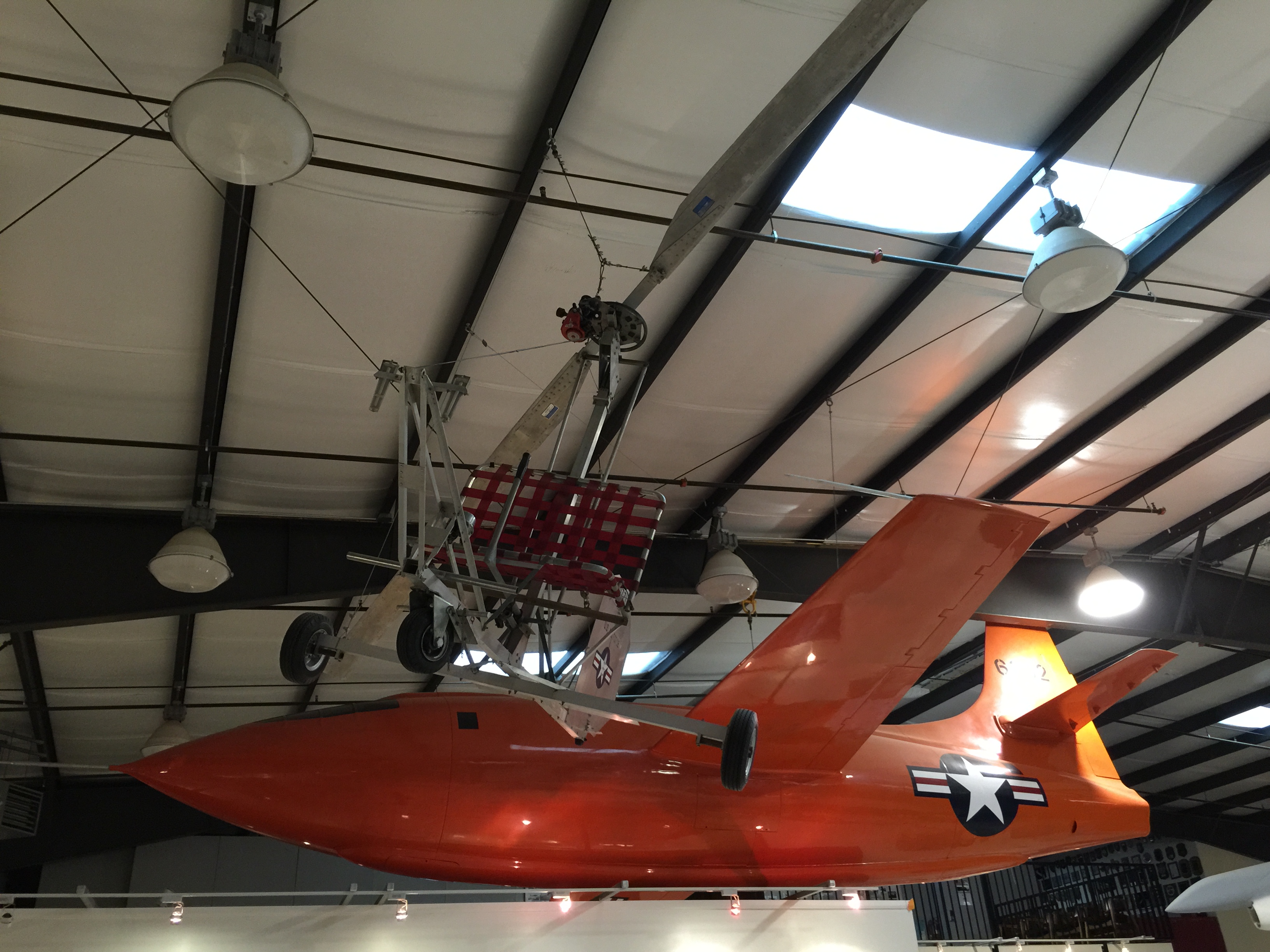
Above your head is a very early gyrocopter, and an exact model of the Bell X-1 aircraft which Chuck Yeager used to break the sound barrier. (The actual original aircraft is in the main hall of the Smithsonian Air & Space Museum in Washington, DC.)
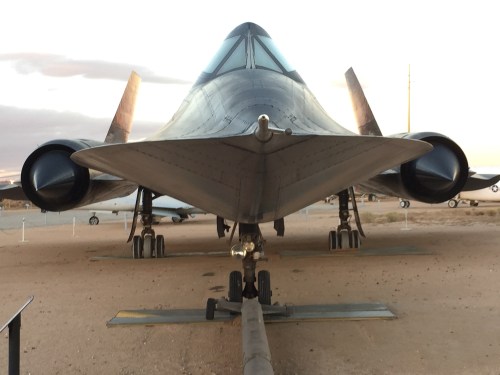
IMG_5389

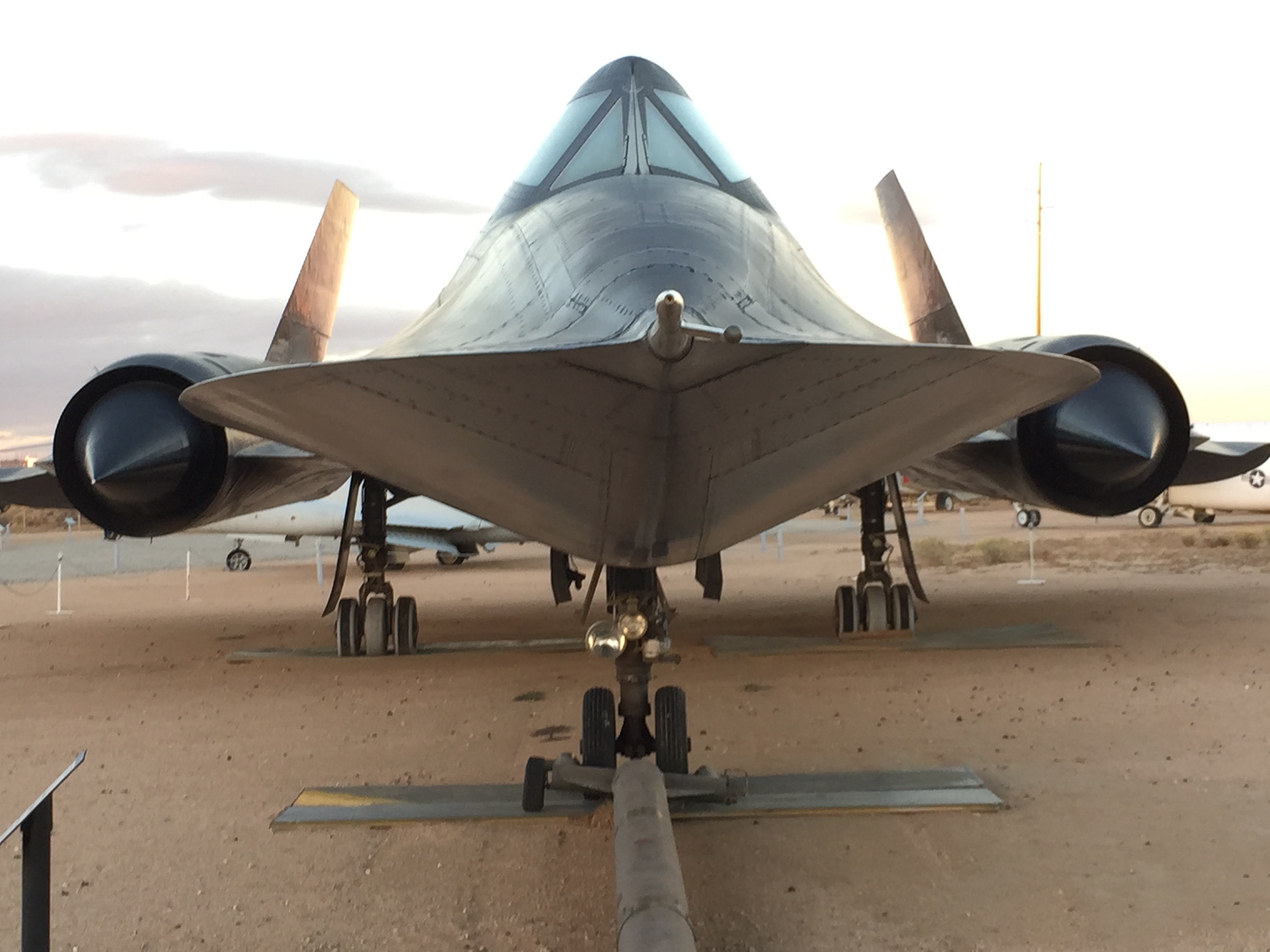
Outside of the Edwards Air Force Base Flight Test Museum, there are a couple dozen planes parked on display. This is an up close and personal look at the nose of an SR-71 Blackbird, the fastest and highest reconnaissance and research aircraft ever flown. The F-15 flew higher, and there are probably a couple others to do so, but the Blackbird was the only one put into production and used regularly for decades. The last I heard, NASA still had at least one that was still flying, but that may have changed by now. (Something to Google later.)
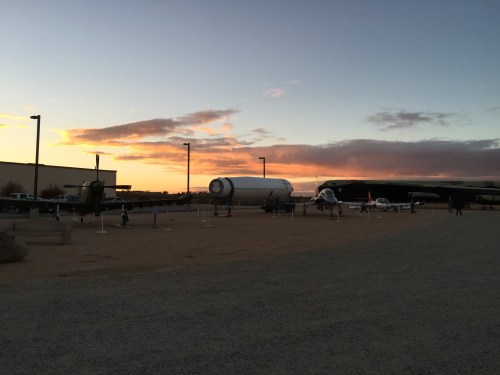
IMG_5390

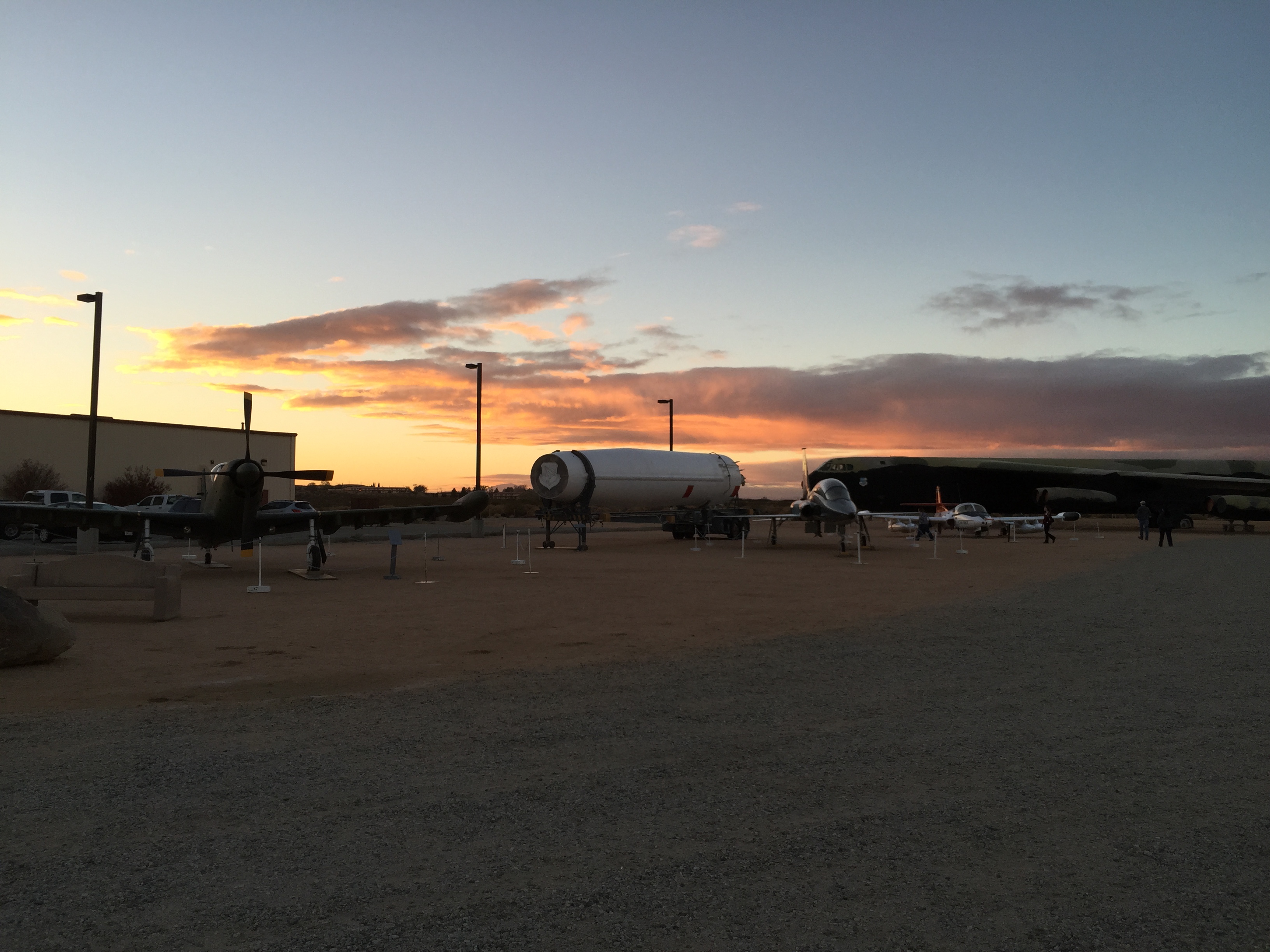
We were getting a great sunset over the museum and the planes and rockets. The B-52 “BUFF” that I shared later that night is on the far right in the distance.
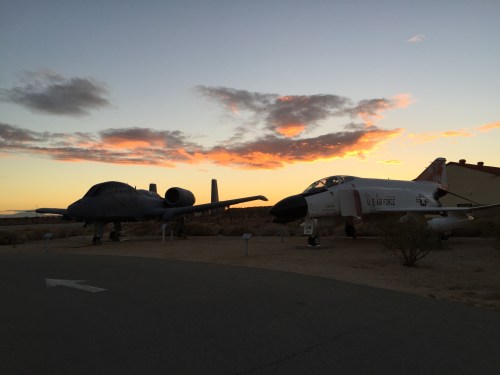
IMG_5393Finally, the prototype A-10 Warthog, the YA-10B can be seen on the left with an F-4C Phantom II on the right, the final fading rays of the sun on the clouds above. You’ve got to love the F-4, proof that if you have a big enough engine, you can make a brick fly at Mach 2.2+.

Now you know why I was exhausted when I got home three hours after this on Wednesday night!

What an incredible event, and I can’t give enough thanks to Kate Squires, Kevin Roher, Peter Merlin, Barbara Bucker, Tom Rigney Al Bowers, Christian Gelzer, David McBride, Robert Lightoot, Larry Hudson, Jennifer Cole, Manny Antimisairis, Tom Miller, Scott Howe, Hernan Posada, Mark Skoog, Christ Naftel, George Welsh, and everyone else who made it happen!

Some time in the next few days, there will be more pictures to share. All of the pictures shown here and on Tuesday were taken with my iPhone in order to make them easy to tweet, post to Facebook, post here, and share ASAP. Next I’ll start going through the higher quality photos from my DSLRs. (I take a LOT of pictures!)

Leave a comment

Filed under Astronomy, Flying, Photography, Space, Writing

NASA Social At NASA Armstrong Flight Research Center (Day One)

WOW! WOW! WOW!

It’s been a really long day, and so will be tomorrow, but I want to do a brain dump, so please forgive me if I use today’s string of Tweets as a framework, and just fill in additional details and more pictures around them. (See, I told you that I loved my blog readers more than my Twitter followers!)

I am not a morning person – but I’ve really been looking forward to this event, so out of the nice, warm, soft, comfy bed I was at 4:50. Neither bright-eyed or bushy-tailed, but I was up and more or less functional.

Except that everyone (i.e., two or three other cars from our hotel) thought that I knew how to get there. I was pretty sure I did in the “big picture” sense (get on the 14 north to Rosamond Road, go right for about 15 miles) but it was the little details where I was lost. Like how to get on the 14 north. There was only an onramp going southbound where I thought there were a pair of onramps – we were lost for a few minutes. Fortunately I do not fit into the standard stereotype of the American male in many respects, so I stopped and got directions. No harm, no fouls.

And we’re underway! Kate Squires is the Grand High Phoobah for this event and she got us going. It looks just like on NASA-TV all those times I’ve seen other NASA Socials. (We were not live on NASA-TV as some Socials are, but they were filming and we’ll probably show up in something sooner or later.)

We started with a competition. Given the information in our packets, who can create the best Tweet or FaceBook post? There will be prizes.

This was mine, which I thought was pretty good. I didn’t win but I did learn something important. In this setting, what’s a huge advantage over the “pretty good” posts is to insert either a picture, a link to related information, or both. Makes sense, good to know — so I posted lots of pictures all day. (Have I ever mentioned that I take a LOT of pictures?)

Today’s focus will be on the “aeronautics” part of “National Aeronautics & Space Administration.”

First stop is the Life Support Lab. These are the guys who deal with ejection seats, oxygen systems, flight suits, emergency rafts, parachutes, and so on. They do their best to keep the pilot alive on a bad day. This is an ejection seat from an F-18.

Curt (sorry, spelled it wrong a couple of times in tweets, only figured it out later) was one of the winners, and the prize was to get to strap into the virtual reality parachute trainer. He chose to try to land back a virtual aircraft carrier, which happened to also be on fire. The instructor (seen in the previous picture) said that no one had ever gotten that one completed successfully.

That record still stands.

While Curt was dangling and going into the drink, we all took pictures and tweeted.

At this point we went through the fabrication and machine tool shops, but my pictures and posts from there ended up on FaceBook. (Trying to spread things around.) Here’s one:

{{Actually, no, here’s not one. For whatever reason, I find that WordPress will not show pictures and Tweets at the same time. WTF? OK, it’s 23:28, no time to troubleshoot tonight. Sorry! We either get to see two pictures or two dozen Tweets, so we’ll go with the Tweets.}}

This is the bed of a water jet cutter. This extremely fine sand is mixed with water and shot out of an incredibly small nozzle at 50,000 PSI. Pfffft, it’s just water, right? Under those conditions, it will slice thorough twelve inch thick sheets of steel like it was butter.

There will probably be more pictures posted next week from there and the “good” pictures taken with the DSLRs. (Have I mentioned that… oh, yeah, I did.)

The model shop was A-M-A-Z-I-N-G. We got to see several UAVs (Unmanned Aerial Vehicles), including a bunch that have been working on projects that will very soon have a huge impact on general aviation, i.e., people like me who fly little planes. Again, great questions, great answers, this place was a lot of fun.

In this hanger are the two NASA F-15s. The grey one on the left is their newest, an F-15D model. We got to get very up close and personal. But no touchee! (Poor Kate, it was like herding cats all day.)

These aircraft are used for a whole list of things, from chase planes, research planes on the ongoing sonic boom research, to being a platform on which to hang other experiments and testing rigs.

This is the F-15B model with the “classic” white and be paint job. *sigh* Yeah, what I wouldn’t give…

We saw several aircraft that are used in noise studies, and are therefore designed to be “vewwy, vewwy, quiet.” This is a powered glider with HUGE long wings, seen here folded in half.

We grabbed lunch and heard from a couple members of the top brass, including NASA Deputy Administrator Robert Lightfoot, who just happened to be here today on his way back to Washington.

The message that we got all day, which we were being asked to pass on and spread the word, is that there are things that NASA does regarding flying that affect all of us, every day, even if we’re not actually on a plane ourselves. Goods move by air, everything from the mail to FedEx to produce to Amazon Prime to… Making the national air system safer and more efficient helps us all. Making planes safer and more efficient helps us get there faster (whether it feels that way some days or not) and with lower ticket prices due to huge fuel savings for the airlines (ditto).

We had a great Q&A session, lots of good, informed, intelligent questions. I had a couple folks send questions for me to try to get in, but I didn’t get the chance.

I really was feeling lucky to be here and I really am glad to share the experience with those who can’t be. I knew this would be great, I just didn’t now how great.

The question was concerning how NASA can get the word out to the general public about all of the critically important work being done. Most people have no idea what NASA does, and even if they know a little bit, it’s probably about rockets. There’s a lot more to NASA than that. Events like this are one way to try to increase the public outreach efforts by NASA.

Lots of testing being done here on supersonic flight and the nature of sonic booms. The one commercial jet that was supersonic, Concorde, was only allowed to go supersonic when travelling over water due to the disruptions that sonic booms can cause to people on the ground. The technology is there today to build supersonic commercial airliners, and even supersonic business jets — but the sonic boom problem still has to be solved. At NASA Armstrong they’re making a lot of progress.

Next we got a panel with four of the NASA Armstrong test pilots. Somehow I managed to tweet three things about it but didn’t include a picture. (Probably over on FaceBook, too late & too tired to check right now.) So here:

{{Ditto, but as I learned a minute later, it’s OK, there actually is a picture of the pilots below.}}

While everyone we met said their job at NASA was the best in the world, my vote goes to these guys!

The varied flying experience all of these pilots have as a group is astonishing. One has a Cessna 172 at Van Nuys (my kind of plane) and does aerobatics at airshows, all the way up to the guys who fly the “SOFIA” 747 and the F-15’s shown above, with just about everything in between. Amazing!

Wait, I guess I did post a picture of the pilots on Twitter. (God, my brain is soooooo fried at the moment, it’s been a really, really long day. Good thing the only “heavy equipment” I’ll be handling tonight is the bed.)

Someone asked a question about integrating UAVs into the national air traffic control system, so that the big guys (United, Southwest, American) and the little guys (private pilots, corporate jets, dirigibles) won’t end up sucking a drone into an engine. Obviously a topic near and dear to my heart.

The short version is that currently all UAV flights are IFR only so they’re monitored by the air traffic system just like any commercial flight or small plane on an IFR flight plan. What comes down the road five or ten years from now remains to be seen, too early to say definitively.

A talk about the ACTE project (Adaptive Compliant Trailing Edge) which is testing a replacement for the traditional flaps on a plane. This was a good one-liner.

Yep, that’s what ACTE will do.

And this is why ACTE is being worked on so much. When perfected, it has the potential for huge efficiency increases, which mean lower fuel costs. It will eliminate a great deal of the noise that planes generate on take-off and landing. And the increased efficiency will leave us with less pollution from jets and cleaner air. That’s why this will be such a big deal.

We saw one of the mission control rooms that are used for monitoring test flights. The concept of the “mission control room” was originated here during the X-15 project in the 1950’s, before NASA adopted it for the manned space program in the early 1960’s. Now it’s a familiar sight and layout, used as well by ESA, SpaceX, the Russians… But it started here.

Then we got to see the ACTE plane. We did not get to see it move, but it’s still pretty neat to see how it’s coming together. They’ve now had two test flights with a third coming up in the next week or so.

In the same hanger was the Ihana UAV. Because of the big optics package hanging underneath the nose, including infrared cameras, it’s been used extensively to look at forest fires through the smoke as well as many other unique projects. In two weeks it will be used to try to track the Orion space capsule as it re-enters the atmosphere and splashes down in the Pacific off of Baja.

Finally, this is what the alarms on my phone look like for about five hours from now so that we can do more of the same tomorrow.

Stay tuned!


1 Comment

Filed under Astronomy, Flying, Photography, Space, Writing

Robots & Tears

Yesterday and today, reading about the final minutes of Philae’s adventures on Comet 67P, I got to wondering again about the way we anthropomorphize these machines we make.

I want to be cold, logical, and cynical enough to realize that they’re just machines! Yes, people involved with these projects spend years and years designing, testing, building and launching these machines. I can see how they would form an attachment to the project, with the actual robot / probe / spacecraft / machine being the obvious symbol that represents all of that. I get it. But you and I aren’t part of that team, we’re just bystanders watching on television or Twitter. (If any of you ARE on one of those teams, can we talk?)

Yet we do it anyway, form emotional attachments, thinking of the robots as brave little soldiers, sent out into the cold and dangerous depths of space on a one-way suicide mission. They do their best to struggle on against all the odds, getting those last little bits of data for us before they expire.

If we pull ourselves out of our mourning and grief, we know that they “struggle on” because they were built solidly and the engineers who designed and built them were thorough and did an excellent job of anticipating different conditions and problems and building in ways of coping. Even when the spacecraft 300,000,000 miles from Earth runs into something unexpected, the engineers down here at ESA or NASA or Roscosmos or JAXA or ISRO or JPL are very clever at coming up with ways to work around it. The robot, the machine, the spacecraft is just doing what it was built for and what it’s programmed and commanded to do.

Yesterday the end came for Philae, which isn’t really “dead.” It’s more like “sleeping” or “hibernating,” since it can reactivate itself should something change on the comet which would allow sunlight to reach its solar panels. (For those who haven’t been following, it bounced on landing, ending up someplace against a cliff or in a canyon of some sort, where it gets very little sunlight.) The mission was designed to last 56 hours or so on batteries, and despite some problems in landing, Philae still carried out 100% of its science mission, getting data from every experiment, taking all of the pictures it was programmed to take, and sending all of that data back to Earth before the batteries died. It’s an overwhelming, spectacular, amazing success!

Yet we get teary-eyed when the end comes.

There are many examples of similar things in movies, but I wonder if the movies are training us to act this way in the real world or if the movies are simply reflecting the zeitgeist of our age. I remember being embarrassed on a date in high school by being so emotionally involved with Huey, Dewey, and Louie, the three small robots in “Silent Running.” We all consider R2-D2 and C3PO to be primary characters in the Star Wars films. (All three Star Wars films!) We worry about Wall-E. We know Johnny-5 is alive. When the Iron Giant sacrifices himself to save everyone else, I’m a puddle. I can watch “Blade Runner” all day long and root for Roy Batty & Pris. The list goes on.
But that’s entertainment, and we know the difference between it and real life. (Don’t say it — just don’t!)

Last night, this was real life, and it left me feeling like I had just shot Old Yeller:

https://twitter.com/CaseyDreier/status/533403994904092672

https://twitter.com/CaseyDreier/status/533404263742181376

https://twitter.com/PlanetDr/status/533404679225356289

https://twitter.com/PlanetDr/status/533405058512076801

https://twitter.com/PlanetDr/status/533405218352795650

https://twitter.com/PlanetDr/status/533405568900161537

https://twitter.com/PlanetDr/status/533406048669798400

https://twitter.com/PlanetDr/status/533407958797791232

https://twitter.com/PlanetDr/status/533408590006992896

https://twitter.com/PlanetDr/status/533418978996391936

I got it. I understand. It’s just a machine, doing an extraordinary job of doing what we designed it for. I know that the “@Philae2014” is a Twitter account being created by some human being at ESA.

But I dare you to read that and not put it on a par with our best human tales of triumph mixed with tragedy.

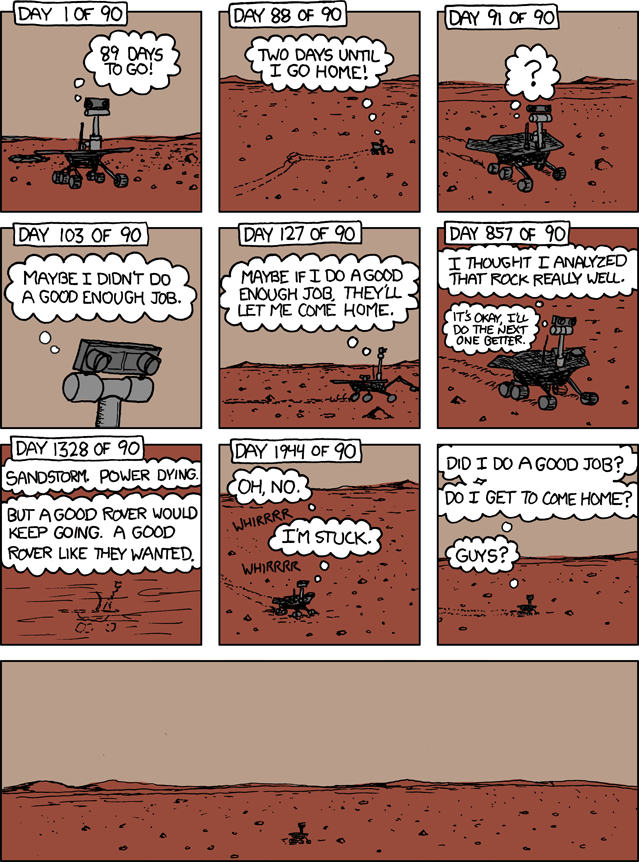
Finally, on a related note, even two years after I first saw it, this (damn you, Randall!) will tear me up every time:

© Randall Munroe at xkcd.com

(Go buy his new book, now a #1 New York Times Best Seller!)


Leave a comment

Filed under Astronomy, Computers, Space