Monthly Archives: November 2014

NaNoWriMo 2014, Day Twenty-Five

Five days and change left in NaNoWriMo. One hundred and twenty-two hours and thirty-three minutes as I write this.

IT’S HERO TIME! *grabs mace and sword and attacks WordPerfect file, striking it repeatedly about the grammar and syntax*

While I normally put in a lot of  internal links to previous, related posts here, I won’t be doing that for what I hope will be this year’s thirty NaNoWriMo posts. If you have jumped into or stumbled onto this story in mid-adventure, there are plenty of other ways to navigate around the site to find previous installments. Actually doing so is left as an exercise to the student.
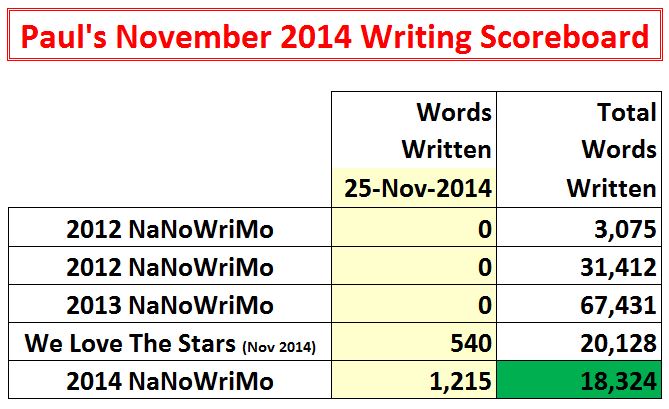
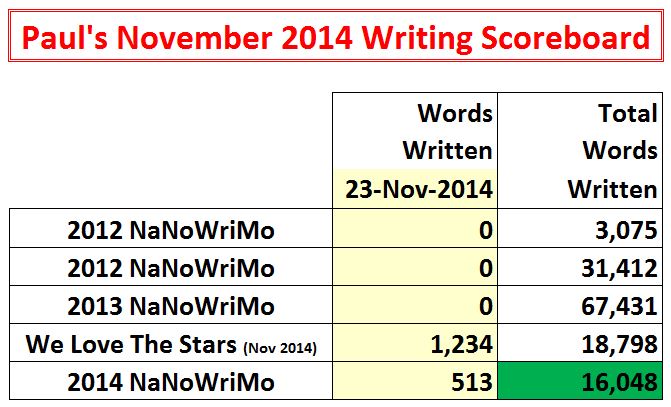
2014-11-25 Word Count Graphic

CHAPTER EIGHT (concluded)

“Once we get up, running, and in contact with the ore deposits, we should be able to move up to the next steps in construction using the processed ore itself. But to get to that point, before we get to the ore, we’re going to need materials to bootstrap the process. While we might be able to do it by scavenging equipment from Cronus, instead I suggest that we use parts of Cronus herself.”

“I don’t follow, what parts?” Alsby asked.

Carson waved his arms at their surroundings. “All of this. The rock, the hull. You know that when they hollowed out this asteroid they left most of the material in there, over engineered it like crazy. We think that we can take a hundred metric tons or more of material out of the interior, making our habitable spaces bigger and processing that material to use to build the first parts of the Rhea station.”

“I would really prefer that you didn’t dismantle the ship around us while we’re a billion miles from the nearest help, if it’s all the same to you.”

“Captain, the main reason they hollowed out so little of the interior of Cronus is that they didn’t need to do any more. It’s not for structural reasons and it’s not for radiation shielding. We can do this safely, and it solves the initial bootstrap problems.”

Alsby was silent. She didn’t like to be second-guessing her superbly qualified crew with a kneejerk reaction. She also didn’t like people taking chances with her ship.

“I’ll give it consideration. Have SaSEM give me access to your plans and calculations and I’ll see how unreasonable and outrageous they are. But one thing you haven’t mentioned is how you’re going to dig down to these ore deposits. I know we’ve talked about using the Enceladus Digger probe, but that’s nowhere near big enough to allow access.”

“Correct, Captain, we’ll be using the Digger,” said Carson. “It’s only designed to melt out and keep open a channel a fraction of a meter wide. The key to using it on Rhea is the distance we’ll have to be digging. Since the Digger was designed to dig through up to fifty kilometers of ice on Enceladus to get to the interior ocean, the connection path to the surface would have to be quite small.”

“But here we’ll only be going down a handful of kilometers at most,” jumped in Phillips. “Since the connection cable keeps the passage clear by heating it, we can put a lot more power into a five kilometer cable than we can a fifty kilometer cable. That will in turn create a much bigger passage. From there we can have modified sample collection bots roaming up and down the cable to widen it even more. We figure we can support a passage with a diameter of nearly ten meters. That’s more than enough to run a pair of lifts and all of the data, supply, and communication cables we need, as well as the plumbing for bringing up gaseous volatiles.”

“You’ve run all of this past CeresOps as well?”

“Yes, ma’am, they’re the ones who thought of it. They’ve been doing the testing on the Digger’s connection cable materials to verify that it will handle the power and heat overload and they’re sure it will.”

“Excellent. Have SaSEM give me access to that as well. Now, you said that you had a personal request as well?”

“Yes, ma’am.” Carson took a deep breath, glanced at Phillips, and then pressed onward. “We’re aware that it’s against regulations, but Betty and I would like to get married. I’m sure you’re aware that we’ve been involved as a couple for some time.”

“Worst kept secret on the ship, Ben. We all know that these things happen, especially in tight quarters and a long mission. So long as it doesn’t get messy and cause problems to the mission, most captains, like myself, generally look the other way. But those couples always wait until they get back home to get married and solidify their relationships. Why do you want to do it here and now, and why do you think it would be allowed in violation of the regs?”

“We believe that the regs were designed and implemented under different circumstances, before the AHF plague hit Earth. We all know how many of the details in the regs are simply window dressing to keep the Earth governments and their taxpayers happy. Now that we’re on our own up here, we believe that it’s essential that we adopt a more pragmatic and realistic system. This would be an excellent, practical, and logical first step.”

“Great speech, Ben, but there’s nothing logical about getting married.” Alsby sighed. “I’m inclined to agree with you, but I don’t see why you have to get married. What’s the rush? Why not just keep the status quo while we loosen the regs onboard concerning fraternization?”

“That’s the other thing, ma’am,” said Phillips. “We’re suggesting that we stay behind to keep the Rhea station and mining operation going when Cronus returns to Ceres.”

Both Alsby and Miller looked stunned by the suggestion.

“It makes sense, Captain,” said Carson. “If we get this operation running, the whole system is going to be depending on us for volatiles, especially water. You said yourself that there will be others coming to permanently inhabit the station. We believe that someone will have to stay behind to keep it running until they get here. We’re the ones with the engineering experience to pull it off, so we should be the ones to stay.”

“How about the fact that we’re going to need your engineering experience on the Cronus?” Alsby asked.

“Once you’re done with Saturn and head back home to Ceres, ninety-nine percent of the engineering on Cronus will be routine maintenance. SaSEM already monitors and directs repairs there. We’re just her puppets who actually have hands, feet, and eyes to get the job done faster than a bot could. Almost anyone in the crew could do that, and you’ll still have Volkov and Simpson for anything fancy.”

There was a long pause as Alsby looked back and forth between her two Chief Engineers. Generally it was tough to squirm in zero-G, but after more than a minute of scrutiny, they were making a good effort.

“You’re asking for a lot,” Alsby finally said. “I agree that we will have to take some additional risks. Perhaps we will have to leave you behind on station. I’ll agree to at least putting that option on the table as we make plans going forward.”

“Thank you, ma’am,” Phillips said.

“Don’t thank me, I’m just stalling to give you time to come to your senses. In the meantime, SaSEM, please tell Naoiki and the department heads that I want to have a conference in, say, two hours to talk about the issue of some potential changes in our regulations . Ben and Betty, I want you here there as well. Todd, you too. Any questions?”

“I hesitate to get overly personal,” Miller said, “but given the circumstances I feel that someone should ask.” He looked at Phillips. “Betty, you’re not pregnant, are you?”

“Jesus, Todd! Of course I’m not. We’re in love, we’re not insane.”

Leave a comment

Filed under Science Fiction, Writing

Kyoto (Part Fourteen)

To Recap: In May, 2012 I went to Asia on the “Three-Countries-Three-Weeks-Three-Kids” tour. The first stop on this once-in-a-lifetime trip was Shanghai, followed by several days in Seoul. Now I was footloose and fancy-free (i.e., lost a lot) in Kyoto, Japan. I found one of the most beautiful and interesting places I’ve ever seen — just search for “Kyoto (Part Two)” through “Kyoto (Part Nine)“. (Yeah, that’s a lot of pictures of one place.)  The next day my daughter didn’t have classes so she started showing me the other sights of Kyoto, including beautiful and ancient temples along the Philosopher’s Path.

Not too far from the Golden Temple (we took the bus – Kyoto has an excellent public transit system of buses and subways, although I’ll admit that having a “native guide” helped) is the Nijo Castle. Surprise! Yet another UNESCO World Cultural Heritage Site!

IMG_4840 small

From the outside, it’s obvious that this was a fortress, complete with moat! Built in the early 1600’s in order to defend the Imperial Palace (which is a couple blocks away), it was also used as an official residence for visiting dignitaries.

IMG_4871 small

Classic Japanese architecture, with guard houses like these at each corner. Very feudal.

IMG_4872 small

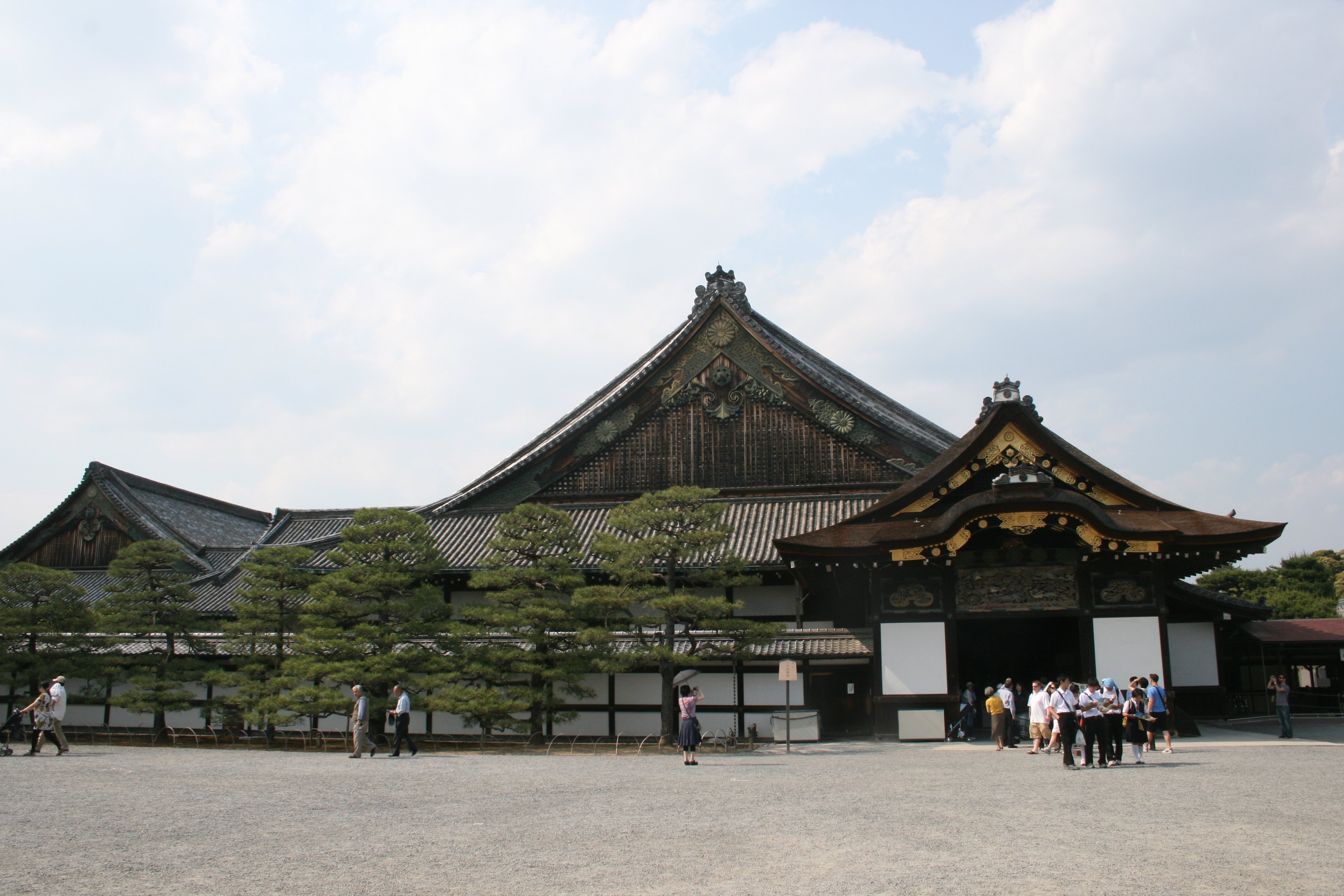
Inside, Ninomaru Palace is huge. Five buildings, thirty-three rooms, 3,300 square feet, with over 800 Tatami (straw mats). You can see more very ornate gilt artwork over the main door, similar to what was seen at the Golden Palace.

IMG_4918 small

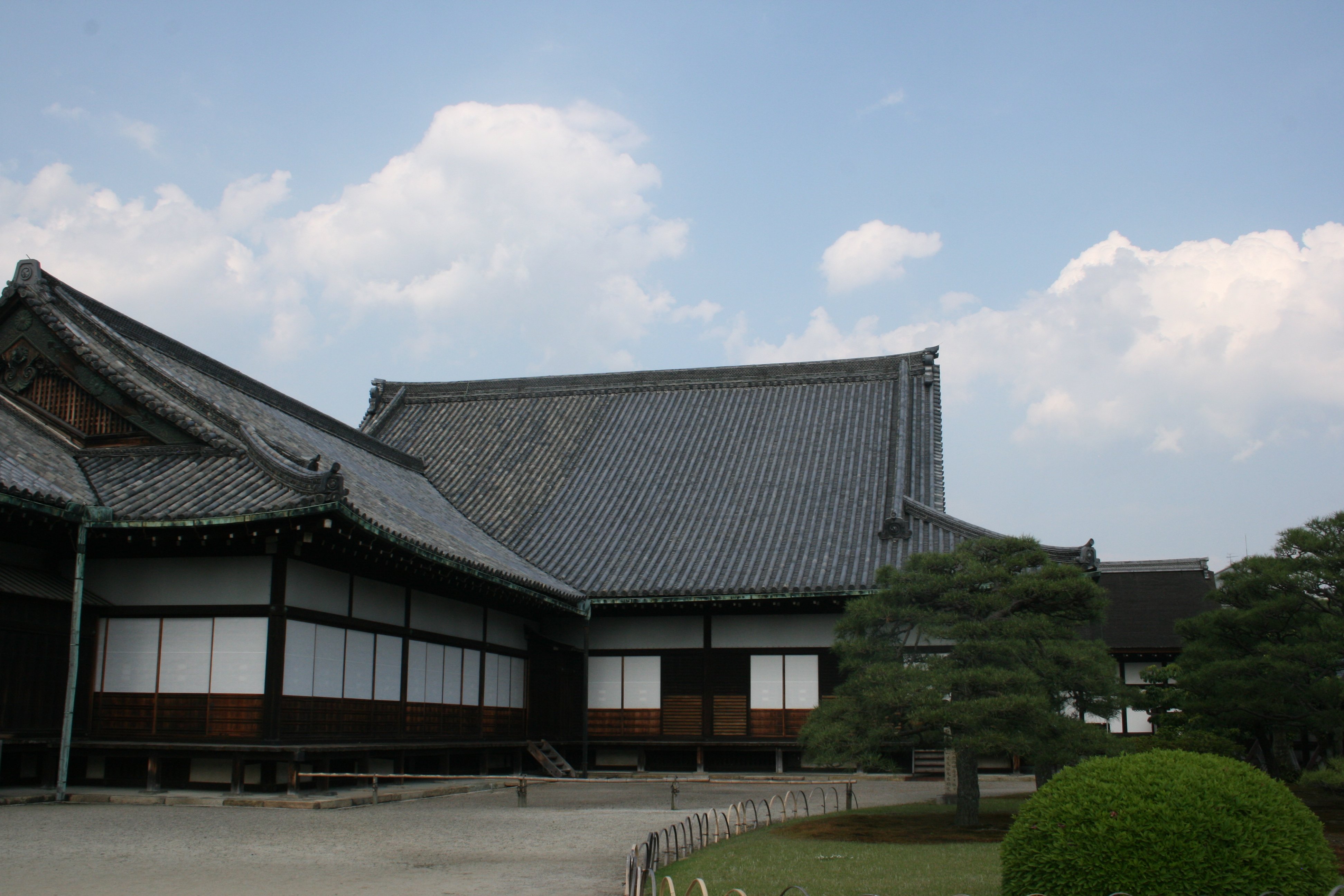
Here you can see some of the side buildings of Ninomaru Palace, looking back toward the entrance area.

IMG_4941 small

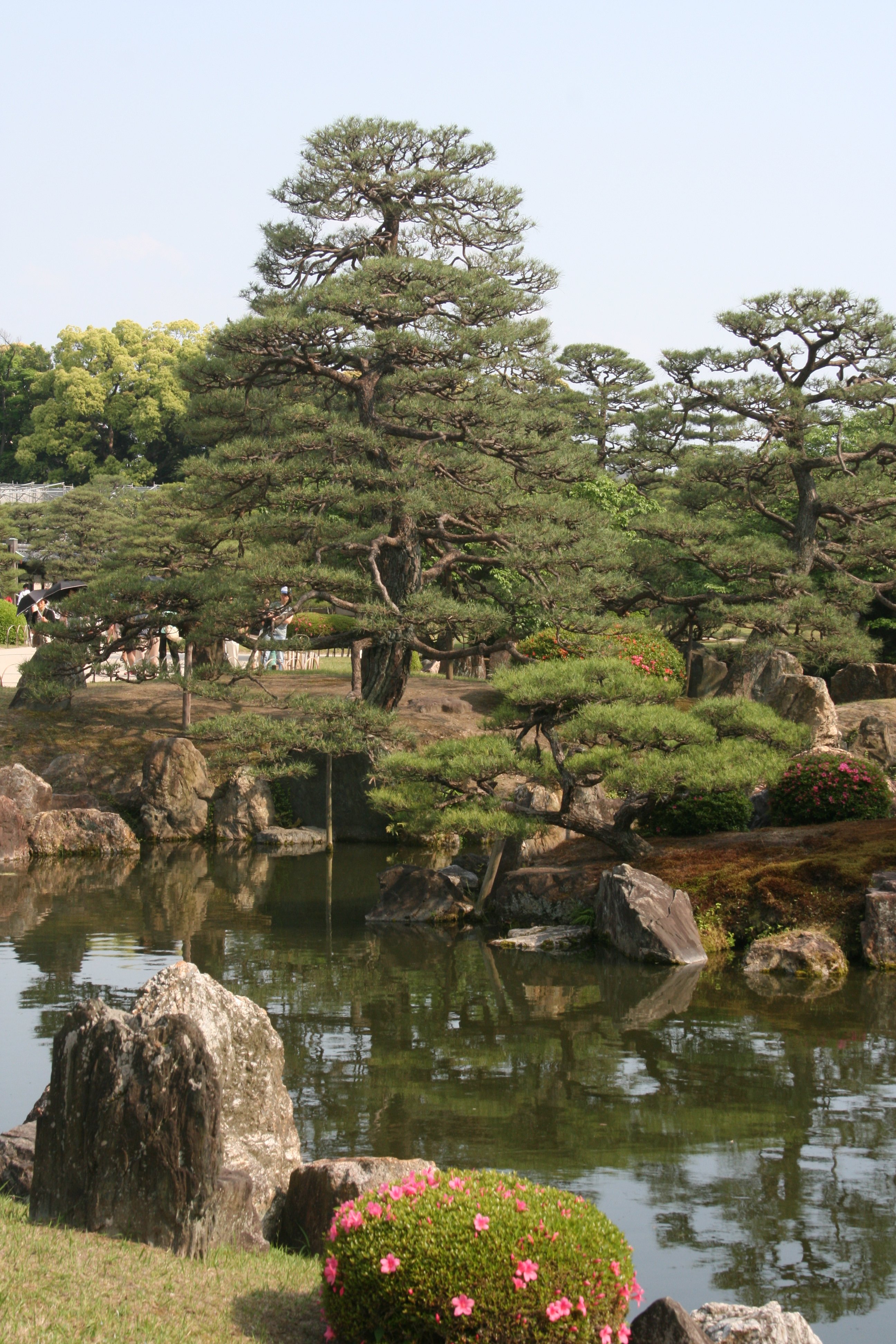
Ninomaru Garden dates back to the original construction in the 1600s and was just gorgeous. Three small islands are out in the pond – Turtle Island, Crane Island, and the Island of Eternal Happiness. (Can I live on that last one?)

IMG_4961 small

For some reason I was fascinated with these ornate metal pieces (pewter? lead?) over many of the doorways. There were a lot of them – I had big memory cards for my cameras.

IMG_4992 small

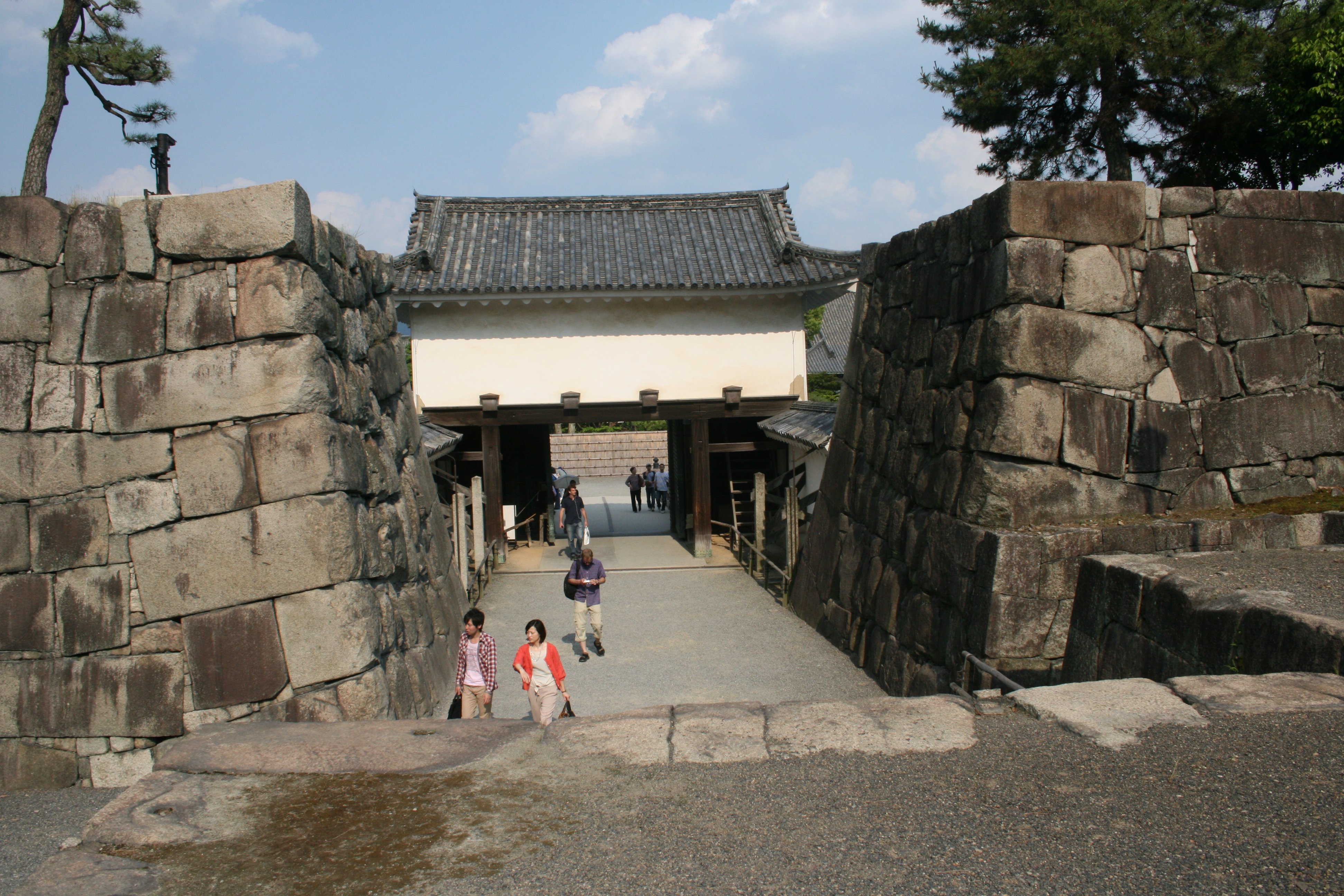
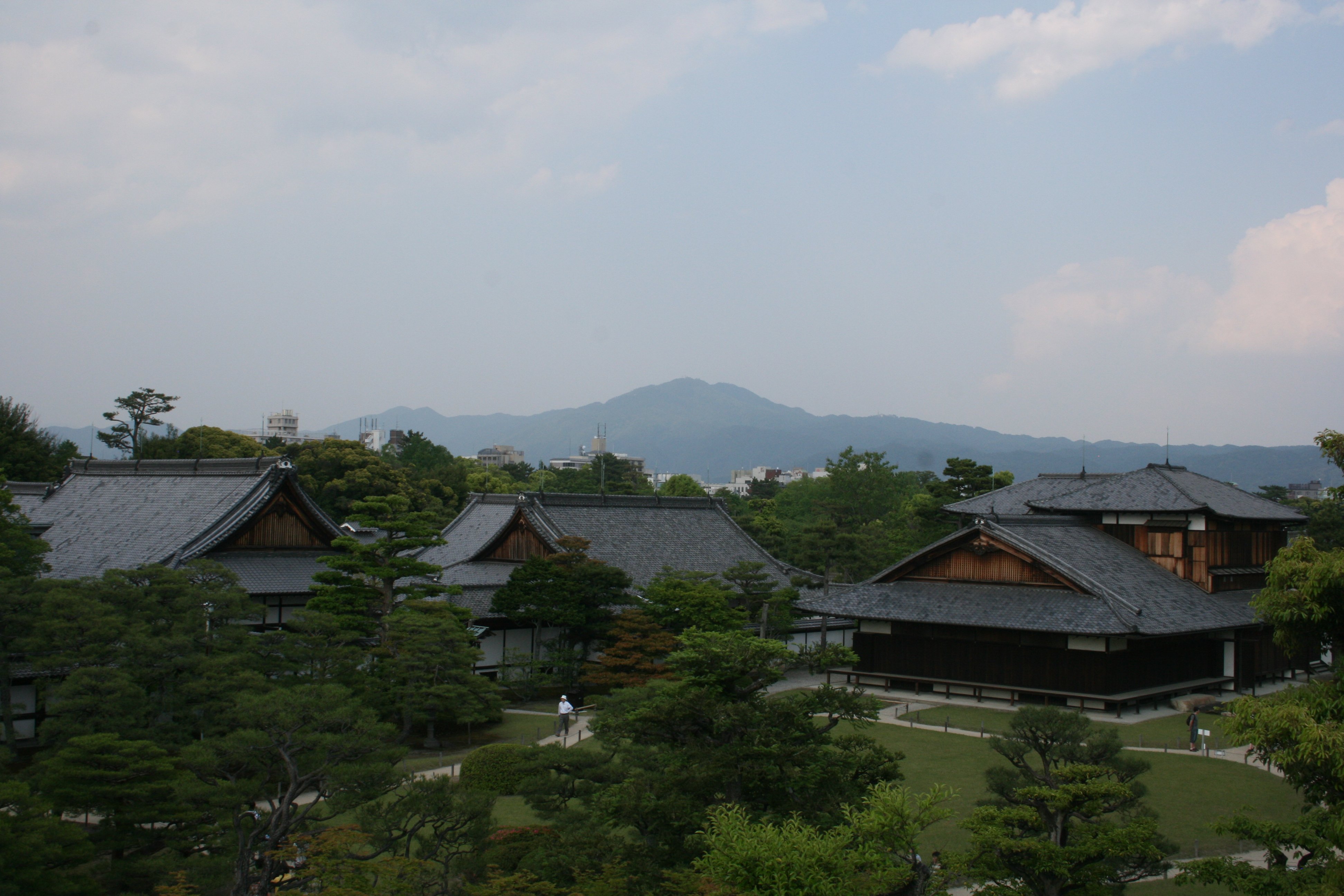
Inside the Nijo Castle grounds is Honmaru, a separate, interior fortress. The size of the blocks in these walls and the walls themselves was quite impressive.

IMG_5061 small

Honmaru consists of several buildings in a style typical of court buildings of the age. It also has a large garden on the grounds, very beautiful.

IMG_5078 small

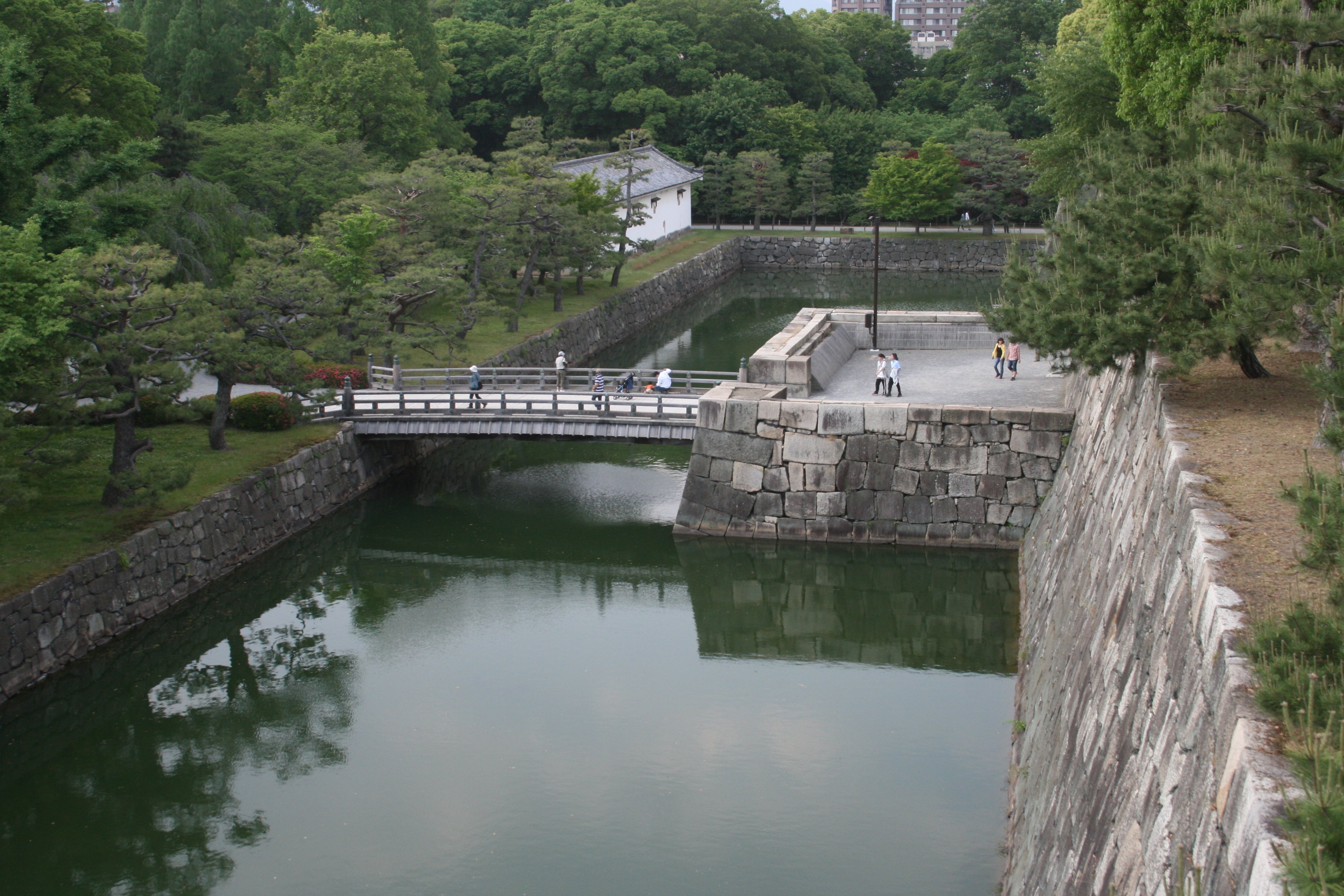
On one corner of Honmaru is a huge, raised Donjon. It towers above the area and gives a commanding view. Given the purpose and military function of the donjon, this would be sort of where the term “commanding view” came from. Here you can see one of the two bridges crossing the inner moat which surrounds Honmaru.

Leave a comment

Filed under Photography, Travel

NaNoWriMo 2014, Day Twenty-Four

The Enterprise is badly damaged, the Genesis Device is counting down, Kahn is quoting Shakespeare, the warp drive’s offline, we’re trying to escape at half-impulse, Checkov’s letting us know just how close we still are to the big BOOM! that’s coming, Sulu says, “We’re not going to make it, are we?”, and Kirk looks over at his long-lost bastard son, who just shakes his head woefully.

If my equivalent to Spock’s next move is out there in the real world of this NaNoWriMo project, now might be a good time for that particular plot twist to manifest itself. The needs of the many, and all of that.

While I normally put in a lot of  internal links to previous, related posts here, I won’t be doing that for what I hope will be this year’s thirty NaNoWriMo posts. If you have jumped into or stumbled onto this story in mid-adventure, there are plenty of other ways to navigate around the site to find previous installments. Actually doing so is left as an exercise to the student.

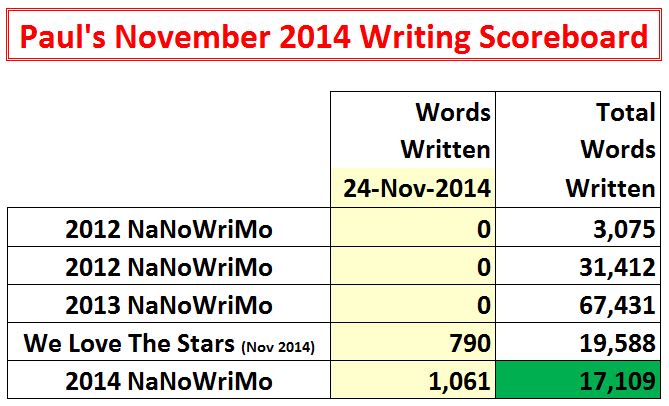
2014-11-24 Word Count Graphic

CHAPTER EIGHT (continued)

The spiders were being guided by images taken from Cronus as it orbited above every forty minutes. While they had been dropped into relatively “safe” locations, they needed to get to more “interesting” locations as soon as possible. They were looking for any sign of land.

It had been known for over one hundred years that Rhea primarily consisted of frozen water ice, with other volatiles mixed in for variety. But in addition to the ice, Rhea had a fair amount of solid materials. While the vast majority of the solids were buried at the center of the moon under hundreds of miles of ice, some of it was still on or near the surface.

“Any luck yet?” asked Alsby.

Miller threw two map images up onto the wall. “We’re getting there. We knew we were putting the probes down close to some mineral and solid deposits, but we only have so much precision from this high up in orbit.”

A knock on the door frame preceded the entrance of Carson and Phillips from engineering. They looked tired, but today they each had a smile.

“Captain, we’ve got some ideas on the station design that could let us kill multiple birds with one stone.”

“Let me see,” said Alsby.

“SaSEM, can you please open the station drawings I’ve been working on?” Phillips asked. A 3-D image appeared above the conference table in front of her, showing a cross sectional slice of Rhea’s surface. “The preliminary data we had for Probe Two showed the largest deposits under Tirawa, which would make sense. It’s one of the largest impact basins on the moon and it was almost certainly created by the impact of a large asteroid. Much of that stony or nickel-iron material would be buried there, but we don’t know how deep.”

“Do we have any good guesses? We’ll be lucky to be able to dig down even a couple of miles, so if it’s fifty or a hundred miles deep, we don’t have any chance of getting to it.”

“It can’t be that far down,” offered Carson, “simply because we can detect it as being differentiated from the background. It might be a mile or two down, but it might also be huge. It will be slowly working its way toward the core over time, but probably hasn’t had a chance to go too far.”

“What about the other probe?”

“Probe One has found several magnetic signatures that appear to be less than a mile deep,” Phillips said. “They’re scattered and much smaller than the Tirawa deposit, but they’re also much easier to access. When we figure out which of them is the biggest and shallowest, that will be where we should build the station.”

“You said something about two birds?”

“Right, we think that we have to try something radical here. All of the existing stations on the Moon, Mars, and Ceres are on or near the surface. They may be underground enough for some radiation shielding, but that’s trivial. We’ve been assuming that we would do the same here and have a mine of some sort to bring the ore up.”

“We want to turn that on its head,” said Carson. “Here we think we should build the station down where the ore is, even if it’s a mile or more down. It will make it much easier to mine and process the ore, while also giving us complete shielding from radiation.”

“You want to dig down over a mile and build there? Do we have that kind of capability?” Alsby asked.

“If it were rock, no way,” said Phillips. “But it’s 99% water ice, so all we need to do is melt our way down. That just means energy, but we’ve got multiple sources of that and we can pretty easily get it to where we need it.”

“But that’s the best part of all,” said Carson. “Instead of just vaporizing it and letting it bleed off into space, we think we have a system that will let us simply melt it, then pump it off to the surface.” He pointed to the diagram floating over the conference table. “We can use that like concrete to put into whatever forms we want to, which will make it much easier to start shipping back to Ceres, Mars, and Earth.”
“They’ve been working on that back at Ceres,” said Miller, not wanting to be left out of the conversation completely. “The high-G ship coming out with the station AI and other supplies will also be carrying dozens of small guidance boosters with autonomous navigation systems. They’ll tell us how big the solid ice shipments need to be, we’ll attach a booster, and it will use a slingshot maneuver around Saturn to speed up its trip. Catching it when it gets there will be their problem, but they seem to have a few good ideas on that already.”

“So we’ll tunnel down,” said Phillips, “sending water and volatiles up the shaft and ready to send back. When we get to the deposits, we’ll start hollowing out our station and start mining and processing the ore. I would kill to find some aluminum, but there’s sure to be plenty of nickel and iron, so we’ll work with what we have.”

“How stable and safe will a station be hollowed out of the ice that far down?” asked Alsby.

“It should be fine, there’s no tectonic activity that we’ve been able to detect so far in the ice. At these temperatures it’s like steel so long as we don’t heat it up too much. We’ll make the station wider and less compact than a normal surface station, since we’ve got all the space in the world to branch out. If we have small station sections scattered over a wide area with huge columns of ice left intact, there should be little chance of a collapse.”

“Alright, let me know when you’ve got your plans and blueprints a bit more firmed up, then make sure that you run them through CeresOps for a double check on the concept. This looks great. Anything else that you need?”

Carson and Phillips looked at each other for a second, before Phillips took the lead.

“There are a couple of things, one for this project and one personal.”

“Go ahead, Betty. What do you need for the project?”

Leave a comment

Filed under Astronomy, Science Fiction, Space, Writing

Take A Breath, Don’t Make Things Worse

Lots of shit going on in the world recently. Ebola. Global Warming. Ferguson. Congress. Rape Culture. GamerGate. Bigotry. Hatred.

Makes the head swim. Makes you frustrated. Makes you angry. Makes you wonder what to do, ’cause we’ve gotta do SOMETHING, don’t we?

I remembered something I was taught when I was learning to fly. I heard it echoed a couple of times last week at the Armstrong NASA Social.

In all of these cases, the category was “EMERGENCY!!!” Bad things were happening in the plane. Fire. Pieces falling off. Out of control. Ground getting bigger real fast.

In every instance, the first rule, of course, is, “Don’t panic.” It’s not just a buzzline from Hitchhiker’s Guide To The Galaxy. In a “situation”, you might be close to dying. If you panic, the odds of dying approach 1.00 very quickly. Your odds might not be great, but they can only get worse if you panic.

Which leads to the second rule – “Don’t make it worse.” Like the Hippocratic Oath for pilots, it reminds us that there’s no situation that can’t be made worse. Maybe you can make it better, maybe you can’t. Buy you can always make it worse. Don’t do that.

To assist in executing Rule One and Rule Two, Rule Three is to, “Take a deep breath or five.” This might be more of a suggestion than a rule, since there might be times when the fire is in the cockpit NOW, or the mountain in front of you as you come out of the clouds is RIGHT THERE. But those are the exceptions. Most crises build and grow, a chain of errors, poor decisions, and bad luck.

So when you realize you’re at the end of such a chain and it’s about to be a “bad day,” take a couple of deep breaths, don’t panic, and don’t make the situation worse.

The suggestion I’ve heard for the next step, when you’re evaluating the danger in your situation, is to see if you’re in mortal danger this second. For example, following an earthquake, if you’re trapped under rubble and you smell gas leaking, you’re in deep guano right this second. But for the vast majority of us, even if you got banged up a little, you’re probably safe this second. There could be fires to come, aftershocks, further damage, lack of food & water for days, looting… But this second, you’re okay. You can plan from there to make sure you’re still safe in a minute, an hour, a day, a week.

Viewing heaping piles of the idiotic, insane, and vitriolic shit that seems to sometimes fill the news and FaceBook and Twitter and the conversation around the water cooler, it’s natural and easy to get angry, to want to react, to want to strike out, to want to do something now to change things. The topic doesn’t matter. Ebola, global warming, Ferguson, Congress, rape culture, GamerGate, bigotry, or hatred.

I’m not saying that there’s nothing we can do about these things, and I’m not saying that we shouldn’t take action to change these things. Quite the opposite.

But… Don’t panic. Don’t make it worse. Take a few deep breaths. See if you personally are in mortal danger at this second.

Then let’s figure out ways to make these things better. Hopefully we’ll make things better by working together, but we’ll do it one individual at a time if necessary. We’ll do it while remembering all of the really good things in the world that balance out some of the really terrible things. We’ll get there, but it’s a marathon, not a spring.

Don’t panic.

Don’t make it worse.

Take a few deep breaths.

3 Comments

Filed under Moral Outrage, Paul, Politics

NaNoWriMo 2014, Day Twenty-Three

Down? Yes.

Out? No way.

Even if it turns out to only be 50 words today, it will be 50 more than I had yesterday.

While I normally put in a lot of  internal links to previous, related posts here, I won’t be doing that for what I hope will be this year’s thirty NaNoWriMo posts. If you have jumped into or stumbled onto this story in mid-adventure, there are plenty of other ways to navigate around the site to find previous installments. Actually doing so is left as an exercise to the student.

2014-11-23 Word Count Graphic

CHAPTER EIGHT

Rhea was an icy cue ball hanging below them, no longer a dot or far distant orb, but a world now. The surface not only was smooth in comparison to the rocky worlds of the solar system, but it was smooth compared to the other ice moons. Still, having kilometer deep craters and ridges in the frozen surface still meant a landscape unlike anything ever explored in person before.

Now in orbit around Rhea, Cronus had dropped two robot probes down to the surface. The first had gone onto the floor of the biggest crater on the moon, Tirawa, which had a tall, irregular central spire. The second had gone down onto one of the wide plains of ice, dotted with millions of small, shallow craters.

Both were having some problems learning to move around. With a surface gravity only 1/37th of Earth, it was as big of a decrease from the Moon’s gravity to Rhea’s as the Moon’s gravity was compared to Earth. With such low gravity and an extremely icy and slick surface, wheeled transport would have been extremely difficult.

Instead, something completely novel had been cooked up before Cronus had left Ceres. The probes designed for use on the icy moons were equipped with L-shaped appendages that could serve as either skis or snow shoes. On hard ice they would turn the ski surface downward, while on any puffy or powdery surface they could rotate their “feet” to have the showshoe side down.

That would let them move around, but didn’t give them a means of locomotion or a way to stay in one place if the terrain wanted to slide them somewhere else. Wanting to not re-invent the wheel, the mission engineers had found a way to let the probes anchor themselves and then move slowly and securely, just like it would be done by ice climbers on Earth.

Three arms on each lander were tipped with sharp pitons. Any one of the arms was enough to hold the probe on anything but the most extreme slopes, but with all three anchored the probes were solid as rock. The pitons could be heated slightly to facilitate their burial into the ice or their removal from it. When the average temperature at noon was −200 °C, it didn’t take much .

In order to move, the landers were equipped with three systems for deploying ropes and hooks, then reeling them in. The thin but strong lines could shoot an anchor up to 100 meters away, allowing the probe to slide itself along the line. To go across an area at an angle, a second or third anchor could be set. By reeling in lines and letting line out with others, it was hoped that the probes could move about fairly easily, if not quickly.

Nuclear powered and ruggedly built, the probes’ large central bodies, the way they were supported off the ground by a tripod of metal, steel-tipped legs, and the way they moved by shooting out lines and then scooting along them quickly earned them the name of “spiders.”

Leave a comment

Filed under Science Fiction, Writing

Amanda Palmer In Los Angeles

The good news was that the show itself was AMAZING! (Many pictures below – good thing I brought the big lens and know how to use the manual settings on the Canon.)

You can look at some of the examples I give about why I think Amanda Palmer (AFP) is a most incredible individual. If you’re rolling your eyes and muttering, “He likes her?!” then it’s OK to just skip this and I’ll see you tomorrow. I understand that we all have different tastes and opinions and things particular artists or music or subjects that I get passionate about might be things you couldn’t care less about. No worries!

The bad news is that the venue (First Unitarian Church on 8th Street, near Wilshire & Vermont) apparently had some issues. (Looking at Twitter comments from others, this is an ongoing problem with this venue.) I don’t know what happened, but the show that was supposed to start at 7:30 didn’t start to nearly 8:30. We were expecting the doors to open about 7:00, they opened at about 7:45. (I don’t know exactly when they opened, we were standing in line a block away.)

The good news is that even after the late start, our event ran waaaaaay long. This was good news if you wanted lots of fascinating discussions, readings from her new book, favorite musical pieces (okay, so it was just three of them), and a surprise that just knocked our socks off. The show was supposed to run about 1:30, followed by everyone getting a couple of seconds each to meet Amanda and get their books and other items signed. It actually ran well over 2:30, pushing 3:00. That meant…

The bad news is that I didn’t get to meet her or get my (already signed for sale by the bookstore) copy of her book personalized. It was nearly 11:30 when they started setting up for the signings, and we were pretty much at the back end of a line of hundreds of people. My best guess was that it could easily be 1:00 AM or later before we got to the front of that line. While I have no doubt at all that Amanda stayed and signed until the last person was done, and I love her for that, The Long-Suffering Wife and I couldn’t stay that late. (For the record, her first tweet after the show was at 1:25, and it was “LOS ANGELES – my god. sorry we destroyed you with a three-hour show that was supposed to be two hours tops. but…life. and wow.”

The Long-Suffering Wife, while not a big fan, was a sport and came along, skipped dinner (traffic sucked) to get there “on time”, stood in the line on the sidewalk for nearly an hour, and sat through an event that was much longer than either of us had expected it to be. She appreciated Amanda’s personality and how authentic and dedicated she is — but she’s not a fan of the music. So, my thanks to her for soldiering on and coming along anyway.

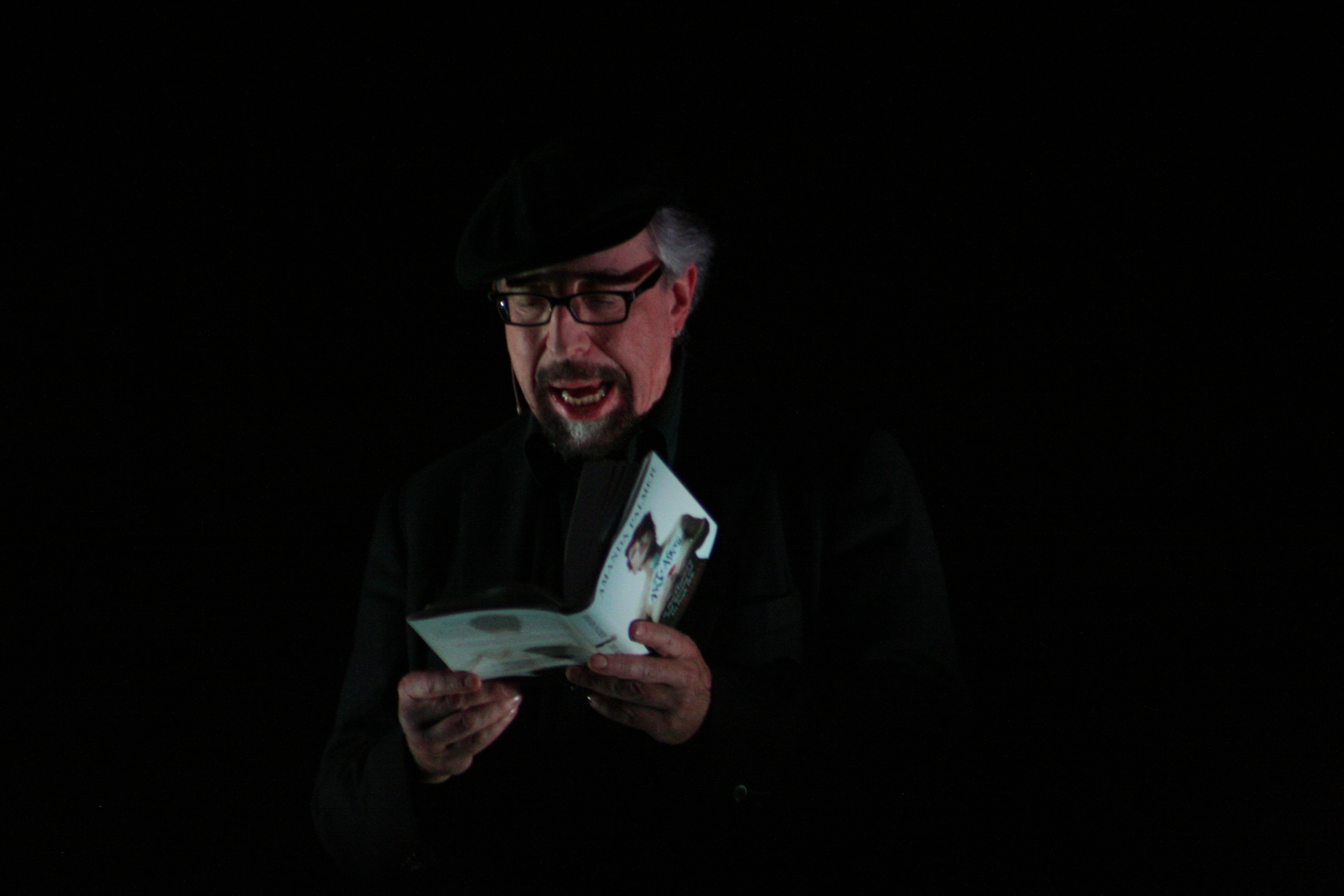
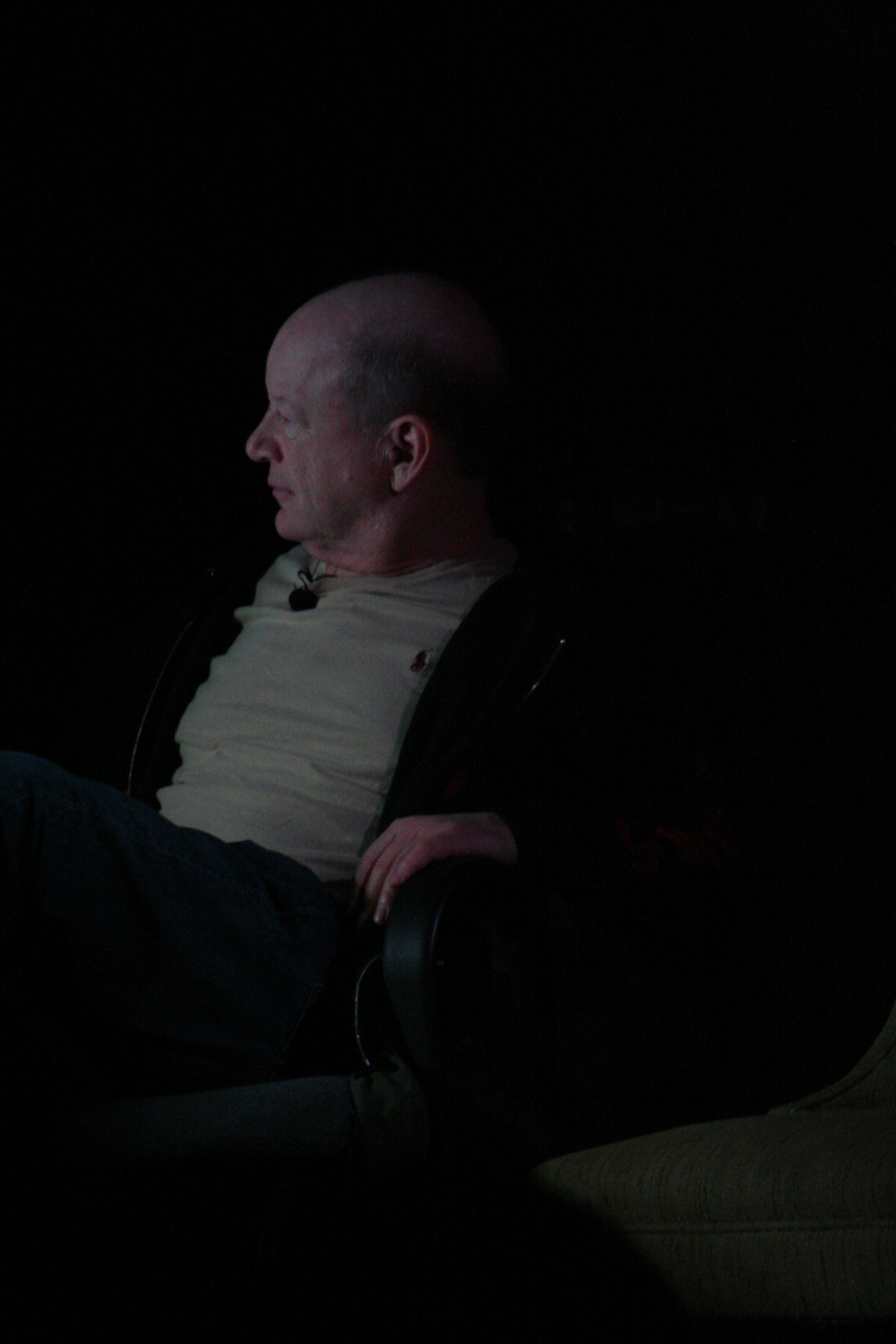
IMG_9713 smallThis is one of the special guests, Jamy Ian Swiss. He was described as the book’s Doula (a sort of midwife), taking 120,000+ words written almost as a stream of consciousness exercise and helping to shape and trim it into a book.

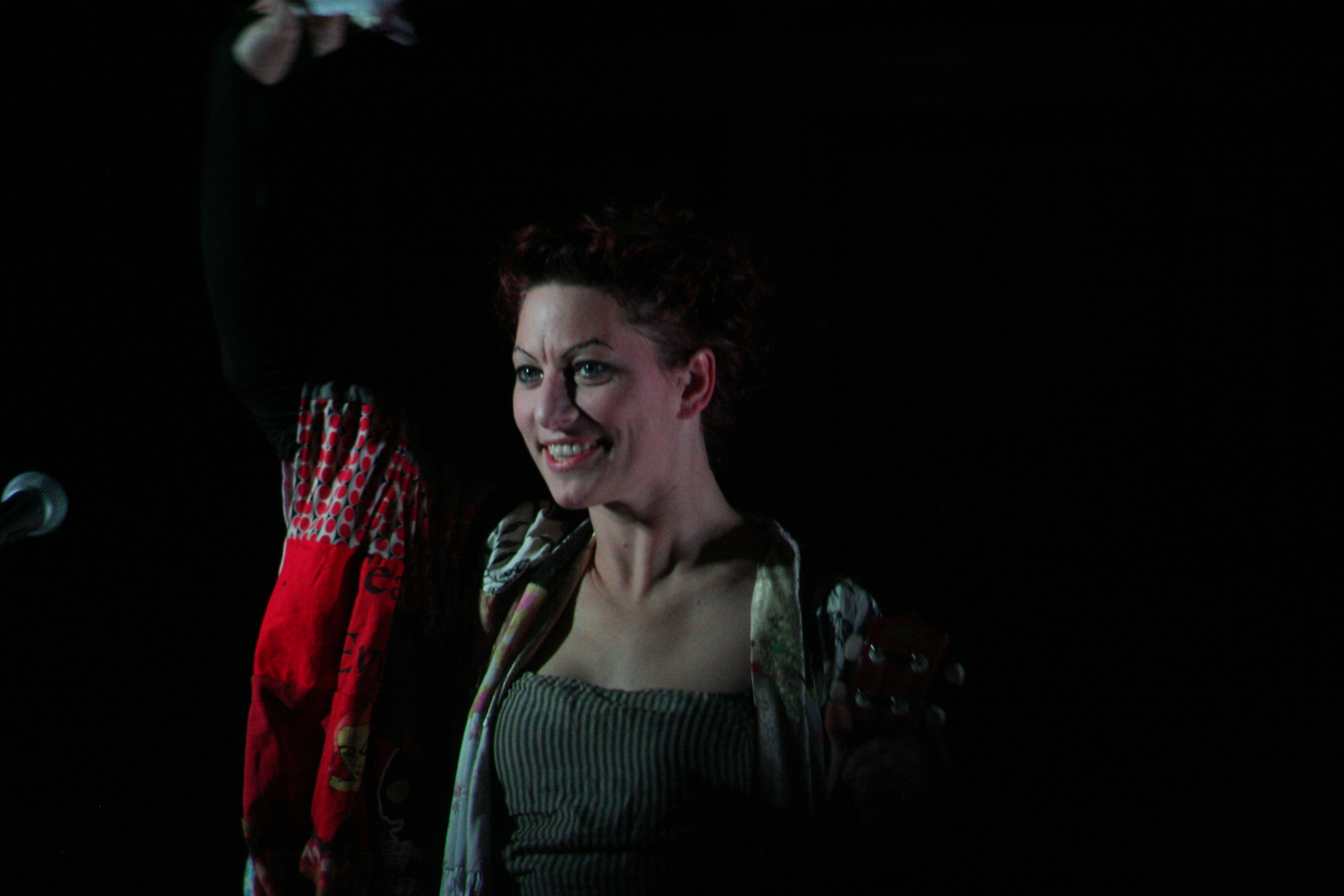
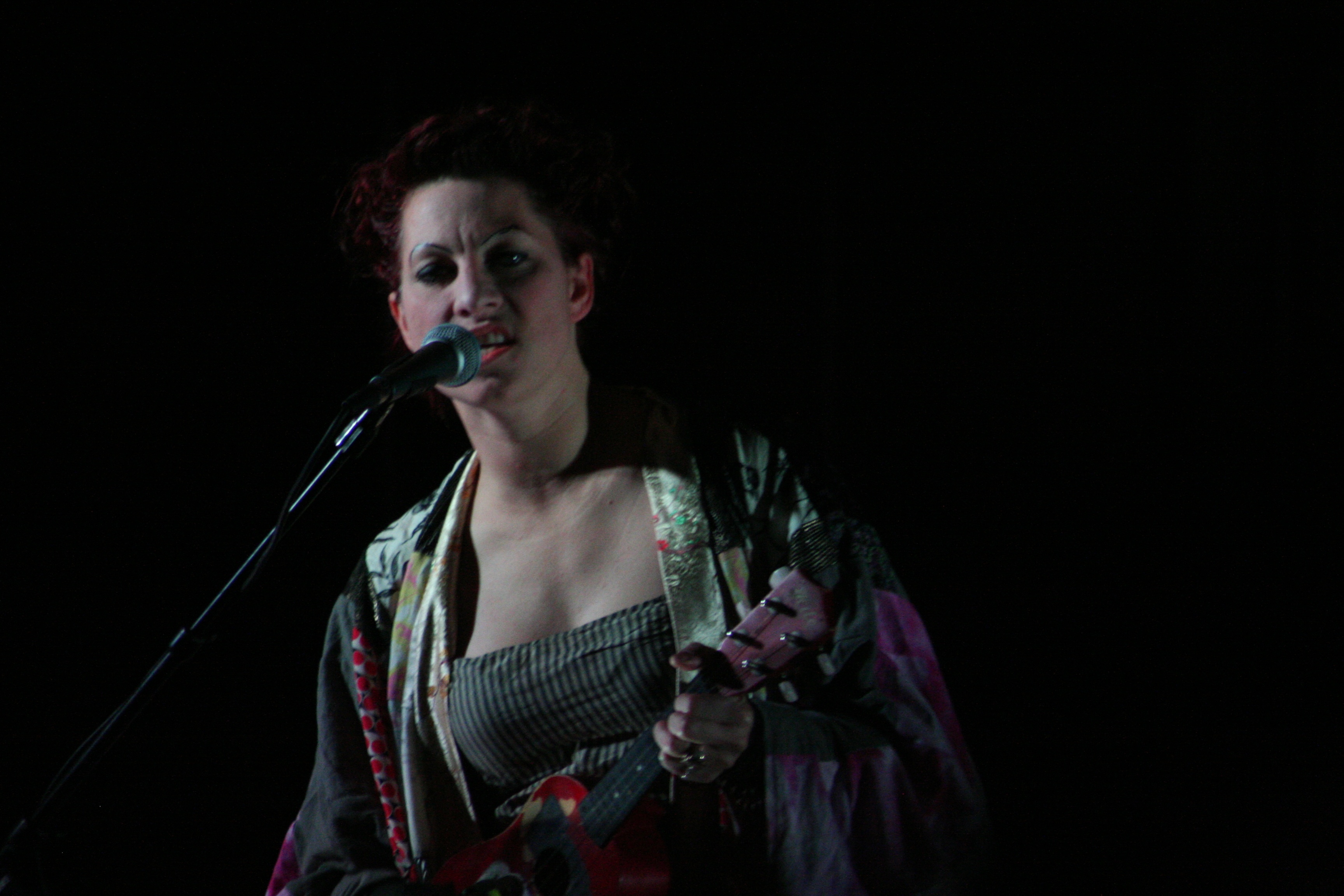
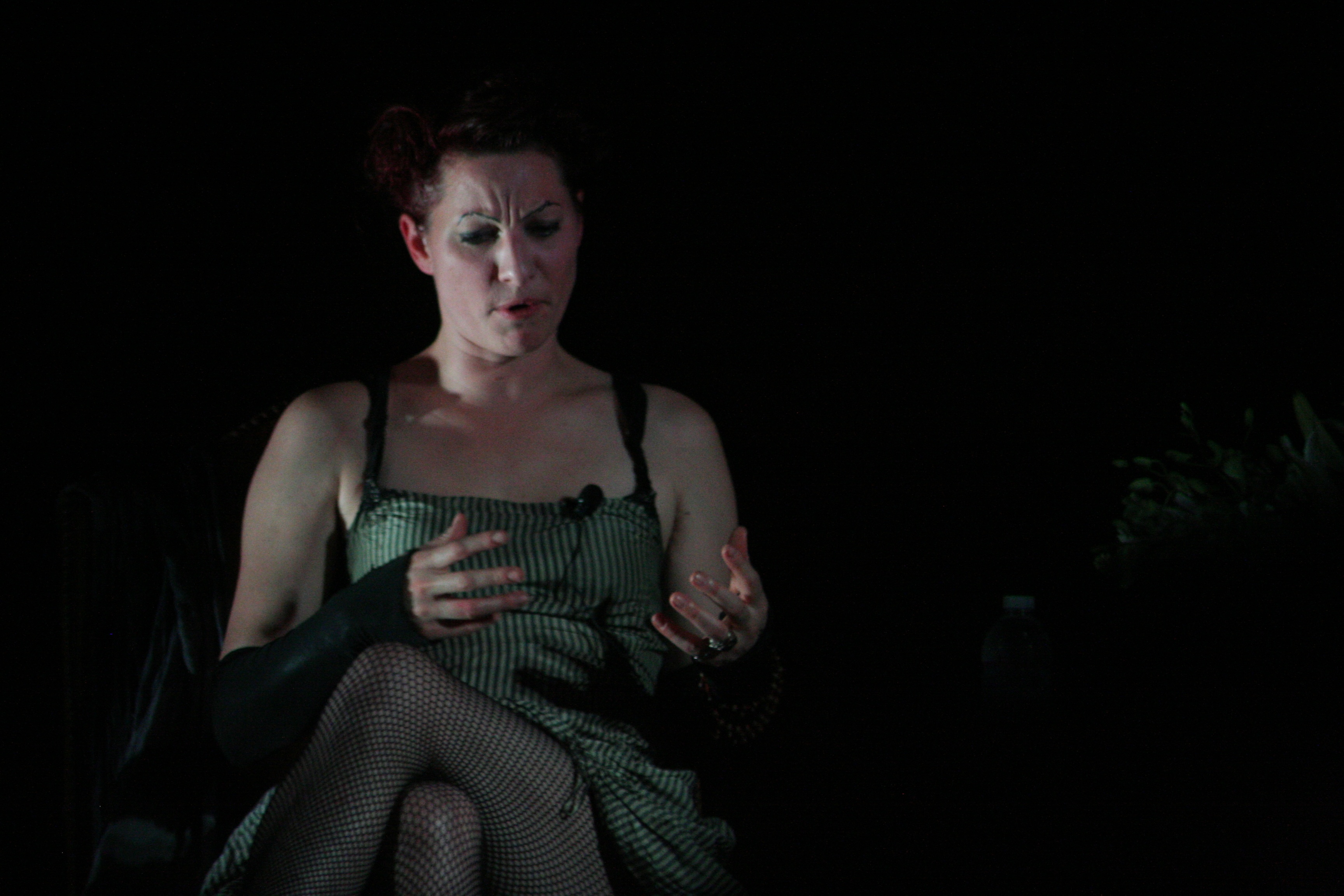
IMG_9716 smallOur first view of Amanda.

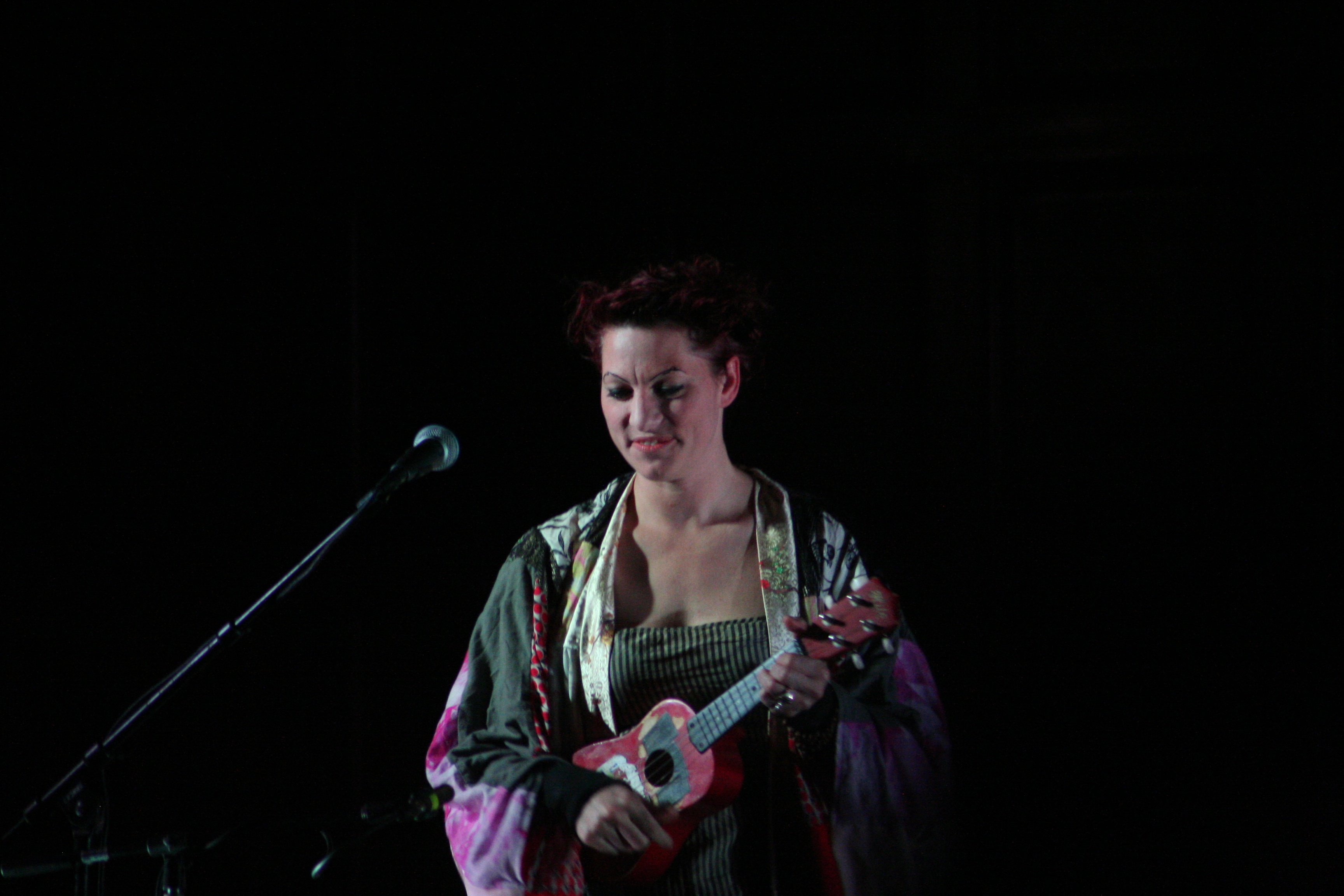
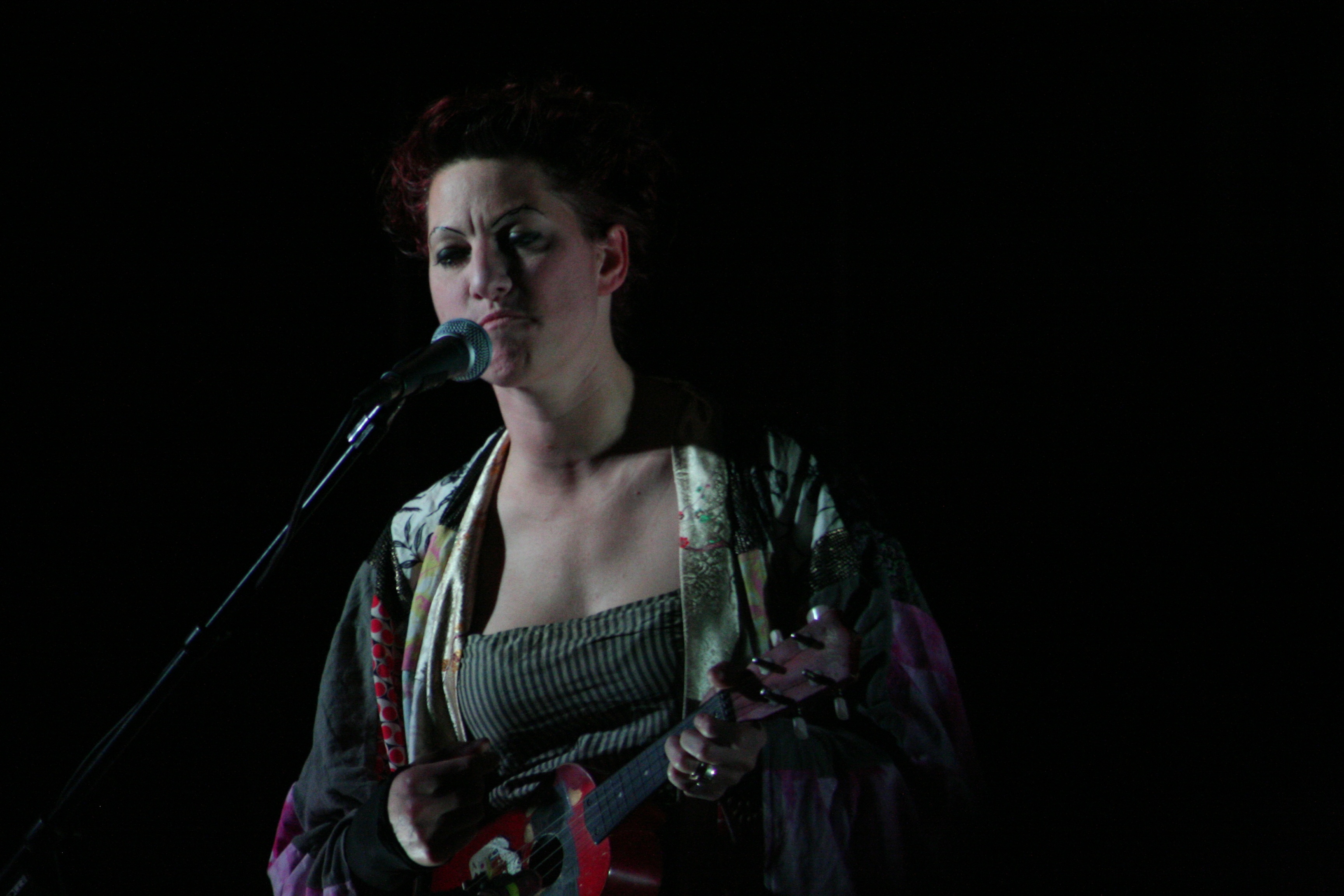
IMG_9717 smallShe started with “In My Mind” on the ukulele, which was wonderful.

IMG_9719 smallI never lose my wallet…

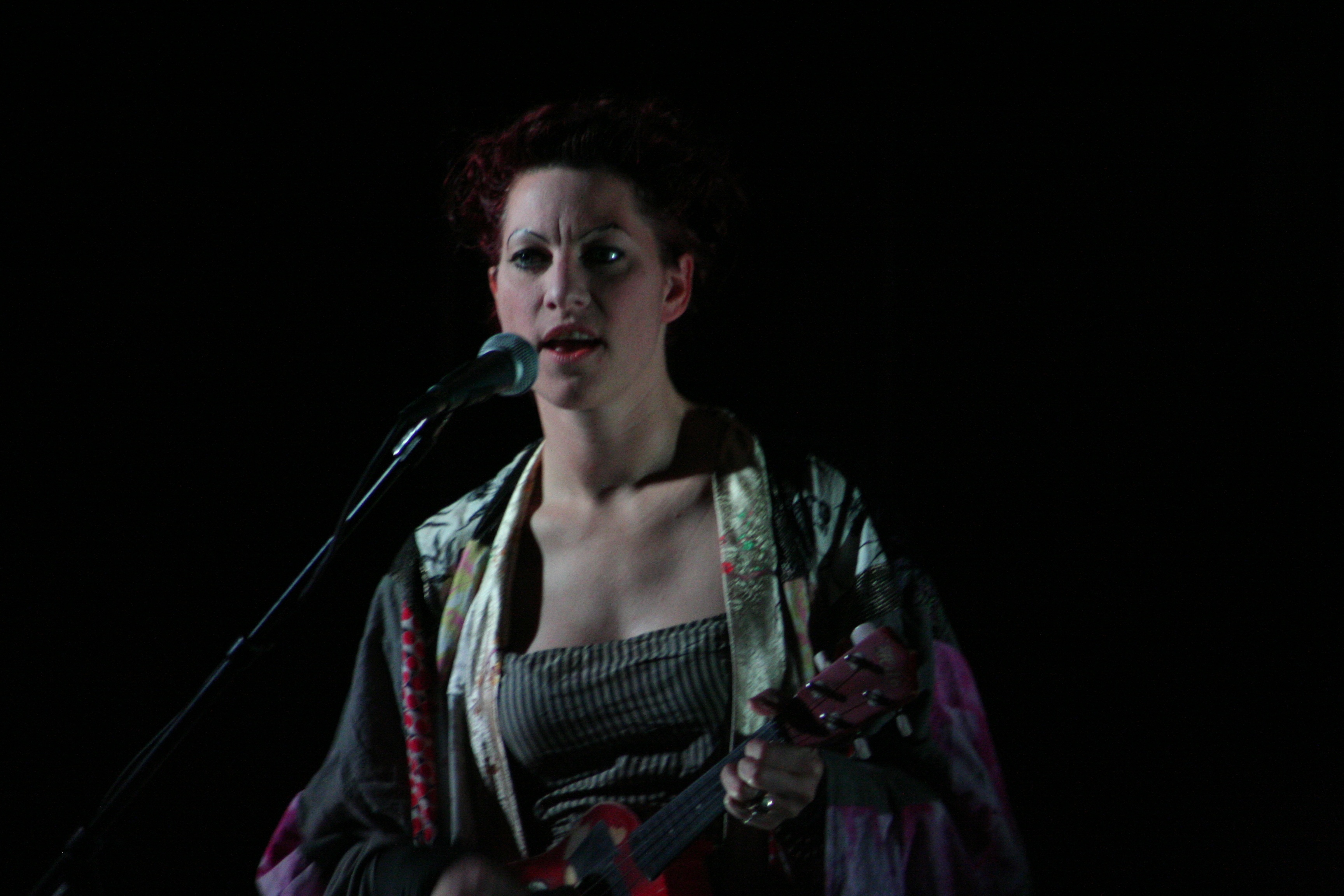
IMG_9720 smallI’ll be a good defensive driver…

IMG_9721 smallPlanting tulips and vegetables…

Then we got two songs, off stage where the baby grand piano was. Another issue with the venue was the sound system, which was marginal at best. The staging was dark (as the photos show), so between the dark, the so-so sound, and the fact that she had disappeared down front off stage, all I heard of the second song was a lot of noise I couldn’t even recognize.

But then…

Then she had them turn off the lights completely, only the emergency “EXIT” lights illuminating the hall, and she did “The Bed Song” and ripped all of our hearts out. That’s something I’ll remember a long, long time.

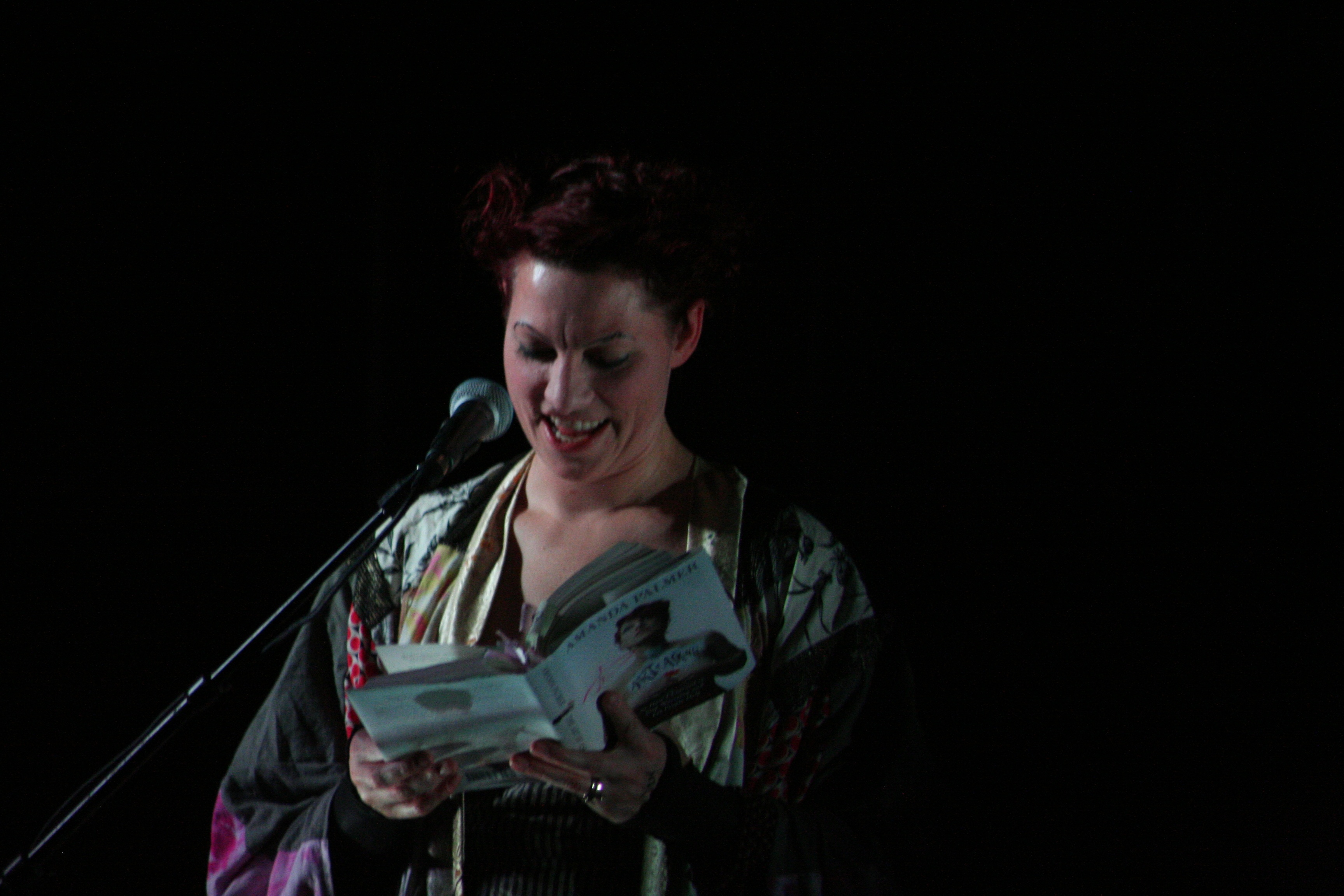
IMG_9722 smallThen we’re getting readings from the new book.

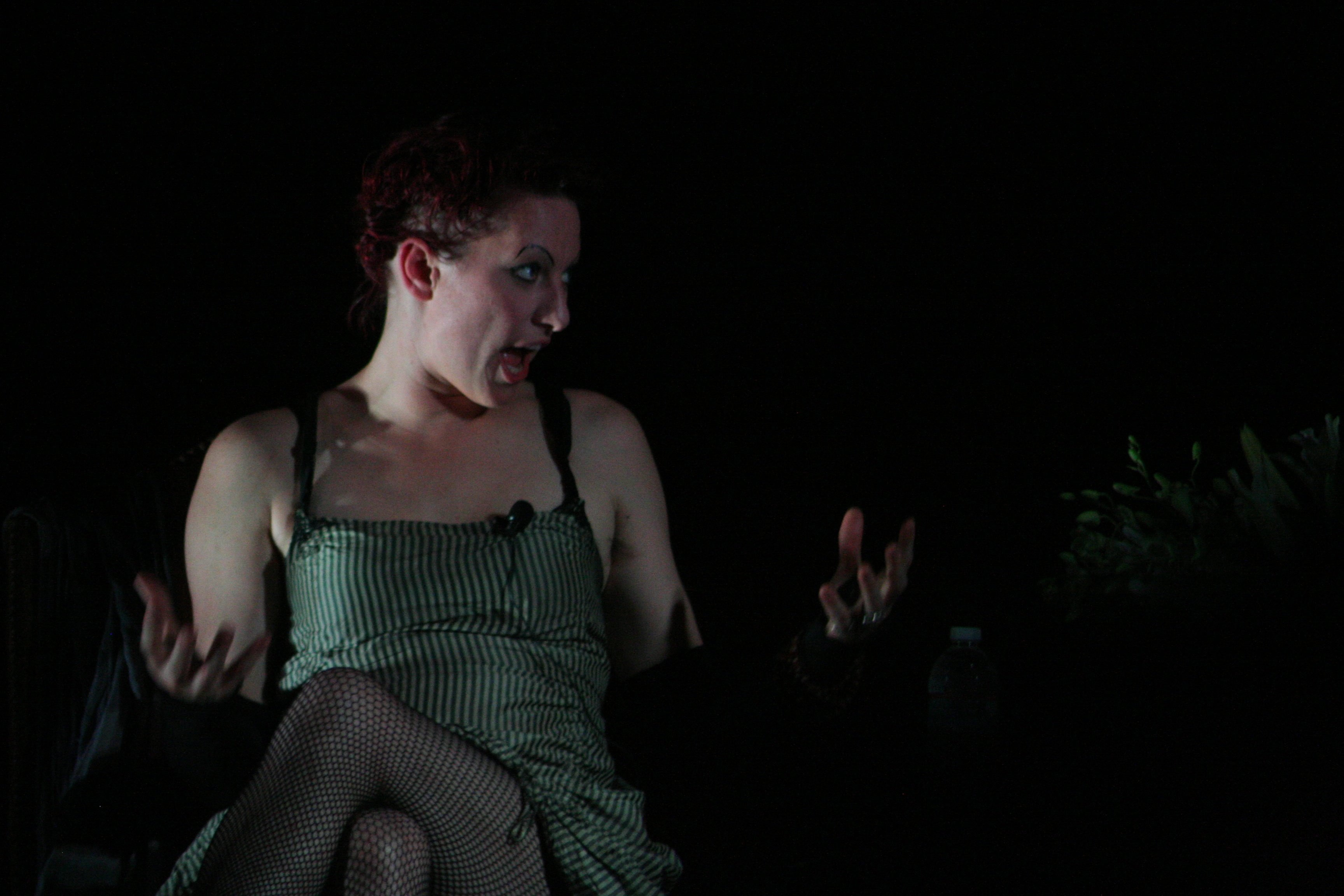
IMG_9726 smallThen a discussion segment as Amanda got asked some very pointed questions.

IMG_9727 smallThe answers were not always simple. This was not “The Tonight Show” or “Letterman.”

IMG_9728 small

IMG_9729 smallThis was the special guest who was doing the interviewing. (Bob?) A well-known, long-time blogger who writes a great deal about the music industry? I know I saw it in an e-mail or blog or tweet from Amanda, but for the life of me I can’t find it tonight, despite my extremely awesome google-foo. But I wasn’t there to gather material for a report, I was there to experience the event.

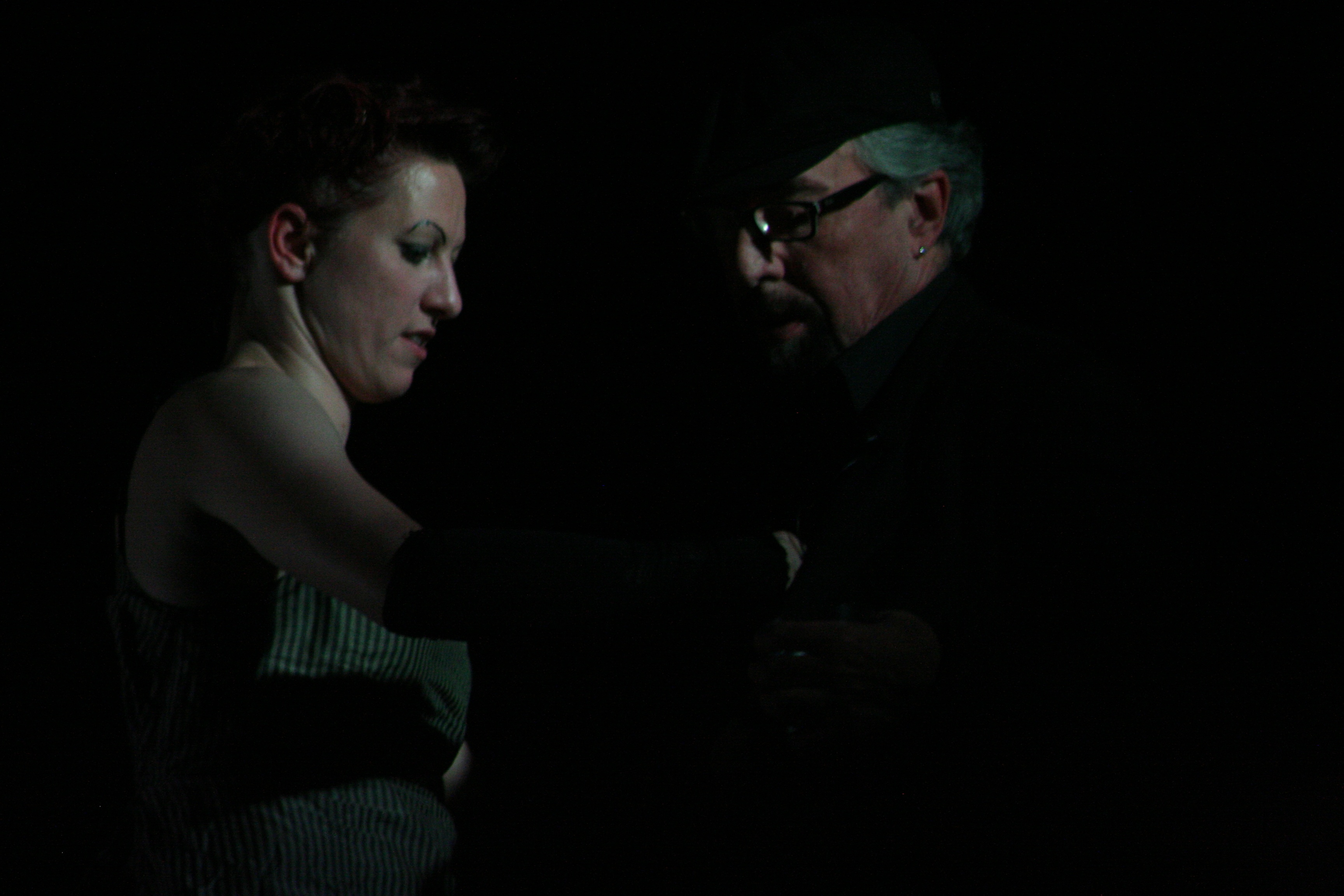
IMG_9736 smallJamy came back out. It turns out he’s a magician, and a good one. We got one really good trick shown to us – after his mike died and Amanda had to pull hers off and put it on him.

Finally, a most amazing final piece before a brief Q&A session. (We were already running so long it wasn’t even funny.)

Amanda read a section of her book (pages 290-293 if you’ve got the book). I found it to be gut-wrenching, particularly in light of all of the shit that’s been going on with women in science and women in writing and publishing and women at conventions and women in gaming all being doxxed, threatened, harassed, and drowned in some of the vilest spew that the internet can deliver.

In short, at a really low time in her life, on her birthday, in Seattle with her husband, Neil Gaiman, Neil set up a massage. When she got there, before they started, the masseuse confessed that as a struggling musician herself, she had often written some of those horrible, vile, angry, disgusting, hateful rants aimed at Amanda.

And then that masseuse from Seattle, Courtney, came up on stage.

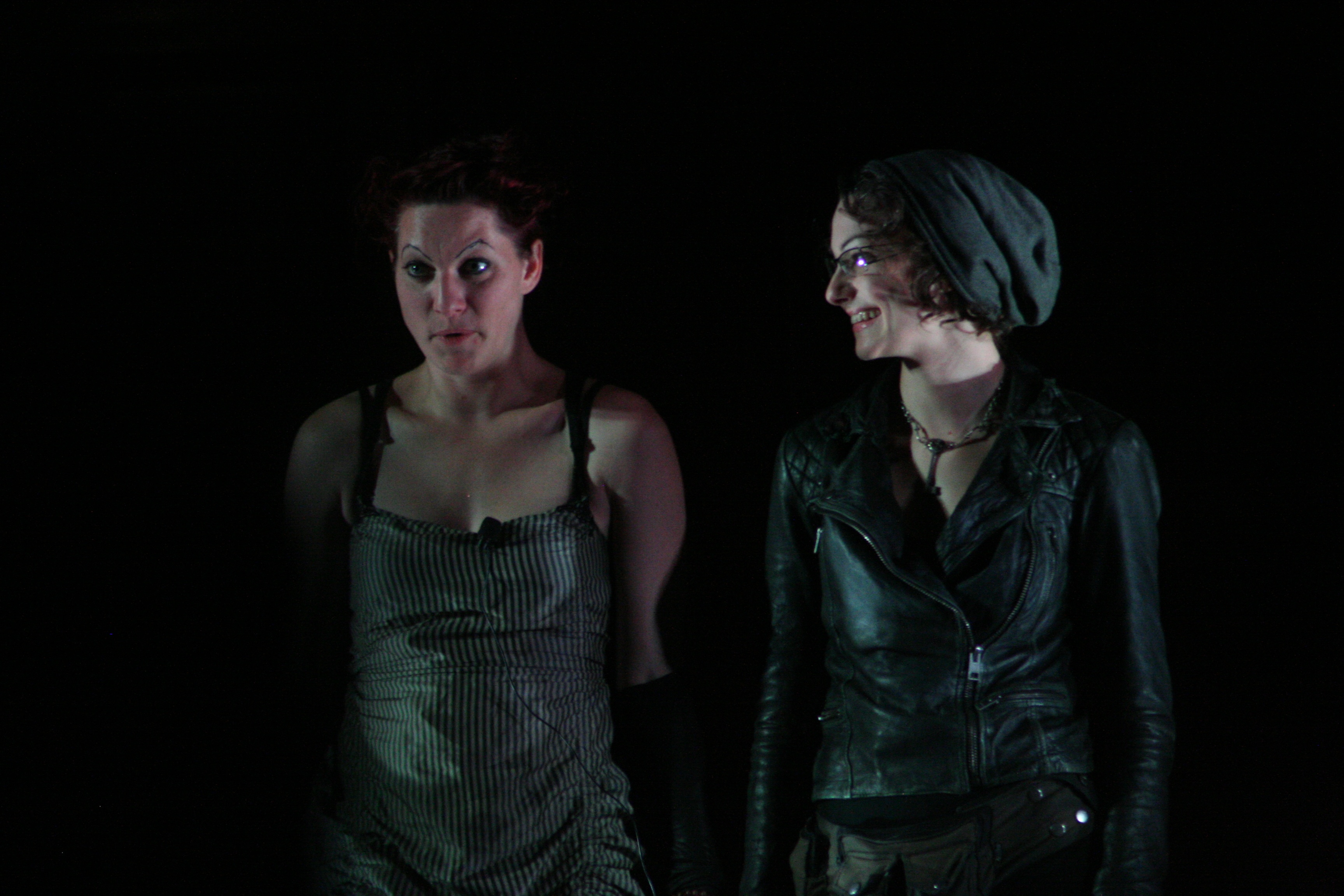
IMG_9740 smallIt sounded like Amanda hadn’t been brave enough to take this particular leap and read that passage at that show, but Courtney came down to LA to be at this show. Their discussion was emotional, shall we say.

Then Courtney, the struggling musician, sang for us, the most haunting version of the first two verses of Pink Floyd’s “Hey You” that I have ever heard. Stunning, absolutely stunning.

Amanda promised to let us know online how to get more music and information from her. I’ll pass it along when I see it. You’ve to to hear her voice, really.

Then it was a quick Q&A and the mob moved toward the book signing area. We looked at our watches and bailed to get our car.

Twenty-two hours later and writing this has taken me right back there. With all of the feelings involved.

All I can add is this — if you ever get a chance to see Amanda Palmer live, take it, or you’ll regret it.

Wow. Can’t wait for the next time I get to see her.

1 Comment

Filed under Art, Music

NaNoWriMo 2014, Day Twenty-Two

It’s now officially a rout. If this were a football game, it would be Reality 143, NaNoWriMo 17 going into the fourth quarter with no time outs left.

While I feel bad about this, it’s comforting to know that it’s happening in large part due to a bunch of really good things taking priority. Today I was at the CAF hanger all day (monthly staff meeting) and tonight we’re going to see Amanda Palmer in concert.

While I normally put in a lot of  internal links to previous, related posts here, I won’t be doing that for what I hope will be this year’s thirty NaNoWriMo posts. If you have jumped into or stumbled onto this story in mid-adventure, there are plenty of other ways to navigate around the site to find previous installments. Actually doing so is left as an exercise to the student.

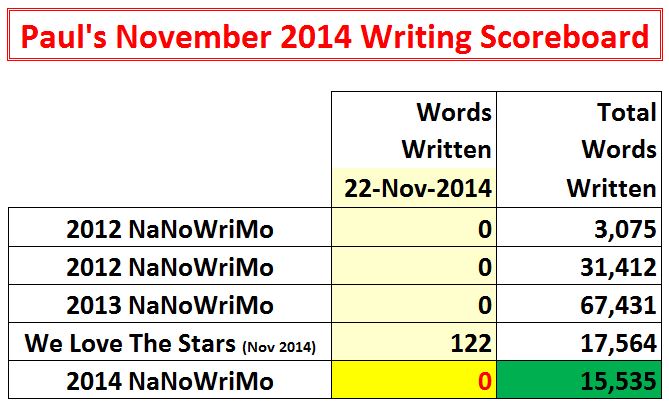
2014-11-22 Word Count Graphic

CHAPTER EIGHT

Leave a comment

Filed under Art, CAF, Music, Science Fiction, Writing

Going Out Tonight…

…to see THIS lady…

theartofasking_imageImage: AmandaPalmer.net

…listen to her talk, listen to her sing, and stand in line for a long time so that I can get my copy of the book personalized and share ten seconds with her.

Because of this TED Talk,

and this song,

and this (very, very NSFW video) song,

and this (very, very NSFW video) song,

and this (very, very NSFW video) song,

and this (mildly NSFW) song (sorry, it’s YouTube, you’ll probably have to watch at least the first part of a stupid commercial before the video),

and this Kickstarter project,

and this commitment to her priorities and ideals,

and the times her and her Twitter followers have made me cry,

and a thousand other things.


Leave a comment

Filed under Art, Entertainment, Music

NaNoWriMo 2014, Day Twenty-One

Priorities, priorities, priorities. Non NaNoWriMo priorities are just kicking this project’s ass this year.

The good news is that I got to go to that tremendous NASA Social for two days. The bad news is that the time spent for days beforehand doing my homework for that event so that I could ask intelligent questions, plus the event itself, plus writing about it after the event (2581 words today about Day Two, woo hoo!), all are sucking huge chunks of time out of my NaNoWriMo writing time.

The problem with the real world is all of that reality.

While I normally put in a lot of  internal links to previous, related posts here, I won’t be doing that for what I hope will be this year’s thirty NaNoWriMo posts. If you have jumped into or stumbled onto this story in mid-adventure, there are plenty of other ways to navigate around the site to find previous installments. Actually doing so is left as an exercise to the student.

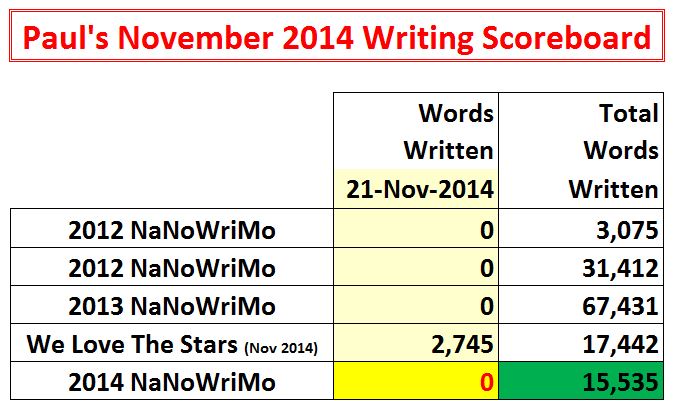
2014-11-21 Word Count Graphic

CHAPTER EIGHT

Leave a comment

Filed under Science Fiction, Writing

NASA Social At NASA Armstrong Flight Research Center (Day Two)

Day Two of the NASA Social at the NASA Armstrong Flight Research Center at Edwards Air Force Base started much as Day One had — early!

IMG_5281

For the record, I’ve posted dozens if not hundreds of sunset photos on this site over the past nineteen months – I’m pretty sure this is the first sunrise photo.

We all trekked out into the desert to be at the Edwards AFB West Gate by 0730 PST (which means an 0630 departure from the hotel, which means an 0500 wake up) only to have “issues” with the gate security. Most of us got held up for over an hour. I’m not sure what issues the Air Force has with NASA, not my float, but it left us running almost an hour and a half late getting started.

But once we got started (and everyone was great about accommodating us and just slipping our appointment times) it was some seriously good stuff. Just like Day One!

IMG_5296

Al Bowers, Chief Scientist at NASA Armstrong, had an extremely interesting talk about the 1984 Controlled Impact Demonstrator test, in which a fully loaded & instrumented 707 was flown by remote control and crashed deliberately. The test was designed to see if a fuel additive would keep fuel from burning in a crash, but the plane landed off target (it was supposed to be going straight and come down on that “X”, not 410 feet to the right as seen here) and turned into a huge fireball.

The FAA, which paid for the test, was not happy and apparently there are still those there who hold a grudge. (In flying circles it’s common to say that the FAA’s motto is, “We’re not happy until you’re not happy!” So…thanks, Dr. Bowers, for a job well done!) But while they didn’t see what they wanted to see, they did learn a tremendous amount, all of which went into improvements in aviation safety that you see today. While there are still crashes and deaths, the number of deaths caused by post-impact fires has dropped to almost nothing.

IMG_5304

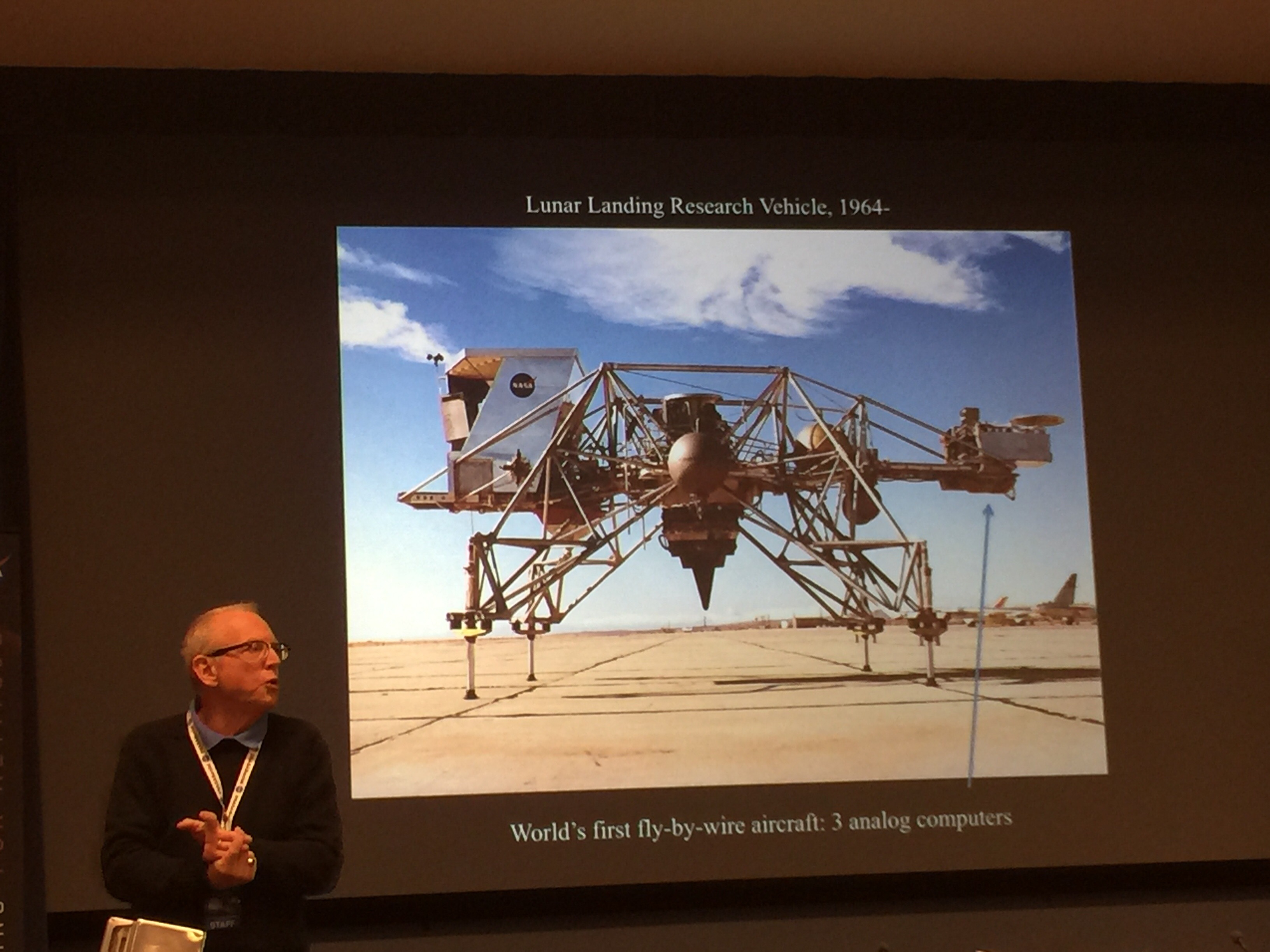
Doctor Christian Gelzer, Chief Historian at NASA Armstrong gave us a talk on the history of “fly-by-wire” (FBW) control systems. The short version is that in an older commercial or military plane, and still in almost all light general aviation aircraft, controls on the plane (yoke, rudder, trim) are connected to rods and levers and maybe hydraulic systems, which are in turn connected directly to the ailerons, flaps, and rudder. In a FBW system, which now includes all military aircraft and the vast majority of all commercial airliners, the controls talk to a computer and the computer talks to a motor attached to the ailerons, flaps, and rudder to move them in the way the pilot is commanding.

The vehicle shown (remember it for later) is the Lunar Landing Research Vehicle, which was the first FBW aircraft. It was developed in the mid-1960s to train the Apollo astronauts on how to land on the moon. It must have worked – six of six landings went just fine!

IMG_5305

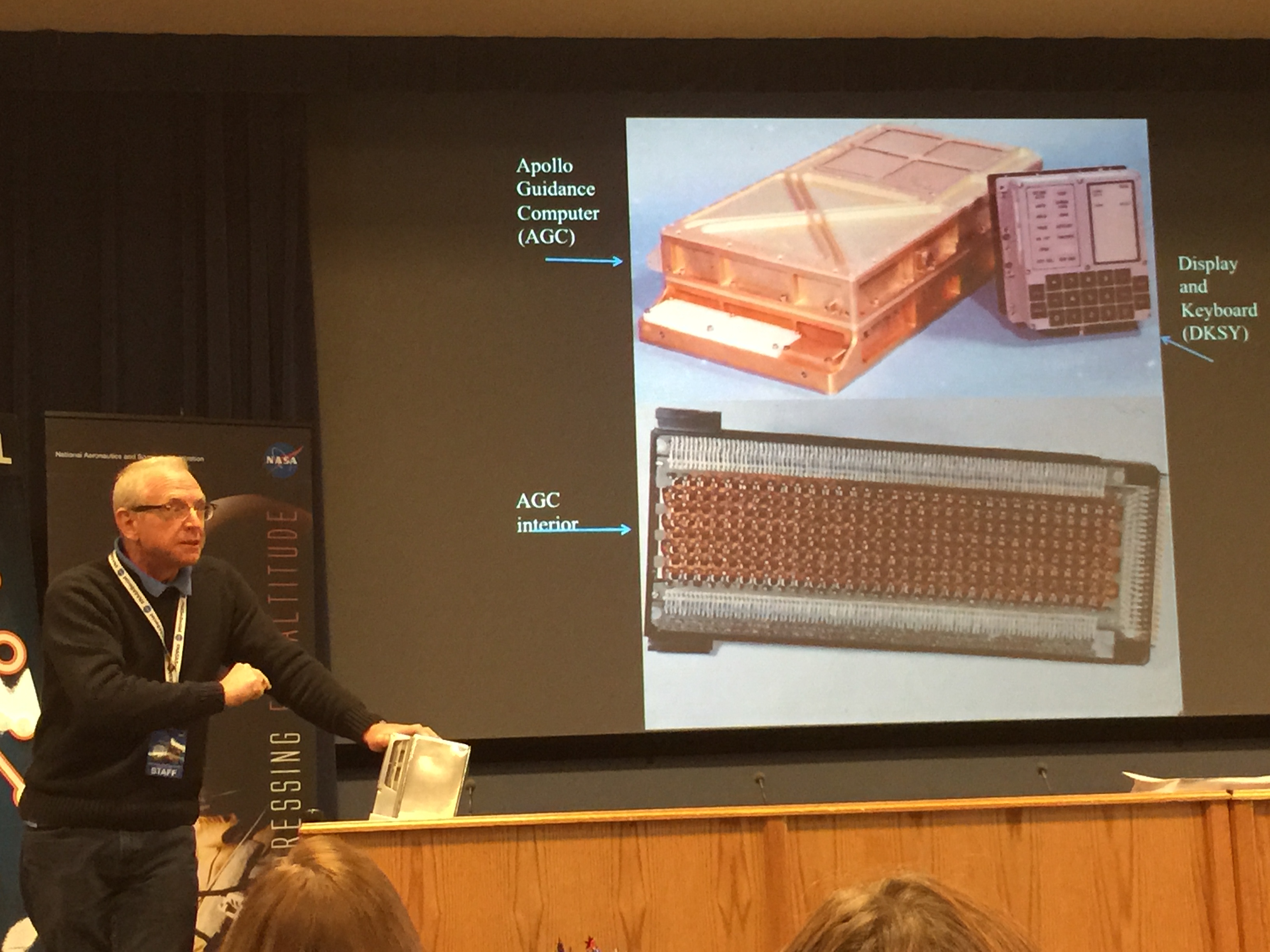
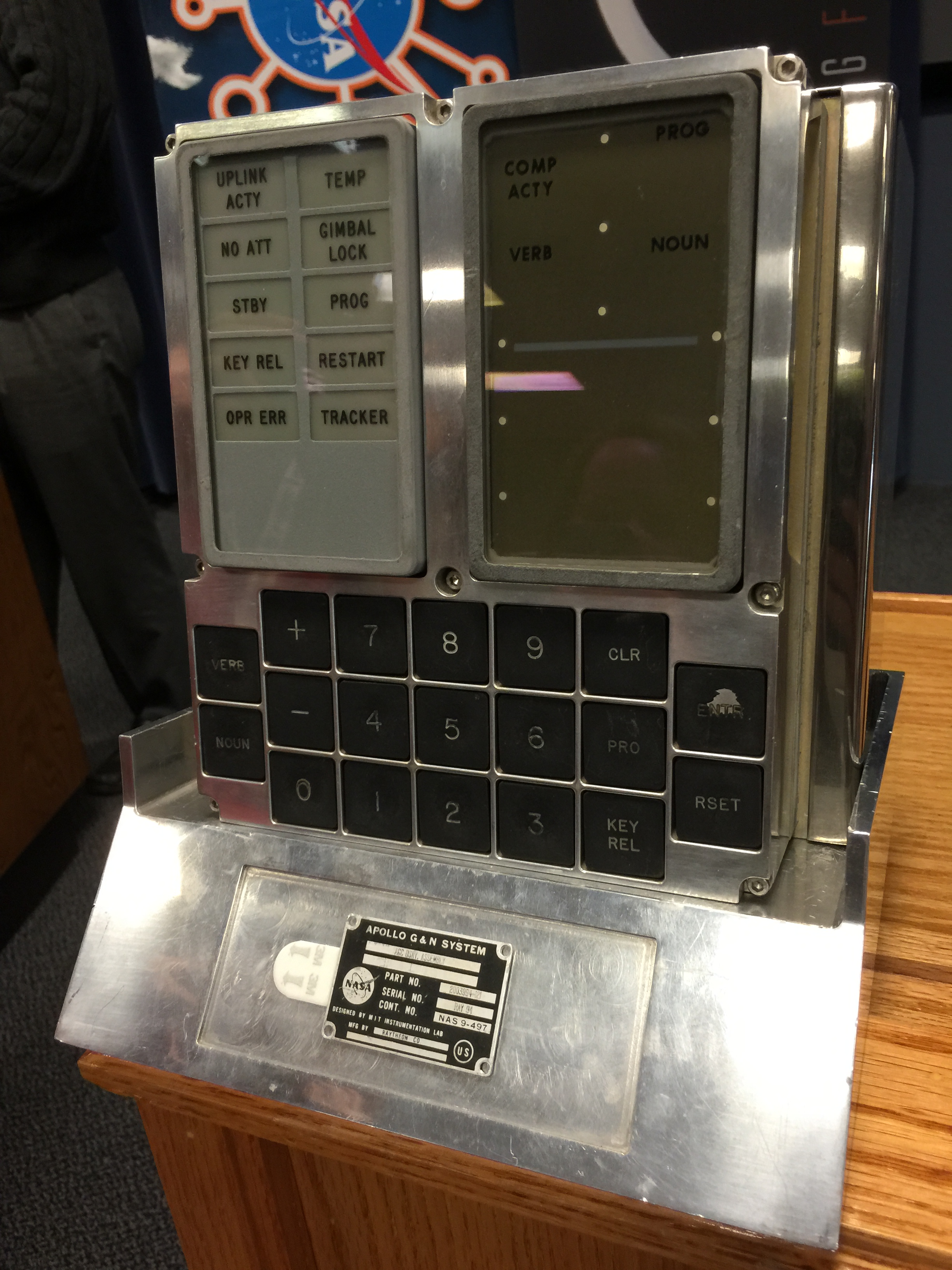
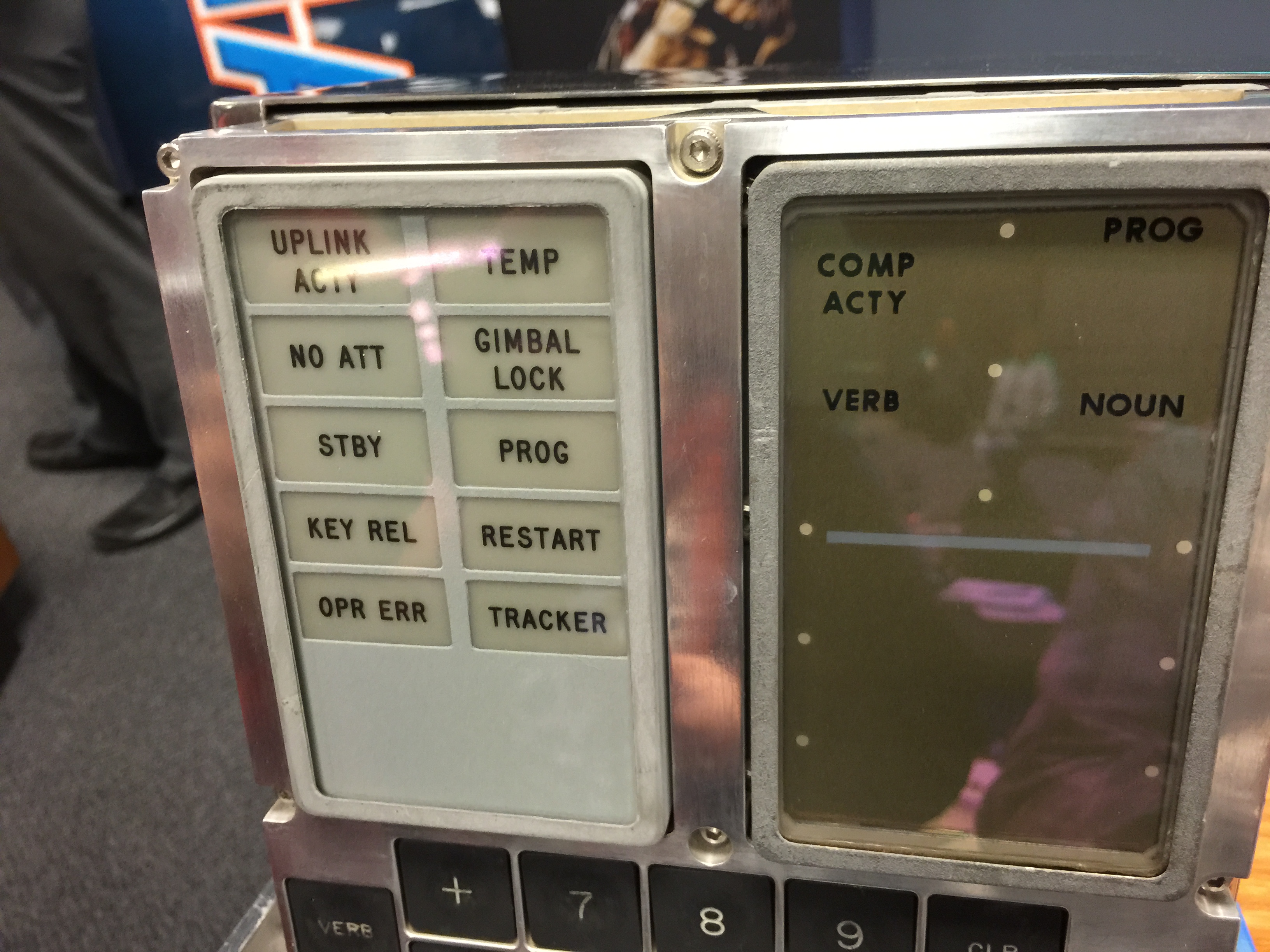
When it came time to start testing FBW on other aircraft, the biggest problem was that the computers of the day weren’t up to the task. Eventually they used the only portable, reliable, and rugged computer on the planet that could do the trick, a leftover Apollo Guidance Computer (AGC). These were made to take the Apollo spacecraft to the moon and back, but the Apollo program got cut back after Apollo 13, leaving spare AGCs.

Things were fine, until the Display & Keyboard (DSKY) unit failed. There weren’t any spares. None had been made. None were ever going to be made.

IMG_5309

This is the actual piece of hardware that they obtained to solve the problem. This “spare” DSKY was taken from the Apollo 15 Command Module after the spacecraft had returned from the moon.

IMG_5310

How much did I squeeeee to be able to not only see and photograph but to touch and push the buttons on the actual honest-to-God flight computer that had gone TO THE FREAKIN’ MOON & BACK? It just might have been a significant amount — and as far as I could see, the other 30+ participants at the NASA Social were squeeeeee-ing right along with me.

IMG_5315

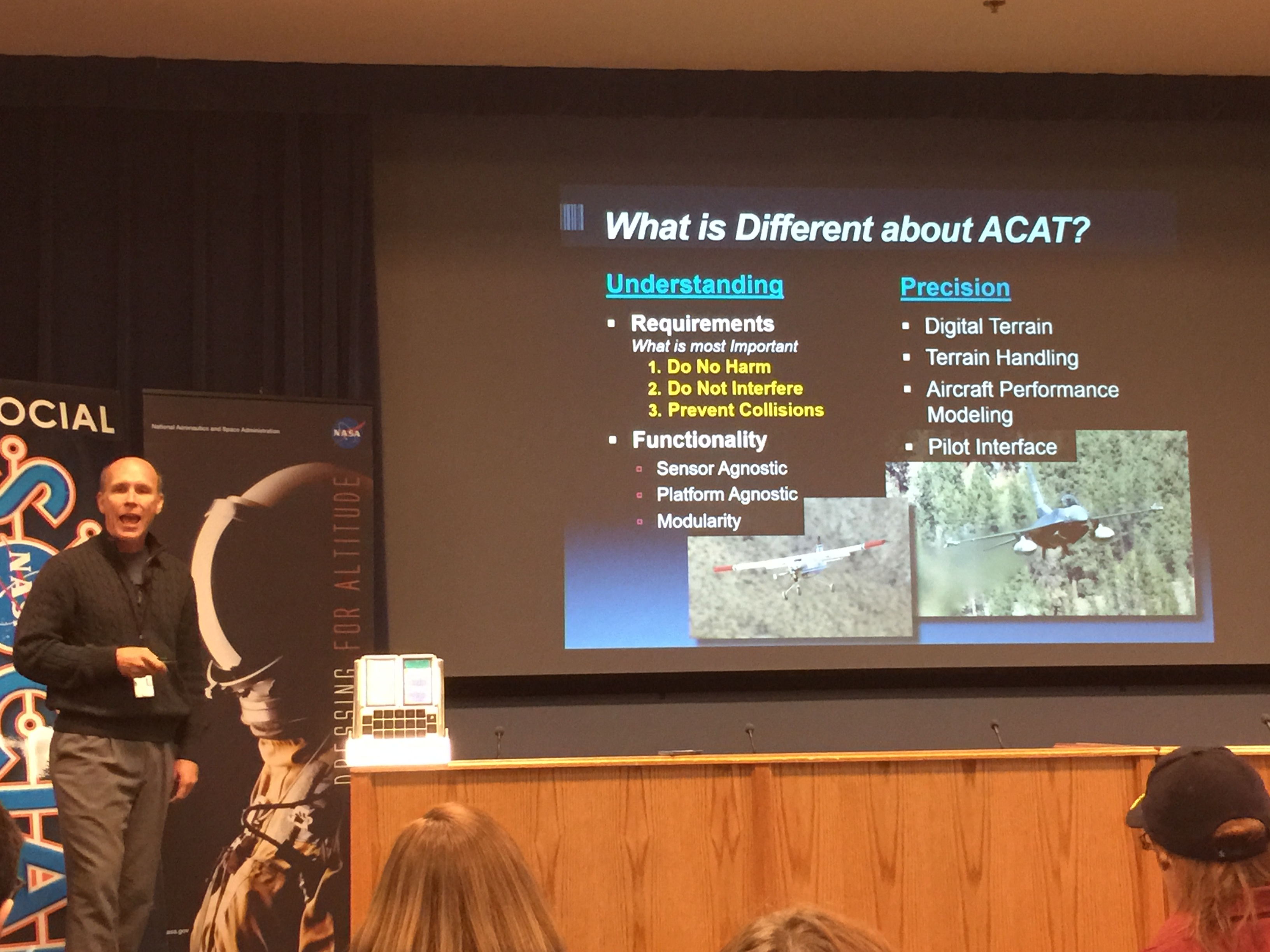
Once we had taken a break and I had (at least figuratively) taken a cold shower, Mark Skoog, Chief Engineer of the Automatic Systems Project Office, gave a fantastic presentation on the Automatic Ground Collision Avoidance System (AutoGCAS). In short, the military has a problem with too many pilots flying perfectly good, healthy, functioning aircraft into the ground or the sides of mountains. This can be caused by fog and clouds, by pilots being temporarily disabled by high G-forces, or by pilots distracted by other tasks in the cockpit.

What the AutoGCAS system has done is take a 3-D digital database of the entire freakin’ planet and condensed it down to where it will fit into a smart phone, with plenty of room to spare. (This is mind boggling to me, but they’ve done it so it must not be as impossible as I would have guessed.) Then they wrote programs for the smart phone which will constantly track the plane’s location and course in 3-D, compare it to the database, and determine when a collision is imminent. Then the system uses the plane’s autopilot to override the pilot and take the last safe option out at the last possible second.

Wow.

The system is now up and running in F-16s and is being installed in other fighters. Furthermore, it’s being developed for use by the civilian commercial and general aviation markets. On a plane like the Cessna 172s which I fly, it might not be able to take control of the plane in an emergency (a light Cessna usually doesn’t have an autopilot that has the capabilities to do that) but it will be able to run on your smart phone and give you warnings and directions.

There is a fantastic video regarding this project on NASA’s YouTube channel here. Most of the models, remote control centers, and several of the people shown in this video are people and things we met and saw.

IMG_5322

Now it was time to boogie out into the field again. First stop was the Flow Visualization Facility, where Jennifer Cole showed us how a giant water tank pumps water past a model being tested. Here you can see the clear, plexiglass testing chamber with the white model of an F-18 fighter pointing up into the flowing water. The models are made very precisely with ultra fine tubes built in, connected to holes in the body of the model. When the water flows and colored dye is pushed out through the holes, the dye will eddy and stream to show where the areas of turbulence and laminar flow exist.

IMG_5329

Next was the Flight Load Lab, where Larry Hudson showed us how materials are tested to see how they react to stress, temperature changes, or dynamic loads. (The lab just had its 50th anniversary.) Materials act differently when very cold at high altitude or very hot when heated by air friction at high Mach numbers. In this lab they can test (to destruction, if necessary) everything from small parts to entire planes.

IMG_5332

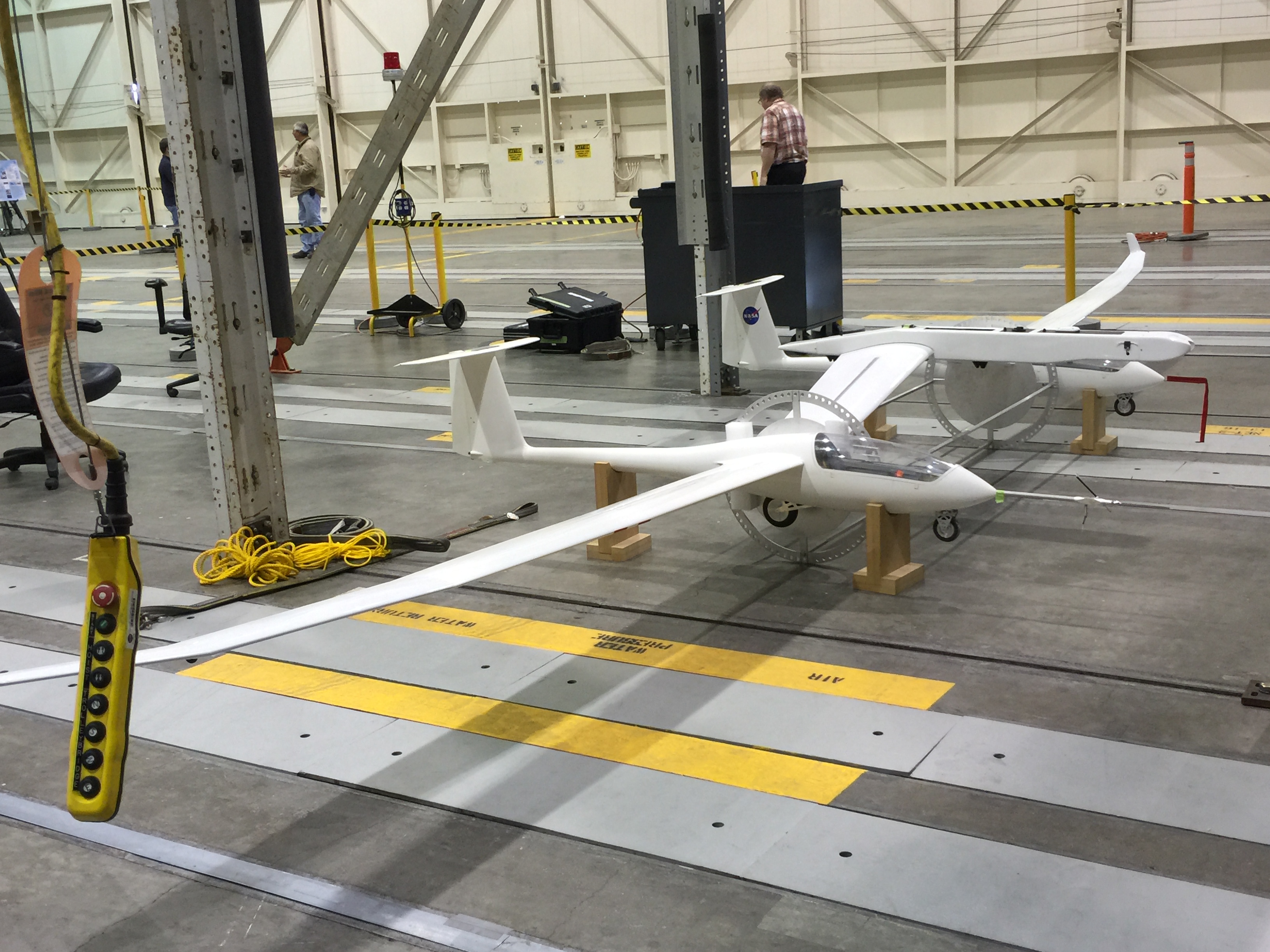
In the lab, being tested for balance and dynamic loads was this scale model of a concept being developed at NASA Armstrong for an unmanned glider which could be used to launch rockets into low Earth orbit (LEO). Similar to Virgin Galactic’s “White Knight 2” carrier airplane, this plane would have much longer wings and be towed to altitude (carrying in the middle the rocket to be launched) by a simple business jet or military cargo jet. At 40,000 feet, the glider cuts loose, the tow plane boogies, and the rocket is launched from the glider.

They believe that this system (which is still a decade away from being in service) could launch twice as much payload at half the cost of launch vehicles today. I asked and was told that it can also be scaled up to the point where manned spacecraft, such as Sierra Nevada’s Dream Chaser could be sent into orbit.

IMG_5334

This is a ring being tested in the Load Lab for the Hypersonic Inflatable Aerodynamic Decelerator (HIAD) project (NASA video here). To get a bigger heat shield without needing a bigger rocket, HIAD will use a series of inflatable rings. When the rings inflate, with the rings of different sizes stacking to look like that children’s toy, you can make a 25 meter heat shield fit into a 5 meter rocket fairing. This in turn lets you land a much bigger spacecraft on someplace like Mars.

IMG_5335

In the lab we also saw a demonstration of how fiber optic stress sensors work. The tan stripe on this model is a long fiber optic sensor. A remote control unit let us bend the wings, and the display behind it showed how the computer picked up the data from that sensor and could display and record it.

IMG_5338

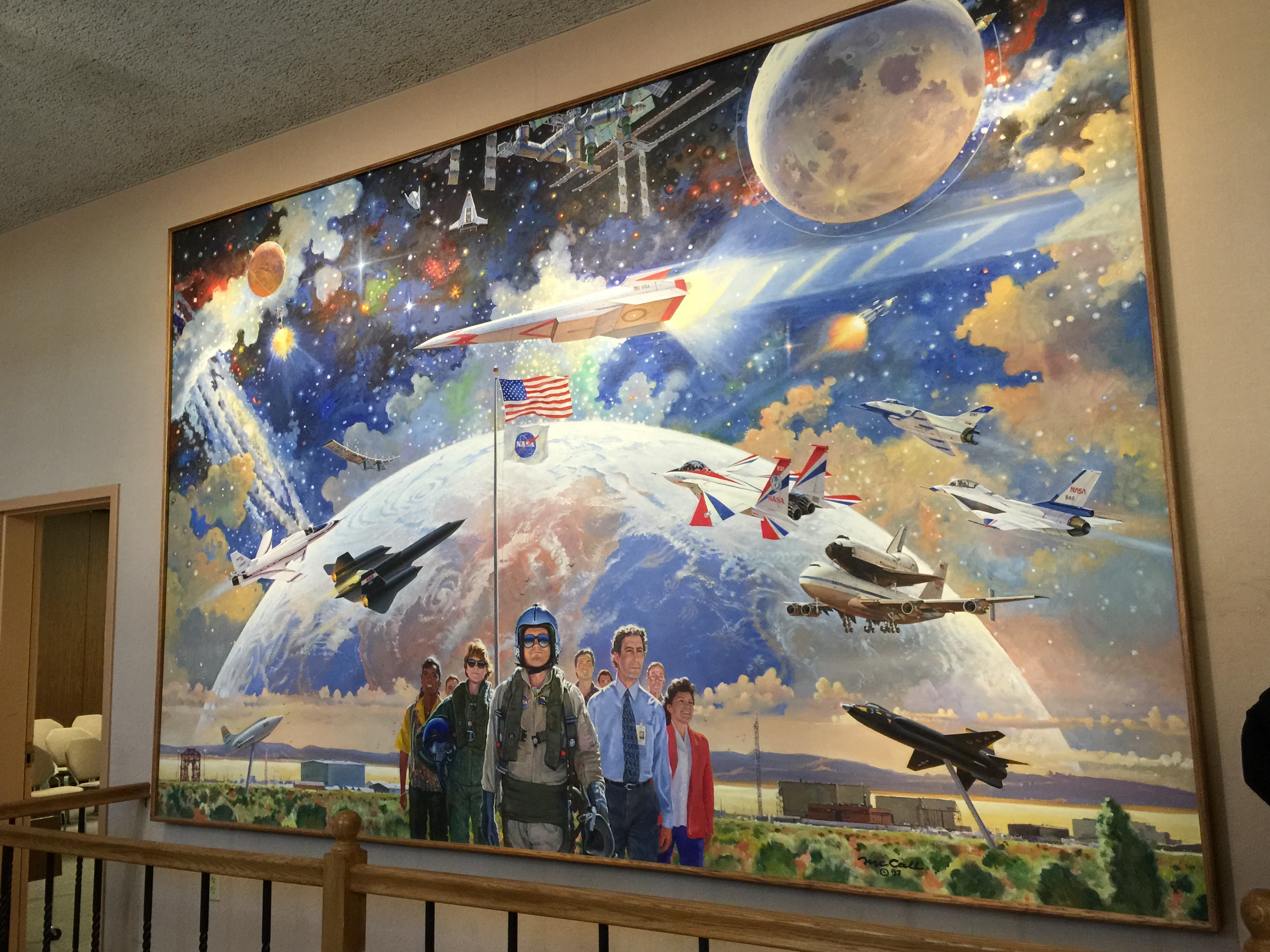
We went to another of the main NASA Armstrong buildings and saw this ginormous painting by Robert McCall. McCall is one of my all-time favorites due to his work in space and aviation art. He worked on the concept drawings for the movie 2001: A Space Odyssey, has had hundreds of paintings commissioned for NASA centers all over the country, and has even had his artwork featured on US postage stamps.

This is a huge McCall painting, wonderful in its detail, typical of his style in the way color is used and the wonder of flight and spaceflight is portrayed. Marvelous to see!

IMG_5342

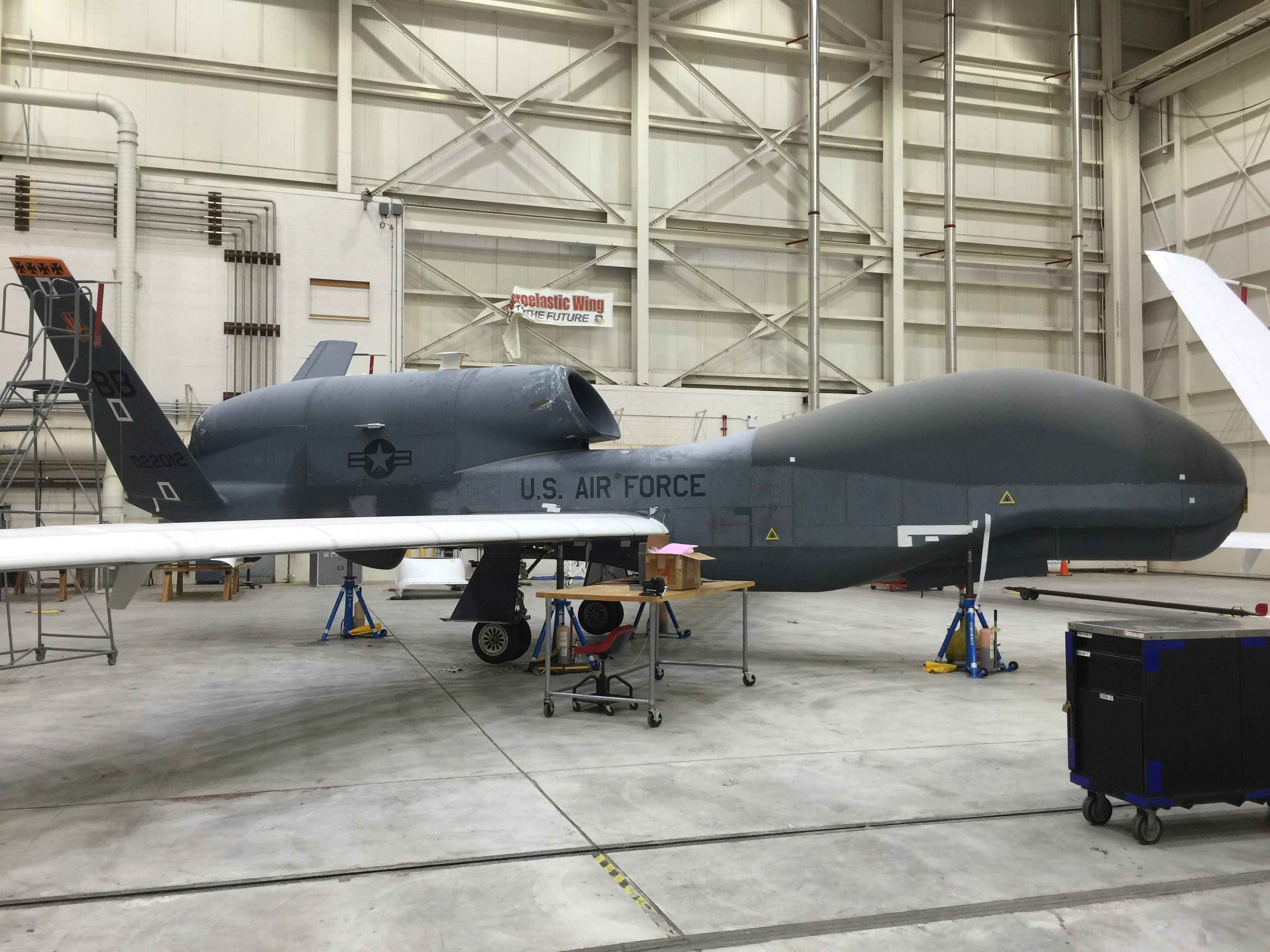
In that building we saw a couple of the NASA Global Hawk UAVs. These are used by NASA to fly long missions, up to twenty-four hours at a time (or longer) in order to gather data on atmospheric conditions, weather, and hurricanes. They are flown remotely from either NASA Armstrong, NASA Wallops Island in Virginia, or a portable mission control setup.

IMG_5354

One example of their use was given in the study of a recent hurricane. There was a manned plane flying high above the hurricane where it was relatively safe. Being more rugged (and expendable) because it is unmanned, the Global Hawk flew through the hurricane’s eye at a much lower altitude as the manned plane flew above it. With both vehicles dropping instrument packages on parachutes, it was the first time that a fully three-dimensional set of data had been collected in the eye of a hurricane. This data will be invaluable for researchers trying to understand hurricanes and how to predict them.

IMG_5357

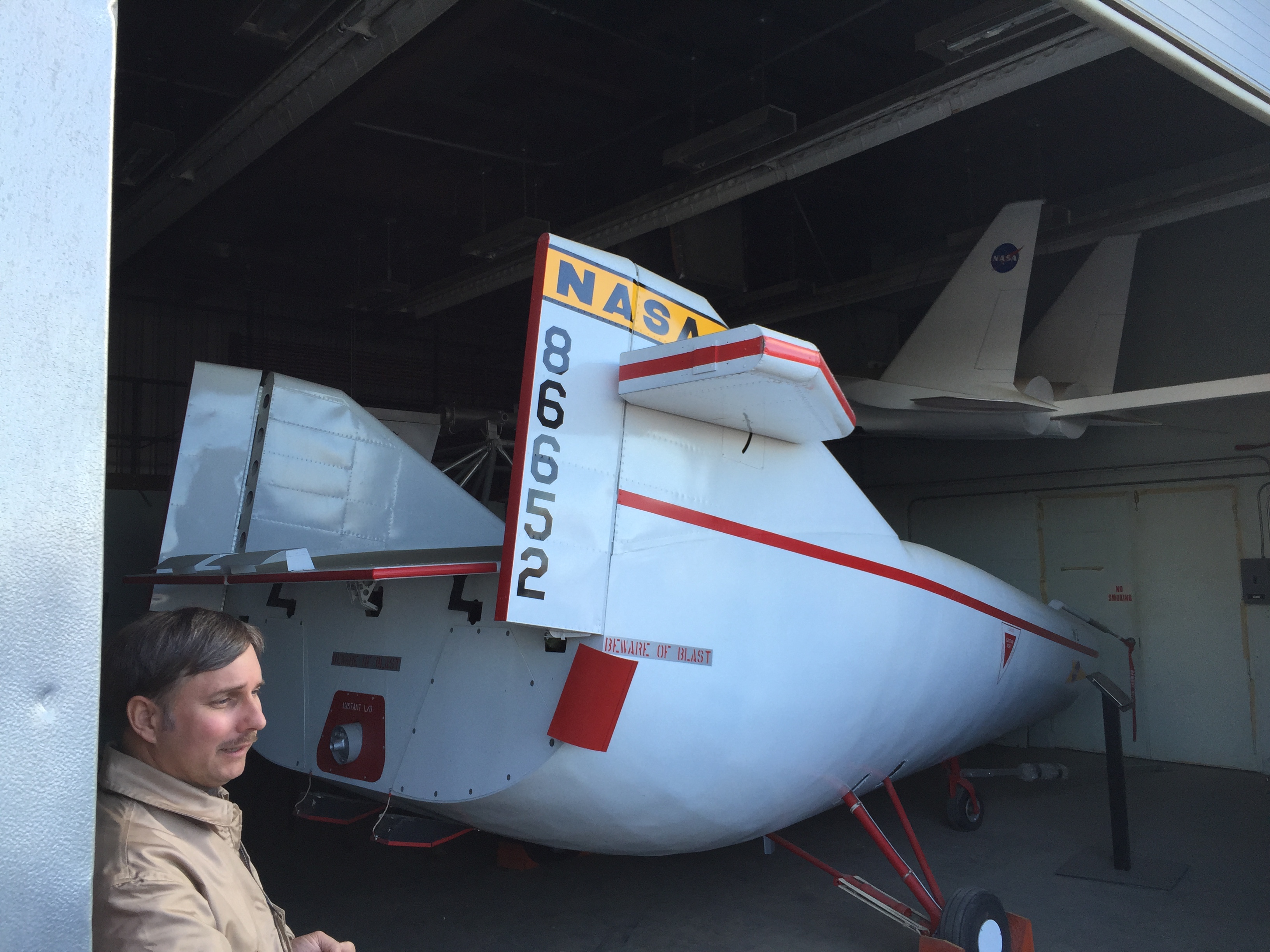
We were almost done, but as a special treat we got to see the original M2-F1 lifiting body. This manned test aircraft was built on a shoestring budget in 1963 at a boat shop. It is lightweight and was tested by towing it behind one of the engineers’ Pontiac convertible which could make it up to 120 MPH. Later tests took it to altitude and hundreds of test flights were made. Later designs based on the M2-F1 were bigger, heavier, and more complex. Early designs for the Space Shuttle looked at this design, but gave us the familiar Space Shuttle look when the need for a large cargo bay was specified.

Standing in front of the M2-F1 is Peter Merlin who is a treasure trove of knowledge about the history of Edwards, NASA Dryden (the former name of NASA Armstrong), and the planes who flew there. If you ever get a chance to see him give a talk, take it!

IMG_5360

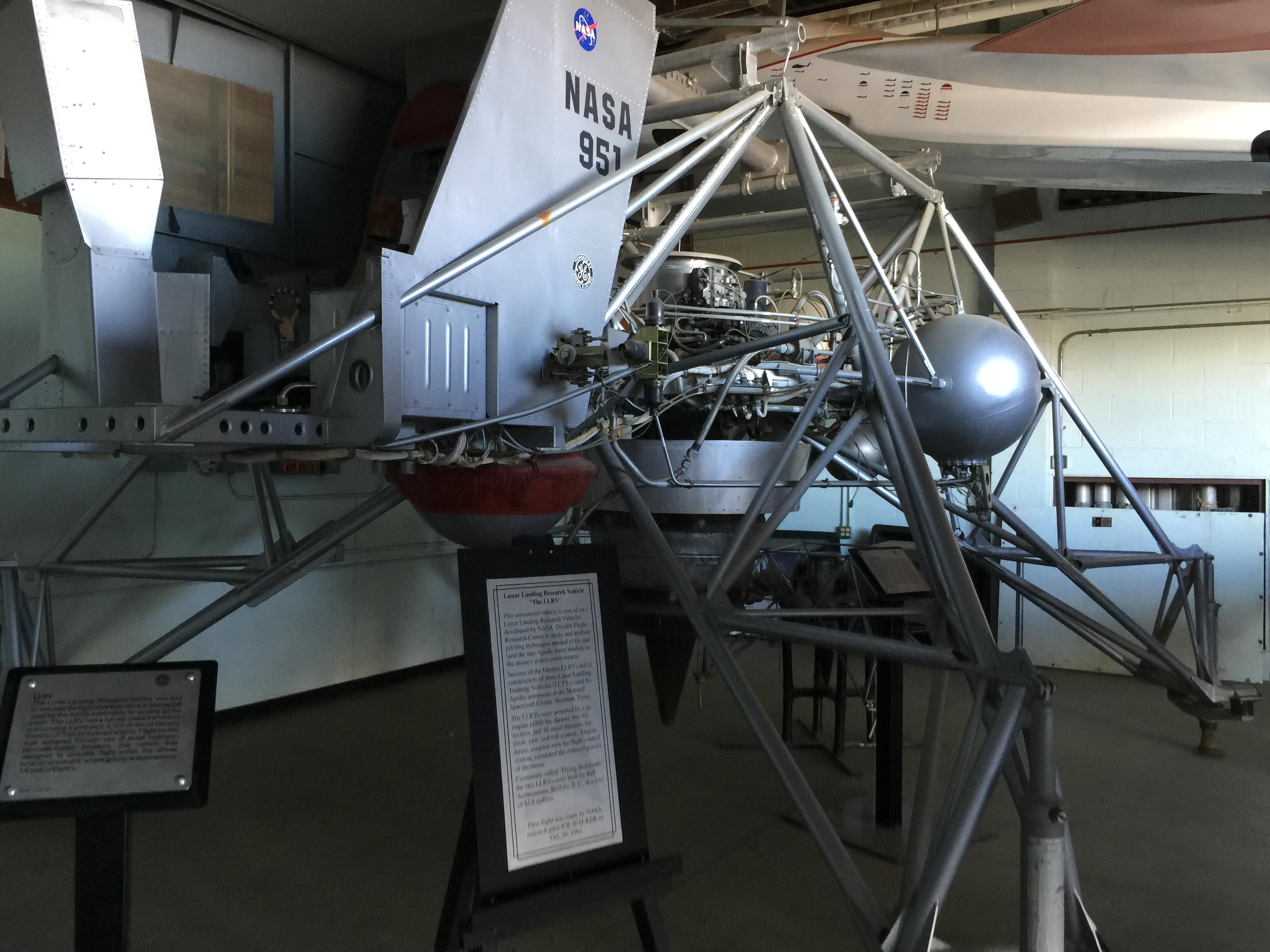
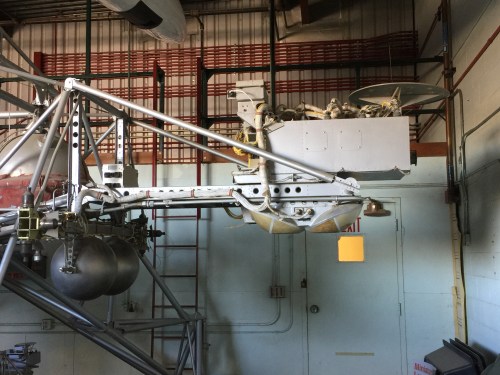
In the garage behind the M2-F1 was the last of the Lunar Landing Research Vehicles. Remember, I told you above to remember that fly-by-wire slide. Here it is! (Cue more über-squeeee-ing!) In the center left you can see the pilot’s compartment cantilevered off of one side. The large jet engine, pointed straight down, is in the center.

IMG_5362

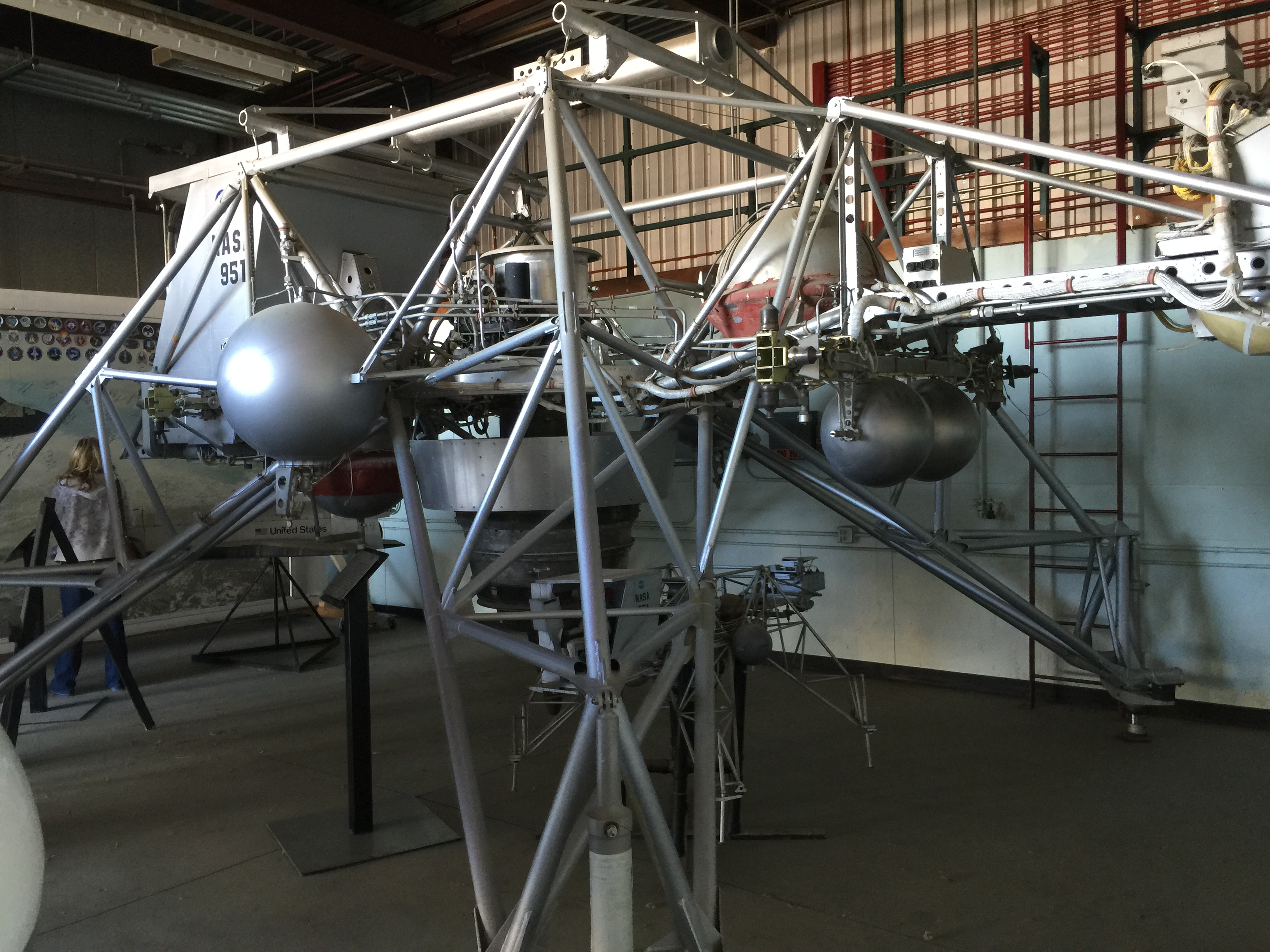
From the other side you can see several of the round fuel tanks that held the rocket propellant for the eight small rocket thrusters that moved it from side to side to control .

IMG_5367

Cantilevered off of the other side is the box containing the three analog computers. (Note again, analog – not digital!) They were hard wired and it was noted that to change their programs you had to use a soldering iron. Now you can see why they needed to use the Apollo Guidance Computers to step up to an even more complex fly-by-wire test.

There’s a great documentary from NASA on this test aircraft here. There’s also a good short documentary here about Neil Armstrong’s accident flying with an LLRV that almost meant that someone else would have been the first man on the moon.

IMG_5368

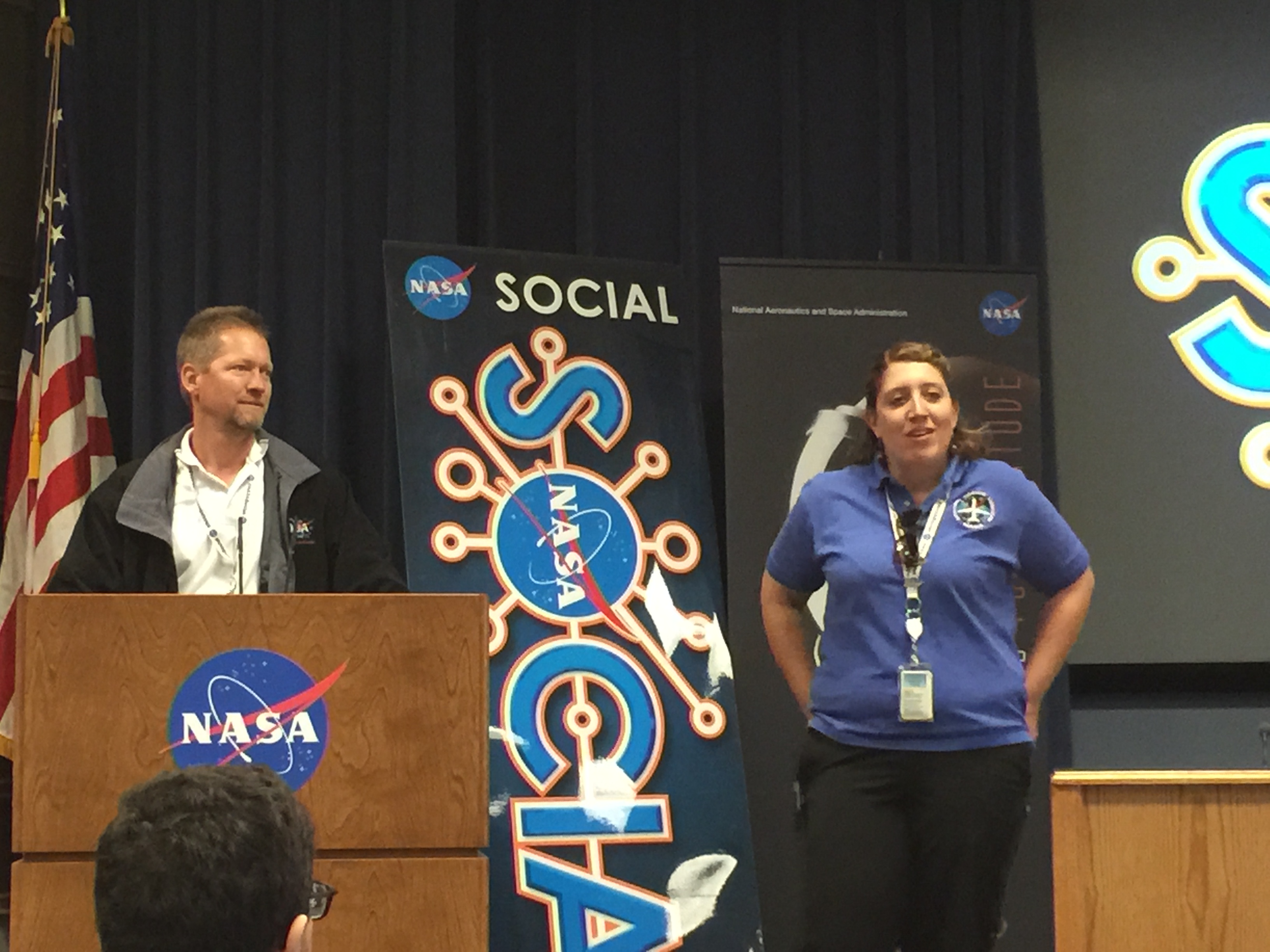
We were almost done for the day. We got some closing comments from Kevin Roher, the Chief of Strategic Communications at NASA Armstrong, and Kate Squires, Social Media Manager at NASA Armstrong, but really the official cat herder who ran this event and kept us all going from site to site, from one amazing thing to another. Props also to Barbara Buckner and the dozens of other people who helped to make this event happen.

IMG_5371

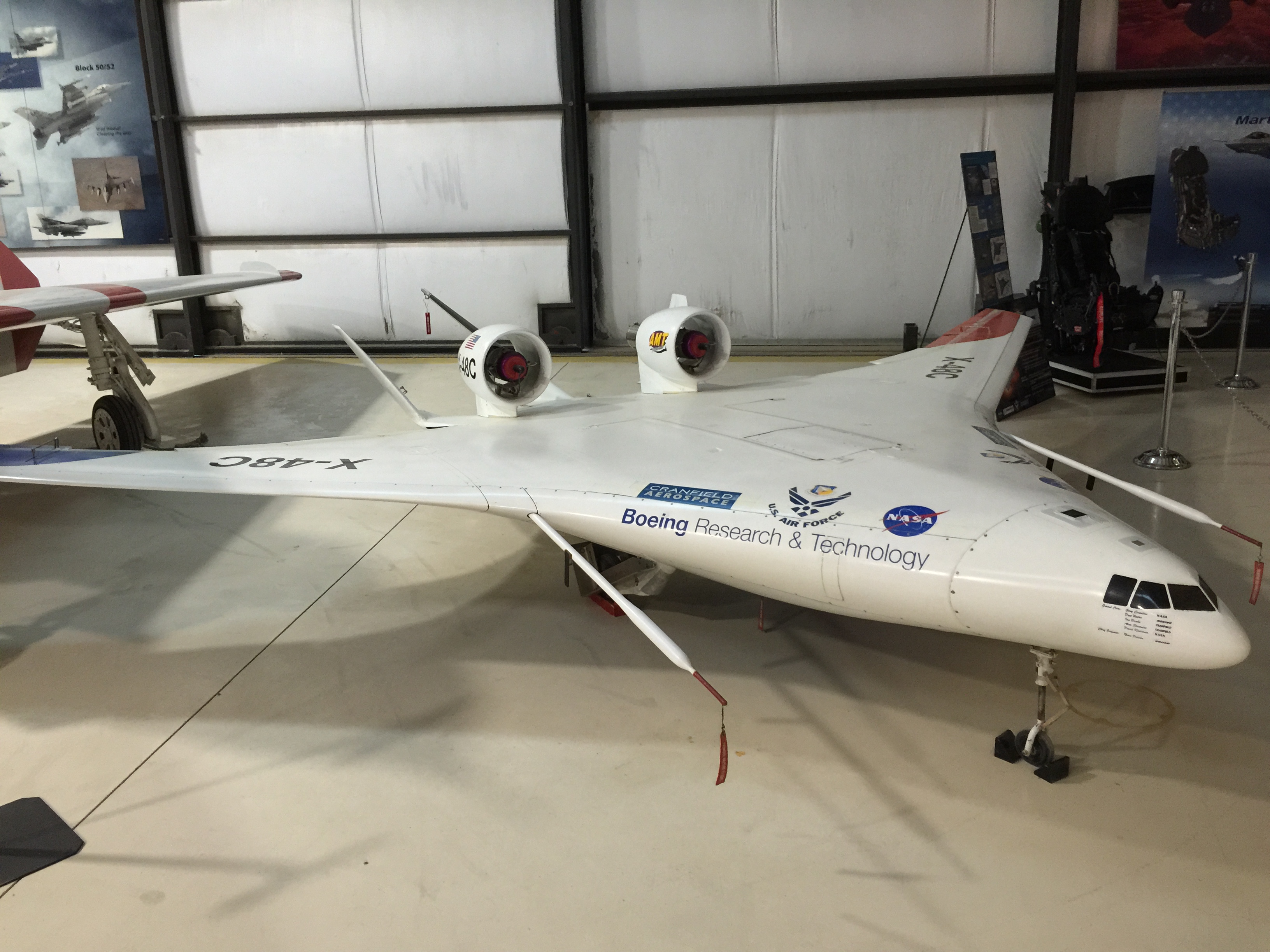
One final unofficial stop on the way out was at the Edwards Air Force Base Flight Test Museum. Many cool things there,including the X-48C test aircraft. This scale aircraft has been used for extensive flight testing of blended wing designs for future commercial aircraft.

IMG_5374

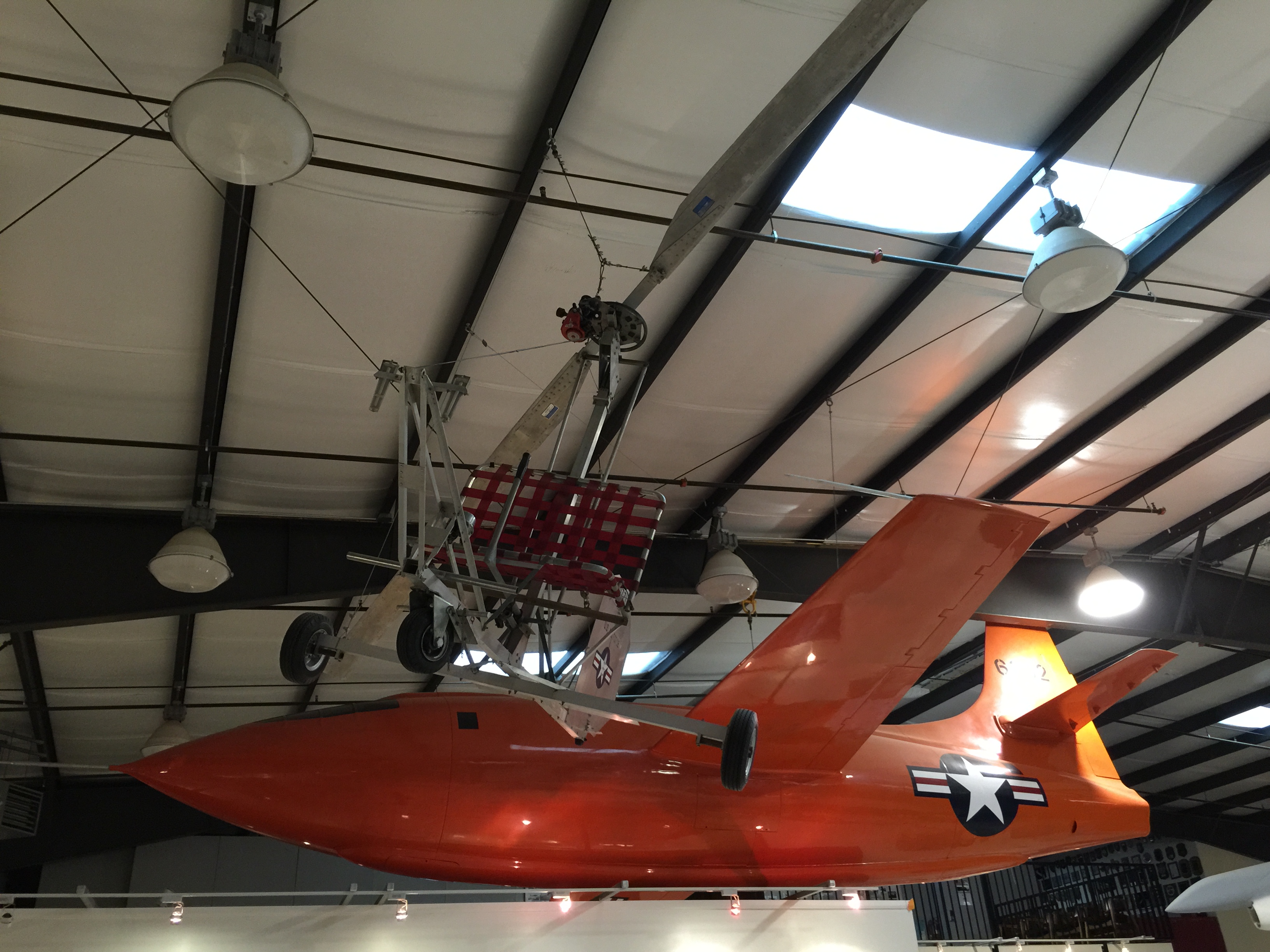
Above your head is a very early gyrocopter, and an exact model of the Bell X-1 aircraft which Chuck Yeager used to break the sound barrier. (The actual original aircraft is in the main hall of the Smithsonian Air & Space Museum in Washington, DC.)

IMG_5389

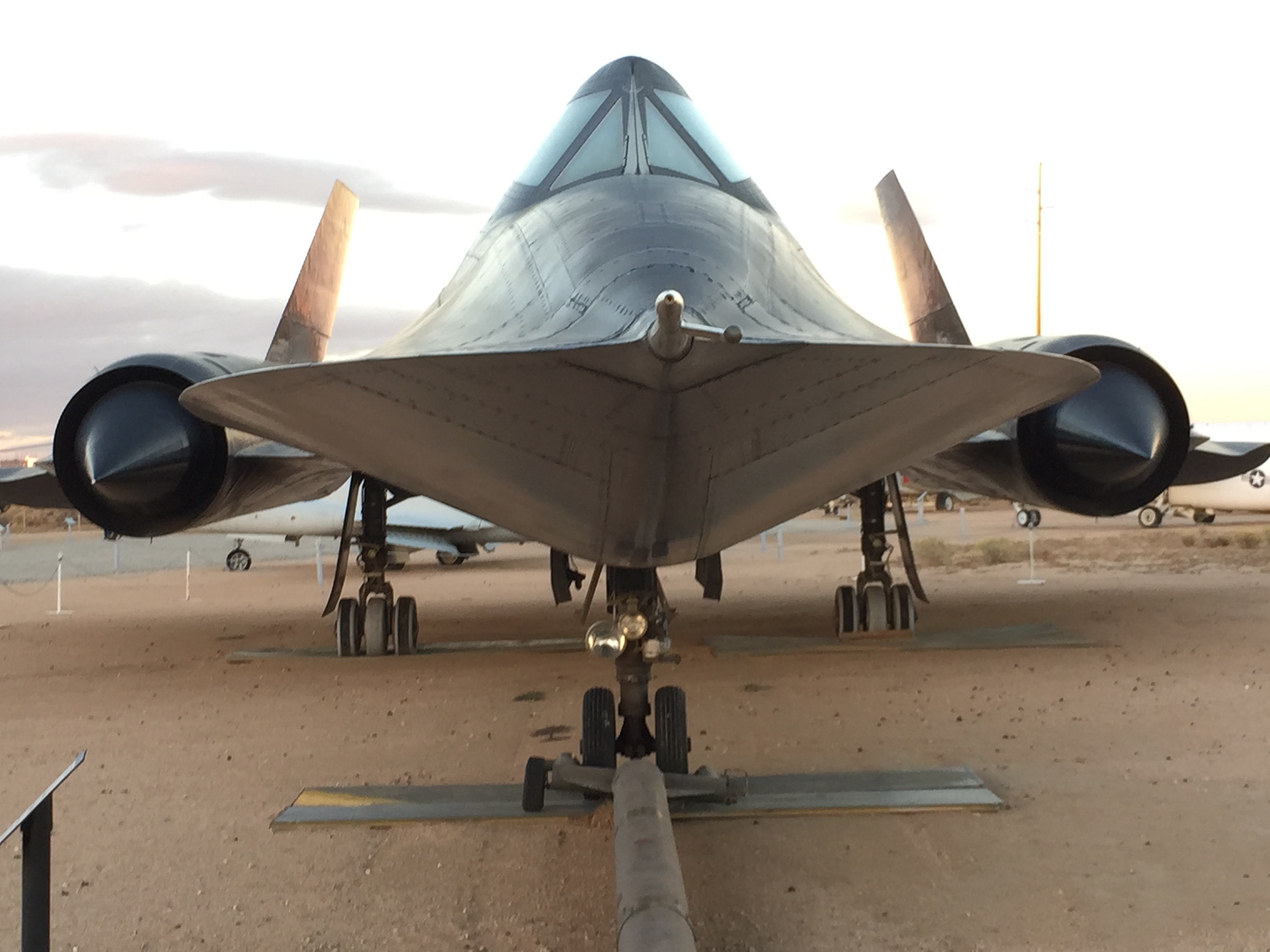
Outside of the Edwards Air Force Base Flight Test Museum, there are a couple dozen planes parked on display. This is an up close and personal look at the nose of an SR-71 Blackbird, the fastest and highest reconnaissance and research aircraft ever flown. The F-15 flew higher, and there are probably a couple others to do so, but the Blackbird was the only one put into production and used regularly for decades. The last I heard, NASA still had at least one that was still flying, but that may have changed by now. (Something to Google later.)

IMG_5390

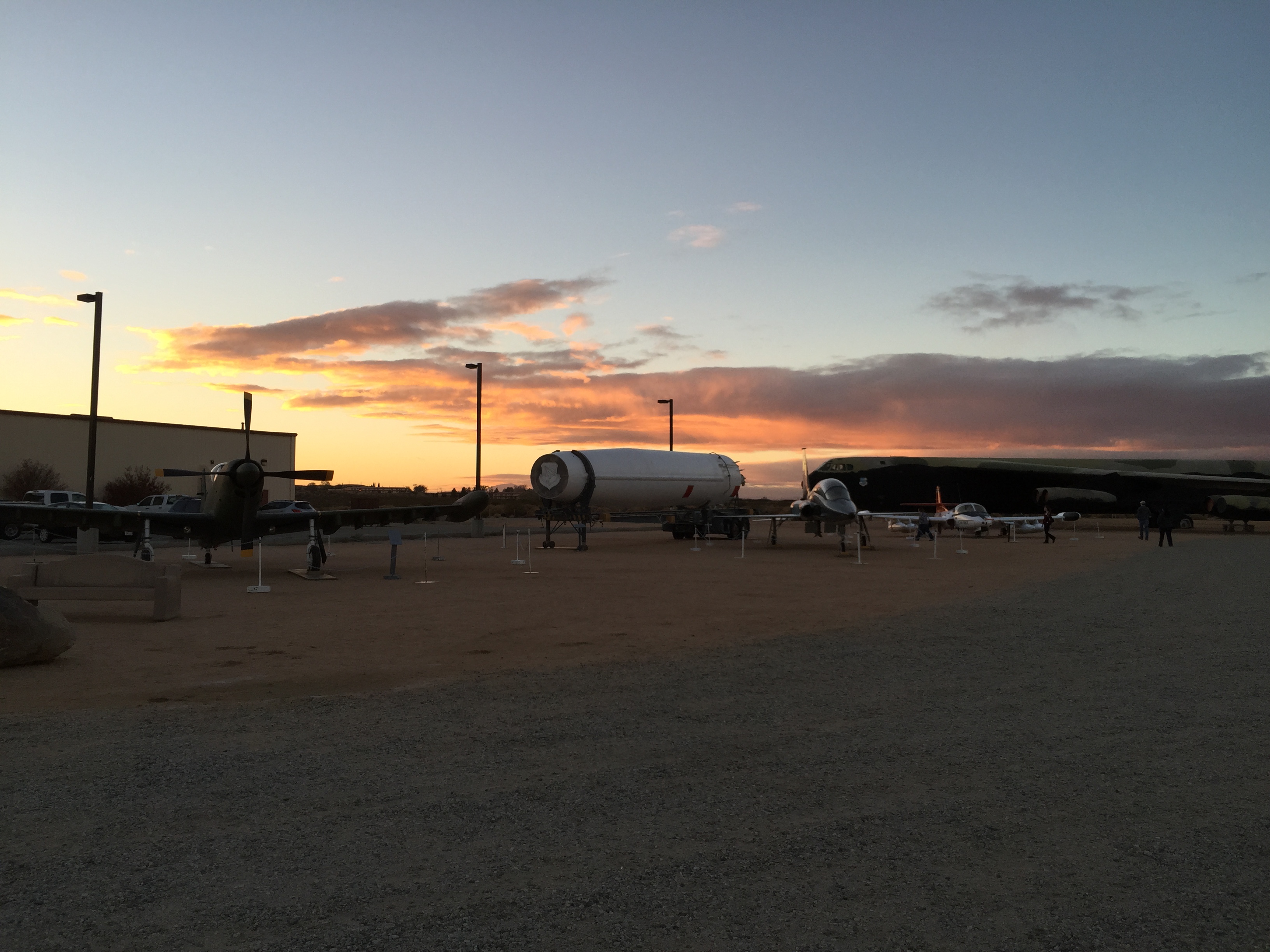
We were getting a great sunset over the museum and the planes and rockets. The B-52 “BUFF” that I shared later that night is on the far right in the distance.

IMG_5393Finally, the prototype A-10 Warthog, the YA-10B can be seen on the left with an F-4C Phantom II on the right, the final fading rays of the sun on the clouds above. You’ve got to love the F-4, proof that if you have a big enough engine, you can make a brick fly at Mach 2.2+.

Now you know why I was exhausted when I got home three hours after this on Wednesday night!

What an incredible event, and I can’t give enough thanks to Kate Squires, Kevin Roher, Peter Merlin, Barbara Bucker, Tom Rigney Al Bowers, Christian Gelzer, David McBride, Robert Lightoot, Larry Hudson, Jennifer Cole, Manny Antimisairis, Tom Miller, Scott Howe, Hernan Posada, Mark Skoog, Christ Naftel, George Welsh, and everyone else who made it happen!

Some time in the next few days, there will be more pictures to share. All of the pictures shown here and on Tuesday were taken with my iPhone in order to make them easy to tweet, post to Facebook, post here, and share ASAP. Next I’ll start going through the higher quality photos from my DSLRs. (I take a LOT of pictures!)

Leave a comment

Filed under Astronomy, Flying, Photography, Space, Writing