Category Archives: Astronomy

Juicy Chunks O’ Wisdom For Sunday, October 19th

‘Cause the Chiefs and the Kings both won today and I’m all relaxed and sports-ed out, that’s why.

  • The results of yesterday’s “research project“? First, the margarita was quite good. It was the first time that I had tried the pre-mixed stuff that you simply pour over ice. Maybe not quite as good as making them “from scratch,” but not bad at all.
  • In case you didn’t notice, there was a comet that came thiiiiiis close to Mars earlier today. From Earth and from Earth orbit (where the Hubble Space Telescope and other telescopes are) it was a unique event. From Mars orbit (where there are five orbiting spacecraft from NASA, ESA, and the Indian space agency) and from the surface of Mars (where Curiosity and Opportunity are exploring), it should have been spectacular. All of our orbiting spacecraft have reported in as safe and unharmed from any impacts with dust, ice, or debris from the comet. It will take a few days to download the data and photos, but keep and eye open, there may be some amazing things coming.
  • For Halloween this year, we’ll be taking the telescopes out as we do, offering kids (and their parents) a look at some of the brighter objects.
  • Secondly, the cookies & cream ice cream was wonderful. The hard stuff, the real Dryer’s full-of-fat-and-lining-my-arteries-as-I-eat-it brand, none of this “reduced fat” or “fat free” crap.
  • Speaking of amazing views of comets, the European Rosetta spacecraft has been getting closer and closer to Comet 67P/Churyumov–Gerasimenko for months now. In about ten days it will release the Philae lander, which will try to make the first soft landing on a comet, where it should send back data for at least a few days. After that the batteries will be discharged, but if we’re lucky and the solar panels can keep recharging the batteries, we could get data for months. Keep an eye out for some mind-boggling images there.
  • There’s something in the pine trees out in back. I could hear it last night, and so could Joey and Jessie. I went out and looked, but never saw it. But from the sound, it’s good sized, not just a squirrel or two. On a related note, something’s back walking around on my roof at night. I figured Rocky and/or Raquel, but either I’ve forgotten how loud it can be when they’re walking around or they’ve grown quite a bit. Or it could be something bigger than a raccoon?
  • Third, while each was excellent in their own right, combined they were marginal at best. The margarita seemed much too tangy and bitter when drunk immediately after a bite of ice cream. Thank goodness I didn’t take The Long-Suffering Wife’s suggestion of pouring the margarita over the ice cream.
  • The Philea lander has a camera which is separate from the cameras on the Rosetta “mothership.” This allowed it to take a selfie of Rosetta with Comet 67P only 16 km away. Wow!
  • The leading candidates for the tree critter: Raccoon, opossum, owl, mutant tree-climbing bunny rabbit, cougar, bear, E.T.
  • Finally, next time it would be best to do the before-bed chores (locking up the house, doing the dishes, cleaning the cat boxes, and so on) before having the margarita, not after. A relaxed, mellow, fuzzy state of mind does not lend itself to thoughts of, “Crap, I’ve still got to clean the cat boxes!”
  • Final astronomical heads up for the week is a partial solar eclipse this Thursday, October 23rd. The areas of visibility are pretty much the same as the total lunar eclipse on October 8th — the two eclipses are related. (Celestial mechanics and all of that sort of thing.) Go look at it if you have the chance, maybe even try to photograph it, but above all, BE SAFE WHEN LOOKING AT THE SUN. (Pop Quiz Redux — What should you never, EVER do because it really, REALLY will make you go blind?) There are ways to do it simply and cheaply (i.e., pinhole projection or a $2 “eclipse filter”), but doing it wrong can lead you to a world of hurt. Be safe, enjoy the sight!
  • November 1st is just thirteen days away, which means…NaNoWriMo. Should I, or shouldn’t I? Any suggestions for a plot, genre, or style you would like to see me tackle?

Remember, “When the going gets weird, the weird turn pro!”
7 Comments

Filed under Astronomy, Critters, Juicy Chunks, Space, Writing

Final Notes On October 8 Lunar Eclipse

A few bits and pieces from me, and some truly spectacular images from people who actually know what they’re doing.


I was tweeting all night long (kept me awake), it looked like this:


As Bill Cosby said, I told you that story to tell you this one.

While the moon was fully eclipsed, the sky was filled with stars, and Jupiter was rising, I had a “what the hell, why not?!” moment and tried to see what my “fast, easy, and portable” gear would show if I tried to image some non-lunar targets. What’s the worse that could go wrong, I end up with a gigabyte of useless files?

IMG_9426 small

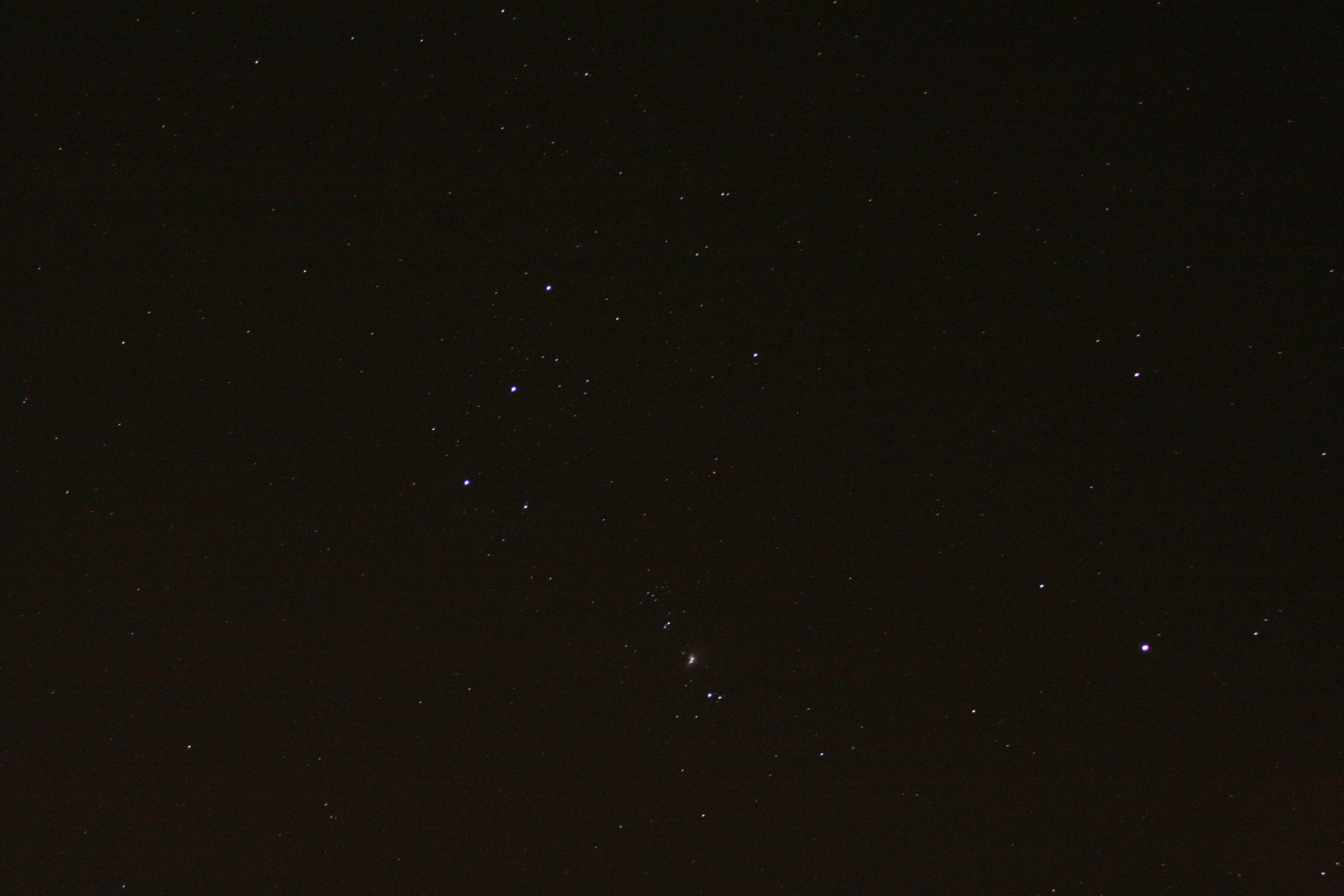
Using the 75mm telephoto lens, this is a 6 second exposure of the lower portion of Orion. Longer exposures started to show the stars as lines instead of points, due to the Earth moving. Nonetheless, the “belt” and “sword” stars of Orion are clearly visible (along with a lot of dimmer stars) and the middle “star” of the sword can clearly be seen to actually be a diffuse nebula, not a star.

IMG_9437 small

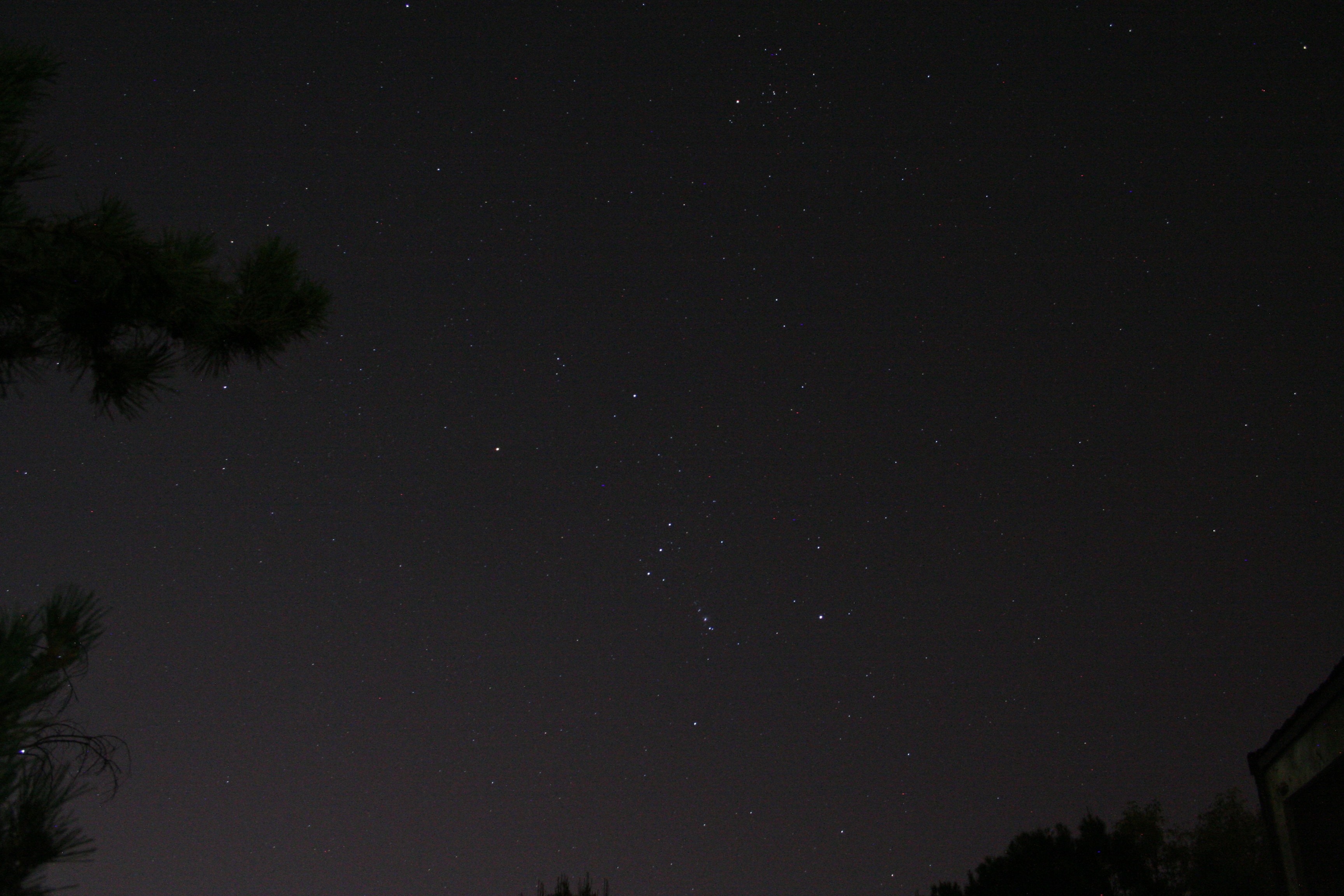
Using the 18mm wide angle lens, this is a 10 second exposure of Orion. The entire constellation can be seen quite clearly. Just peeking through the branches at the far lower left corner is Procyon. Not half bad for slapping a camera on a tripod and seeing what happens.

IMG_9446 small

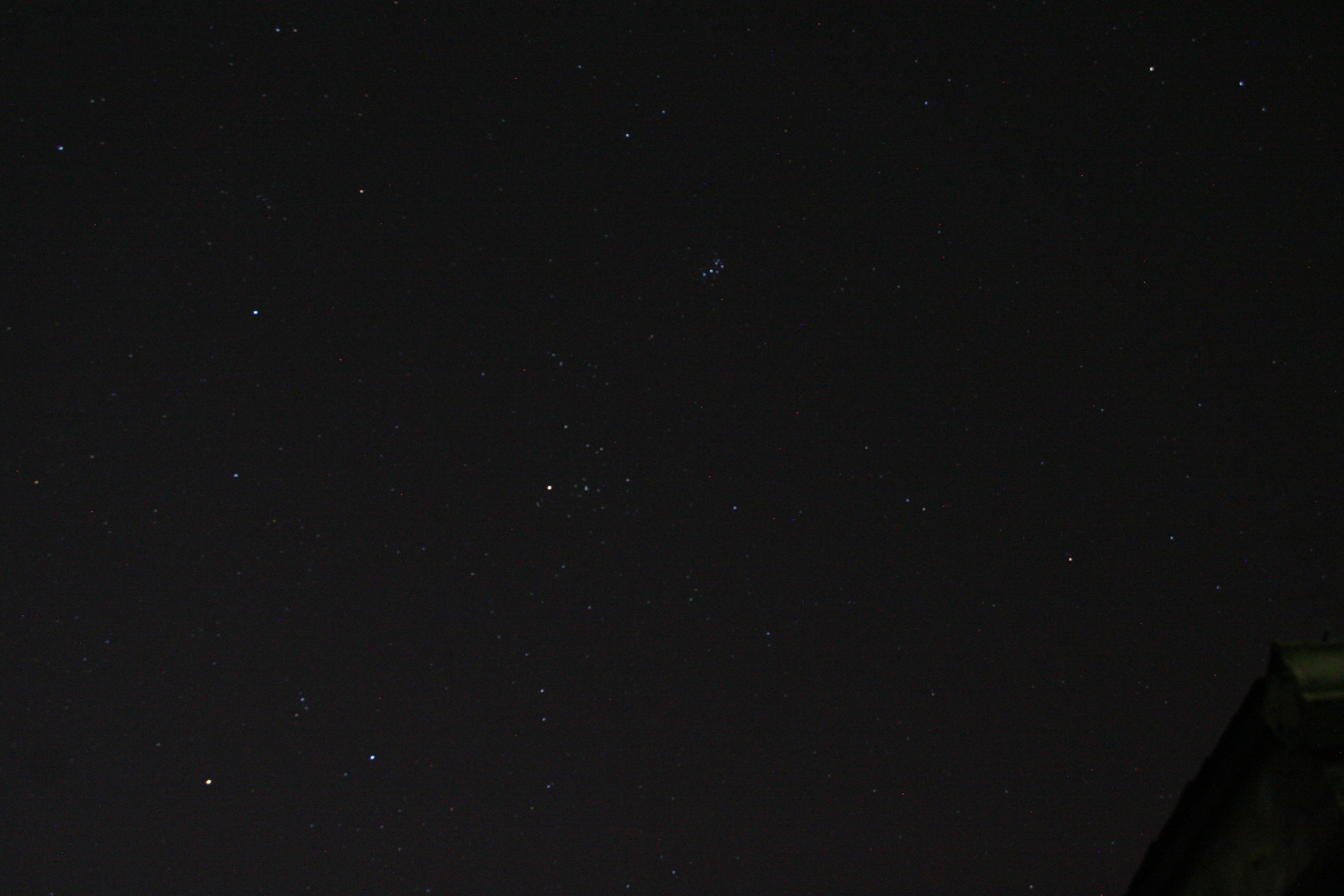
Straight overhead, still using the 18mm lens, the Pleiades open cluster and the “V” of Taurus are clearly seen in another ten second exposure. The orange color of Aldebaran in Taurus is obvious.

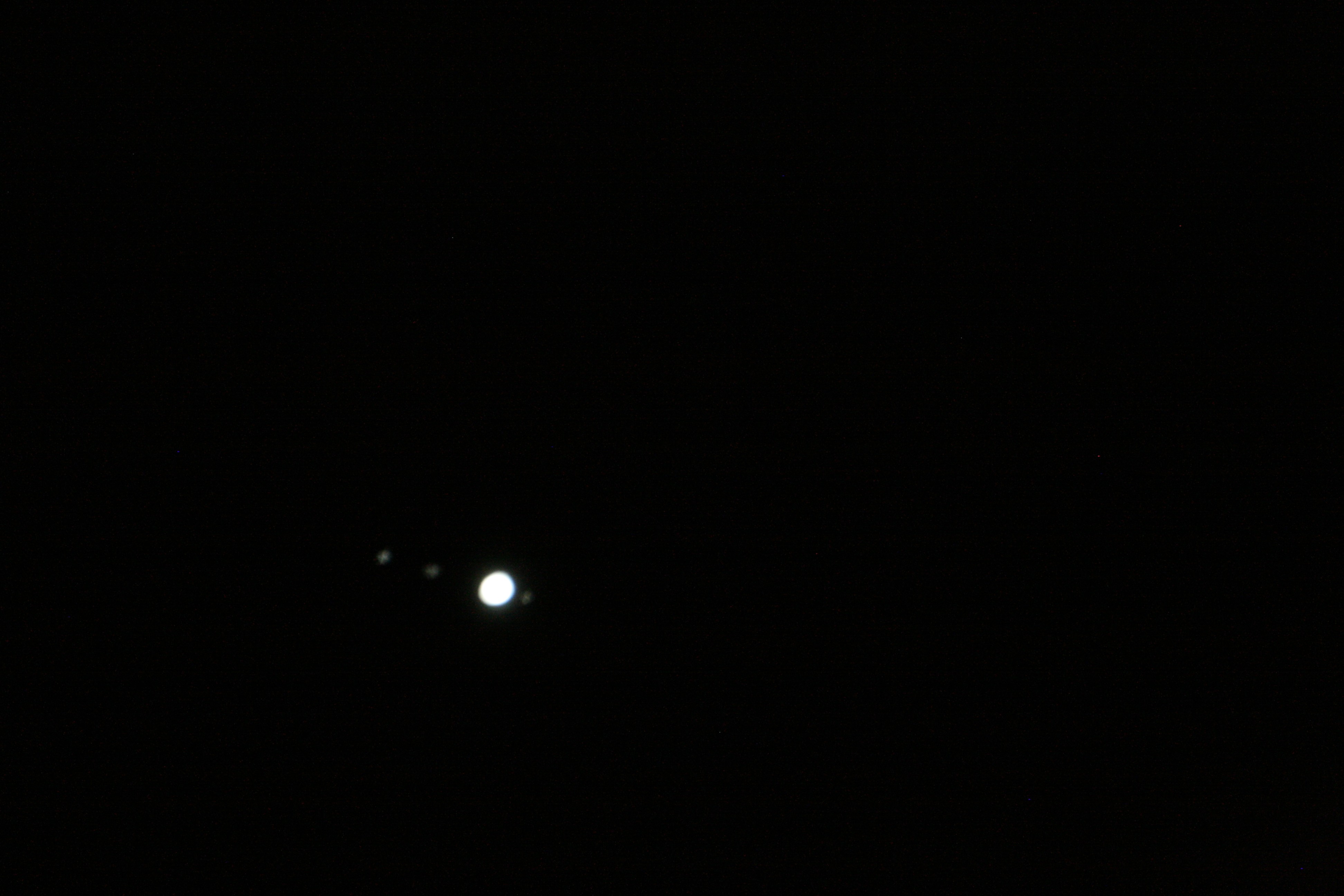
IMG_2284 smallAs Jupiter started rising in the east, I turned the telescope setup that way. It’s blurry, since I had been focused on the moon and Jupiter’s a lot further away (I didn’t want to try to re-focus because it’s a real bitch to focus accurately on dimmer objects, something else I have to find a solution for in the near future.) Nonetheless, this one second exposure through the scope clearly shows Jupiter and three of the Galilean moons.

The proper way to improve these “quick and dirty” pictures is to line the telescope mount up very precisely and then have a motor drive the telescope in the opposite direction at the same rate. My little scope will do that, my big one will do it better, but for the eclipse I didn’t bring out the big scope and didn’t align or power up the drive on the little one. I just wanted to try, on the spur of the moment, to see if even something as simple as this could produce recognizable images. It did, so now I really want to try stepping up my game and getting the big equipment running.


I mentioned this really loud owl that was out. I spent a little bit of time early in the evening walking around the neighborhood and trying to figure out where it was and trying to record the sound on my phone. Like my photos, it’s not really good gear to do a really great job, but it works.


Finally, here are some links to a couple of truly fantastic pictures of the eclipse.

Phil Plait’s article on Slate.com has several amazing pictures of the eclipse, but the huge one by Rogelio Bernal Andreo is just jaw-dropping. It’s a composite picture — as I was noting, it’s hard (i.e., next to impossible because of all of that physics stuff) to get an image that is short enough to show the colors of the moon but long enough to show the stars. Get the moon, and the stars are extremely faint. Get the stars, and the moon is too bright and overexposed. Andreo took two photos, one for the moon, one for the stars, and then combined them. The result is stunning. And as the huge copy of the picture in Plait’s article shows, not only do you see the eclipsed moon, an immense star field, and Uranus, but you can also see two of the moons around Uranus.

Wow. Just…wow.

But today I found one that’s even better. It shows something that we see all the time around other planets, but I don’t know that it’s ever been seen around ours. It’s a moon going into shadow, into eclipse, seen from afar.

Around all of the outer planets you can see this regularly. In fact, the Galilean moons of Jupiter do it so regularly and it’s so easy to see that Galileo saw them in 1610, over four hundred years ago. Anyone with binoculars can see them today, disappearing as their orbit carries them into Jupiter’s shadow and reappearing as they come back into the sunlight.

Emily Lakdawalla at The Planetary Society wrote an article today with a video from the MESSENGER spacecraft, which has been orbiting Mercury since March 18, 2011. Looking back from 63.4 million miles away, MESSENGER recorded this video of the moon going into eclipse behind the Earth.

The only way that’s not the coolest thing you’ve seen today is if you also saw one of your kids being born!


Leave a comment

Filed under Astronomy, Photography, Space

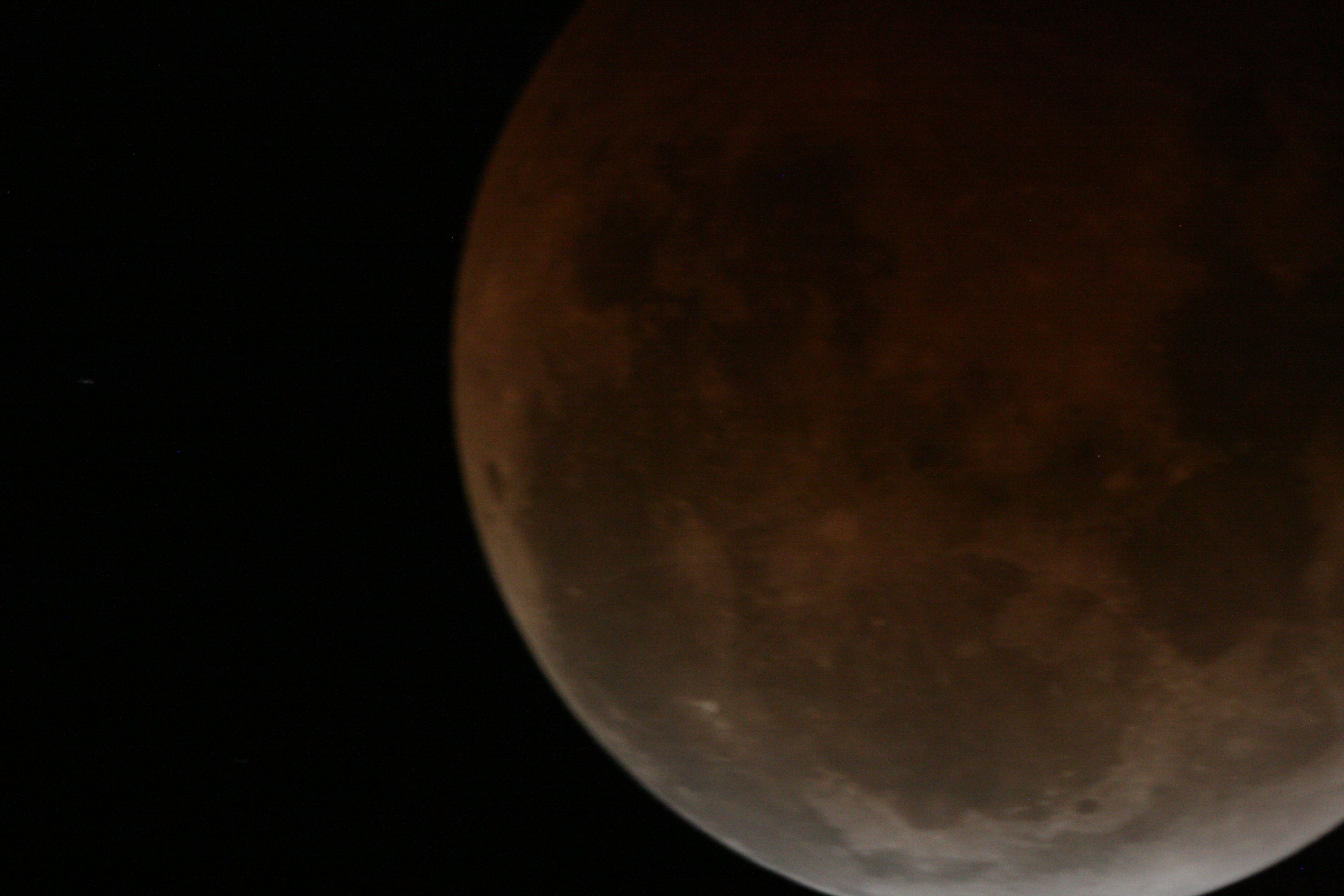
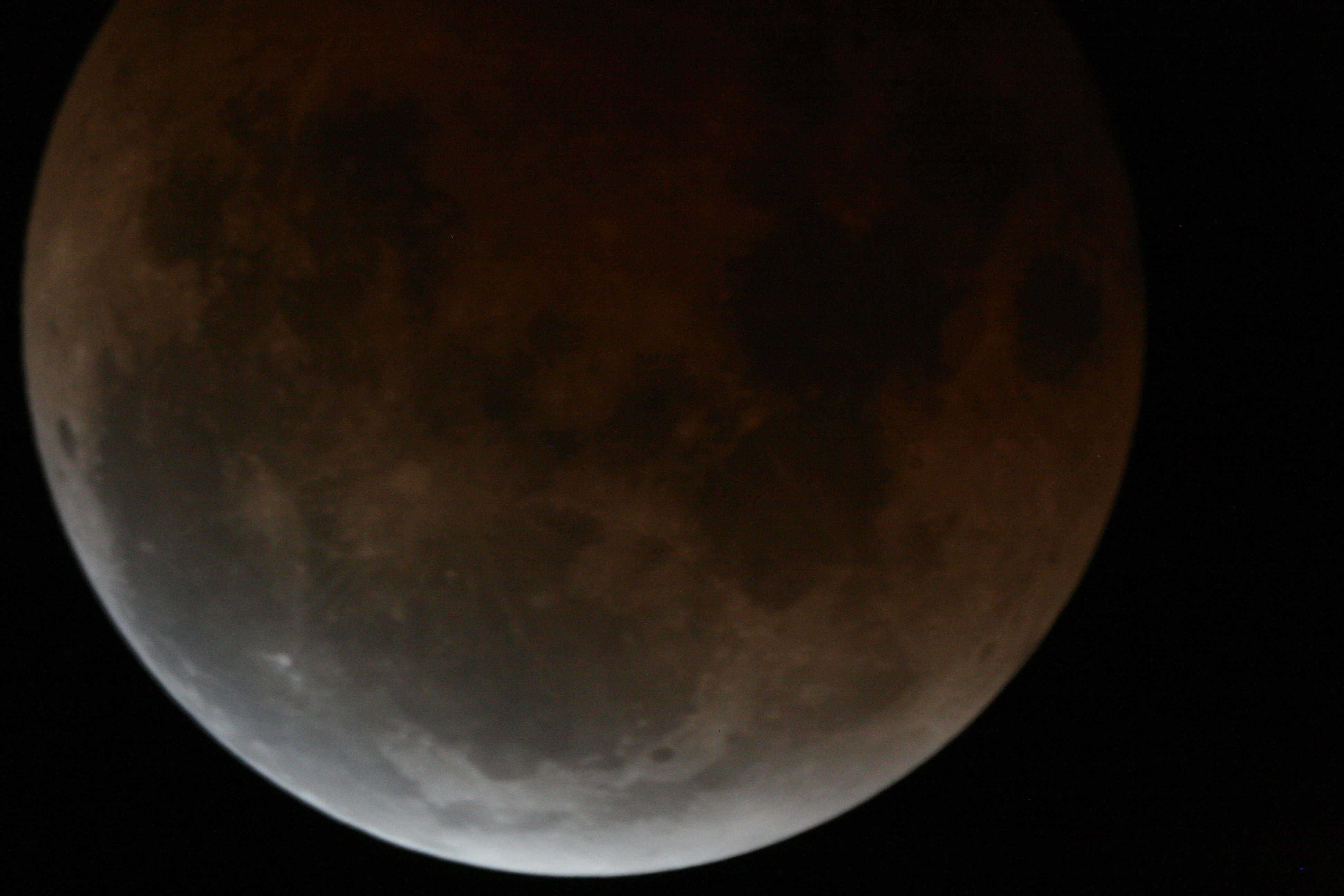
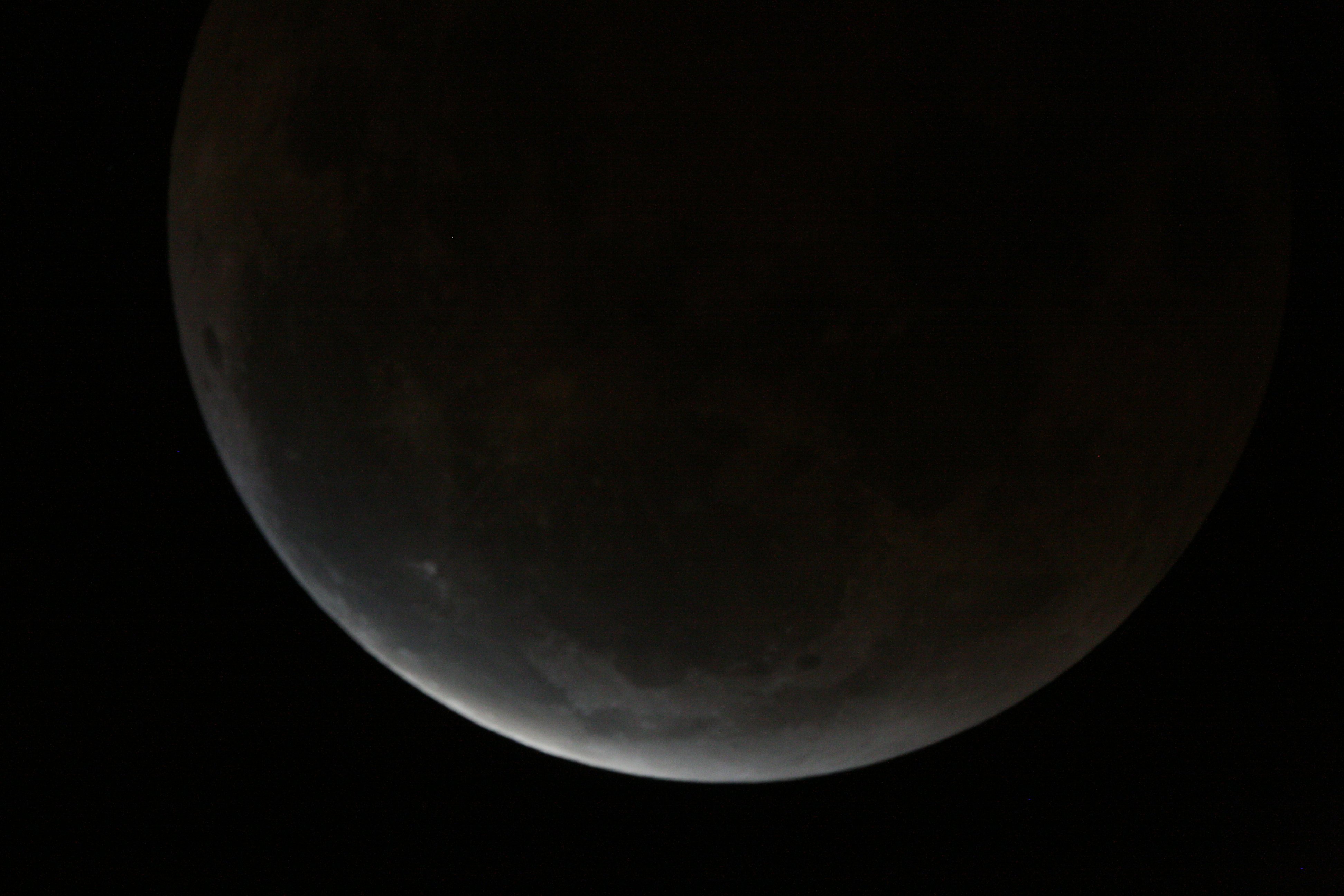
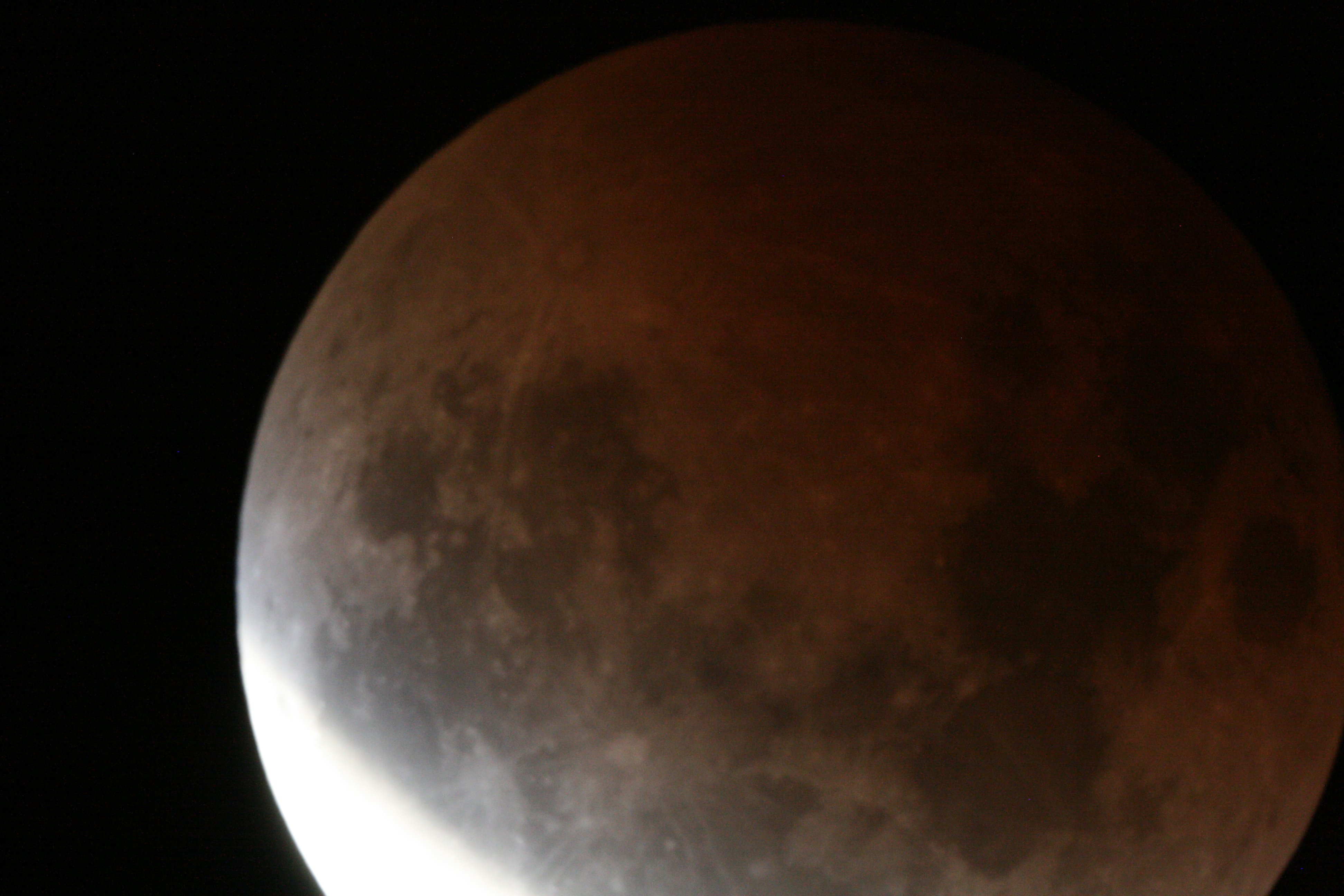
Total Lunar Eclipse Of October 8 2014

I’m really tired. I was almost correct about one thing yesterday – I may not be too old to pull an all-nighter, but it sure kicks my ass in ways that it didn’t when I was twenty. But it was worth it. The eclipse was spectacular, the night was crystal clear, and here are the pictures!

Basically the same as for the April 2014 eclipse, where I went into a lot of detail on how each picture was taken, the exposure, and so on. I’m not going to do a lot of that today. If you need to know, the EXIF data should still be attached to the files, or you can just ask and I’ll be more than glad to answer.

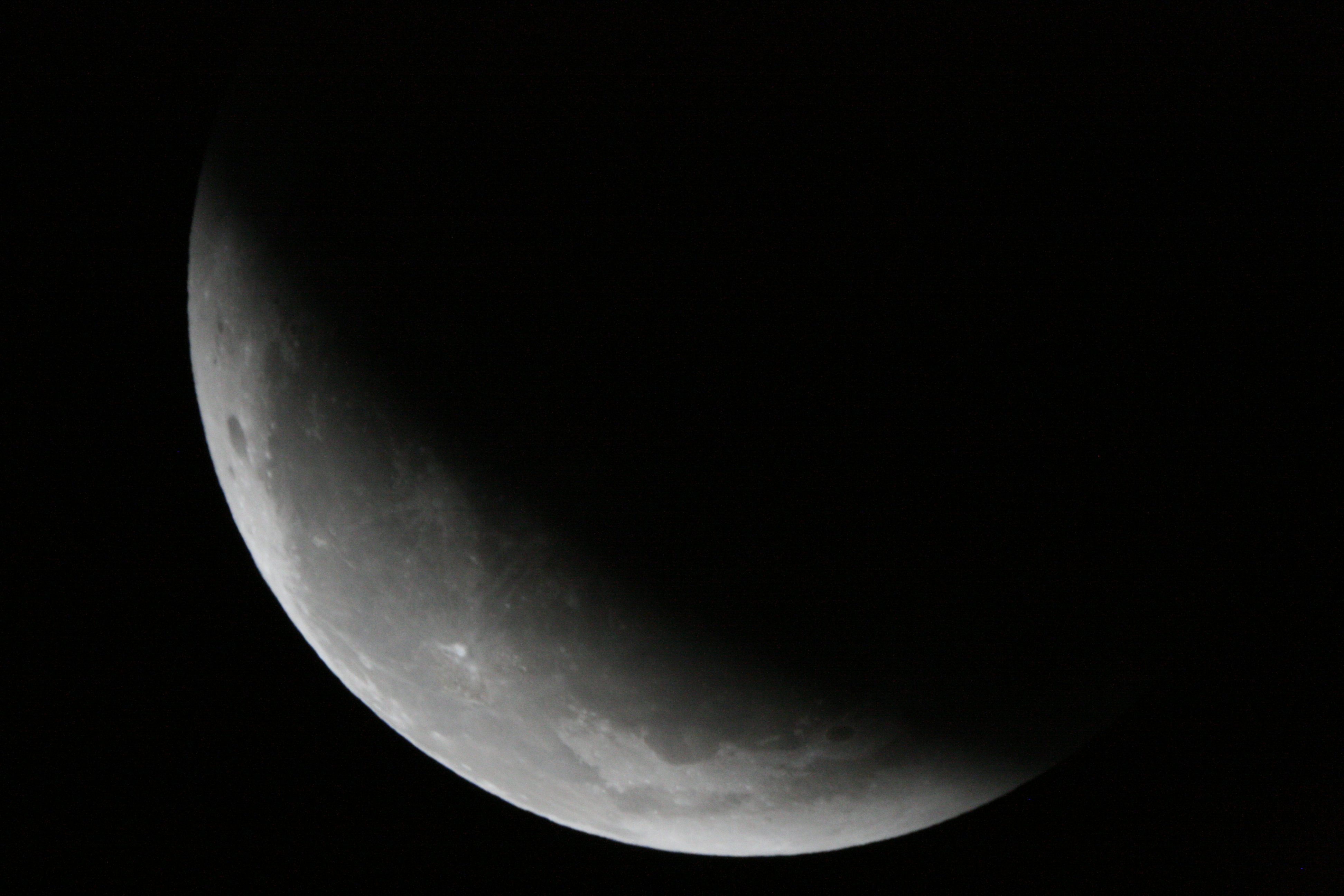
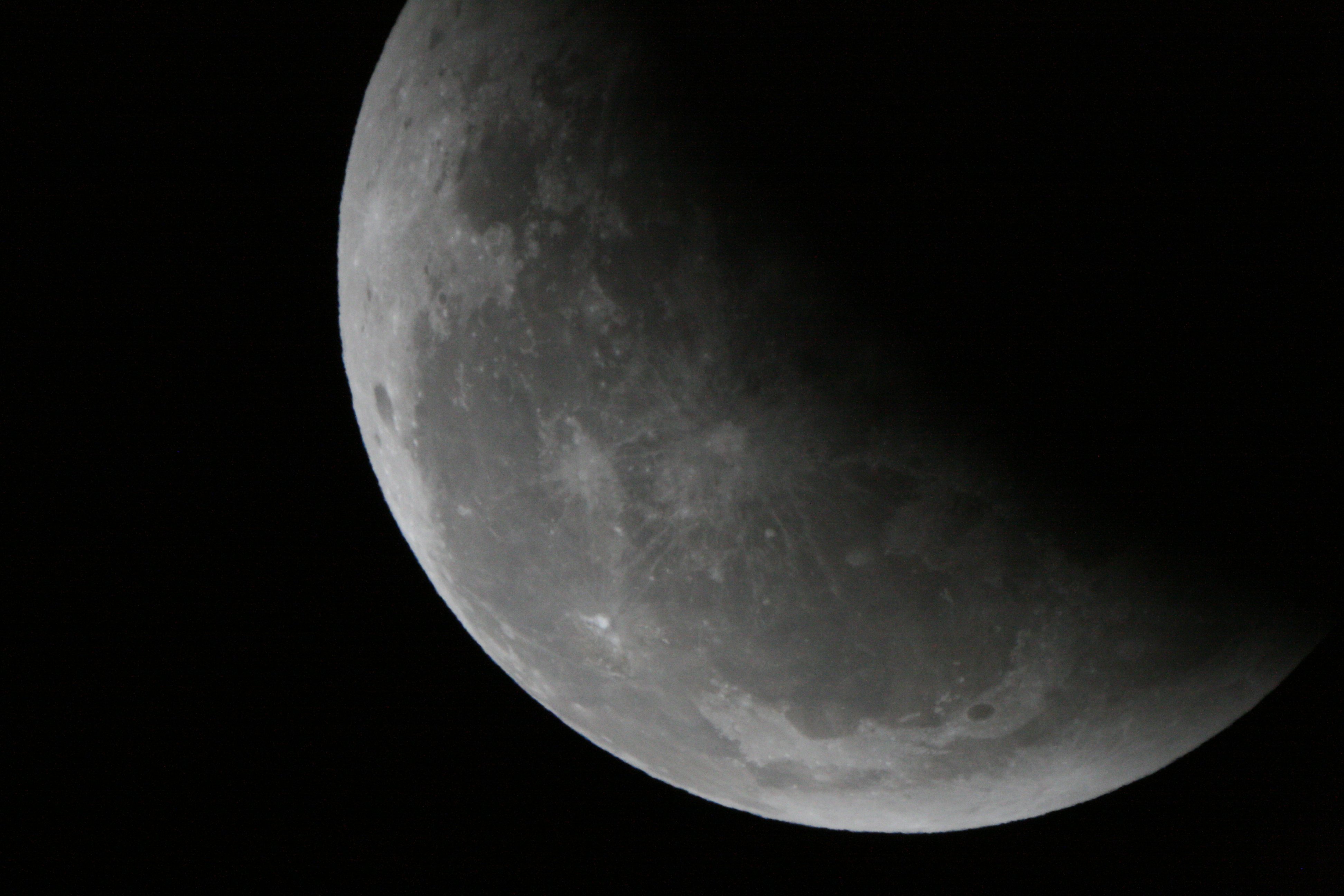
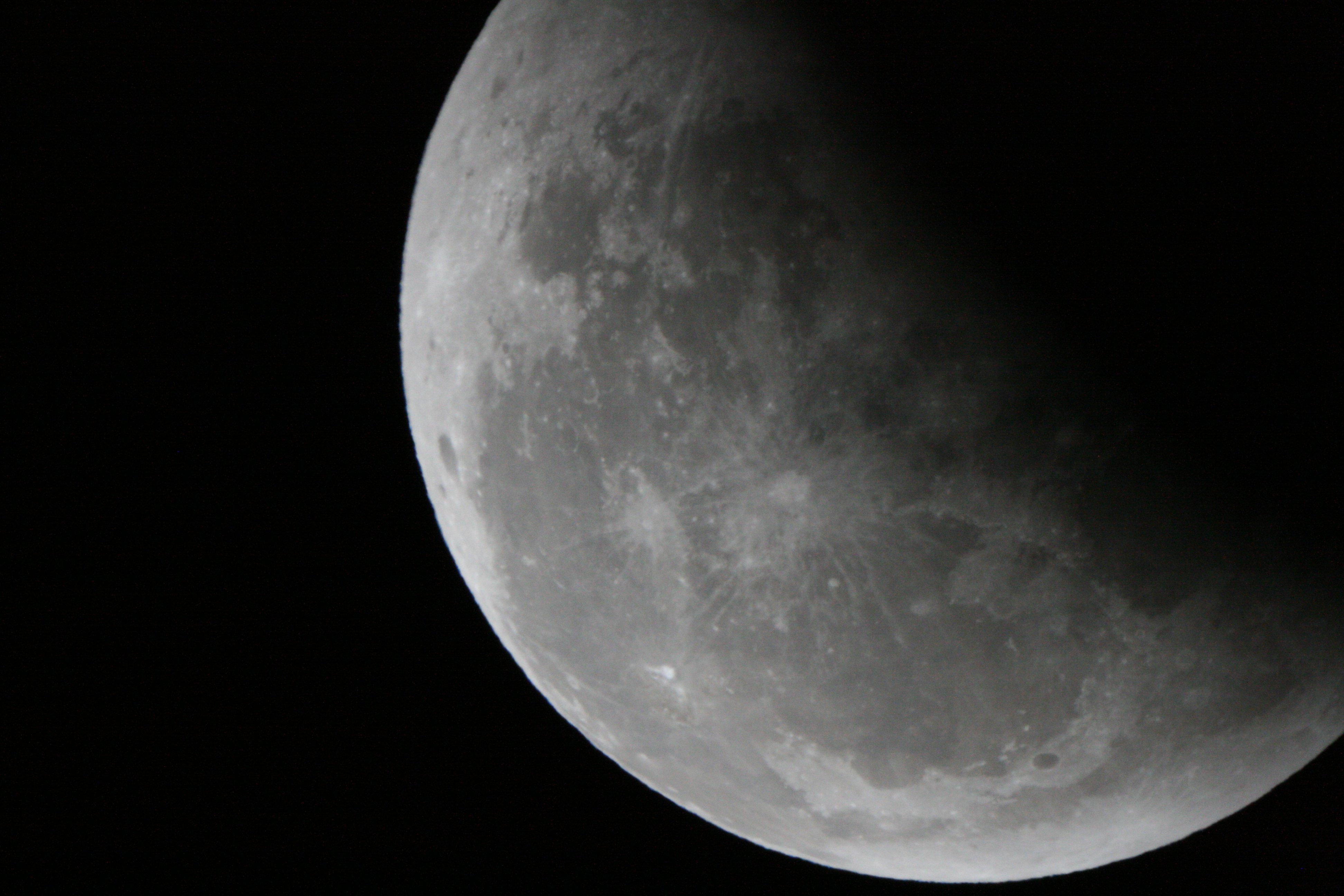
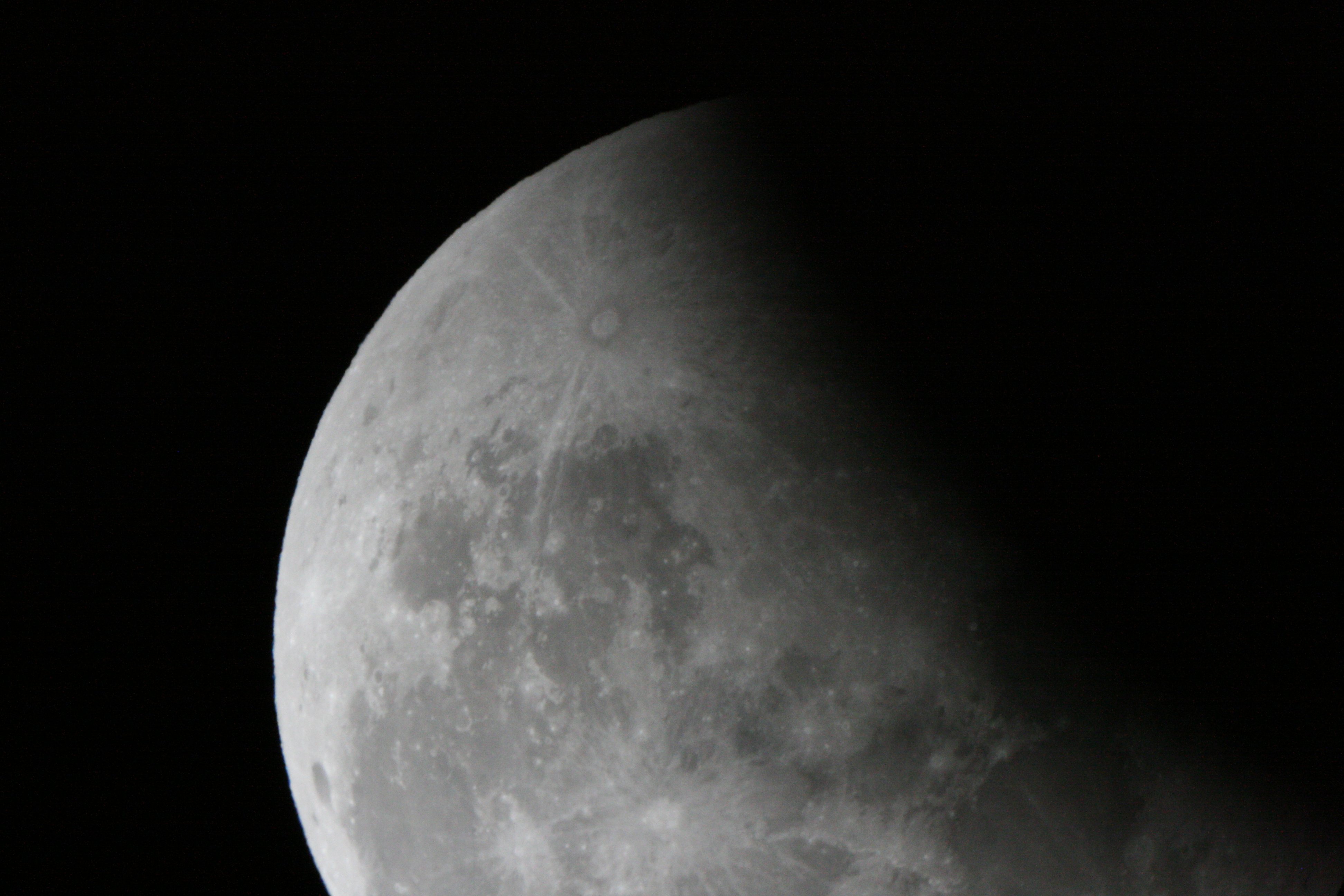
Two sets of photos, taken simultaneously, the first one using the Meade ETX-125 telescope as a 1900mm telephoto lens on a Canon Rebel xTi DSLR, the second using a 75-300 Tascam zoom lense on a Canon Rebel xT. Exposures go from 1/4000 second for the überbright full moon, one to two seconds for the fully eclipsed moon.

IMG_1969 small

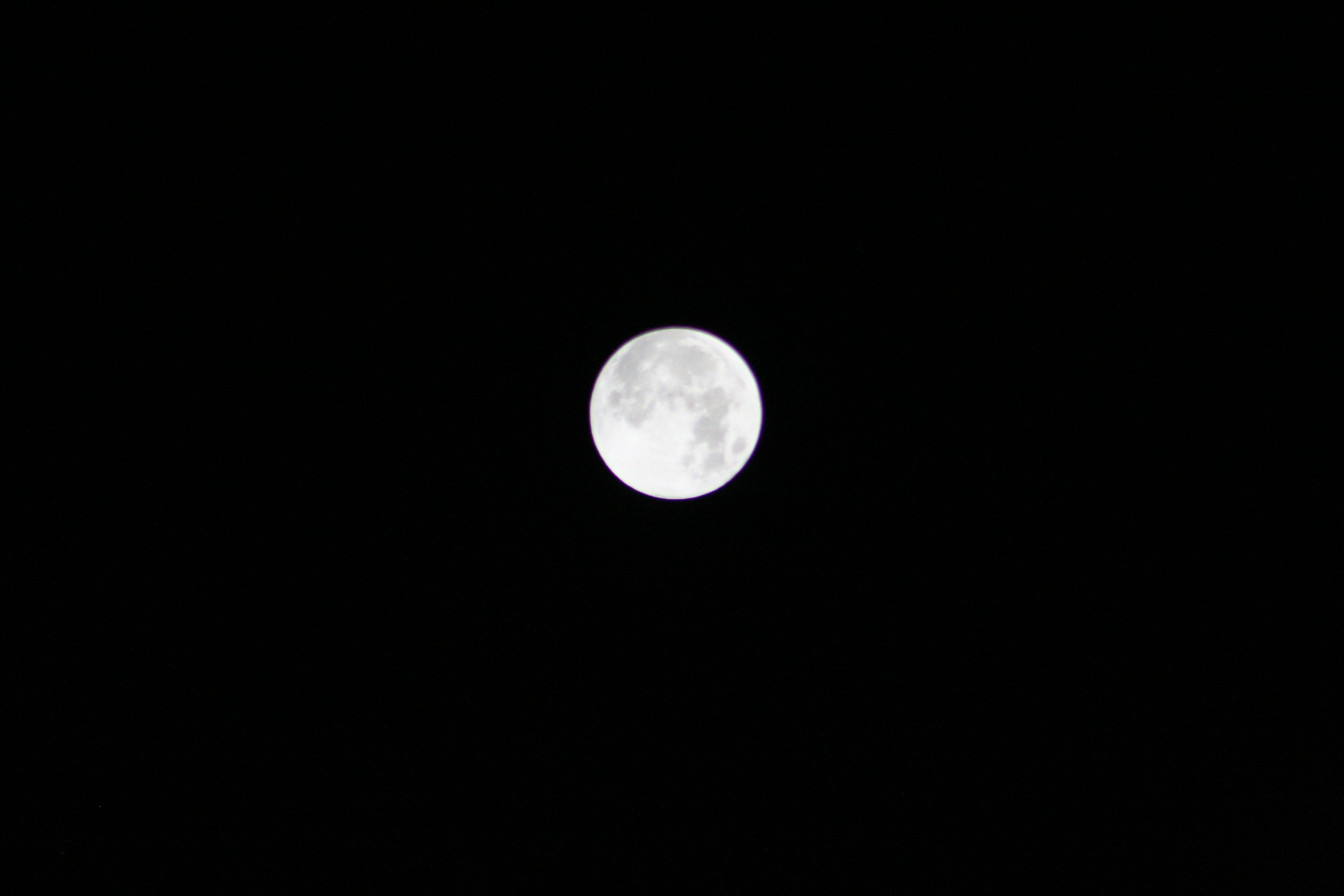
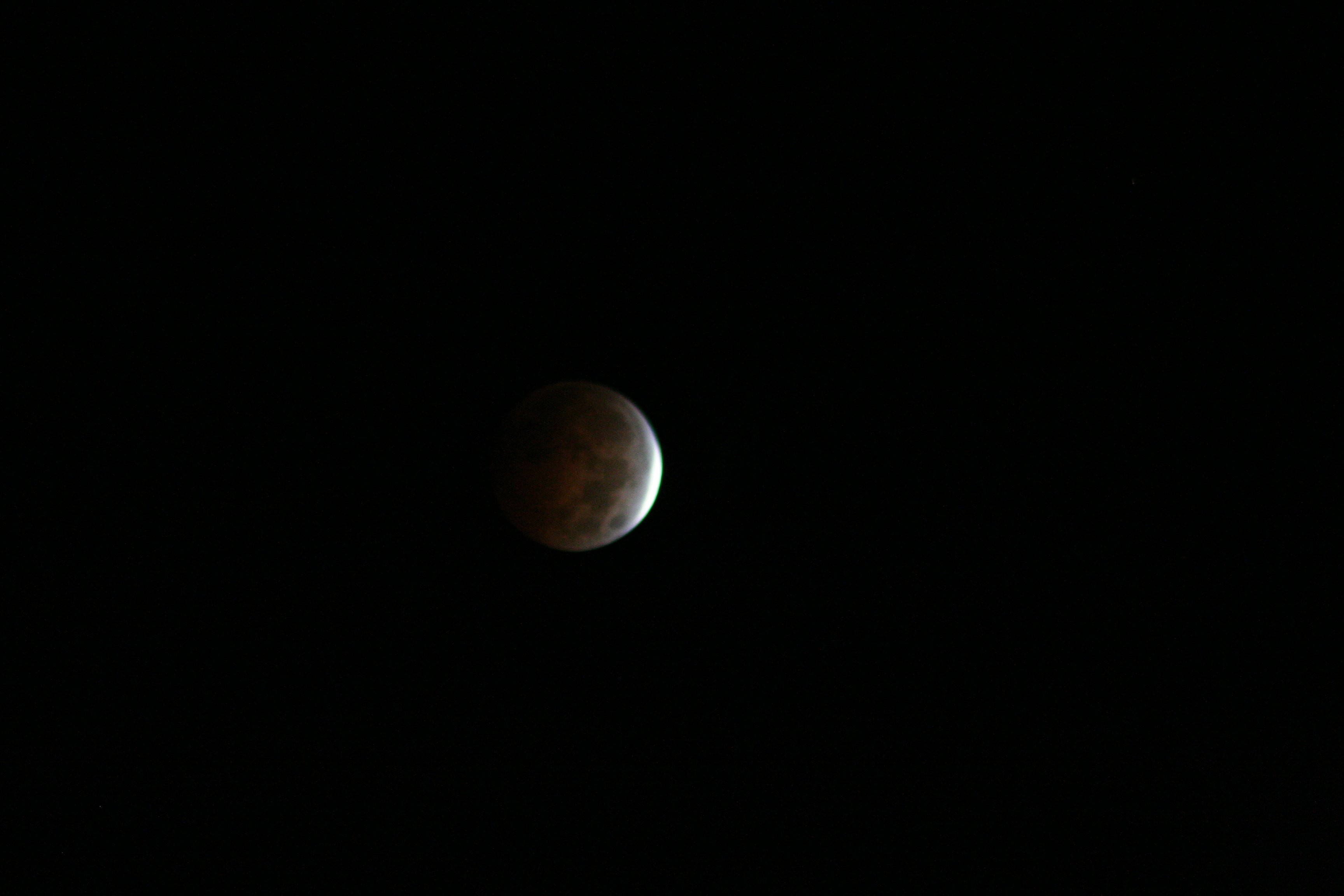
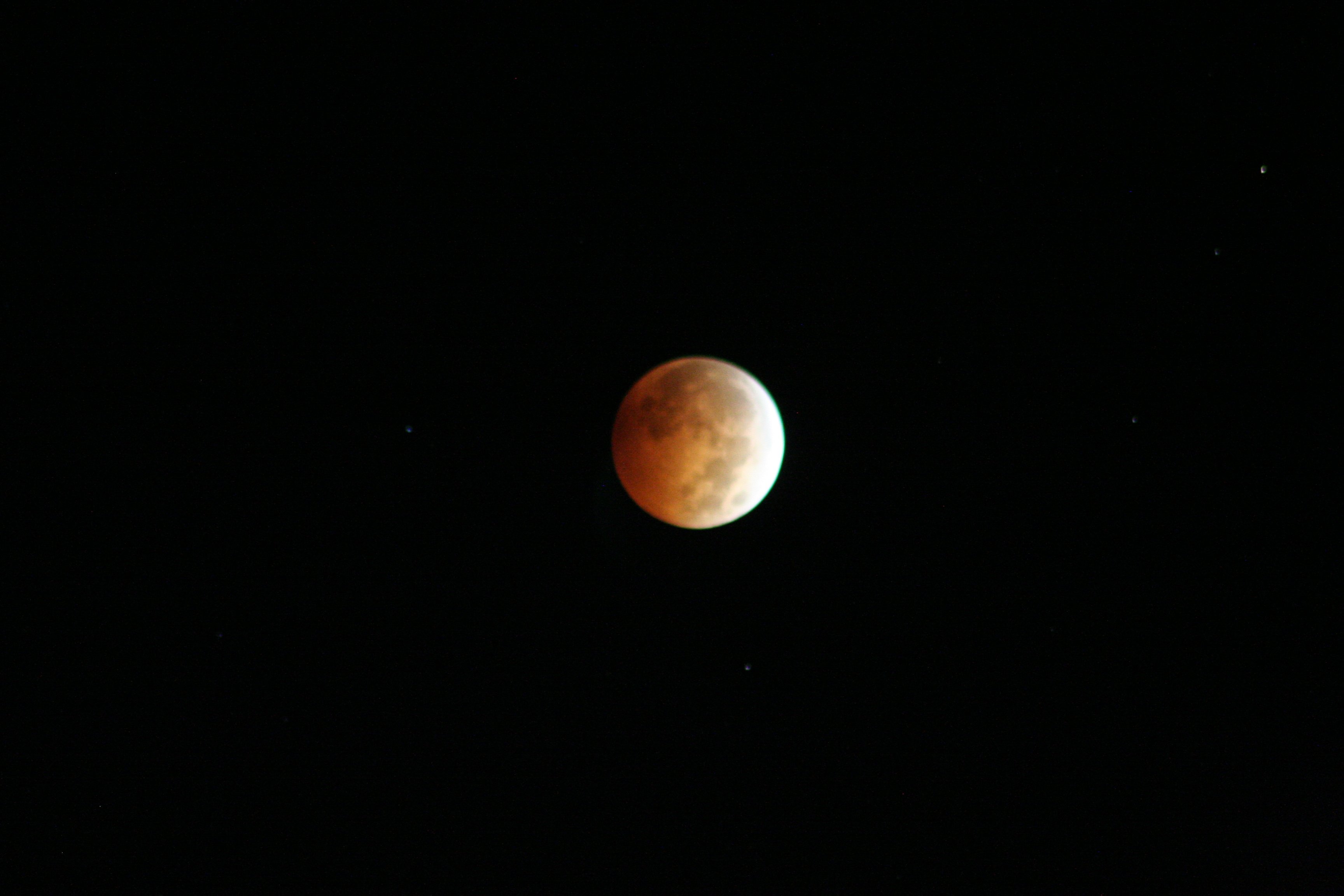
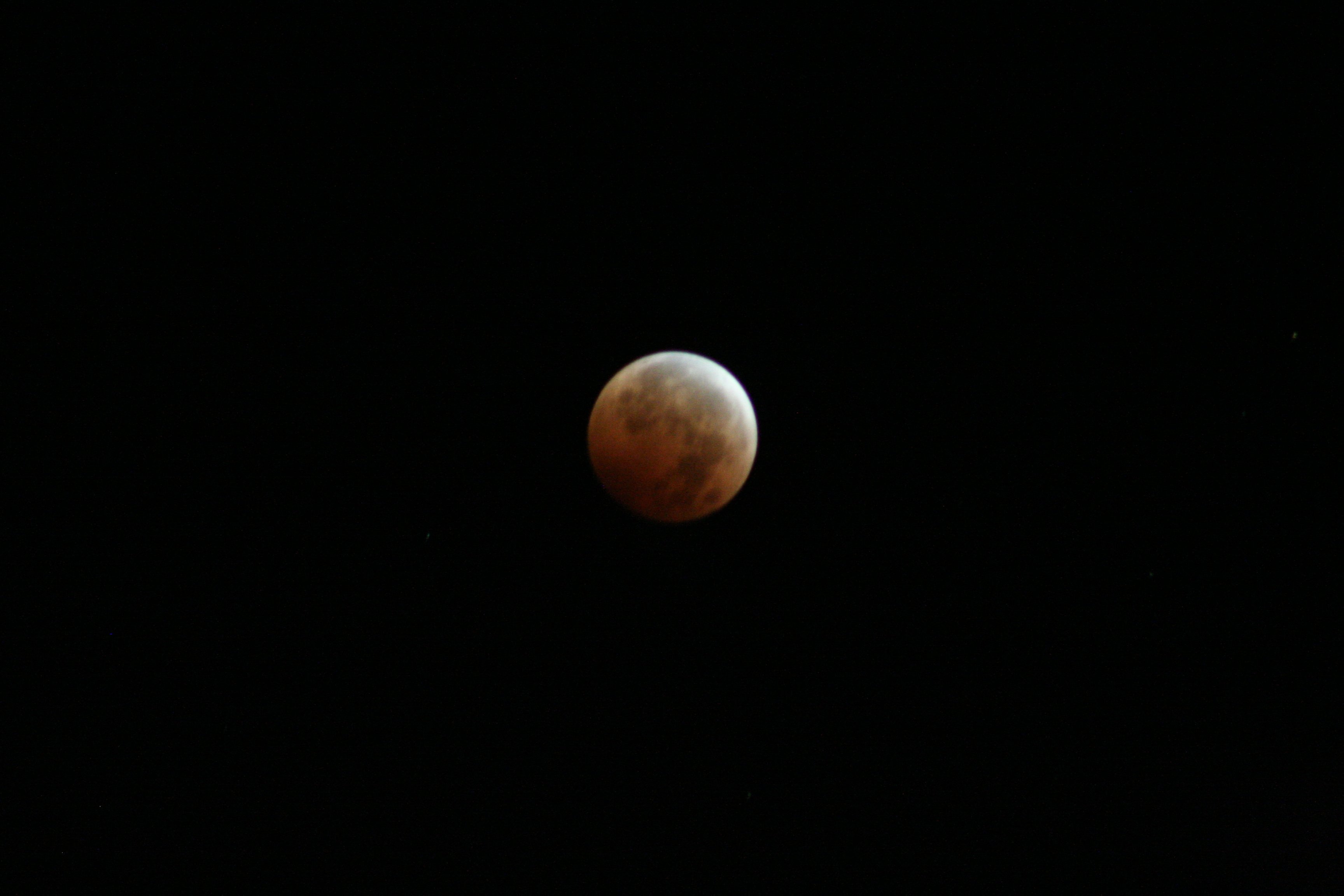
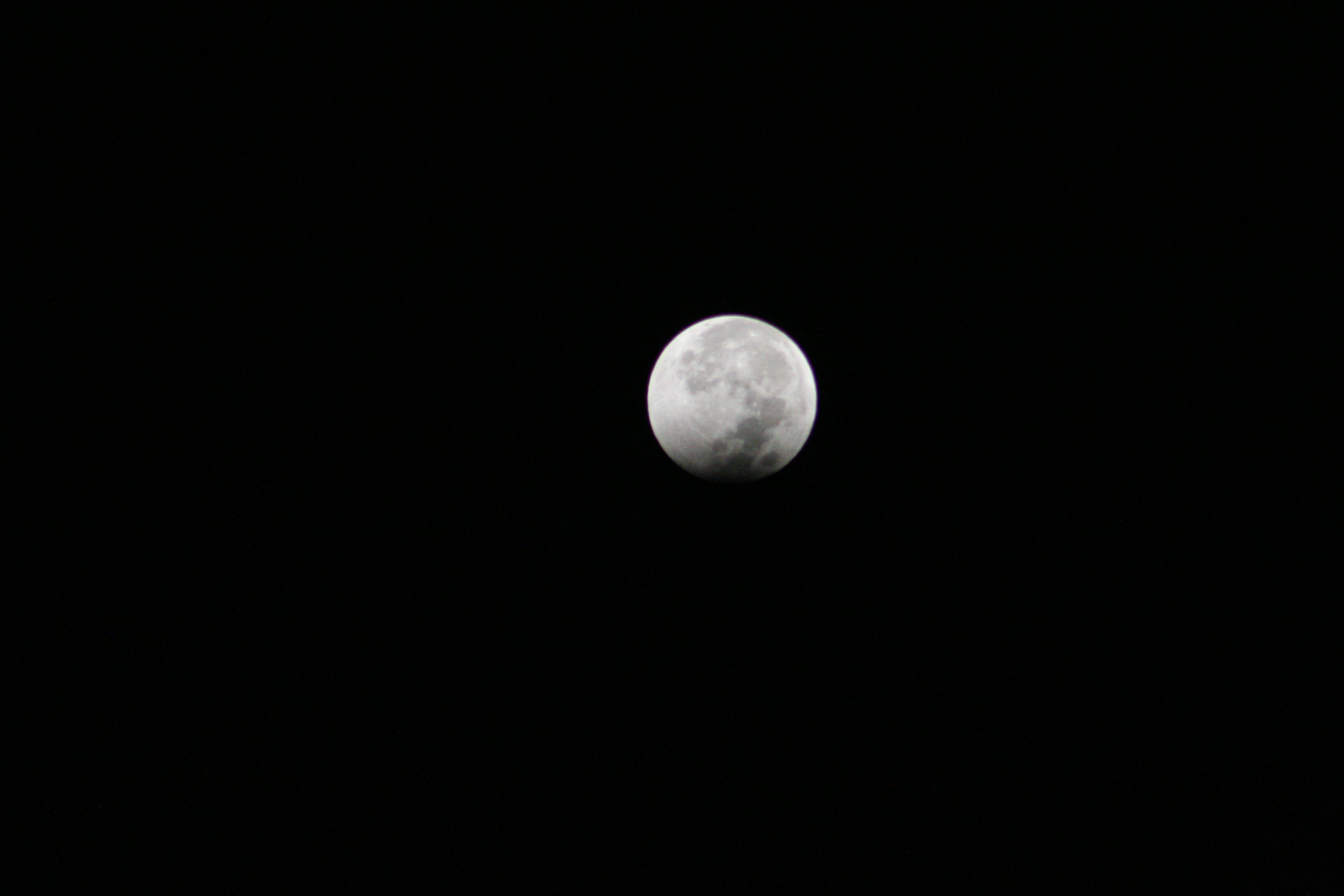
Full moon, 99.99% full, in the early stages of the penumbral phase of the eclipse.

IMG_1986 small

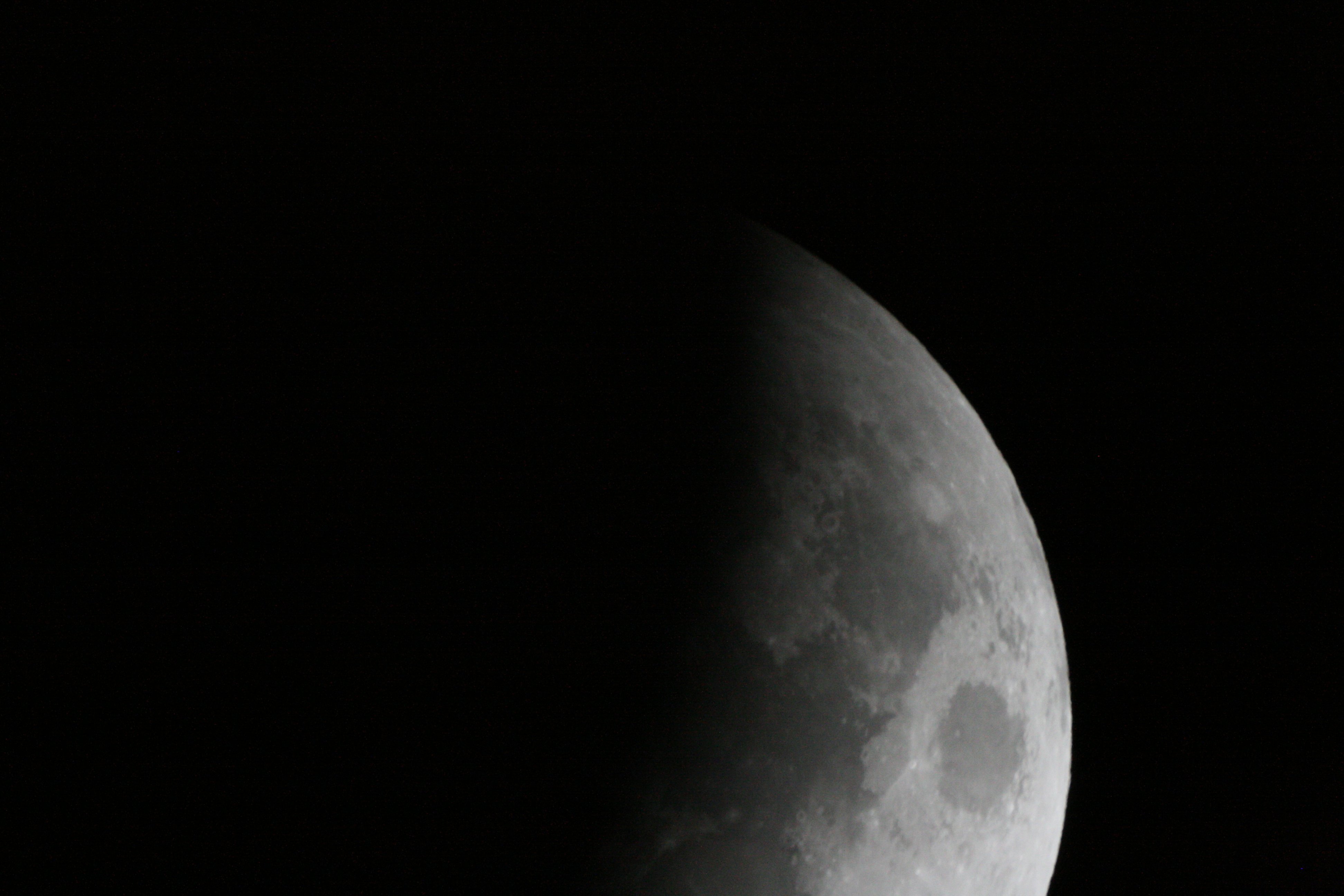
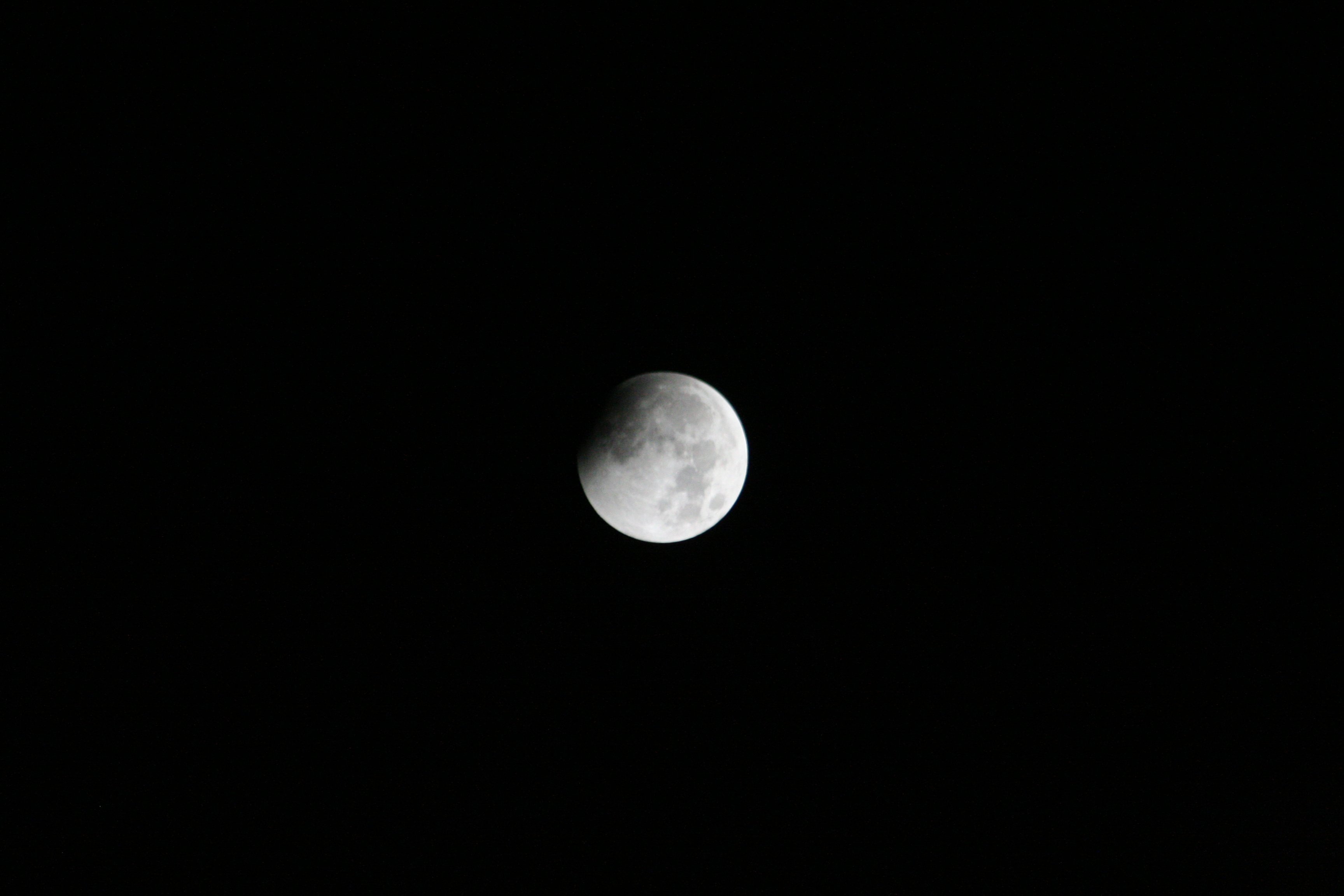
A few minutes into the partial, umbral phase,the darkening starting on the left side.

IMG_2016 smallAbout a third of the way into the partial phase.

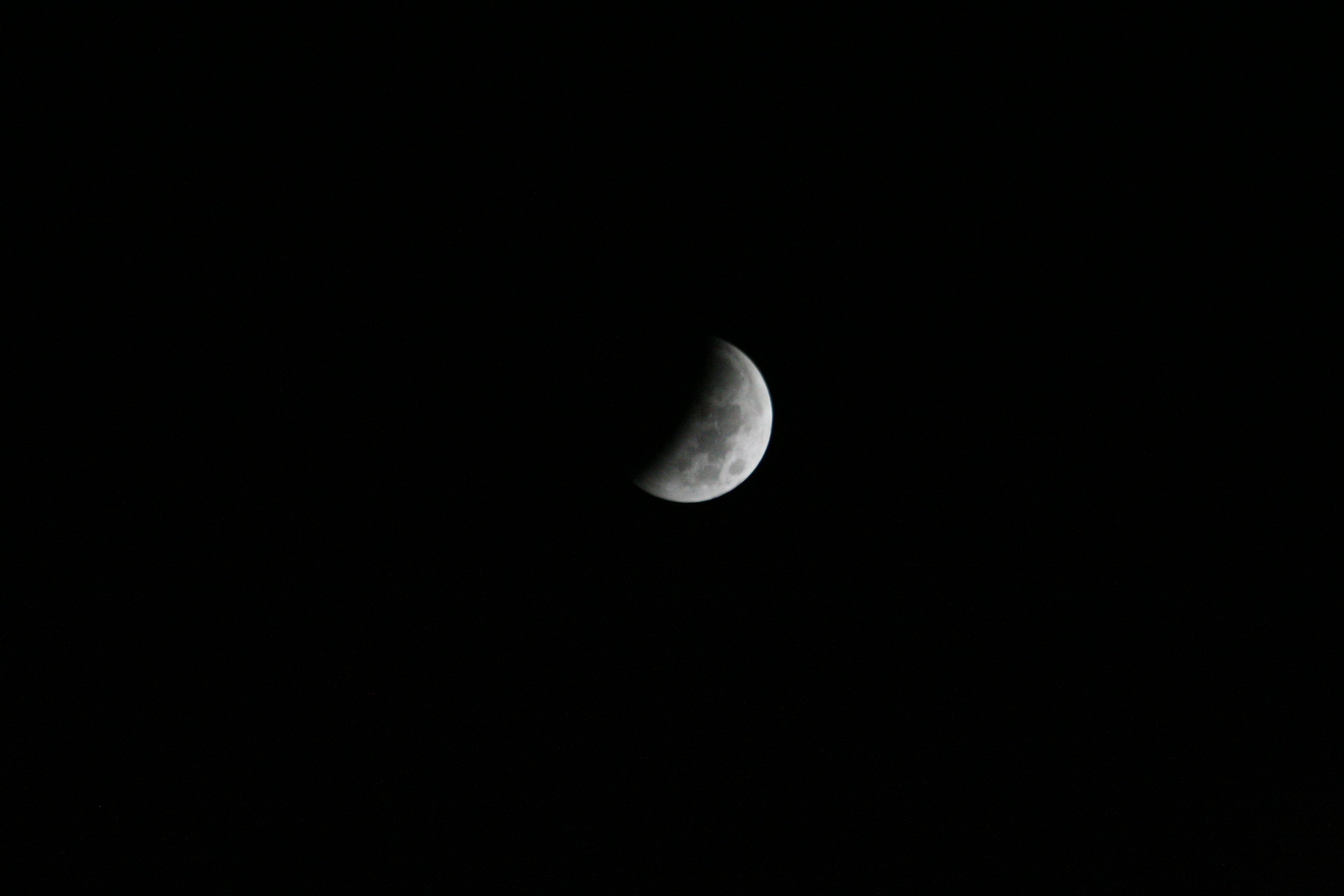
IMG_2061 smallAbout half way.

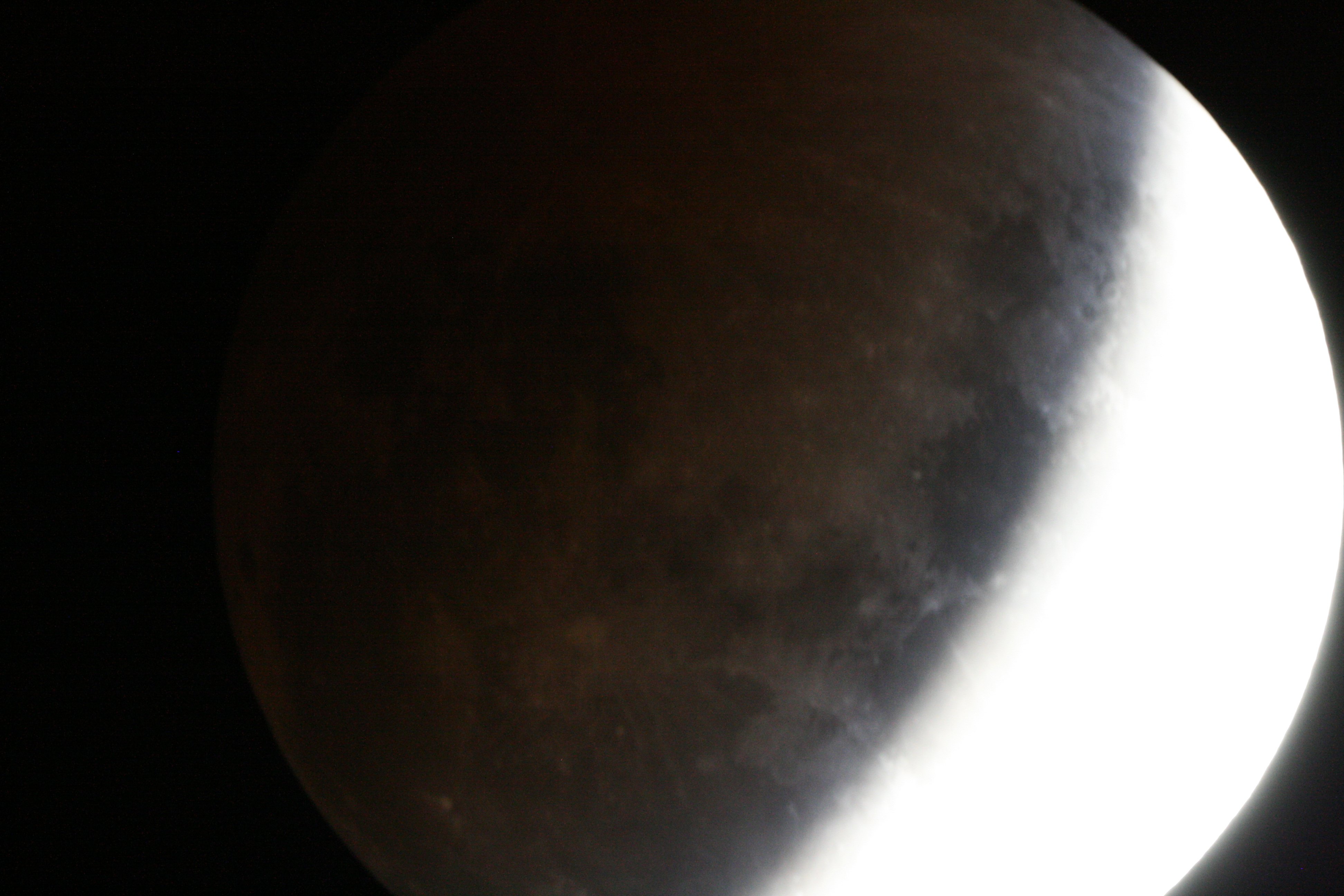
IMG_2068 smallTwo thirds of the way. So far the exposures have been to show the illuminated portion with the shadowed portion of the moon left in darkness. But about this time in the eclipse, if you start to really overexpose the lit portion…

IMG_2092 small…you start to see the reds, browns, and oranges in the shadowed portion.

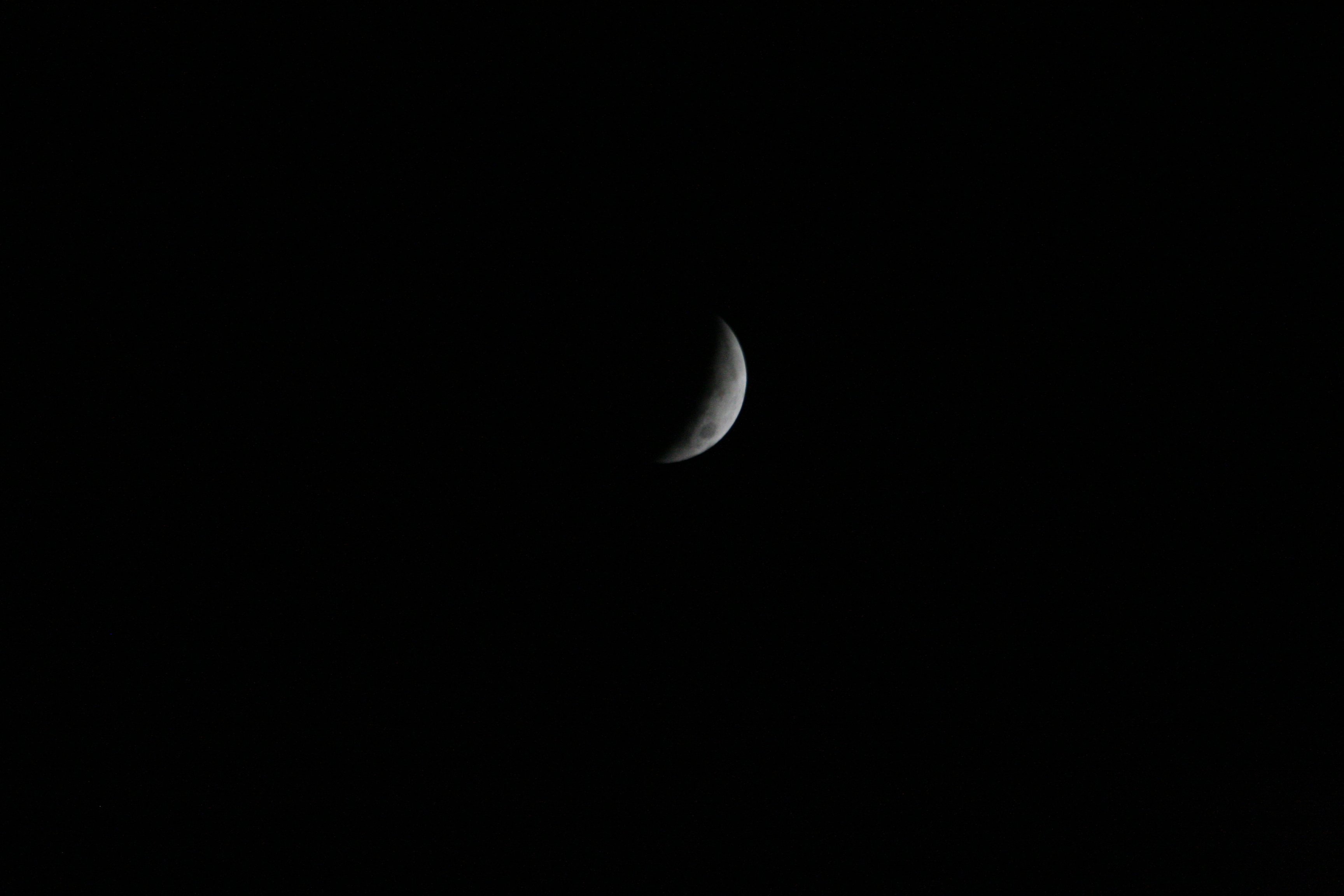
IMG_2128 smallAbout 80% eclipsed.

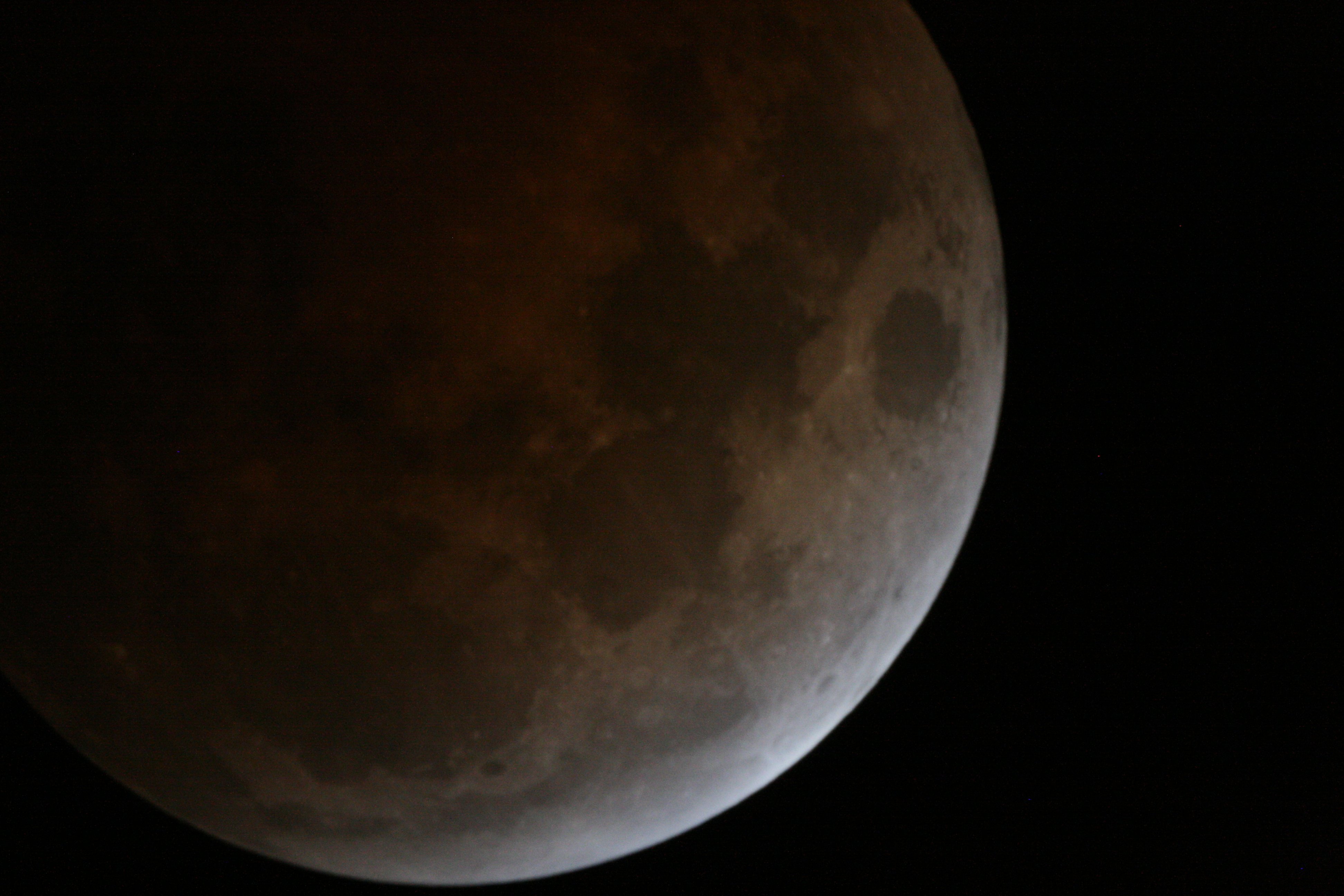
IMG_2179 smallStart of the totally eclipsed phase. Now longer exposures make for slightly more blurry pictures (I’m not guiding the camera or telescope, and the Earth and moon are both moving at a pretty good clip) but also bring out all of the colors.

IMG_2202 smallAbout half way through the eclipsed phase. As noted before, when seen like this, it looks a lot like Mars.

IMG_2224 smallAbout 95% done with the totally eclipsed phase.

IMG_2236 smallJust starting to exit from totality.

IMG_2261 smallNow we just reverse the process that brought us into the eclipse.

IMG_2263 small

About a third of the way out.

IMG_2302 small

About half way out.

IMG_2313 small

About three-quarters out.

IMG_2322 small

Still about three-quarters out, but showing the other pole. With the Meade, the field of view is just a bit too small to take the whole moon in at one time.

IMG_2343 small

About 85% out.

IMG_2348 small

About 90% out.

IMG_2364 small

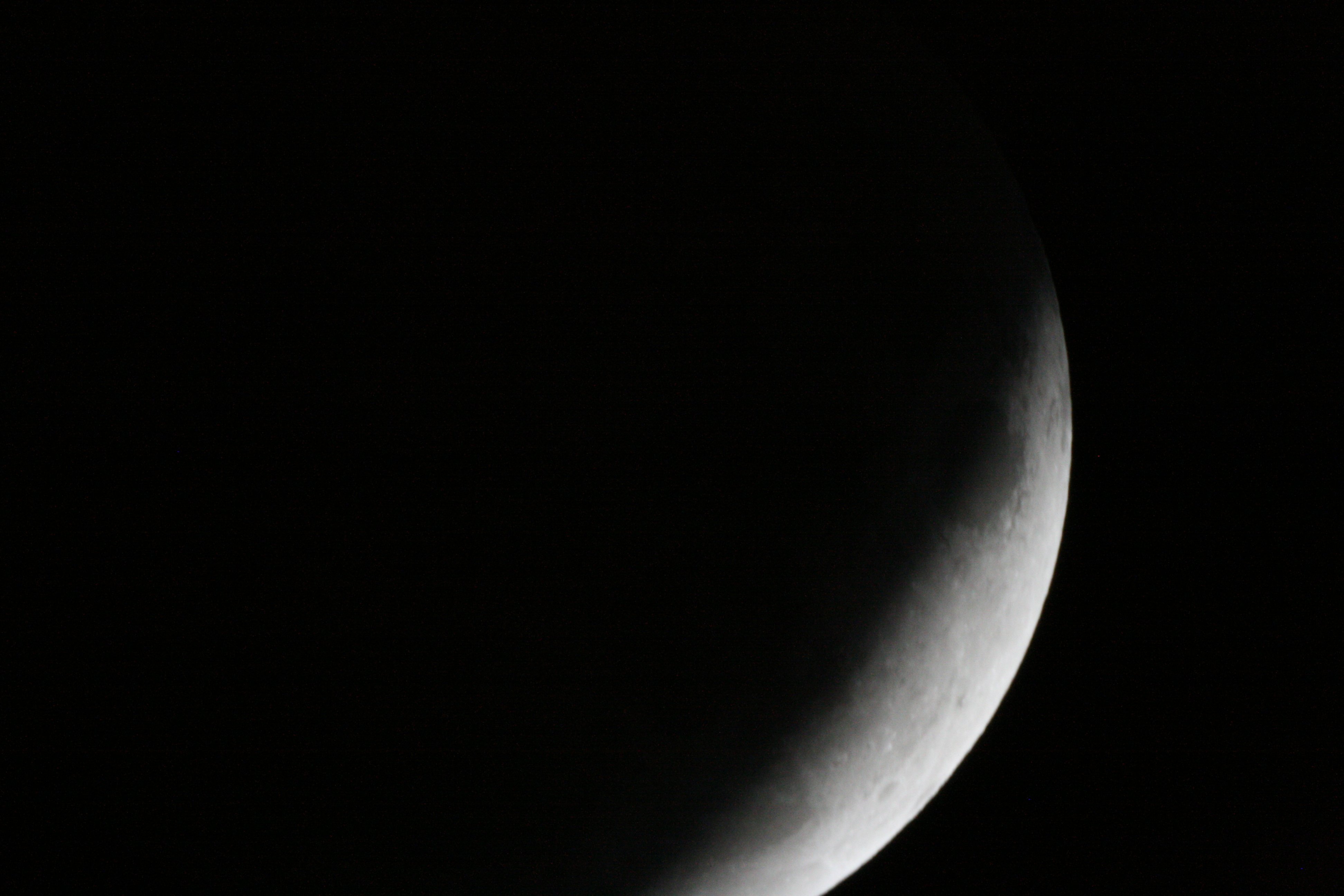
Very near the end of the partial phase, moving into the final (dim) penumbral phase.

IMG_2375 small

Clear! Back to a very bright full moon.

IMG_9280 small

With the zoom lens instead of the telescope, the image is smaller, but it’s actually tough to take a picture of the full moon because it’s so bright. This is a 1/4000 second, as fast as the Canon will go, and it’s still overexposed.

IMG_9287 smallEntering the partial phase.

IMG_9304 small

Halfway in.

IMG_9329 small

Three-quarters in.

IMG_9387 small

Totality.

IMG_9398 small

A longer exposure shows the bright reds and oranges that can be seen. In addition, about one moon-diameter to the left of the moon’s disc you can clearly see a small, round, blue dot. That’s Uranus.

IMG_9417 small

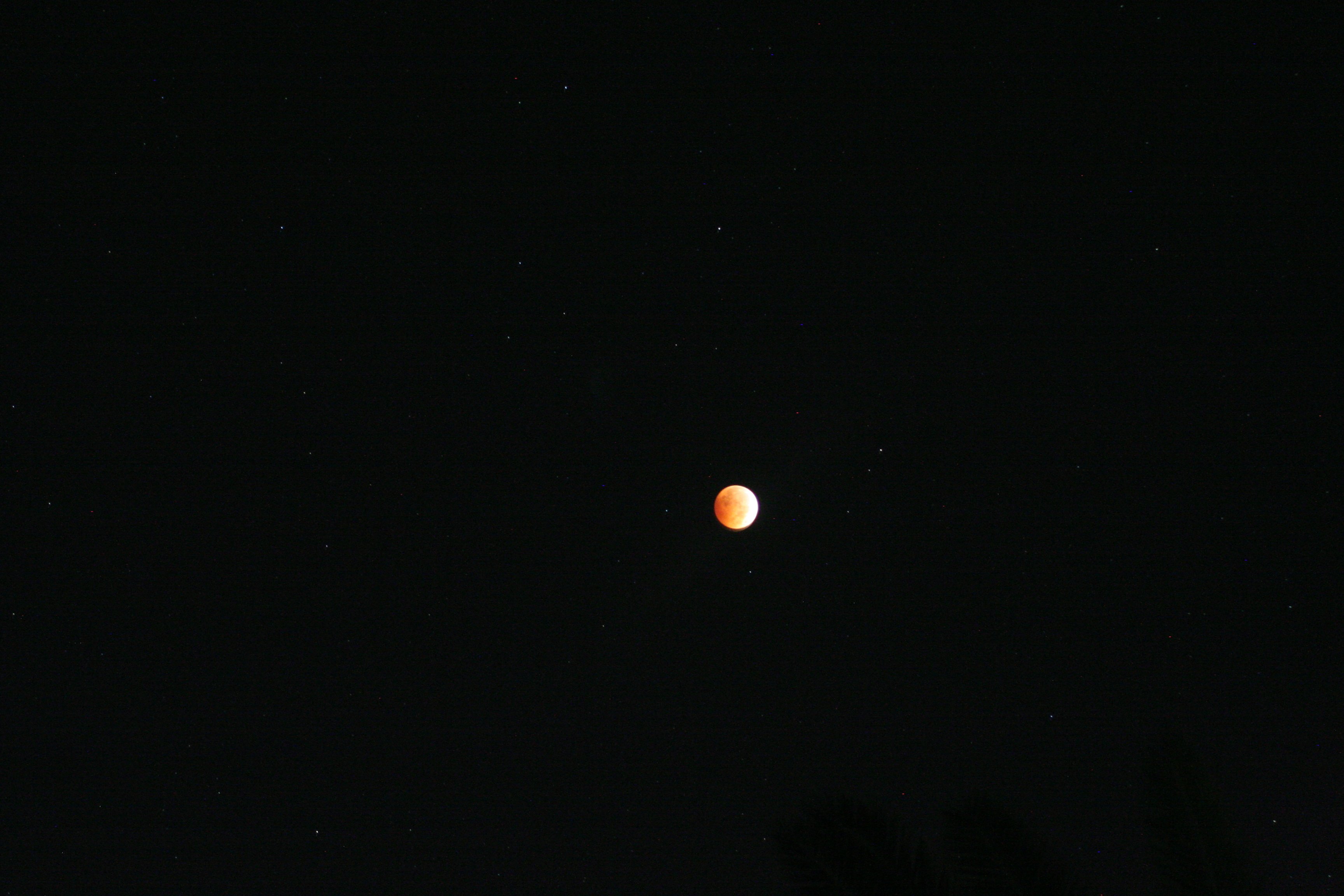
A picture with the zoom lens at its 75mm setting. This is a pretty good approximation of how it actually looked, with the palm trees dim in the foreground.

IMG_9484 small

One of the things that’s always interesting is how many stars you can see during totality. With the bright full moon shining two hours earlier,you could barely see Rigel or Betelgeuse in Orion. With the moon eclipsed, you could see stars down to the limits of what’s possible given the light pollution in a major metropolitan area.

IMG_9538 small

Almost back out of the final partial phase.

More comments, notes, and some semi-related pictures in a couple of days. I really, really need to get some sleep!

7 Comments

Filed under Astronomy, Photography, Space

Total Lunar Eclipse Tonight & ISS Pass At Sunset

Reminder, there’s a total lunar eclipse tonight, in the wee hours of the morning before sunrise if you’re in North America or South America, in the comfortable hours after sunset if you’re in Japan, eastern Asia, New Zealand, eastern Australia. Or on a Pacific Island west of the International Date Line.

The fancy, scientific, big numbers data is here, but for North American viewers, the tl;dr version is:

  • P1 = entering (dim shadow) penumbra at 1:15:33 PDT, 4:15:33 EDT
  • P2 =entering (dark shadow) umbra at 2:14:48 PDT, 5:15:48 EDT
  • P3 = entering totality at 3:25:10 PDT, 6:25:10 EDT (Obviously, if you’re on the US east coast, this is getting close to sunrise, which means moonset.)
  • P4 = start leaving totality at 4:24:00 PDT, 7:24:00 EDT
  • P5 = start leaving umbra at 5:34:21 PDT
  • P6 = leave penumbra, eclipse ends, at 6:33:43 PDT

If you’re up and have a clear sky, it should look a lot like April’s event. But I’m already hearing from my New England friends that they’re likely to be clouded out. As for Japan and eastern Asia, there’s a freakin’ huge typhoon hitting, so maybe they won’t see it either.

But it should be clear here. What could go wrong? Well, the Vegas odds are currently 50/50 at best on whether or not I’ll be able to wake up at 1:00 AM and go see it. (Sleep is goooooood. My body’s saying that I’m getting too old for this sort of thing. The little kid trapped inside is screaming bloody murder and wondering how I could ever be thinking such thoughts.)


In other looking-at-the-sky news, an hour ago there was another great ISS pass over SoCal. It looked fantastic, horizon to horizon, almost directly overhead.

Now, let’s do some math and common sense thinking. Last night I had pictures from yesterday’s ISS pass and talked about exposure times.

  • Fifteen seconds was okay, thirty seconds was getting overexposed, anything longer was out of the question.
  • Last night’s pass started at 19:55, tonight’s at 19:05.
  • Fifty minutes earlier means fifty minutes brighter, as in “not darker.”
  • Earlier this year I had a really bright ISS pass just after sunset and all of my pictures were totally, 100% overexposed.

Now class, what kind of exposures should I have used tonight? Not rocket science, right? Fifteen seconds, tops! Probably more like five seconds, maybe only three. Or shot video…

Here’s what the best of my string of forty-five second exposures looks like:

IMG_1963 small

See that long streak of the ISS passing across the sky? Or just evidence that it’s tough getting good help and I’m a slow learner sometimes?

Let’s see if I can get out of bed and not screw anything up too much tonight for the eclipse.


3 Comments

Filed under Astronomy, Photography, Space

ISS Pass For October 6th

In addition to tomorrow night’s total lunar eclipse, tonight and tomorrow night there are really high, bright International Space Station passes in the evening over the US. Check on NASA’s “Spot The Station” website (free), or the Heavens Above website (free), or any of a dozen or more other websites, or get an app for your smartphone such as “Flyby” (my favorite, a bargain at $3, also available for Android).

For the SoCal region, tomorrow’s ISS flyby is at 19:03:32, rising in the SSW, maximum elevation of 67.7°, magnitude -3.8 (super bright!). It should be a balmy 74° F and clear tomorrow night, and I realize that the timing conflicts with the start of the first LA Kings hockey game of the season and we’ll be raising our banner for last year’s Stanley Cup Championship — but it’s a really great pass. Go out and see it, you can take your tablet or phone out to watch the Kings game while you look at the ISS go overhead.

(For later tomorrow night / Wednesday morning, for the full lunar eclipse, the weather’s predicted to be 63° and clear as a bell – let’s hope!)

Of course I was out with a camera tonight.

IMG_1945 small

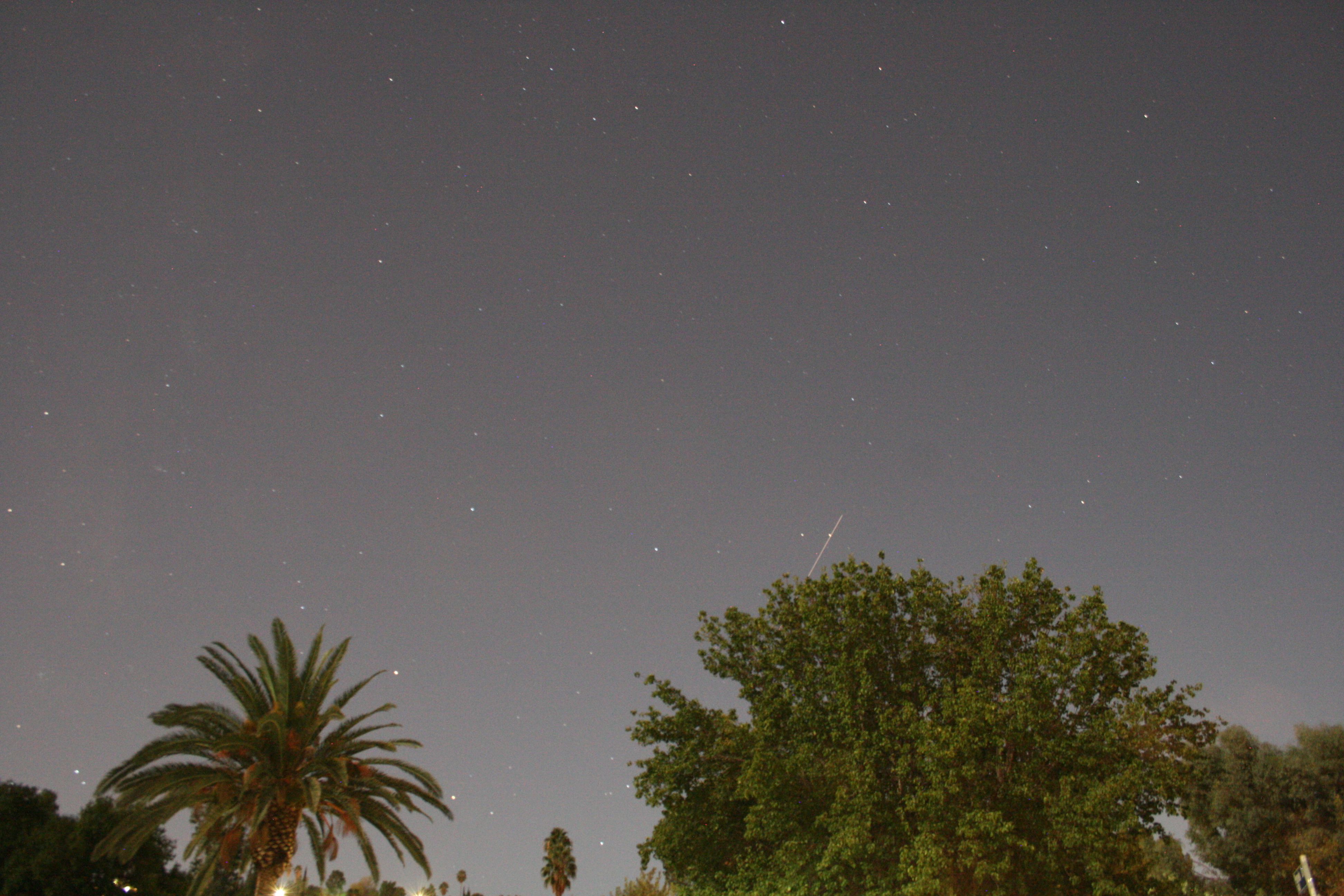
Fifteen-second exposure. The bright line at the upper left with red and white alternating dots is a jet leaving LAX. So is the one just above the horizone in the center, going through the leaves of our palm tree.

The ISS is just starting to rise. Look at the big tree in the lower right corner. There’s a notch in the branches at about the 10:00 position. You can see the ISS rising there.

I’m posting this picture in its full size for a reason. If you want to play along, click on the image, blow it up to full size, and see if you can see some of the other things that I was gobsmacked to see.

Hint: Look at the lower left, between the palm tree and the big airplane trail. Second Hint: It’s not a pterodactyl. I’ll spill the beans at the end of this article.

IMG_1946 small

Twenty-six second exposure, the ISS is just clearing that big tree. I’m also drawing a crowd, neighbors walking their dogs and wondering what I’m looking at. They’re all interested, not just humoring the odd guy who lives in the middle of the block (that would be me, but you all knew that), so I’m trying to answer questions and do a running commentary while I keep shooting.

IMG_1947 small

Sixteen second exposure. I would love to get a nice, long, ninety second exposure showing the ISS passing across half the sky — but this is the heart of the “world famous San Fernando Valley,” so any exposure that long would be so overexposed it would look like this one from June. You need a dark sky to do a long exposure like that.

IMG_1948 small

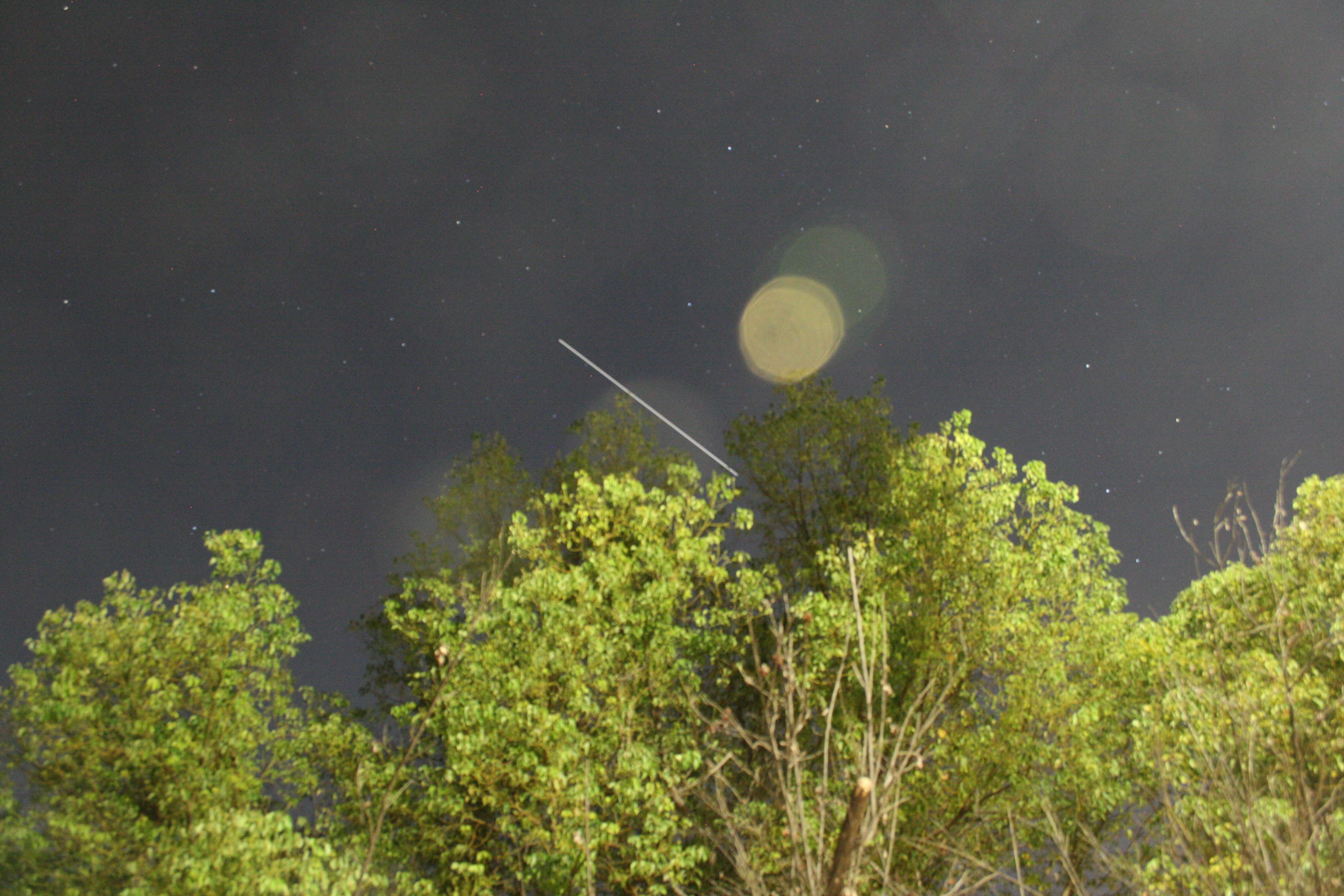
Fifteen second exposure. The two bright spots are lens flares caused by the street light which was right over my head. Not much of a factor when I was aiming toward the horizon away from it, but now that I’m looking closer and closer to it, the flares start.

IMG_1949 small

A thirty second exposure. See how much lighter the background sky is? Three times this exposure, six times the one above? Not going to work in this environment.

On the other hand, I’m loving the tripod setup and especially the new remote control trigger for the Canon DSLR. It eliminates almost all jitter caused by manually pushing the button on the camera, and for these pictures, it eliminates having to hold down the button for the entire length of the exposure, which introduces a lot of jitter, tripod or not. With the remote, you set the camera to “bulb” and hit the button on the remote and hold it for a second to start the exposure. From there, the camera will keep the shutter open until you hit the remote control button again, AND there’s a nice clock on the display on the camera back, letting you know how long the exposure is.

IMG_1950 small

Sixteen second exposure. Heading down behind the trees on this side of the street. If I’m alone I would have grabbed the gear and sprinted back across the street and up a house or two. (After carefully looking both ways for traffic, of course.) From there I could have watched the ISS another couple of minutes as it headed out to the NNE, and possibly even seen it fade into darkness. But I had an audience of dogs (yes, when I came in, Jessie knew that I’d been petting Ozzie, seeing other dogs) and neighbors so that wasn’t practical.

IMG_1951 small

Seventeen second exposure. (I need to remember that the Canon will do exposures up to about sixty seconds on its own, rather than having me guesstimate when to stop the exposure.) The trees are very brightly lit by the street lights in a long exposure, and the lens flares are winning.

I was still answering questions about whether my tripod was tracking the stars or the ISS, whether or not you could see the actual structure of the ISS with this gear, when’s the eclipse this week, will I have my telescopes out, will I have our telescopes out for Halloween…  (No, it’s just a regular old tripod. Nope, you need at least a 16-inch telescope, a 20-inch or 24-inch would be better, and some really fantastic tracking software. Late, late tomorrow night or early, early Wednesday morning, 3:00 AM to 4:30 AM-ish. Yes, if I can wake up. Yes, unless it’s cloudy.)


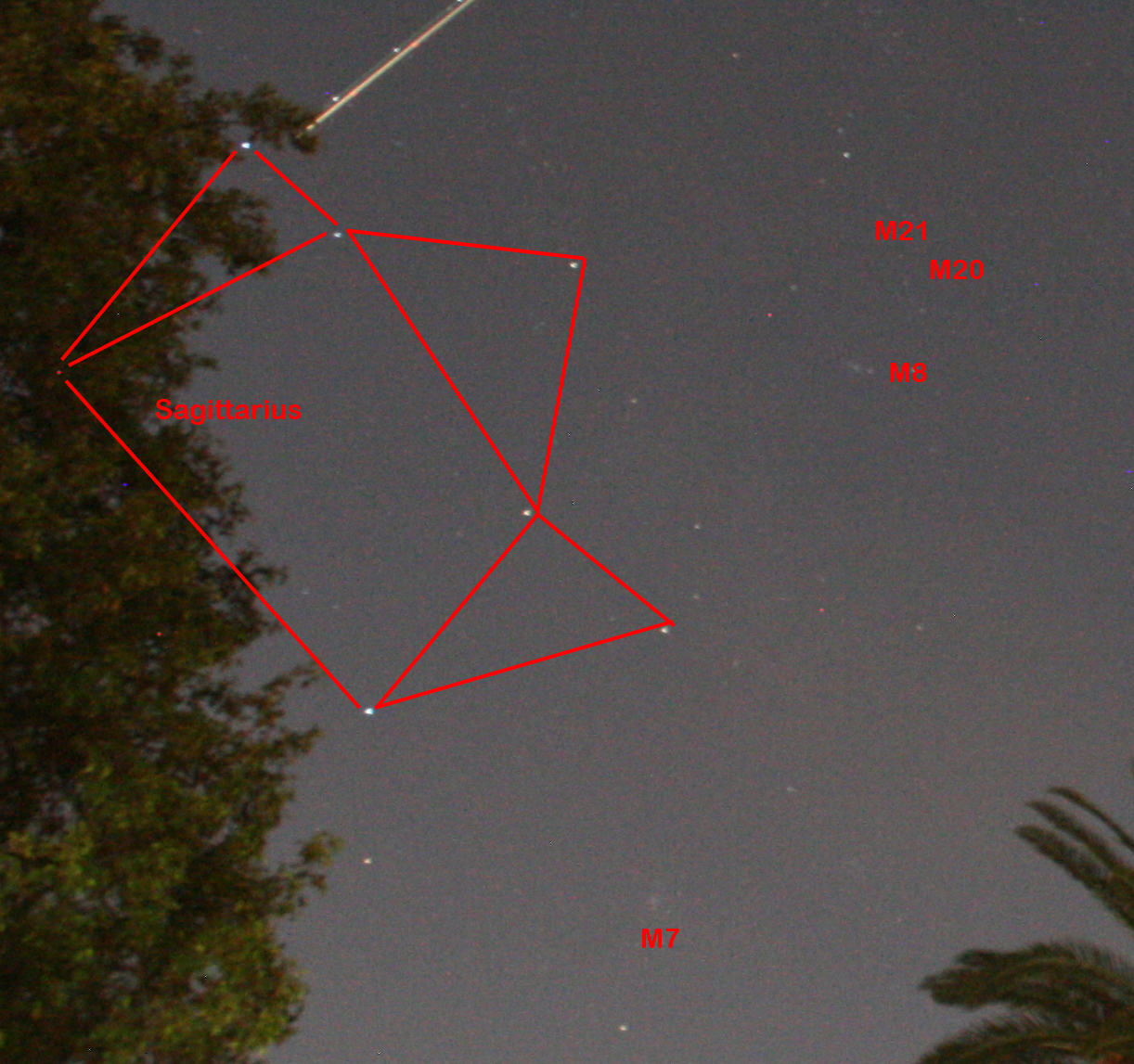
Remember that first picture above, the fifteen second exposure in the light polluted soup that’s LA’s sky? I know what’s up in that part of the sky, but I had no idea that you would be able to see any of it. I was wrong.

Just to the right of that tree, just below the start of the big airliner trail, you can see the brightest stars in Sagittarius. It’s generally described as a “teapot” and in a dark sky, “boiling up” out of the “teapot” is a “cloud of steam,” which is actually the Milky Way. The region is full of bright nebulae and globular clusters, easy targets for even a small telescope. (NOTE: You’re not going to see anything that looks like this spectacular image of M8 and M20 with the naked eye, even with a huge telescope. It’s what many people expect since it’s what they see on the television and internet, buy you’ll just see a ton of stars and some whitish and greyish clouds of gas. Some other time we can get into why.)

In a dark sky, it can be spectacular. I fully expected it to be invisible from this location. But lo and behold, when I looked at the image, you can clearly see hazy spots of grey nebulosity where M8 (the Lagoon Nebula), M20 (Triffid Nebula), and M7 (Ptolemy’s Cluster) are.

Gobsmacked!

Here’s an annotated image, showing the “teapot” and the different Messier objects that can be ever so vaguely seen.


IMG_1945 annotated cropped

I guess that’s why I should try these things instead of just assuming that I wouldn’t see anything. You know what they say about “assuming”…

Check your location, go out tomorrow night and see the ISS go over! (Then go watch the Kings.)


5 Comments

Filed under Astronomy, LA Kings, Photography, Space, Sports

Astrophotography For October 5th

Nine days ago the moon was just over two days old and a sliver in the still light sky at dusk. I commented on how it was a bit difficult to focus due to the low contrast. The moon also looks a bit “off” against a blue background.

Three nights ago I posted a picture from the early 1970s where I didn’t have the kind of equipment I have today. I was trying to see if I could take a picture (B&W film) using my dad’s old camera (an Argus C3 I think) with the lens just held up against a pair of binoculars mounted on a tripod.

Below are some pictures I took an hour ago with my current DSLR and a small Celestron telescope.

The other note I would bring to your attention is that there’s another lunar eclipse coming up in just a couple of days. This eclipse is part of the same cycle as the lunar eclipse from April 15th earlier this year. My pictures from that eclipse are here, and a wrote an article about lunar eclipses and how to observe them here.

You should be able to see at least some of the total phase of the eclipse if you live anywhere other than Europe or Africa. If you’re on the west coast of North America (west of the Rockies, more or less) or in Japan or eastern Australia, you should be to see the entire total phase.

The eclipse will be in the early hours of Wednesday morning, October 8th. (Or very late on Tuesday night, your position on the planet may vary.) On the US east coast, totality starts at 6:25 am EDT. You’ll lose the eclipse into the brightening sky as the sun rises. On the US west coast, totality goes from 3:25 am PDT to 4:24 am PDT. That means either a really late night or a really early morning.

Assuming that the sky’s clear of course. If it’s going to be cloudy, enjoy a good night’s sleep and look here on Wednesday for my pictures. (Which assumes that my sky will be clear. Right now that looks like a good bet.)

Tonight it was very clear, the moon is 11 days & 20 hours old, and this is what I saw:

IMG_1866 small

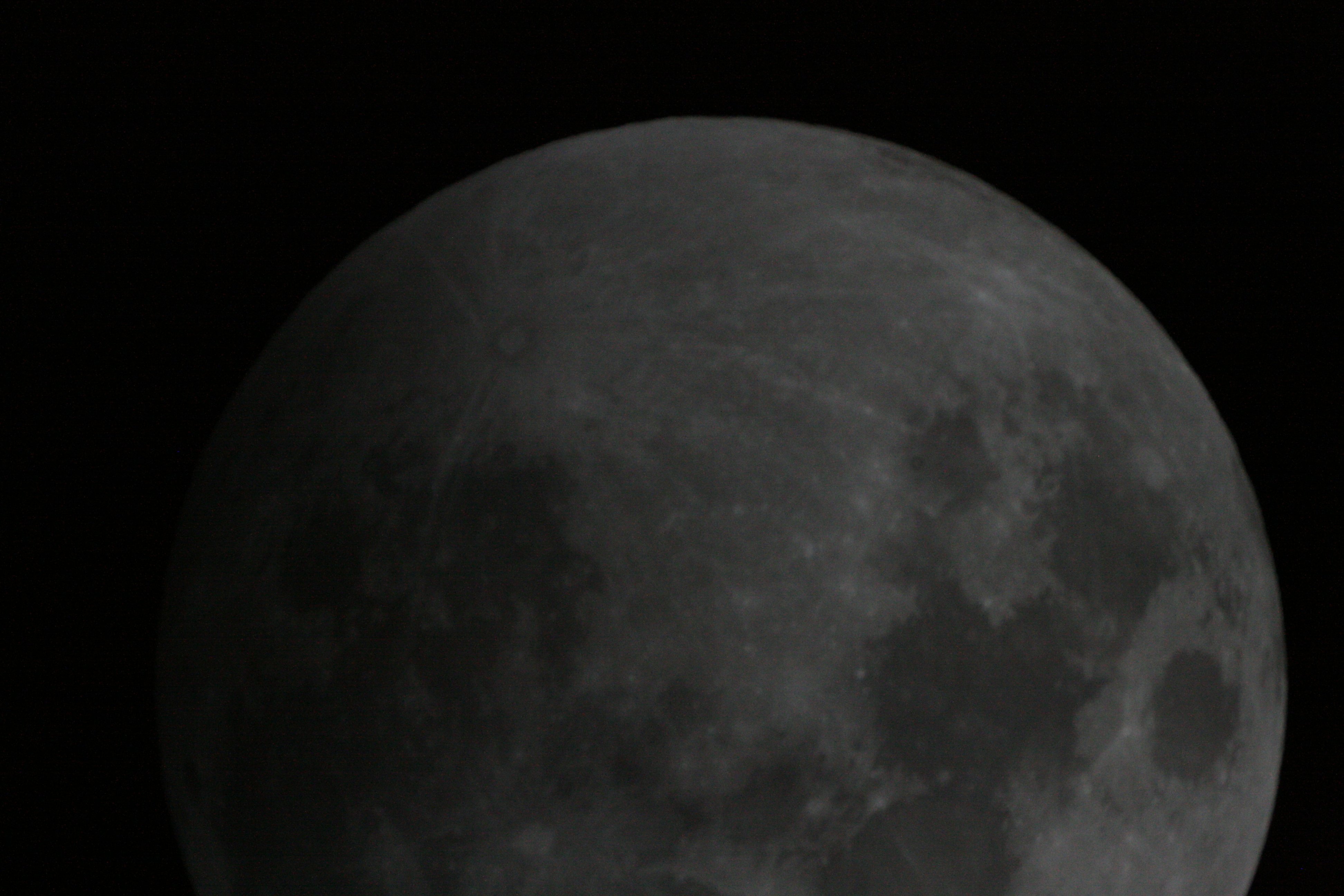
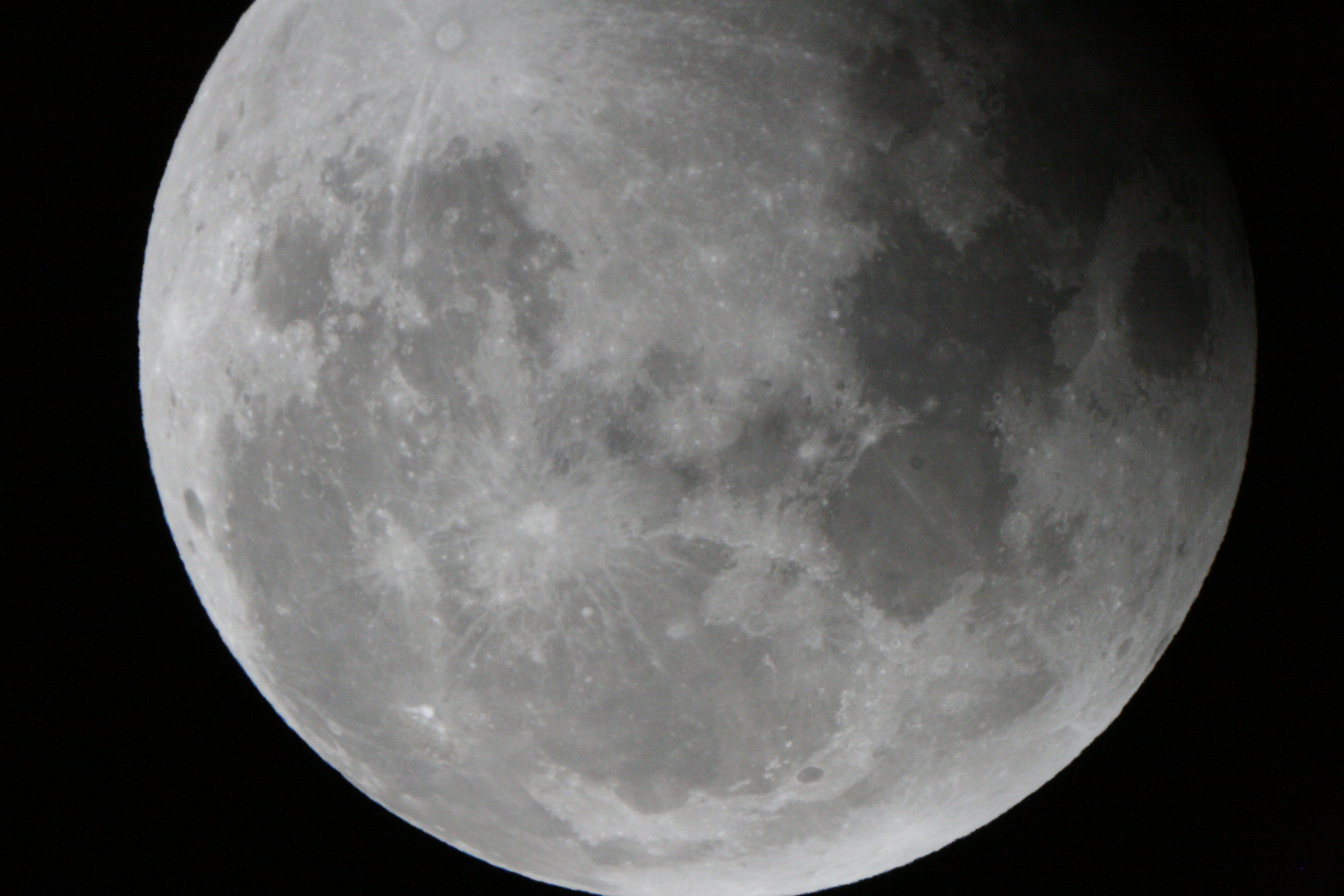
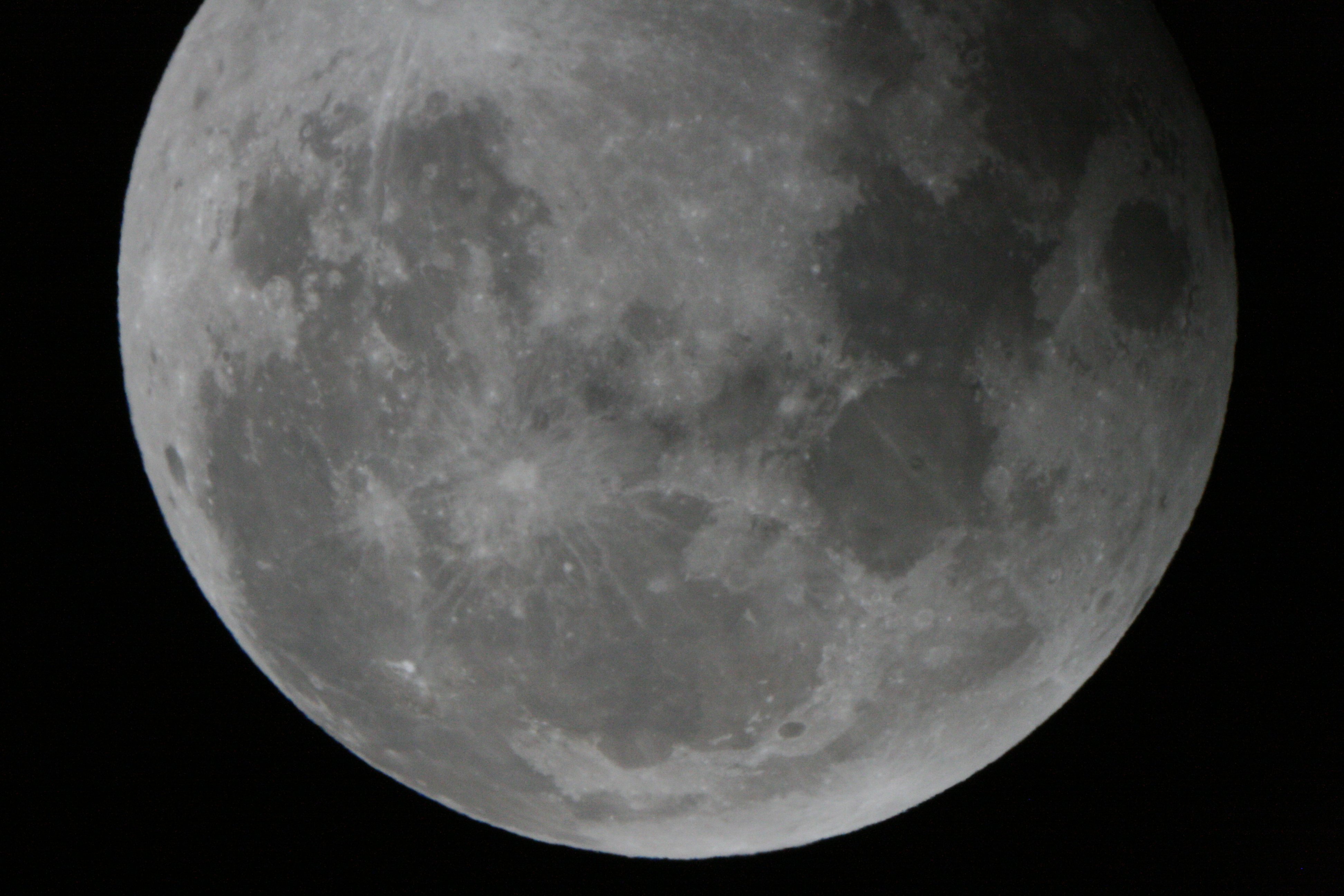
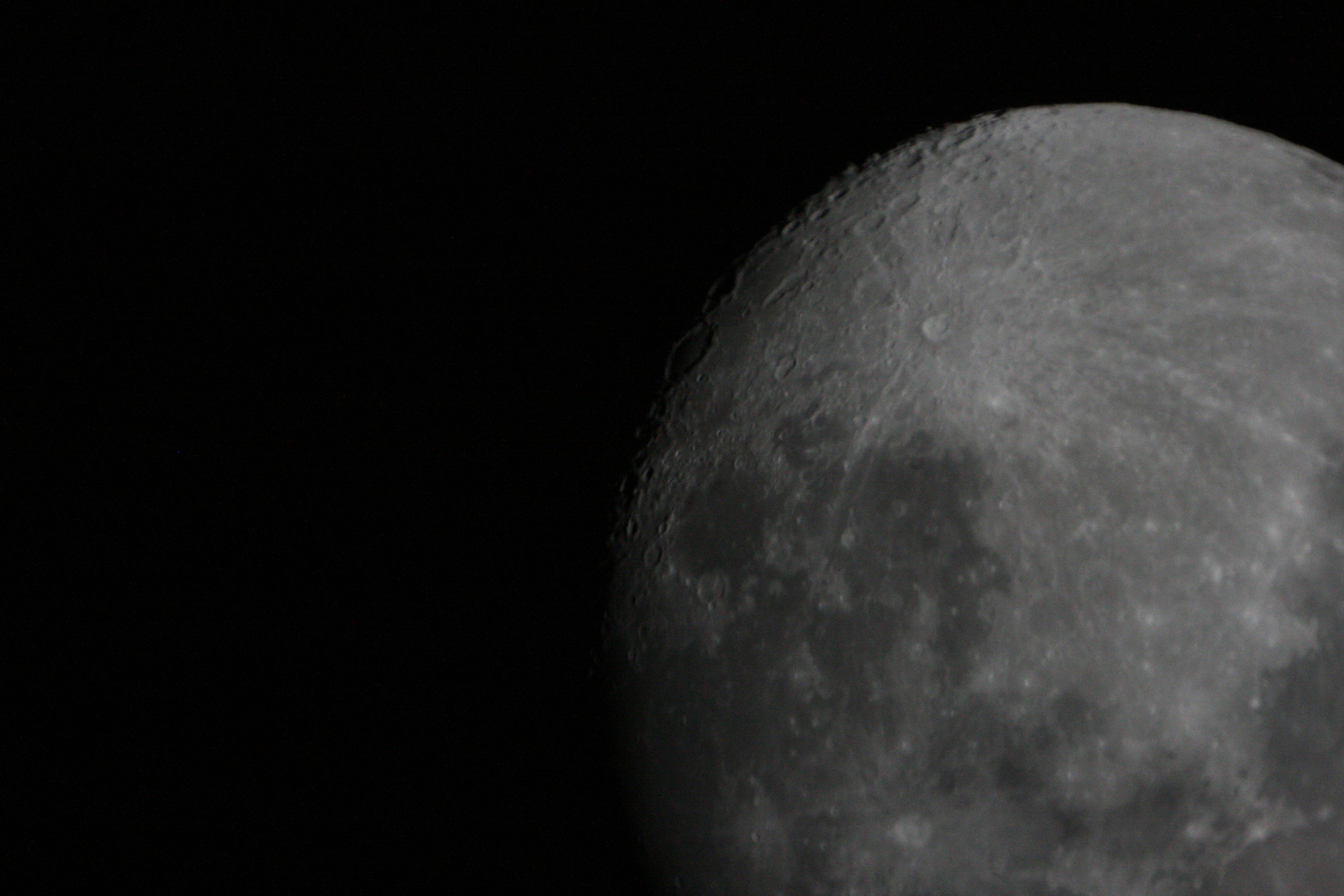
With the camera attached to the Meade ETX-125 telescope, it acts as if it were a 1900 mm telephoto lens. (For reference, my “big” zoom lens is a 75 to 300 mm.) The full moon is just a tad too big to fit into the full frame of the camera at that magnification. So I shot a bunch of frames at the left, right, top, bottom, middle, and so on.

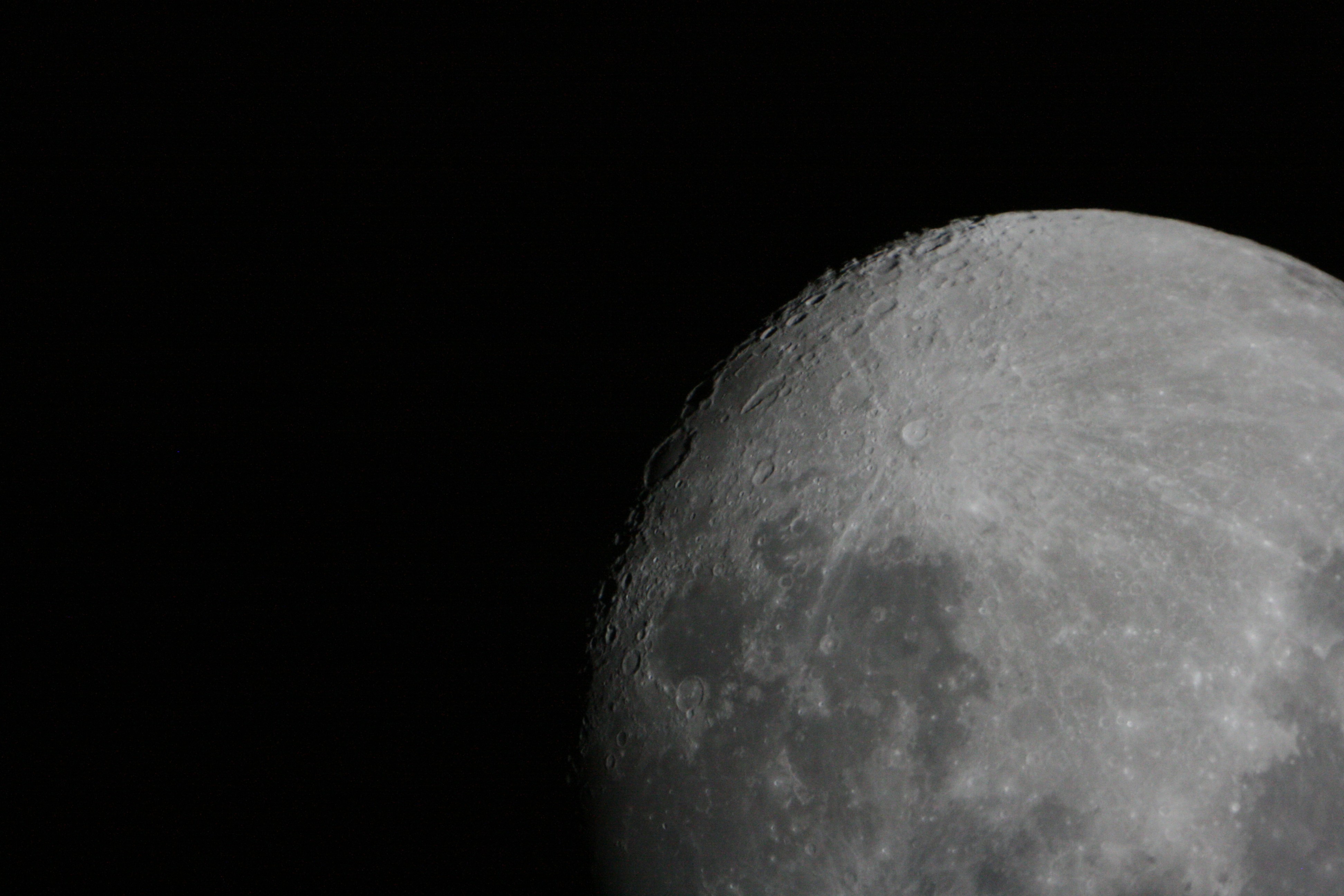
IMG_1873 small

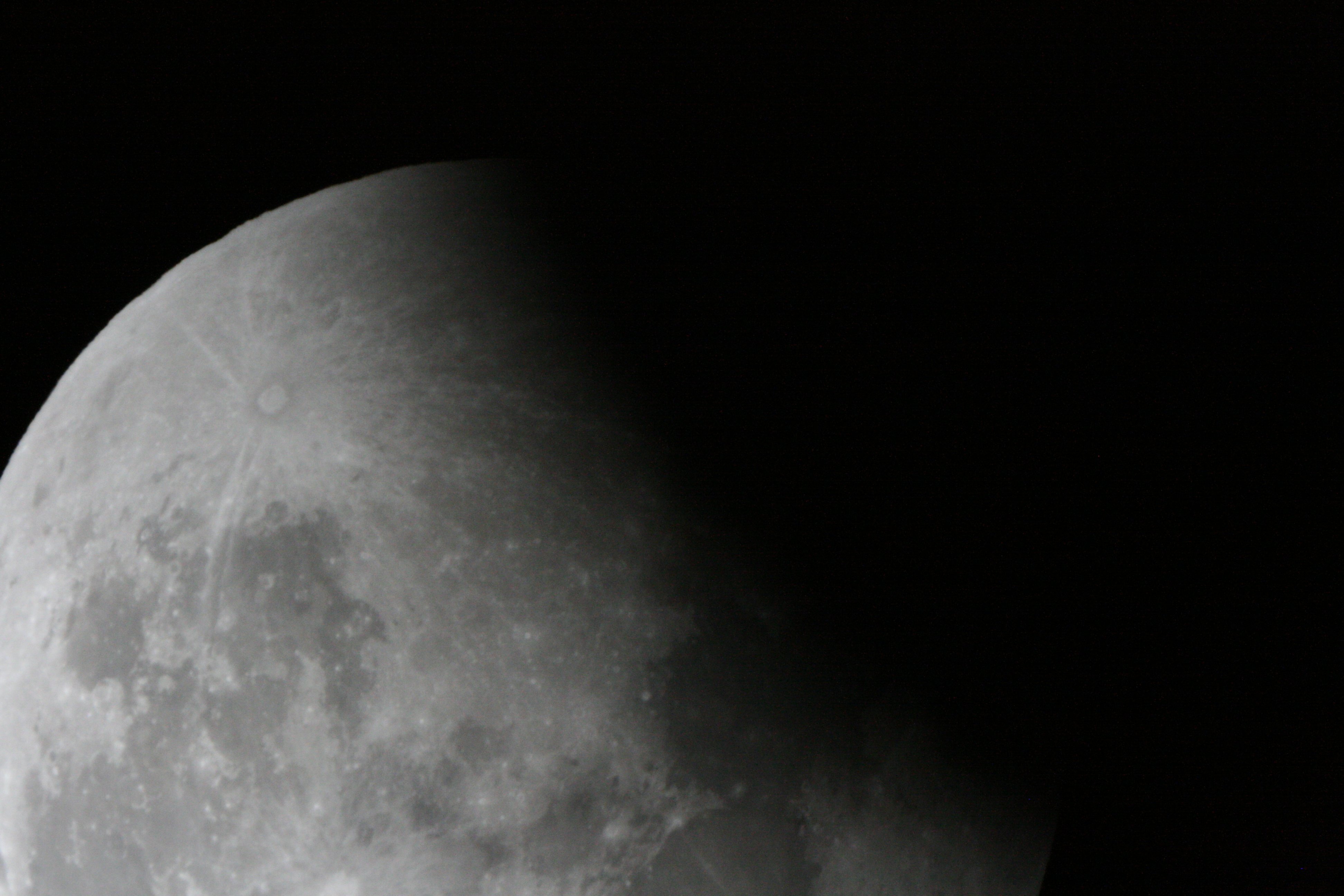
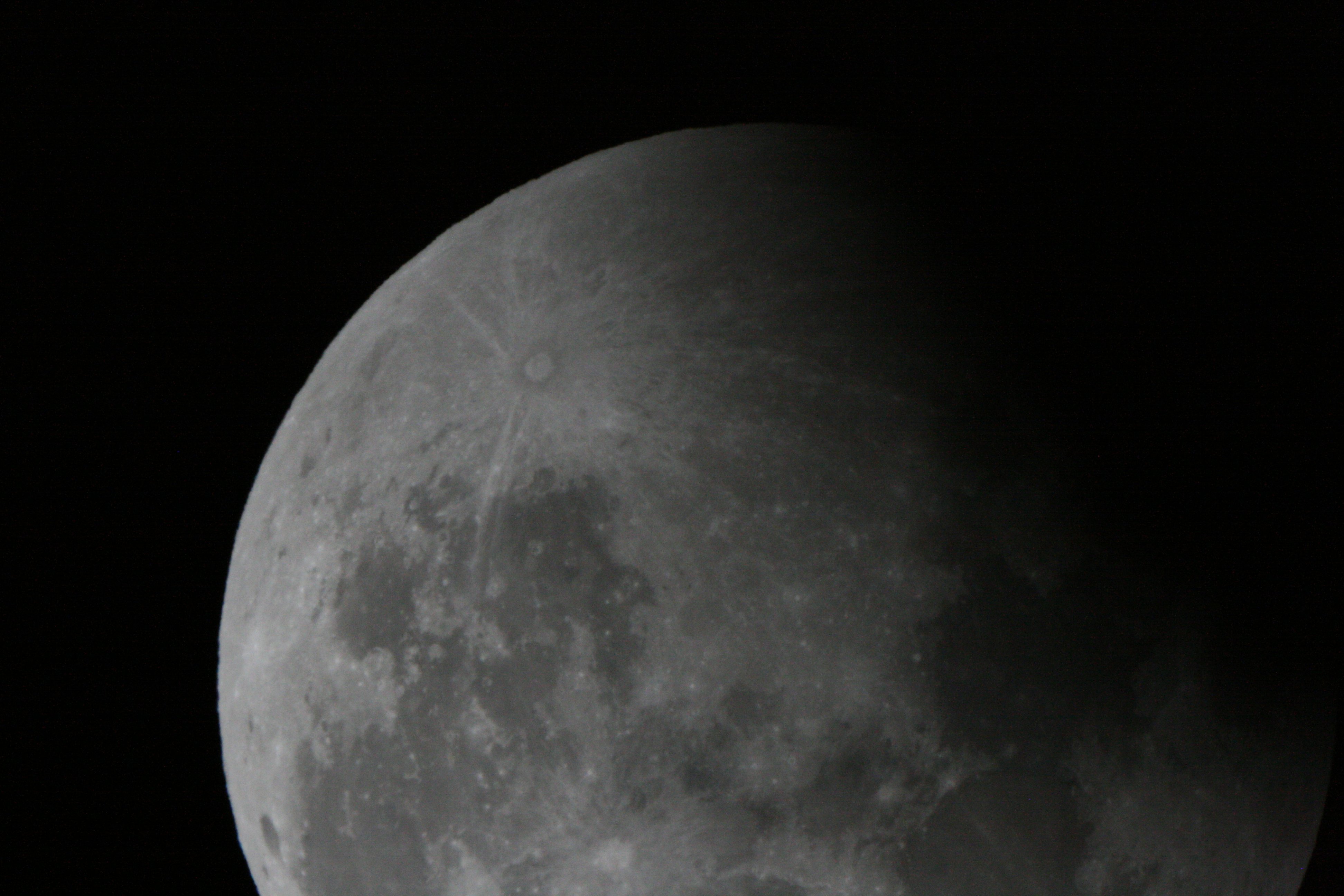
The terminator is at the upper right here and you can see some good definition of the mountains and craters along that edge of the moon. The huge crater at the upper left, with rays shooting halfway across the globe is Tycho.

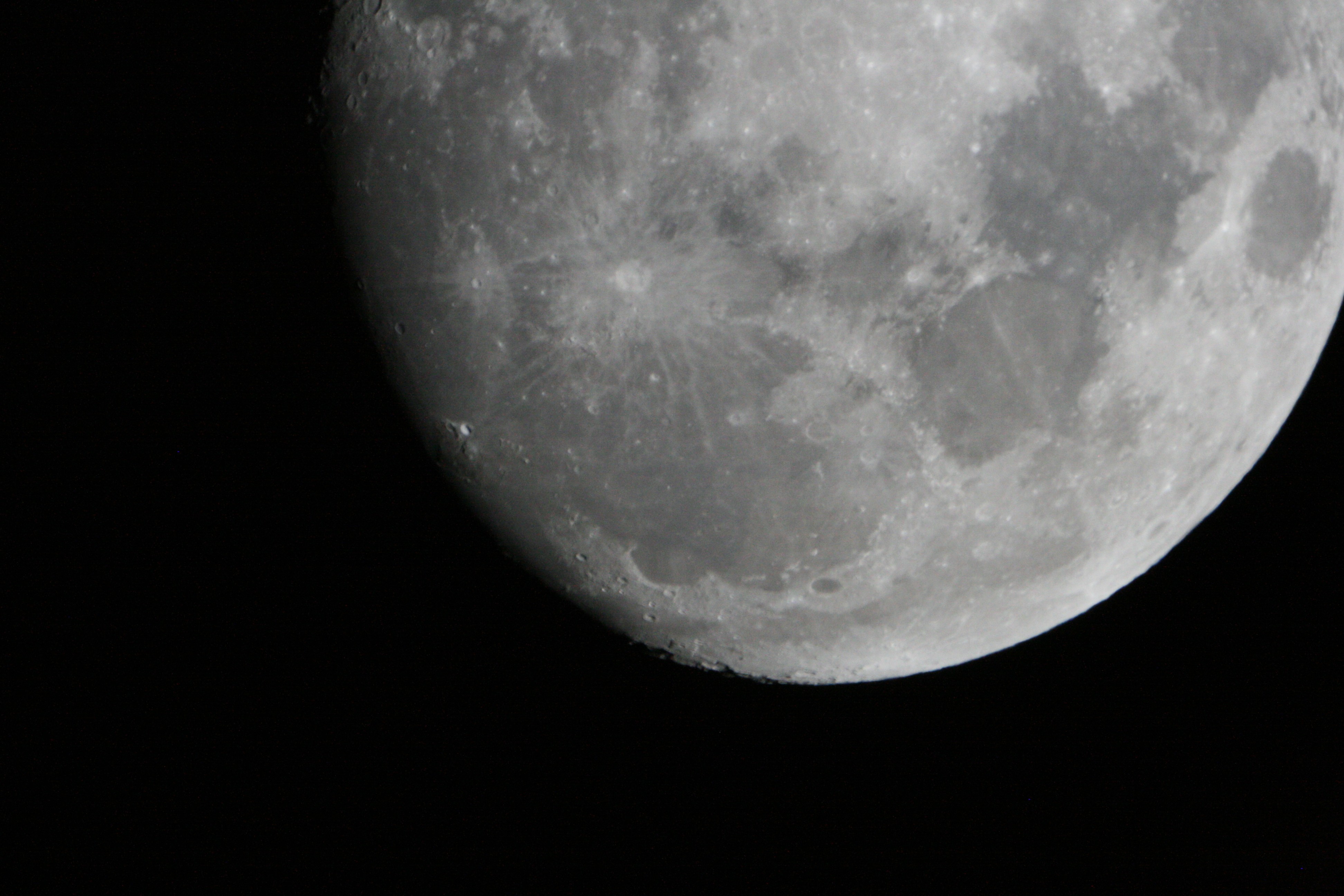
IMG_1879 small

Here we see what appears to be the “bottom” edge of the terminator as you look at it with the naked eye.

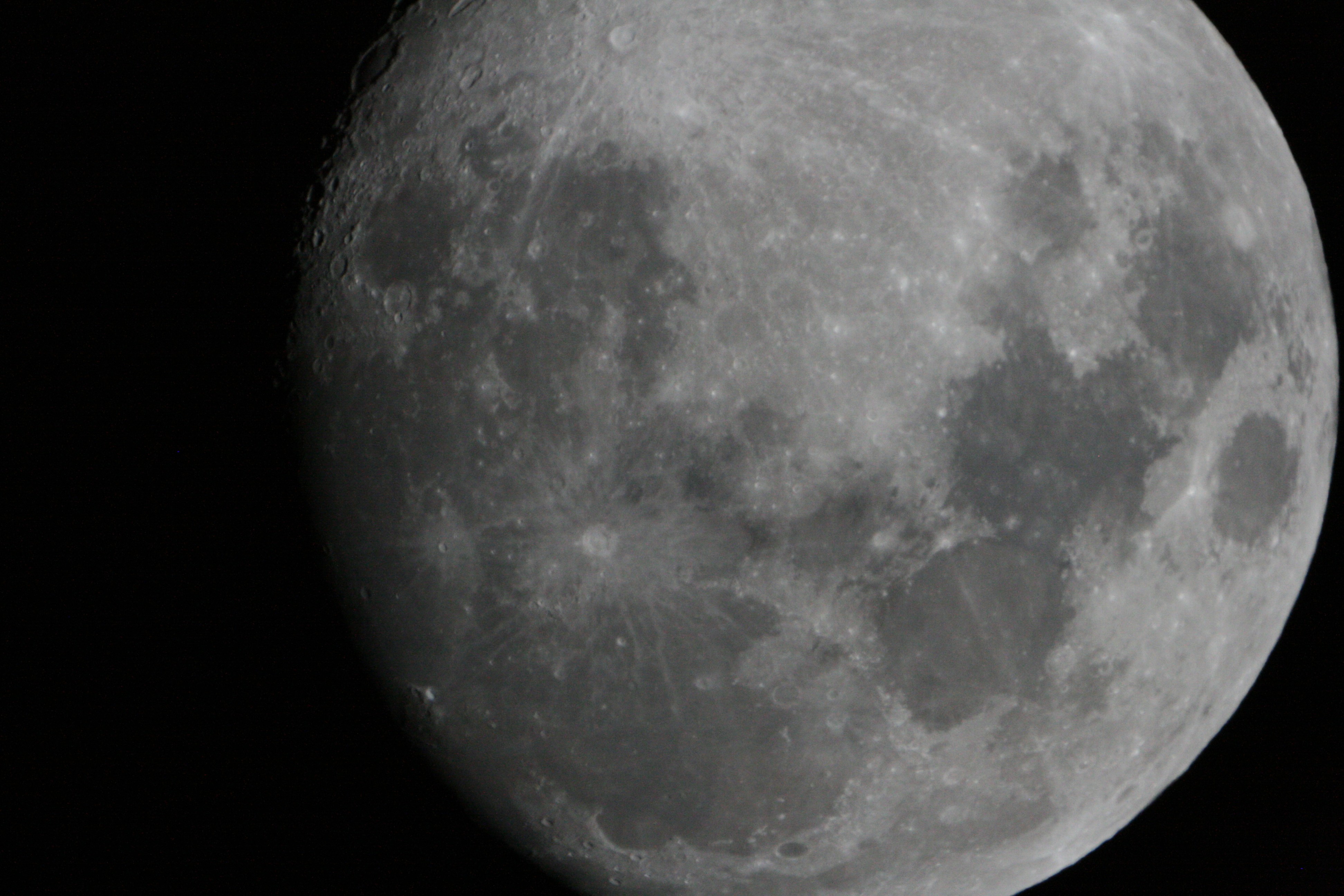
IMG_1885 small

A “center” shot.

IMG_1901 small

The new remote control I have for tripping the shutter on the camera works great and eliminates a lot of the vibrations that have been a problem in the past, particularly on the portable telescope mount. Some day it would be great to have a heavy-duty, permanent mount, but that day isn’t today. We do the best we can with what we’ve got.

IMG_1921 small

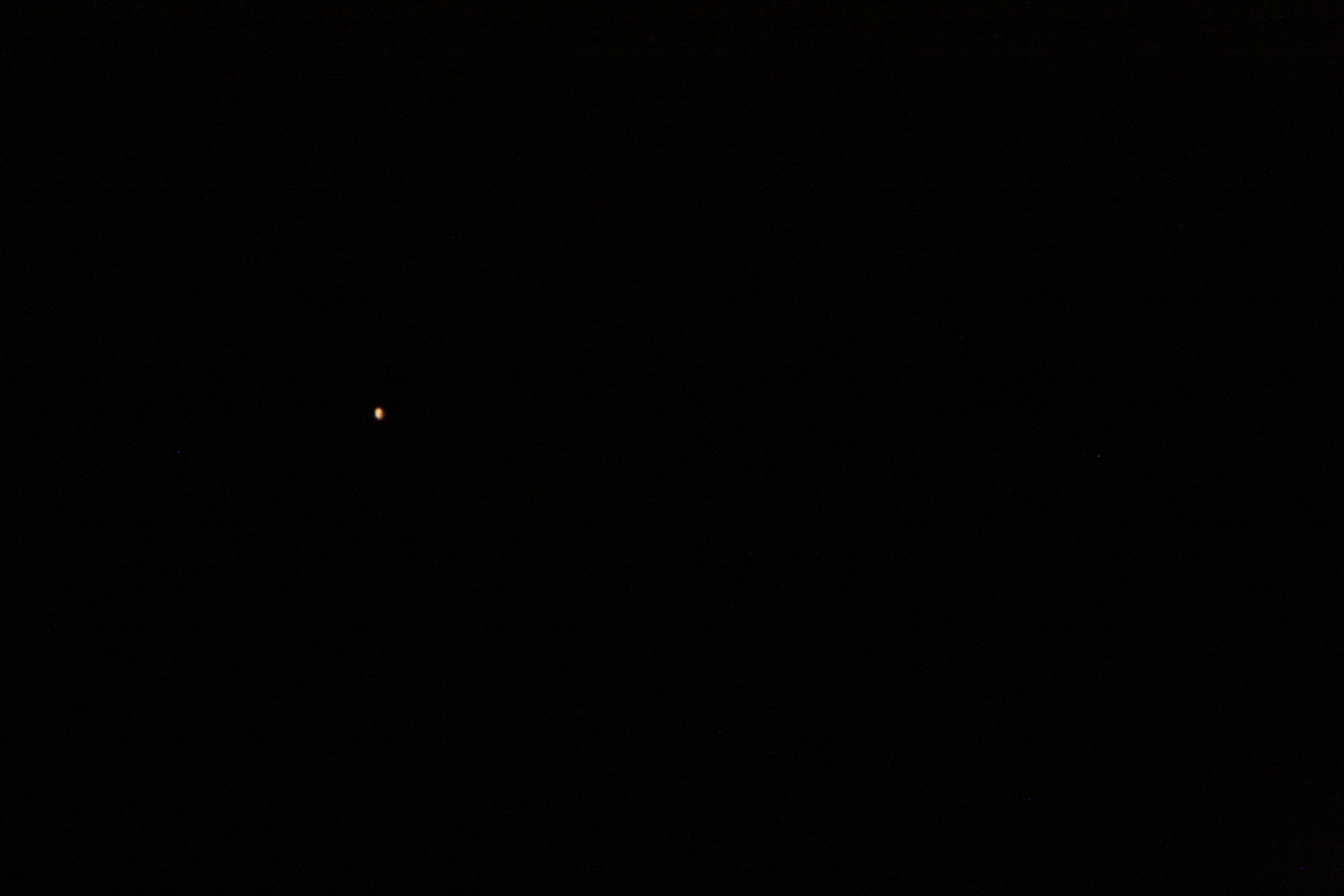
Then, as long as it was hanging there in the west near the horizon, I took a shot at Mars.

Mars

It’s red, it’s tiny, but it’s a disc.

IMG_1872 small

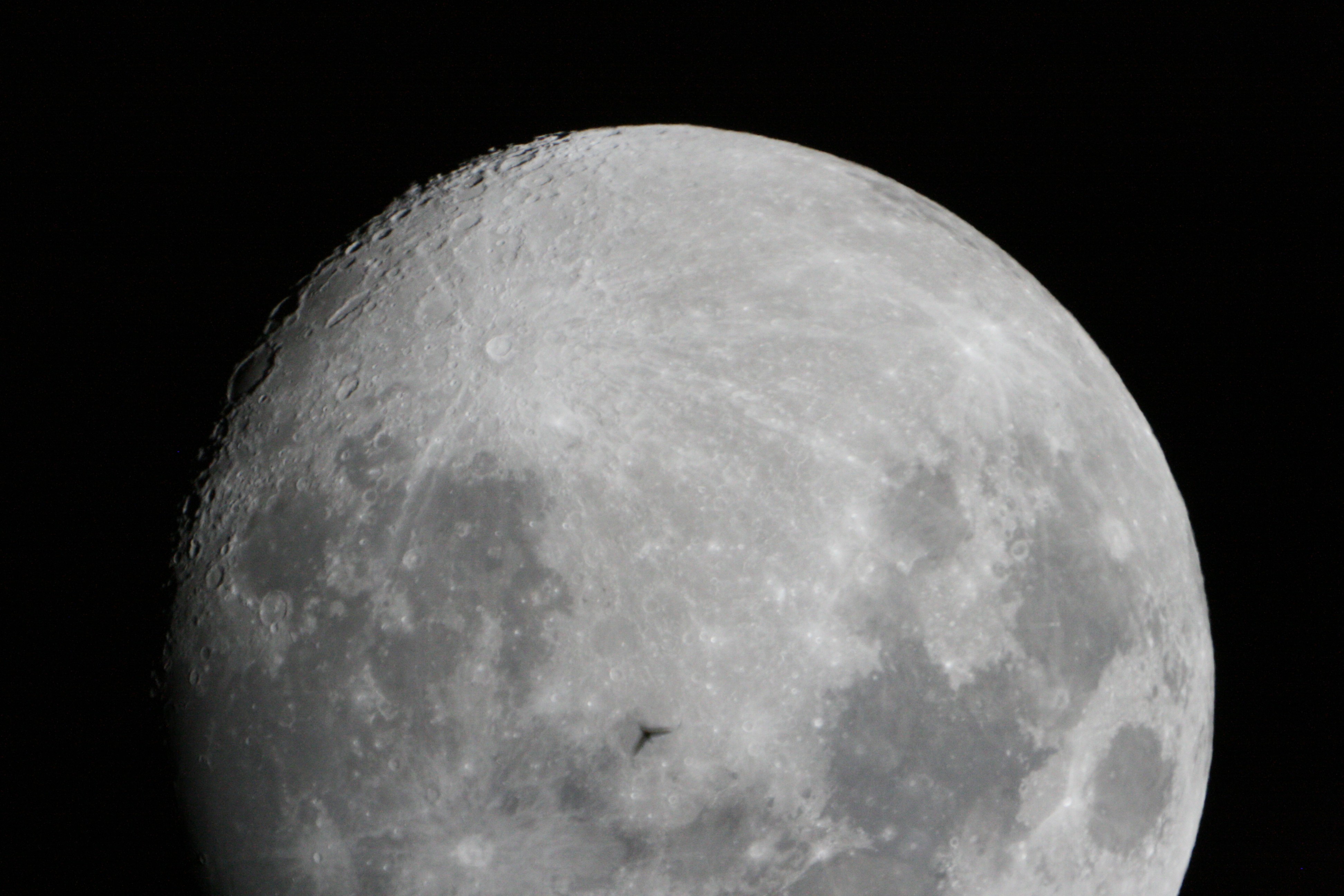
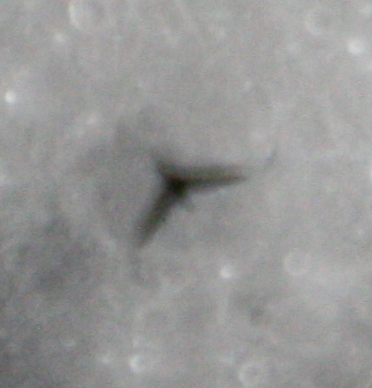
Finally, this picture was taken just four seconds after the second picture above, and I wasn’t going to use it since it’s a bit overexposed. Then I noticed the thing in the middle.

Plane Or Bird

It’s way out of focus since I was focused on the moon, 362,544 kilometers away. At first I figured it must be a plane up at 35,000 feet, since we are right under the departure track from LAX to parts north and Asia-ward. But if it were a plane, wouldn’t we see the anti-collision lights? So maybe it is a bird at 350 feet? But those are really long wings for any bird normally seen around here.

A super-secret DOD spy plane, or even an old-fashioned U2? A Klingon bird of prey starship?

It’s a mystery! Maybe we’ll see it again during the eclipse in forty-eight hours!

4 Comments

Filed under Astronomy, Photography, Space

No Flash Fiction — Have A Time Machine, Instead

As we all know, Thursday is normally the time for my weekly post regarding Chuck Wendig’s weekly Flash Fiction Challenge. However, this week it’s again a simple “Write a one sentence thing” assignment, to be posted directly to his site.

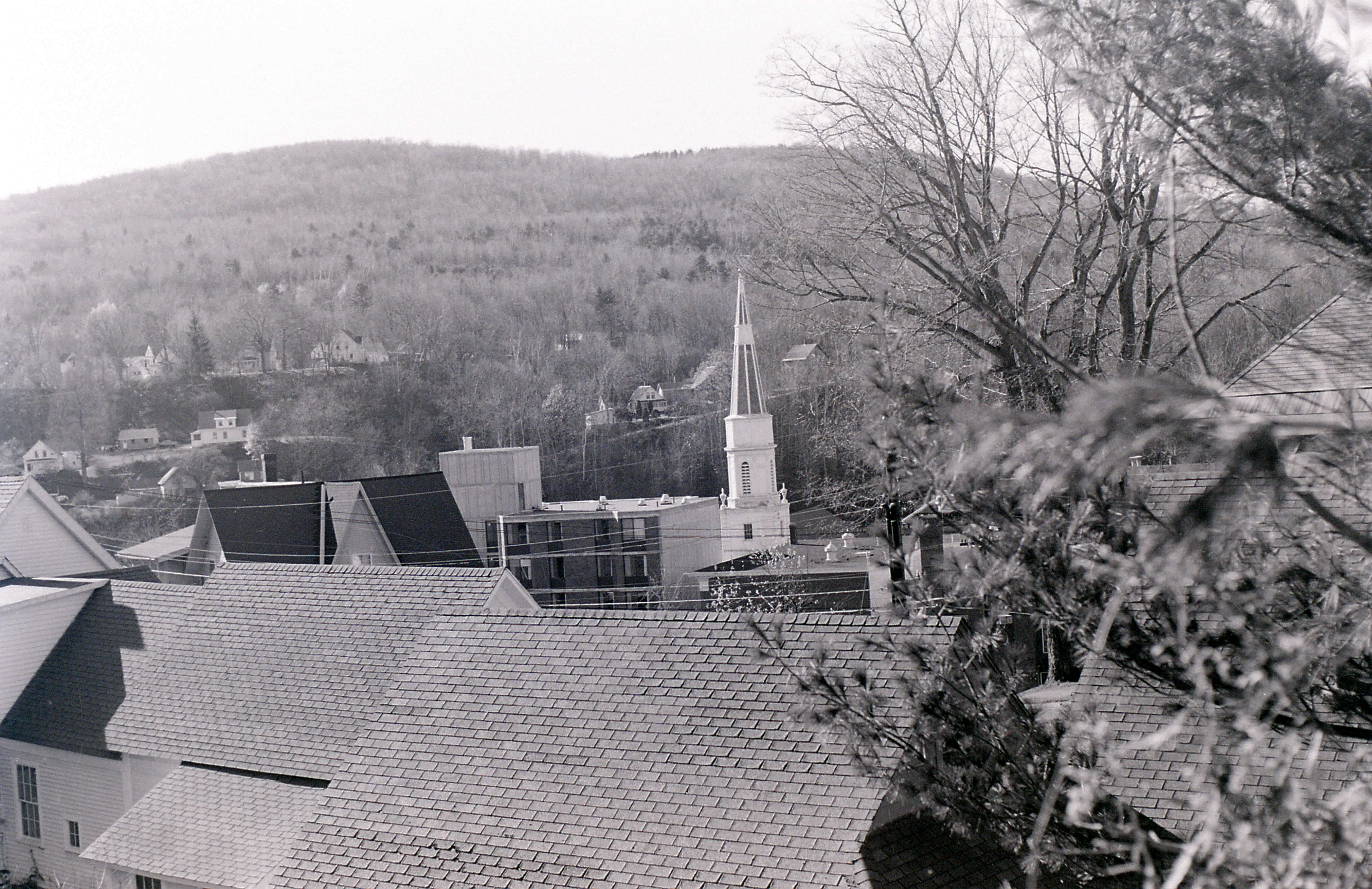
Instead, stealing a meme from the Twitter and Facebook worlds where Thursdays are “Throwback Thursdays”, here are some pictures from (probably) very early 1973. At the time I was just starting to take a LOT of pictures (it had to have started somewhere) and with film and processing being expensive, I was learning how to do my own darkroom work. I also was buying black and white 35mm film stock in 100′ rolls and loading my own 36-frame film cartridges in order to save money.

These pictures are recently scanned from those 40+ year old negatives.

1973_Page28_1c

Winter in small-town southern Vermont. I was probably standing in snow up to my hips on the hill above the town square in order to take this.

1973_Page28_2d

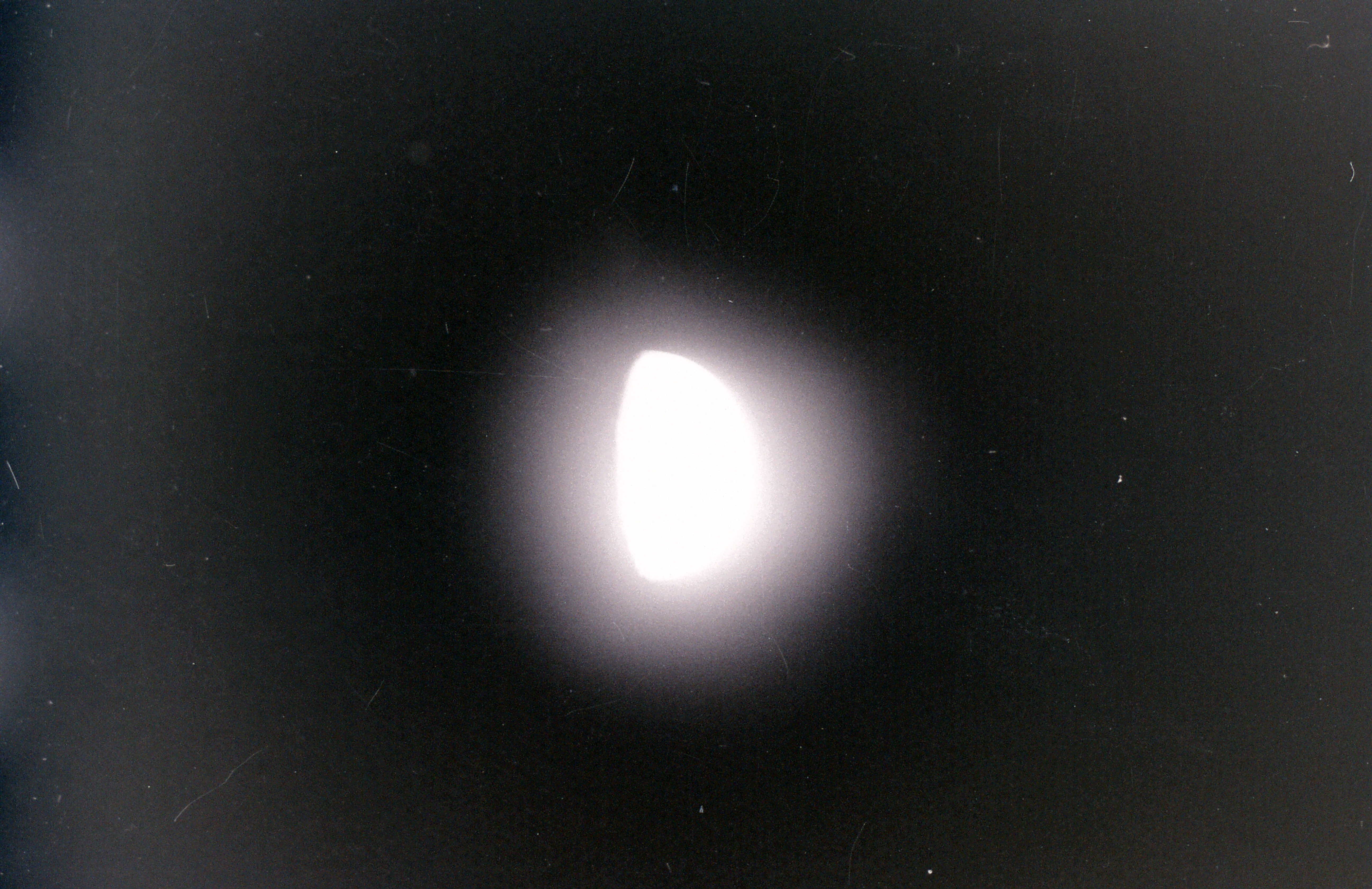
Very, very early experiments to see what simple astrophotography I could do. I didn’t have anything that might be described as a decent camera, just a box-like Brownie for myself and an ancient 35mm Argus (?) camera of my dad’s that I could borrow at times. It wasn’t an SLR, had no “auto” anything, focusing was sort of hit or miss, and you had to guess (or learn) at setting the exposure and f/stop manually. It did not have interchangeable lenses and I didn’t have a telescope yet, so I was trying to see if I could take pictures of the moon using a pair of binoculars with the camera held up to the eyepiece.

The exposure’s all wrong, it’s not in good focus at all — but it’s almost kinda-sorta maybe recognizable as the moon?

1973_Page28_3a

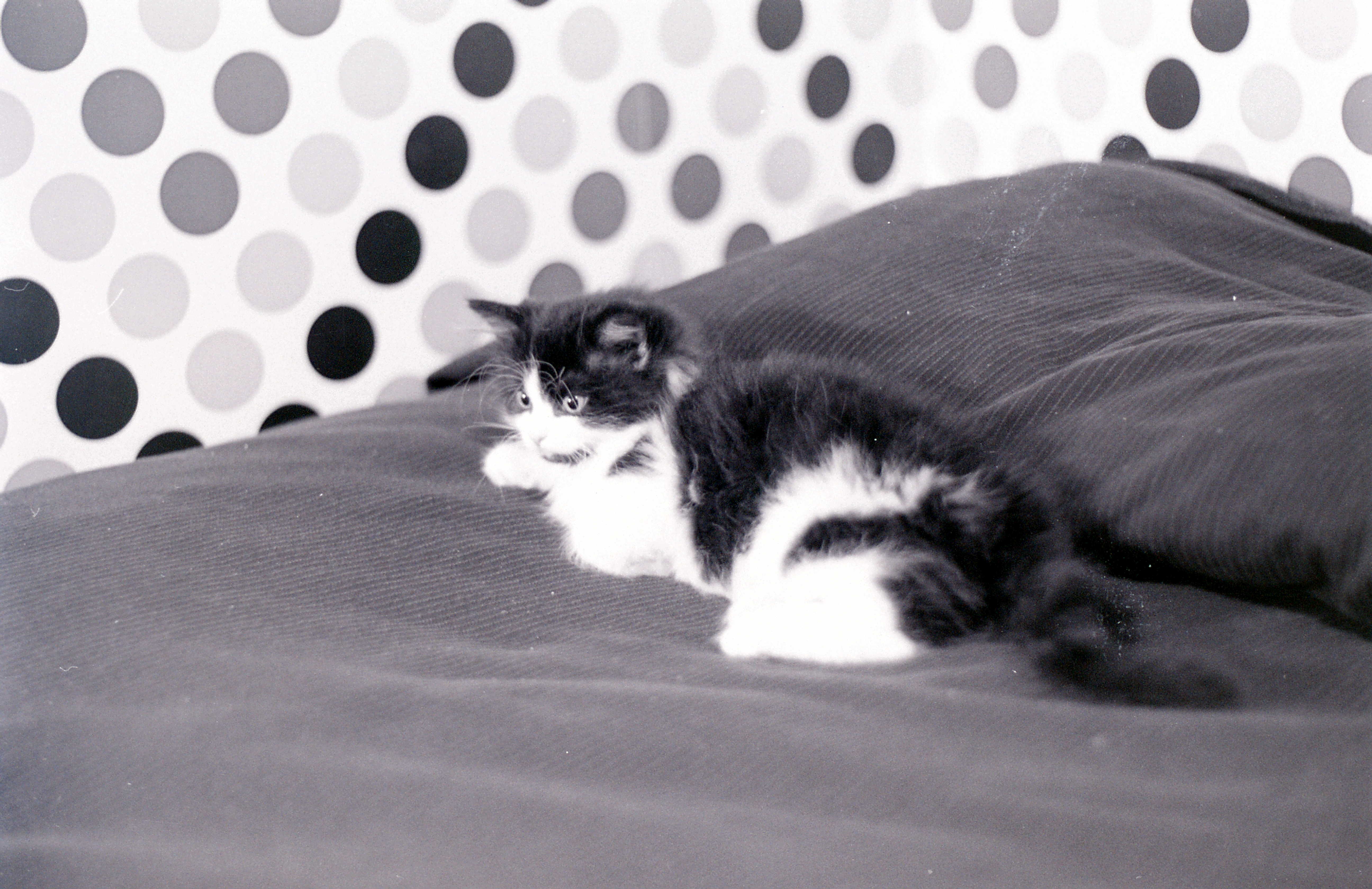
My sister’s kitten. She probably got it for Christmas and the critter went through multiple names. I think it was originally Thumper, which changed to something like “Doofus” when my parents inherited the cat when my sister moved out a few years later. The name later devolved into “Doovie” and the cat got big, fat, slow, friendly, toothless, and drooly. Unless I’m completely mis-remembering (which is quite possible) she lasted long enough for at least a couple of my kids to play with in the late 1980’s.

Sixteen or seventeen years old for a cat? Could be, Joey Chan’s already coming up on fourteen and she seems healthy enough, except for “feline Alzheimer’s.” (She’s forgotten to be aloof and now wants to be petted and held.)

A special note for the wallpaper – the polka dots were black, silver, and brown. I really wish I had a color picture. (I might have 8mm film, maybe I could find a really tiny and grainy frame to scan.) The only thing that screamed “EARLY SEVENTIES!” louder than that wallpaper was the wallpaper in every other room of the house. With eight kids, three stories, and seven bedrooms, we had a LOT of really bizarre wallpaper that seemed perfectly normal and trendy at the time.

1 Comment

Filed under Astronomy, Cats, Critters, Family, Photography

Juicy Chunks O’ Wisdom For Sunday, September 28th

‘Cause the baseball postseason is here and my beloved Angels have the best record in baseball, that’s why.

  • In addition to the moon in the evening sky, there are a couple of bright planets. Look for them all! Last night (Saturday, 09/27) the Moon was very close to a very bright Saturn. Tonight, the Moon was getting close to a somewhat bright but very reddish Mars. The Moon will keep heading up higher into the sky each night and getting brighter, but if you’ve got binoculars, it’s a great time to be looking. Before it starts getting cold. Like GRRM said…
  • The Long-Suffering Wife cut her finger yesterday in the kitchen. I put a bandage on it, and the one immediately at hand in the kitchen cupboard was an old SpongeBob SquarePants bandage. Not a big issue, until much later, when the lights got turned off in the bedroom and she realized that it glowed in the dark. Her reaction was quite interesting, to say the least.
  • Is it unreasonable to think that our air traffic system should be robust enough so that a single disgruntled employee can cause massive disruptions of thousands of flights, leaving hundreds of thousands of travelers stranded, a mess than continues to be a mess three days later and will continue to be a mess for days more? Did no one anywhere in the FAA or Transportation Department think that there should be some sort of backup plan if a single TRACON had to go offline?
  • Jessie went out on Wednesday morning and was stunned to find her prized squirrel carcass gone from the patio sidewalk. For two days, every time she went out in back she went straight to that spot and started sniffing around and looking for it. Then she would look at me with sad, accusing, old dog eyes. I swear, I didn’t touch it, I left it there. I’m figuring there’s a coyote or raccoon or owl or hawk or crow that found an easy, more or less freshly dead meal and took off with it.
  • Pumpkin spice Oreos? Really? I will make a bold statement here — I have never had “pumpkin spice” anything. Not lattes, not beer, not cookies, not cheesecake, not ice cream, not pickles — nothing! As such, I feel fully qualified to feel like I’m the last guy who can tell humanity about the pods in “Invasion of the Body Snatchers,” or Charlton Heston at the end of “Soylent Green.” “It’s pumpkin spice, humans! Stop eating it! It’s sent by aliens to take over your brains! Don’t eat the pumpkin spice!”
  • At least the glow in the dark SpongeBob SquarePants bandage is on her “driving” finger. At least, that’s what we call it here in Los Angeles.
  • It’s hockey preseason and I’m learning that I need to get my gimpy shoulder into mid-season form quickly. My usual reaction to a Kings goal is to instinctively and immediately throw my arms in the air. If my arm hurts when I do that, we’ve got a problem. (The Vuvuzela of Victory only sings its sweet, sweet song during the playoffs. We have to save the juju for when it’s really needed.)
  • How much does a wagon cost these days? You know — small, red, kid sized, used for hauling toys, dirt, and little sisters. I’m asking for a canine friend.
  • The reports I’ve seen said that the contract employee who sabotaged the FAA air traffic control center in Chicago was upset because they had just been informed they were being transferred to Hawaii. Further developments and information are most certainly coming, but for the moment, let’s examine that allegation. Now, mind you, I absolutely love the city of Chicago. I spent a couple of years there as a kid (junior high school years) in the suburbs, still love going back to visit. I’ve never had a bad time there. But is it so good that when “threatened” with a transfer to freakin’ HAWAII I would go berserk? Are we talking about a different Hawaii than the one I see on TV with the beaches, the jungles, the weather, the surfing, blah, blah, blah?
  • Or the squirrel RE-ANIMATED and its rotting, evil, zombie squirrel body is stalking the trees, waiting for its chance to catch Jessie unawares so that it can WREAK ITS VENGEANCE!!
  • That comma is really important in the “It’s pumpkin spice, humans!” line.
  • Los Angeles about ten days ago, lunch time, near Beverly Hills. South of Sunset, by the Pacific Design Center, between San Vicente and La Cienega. One of the million little, itty-bitty strip malls that cover LA like scabs. As usual for the breed, this one might have had 12 to 15 parking spaces, all full. I’m sitting there eating outside when a brand new, white, shiny, Maserati Quattorporte pulls into the lot. He’s in luck! There’s a full size SUV, an Urban Assault Vehicle, just pulling out of a space. The SUV departs and the person driving (the windows were blacked out, couldn’t see them) whips it around and tries to pull into the just-vacated parking spot. “Tries” is the key word here. They back up and try again, unsuccessfully. And again. And again. All of this despite the fact that a vehicle twice as big just pulled out of that spot. Just about the time I’m ready to start laughing and go offer to park it for them, they give up. They ROAR out of the parking lot, tires screaming — because they have a Maserati Quattroporte and they have to show the world how insanely cool they are. As they leave, another SUV, just as large as the previous one, pulls in and swings into that parking spot in one try. The conclusion is obvious — despite that $140K price tag, the Maserati Quattroporte has the turning radius of a battleship and is a pig to handle in tight spaces! Well, that or someone was seriously overcompensating for something, and it wasn’t the fact that they can’t drive for beans.

Remember, “Some days you win, some days you lose. Some days it rains.” That’s deep. Really. Not even being snarky. From Bull Durham, one of the finest baseball movies ever made. (It happens to be about baseball. A bit. And other things.) ((I’ll shut up now.))

4 Comments

Filed under Astronomy, Dogs, Freakin' Idiots!, Health, Juicy Chunks, LA Angels, Los Angeles, Ronnie, Sports

Astrophotography For September 26th

“Low hanging fruit.” In common usage today, it means winning the easy game, picking up the simple rewards that are right in front of you, or taking advantage of opportunities that you practically are tripping over. Tonight’s photos are an instance of “low hanging fruit” in an astronomical photography sense.

When I took Jessie out for her evening constitutional, it was “clear and a million” here. It was about a half hour after sunset, just starting to get dark. The bats were out — it’s a good thing, keeps the bug population down. And hanging low in the west was a very thin crescent moon. I left Jessie to check her “pee-mail” and ran inside to get cameras and the little telescope.

A quick check of the ephemeris app (I like “Moon Phase”, it howls on full moon nights) shows that the moon was new on the 23rd at 23:15 UT. Since it was now about 02:00 UT on the 27th (19:00 on the 26th PDT), that meant that the moon was about 74:45 old, a bit over three days. That’s a thin crescent.

It isn’t that hard to see the moon as much as a day earlier than that, but it gets exponentially harder the earlier you get to new moon. Not only is the “younger” moon closer to the sun and lost in the glare, which means it’s closer to the horizon at sunset at a time when the sky’s brighter, but it’s also thinner and dimmer to boot. There are amateur astronomers who actively try to see how “young” a moon they can see. I think the earliest I’ve seen it is about 35:00 or so, but the records are 15:32 for the naked eye and 11:40 for optically-aided sightings.

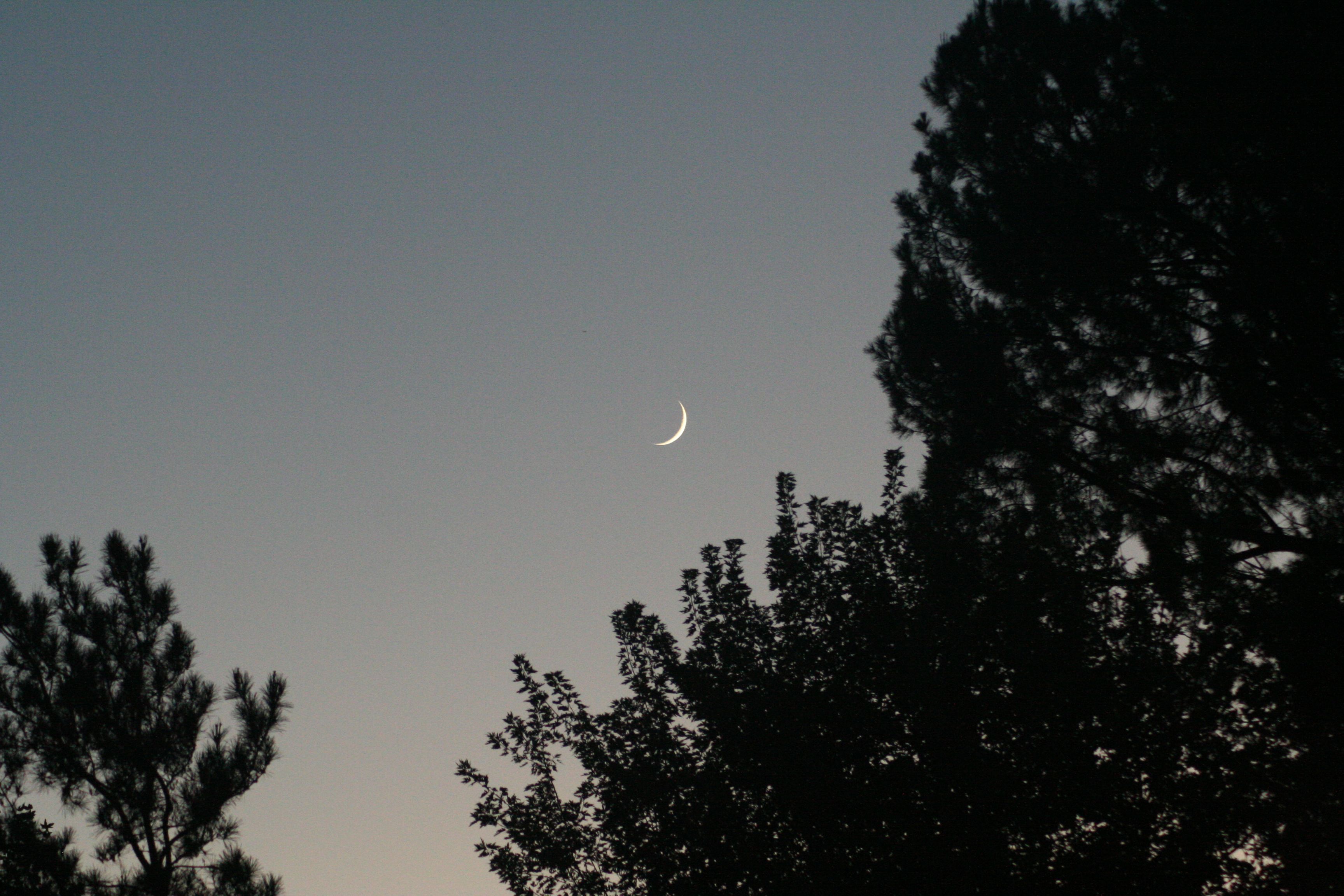
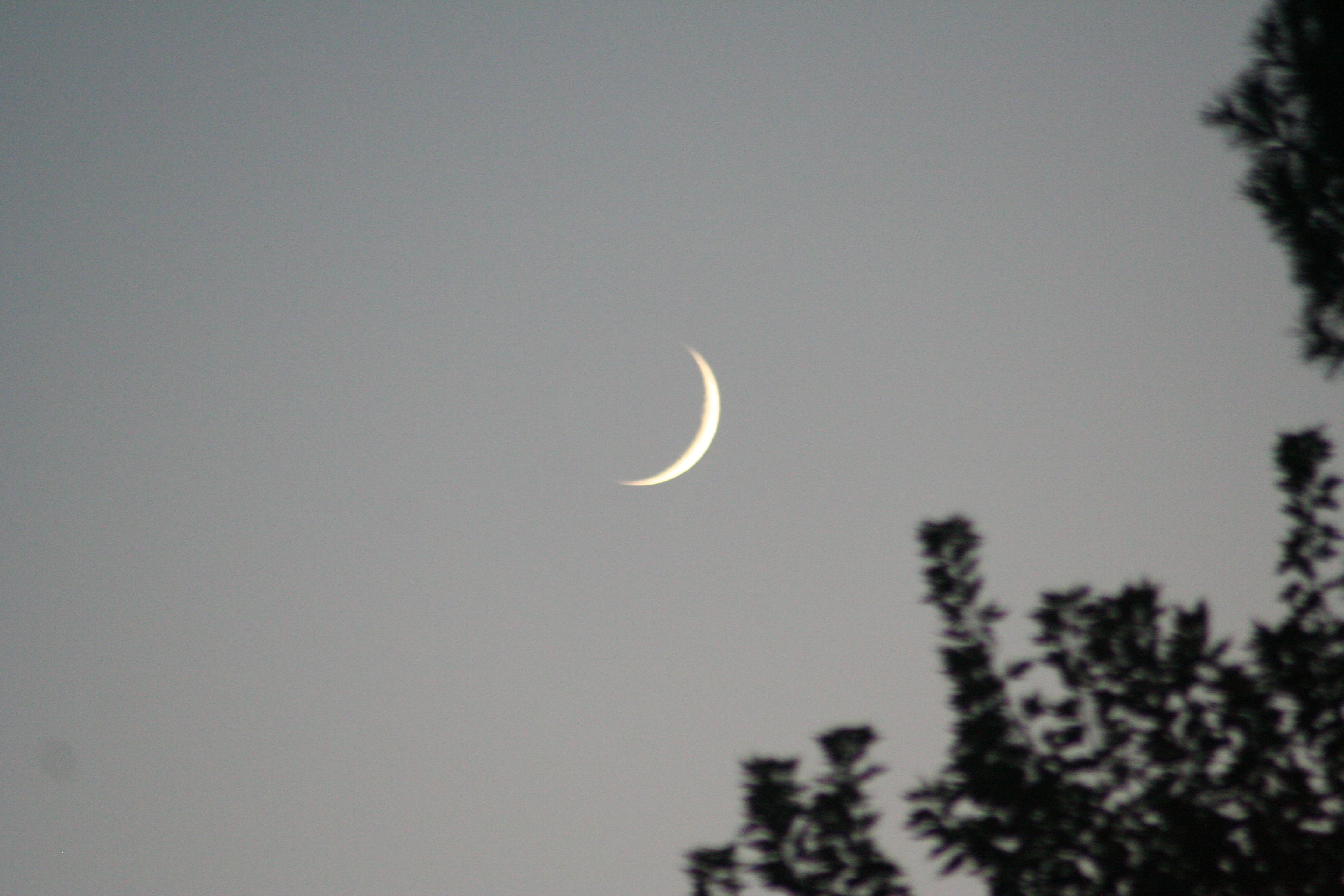
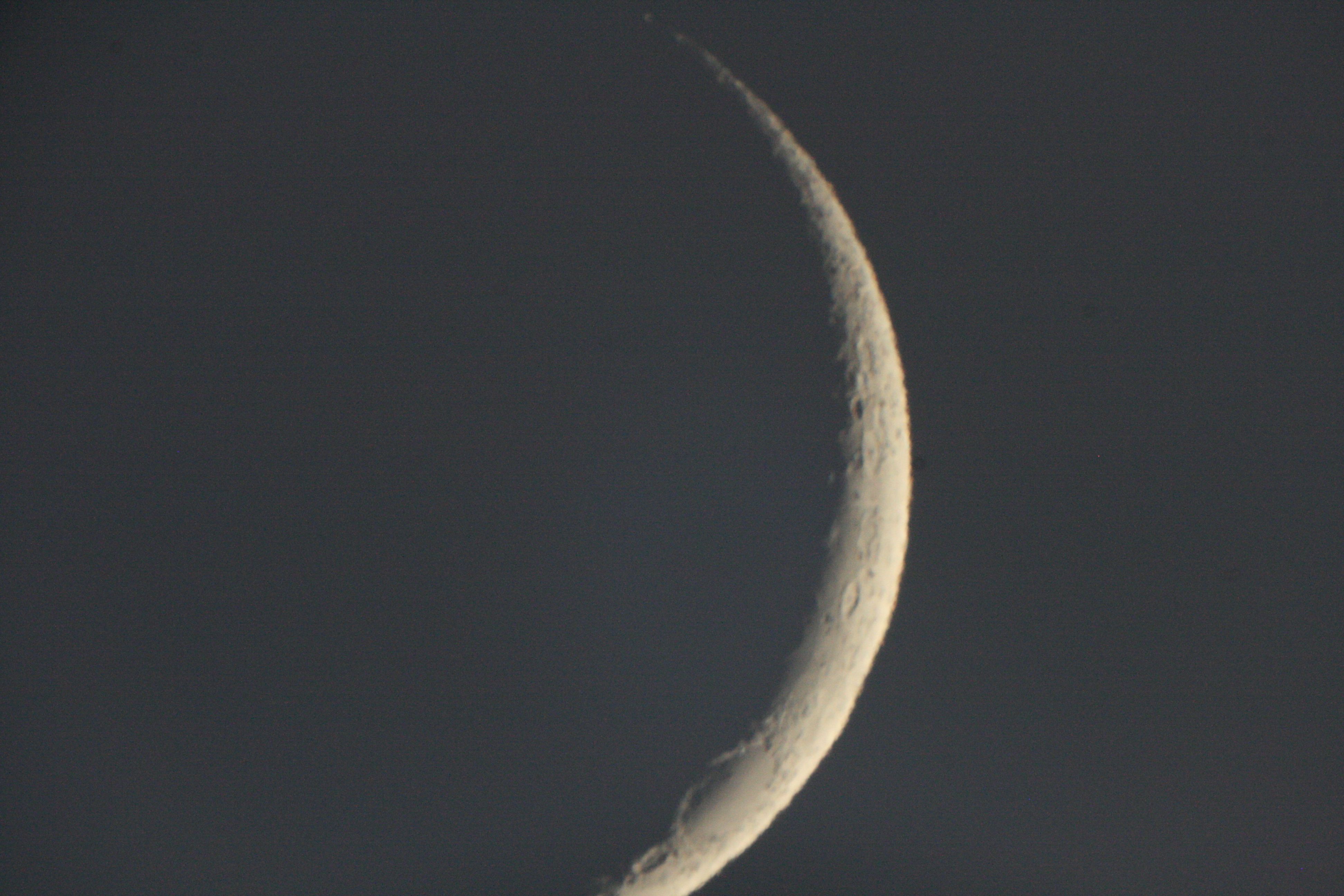
So 74:45 is very pretty, quite noticeable, and not that hard to take photos of. With a mid-sized telephoto lens (75-300 mm) you can see this:

IMG_9260 small

A wider-angle shot with the moon down near the horizon will often show trees, hills, and buildings along with the moon. This can help frame the picture.

IMG_9269 small

In addition, you can see that the moon is floating through a sky that is still not that dark at all. For shots using a long telephoto lens, you should use a tripod if available, or at least try to brace yourself against something (such as a car). This will minimize blurring when the exposures get up to a significant fraction of a second.

IMG_1801 small

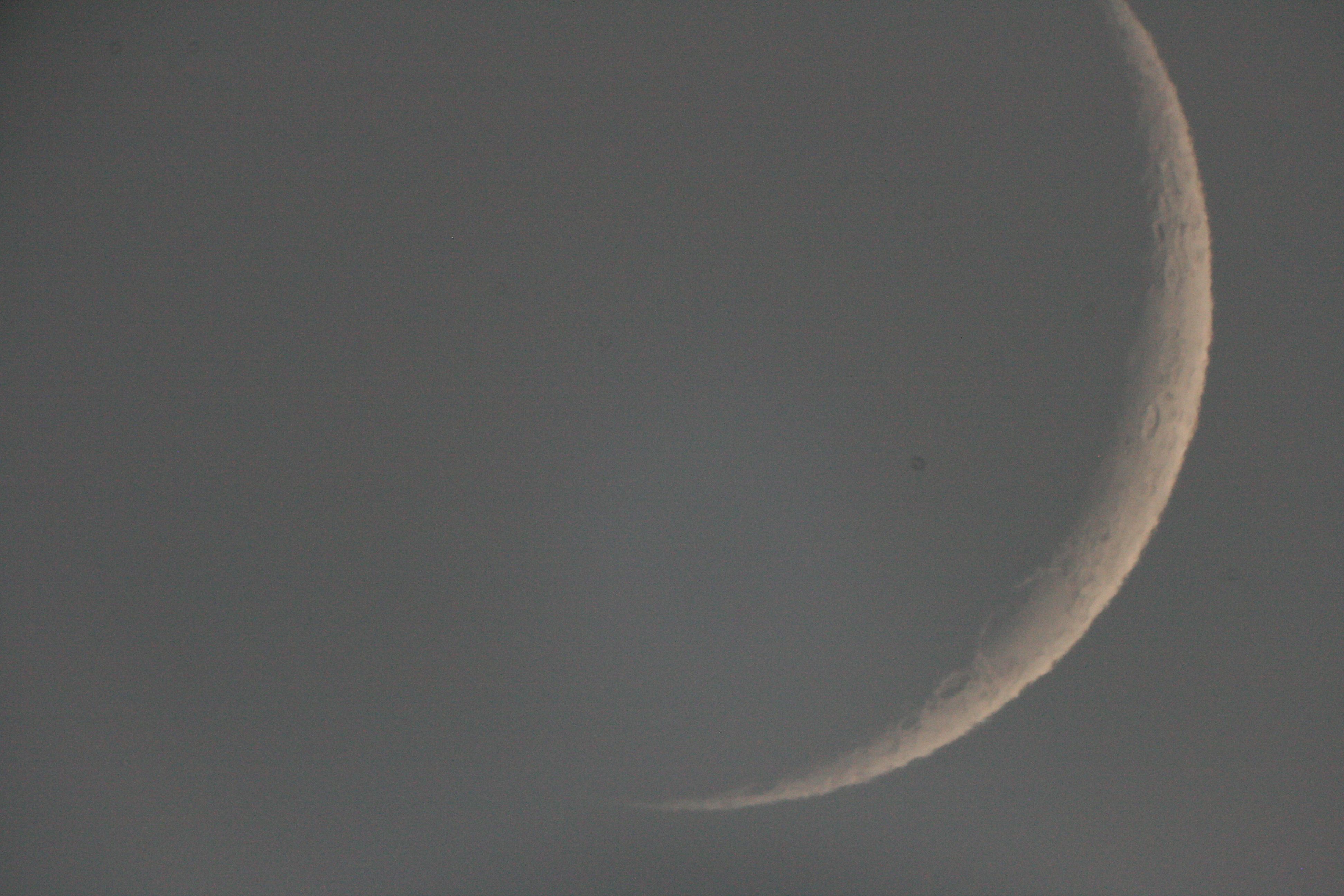
Quickly setting up the little ‘scope, while it was still fairly light, I got this view. It’s similar to the view I got when I did this last year, but the moon then was 13% illuminated and 91 hours old, as opposed to 8% illuminated at 74:45 hours.

The first problem with taking these images is that it’s hard to focus, with the moon being difficult to see. This same issue also makes the pictures wishy-washy. The problem is in the low contrast due to the bright-ish sky and relatively dim moon. In a few days, the illuminated portion of the moon will be MUCH brighter and the pictures can be taken well after sunset so the background sky will be quite dark, giving you a high contrast situation. Good pictures, easier focusing.

IMG_1831 small

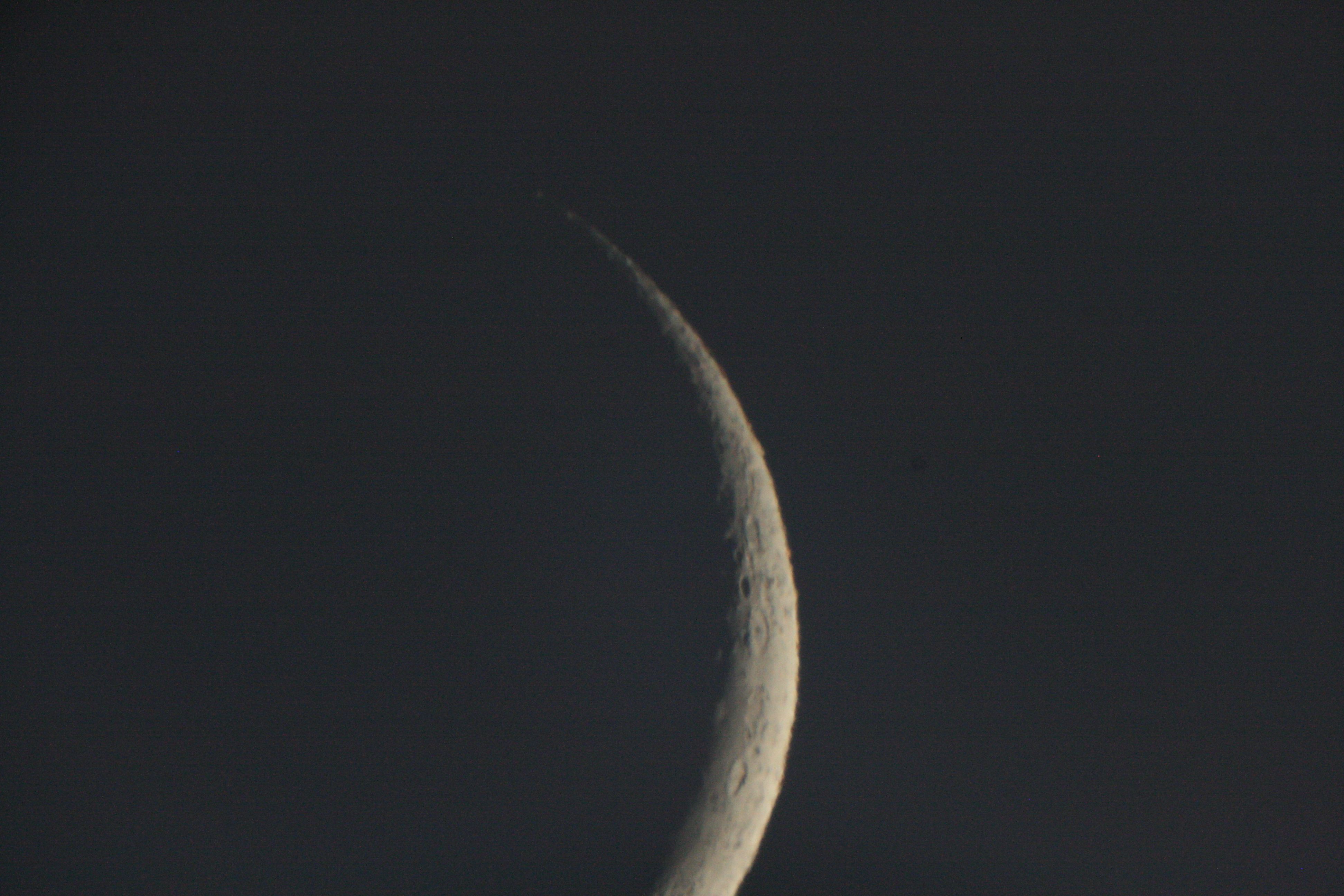
Once the sky gets a little darker, your focusing gets easier and the contrast goes up, but now you’re looking through a whole lot more atmosphere. Even clear air is usually turbulent and gives a slightly fuzzy image as a result. (There’s a reason the Hubble Space Telescope and every other telescope we can manage are all up above the atmosphere.) At sunrise or sunset, longer viewing paths through the air, much more turbulence, much fuzzier pictures.

IMG_1833 small

The other factor which didn’t help was vibration as I took the pictures. I have gotten a neat little toy which will trigger the camera remotely, which can reduce the vibration by a couple of orders of magnitude — but the battery is dead on the receiver. So much for being an old Boy Scout — I was not prepared.

Tomorrow I’ll try to remember to get new batteries. Of course, tomorrow it won’t be “clear and a million.” If I’m prepared in advance and looking forward to an observing and photography session, we’ll no doubt have the first significant rain for the first time in close to a year.

It’s okay. We need the water.

5 Comments

Filed under Astronomy, Photography, Space

Fall Equinox 2014

This evening our planet with its rotational axis offset from the plane of its orbit around the primary star passed through the point where the number of hours of sunlight is the same as the number of hours of darkness. In the northern hemisphere, the days have been getting shorter and the nights getting longer since the summer solstice. Now they’re even. From here, we’ll keep having shorter days and longer nights until we get to the winter solstice, at which point the cycle will reverse. On and on, ad infinitum.

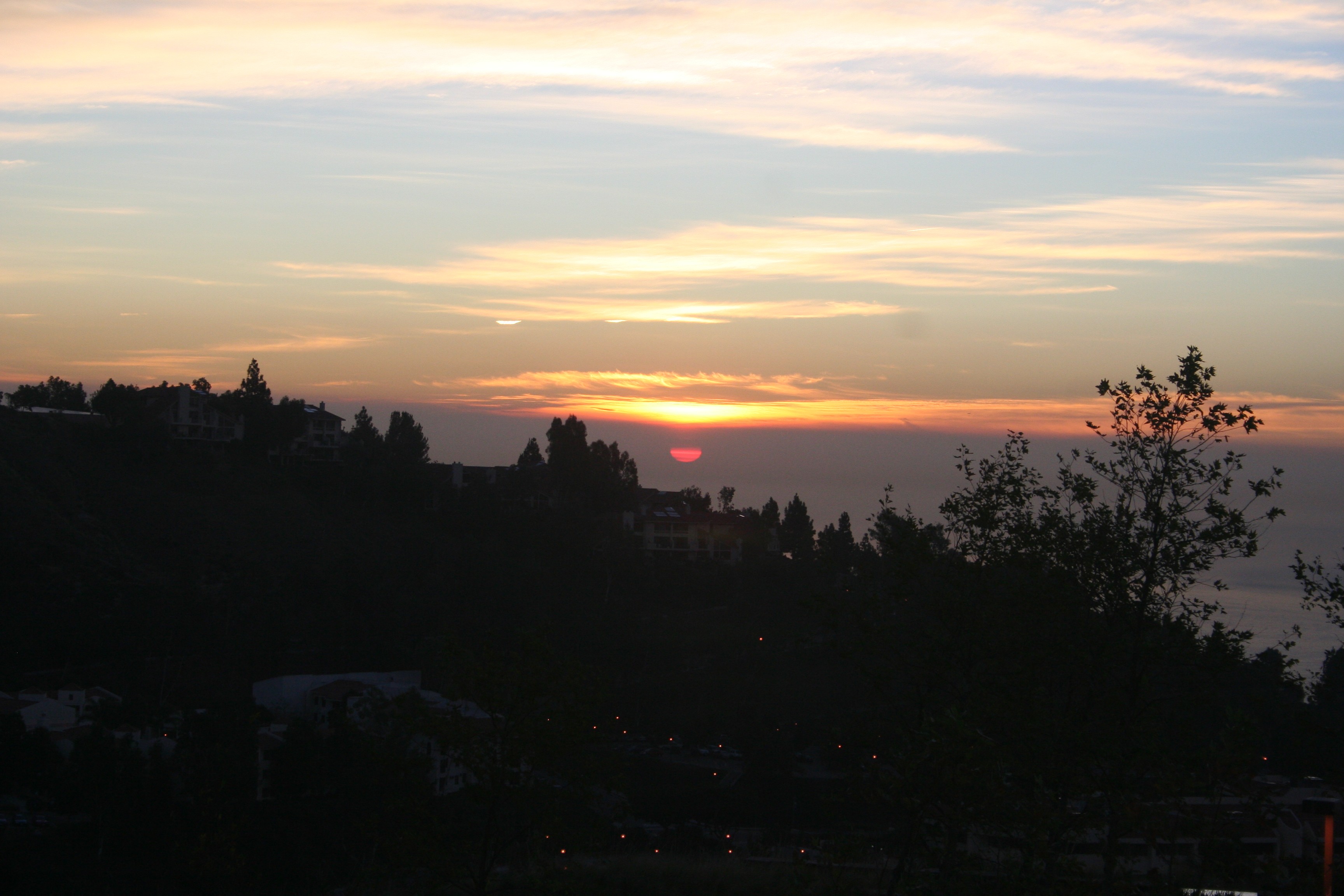
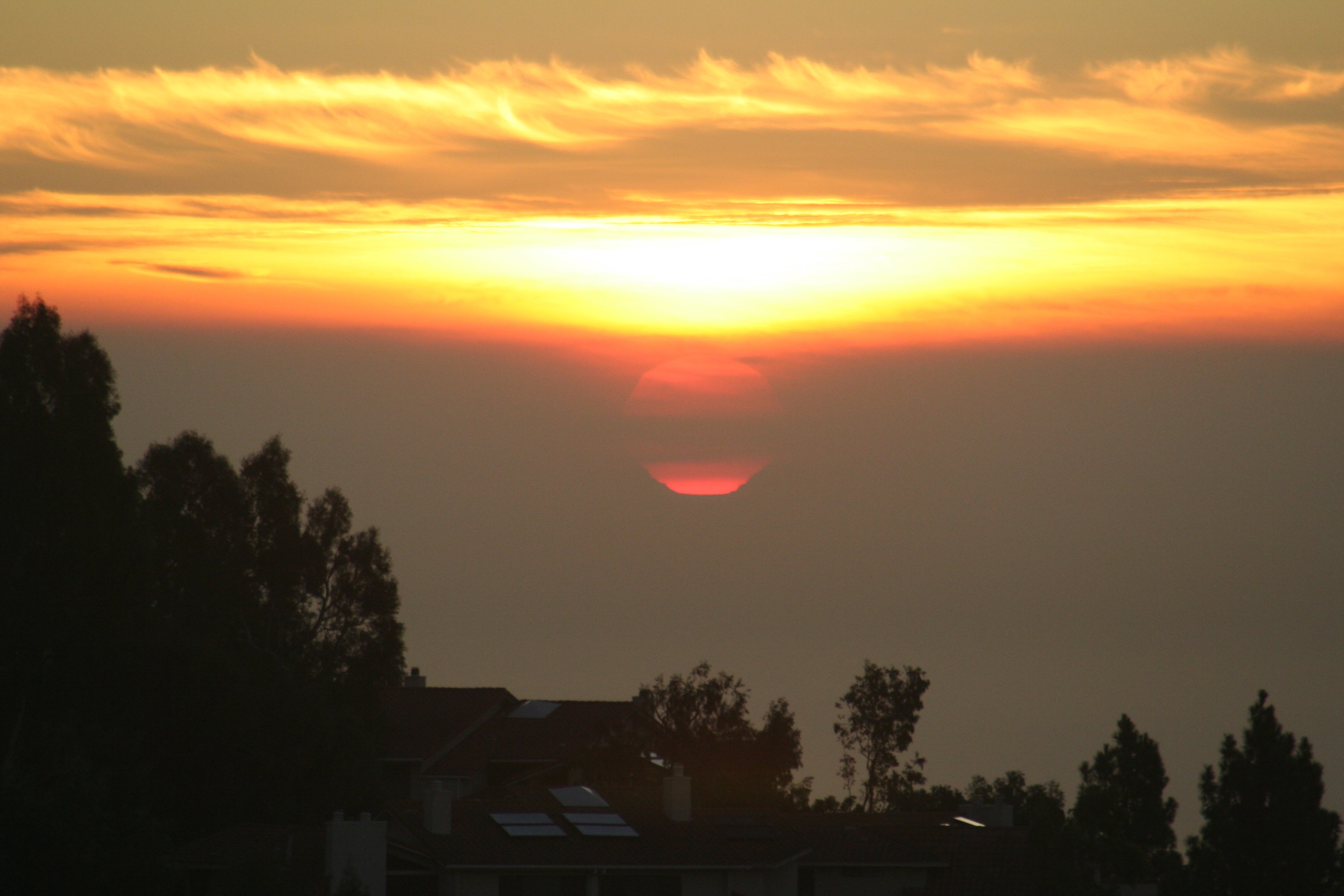
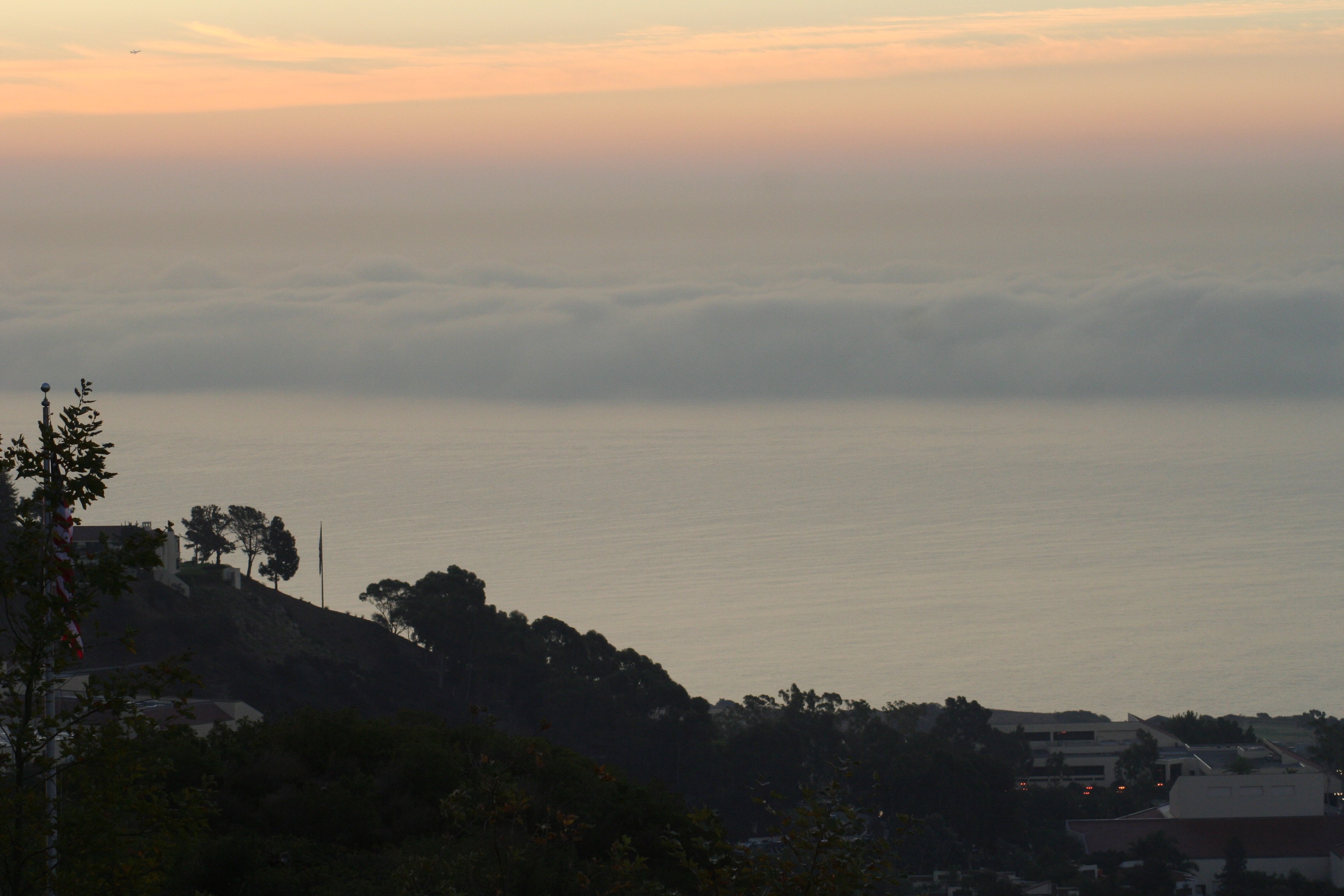
Around these parts, if you’re really lucky (or rich), one of the better spots to watch the sunrise is Malibu. While one normally thinks of the sun setting over the ocean in the west on this coast, the alignment of the coast is such that in the fall and winter months, when the sun is rising in the southeast instead of due east, you can see the sun coming up from over the LA Basin or even the ocean if you’re far enough up toward Point Conception.

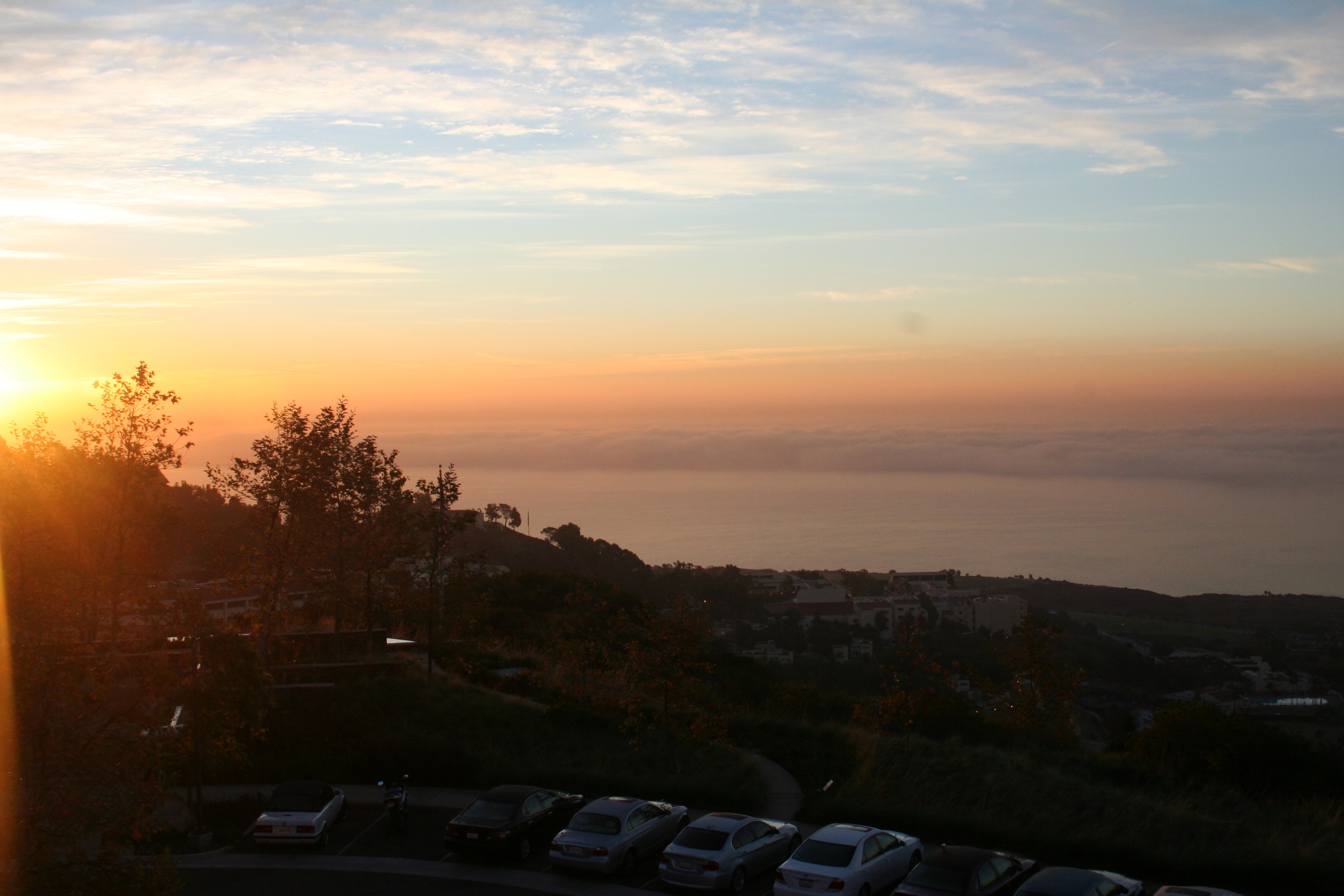
These photos were not taken today, I am rarely a morning person who’s up early enough to see the sunrise, I am not rich, and I do not live in Malibu — but I got my MBA from Pepperdine University which is in Malibu, and for whatever reason one morning when we were on campus I saw this. The coastal low clouds and fog lies just a mile or so offshore, the sun rises through them, and it all looks wonderful.

IMG_7030 small

IMG_7032 small

IMG_7034 small

IMG_7041 small

One final note — while today was the equinox and no doubt a holiday for all of the pagans and druids out there, much more importantly, today was National Ice Cream Cone day, celebrating the 211th birthday of the ice cream cone. Now that’s something to celebrate!

We celebrated with Dryer’s Cookies & Cream and Keebler chocolate coated cones — your personal rituals were no doubt different but no less sacred. If you missed today’s celebration, you might have to celebrate twice tomorrow to atone for your lapse in faith. If you celebrated today, you get to celebrate twice tomorrow as a reward for your faith.

As religions go, it’s got a lot of good things going for it.


Leave a comment

Filed under Astronomy, Los Angeles, Photography, Weather