Category Archives: Travel

NASA Social For Hubble25 (Part Four)

A week ago, April 23rd, I was in Washington to see my first NASA press conference, held at the Newseum for the 25th anniversary of the launch of the Hubble Space Telescope (HST). Afterward, I and the other attendees at the NASA Social were taken out to NASA’s Goddard Space Flight Center. We first learned about the James Webb Space Telescope (JWST), then got some Hubble Space Telescope (HST) history and saw the Satellite Servicing Capabilities Office (SSCO).
19_IMG_8358 small

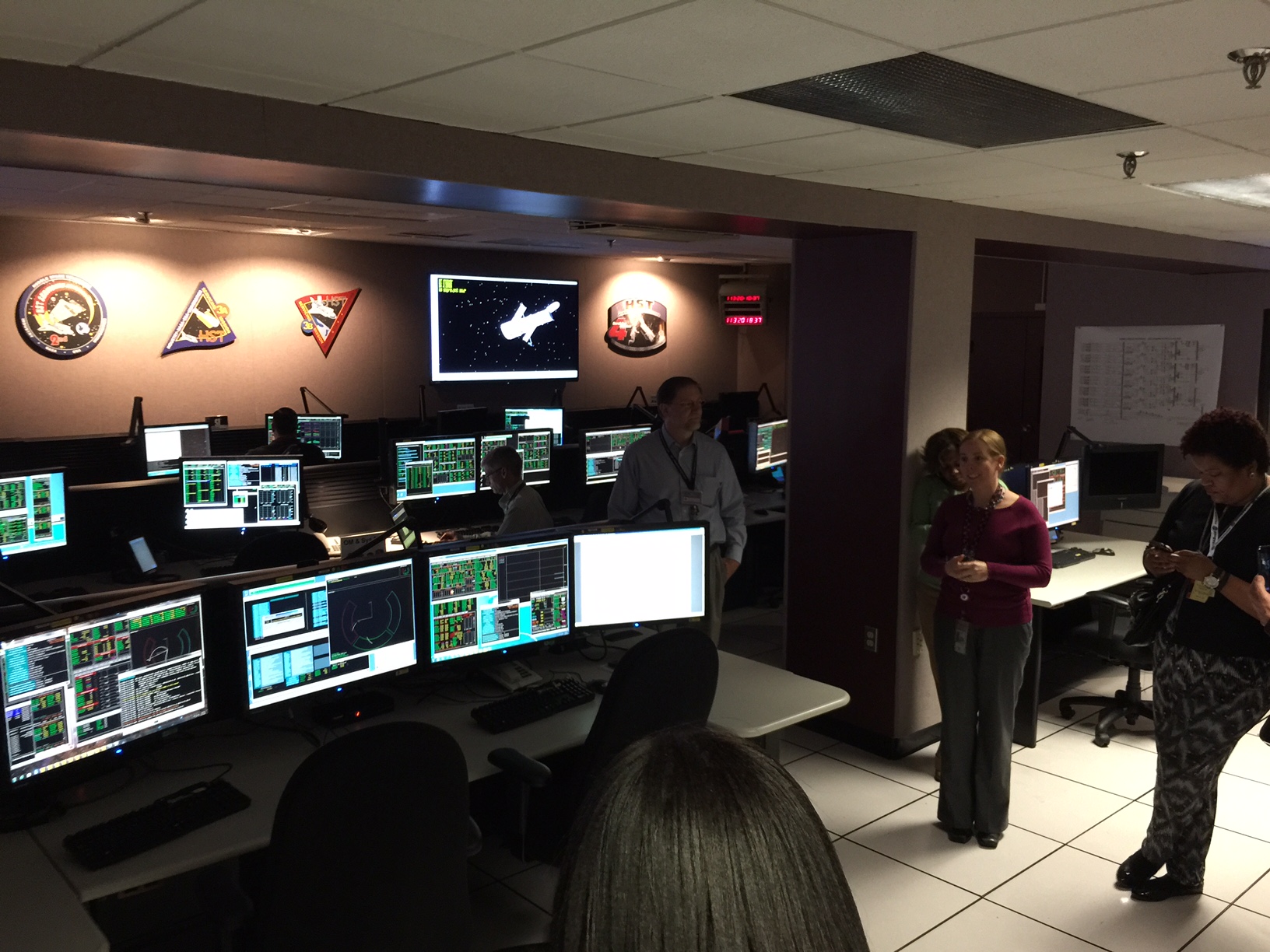
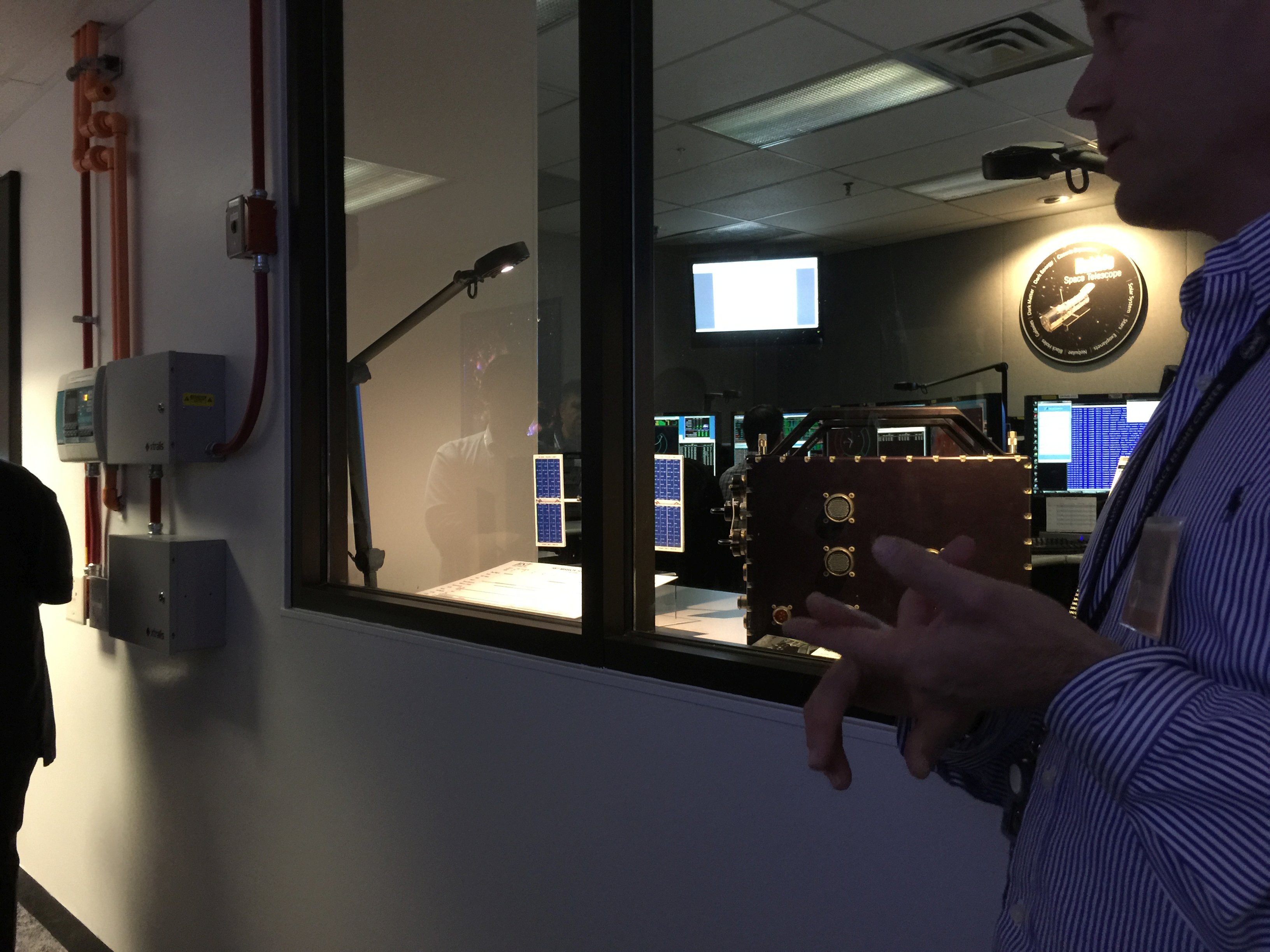
We got a peek in through the window into the HST mission control room. Commands are sent up to HST after being carefully checked and double checked to make sure they don’t accidentally instruct the spacecraft to do something stupid and/or fatal.

For many years all of the command consoles were staffed 24/7/365. With the upgrades both on HST and on the ground, many of the operations no longer require constant monitoring. There is an extensive system in place to alert Goddard staff when anything goes “off nominal.” Minor issue will result in a text message or email, more critical problems are met with more aggressive alerts.
20_IMG_6330 small

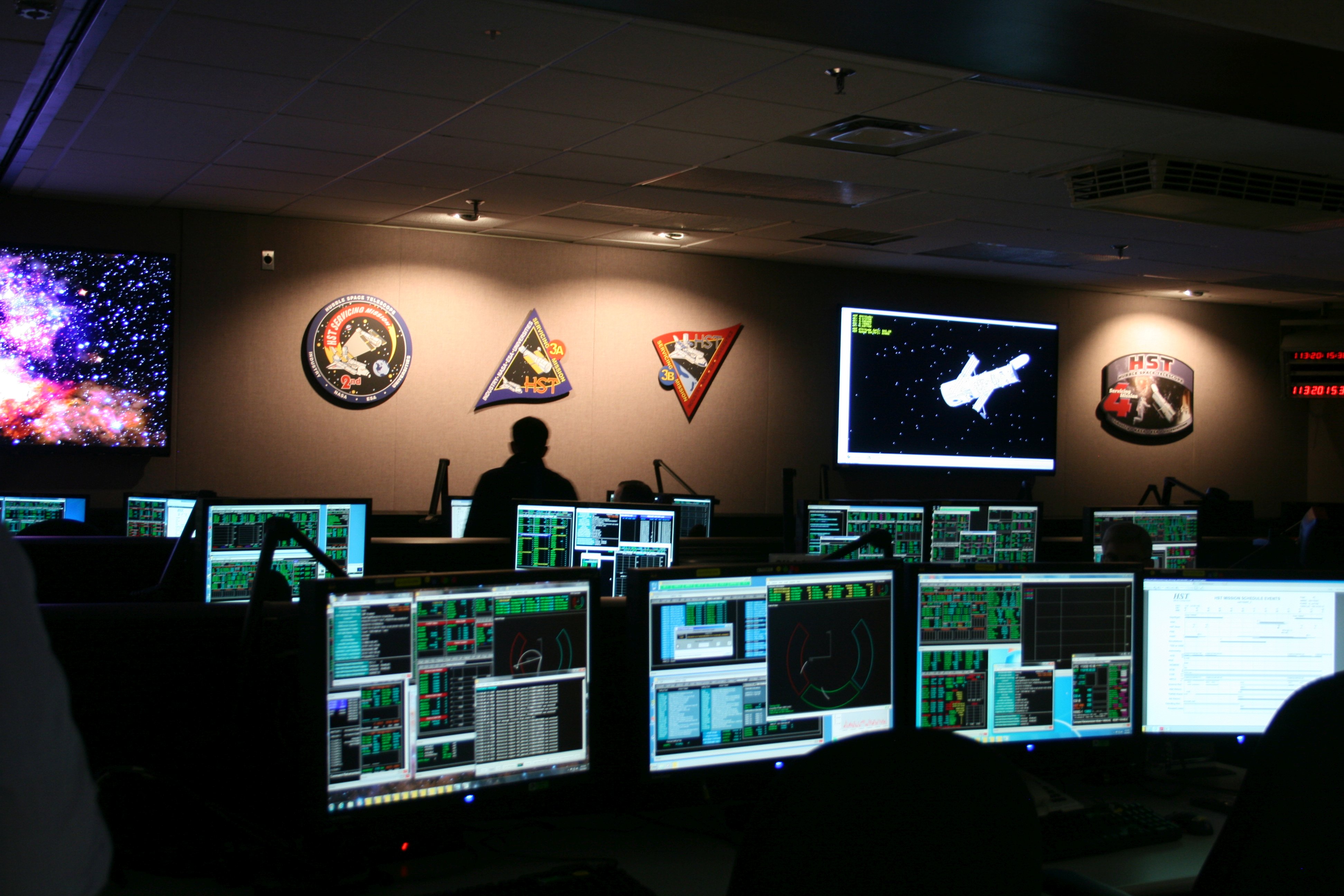
In the HST mission operations center we saw where the data from Hubble is coming down and the astronomical observations were monitored. There was data everywhere on dozens of big monitors — heaven of the little kid inside me who still likes to see buttons pushed and lights flashing.

In particular, I asked about the “pickle” diagram, visible on the center monitor closest to us. It shows how Hubble is using its three Wide Field Detectors (WFDs) to track stars in the current field of view. With two detectors tracking stars, Hubble can maintain tracking accuracy to less than 7 milliarcseconds per day.

How good is that? A circle around the sky is 360 degrees. Each of those degrees is split into 60 arcseconds. Now split each of those arcseconds into 1,000 bits. That’s a milliarcsecond. In the real world, 7 milliarcseconds is the size of a dime on the Washington Monument in DC as seen from the Empire State Building in New York City.

The HST is the size of a school bus, weighs twelve tons, and is floating weightless in space. How do they keep pointing it that accurately? (Assuming it’s not some serious black magic.)

22_IMG_6342 small

These little guys are key. Some of the most accurate gyroscopes ever made are at the heart of these rate sensor arrays (RSAs). Hubble has six of these assemblies, two each on each of the three axes. Usually they run just three at a time, one from each set.

These gyros and RSAs are among the hardest working systems on Hubble and were replaced on three of the five servicing missions. In fact, the failures of gyros were the reason that the third servicing mission was broken into two separate Space Shuttle missions. Four of the six RSAs had failed by November 1999, putting Hubble into a hibernation or safe mode. With less than three working gyros, Hubble could have started drifting and tumbling, making it difficult or impossible to capture by the astronauts on the next shuttle servicing mission. So the planned June 2000 mission was split, with STS-103 going up to replace the RSAs (and other things, such as the primary onboard computer) in December 1999, while STS-109 went up in March 2002.

Hubble doesn’t use thrusters or jets to control its movements in space. For one thing, the gasses used (primarily hydrazine) are very nasty to have around delicate optical instruments. In addition, once the fuel is gone, so is your ability to control your attitude. (Remember the bit yesterday about RRM?) So Hubble is controlled by four massive Reaction Control Wheels (RCWs) which move the spacecraft by gyroscopic action. (For a lot of detail and technical minutia on the Hubble guidance system, see this NASA technical paper.) In high school, did you ever do the experiment where you sit on a bar stool and hold a spinning bicycle wheel, tilting the wheel to make you spin around? That’s how Hubble moves, but with wheels that weigh hundreds of pounds each and are precision machined.

23_IMG_6343 small

In addition to the gyroscopes in the RSAs, Hubble also senses its position in space using large, sensitive Charge Coupling Devices (CCDs), the same kind of sensors that are at the heart of your digital cameras. Two CCDs are built into each WFD and there are three WFDs on Hubble. (Remember the “pickle” diagram above?) As long as two of the WFDs have a star to track in their field of view, the WFDs and RSAs combined can give Hubble that 7 milliaarcsecond per day guidance.

That’s some seriously awesome engineering there!
21_IMG_6339 small

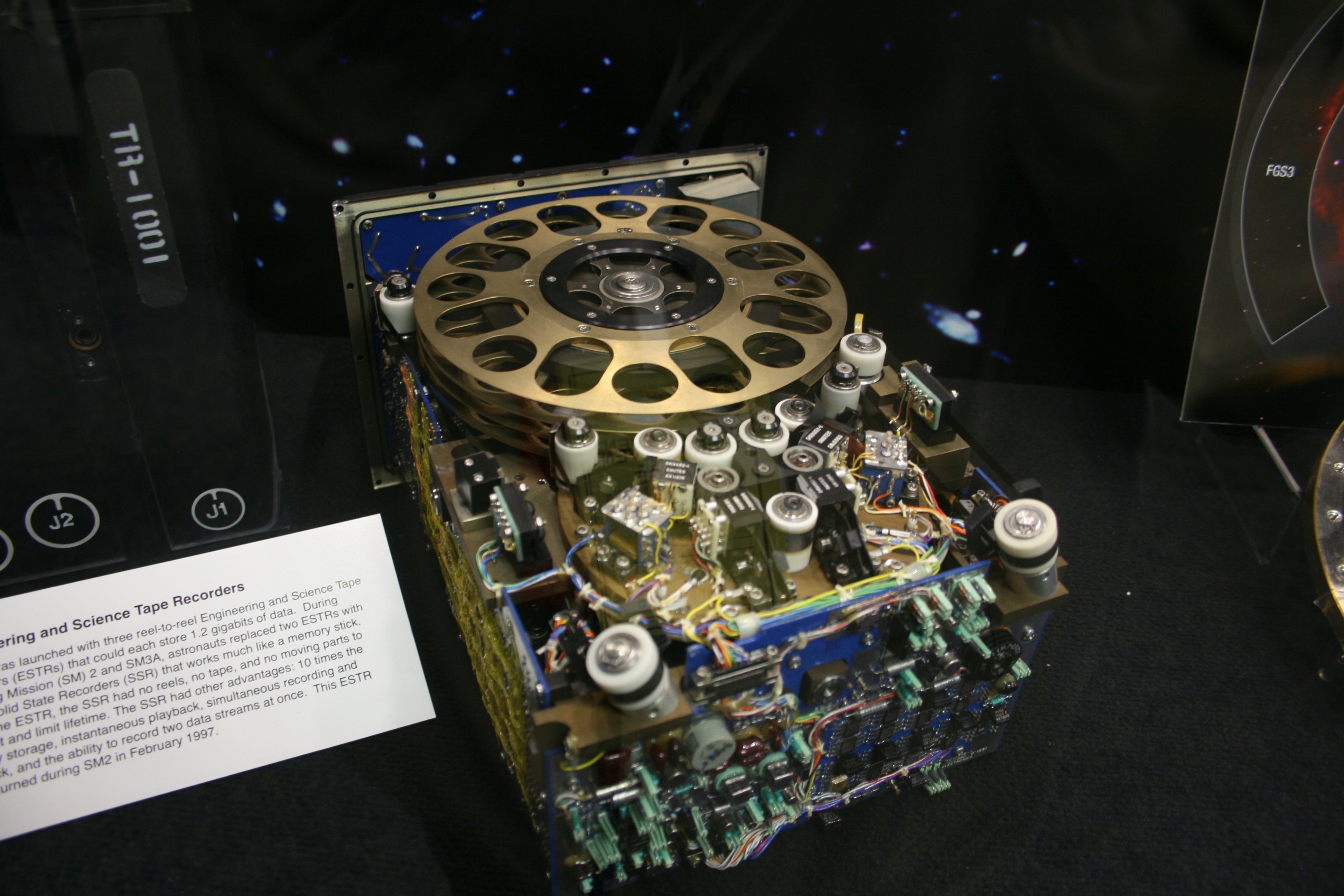
Originally HST was launched with three Engineering & Science Tape Recorders (ESTRs) for recording and playing back data. Designed in the 1980s, the ESTRs were reel-to-reel tape assemblies. Data was written and retrieved sequentially and when the tape broke or jammed (as this one did) the ESTR was useless. These ESTR units held 1.2 gigabites of data, state of the art at the time.

The ESTRs were one of the components of HST which were designed from the beginning to be upgraded as technology advanced. They were replaced on the second and third servicing missions with solid state recording units. The upgraded units are like huge, radiation hardened memory sticks. Not only do they hold over ten times as much data as an ESTR, but they can also be read instantaneously instead of sequentially, and sections of memory which become damaged (perhaps by a radiation hit) can be bypassed, leaving the rest of the unit still functioning.

For those interested, I believe these three pieces of hardware were all flight-flown, coming back down from HST after being removed and replaced during a servicing mission.

24_IMG_8368 small

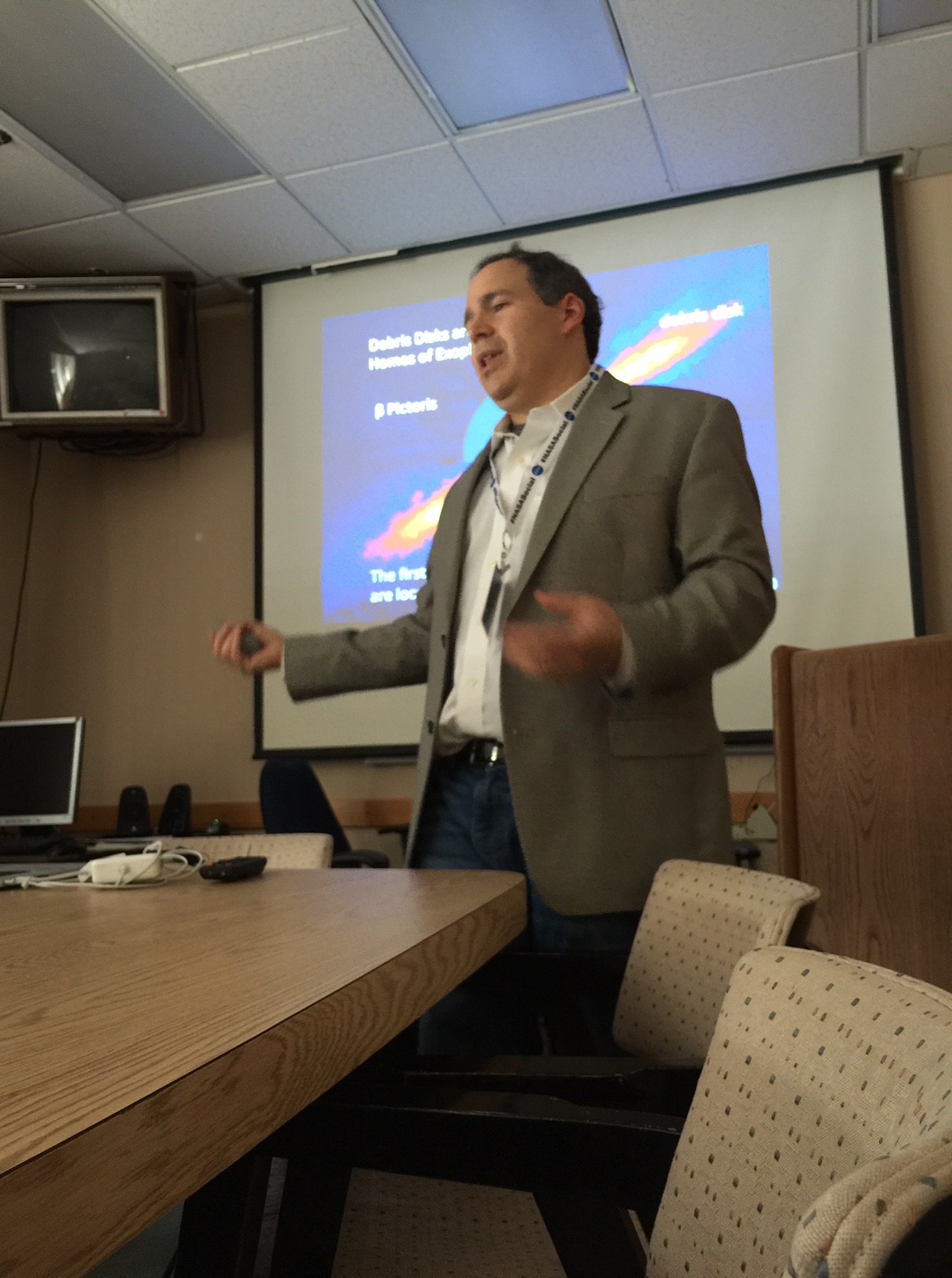
Dr. Marc Kuchner wants your help in looking for targets for HST, and later for JWST. There’s a crowd sourced (Zooniverse) project called “Disk Detective” in which you can do real, honest-to-god science in your spare time.

The short version is that stars with planets are stars surrounded by dust due to the planets, asteroids, comets, and other assorted objects crashing into each other every so often. Because of celestial mechanics and conservation of angular momentum, the dust tends to flatten into a disc or ring. Conversely, we’re finding that when we see a star with a dust disc, we often find planets there.

It’s time consuming and inefficient to have have telescopes like Hubble look at every single star looking for planets, so we would like to improve our odds and find another way to narrow the search. A key tool here is the Wide-field Infrared Survey Explorer (WISE) mission, a space-based telescope which looks at big chunks of the sky at once, but at lower resolution than telescopes such as Hubble.

Dust is bright in the infrared part of the spectrum since it absorbs starlight and re-radiates the energy in the infrared. Therefore, if we look at a star in WISE images and find a dust disk, that’s a good candidate to look at more closely using Hubble or another big telescope.

But how do you look at all of the stars in the WISE images? Computers? Not really. It turns out that computers aren’t that good at examining images and “looking” for certain telltale characteristics. But the human eye and brain are pretty good at that. But there are billions of stars. So what if a whole lot of people each looked at a few dozen or a few thousand stars each?

That’s how Disk Detective works. If you go to the site it will show you a series of ten images for a single star, each image in a different wavelength. You can flip through the images as often as you want, then answer six simple questions about the images, such as if the object is moving. This only takes a minute or two, you submit your answers, and go on to the next image.

If multiple people independently judge a particular image to be a good candidate to have a dust disc and possibly planets, then the pros can take a look at it, possibly moving the observations up to a much bigger telescope, or even up to Hubble. It’s a piece of cake, and beats the hell out of playing Solitaire on your computer! Give it a try, maybe you’ll be the one who finds another new planet.

25_IMG_6345 small

Finally, we got to talk to two of the engineers who helped to design and built the tools needed to perform the delicate tasks of the Hubble servicing missions. (Again, I apologize for not getting their names – if anyone can fill in the blanks for me in the comments, I would appreciate it.)

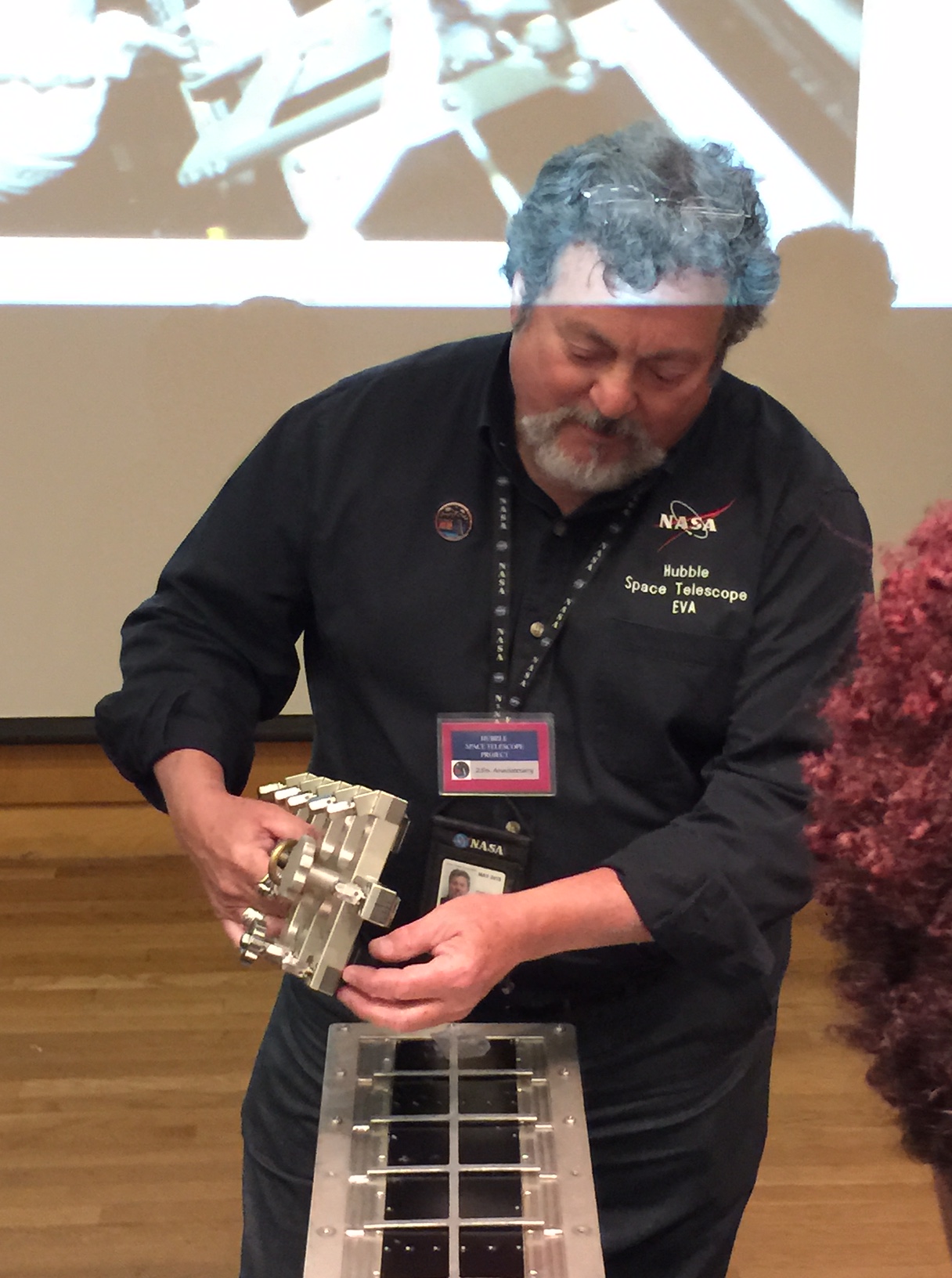
Here we see a panel that was designed to go over a series of over a hundred screws and bolts that had to be removed, without allowing any of them to get away or fly loose. A single nut, bolt, washer, or screw that escaped and drifted into the telescope could cause an electrical short or damage a lens or mirror, causing an incredible amount of damage. And remember, this work was being by astronauts wearing spacesuits with very limited mobility and dexterity, floating weightless, often with poor or little lighting. The astronauts described it as being like performing brain surgery while blindfolded and wearing oven mitts.

In order to safely open panels and instruments that were never designed to be opened while simultaneously preventing any loose bits from drifting away, some very complex tools were designed and built. For example, the blue panel above was attached in place with bolts screwed in using the big handles (easy to use with gloves). The clear holes lined up over the screws that needed to be removed, and the holes in the plastic were just big enough to allow a screwdriver tip or other tool to get through while still being small enough to not let the screw escape.

26_IMG_8375 small

Another problem was dealing with sharp edges, knives, and cutting tools. In a pressure suit surrounded by hard vacuum, NASA doesn’t want astronauts handling a knife or anything sharp. When this top panel had to be removed with a whole series of cuts, this tool was built to screw on (again, big handles, easy to use in stiff spacesuit gloves), cut the top of the compartment off with blades that were recessed and not a danger to the spacesuit or gloves, then pull off with all of the loose bits captured inside.

Other new tools had be developed to make the Hubble repairs feasible. For example, the standard Pistol Grip Tool (PGT) which we saw in the  SSCO is used to remove and install screws and bolts – but it’s really slow. For something like the job above with the blue panel, which had 100+ screws, that would take forever. So other faster, more lightweight tools were developed for the Hubble repairs. In addition, since they would be working in the dark a lot, let’s put some LED lights on there so we can see what we’re doing while looking out through that spacesuit helmet. Right?
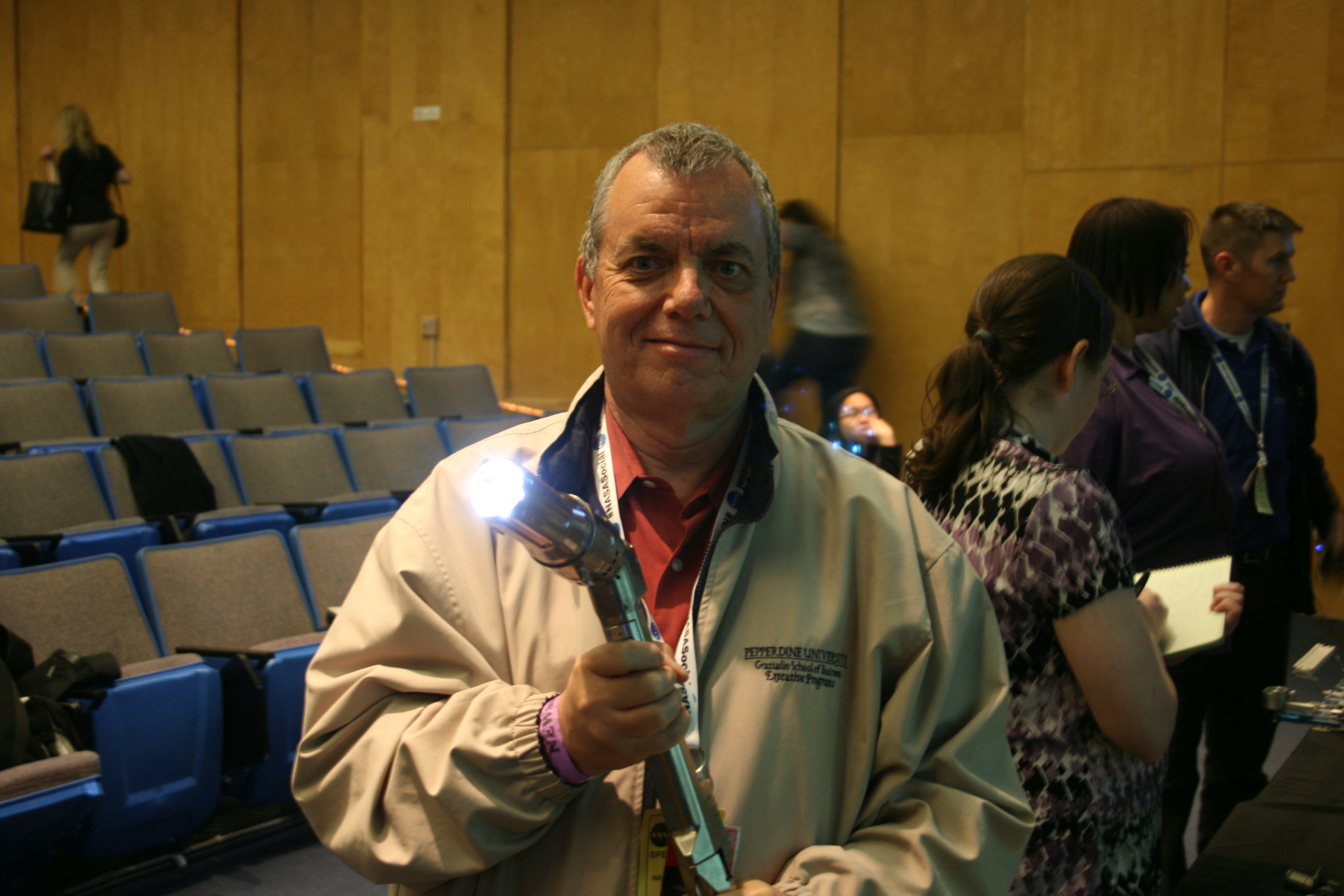
27_IMG_6357 small

Yeah, this is the one they developed (I believe it was flight-flown), and yes, they let me hold it.

Geek joy!!

FYI, it’s heavy and awkward to hold even there in the auditorium using just my bare hands. We can’t ever give enough credit to the astronauts who pulled off five astonishingly successful service missions, giving us one of the landmark scientific instruments of our generation.

Flip through the images that we’ve gotten from Hubble.

Go see one of the IMAX 3D movies about Hubble, or watch the PBS Nova special from last week.

Read about some of the discoveries that Hubble has allowed us to make in the last 25 years.

Study how the initial problems with the Hubble optics were overcome. It’s a classic study in recovery management, how an initial critical error, particularly a very public and very expensive one, can be faced head on and resolved, leading to one milestone achievement after another.

That’s why we’re celebrating twenty-five years of Hubble’s observations.

That’s why we’re looking forward to many more years of Hubble’s observations.

It was a great NASA Social!

Leave a comment

Filed under Astronomy, Photography, Space, Travel

NASA Social For Hubble25 (Part Three)

After rubbing elbows with Space Shuttle mission commanders (sorry, still squeeing) at last Thursday’s NASA press conference for the 25th anniversary of the launch of the Hubble Space Telescope (HST), the attendees at the NASA Social were taken out to NASA’s Goddard Space Flight Center where we learned about the James Webb Space Telescope (JWST) and saw where it was being assembled.

First of all, I want to apologize to all of the wonderful researchers and engineers at Goddard whose names I did not get. They all deserve all of the credit in the world for the amazing work they’re doing, and have been doing for decades. If anyone from Goddard or any fellow NASA Social attendees can fill in any names that I missed, I would greatly appreciate a note in the comments with the information.

10_IMG_8355 small

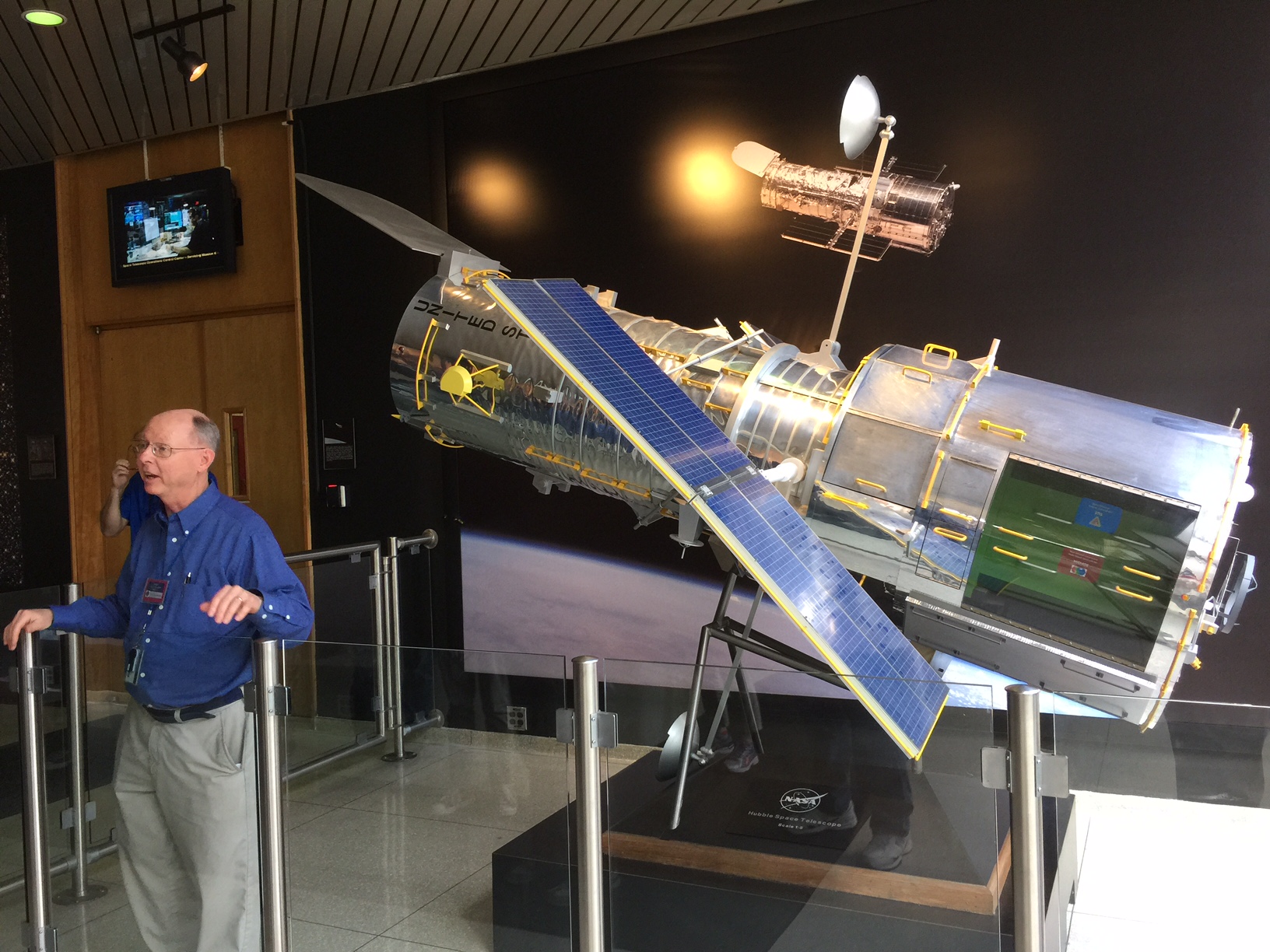
This is a 1:5 scale model of HST. The see-through panel at the back end is there to show where the instruments are. HST was visited five times by Space Shuttle crews who replaced and upgraded control systems, instruments, cameras, and optics. Any one of those visits could have ended disastrously. One loose screw, one bolt that wouldn’t come loose, and HST could have been permanently crippled.

The fact that the five servicing missions were 100% successful despite glitches and problems is one of the reasons I like crewed missions. Things never go the way they’re planned and humans are highly adaptable. Check out the PBS’s Nova program, “Hubble’s Amazing Rescue” for a great description of what was at stake, how nearly impossible to get it right was, and how spectacularly triumphant the results were.

11_IMG_8341 small

Ben Reed runs the Satellite Servicing Capabilities Office (SSCO) at Goddard, where they design and build tools and robots to work in space. Here he’s holding a Pistol Grip Tool (PGT) which is used to screw and unscrew nuts, bolts, and screws in microgravity. This particular one is actually from the Neutral Buoyancy Laboratory (NBL) where astronauts train for their space walks.

12_IMG_6301 small

One of the projects being worked on at the SSCO is the Robotic Refueling Mission (RRM). I remember seeing these experiments being run  on the International Space Station (ISS) a while back. This test panel is identical to one flown to Low Earth Orbit (LEO), as is the next one shown below.

Thousands of satellites have been sent to orbit and then become useless as they aged. Sometimes a critical piece fails, maybe a power relay or the onboard computer. Sometimes satellites get hit by meteorites or other orbital debris. More often than not though, the satellite fails when it runs out of maneuvering fuel.

Due to various factors such as atmospheric drag and gravitational pull from the Sun, Moon, and other planets, satellites tend to not stay where you put them. They’ll all use some sort of small thrusters to “station keep.” When that fuel runs out, they drift, lose attitude control , and become useless. Oh, and 99.9999% of these satellites were never intended to be serviced or refueled, so when they’re dead, they’re dead.

Unless…

Let’s say you built a robot. A very clever robot with a bunch of nifty tools. Maybe the robot is autonomous, or remote controlled from the ground, or a little of both. (Yeah, I would send a crewed mission since humans are incredibly dexterous and clever monkeys, but that’s just me.) Maybe these nifty tools and clever programming would allow securing wires to be snipped, locked on bolts to be unlocked, thermal blankets to be peeled back, and sealed access ports to be unsealed on dead satellites.

13_IMG_6303 small

Now you need to test your robot. It’s expensive (and a whole different engineering problem) to accurately locate the broken satellite, rendezvous, and attach your refueling robot to it. Especially when you don’t know yet if you’ll actually be able to do the undoable when you get there. So you want to test the breaking and entering and refueling before you spend all of that other money on finding and rendezvousing and capturing. This is where the RRM and ISS come in.

These panels have fueling ports and connections that are the same as those used on numerous commercial satellites. The test is to see if controllers on the ground can remotely use the tools built into the robot to do the job.

14_IMG_8349 small

The RRM mission on ISS uses the Canadian-built Dextre two-armed robot along with tools built for this task. Dextre can be held at the end of Canadarm2 or it can be docked at one of the Mobile Base Stations on ISS. Seen here is a heavy-duty version of a remotely controlled robot similar to Dextre. (Dextre’s tough, but lightweight and designed to work in microgravity. This one has to be bigger and heavier to work at 1G.)

So far the RRM tests on ISS have gone very well. There have been no “show stoppers” in proving that a remotely controlled robot can break into a satellite with empty fuel tanks, refill the tank, reclose the port, and release the satellite.

The issue, as it always is, is money. A robotic refueling mission like this might cost $500M or more, plus the initial development costs. (Please note, all of these numbers are Wild Ass Guesses (WAGs) and yes, I am trying to see how many Three Letter Acronyms (TLAs) that I can put into this article.) Would it make economic sense? That was one of my questions for Ben Reed.

The answer is, not surprisingly, “It depends.” It’s not a single calculation but a spectrum. On the low end, if you have a cubesat that only cost $50K to build & launch, spending hundreds of millions of dollars to refuel it would be stupid. On the high end, if you spend $7.998B to build and launch JWST, perhaps a couple hundred million dollars to double or triple its lifetime might make sense.

To be quite clear — NO ONE at Goddard said ANYTHING about possibly refueling JWST. In fact, whenever the concept got brought up, it was politely but firmly squashed. JWST has been designed from the get-go to be a “fire & forget” spacecraft with no possibility of being repaired or refueled. I’m just speculating wildly here.

But that being said, remember, it’s an economic spectrum. Even if you can’t refuel JWST, what about if you’ve got a $1B+ weather satellite or communication satellite. If your choice is to build & launch another $1B+ satellite or try spending $250M to refuel the old one (again, WAGs!), which do you choose?

More to the point, if you build your robot with lots of different capabilities and a big tank of fuel, maybe you can refuel ten satellites. Or fifteen. Or thirty. Now your cost per satellite is maybe $20M each. So if you have a perfectly good, functioning $1B+ satellite that’s out of fuel, do you build another, or risk $20M or so to double its lifespan? If the technology’s there, the answer seems obvious.

The SSCO isn’t developing this technology just because NASA necessarily has any plans to use it. The key word in SSCO is “Capability.” Yes, NASA would like to be capable of doing this if they need to, but it could be another NASA spinoff that saves billions of dollars.

15_IMG_6308 small

That’s not all the SSCO is working on. Here you can see “test rocks” of different sizes, weight, and composition. Some are hard as a rock, some are more like clumps of sand barely holding together. Some are metallic, some not.

These test rocks are being used to see how current robots and their manipulators (“hands,” if you will) can deal with different objects they might encounter on the surface of a comet or asteroid. (Remember OSIRIS-REx from yesterday?) We don’t know what we’ll find on the surface of any given object (that’s the reason we’re going, to find out – right?) so the robot spacecraft we design and build have to be prepared for a range of options.

Also on the left in this picture you can see a grey-white object. I believe this is a model of a device currently on ISS in the Japanese Experiment Module (JEM, better known as Kibo) and used to launch cubesats from ISS. What I want you to see however is that this has been made by “additive printing,” otherwise known as “3D printing.”

3D printing is going to be HUGE! For example, in a case like this, you can prototype an object for hundreds or  thousands of dollars instead of spending hundreds of thousand dollars or more. Then you can test it, tweak it, break it, refine it, and print another. You work out the bugs using the cheaper 3D printing route, then you build the final product the old fashioned way.

I’m sure I’ll be ranting at length about 3D printing here at some point.

16_IMG_6310 small

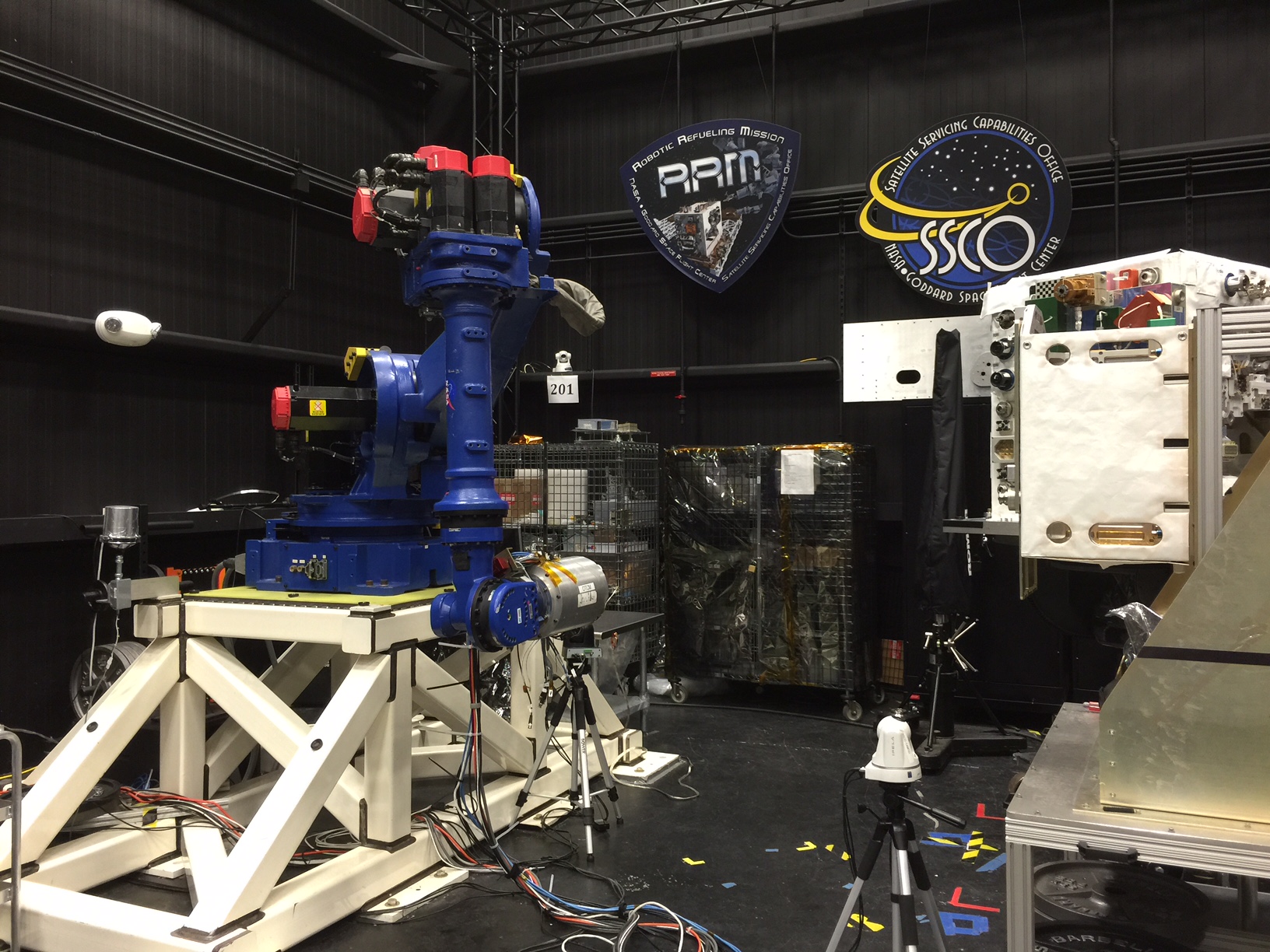
In the other corner of SSCO they’re working on the other part of the robot refueling problem – rendezvous and capture of a satellite that might not be under control. If the fuel’s gone (or there’s some other problem) it could be spinning, rolling, tumbling — or doing all three at once. The more it’s moving, the harder it’s going to be to latch onto.

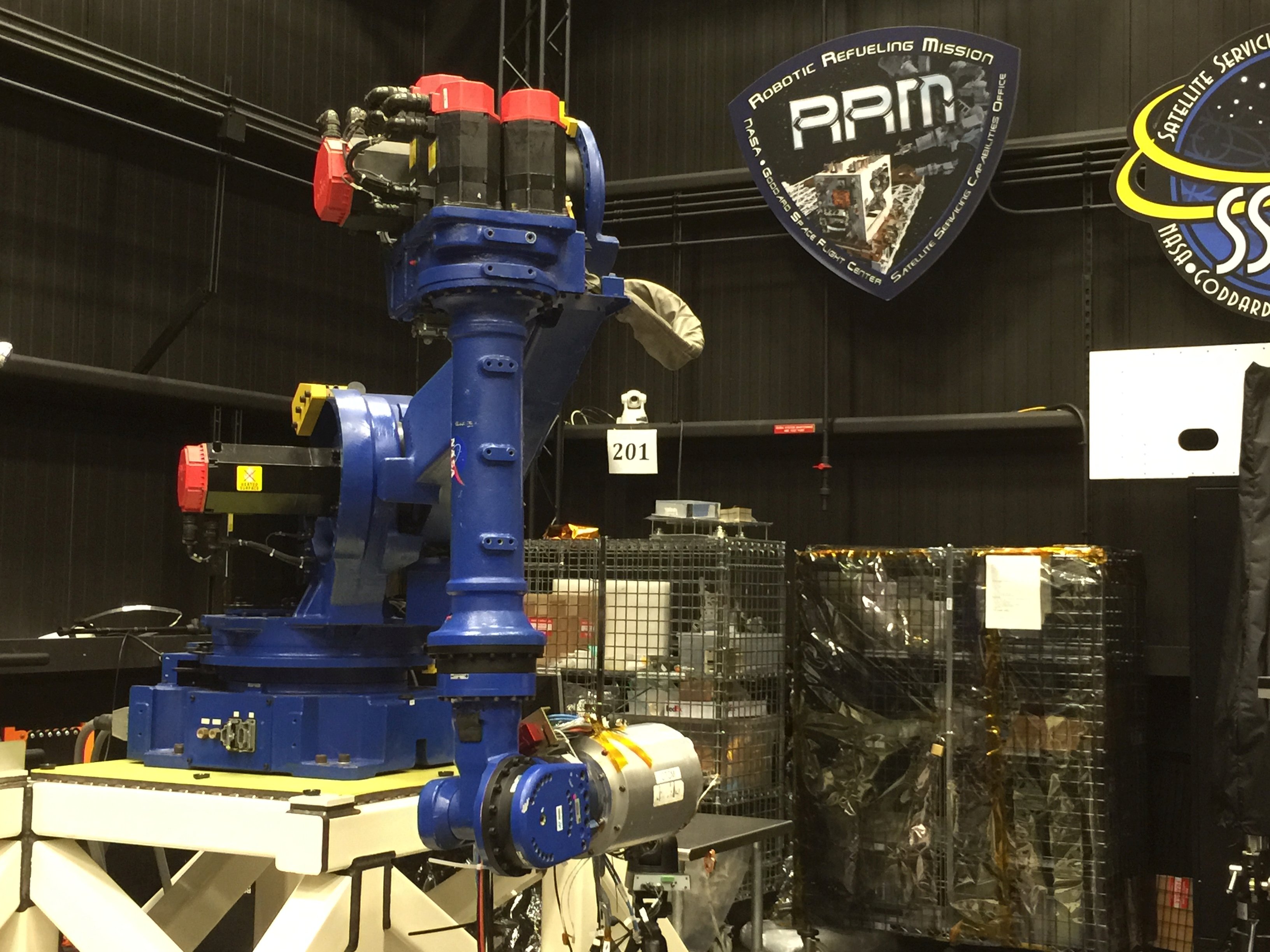
This mockup of a satellite panel is mounted on a rig that can move it through a wide range of motion. The (again, heavy duty, designed for 1G, not microgravity) robot arm on the right is being used to develop software and techniques to learn how to approach and grapple a tumbling satellite, or to figure out when it can’t be done and back off.

17_IMG_6316 small

These three tools were on display in SSCO, demonstrating how much smaller, more capable, and more elegant our tools for working on orbit have become.

The big blue on on the left was used in the rescue & repair of the Solar Max satellite in 1984. The center tool is that PGT used by shuttle astronauts and now by ISS astronauts on their space walks. The far right tool is one of the tools that was used by Dextre during one of the RRM experiments.

18_IMG_6327 small

Again, I apologize for not getting the name of this woman who did such a great job of walking us through many of the discovery highlights from HST. From planets, to planetary nebula, to galaxies, to black holes, Hubble has spent the last twenty-five years revolutionizing the way we look at the universe around us.

Getting observing time on Hubble is non-trivial. There are, of course, far, far more requests for observing time than the telescope can perform. Observing time is allocated by a committee that picks the most worthy proposals.

In addition, there is a certain amount of time that is set aside as “director’s discretionary” time. One thing that this time is used for is Hubble observing time when something transitory or unexpected happens. Maybe there’s a supernova, or a comet’s going to slam into Jupiter. With discretionary time, these objects and events can be observed without kicking anyone else off the schedule.

In fact, the landmark “Deep Field” image by HST was done using director’s discretionary time. After all, it was quite literally a blank, empty piece of the sky, without any known stars or other objects in it. Why would the committee give anyone ten continuous days of observing time to look at “nothing”? Yet this image, covering the area the size of a dime as seen from seventy-five feet (let that sink in) contains over 1,500 galaxies.

1,500 galaxies, each with billions of stars, many of them with planets, almost certainly some of the planets containing life, almost certainly some of that life reaching a level of intelligence equal to or better than ours. All that from an “empty” area that small.

The universe is a big place!

Next, we see how HST is operated every day, how it points so stinkin’ accurately, and how it got fixed and upgraded on the servicing missions.

2 Comments

Filed under Astronomy, Photography, Space, Travel

NASA Social For Hubble25 (Part Two)

Yesterday, having found decent wi-fi at the Reagan National Airport (DCA) terminal, I began telling you about the main event in my week-long trip to Washington for the Hubble 25th Anniversary NASA Social. Part One brought you the events of the NASA press conference at the Newseum on April 23rd.

01_IMG_6243 small

After the news conference was over and we were done schmoozing with astronauts and astrophysicists, we were free to wander around the Newseum for an hour or so, then we were loaded on a bus and driven out to Greenbelt, MD, the home of NASA’s Goddard Space Flight Center.

02_IMG_8286 small

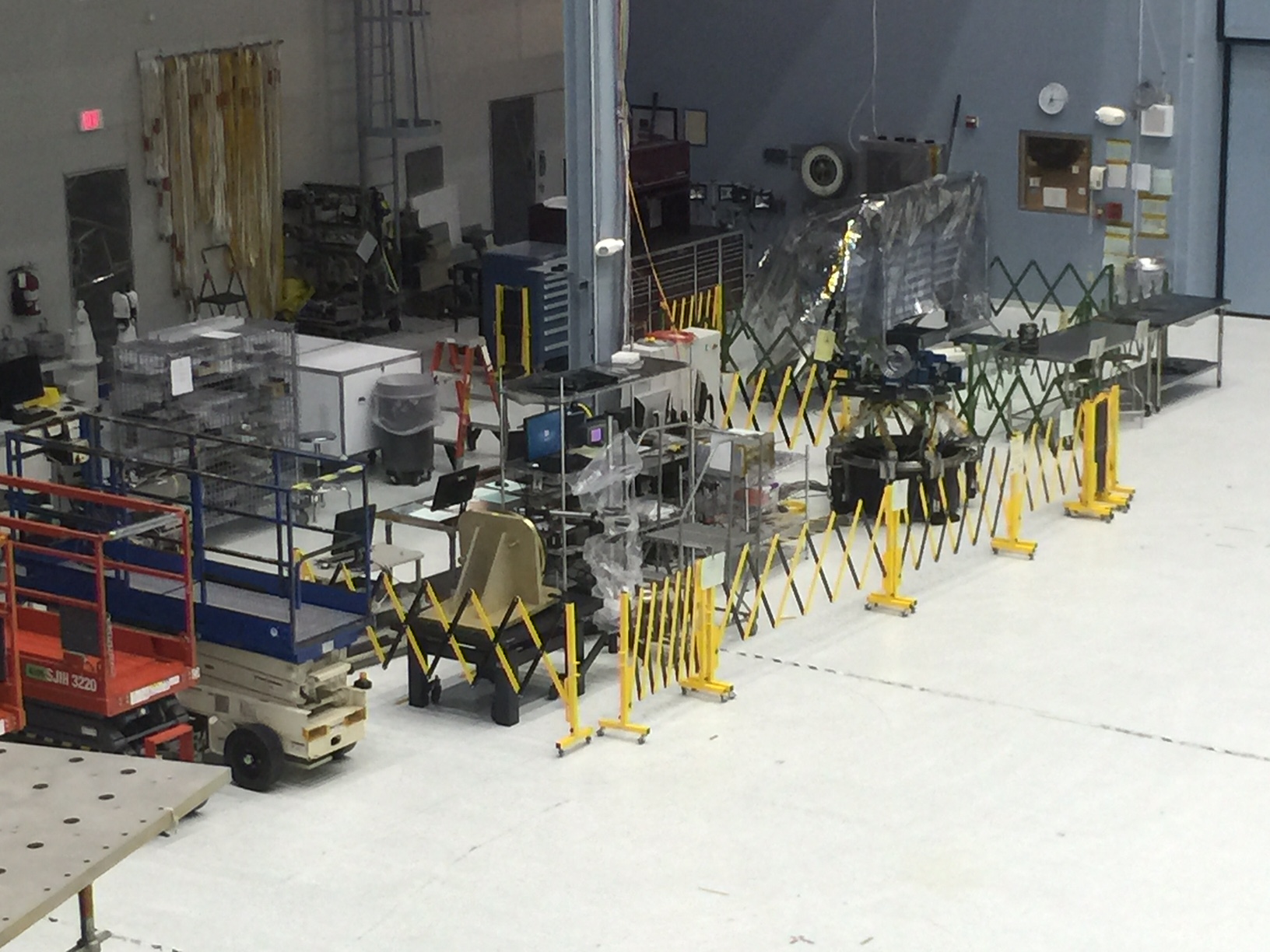
First stop at Goddard was the viewing room overlooking the clean room where the James Webb Space Telescope (JWST) is being built, tested, and assembled. I’ve seen the clean rooms at JPL where planetary spacecraft have been built, also impressive places. We were told that this was the largest known clean room, the implication being that there might be other, not-quite-so-public government agencies that also build and launch large satellites who might have one larger, but if they told us they would have to kill us.

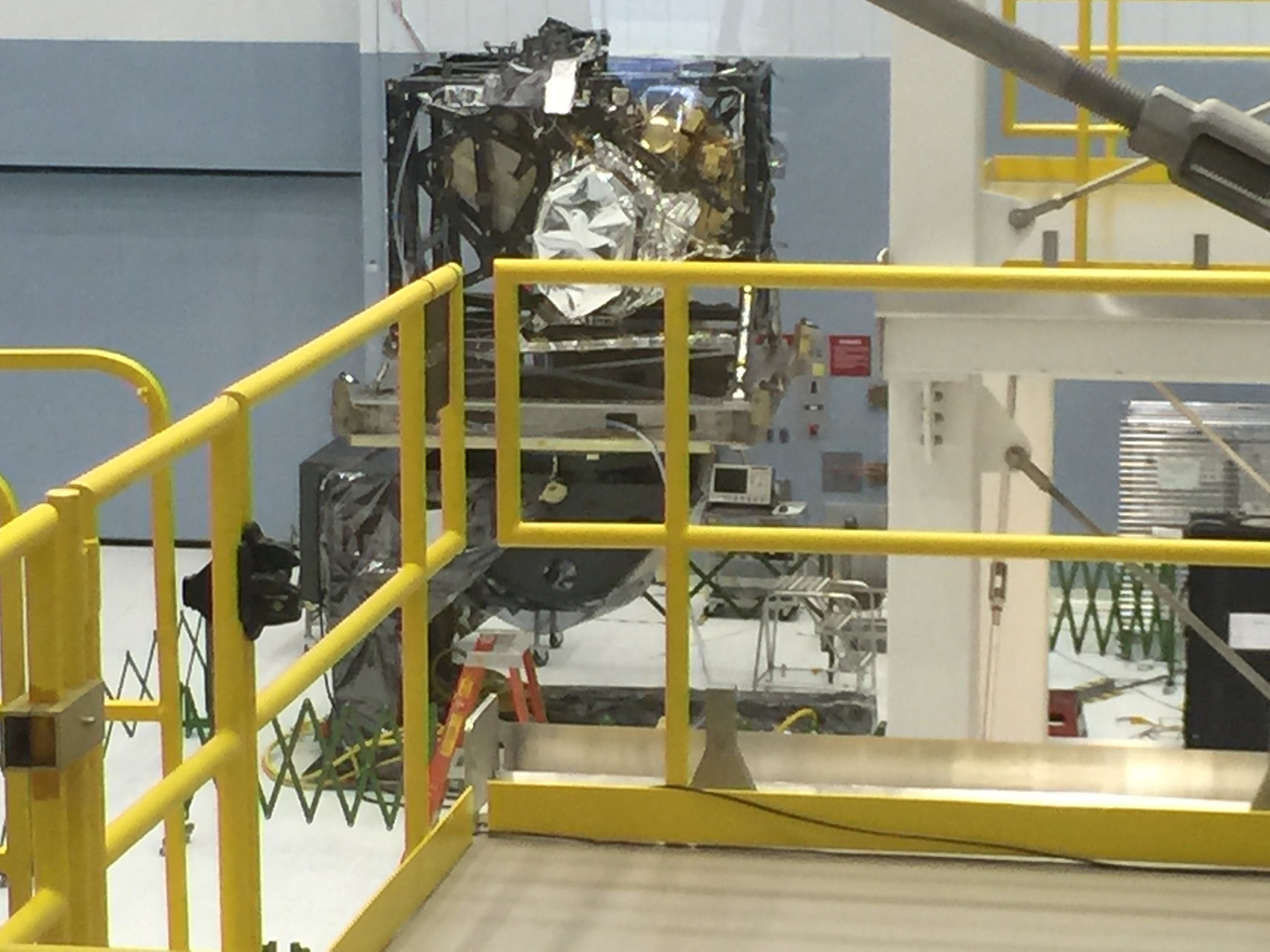
Here you can see part of the flight hardware, the Integrated Science Instrument Module (ISIM). The ISIM will be a large structure at the back of the telescope, behind the mirror, holding all of the scientific instruments that are looking at the image coming off of the main mirror, the secondary mirror (out in front on that tripod structure), and back through the center of the main mirror.

06_IMG_6257 small

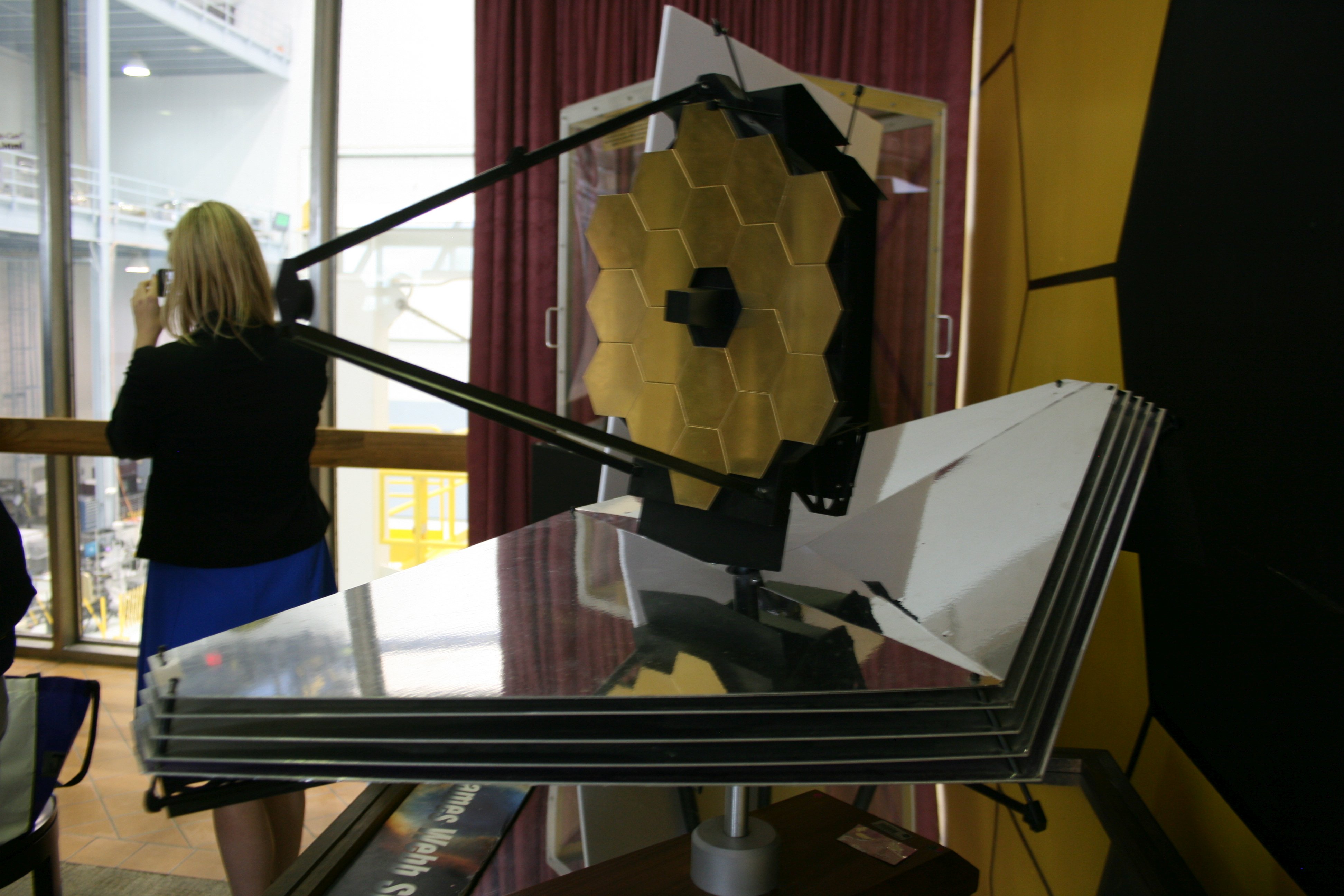
This is the model of JWST in the observation room. You can see how, unlike the Hubble Space Telescope (HST), the mirror for JWST isn’t one solid piece. In order to get this massively huge telescope into a very confined rocket to launch, it’s been designed to fold up like the biggest, most expensive origami piece ever built.

The full-sized mirror will be made of eighteen smaller mirrors, all mounted and actively controlled to make sure that they’re working in unison. The other major feature is the sun shield, seen here as five layers of material underneath the telescope.

The short version is that JWST is an infrared telescope, unlike HST which is primarily an optical telescope. While HST sees pretty much the same bands of light we see, JWST will see longer wavelength light, what we perceive as heat.

Since JWST is seeing heat, anything warm nearby will be like having a bright light near an optical telescope. It would fog and degrade the seeing. In order to counter this, JWST needs to be kept as cold as possible. This will be accomplished by the use of the huge sun shield. Hidden permanently (we hope) on the shadow side of the shield, JWST will chill down to just a few degrees above absolute zero.

The sun shield will be made of multiple thin layers of Kapton, which is incredibly thin as well as opaque to sunlight. The equivalent of an SPF of 10,000, the thinness of Kapton allows it to be folded multiple times in order to fit into the launch vehicle. Remember the Mythbusters episode where they tried to fold a sheet of paper over and over and couldn’t do it past a certain point? Same problem – the thinner the material, the more you can fold it.

As for size, while HST is the size of a school bus, JWST is the size of a 747. To see a picture of the Goddard team along with a full-sized model of JWST, go here.

05_IMG_8290 small

On the wall behind Laura Betz and Maggie Masetti, our hostesses for this part of the presentation, is a partial model of the JWST mirror. Each of the mirrors is over four feet wide, and altogether the primary mirror is far too large to fit on the wall here. In comparison, the HST mirror is about seven feet wide, so it would comfortably fit between floor and ceiling.

Yesterday I mentioned a misconception about HST images, where people would not see the planetary nebula and galaxies with the naked eye as they would in the image, because the image is made of hours of light collection using a huge aperture, where the human eye is small and unable to integrate an image over time.

Another big difference between HST and JWST is that JWST will not be in low Earth orbit (LEO). While it’s (relatively) easy to fix and service a spacecraft in LEO (there were five servicing shuttle missions to HST), it also means that there’s a huge (and warm) planet filling half of your sky all the time. JWST will be put into orbit at the L-2 point, a spot roughly a million miles from Earth. L-2 is a spot between the Earth and the Sun where their gravitational pulls balance out.

That solves a lot of observational problems, but it brings up a lot of operational “challenges.” There are currently no plans to ever be able to service or repair JWST, so it’s a one-shot deal. (I noted that plans change, and we are very clever monkeys when backed into a corner.)

03_IMG_2604 small

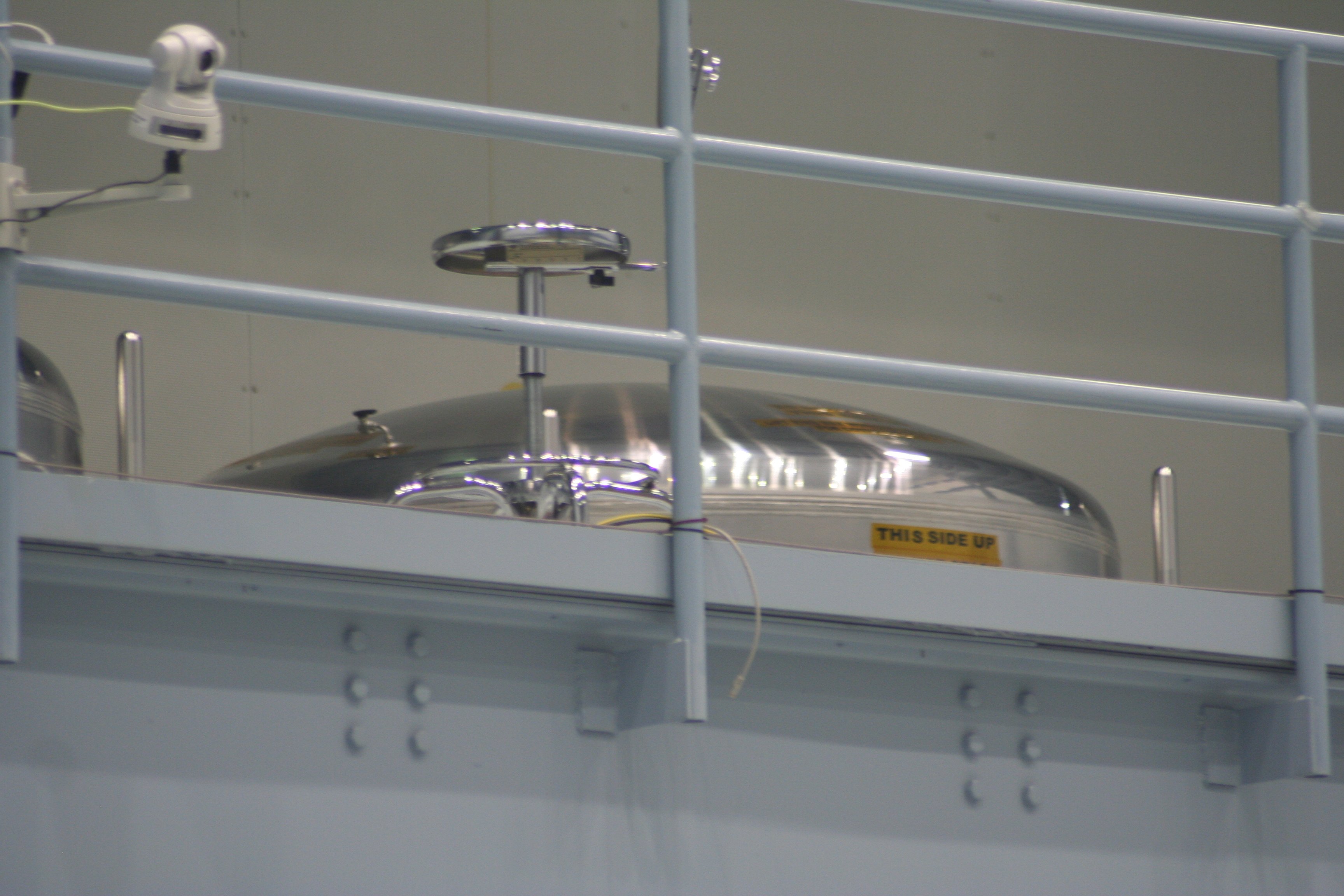
The feed from that little webcam up there is available to the public if you want to see what’s happening in the clean room. Of course, it’s called a Webb-cam.

04_IMG_2605 small

More importantly, those big silver containers are not pods containing alien bodies being prepared to take over humanity. (Or at least, that’s what they said.) They in fact hold the mirror segments that have been assembled and are now awaiting assembly. Over the next two years you might want to check in occasionally to see how assembly is proceeding.

Getting a telescope that big, with all of those folded-up parts, into a package small enough so that it can be launched into space on an Ariane 5 rocket, has got to be a fascinating process to watch. JWST is scheduled to launch in 2018 from French Guiana. With luck both JWST and HST will be working concurrently for at least a year or two. Unlike HST (Happy 25th Birthday!), JWST is only expected to last five to ten years before something fails or the spacecraft runs out of maneuvering fuel.

Gee, for all of those billions of dollars spent on building it, maybe it would be worth figuring out how to spend a bit more and send a crewed Orion out there to refuel and refurbish. Just sayin’!

07_IMG_6267 small

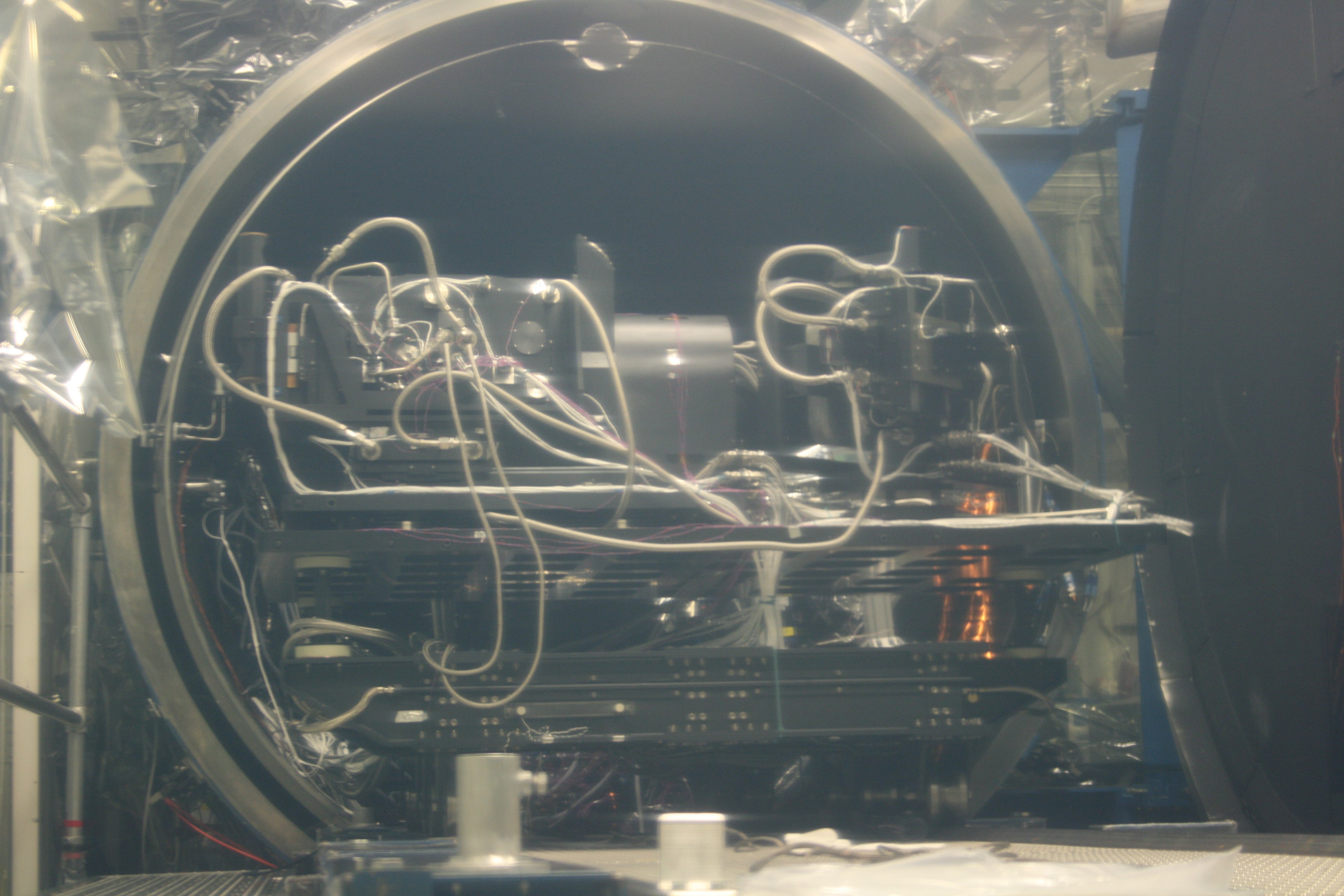
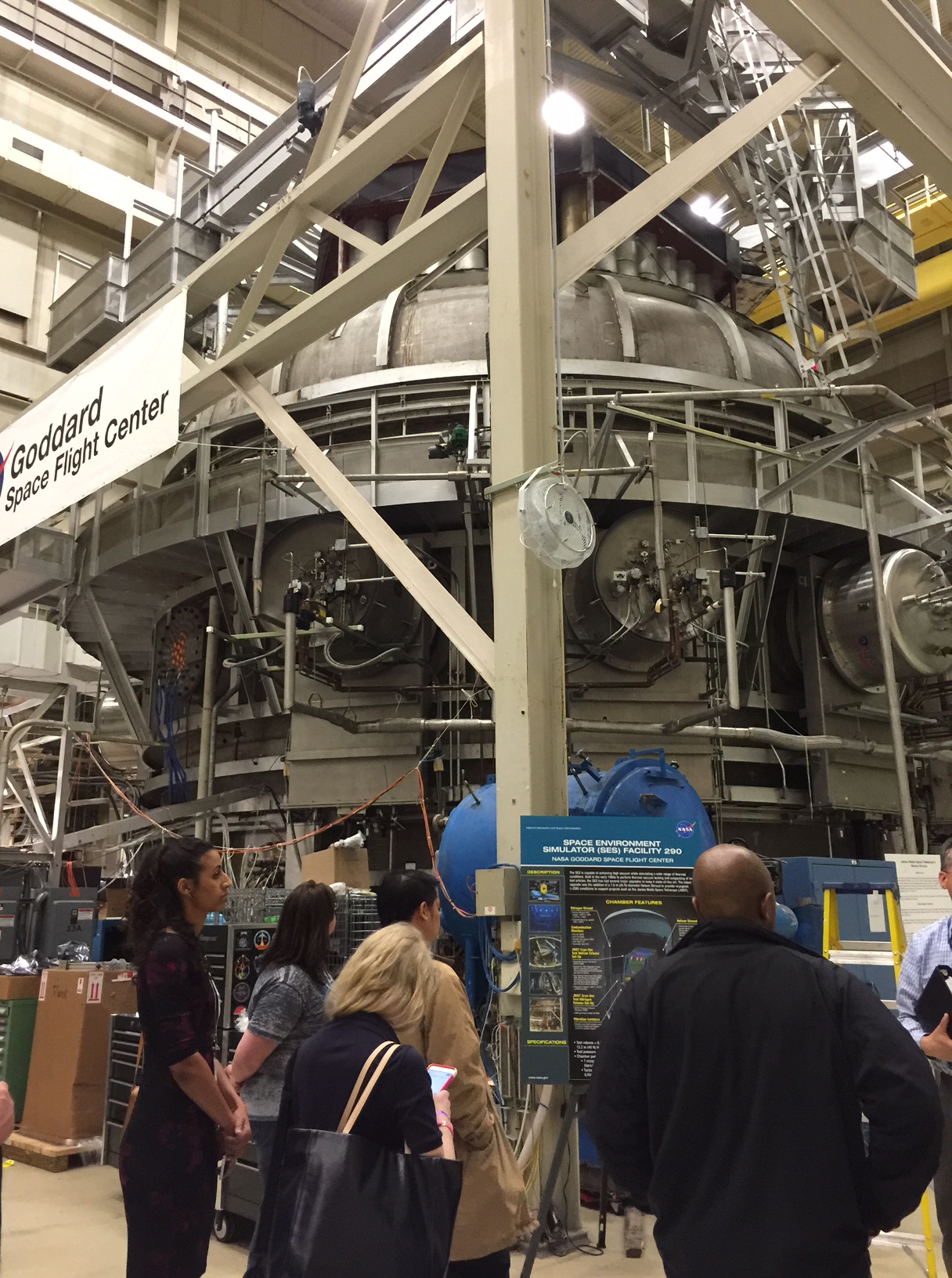
Sent outward and onward, we found the Space Environment Simulator (SES) facility. This chamber actually goes down a floor or more and can be cooled to 20°K, which is -424°F, or heated to 176°F (80°C). This simulates the temperature ranges that JWST will have to endure at L2.  In addition to simulating the extreme temperatures that JWST will live in, the SES can be evacuated down to 10^-7 torr. That’s one ten-billionth of an atmosphere.

While all of this is going on, the SES uses massive amounts of liquid nitrogen and liquid helium to do the cooling. You know those big trucks you see on the freeways carrying liquid gases? (Or the one that gets crashed to freeze the Terminator at the end of T2 – c’mon, you know that you’ve seen it!) The SES uses two of those a day during testing.

08_IMG_6282 smallDr. Dennis Reuter told us about OSIRIS-REx, the Origins-Spectral Interpreation-Resource Identification-Security-Regolith Explorer. As well as being the first US mission to attempt to rendezvous with an asteroid and bring back samples, it’s also proof that the geniuses at NASA can come up with an acronym for ANYTHING.

OSIRIS-REx is scheduled to launch in September 2016 to rendezvous with the asteroid Bennu, an asteroid with a non-zero probability of impacting Earth in the late 22nd Century. (No need to start packing just yet.) It will study what the asteroid is made of (the better to deflect it or otherwise keep it from slamdancing Secaucus) as well as bring back a small sample to be analyzed for organic materials left over from the early creation of the solar system.

This was also one of the nosiest rooms in the world and I only heard about one of every three or four words. The bottom line is that OSIRIS-REx is being tested and assembled now, must hit its launch window in sixteen months, and will give us invaluable data on what we’re dealing with if/when some asteroid draws a bulls eye on our little slice of heaven.

09_IMG_6287 small

The “close-up” of the flight hardware, as seen through the plastic tent protecting it from outside contaminants. (Like us.) Say hello to Bennu for us!

Next, more on HST’s history and some of the other cutting edge projects being worked on at Goddard.

4 Comments

Filed under Astronomy, Photography, Space, Travel

NASA Social For Hubble25 (Part One)

I really did not expect to get an invite to this event, but I am so, So, SO glad that I did. Having attended three previous NASA Socials at NASA Armstrong and JPL in Southern California, I knew that there would be some fantastic material displayed and some amazing people to meet. Since this event was in Washington, DC, I expected the “superstar” factor to be ramped up a notch, and I was not disappointed.

This was the first event where I was in attendance at a NASA press conference. At a couple of the earlier events on the West Coast we had “participated” in the national news conferences, i.e., we had watched and the group had one or two questions transmitted to be answered at the main event.

The 25th anniversary of the launch of the Hubble Space Telescope (HST) is a milestone event, and it was clear that NASA would make a big deal about it. That was confirmed and reinforced when I got to Washington.

IMG_6175 small

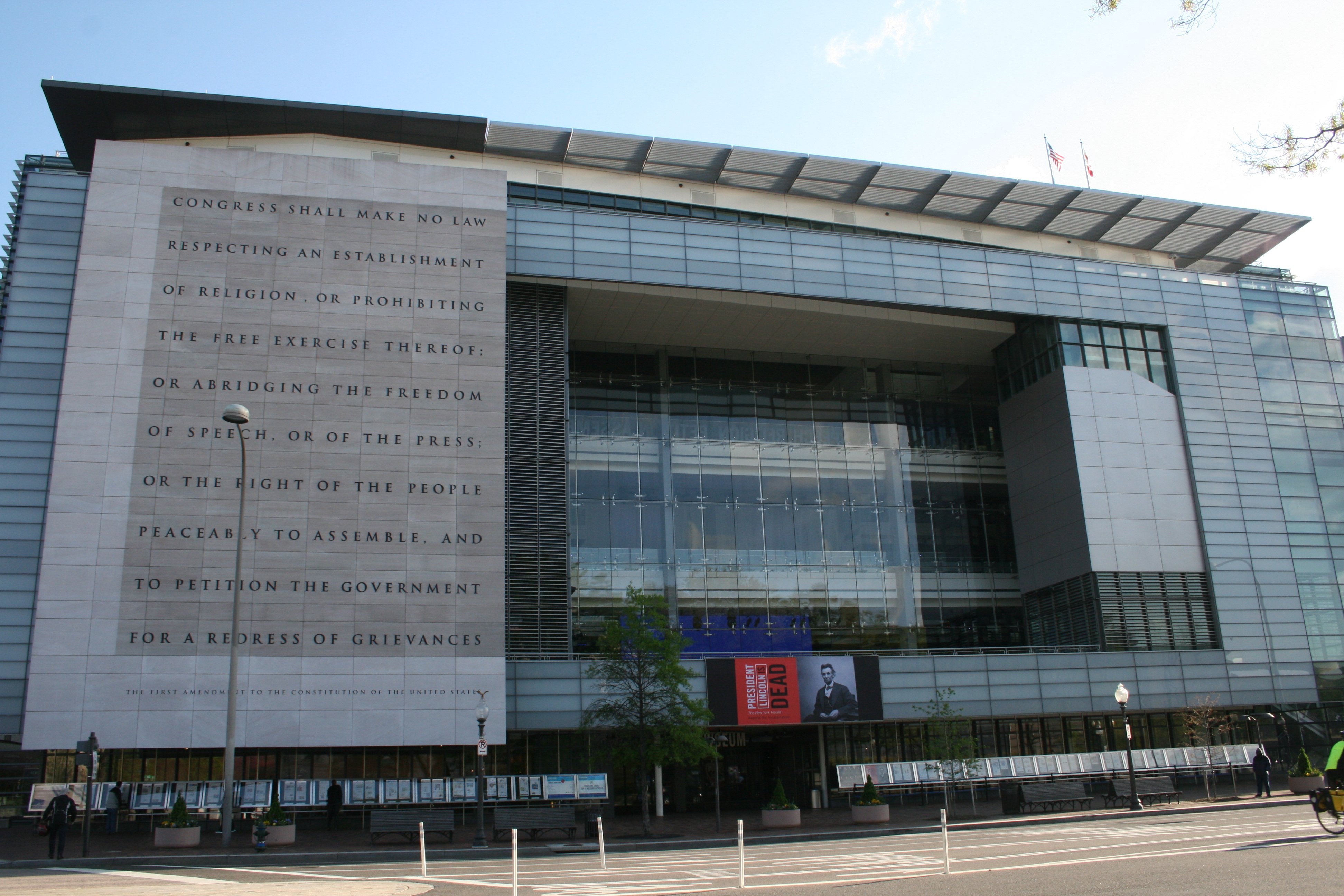
The event was to be held at the Newseum in downtown Washington, just blocks from the Capitol and NASA Headquarters. I had been down to the Mall area the previous day, in part to do the obligatory sightseeing, in part to make sure that I knew how to get there from my hotel using the DC Metro system.

Bright-eyed and bushy-tailed I navigated the system again, getting there a half-hour early. (Much better than getting there a half-hour late.)

Hey, pop quiz! Guess what I spent the half-hour doing? (If you said, “taking a LOT of pictures,” you’re a winner!)

IMG_8227 small

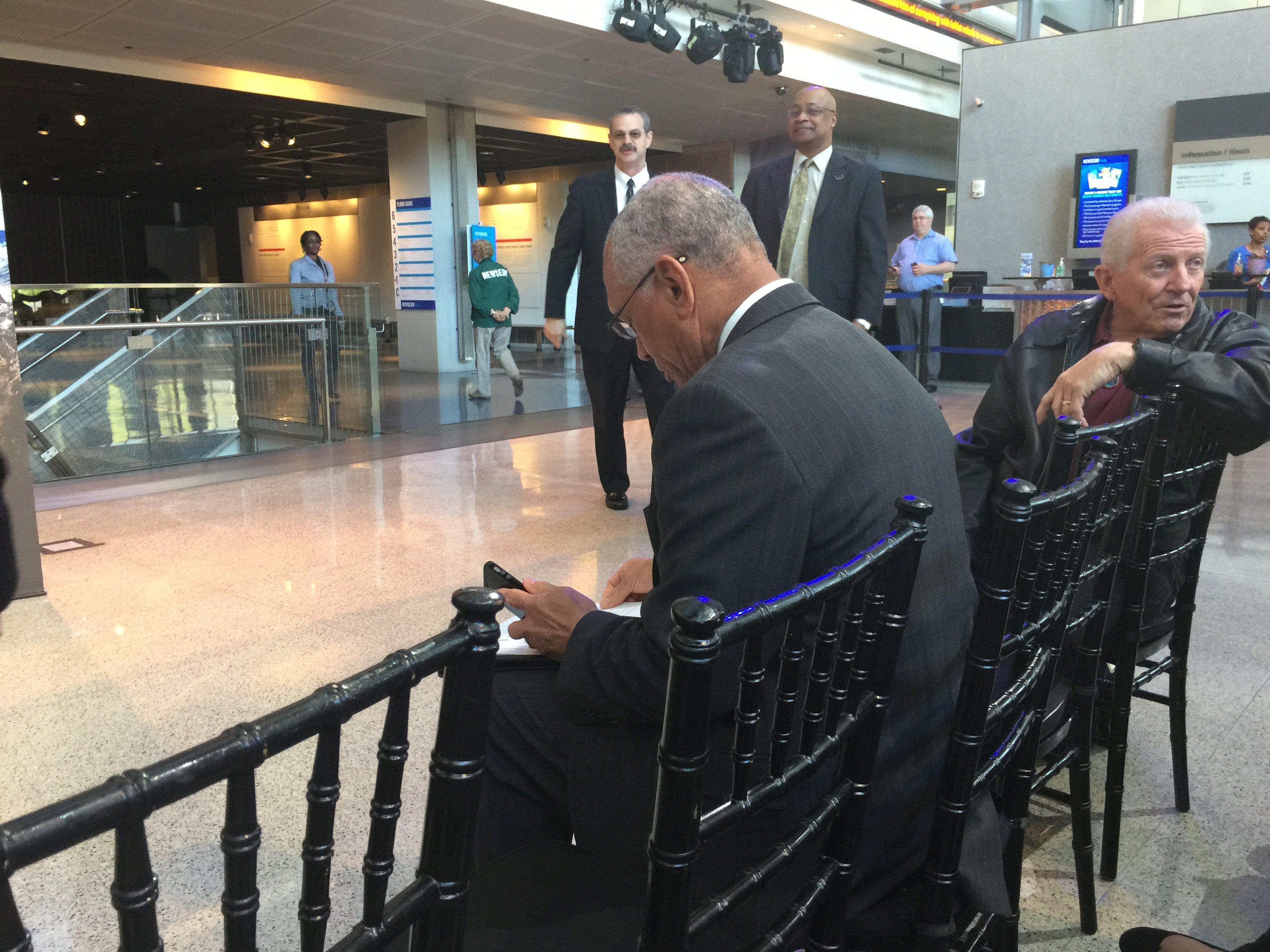
Immediately upon getting inside it was clear that I was not going to be disappointed. Told to grab a seat anywhere except for the first row center seats, I got second row center. Yes, that would be just two seats away from USMC Major General (retired), four-time Space Shuttle astronaut, and current NASA Administrator Charlie Bolden.

I did my best to use my “inside squeee.” No one was looking at me funny (well, no funnier than normal) so I guess I did okay.

Other people looked familiar. Not all were wearing the “normal” NASA astronaut gear (that gorgeous bright blue jacket or flight suit) but my Google-fu was strong. It wasn’t hard to figure that they might be astronauts from the six Space Shuttle flights that launched and serviced HST.

IMG_6184 small

After getting mic’d up and some basic stage instructions on what was going where and who was going up to speak when, we got the usual call of, “We’re live in five, four, three…”

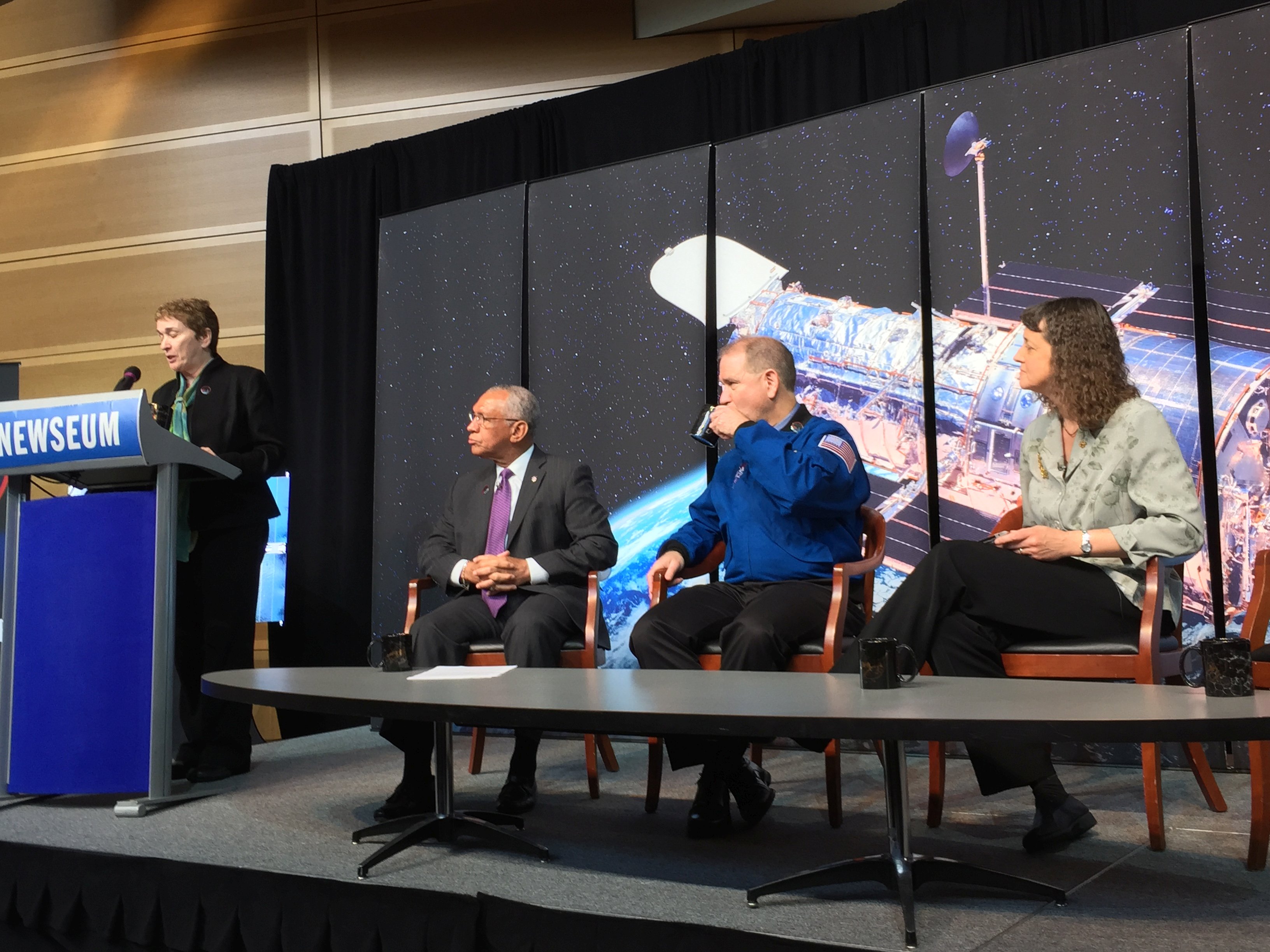
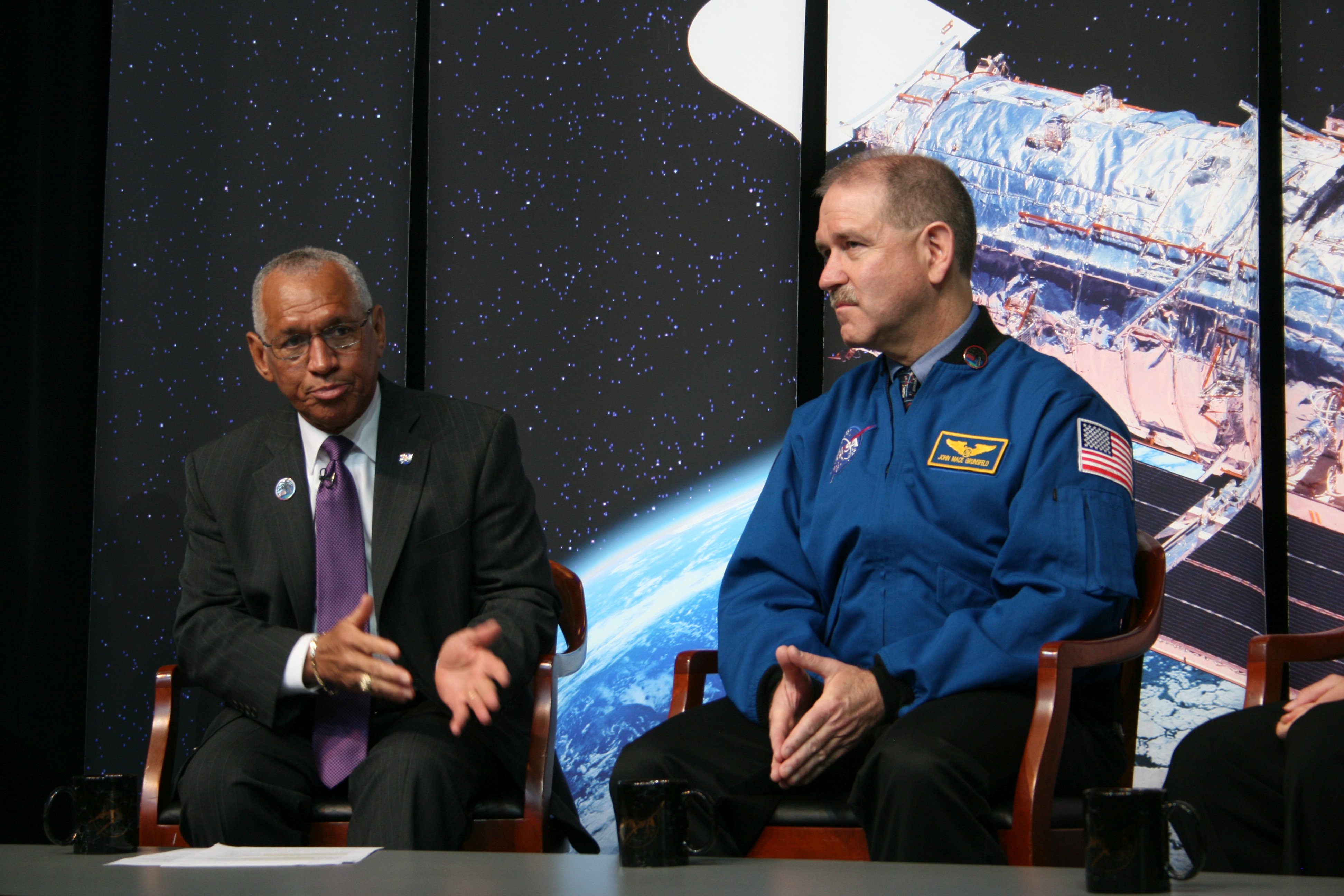
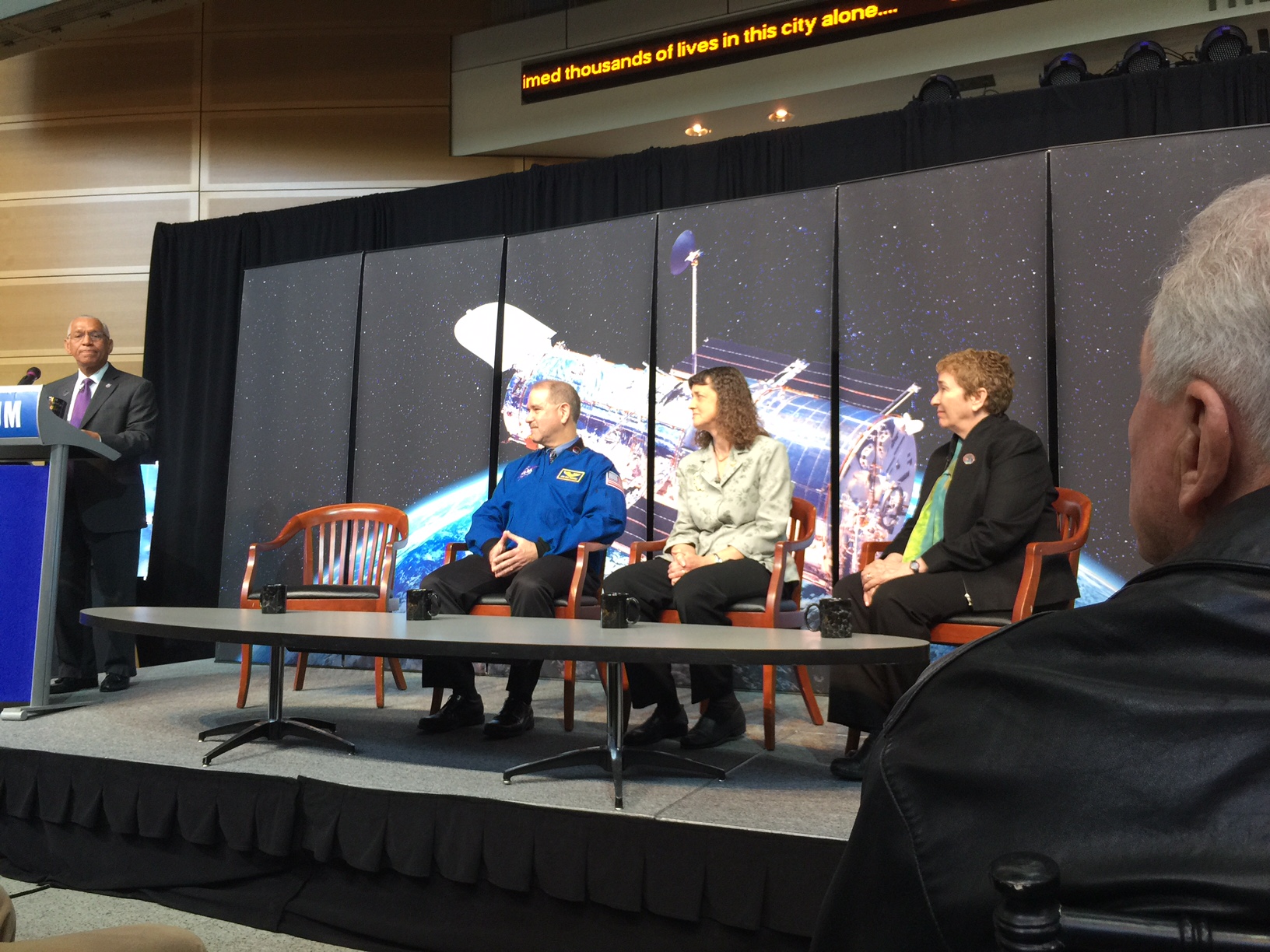
Sitting left to right are Charlie Bolden, John Grunsfeld (five-time Space Shuttle astronaut and current NASA Associate Administrator for the Science Directorate, wearing one of the aforementioned bright blue NASA astronaut jackets), Dr. Jennifer Wiseman (senior project scientist for HST at NASA’s Goddard Space Flight Center), and Dr. Kathryn Flanagan (Deputy Director of STScI, the Space Telescope Science Institute).

IMG_8242 small

That’s some heavy duty personnel for a space cadet like me! You can see the press conference here — I’m in the red shirt near the stage and for the most part they got my good side (the back).

Charlie Bolden has a personal connection to HST – he was onboard the Space Shuttle mission that launched it twenty-five years ago. HST is generating over ten terabytes of data a year and has lasted far longer than it was originally intended to function. That’s in large part due to the five servicing missions by Space Shuttle crews that have rebuilt almost every major system and control on the spacecraft.

HST is now expected to last until at least 2020, barring some sudden, catastrophic failure of a key system. That’s important, because HST’s successor, the James Webb Space Telescope, is supposed to launch in 2018. It would be wonderful if the two telescopes could operate together, reinforcing each other’s observations, for at least a year or two.

Grunsfeld noted that there isn’t anyplace he would rather be than in space. He would go up to ISS in a heartbeat, or on Orion, or to Mars… Bolden just kept nodding agreement.

IMG_8237 small

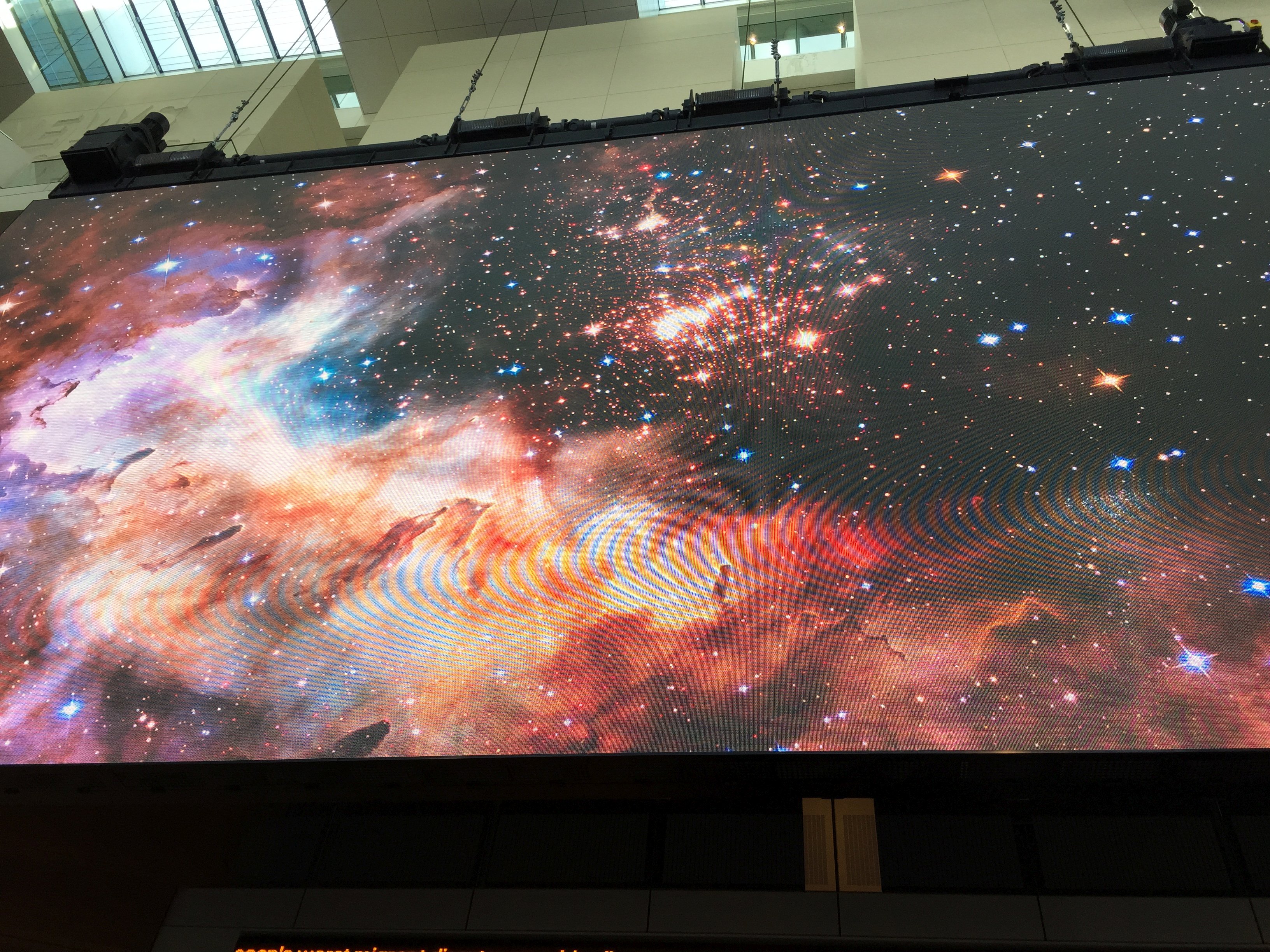
Once all of the opening comments had been made, the big reveal was done by Bolden and Grunsfeld. This new image is a star cluster called Westerlund 2, showing about 3,000 stars embedded in a nebula about 20,000 light years away.

Go see the new image in as much resolution as you can get (a 80″ 4K ultra-high-def monitor will work just fine), and also watch the 3D animation that’s on that site, showing what it would be like to fly through the cluster. Granted, you would have to fly through it at several thousand times the speed of light for it to look like that, and then it wouldn’t look like that because it would be blue-shifted in the X-ray spectrum, and NASA isn’t saying that it’s got the technology to travel at several thousand times the speed of light — but you know what I mean.

As good as it looks on your monitor, it’s hard to beat having it over your head on a high-def monitor about sixty feet across, while you’re sitting next to a bunch of shuttle astronauts. (Just sayin’. Yeah, sorry, still squeeeeing a bit inside.)

IMG_6189 small

After the reveal there was a Q&A session. Among the best questions asked and answered was one regarding common public misconceptions regarding Hubble. The answer went to something that I learned long ago in college when I was taking an upper-level course on stellar astrophysics.

We look at all of these images and we see them in bright colors. Some of the images are actually not taken in visible light, but in infrared, ultraviolet, or some other frequency of light. They’re then turned into “color” images based on some scientific and some artistic criteria. Plus, I’m talking about just the images released to the public – some data is just that, data, and never gets turned into an image, or if it is, will be completely false-color for the researcher’s benefit to highlight some aspect of the data or another.

But even for pictures taken in visible light, most people believe that if we could somehow be transported much, much nearer to these objects, they would look to our eye the way that the Hubble pictures make them look, and that’s not true. The other factor involved is how dim these objects are. If you were floating in space somewhere where you could see, say, the Pillars of Creation nebula, you wouldn’t see all of those stunning blues and yellows and oranges. You would see the couple of bright stars in the field, but the clouds of dust and gas would be black, grey, or at best, a faint, foggy white.

The reason that the Hubble pictures look so vibrant (and this is true of any astrophotography of deep space objects, even ones done in the 1950’s by ground-based telescopes or done today by amateur astronomers like myself) is because they collect far, far more photons than the human eye can capture. The pupil of your eye is less than a centimeter across – the HST mirror is over seven feet across. In addition, your eye collects data and sends an image to your brain hundreds of times a second – the HST photos are the result of hours (and in some cases days) of accumulated light collection.

The other great observation of the day came from John Grunsfeld when he noted that Hubble hasn’t discovered a single thing. It’s just a robot, a tool. The people who built it, launched it, and run it are the ones who have made the discoveries and changed the way we look at the universe. An excellent observation, and important to keep in mind.

IMG_6197 small

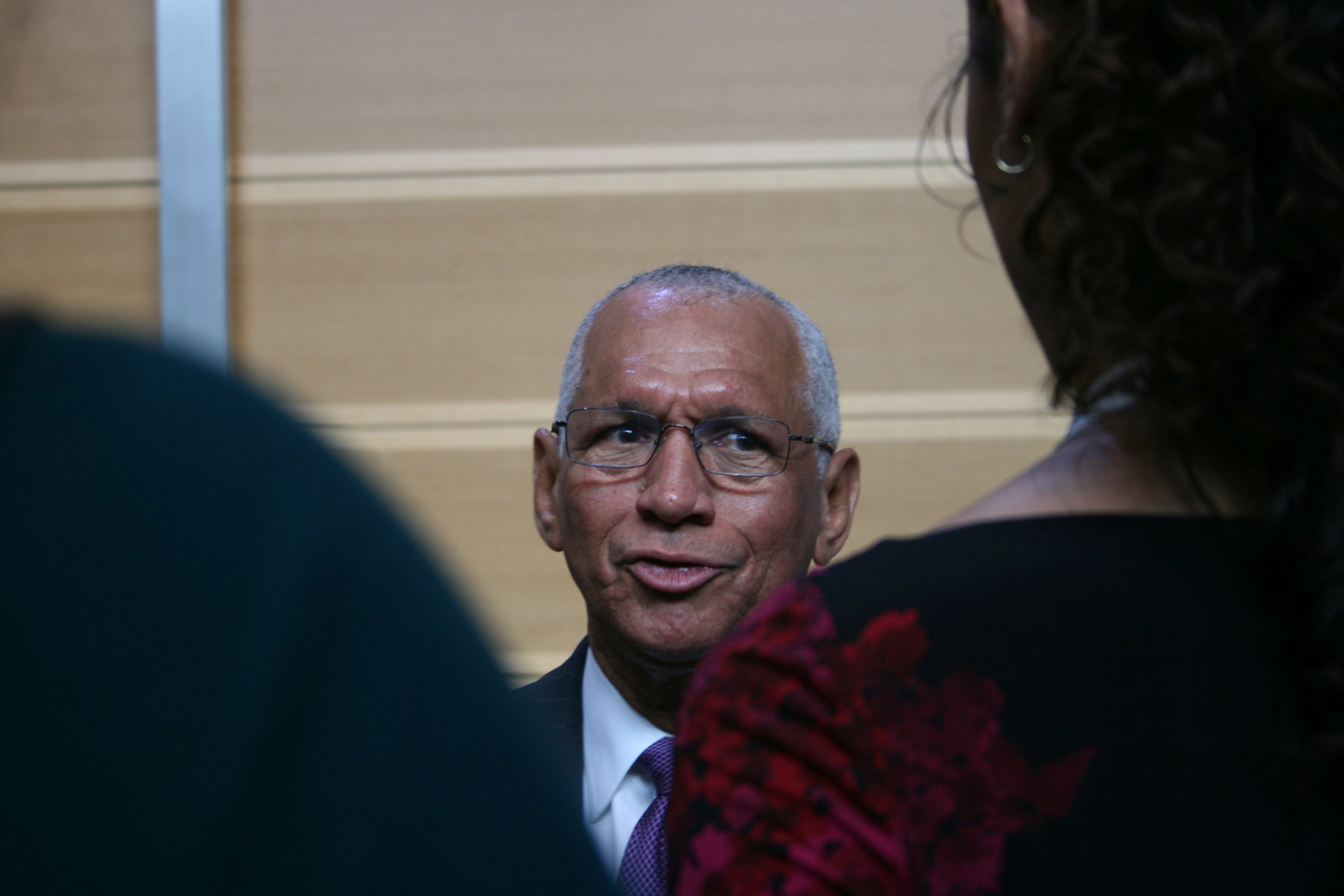
After the press conference, I got to meet and chat for a brief second with Charlie Bolden, and listened in while he was interviewed by a reporter.

IMG_6195 small

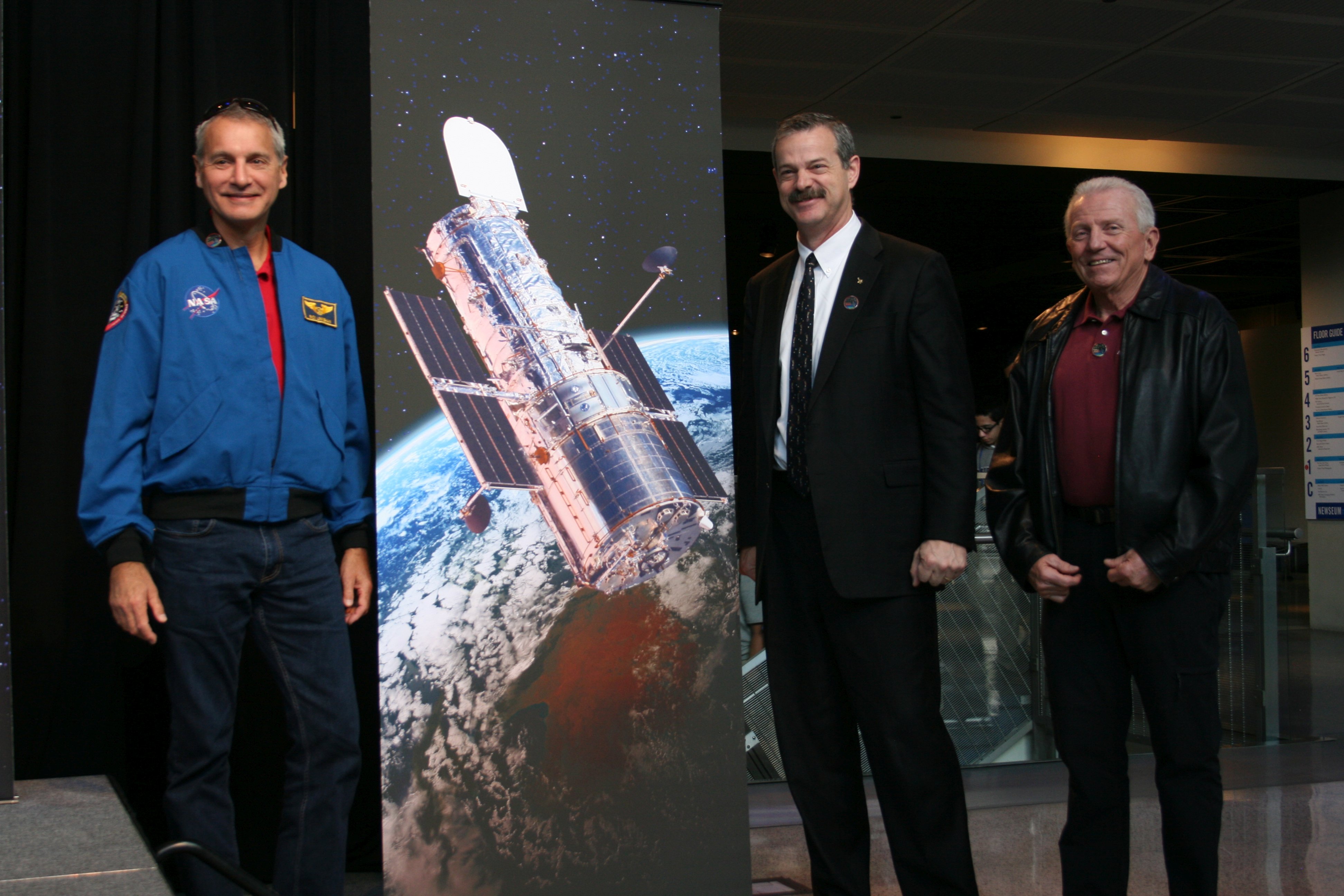
Other than Bolden and Grunsfeld, there were three other Space Shuttle astronauts there, here seen posing next to one of the posters showing the HST. From left to right are Richard Linnehan (four Space Shuttle missions, including the fourth HST servicing mission), Scott Altman (four Space Shuttle missions, including being the mission commander of the fourth and fifth HST servicing missions), and Loren Shriver (three Space Shuttle missions, including being the commander of STS-31, which launched HST).

IMG_8253 small

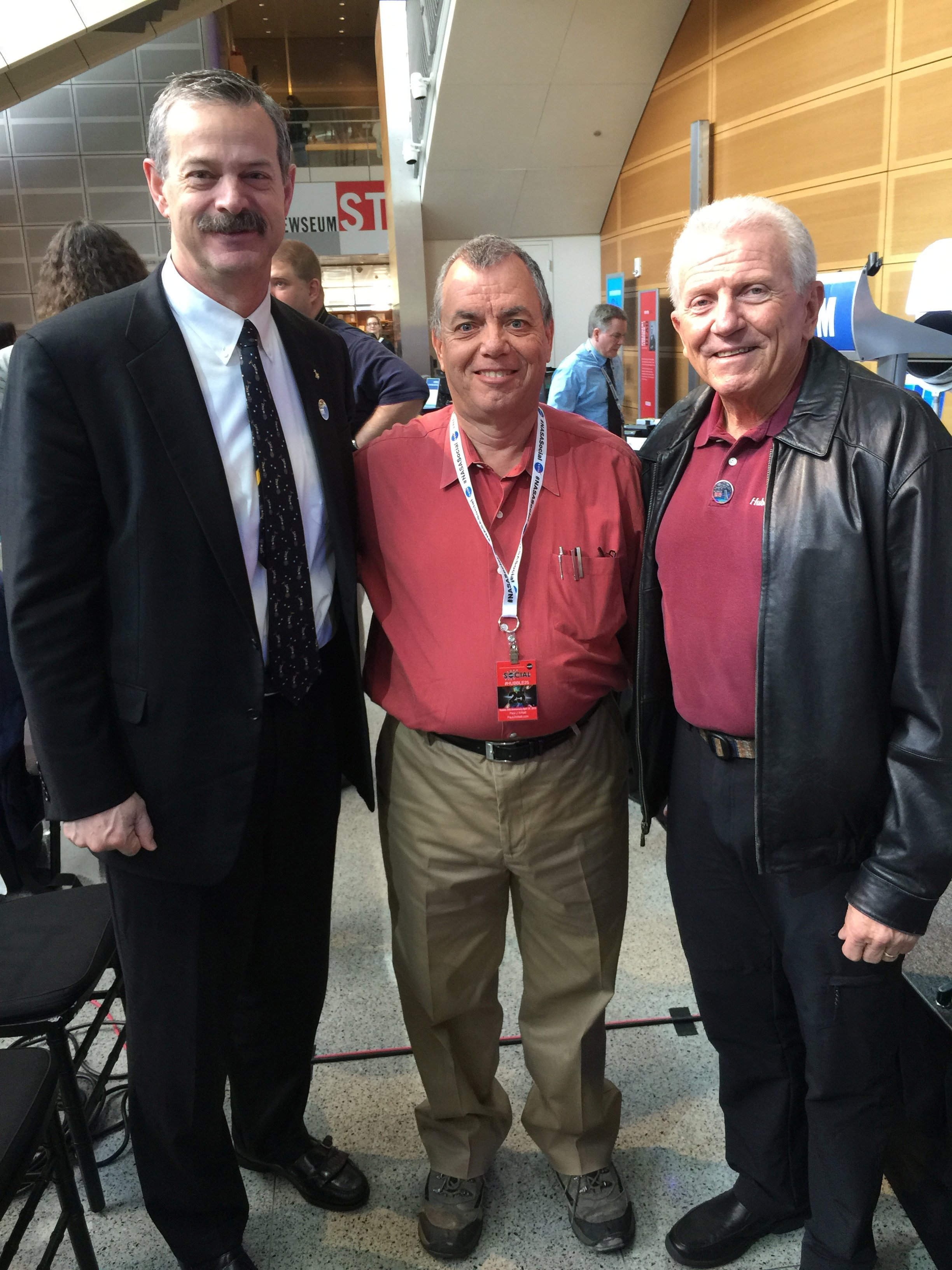
Normally, I’m not one to be asking folks to get my picture taken with them, but in this case I made an exception. I had been talking to Altman and Shriver for several minutes about the future of HST and there had been a steady stream of other NASA Social attendees coming up to get their pictures taken with them. “When in Rome…”

Yeah, still squeeing.

Next, the rest of the day at Goddard Space Flight Center.

Leave a comment

Filed under Astronomy, Photography, Space, Travel

Sunday In DC Snapshots

Number One issue this week with trying to keep up on this site – hotel internet that sucks, sucks, sucks. Aside from the fact that it’s running at barely 2 Mbps download and only 0.28 Mbps upload, that’s when it’s actually up. I can always connect – but it freezes or locks up and I have to re-connect every five minutes or so.

Note to self – Self, add to the travel checklist, “Check internet & wi-fi speed and Yelp comments before booking hotel!”

Final day of sightseeing, glorious weather, one really sore toe with a blister, but some great sights. More, of course, when I get back home and can actually connect and post something like this in a half hour rather than in three hours.

IMG_8719

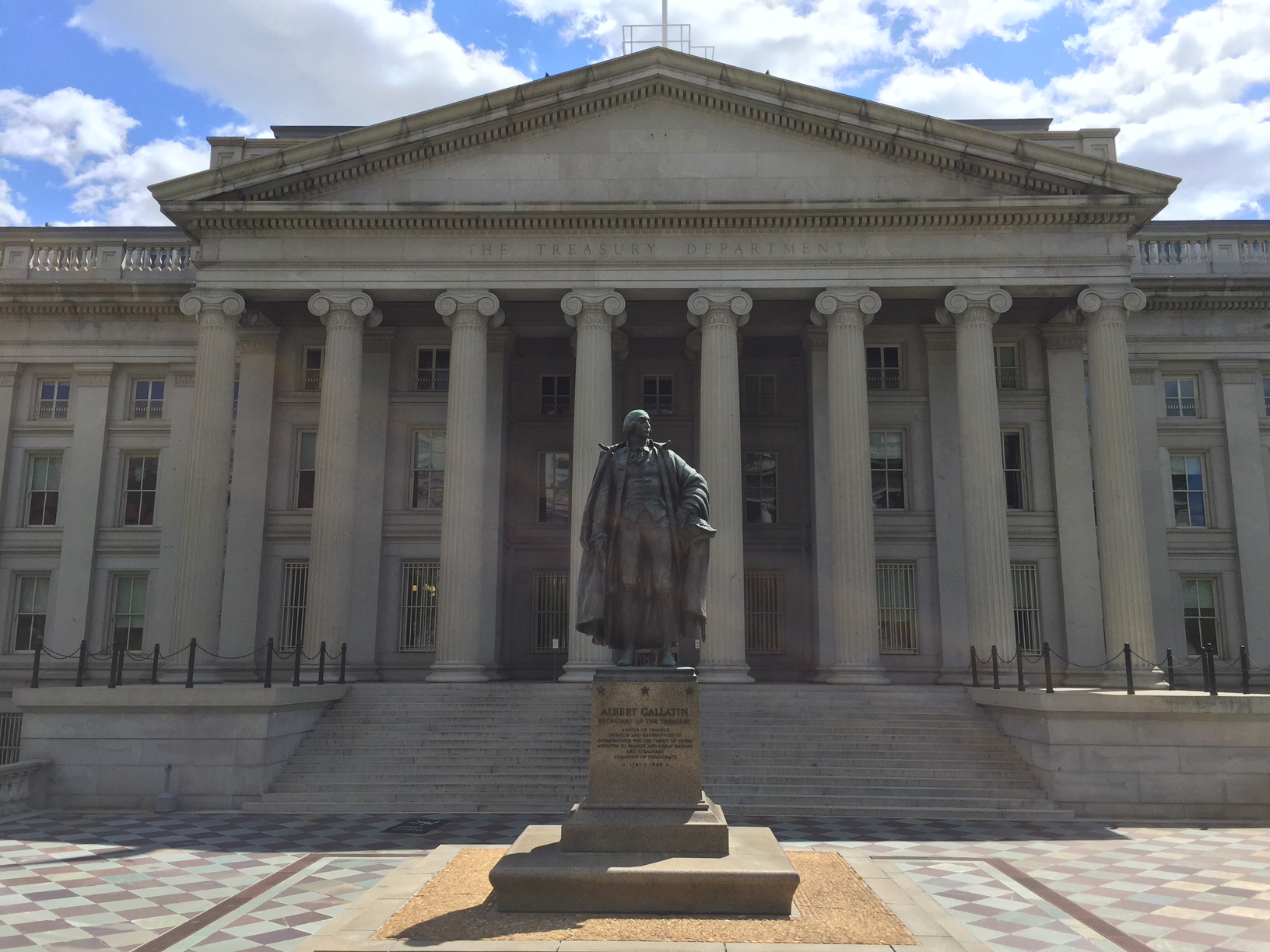
Treasury Department

IMG_8725

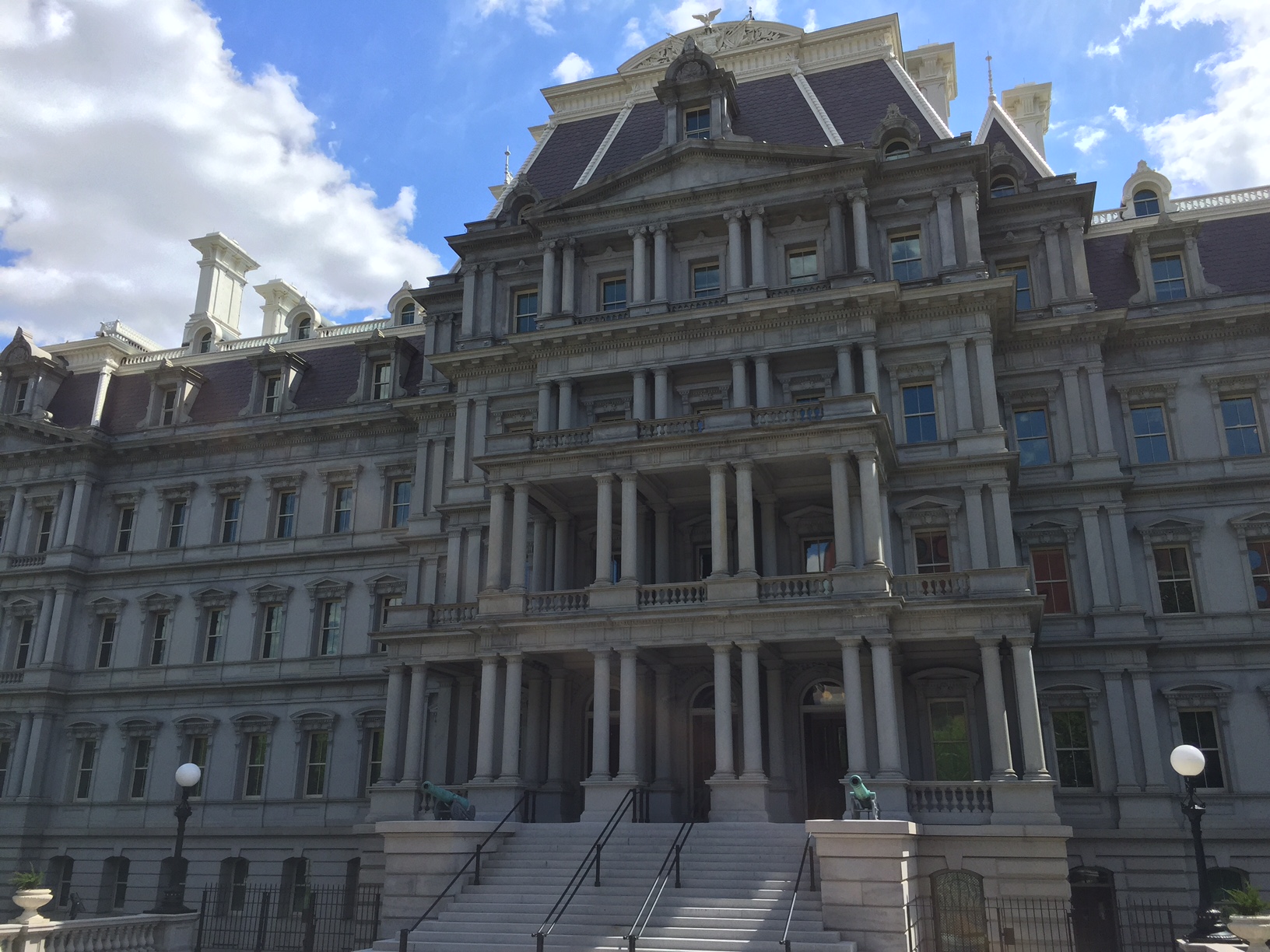
Eisenhower Executive Office Building

IMG_8729

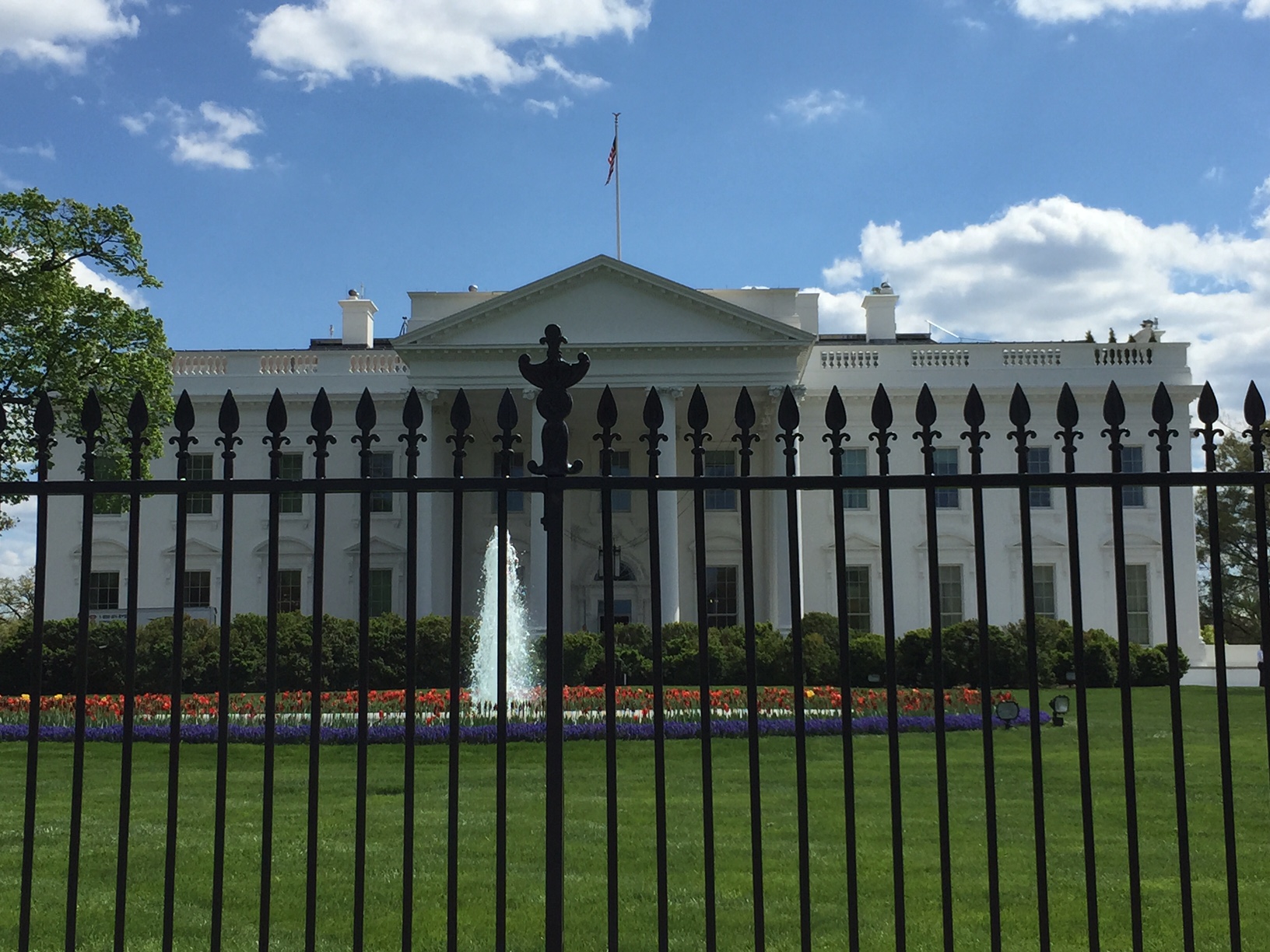
White House

IMG_8732

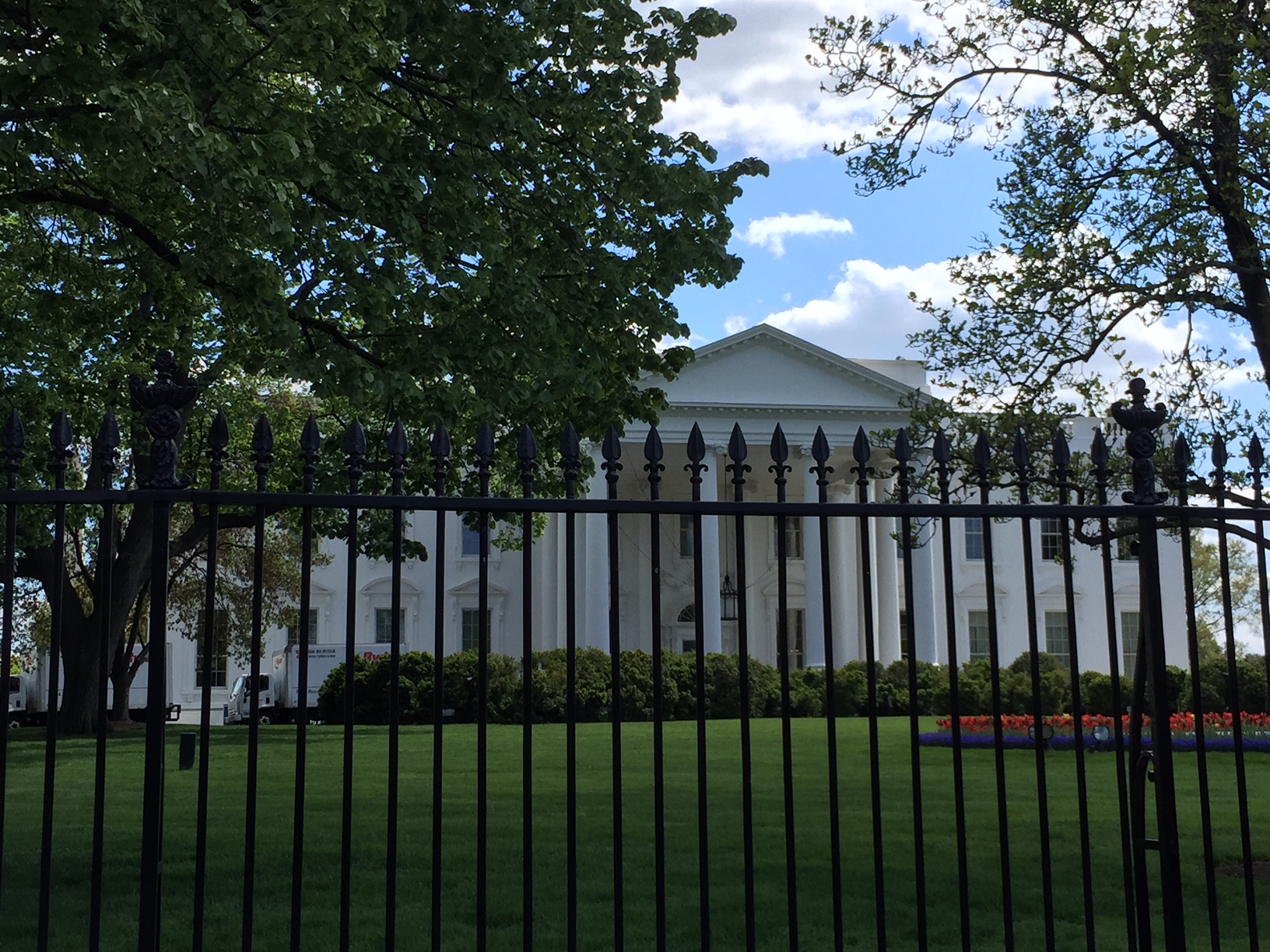
White House

IMG_8738

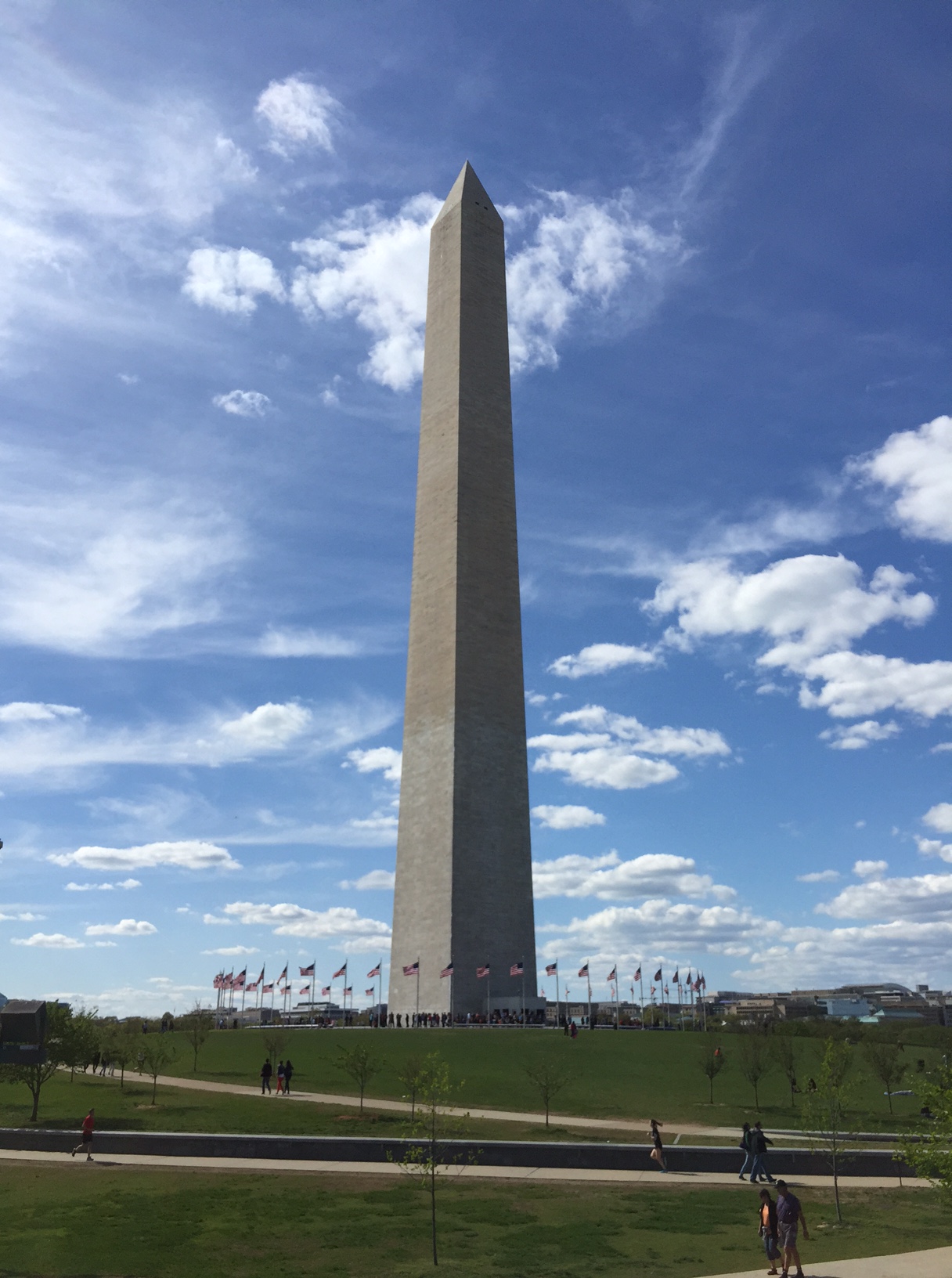
Washington Monument in the warm sun instead of ungodly cold & rain

IMG_8745

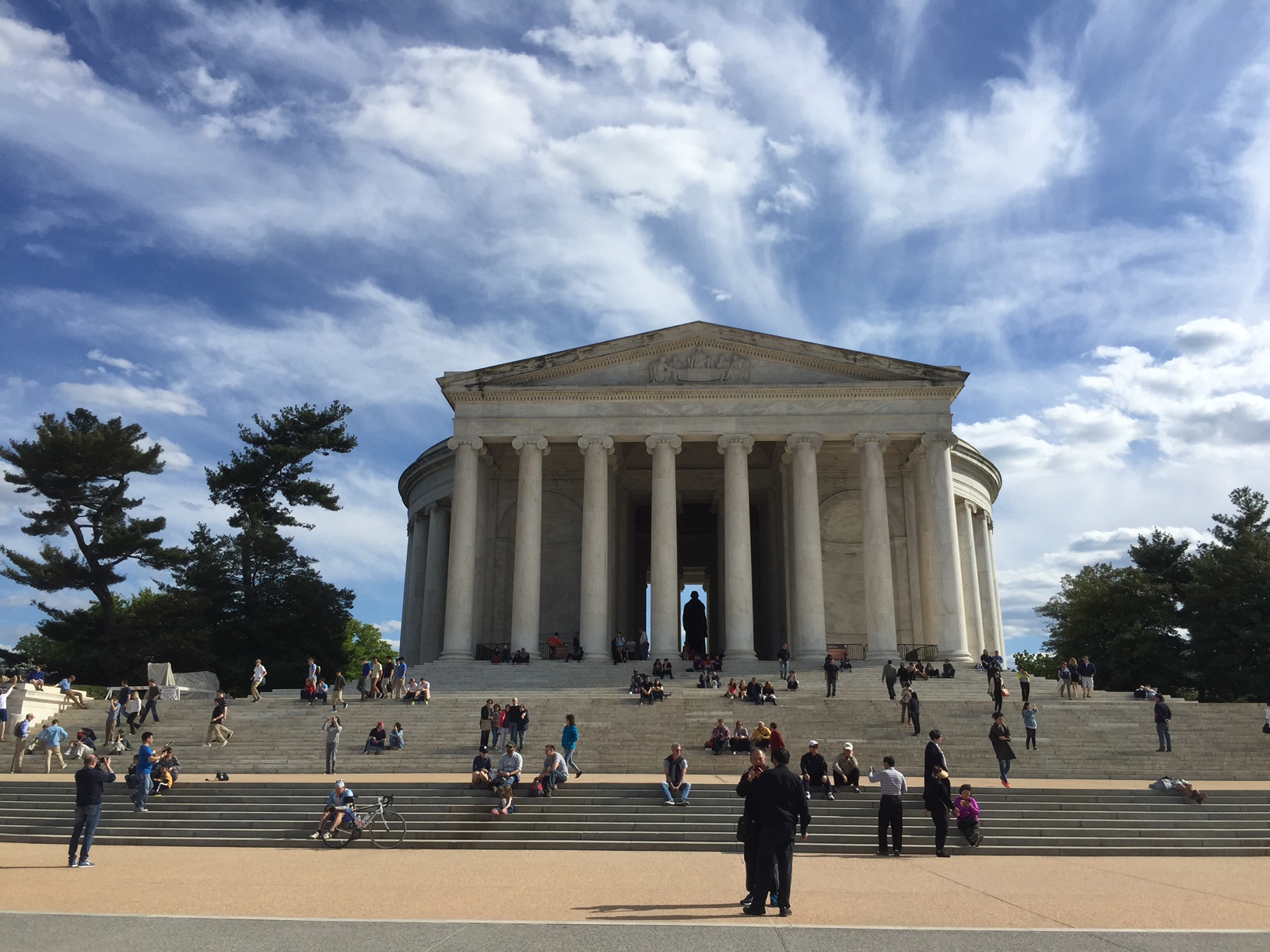
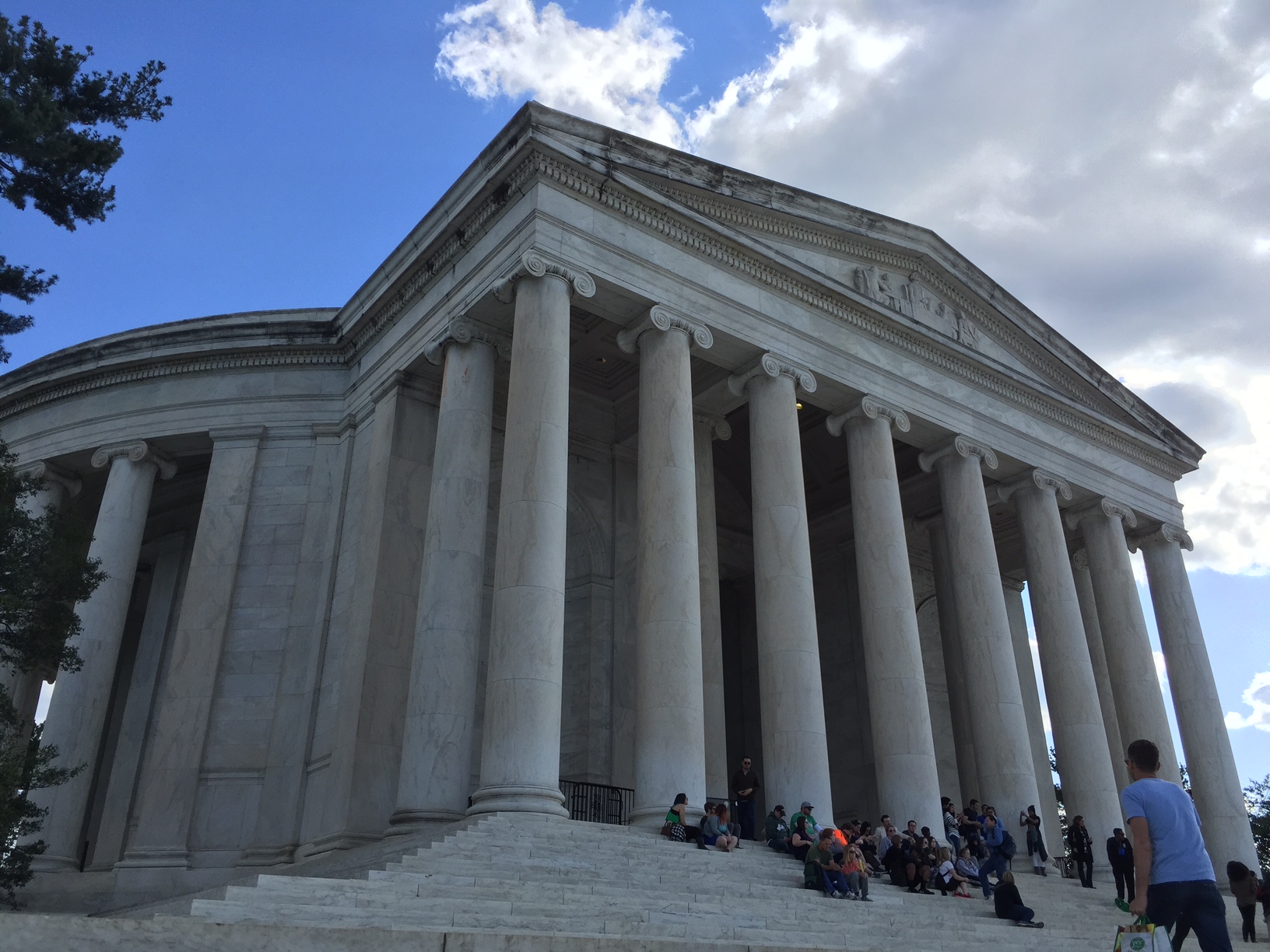
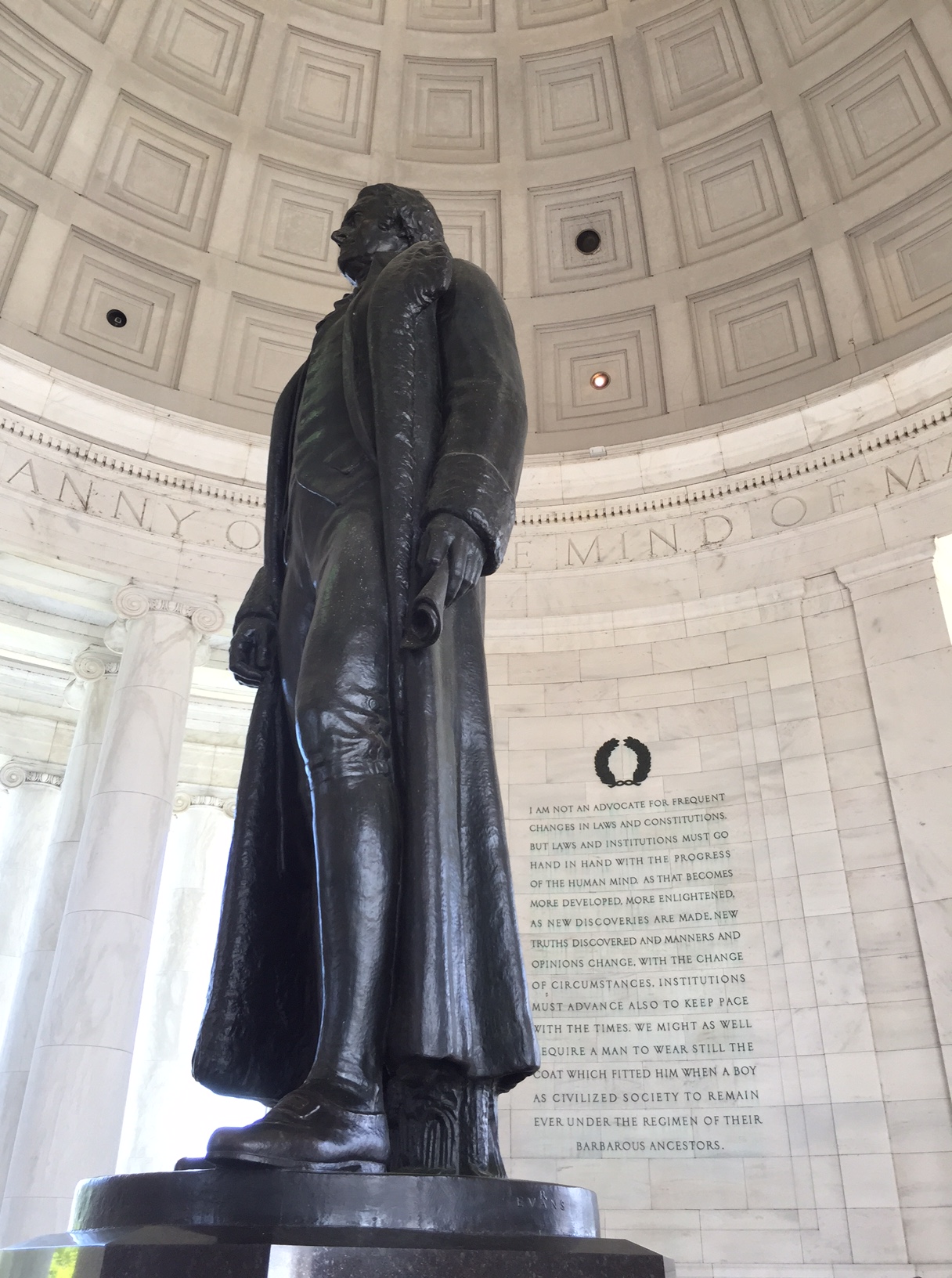
Jefferson Memorial. First time I’ve ever visited here.

IMG_8768Jefferson Memorial

IMG_8748

Jefferson Memorial. I love this picture.

IMG_8777

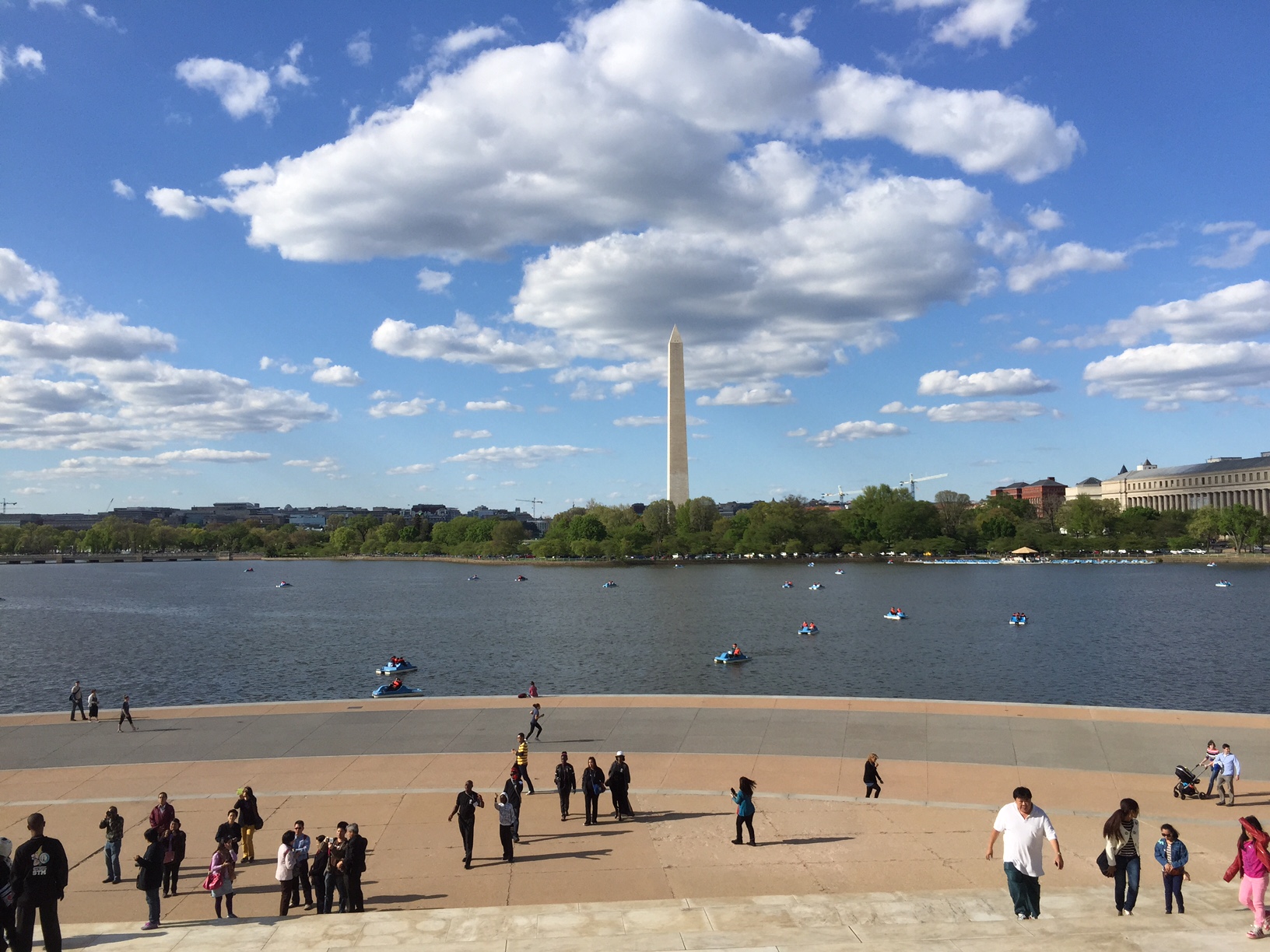
From the steps of the Jefferson Memorial, across the Tidal Basin full of paddle boats, you can see the White House through the trees to the left of the Washington Monument.

2 Comments

Filed under Photography, Travel

Saturday In DC Snapshots

So much to talk about in more detail about all of this! So, so late getting back to the hotel every night! So, so, so sick of the hotel internet being about as fast as a 9600 baud modem (google it, kids) and dropping out every couple of minutes. Trying to upload photos is so slow that it’s like watching grass grow.

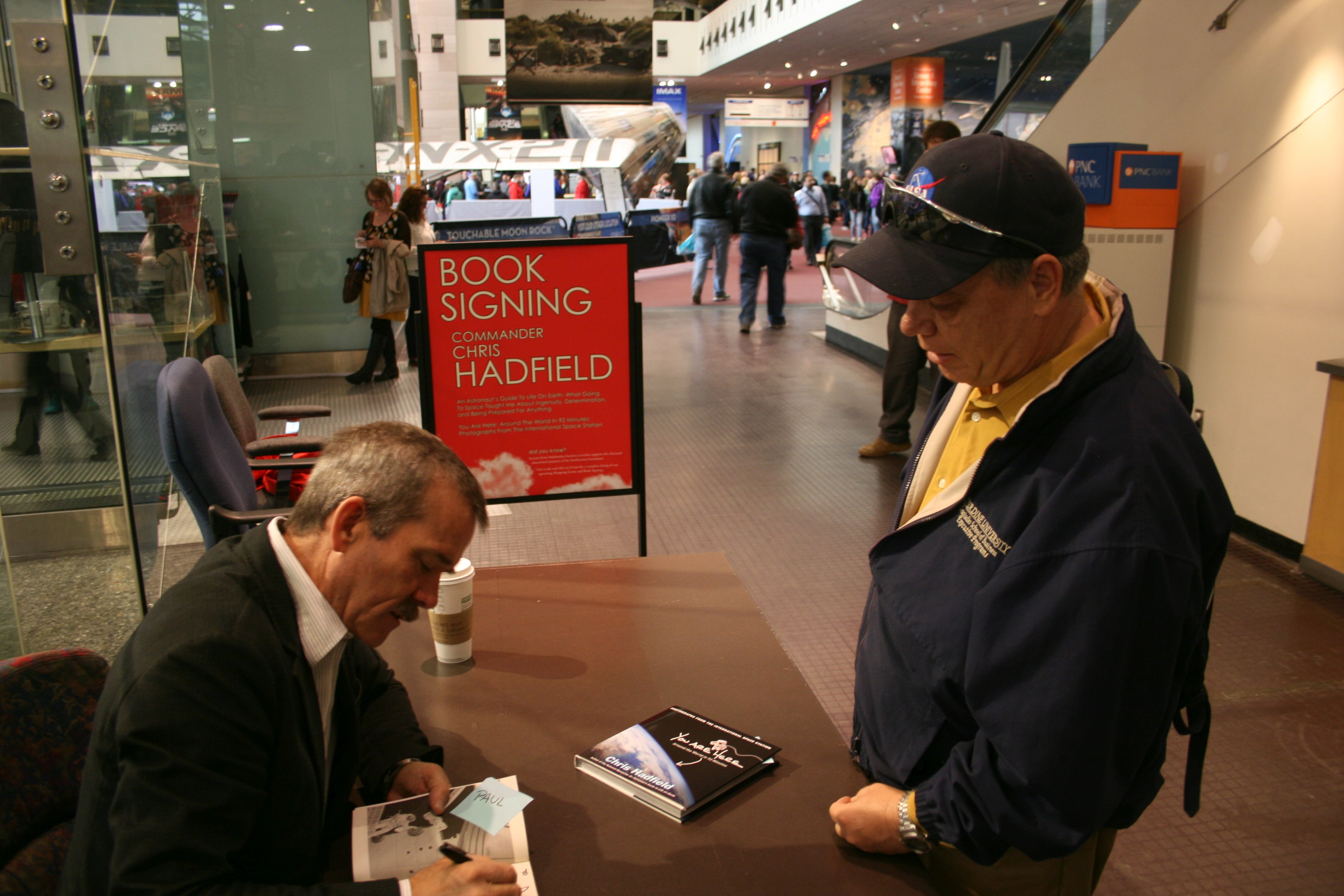
I found myself back at the Smithsonian Air & Space Museum today. Not that I really needed a big excuse, but I had heard that there was a certain Canadian astronaut, musician, and author who would be there signing his two books. I figured there might be an hour or more wait, but it would be worth it anyway. Instead, it was a twenty minute wait and there was time to actually chat for a minute or two about his work, the CAF, his F-86 Saber jet, and his concerts with Amanda Palmer.

If that’s not a highlight in a week full of highlights, I don’t know what would be!

Then, of course, as long as I was already there and there were a few galleries that I hadn’t seen yesterday… And where yesterday the HUGE Robert McCall mural in the main hallway had been mostly covered up by curtains hiding construction equipment, today it was there to be seen in all of its glory… And then, since there are other things in DC besides NASA Socials and museums and monuments, I met The Long-Suffering Sister-In-Law for a dance performance at her daughter’s college.

And now it’s again after 1:45 AM local and the wi-fi just went out for the 100th time… Snapshots, just snapshots for now.

IMG_7115 small

IMG_7129 small

IMG_8647

IMG_8665

IMG_8668

IMG_8674

IMG_8685

IMG_8707

IMG_8709


Leave a comment

Filed under Art, Astronomy, Family, Photography, Space, Travel

Air & Space Museum Snapshots

What another wonderful, exciting, amazing day! And the hotel internet still sucks.

Again, many pictures (probably not these exact ones) along with comments and captions were posted to Twitter (@momdude56) and you can see them on the right side of the screen. Again, I will bury you with more pictures and stories and things when I can about today’s adventures.

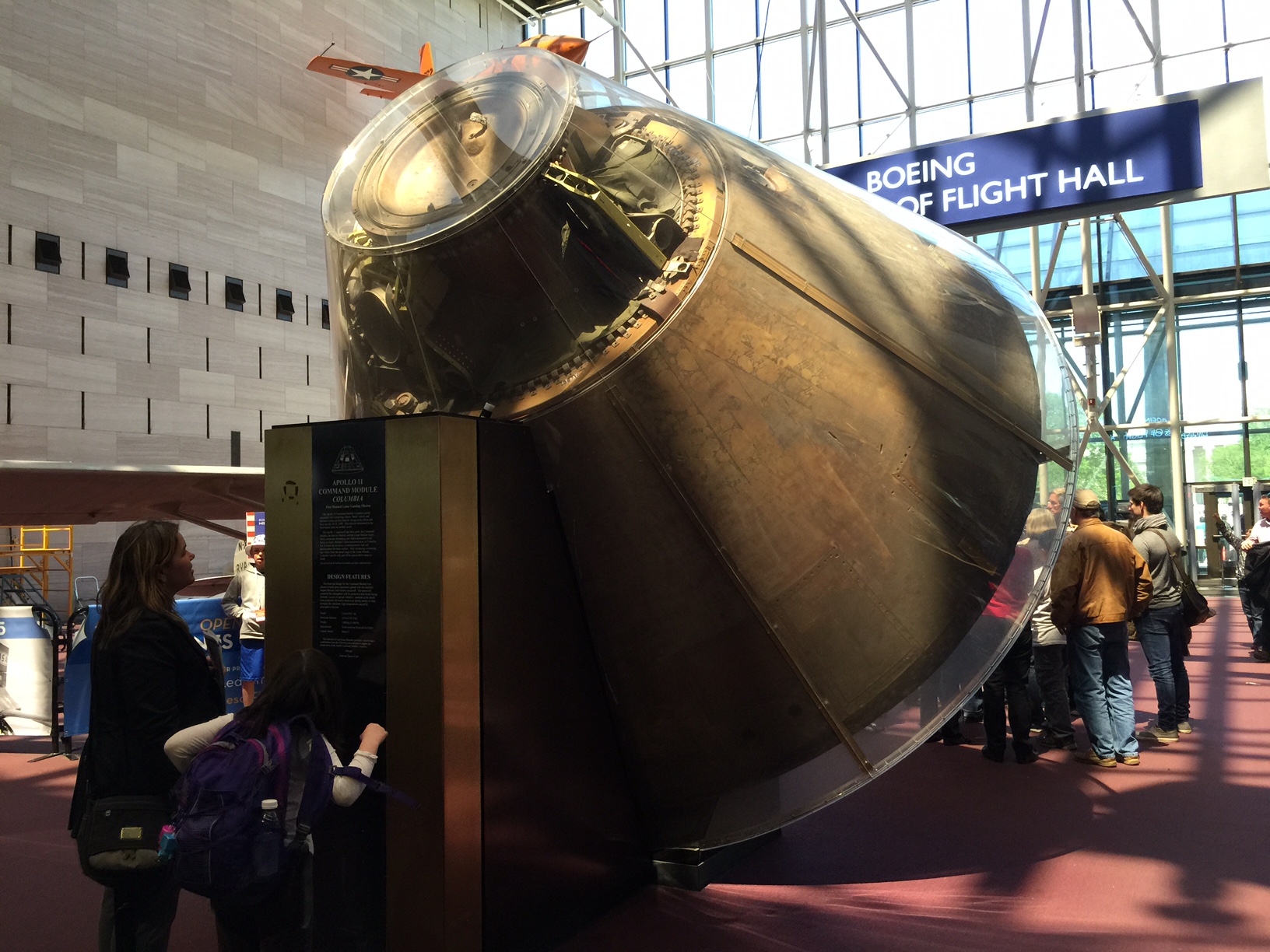
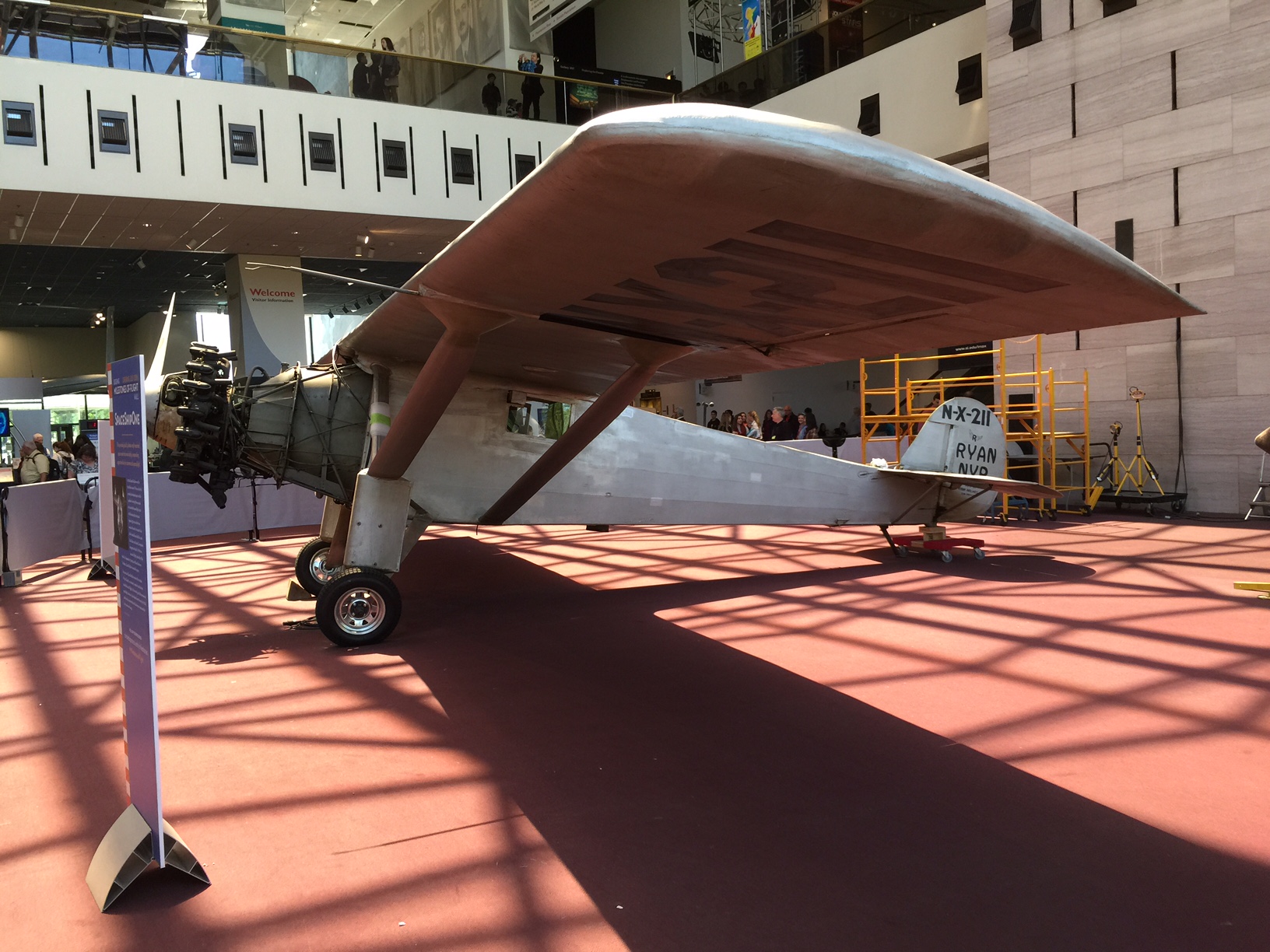
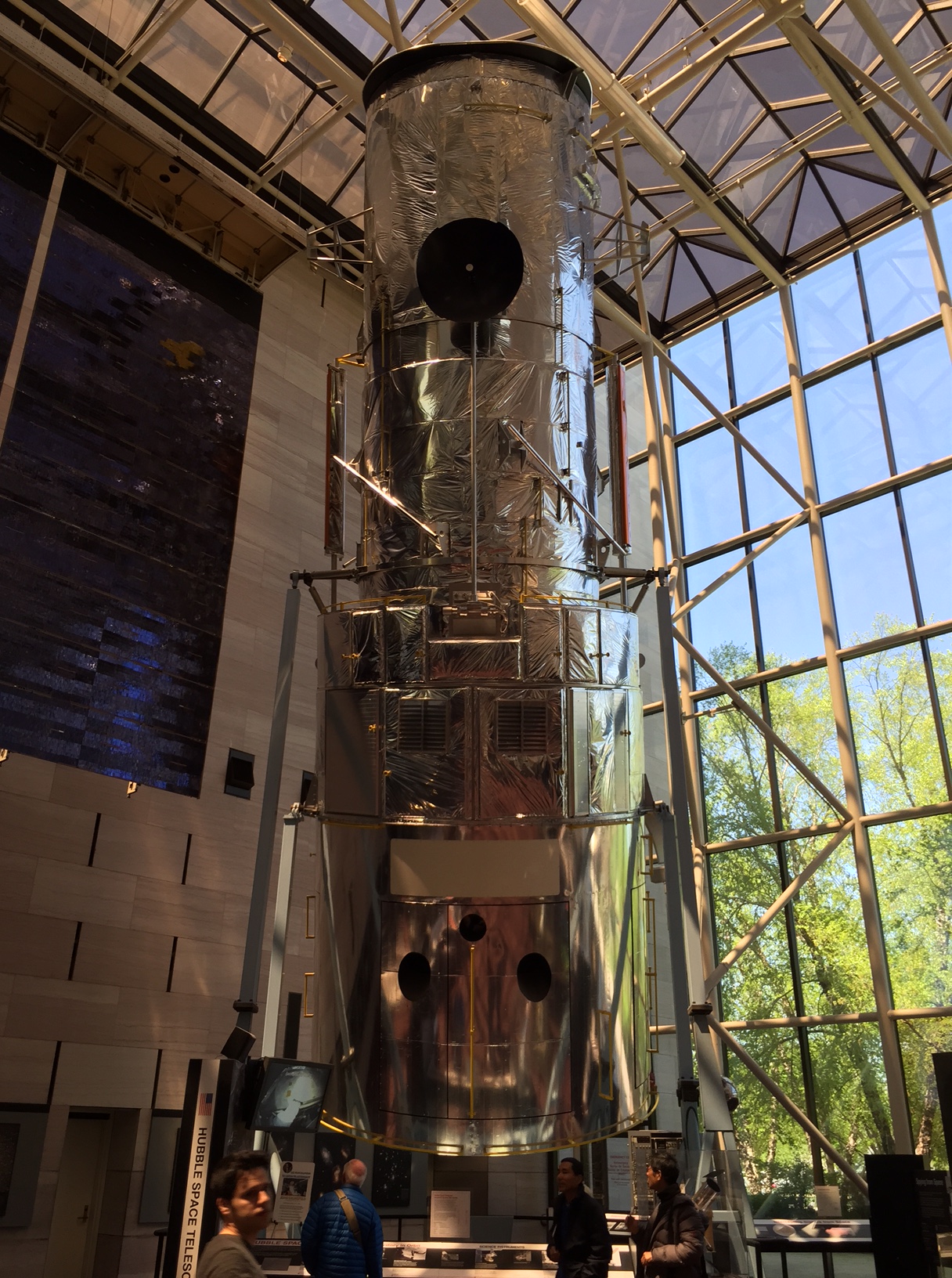
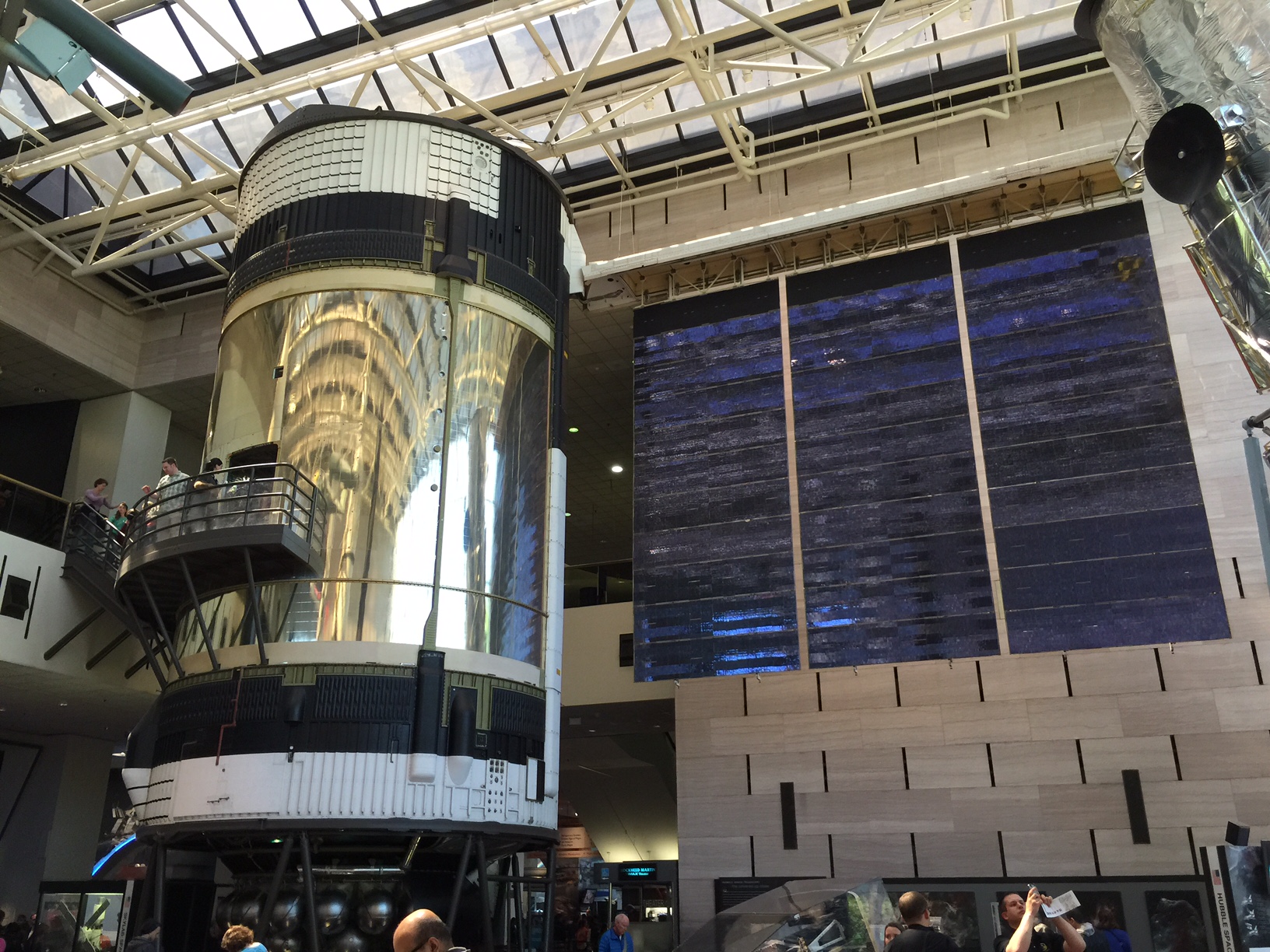
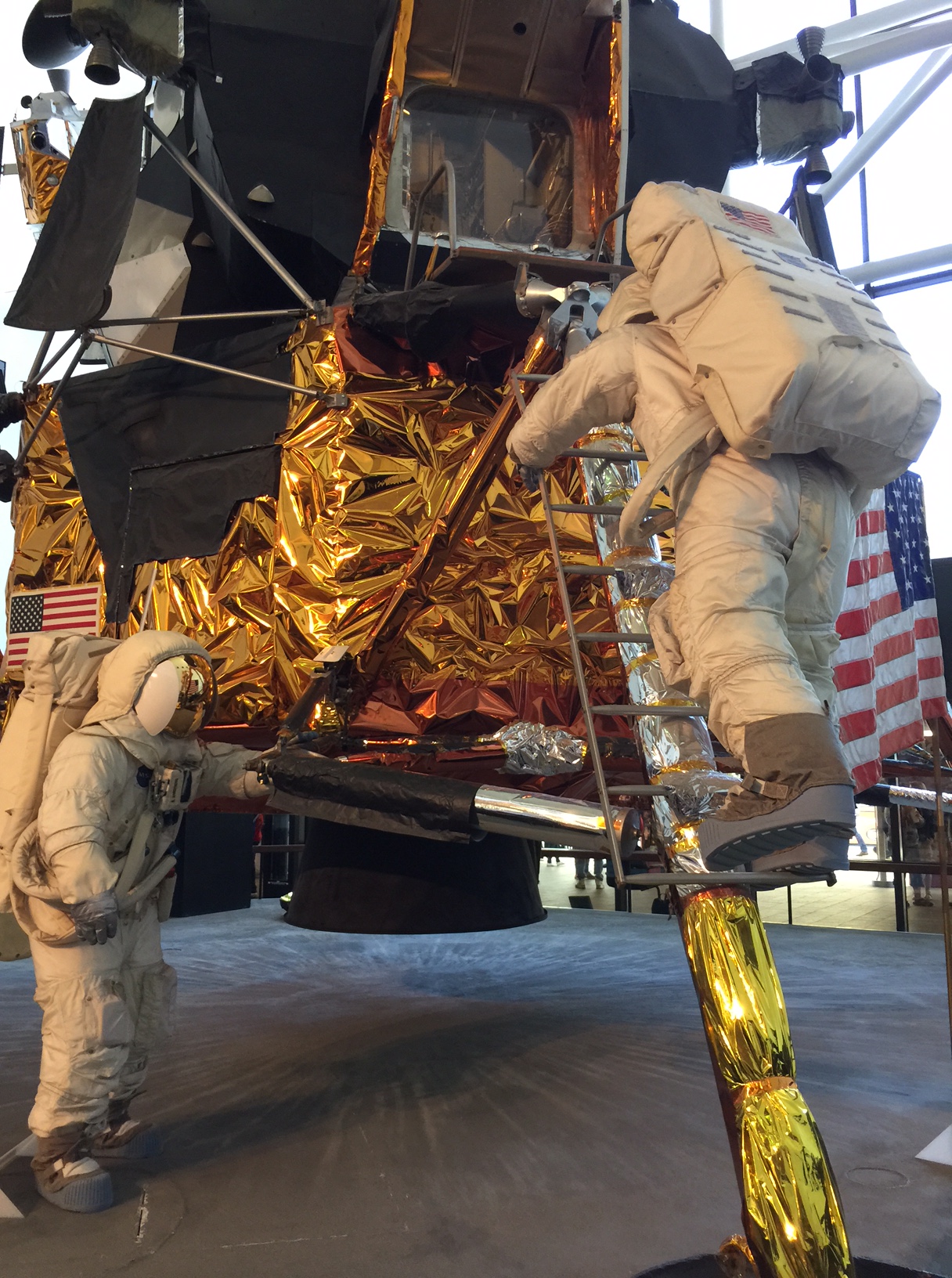
For now, snapshots. For the vehicles that are either still in space (HST) or that have been flown, jettisoned, and burned on reentry (Skylab), the exhibits shown are the structural or proof test vehicles, designed identically to the vehicle that flew, but used for testing and engineering tests.

IMG_8430

Apollo 11

IMG_8435

Spirit of St. Louis

IMG_8441

Hubble Space Telescope

IMG_8445

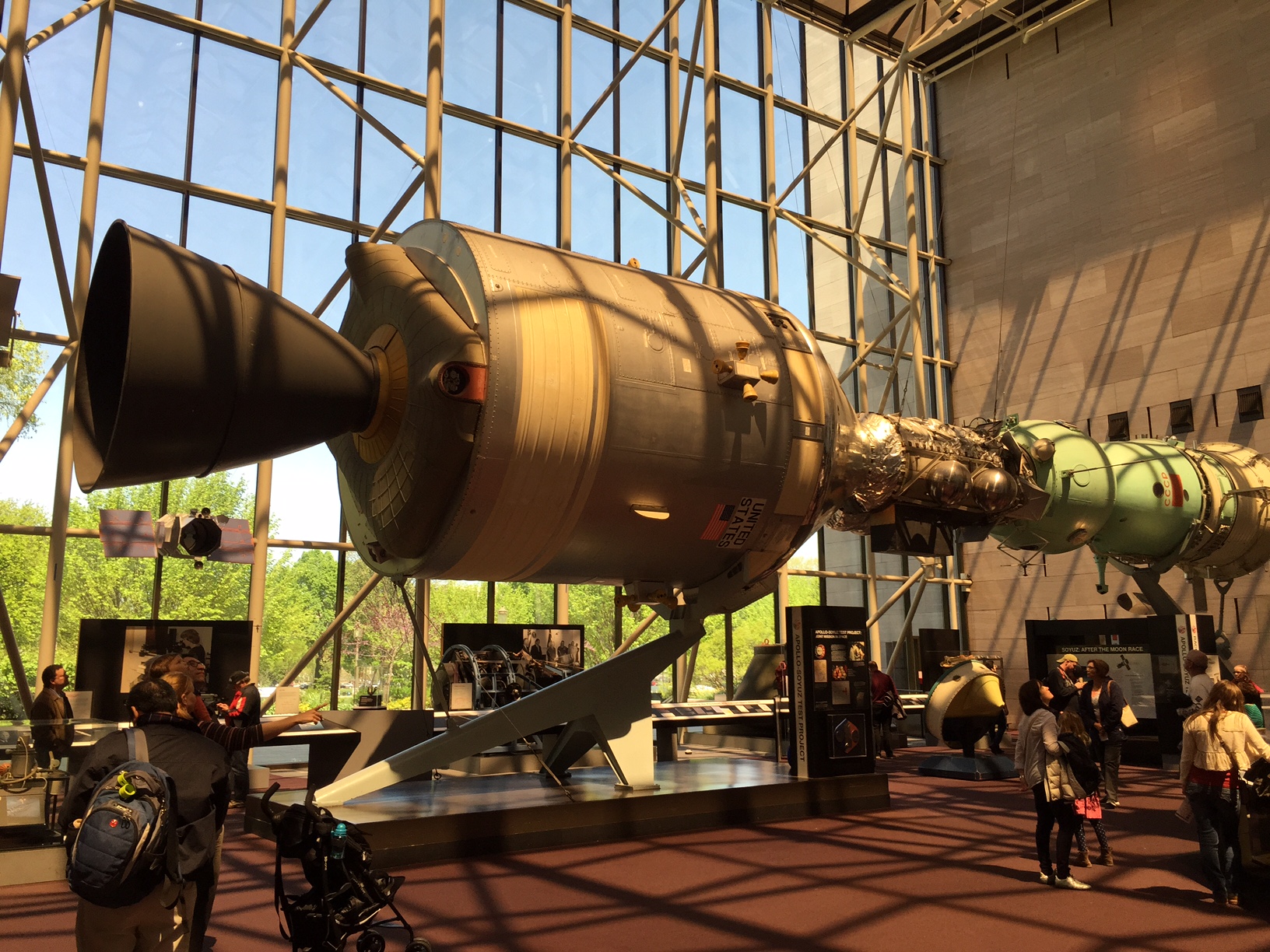
Apollo-Soyuz

IMG_8457

Skylab

IMG_8467

Apollo Lunar Module

IMG_8492

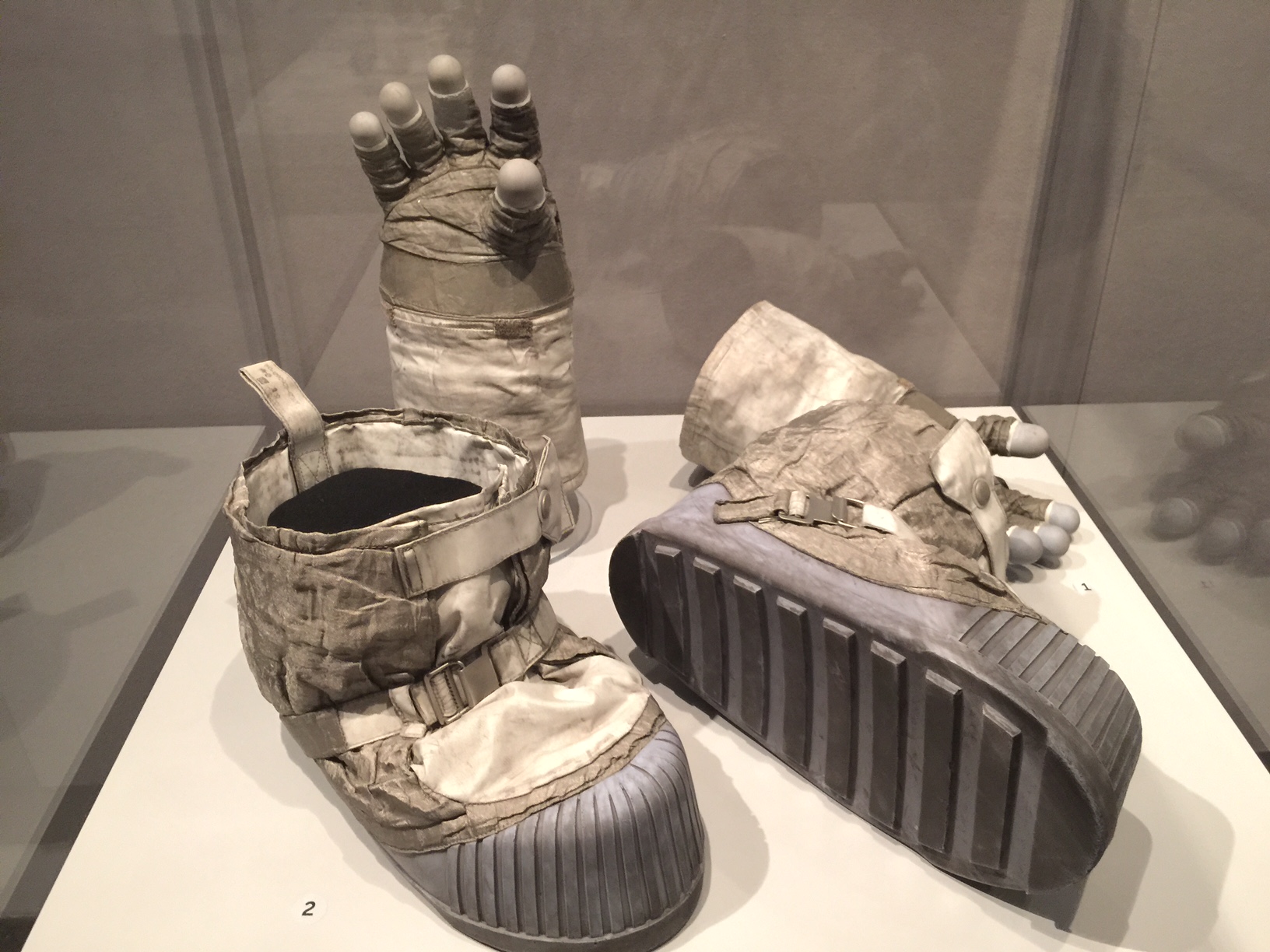
Gene Cernan’s boots from Apollo 17. The shoes that made the last footprints on the moon. (So far!)

IMG_8529

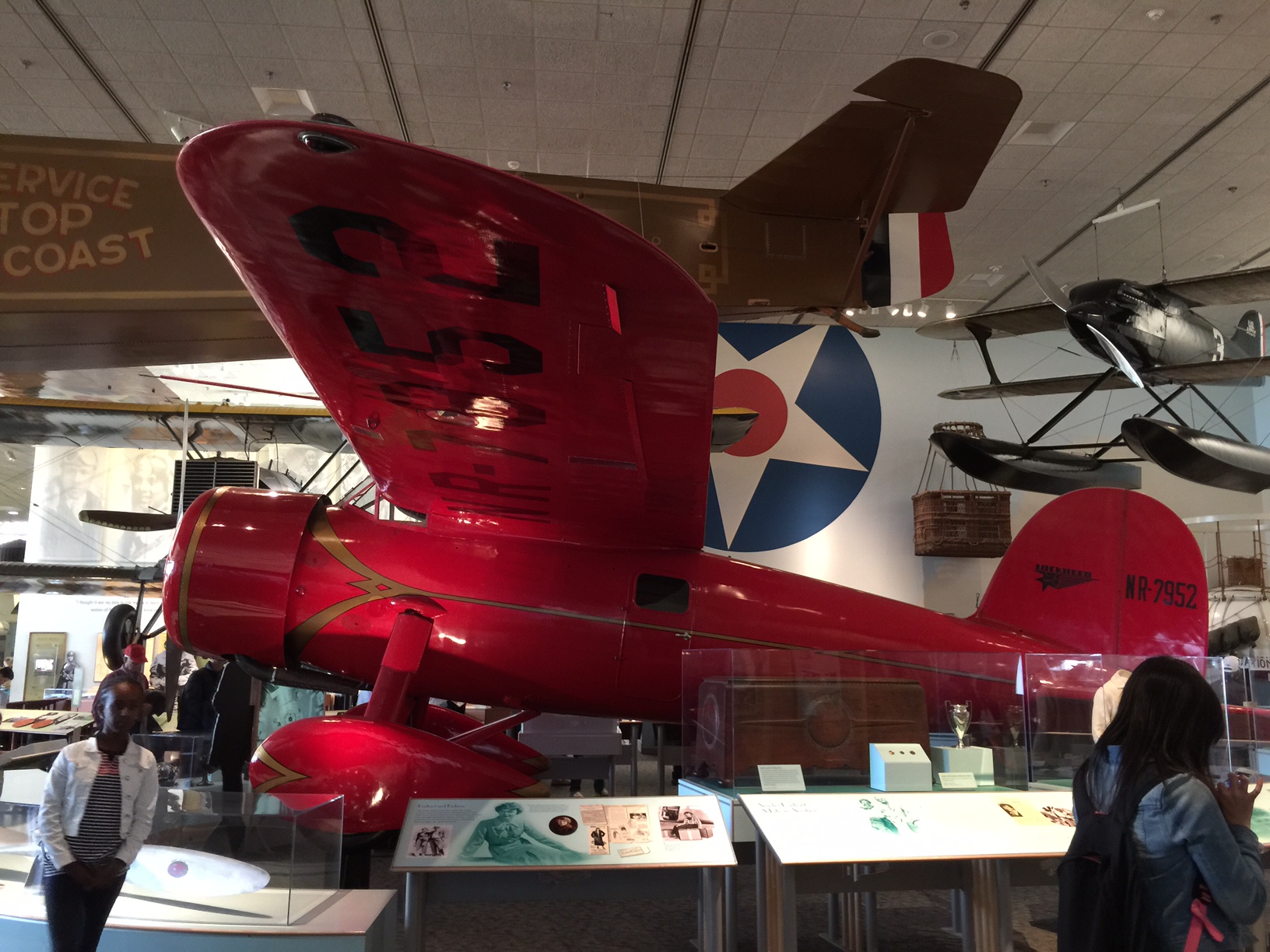
Emelia Earhart’s Lockheed 5B Vega

IMG_8544

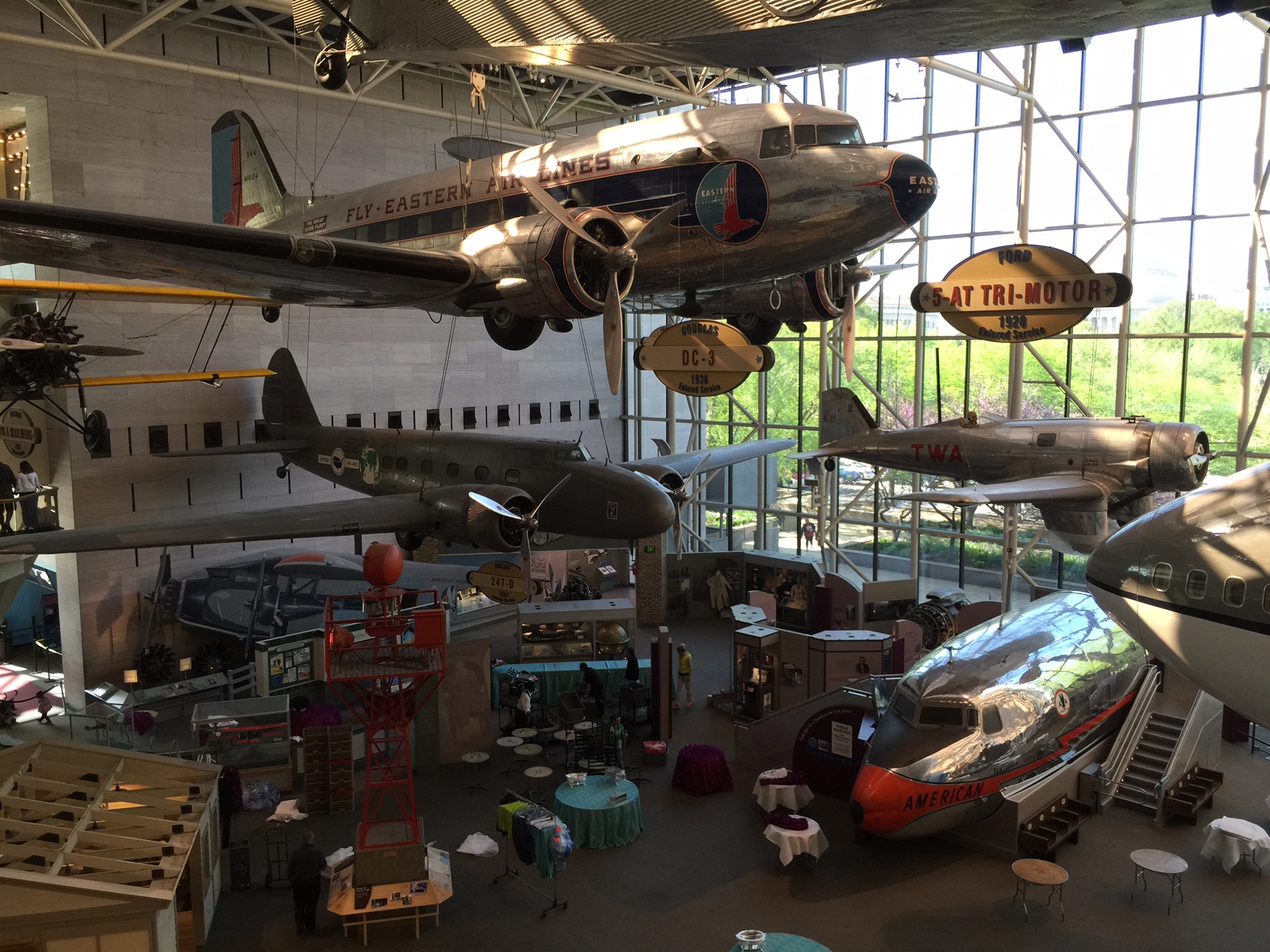
Wonderful old commercial planes


Leave a comment

Filed under Astronomy, Flying, Photography, Space, Travel

Hubble 25th Anniversary NASA Social Snapshots

What a wonderful, exciting, amazing day!

What a really long day it’s been (again). How did it (again) get to be way after midnight EDT? And why does this hotel internet suck so bad?

Here are a bunch of snapshots from today’s wonderful, exciting, amazing, and long day. I think that I referenced all of them in some form or another in Twitter posts (at the right-hand side of the screen), although with different pictures. On the other hand, I’ve only got two brain cells left to rub together, so I could be completely wrong.

Tomorrow, or when I get some sleep and a decent internet connection, or both, I will bury you for about three days with pictures and stories and humblebrags. In the meantime, enjoy!

IMG_8231IMG_8270IMG_8287IMG_8326IMG_8348IMG_8355IMG_8363IMG_8367IMG_8375

Leave a comment

Filed under Astronomy, Photography, Space, Travel

Hubble25 At DCA

Long, touristy day, late night tonight, early rising tomorrow for the Hubble 25th Anniversary (#Hubble25 on Twitter) NASA Social — so I’ll be brief.

This is a big deal here in Washington! (As it should be, but still, we all know that science and space and tech stuff isn’t always appreciated by everyone, especially politicians.) Tonight at the Washington Nationals – St Louis Cardinals baseball game, the first pitch ceremony involved some of the lead scientists from the Space Telescope Science Institute (STScI) and for the “President’s Race” the gag tonight was Teddy Roosevelt setting up a telescope so everyone could look at Hubble — while they were looking, he snuck across the finish line.

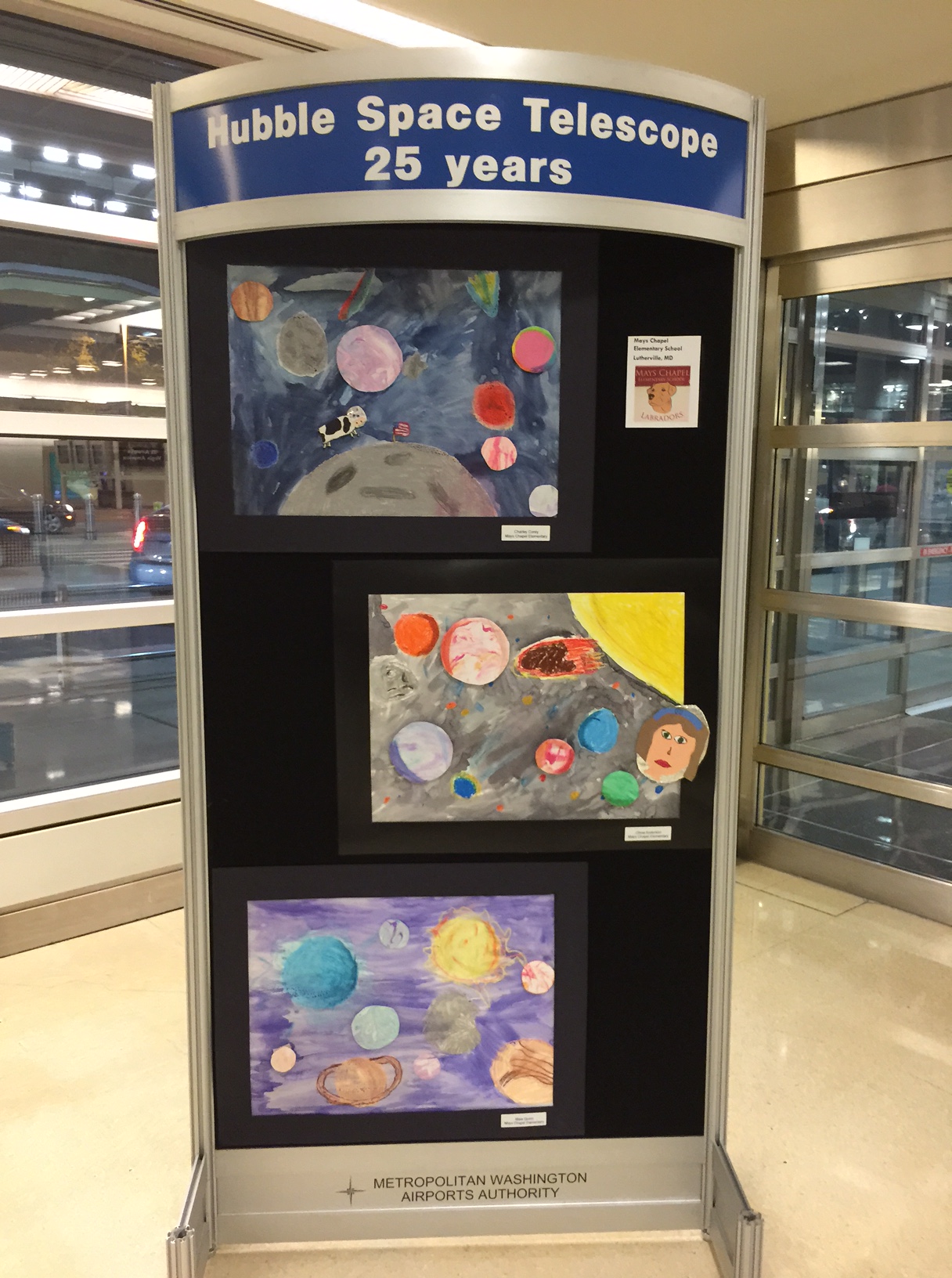
In addition, when I came into Reagan-National Airport (DCA) late last night, on the way to the baggage area I found several Hubble posters…

IMG_8071

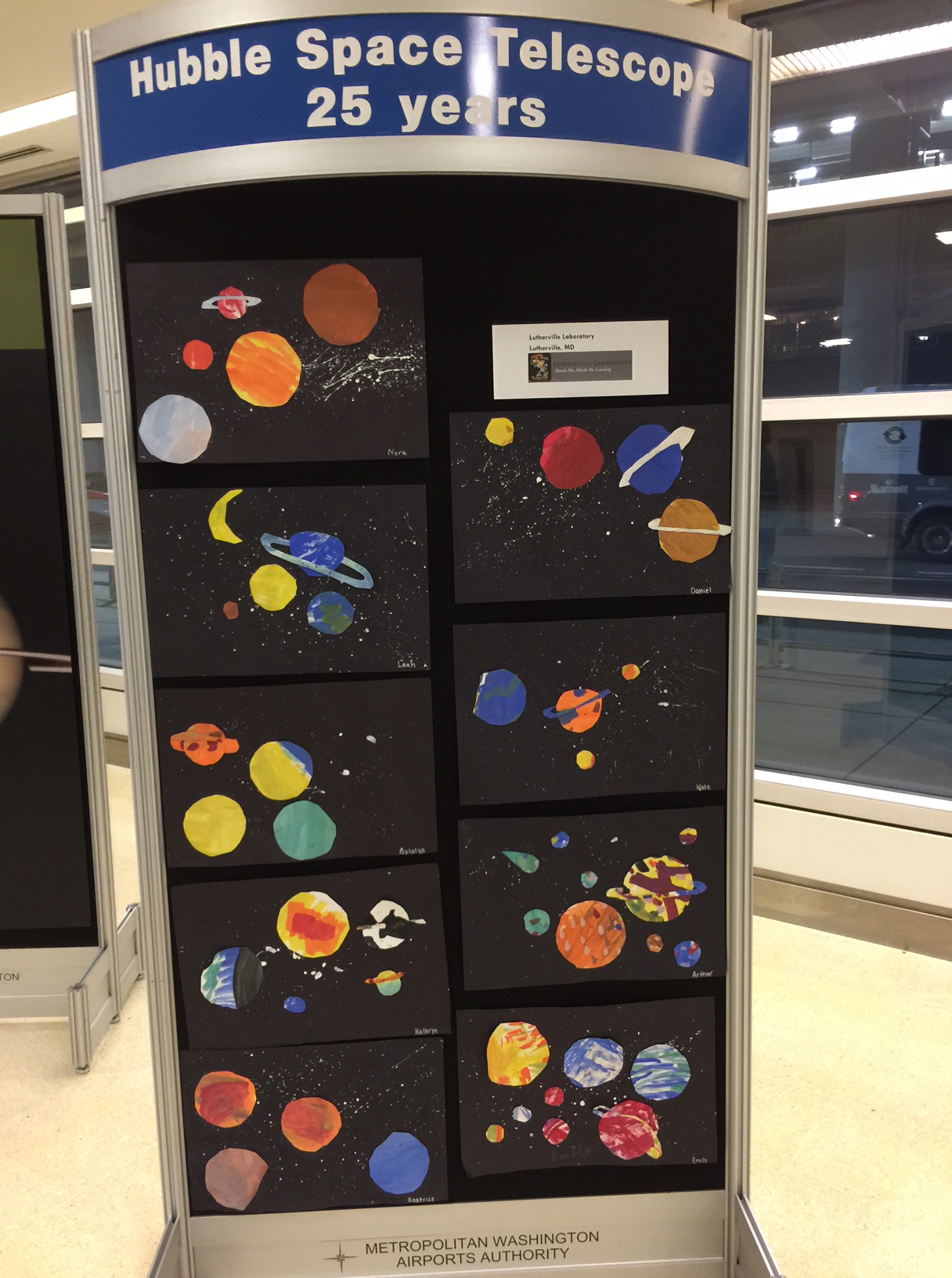
… as well as several panels of Hubble-like drawings done by school kids.

IMG_8070IMG_8072IMG_8069IMG_8068

Tomorrow’s going to be fantastic! Stay tuned!


Leave a comment

Filed under Astronomy, Photography, Space, Travel

Outrunning The Sunset

A week ago I was headed from North Carolina to Los Angeles on an “Oh Dark Thirty” flight and posted a picture of the sunrise catching us somewhere over the southwest United States. I also had mentioned a few days earlier that the trip out from LA to NC had been “an adventure.”

Today the trip back to the East Coast (for this week’s NASA Social and celebration of the 25th anniversary of the launching of the HST, but you knew that) was much more “nominal” and much less “adventurous.” No delays, both flights left on time. No hassles with lost luggage. The flight from DFW to DCA actually got in over thirty-five minutes early. The ride from DCA to my hotel was tedious but cheap.

With the plane tickets being bought on somewhat short notice (I didn’t get the invite to the NASA Social until a couple of days after we were back in LA), I had been told that I would have nothing but center seats. In fact, I got the opportunity to change with someone for an aisle seat on the first flight, and on the second flight I got moved to a window seat.

Even better, it was a window seat with extra leg room, the first one in the cabin. But that meant that I didn’t have my backpack o’ cameras at hand. It was stuffed into an overhead bin instead of under the seat in front of me – there wasn’t any seat in front of me.

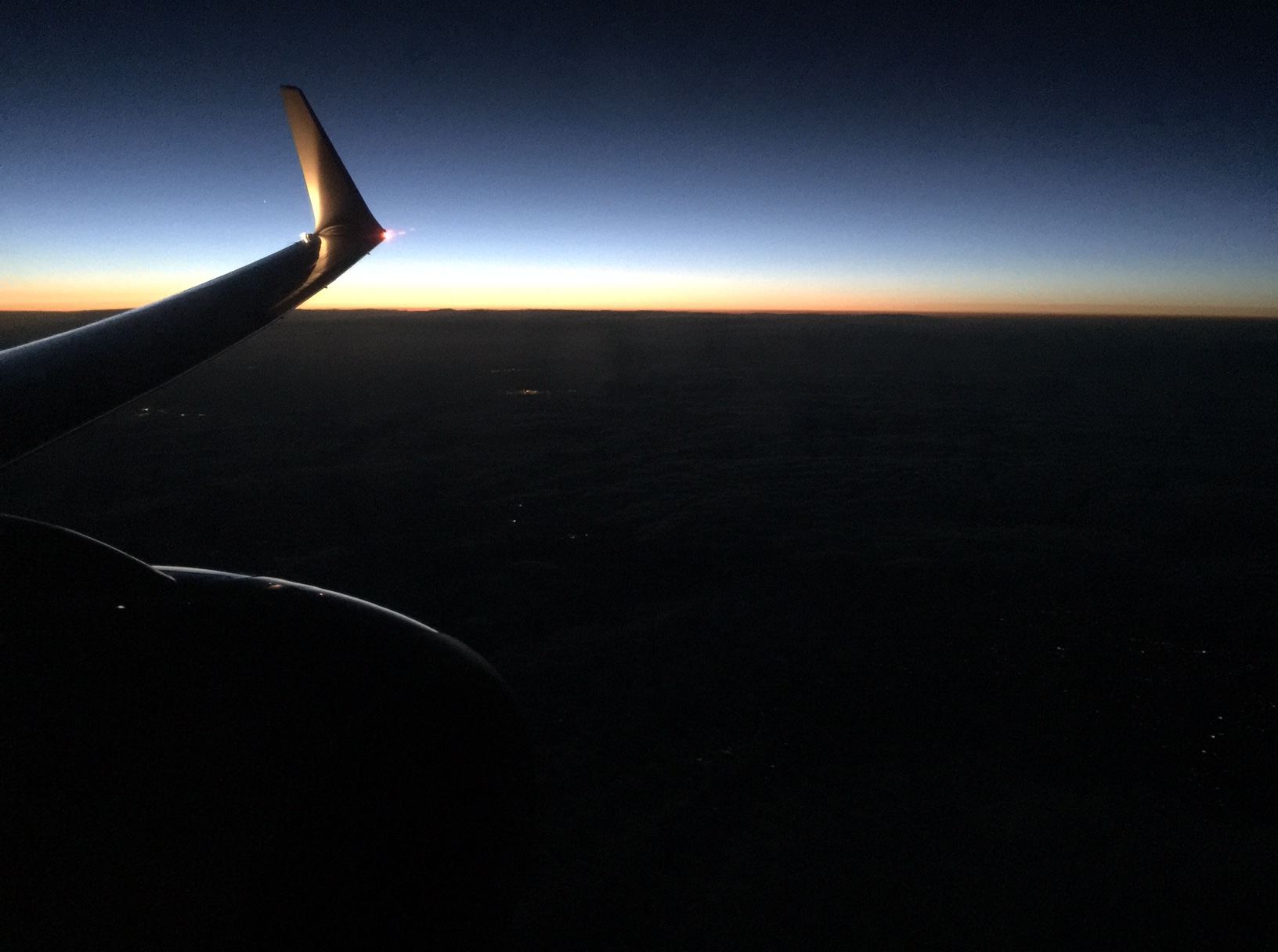
As unusual as it might be for me to be on a plane with a window seat and not take any pictures (I take a LOT of pictures!) I figured that it wasn’t that big of a deal. It was cloudy as soon as we took off from DFW, and it was the “boring overcast to the horizon” cloudy, not the “oooh, cool, look at the thunderheads” cloudy. And then it was going to be dark, so what the heck. Time to catch up on some reading during the flight.

And then this happened (and I remembered that my iPhone had a perfectly good camera in it):

IMG_7968

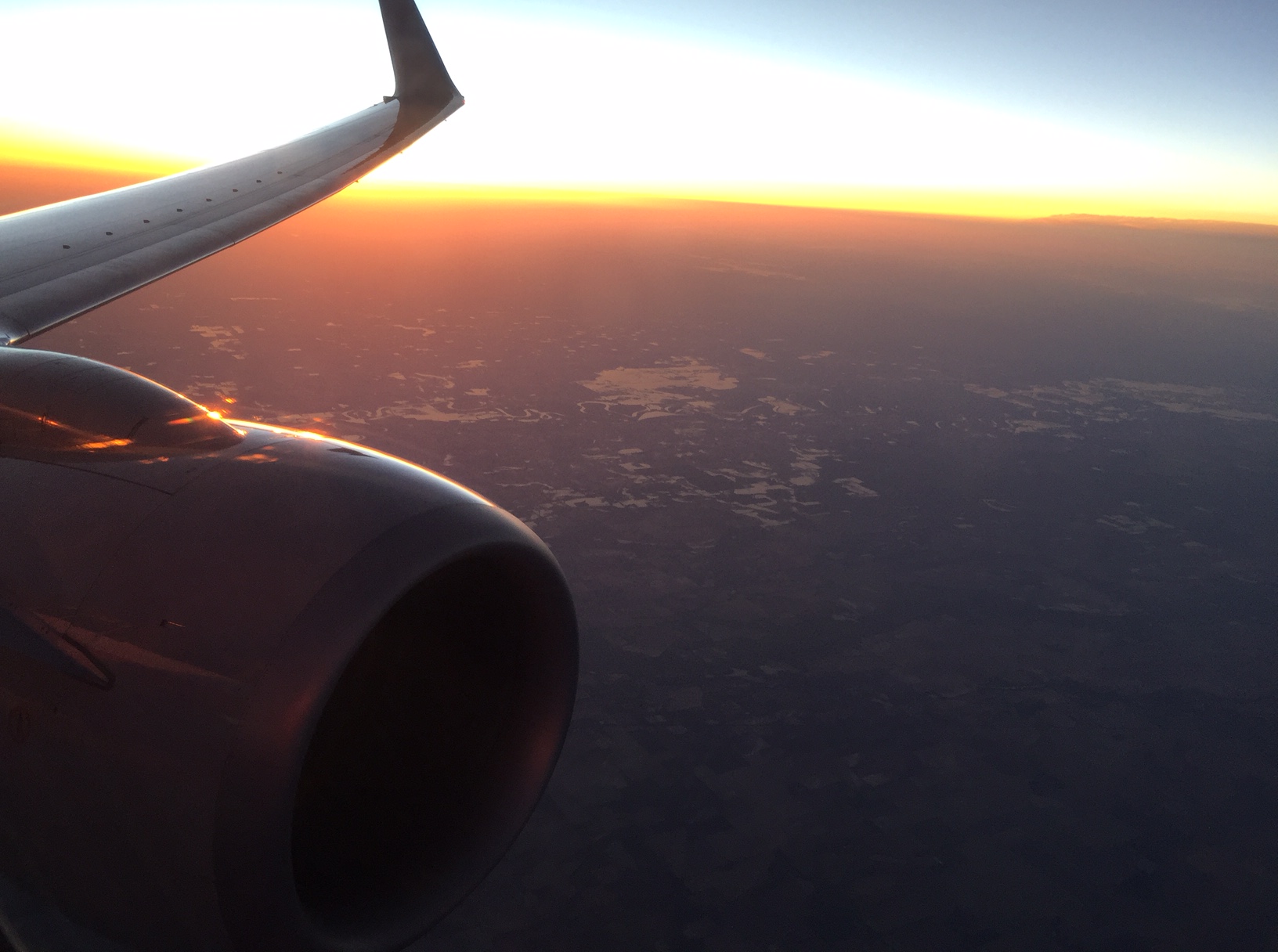
From out behind the wingtip…

IMG_7979

…with the sunset glinting off of lakes…

IMG_7988

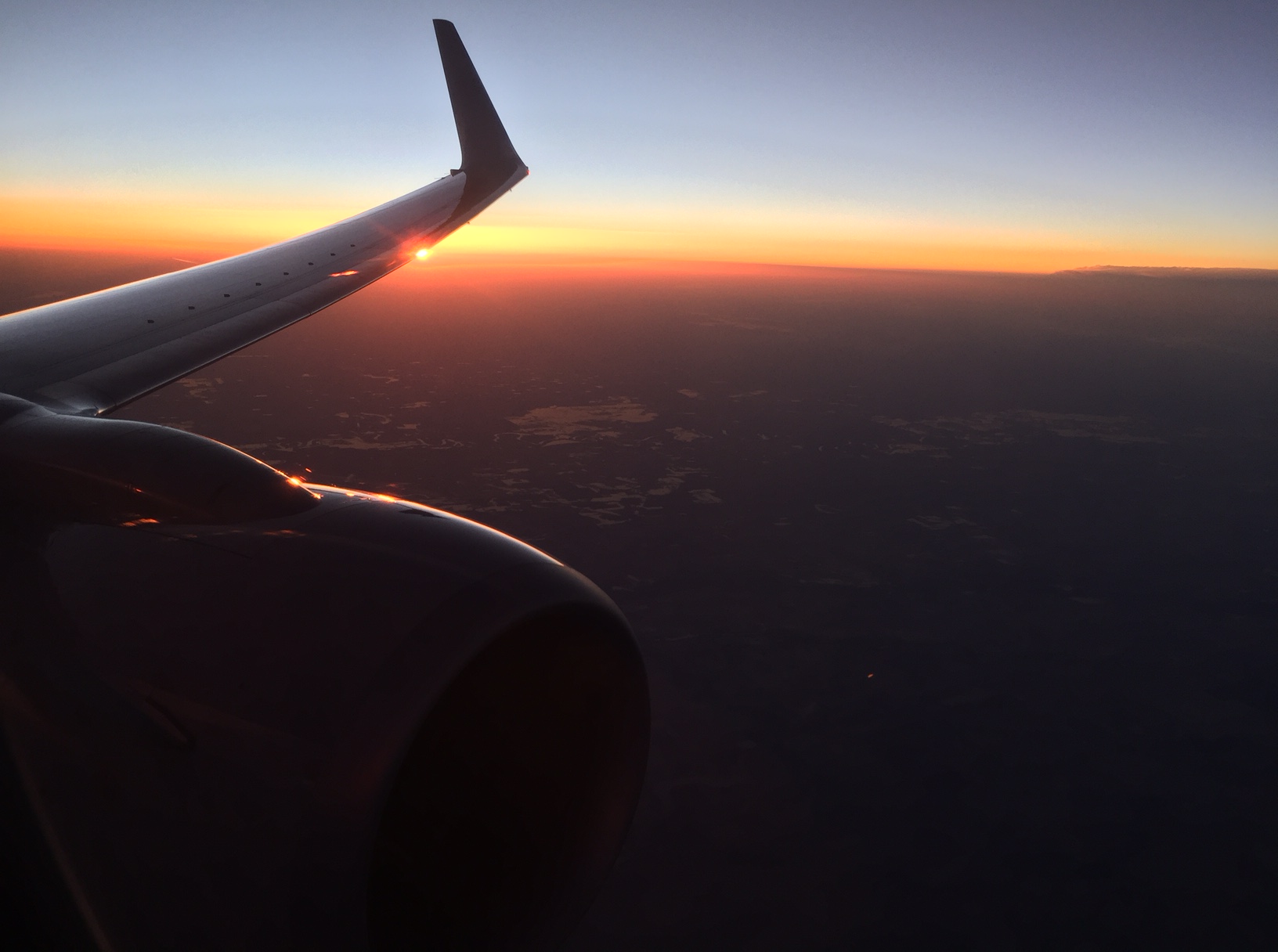
…the sun popped out…

IMG_8004

…just in time to set underneath the wing.

IMG_8017

A big lake in the distance and a tiny one nearer to us caught the sunlight…

IMG_8029

…while the sun started to disappear…

IMG_8041

…and finally vanished…

IMG_8051

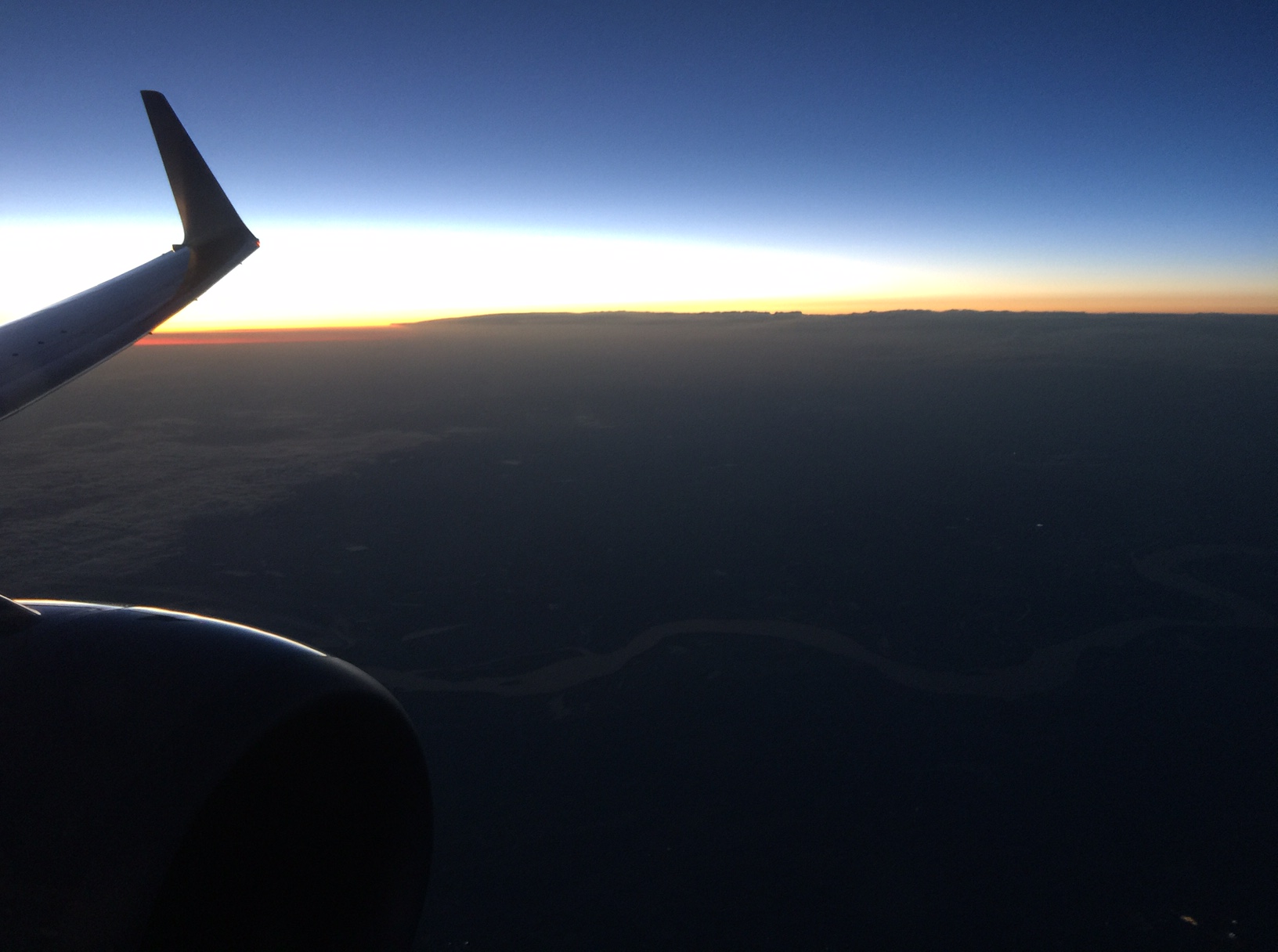
…leaving in its afterglow a winding river, thunderstorms silhouetted on the horizon…

IMG_8061

…and small towns across the American midwest starting to light up like Earthbound stars.

1 Comment

Filed under Photography, Travel