Category Archives: Astronomy

Non-Prescription Anti-Depressant FROM SPACE!!

Caution: could be habit forming.

I’ve told you before about the free NASA-TV app which includes the “Live HD Views From ISS” feed for free as well. If you want to know where the ISS is when you’re looking at that free video fee, use the free “ISS Tracker” app.

If you’re anything at all like me (which is somewhat likely at least a tiny little bit, otherwise why are you wasting your time reading this website?) you will be able to watch the view from the ISS for hours and hours on end. It’s very relaxing. I would love to have it displayed 24/7 in my office, like a framed, live picture into space.

For example, this series of screen grabs from about twenty minutes ago. Where are we? I’ll show you at the end. (All images courtesy of NASA,  the International Space Station program and the JSC Earth Science & Remote Sensing Unit, ARES Division, Exploration Integration Science Directorate.)

IMG_7595

Over a land mass, coming up on a coastline, with another land mass on the horizon.

IMG_7597

Something like the Gulf of California between Baha and the Mexican mainland, perhaps?

IMG_7598

Probably not, this is live and it was well after 22:00 here on the US West Coast, so there’s no way Baja is sunlit.

IMG_7599

Wherever it is, the west coast is clear, with clouds piling up along the east coast.

IMG_7600

There’s a southern tip of wherever this is, so it’s not a continental mass approaching. Probably an island.

IMG_7601

A big island. We crossed over the east coast of something and now there’s a big island there.

IMG_7602

Stunning cloud formations off to the east ahead of us.

IMG_7603

No land in sight on the horizon, so this is it for the landmarks for a while. Coastline. Big island. Lots of ocean beyond.

IMG_7604

A nice, thin line of storms along that coast it seems. But no big cyclones or hurricanes in sight, which is good if you’re down there.

IMG_7605

Why do we call it “Earth” when it’s three-quarters water?

IMG_7606

That’s it, out over the vast ________ Ocean we go!

Got a good guess? Here’s the map’s view from the beginning of the run, showing our path:

IMG_7596

Look at that! We came off of the east coast of Africa, over the southern tip of Madagascar, and out over the Indian Ocean. We should have waved at the lemurs!

And in the forty minutes since that first picture was taken, while I’ve been writing this, the ISS is now approaching the Northern California coast, headed toward Canada.

Don’t you feel better now?

Remember, the next time you’ve watched one too many news show or had one too many clowns try to kill you on the commute home, serenity is available at your fingertips. Non-prescription, totally addicting, beamed right to your phone or computer (switch to booming, echoey voice) FROM SPACE!!

2 Comments

Filed under Astronomy, Photography, Space

It’s A Big Sky & A Long Year

I dragged my sorry butt out of bed this morning, fired up the communication links with the outside world, and immediately saw this:

File May 22, 23 07 41

So I started my day a bit on the ranty side:

Is FaceBook really this FREAKIN’ STUPID, or do they just assume that everyone else on the planet is?

This is not a headline – this is not a special event – this is not breaking news.

We’ve been able to see Mars in the evening sky “without a telescope” for weeks and it will continue to be there for weeks more. Then it will move to the pre-dawn sky, then back again, back & forth, EASILY visible to the naked eye somewhere in the night sky about 90% of the time. (Sometimes it goes around on the far side of the sun from us and is harder to see, but it’s still there.)

Hey, Mark Zuckerberg, tell your minions that not only is Mars visible tonight without a telescope, but moving around up there in the sky are also Mercury, Venus, Jupiter, and Saturn. They’re called “planets,” which is from the Greek “planētēs,” which means “wanderer” – because people figured out they were there and moving around and could be seen “without a telescope” way back BEFORE WE INVENTED THE FREAKIN’ WHEEL!

Maybe you could have Googled that.

Then I spent all day thinking about why I was ranty and so pissed off over this. And it wasn’t just FaceBook. I saw this on the television news and on a hundred different sites, many of them places that are pretty good at bringing science to the general public.

Why does this bug me?

I finally saw it. It’s because posts like this make it seem to the general public that events like this are extremely rare. If this is what you see all the time as someone who’s not familiar with astronomy, you’re being told the ability to view the planets, our solar system, nebula, double stars, asteroids, comets, and dozens of other objects is a rare, special, and difficult thing.

Promoted fallacy #1 – what if it’s cloudy tonight? Oops, well, I guess that we’ll just have to wait another decade or two or whatever it is.

WRONG!

Mars doesn’t somehow vanish or move off to somewhere we can’t see it. It will be visible in pretty much the same place at the same time for WEEKS! The shift from the evening sky to the morning sky and back takes months and months.

Promoted fallacy #2 – if we don’t see it tonight, we’ll need a telescope to see it. It says right there that tonight’s the night that we can see it without one.

WRONG!

Mars was 99.99% as bright on Friday and Saturday as it was tonight, and it will be 99.99% as bright on Monday, Tuesday, Wednesday… Yes, it will fade a bit from its absolute brightest tonight, but the change will be gradual. Even at its dimmest, Mars is trivially easy to see with the naked eye, even from the bright lights of the city.

Promoted fallacy #3 – tonight a unique and special night because we don’t need a telescope to see things.

WRONG!

Get out away from the city and with the naked eye you can see millions of stars! In the summer evening sky you can see the Milky Way streaming across the sky actually looking like a streaming, churning river of light. In the winter evening sky you can see the brightest stars and the most distinct constellations. In a dark sky you can see with the naked eye the Andromeda Galaxy, which is over two and a half million light years away.

Promoted fallacy #4 – if I see Mars tonight like they say, then there’s nothing else to see. Not only is Mars only visible without a telescope tonight, but it’s the only planet visible to the naked eye.

WRONG!

Mercury, Venus, Mars, Jupiter, and Saturn are all easily seen, even from the bright lights of the city. (Not to mention the International Space Station and other satellites and spacecraft, but let’s stick to the natural objects for the moment.) Venus in fact is at times the third brightest natural object in the sky, behind only the Sun and the Moon.

In their rush to grab a headline and manufacture some clickbait, sites like FaceBook are doing a grave disservice to the public. (Like that’s news, but we don’t need to go there tonight.) People need to know that there are amazing things that they can see every single clear night. They just need to know when and where to look, which is not a big deal at all these days since there’s this thing called “the Internet” where you can almost instantly find answers to questions like that.

I’m not PO’d because FaceBook wanted people to go look at Mars tonight. I’m PO’d because it didn’t bother to tell them that they can look tomorrow, and then look at Jupiter, and then see the ISS, and then see the constellations, and then see Saturn, and then see something new, different, and amazing every night.

Every.

Single.

Night.

It’s a big universe. Why do we reduce it to a clickbait headline?

2 Comments

Filed under Astronomy, Space

Zoom The Moon

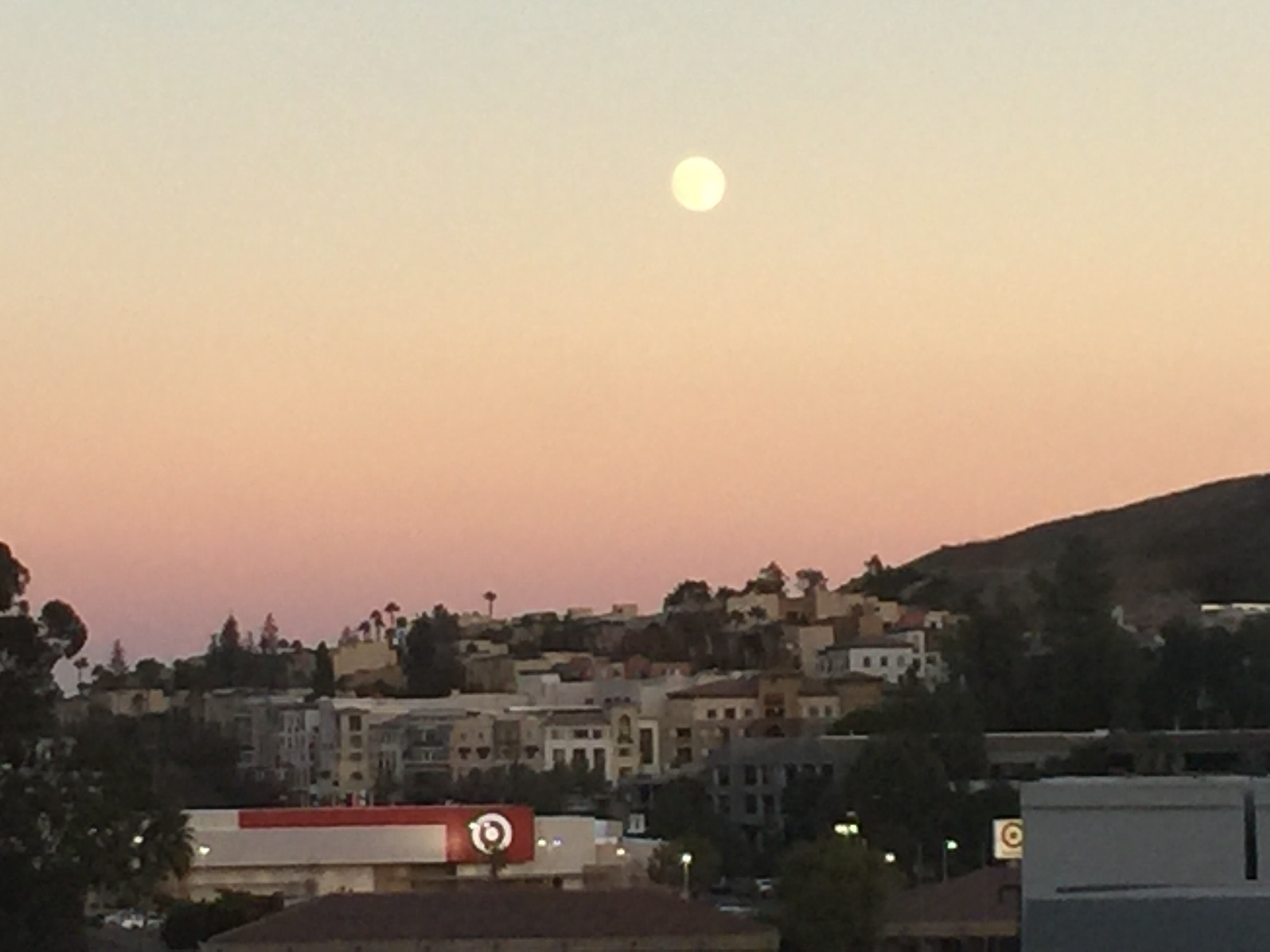
I was finally getting ready to leave the office tonight when I saw the full, Full, FULL moon rising over the hills to the east.

File Apr 21, 22 11 36 small

The eye plays tricks, making it look spectacular, because the brain filters out the five-story building outside of your sixth-floor window.

File Apr 21, 22 13 24 small

All your brain focuses on is the humongous, white, perfect circle on the horizon.

File Apr 21, 22 14 02 small

The horizon illusion works like a charm on the brain, but the camera only starts to see…

File Apr 21, 22 14 25

…the spectacular when the picture zooms in…

File Apr 21, 22 14 56

…to more accurately portray what the brain perceives. Except, of course, for the top of that five-story building.

File Apr 21, 22 15 56

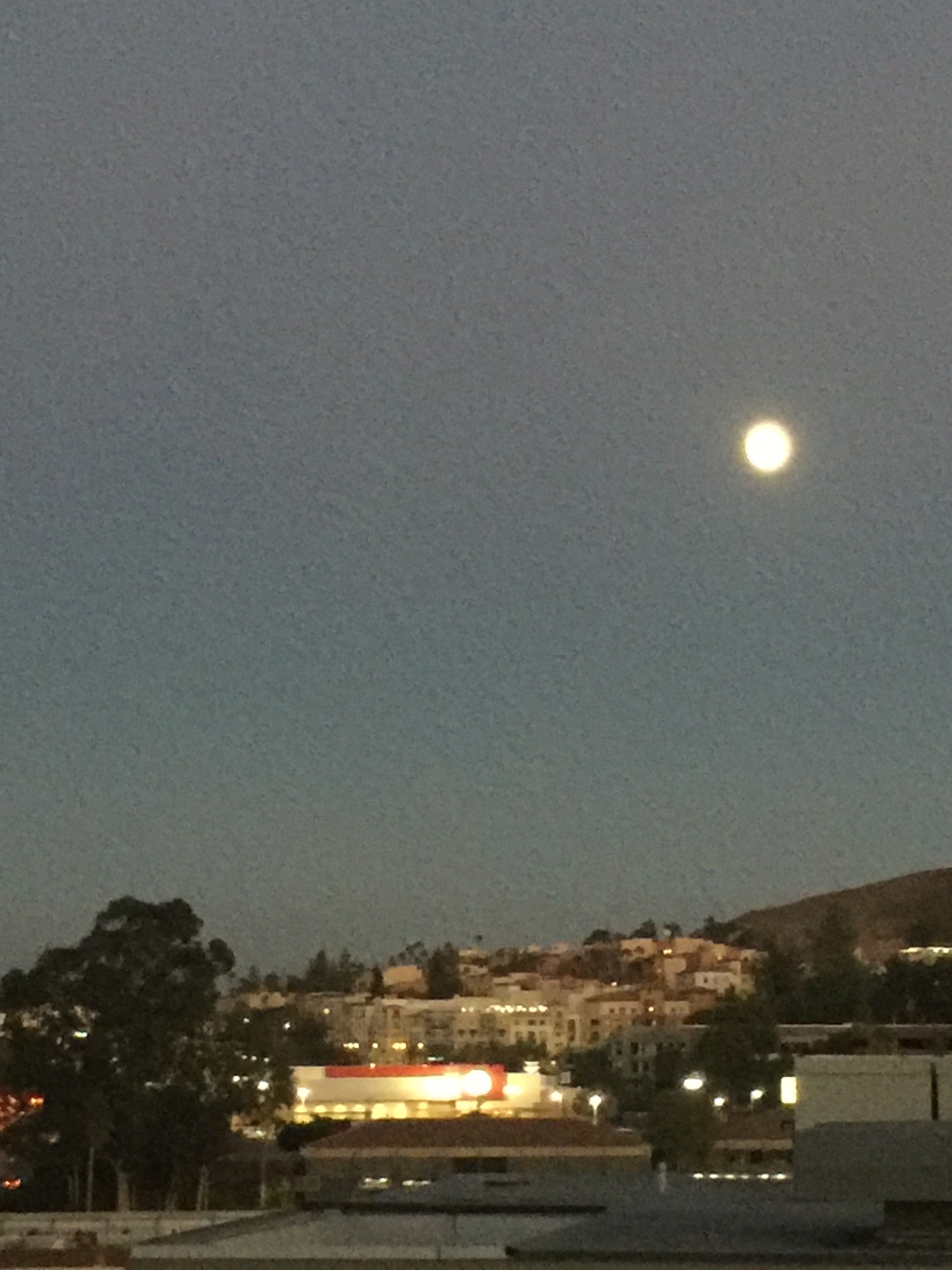
From a different perspective, on the second floor of the garage parking lot five minutes later, the full moon is still hovering right on top of that hill.

File Apr 21, 22 16 24

It looks all the bigger with nothing but the trees and houses in the distance, enhancing the illusion. To the eye, all the lunar features seemed to be etched they’re so clearly seen.

I guess some days it does pay to stay late at the office!

1 Comment

Filed under Astronomy, Photography, Space

Color Gradient

According to Wikipedia,

“In computer graphics, a color gradient (sometimes called a color ramp or color progression) specifies a range of position-dependent colors, usually used to fill a region.[1] For example, many window managers allow the screen background to be specified as a gradient. The colors produced by a gradient vary continuously with position, producing smooth color transitions.”

Out there in what may be the biggest, baddest display of computer graphics and the ultimate simulation (i.e., “reality”) you find this:

File Apr 12, 22 38 44 small

Even in a sky that’s close to “clear and a million,” you can get a pretty decent sunset.

Those trees that look like ginormous dandelions? They prove that we’re nowhere near Canada.

Happy Yuri’s Night!

1 Comment

Filed under Astronomy, Photography, Space

Spring Starts Tomorrow?

Well, at least in this time zone. 21:30 on March 19th PDT, 00:30 on March 20th EDT, 04:30 on March 20th UTC.

Why can’t we all just use UTC and just know that in our particular time zone (for example) it might be “normal” for sunrise to be at 16:00 or so and sunset to be at 05:00 or so the next day? Too confusing?

They’re just arbitrary numbers.

Anyway, a non-arbitrary event (the sun crossing the equator as the Earth’s tilted axis and orbit around the sun make the sun appear to rise higher and/or lower throughout the year) occurs tomorrow, and I for one can’t wait. It’s been a truly brutal winter in Los Angeles.

The must have been at least three or four days where it got all the way down into the upper 40’s! Not to mention at least two days when it rained. What kind of cut-rate paradise is this, anyway!

2 Comments

Filed under Astronomy, Weather

Six Years Ago Today – Moonbow & Mars

Pulling a picture from February 25, 2010, I found this:

IMG_3607 small

There was a twelve day old moon, 92% illuminated, but it was being seen through a thin layer of high clouds. This caused there to be a large “moonbow” or ring around the moon. In addition, Mars can be seen just above the moon.

1 Comment

Filed under Astronomy, Photography, Space

Postage Stamp Futures

While this may or may not be the last year for our mega Christmas light display, I expect the deluge of Christmas cards to continue no matter where we’re living.

One thing I always try to do is pick a nice US Postage stamp if one is available. There have been a couple years when we used the generic “wreath” or “tree” or “Merry Christmas” stamp. But it’s better if it’s a nice commemorative stamp, particularly if it’s one that I really like.

This year we didn’t have a super fantastic choice, but went with the “Peanuts” stamps, which were a pretty good second choice.

Next year, however.

In the last week of 2015 the US Post Office announced a number of their stamps to be issued in 2016. This one caught my attention, for obvious reasons.

File Jan 05, 22 16 27

Image: US Post Office

All eight planets, in enhanced color, which is sort of how they would look to the naked eye. Assuming you could see the surface of Venus, and not fry from the radiation surrounding Jupiter or Saturn, or fry from the heat and sunlight while near Mercury…

Nit picky details! These will be spectacular!!

But something’s missing, especially considering the biggest science story of 2015.

Back in 1991 the US Post Office put out a strip of nine stamps, one for each of the planets, all of which had pictures from flybys or orbiting spacecraft. Except Pluto. That stamp said:

0-0_USPS91STA114j-1

Image: US Post Office

Well, that’s not true any more! But it’s not a planet any more? Maybe? Kinda? Sorta? But wow, what about New Horizons and the views we got last year?!

So the US Post office is also issuing this in 2016:

File Jan 05, 22 17 03

Image: US Post Office

Wow, two sets of stamps that I would love to use on our Christmas cards! They’re all “forever” stamps, so I can buy a bunch now and just horde them until Christmas 2016, then use the other batch for Christmas 2017. Right?!

Then I saw that these will also be issued in 2016:

File Jan 05, 22 24 18

Image: US Post Office

That should take care of the Christmas cards for 2018…

It looks like I’ll be investing in US postage stamp futures this year.

1 Comment

Filed under Astronomy, Christmas Lights, Entertainment, Science Fiction, Space

Perfect ISS Pass With Four Minutes Warning

Pretty much what it says – I was home, getting on the computer, starting to run routine maintenance stuff (Windows update, backups, etc) when I saw a Tweet to folks in the Bay Area that there was a really good ISS pass coming up in about two minutes.

The Bay Area and Los Angeles are roughly 400 miles apart, so depending on the ISS ground path, that could mean that we would see nothing. But I checked my Flyby app and saw that it was a super bright pass, almost straight overhead, and starting in just a bit over four minutes.

For about two seconds I thought of simply going out and watching. Then my idiot brains stepped up and said, “After all, there’s no way you could get the camera set up from scratch and ready to go in just four minutes. No! Way!”

Stupid brain. (You see this coming, don’t you?)

The tripod’s in the car, the camera’s in it’s usual “ready to grab” spot, the remote shutter trigger is in its normal spot with the telescope accessories. Who says I can’t get that all together and working in four minutes flat?

Grab the camera. Grab the remote trigger. Put the battery into the remote trigger, mount it on the camera, plug it in. Grab car keys. Head out the door. Open the car & grab the tripod. Get it out of it’s bag, extend the legs. Pull the shoe off, get the shoe mounted on the camera. Mount the camera on the tripod. Close the car. Grab the phone to double check to see what direction ISS is coming from (four seconds to spare) and head toward a spot where that part of the sky looks clear. Make sure the camera is set correctly to “bulb.” Wait, that’s wrong, I’ve got that stacking software, that worked better. Set the camera to one-second exposures. Make sure the lens is set to manual focus and quickly look at the full moon to get the focus set, pray it’s correct. Look for ISS, spot it just coming up over the trees. Try to start shooting, but the remote trigger isn’t on. Fumble with the power switch, get it turned on, start shooting photos. As the ISS goes straight overhead, move the camera every twenty to thirty seconds as the ISS moves out of what I’m guessing is the field of view. Have some problems with the data on the camera not being recorded fast enough, so I can’t keep shooting every second, bang-bang-bang-bang, it ends up more like bang-bang-b-a-n-g-bang-ba-ng-bang-bang.

Fortunately I’m having a good time watching the pass as well. As advertised, extremely bright, right through the zenith, rising in the NNW and heading to the SSE. ‘Twas a thing o’ beauty.

Now check out the pictures, which were shot frantically, blind, hoping for the best. What went wrong that I overlooked?

Well, the 18-55 mm zoom lens was set much closer to 55 mm than 18 mm. While I thought I was looking at a huge, wide swath of sky and shooting thirty-five to forty pictures as the ISS moved across the field of view before moving the camera and repeating, I was zoomed in on a very small field of view, with about a third of the pictures in each set being out of sight off the bottom, a third crossing the field of view, and a third out of sight off the top. Meh.

On the other hand, the focus wasn’t too far off, so instead of getting this ultra-thin thread of light crossing the sky, when I did catch the ISS I got a honkin’ huge streak, along with a number of background stars.

Download the pictures, load up that stacking software I found that worked so well last time, and see what it does:

StarStaX_IMG_5341-IMG_5356_lighten

North at the bottom, the zenith overhead at the top. You can see a few of the brighter stars, from the Big & Little Dippers on the left, Cassiopeia on the right. The “stuttering” in my rhythm of shooting is obvious in two spots, but each segment is a one-second exposure. I need to look into getting a remote trigger that can be set to shoot on its own given some timing parameters. They’re not that expensive.

Not bad for four minutes of prep! (Stupid brain.)

3 Comments

Filed under Astronomy, Photography, Space

How Do You View This Site?

Out of curiosity, how do you view this site? Not in the sense of, “Is this guy the next Zen master & Enlightenment elf?” but in the sense of, “Email? Website? Phone? Tablet? Desktop?”

I ask in part because a month ago I changed the background graphics for those viewing the site on a desktop with a typical browser, such as Chrome, Firefox, Internet Explorer, and so on. While I originally had a grey-blue background with an old picture of Fifi (the CAF’s B-29) and some of our other planes escorting her into Camarillo in 2013.

That image was sort of dull I finally realized, so I changed it to the current one, a NASA-Hubble photo of Omega Centaur. There are a lot of adjectives that describe it, but “dull’ will never be one.

Yet no one said a word. Not one.

That made me think that most of those of you who view the site routinely and subscribe, probably get each post in your email. That’s the way I get other blogs that I subscribe to, and I know that the email versions are streamlined for that format and leave out a lot of the razzle-dazzle items that the webpage itself has. Meanwhile, folks stumbling onto the site without any background or reference would just see the new background and figure that’s the way it always is.

This theory makes sense, but I figured it wouldn’t hurt to ask. So, how do you view this site?

Email? The website itself? On your phone? A tablet? A desktop? Which browser? Chrome? IE? Firefox?

I’m curious. Feel free to stick something in the comments if you wish to share.

8 Comments

Filed under Astronomy, CAF, Computers

Halloween 2015

Unlike last year, when it was cloudy on Halloween, this year it was “clear and a million” so we had the telescopes out. We started doing this a few years back and it works like a charm. The Long-Suffering Wife hands out candy and I give a three-hour long impromptu astronomy lesson to one and all.

File Oct 31, 21 55 34 small

All set up, waiting for the first trick or treaters, and some darkness. Note the attack beast in her guard dog position – she ended up inside for most of the night, howling in protest. The kids started showing up before it got dark enough to see anything. Those first few were disappointed with not being able to look through the telescopes, but many swung back around later and got to take a look.

File Oct 31, 21 57 07 small

The main instrument for the day is my 8″ Cave Newtonian reflector. (The big white one in the middle here.) It’s the easiest to use and re-point quickly and that’s key in this kind of thing. Probably a third or more of our guests end up moving the telescope while trying to get to the eyepiece, so being able to re-aim it quickly is essential. The 8″ has a good spotter scope and I used it with the 25mm eyepiece which gives a wide field of view, about the size of the full moon.

The little Meade is better for photography and not easily aimed, so while I hoped to use it, I rarely had time to play with it at all. On the far end are the binoculars on a tripod, and while they give some fantastic wide-field views, it’s a bit futile to have out if no one is there to help people with using it.

File Oct 31, 22 04 32 small

The biggest problem tonight was the lack of any big, bright objects to observe in the early evening. The moon, Pleiades, Orion, Jupiter, Venus, and Mars all rose later, starting about 21:30. By that time, the kids were gone and I was tearing down the equipment.

I had hoped that, even in the light polluted city, it might be possible to spot at least M13 and M31, but that proved to be so much wishful thinking. In order to get the ball rolling, I put the scope on Vega. To me it’s boring, just a bright star which doesn’t look much different in a telescope than it does to the naked eye. You can see a couple of other field stars when looking at it, but it’s sure nothing special…

…unless you’ve never looked through a real telescope before. To the vast majority of the kids, teens, and adults who stopped by and saw Vega, it was a real treat.

Once it got a bit darker I switched over to Albireo, a double star system with one golden star and one blue star. It’s very pretty, easy to spot (it’s the bottom of the “Northern Cross” in Cygnus), and much more interesting than “just plain, old Vega.” Albireo was a huge hit, especially when describing how the two stars orbit around each other.

It was again a huge success. We have so many people thanking us for doing this, many noting they’ve been here every year. (Last year when it was cloudy, almost half of the people coming to the door asked, “Where are the telescopes?”) The teens all want to look but want to do so without looking too geeky in front of their friends – but they all look. The adults often assumes we’re doing it just for the kids, but when they find out they can take a turn as well, they all want to look.

There were several times when we had fifteen or twenty people lined up. Judging by the amount of candy that disappeared, we probably had in excess of 200 kids there, and with the parents as well, I wouldn’t be surprised if 300+ people took a look.

Best of all is when the young kids, maybe five through ten years old, see for the first time. You often get an audible gasp from them, often a shout to their parents. “I see it!” It makes it all worth it.

Let’s hope next year we have a couple of nice bright objects up in the evening.  (There’s an app for that.) A first quarter crescent moon plus Jupiter plus Saturn would be just fine, thank you.


A programming note – in an hour it will be November. We know what November means, right?

National  Novel  Writing  Month = NaNoWriMo.  One month, 50,000+ words, a “zeroth” draft of a novel. Editing be damned, just keep writing! There’s plenty of time in 2016 to edit, re-write, clean up, rearrange, and polish this nonsense into something resembling a first draft.

Of course, as an egomaniac with a web site, I inflict this raw verbiage onto my loyal readers (i.e., you), with various levels of success. The 2013 effort was pretty good, if somewhat unfinished. The 2014 quest had a really good idea which I still want to explore, but the NaNoWriMo treatment of it was awkward and unwieldy and sort of fell apart.

We’ll see what the 2015 campaign brings. All things being equal, I was thinking about skipping it this year. But there’s a meme going around that basically says, “You must meditate an hour a day, unless you don’t have the time to spare, in which case you must meditate for two hours a day.” Applying that philosophy to this problem, I don’t have time to write two novels this month, so I had better make time to write the one.

Of course I will gladly accept constructive comments as we go along, but if you want to just ignore the whole thing I most certainly won’t take it personally. (I won’t have the time to take it personally, I’ll be too busy working on tomorrow’s 2K words!)

As for my regular, daily posts, expect lots of pictures all month. You’ve been warned.

7 Comments

Filed under Astronomy, Castle Willett, Panorama, Photography, Writing