Category Archives: Astronomy

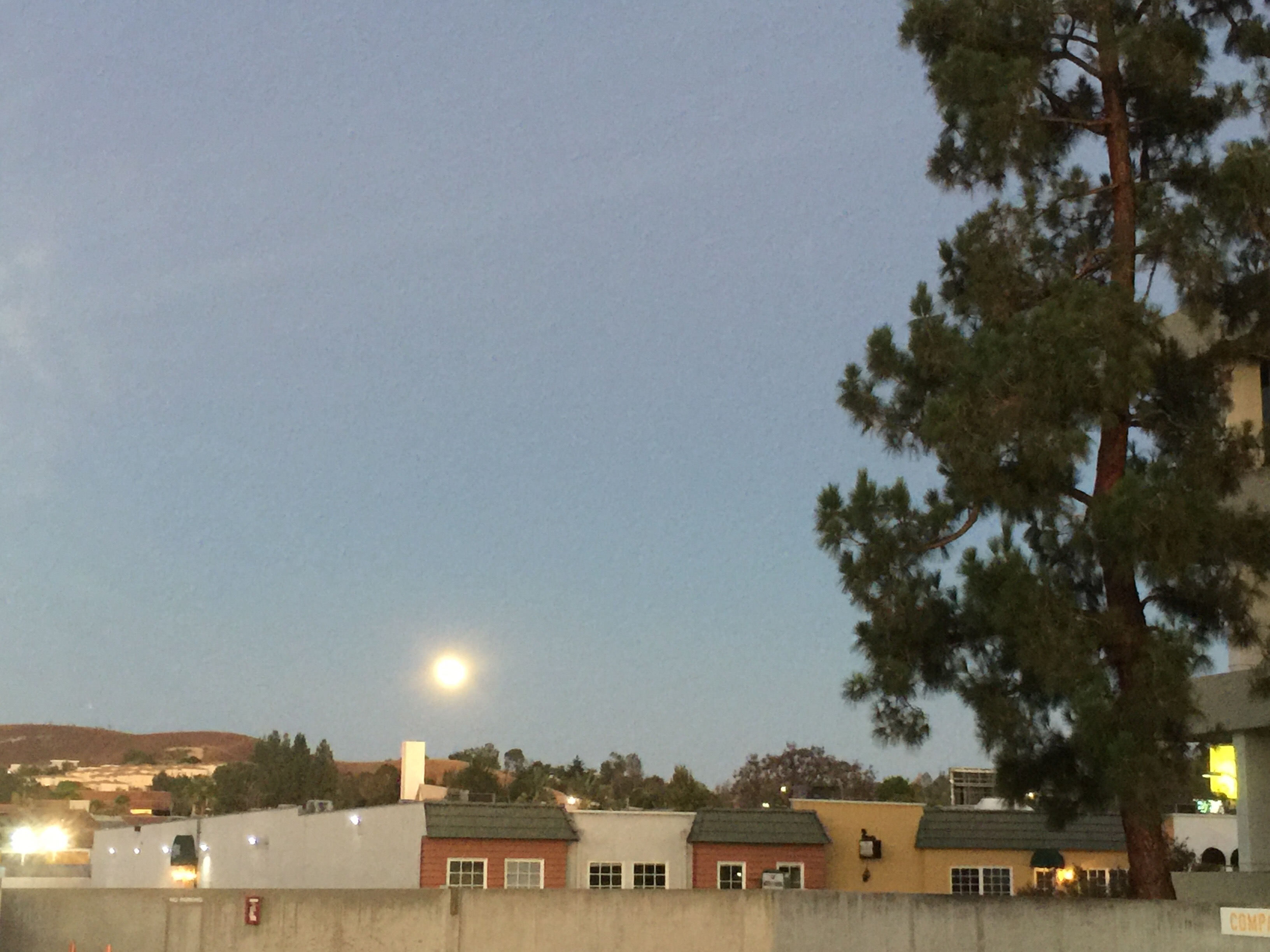
Yet Another Suuuuuper Moon!!

Yesterday the sun – today the moon!

I knew that it was full moon tonight, but I didn’t hear any of the “suuuuuuuper mooooon” hype on any of the national or local media outlets until late this afternoon. They must have moved on to another marginally accurate and completely overblown piece of fluff to push as “BREAKING NEWS!!!

Nonetheless, as we were coming home we just happened to be coming around the corner and off of a little hill just as the moon was rising right in front of us.

It. Was. Spectacular!

So I pulled into the driveway and parked, let the dog out, got dinner and the groceries in, grabbed a camera, and hustled back up the street.

The bad news was that in order to get the shot I wanted, the perfect place to stand was right in the middle of the street. It’s “interesting” trying to frame and expose and focus to get the perfect image, all while keeping one eye on traffic in front of me coming up past our house and, more importantly, another eye on traffic that might be coming around the corner right behind me. Good thing I was dressed in dark clothing…

The good news is that I got these pictures:

IMG_2659_2700_Composite small

IMG_2666_2686_Composite small


Remember when I was talking about High Dynamic Range (HDR) photography the other day? Bright objects mixed with dim objects – expose for bright and leave all the detail in the dim areas in the dark, expose for the dim areas and the bright gets totally overexposed? The solution is to take two (or more) photographs and then put them together into a composite picture that has the best of them both.

This is a textbook case and that’s the technique I’ve used here. Last Wednesday I talked about using an app on the iPhone. For these pictures, using my Canon DSLR, I used Photoshop.

The top picture above comes from these two original images:

IMG_2659 small

IMG_2700 small

Essentially the exact same scene, taken just a few seconds apart, but the top photo is a 1/30 second exposure and the bottom is a 1/500 second exposure. Combine them, align them to overlap, adjust the brightness and contrast a little so they match better, and voilà!

Ditto for the second composite photo:

IMG_2666 small

IMG_2686 small

Again, a 1/30 second exposure for the trees, a 1/4000 second exposure for the moon (remember, it’s BRIGHT!), mix and match in the computer, and you have an image that not only is fantastic looking, but also much more accurately represents what the human eye sees.

This is a technique that I intend to use a lot more as I get practice and some skills. I won’t be going through a demonstration of the “magic behind the curtain” work every time, but simply sharing the end result.

I think I’ll talk about the “reality” of these pictures more in the next day or two. It’s something I’ve given some considerable thought to for quite a while.

In the meantime, enjoy the photos!

2 Comments

Filed under Astronomy, Photography, Space

Sun Dog & Halo

While leaving the CAF hangar yesterday I noticed a “sun dog” near the setting sun as it shone through a layer of high clouds that had moved in. I was in bright sunlight but could still see the little rainbow-colored patch, so I moved into the shadow of one of the new hangars to take a photo.

File Oct 25, 22 07 55 small

File Oct 25, 22 08 30

Once in the shadow, my eyes adjusted a bit to the lower light, and I noticed the full 22° halo around the sun.

File Oct 25, 22 08 55 small

File Oct 25, 22 09 15 small

Caused by the sunlight passing through high-altitude ice crystals, I could see an identical (but dimmer) ring around the moon later in the evening. But it was too dim for me to get a good picture.

Leave a comment

Filed under Astronomy, CAF, Photography, Weather

This Seems Familiar

After sunset I was out with The Beast and noticed the three-day-old crescent moon hanging right next to the aforementioned iconic date palm.

File Oct 15, 19 16 40 processed

I thought it looked familiar – then it came to me.

South_Carolina-printable-flag

I guess all the folks on the block with the “USC” license plate frames are Gamecocks, when I thought they were Trojans.

Leave a comment

Filed under Astronomy, Castle Willett, Photography

Look To The East

Without a doubt there have been enough sunset pictures posted here over the years, most of them showing that almost iconic, huge date palm silhouetted against the fading light.

Did you know that if you get up really early, like, before the sun comes up, there can be pretty clouds and colors in the sky in the east also?!

IMG_5279 smallYou know that it’s east because you can’t see that palm tree!

Did you know that if you’re standing out in the shadows in the front yard at 06:30-ish and holding a camera you can get the neighbor to come and yell at you and demand to know who you are and what you’re doing?

I didn’t either, but it’s a good thing to know. As soon as he got close enough to recognize me and I told him what I was taking pictures of it was all copacetic. (“Honey, you’re never gonna guess what that whack-job with the cameras next door is doing now!”) But it’s good to know that if there’s an oddball hanging about in the dark they’ll get challenged and not ignored.

This sunrise wasn’t nearly as amazing as some of the sunsets we’ve gotten, but that doesn’t mean that we don’t get some beautiful sunrises. It just means that I’m usually still asleep then.

Might need to think about changing that.

Leave a comment

Filed under Astronomy, Castle Willett, Photography

Tons Of Airshow, Ounces Of Lunar Eclipse

It’s been a long, long day at the Pt. Mugu airshow today. It was a great show (above all, nobody hurt, nothing bent) and I enjoyed it quite a bit. Over on Twitter there are a bunch of pictures, and I’m sure I’ll have many, many pictures and even some video to share here in the next few days. But for now, just a taste for you:

IMG_1924 small

Driving home I kept looking for the almost fully eclipsed moon rising in the east, but saw nothing. We had a solid bank of clouds to the east. When I got home I kept checking, and finally saw just the tiniest bit of it through a fair-to-middlin’ layer of clouds. So while there will be many more airshow pictures to follow, this will be it for this lunar eclipse: IMG_2639 small

This was the best view I had of anything going on tonight, about seventeen minutes after totality ended.

IMG_2650 small

As you can see from the wide view, the seeing varied from bad, to worse, to even worse yet.

Now I need to go see what bits and strips of exposed flesh got missed when I slathered on the SPF50 this morning. I know there’s at least one.

Leave a comment

Filed under Airshows, Astronomy, Flying, Photography, Space

Reminders For Sunday!

It was going to be a busy weekend, and it’s gotten busier. The Blue Angels and a very large airshow are at Pt. Mugu this weekend. Our Camarillo airshow gets approximately 40,000 people over two days – a show with military demonstrations and the Blue Angels (or Thunderbirds or Red Arrows) will pull in 250,000+ over two days.

I wasn’t going to go today, but Camarillo and the CAF hangars are only about seven miles from Pt. Mugu, and there was an opportunity to hop over there for lunch and a quick look-around. Better yet, we weren’t going to go out into the crowd, but onto the ramp where our planes were sitting between performances. How could I say no?

File Sep 26, 22 36 25

After flying a twenty-minute performance at noon, here (from left to right) are our F8F Bearcat, P-51 Mustang, A6N3 Zero, F6F Hellcat, and Spitfire. The monstrously huge tail sticking up behind the Hellcat is C-17.

After our first set (there was another about 14:20) we had the Breitling Jet Team, a private group from France flying seven L39-C Albatross jets. They’re pretty spectacular.

The Pt. Mugu airshow continues tomorrow. If you’re in the Los Angeles or Ventura County area, come on out. Parking and admission are free, but get there early and expect crowds. Bring lawn chairs and cameras (but not coolers or other prohibited items) and plenty of sunblock. The flying starts at about 11:30 but there are a ton of planes to look at up close, and even a few to tour inside. As mentioned, our planes go up at noon and 14:20 – cheer extra loud for them!

Finally, the Blue Angels go up from 15:00 to 16:00. If you’ve never seen them, I can’t say anything other than it’s a life-changing experience for folks like me.

After you’re done with the airshow…

You’ve no doubt heard all about the “SUPERMOON!!!!” eclipse tomorrow night. It’s a normal lunar eclipse (like this one and this one and this one) but this particular eclipse happens to occur when the moon’s at a point in its orbit when it’s almost at its closest point to Earth. That makes it appear about 5% bigger and brighter, which 99% of us wouldn’t notice if it weren’t for all of the hysterical news reports and headlines.

If you’re in Europe, North America east of the Mississippi, South America, or western Africa, you’ll see the whole thing. If you’re on the North American west coast, you’ll see the moon rising in the east already partially or fully eclipsed. For Los Angeles, moonrise is at 18:31, the totality phase starts at 19:11 and ends at 20:23.

The short version – if you’re not in Asia or Australia, look for the moon. It’s totally safe, it’s not the end of the world, it’s not really anything any more or less spectacular than any other total lunar eclipse. Then again, I think a “regular” total lunar eclipse is pretty cool, so YMMV.

Relax and enjoy the celestial show!

File Sep 26, 22 44 58

Diagram from GreatAmericanEclipse.com

Leave a comment

Filed under Airshows, Astronomy, CAF, Flying, Photography, Space, Video

Odds & Sods For Monday, August 31st

Item The First: This is odd:

Site Stats

Normally this site percolates along with a handful of hits per hour. It’s not bad, but it’s not going to get any buyouts from Google or Medium any time soon. Three weeks ago there was a spike where it went up to 31 views in one hour, which I think was a record for WLTSTF. I may know what and/or who caused that one.

Then last week there was a one-hour long spike up to 47 views in an hour. No clue.

And today this. Again, no clue as to who or what.

Note, this is not a bad thing. I put this out there in order for it to be read and shared after all. But it just is odd that it’s happening and I’m curious. I’m also hoping that it’s a “good odd” as opposed to a “disastrous odd.” Since I’m pretty sure I know what the first one was, I’m also pretty sure (not certain) that it was a good thing and got good (if limited) results. I can hope for the best.

Cryptic? It’s that “elephant” thing again.

Item The Second: Good thing that football season is about to start and hockey training camps are about to open. I guess I’ll just have to live with the Chiefs taking the Super Bowl and the Kings winning the Stanley Cup this year. It doesn’t look like the Angels are going to even make the playoffs, let alone win the World Series.

Item The Third: I mentioned back at the end of April how great that month had been. The road has gotten decidedly rockier since then. This isn’t to say that there haven’t been some great things in the last four months (New Horizons, Vermont, our airshow, and so on) but there have definitely been some significant disappointments and issues to go along with them.

All in all, August? Don’t let the door hit you in the ass on the way out, okay? September? You and I need to talk and set some boundaries and goals, right here and now.

Item The Fourth: Tomorrow night (US time) there will be another crew going to ISS on a Russian Soyuz. Launch time for the “Expedition 45/Visiting Crew” TMA-18M is scheduled for 00:37 Thursday morning EDT, which will be 21:37 Wednesday night PDT. As usual, you can watch live on NASA-TV or on your computer using any of the free apps that bring NASA-TV over your internet connection.

For a few days the ISS crew will be back up to nine, before dropping back to its usual six. Remember the good old days when the Shuttle was flying and we routinely had thirteen up there for a couple weeks at a time?

Item The Fifth: Finally, there will be a full lunar eclipse on the night of September 28th (evening of September 27th in the US). Here in LA and on the US West Coast we’ll only see partial phases, but this eclipse will be perfectly positioned for all of Western Europe, Western Africa, the US east of the Mississippi River, and 100% of South America. I’m sure I’ll be reminding you of it later and giving more exact times, but if you want to see it, now’s a good time to stick it on your calendar.

2 Comments

Filed under Astronomy, KC Chiefs, LA Angels, LA Kings, Odds & Sods, Space, Sports, Writing

Pluto Space P+1

And thus it was that the Robot Who Lived after passing through the lands of Pluto, Charon, Styx, Nix, Hydra, and Kerberos, turned toward its home and sung the faint song of its victory. Those who had sent the Robot on its mission heard that song, and there was much rejoicing and awe.

This morning we got the first two high quality photographs of Pluto and Charon, the first picture of any kind of Hydra, and the start of the sixteen-month “data waterfall” that New Horizons will rain down on us following its closest approach yesterday. This will be your “Reader’s Digest” version of what we’re seeing in these photos – for more detailed information, refer to any of the sources I listed three days ago, particularly the two official New Horizons sites and Emily Lackdawalla’ s blog posts for The Planetary Society.

Pluto & Charon

Photo: NASA / JHUAPL / SwRI

One of the last pictures taken on the way inbound to Pluto that showed both Pluto and Charon in the same frame. After that, New Horizons was too close to see them both.

Charon

Photo: NASA / JHUAPL / SwRI

Charon in detail. Most folks expected something heavily cratered since it was believed that there were no active processes that could “erase” craters once they occurred. On Earth, Mars, Venus, and Titan there are winds and rain, as well as tectonic movements and volcanoes. On Io there are massive sulfur volcanoes. On Europa and Enceladus there are tidal forces to generate heat, which in turn drives geysers and other active processes. It was expected to find none of that this far out, this cold, on a “dead” world.

Surprise!

Very few craters, so something’s erased them. This is a “young” surface, probably less than 100 million years old. (In geologic terms where these bodies formed between four and six billion years ago, 100 million years is “young.”) Massive canyon systems, some as deep as four or five miles. On the horizon at about the two o’clock position you can see two notches in the disc where a huge canyon loops around. We’re actually looking sideways through two holes in the crust that are miles and miles deep.

The dark spot at the north pole is probably liquid nitrogen that has escaped from Pluto’s atmosphere and been captured by Charon. The area has tentatively been named “Mordor.”

Hydra

Photo: NASA / JHUAPL / SwRI

Hydra’s small and far away even for New Horizons, but this was the first picture of it that was more than just a couple of pixels wide. Hydra is only about 27 by 20 miles, somewhat football or cigar shaped. This image might indicate an even more irregular shape than that, possibly with a huge crater at the right “end.” Given its mass, size, and extremely bright white color, Hydra is believe to be almost all water ice.

Pluto Hi-Def Section Location

Photo: NASA / JHUAPL / SwRI

Pluto, the star of the show. Overlaid at the bottom of the full-disc picture of Pluto we got just before the closest encounter procedures began, you can see where the high-def picture is located. It’s the bottom left part of the “heart” formation.

Pluto

Photo: NASA / JHUAPL / SwRI

Again, not flat, or even flat-ish. That range of mountains there goes up to 11,000 feet, the size of the Rockies. Those mountains are made of solid water ice, which is hard as rock at this temperature. But how did they get formed? It looks like some sort of tectonic activity, but there shouldn’t be any plates in the crust of Pluto. In fact, Pluto shouldn’t even have a “crust” as we think of it.

Again, not cratered. One of the scientists said something to the effect that one of the last things he would have ever expected would be to find almost no craters on massive sections of Pluto. But that’s what we have.

What is that hilly or bumpy section to the lower right of center? What’s that sort of “slash” across the big blobby area just below center, a long hole of some sort, or a shadow from a long, HIGH, straight cliff? What could have caused that? Then there are sections that are flat, plain, and craterless. Why no craters? Then there’s that long “crease passing through the blobby area, running from about the center to the lower right. Did Pluto get into a mean knife fight somewhere along the way?

During the press conference one thing heard over and over in response to questions was some variant of, “I don’t know.” “We’re baffled.” “We have no clue.” “No idea.” That’s wonderful.

Yet there were hundreds of folks on Twitter responding with, “What do you mean, you don’t know? You’re the big brains, the scientists! How can you not know?”

This displays one of the fundamental problems I see with the gap between the sciences and large parts of the general population that don’t understand the scientific method. A basic tenet is that we often don’t know, and we need to admit it and then go start asking questions. We didn’t know what we would find on Pluto – that’s why we went! Now some of our questions are being answered and they almost all lead to a hundred more questions. If we think we know something about our models and hypotheses (i.e., “It will be heavily cratered and flat”) and then we’re shown to be wrong, it’s time to adjust or toss out the models and find new ways to understand what’s going on, ways that fit the existing data.

The universe doesn’t care what we think we “know.” Therefore, being inflexible and having the arrogance to think you have all of the answers is a sure-fire sign of someone who’s WRONG. It’s one of the reasons I love seeing science done, particularly on this sort of grand scale. It’s also one of the reason that I get so impatient and frustrated with certain groups that sanctimoniously declare that they’re 100% right and the universe has to bend to them, no matter how much data there is to show that they’re wrong. (I’ll leave it as an exercise to the student to figure out the kind of folks I’m referring to there.)

My heroes will keep on exploring, searching, and probing. They’ll find themselves to be wrong in some small or huge way. They’ll figure out a better way and then go explore some more, building each level of understanding on the bedrock (or “bed-ice” in this case) of the facts that have come before.

Speaking of which, the next release of new photos and press conference to discuss them is on Friday morning. Watch it on NASA-TV or online.

Time to start wallowing in fresh, juicy data!


Leave a comment

Filed under Astronomy, Space

Pluto Space P-0

In case you might have missed it,

New Horizon’s encounter with Pluto today was absolutely, completely, 100% successful!

Needless to say, there was some excitement in the Willett household.

For truly monumental events, the Vuvuzela Of Victory must sing. Its joyous bellow can not be silenced.


Despite writing at length yesterday about how we would not be in any kind of contact with New Horizons at its moment of closest approach, making it somewhat of a non-event in terms of live action, I was up a couple hours early to watch the feed from the Johns Hopkins University Applied Physics Laboratory (JHUAPL). At “the moment” there was a countdown in the control room, a cheer, and then they got ready for a press conference.

2015-07-14 Last Pluto Pre-Flyby

Photo: NASA / JHUAPL / ScRI

The press conference released this photo, the one downlinked quickly last night, “highly compressed.” The pictures taken today (which we will see in dribs and drabs over the next few months) will be as much as one hundred times as detailed as this one. Clearly visible is the huge “heart” shape, which breaks the dark equatorial belt. Also visible are craters in the lower left, “hummock-like” formations in the lower right, a polar cap (some different type of ice, perhaps? nitrogen? methane?) at the top, a possible mountain range just above and to the left of the “heart,” and so on.

And this is the poor quality version of this photo, squeezed into a quick downlink of engineering data late last night.

Everyone said the right things at the 0815 EDT press conference before going to wait through the day. Many of the senior project scientists and engineers spent much of the day giving interviews and answering questions on Reddit, Twitter, Facebook, and other social media outlets. I know they did it because they love doing the outreach and showing their work to the public, but I wonder if they didn’t also do it to give them something to do to keep their minds off of what this evening would bring.


To recap, New Horizons was operating completely on its own, executing a pre-programmed sequence of spins, turns, and targeting to take hundreds of pictures and thousands of scientific measurements. Pluto is currently over three billion miles away, which is 4:26 in light travel time. In addition, New Horizons spent the hours near closest approach doing science and taking pictures, not stopping to send the data back to Earth.

So, this afternoon and evening the big question was, “Did New Horizons live?” Was it out there executing the commands so carefully crafted over years by the engineers on the ground? Was it humming along like a contented little robot, doing what it was designed to do, performing like a champion in its moment of triumph?

Or had something inexplicable gone wrong? Tearing through the Pluto system at 31,000 MPH, colliding with a piece of orbiting rock the size of a grain of sand could be a disaster. Hitting something the size of a marble would probably totally destroy her. Or had there been some software error, or hardware failure, something that might have caused the computer to lock up and reboot at a critical time? Engineers are really good at thinking up failure scenarios, in part to figure out how to plan ahead for them, but the ones you don’t know about can ruin your day.

2015-07-14-1737 DSN

Image: NASA / JPL / DSN

This evening we all sat watching as 20:53 EDT approached, waiting for the huge 63 meter antenna in Madrid, Spain to pick up the faint signal from New Horizon.

If all had gone according to plan, New Horizons should have sent a short “I’m alive!” or “phone home” message at 16:27 EDT. That message, trundling across the solar system at a piddling 186,000 miles per second should have been picked up by Madrid and passed on to the New Horizons team at JHUAPL.

Capture

Image: NASA / JPL Eyes On The Solar System

There’s the simulation, pointing at Earth, dumping a quick engineering data set. But would reality match the simulation, or had Murphy accompanied us to Pluto?

As we watched MOM (Mission Operations Manager) Alice Bowman talk to the DSN staff, watch her monitors, and then talk to her staff, her calls came quickly.

  • “Okay, we’re in lock with carrier” – the New Horizons carrier wave radio signal was being received and Madrid had locked onto it.
  • “Stand by for telemetry” – New Horizons was alive – but was it acting like it was supposed to or was something odd happening?
  • “In lock on symbols” – New Horizon was sending information at the rate and in the format expected if it were healthy and operating correctly.
  • “Okay, copy that, we’re in lock with telemetry with the spacecraft” – the “phone home” message was coming in as expected and the data was being received correctly.
  • Let the cheering and clapping commence! In the conference room, after a deep breath,
  • “Subsystems, please report your status as you get enough data” – the message contains status information on many spacecraft systems, each with its own set of specialists and flight controllers.
  • RF reports as nominal, “nominal signal to noise ratio for the telemetry.” New Horizons is communicating as expected, no problems.
  • Autonomy reports as nominal, “no rules have fired.” No alarms, no alerts, nothing unexpected to report.
  • CNDH reports as nominal, “we recorded the expected amount of data.” The big, solid-state memory banks built into the computers are as full as they’re supposed to be if everything went as planned.
  • GNC reports as nominal, “all hardware is healthy and we have a good number of thruster counts.” The pre-programmed “ballet” to point at one target after another went exactly as planned.
  • Propulsion reports as nominal, “tank pressure is 176.8.” There’s plenty of fuel left on board, as expected.
  • Power reports as nominal, “all hardware is healthy.” That RTG is cooking along just like it was designed to.
  • Thermal reports as nominal, “all temperatures green.” It’s cold way out here, but the right amount of cold.
  • “PI, MOM on Pluto One. We have a healthy spacecraft, we’ve recorded data of the Pluto system, and we’re outbound from Pluto.”
  • Time for the partying and celebrations to begin. New Horizons is alive and well, with a full load of data.

As soon as New Horizons was done sending its report multiple times (to make sure that we got it and got it correctly), it had (4:26 earlier) turned back away from Earth and started taking more pictures and data. The pace of the observations is starting to slow, and by tomorrow morning there will again be time for New Horizons to turn back to Earth and start sending back the data it’s stored.

Tomorrow afternoon at 15:00 EDT we’ll get the next press conference. If all continues to go as expected, we should see some of the first fantastic, high-resolution, close-up pictures of both Pluto and Charon. We should also get the first early results from the other scientific instruments.


It will take over sixteen months to downlink all of the data. We’ll get high priority data for the next two weeks, then go into a downlink of the “slow data.” It’s not a slower downlink speed, but data that was recorded at a slower rate during the flyby. This makes it easier to downlink, which will give the primary New Horizons operation team a chance to take a badly needed breather. Then, in September they’ll crank up the intensity again.

By November another part of the team will have looked more closely at possible secondary targets deep out in the Kuiper Belt. One will be chosen and a series of small course changes will be started in the hopes of flying by a Kuiper Belt planetesimal in four or five years. Doing so will depend on future funding and commitment by Congress and the President.

Congratulations to the PI (Primary Investigator) Alan Stern, the MOM (Mission Operations Manager) Alice Bowman, and the entire New Horizons team. I hope that you’re all getting a good night’s sleep tonight. You’ve earned it.

Leave a comment

Filed under Astronomy, Space, Video

Pluto Space At P-1

The die is cast. For better or for worse, the time is here.

Fifty years ago this Wednesday, the day after tomorrow, on July 15, 1965 we got our first close up pictures of one of our neighboring planets. We found out that Mars did not have a thick atmosphere, did not have lakes and oceans, did not have obvious plant or animal life. We also found out that it was a unique and amazing place and we’ve spent the last forty years orbiting, landing, and roving all over it.

Tomorrow, on July 14, 2015, we will get our first close up pictures of the last big chunk of our solar system, Pluto. If the last fifty years in planetary science have taught us anything, it’s to expect the unexpected.

Someone pointed out that we’ve gone from the first powered flight in 1903 to flying by every one of the planets in only 112 years. That’s not bad. I wonder how many of those planets, asteroids, and moons will have humans living on them 112 years from now. (Make a note: Check back on this on July 14, 2137.)

How big of a feat is this? It’s the fastest spacecraft we’ve ever launched. It will pass Pluto at nearly 31,000 miles an hour. It’s the furthest out we’ve ever examined another planet. It’s the longest we’ve ever had to wait until we got to our final destination. And if the New Horizons team is granted the funding and go-ahead for an extended mission, in five to ten years they’ll pass by another Kuiper Belt object and re-write all of those records as well.

How accurate is the targeting and navigation on the flight to Pluto? It’s the equivalent of hitting a golf ball in New York City and making a hole-in-one on the fly (no bounces!) in Los Angeles. Nearly four billion miles from Earth, nine years of spaceflight, slingshotting around Jupiter along the way to pick up speed, and they’re hitting a box that’s 60 by 90 miles, located 7,750 miles from the surface of Pluto.

File Jul 13, 20 04 18

Image: NASA / JHUAPL / SwRI

Why do they have to hit that box accurately? Couldn’t they just get “close enough?” Well, no. First of all, Pluto and New Horizons are 4:26 light-hours away from Earth. When something happens at Pluto, it takes 4.5 hours for us to find out about it, and 4.5 hours for our answer or instruction to get back to Pluto. When things are happening every couple of minutes, a nine-hour delay just won’t cut it. So New Horizons is pre-programmed to make all of its science readings and take all of its pictures. This involves a whole series of swings back and forth and up and down in order to point different instruments at different places in the Pluto system. If we’re off course and Pluto and its moons aren’t where we expect them to be, then we’ll be taking pictures of nothing but deep space.

(For those of you who weren’t here yesterday, “JHUAPL” is the Johns Hopkins University Applied Physics Laboratory in Laurel, Maryland, and “SwRI” is the Southwest Research Institute in Boulder, Colorado. If you don’t know what “NASA” is, I have no clue why you’re reading this site.)

20130201_new_horizons_close_approach_diagram

Diagram: NASA / JHUAPL / SwRI

Secondly, after closest approach to Pluto, New Horizons is targeted to fly through the shadow of Pluto and the shadow of Charon. Looking back as the sun sets and rises past the edge of the planet (or moon) and through its atmosphere (if any) will tell us a great deal about the composition, density, and height of the atmosphere. In addition, as New Horizons goes behind Pluto and Charon it will also lose sight of Earth. New Horizons might not be broadcasting to Earth, but it can listen. We will be blasting out a radio signal and the way that signal varies, falls, disappears, and is regained will also tell us a great deal. But in order to be in those two right places at those two right times, New Horizons needs to hit that 60 miles by 90 miles box.


How good will our pictures get? Before New Horizons, these were the best pictures ever taken of Pluto, using the Hubble Space Telescope.

Best Hubble Photos - NASA - ESA - M Buie at SwRI

Photos: NASA / ESA / M Buie, SwRI

What about Pluto’s moons?

HST Moons of Pluto

Photos: NASA / ESA / JHUAPL / SwRI

The New Horizons team spent a lot of time trying to find any new moons around Pluto or any signs of debris or dust near the planet. Moving at 31,000 miles an hours, it wouldn’t take much to trash the spacecraft. In the end, nothing was found, even by New Horizons as it got closer, so the odds of an accident are at 1 in 10,000.

When trying to get detailed images of Pluto, Hubble is a really big telescope that’s a really, really long way away. New Horizons is a much smaller telescope that’s been getting closer like a bat out of hell. (Spoiler alert: New Horizons wins!)

File Jul 13, 20 06 27

Photos: NASA / JHUAPL / SwRI

By July 2014 New Horizons could clearly see Pluto and Charon, although just as a small dot and a big dot. But it could see them orbiting each other, as this twelve-image animation taken over four days shows.

File Jul 13, 20 06 08

Photo: NASA / JHUAPL / SwRI

Once we got into April 2015, the pictures taken by New Horizons were as good or better than the ones taken by Hubble. Color data indicated that the educated guesses were correct. Pluto has a reddish tinge to it, while Charon is more grey and white.

File Jul 13, 20 05 40

Photos: NASA / JHUAPL / SwRI

By mid-May 2015 we were starting to see more surface features on Pluto than we ever could have using Hubble. These images, taken over the course of four days, show one full rotation of Pluto.

File Jul 13, 20 05 15

Photo: NASA / JHUAPL / SwRI

Last week, on July 8th, we got this color image, showing the “heart” formation on the right near the equator. With luck we’ll get to see it more closely during the pass near closest approach.

File Jul 13, 20 04 48

Photo: NASA / JHUAPL / SwRI

Three days ago, on July 10th, we started to see much higher detail on Pluto, including all of those hexagonal-shaped areas and that dark belt along an area near the equator. The equatorial dark area actually had been predicted, as a result of seasonal heating melting ices, which are then transported to the poles by the atmosphere where they freeze out again. The dark belt is the “sludge” left behind when the equatorial ices melt, primarily tholins and other hydrocarbons. As we get closer, the other instruments on New Horizons should give us much more data on the composition of the surface ices and the atmosphere.

2015-07-12 Pluto

Photo: NASA / JHUAPL / SwRI

Yesterday, on July 12th, we got this final picture of this side of Pluto. All of the close encounter pictures will be of the other side, and by the time this side rotates back into the view of New Horizons the spacecraft will be on the night side and we don’t expect to be able to see anything. Out here, when we say “dark,” we really mean “dark!


Which brings me back to another point that was mentioned about seven weeks ago. While the dark side of Pluto and Charon and the other moons are extremely dark, i.e. pretty much nothing but starlight unless one of the other moons happens to be over the horizon and casting some extremely dim moonlight, daytime on Pluto still isn’t all that bad as far as the seeing would go.

There’s another free NASA website you can visit to see what your local “Pluto time” is. This is the time at your location when the amount of light outside is approximately the same level as you would see at high noon on Pluto.

It’s much more light than I had expected. For me tonight, it was at 20:12, which was nineteen minutes after sunset. (Click on the image to enlarge it.)

File Jul 13, 20 42 41

Photo: ME!!

You could read a newspaper by this much light. Most of Los Angeles’ drivers don’t bother to have their headlights turned on in this much light. (Seriously!) On Pluto, if there were clouds in the sky they would be much thinner, as would the atmosphere, and so cold you couldn’t even begin to get warm with all of the Starbucks coffee ever brewed. It would be about 385°F colder, and that’s at noon. At night it would really get cold and dark.

(That’s when the ice weasels roam, but that’s a different story.)


Pluto has five moons that we know of so far. Hydra, Nix, Styx, and Kerberos are all small, no more than 40 miles in diameter at current estimates. We hope to get much better estimates on their sizes and shapes (and maybe a couple of distant pictures) when all of the New Horizons data has been downlinked in a year or so. Nix and Hydra are thought to be elongated, somewhat cigar-shaped, and a recent analysis theorized that their rotations might be chaotic. In other words, instead of the usual “sunrise in the east, sunset in the west, here’s the equator, here are the poles” routine, they might tumble, split, flop, roll, and rotate at random as they’re pulled around by the gravity of Pluto and Charon. There’s a pretty cool animation here courtesy of NASA / ESA / M. Showalter (SETI Institute) / G. Bacon (STScI).

That’s four of the five moons. The other one is in a class all of its own. Charon is so big compared to Pluto that it doesn’t actually orbit Pluto itself. Pluto and Charon orbit each other around a balance point (barycenter) which is actually out in space approximately 960 km between the two bodies. (The Earth and Moon also actually rotate around a barycenter, but in their case the barycenter is not out in space, but 4,671 km from the Earth’s center and 1,707 km below the Earth’s surface.)

In addition, Charon and Pluto are tidally locked, always showing the same face to each other. If you lived on the “far side” of Pluto, you wouldn’t ever see Charon, and if you lived on the “far side” of Charon, you wouldn’t ever see Pluto. Even more cool, if you lived on Pluto at the “sub-earth point” directly under Charon, it would look to just hang there in the sky, not moving, not rotating. For the ultimate in cool, sit on Charon at the sub-earth point directly under Pluto. It would be HUGE compared to the Moon in Earth’s sky, but again, it would just hang there forever, not spinning, not moving, at least, from your point of view.

These two sub-earth points also make a very handy place to define as the the 0° prime meridian for cartography purposes on both Pluto and Charon.


Next crisis – how in hell do you pronounce “Charon?” Is it “sharon,” or “karen,” or “ki-ron,” or “kay-ron,” or something else.

Yes. It is. No one really has defined it and there is no agreed upon usage. For example, in this morning’s NASA-TV press conference, Alan Stern, the project principal investigator, used “sharon.” One of the other panelists use three different pronunciations, mostly “sharon” and “karen” with an occasional “kay-ron” thrown in for entertainment and chaos purposes.

I go with “sharon,” but I don’t know that it’s anything I’m real passionate about.


Is Pluto a planet? A “dwarf planet”? A “double planet”? A “plutoid”? (Actually no one uses “plutoid,” including the person who proposed it.)

Again, as in the sharon/karen/kiron/kayron issue, I don’t care. According to the IAU, it’s not. I grew up thinking it was, but most folks don’t know that in the late 1800’s and early 1900’s it was taught that Vesta and Ceres were planets as well. Then we found out how small they were and that they were just part of a much bigger belt of asteroids, and they got “demoted.” Or “reclassified to correct the original mistake.” Po-TAY-to, Po-TAA-to!

If I had a vote, I would come down on the side of “planet.” The argument against that is that we’ve now discovered several Kuiper Belt objects way, way out there that are (probably? possibly?) bigger than Pluto – if we call Pluto a planet, do we call Eris, Haumea, Makemake “planets” also? What about Ceres and Vesta? Do they get “re-promoted?”

It’s a stupid argument. How about we go send landers, orbiters, and rovers to every one of them, regardless of what they’re called. Let’s do it simply because they’re all really cool and unique “chunks” of the universe that are close enough for us to study in our lifetimes?

In the future, we may call this the “Willett-‘chunk’ Theory.” (I like it!)


To summarize:

  1. It’s been a fantastic time to be alive though this First Golden Age of Space Exploration.
  2. There are a ton of resources for you to follow along as we have our “last first time” of the First Golden Age – and head off into the Kuiper Belt for the beginning of the Second, we hope.
  3. New Horizons is now closer to Pluto than the Moon is to the Earth.
  4. New Horizons is busier than a long-tailed cat in a room full of rocking chairs as it twists and turns its way through a long sequence of pre-programmed actions to take data and pictures as it tears past Pluto and Charon tonight.
  5. New Horizons did take a few minutes three hours ago (about 23:00 EDT, 20:00 PDT) to send down a quick, highly-compressed image (so it will look jaggy and rough) and a load of engineering data that will give a quick snapshot of how it’s doing.
  6. We won’t be watching live as any of the events a Pluto happen. Almost four and a half hours (4:26 to be exact) in one-way light travel time, nine hours round-trip – New Horizons will live or die on her own.
  7. At 05:30 EDT (02:30 PDT) NASA-TV will be on the air for a show about New Horizons from JHUAPL. Expect a whole slew of features we’ve seen before, maybe some new ones, and interviews with lots of nervous and very, very sleep-deprived scientists and engineers. (Some of them may have black coffee or Red Bull IV’s going.)
  8. At 07:49:57 EDT (04:49:57 PDT), New Horizons will be at its closest point to Pluto.
  9. At 07:30 EDT (04:30 PDT) NASA-TV will air a live “mission celebration.” We still will not have heard a single thing back from New Horizons. (The speed of light is a bitch!)
  10. At 08:00 EDT (05:00 PDT) there will be a New Horizons news briefing on NASA-TV. Other networks may carry it as well. There still will not have been any word back from New Horizons. They will probably release that grainy, compressed photo that got downlinked tonight with the engineering data.
  11. At 09:00 EDT (06:00 PDT) NASA-TV will be carrying more interviews with Charlie Bolden and New Horizons engineers and scientists. Will any of them have any news or any new word from New Horizons? (Hint: Nope!)
  12. Tomorrow evening, NASA-TV will be back to watch as the first radio contact since the Pluto encounter is received. Nominally this is expected about 20:53 EDT (give or take five or ten agonizing minutes as data is captured by the Deep Space Network and flung around the globe back to Maryland), but the current NASA-TV schedule says they have their news conference at 21:30. Stay loose, stay connected, and let’s hope that someone’s live when that first signal and first new picture come back just before 21:00 EDT (18:00 PDT).

You’ll know what the results are by the reactions in the room. If everyone starts screaming, hugging, crying, laughing, and generally losing their shit, then you know that New Horizons is fine and data is coming down. If the silence goes on and on and on and people start gulping antacids and anti-depressants like M&Ms, well…

Me, I’ll be ready with the Vuvuzela Of Rejoicing, ready to play it loud enough to be heard all the way in Maryland.

2015-07-13-2244 NASA Eyes

Image: NASA / JPL Eyes On The Solar System

We’re 187,344 miles out, at 30,821 MPH, 06:5:48 from closest approach, and about 18:55 from the next word from New Horizons.

Buckle up. It’s time to science!

1 Comment

Filed under Astronomy, Panorama, Photography, Space