Category Archives: Travel

Images & A Story Saved For Today

There was something else penciled in for today’s post and a special set of pictures saved for some other special day, but then the world changed and I realized that today was the special day.

Two months ago when I had spent a week in Washington for the Hubble 25 NASA Social, I flew back to Los Angeles through Dallas Fort-Worth. As anyone who has flown through DFW knows, weather can be a factor there. Large thunderstorms are not uncommon and they can snarl traffic throughout the nation and the world as delays and cancellations start to cascade through the air traffic control system. This was one of those days.

Just out of Washington we were informed that instead of a direct route (over West Virginia, Kentucky, Tennessee, and Arkansas) we would be diverted north in order to avoid storms. We would be going across Indiana, Illinois, Missouri, Kansas, and Oklahoma. This would make us late, most of us would miss our connections, blah blah blah, except that the connections were just as screwed up as we were, so…

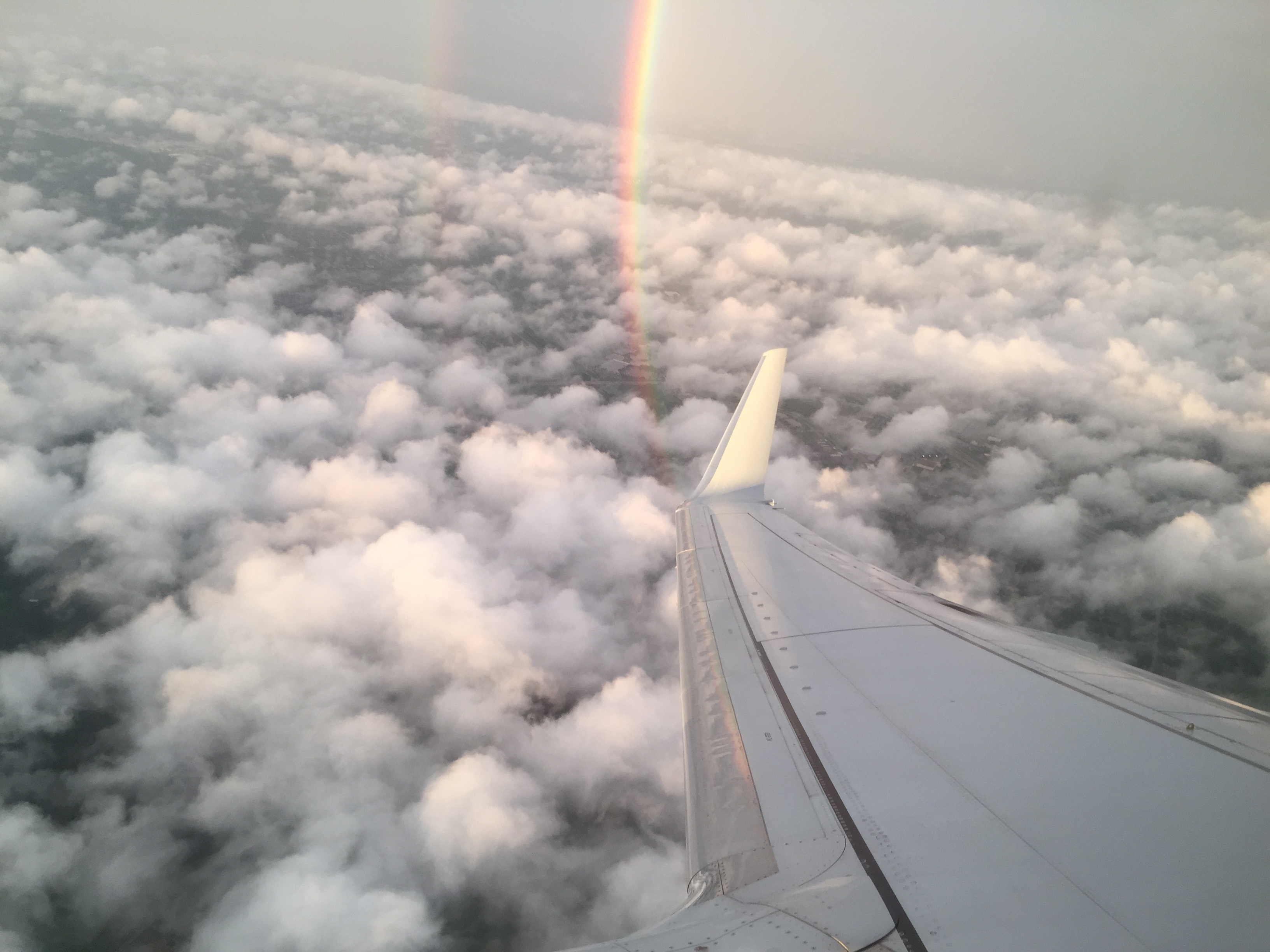
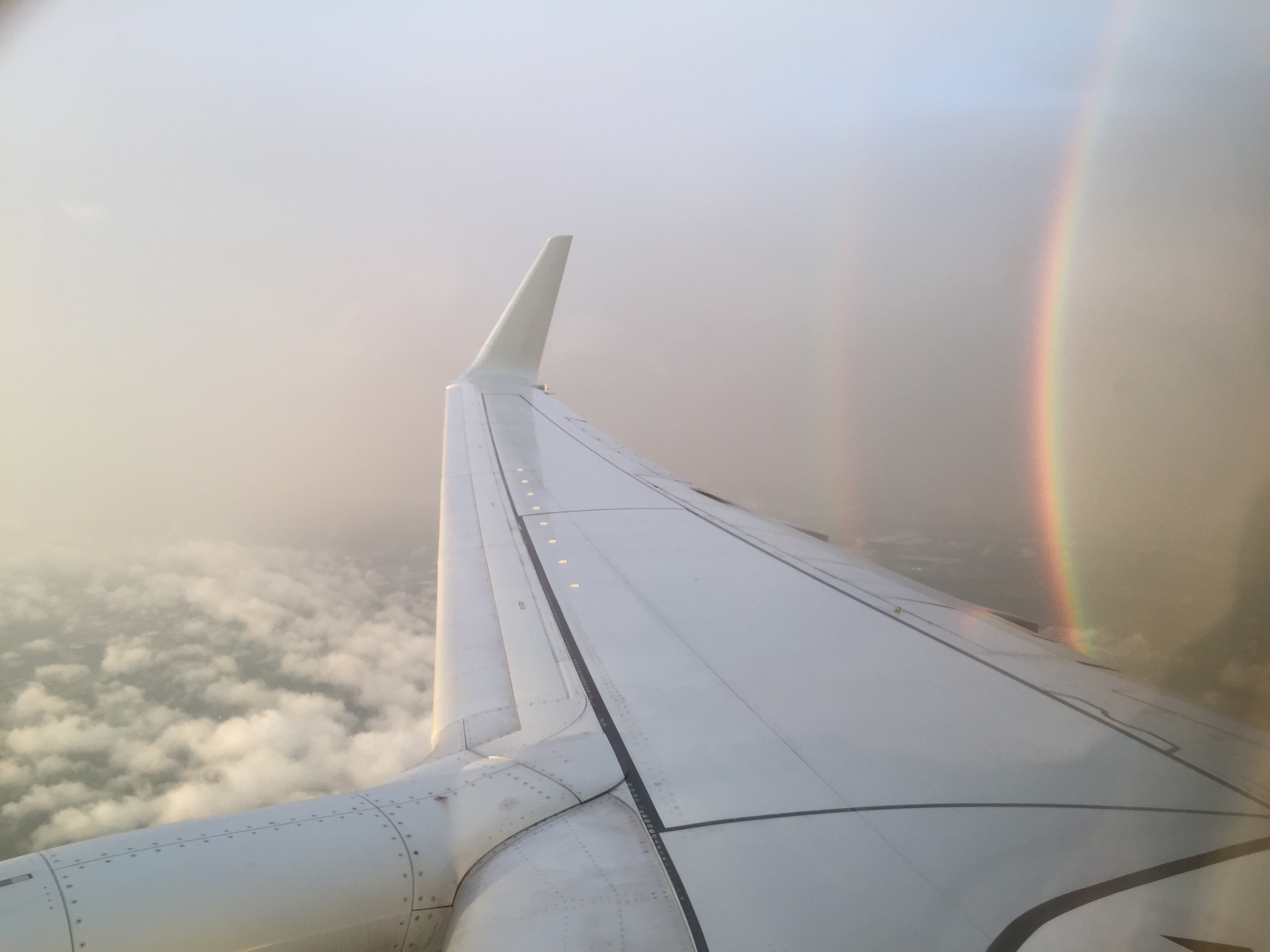
As is my wont, I took pictures out the window while flying. After bouncing through some significant storms and turbulence on our downwind leg over Mesquite, we turned to base south of DFW, then turned north on final, broke through underneath the clouds and found this:

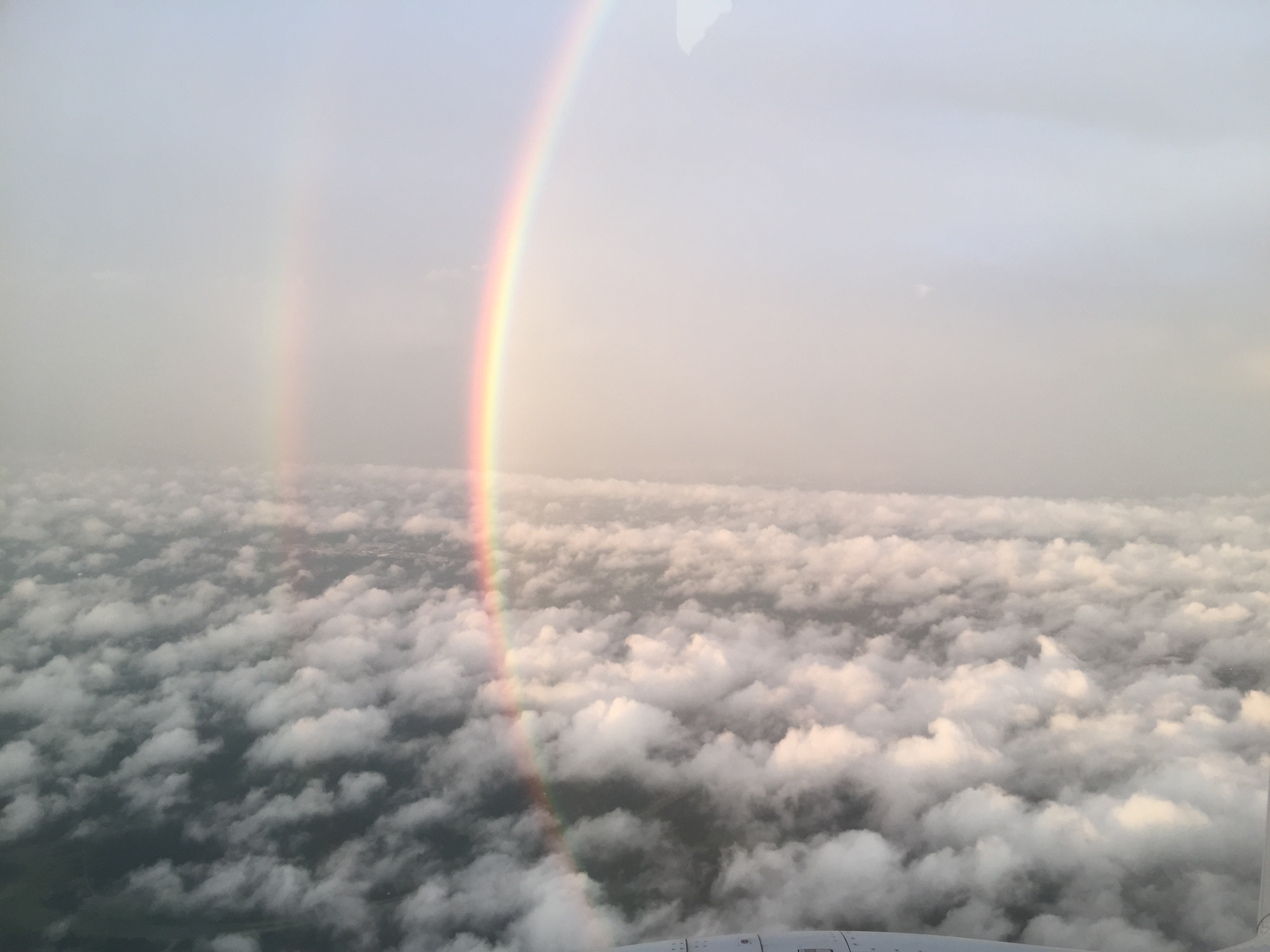
IMG_8897A double rainbow off to the east! The clouds were in layers with rain falling between them, and the sun setting in the west was in a perfect position to make a spectacular display.

IMG_8912As we turned and dodged thunderstorms, the rainbows turned with us, sometimes fading as the sun would go behind a cloud off to the west.

IMG_8919But they always came back again, just as strong, the second (outer) rainbow just about as bright as I’ve ever seen one.

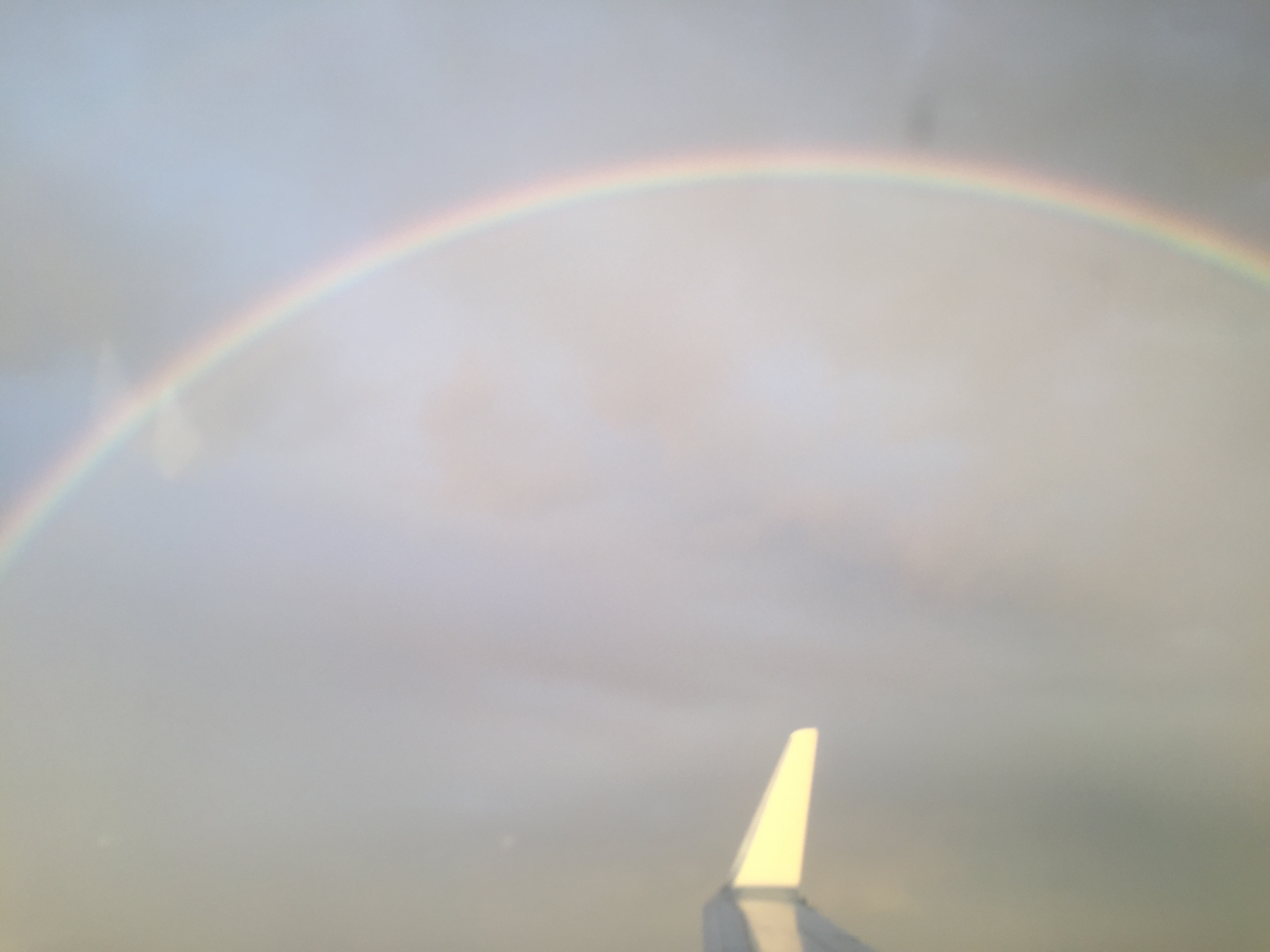
IMG_8921Then I looked up…

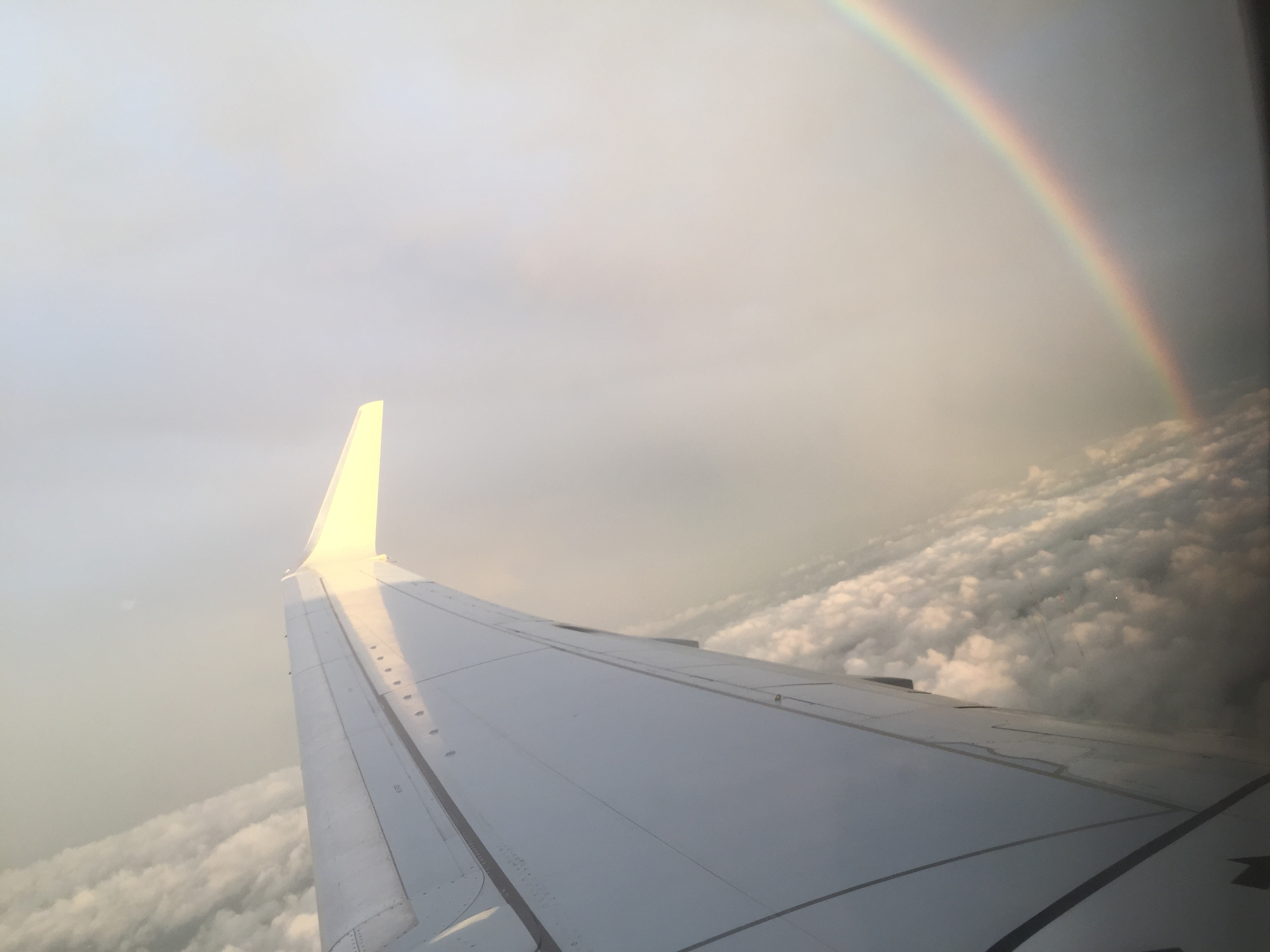
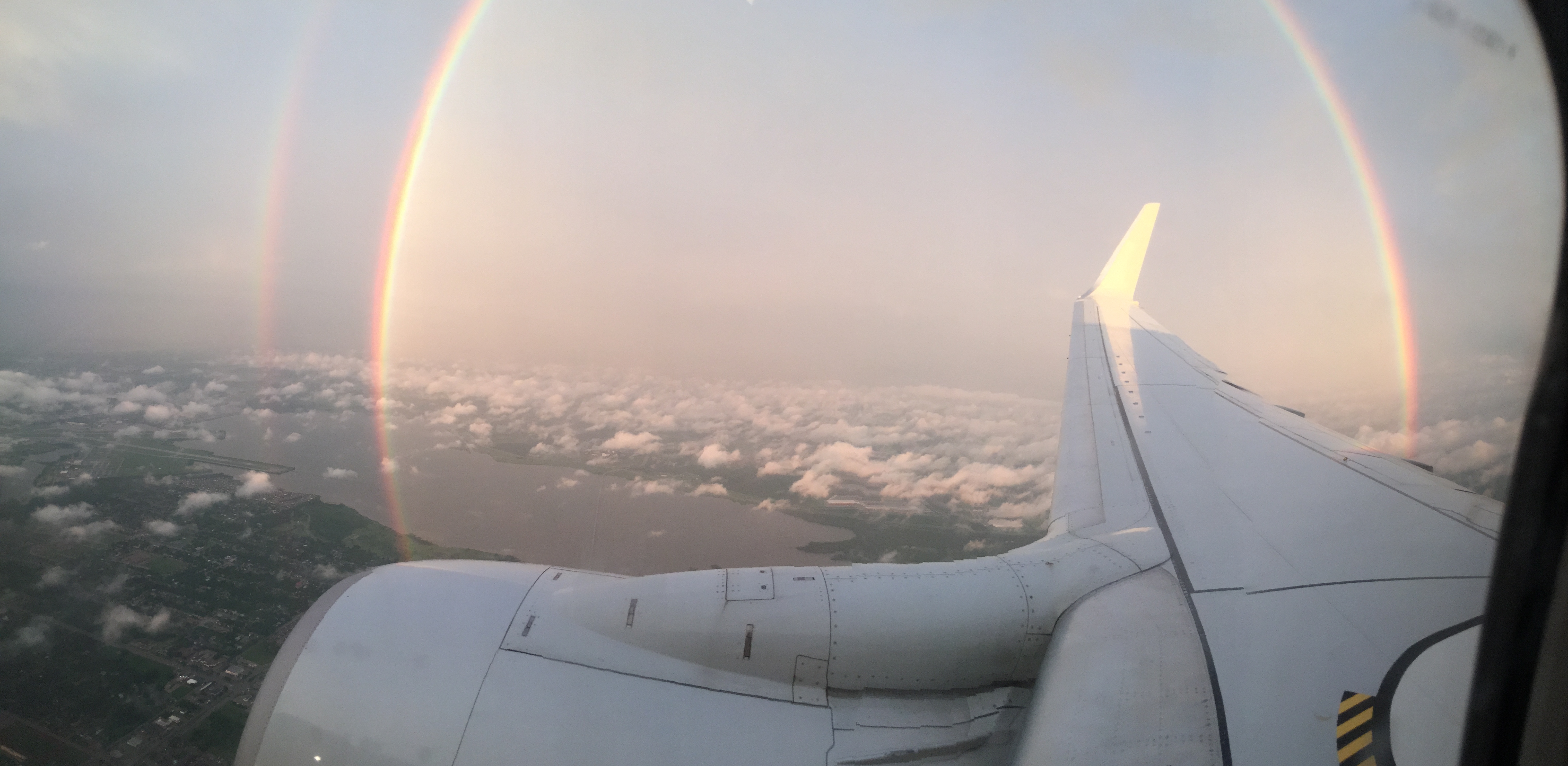
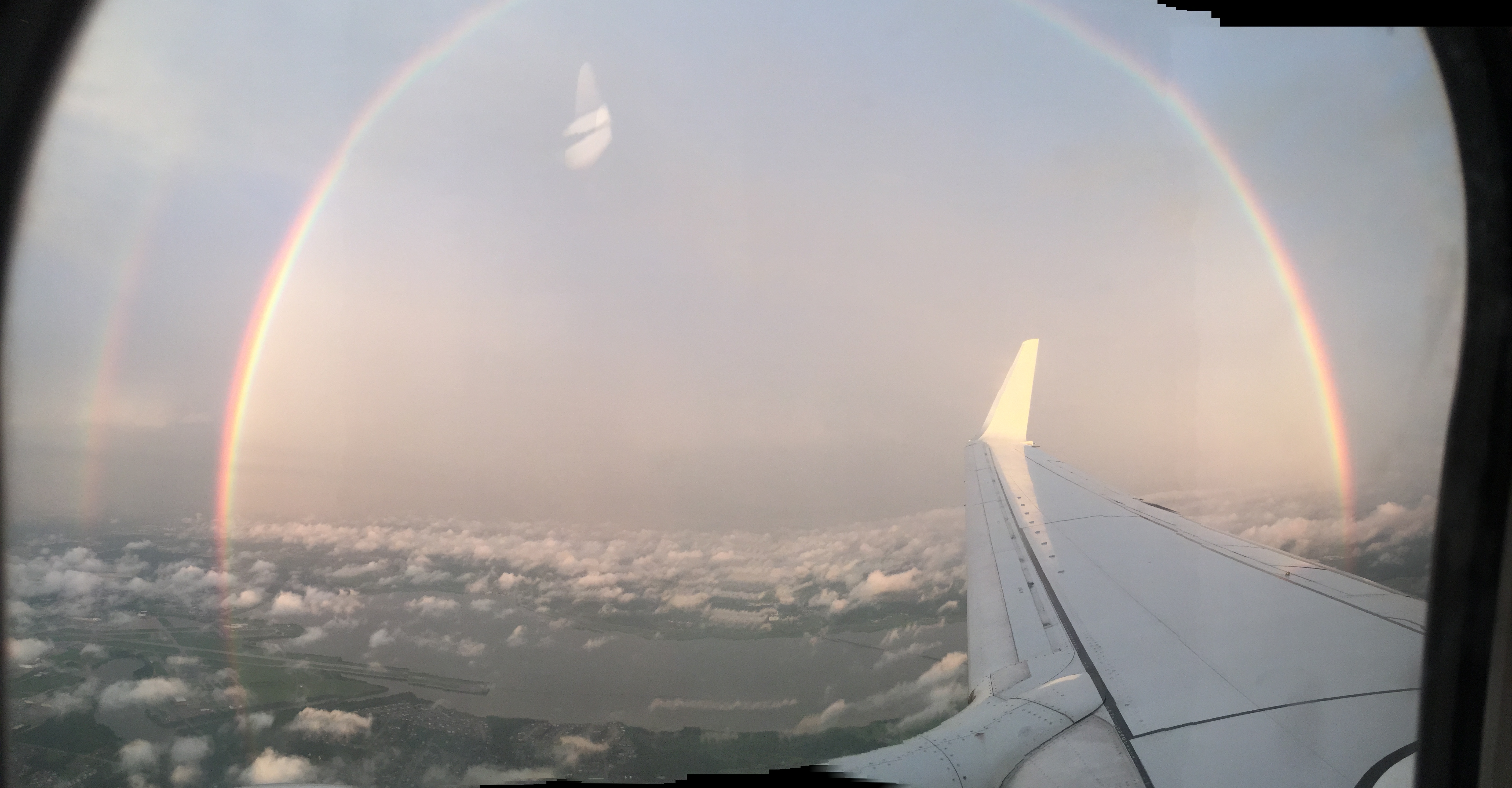
IMG_8922…and contorted in my seat as best I could to look back. Not only did we have a double rainbow, but we had a full-arc rainbow! It was the first time I had ever seen such a thing. I wanted to get the entire rainbow into one picture, but the full arc is too wide for anything but a wide-angle lens.

Wait! I could shoot multiple frames and combine them into a panorama! I was shooting pictures with my iPhone and really wanted to get to my DSLR to get a better set of pictures to combine into the panorama. But on short final, trays up, seat backs in a full and upright position, my good cameras safely buried under the seat in front of me, and only seconds to go before the rainbow would fade, I knew that wasn’t going to happen.

Then it occurred to me that my iPhone has that panorama mode. We were bouncing all over the place in the turbulence – would the iPhone’s panorama software handle that?

IMG_8932Click on this and the picture below to get the full-sized images. Look at them full screen and in all their glory.

IMG_8933Not only was the rainbow a full arc, but it was a double! The outside arc was more visible on the ends near the ground, but the dark area between the two arcs was quite distinct and the full outside arc could be seen dimly.

This was a fantastic end to a fantastic trip. There were all of the flight delays to deal with, but that just gave me a chance to go through these pictures and start tweeting and emailing copies to American Airlines and several prominent online science journalists and photographers.

It should be obvious why a story about rainbows, especially a story full of excitement, passion, and beauty, would be so appropriate today. It was a very good day when I caught the images of this complete arc double rainbow – it was a very good day today as well.

Today deserves these rainbows.

1 Comment

Filed under Flying, Photography, Travel, Weather

Random Photo For June 7th

  • Random number between 1999 and 2015 = 2005
  • Random number between 1 and 12 = 8
  • Random number between 1 and 31 (or 30 or 28 or 29) = 18

DSCN5464 small

We were in Seattle, our first trip there, a family vacation. In the iconic Farmer’s Market, I saw this sculpture of a giant squid suspended above us.

By all accounts, squid can get quite large, and they’re not stupid. The exhibit curiosity and non-random, non-instinctive behaviors. There have been instances of remote vehicles thousands of feet down in the ocean seeing giant squid and having the squid come back several times to investigate and even play with the submarine.

Better yet, their aquatic relatives, the octopus, are in some cases being shown to be as intelligent as a chimpanzee or dog. They can be trained to perform complex tasks and can use simple logic and reason to solve problems. For example, in this video (which has Spanish titles, but a favorite Jean Michel Jarre soundtrack) an octopus figures out how to unscrew a jar in order to get at the food inside.

I’m hoping that we don’t manage to kill off all of the squid and the octopus as we continue to screw up the planet. We’re seeing significant temperature increases in the oceans as the atmospheric temperatures rise. We’re also seeing the oceans getting more acidic as the warmer water combines with the increased CO2 levels in the atmosphere, creating increased amounts of carbolic acid at the sea/air interface. Of course, we also have issues like oil spills that are causing major amounts of damage in the areas where they occur – look at how much oxygen levels in the water fell and marine life suffered after the British Petroleum spill in the Gulf of Mexico in 2010. Then we overfish for many species, depleting them to the point where they’re near extinction, which in turn depletes the species which feed on them, which in turn…

Given the increasing odds that at some point we’re going to screw up so badly that we put ourselves on the endangered species list, I hope that species like the squid and the octopus are able to survive. I know that in the long run, Mother Nature will do just fine without humans, just like she did just fine without dinosaurs and millions of other species before us. Something else will rise to the top of the food chain when primates are gone, just like mammals and primates rose when the dinosaurs faded into history. The planet will be just fine without us.

Maybe it will be octopus that get the next crack at it. If we don’t take them with us.

Leave a comment

Filed under Critters, Disasters, Photography, Travel

Memorial Day 2015

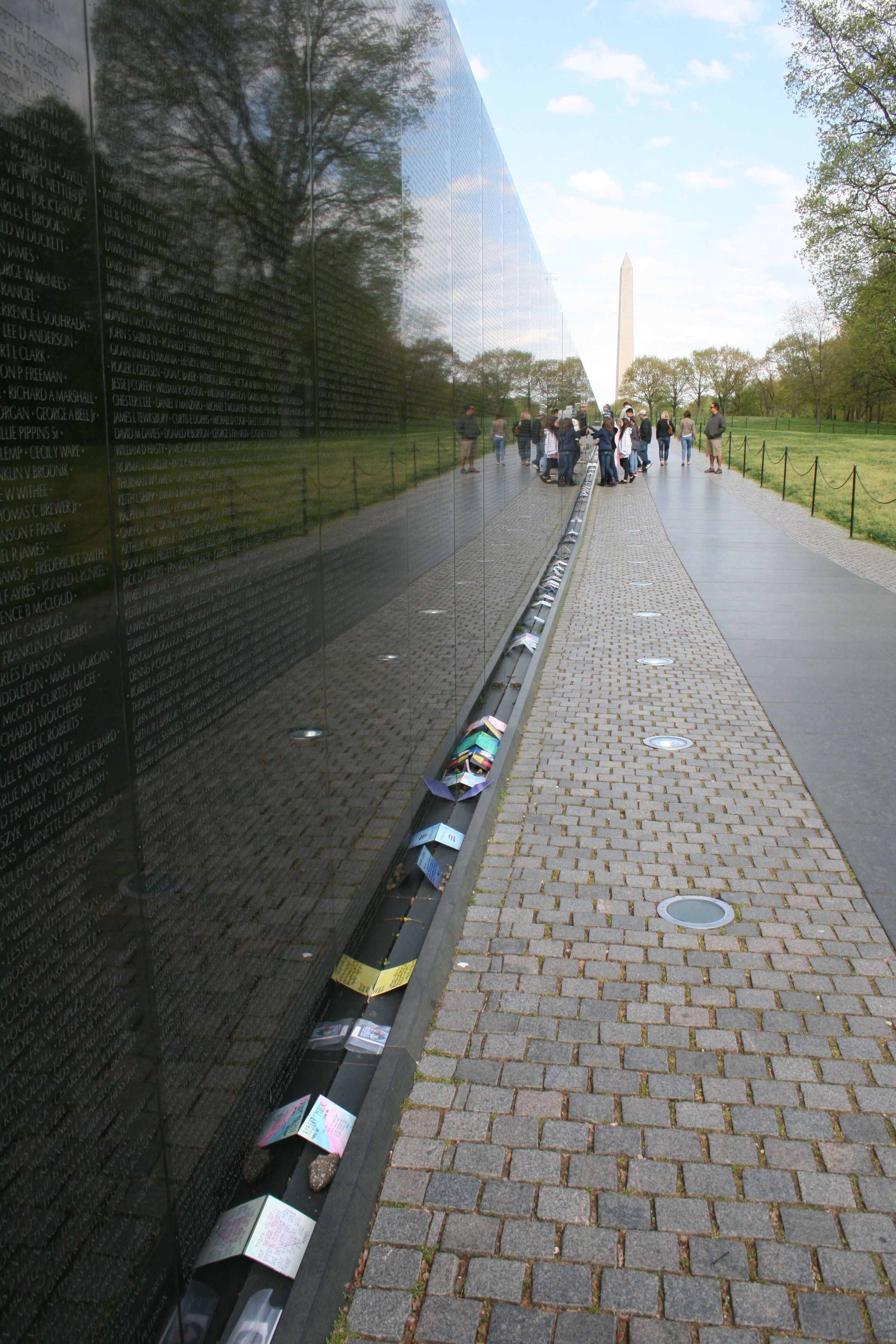
A visit to Washington DC offers many opportunities to think about what Memorial Day is truly about. Our thanks to all of our nation’s military personnel, past and present, who served their country and did what was necessary to keep the wolves at bay.

IMG_5619 small

National World War II Memorial.

IMG_5919 small

Vietnam Veterans Memorial

IMG_5932 small

Vietnam Women’s Memorial

Leave a comment

Filed under Photography, Travel

Boston (Part Six)

It’s finally time to wrap up this visit to Boston, one of my favorite cities. (I’m sure we’ll be back here sooner or later.) So far we have walked The Freedom Trailstarting at Boston Common, seen the Old State House and Faneuil Hall, gone through Paul Revere’s house and the Old North Church, went through the USS Cassin Young in the Charlestown Navy Yard, then showed off the USS Constitution.

IMG_7421 small

Leaving the USS Constitution and the Charlestown Navy Yard, one last thing that caught my eye. While it’s a routine item in Boston, it’s a funny looking oddity to someone who’s lived too long in Southern California. I had to stop and wonder, why does this fire hydrant have an antenna? Are the fire hydrants here all connected to the Internet or linked to the other fire hydrants? Are these really, really high tech fire hydrants in one of our country’s oldest cities?

Obviously not. (I’m goofy and silly, but not that goofy and silly.) It’s just there to warn the snowplow drivers about the hydrant’s presence so that they don’t sheer it off when clearing the the street while the snow’s three or four feet deep. Or, if this corner of the lot hasn’t been cleared at all, it lets the fire department find the hydrant underneath the snow in the event of an emergency. Although that might not have been much use this last winter when they had ten to fifteen to twenty feet or more of snow piled up.

IMG_7578 small

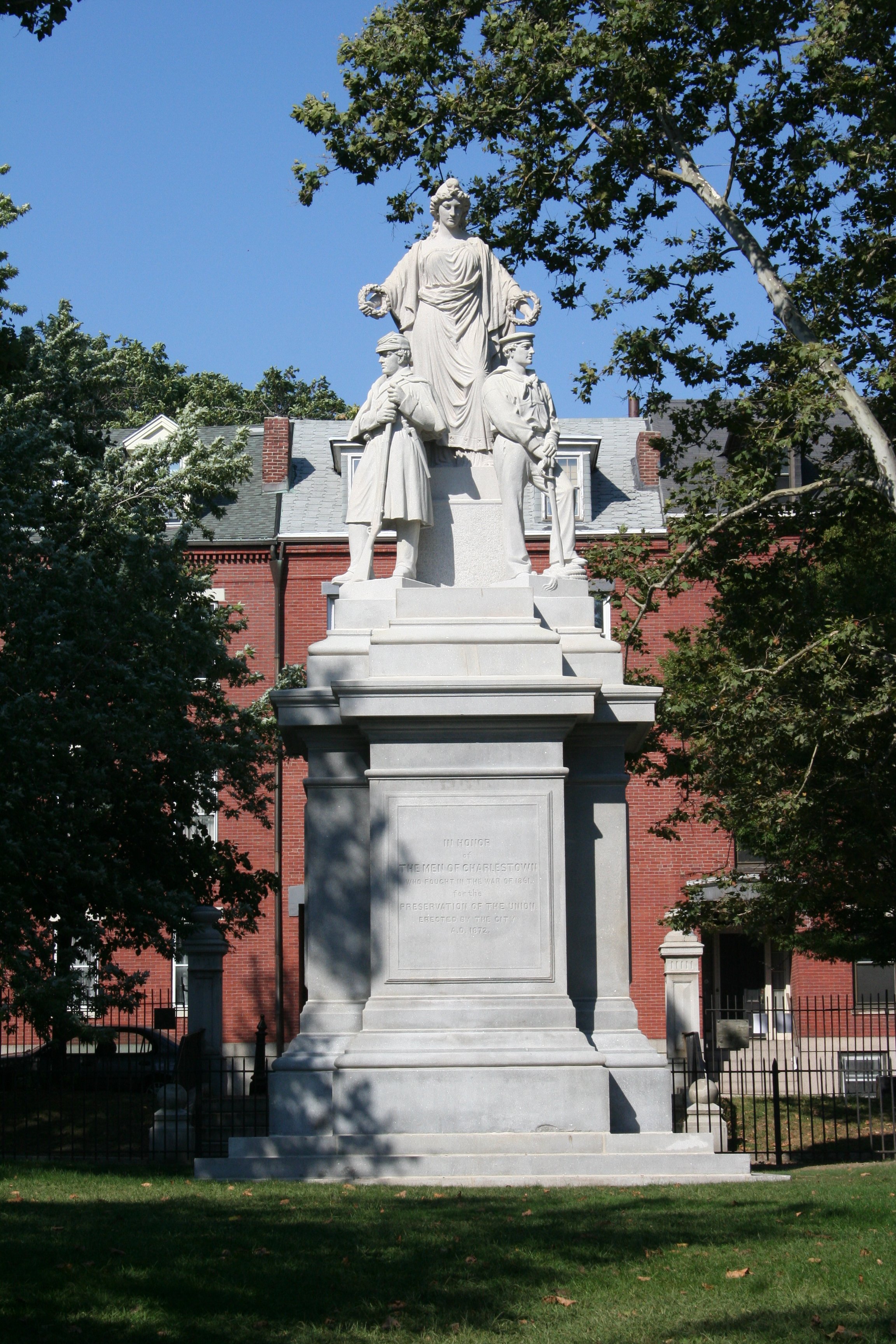
Heading back up the hill and inland from the Charlestown Navy Yard, you’ll remember that we found this statue on the Charlestown Training Ground. I want to know who cleans it – it’s surprisingly clear of “pigeon residue” for a big city statue.

IMG_7517 small

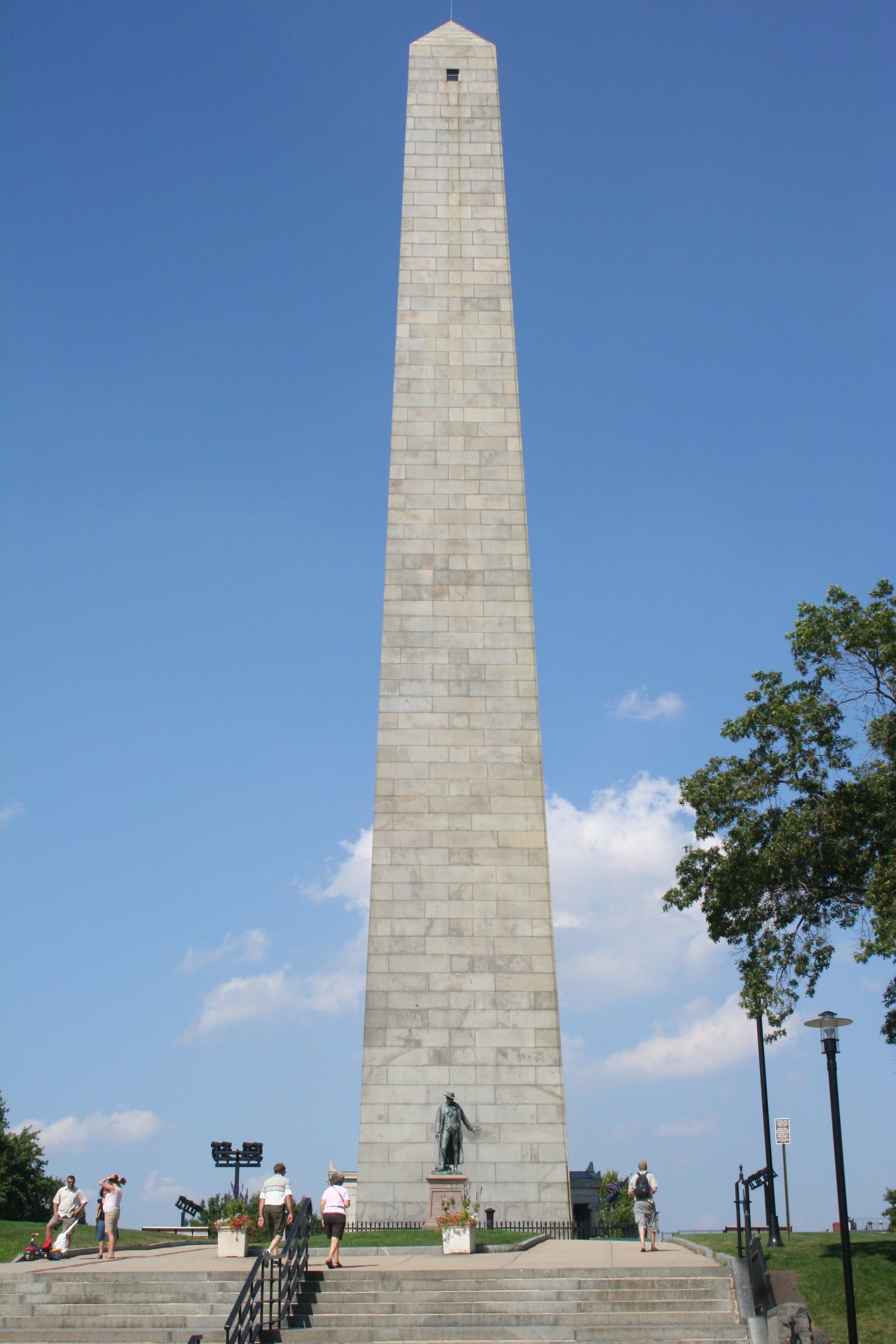
Three blocks up from the Training Ground you’ll find the Bunker Hill Monument. I knew it was there because the maps said it should be, and I had seen it sticking up from a distance when crossing the Charles River. But the townhouses and apartment buildings along those blocks are a couple stories high, the streets are tree-lined, so I remember being surprised to come out from between them and suddenly find a large, open area with the monument.

IMG_7522 small

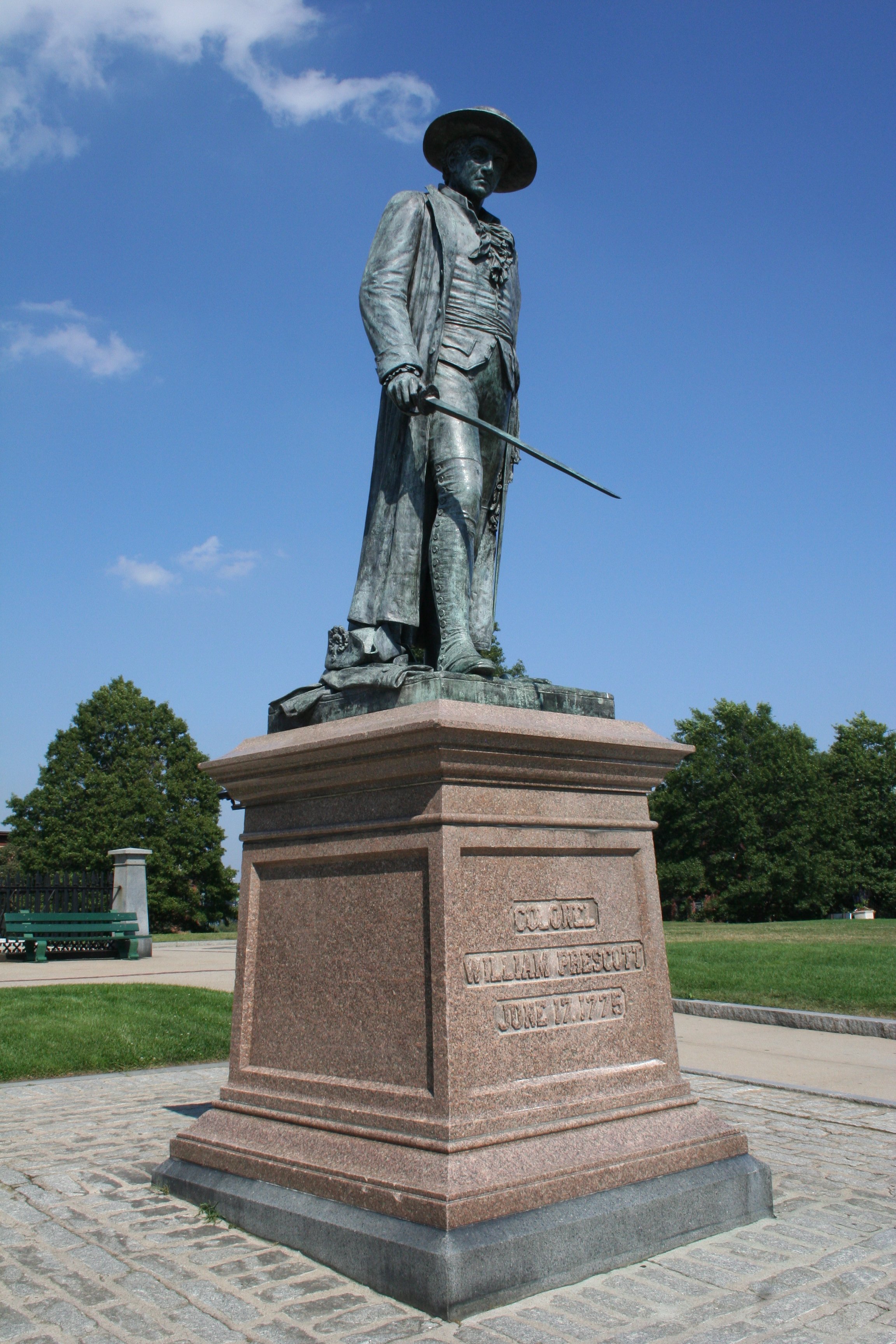
Colonel William Prescott was one of the leaders of the revolutionary military movement in 1775 Boston. On June 17, 1775, the American revolutionary militia took on a much larger British force in the “Battle of Bunker Hill.” The battle is considered to be the first significant battle in the American Revolution. The British forces, while ultimately able to prevail in three assaults on the militia positions, had over 800 injured and 200 killed from their force of 2,200. The Americans forces suffered 100 killed and more than 300 injured before retreating.

However, the “Battle of Bunker Hill” was not fought on Bunker Hill. Bunker’s Hill is about 600 yards inland. The monument, statues, and the legend have the name, but the battle was actually fought on Breed’s Hill. Prescott had been ordered to put his fortifications on Bunker’s Hill, but had decided that Breed’s Hill was a better defensive position, despite being lower, less steep to climb, and much closer to the British positions. The monument is at the site of the battle, but despite the name, it’s Breed’s Hill, not Bunker’s Hill.

IMG_7528 small

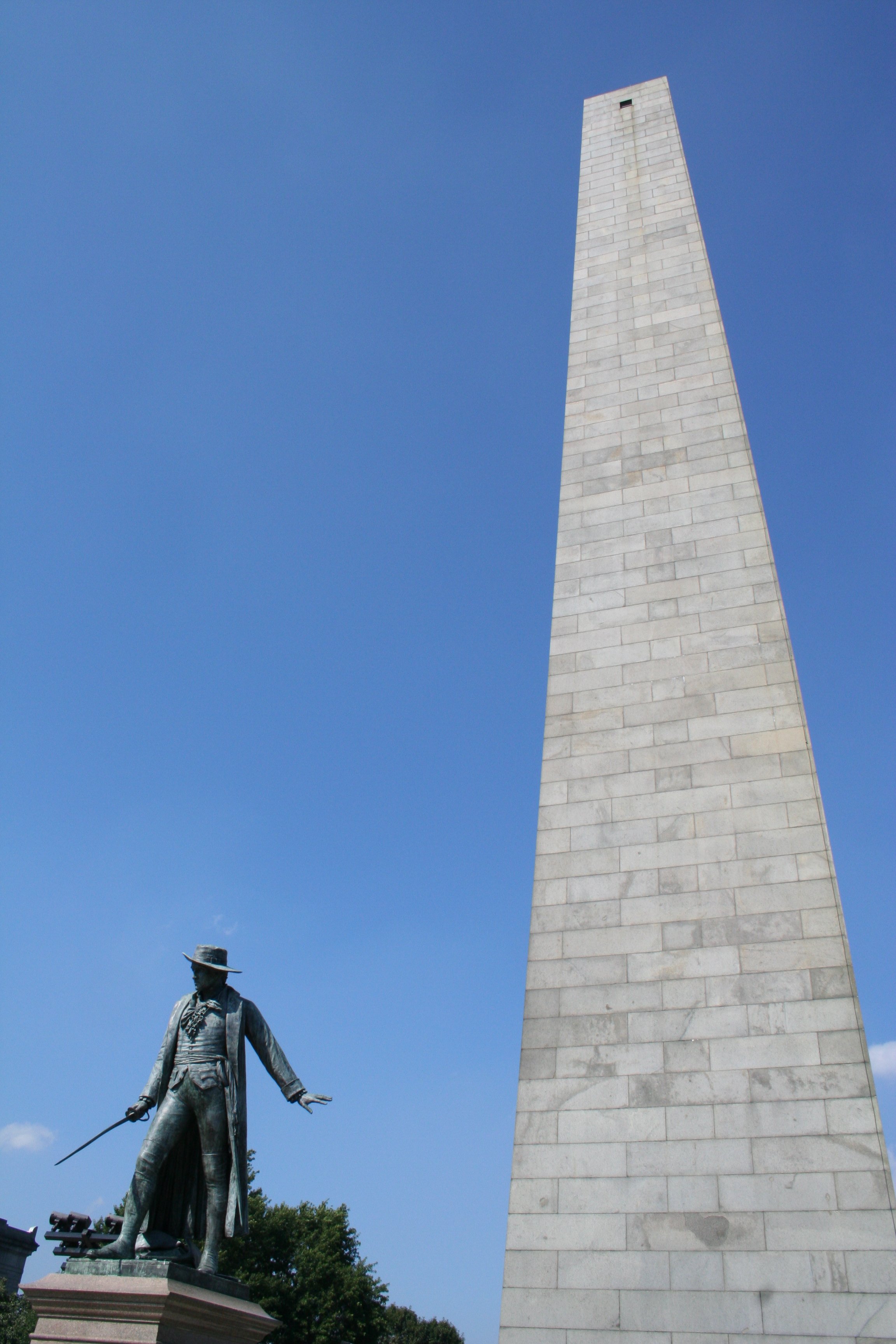
The Bunker Hill Monument is 221 feet tall and was completed in 1843. There’s an obvious comparison to the Washington Monument in Washington, completed in 1884, which at 555 feet is two and a half times taller.

Legend has it that, due to the severe shortage of gunpowder and musket balls that the American troops had, Prescott gave his troops the famous order, “Don’t shoot until you see the whites of their eyes!” While it’s true that the Americans held their fire until the British were quite close (and then shot at the officers first in order to cause chaos), the “whites of their eyes” order was never given. It’s a fiction, created much later to dress up the story.

It’s an impressive monument for an American defeat, especially with all of the incorrect information regarding the battle itself. What is undeniably true about the battle is that it proved to the British that this minor uprising of a few malcontents was going to be much more widespread and difficult. It was going to be a much, much longer battle than they expected, and it was going to cost them far more than they would ever have believed.

IMG_7533 small

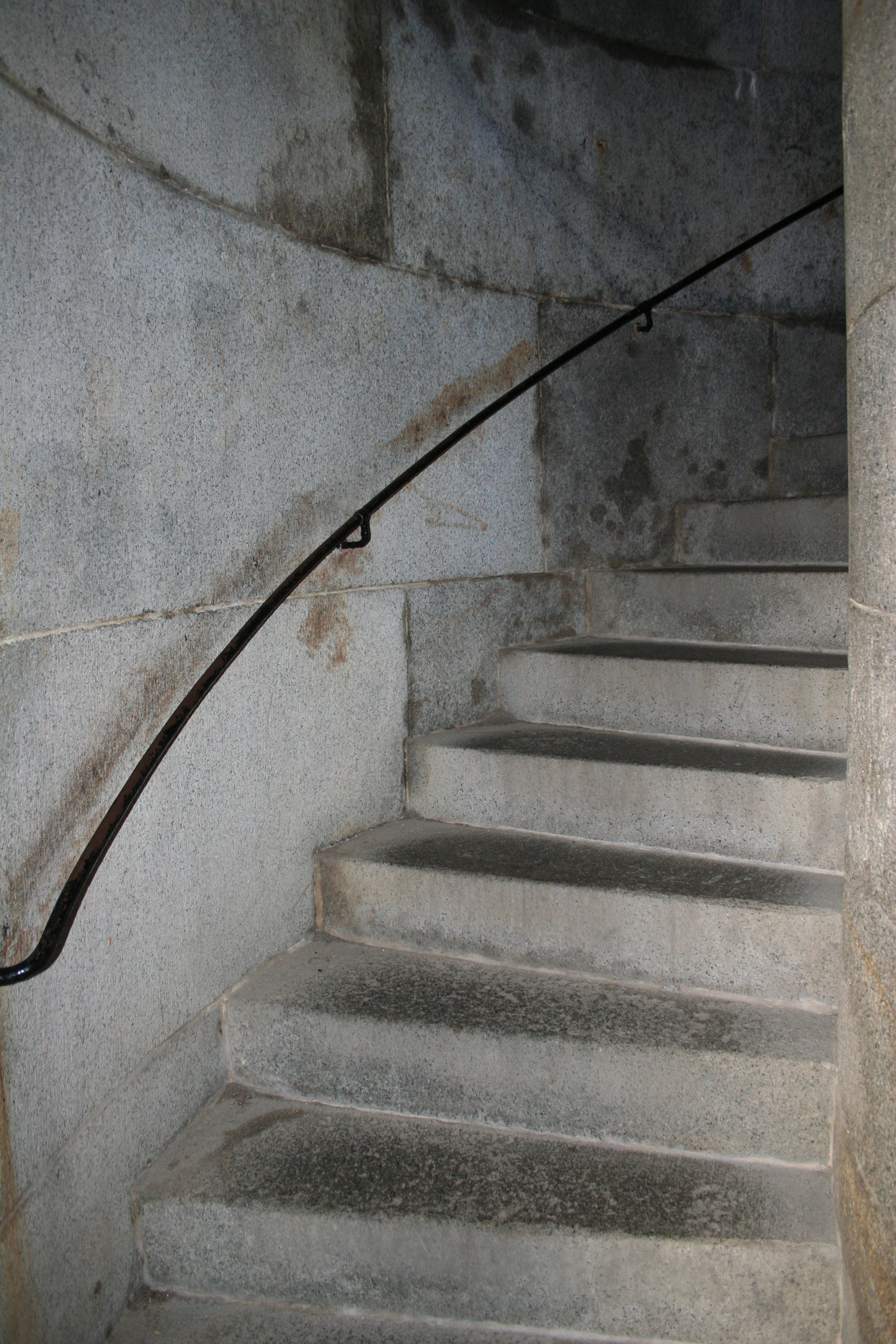
Unlike the Washington Monument, where you get up and down by elevator (there are stairs, but they’ve been off-limits for decades), you get to the top of the Bunker Hill Monument by climbing the stairs. Two hundred and ninety-four steps. The stairwell is steep and narrow. You are warned, repeatedly, by park rangers at the bottom, that you really need to make sure you want to make the climb and you’re physically in shape to make the climb. There was a charming young lady there, maybe in her mid to late 20’s, who asked me if I really knew what I was getting into, suggested that I not climb, and then gave me that smug, silent, “Reallllly?” look.

Of course I’m in good enough shape! Maybe I was over fifty and carrying a few pounds that I would like to lose, but had I not just walked the entire Freedom Trail? Am I not a macho, stud muffin of a manly man?

Though. I. Was. Going. To. DIE!

The worst part was the tweens and teens scampering by me like they were floating. Rotten little brats. (The climb really isn’t that bad if you’re in reasonably good shape, but your thighs will be feeling it if you’re not used to hill climbing or using the StairMaster.)

IMG_7553 small

Perseverance will give you some great views back toward Boston. There’s a somewhat cramped observation floor at the top, with windows looking out in all four directions. You can look down on Logan Airport to your east, inland toward Cambridge and Harvard, or north toward the Mystic River area and Malden. Here you can see the downtown area to the south, with the spire of the Old North Church visible on the far left side, just across the Charles River.

IMG_7580 small

Having survived the Bunker Hill Monument (it’s a lot easier climbing down than it is up, and my smug “told you so!” look at the park ranger there wasn’t quite as effective as I wanted since I was sweating like a pig), it was time to head back toward Boston. In theory I could have called a cab – but where’s the fun in that?! I had to get back to meet with The Long-Suffering Wife after she got out of her conference, so I took far fewer pictures on the way back and concentrated on making tracks.

Which, of course, is not to say that I took no pictures on the way back. Just before crossing back over the river into North Boston I found City Square Park, which is a new-ish, one-acre park created early in “The Big Dig.” The Big Dig was a highway project that took over 20+ years and over $22B in an attempt to expand the freeways cutting through the heart of the city by burying them under the existing skyscrapers and houses. (The word “boondoggle” is thrown about quite a bit, and many Bostonians will still start twitching a bit when you mention it.) Directly under City Square Park are some of the freeway tunnels and connecting ramps between US Highway 1 and Interstate 93.

The park is full of all sorts of sculptures, many of fish and other odd creatures. I found them to be extremely fun and whimsical. I also found some quiet and shade and a place to sit for ten minutes. (My thighs were still feeling the whole 294-steps thing.) This fountain and weather vane are in the center of the park.

IMG_7584 small

While there, I also talked to some of the local residents, one of whom was nice enough to take my picture. Of special note are the pasty-white legs, the Angels hat (just to provoke a response), my favorite white-water rafting T-shirt (“The orange vest doesn’t make you safer, just easier to find”), the sacred sunglasses, and the backpack that’s been ’round the world a couple of times carrying my cameras.

Compare this outfit to the slightly more hideous one I displayed while being a tourist in Shanghai. Same hat, glasses, shoes, pasty white, and backpack, but obviously when I want to look like a “classy” tourist I wear a Hawaiian shirt instead of a T-shirt!

Go see Boston, walk the Freedom Trail. Also go to a game at Fenway, see the Boston Pops outside, got to Harvard Square, go down to Quincy to see all of the John Adams sites, go out to Cape Cod. It’s a great city.


Leave a comment

Filed under Paul, Photography, Travel

Boston (Part Five)

It’s time to double back a bit in the photographic saga of my most recent trip to Boston. I say “most recent” because it was a city I visited often when I was in high school, given that I could get there easily from Southern Vermont. It’s also a favorite city so I plan on going back every chance I get.

For this trip I was the “Trophy Husband” the Long-Suffering Wife on one of her business trips. (She calls me that, but someone has pointed out that she never said it was a first-place trophy. It could have been for “best effort,” “most enthusiastic participation,” or “best cookbook collection.”) We were in a hotel downtown, she was in meetings all day, so I walked The Freedom Trailstarting at Boston Common, up Fremont Street to the Old State House and Faneuil Hall, into the North End to Paul Revere’s house and the Old North Church, then finally across the Charles River and into the Charlestown Navy Yard.

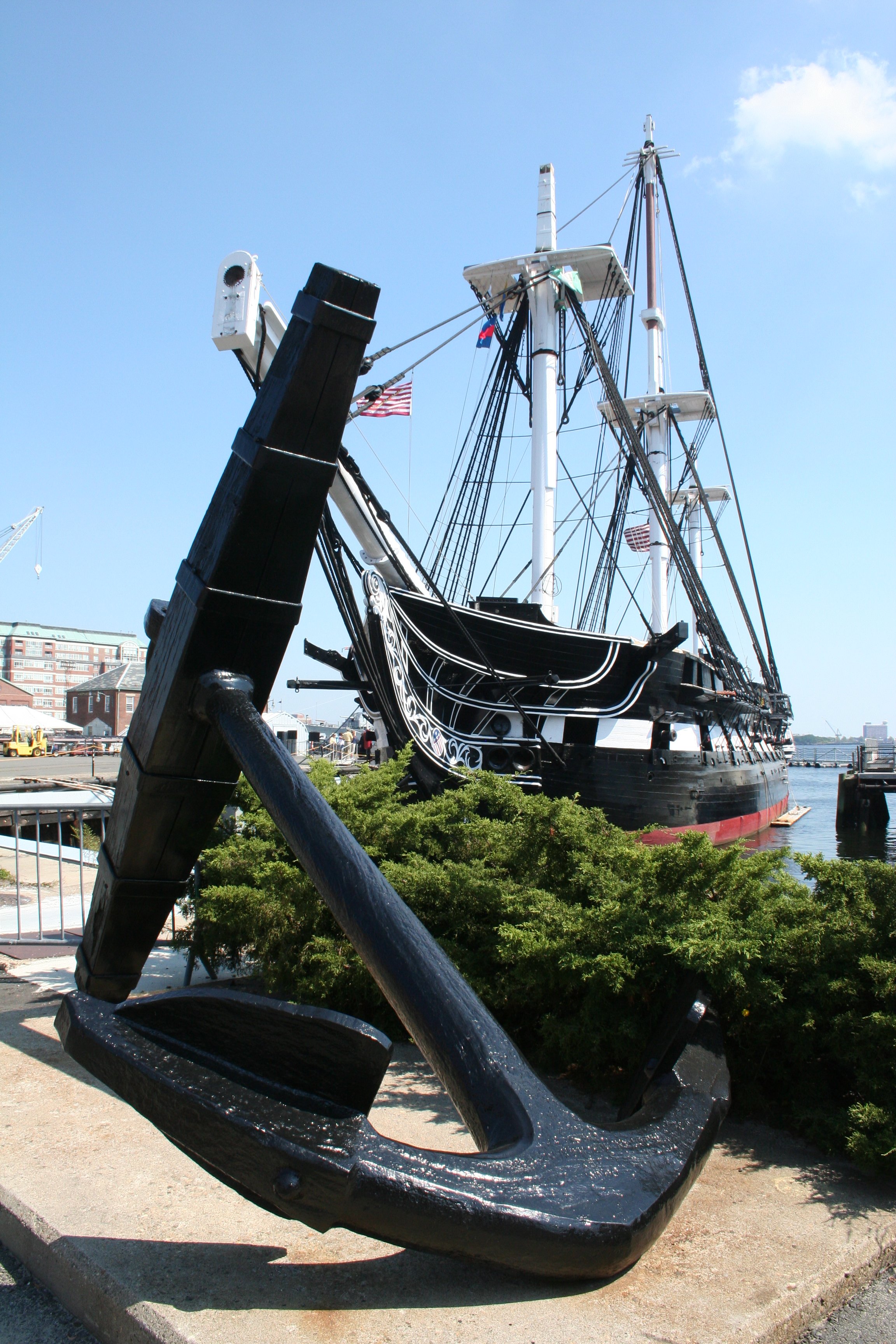
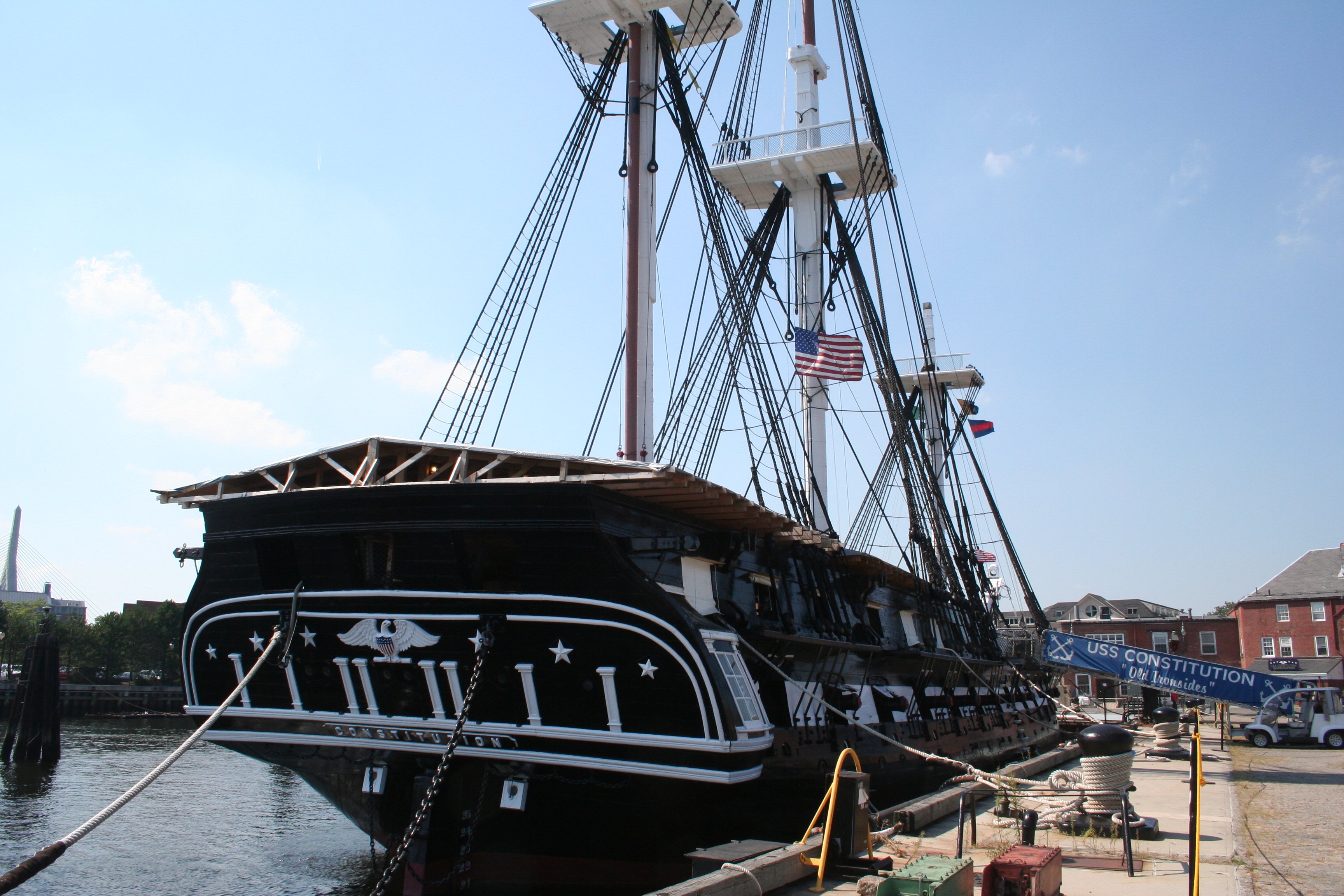
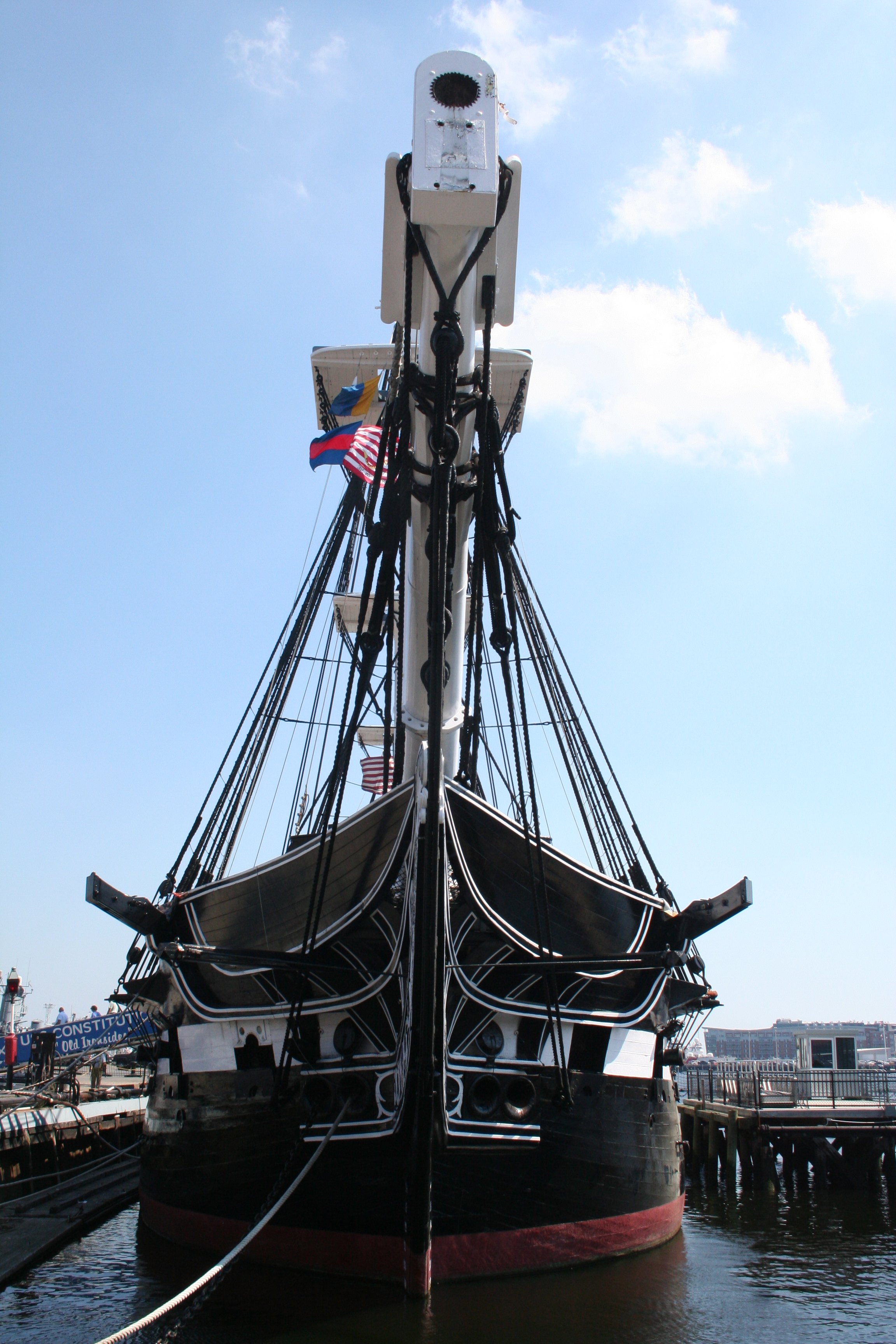
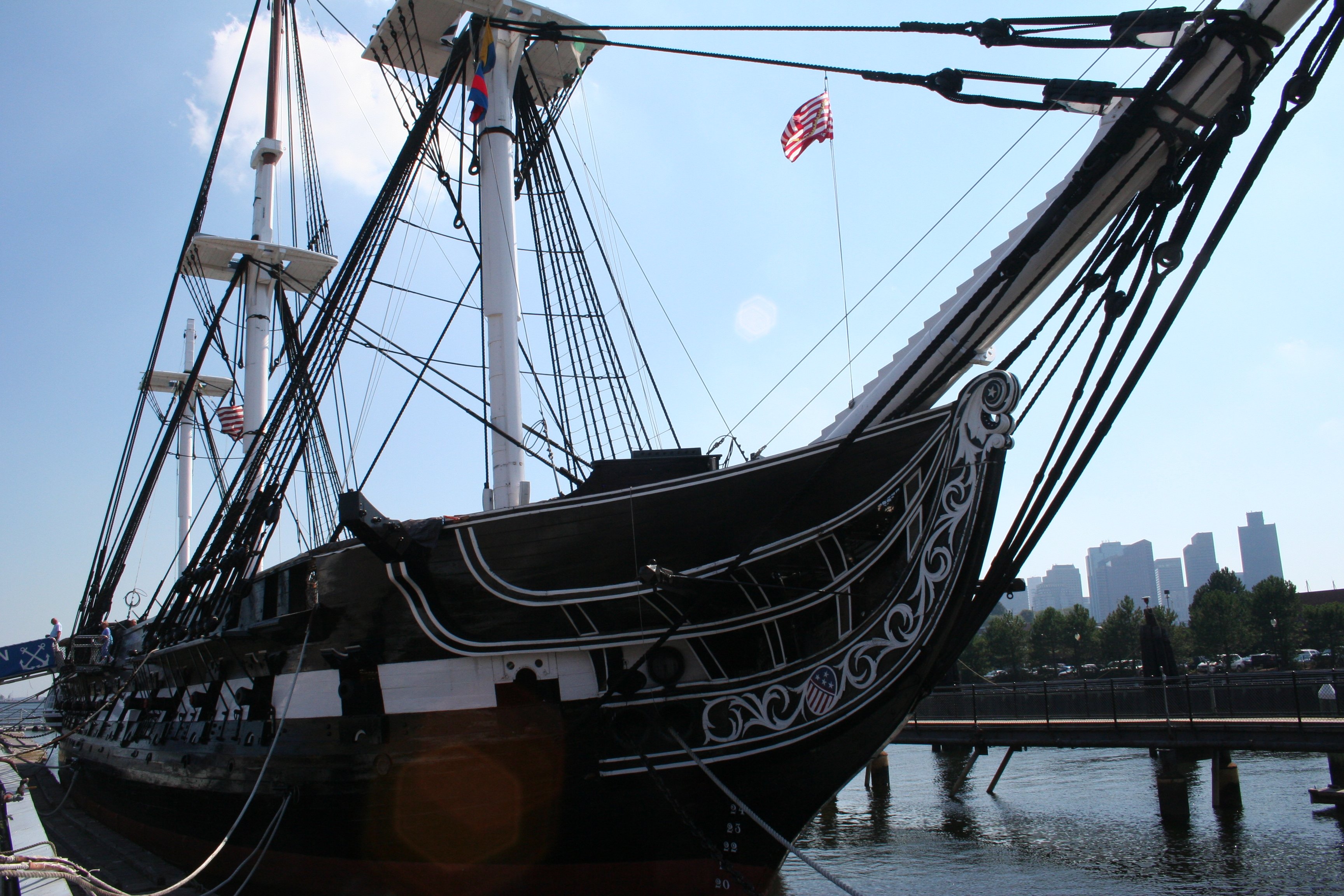
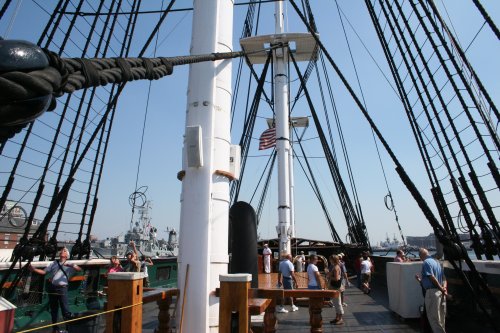
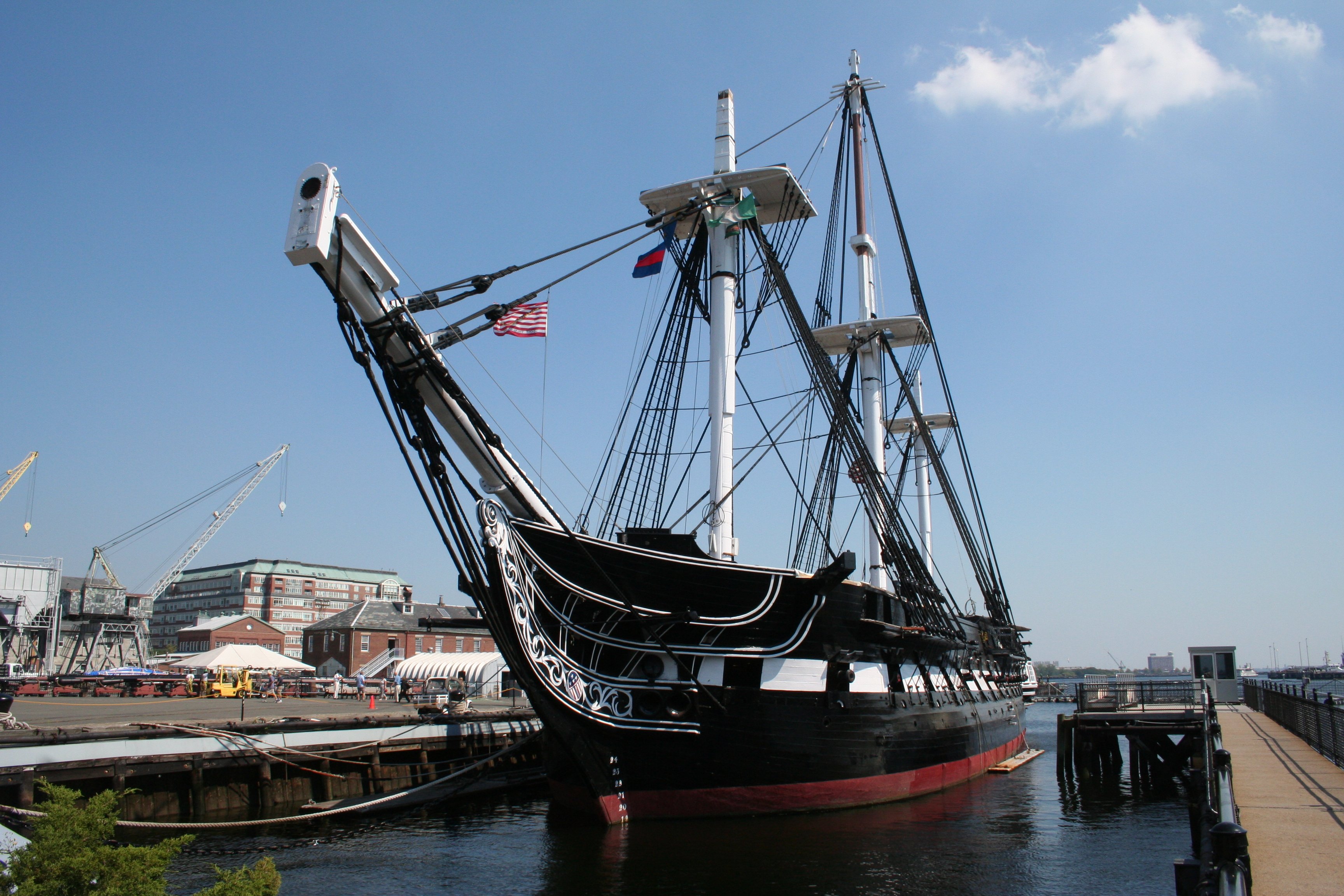
Last time I showed pictures of the USS Cassin Young and mentioned that she was the second-most famous attraction in the Charlestown Navy Yard. That is, of course, because she sits across the pier from the USS Constitution, otherwise known as “Old Ironsides.”

IMG_7420 small

The USS Constitution is the oldest commissioned vessel in the world, launched in 1797.

IMG_7431 small

She is not just a museum piece, but a seaworthy, commissioned US Navy vessel. When you go onboard you’ll have to go through a brief security check (about like going to a ballgame) because technically you are entering onto US military property. Tours are free. (But check if you’re going in the next year or two, she may be in dry dock and unavailable for tours from time to time.)

IMG_7417 small

She earned the nickname “Old Ironsides” in the War of 1812. Taking on and defeating four British frigates, it seemed that the British cannonballs were simply bouncing off of her sides.

She was a primary ship in the 1804-1805 engagements between the young United States fleet and pirate ships operating out of Tripoli. You know, “From the Halls of Montezuma to the shores of Tripoli…”

She made a round-the-world excursion in May 1844 through October 1846, briefly participating in the Mexican-American War while enroute.

IMG_7415 small

Today her uses are ceremonial (I don’t see her taking on any Russian subs or Chinese aircraft carriers any time soon) as one of the finest tall ships from the United States. She sailed during the “tall ship” celebration of the US Bicentennial in 1976, after previously occasionally undertaking several multi-year US coastal tours. For example, in 1930-1934 she toured from Maine to the Caribbean, through the Panama Canal, and up the West Coast to Washington, and back to Boston. The controversy on that trip was that she was towed by a mine sweeper instead of travelling under sail, because the Secretary of the Navy at the time didn’t believe that a crew could be trained to properly handle her in actual sea conditions..

IMG_7403 small

In 1997 she sailed under her own power in celebration of the 200th anniversary of her launch. In 2012 she sailed again for the 200th anniversary of her victories in the War of 1812. In 2014 she sailed around Boston Harbor five times in anticipation of a return to dry dock for maintenance in 2015. She’s expected to sail again in 2018.

IMG_7399 small

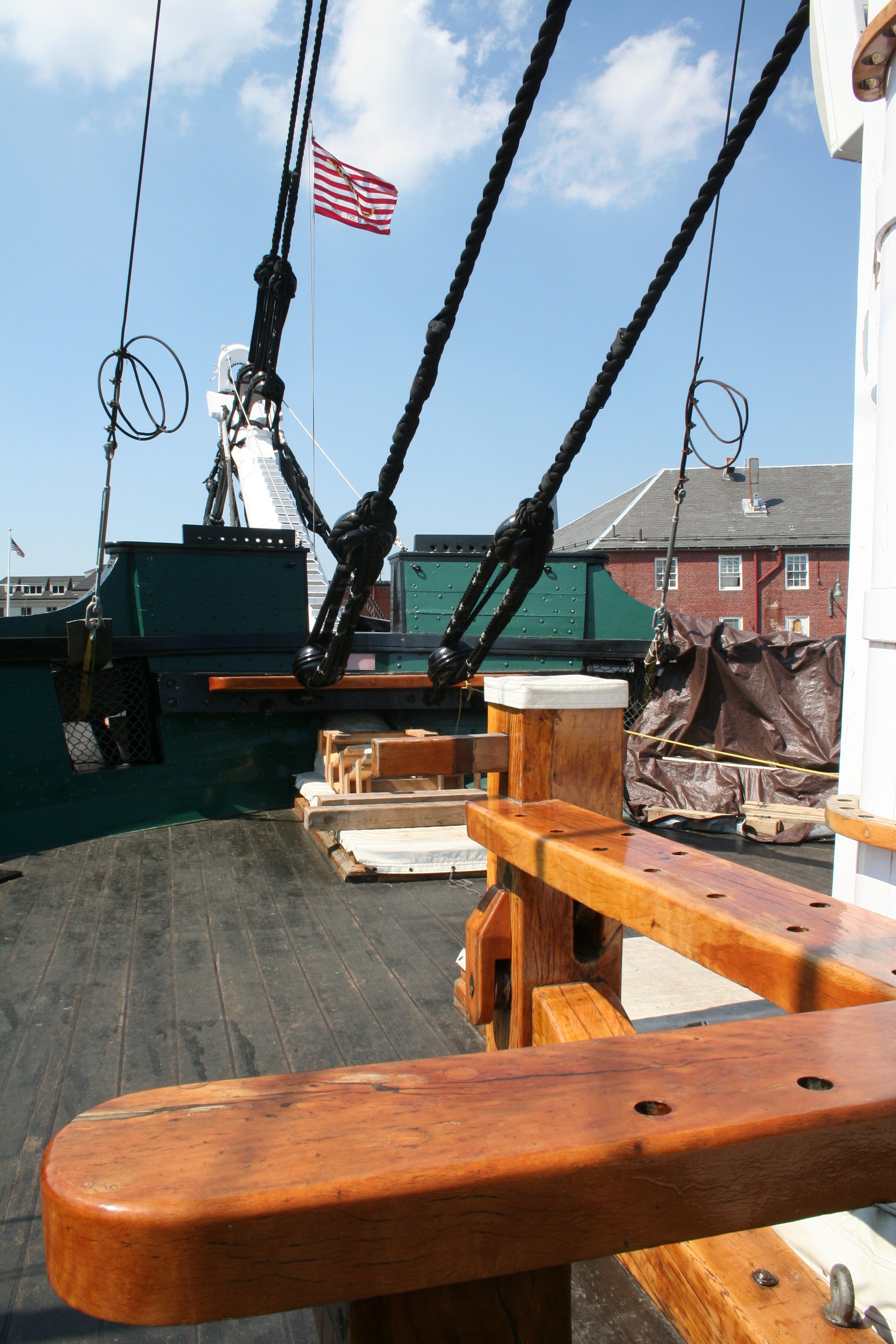
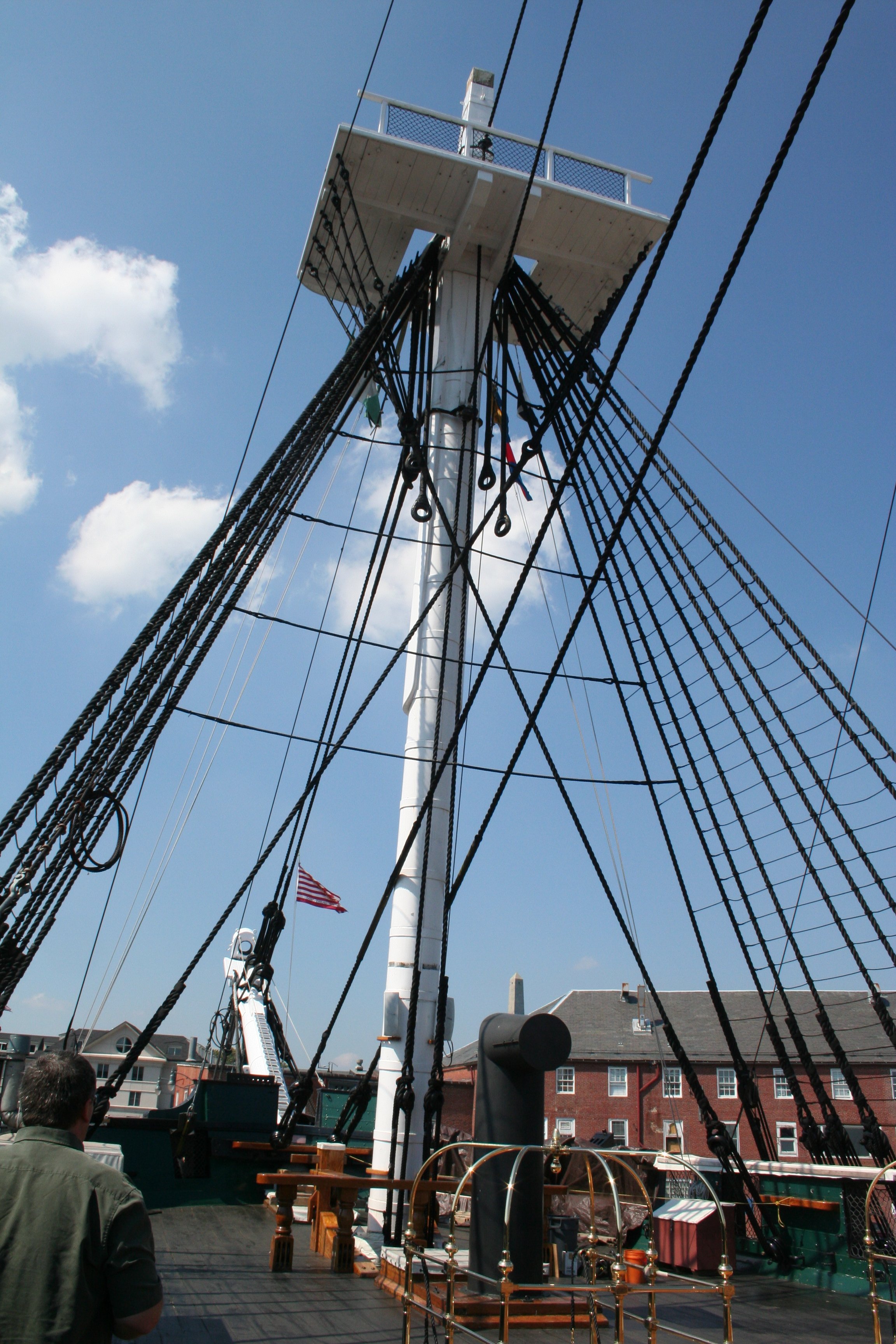
The Constitution is crewed by sixty regular members of the US Navy. It is obviously a great privilege to serve an assignment as part of her crew. The care that the crew takes with every line, every beam, and every bolt onboard is quite apparent. This is a vessel which is honored, revered, and respected.

IMG_7395 small

In a round of restorations and upgrades from 1930-1934, modern amenities were installed belowdecks, including modern toilets, water piping, and electrical lighting. In recent maintenance and upgrade cycles the entire ship has been gone over inch by inch, with modern techniques such as radiographic scans used to check for damage and rot hidden inside timbers.

IMG_7393 small

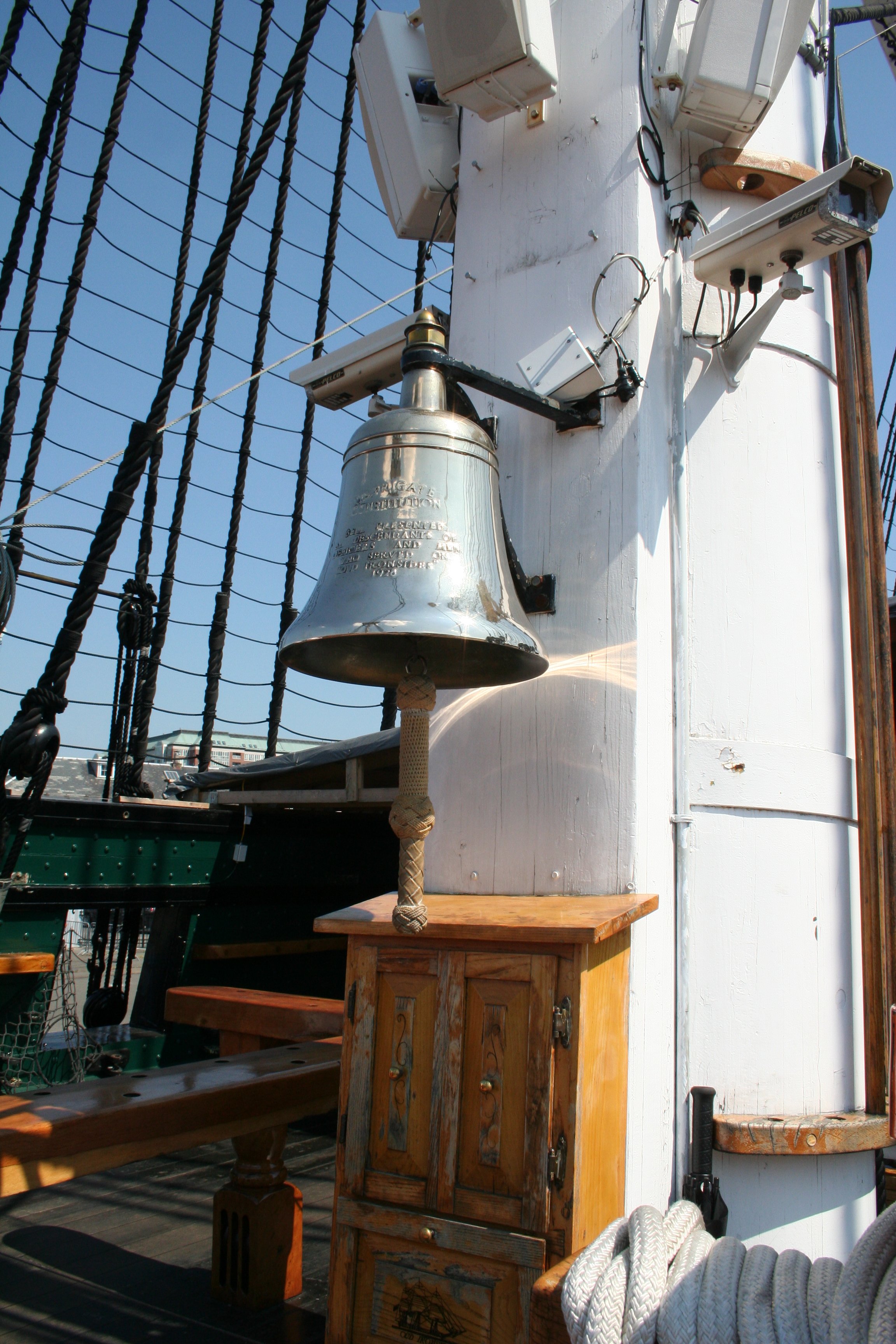
The original bell for the Constitution weighed 242 pounds and was cast by Paul Revere in 1798. That bell was lost during the 1812 battle with the HMS Guerriere, and the Constitution took the Guerriere‘s bell as a replacement. The Guerriere‘s bell is now in the on-site USS Constitution Museum.

The current bell shown above is inscribed, “U.S. frigate Constitution – bell presented by descendants of officers and men who served on Old Ironsides – 1926.” (The closed circuit security cameras and flood lights on the mast above the bell are, presumably, not original equipment from 1797.)

IMG_7422 small

If you get a chance to walk the Freedom Trail (and I really hope you do, it’s a great way to spend a day), a visit to the Constitution is a great way to relax and rest for a bit before pushing on to the final end of the trail. She’s a great old ship and it’s a joy to see her riding at anchor.

Next time, we press on toward the end of the Freedom Trail, and that slightly mis-named monument in honor of the battle fought in 1775 on Breed’s Hill.

Leave a comment

Filed under Photography, Travel

Low Tech Advances

We’re all quite aware of the “technological advances” that are happening all around us. But when you ask anyone to name some “technological advances,” you’ll hear about the latest and greatest Apple or Samsung or BMW or NASA. And it’s true, all of these examples (and thousands more just like them) demonstrate how the stunning advances in high tech. Your new watch has more computing power than an Apollo spacecraft, your phone does more than the entire Radio Shack catalog of a decade ago.

That’s not what I want you to think about today.

In spending two weeks on the road in April, it struck me at some point that very quietly, without much fanfare at all, there are aspects of our lives that are decidedly low tech that are still making progress all the time to make our lives better. These advances might not ever get a press conference at their introduction and you might not ever even notice their existence at all — but they’re there.

For example, the shower curtain.

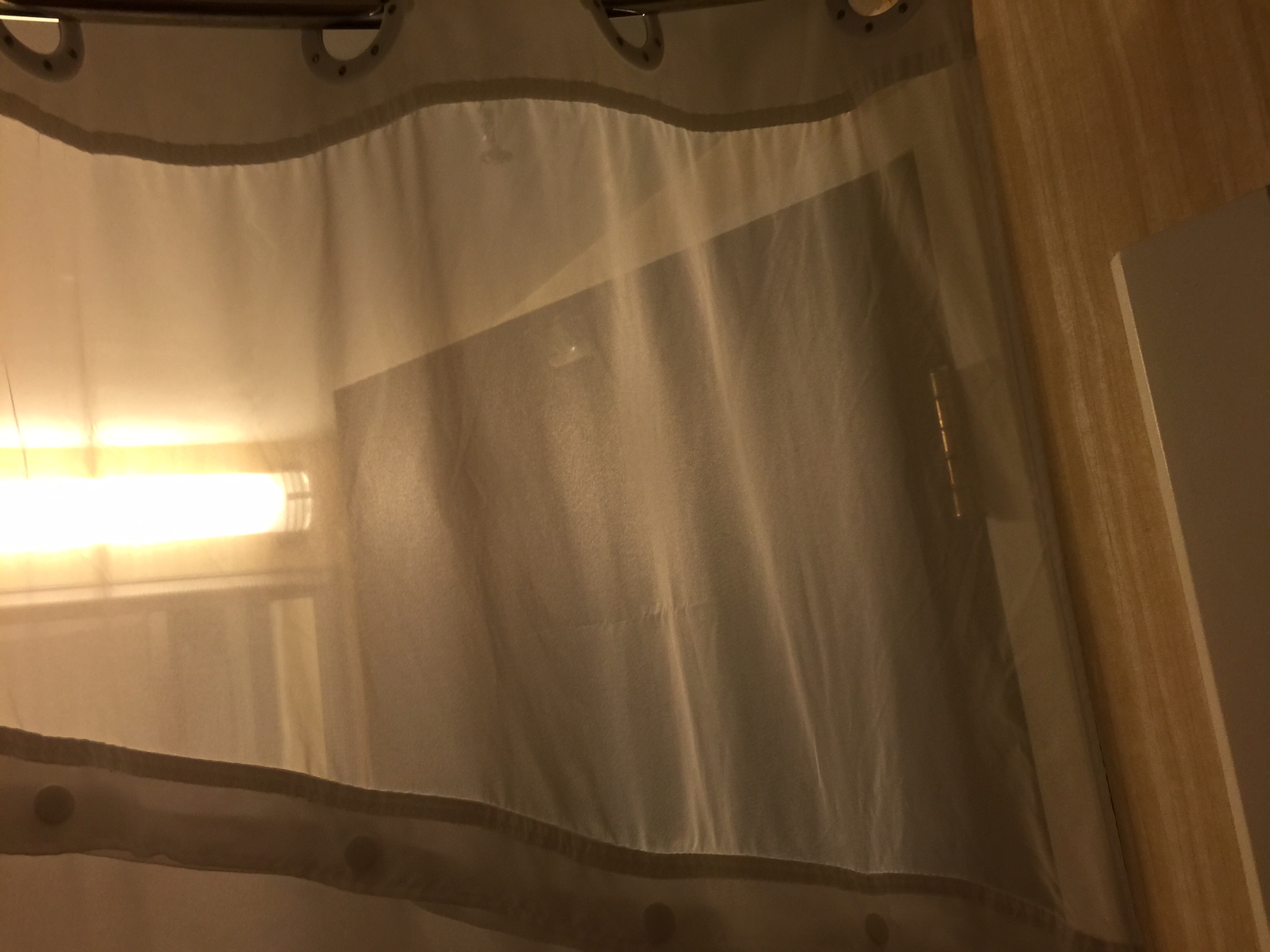
Think back even fifteen or ten years. A shower curtain was a plastic sheet, yellow or white, possibly with floral prints or some such decoration, hung on a straight pole (metal or wood) above the edge of the bathtub. It was generally semi-opaque, or at best translucent — every serial killer in the world was on one side when our femme fatale was showering and she was always clueless. It just dangled there, hanging by wire hooks that were like giant safety pins, except they were made of wire thicker than hangers and you could lose a finger if you weren’t careful. You had to buy a new shower curtain every couple of years because even if you were religious about cleaning the things to keep them free of mildew and fungus, the cheap plastic would age, get brittle, and crack. They would stick to you as you moved around in your narrow shower, pulling back and moving to allow water to spray all over the bathroom if you weren’t constantly vigilant.

The basic shower curtain came straight out of the introduction of indoor plumbing in the early 20th Century and didn’t change much at all for a hundred years.

But now…

IMG_8797

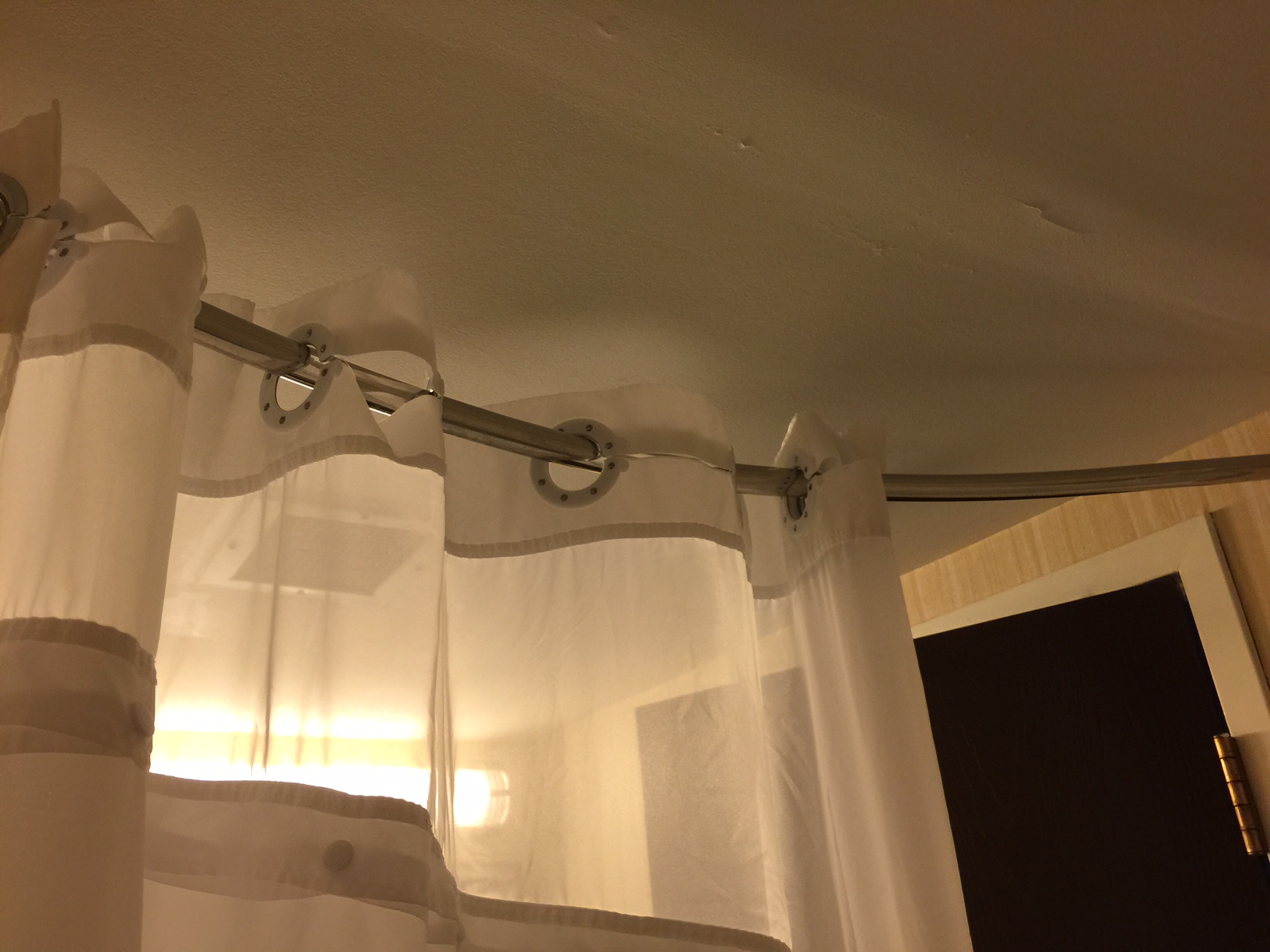
A few years back, hotels started using the curved rod. It gives you more room in the shower without taking it away from anyone else  using the bathroom.

IMG_8798

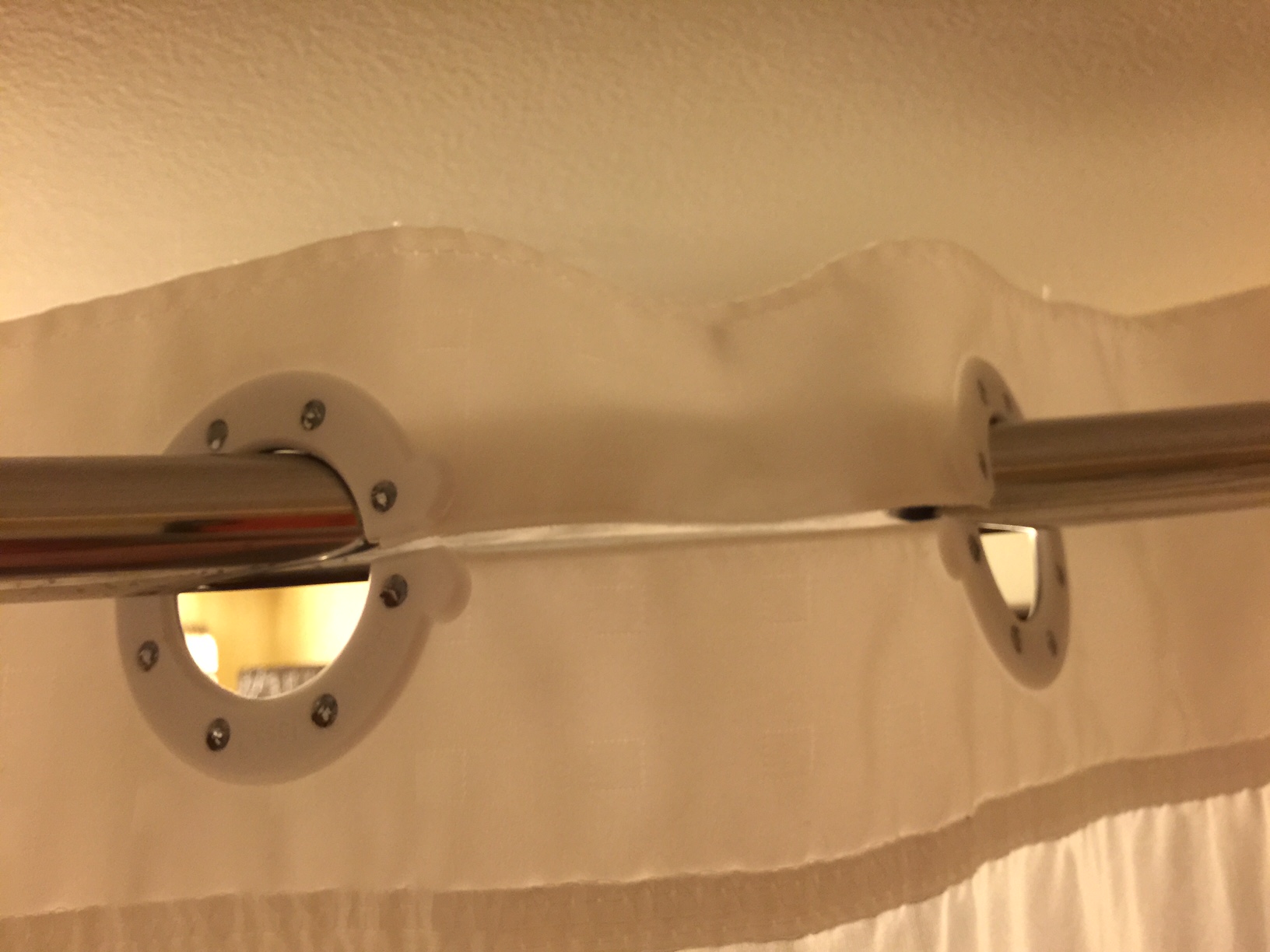
Those nasty metal hooks are gone, replaced by these clever nylon rings with slits between them. Not only does it make it trivial and fast to snap a curtain onto or off of the bar, the nylon also slides much easier than the metal hooks would, particularly after the hooks started to rust and get nasty.

IMG_8801

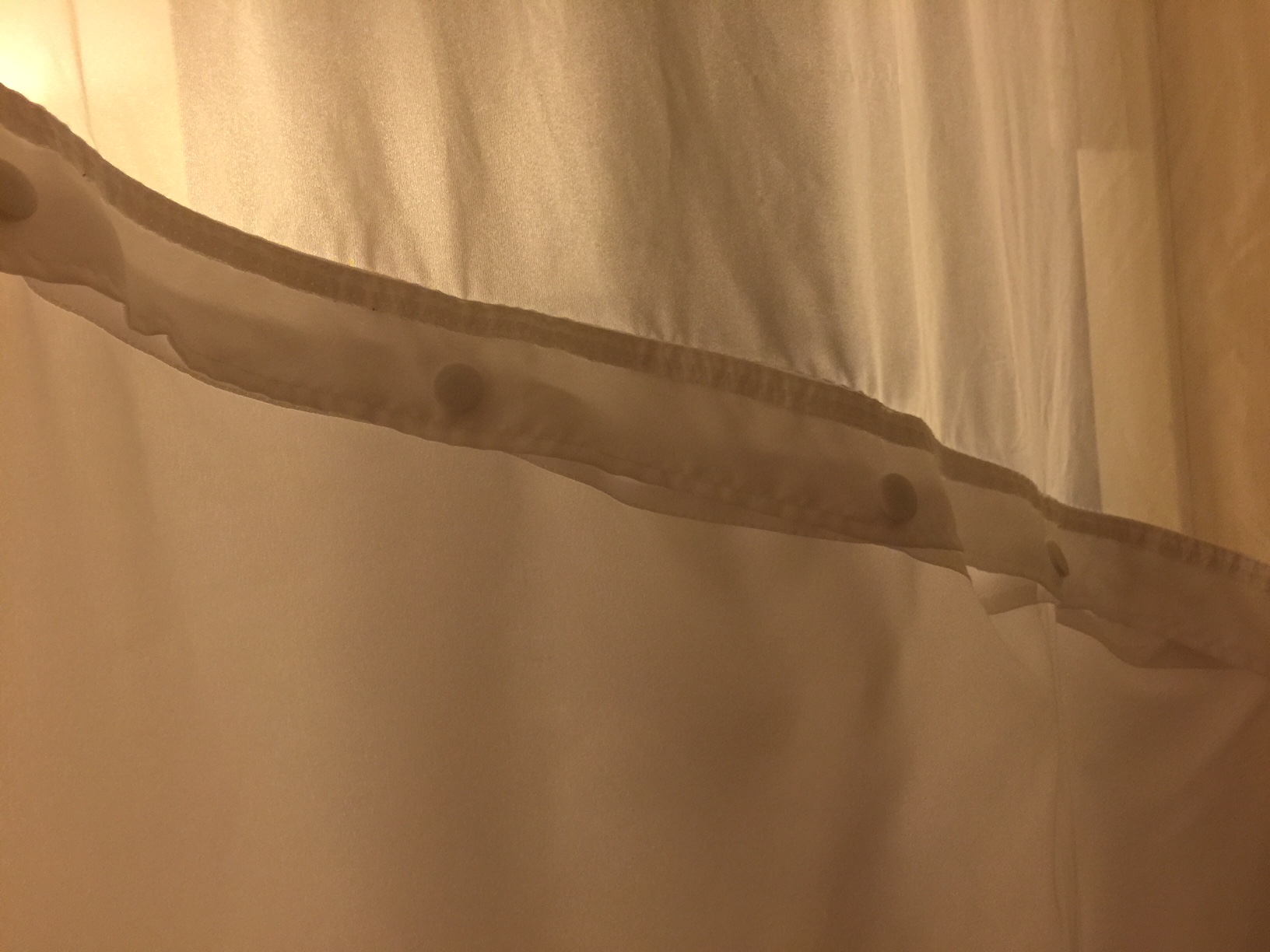
The shower curtain isn’t all one part, and they’re not made of that cheap, brittle plastic any more. Most appear to be made of some sort of synthetic cloth instead of a sheet of plastic. They have a top and a bottom part, snapping together quickly and easily. If a curtain gets dirty or torn, it’s almost always going to be the bottom part, which can simply be unsnapped, replaced, and thrown into the laundry for cleaning.

IMG_8803

Many hotels now have top halves that are a transparent mesh — no serial murderers sneaking up on us any more!

IMG_8804

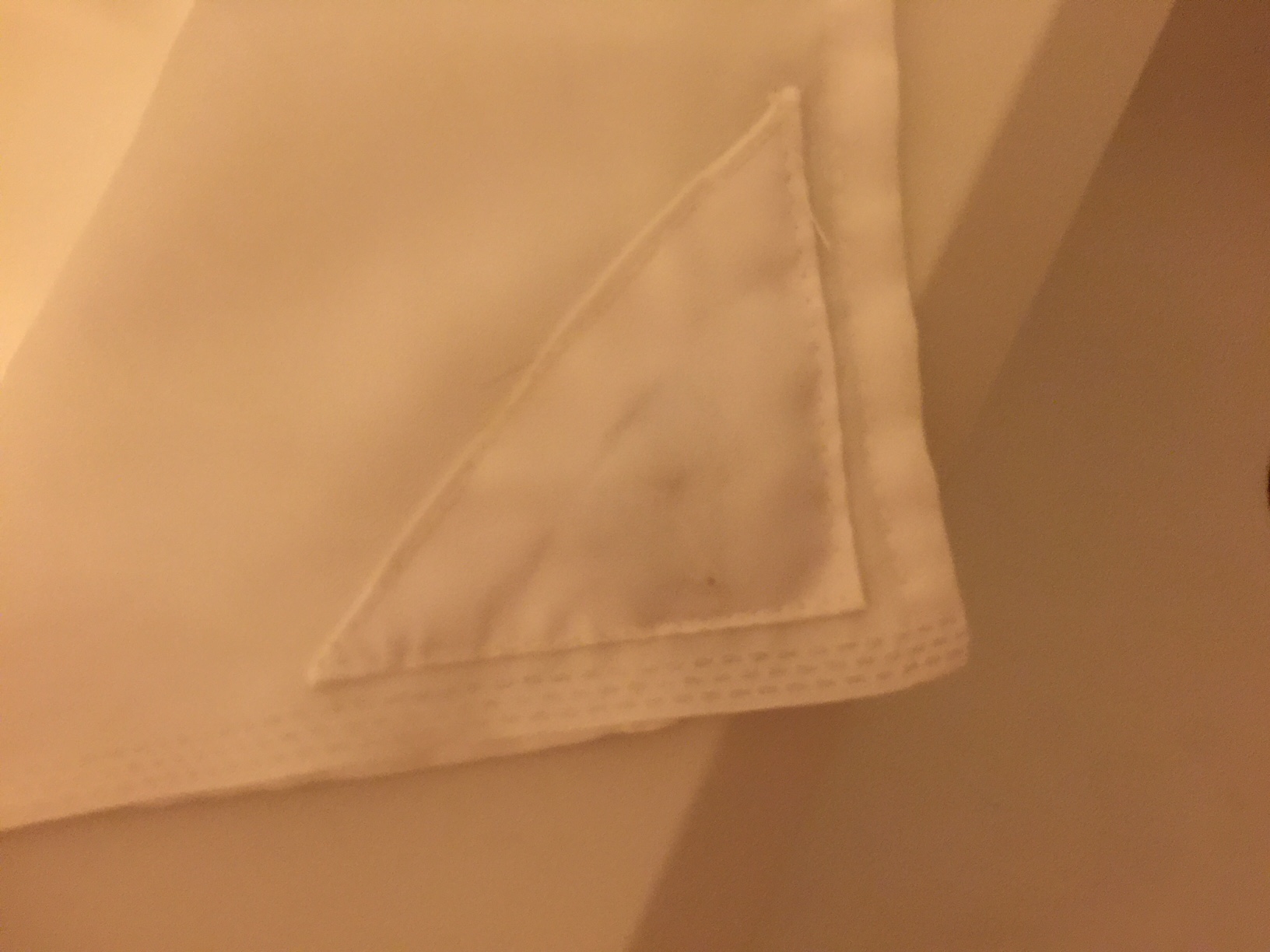
In the bottom corners, many modern shower curtains have magnets sewn in. Not only are they heavy enough to keep the shower hanging down rather than crimping up and sneaking out of the tub (where they become useless or worse), they also will grip onto the metal tub and keep the curtain where you want it.

Five simple, obvious, low tech improvements to a completely forgettable household item — yet look how much easier it is to clean, how much more functional it is than it was before. No press conferences, no fanfare, just doing its job better and easier and faster.

In addition, if you don’t want hotel off-white, yellow, or white, there are all kinds of options for color and patterns. Places like Think Geek even have shower curtains designed for high tech geeks and space cadets!

Of course, all of that low-level high tech won’t do any good if there’s a basic user error. For example, the magnets shown in my Holiday Inn room were only useful as weights, not magnets. The tub was fiberglass with no metal beneath to allow the magnet to stick. Maybe it was those useless magnets dangling all over the hotel that interfered with the Wi-fi and screwed it up so badly.

What other low tech improvements have been made to fundamental and functional items in our homes, schools, and offices? What other advances and improvements are we looking at but not seeing simply because they’re part of the background of life?

Finally, what simple but fundamental improvements are still there waiting to be discovered, waiting for that “A-ha!” moment by someone who might make a significant pile of cash by seeing something that’s hidden in plain sight?

2 Comments

Filed under Photography, Travel

My Photography Field Techniques (In Gruesome Detail)

As I may have mentioned, I take a LOT of photos. Since I haven’t yet found a good (by my definition) photo filing & tagging program, I file my photos manually, sorted into directories by year, by date, by event, and by camera used.

For example, looking at my directories for a day in Shanghai:

  1. 2012-05-17a_Shanghai_Dawn
  2. 2012-05-17b_Shanghai_Dawn
  3. 2012-05-17c_Shanghai_Hotel
  4. 2012-05-17d_Shanghai_International_High_School
  5. 2012-05-17e_Shanghai_International_High_School
  6. 2012-05-17f_Shanghai_International_High_School
  7. 2012_05_17g_Shanghai_Oldtown
  8. 2012_05_17h_Shanghai_Oldtown
  9. 2012_05_17i_Shanghai_Miscellaneous

The date (and the directories before and after it in the list, for 2012-05-16 and 2012-05-18 and so on) tell me that it was my first full day in Shanghai. For the record, I was jet lagged as hell. It was also the first day of my first trip to Asia, as well as the first time I had seen my daughter in a while. I had enough adrenaline to light the city.

I was using three cameras extensively that day. I used the two Canon DSLRs (one with a standard 18-55 mm lens, the other with a 70-300 mm zoon lens) when I got up before dawn (jet lagged! adrenaline!) and took pictures. (Directories #1 and #2.) While waiting for my daughter to come and get me, I wandered around the hotel taking pictures. (Directory #3 – it was no Holiday Inn!) While my daughter was at work (she was teaching) I wandered the grounds of the high school using the two DSLRs and my backup point-and-shoot, a rugged, waterproof Olympus Stylus. (Directories #4, #5, and #6.)

I use the Stylus because it’s got a decent image and it’s one tough little camera. I originally got it when I was going white-water rafting, but I use it everywhere.

Why take the Stylus when I’ve got two DSLRs with me? Because I’ve had cameras fail. I’ve had memory cards fail. I’ve had cameras stolen. I’ve had backpacks and briefcases stolen when they had full memory cards stashed away inside. A couple of our vacations are only half there in photos, hundreds or thousands of photos gone. As a result, I’m just a bit obsessed with multiple backup systems.

I almost always carry the two DSLRs, each with a different lens so I can quickly and easily get both wide-angle and telephoto pictures. I use the Stylus as a backup to the DSLRs. At a given location or scene I may take dozens of pictures with the DSLRs, but only one or two with the Stylus. But in a worst case scenario, with both DSLRs gone (stolen, broken in an accident, dropped into the ocean, stepped on by an elephant, eaten by alien LGMs…) I’ll still have at least one set of pictures, even if it is a truncated set.

Moving on…

After my daughter got out of work we went to Oldtown to see the sights and get dinner. Again, I was using the two DSLRs. (Directories #7 and #8.)

Finally, for somewhat completely different reasons, my fourth camera is my iPhone. The miscellaneous pictures taken from the entire day go into Directory #9.

The biggest advantage to the iPhone is the ability to use the pictures immediately. (OK, so it also serves as a backup to the backup if the Stylus gets crushed by an elephant after the two DSLRs are eaten by alien LGMs.) With the DSLRs and Olympus, I can’t really share via email / text / FaceBook / Twitter until I get back to the hotel and download the images onto my laptop. Photos on the iPhone can go out in seconds.

That’s really a big deal at events such as the NASA Socials. All of the social media photos and “snapshots” come from the iPhone because they’re instantaneous. The (generally) higher quality photos (particularly telephoto images) come out of the DSLRs and the Olympus.

The newer iPhone has a number of other great features, particularly the “panorama” feature. Again, as I’ve pointed out, panoramas created by weaving together multiple high-resolution images from a DSLR are bigger and more detailed than one from the iPhone – but again, the iPhone panorama is fast and it can get shared and go out onto social media immediately. Trade offs!

So far as security & backups go, the other step I take on a daily basis (assuming I’m not getting back to the room at 3:00 AM or something, which can happen) is to backup all of my images each day from all four cameras onto my laptop. If I’ve got a really good, high speed internet connection at the hotel (which I did NOT in Washington) and I’m really, really, REALLY paranoid (maybe I got excellent pictures of the alien LGMs eating one camera while an elephant crushed another), I’ll upload them to Dropbox or iCloud. Let’s see those little alien bastards eat the entire internet!

The observant among you might be wondering if I have a fifth camera when I’m in full sightseeing mode. Well, yes, of course I do. I generally carry a compact hi-def video camera (also a Canon), but I (at least so far) haven’t done a lot with using or sharing any of the video I’ve shot. I’m sure that day will come. And of course, being hi-def, I can do frame grabs and get decent still images if the two DSLRs, Stylus, and iPhone… Well, you know.

So, there you have it. That’s how I take a lot of pictures.


But that’s not what I wanted to post tonight. I told you that story so that I can tell you this one…


Leave a comment

Filed under Computers, Photography, Travel

April Was One Great Month!

A month ago I was happy to have survived March. March this year had some really good times (“Fifi” visiting us at CAF SoCal, my chance to fly in her, my birthday, CAF SoCal website launch, CAF audit, tax returns, daughter coming home from South America) but was generally lived at about 100 miles an hour with no rest stops.

It occurred to me today when I noticed that post that April had been just as busy, if not more so. But where March felt like hard work, April felt like the whole month was spent at Disneyland. (The good Disneyland, i.e. the fantasy one in the commercials, not the real Disneyland, with long waits for every ride and crowds like the Tokyo subways at rush hour.)

April started with a total lunar eclipse, the third one in less than two years!

There were two week-long trips to the East Coast, with all of the fun & games of commercial air travel. That included our first set of lost luggage in quite a while, some delays due to weather and mechanical issues that led to some very tight connections, and enough jet lag to keep my head spinning like a top.

North Carolina had weather & thunder boomers! Duke Gardens! The Durham Museum of Live & Science! Artsy-trendy-weird hotel-restaurant-bar-museum place! Durham Bulls Stadium! North Carolina Museum of Natural Science! North Carolina State Capitol Building!

I got an invite and went to my fourth NASA Social, this one in Washington for Hubble’s 25th Anniversary! The Smithsonian Air & Space Museum! The Capitol, White House, Washington, Lincoln, & Jefferson Memorials! The World War II and Vietnam War Memorials! A game at Nationals Park! Meeting up with my sister-in-law and getting to see my niece perform in an epic belly dance performance!

Whew!

After a good & busy March, I celebrated with fireworks pictures from Dodger Stadium. That resulted in a great & busy April. How ’bout we post more pictures from that set and see if we can go for a fantastic & busy May? (Let’s keep it going, I’ve got a whole thesaurus of superlatives to use.)

Sympathetic magic from a die-hard physics major? Whatever works, baby, whatever works.

IMG_2790 small

IMG_2805 small

IMG_2813 small

IMG_2825 small

IMG_2842 small

IMG_2848 small

IMG_2859 small

IMG_2873 small

IMG_2882 small

Leave a comment

Filed under Astronomy, CAF, Family, Fireworks, Photography, Space, Travel, Weather

NASA Social For Hubble25 (Part Four)

A week ago, April 23rd, I was in Washington to see my first NASA press conference, held at the Newseum for the 25th anniversary of the launch of the Hubble Space Telescope (HST). Afterward, I and the other attendees at the NASA Social were taken out to NASA’s Goddard Space Flight Center. We first learned about the James Webb Space Telescope (JWST), then got some Hubble Space Telescope (HST) history and saw the Satellite Servicing Capabilities Office (SSCO).

19_IMG_8358 small

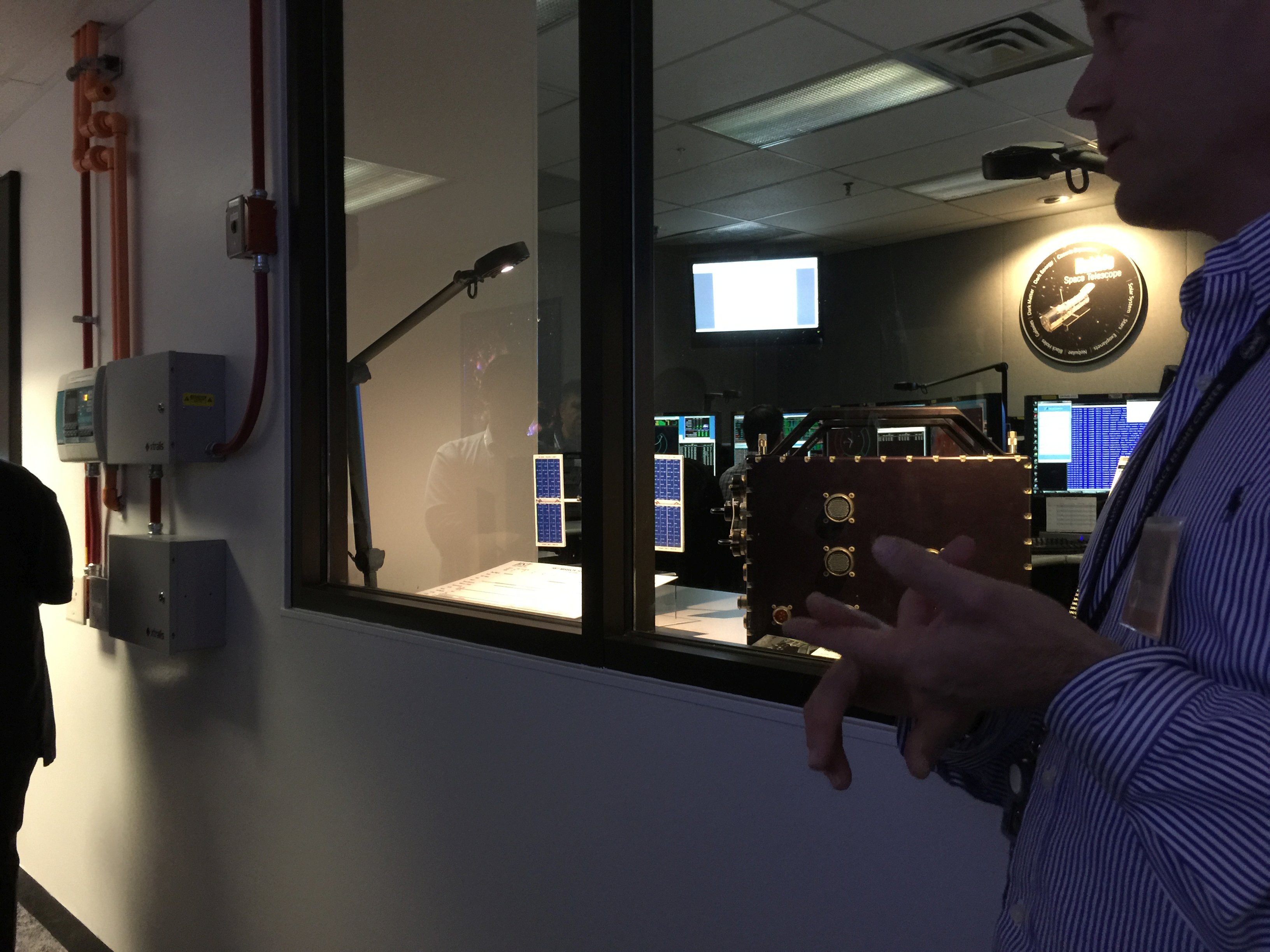
We got a peek in through the window into the HST mission control room. Commands are sent up to HST after being carefully checked and double checked to make sure they don’t accidentally instruct the spacecraft to do something stupid and/or fatal.

For many years all of the command consoles were staffed 24/7/365. With the upgrades both on HST and on the ground, many of the operations no longer require constant monitoring. There is an extensive system in place to alert Goddard staff when anything goes “off nominal.” Minor issue will result in a text message or email, more critical problems are met with more aggressive alerts.

20_IMG_6330 small

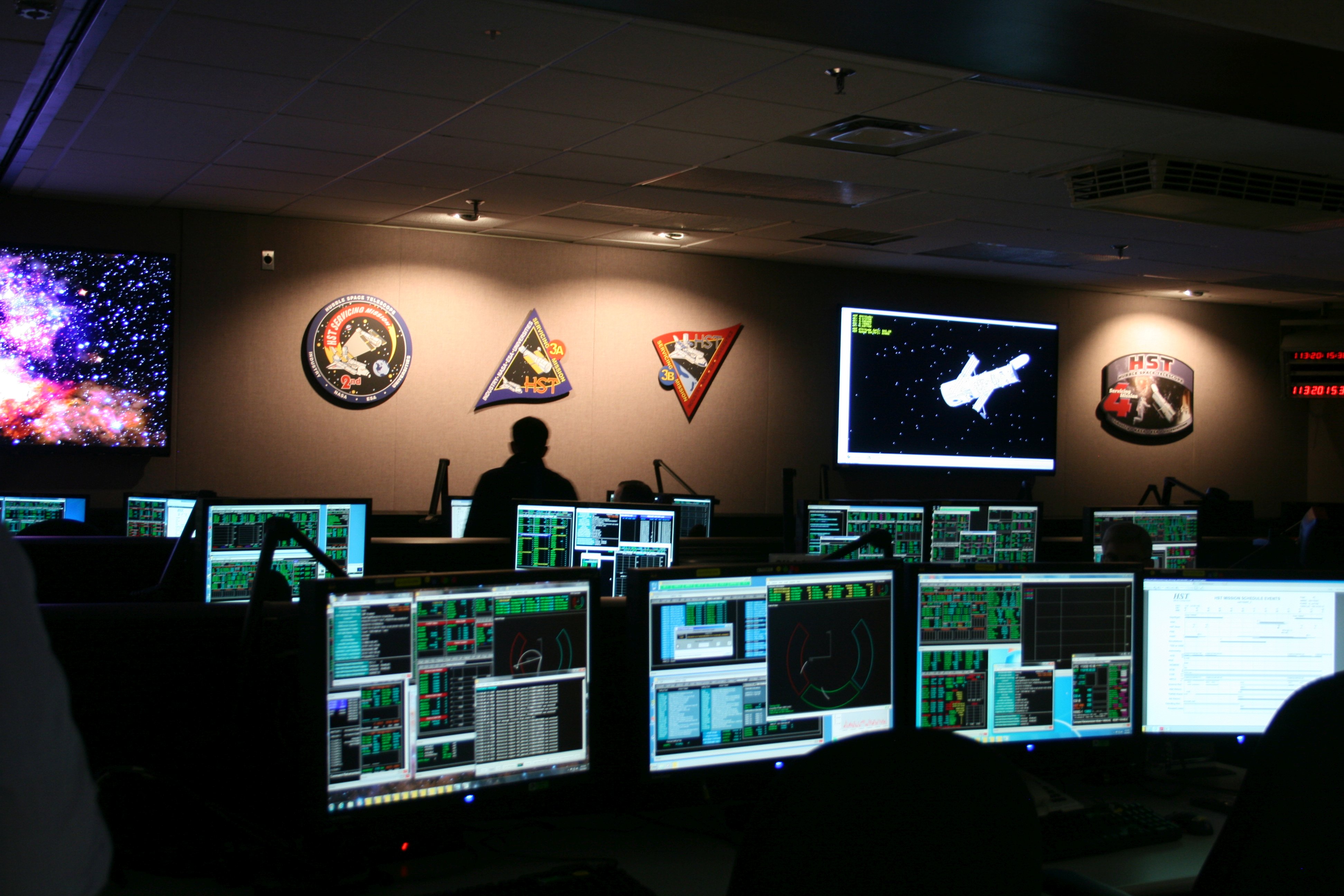
In the HST mission operations center we saw where the data from Hubble is coming down and the astronomical observations were monitored. There was data everywhere on dozens of big monitors — heaven of the little kid inside me who still likes to see buttons pushed and lights flashing.

In particular, I asked about the “pickle” diagram, visible on the center monitor closest to us. It shows how Hubble is using its three Wide Field Detectors (WFDs) to track stars in the current field of view. With two detectors tracking stars, Hubble can maintain tracking accuracy to less than 7 milliarcseconds per day.

How good is that? A circle around the sky is 360 degrees. Each of those degrees is split into 60 arcseconds. Now split each of those arcseconds into 1,000 bits. That’s a milliarcsecond. In the real world, 7 milliarcseconds is the size of a dime on the Washington Monument in DC as seen from the Empire State Building in New York City.

The HST is the size of a school bus, weighs twelve tons, and is floating weightless in space. How do they keep pointing it that accurately? (Assuming it’s not some serious black magic.)

22_IMG_6342 small

These little guys are key. Some of the most accurate gyroscopes ever made are at the heart of these rate sensor arrays (RSAs). Hubble has six of these assemblies, two each on each of the three axes. Usually they run just three at a time, one from each set.

These gyros and RSAs are among the hardest working systems on Hubble and were replaced on three of the five servicing missions. In fact, the failures of gyros were the reason that the third servicing mission was broken into two separate Space Shuttle missions. Four of the six RSAs had failed by November 1999, putting Hubble into a hibernation or safe mode. With less than three working gyros, Hubble could have started drifting and tumbling, making it difficult or impossible to capture by the astronauts on the next shuttle servicing mission. So the planned June 2000 mission was split, with STS-103 going up to replace the RSAs (and other things, such as the primary onboard computer) in December 1999, while STS-109 went up in March 2002.

Hubble doesn’t use thrusters or jets to control its movements in space. For one thing, the gasses used (primarily hydrazine) are very nasty to have around delicate optical instruments. In addition, once the fuel is gone, so is your ability to control your attitude. (Remember the bit yesterday about RRM?) So Hubble is controlled by four massive Reaction Control Wheels (RCWs) which move the spacecraft by gyroscopic action. (For a lot of detail and technical minutia on the Hubble guidance system, see this NASA technical paper.) In high school, did you ever do the experiment where you sit on a bar stool and hold a spinning bicycle wheel, tilting the wheel to make you spin around? That’s how Hubble moves, but with wheels that weigh hundreds of pounds each and are precision machined.

23_IMG_6343 small

In addition to the gyroscopes in the RSAs, Hubble also senses its position in space using large, sensitive Charge Coupling Devices (CCDs), the same kind of sensors that are at the heart of your digital cameras. Two CCDs are built into each WFD and there are three WFDs on Hubble. (Remember the “pickle” diagram above?) As long as two of the WFDs have a star to track in their field of view, the WFDs and RSAs combined can give Hubble that 7 milliaarcsecond per day guidance.

That’s some seriously awesome engineering there!

21_IMG_6339 small

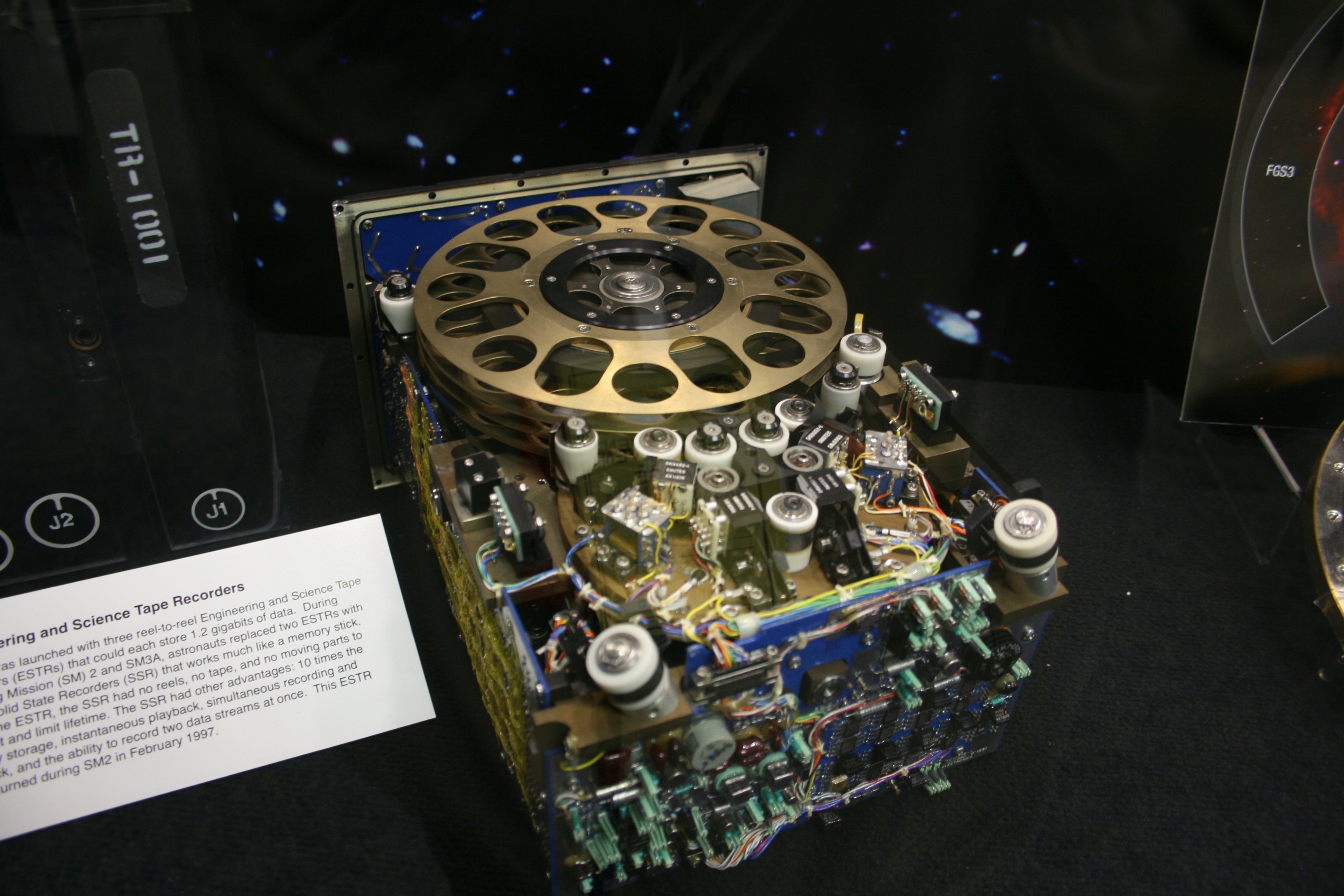
Originally HST was launched with three Engineering & Science Tape Recorders (ESTRs) for recording and playing back data. Designed in the 1980s, the ESTRs were reel-to-reel tape assemblies. Data was written and retrieved sequentially and when the tape broke or jammed (as this one did) the ESTR was useless. These ESTR units held 1.2 gigabites of data, state of the art at the time.

The ESTRs were one of the components of HST which were designed from the beginning to be upgraded as technology advanced. They were replaced on the second and third servicing missions with solid state recording units. The upgraded units are like huge, radiation hardened memory sticks. Not only do they hold over ten times as much data as an ESTR, but they can also be read instantaneously instead of sequentially, and sections of memory which become damaged (perhaps by a radiation hit) can be bypassed, leaving the rest of the unit still functioning.

For those interested, I believe these three pieces of hardware were all flight-flown, coming back down from HST after being removed and replaced during a servicing mission.

24_IMG_8368 small

Dr. Marc Kuchner wants your help in looking for targets for HST, and later for JWST. There’s a crowd sourced (Zooniverse) project called “Disk Detective” in which you can do real, honest-to-god science in your spare time.

The short version is that stars with planets are stars surrounded by dust due to the planets, asteroids, comets, and other assorted objects crashing into each other every so often. Because of celestial mechanics and conservation of angular momentum, the dust tends to flatten into a disc or ring. Conversely, we’re finding that when we see a star with a dust disc, we often find planets there.

It’s time consuming and inefficient to have have telescopes like Hubble look at every single star looking for planets, so we would like to improve our odds and find another way to narrow the search. A key tool here is the Wide-field Infrared Survey Explorer (WISE) mission, a space-based telescope which looks at big chunks of the sky at once, but at lower resolution than telescopes such as Hubble.

Dust is bright in the infrared part of the spectrum since it absorbs starlight and re-radiates the energy in the infrared. Therefore, if we look at a star in WISE images and find a dust disk, that’s a good candidate to look at more closely using Hubble or another big telescope.

But how do you look at all of the stars in the WISE images? Computers? Not really. It turns out that computers aren’t that good at examining images and “looking” for certain telltale characteristics. But the human eye and brain are pretty good at that. But there are billions of stars. So what if a whole lot of people each looked at a few dozen or a few thousand stars each?

That’s how Disk Detective works. If you go to the site it will show you a series of ten images for a single star, each image in a different wavelength. You can flip through the images as often as you want, then answer six simple questions about the images, such as if the object is moving. This only takes a minute or two, you submit your answers, and go on to the next image.

If multiple people independently judge a particular image to be a good candidate to have a dust disc and possibly planets, then the pros can take a look at it, possibly moving the observations up to a much bigger telescope, or even up to Hubble. It’s a piece of cake, and beats the hell out of playing Solitaire on your computer! Give it a try, maybe you’ll be the one who finds another new planet.

25_IMG_6345 small

Finally, we got to talk to two of the engineers who helped to design and built the tools needed to perform the delicate tasks of the Hubble servicing missions. (Again, I apologize for not getting their names – if anyone can fill in the blanks for me in the comments, I would appreciate it.)

Here we see a panel that was designed to go over a series of over a hundred screws and bolts that had to be removed, without allowing any of them to get away or fly loose. A single nut, bolt, washer, or screw that escaped and drifted into the telescope could cause an electrical short or damage a lens or mirror, causing an incredible amount of damage. And remember, this work was being by astronauts wearing spacesuits with very limited mobility and dexterity, floating weightless, often with poor or little lighting. The astronauts described it as being like performing brain surgery while blindfolded and wearing oven mitts.

In order to safely open panels and instruments that were never designed to be opened while simultaneously preventing any loose bits from drifting away, some very complex tools were designed and built. For example, the blue panel above was attached in place with bolts screwed in using the big handles (easy to use with gloves). The clear holes lined up over the screws that needed to be removed, and the holes in the plastic were just big enough to allow a screwdriver tip or other tool to get through while still being small enough to not let the screw escape.

26_IMG_8375 small

Another problem was dealing with sharp edges, knives, and cutting tools. In a pressure suit surrounded by hard vacuum, NASA doesn’t want astronauts handling a knife or anything sharp. When this top panel had to be removed with a whole series of cuts, this tool was built to screw on (again, big handles, easy to use in stiff spacesuit gloves), cut the top of the compartment off with blades that were recessed and not a danger to the spacesuit or gloves, then pull off with all of the loose bits captured inside.

Other new tools had be developed to make the Hubble repairs feasible. For example, the standard Pistol Grip Tool (PGT) which we saw in the  SSCO is used to remove and install screws and bolts – but it’s really slow. For something like the job above with the blue panel, which had 100+ screws, that would take forever. So other faster, more lightweight tools were developed for the Hubble repairs. In addition, since they would be working in the dark a lot, let’s put some LED lights on there so we can see what we’re doing while looking out through that spacesuit helmet. Right?

27_IMG_6357 small

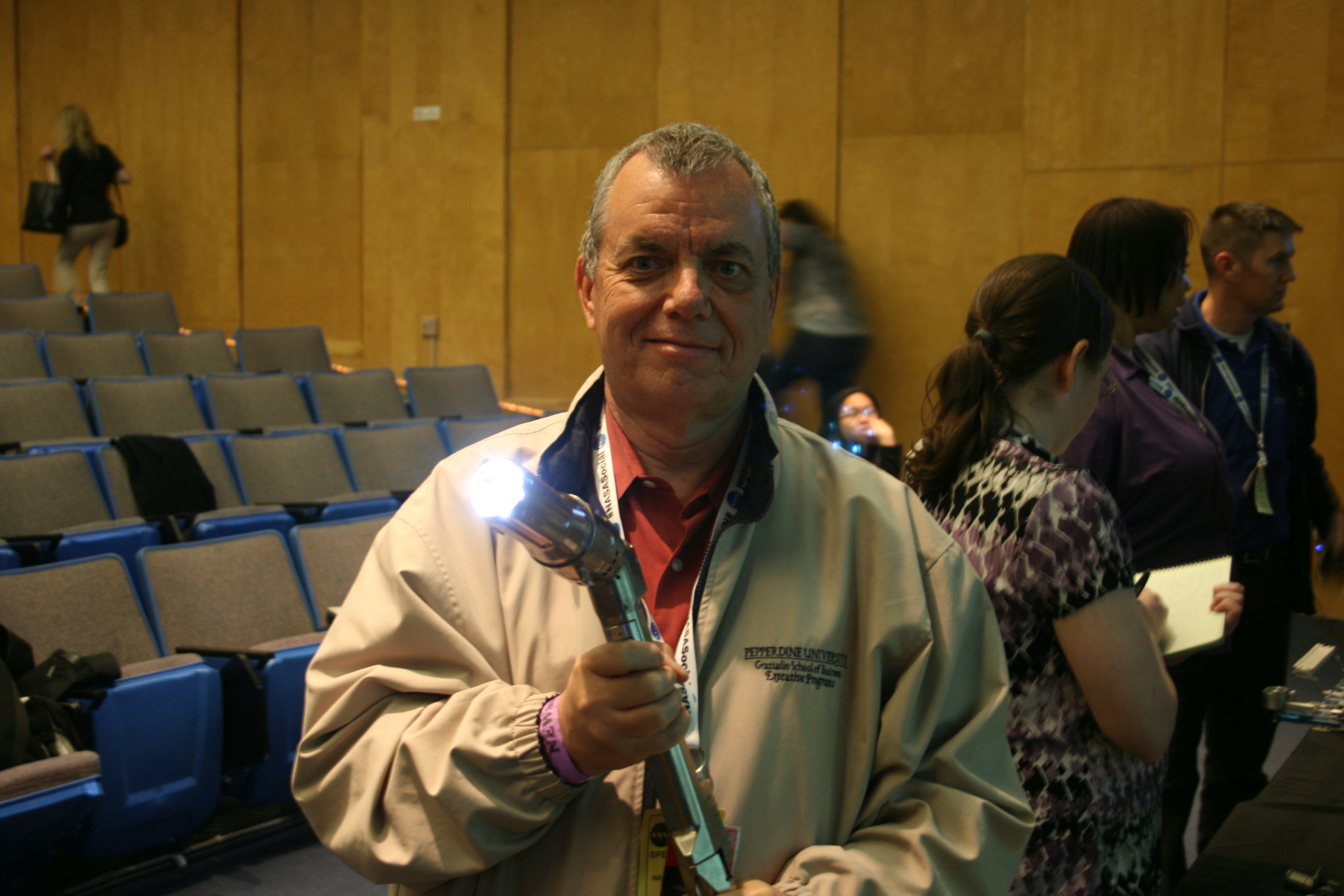
Yeah, this is the one they developed (I believe it was flight-flown), and yes, they let me hold it.

Geek joy!!

FYI, it’s heavy and awkward to hold even there in the auditorium using just my bare hands. We can’t ever give enough credit to the astronauts who pulled off five astonishingly successful service missions, giving us one of the landmark scientific instruments of our generation.

Flip through the images that we’ve gotten from Hubble.

Go see one of the IMAX 3D movies about Hubble, or watch the PBS Nova special from last week.

Read about some of the discoveries that Hubble has allowed us to make in the last 25 years.

Study how the initial problems with the Hubble optics were overcome. It’s a classic study in recovery management, how an initial critical error, particularly a very public and very expensive one, can be faced head on and resolved, leading to one milestone achievement after another.

That’s why we’re celebrating twenty-five years of Hubble’s observations.

That’s why we’re looking forward to many more years of Hubble’s observations.

It was a great NASA Social!

Leave a comment

Filed under Astronomy, Photography, Space, Travel

NASA Social For Hubble25 (Part Three)

After rubbing elbows with Space Shuttle mission commanders (sorry, still squeeing) at last Thursday’s NASA press conference for the 25th anniversary of the launch of the Hubble Space Telescope (HST), the attendees at the NASA Social were taken out to NASA’s Goddard Space Flight Center where we learned about the James Webb Space Telescope (JWST) and saw where it was being assembled.

First of all, I want to apologize to all of the wonderful researchers and engineers at Goddard whose names I did not get. They all deserve all of the credit in the world for the amazing work they’re doing, and have been doing for decades. If anyone from Goddard or any fellow NASA Social attendees can fill in any names that I missed, I would greatly appreciate a note in the comments with the information.

10_IMG_8355 small

This is a 1:5 scale model of HST. The see-through panel at the back end is there to show where the instruments are. HST was visited five times by Space Shuttle crews who replaced and upgraded control systems, instruments, cameras, and optics. Any one of those visits could have ended disastrously. One loose screw, one bolt that wouldn’t come loose, and HST could have been permanently crippled.

The fact that the five servicing missions were 100% successful despite glitches and problems is one of the reasons I like crewed missions. Things never go the way they’re planned and humans are highly adaptable. Check out the PBS’s Nova program, “Hubble’s Amazing Rescue” for a great description of what was at stake, how nearly impossible to get it right was, and how spectacularly triumphant the results were.
11_IMG_8341 small

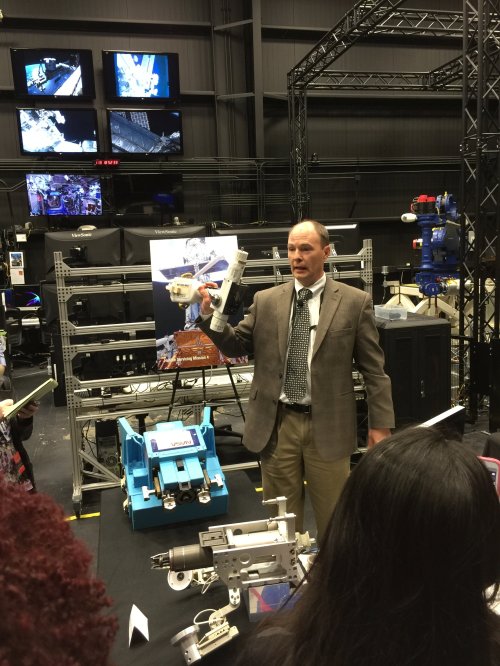
Ben Reed runs the Satellite Servicing Capabilities Office (SSCO) at Goddard, where they design and build tools and robots to work in space. Here he’s holding a Pistol Grip Tool (PGT) which is used to screw and unscrew nuts, bolts, and screws in microgravity. This particular one is actually from the Neutral Buoyancy Laboratory (NBL) where astronauts train for their space walks.
12_IMG_6301 small

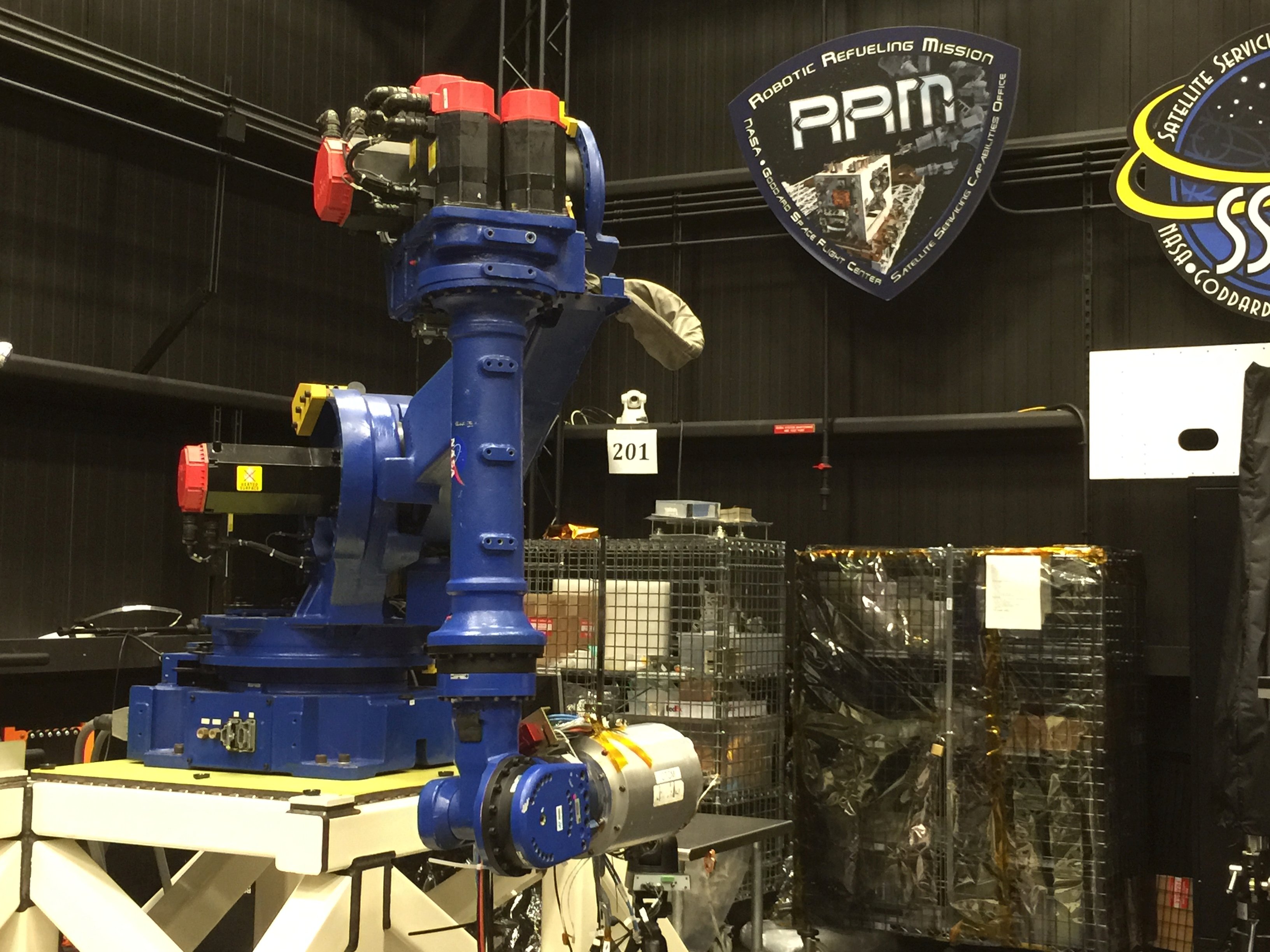
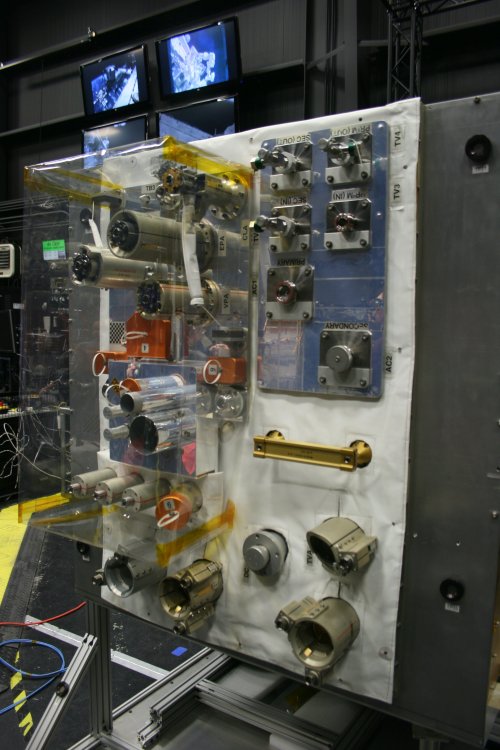
One of the projects being worked on at the SSCO is the Robotic Refueling Mission (RRM). I remember seeing these experiments being run  on the International Space Station (ISS) a while back. This test panel is identical to one flown to Low Earth Orbit (LEO), as is the next one shown below.

Thousands of satellites have been sent to orbit and then become useless as they aged. Sometimes a critical piece fails, maybe a power relay or the onboard computer. Sometimes satellites get hit by meteorites or other orbital debris. More often than not though, the satellite fails when it runs out of maneuvering fuel.

Due to various factors such as atmospheric drag and gravitational pull from the Sun, Moon, and other planets, satellites tend to not stay where you put them. They’ll all use some sort of small thrusters to “station keep.” When that fuel runs out, they drift, lose attitude control , and become useless. Oh, and 99.9999% of these satellites were never intended to be serviced or refueled, so when they’re dead, they’re dead.

Unless…

Let’s say you built a robot. A very clever robot with a bunch of nifty tools. Maybe the robot is autonomous, or remote controlled from the ground, or a little of both. (Yeah, I would send a crewed mission since humans are incredibly dexterous and clever monkeys, but that’s just me.) Maybe these nifty tools and clever programming would allow securing wires to be snipped, locked on bolts to be unlocked, thermal blankets to be peeled back, and sealed access ports to be unsealed on dead satellites.

13_IMG_6303 small

Now you need to test your robot. It’s expensive (and a whole different engineering problem) to accurately locate the broken satellite, rendezvous, and attach your refueling robot to it. Especially when you don’t know yet if you’ll actually be able to do the undoable when you get there. So you want to test the breaking and entering and refueling before you spend all of that other money on finding and rendezvousing and capturing. This is where the RRM and ISS come in.

These panels have fueling ports and connections that are the same as those used on numerous commercial satellites. The test is to see if controllers on the ground can remotely use the tools built into the robot to do the job.

14_IMG_8349 small

The RRM mission on ISS uses the Canadian-built Dextre two-armed robot along with tools built for this task. Dextre can be held at the end of Canadarm2 or it can be docked at one of the Mobile Base Stations on ISS. Seen here is a heavy-duty version of a remotely controlled robot similar to Dextre. (Dextre’s tough, but lightweight and designed to work in microgravity. This one has to be bigger and heavier to work at 1G.)

So far the RRM tests on ISS have gone very well. There have been no “show stoppers” in proving that a remotely controlled robot can break into a satellite with empty fuel tanks, refill the tank, reclose the port, and release the satellite.

The issue, as it always is, is money. A robotic refueling mission like this might cost $500M or more, plus the initial development costs. (Please note, all of these numbers are Wild Ass Guesses (WAGs) and yes, I am trying to see how many Three Letter Acronyms (TLAs) that I can put into this article.) Would it make economic sense? That was one of my questions for Ben Reed.

The answer is, not surprisingly, “It depends.” It’s not a single calculation but a spectrum. On the low end, if you have a cubesat that only cost $50K to build & launch, spending hundreds of millions of dollars to refuel it would be stupid. On the high end, if you spend $7.998B to build and launch JWST, perhaps a couple hundred million dollars to double or triple its lifetime might make sense.

To be quite clear — NO ONE at Goddard said ANYTHING about possibly refueling JWST. In fact, whenever the concept got brought up, it was politely but firmly squashed. JWST has been designed from the get-go to be a “fire & forget” spacecraft with no possibility of being repaired or refueled. I’m just speculating wildly here.

But that being said, remember, it’s an economic spectrum. Even if you can’t refuel JWST, what about if you’ve got a $1B+ weather satellite or communication satellite. If your choice is to build & launch another $1B+ satellite or try spending $250M to refuel the old one (again, WAGs!), which do you choose?

More to the point, if you build your robot with lots of different capabilities and a big tank of fuel, maybe you can refuel ten satellites. Or fifteen. Or thirty. Now your cost per satellite is maybe $20M each. So if you have a perfectly good, functioning $1B+ satellite that’s out of fuel, do you build another, or risk $20M or so to double its lifespan? If the technology’s there, the answer seems obvious.

The SSCO isn’t developing this technology just because NASA necessarily has any plans to use it. The key word in SSCO is “Capability.” Yes, NASA would like to be capable of doing this if they need to, but it could be another NASA spinoff that saves billions of dollars.

15_IMG_6308 small

That’s not all the SSCO is working on. Here you can see “test rocks” of different sizes, weight, and composition. Some are hard as a rock, some are more like clumps of sand barely holding together. Some are metallic, some not.

These test rocks are being used to see how current robots and their manipulators (“hands,” if you will) can deal with different objects they might encounter on the surface of a comet or asteroid. (Remember OSIRIS-REx from yesterday?) We don’t know what we’ll find on the surface of any given object (that’s the reason we’re going, to find out – right?) so the robot spacecraft we design and build have to be prepared for a range of options.

Also on the left in this picture you can see a grey-white object. I believe this is a model of a device currently on ISS in the Japanese Experiment Module (JEM, better known as Kibo) and used to launch cubesats from ISS. What I want you to see however is that this has been made by “additive printing,” otherwise known as “3D printing.”

3D printing is going to be HUGE! For example, in a case like this, you can prototype an object for hundreds or  thousands of dollars instead of spending hundreds of thousand dollars or more. Then you can test it, tweak it, break it, refine it, and print another. You work out the bugs using the cheaper 3D printing route, then you build the final product the old fashioned way.

I’m sure I’ll be ranting at length about 3D printing here at some point.

16_IMG_6310 small

In the other corner of SSCO they’re working on the other part of the robot refueling problem – rendezvous and capture of a satellite that might not be under control. If the fuel’s gone (or there’s some other problem) it could be spinning, rolling, tumbling — or doing all three at once. The more it’s moving, the harder it’s going to be to latch onto.

This mockup of a satellite panel is mounted on a rig that can move it through a wide range of motion. The (again, heavy duty, designed for 1G, not microgravity) robot arm on the right is being used to develop software and techniques to learn how to approach and grapple a tumbling satellite, or to figure out when it can’t be done and back off.

17_IMG_6316 small

These three tools were on display in SSCO, demonstrating how much smaller, more capable, and more elegant our tools for working on orbit have become.

The big blue on on the left was used in the rescue & repair of the Solar Max satellite in 1984. The center tool is that PGT used by shuttle astronauts and now by ISS astronauts on their space walks. The far right tool is one of the tools that was used by Dextre during one of the RRM experiments.
18_IMG_6327 small

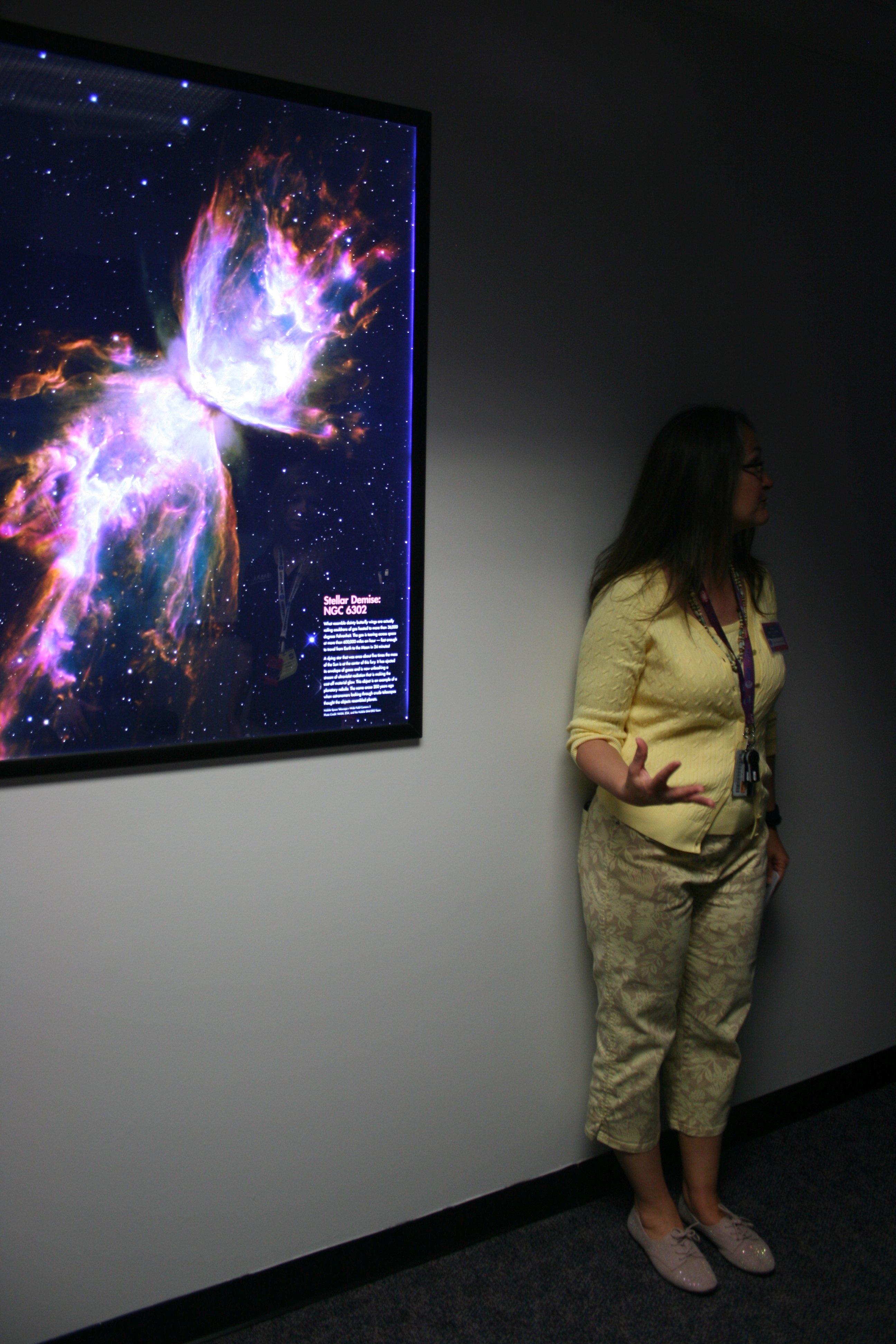
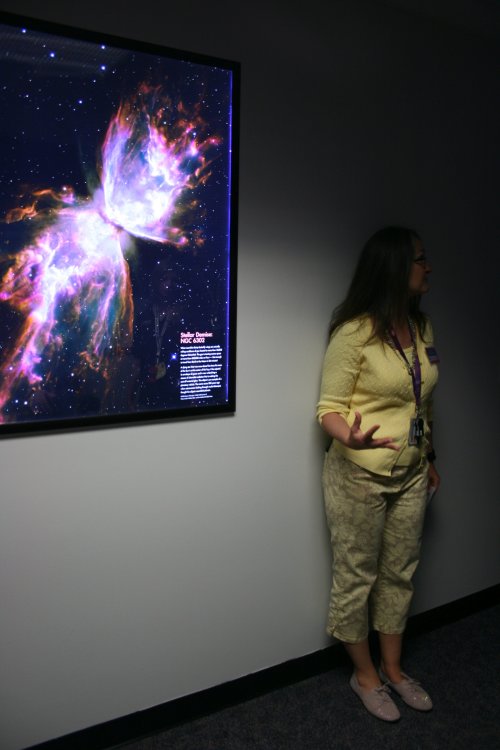
Again, I apologize for not getting the name of this woman who did such a great job of walking us through many of the discovery highlights from HST. From planets, to planetary nebula, to galaxies, to black holes, Hubble has spent the last twenty-five years revolutionizing the way we look at the universe around us.

Getting observing time on Hubble is non-trivial. There are, of course, far, far more requests for observing time than the telescope can perform. Observing time is allocated by a committee that picks the most worthy proposals.

In addition, there is a certain amount of time that is set aside as “director’s discretionary” time. One thing that this time is used for is Hubble observing time when something transitory or unexpected happens. Maybe there’s a supernova, or a comet’s going to slam into Jupiter. With discretionary time, these objects and events can be observed without kicking anyone else off the schedule.

In fact, the landmark “Deep Field” image by HST was done using director’s discretionary time. After all, it was quite literally a blank, empty piece of the sky, without any known stars or other objects in it. Why would the committee give anyone ten continuous days of observing time to look at “nothing”? Yet this image, covering the area the size of a dime as seen from seventy-five feet (let that sink in) contains over 1,500 galaxies.

1,500 galaxies, each with billions of stars, many of them with planets, almost certainly some of the planets containing life, almost certainly some of that life reaching a level of intelligence equal to or better than ours. All that from an “empty” area that small.

The universe is a big place!

Next, we see how HST is operated every day, how it points so stinkin’ accurately, and how it got fixed and upgraded on the servicing missions.

2 Comments

Filed under Astronomy, Photography, Space, Travel